Category: Innovation

Cutting CO2 emissions – who leads the world!

The U.S. leads the world in cutting CO2 emissions — so why aren’t we talking about it?

On the 31st July, I republished a TomGram from William deBuys that showed some pretty frightening aspects of climate change in the South-West USA.  Then there was the video on the 10th August, last Friday, that spelt out in very clear ways how the world is in a new, unfamiliar place.  It would be so easy to think it’s all going to hell in a handbasket.  So a change of tone.

There was an article on Grist by David Roberts about the US leading the world in cutting CO2 emissions.  David kindly gave me permission to republish it on Learning from Dogs.

U.S. leads the world in cutting CO2 emissions — so why aren’t we talking about it?

By David Roberts
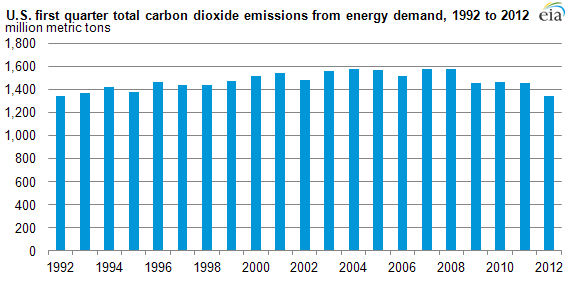
Contrary to popular belief, the U.S. is making progress on climate change.We have cut our carbon emissions more than any other country in the world in recent years — 7.7 percent since 2006. U.S. emissions fell 1.9 percent last year and are projected to fall 1.9 percent again this year, which will put us back at 1996 levels. It will not be easy to achieve the reductions Obama promised in Copenhagen — 17 percent (from 2005 levels) by 2020 — but that goal no longer looks out of reach, even in the absence of comprehensive legislation.

Why isn’t this extraordinary story a bigger deal in U.S. politics? You’d think Obama would be boasting about it! Turns out, though, it’s a little awkward for him, since several of the drivers responsible are things for which he can’t (or might not want to) take credit.

Awkward: that whole recession thing

First off there’s the Great Recession, which flattened electricity demand in 2008. It has never recovered — in fact, in part due to 2011′s mild winter, it has even declined slightly:

US electricity consumption, 2000-2011

Click to embiggen.

For obvious reasons, boasting about the environmental benefits of the recession is not something Obama’s eager to do.

Awkward: frack-o-mania

The second big driver is the glut of cheap natural gas, which is currently trading at the 10-year low of about $3 per million British thermal units. This is absolutely crushing coal, the biggest source of CO2 in the electric sector:

The share of U.S. electricity that comes from coal is forecast to fall below 40% for the year, its lowest level since World War II. Four years ago, it was 50%. By the end of this decade, it is likely to be near 30%.

Here’s U.S. electricity generation from 2000-2012. Look how dramatic coal’s recent plunge is:

EIA: electricity generation by source, 2000-2012

Click to embiggen.

In April, coal and natural gas both contributed 32 percent to the U.S. electricity mix — equal for the first time since EIA started collecting data in the ’70s. This is, as Alexis Madrigal emphasizes, an extraordinary shift, unprecedented in the history of the U.S. electrical system.

It’s helpful to Obama to be able to point to cheap natural gas when people accuse his EPA of killing coal. And it’s helpful in his effort to claim “all of the above.” But fracking’s potential environmental and health impacts has quickly made it a flash point with his environmental base (and his Hollywood base), so it’s at the very least a fraught subject.

Awkward: Kenyan socialist EPA sharia tyranny

A less significant driver of the switch from coal to natural gas is the EPA’s long overdue rollout of new or tightened clean-air rules on mercurySO2 and NOx, and CO2. Those rules may do more work later on down the line when/if natural gas prices rise again, but for now the best analysis [PDF] shows that natural gas is doing most of the work killing coal. Nonetheless, EPA regs have proven a source of potent right-wing attacks on Obama and he’s probably not eager to call undue attention to them.

Thus: silence in the political world

So: given the fact that the decline in emissions is driven, at least in the conventional narrative, by an explosion in fossil fuel production, a recession, and a series of EPA regulations, it’s not hard to see why Obama isn’t eager to put it front and center. It’s got a little something for everyone to hate.

And of course the right isn’t eager to talk about it either, since conservative dogma tells us that there’s no way to grow the economy and shrink CO2 emissions at the same time … and yet, uh, that’s what’s happening. At the end of 2012, our economy will be much larger than it was in 1996, yet its carbon emissions will be the same. If conservatives acknowledge that it’s possible to loosen the link between climate pollution and economic growth, they’ll have to explain why we shouldn’t do a whole lot more of it.

Still, while the story has remained largely sub rosa in political media, there are several overlooked details that paint a happier picture than the conventional one above. There’s more to this story than natural gas and recession.

Happy: Coal’s getting its ass kicked by activists

First, it isn’t just natural gas and EPA taking coal out — it’s the kick-ass anti-coal movement! Fighting tooth-and-nail, plant-by-plant, it has blocked new construction and shut down over 100 existing plants.

Beyond Coal: 112 down

The campaign has been so disciplined and successful that it’s drawn the support of NYC Mayor Michael Bloomberg, who does not typically invest his own money in feel-good symbolism. He expects accountability and he’s getting it. Like the man said, “Ending coal power production is the right thing to do.”

Happy: Clean energy is happening

Renewable energy still represents a small portion of U.S. electricity generation, but that fact obscures its outsized impact. The U.S. doesn’t need to add a ton of renewables for things to start shaking loose.

Here’s growth over the last decade:

EIA: renewable energy share, 2001-2011

Click to embiggen.

One thing that jumps out is that renewables are growing much faster in some places than others. South Dakota now gets 22 percent of its electricity from wind, Iowa 19 percent. The top two states in total installed wind are Kansas and Texas. The top two for wind jobs are Iowa and Texas. That’s three red states and a deeply purple one — a wedge separating clean energy from the climate culture wars. That portends accelerating changes in the political economy.

Also driving changes in political economy: 29 states and D.C. now have mandatory renewable energy standards.

FERC: renewable energy standards, 2011

Click to embiggen.

Installed wind and solar have doubled in the U.S. since Obama took office. Costs for solar are plunging like crazy and onshore wind power may be competitive with fossil fuels without subsidies by 2016. The National Renewable Energy Laboratory says the U.S. could get 80 percent of its power from renewables by 205o. Given that “official” projections of renewable energy growth have been consistently beneath the mark, it’s not unreasonable to think we may be underestimating future growth.

And renewables don’t have to get that big to start making waves. The sun shines most when the most electricity is being used — “peak demand” — so it serves to sharply reduce peak prices. Turns out that’s where utilities make a lot of their money. U.S. utilities are being forced to crank off coal plants when peak prices drop and then crank them back on afterwards.

It is no fun to turn coal plants on and off — it’s slow, laborious, and kills their economics. More and more, utility managers are turning toward upgraded, smarter grids and more flexible, responsive “mid-load” plants (i.e. natural gas). By hacking off peak prices, renewables will make the dynamics even worse for coal, well before they reach a large proportion of total electricity.

So renewables are a bigger part of this story than they appear, and getting bigger.

Happy: Demand is leveling off long-term

It’s not just the recession that’s bringing down U.S. energy demand — the leveling off of demand is a long-term trend. The U.S. Energy Information Administration (EIA) projects energy use will grow quite slowly through 2035:

EIA: energy demand to 2035

Click to embiggen.

And this is almost certainly conservative: EIA doesn’t model policy changes, underestimates the role of technology, ignores rising fossil fuel prices, and is incapable of predicting cultural shifts.

For instance, few projections anticipated the sharp decline in driving in the U.S., which has been driven (ahem) as much by cultural and demographic factors as by economics.

Or consider the dramatic progress in energy use in buildings, which was also not anticipated by EIA. From Architecture 2030 comes this graph, which compares the EIA Annual Energy Outlook (AEO) projections on U.S. building stock from 2005 with the ones from 2012:

EIA projections for building energy consumption, 2005 vs 2012

Click to embiggen.

The growth in U.S. building stock is slowing (in part — but only in part! — due to the recession), but growth in building energy consumption is dramatically slowing, thanks to advances in energy efficiency technology. EIA now expects CO2 emissions from the building sector to decline by 2035. That’s a pretty big change from going up by over 50 percent!

And that’s just with straight-line projections. If “best available demand technologies” are deployed, it looks like this:

EIA projections for building energy consumption, best available tech, 2005 vs 2012

Click to embiggen.

It’s within our reach to reduce the CO2 emissions of the building sector almost 22 percent! Given that building standards are one of the few areas of bipartisan agreement on energy these days, it’s not crazy to think that we’ll get closer to the latter projections than the former.

And the EIA projections for building energy consumption, Architecture 2030 notes, do not incorporate “sustainable planning applications or passive heating and cooling, natural ventilation, daylighting, or spatial configuration and site design strategies,” all of which are gaining in popularity and sophistication.

In short, there’s reason to think the demand-side story is similar to the supply-side story: official projections are dramatically underestimating potential.

Worry, but be happy

To sum up: yes, the explosive growth of natural gas and the Great Recession played a big part in U.S. climate emissions declining in recent years. And either of them could reverse in years to come. But they are not the whole story. There are real transitions underway — seedlings that can be watered and fertilized.

As Brad Plumer notes, America’s modest progress to date still leaves the world on a pathway to climate catastrophe. But it also shows that projections are not destiny. Things can change, and quickly.

Let me just pick out two sentences from near the end, “But they are not the whole story. There are real transitions underway — seedlings that can be watered and fertilized.”

It serves as a very good reminder that many people are voting with their feet, so to speak, and making a difference.

Postscript to Long Life post

More information about fasting, not about being female!

In yesterday’s post on Learning from Dogs, I wrote that there are two important aspects of living a longer life.  The first one was be a female and the second one was about fasting.  I propose to expand a little on that second aspect because of the number of people who found the topic so interesting.

Valter D. Longo and students.

In yesterday’s post there was reference to the work that Professor Valter D. Longo of the University of Southern California (USC) has been undertaking.  As the USC web reference explains, Valter Longo is the Director of the Longevity Institute, a Professor of Gerontology and Biological Sciences and the Edna Jones Chair of Biogerontology, so if anyone understands how humans tick, it’s likely to be this man!  As his research overview states,

He is interested in understanding the mechanisms of aging in organisms ranging from yeast to humans. The focus is on the conserved nutrient signaling pathways that can be modulated to protect against age-dependent oxidative damage and delay or prevent diseases of aging including cancer, diabetes and neurodegenerative diseases.

(Any questions, ask Prof. Longo not me!)

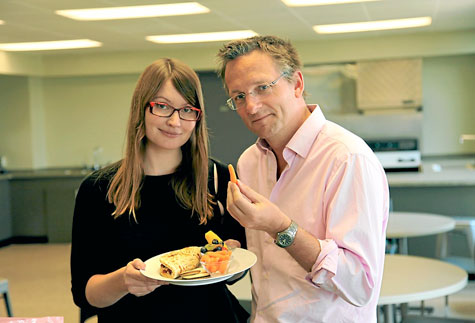
BBC Presenter Michael Mosley with Dr Krista Varady

The other learned person referred to in yesterday’s post was Dr. Krista Varady.  This is what was written,

Dr Krista Varady of the University of Illinois at Chicago carried out an eight-week trial comparing two groups of overweight patients on ADF. (ADF = Alternative Day Fasting)

Over on the Healthy Fellow blogsite, there’s an interview with Dr. Varady.  The web link of that interview is here and crossing over and reading the full interview is much recommended.  Here’s a taste, pardon the pun, of that interview:

JP: Can you help explain the distinctions between alternate day fasting and caloric restriction?

Dr. Varady: Caloric restriction is basically daily calorie restriction where an individual would restrict themselves by about 15% to 40% of their energy needs daily. So basically every single day you’re undergoing the same amount of restriction, whereas alternate day fasting involves a fast day wherein the individual would only eat 25% of their energy needs. So about 500 calories or so and that’s alternated with something called a “feed day” where the individual would eat ad libitum – so as much as they want. However in our studies we show that people end up losing weight because they can’t fully make up for the lack of food on the fast day on the feed day.

Let me add a personal perspective on this.  On the morning of the first day after our two-day fast, my weight was 162.5 lbs (73.71 kg), on the morning of the second day after our fasting days my weight was 161.8 lbs (73.39 kgs) and on the morning of the third day after our fasting, my weight was 161.6 lbs (73.30 kgs).  Ergo even though we were back to eating normally for three days after our two days of fasting, I continued to lose 0.9 lbs (0.4 kgs).

So if you have any concerns over cardiovascular health or want to explore a realistic way of losing excess weight, then do read the interview.  Part One of that interview is here and Part two here.

As is said, we are what we eat and I shall close this postscript with a link to an article on the Mother Nature Network website that was published a little over a year ago: 18 foods that fight common ailments – Try healthy eats that help fight diabetes, heart disease, migraines and more.

So may we all live forever!

Living the long life

Two remarkable aspects of human longevity.

OK, a change to the theme of the last few days, to a topic that must cross the minds of practically every single human being at some point; what is our lifespan going to be?  Who doesn’t want to live a long and healthy life, and I don’t wish to be insensitive to those who labour under mental and physical troubles, of course.

So a recent couple of fascinating stories have given an insight into just how to live that longer and healthier life.

The first one is easy – be a woman!

Actress Michelle Ryan as the Bionic Woman was destined to live even longer!

OK, a bit of an issue if you are a man like me but did you realise, because I didn’t, that being the female of many species offers a significant advantage.  This came from a BBC item published on the 2nd August, from which I quote,

Scientists believe they have discovered a clue to why women tend to live longer than men – by studying fruit flies.

Writing in Current Biology, they focus on mutations in mitochondrial DNA – the power source of cells.

Mitochondria are inherited only from mothers, never from fathers, so there is no way to weed out mutations that damage a male’s prospects.

Then came an extraordinary fact [my italics below],

By the age of 85, there are approximately six women for every four men in the UK, and by 100 the ratio is more than two to one.

And females outlive males in many other species.

If you are of the scientific bent and/or a woman! you can read a fuller account of the research findings on the Science Daily website.  As well as that link you can also read the  Monash University press release on those research findings.

As a fella’ I think I’m moving on!

The second one is almost as easy – Fasting

Again, this news came from the BBC website, the news about the power of fasting.  In an article promoting the showing of a BBC Horizon programme, Michael Mosley wrote this,

Scientists are uncovering evidence that short periods of fasting, if properly controlled, could achieve a number of health benefits, as well as potentially helping the overweight, as Michael Mosley discovered.

I’d always thought of fasting as something unpleasant, with no obvious long term benefits. So when I was asked to make a documentary that would involve me going without food, I was not keen as I was sure I would not enjoy it.

But the Horizon editor assured me there was great new science and that I might see some dramatic improvements to my body. So, of course, I said, “yes”.

I am not strong-willed enough to diet over the long term, but I am extremely interested in the reasons why eating less might lead to increased life span, particularly as scientists think it may be possible to get the benefits without the pain.

For obvious reasons I can’t republish the full BBC article but I encourage you to read it here.  And stay with me for some more research links that are most interesting.

But I will just include this part from the BBC item,

The IGF-1 hormone (insulin-like growth factor) is one of the drivers which keep our bodies in go-go mode, with cells driven to reproduce. This is fine when you are growing, but not so good later in life.

There is now evidence suggesting that IGF-1 levels can be lowered by what you eat. Studies on calorie restrictors suggest that eating less helps, but it is not enough.

As well as cutting calories you have to cut your protein intake. Not entirely – that would be a very bad idea. It’s about sticking to recommended guidelines, something most of us fail to do.

The reason seems to be that when our bodies no longer have access to food they switch from “growth mode” to “repair mode”.

As levels of the IGF-1 hormone drop, a number of repair genes appear to get switched on according to ongoing research by Professor Valter Longo of the University of Southern California.

Intermittent fasting

One area of current research into diet is Alternate Day fasting (ADF), involving eating what you want one day, then a very restricted diet (fewer than 600 calories) the next, and most surprisingly, it does not seem to matter that much what you eat on non-fast days.

Dr Krista Varady of the University of Illinois at Chicago carried out an eight-week trial comparing two groups of overweight patients on ADF.

“If you were sticking to your fast days, then in terms of cardiovascular disease risk, it didn’t seem to matter if you were eating a high-fat or low-fat diet on your feed (non-fast) days,” she said.

Michael Mosley explains how he couldn’t manage Alternate Day Fasting and found it was just too impractical.

Instead I did an easier version, the so-called 5:2 diet. As the name implies you eat normally 5 days a week, then two days a week you eat 500 calories if you are a woman, or 600 calories, if you are a man.

The BBC Horizon programme  was screened on the 6th August but is available on the BBC iPlayer for UK viewers.  Here’s how it was promoted on the BBC website,

Michael Mosley has set himself a truly ambitious goal: he wants to live longer, stay younger and lose weight in the bargain. And he wants to make as few changes to his life as possible along the way. He discovers the powerful new science behind the ancient idea of fasting, and he thinks he’s found a way of doing it that still allows him to enjoy his food. Michael tests out the science of fasting on himself – with life-changing results.

This programme clip will also attract your attention, trust me!

and if you would prefer a more inspiring antidote then here’s another clip from the programme,

Tomorrow, I’m going to link to the scientists behind these new findings because this is very significant research that could revolutionize the future health for millions.

Finally, I’m here to tell you that Jean and I have ‘signed up’ to the 5:2 pattern and had our fast days last Thursday and Friday.  They were much easier than I expected and, frankly, will be fun to maintain.  Leave a comment if you would like details of the food and calorific values of what Jean served those two days.

From feeling to doing!

Each of us must understand there is no choice – we have to change. So let’s do it!

This timely video from The Evergreen State College conference, another contribution from David Roberts, was brought to my attention by a recent post on Christine’s excellent blog, 350 or bust.

It so perfectly carries on from yesterday’s Learning from Dogs post, You have to feel it.

So please, promise yourself to watch this video now!  It’s just 15 minutes of very plain speaking by David.  Watch it not just for yourself but for the children and the children’s children across this beautiful world.

David Roberts is staff writer at Grist.org. In “Climate Change is Simple” he describes the causes and effects of climate change in blunt, plain terms.

On April 16, 2012, speakers and attendees gathered at TEDxTheEvergreenStateCollege: Hello Climate Change to reflect on the ability — and responsibility — of formal and informal education to inspire and empower action in this era of climate change.

Watch, be inspired and be empowered as a person that is taking personal responsibility for doing!

As dear old Albert said, (as in Albert Einstein) “You cannot solve a problem from the same consciousness that created it. You must learn to see the world anew.”

Not even sure what to call this Post?

A futile attempt to explore the concepts of truth, reason, craziness and … (I give up!)

Can’t make sense of this?

Yesterday, I republished an article that Pete Aleshire recently wrote in the Payson Roundup, our local newspaper, on thinking outside the box.  Pete entitled his essay, Strange theory reveals secrets of the universe, the logic of sycamore leaves and why even smart people struggle with new ideas.

And it was part of that title that resonated with a mind-bending (literally) essay that Patrice Ayme presented on his blog on the 27th July.  The part of the title that ‘clicked’ with me was “why even smart people struggle with new ideas.”

You see what Patrice wrote about on the 27th July was about the proposition “that superior intelligence in a species can only come from an ability to engineer (productive) craziness.”

As Patrice explained,

Two of the creators of modern mathematics and metamathematics, Georg Cantor and Kurt Godel, experienced some craziness. Nietzsche produced some of his best work before he went insane. Van Gogh experienced serious mental difficulties. Bolztman killed himself. All these cases were within a generation. Those may all be unrelated accidents, sure.

Immediately leading on to him writing,

 However I will show below that superior intelligence in a species can only come from an ability to engineer (productive) craziness. (Perhaps the reason why chimps and bears are so unpredictable: they are not just clever, but a bit crazy!)

Then after some very detailed reflections on man, Patrice wrote,

Hominids who practiced a bit of craziness were evolutionary advantaged, because they found more readily solutions to logical incompleteness at hand. Craziness allowed to find new, necessary axioms. Thus evolution learned to exploit logical incompleteness.

Typical of Patrice Ayme, the essay is not an easy read but it is brim full of fascinating ideas and well worth the effort.  Patrice concludes,

 If craziness is so useful to augment those mental powers we need so much to survive as a civilization, how do we survive it? Precisely by augmenting the truth. Thus only craziness compatible with the truth will be able to survive. That is why I have not hesitated to tell various truths about Obama (whom I have intensely supported in all sorts of ways), or Hollande, whom I approved of, until he started to say lies about World War Two (details soon to come).

Truth is my religion. A touch of craziness my sanity. (Latest demonstration: It’s not like I did not know of the danger in advance. I was slightly charged by a large bad mood moose with calf today on an Alaskan trail, where I was nonchalantly running with a bad ankle; after a high speed retreat, as a good predator, I circumvented the difficulty, and anxiety switched sides, the calf nearly spraining its own ankle in the process… . )

There is no truth but the full truth, and a touch of craziness is its prophet.

Now go back to Pete Aleshire and see the harmony between his beautiful prose and the fascinating ideas flowing from Patrice’s mind. This is how Pete concluded his essay,

So Drake [Larson] and I spent the day wandering along the banks of Fossil Creek as he kept trying to come up with metaphors so I could grasp math’s secret within the beauty of Fossil Creek’s sycamore leaves. The well-designed sycamore leaves adhere to the Fibonacci sequence, a mysterious progression of numbers that crops up throughout nature — from the spiral of a nautilus shell to the layout of the ruins of Chaco Canyon.

So I figured I’d just write this — and get earth’s 17 PSI cap for dark energy out there in the time/date/ stamped world.

Oh, yeah: And about Kenny Evans. [Mayor of Payson, AZ]

So that night, I took Drake to the Payson council meeting. Turns out, Drake’s family was growing grapes in the Coachella Valley at the same time Evans was farming 10,000 acres in Yuma. They both managed to survive that tempestuous time when the United Farm Workers union organized agriculture workers.

I introduced them and listened as they recalled events and figured out whom they knew in common.

It was then that I decided to blame Drake for my faith in Evans’ ridiculous conviction that a university will build a campus here in this itty bitty tourist town — complete with a research center and convention hotel. No sensible small-town mayor would risk public ridicule while spending thousands of hours on such an outside-the-box notion … unless he’d learned to gamble on dreams and hard work during all those years as a farmer.

Evans’ notion is almost as silly as a farmer who calculates the amount of dark energy emanating from earth, while credentialed experts scratch their collective heads.

Still, I’m thinking maybe I’ll get a nice suit jacket — something I can wear to both the university’s groundbreaking and the ceremonies in Oslo.

Hey, never hurts to be prepared.

So there, I feel much better now!  None the wiser, indeed even more confused, but just grateful there are some out there who have a go at trying to explain ….. whatever it is they are explaining!

Compelled by curiosity

Wonderful news and a fabulous achievement!

I’m writing this as 5.40 am on the 6th.  I let our ‘bedroom’ dogs out for their early-morning pee some 20 minutes ago and then jumped back in bed, turned on my Kindle and went to the BBC News website.  There I read,

Nasa’s Curiosity rover successfully lands on Mars

The US space agency has just landed a huge new robot rover on Mars.

The one-tonne vehicle, known as Curiosity, was reported to have landed in a deep crater near the planet’s equator at 06:32 BST (05:32 GMT).

It will now embark on a mission of at least two years to look for evidence that Mars may once have supported life.

A signal confirming the rover was on the ground safely was relayed to Earth via Nasa’s Odyssey satellite, which is in orbit around the Red Planet.

The success was greeted with a roar of approval here at mission control at the Jet Propulsion Laboratory (JPL) in Pasadena, California.

As David Shukman, Science Editor of the BBC, wrote,

The day I watched Curiosity being built in a clean room at Nasa’s Jet Propulsion Laboratory in Pasadena last year, the rover’s six wheels were lying on one work bench while the chassis stood on another and it was hard to believe the white-suited engineers could make sense of the maze of tubes and cabling.

But what they’ve created now stands on the red soil of Mars – and it’s in one piece. In the hallway of a JPL building we were shown a full-size replica. Walking around it made me realise something difficult to grasp from the pictures and video: this is a beast of a machine, a kind of cosmic Humvee with instruments instead of weapons.

Sometimes Nasa public relations can appear bragging. Today it feels justified. Curiosity is all set to discover something remarkable about our strangest neighbour.

Well said and people from all around the world will echo those sentiments.

When I read what Patrice wrote in my Setting the scene post not so many hours ago,

Well, OK, keeping my fingers, and even my arms, crossed here. Seems to me the “sky crane” is over-complex, and I was not reassured when one of the physicist-engineers boasted that they had run the landing millions of time on simulator. Yeap, OK, how many times for real in Earth’s gravity?
I don’t see why they could not have landed normally, LEM style. Especially as they have wheels and could have rolled away to find undistrubed land.
There are no back-ups…
OK, let’s hope I’m wrong to be suspicious…
PA

I instinctively agreed and hoped his worries were misplaced.  They were!  The Curiosity rover is down!  Good luck to the Rover and all those who made it possible.  Well done, the team!

And now to do something.

The cumulative effect of millions of decisions brings about change!

Yesterday’s Post was about personal change.  It came on the back of a short series that was triggered by the Bill McKibben essay in Rolling Stone magazine that I republished on 31st July.  If you haven’t read it, do yourself a favour and read it soon.

The essay highlighted the challenge of how we change our ways, that is at a personal level, which is why I decided to devote a complete Post to the subject of change.  There was no doubt that the McKibben essay opened our eyes to the need for change, if they weren’t open already.  So being clear about the need for change and how, initially, it can make us feel less sure of ourselves, where do we go from here?  As John Fisher explains, within the change process, there is the stage where things start to happen.  This is what he writes about that stage,

Moving forward

In this stage we are starting to exert more control, make more things happen in a positive sense and are getting our sense of self back. We know who we are again and are starting to feel comfortable that we are acting in line with our convictions, beliefs, etc. and making the right choices. In this phase we are, again, experimenting within our environment more actively and effectively.

Keep this stage in mind as you journey along your individual path towards reducing your impact on the planet.  It really does act as a beacon for you, as a candle in the darkness.

OK, there’s an old saying in business ‘if you can’t measure it you can’t manage it!‘  So let’s start off by calculating the CO2 we are presently responsible for.

There are a number of CO2 calculators available on the Web but this one from The Resurgence Trust website seems as good as any.  Easy to use and it provides a starting point from which to plan your attack!  Make a promise to calculate your present CO2 output, soon!

Then to the plan of action!  A web search on reducing CO2 produces a huge number of results and I recommend that you undertake your own trawl to find the information that ‘rocks your boat’.  But on the Brave New Climate website there’s a summary that caught my eye, especially how it was introduced:

Top 10 ways to reduce your CO2 emissions footprint

Posted on 29 August 2008 by Barry Brook

Solving climate change is a huge international challenge. Only a concerted global effort, involving the governments of all nations, will be enough to avert dangerous consequences. But that said, the individual actions of everyday people are still crucial. Large and complex issues, like climate change, are usually best tackled by breaking down the problem into manageable bits.

For carbon emissions, this means reducing the COcontribution of each and every one of the six and a half billion people on the planet. But what can you, as an individual person or family, do that will most make a difference to the big picture? Here are my top ten action items, which are both simple to achieve and have a real effect. They are ranked by how much impact they make to ‘kicking the COhabit’.

Then follows ten solid recommendations:

  1. Make climate-conscious political decisions.
  2. Eat less red meat.
  3. Purchase “green electricity“.
  4. Make your home and household energy efficient.
  5. Buy energy and water efficient appliances.
  6. Walk, cycle or take public transport.
  7. Recycle, re-use and avoid useless purchases.
  8. Telecommute and teleconference.
  9. Buy local produce.
  10. Offset what you can’t save.

Each of these recommendations is supported by great web links and plenty of advice.  So don’t just skip through those 10 options, go here and commit to doing something!

And when you are ready to involve others beyond your family, 350.org has a great selection of resources for potential organizers.

We can make a difference!

More on the ‘Act’ stuff!

The business of acting to make a difference.

The future depends on what we do in the present. – Mahatma Gandhi

Yesterday, I republished a long essay from Bill McKibben under my title of Stop, read, reflect and Act!    Bill’s essay was called Global Warming’s Terrifying New Math and terrifying the numbers are!

If you didn’t read it yesterday, I encourage you to do so as soon as you can.  Why?  Because the process of change cannot start until we truly want to change; a total emotional commitment.  And the formation of those emotions, that realisation, requires a new understanding of the world around us, who we are and who we want to be.  An outcome that is all part of being better informed, which is why the McKibben essay is so profoundly important.

Tomorrow, I want to explore that process of personal change.

But before then, let me go back and repeat some words in Bill’s essay that really jumped off the page and hit me between the eyes.

Writing of Germany, Bill said, “… on one sunny Saturday in late May, that northern-latitude nation generated nearly half its power from solar panels within its borders. That’s a small miracle – and it demonstrates that we have the technology to solve our problems. But we lack the will.

We lack the will!!

Then in the next paragraph, Bill went on to write,

This record of failure means we know a lot about what strategies don’t work. Green groups, for instance, have spent a lot of time trying to change individual lifestyles: the iconic twisty light bulb has been installed by the millions, but so have a new generation of energy-sucking flatscreen TVs. Most of us are fundamentally ambivalent about going green: We like cheap flights to warm places, and we’re certainly not going to give them up if everyone else is still taking them. Since all of us are in some way the beneficiaries of cheap fossil fuel, tackling climate change has been like trying to build a movement against yourself – it’s as if the gay-rights movement had to be constructed entirely from evangelical preachers, or the abolition movement from slaveholders.

This is what hit me between the eyes, “the iconic twisty light bulb has been installed by the millions, but so have a new generation of energy-sucking flatscreen TVs.”  That describes me to perfection.  OK, we have installed solar panels as well but I admit to a significant degree of ambivalence! ” tackling climate change has been like trying to build a movement against yourself

Let me remind you of Bill’s next paragraph,

People perceive – correctly – that their individual actions will not make a decisive difference in the atmospheric concentration of CO2; by 2010, a poll found that “while recycling is widespread in America and 73 percent of those polled are paying bills online in order to save paper,” only four percent had reduced their utility use and only three percent had purchased hybrid cars. Given a hundred years, you could conceivably change lifestyles enough to matter – but time is precisely what we lack.

So it comes down to change; change in a timely manner, to boot!

Let’s hold that until tomorrow and I will leave you with this: Put your future in good hands – your own.

More reflection on being human!

The voice of reason from James Howard Kunstler.

Yesterday, I published a Post that I called What it is to be human.  It was inspired and based on the compelling film I AM‘ by Tom Shadyac.  As so often seems to happen, shortly after completing yesterday’s Post, an item from Chris Martensen’s Blog caught my eye.

Chris publishes the blog Peak Prosperity and on July 14th Chris had an item featuring James Howard Kunstler.

Let me give you an idea of that item from Chris.

Author and social critic James Howard Kunstler has been one of the earliest, most direct, and most articulate voices to warn of the consequences — economic and otherwise — of modern society’s profligate wasting of the resources that underlie its growth.

In his new book, Too Much Magic, Jim attacks the wishful thinking dominant today that with a little more growth, a little more energy, a little more technology — a little more magic — we’ll somehow sail past our current tribulations without having to change our behavior.

Such self-delusion is particularly dangerous because it is preventing us from taking intelligent, constructive action at the national level when the clock is fast ticking out of our favor. In fact, Jim claims that we are past the state where solutions are possible. Instead, we need a response plan to help us best brace for the impact of the coming consequences. And we need it fast.


James Howard Kunstler

Mr. Kunstler is the author of the very successful book The Long Emergency and his latest book, as mentioned above, Too Much Magic expands on his alarming argument that our oil-addicted, technology-dependent society is on the brink of collapse, ergo that the long emergency has already begun.  His website is here.

Anyway, back to the Chris Martenson’s piece.  Chris goes on to quote Mr. Kunstler, as follows:

[We now live in] this weird, peculiar period in American history when the delusional thinking has risen to astronomical levels — predictably, really — in response to the stress levels that our society feels. And it is expressing itself as sort of “waiting for Santa Claus and the Tooth Fairy” to deliver a set of rescue remedies to us so that we can continue running Wal-Mart, Walt Disney World, Suburbia, the U.S. Army, and the Interstate Highway System by other means. That is the great wish out there. It is kind of understandable, because that is the stuff that we have, and people tend to defend the stuff that they have in any given society and the systems and platforms that they run on. But it is probably a form of collective behavior that is not really going to benefit us very much and really amounts to simply wasting our time, and wasting our dwindling resources, and even our spiritual resources when we could be doing things that are a lot more intelligent.

Here is something I have detected as I travel around the country: There is a clamor for “solutions.” Everywhere I go, people say “Don’t be a doomer; give us solutions.” And I discovered that the subtext to all that is they really want solutions for allowing them to keep on living exactly the way they are living now. To keep on running Wal-Mart, and keep on running Suburbia, and keep on running the highway system, and the whole kit of parts. And what that really means is that they are looking for ways to add on additional complexity to a society that is already suffering from too much complexity.

(Read the full article here.)

There is a podcast of the interview with James Kunstler here and also on YouTube, as below.

My own reflection on this item, as with so many other articles, essays and items available to read online, is that the power of the Web is informing and educating millions of people around the world in a way that Governments and the media have failed to so do.

That promises change and, maybe, sooner than we might expect.

A coating of thought!

Evidence that supports the notion that deliberation is really rather a good idea!

In the issue of The Economist, the July 7th edition, there was a rather intriguing article from the pen of Schumpeter entitled,

In praise of procrastination

that proposes that the world of speed and instant decisions is much less efficient than giving things a decent ‘coating of thought’.

Here’s an extract from the article that makes this point,

These thoughts have been inspired by two (slowly savoured) works of management theory: an obscure article in the Academy of Management Journal by Brian Gunia of Johns Hopkins University; and a popular new book, “Wait: The Art and Science of Delay”, by Frank Partnoy of University of San Diego. Mr Gunia and his three co-authors demonstrated, in a series of experiments, that slowing down makes us more ethical. When confronted with a clear choice between right and wrong, people are five times more likely to do the right thing if they have time to think about it than if they are forced to make a snap decision. Organisations with a “fast pulse” (such as banks) are more likely to suffer from ethical problems than those that move more slowly. (The current LIBOR scandal engulfing Barclays in Britain supports this idea.) The authors suggest that companies should make greater use of “cooling-off periods” or introduce several levels of approval for important decisions.

Readers who want to read Brian Gunia’s research article may find it in full here.  Details of Frank Partnoy’s book are here.

Then the day after reading that copy of The Economist, this came into my ‘inbox’ from the Big Think website,

The Lost Art of Thinking Before You Act

Megan Erickson on July 8, 2012, 12:00 AM

What’s the Big Idea?

Philosopher Slavoj Žižek is fundamentally anti-capitalist, and yet, the man who describes himself as a “complicated Marxist” also expresses palpable irritation at the idea that capitalists are nothing more than egomaniacal psychopaths. In a recent interview with Big Think, he told us that although he’s highly critical of capitalism in his work, when asked about it in public, he’s tempted to detail all the things that are great about it.

Political critiques that don’t account for the passion of the individual capitalist are flawed, he says, because capitalism is as much an ethical as it is an economic system. “It’s not true when people attack capitalists as egotists. ‘They don’t care.’ No! An ideal capitalist is someone who is ready, again, to stake his life, to risk everything just so that production grows, profit grows, capital circulates. His personal or her personal happiness is totally subordinate to this. This is what I think Walter Benjamin, the great Frankfurt School thinker, had in mind when he said capitalism is a form of religion.”

There’s a video interview with Slavoj Zizek in that Big Think article that isn’t available on YouTube, so to watch that video and read the full article, do go here and enjoy!

But there are other videos of Slavoj Zizek (anyone know how to pronounce his name??) on YouTube and I selected this one as possibly being of wider interest.

Philosopher Slavoj Zizek argues environmentally conscious consumers are desperate for simple tasks they can perform to alleviate their guilt, so they do things like purchase overpriced organic produce. Zizek also highlights Starbucks, which he suggests attracts customers by appealing to their sense of altruism.

Complete video is here – Slavoj Zizek: Catastrophic But Not Serious.  It’s over two hours long but strikes me as two hours of very educational viewing from The Graduate Center, City University of New York.

Footnote:

Having completed this Post, I looked for a relevant photograph to head up the article.  The one I chose came just by chance from the website of Ideas Champions, innovation consultants.  Indeed the photo came from this article Creating Time to Innovate which included this paragraph,

Aspiring innovators don’t need pep talks. They need TIME. Time to think. And time to dream. Time to collaborate. And time to plan. Time to pilot. And time to test. Time to tinker. And time to tinker again.

Fancy that!  Think I’ll go and lie down and have a good think!