This item from The Conversation website is very interesting!
Cancer touches so many people.
My father died of lung cancer in 1956. My step-father in turn died of cancer much later on (I can’t recall what cancer it was and when he died).
It’s a terrible disease.
Key facts. Cancer is the second leading cause of death globally, and is responsible for an estimated 9.6 million deaths in 2018. Globally, about 1 in 6 deaths is due to cancer. Approximately 70% of deaths from cancer occur in low- and middle-income countries.
Cancer – World Health Organization
But then this comes along and offers hope.
The Conversation
Published on Jul 23, 2019
Cheryl London, a professor of veterinary medicine at Tufts University, practices “comparative oncology,” or testing cancer treatments in animals for potential use in humans. Her trials give sick pets a chance at a longer life – and could help contribute to new therapies for people.
That seems like it’s good for dogs and good for us!
Not all heroes wear capes — but when it comes to helping animals in need, some really do.
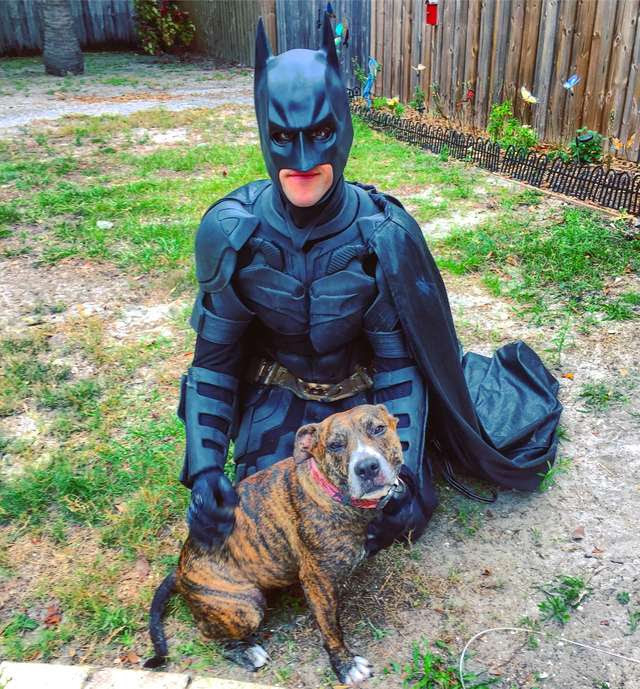
That’s what one homeless pit bull named Koko learned when the Caped Crusader himself changed her life forever.
Photo Credit: Batman4Paws
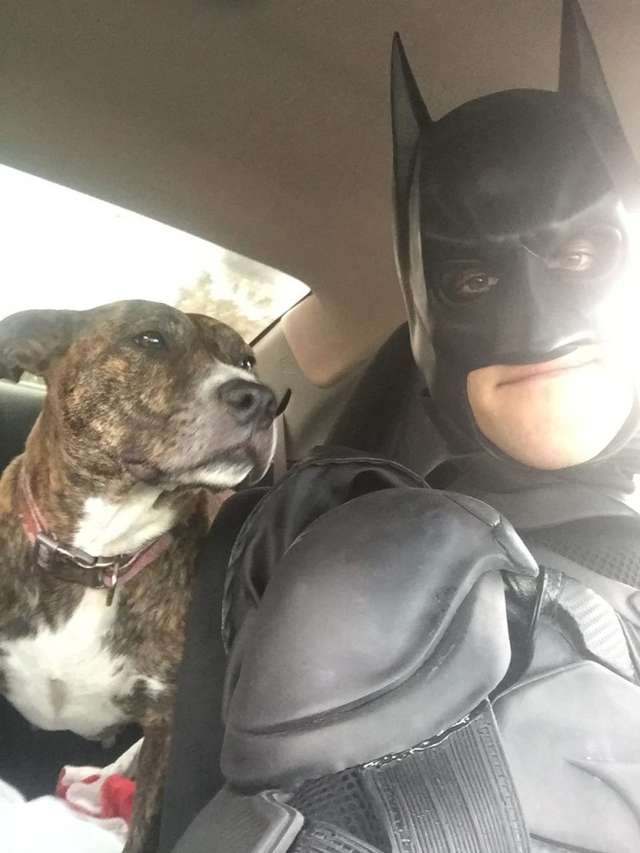
Koko arrived at the Pet Resource Center of Tampa as a stray. Day after day, she waited patiently for a family to choose her. But, before that day could come, she was put on the euthanasia list. With an hour left to live, Koko was pulled from the shelter by her foster mom and months later found a forever home in Gatlinburg, Tennessee.
The only problem? She had no way of getting there.
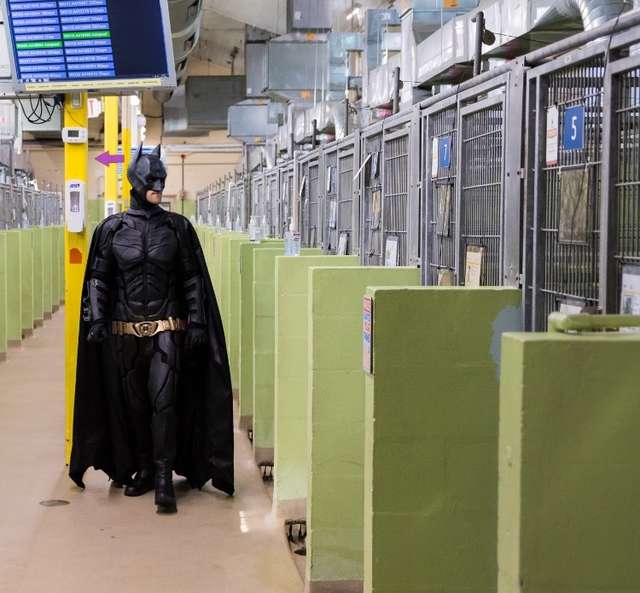
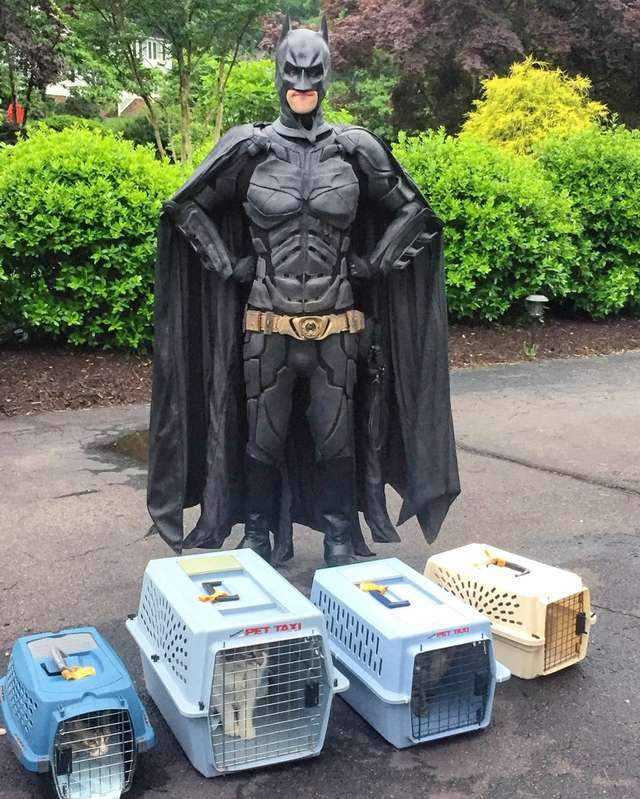
Enter the Dark Knight — otherwise known as Chris Van Dorn, founder of the animal rescue nonprofit Batman4Paws.
Batman4Paws
An eight-hour road trip dressed in an elaborate Batman costume is all in a day’s work for Van Dorn. “I would say I’m just the middleman,” Van Dorn told The Dodo. “The real heroes are the people giving these dogs a good, loving home.”
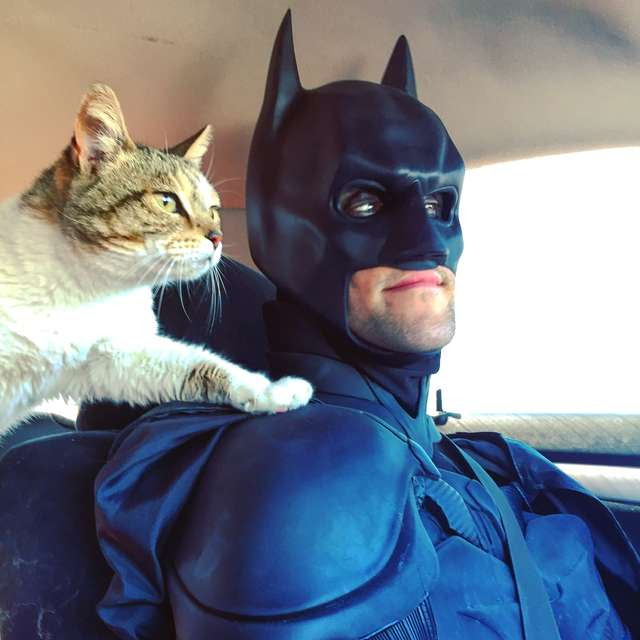
Koko is one of many dogs and cats whom Van Dorn has helped transport from overcrowded shelters to the safety of their forever homes.
And while dressing as Batman isn’t necessary to save an animal’s life, it has helped Van Dorn open up a dialogue about the importance of adoption and fostering.
Batman4Paws
The costume just makes everybody happy and smile,” Van Dorn said. “It’s special to see Batman walking around, and when they find out that he’s doing a good deed in the world they get even more excited.”
“It kind of just came as a way to embody all the good I wanted to do in the world,” he added, “and make it easy for people to talk to me right off the bat.”
Batman4Paws[/caption]
Van Dorn grew up watching the Batman animated series and began volunteering with animal rescues when his family adopted an Australian shepherd named Mr. Boots. When it came time for Van Dorn to start his own rescue organization, he decided to do it as Batman with, of course, Mr. Boots occasionally stepping in as Robin.
Batman4Paws
Every superhero has a secret identity, and for Van Dorn, wearing a mask was an intentional way of keeping the focus on his mission of saving animals.
“When I was first starting out, I was keeping everything really anonymous,” Van Dorn said. “I would sign everything ‘Bruce Wayne’ and not put my real name out there … My catchphrase is, ‘It’s not who I am underneath but what I do that defines me,’ and I still hold that true today.”
Batman4Paws
His cover was blown when GoFundMe honored his campaign, naming him as their GoFundMe Hero for May. Van Dorn hopes soon to put his private pilot’s license to good use by purchasing a plane so he can fly the animals to their forever homes every week.
But for the time being, he’s using his Batmobile, and making a difference whenever he can.
“Actions speak louder than words and I’m just doing my best to empty the cages,” Van Dorn said. “And I challenge anyone to go to their local shelter because it’s a depressing place, but if you can help out in any way — whether that’s to foster a dog or adopt a dog or just volunteer your time, then you should go out and do it.”
ooOOoo
This is one amazing guy. Simple and straightforward!
There was a simply lovely article on The Dodo about a service dog receiving a call from her Mom.
ooOOoo
Service Dog Has The Sweetest Reaction To Getting A Video Call From Her Mom
Photo Credit: Facebook/Adventures with Moxie: Service Dog
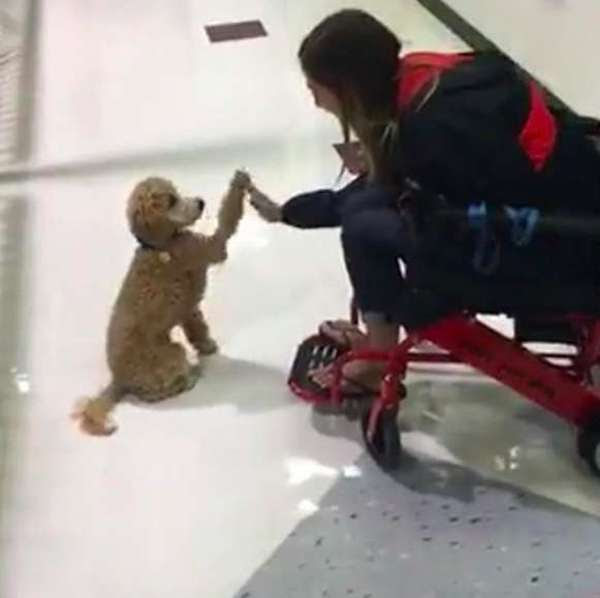
Meet Moxie — a very good girl who works every day to make her mom’s life a little bit easier.
Ever since Moxie met Katie Harris, the two have rarely been apart. Moxie accompanies her mom to work and is always by her side at home.
“Moxie helps me every day and truly has been such a huge blessing to me,” Harris told The Dodo. “Very often, when I would bend over, I would either injure myself from a dislocation or pass out from blood pressure issues. Moxie will pick up anything I drop, retrieve my shoes, clothes or anything else I need.”
Photo Credit: Facebook/Adventures with Moxie: Service Dog
Harris suffers from Ehlers-Danlos syndrome, a connective tissue disorder, and recently had surgery to help ease her symptoms. Unfortunately, that meant Moxie had to stay at home while she was in the hospital for an extended stay.
Harris knew it would be difficult to not be around Moxie — but she had no idea how the service pup would react to the separation.
“I hate being away from Moxie, especially during hard times,” Harris said. “When I knew I was going to be transferred to rehab, I kind of jokingly FaceTimed her, not knowing if she would have any reaction.”
Photo Credit: Facebook/Adventures with Moxie: Service Dog
After 12 days apart, it was clear that Moxie missed her mom, too. The pup seemed overjoyed to see her mom’s face again — even if it was just on a phone screen.
“She immediately recognized my voice and when she started licking the phone — I definitely teared up,” Harris said. “I didn’t quite see the full reaction until my stepmom sent me the video and I couldn’t believe it! I truly do believe she knew that was me.”
The next day, Moxie reunited with her mom, and the pup couldn’t contain her excitement. It was clear that though Moxie is a dog with a job, her love for her mom goes far beyond duty or training.
Even the way she greeted her mom shows just how much she cares.
Photo Credit: Facebook/Adventures with Moxie: Service Dog
“I couldn’t wait to see her, but I was a little nervous about my neck due to my cervical fusion,” Harris said. “But although she jumped in my lap and immediately started licking me, she didn’t hurt my neck at all. We eventually just paused in more of a hug as I just held her.”
Harris understands how life-changing a service dog can be and is now working to raise money to gift service animals to those in need.
“I can honestly say that having Moxie has ‘saved me’ and I am so incredibly thankful for her,” Harris said. “Not only does she help me physically, but we truly are a team as we navigate these challenges and hurdles together.”
ooOOOo
Katie Harris is unfortunate but also incredibly lucky. For her Moxie is the centre of her life and one can hardly imagine life without Moxie.
Moxie has developed an amazing relationship with Katie and it’s a lovely example of how close the bond between a human and a dog can get!
Sean Coughlan wrote a most delightful piece on the BBC News website the other day.
No matter how many times dogs are referred to it always cheers me up to read about them, especially on a major news website.
ooOOoo
Dogs ‘prevent stressed students dropping out’
By Sean Coughlan, BBC News family and education correspondent
July 2nd, 2019
Therapy dogs are used in more than 1,000 universities and colleges in the US – Getty Images
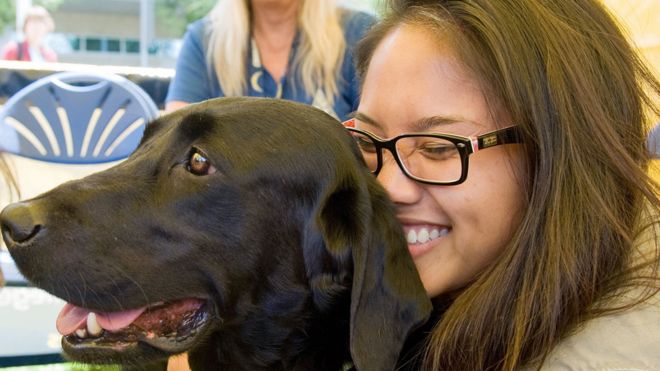
Stress among students really can be reduced by spending time with animals, according to research from the US.
It has become increasingly common for universities to bring “therapy dogs” on to campus – but claims about their benefits have often been anecdotal.
Now, scientists say they have objective evidence to support the use of dogs.
Patricia Pendry, from Washington State University, said her study showed “soothing” sessions with dogs could lessen the negative impact of stress.
Dogs are also used to help people with post-traumatic stress disorder – Getty Images
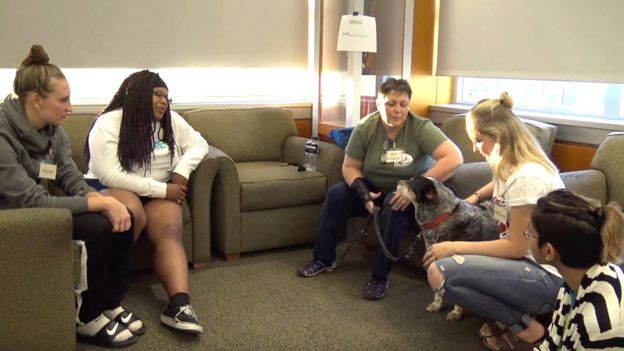
The study of more than 300 undergraduates had found weekly hour-long sessions with dogs brought to the university by professional handlers had made stressed students at “high risk of academic failure” or dropping out “feel relaxed and accepted”, helping them to concentrate, learn and remember information, she said.
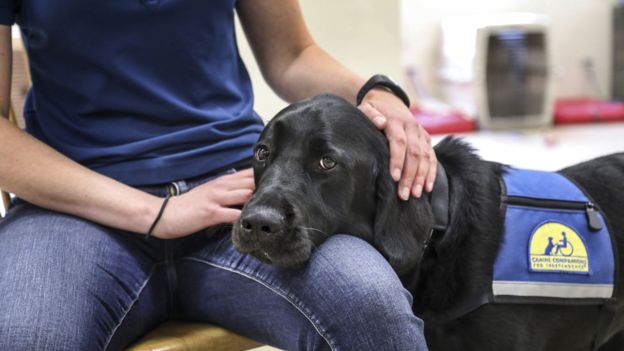
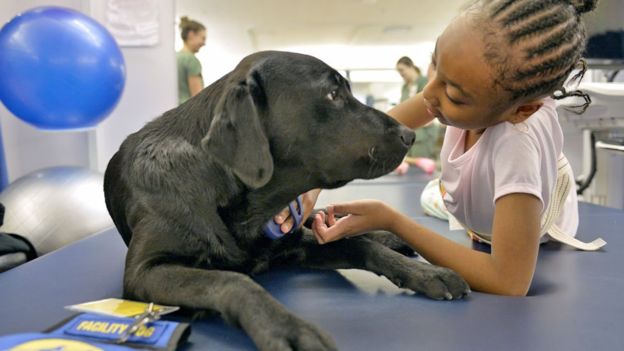
A children’s hospital in California got its first therapy dog this year – Getty Images
“Students most at risk, such as those with mental health issues, showed the most benefit,” said Dr Pendry.
The dog therapy research team at Washington State University
It has also become more common in the UK, with Buckingham, University College London, Cambridge, Nottingham Trent, London Metropolitan and Swansea among those deploying dogs.
The University of Middlesex has even put “canine teaching assistants” on to the staff, to stop lonely students dropping out.
The university study involved 300 undergraduates at Washington State
Previous research has suggested stroking pets can reduce stress hormone levels.
Students spent an hour with dogs, brought to the university by professional handlers
“There does seem to be something specific about the reducing of anxiety from the petting of animals,” said Dr Pendry.
Middlesex University has put dogs on the staff as “canine teaching assistants”
“Do we fully understand the mechanism? No,” said Prof Nancy Gee, a psychologist at the State University of New York and researcher from the Waltham Centre for Pet Nutrition, also part of the project.
But students appeared to “feel calmer and more socially supported”, giving them more confidence in their studies.
Even just looking at animals could sometimes lighten the mood, Prof Gee added.
ooOOoo
This is such a lovely piece. Professor Nancy Gee sums up what we feel when we are close to a dog and yet ponders on the precise science of it.
It’s true! Even just looking at a dog, or more in our case, definitely lightens the mood.
Just look at the exchange of softness in that third photograph from the top. The one about a children’s hospital in California that took on its first therapy dog.
I have taken it from BoredPanda, not a site that I frequent, but this is such a marvellous account of how dogs make, every day, a real difference to the lives of people.
It’s been taken from a Twitter account so my apologies for the ‘staccato’ effect.
ooOOoo
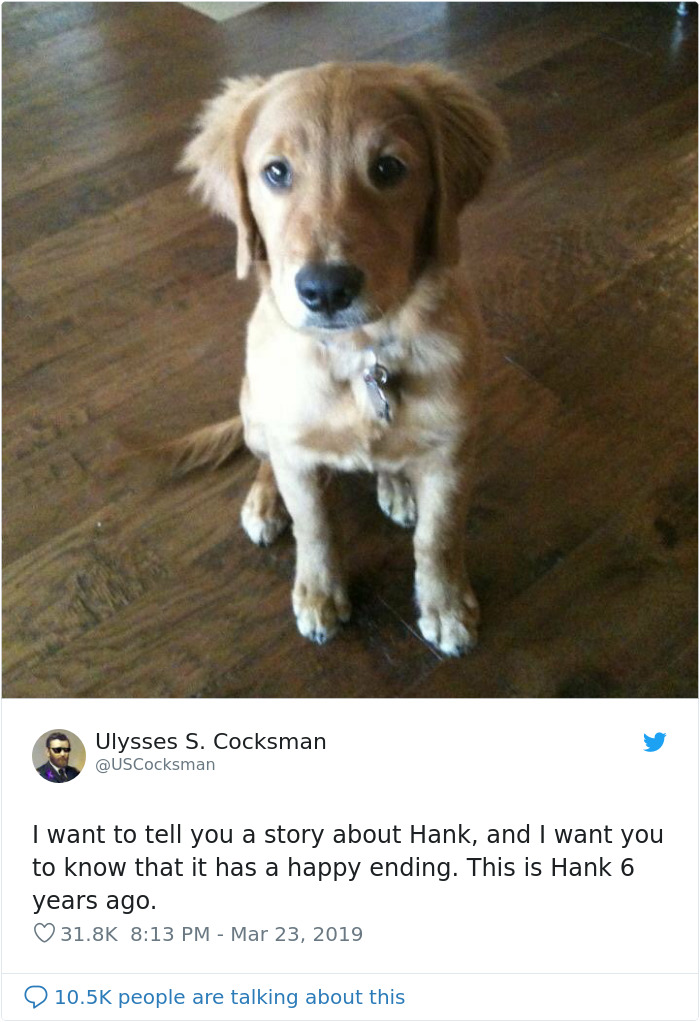
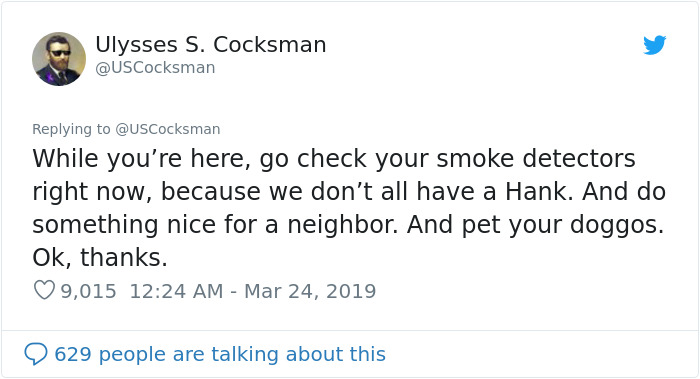
Man Shares A Heartwarming Story About How His Dog Saved His House From Burning Down
Dogs… if only there was a word that would show how much we adore these adorable creatures that we get to call our most loyal friends and also beloved family members. Here at Bored Panda, dogs (amongst other animals) have a very special place, despite the fact that they can do the worst things, we still adore them. Also, today’s story teaches us that just because your puppy did something wrong, don’t be too quick to punish them since they might compensate it by doing something truly heroic.
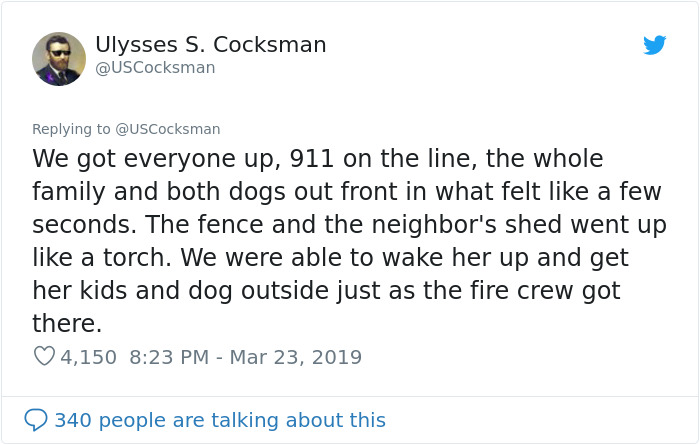
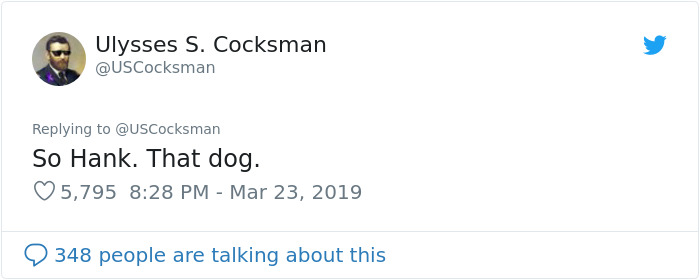
Recently, one Twitter user shared a heartwarming story about his dog Hank saving his entire family from fire
Hank even got some presents dedicated to his heroic act
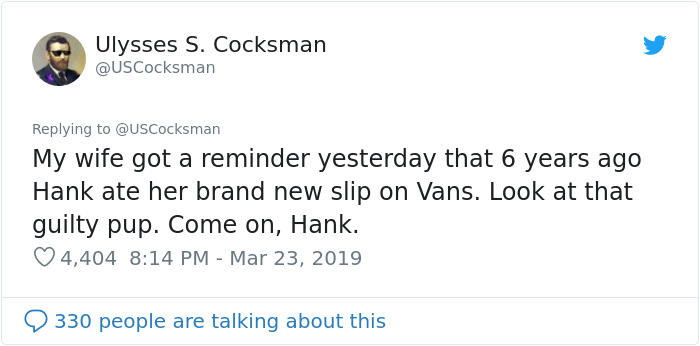
People online were not only touched by this story, but they also think Hank deserves to chew all of the shoes in the world.
This is a wonderful story and one that I shall go straight into. Reason I have software problems that I’m trying to fix today!
This article was first published by The Smithsonian magazine.
ooOOoo
A Perfectly Preserved 32,000-Year-Old Wolf Head Was Found in Siberian Permafrost
Given the head’s state of preservation, researchers are hopeful that they can extract viable DNA and use it to sequence the wolf’s genome.
The specimen is the first (partial) carcass of an adult Pleistocene steppe wolf—an extinct lineage distinct from modern wolves—ever found (Courtesy of Dr. Tori Herridge)
Last summer, a mammoth tusk hunter exploring the shores of the Tirekhtyak River in Siberia’s Yakutia region unearthed the fully intact head of a prehistoric wolf. Preserved by the region’s permafrost, or permanently frozen ground, for some 32,000 years, the specimen is the first partial carcass of an adult Pleistocene steppe wolf—an extinct lineage distinct from modern wolves—ever found.
The discovery, first reported by the Siberian Times, is poised to help researchers better understand how steppe wolves compared with their contemporary counterparts, as well as why the species eventually died out.
As Marisa Iati writes for the Washington Post, the wolf in question was fully grown, likely aged 2 to 4 years old, at the time of its death. Although photographs of the severed head, still boasting clumps of fur, fangs and a well-preserved snout, place its size at 15.7 inches long—the modern gray wolf’s head, in comparison, measures 9.1 to 11 inches—Love Dalén, an evolutionary geneticist at the Swedish Museum of Natural History who was filming a documentary in Siberia when the tusk hunter arrived on the scene with the head in tow, says that media reports touting the find as a “giant wolf” are inaccurate.
“It is not that much bigger than a modern wolf if you discount the frozen clump of permafrost stuck to where the neck would [normally] have been,” Dalén explains to Smithsonian.com.
According to CNN, a Russian team led by Albert Protopopov of the Republic of Sakha’s Academy of Sciences is currently building a digital model of the animal’s brain and the interior of its skull.
David Stanton, a researcher at the Swedish Museum of Natural History who is leading genetic analysis of the remains, tells Smithsonian.com that given the head’s state of preservation, he and his colleagues are hopeful that they can extract viable DNA and use it to sequence the wolf’s genome. This work, expected to last at least another year, will eventually be published in a peer-reviewed scientific journal.
A Russian team is currently building a digital model of the animal’s brain and the interior of its skull (Albert Protopopov)
For now, it remains unclear exactly how the wolf’s head became separated from the rest of its body. Speaking with Smithsonian.com, Tori Herridge, an evolutionary biologist at London’s Natural History Museum who was part of the team filming in Siberia at the time of the discovery, says that a colleague, Dan Fisher of the University of Michigan, thinks scans of the animal’s head may reveal evidence of it being deliberately severed by humans—perhaps “contemporaneously with the wolf dying.” If so, Herridge notes, the find would offer “a unique example of human interaction with carnivores.” Still, she concludes in a post on Twitter, “I am reserving judgment until more investigation [is] done.”
Dalén echoes Herridge’s hesitancy, saying that he has “seen no evidence convincing” him that humans cut off the head. After all, it’s not uncommon to find partial sets of remains in the Siberian permafrost. If an animal was only partially buried and subsequently frozen, for example, the rest of its body could have decomposed or been eaten by scavengers. Alternatively, it’s possible that shifts within the permafrost over thousands of years led the carcass to break into multiple pieces.
According to Stanton, steppe wolves were “probably slightly larger and more robust than modern wolves.” The animals had a strong, wide jaw equipped for hunting large herbivores such as woolly mammoths and rhinos, and as Stanton tells USA Today’s N’dea Yancey-Bragg, went extinct between 20,000 to 30,000 years ago, or roughly the time when modern wolves first arrived on the scene. If the researchers successfully extract DNA from the wolf’s head, they will attempt to use it to determine whether the ancient wolves mated with modern ones, how inbred the older species was, and if the lineage had—or lacked—any genetic adaptations that contributed to its demise.
To date, the Siberian permafrost has yielded an array of well-preserved prehistoric creatures: among others, a 42,000-year-old foal, a cave lion cub, an “exquisite ice bird complete with feathers,” as Herridge notes, and “even a delicate Ice Age moth.” According to Dalén, these finds can largely be attributed to a surge in mammoth tusk hunting and increased melting of permafrost linked with global warming.
Speaking with Smithsonian.com, Stanton concludes, “The warming climate … means that more and more of these specimens are likely to be found in the future.”
At the same time, he points out, “It is also likely that many of [them] will thaw out and decompose (and therefore be lost) before anyone can find … and study them.”
ooOOoo
It’s an ill wind that blows no-one any good. That saying comes to mind when I read about the warming climate and more specimens being found.
This story has been carried by numerous magazines and journals and well it should.
It reveals that the eyes that dogs have are an evolution as a result of their long association with humans.
But let me shut up and let The Atlantic carry on with the account.
ooOOoo
Dogs’ Eyes Have Changed Since Humans Befriended Them
Two specialized muscles give them a range of expression that wolves’ eyes lack.
HALEY WEISS
JUN 17, 2019
English Springer spaniel dog called Twiglet poses on June 30, 2016 in Sydney, Australia. JAMES D. MORGAN / GETTY
Dogs, more so than almost any other domesticated species, are desperate for human eye contact. When raised around people, they begin fighting for our attention when they’re as young as four weeks old. It’s hard for most people to resist a petulant flash of puppy-dog eyes—and according to a new study, that pull on the heartstrings might be exactly why dogs can give us those looks at all.
A paper published today in the Proceedings of the National Academy of Sciences found that dogs’ faces are structured for complex expression in a way that wolves’ aren’t, thanks to a special pair of muscles framing their eyes. These muscles are responsible for that “adopt me” look that dogs can pull by raising their inner eyebrows. It’s the first biological evidence scientists have found that domesticated dogs might have evolved a specialized ability used expressly to communicate better with humans.
For the study, a team at the University of Portsmouth’s Dog Cognition Centre looked at two muscles that work together to widen and open a dog’s eyes, causing them to appear bigger, droopier, and objectively cuter. The retractor anguli oculi lateralis muscle and the levator anguli oculi medialis muscle (mercifully known as RAOL and LAOM) form two short, straight lines, which connect the ring of muscle around a dog’s eye to either end of the brow above.
These researchers have long been interested in the ways dogs make eye contact with humans and, in particular, how they move their eyebrows. In 2017, Juliane Kaminski, the lead author of the new paper, found that dogs moved their eyebrows more often while a human paid attention to them, and less often when they were ignored or given food (which, sorry to say, is a more exciting stimulus for them than human love). That suggested the movement is to some degree voluntary. On our side of these longing glances, research has also shown that when dogs work these muscles, humans respond more positively. And both man and mutt benefit from a jolt of oxytocin when locked in on each other.
This isn’t simply a fortuitous love story, in which the eyes of two species just so happen to meet across a crowded planet. Like all the best partnerships, this one is more likely the result of years of evolution and growth. If dogs developed their skill for eyebrow manipulation because of their connection to humans, one way to tell would be to look for the same capacity in wolves. Because dogs split off from their wolf relatives—specifically, gray wolves—as many as 33,000 years ago, studying the two animals is a bit like cracking open a four-legged time capsule. Divergence between the two species marked the start of dogs’ domestication, a long evolutionary process influenced—and often directly driven by—humans. Today, researchers can identify and study differences between the species to gain an understanding of exactly how dogs have changed over time.
In this case, those eyebrow-raising muscles do appear to be an addition to dogs’ anatomy. In the four gray wolves the researchers looked at, neither muscle was present. (They did find bundles of fibers that could be the precursors to the RAOL and LAOM.) In five of the six breeds of dogs the researchers looked at, both muscles were fully formed and strong; in the Siberian husky, the wolflike, oldest breed of the group, the researchers were unable to locate a RAOL.
Sometimes, the origins of changes like these aren’t immediately apparent. Certain physical dog traits—including floppy ears and short snouts—likely originate from the same set of developmental cells that code for tameness, a preferable trait in household pets, for instance. In the case of this new research, though, the connection between the physical trait and the related behavior is a bit more direct. “Previous work—and much of it by these same authors—had shown that these muscles were responsible for enhancing positive responses in humans,” Brian Hare, the director of Duke University’s Canine Cognition Center and the editor of the paper, told The Atlantic via email, “but the current suggests the origin of these facial expressions is after dogs split from wolves.”
By evolutionary standards, the time since this split has been remarkably short for two new facial muscles to have developed. For a species to change that quickly, a pretty powerful force must be acting on it. And that’s where humans come in. We connect profoundly with animals capable of exaggerating the size and width of their eyes, which makes them look like our own human babies and “hijacks” our nurturing instincts.
Research has already demonstrated that humans prefer pets with more infantlike facial features, and two years ago, the authors of this latest study showed that dogs who made the facial movement enabled by the RAOL and LAOM muscles—an expression we read as distinctly humanlike—were more likely to be selected for adoption from a shelter than those who didn’t. We might not have bred dogs for this trait knowingly, but they gained so much from having it that it became a widespread facial feature. “These muscles evolved during domestication, but almost certainly due to an advantage they gave dogs during interactions with humans that we humans have been all but unaware of,” Hare explained.
Tim Smith
“It’s such a classically human system that we have, the ways we interact with our own infants,” says Angie Johnston, an assistant professor at Boston College who studies canine cognition and was not involved with the study. “A big theme that’s come out again and again in canine cognition and looking at the domestication of dogs is that it seems like they really just kind of dove right into our society in the role of being an infant or a small child in a lot of ways. They’re co-opting existing systems we have.”
The same humanlike facial gestures could also be a dog’s way of simply securing attention in the first place. Eyebrow raising is one of the most well-understood examples of what researchers call ostensive cues, a family of nonverbal signals (often facial movements and expressions) humans send one another to convey their intention to directly communicate. Dogs’ uncanny ability to mimic this human expression likely leads us to project certain human emotions onto them in ways we don’t with other animals, regardless of what they might actually be feeling.
The movement of the RAOL and LAOM muscles is particularly open to interpretation. “In different contexts we’ll call that something different,” says Alexandra Horowitz, a senior research fellow at the Barnard College Dog Cognition Lab. “In one case, I might say it’s sad, but in another case I’ll say, He’s really paying attention. It can look wry, like a questioning or unbelieving look.” According to Horowitz, dogs are the only animals aside from our primate cousins that are expressive in this eerily familiar way. Horses alone share the ability to twist their eyes into the same doleful shape, but their overall expressions don’t strike us as humanlike in the same way that dogs’ do. With dogs, Horowitz points out, we’re so driven to connect that we often search for “smiles” in the shapes of dogs’ mouths. The new research, she says, “makes me think it’s more about being able to move the face in a way that humans move the face. We don’t like unexpressive faces.”
Both Horowitz and Johnston suggested that similar studies looking at populations of dingoes (which Johnston researches) and Siberian foxes could provide yet another time capsule of sorts for understanding eyebrow movements and other evolutionary traits. Both species live near humans and are some of the closest living relatives to the earliest dogs. Why did they stay wild while dogs drifted into domestication? “Anything to do with getting to the bottom of why we as a species picked out this one animal can carry a huge amount of information,” Horowitz says. “In some ways, it’s discovering something about ourselves.”
This is the post (and I trust I can share it with you!)
ooOOoo
If you have ever wondered what it must be like to be a bird flying alongside them is about as close as you can come.
Christian Moullec takes us some amazing flights with his birds in this wonderful video. He has been helping birds migrate from Germany to Sweden since 1995. His efforts have raised awareness about the disappearance of migratory birds in Europe. I hope you enjoy this beautiful video as much as I did!
Two days of nostalgia follow! (You have been warned!)
As many of you already know, my father died fairly suddenly on December 20th, 1956. I had turned 12 some six weeks previously.
After about a year my mother remarried. His name was Richard Mills. Richard came to live at the house in Toley Avenue and had the unenviable task of taking on a new ‘son’ and ‘daughter’. (My sister, Elizabeth, some four years younger than I.)
Richard was a technical author in the newly-arrived electronics industry and one day he asked me if I would like to build a short-wave receiver. He coached me in the strange art of soldering wires and radio valves and other components and in the end I had a working receiver. That led, in turn, to me studying for an amateur radio licence. More of that tomorrow.
Simply elegant, Morse code marks 175 years and counting
The elegantly simple code works whether flashing a spotlight or blinking your eyes—or even tapping on a smartphone touchscreen
There’s still plenty of reason to know how to use this Morse telegraph key. (Jason Salmon/Shutterstock.com)
By Eddie King
Ph.D. Student in Electrical Engineering, University of South Carolina
May 21st, 2019
The first message sent by Morse code’s dots and dashes across a long distance traveled from Washington, D.C., to Baltimore on Friday, May 24, 1844 – 175 years ago. It signaled the first time in human history that complex thoughts could be communicated at long distances almost instantaneously. Until then, people had to have face-to-face conversations; send coded messages through drums, smoke signals and semaphore systems; or read printed words.
Thanks to Samuel F.B. Morse, communication changed rapidly, and has been changing ever faster since. He invented the electric telegraph in 1832. It took six more years for him to standardize a code for communicating over telegraph wires. In 1843, Congress gave him US$30,000 to string wires between the nation’s capital and nearby Baltimore. When the line was completed, he conducted a public demonstration of long-distance communication.
Morse wasn’t the only one working to develop a means of communicating over the telegraph, but his is the one that has survived. The wires, magnets and keys used in the initial demonstration have given way to smartphones’ on-screen keyboards, but Morse code has remained fundamentally the same, and is still – perhaps surprisingly – relevant in the 21st century. Although I have learned, and relearned, it many times as a Boy Scout, an amateur radio operator and a pilot, I continue to admire it and strive to master it.
Samuel F.B. Morse’s own handwritten record of the first Morse code message ever sent, on May 24, 1844. Library of Congress
Easy sending
Morse’s key insight in constructing the code was considering how frequently each letter is used in English. The most commonly used letters have shorter symbols: “E,” which appears most often, is signified by a single “dot.” By contrast, “Z,” the least used letter in English, was signified by the much longer and more complex “dot-dot-dot (pause) dot.”
In 1865, the International Telecommunications Union changed the code to account for different character frequencies in other languages. There have been other tweaks since, but “E” is still “dot,” though “Z” is now “dash-dash-dot-dot.”
The reference to letter frequency makes for extremely efficient communications: Simple words with common letters can be transmitted very quickly. Longer words can still be sent, but they take more time.
Going wireless
The communications system that Morse code was designed for – analogue connections over metal wires that carried a lot of interference and needed a clear on-off type signal to be heard – has evolved significantly.
The first big change came just a few decades after Morse’s demonstration. In the late 19th century, Guglielmo Marconi invented radio-telegraph equipment, which could send Morse code over radio waves, rather than wires.
The shipping industry loved this new way to communicate with ships at sea, either from ship to ship or to shore-based stations. By 1910, U.S. law required many passenger ships in U.S. waters to carry wireless sets for sending and receiving messages.
The arrow points at the chart label indicating the Morse code equivalent to the ‘BAL’ signal for a radio beacon near Baltimore. Edited screenshot of an FAA map, CC BY-ND
Aviators also use Morse code to identify automated navigational aids. These are radio beacons that help pilots follow routes, traveling from one transmitter to the next on aeronautical charts. They transmit their identifiers – such as “BAL” for Baltimore – in Morse code. Pilots often learn to recognize familiar-sounding patterns of beacons in areas they fly frequently.
There is a thriving community of amateur radio operators who treasure Morse code, too. Among amateur radio operators, Morse code is a cherished tradition tracing back to the earliest days of radio. Some of them may have begun in the Boy Scouts, which has made learning Morse variably optional or required over the years. The Federal Communications Commission used to require all licensed amateur radio operators to demonstrate proficiency in Morse code, but that ended in 2007. The FCC does still issue commercial licenses that require Morse proficiency, but no jobs require it anymore.
Blinking Morse
Because its signals are so simple – on or off, long or short – Morse code can also be used by flashing lights. Many navies around the world use blinker lights to communicate from ship to ship when they don’t want to use radios or when radio equipment breaks down. The U.S. Navy is actually testing a system that would let a user type words and convert it to blinker light. A receiver would read the flashes and convert it back to text.
Skills learned in the military helped an injured man communicate with his wife across a rocky beach using only his flashlight in 2017.
Other Morse messages
Perhaps the most notable modern use of Morse code was by Navy pilot Jeremiah Denton, while he was a prisoner of war in Vietnam. In 1966, about one year into a nearly eight-year imprisonment, Denton was forced by his North Vietnamese captors to participate in a video interview about his treatment. While the camera focused on his face, he blinked the Morse code symbols for “torture,” confirming for the first time U.S. fears about the treatment of service members held captive in North Vietnam.
Navy pilot Jeremiah Denton, a prisoner of war, blinks Morse code spelling out ‘torture’ during a forced interview with his captors.
There are still many ways people can learn Morse code, and practice using it, even online. In emergency situations, it can be the only mode of communications that will get through. Beyond that, there is an art to Morse code, a rhythmic, musical fluidity to the sound. Sending and receiving it can have a soothing or meditative feeling, too, as the person focuses on the flow of individual characters, words and sentences. Overall, sometimes the simplest tool is all that’s needed to accomplish the task.
ooOOoo
I do hope you read this article in full because it contains much interesting information. Many people will not have a clue about The Morse Code and, as you can see above, it is still relevant.
Finally, I can still remember the The Morse Code after all these years!
Posted by Eleanor Imster in EARTH | HUMAN WORLD|March 28, 2019
Across North America, coyotes are moving into urban environments. While human residents are having to get used to the new animal neighbors, coyotes are also habituating to people.
Seven-week-old coyote pups walk through the research facility in Utah as the mother follows. The first pup carries a bone in its mouth. Image via USDA National Wildlife Research Center/Steve Guymon.
As coyotes are moving into urban environments across North America, many human residents – whether they like it or not – are having to get used to them. Meanwhile, how are coyotes habituating to people?
A new study, published December 2018 in the peer-reviewed journal Ecology and Evolution, suggests that coyotes can habituate to humans quickly and that habituated parents pass this fearlessness on to their offspring.
Image via Connar L’Ecuyer via National Park Service/Flickr.
Until the 20th century, coyotes lived mostly in the U.S. Great Plains. But when wolves were hunted almost to extinction in the early 1900s, coyotes lost their major predator, and their range began to expand.
With continuing landscape changes, coyotes are now increasingly making their way into suburban and urban environments — including New York City, Los Angeles and cities in the Pacific Northwest — where they live, mainly off rodents and small mammals, without fear of hunters.
The aim of the new study, was to understand how a skittish, rural coyote can sometimes transform into a bold, urban one — a shift that can exacerbate negative interactions among humans and coyotes. University of Washington biologist Christopher Schell is the first author of the study, Schell said in a statement:
Instead of asking, ‘Does this pattern exist?’ we’re now asking, ‘How does this pattern emerge?’.
A key factor, the researchers suggest, might be parental influence. Coyotes pair for life, and both parents contribute equally to raising the offspring. This may be because of the major parental investment required to raise coyote pups, and the evolutionary pressure to guard them from larger carnivores.
The new study observed eight coyote families at the U.S. Department of Agriculture’s Predator Research Facility in Utah during their first and second breeding seasons. These coyotes are raised in a fairly wild setting, with minimal human contact and food scattered across large enclosures.
Five-week-old coyote pups eat food rations during the experiment. These second-litter pups were born in 2013 to more-experienced parents, and were more likely to approach a human. Image via USDA National Wildlife Research Center/Christopher Schell.
But during the experiment researchers occasionally placed all the food near the entrance of the enclosure and had a human researcher sit just outside, watching any approaching coyotes, from five weeks to 15 weeks after the birth of the litter. Then they documented how soon the coyotes would venture toward the food. Schell said:
For the first season, there were certain individuals that were bolder than others, but on the whole they were pretty wary, and their puppies followed. But when we came back and did the same experiment with the second litter, the adults would immediately eat the food – they wouldn’t even wait for us to leave the pen in some instances.
Parents became way more fearless, and in the second litter, so, too, were the puppies.
In fact, the most cautious pup from the second-year litter ventured out more than the boldest pup from the first-year litter. Schell said:
The discovery that this habituation happens in only two to three years has been corroborated, anecdotally, by evidence from wild sites across the nation. We found that parental effect plays a major role.
He added:
Even if it’s only 0.001 percent of the time, when a coyote threatens or attacks a person or a pet, it’s national news, and wildlife management gets called in. We want to understand the mechanisms that contribute to habituation and fearlessness, to prevent these situations from occurring.
Bottom line: A new study suggests coyotes puppies learn from their parents how to habituate to humans.
 Batman4Paws[/caption]
 Batman4Paws











/https://public-media.si-cdn.com/filer/95/cd/95cd30a1-3999-431d-8f96-3e8fa5f5d616/screen_shot_2019-06-14_at_113850_am.png)






 Learning from Dogs