Category: History

Horror at Smolensk

Will this air crash be a milestone in improving relationships with the Russians?

The Poles are naturally turning out to mourn their President and other leaders killed in the tragic accident at Smolensk.

Sadly, I fear that if and when the investigation turns up the truth about what happened the reaction may be more questionable. The Russians have apparently recovered the black boxes and presumably cockpit recordings, and what already seems clear from ATC Officers involved is that the pilot had categorically refused “instructions” to land at another airport, Smolensk being judged by ATC to be too dangerous.

Now others on Learning from Dogs will know far better than me, but it seems to me extraordinary that a professional, experienced pilot would refuse such advice and try to land in such appalling weather conditions.

This of course begs the question of why he did so, which is where the deceased President may come in.  An extract from the NY Times of April 12th:

Investigators examining the crash appeared to be focusing on why the pilot did not heed instructions from air traffic controllers to give up trying to land in bad weather in western Russia on Saturday morning.

Their inquiry may lead to an even more delicate question: whether the pilot had felt under pressure to land to make sure that the Polish delegation would not be late for a ceremony on Saturday in the Katyn forest, where more than 20,000 Polish officers and others were massacred by the Soviets during World War II.

Let us hope that it was mechanical failure of some kind (though early reports seem to rule this out) rather than the repetition of a previous incident where the Polish President had argued with the pilot of his plane.

This tragic event is of course surreally-ironic, as if the grisly hand of Josef Stalin had risen from the grave to cause the deaths of yet more Poles in addition to the 20,000 or so murdered in Katyn Forest on his direct orders.

As one who grew up during decades of Soviet denials of responsibility for this cruel genocide, I have been moved by the reaction of the Russians to all this, and no more so than by Putin himself. This is a man who referred to the demise of the Soviet Union as “the greatest tragedy of my life”, yet his grief and fellow-feeling for the Poles have been clear and genuine.

It was already a major breakthrough that Russia should have after all this time so clearly accepted responsiblity – and made apologies – for the Katyn massacre. That Putin and others have shown such fellow-feeling for the Polish loss gives one hope for a deeper reconciliation after the terrible schism in Europe caused by the Russian Revolution and seizure of power by Stalin, possibly the most murderous dictator in history. It was always insane that Russia should be our enemy; let us hope that by and by they will become our firm friends and allies.

By Chris Snuggs
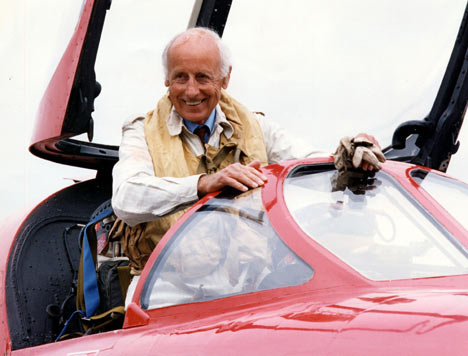
The Hawker Hunter aircraft

What a beautiful aircraft!

On April 2nd, I published an account of a flight in a Hawker Hunter that my dear cousin, Richard, experienced in 2003, the 50th anniversary of Neville Duke’s breaking of the existing world speed record on September 7th, 1953.  Neville Duke died in 2007 at the age of 85.

Squadron Leader Neville Duke, 85, flew 485 operational sorties during the war

It seemed fitting to add a little more information about this marvellous aircraft from an era when Britain built some of the best aircraft in the world.

As always, WikiPedia has an excellent account of the history of the aircraft.  So this Post will just present a few images for readers to ooh, aah over!

Thunder and Lightnings has some excellent images of all the different types including WB188 that Duke broke the speed record in.

Copyright 2009 Damien Burke

F.3 WB188, Hawker Aircraft, RAF Tangmere, 1953; author
As at 7th September 1953, when World Absolute Speed Record of 722.2 mph gained by Neville Duke; pointed nose, reheated engine, additional curved/raked windscreen
Later scheme of Scarlet Red

There is also a distant connection with our erstwhile editor, Paul.  Paul used to fly a TB2o from Exeter Airfield in SW England which is where the Hunter Club is based.  Jonathan Whaley, who commanded the Hunter that Richard flew in, has his own personal Hunter – Miss Demeanour – registration G-PSST so during the summer months it was not uncommon to see Hunters in the sky above Exeter.

Hawker Hunter 'Miss Demeanour'

Finally, a couple of videos to drool over.

and a lovely display at RAF Waddington in rather unpleasant weather conditions

Wonderfully nostalgic!

By Bob Derham

Science is Us!

A plea for science education.

a science class at Woolverstone Hall School, late 50s - click to see more

Apart from hearing and knowing that many people are suffering terrible hardships in this world, I find few things more depressing than to hear young people say “I’m not interested in science”.

We are part of Nature. Science is the study of Nature.

How can it possibly NOT be the most interesting and endlessly-fascinating of subjects? There is a shortage of well-trained science teachers in Britain. There are too many students doing courses on “Football Management”, “Media Studies” or even “sociology”.

Why is this? I can’t explain it. Can anyone else?

I am not a scientist, having had to abandon the study of physics and biology – two subjects I loved – because I was better at languages.  Too many youngsters have to drop science at the age of 16. What an absolute folly in the technological age, even 50 years ago.

My point is not just that science is important but that it is so interesting. Is the problem that some kids find it “too hard”? That must be poor teaching, surely? You gear your lessons to your students.

One positive point about British schools – at least in my distant experience – was the great use made of practical work. I so looked forward to that in physics: boiling up water in calorimeters, mucking about with levers and pulleys, passing electrical currents through each other …. I looked on physics lessons as a game, not a boring school subject.

Yes, science CAN be hard, especially for those not that good at maths. Some of the most brilliant minds on the planet do science; we cannot hope to understand all they do. But this doesn’t matter, does it?

ISBN: 0-19-511699-2

As for maths, I have recently been reading a most stupendous book, one that I cannot recommend too highly to any layman interested in science. Shown right, this was written by Brian Silver, former Professor of Physical Chemistry at the Technicon Institute of Technology in Israel.

I read and re-read this book every night, each time hoping – somewhat in vain – that I will  eventually understand what quantum mechanics and relativity really are. But I read it, too, with a tinge of sadness, for Brian Silver died in 1997, just prior to the publication of his book, which I personally feel is a masterpiece of its kind.

In this book Professor Silver takes us through the history of science from Antiquity and before right up to the end of the 20th century.  As well as chapters on all the major fields and discoveries of science from Pythagoras to Hawking we have fascinating snippets of biographical information about the science greats: Galileo, Copernicus, Newton, Herschel, Boyle, Hooke, Faraday, Lavoisier, Maxwell, Mendel, Darwin, Planck, Bohr, Heisenberg, Schrödinger, Einstein, Rutherford, Crick and so many more.

Their biographies themselves make fascinating reading, let alone their discoveries.

I read a book some years ago about Joseph Salk and the development of the polio vaccine. This was a hundred times more exciting than the most classy whodunnit, recounting the story of one of the greatest triumphs of medicine. Do you know anyone with polio? Nor do I, though I did when I was a kid in the 50s and of course there are many in “developing” nations still today, as we spend billions on CERN and not enough on medicine for the deprived of this world. Interwoven with the factual accounts of science and scientists considerable attention is given to philosophy and the placing of scientists and their discoveries in their historical context. A dry, purely factual book this isn’t, with the final chapters on cosmology, the origin of the universe and the meaning of life. (But don’t expect any answers to the last two!!)

Maths? Well, Professor Silver puts Michael Faraday right up there among the immortals. An astounding practical scientist/technologist, he made major discoveries in the field of electricity that affect the lives of everyone on the planet today. But his maths wasn’t too good! So much so that he pleaded with James Clerk Maxwell to write his equations in a more understandable way!

So you don’t have to be a great mathematician to do good things in science. If only I’d realized that before, I could have been another Faraday!

This book should be a standard textbook for all 6th formers, not just those doing science. I salute the brilliant and too-soon departed author.

By Chris Snuggs

Alistair Cooke

A tribute to Alistair Cooke of Letter from America

Many, many people of a certain age will remember with very fond affection the weekly BBC Radio broadcasts of Alistair Cooke under the title of Letter from America.

Alistair’s broadcast title, Letter from America, came to mind because I have been thinking for a couple of weeks about what to call my impressions about moving to Payson in Arizona.

Payson Perceptions? Pictures of Payson? Payson Profile?  No!  They all seemed naff!

But would it be too presumptuous to echo Cooke’s hugely famous programme title?  Hopefully not.

(And regular readers will know that yesterday, the first Letter from Payson was published.)

I did a Google search on Alistair Cooke and immediately found the BBC web page devoted to him.  For those that don’t know Cooke here are a few details from WikiPedia.

Born in 1908 in Salford, Lancashire, England, Cooke first started broadcasting for the BBC in 1946 and continued until the 20th February, 2004, a total of 58 years and making Letter from America the longest-running speech radio show in the world.

I hope the BBC will forgive me in reproducing here on Learning from Dogs the obituary that is on the Alistair Cooke website.  He was a wonderfully interesting man and his weekly Letter from America seems to have been part of my complete life (in a sense it was).

——————-

Reading Letter from America in the 1950s

He read his Letter from America for 58 years

Esteemed writer and BBC broadcaster Alistair Cooke, famed for his programme Letter From America, has died aged 95. BBC News Online looks back at his long and respected career.

For more than half a century, Alistair Cooke’s weekly broadcasts of Letter from America for BBC radio monitored the pulse of life in the United States and relayed its strengths and weaknesses to 50 countries.

His retirement from the show earlier this month after 58 years, due to ill health, brought a flood of tributes for his huge contributing to broadcasting.

Born in Salford, near Manchester, northern England, Alistair Cooke’s father was an iron-fitter and Methodist lay-preacher.

Alistair Cooke

Alistair Cooke: Consummate broadcaster

Winning a scholarship to Jesus College, Cambridge he read English, edited the undergraduate magazine, Granta, and founded the Cambridge University Mummers.

Alistair Cooke made his first visit to the United States in 1932, on a Commonwealth Fund Fellowship which took him to both Yale and Harvard universities.

Following his return to Britain, he became the BBC’s film critic and, in 1935, London correspondent for America’s National Broadcasting Corporation.

He returned to the United States in 1937 to work as a commentator on American affairs for the BBC. He made his home there and, in 1941, became an American citizen.

Alistair Cooke

A passion for jazz

March 1946 saw the first edition of American Letter, which became Letter from America in 1949.

The series was the longest-running series in history to be presented by a single person.

Alistair Cooke never decided what he was going to talk about until he wrote the script, made no notes during the preceding week and preferred to rely on his memory.

In an interview given at the time of the 3,000th edition of Letter from America, he appeared to have mixed feelings about the future of the United States.

“In America,” he said, “the race is on between its decadence and its vitality, and it has lots of both.”

Addressing Congress in 1973

He addressed Congress in 1973

Cooke led his listeners through the American vicissitudes of Korea, Kennedy, Vietnam, Watergate, Nixon’s resignation and Clinton’s scandals.

In all of this, Cooke pulled no punches. The lyricism of his broadcasting and the urbanity of his voice did not disguise his fears for America which he saw becoming a more violent society.

A liberal by nature, he reserved particular dislike for what he saw as the shallow flag-waving of the Reagan presidency.

Alongside working for the BBC and The Guardian, for which he wrote from 1945 to 1972, he developed a passion for jazz and golf and, as a film critic, he mixed with Hollywood stars.

As a commentator on history, Cooke was sometimes an eyewitness too. He was just yards away from Senator Bobby Kennedy when the latter was assassinated in 1968.

He was never as comfortable on television as radio but, by the 1970s, his hugely successful television series America recounted his personal history of his adopted homeland and won international acclaim, two Emmy Awards and spawned a million-selling book.

British or American?

The Queen awarded him an honorary knighthood in 1973 and the following year, for a journalist, he received the ultimate recognition – he was asked to address the United States Congress on its 200th anniversary.

He told his audience he felt as if he was in a dream, standing naked before them and there was only one thing he could find to say.

Teasing, he exclaimed to the assembled legislators, “I gratefully accept your nomination for President of the United States!”

Naturally, he brought the house down.

Many Britons thought he was American, but to the Americans he was the quintessential Brit, the man who brought them the best of British television as presenter of Masterpiece Theatre. For his part, he explained, “I feel totally at home in both countries.”

He impressed both audiences with his high quality work. With his unquenchable curiosity, Alistair Cooke remained for decades the consummate broadcaster, an elegant writer and a man of enormous wit and charm who made sense of the American Century.

By Paul Handover (still missing Letter from America on the radio.)

Europe Uber Alles, Pt 2.

A Guest post by Patrice Ayme

Part One ended saying:

The euro, long in planning by some European institutions, was introduced minimally, namely without the governmental apparatus generally associated to a currency. This is the way Europeans have found to progress peacefully towards greater harmony: do what is necessary, and nothing more than that, and do it with total consensus.

Everybody knew that a currency without a government to create and anchor it had never happened before, and was unlikely to endure.

The European Union

Part Two continues

That fit the European federalists just right, and could not have escaped the understanding of Paris and Berlin. As it turned out, the PIIGS’ crisis is putting back Paris and Berlin, the historical engine of Europe, back on top, and this, for an excellent reason.

“PIIGS” stand for Portugal Ireland Iceland Greece Spain. All of them ran bubble economies, partially propelled by taxes from the richest European countries (including France and Germany). It became ridiculous as, for example, Ireland was getting European subsidies while the Irish were already way richer than those subsidizing them. (OK Iceland is not in the EU, yet, but it begged to enter the Eurozone, and it has disappeared the savings of countless Brits and Dutch, which means it has some outstanding business with the rest of Europe, that it will have to sort out, after executing a few more whales, guilty as charged.)

Some acknowledge the convenience of a common European currency and easier border transits, while remaining obsessed by what they view as gigantic differences between European countries. Those quaint nationalists and parochial types obsess that core differences between countries are so strong and deep-rooted that any form of real European union is a ridiculous concept. This is triply erroneous.

Read the rest of this Post

Europe Uber Alles

Welcome Patrice Ayme

On the 22nd March, Learning from Dogs had the pleasure of a Post from our first Guest Author, Elliot Engstrom.  We were then doubly delighted to have Per Kurowski join us as our second Guest Author with his introductory Post.

Now we have the additional honour of welcoming Patrice Ayme to the growing ranks of Guest Author to Learning from Dogs.

Patrice, like Elliot and Per, also is a prolific blogger.  He describes himself as:

I was born in Europe, raised in Africa, and lived in America. So doing, I learned to compare different cultures, even during my early childhood, and to appreciate superiority of many of their traits, even the most surprising. I consider myself Senegalese, and proudly so. I studied, and know, several languages, not just Latin, and several cultures, deeply, by living through and inside them for years. I have done formal studies in mathematics and physics at three leading Universities receiving the highest degrees, and putting me in a good position to learn to differentiate between hard knowledge and wishful thinking, differently from many a common philosopher. I am a specialist of non commutative geometry, arguably the most abstract field of knowledge in existence (even hard core logic, model theory, is used in my approach).

Here is Patrice’s first Guest Post for Learning from Dogs.

——————————

GREEK TROJAN HORSE TO CONQUER BETTER EUROPEAN UNION

Abstract:

The European currency, the euro, is, foremost, a solution to a problem. War. All other problems, and the euro solves many, pale in significance relative to this one.

Many talk about “problems” with the euro, and, oozing with glee all over, perceive weakness. They are right, there is weakness, but it is not European weakness. Just the opposite.

What those skeptics are seeing with their uncomprehending neurology is the further construction of the European imperium, according to its core principle: fix what needs to be fixed, but with complete consensus of the parties concerned, which means do it just so. It appears messy, because it’s democratic, and before the people (demos) can use its kratos (power), it needs to think right, which means it has to argue thoroughly. It looks like squabbling, but it is thinking aloud. Europe is not built for some parties to gain advantage anymore (as it was with Napoleon, or Hitler), but to solve problems and gain opportunities for all.

The euro is, for the first time, used as a weapon against Europe’s enemies. Hence all the squealing. Far from weakening Franco-German resolve, the recourse to the IMF adds another layer of authority to the European Communities. When the IMF, speaking in the name of Franco-German taxpayers, tell restive exploiters in Greece that they have to pay more taxes (only 6 plutocrats declare more than one million euro income in Greece, and more than 500 professions can retire at 50 years of age, whereas Germany just brought up the retirement age to 67!), they will have to submit under orders (imperare, to use the Roman notion)

The European Union

Read more of Patrice’s fascinating article

A flight in a Hawker Hunter

A personal story about a wonderful flying experience.

This is a tale about my cousin Richard.  He has never been a pilot but has always been fascinated in flying.  He was reminiscing the other day about an event in a lifetime, flying in a military jet.  But this was no ordinary jet, this was the iconic Hawker Hunter.

These are Richard’s words.

It all started early in 2003. Lynne and I decided to take her son Henry and his friend to Tangmere Air Museum.

We were looking around, and were particularly taken by the bright red Hawker Hunter (WB188), in which Neville Duke had broken the world speed record on 7th September 1953, between Littlehampton and Worthing piers.

The curator of the museum was listening to us, and said – ‘Sad, isn’t it, we were hoping to have a 50th anniversary re-run of the flight. We have the aeroplane and the pilot, but nobody will sponsor us the fuel‘.

In the way that Lynne does, she just said ‘That’s alright, Richard will sponsor you the fuel!’

Well, that was all very well, but how much would it cost?

Anyway, to cut a long story short, a cheque for £1,600 ($2,400) was sent to the Hunter Flying Club at Exeter, which was followed by a telephone call from them. Basically, they said they were going to use a 2 seat Hunter, and as I had paid for the fuel, would I like the left hand seat!!!

On the morning of 7th September, I drove to Exeter Airport, and was introduced to the ground crew, and to the pilot Jonathan Whaley, who has his own multi-coloured Hunter ‘Miss Demeanor’, which I am sure you will have seen on the air display circuits.

WV322 looked stunning with newly painted top, tail and fuel tanks in gleaming red to remind us of WB188, which was painted bright red so that it could be easily seen by the timekeepers.

Settling into the LH seat!

After an hours tuition on the use of the ejector seat, the time came to be shoe-horned into the cockpit, and we taxied out. Special permission had been given for us to take-off towards the East, even though the pattern for the day was to the West. This was to save as much fuel as possible, as we had a long way to go!

A very smooth take-off, and a cruise at approx 3000 feet along the south coast to Chichester, followed by a sudden turn to the left and a dive into Goodwood, where the Revival Meeting was taking place. After nearly taking the roof off the Grandstand, a climbing turn and a low pass over Tangmere (where Neville Duke was watching), and on towards Selsea Bill.

Hunter and me!

A sharp left turn, and we were on our way past Littlehampton, and on towards Worthing Pier, where family and friends were waiting.

Well! We passed Worthing Pier at about 400 knots and at 400 feet, immediately going up into a Derry turn and pulling 4G!

It was unbelievable. I remember seeing the sea a few feet above my head, followed by the pebbles on the beach, at which point I thought ‘He’s never going to get round to the end of the pier – he’s going straight across the town!’

Of course, I was wrong, and we made a slower run back past the pier, and Jonathan gave a nice little ‘Wing Waggle’ for the people watching.

Back to Selsea Bill, and Jonathan said to me that he had heard that Neville Duke had actually done three Victory rolls across Tangmere to celebrate. ‘O.K., we’ll do the same‘

Three very sharp rolls later, and he realised he had ‘rolled’ over the wrong greenhouses!. (Tangmere these days is covered in greenhouses). So, three more very tight rolls – this time in the correct place – before a fast run back into Goodwood before a sharp climb and three more rolls – wow! Nine rolls in a matter of seconds!

A turn towards the Solent, and we formated with a Russion Yak, with rear cockpit open, and a photographer giving Jonathan instructions so that he could get a good variety of shots.

YAK - photo platform!

Then, with limited fuel, it was time to go. Imagine how I felt when Jonathan handed me the controls! All my birthdays had come at once!

As we approached Exeter, the weather was closing in. We just had time for Jonathan to play his favourite game – Up over a big cumulus cloud, down the other side, banking hard through a small gap between the clouds.

At this point, I confess that the negative ‘G’ had the cold sweat appearing on my forehead. Then it was back into Exeter and a smooth landing, braking hard before the end of the runway.

‘That’s fine‘ said Jonathan, ‘We’ve still got 7 minutes fuel left‘. Sensing my concern, he added, ‘Don’t worry – You can go a long way in 7 minutes in one of these!!‘

Taxiing back to our stand, followed by being told to keep still while the ‘seat’ was disarmed, and a shaky me made my way down the ladder onto the ground, where I was offered a cup of tea – it was wonderful. The grin on my face stretched from ear to ear.

The total flight was 70 minutes, and it is 70 minutes of my life that I will never forget

Rather than dilute Richard’s account here, I will add another article with some general background information on the Hunter in the next few days.

By Bob Derham

Elinor Smith, pilot extraodinaire

A remarkable woman who died a week ago

There are many famous names in aviation but I would wager that Elinor Smith, despite being one of the greats in the history of flying, is not a name that falls off the lips of thousands.  It ought to.

Last Friday, just a week ago, Elinor Smith died at the amazing age of 98.

Elinor Smith

There are many accounts of her life accessible online.  Here’s an extract from an obituary published by the Wall Street Journal.

Ms. Smith, who died Friday at age 98, was one of the last survivors of aviation’s early barnstorming days. She flew with such legends as Amelia Earhart and James Doolittle. She recalled Charles Lindbergh seeing her off from Roosevelt Field in 1928 on her most notorious exploit, flying under four of New York City’s East River bridges.

and also from the WSJ:

Over the next few years, Ms. Smith would set numerous records, spurred on by a handful of other aviatrices, including Ms. Earhart, Bobbi Trout, and Pancho Barnes. All were trumpeted by the media. Ms. Smith’s “Flying Flapper” moniker was matched by “The Flying Cashier” and “The Flying Salesgirl.” Each strove to break free of the pack.

“That’s how you got jobs, by setting records,” said Dorothy Cochrane, a curator at the National Air and Space Museum. “Women had to take what they could get since careers in the military were closed to them.”

Ms. Smith set several endurance records, and once flew so high in an attempt to set the altitude record that she blacked out above 30,000 feet.

There is also a comprehensive account of her life on WikiPedia.

Plus a few days ago, someone posted a brief clip on YouTube.

More about Elinor Smith, courtesy of Cradle of Aviation:

Facts:

  • Born August 17, 1911 in New York City. In 1917, at the age of six, Smith took her first flight in a Farman pusher biplane and from then on she was hooked on aviation.Growing up in Freeport, Long Island during the heyday of the golden age of flight, Elinor Smith had access to some of the best flying fields in the country and some of the most famous flyers.
  • At the age of fifteen, Smith flew her first solo flight and one year later in 1928 she received her pilot’s license to become the world’s youngest licensed pilot.
  • One of her earliest and most famous stunts in 1928 was flying under all four East River suspension bridges—a feat never accomplished by another pilot.
  • In 1928, Smith set a light plane altitude record of 11,889 feet, the first of many records she was to set during her career. In 1929, alone she set four world records.
  • The following year Smith set the women’s solo endurance record after spending thirteen hours, sixteen minutes flying an open cockpit Brunner Winkle Bird on a frigid January night over Roosevelt Field.
  • Smith toured the U.S. air show circuit in 1929, piloting a Bellanca Pacemaker for a group of parachutists promoting the Irvin Parachute Company.
  • Flying with co-pilot Bobbie Trout, she set the first Women’s Refueling Record of 42 _ hours over Los Angeles.
    Smith was the first woman test pilot for both Fairchild Aviation Corporation and Bellanca Corporation.
  • Set Woman’s World Speed Record of 190.8 miles per hour in 1929 in a Curtiss Falcon over a closed course, Motor Parkway, Long Island.
  • In 1930, Elinor Smith received one of the greatest honors in her life when she was voted the best woman pilot in the United States.
  • From 1930 to 1935, Smith she worked as a radio commentator on aviation events for NBC.
  • After retiring from flying, Elinor Smith worked to preserve the history of Long Island aviation. She was a founding member of the Long Island Early Fliers and promoted the creation of an aviation museum on Long Island.
  • In 1960, she piloted a T-33 jet trainer at Mitchel Field.

By Paul Handover

So what next in the global merry-go-round?

Well, it is a Chinese saying, “May you live in interesting times”!

A couple of weeks ago on Learning from Dogs, there was an article reminding readers that the web has been around for 20 years and Sir ‘Tim’ Berners-Lee is still hard at it in terms of Internet innovations. And to support this, today accompanying this Post is one on what the BBC is doing to commemorate the event.

The Internet has completely reformed the way that ordinary people get access to information.  Stratfor is a great example.

From their web site:

STRATFOR’s global team of intelligence professionals provides an audience of decision-makers and sophisticated news consumers in the U.S. and around the world with unique insights into political, economic, and military developments. The company uses human intelligence and other sources combined with powerful analysis based on geopolitics to produce penetrating explanations of world events. This independent, non-ideological content enables users not only to better understand international events, but also to reduce risks and identify opportunities in every region of the globe.

One can subscribe to a range of free reports and it came to pass that a Stratfor report on China came into my in-box.

Stratfor generously allow free distribution of this report and because the relationship between China and the USA has so many global implications, the report is published in full, as follows:

Read the Stratfor report

Poor old Europe!

Why has it seemed like pushing water uphill for so long?

I’m in my mid-60s, having been born six months before the end of WWII.  From the earliest days that I can remember, my parents loved to holiday in France and Spain.  In those days if one was to motor into Europe then it was a case of the car being craned aboard the ferry from England to France.  How things change!

Modern cross-channel ferry

Much later on in life, I did business extensively in many European countries and, for a while, taught sales and marketing at the international school, ISUGA, in Quimper, NW France.  (Indeed, fellow Blog author Chris Snuggs was my Director of Studies at ISUGA – that’s how we came to meet.)  I like to think that I have a reasonable understanding of the variety of cultures that is Europe.

So while acknowledging the convenience of a common currency (sort of) and ease of border transits, the one thing that has remained in my mind is that each country in Europe is very, very different to the other.  These core differences have always struck me as so strong and deep-rooted that any form of real union was a ridiculous concept.  The present deep problems with Greece seem to be the tip of this fundamental issue.  Thus a couple of recently published articles, on Baseline Scenario and The Financial Times seem worthy of being aired on Learning from Dogs.

First, the article by Simon Johnson on Baseline Scenario:
Read more of this Post