A wonderful story that mustn’t be allowed to fade away.
Togo
A week ago, I wrote a post called Sticks and Stones. Towards the end of that post, I mentioned Togo,
In 1925, a ravaging case of diphtheria broke out in the isolated Alaskan village of Nome. No plane or ship could get the serum there, so the decision was made for multiple sled dog teams to relay the medicine across the treacherous frozen land. The dog that often gets credit for eventually saving the town is Balto, but he just happened to run the last, 55-mile leg in the race. The sled dog who did the lion’s share of the work was Togo. His journey, fraught with white-out storms, was the longest by 200 miles and included a traverse across perilous Norton Sound — where he saved his team and driver in a courageous swim through ice floes.
and added that I would write more about Togo. Here it is.
Togo (October 1913 – December 5, 1929) was the sled dog who led Leonhard Seppala and his dog sled team as they covered the longest distance in the 1925 relay of diphtheria antitoxin from Anchorage to Nome, Alaska, to combat an outbreak of the disease. The run is commemorated by the annual Iditarod dog sled race.
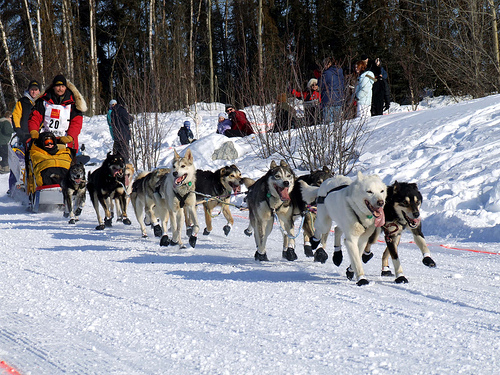
Annual Iditarod Trail Sled Dog Race
Togo was a Siberian Husky, his coat was black, brown, and gray, and he weighed about 48 pounds (22 kg). Seppala’s lead dog during the 1914 All-Alaska Sweepstakes, and was a precocious leader. At the time of the serum run Togo was twelve years old.
Within that entry, under the sub-heading of the Great Race of Mercy is this,
The first batch of 300,240 units of serum was delivered by train from Anchorage to Nenana, Alaska, where it was picked up by the first of twenty mushers and more than 100 dogs who relayed the serum a total of 674 miles (1,085 km) to Nome.
Togo and Seppala traveled 170 miles (274 km) from Nome in three days, and picked up the serum in Shaktoolik on January 31. The temperature was estimated at −30 °F (−34 °C), and the gale force winds causing a wind chill of −85 °F (−65 °C).
The return trip crossed the exposed open ice of the Norton Sound. The night and a ground blizzard prevented Seppala from being able to see the path but Togo navigated to the roadhouse at Isaac’s Point on the shore by 8 AM preventing certain death to his team. After traveling 84 miles (134 km) in one day, the team slept for six hours before continuing at 2 AM.
Before the night the temperature dropped to −40 °F (−40 °C), and the wind increased to 65 mi/h (105 km/h). The team ran across the ice, which was breaking up, while following the shoreline. They returned to shore to cross Little McKinley Mountain, climbing 5,000 feet (1,500 m). After descending to the next roadhouse in Golovin, Seppala passed the serum to Charlie Olsen, who in turn would pass it to Gunnar Kaasen and Balto.
A web search for ‘Togo’ including a mention on a website called Find A Grave that has this,
Birth: Oct., 1913
Death: Dec. 5, 1929, Poland Spring, Androscoggin County, Maine, USA
A sled dog for Leonhard Seppala. In 1925, When a diphtheria out brake happened in Nome Alaska. Seppala, Togo and a team of dogs ran to Nenana. He ran 10 times the distance of a average sled run. However another dog named Balto got nearly all of the fame. After the run, Seppala sold Togo to a friend in Poland Spring Maine were Togo was euthanized on December 5th 1929. He was stuffed and was put on display at Yale University. He was eventually moved to the Iditarod Trail Sled Dog Race Museum in Wasilla Alaska, where he is today.
Burial: Iditarod Trail Sled Dog Race Museum, Wasilla, Matanuska-Susitna Borough, Alaska, USA
A reflection on why living in harmony with Planet Earth seems so challenging.
John Hurlburt is the ‘mover and shaker’ behind a series of talks and discussions under the overall title of Everything Fits Together, part of the adult education umbrella of St Paul’s Episcopal Church here in Payson, AZ. John generously asked if I would lead the discussion tonight (19th) along the theme of Nature and Faith. I plan to close the session with these words and the compelling video that was on Learning from Dogs last Friday A planet worth protecting.
oooOOOooo
Man – a study in behaviours.
The relationship between Planet Earth and man goes back a very long way. But what of today?
There is little doubt that many people, even with the minimum of awareness about the world in which we live, are deeply worried. On so many fronts there are forbidding and scary views. It feels as though all the certainty of past times has gone; as if all the trusted models of society are now broken. Whether we are talking politics, economics, employment or the environment, nothing seems to be working.
Why might this be?
It would be easy to condemn man’s drive for progress and an insatiable self-centredness as the obvious causes of our society failing in widespread ways. But in my view that’s too simple an explanation. It’s much more complex.
I propose that the challenges we all face today have their roots in the dawning of our evolution. Let’s remind ourselves how far back that goes.
The earliest documented members of the genus Homo are Homo habilis which evolved around 2.3 million years ago. Homo habilis was the first species for which we have positive evidence of the use of stone tools.
A theory known as Recent African Ancestry theory, postulates that modern humans evolved in Africa possibly from Homo heidelbergensis and migrated out of the continent some 50,000 to 100,000 years ago, replacing local populations of Homo erectus and Homo neanderthalensis.
Thus for tens of thousands of years, the behaviours of humans have served our species well, by definition. Ergo, mankind has evolved as the result of mankind’s behaviours. Behaviours that may have changed little over those countless years.
So one might speculate that these behaviours have been potentially damaging to the ultimate survival of our species, perhaps hugely damaging, for a very long time. But because man’s population footprint has been so small for 99% of eternity the consequences have not impinged on the planet until now. Let’s reflect on those population figures.
Until the development of agriculture, around the 11th millennium BC, the world population was stable at around one million persons, as man lived out a subsistence hunter-gatherer existence. By about 2000 years ago the global population of man had climbed to around 300 million. It took another 1,200 years for that global population to reach the first billion, as it did in 1804.
However, just 123 years later, in 1927, the two-billionth baby was born. The three-billionth baby was born in 1960, just 33 years later! Only a further 14 years slip by for the four-billionth baby to be born in 1974. Another blink of the geological eyelid and 13 years later, in 1987, along comes the five-billionth bundle of joy. Around October 1999, the sixth-billionth baby is born! It is likely that we are in a world where there are now seven billion people! Indeed, the world population clock estimates that on September 12th, a week ago, the world population was 7,039,725,283 persons.
About a billion every decade. The equivalent of a growth of 100 million each and every year, or around 270,000 every single day! Or if you prefer 11,250 an hour (Remember that’s the net growth, births minus deaths, of the population of humans on this planet!)
Combine man’s behaviours with this growth of population and we have the present situation. A totally unsustainable situation on a planet that is our only home.
The only viable solution is to amend our behaviours. To tap into the powers of integrity, self-awareness and mindfulness and change our game.
All of us, no exceptions, have to work with the fundamental, primary relationships we have with each other and with the planet upon which we all depend. We need the birth of a new level of consciousness; of our self, of each other and of the living, breathing planet. A new consciousness that will empower change. We need spiritual enlightenment. We need a spiritual bond with this beautiful planet.
Over eons of time, Planet Earth has favoured our evolution. Now, today, not tomorrow, it is time to favour our beautiful planet with our love and with our faith. It is the ultimate decision for our species.
oooOOOooo
If you need a reminder of how beautiful our planet is (and I’m sure the majority of LfD readers don’t require that reminder) then go back and watch David Attenborough’s video and voice-over to the song What a Wonderful World.
I will close by inserting into this post, the video that Martin Lack included in a recent comment to my post The wind doth blow!
I admit to being too free with my silly clichés including, “I can predict anything unless it involves the future!” So now that millions of informed people have the benefit of “20:20 hindsight“, why is it years since the banking crisis first erupted and we are still without a root and branch overhaul of the governance of the industry?
Did you see Per Kurowski’s interview with a leading regulator on Learning from Dogs yesterday? Aren’t we so slow to learn!
Anyway, I waffle on! Let me get to the point of today’s post.
Back on the 1st September, there was a post called Understanding Europe. One of the resulting commentators was Pendantry who is author of a blog called Wibble. He included a link to a poem that he wrote on the 28th February, 2009! The fact that the poem is still so relevant (and when we see what’s happening in Europe perhaps even more relevant now!) is truly shocking. I wanted to republish it which I do with the kind permission of Pendantry. Here it is.
oooOOOooo
House of cards
When the inevitable strikes,
when the house falls down,
do you patch up the walls,
fix the holes in the roof,
shore it all up,
splash it with paint?
No.
You learn from the mistakes.
You start from scratch.
You call in the architects.
You rebuild the foundations.
You use new materials;
replace wattle and daub
with a sounder design.
Unless:
Because you’re lost outside the box,
and your mates demand
to regain their riches (and, now!):
You set up the same as before,
perhaps with a few bells and whistles
(spun to persuade that they’ll work).
And… in the end, we’ll believe
that your clothing is not invisible.
“Who is more foolish?
The fool, or the fool who follows him?”
oooOOOooo
Written over three years and five months ago. Shame on us all!
Like millions of others on this planet, I was held spellbound by the historic and epic moment of man placing his mark on another heavenly body, the Moon. I had been so wrapped up in NASA’s space missions that I took a holiday from work (I was working at the time for ICIANZ in Sydney, Australia) for the week of July 16th, 1969.
It was, of course, July 16th when the Apollo 11 Mission launched from the Kennedy Space Center culminating at precisely 20:17:39 UTC on July 20, 1969, the moment when the Lunar Module made lunar contact.
But in terms of me writing my own obituary for Neil, what could I offer?
Then a couple of items changed my mind.
Neil Armstrong (August 5, 1930 – August 25, 2012)
The first was reading the obituary printed in The Economist. I have long admired the many, many beautiful obituaries that have been published by this newspaper and this one was no exception. Take this extract from the Neil Armstrong obituary,
He had an engineer’s reserve, mixed with a natural shyness. Even among the other astronauts, not renowned for their excitability, he was known as the “Ice Commander”. Mike Collins, one of his crew-mates on the moon mission, mused that “Neil never transmits anything but the surface layer, and that only sparingly.” He once lost control of an unwieldy contraption nicknamed the Flying Bedstead that was designed to help astronauts train for the lunar landing. Ejecting only seconds before his craft hit the ground and exploded, he dusted himself off and coolly went back to his office for the rest of the day. There was work to be done.
Then the beautiful words that bring the obituary to a close,
Earth’s beauty
Over half a century, the man who never admitted surprise was surprised to observe the fading of America’s space programme. The Apollo project was one of the mightiest achievements of the potent combination of big government and big science, but such enterprises came to seem alien as well as unaffordable. Mr Armstrong, who after his flight imagined bases all over the moon, sadly supposed that the public had lost interest when there was no more cold-war competition.
Yet the flights had one huge unintended consequence: they transformed attitudes towards Earth itself. He too had been astonished to see his own planet, “quite beautiful”, remote and very blue, covered with a white lace of clouds. His reserve, after all, was not limitless. One photograph showed him in the module after he and Buzz Aldrin had completed their moon-walk, kicking and jumping their way across the vast, sandy, silver surface towards the strangely close horizon. He is dressed in his spacesuit, sports a three-day beard, and is clearly exhausted. On his face is a grin of purest exhilaration.
” … they transformed attitudes towards Earth itself. He too had been astonished to see his own planet, “quite beautiful”, remote and very blue, covered with a white lace of clouds.” For that reason alone, we need to celebrate the achievement of the Apollo 11 mission for putting our own planet into perspective within the enormity of the universe.
The second item that persuaded me to write this was a wonderful historic insight into how a potential catastrophy on the surface of the Moon would have been handled by President Nixon. This historic item was published on Carl Milner’s blog the other day, the specific item being What if the Moon Landing Failed? Republished with the very kind permission of Carl.
When Richard Nixon was the President of the United States, they had a speech ready for him to deliver to the world just in case the 1969 moon landing had ended in disaster. In fact many experts believed there was a big chance that Neil Armstrong and Edwin ‘Buzz’ Aldrin could have really gotten stuck on the moon. It’s something we don’t really think about now because we all know it was such a success. American Archives have unearthed the speech that would have been delivered if the late great Armstrong and Aldrin had never made it back to earth. This is such a great piece of history that I thought I might never see.
Give it a read, It’s such a moving and well prepared speech, and such a good thing that President Nixon never had to delivered it.
So, as with millions of others, I am delighted that this speech remained unspoken and instead we experienced: “At 5:35 p.m. (US EDT), Armstrong and Aldrin successfully docked and rejoined Collins, and at 12:56 a.m. on July 22 Apollo 11 began its journey home, safely splashing down in the Pacific Ocean at 12:50 p.m. on July 24.”
Neil Armstrong’s legacy is not only being part of the wonderful team that allowed man to make the first footprint on the Moon but also bringing into our human consciousness that this blue, wonderful planet we all live on is the only home we have.
First Full-View Photo of Earth Photograph courtesy NASA Johnson Space Center This famous “Blue Marble” shot represents the first photograph in which Earth is in full view. The picture was taken on December 7, 1972, as the Apollo 17 crew left Earth’s orbit for the moon. With the sun at their backs, the crew had a perfectly lit view of the blue planet.
Strikes me that celebrating July 20th each year as Blue Planet Day might not be a bad idea! Any takers? Now that would be a legacy for Neil!
A stirring set of pictures from the Queen’s Jubilee
At the end of June, pilot friend Bob Derham sent me an email which contained all of what follows. I ‘filed’ it away and then forgot I had received it! My apologies. But as Europe was the subject of yesterday’s post, then maybe this can be seen as remaining on theme. Enjoy.
oooOOOooo
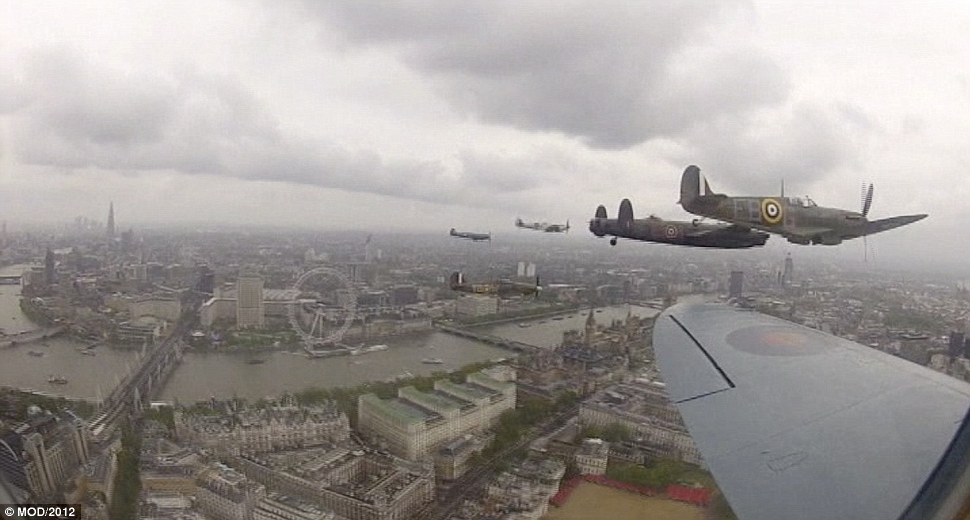
One last look back at those amazing Jubilee celebrations . . . as seen by the ‘Tail-end Charlie’ in Britain’s last airworthy Lancaster
Incredible footage has been released showing the bird’s eye view enjoyed by the crew aboard a Lancaster bomber flying over London for the Queen’s Diamond Jubilee celebrations.
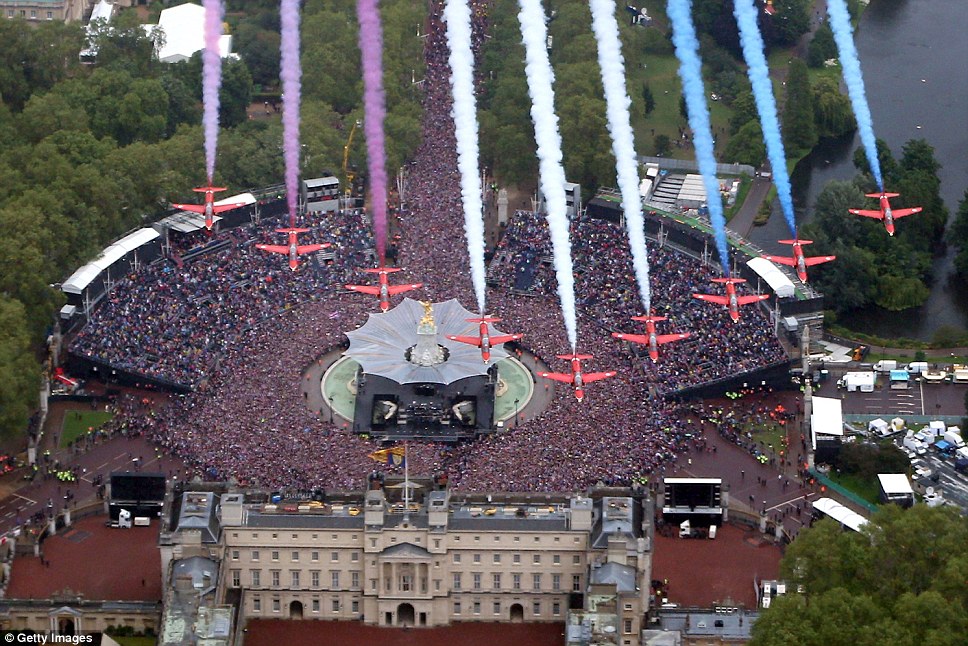
The aeroplane, which is part of the RAF’s Battle of Britain Memorial Flight (BBMF), flew in formation with aircraft including a Spitfire, Hurricane and Dakota transport aircraft down The Mall, followed by the Red Arrows aerobatic team – to the delight of crowds and the Royal Family at Buckingham Palace below.
As well as preserving a fleet of priceless aircraft and keeping them in tip-top flying condition, the BBMF reminds the nation of the sacrifices made during World War Two.
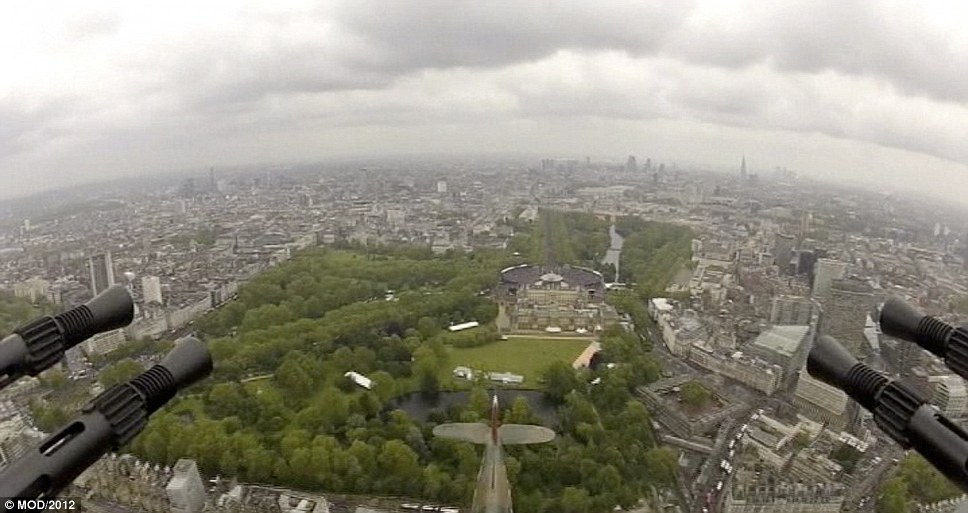
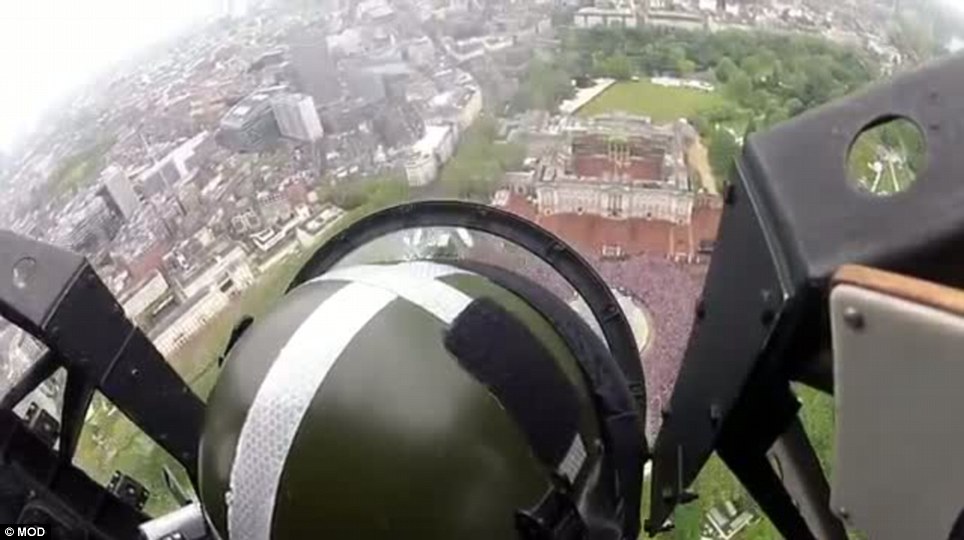
Spectacular: The tail gunner’s view from the Lancaster bomber, as it completed the Diamond Jubilee flypast. Buckingham Palace Gardens can be seen behind the tail of a Hurricane fighter, also of the Battle of Britain Memorial Flight, which flew in formation with the LancasterFinal approach: Having lined up on The Mall, the RAF Battle of Britain Memorial Flight Lancaster flies towards Buckingham Palace with St James’ Park on the left and Birdcage Walk beyond.The nose of the Lancaster passes over the Memorial to Queen Victoria in front of Buckingham Palace.
The BBMF is based at RAF Coningsby in Lincolnshire with many of its personnel, including pilots, acting as volunteers; the flight costs about £3m a year to run.
Squadron Leader Ian Smith, who is in charge of the BBMF, is the only permanent member, with all of the remaining pilots, navigators, air engineers and other crew coming from different airbases and ordinarily flying several different types of aircraft; from Typhoon fighters to the huge Hercules transport plane.
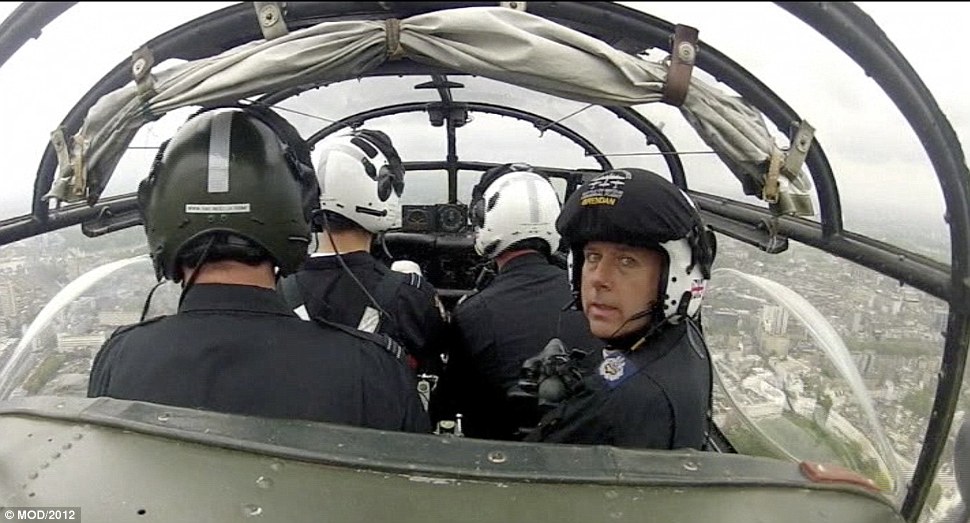
Cramped: The footage shows just how tight a fit it can be aboard a vintage aircraft and what a tight squeeze it is for the crew aboard the Lancaster bomber.
The aircrew give up three out of every four weekends from May to the end of September in order to fly and display the historic aircraft.
The footage, released by the Ministry of Defence, shows just how tight a fit it can be aboard a vintage aircraft, with the crew – clearly eager to catch a glimpse of the Queen – taking up most of the available space.
The historic flight includes the Lancaster, which first saw service in 1942. The ‘Lanc’ was the most famous of the Second World War bombers and gained renown for its starring role in the momentous ‘Dambuster’ raid on Germany’s Ruhr Valley in 1943.
Carrying a payload of 22,000lb and with a 1,500-mile range, the RAF bomber wreaked havoc on Germany. Some 3,500 were lost in action during the war.
The view of Buckingham Palace and The Mall beyond from the Lancaster bomber.In formation: Incredible footage has been released showing the view enjoyed by crew aboard a Lancaster bomber flying over London for the Queen’s Diamond Jubilee celebrations.
Hurricane single-seater fighters played a crucial role in the Battle of Britain. Heavier and slower than the Spitfire, it was considered the RAF’s ‘workhorse’ against the Luftwaffe.
A remarkable total of 14,533 Hurricanes were built and served operationally on every day and in every theatre during the war. Only 12 are still airworthy worldwide.
The Spitfire is the iconic fighter that won legendary status against the Luftwaffe in the Battle of Britain. It possessed a top speed of 378mph, an altitude of 35,000ft and armed with two 20mm cannons, four Browning machine guns and two 250lb bombs.
One of the four that flew yesterday was P7350 – the oldest airworthy Spitfire in the world and the only one which actually fought in the Battle of Britain. It was shot up by a Messerschmitt 109 during combat in October 1940 but its wounded Polish pilot Ludwik Martel managed to crash-land it, wheels up, near Hastings.
The pride of Britain: The vintage planes – all powered by classic World War Two Merlin engines – roar across the London sky.Flypast: The Duchess of Cornwall, the Prince of Wales, the Queen, the Duke and Duchess of Cambridge and Prince Harry watch the aerial action.Aerobatic aces: The Red Arrows display team fly in formation over Buckingham Palace.Stirring image: The Lancaster, centre, was accompanied by two Spitfires on both flanks and tailed by a Hurricane.
oooOOOooo
A wonderful and incredibly nostalgic set of photographs. Finally, let me close with a short piece of video of that Lancaster Bomber in flight.
Strange theory reveals secrets of the universe, the logic of sycamore leaves and why even smart people struggle with new ideas.
A guest post from Pete Aleshire, Editor, Payson Roundup.
Introduction
The Payson Roundup is our local newspaper here in Payson, AZ. I first saw this article by Pete a couple of weeks ago and was just utterly engrossed by it. Not just the tantalising peek into a physics I know so little about but the beautiful prose. The latter is not surprising because as well as being editor of the paper, Pete also teaches the creative writing course at our local college. Jean and I had the benefit of attending the course, I guess about a year ago, and therefore can speak from experience.
So settle down and enjoy.
oooOOOooo
I finally got Drake Larson together with both sycamore leaves and Payson Mayor Kenny Evans. Moreover, I have been entrusted with a formula that may win me an invitation to Oslo if Drake gets a Nobel Prize.
But even if that don’t work out, I did get to eavesdrop on Drake and Evans. Quite the event, from my bemused point of view, since it shed light on dangerous delights of outside-the-box thinking and the Nature of the Universe.
But wait. You look confused.
Let me back up — and start somewhere closer to the beginning. Be patient with me — by the time we’re done, you’ll realize why God’s a math nerd, one surprising secret of Dark Energy, why farmers become original thinkers and what sycamore leaves tell us about the universe.
But first, I have to explain about Drake.
We grew up together, getting into (and mostly out of) various varieties of trouble. Very early on, I realized that he was much (much) smarter than me. This initially really irritated me, as I was previously inclined to vanity about my intelligence. Turns out, I love learning stuff other people have discovered, but Drake only gets truly excited when he has hold of a completely new idea that no one else can quite grasp. This prepared me, as it turns out, for meeting Kenny Evans — but that’s getting ahead of the story.
Drake and I grew up doing math homework together, before I wandered off into a career in newspapers. He got his degree in mathematics, turned down a job with the RAND Corporation and took up growing table grapes.
But he never quit picking at the lock of the universe.
Years ago when I was the science writer for the Oakland Tribune, he came to me all excited about a set of formulas he had. I did my best to follow the two pages of calculations, but all I can tell you is that they described instabilities of any sphere with uniform density. He predicted that when the Voyager spacecraft reached Jupiter, it would report inexplicable turbulence at a certain depth in the atmosphere. I ran his numbers past various top-level physicists and mathematicians who couldn’t find a flaw in his formulas — but concluded that it had to be wrong since it led to a violation of the keystone laws of conservation of mass and energy.
But I took note some months later when the Voyager spacecraft reported mysterious levels of turbulence deep within the atmosphere of Jupiter.
The years passed. Drake kept growing grapes, flowers, dates and vegetables — and working on his calculations. He wrote a book, “The Cults of Relativity,” in which he described a few of his theories, delighted in the conundrums of mathematics and pondered the curious resistance of even smart people to unconventional ideas.
We got together again recently. I took him down to Fossil Creek, all overhung with sycamores with the rustle of floppy, five-pointed leaves. Drake was his old self on our Fossil Creek tour as he tried to show me math’s beauty around us, although I was but a blind man clutching the tail of his mathematical elephant.
He had now connected his formulas to dark energy, a still hypothetical form of energy invoked by desperate cosmologists to explain the startling observation that the expansion of the universe is actually accelerating. To explain this seeming impossibility, they invented “dark energy” — which they figure pervades the universe and at certain densities creates a repulsive force stronger than the attractive force of gravity.
Anyhow, here’s the point: Drake was in awe that his mathematical wanderings offered a way to calculate dark energy’s cap within earth — it happened to be an “inside is now outside” inversion of Isaac Newton’s simplest integral. No. Please. Don’t ask me to explain that. But earth’s dark energy cannot exceed 17 pounds per square inch at a depth of about 1,500 miles. He’s been working with University of Southern California computer crunching guru professor Barry Boehm, and the University of California at Riverside geophysics professor Shawn Biehler on its implications. Among other things, it could explain the perplexing observation that major earthquakes increase the earth’s rotation rate.
No one knows how to measure such a quantity at present. Someday they will. If it turns out that 17 pounds per square inch is a relevant benchmark for earth’s dark energy, then this column will maybe win Drake the Nobel — and I’ll get to dress up and attend the ceremony.
So Drake and I spent the day wandering along the banks of Fossil Creek as he kept trying to come up with metaphors so I could grasp math’s secret within the beauty of Fossil Creek’s sycamore leaves. The well-designed sycamore leaves adhere to the Fibonacci sequence, a mysterious progression of numbers that crops up throughout nature — from the spiral of a nautilus shell to the layout of the ruins of Chaco Canyon.
So I figured I’d just write this — and get earth’s 17 PSI cap for dark energy out there in the time/date/ stamped world.
Oh, yeah: And about Kenny Evans.
So that night, I took Drake to the Payson council meeting. Turns out, Drake’s family was growing grapes in the Coachella Valley at the same time Evans was farming 10,000 acres in Yuma. They both managed to survive that tempestuous time when the United Farm Workers union organized agriculture workers.
I introduced them and listened as they recalled events and figured out whom they knew in common.
It was then that I decided to blame Drake for my faith in Evans’ ridiculous conviction that a university will build a campus here in this itty bitty tourist town — complete with a research center and convention hotel. No sensible small-town mayor would risk public ridicule while spending thousands of hours on such an outside-the-box notion … unless he’d learned to gamble on dreams and hard work during all those years as a farmer.
Evans’ notion is almost as silly as a farmer who calculates the amount of dark energy emanating from earth, while credentialed experts scratch their collective heads.
Still, I’m thinking maybe I’ll get a nice suit jacket — something I can wear to both the university’s groundbreaking and the ceremonies in Oslo.
Hey, never hurts to be prepared.
oooOOOooo
A big thank-you for the permission to republish this on Learning from Dogs. I have no doubt that many LfD readers enjoyed it as much as I did! Stay with me for tomorrow when the theme of thinking, innovation and craziness is explored a touch more.
Pat Shipman showing how animals were intimately involved in the development of early humans.
Yesterday’s fascinating post was predominately taken up by a long and deeply interesting essay by Prof. Pat Shipman, The Woof at the Door.
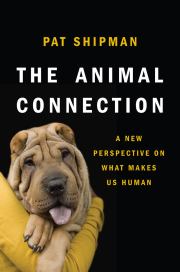
Today, I want to report further on Pat Shipman primarily by looking at her book The Animal Connection.
What makes us human?
Let me do no more than quote from page 259,
Domesticating animals provided a new sort of benefit. They were living tools first and meat sources later, only when their useful lives were over or circumstances required. The crucial importance of animal domestication in modern life shows that our relationship with animals selected for a set of communication skills and abilities to observe, draw conclusions and make connections among different observations that had been increasingly important since at least 2.6 million years ago. The relationship between such skills and modern behaviors that characterize humanity is clear.
Prof. Shipman also confirms that the first domestication was of the dog at 32,000 years ago and goes on to say,
Other types of domestic animals provide enhanced protection for people, dwellings, stored crops, and other livestock. Dogs and cats are the obvious examples, but herders have recently started touting llamas as guardians for flocks of sheep.
The domesticated carnivores also provide important assistance in hunting. Dogs are better trackers than humans; they are faster runners, take larger prey, and will hunt with humans. Cats hunt solitarily and are far superior to humans at catching rodents that can decimate crops or carry disease. Dogs hunt with you; cats hunt for you; but both offer an advantage. (p.254)
As I said, it’s a fascinating book and one that is already reshaping my knowledge about the early evolution of man. And in terms of reshaping knowledge about early man, do go across to Pat Shipman’s Blog, The Animal Connection.
You can read a full review with links to a number of book sellers here. Let me close by using this praise for the book by Jeffrey Moussaieff Masson. (Masson’s book Dogs Never Lie About Love is just a few feet from me as I write this, a deeply moving book for all dog lovers.)
This is what Jeffrey Masson wrote about The Animal Connection,
Pat Shipman has written one of the most important books on the human-animal connection ever. One might even say it is the single most important book, possibly the only one, to look at our deep connection to animals over the entire evolutionary history of our species.
The grandeur of the ancient relationship between dog and man.
A couple of weeks ago, I came across a fascinating article that had been published in American Scientist magazine (online version) written by Professor Pat Shipman. The article provided the background and evidence to support the proposition that dogs may have been man’s best friend for thousands of years longer than we realized.
Very quickly I came across Pat Shipman’s website and learnt that this is one clever lady. As her About page explains,
CAREER SUMMARY
Prof. Shipman
I am internationally known as a paleoanthropologist and conducted research for many years in Africa on human evolution and the animal communities in which humans evolved.
I have conducted research on material from sites in France, Spain, the United States, Java, Ethiopia, Kenya, Tanzania, and South Africa. I have written more than 50 scholarly articles, appearing in journals such as Nature, Science, Journal of Archaeological Science, Paleobiology, Journal of Human Evolution, and Current Anthropology.
I have written more than 100 articles in popular science magazines or newspapers, including The Guardian, The New York Times, The Times Literary Supplement, American Scientist, Discover, and Natural History. Two of my books were featured on the cover of The New York Times Book Review: The Neadertals and Taking Wing. Taking Wing won the Phi Beta Kappa prize for science book of the year and was a runner-up for the LA Times Science Book prize.
My book on Homo erectus, Wisdom of the Bones, was co-authored by Alan Walker and won the Rhone-Poulenc Prize in science writing.
My books have been widely praised as compelling, accessible, and highly readable, with a strong narrative thread. Reviewers frequently comment upon the meticulous research that underpins my books, a feature I consider to be my trademark.
My most recent popular science book, The Ape in the Tree, written with Alan Walker, was called by The Vancouver Sun “part adventure story, part cutting-edge science.” In a Science magazine review, the book was praised as “a fine account of new ways to puzzle out the behaviors of fossilized animals from odd scraps of bone.” Another reviewer raved, “Wonderfully engaging and insightful, The Ape in the Tree, is sure to become a classic in the literature on human origins.” MacArthur fellow John Fleagle wrote in the Quarterly Review of Biology, “Science writing doesn’t get any better than this.” In 2009, this book was awarded the W.W. Howells Book Prize by the American Anthropological Association.
In Britain, my new biography of Mata Hari, Femme Fatale, was selected as The Book of the Week by BBC radio. Each day during the week, an actress gave dramatic readings from the book on the air for fifteen minutes.
With The Animal Connection, I return to paleoanthropology and consider the influence of our connection with animals on human evolution and the origin of modern human behavior.
See what I mean!
Anyway, as you can readily understand, as the author of a blog that writes about what we can learn from this ancient relationship between the dog and man, it struck me as wonderful if I might be permitted to republish in full that article. Prof. Shipman promptly gave me such permission.
So today, I am doing just that and tomorrow I want to write more about Pat Shipman’s latest book, The Animal Connection.
oooOOOooo
The Woof at the Door
Dogs may have been man’s best friend for thousands of years longer than we realized
It’s funny how much difference a single letter makes. A “woof” at the door is a very different thing from a wolf at the door. One is familiar, domestic, reassuring; the other is a frightening apparition of imminent danger. The distinction between our fond companions and the ferocious predator of northern climes goes back a long way.
Dogs are descended from wolves, probably the gray wolf. Some scientists argue that, because dogs and wolves can and do interbreed, they shouldn’t be considered to be separate species at all. They believe that domestic dogs are only a subspecies or variant of the gray wolf, Canis lupus, and ought to be called Canis lupus familiaris (the familiar or domestic wolf) instead of Canis familiaris (the familiar or domestic dog). Although the ability to interbreed and produce fertile offspring is a tried-and-true criterion for recognizing that two populations are really variants of a single species, the reality is more nuanced. We cannot know whether dog-wolf hybrids will thrive and survive, or die out, in the long run.
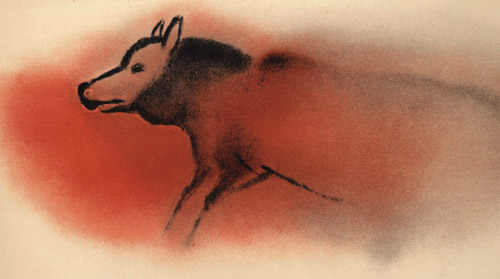
Prehistoric cave paintings rarely depict wolves or other carnivores. This watercolor tracing of a cave painting was made by the archaeologist Abbé Henri Breuil in the early 1900s from the Grotte de Font-de-Gaume in France. The 17,000-year-old cave paintings number about 250 and mostly show bison and mammoths—only one is thought to be a wolf. Canids may have been domesticated by this point; it is possible that portraying wolves and humans was taboo. Paul Bahn
Certainly we expect to be able to distinguish a dog from a wolf if we see one. Of course, domestic dogs are wildly variable in size and shape, thanks to several hundred years of selective breeding. Some have long, fluffy coats; others have tightly curled, nearly waterproof coats and webbed feet. Some are leggy and swift, whereas others are solid, stoutly built guard dogs. Some fit neatly into a pocketbook, but others barely fit into a compact car. As Robert K. Wayne of the University of California at Los Angeles declares, “Dogs show more diversity in appearance than any other mammal.”
What is it that tells us this animal is “dog” and that one is “wolf?”
Modern wolves and dogs can be distinguished reasonably easily by their appearance. The most telling feature of dogs is the snout, which is significantly shorter and wider than wolves’ snouts. Only a few dog breeds with extremely elongated, slender snouts, such as Irish wolfhounds, surpass wolves in “snoutiness.”
But a crucial part of the difference we perceive is in the animals’ manner and attitude towards humans. Domesticated dogs are just that: canids that live in the house or domicile of humans. They are genetically disposed to seek out human attention and approval and to accept human leadership. Wolves are not.
How did this important change come about? Probably in the distant past, humans took in a wolf cub, or even a whole litter of cubs, and provided shelter, food and protection. As the adopted cubs matured, some were aggressive, ferocious and difficult to handle; those probably ended up in the pot or were cast out. The ones that were more accepting of and more agreeable to humans were kept around longer and fed more. In time, humans might have co-opted the natural abilities of canids, using the dogs’ keen noses and swift running skills, for example, to assist in hunting game. If only the most desirable dogs were permitted to breed, the genes encoding for “better” dogs would continue to be concentrated until the new domesticated species (or subspecies) was formed.
Time to Tame
The creation of a domestic, useful, familiar canid by years of selectively breeding wild and terrifying wolves was almost certainly unplanned. The wolf at the beginning of the process of domestication was tamed—made individually docile—but the essential fact is that, over time, the offspring of those initial wolves were genetically inclined to be more tractable.
Domestication was one of the most brilliant accidents in the entire history of humankind. What’s more, we got it right the first time: Dogs were the original trial animal, and successful product, of such an accident—the happy outcome of years of unwitting experiments and dumb luck.
How long does domestication take? Nobody knows. In an experiment, Russian biologists kept a breeding colony of silver foxes and intentionally selected for breeding those with the least fear and the least aggression toward humans. After 10 generations, 18 percent of the foxes sought human contact and showed little fear. After 30 or so generations, a “domesticated fox” had been created.
The catch is that this experiment was deliberate and strictly controlled. The foxes could not breed with wild foxes and dilute the changing gene pool. Human contact was minimized so animals could not be tamed by their handlers. And because of the experiment’s scientific intent, no one could say, “Oh this one is so cute, let’s let it breed even if it is a little aggressive.” So in the case of dogs, without all these controls, the process could have taken much longer.
Another way of estimating the time at which domestic dogs originated is to consider their genetic differences from wolves. One prominent group of researchers, including Robert Wayne, along with Carles Vilà of the Uppsala University in Sweden and their collaborators, initially estimated in 1997 that dogs diverged from gray wolves 100,000 to 135,000 years ago. After more study, they revised their divergence date to between 40,000 and 100,000 years ago. Another group, led by Peter Savolainen of the Royal Institute of Technology in Sweden, favored the Chinese wolf, a subspecies of the gray wolf, as the probable ancestor and estimated in 2002 that it was domesticated between 15,000 and 40,000 years ago.
How do these genetic estimates stack up against the fossil record? Until 2009, the oldest known remains of domestic dogs were two adult skulls dated to between 13,000 and 17,000 years ago, from Eliseevichi, a region in Russia. Both had the relatively broad, short snout typical of dogs, and both were large, heavy animals, nearly the size of great Danes.
Then a team led by Mietje Germonpré of the Royal Belgian Institute of Natural Sciences reported a stunning new finding in the February 2009 issue of Journal of Archaeological Science: a nearly complete fossil dog skull dated to 31,680 + 250 years ago.
Another Look
Germonpré and her colleagues thought that researchers might have overlooked early prehistoric dogs in the fossil record of the Upper Paleolithic, so they analyzed skulls of large canids (wolves or dogs) from various European sites. The Upper Paleolithic time period spanned 40,000 to 10,000 years ago and is divided into sections based on the artifacts from those times. By convention, each span is named for a culture of people who made the artifacts, and the people, in turn, are usually named for the geographical location where the artifacts were found. The Epigravettian culture existed from 14,000 to 10,000 years ago; before that, the Magdalenian culture thrived from 18,000 to 10,000 years ago; and skipping back a few sections, the Aurignacian culture occurred from 32,000 to 26,000 years ago.
In order to identify the fossil skulls accurately, Germonpré’s team first analyzed a large reference sample of 48 wild, modern wolves and 53 dogs belonging to 11 different breeds. They also examined five skulls (including the ones found in Eliseevichi) that were firmly established as prehistoric domesticated dogs.
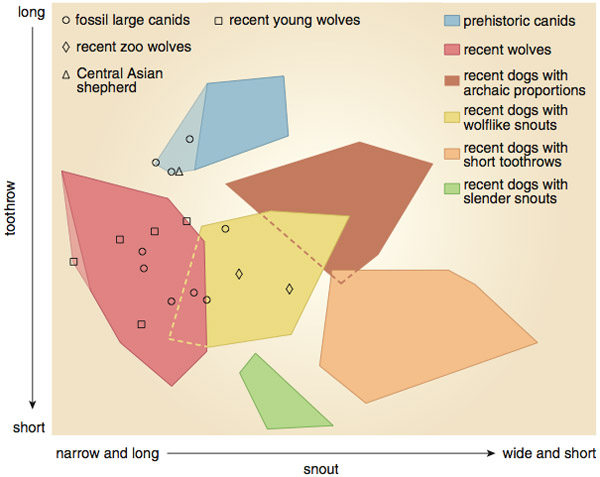
In order to establish the morphological differences between wolves and dogs, a group of researchers led by Mietje Germonpré statistically analyzed skulls from 48 modern, wild wolves and 53 modern dogs from 11 breeds, as well as five skulls that were previously established to be from prehistoric dogs. Recent wolves (pink) and prehistoric dogs (blue) clustered into their own groups, based on the length of their toothrows and the shape of their snouts. Modern dogs clustered into four groups, with some overlap in their areas. Recent dogs with archaic proportions included huskies (brown), recent dogs with wolflike snouts included German shepherds (yellow), recent dogs with short toothrows included great Danes (orange), and recent dogs with slender snouts included doberman pinscers (green). One modern dog, a Central Asian shepherd, clustered with the prehistoric dogs. The group then classified new skulls into the established groupings; examples that fell slightly outside of the ranges but that are statistically likely to be within the group are shown as lighter-shaded areas. Recent young wolves fell into the recent-wolf group, whereas wolves kept in captivity were classifed as recent dogs with wolflike snouts. Fossil canid skulls divided between the recent-wolf group and the prehistoric-dog group, with one falling in the group of recent dogs with wolflike snouts. Stephanie Freese, data courtesy of Mietje Germonpré.
The team used statistical analysis of cranial and dental measurements on the skulls to sort the reference sample into six natural clusters. One cluster contained modern wolves. Another consisted of recent dogs of archaic proportions (such as chow-chows and huskies); a single specimen of a Central Asian shepherd was closer to this group than any other but fell outside it. A third cluster included dogs, such as German shepherds and malinois, which have wolflike proportions. These three groups overlapped each other in their cranial proportions. A fourth group of modern dogs has short toothrows—the length of the jaw that contains teeth—and includes such breeds as great Danes, mastiffs and rottweilers. This group overlapped slightly with the archaic-proportioned dog group but not with the others.
The fifth and sixth clusters were completely separate from all others. One consisted of dogs with extremely long, slender snouts, such as Doberman pinschers. The final group, which had long toothrows and short, broad snouts, was made up of the prehistoric dogs. Statistically, the team’s ability to identify any individual specimen as belonging to the correct group was highly significant and accurate.
Using these clusters as reference categories, Germonpré and colleagues used a statistical technique (called discriminant function analysis ) to assign 17 unknown fossil canid skulls to the established categories. Not all of the “unknowns” were truly unknown, however. Five were immature modern wolves that might have had different proportions because of their age, two were wolves that had been kept in captivity, and one was the Central Asian shepherd that didn’t cluster into any of the groups. Additional unknowns were 11 fossil skulls from sites in Belgium, the Ukraine and Russia, although two of these fossil skulls proved to be too incomplete to classify.
The technique correctly classified all of the immature wolves as wolves, but the two zoo wolves were classified as recent dogs with wolflike snouts. Five of the fossil skulls also fell easily into the modern wolf group; although two of these specimens fell into the region of measurements that overlapped with the group of recent dogs with wolflike snouts, they had a higher statistical probability of being wolves. One fossil skull fit directly into the group of recent dogs with wolflike snouts, even though this specimen was clearly ancient.
The remaining three fossil skulls—one from Goyet Cave in Belgium and one each from Mezin and Mezhirich in the Ukraine—resembled each other closely. All three were classified as prehistoric dogs with probabilities of 99 percent, 73 percent and 57 percent, respectively, as was the (modern) Central Asian shepherd, with a 64 percent probability. In addition, the Mezin skull was odd enough in appearance (for a wolf) that another researcher has suggested it might have been a captive wolf. Germonpré and her team were delighted with these results.
The group also successfully extracted mitochondrial DNA (mtDNA) from seven ancient canid bones from Goyet Cave and Trou des Nutons in Belgium. Rather than damage precious skulls, they sampled only bones in which wolves and dogs differ little, so they presumed all of those they sampled for mtDNA were wolves. From each sample, they sequenced a segment of the mtDNA that is highly variable in living wolves and dogs. Each fossil had a unique mtDNA sequence, or haplotype , in this region, which could not be matched with any known sequences for modern wolves (of which there are about 160) or modern dogs (of which more than 1,000 exist) stored in GenBank, a database of all publicly available nucleotide sequences.
“I was not so surprised at the rich genetic diversity of the fossil wolves,” says Germonpré, because there have been other studies with similar findings. Foxes and wolves underwent a severe bottleneck in population size at the end of the last Ice Age, and many genetic lineages went extinct at this time.
“But we were surprised at the antiquity of the Goyet dog,” Germonpré adds. “We expected it would probably be Magdalenian,” perhaps 18,000 to 10,000 years old. This outcome would fit with their results for the Mezin and Mezhirich skulls, which were found with Epigravettian artifacts roughly 14,000 to 10,000 years old. When the age of this specimen from Goyet was directly dated using accelerated mass spectroscopy radiocarbon-dating techniques, the team found that it was not 18,000 years old, but almost twice as old as the next oldest dog, placing the Goyet dog in the Aurignacian period.
A Time of Change
The Goyet dog fossil shows that the domestication of the first animal was roughly contemporaneous with two fascinating developments in Europe.
Around this time, Europeans began producing objects that are recognizable as art. Some of the earliest known art objects from Europe include the remarkable cave paintings of Chauvet Cave in France, the oldest of which were made 32,900 ± 490 years ago. None of the hundreds of glorious Chauvet paintings show wolves. However, the cave preserves something even more haunting: the footprints of a human child about four-and-a-half feet tall, as well as many footprints of large canids and bears.
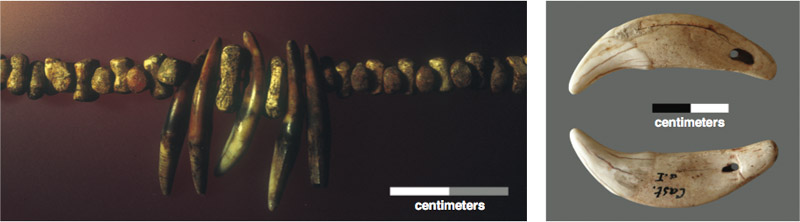
Around 33,000 years ago, humans began perforating teeth for use in decoration. Although canid teeth made up a very small percentage of the total fauna teeth available, they were used in a majority of the ornaments. Fangs from foxes and wolves appear to have been favorites. One example of a perforated wolf tooth (shown in two views at right) is from Abri Castanet in France and has been dated to 33,000 years ago. A strand of beads interspersed with fox teeth came from the Russian site of Sungir and has been dated to 24,000 years ago (left). There is no specific evidence that canid teeth were used in necklaces; the fox-teeth strand may have been a belt. Randall White
Michel-Alain Garcia of the Centre National de la Recherche Scientifique in Nanterre noticed in 1999 that one track of canid prints appears to accompany the child’s prints. These canid prints, unlike the others, have a shortened middle digit on the front paw: a characteristic of dogs. Garcia suggested that the child and dog might have explored the cave together. Charcoal from a torch the child carried is 26,000 years old.
The Upper Paleolithic cultures of Europe are famous for the flowering of all kinds of exquisite art: sculptures, carvings, paintings and engravings. Animals are common and readily recognizable subjects. Prehistoric art expert Paul Bahn notes that depictions of carnivores, including wolves or dogs, and of humans are rare. Bahn conjectures that portraying wolves and humans might have been taboo.
Anne Pike-Tay of Vassar College offers another perspective. She observes that the scarcity of artistic depictions of carnivores parallels their scarcity in the fossil faunas of the Upper Paleolithic. If domesticated dogs were helping humans hunt, she speculates that they might have been placed in a completely different symbolic category from other animals.
“What if dogs were put in the ‘human family’ category as an extension of the hunter, and like humans, warranted no (or very few) painted or engraved depictions?” she wonders.
The second development of the Aurignacian period is the appearance of objects of personal adornment: jewelry. Although beads and perforated objects occurred much earlier in Africa, the earliest such objects in Europe appeared about 40,000 years ago. At 33,000 years ago, early Aurignacian people began perforating animal teeth (and occasionally human teeth) to wear as pendants or other ornaments, such as belts.
Which teeth did they choose? Among their favorite sources are what have been identified as fangs of foxes and wolves. These identifications might better be termed “small or large canids,” because until now no one has considered the possibility that dogs might have been domesticated so long ago. Besides, identifying a single canid tooth specifically as dog or wolf would be difficult, if not impossible.
Randall White of New York University argues that Aurignacian and later people chose to wear objects that displayed their identity or membership in a certain group or clan. Like gang colors or a t-shirt that proclaims its wearer to be a fan of a particular band, ancient people wore things that made their allegiances clear.
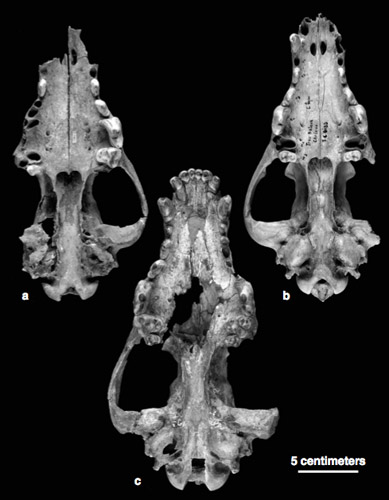
Fossils have helped to establish a far earlier timeframe for dog domestication. A paleolithic canid skull from Goyet in Belgium, about 31,000 years old, has traits characteristic of a dog rather than a wolf (a). When compared to wolves from a similar era, one from Trou Ballu (b) and one from Trou des Nutons (c) in France, the Goyet dog has a relatively wider snout and larger carnassial teeth, and it also has a wider braincase. Elsevier Ltd.
White observes that the teeth Aurignacian people chose to wear were obviously not a random sample of the animals in the fauna. For example, the fauna from the Grotte des Hyènes (Cave of Hyenas) at Brassempouy, France, is dominated by horses, aurochs (a type of cattle) and reindeer—mostly as food remains that often show cutmarks or charring—as well as hyenas, which probably lived in the cave when humans did not. Wolves are rare, making up less than 3 percent of the total fauna. Of approximately 1,600 animal teeth at Brassempouy, only about 2 percent were modified for use as ornaments. However, nearly two-thirds of the ornaments are teeth of wolves or foxes. The rest of the perforated teeth are from other rare species: bear, humans and red deer. None of the teeth of the most common species were used as ornaments at Brassempouy.
Did someone who wore a perforated canid tooth 33,000 years ago proclaim him- or herself to be one of the group that domesticated dogs?
Possibly. Domesticating dogs was a remarkable human achievement that doubtless provided a definite selective advantage to those who accomplished it successfully. They might well have had reason to brag about their accomplishment by wearing canid teeth.
Bibliography
Germonpré, M., et al. 2009. Fossil dogs and wolves from Paleolithic sites in Belgium, the Ukraine and Russia: Osteometry, ancient DNA and stable isotopes. Journal of Archaeological Science 36:473–490.
Morey, D. F. 1994. The early evolution of the domestic dog. American Scientist 82:336–347.
Ostrander, E. A. 2007. Genetics and the shape of dogs. American Scientist 95:406–413.
Savolainen, P., et al. 2002. Genetic evidence for an East Asian origin of domestic dogs. Science 298:1610–1613.
Trut, L. N. 1999. Early canid domestication: The farm-fox experiment. American Scientist 87:160–169.
Vilà, C., et al. 1997. Multiple and ancient origins of the domestic dog. Science 276:1687–1689.
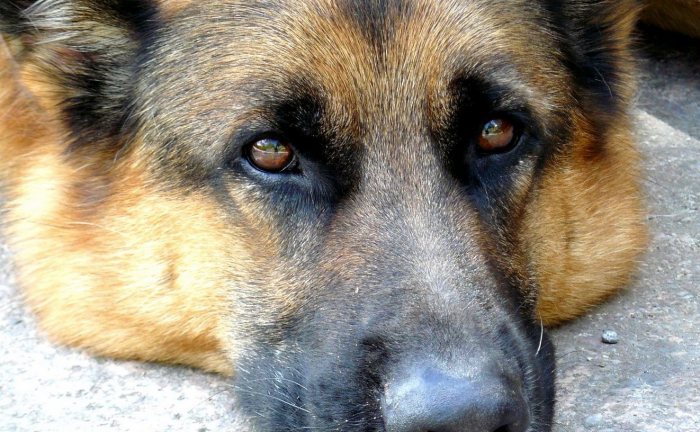
He lay there, on the hard concrete, motionless, his eyes linked to mine. Linking our two very different species in a bond that defied rational description. A bond across not only two radically different creatures but across the tens of thousands of years since species dog embraced species homo sapiens, that is the hunter-gatherer version.
Such history of intimate co-operation shining out from those quiet, wise, brown eyes. Impossible not to sense the linking of souls as each gazed into the eyes of the other. The arm of the man reached behind, found the camera, and captured forever this magic.
The Declaration of Independence, CONGRESS, July 4, 1776.
The unanimous Declaration of the thirteen united States of America,
When in the Course of human events, it becomes necessary for one people to dissolve the political bands which have connected them with another, and to assume among the powers of the earth, the separate and equal station to which the Laws of Nature and of Nature’s God entitle them, a decent respect to the opinions of mankind requires that they should declare the causes which impel them to the separation.
We hold these truths to be self-evident, that all men are created equal, that they are endowed by their Creator with certain unalienable Rights, that among these are Life, Liberty and the pursuit of Happiness.–That to secure these rights, Governments are instituted among Men, deriving their just powers from the consent of the governed, –That whenever any Form of Government becomes destructive of these ends, it is the Right of the People to alter or to abolish it, and to institute new Government, laying its foundation on such principles and organizing its powers in such form, as to them shall seem most likely to effect their Safety and Happiness. Prudence, indeed, will dictate that Governments long established should not be changed for light and transient causes; and accordingly all experience hath shewn, that mankind are more disposed to suffer, while evils are sufferable, than to right themselves by abolishing the forms to which they are accustomed. But when a long train of abuses and usurpations, pursuing invariably the same Object evinces a design to reduce them under absolute Despotism, it is their right, it is their duty, to throw off such Government, and to provide new Guards for their future security.–Such has been the patient sufferance of these Colonies; and such is now the necessity which constrains them to alter their former Systems of Government. The history of the present King of Great Britain is a history of repeated injuries and usurpations, all having in direct object the establishment of an absolute Tyranny over these States. To prove this, let Facts be submitted to a candid world.
He has refused his Assent to Laws, the most wholesome and necessary for the public good.
He has forbidden his Governors to pass Laws of immediate and pressing importance, unless suspended in their operation till his Assent should be obtained; and when so suspended, he has utterly neglected to attend to them.
He has refused to pass other Laws for the accommodation of large districts of people, unless those people would relinquish the right of Representation in the Legislature, a right inestimable to them and formidable to tyrants only.
He has called together legislative bodies at places unusual, uncomfortable, and distant from the depository of their public Records, for the sole purpose of fatiguing them into compliance with his measures.
He has dissolved Representative Houses repeatedly, for opposing with manly firmness his invasions on the rights of the people.
He has refused for a long time, after such dissolutions, to cause others to be elected; whereby the Legislative powers, incapable of Annihilation, have returned to the People at large for their exercise; the State remaining in the mean time exposed to all the dangers of invasion from without, and convulsions within.
He has endeavoured to prevent the population of these States; for that purpose obstructing the Laws for Naturalization of Foreigners; refusing to pass others to encourage their migrations hither, and raising the conditions of new Appropriations of Lands.
He has obstructed the Administration of Justice, by refusing his Assent to Laws for establishing Judiciary powers.
He has made Judges dependent on his Will alone, for the tenure of their offices, and the amount and payment of their salaries.
He has erected a multitude of New Offices, and sent hither swarms of Officers to harrass our people, and eat out their substance.
He has kept among us, in times of peace, Standing Armies without the Consent of our legislatures.
He has affected to render the Military independent of and superior to the Civil power.
He has combined with others to subject us to a jurisdiction foreign to our constitution, and unacknowledged by our laws; giving his Assent to their Acts of pretended Legislation:
For Quartering large bodies of armed troops among us:
For protecting them, by a mock Trial, from punishment for any Murders which they should commit on the Inhabitants of these States:
For cutting off our Trade with all parts of the world:
For imposing Taxes on us without our Consent:
For depriving us in many cases, of the benefits of Trial by Jury:
For transporting us beyond Seas to be tried for pretended offences
For abolishing the free System of English Laws in a neighbouring Province, establishing therein an Arbitrary government, and enlarging its Boundaries so as to render it at once an example and fit instrument for introducing the same absolute rule into these Colonies:
For taking away our Charters, abolishing our most valuable Laws, and altering fundamentally the Forms of our Governments:
For suspending our own Legislatures, and declaring themselves invested with power to legislate for us in all cases whatsoever.
He has abdicated Government here, by declaring us out of his Protection and waging War against us.
He has plundered our seas, ravaged our Coasts, burnt our towns, and destroyed the lives of our people.
He is at this time transporting large Armies of foreign Mercenaries to compleat the works of death, desolation and tyranny, already begun with circumstances of Cruelty & perfidy scarcely paralleled in the most barbarous ages, and totally unworthy the Head of a civilized nation.
He has constrained our fellow Citizens taken Captive on the high Seas to bear Arms against their Country, to become the executioners of their friends and Brethren, or to fall themselves by their Hands.
He has excited domestic insurrections amongst us, and has endeavoured to bring on the inhabitants of our frontiers, the merciless Indian Savages, whose known rule of warfare, is an undistinguished destruction of all ages, sexes and conditions.
In every stage of these Oppressions We have Petitioned for Redress in the most humble terms: Our repeated Petitions have been answered only by repeated injury. A Prince whose character is thus marked by every act which may define a Tyrant, is unfit to be the ruler of a free people.
Nor have We been wanting in attentions to our Brittish brethren. We have warned them from time to time of attempts by their legislature to extend an unwarrantable jurisdiction over us. We have reminded them of the circumstances of our emigration and settlement here. We have appealed to their native justice and magnanimity, and we have conjured them by the ties of our common kindred to disavow these usurpations, which, would inevitably interrupt our connections and correspondence. They too have been deaf to the voice of justice and of consanguinity. We must, therefore, acquiesce in the necessity, which denounces our Separation, and hold them, as we hold the rest of mankind, Enemies in War, in Peace Friends.
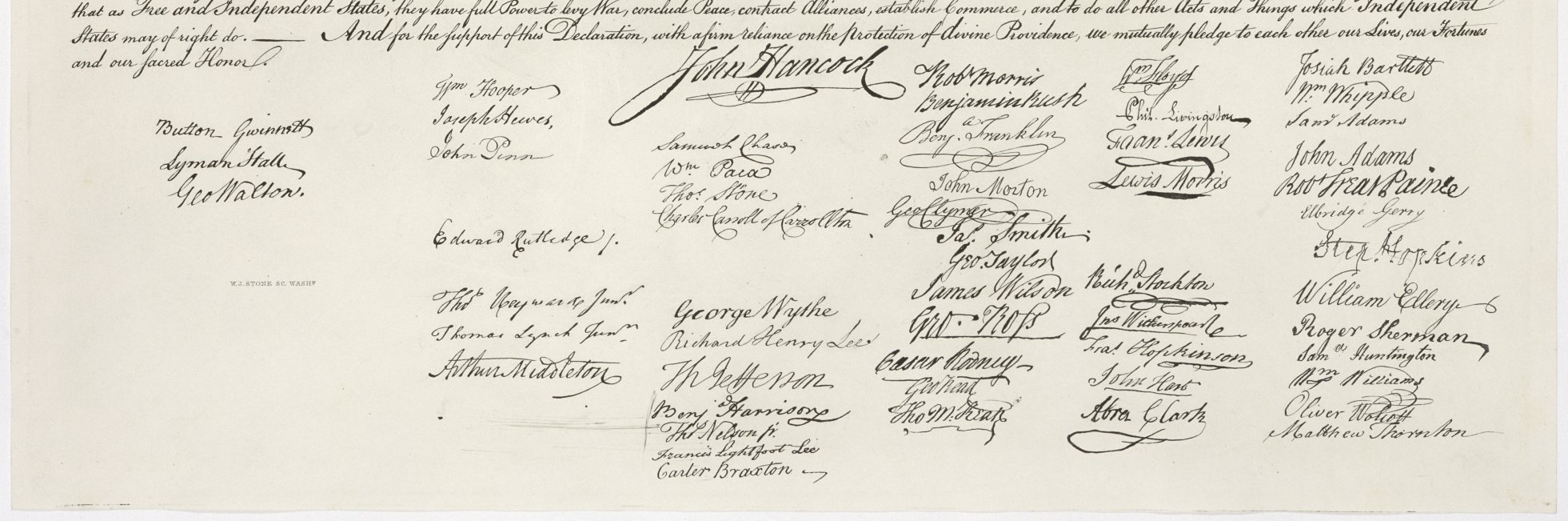
We, therefore, the Representatives of the united States of America, in General Congress, Assembled, appealing to the Supreme Judge of the world for the rectitude of our intentions, do, in the Name, and by Authority of the good People of these Colonies, solemnly publish and declare, That these United Colonies are, and of Right ought to be Free and Independent States; that they are Absolved from all Allegiance to the British Crown, and that all political connection between them and the State of Great Britain, is and ought to be totally dissolved; and that as Free and Independent States, they have full Power to levy War, conclude Peace, contract Alliances, establish Commerce, and to do all other Acts and Things which Independent States may of right do. And for the support of this Declaration, with a firm reliance on the protection of divine Providence, we mutually pledge to each other our Lives, our Fortunes and our sacred Honor.
The 56 signatures on the Declaration of Independence