It’s amazing to think that anyone lived here, that this valley was once green. Now it is sun-blasted, scorching hot, and the only life is the circling vultures and the rainbow-colored iguanas, like something out of a desert hallucination, skittering across the rocks.
The reminders of past life rise up around me, however, eroded to look more like drip castles than the pyramids they once were. I am in Túcume, the once-grand capital of the Sican culture, Peru’s mythical Valley of the Pyramids.
I am not far from Chiclayo, and even closer to the city of Lambayeque, where the Royal Tombs of Sipán Museum serves as one of the major tourist attractions on the north coast. Here at Túcume however, there are few visitors.
It is not hard to get to the site. Combis leave regularly from Chiclayo and Lambayeque, dropping passengers in the modern village of Túcume, from which an quick mototaxi ride leads to the ruins. By car or taxi, it is about a 30 minute ride from Chiclayo.
There are two main trails marked out across the desert plain in Túcume. One leads to Cerro Purgatorio, a craggy hill overlooking the 26 pyramids that comprise the site. The trail winds across the scorched valley, between several of the pyramids, before arriving at a staircase leading to different scenic overlooks on the face of Purgatorio.
Then there’s a long and revealing article on the InkaNatura Travel Site, which I recommend you go to.
So what happened at Túcume to cause the civilisation to fail? Maybe this 10-minute film gives the answers, but just a note to say that there are some potentially upsetting scenes for the younger or more sensitive among us.
So anyone sufficiently brave to say that history won’t repeat itself.
Please indulge me with this purely personal reflection.
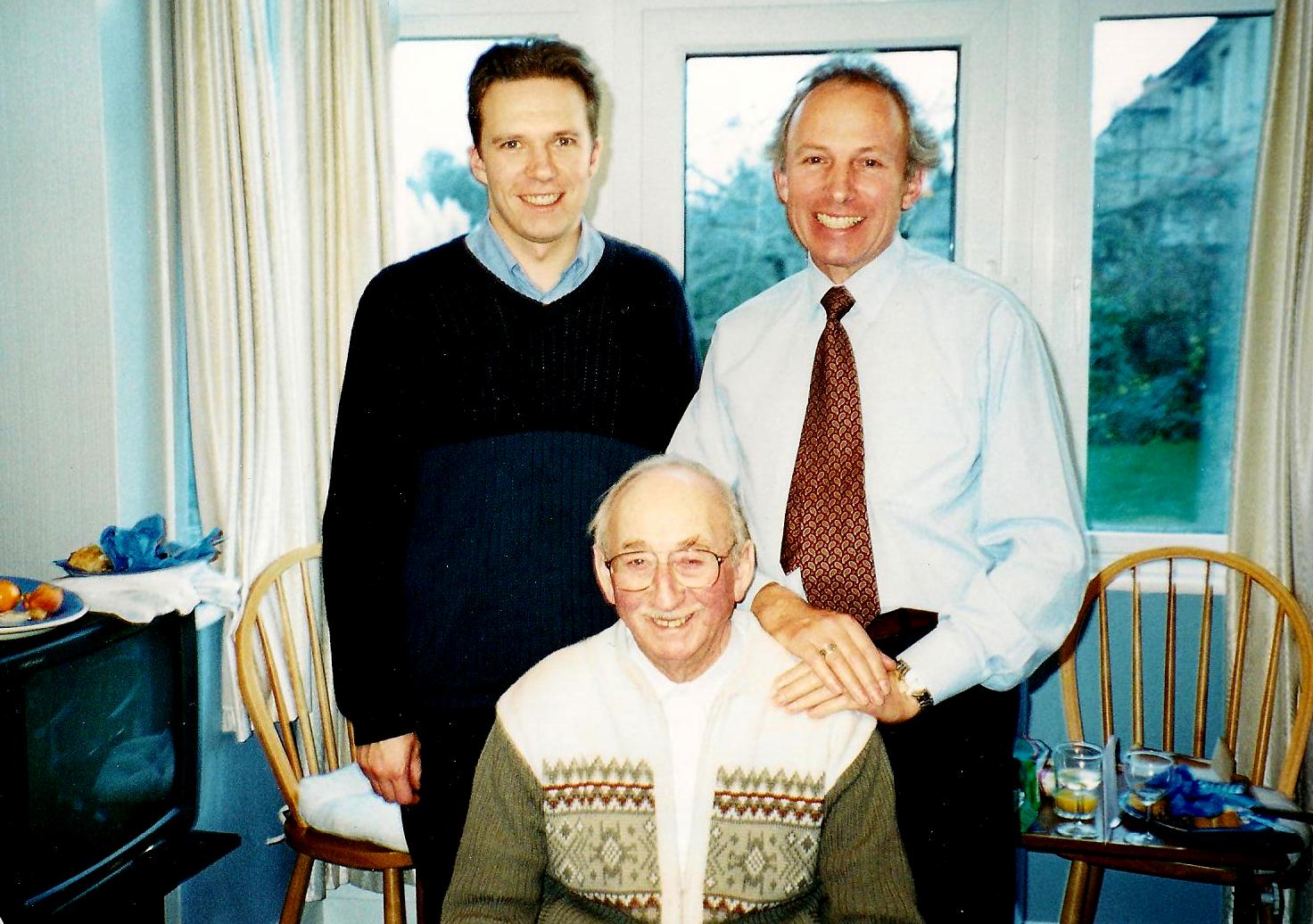
My Uncle Peter died in his sleep at 1.30am UK time on Monday, the 21st May, 2012. He was 91 and had been suffering from declining health for a while.
As my parting gift from across the seas, I just wanted to record the great inspiration that he was to both me and my son, Alex.
Peter was a great gliding fan (sailplane in American speak!). He must have started gliding not many years after the end of the war in 1945. Anyway, when I was a young lad, back in the mists of time, my Uncle Peter took me for a glider flight. That left a memory in me that lay dormant for many years until the late 1970s when a colleague, Roger Davis, introduced me to the Rattlesden Gliding Club and that started a 25-year interest in gliding and later power flying.
My son, Alex, also when he was a young boy was taken up for his first flight in a glider by Uncle Peter and later flew with me many times both in gliders and power aircraft. Today he is a Senior Captain with a British airline.
So, dear Uncle Peter, what an aviation inspiration you have been for two generations.
Uncle Peter and two generations of pilots.
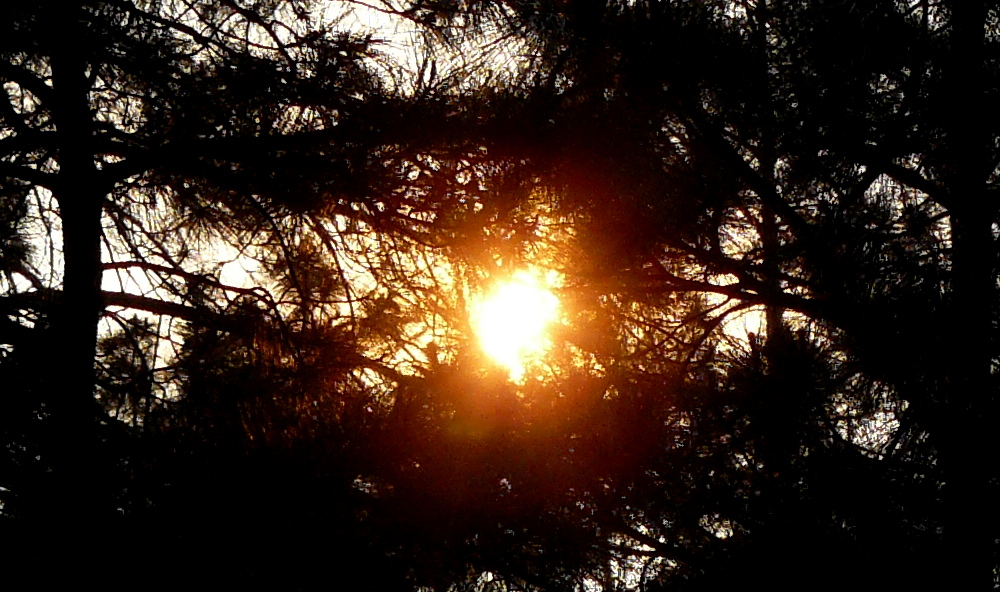
As it happens, 1.30 am UK time on Monday the 21st was 5.30pm Arizonan time on Sunday the 20th. At that very moment, well 5.26pm to be precise, Jean and I were watching the solar eclipse and I took the photograph below of what was the partial eclipse here in Payson.
Partial solar eclipse partly hidden by the pine trees.
A tribute to a wonderful family man with a great sense of humour.
It struck me recently that there is no easy journey of change. Must have been like that since time immemorial. Using the phrase ‘no easy journey’, is a safe interpretation! The reality for all thinking, feeling individuals when we look at the madness of where mankind has arrived and the journey ahead must cause us all to weep; not all that infrequently I suspect. Hence my choice of title for today’s Post on Learning from Dogs.
Maybe I am drawn to this reflective mood because I have finished James Hansen’s book, Storms of my Grandchildren. To say it has disturbed me is a massive understatement. But let me not wander off into some emotional haze but come back to the journey.
The road to hell.
Let’s take coal. Here are Hansen’s thoughts on “Old King Coal” going back to 2007. Note: CCS stands for carbon capture and sequestration.
Scientific data reveal that the Earth is close to dangerous climate change, to tipping points that could produce irreversible effects. Global warming of 0.6°C in the past 30 years has brought the Earth’s temperature back to about the peak level of the Holocene, the current period of climate stability, now of nearly 12,000 year duration, and more warming is “in the pipeline” due to human-made greenhouse gases already in the air. The Earth’s history tells us that the world is approaching a dangerous level of greenhouse gases, a level that would produce accelerating sea level rise, extermination of many animal and plant species, and intensification of regional climate extremes, including floods, storms, droughts and forest fires. It is urgent to slow emissions, as another decade of increasing emissions would practically guarantee elimination of Arctic sea ice, accelerating disintegration of the West Antarctic ice sheet, and regional climate deterioration during coming decades.
The most important time-critical action needed to avert climate disasters concerns coal. Consider: 1) one-quarter of fossil fuel CO2 emission remains in the air for more than 500 years, 2) conventional oil and gas reserves are sufficient to take atmospheric CO2 at least to the vicinity of the “dangerous” level, and it is impractical to capture their CO2 emission as it is mostly from small sources (vehicles), 3) coal reserves are far greater than oil and gas reserves, and most coal use is at power plants, where it is feasible to capture and permanently sequester the CO2 underground (CCS = carbon capture and sequestration). Clear implication: the only practical way to keep CO2 below or close to the “dangerous level” is to phase out coal use during the next few decades, except where CO2 is captured and sequestered.
The resulting imperative is an immediate moratorium on additional coal-fired power plants without CCS. A surge in global coal use in the last few years has converted a potential slowdown of CO2 emissions into a more rapid increase. But the main reason for the proposed moratorium is that a CO2 molecule from coal, in effect, is more damaging than a CO2 molecule from oil. CO2 in readily available oil almost surely will end up in the atmosphere, it is only a question of when, and when does not matter much, given its long lifetime. CO2 in coal does not need to be released to the atmosphere, but if it is, it cannot be recovered and will make disastrous climate change a near certainty.
The moratorium must begin in the West, which is responsible for three-quarters of climate change (via 75% of the present atmospheric CO2 excess, above the pre-industrial level), despite large present CO2 emissions in developing countries. The moratorium must extend to developing countries within a decade, but that will not happen unless developed countries fulfill their moral obligation to lead this moratorium. If Britain should initiate this moratorium, there is a strong possibility of positive feedback, a domino effect, with Germany, Europe, and the United States following, and then, probably with technical assistance, developing countries.
A spreading moratorium on construction of dirty (no CCS) coal plants is the sine quo non for stabilizing climate and preserving creation. It would need to be followed by phase-out of existing dirty coal plants in the next few decades, but would that be so difficult? Consider the other benefits: cleanup of local pollution, conditions in China and India now that greatly damage human health and agriculture, and present global export of pollution, including mercury that is accumulating in fish stock throughout the ocean.
There are long lists of things that people can do to help mitigate climate change. But for reasons quantified in my most recent publication, “How Can We Avert Dangerous Climate Change?” a moratorium on coal-fired power plants without CCS is by far the most important action that needs to be pursued. It should be the rallying issue for young people. The future of the planet in their lifetime is at stake. This is not an issue for only Bangladesh and the island nations, but for all humanity and other life on the planet. It seems to me that young people, especially, should be doing whatever is necessary to block construction of dirty (no CCS) coal-fired power plants. No doubt our poor communication of the matter deserves much of the blame. Suggestions for how to improve that communication are needed.
OK, before I finish off, enjoy Hansen’s interview on CBS’s “Late Show with David Letterman” which has found it’s way onto YouTube, (I found the sound level pretty low!)
All of us who embrace this beautiful planet and acknowledge the extraordinary set of circumstances that enabled man to achieve so much must now weep. Weep for what we have unwittingly done to Planet Earth, and hope our tears bring about change.
A remarkable insight into our present world and hopes for the future.
As many of you dear readers will know, I am incredibly fond of the essays that Tom Engelhardt of TomDispatch fame publishes on a regular basis. Indeed, it was just a week ago that I published a Tomgram from Bill McKibben. Had it not been for Tom querying if I had read his Ernest Callenbach last-words piece I might have missed what, for me, has been one of the most profound ‘mind-stretching’ reads for a very long time.
I pondered for most of a morning as to whether to publish Tom’s essay in one piece, as Tom presented it, or to break it down into two. Our much shorter attention-spans as a result of the world we now live in worked against it being two parts. But I also wanted to include other materials that give an insight into the late Ernest Callenbach so, in the end, this TomDispatch is republished as two pieces. I trust that works for you.
So without further ado, here is Tom’s introduction to the last words of Ernest Callenbach.
Tomgram: Ernest Callenbach, Last Words to an America in Decline
Thirty-five years later, it was still on my bookshelf in a little section on utopias (as well it should have been, being a modern classic). A friend had written his name inside the cover and even dated it: August 1976, the month I returned to New York City from years of R&R on the West Coast. Whether I borrowed it and never returned it or he gave it to me neither of us now remembers, but Ecotopia, the visionary novel 25 publishers rejected before Ernest Callenbach published it himself in 1975, was still there ready to be read again a lifetime later.
Callenbach once called that book “my bet with the future,” and in publishing terms it would prove a pure winner. To date it has sold nearly a million copies and been translated into many languages. On second look, it proved to be a book not only ahead of its time but (sadly) of ours as well. For me, it was a unique rereading experience, in part because every page of that original edition came off in my hands as I turned it. How appropriate to finish Ecotopia with a loose-leaf pile of paper in a New York City where paper can now be recycled and so returned to the elements.
Callenbach would have appreciated that. After all, his novel, about how Washington, Oregon, and Northern California seceded from the union in 1979 in the midst of a terrible economic crisis, creating an environmentally sound, stable-state, eco-sustainable country, hasn’t stumbled at all. It’s we who have stumbled. His vision of a land that banned the internal combustion engine and the car culture that went with it, turned in oil for solar power (and other inventive forms of alternative energy), recycled everything, grew its food locally and cleanly, and in the process created clean skies, rivers, and forests (as well as a host of new relationships, political, social, and sexual) remains amazingly lively, and somehow almost imaginable — an approximation, that is, of the country we don’t have but should or even could have.
Callenbach’s imagination was prodigious. Back in 1975, he conjured up something like C-SPAN and something like the cell phone, among many ingenious inventions on the page. Ecotopia remains a thoroughly winning book and a remarkable feat of the imagination, even if, in the present American context, the author also dreamed of certain things that do now seem painfully utopian, like a society with relative income equality.
“Chick” — as he was known, thanks, it turns out, to the chickens his father raised in Appalachian central Pennsylvania in his childhood — was, like me, an editor all his life. He founded the prestigious magazine Film Quarterly in 1958. In the late 1970s, I worked with him and his wife, Christine Leefeldt, on a book of theirs, The Art of Friendship. He also wrote a successor volume to Ecotopia (even if billed as a prequel), Ecotopia Emerging. And as he points out in his last piece, today’s [tomorrow’s, Ed.] TomDispatch post, he, too, has now been recycled. He died of cancer on April 16th at the age of 83.
Just days later, his long-time literary agent Richard Kahlenberg wrote me that Chick had left a final document on his computer, something he had been preparing in the months before he knew he would die, and asked if TomDispatch would run it. Indeed, we would. It’s not often that you hear words almost literally from beyond the grave — and eloquent ones at that, calling on all Ecotopians, converted or prospective, to consider the dark times ahead. Losing Chick’s voice and his presence is saddening. His words remain, however, as do his books, as does the possibility of some version of the better world he once imagined for us all. Tom
Let’s find out a bit more about ‘Chick’ ahead of his words tomorrow.
Born April 3, 1929 in Williamsport, Pennsylvania, he attended the University of Chicago, where he was drawn into the then ‘new wave’ of serious attention to film as an art form. After six months in Paris at the Sorbonne, watching four films a day, he returned to Chicago and earned a Master’s degree in English and Communications.
For many years Callenbach edited the Natural History Guides at the U.C. Press. He began to take environmental issues and their connections to human value systems, social patterns, and lifestyles just as seriously as he had taken film. He was heavily influenced by Edward Abbey. He is therefore known as an author of green books, namely as author of the ecologicalutopiasEcotopia (1975) and Ecotopia Emerging (1981). (While his novel popularized the term “ecotopia,” it was actually coined by the ethnographer E. L. Anderson.)
In terms of concepts of human involvement with the ecology, as well as some of the economic and social concepts, the Ecotopia books are related to what is known as the sustainability movement. Callenbach’s Ecotopian concept is not “Luddite” — he does not reject high technology, but rather his fictional society shows a conscious selectivity about technology. As an example, with its emphasis on personal rather than impersonal interaction, Callenbach’s Ecotopian society anticipates the development and liberal usage of videoconferencing.
Indeed, for all his involvement with print publications, Callenbach remained quite interested in visual media. Aspects of his book Ecotopia in some ways anticipated “reality TV” — which emerged into recognition, and was given a label as a genre, 20 or more years later — because in the story the daily life of the legislature and some of that of the judicial courts is televised in this fictional society, and televised debates (including technical debates concerning ecological problems) met a need and desire among citizens.
Finally, there are a number of good videos featuring Ernest Callenbach’s visionary ideas and one of his longer ones will be included tomorrow.
To close today’s Post let me leave you with this.
THE TEN COMMANDMENTS OF MOTHER EARTH by Ernest Callenbach
I. Thou shall love and honor the Earth for it blesses thy life and governs thy survival.
II. Thou shall keep each day sacred to the Earth and celebrate the turning of its seasons.
III. Thou shall not hold thyself above other living things nor drive them to extinction.
IV. Thou shall give thanks for thy food, to the creatures and plants that nourish thee.
V. Thou shall educate thy offspring for multitudes of people are a blessing unto the Earth when we live in harmony.
VI. Thou shall not kill, nor waste Earth’s riches upon weapons of war.
VII. Thou shall not pursue profit at the Earth’s expense but strive to restore its damaged majesty.
VIII. Thou shall not hide from thyself or others the consequences of thy actions upon the Earth.
IX. Thou shall not steal from future generations by impoverishing or poisoning the Earth.
X. Thou shall consume material goods in moderation so all may share the Earth’s bounty.
A breath-taking film from the BBC Horizon series about a vast hidden lake under the Antarctic ice sheet.
My apologies for putting very little effort into today’s Post. It’s because Jean and I will be in Phoenix for much of Tuesday (I’m writing this on Monday, 7th!) and it felt easier on me to drop this in for your elucidation than try and write something in a scrabble on Tuesday evenning.
Jean and I watched this last week-end and, …. well just watch it!
It sometimes seems as if our planet has no secrets left – but deep beneath the great Antarctic ice sheet scientists have made an astonishing discovery. They’ve found one of the largest lakes in the world. It’s very existence defies belief. Scientists are desperate to get into the lake because its extreme environment may be home to unique flora and fauna, never seen before, and NASA are excited by what it could teach us about extraterrestrial life. But 4 kilometers of ice stand between the lake and the surface, and breaking this seal without contaminating the most pristine body of water on the planet is possibly one of the greatest challenges science faces in the 21st century.
In 1957 the Russians established a remote base in Antarctica – the Vostok station. It soon became a byword for hardship – dependent on an epic annual 1000km tractor journey from the coast for its supplies. The coldest temperature ever found on Earth (-89°C) was recorded here on the 21st July 1983. It’s an unlikely setting for a lake of liquid water. But in the 1970’s a British team used airborne radar to see beneath the ice, mapping the mountainous land buried by the Antarctic ice sheet. Flying near the Vostok base their radar trace suddenly went flat. They guessed that the flat trace could only be from water. It was the first evidence that the ice could be hiding a great secret.
But 20 years passed before their suspicions were confirmed, when satellites finally revealed that there was an enormous lake under the Vostok base. It is one of the largest lakes in the world – at 10,000 square km it’s about the extent of Lake Ontario, but about twice as deep (500m in places). The theory was that it could only exist because the ice acts like a giant insulating blanket, trapping enough of the earth’s heat to melt the very bottom of the ice sheet.
Well nothing complicated about the definition, is there! If only society was equally motivated by getting to the truth of climate change. Yes, I know I’m being naive!
Why my mini-rant?
I’m well in to James Hansen’s book Storms of my Grandchildren and it’s confirming my fears about the issues that are facing mankind now! But more of that later.
More than two decades after the Intergovernmental Panel on Climate Change (IPCC) began publishing the latest scientific consensus on the globe’s changing climate, widespread doubts persist in the U.S. over whether there really is widespread agreement among scientists. It’s the primary argument of those who deny basic scientific foundations of warming.
But new and innovative survey results suggest the consensus among scientists might actually be stronger than the scientists themselves had thought.
The battles to define and debunk scientific consensus over climate change science have been fought for years. In 2004, University of California San Diego science historian Naomi Oreskes wrote about a broad consensus she found after studying 928 scientific papers published between 1993 and 2003.
But what I found deeply fascinating was that later on Bruce Lieberman, the report’s author, lists in detail the actual levels of agreement compared to the perceived levels. To make it easier to take in, I have amended the telling differences to italic.
In sum, the newly released poll results identified surprisingly common points of agreement among climate scientists; and yet for each point, those scientists underestimated the amount of agreement among their colleagues. The results:
Human activity has been the primary cause of increases in global average air and ocean temperatures in the last 250 years. (About 90 percent of respondents agreed with this characterization, but those respondents estimated that less than 80 percent of their scientist colleagues held that view.)
If governmental policies do not change, the CO2 concentration in the atmosphere will exceed 550 parts per million between 2050 and 2059. (More than 30 percent agreed, but those respondents estimated that just over 20 percent of their peers held that view.)
If and when atmospheric CO2 concentrations reach 550 ppm, the increase in global average surface temperature relative to the year 2000 will be 2-3 degrees Celsius, or 3.2-4.8 F. (More than 40 percent agreed, but those respondents estimated that less than 30 percent held that view.)
If governmental policies do not change, in the year 2050, the increase in global average surface temperature relative to the year 2000 will be 1.5-2 degrees Celsius, or 2.4-3.2 F). (More than 35 percent agreed, but those respondents estimated that just over 30 percent held that view.)
The likelihood that global average sea level will rise more during this century than the highest level given in the 2007 assessment of the IPCC (0.59 meters, 23.2 inches) is more than 90 percent. (More than 30 percent agreed, but those respondents estimated that less than 20 percent held that view.)
Since 1851, the U.S. has experienced an average of six major hurricane landfalls (> 111 mph) per decade. The total number of major hurricane landfalls in the U.S. from 2011-2020 will be seven to eight. (Nearly 60 percent agreed, but those respondents estimated that just over 30 percent held that view.)
The total number of major hurricane landfalls in the U.S. from 2041 to 2050 will be seven to eight. (About 35 percent agreed, but those respondents estimated that less than 30 percent held that view.)
Given increasing levels of human activity, the concentration of CO2 in the atmosphere can be kept below 550 ppm with current technology — but only with changes in government policy. (Nearly 70 percent agreed, but those respondents estimated that just over 50 percent held that view.)
Now back to Hansen’s book. Here’s what Hansen writes starting on p.144,
Getting to the truth!
Sea level rise is one of the two climate impacts that I believe should be at the top of the list that defines what is “dangerous,” on any time scale that humanity can imagine. Ice sheets take thousands of years to build up from snowfall. Reasonable “adaptation” to a large sea level rise is nearly impossible, because once ice sheets begin to rapidly disintegrate, sea level would be continually changing for centuries. Coastal cities would become impractical to maintain.
The other climate change impact at the top of my “dangerous” list is extermination of species. Human activities already have increased the rate of species extinctions far above the natural level. Extinctions are occurring as humans take over more and more of the habitat of animal and plant species. We deforest large regions, replace biologically diverse grasslands and forests with monoculture crops, and introduce foreign, invasive animal and plant species that sometimes wipe out the native ones.
Hansen points out that about a billion people live at elevations less than 25 metres (81 feet).
I included a short video of James Hansen in a Learning from Dogs Post just a few days ago. You’ll find it here – go and watch it – and think about the truth!
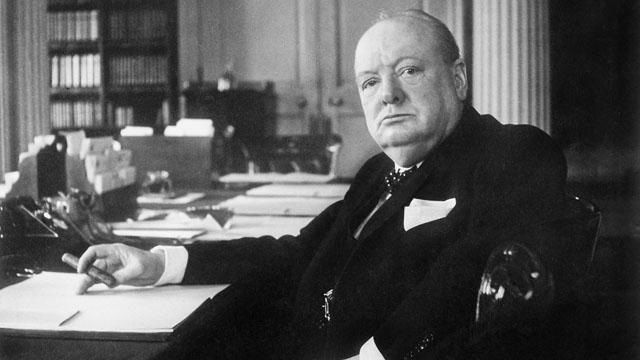
Photo: Winston Churchill, photographed by Cecil Beaton, at 10 Downing Street, London, in 1940.
Men stumble over the truth from time to time, but most pick themselves up and hurry off as if nothing happened.– Winston Churchill
There are a number of news stories about this extra-special full moon but I’ve chosen to republish some of what appeared on the Mother Nature Network website.
In terms of the timing of this full moon, rather than give you times for various places around the world, as this website does, I will simply offer the UTC/GMT time:
Sunday 6th May 2012 at 03:35:06 am
If you want to covert that to your local time wherever you are on this beautiful planet The World Time Server is as good a website as any.
BIGGER THAN YOUR AVERAGE MOON: Skywatcher Tim McCord of Entiat, Washington caught this amazing view of the March 19, 2011 supermoon. (Photo: Tim McCord)
Skywatchers take note: The biggest full moon of the year is due to arrive this weekend. And because this month’s full moon coincides with the moon’s perigee — its closest approach to Earth — it will also be the year’s biggest.
The moon will swing in 221,802 miles (356,955 kilometers) from our planet, offering skywatchers a spectacular view of an extra-big, extra-bright moon, nicknamed a supermoon.
And not only does the moon’s perigee coincide with full moon this month, but this perigee will be the nearest to Earth of any this year, as the distance of the moon’s close approach varies by about 3 percent, according to meteorologist Joe Rao, SPACE.com’s skywatching columnist. This happens because the moon’s orbit is not perfectly circular.
The full Moon will be up to 14% larger and 30% brighter than others during the year. The reason for this phenomenon is that the Moon becomes full on its closest approach to Earth on May 5, 2012, also known as the perigee full Moon.
So enjoy this most beautiful sight if you are somewhere on this planet where the moon will be visible at night. And double-check the time and the day so you don’t miss it! Finally, let me close by ‘spoiling’ my many readers in Arizona, and to serve as a good reminder for yours truly by saying that anyone on US Mountain Standard Time will see this moon at:
Saturday, 5th May 2012 at 20:35:06
“Aim for the moon. If you miss, you may hit a star.” W. Clement Stone.
Forgive me, dear readers, but something light and simple for today. I don’t mean in the sense of the content, far from it, just easy for me to put the post together as it is from a presentation that I gave a year ago.
Here’s a picture of our solar system.
Most of us are reasonably familiar with this visual concept of our solar system, but what of it’s age? That’s much more difficult to embrace in a way that we can relate to.
So let’s use something to represent the age of our solar system, the distance from Phoenix to Payson.
In round terms, Payson is 80 miles North-East from Phoenix. Put another way, that’s 422,400 feet!
So if those 80 miles represented the age of our solar system, what would be the significant milestones on this metaphorical journey?
Phoenix represents the start, the ‘start’ of our solar system some 4.54 billion years ago
It was 1,075,000,000 years before Blue-green algae appeared. That is the equivalent of travelling 18.94 miles from Phoenix North-East along Highway 87. Or looking back, those algae appeared some 3.465 billion years ago.
But on we travel, metaphorically an unimaginable 3,459,800,000 years after the arrival of Blue-green algae until the next milestone; the earliest hominids. In terms of our Highway that’s a further 60.97 miles. Again, looking back that was 5,200,000 years ago.
The sharp-eyed among you will see that 18.94 miles added to 60.97 miles is 79.91 miles. Goodness that’s awfully close to the total distance of 80 miles between Phoenix and Payson! In fact, the 0.09 miles to run is the equivalent of 484 feet!
So let’s look at those last 484 feet.
The first 465.20 feet represents the approximately 5 million years after the earliest hominids appeared before H. sapiens arrived, some 200,000 years ago.
The appearance of Homo sapiens brings us to just 18.6 feet from Payson.
But first, we travel 9.3 feet and see the arrival of dogs, generally regarded to have separated, in DNA terms, from the Grey Wolf 100,000 years ago.
And are you 60 years old? You were born just 0.0669 inches or 7/100ths of an inch from Payson! If my maths is correct (someone please check!) 0.0669 inches is about 34 times the thickness of the human hair! That’s very close to Payson!
Don’t know about you but it puts the age of our solar system into a perspective one might be able to get one’s arms around.
On the scale used above, one inch represents 895.68 years, one foot the equivalent of 10,748.11 years and a mile represents 56,750,000 years.
Anybody want to hazard a guess as to the state of our planet in one further inch?
The difference an inch makes! 895.68 years!
OK, let me stay more or less on topic and just round things off.
EarthSky website seems to have some great items, including this one.
Ten things you may not know about the solar system
9 ) Pluto is smaller than the USA
The greatest distance across the contiguous United States is nearly 2,900 miles (from Northern California to Maine). By the best current estimates, Pluto is just over 1400 miles across, less than half the width of the U.S. Certainly in size it is much smaller than any major planet, perhaps making it a bit easier to understand why a few years ago it was “demoted” from full planet status. It is now known as a “dwarf planet.”
How far do the stars stretch out into space? And what’s beyond them? In modern times, we built giant telescopes that have allowed us to cast our gaze deep into the universe. Astronomers have been able to look back to near the time of its birth. They’ve reconstructed the course of cosmic history in astonishing detail.
From intensive computer modeling, and myriad close observations, they’ve uncovered important clues to its ongoing evolution. Many now conclude that what we can see, the stars and galaxies that stretch out to the limits of our vision, represent only a small fraction of all there is.
Does the universe go on forever? Where do we fit within it? And how would the great thinkers have wrapped their brains around the far-out ideas on today’s cutting edge?
For those who find infinity hard to grasp, even troubling, you’re not alone. It’s a concept that has long tormented even the best minds.
Over two thousand years ago, the Greek mathematician Pythagoras and his followers saw numerical relationships as the key to understanding the world around them.
But in their investigation of geometric shapes, they discovered that some important ratios could not be expressed in simple numbers.
Take the circumference of a circle to its diameter, called Pi.
Computer scientists recently calculated Pi to 5 trillion digits, confirming what the Greeks learned: there are no repeating patterns and no ending in sight.
The discovery of the so-called irrational numbers like Pi was so disturbing, legend has it, that one member of the Pythagorian cult, Hippassus, was drowned at sea for divulging their existence.
A century later, the philosopher Zeno brought infinity into the open with a series of paradoxes: situations that are true, but strongly counter-intuitive.
In this modern update of one of Zeno’s paradoxes, say you have arrived at an intersection. But you are only allowed to cross the street in increments of half the distance to the other side. So to cross this finite distance, you must take an infinite number of steps.
In math today, it’s a given that you can subdivide any length an infinite number of times, or find an infinity of points along a line.
What made the idea of infinity so troubling to the Greeks is that it clashed with their goal of using numbers to explain the workings of the real world.
To the philosopher Aristotle, a century after Zeno, infinity evoked the formless chaos from which the world was thought to have emerged: a primordial state with no natural laws or limits, devoid of all form and content.
But if the universe is finite, what would happen if a warrior traveled to the edge and tossed a spear? Where would it go?
It would not fly off on an infinite journey, Aristotle said. Rather, it would join the motion of the stars in a crystalline sphere that encircled the Earth. To preserve the idea of a limited universe, Aristotle would craft an historic distinction.
On the one hand, Aristotle pointed to the irrational numbers such as Pi. Each new calculation results in an additional digit, but the final, final number in the string can never be specified. So Aristotle called it “potentially” infinite.
Then there’s the “actually infinite,” like the total number of points or subdivisions along a line. It’s literally uncountable. Aristotle reserved the status of “actually infinite” for the so-called “prime mover” that created the world and is beyond our capacity to understand. This became the basis for what’s called the Cosmological, or First Cause, argument for the existence of God.
Some people seem to have a knack for saying it how it should be!
My sub-heading, above, applies to many people right across the world. But the reason that this was triggered in my mind for today’s post, was a recent item on Christine’s excellent Blog, 350 or bust. Read more about that Blog here. I subscribe to that Blog.
Gene Roddenberry, the creator of the amazingly popular Star Trek series, was a man ahead of his time. Here is one of the things he had to say about humanity and our problems (with one editorial comment from me!):
“I believe in humanity. We are an incredible species. We’re still just a child creature, and we’re still being nasty to each other [Stephen Harper: are you listening?]. And all children go through those phases. We’re moving into adolescence now. When we grow up, man, we’re going to be something!”
But what caught my eye were these comments to the Post.
The first one from a Mickey Haist that read,
It’s a nice goal, but would clenching our teeth and willing progress be of any effect? After all, children don’t spontaneously mature – they’re raised.
Have to say that I was left unsure by what Mr. Haist was trying to convey. But not so Christine! This was the first of her two replies,
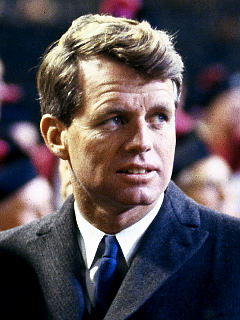
No teeth clenching allowed! Robert Kennedy once said “Each time a person stands up for an ideal, or acts to improve the lot of others, or strikes out against injustice, he or she sends forth a tiny ripple of hope. And crossing each other from a million different centers of energy and daring, those ripples build a current that can sweep down the mightiest walls of oppression and resistance.”
It’s not about everyone doing everything, it’s about each of us doing what we can. Not taking action because the problem is too big is not the answer.
And her second reply,
And Mickey – if the challenge of climate change/ocean acidification/biodiversity loss that we are facing as a species (taking the rest of the natural world with us) doesn’t make us mature, then nothing will. But I believe it will – as Paul Gilding says, humans are slow but not stupid!
Paul Gilding’s excellent website is always a great read, by the way.
But do reread those words of Robert Kennedy, they are powerfully inspiring.
Robert Kennedy
Each time a person stands up for an ideal, or acts to improve the lot of others, or strikes out against injustice, he or she sends forth a tiny ripple of hope. And crossing each other from a million different centers of energy and daring, those ripples build a current that can sweep down the mightiest walls of oppression and resistance.
Despite the fact that these words were said in response when South Africans suffered the tyranny of apartheid, the words are, perhaps, even more relevant today. Mankind has to combine the many ‘ripples of hope’ and build that current that will sweep away the crazy selfishness that is preventing us from living in harmony with this beautiful planet for hundreds of years ahead.
It was called “the most influential environmental photograph ever taken.” Rightly so!
Those words were spoken by the late Galen Rowell, the famous Californian wilderness photographer, commenting about the Earthrise photograph taken from Apollo 8 on December 24th, 1968 during the first manned mission to the Moon.
No one who saw that picture of the planet we all live on could fail to be moved. Indeed, none more so than onboard NASA astronaut Frank Borman who uttered the words as the Earth rose above the horizon of the moon, “Oh my God! Look at that picture over there! Here’s the Earth coming up. Wow, is that pretty.” It was fellow Apollo 8 crew-member, Bill Anders, who then took the ‘unscheduled’ photograph.
Who hasn’t gazed into a night sky and been lost in the beauty above our heads. Or felt the wind, flowing across our ancient lands, kiss our face. We stand so mite-like, so insignificant in all this immensity of creation. Our planet is ‘pretty’. Indeed, Planet Earth is good, beautiful, and so precious to life. Life that arose in just a fraction of time after our Solar System formed 3.7 billion years ago; the oldest traces of life have been found in fossils dating back 3.4 billion years. Our miracle of life.
But the one thing we cannot do is to take that miracle of life for granted. Here’s a perspective on that. Just a couple of months after that famous Earthrise photograph, in February 1969, America’s National Oceanic and Atmospheric Administration (NOAA) recorded the level of CO2 in the Earth’s atmosphere as 324.42 parts per million (PPM).
From 43 years ago we fast forward to February of 2012. NOAA now recorded that CO2 level as 393.65 PPM, some 21% higher than the 1969 level, but even more importantly over 12% higher than the figure of 350 PPM which is regarded by climate scientists as the maximum safe level for our Planet. And the trend upwards is steepening. Not just for CO2 but also for Methane and Nitrous Oxide which have the potential to be incredibly more damaging to our beautiful planet than CO2.
Across the face of the world people are waking up to the fact that something has to be done. While some Governments and many industries are providing great leadership, the complexities of these modern institutions means that progress is slow; far too slow. People are now taking action for themselves and for their communities.
The most notable group is the worldwide Transition Movement. It started in the UK in September 2006, indeed started in the town of Totnes, Devon, just three miles from where I used to live.
Less than 6 years later across the world there are 975 initiatives! Including nearly 500 Transition Communities in Europe and 392 in the UK.
In the USA, there are a staggering 285 initiatives with 26 in California and three here in Arizona: Tucson, Pima and and East Valley in Phoenix ‘mulling’ it over. The ideas behind the Transition concept are powerfully simple and can be easily summarised thus:
That it is inevitable that our lives will soon have to adapt to a dramatically lower energy consumption, especially carbon-based energy, and that it’s better to plan for it than to be taken by surprise.
That the over-whelming majority of communities, currently lacks resilience.
That we have to act now to rebuild our community resilience and prepare for life without fossil fuels.
That by tapping into the collective potential of the community, it is possible to develop new ways of living that are nourishing, fulfilling and ecologically sustainable.
Reduce our energy use, increase our resilience, switch away from carbon-based fuels and go back to the strength of communities. No mystery about what to do!
We do not have another 43 years. Indeed, some say we are very close to the tipping point of runaway climate consequences.
My message for this Earth Day and, indeed, for every day of the rest of our lives.






 Learning from Dogs