Pat Shipman showing how animals were intimately involved in the development of early humans.
Yesterday’s fascinating post was predominately taken up by a long and deeply interesting essay by Prof. Pat Shipman, The Woof at the Door.
Today, I want to report further on Pat Shipman primarily by looking at her book The Animal Connection.
What makes us human?
Let me do no more than quote from page 259,
Domesticating animals provided a new sort of benefit. They were living tools first and meat sources later, only when their useful lives were over or circumstances required. The crucial importance of animal domestication in modern life shows that our relationship with animals selected for a set of communication skills and abilities to observe, draw conclusions and make connections among different observations that had been increasingly important since at least 2.6 million years ago. The relationship between such skills and modern behaviors that characterize humanity is clear.
Prof. Shipman also confirms that the first domestication was of the dog at 32,000 years ago and goes on to say,
Other types of domestic animals provide enhanced protection for people, dwellings, stored crops, and other livestock. Dogs and cats are the obvious examples, but herders have recently started touting llamas as guardians for flocks of sheep.
The domesticated carnivores also provide important assistance in hunting. Dogs are better trackers than humans; they are faster runners, take larger prey, and will hunt with humans. Cats hunt solitarily and are far superior to humans at catching rodents that can decimate crops or carry disease. Dogs hunt with you; cats hunt for you; but both offer an advantage. (p.254)
As I said, it’s a fascinating book and one that is already reshaping my knowledge about the early evolution of man. And in terms of reshaping knowledge about early man, do go across to Pat Shipman’s Blog, The Animal Connection.
You can read a full review with links to a number of book sellers here. Let me close by using this praise for the book by Jeffrey Moussaieff Masson. (Masson’s book Dogs Never Lie About Love is just a few feet from me as I write this, a deeply moving book for all dog lovers.)
This is what Jeffrey Masson wrote about The Animal Connection,
Pat Shipman has written one of the most important books on the human-animal connection ever. One might even say it is the single most important book, possibly the only one, to look at our deep connection to animals over the entire evolutionary history of our species.
The grandeur of the ancient relationship between dog and man.
A couple of weeks ago, I came across a fascinating article that had been published in American Scientist magazine (online version) written by Professor Pat Shipman. The article provided the background and evidence to support the proposition that dogs may have been man’s best friend for thousands of years longer than we realized.
Very quickly I came across Pat Shipman’s website and learnt that this is one clever lady. As her About page explains,
CAREER SUMMARY
Prof. Shipman
I am internationally known as a paleoanthropologist and conducted research for many years in Africa on human evolution and the animal communities in which humans evolved.
I have conducted research on material from sites in France, Spain, the United States, Java, Ethiopia, Kenya, Tanzania, and South Africa. I have written more than 50 scholarly articles, appearing in journals such as Nature, Science, Journal of Archaeological Science, Paleobiology, Journal of Human Evolution, and Current Anthropology.
I have written more than 100 articles in popular science magazines or newspapers, including The Guardian, The New York Times, The Times Literary Supplement, American Scientist, Discover, and Natural History. Two of my books were featured on the cover of The New York Times Book Review: The Neadertals and Taking Wing. Taking Wing won the Phi Beta Kappa prize for science book of the year and was a runner-up for the LA Times Science Book prize.
My book on Homo erectus, Wisdom of the Bones, was co-authored by Alan Walker and won the Rhone-Poulenc Prize in science writing.
My books have been widely praised as compelling, accessible, and highly readable, with a strong narrative thread. Reviewers frequently comment upon the meticulous research that underpins my books, a feature I consider to be my trademark.
My most recent popular science book, The Ape in the Tree, written with Alan Walker, was called by The Vancouver Sun “part adventure story, part cutting-edge science.” In a Science magazine review, the book was praised as “a fine account of new ways to puzzle out the behaviors of fossilized animals from odd scraps of bone.” Another reviewer raved, “Wonderfully engaging and insightful, The Ape in the Tree, is sure to become a classic in the literature on human origins.” MacArthur fellow John Fleagle wrote in the Quarterly Review of Biology, “Science writing doesn’t get any better than this.” In 2009, this book was awarded the W.W. Howells Book Prize by the American Anthropological Association.
In Britain, my new biography of Mata Hari, Femme Fatale, was selected as The Book of the Week by BBC radio. Each day during the week, an actress gave dramatic readings from the book on the air for fifteen minutes.
With The Animal Connection, I return to paleoanthropology and consider the influence of our connection with animals on human evolution and the origin of modern human behavior.
See what I mean!
Anyway, as you can readily understand, as the author of a blog that writes about what we can learn from this ancient relationship between the dog and man, it struck me as wonderful if I might be permitted to republish in full that article. Prof. Shipman promptly gave me such permission.
So today, I am doing just that and tomorrow I want to write more about Pat Shipman’s latest book, The Animal Connection.
oooOOOooo
The Woof at the Door
Dogs may have been man’s best friend for thousands of years longer than we realized
It’s funny how much difference a single letter makes. A “woof” at the door is a very different thing from a wolf at the door. One is familiar, domestic, reassuring; the other is a frightening apparition of imminent danger. The distinction between our fond companions and the ferocious predator of northern climes goes back a long way.
Dogs are descended from wolves, probably the gray wolf. Some scientists argue that, because dogs and wolves can and do interbreed, they shouldn’t be considered to be separate species at all. They believe that domestic dogs are only a subspecies or variant of the gray wolf, Canis lupus, and ought to be called Canis lupus familiaris (the familiar or domestic wolf) instead of Canis familiaris (the familiar or domestic dog). Although the ability to interbreed and produce fertile offspring is a tried-and-true criterion for recognizing that two populations are really variants of a single species, the reality is more nuanced. We cannot know whether dog-wolf hybrids will thrive and survive, or die out, in the long run.
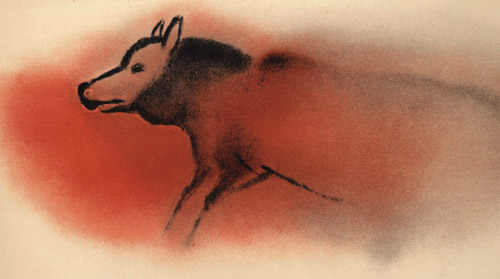
Prehistoric cave paintings rarely depict wolves or other carnivores. This watercolor tracing of a cave painting was made by the archaeologist Abbé Henri Breuil in the early 1900s from the Grotte de Font-de-Gaume in France. The 17,000-year-old cave paintings number about 250 and mostly show bison and mammoths—only one is thought to be a wolf. Canids may have been domesticated by this point; it is possible that portraying wolves and humans was taboo. Paul Bahn
Certainly we expect to be able to distinguish a dog from a wolf if we see one. Of course, domestic dogs are wildly variable in size and shape, thanks to several hundred years of selective breeding. Some have long, fluffy coats; others have tightly curled, nearly waterproof coats and webbed feet. Some are leggy and swift, whereas others are solid, stoutly built guard dogs. Some fit neatly into a pocketbook, but others barely fit into a compact car. As Robert K. Wayne of the University of California at Los Angeles declares, “Dogs show more diversity in appearance than any other mammal.”
What is it that tells us this animal is “dog” and that one is “wolf?”
Modern wolves and dogs can be distinguished reasonably easily by their appearance. The most telling feature of dogs is the snout, which is significantly shorter and wider than wolves’ snouts. Only a few dog breeds with extremely elongated, slender snouts, such as Irish wolfhounds, surpass wolves in “snoutiness.”
But a crucial part of the difference we perceive is in the animals’ manner and attitude towards humans. Domesticated dogs are just that: canids that live in the house or domicile of humans. They are genetically disposed to seek out human attention and approval and to accept human leadership. Wolves are not.
How did this important change come about? Probably in the distant past, humans took in a wolf cub, or even a whole litter of cubs, and provided shelter, food and protection. As the adopted cubs matured, some were aggressive, ferocious and difficult to handle; those probably ended up in the pot or were cast out. The ones that were more accepting of and more agreeable to humans were kept around longer and fed more. In time, humans might have co-opted the natural abilities of canids, using the dogs’ keen noses and swift running skills, for example, to assist in hunting game. If only the most desirable dogs were permitted to breed, the genes encoding for “better” dogs would continue to be concentrated until the new domesticated species (or subspecies) was formed.
Time to Tame
The creation of a domestic, useful, familiar canid by years of selectively breeding wild and terrifying wolves was almost certainly unplanned. The wolf at the beginning of the process of domestication was tamed—made individually docile—but the essential fact is that, over time, the offspring of those initial wolves were genetically inclined to be more tractable.
Domestication was one of the most brilliant accidents in the entire history of humankind. What’s more, we got it right the first time: Dogs were the original trial animal, and successful product, of such an accident—the happy outcome of years of unwitting experiments and dumb luck.
How long does domestication take? Nobody knows. In an experiment, Russian biologists kept a breeding colony of silver foxes and intentionally selected for breeding those with the least fear and the least aggression toward humans. After 10 generations, 18 percent of the foxes sought human contact and showed little fear. After 30 or so generations, a “domesticated fox” had been created.
The catch is that this experiment was deliberate and strictly controlled. The foxes could not breed with wild foxes and dilute the changing gene pool. Human contact was minimized so animals could not be tamed by their handlers. And because of the experiment’s scientific intent, no one could say, “Oh this one is so cute, let’s let it breed even if it is a little aggressive.” So in the case of dogs, without all these controls, the process could have taken much longer.
Another way of estimating the time at which domestic dogs originated is to consider their genetic differences from wolves. One prominent group of researchers, including Robert Wayne, along with Carles Vilà of the Uppsala University in Sweden and their collaborators, initially estimated in 1997 that dogs diverged from gray wolves 100,000 to 135,000 years ago. After more study, they revised their divergence date to between 40,000 and 100,000 years ago. Another group, led by Peter Savolainen of the Royal Institute of Technology in Sweden, favored the Chinese wolf, a subspecies of the gray wolf, as the probable ancestor and estimated in 2002 that it was domesticated between 15,000 and 40,000 years ago.
How do these genetic estimates stack up against the fossil record? Until 2009, the oldest known remains of domestic dogs were two adult skulls dated to between 13,000 and 17,000 years ago, from Eliseevichi, a region in Russia. Both had the relatively broad, short snout typical of dogs, and both were large, heavy animals, nearly the size of great Danes.
Then a team led by Mietje Germonpré of the Royal Belgian Institute of Natural Sciences reported a stunning new finding in the February 2009 issue of Journal of Archaeological Science: a nearly complete fossil dog skull dated to 31,680 + 250 years ago.
Another Look
Germonpré and her colleagues thought that researchers might have overlooked early prehistoric dogs in the fossil record of the Upper Paleolithic, so they analyzed skulls of large canids (wolves or dogs) from various European sites. The Upper Paleolithic time period spanned 40,000 to 10,000 years ago and is divided into sections based on the artifacts from those times. By convention, each span is named for a culture of people who made the artifacts, and the people, in turn, are usually named for the geographical location where the artifacts were found. The Epigravettian culture existed from 14,000 to 10,000 years ago; before that, the Magdalenian culture thrived from 18,000 to 10,000 years ago; and skipping back a few sections, the Aurignacian culture occurred from 32,000 to 26,000 years ago.
In order to identify the fossil skulls accurately, Germonpré’s team first analyzed a large reference sample of 48 wild, modern wolves and 53 dogs belonging to 11 different breeds. They also examined five skulls (including the ones found in Eliseevichi) that were firmly established as prehistoric domesticated dogs.
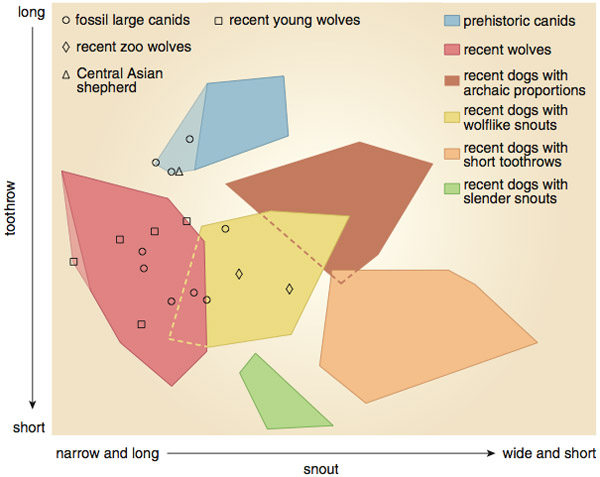
In order to establish the morphological differences between wolves and dogs, a group of researchers led by Mietje Germonpré statistically analyzed skulls from 48 modern, wild wolves and 53 modern dogs from 11 breeds, as well as five skulls that were previously established to be from prehistoric dogs. Recent wolves (pink) and prehistoric dogs (blue) clustered into their own groups, based on the length of their toothrows and the shape of their snouts. Modern dogs clustered into four groups, with some overlap in their areas. Recent dogs with archaic proportions included huskies (brown), recent dogs with wolflike snouts included German shepherds (yellow), recent dogs with short toothrows included great Danes (orange), and recent dogs with slender snouts included doberman pinscers (green). One modern dog, a Central Asian shepherd, clustered with the prehistoric dogs. The group then classified new skulls into the established groupings; examples that fell slightly outside of the ranges but that are statistically likely to be within the group are shown as lighter-shaded areas. Recent young wolves fell into the recent-wolf group, whereas wolves kept in captivity were classifed as recent dogs with wolflike snouts. Fossil canid skulls divided between the recent-wolf group and the prehistoric-dog group, with one falling in the group of recent dogs with wolflike snouts. Stephanie Freese, data courtesy of Mietje Germonpré.
The team used statistical analysis of cranial and dental measurements on the skulls to sort the reference sample into six natural clusters. One cluster contained modern wolves. Another consisted of recent dogs of archaic proportions (such as chow-chows and huskies); a single specimen of a Central Asian shepherd was closer to this group than any other but fell outside it. A third cluster included dogs, such as German shepherds and malinois, which have wolflike proportions. These three groups overlapped each other in their cranial proportions. A fourth group of modern dogs has short toothrows—the length of the jaw that contains teeth—and includes such breeds as great Danes, mastiffs and rottweilers. This group overlapped slightly with the archaic-proportioned dog group but not with the others.
The fifth and sixth clusters were completely separate from all others. One consisted of dogs with extremely long, slender snouts, such as Doberman pinschers. The final group, which had long toothrows and short, broad snouts, was made up of the prehistoric dogs. Statistically, the team’s ability to identify any individual specimen as belonging to the correct group was highly significant and accurate.
Using these clusters as reference categories, Germonpré and colleagues used a statistical technique (called discriminant function analysis ) to assign 17 unknown fossil canid skulls to the established categories. Not all of the “unknowns” were truly unknown, however. Five were immature modern wolves that might have had different proportions because of their age, two were wolves that had been kept in captivity, and one was the Central Asian shepherd that didn’t cluster into any of the groups. Additional unknowns were 11 fossil skulls from sites in Belgium, the Ukraine and Russia, although two of these fossil skulls proved to be too incomplete to classify.
The technique correctly classified all of the immature wolves as wolves, but the two zoo wolves were classified as recent dogs with wolflike snouts. Five of the fossil skulls also fell easily into the modern wolf group; although two of these specimens fell into the region of measurements that overlapped with the group of recent dogs with wolflike snouts, they had a higher statistical probability of being wolves. One fossil skull fit directly into the group of recent dogs with wolflike snouts, even though this specimen was clearly ancient.
The remaining three fossil skulls—one from Goyet Cave in Belgium and one each from Mezin and Mezhirich in the Ukraine—resembled each other closely. All three were classified as prehistoric dogs with probabilities of 99 percent, 73 percent and 57 percent, respectively, as was the (modern) Central Asian shepherd, with a 64 percent probability. In addition, the Mezin skull was odd enough in appearance (for a wolf) that another researcher has suggested it might have been a captive wolf. Germonpré and her team were delighted with these results.
The group also successfully extracted mitochondrial DNA (mtDNA) from seven ancient canid bones from Goyet Cave and Trou des Nutons in Belgium. Rather than damage precious skulls, they sampled only bones in which wolves and dogs differ little, so they presumed all of those they sampled for mtDNA were wolves. From each sample, they sequenced a segment of the mtDNA that is highly variable in living wolves and dogs. Each fossil had a unique mtDNA sequence, or haplotype , in this region, which could not be matched with any known sequences for modern wolves (of which there are about 160) or modern dogs (of which more than 1,000 exist) stored in GenBank, a database of all publicly available nucleotide sequences.
“I was not so surprised at the rich genetic diversity of the fossil wolves,” says Germonpré, because there have been other studies with similar findings. Foxes and wolves underwent a severe bottleneck in population size at the end of the last Ice Age, and many genetic lineages went extinct at this time.
“But we were surprised at the antiquity of the Goyet dog,” Germonpré adds. “We expected it would probably be Magdalenian,” perhaps 18,000 to 10,000 years old. This outcome would fit with their results for the Mezin and Mezhirich skulls, which were found with Epigravettian artifacts roughly 14,000 to 10,000 years old. When the age of this specimen from Goyet was directly dated using accelerated mass spectroscopy radiocarbon-dating techniques, the team found that it was not 18,000 years old, but almost twice as old as the next oldest dog, placing the Goyet dog in the Aurignacian period.
A Time of Change
The Goyet dog fossil shows that the domestication of the first animal was roughly contemporaneous with two fascinating developments in Europe.
Around this time, Europeans began producing objects that are recognizable as art. Some of the earliest known art objects from Europe include the remarkable cave paintings of Chauvet Cave in France, the oldest of which were made 32,900 ± 490 years ago. None of the hundreds of glorious Chauvet paintings show wolves. However, the cave preserves something even more haunting: the footprints of a human child about four-and-a-half feet tall, as well as many footprints of large canids and bears.
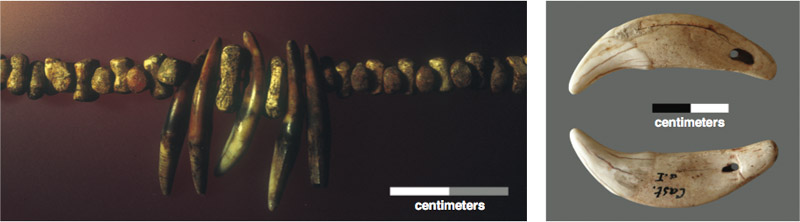
Around 33,000 years ago, humans began perforating teeth for use in decoration. Although canid teeth made up a very small percentage of the total fauna teeth available, they were used in a majority of the ornaments. Fangs from foxes and wolves appear to have been favorites. One example of a perforated wolf tooth (shown in two views at right) is from Abri Castanet in France and has been dated to 33,000 years ago. A strand of beads interspersed with fox teeth came from the Russian site of Sungir and has been dated to 24,000 years ago (left). There is no specific evidence that canid teeth were used in necklaces; the fox-teeth strand may have been a belt. Randall White
Michel-Alain Garcia of the Centre National de la Recherche Scientifique in Nanterre noticed in 1999 that one track of canid prints appears to accompany the child’s prints. These canid prints, unlike the others, have a shortened middle digit on the front paw: a characteristic of dogs. Garcia suggested that the child and dog might have explored the cave together. Charcoal from a torch the child carried is 26,000 years old.
The Upper Paleolithic cultures of Europe are famous for the flowering of all kinds of exquisite art: sculptures, carvings, paintings and engravings. Animals are common and readily recognizable subjects. Prehistoric art expert Paul Bahn notes that depictions of carnivores, including wolves or dogs, and of humans are rare. Bahn conjectures that portraying wolves and humans might have been taboo.
Anne Pike-Tay of Vassar College offers another perspective. She observes that the scarcity of artistic depictions of carnivores parallels their scarcity in the fossil faunas of the Upper Paleolithic. If domesticated dogs were helping humans hunt, she speculates that they might have been placed in a completely different symbolic category from other animals.
“What if dogs were put in the ‘human family’ category as an extension of the hunter, and like humans, warranted no (or very few) painted or engraved depictions?” she wonders.
The second development of the Aurignacian period is the appearance of objects of personal adornment: jewelry. Although beads and perforated objects occurred much earlier in Africa, the earliest such objects in Europe appeared about 40,000 years ago. At 33,000 years ago, early Aurignacian people began perforating animal teeth (and occasionally human teeth) to wear as pendants or other ornaments, such as belts.
Which teeth did they choose? Among their favorite sources are what have been identified as fangs of foxes and wolves. These identifications might better be termed “small or large canids,” because until now no one has considered the possibility that dogs might have been domesticated so long ago. Besides, identifying a single canid tooth specifically as dog or wolf would be difficult, if not impossible.
Randall White of New York University argues that Aurignacian and later people chose to wear objects that displayed their identity or membership in a certain group or clan. Like gang colors or a t-shirt that proclaims its wearer to be a fan of a particular band, ancient people wore things that made their allegiances clear.
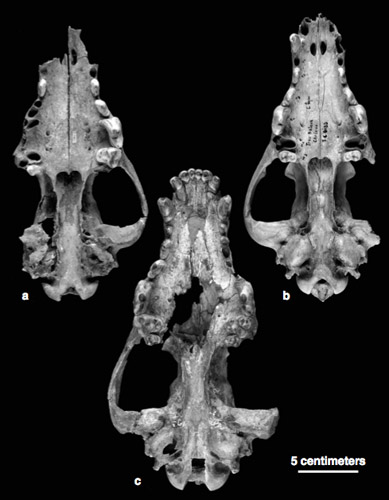
Fossils have helped to establish a far earlier timeframe for dog domestication. A paleolithic canid skull from Goyet in Belgium, about 31,000 years old, has traits characteristic of a dog rather than a wolf (a). When compared to wolves from a similar era, one from Trou Ballu (b) and one from Trou des Nutons (c) in France, the Goyet dog has a relatively wider snout and larger carnassial teeth, and it also has a wider braincase. Elsevier Ltd.
White observes that the teeth Aurignacian people chose to wear were obviously not a random sample of the animals in the fauna. For example, the fauna from the Grotte des Hyènes (Cave of Hyenas) at Brassempouy, France, is dominated by horses, aurochs (a type of cattle) and reindeer—mostly as food remains that often show cutmarks or charring—as well as hyenas, which probably lived in the cave when humans did not. Wolves are rare, making up less than 3 percent of the total fauna. Of approximately 1,600 animal teeth at Brassempouy, only about 2 percent were modified for use as ornaments. However, nearly two-thirds of the ornaments are teeth of wolves or foxes. The rest of the perforated teeth are from other rare species: bear, humans and red deer. None of the teeth of the most common species were used as ornaments at Brassempouy.
Did someone who wore a perforated canid tooth 33,000 years ago proclaim him- or herself to be one of the group that domesticated dogs?
Possibly. Domesticating dogs was a remarkable human achievement that doubtless provided a definite selective advantage to those who accomplished it successfully. They might well have had reason to brag about their accomplishment by wearing canid teeth.
Bibliography
Germonpré, M., et al. 2009. Fossil dogs and wolves from Paleolithic sites in Belgium, the Ukraine and Russia: Osteometry, ancient DNA and stable isotopes. Journal of Archaeological Science 36:473–490.
Morey, D. F. 1994. The early evolution of the domestic dog. American Scientist 82:336–347.
Ostrander, E. A. 2007. Genetics and the shape of dogs. American Scientist 95:406–413.
Savolainen, P., et al. 2002. Genetic evidence for an East Asian origin of domestic dogs. Science 298:1610–1613.
Trut, L. N. 1999. Early canid domestication: The farm-fox experiment. American Scientist 87:160–169.
Vilà, C., et al. 1997. Multiple and ancient origins of the domestic dog. Science 276:1687–1689.
He lay there, on the hard concrete, motionless, his eyes linked to mine. Linking our two very different species in a bond that defied rational description. A bond across not only two radically different creatures but across the tens of thousands of years since species dog embraced species homo sapiens, that is the hunter-gatherer version.
Such history of intimate co-operation shining out from those quiet, wise, brown eyes. Impossible not to sense the linking of souls as each gazed into the eyes of the other. The arm of the man reached behind, found the camera, and captured forever this magic.
The Declaration of Independence, CONGRESS, July 4, 1776.
The unanimous Declaration of the thirteen united States of America,
When in the Course of human events, it becomes necessary for one people to dissolve the political bands which have connected them with another, and to assume among the powers of the earth, the separate and equal station to which the Laws of Nature and of Nature’s God entitle them, a decent respect to the opinions of mankind requires that they should declare the causes which impel them to the separation.
We hold these truths to be self-evident, that all men are created equal, that they are endowed by their Creator with certain unalienable Rights, that among these are Life, Liberty and the pursuit of Happiness.–That to secure these rights, Governments are instituted among Men, deriving their just powers from the consent of the governed, –That whenever any Form of Government becomes destructive of these ends, it is the Right of the People to alter or to abolish it, and to institute new Government, laying its foundation on such principles and organizing its powers in such form, as to them shall seem most likely to effect their Safety and Happiness. Prudence, indeed, will dictate that Governments long established should not be changed for light and transient causes; and accordingly all experience hath shewn, that mankind are more disposed to suffer, while evils are sufferable, than to right themselves by abolishing the forms to which they are accustomed. But when a long train of abuses and usurpations, pursuing invariably the same Object evinces a design to reduce them under absolute Despotism, it is their right, it is their duty, to throw off such Government, and to provide new Guards for their future security.–Such has been the patient sufferance of these Colonies; and such is now the necessity which constrains them to alter their former Systems of Government. The history of the present King of Great Britain is a history of repeated injuries and usurpations, all having in direct object the establishment of an absolute Tyranny over these States. To prove this, let Facts be submitted to a candid world.
He has refused his Assent to Laws, the most wholesome and necessary for the public good.
He has forbidden his Governors to pass Laws of immediate and pressing importance, unless suspended in their operation till his Assent should be obtained; and when so suspended, he has utterly neglected to attend to them.
He has refused to pass other Laws for the accommodation of large districts of people, unless those people would relinquish the right of Representation in the Legislature, a right inestimable to them and formidable to tyrants only.
He has called together legislative bodies at places unusual, uncomfortable, and distant from the depository of their public Records, for the sole purpose of fatiguing them into compliance with his measures.
He has dissolved Representative Houses repeatedly, for opposing with manly firmness his invasions on the rights of the people.
He has refused for a long time, after such dissolutions, to cause others to be elected; whereby the Legislative powers, incapable of Annihilation, have returned to the People at large for their exercise; the State remaining in the mean time exposed to all the dangers of invasion from without, and convulsions within.
He has endeavoured to prevent the population of these States; for that purpose obstructing the Laws for Naturalization of Foreigners; refusing to pass others to encourage their migrations hither, and raising the conditions of new Appropriations of Lands.
He has obstructed the Administration of Justice, by refusing his Assent to Laws for establishing Judiciary powers.
He has made Judges dependent on his Will alone, for the tenure of their offices, and the amount and payment of their salaries.
He has erected a multitude of New Offices, and sent hither swarms of Officers to harrass our people, and eat out their substance.
He has kept among us, in times of peace, Standing Armies without the Consent of our legislatures.
He has affected to render the Military independent of and superior to the Civil power.
He has combined with others to subject us to a jurisdiction foreign to our constitution, and unacknowledged by our laws; giving his Assent to their Acts of pretended Legislation:
For Quartering large bodies of armed troops among us:
For protecting them, by a mock Trial, from punishment for any Murders which they should commit on the Inhabitants of these States:
For cutting off our Trade with all parts of the world:
For imposing Taxes on us without our Consent:
For depriving us in many cases, of the benefits of Trial by Jury:
For transporting us beyond Seas to be tried for pretended offences
For abolishing the free System of English Laws in a neighbouring Province, establishing therein an Arbitrary government, and enlarging its Boundaries so as to render it at once an example and fit instrument for introducing the same absolute rule into these Colonies:
For taking away our Charters, abolishing our most valuable Laws, and altering fundamentally the Forms of our Governments:
For suspending our own Legislatures, and declaring themselves invested with power to legislate for us in all cases whatsoever.
He has abdicated Government here, by declaring us out of his Protection and waging War against us.
He has plundered our seas, ravaged our Coasts, burnt our towns, and destroyed the lives of our people.
He is at this time transporting large Armies of foreign Mercenaries to compleat the works of death, desolation and tyranny, already begun with circumstances of Cruelty & perfidy scarcely paralleled in the most barbarous ages, and totally unworthy the Head of a civilized nation.
He has constrained our fellow Citizens taken Captive on the high Seas to bear Arms against their Country, to become the executioners of their friends and Brethren, or to fall themselves by their Hands.
He has excited domestic insurrections amongst us, and has endeavoured to bring on the inhabitants of our frontiers, the merciless Indian Savages, whose known rule of warfare, is an undistinguished destruction of all ages, sexes and conditions.
In every stage of these Oppressions We have Petitioned for Redress in the most humble terms: Our repeated Petitions have been answered only by repeated injury. A Prince whose character is thus marked by every act which may define a Tyrant, is unfit to be the ruler of a free people.
Nor have We been wanting in attentions to our Brittish brethren. We have warned them from time to time of attempts by their legislature to extend an unwarrantable jurisdiction over us. We have reminded them of the circumstances of our emigration and settlement here. We have appealed to their native justice and magnanimity, and we have conjured them by the ties of our common kindred to disavow these usurpations, which, would inevitably interrupt our connections and correspondence. They too have been deaf to the voice of justice and of consanguinity. We must, therefore, acquiesce in the necessity, which denounces our Separation, and hold them, as we hold the rest of mankind, Enemies in War, in Peace Friends.
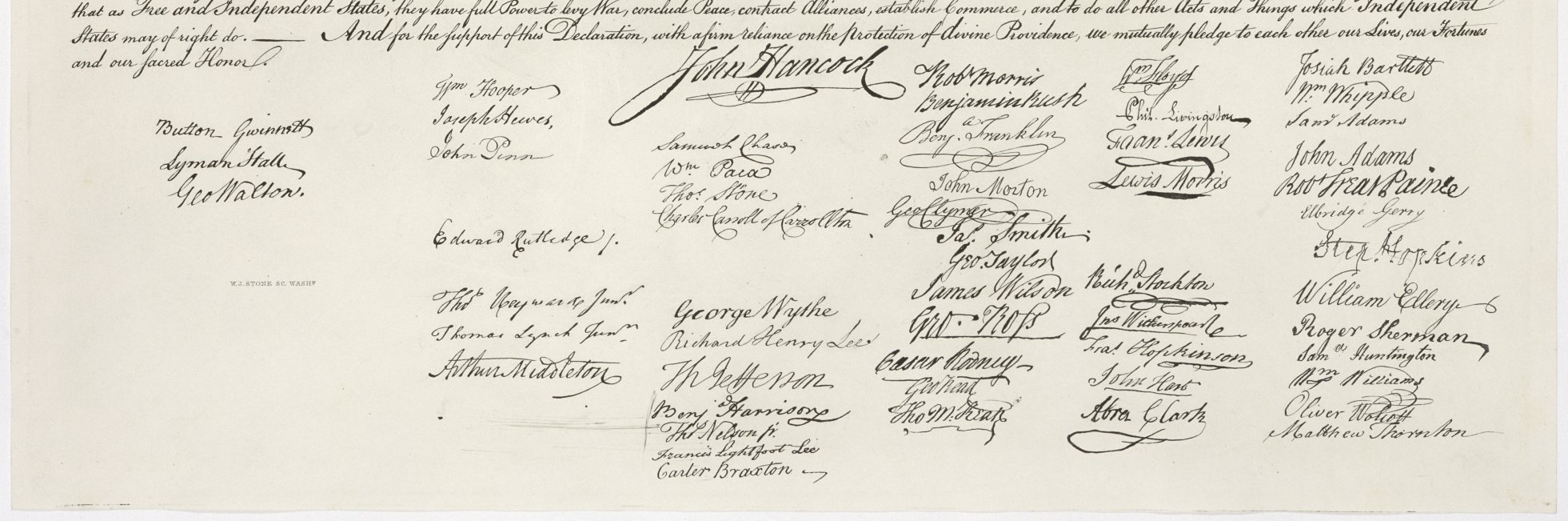
We, therefore, the Representatives of the united States of America, in General Congress, Assembled, appealing to the Supreme Judge of the world for the rectitude of our intentions, do, in the Name, and by Authority of the good People of these Colonies, solemnly publish and declare, That these United Colonies are, and of Right ought to be Free and Independent States; that they are Absolved from all Allegiance to the British Crown, and that all political connection between them and the State of Great Britain, is and ought to be totally dissolved; and that as Free and Independent States, they have full Power to levy War, conclude Peace, contract Alliances, establish Commerce, and to do all other Acts and Things which Independent States may of right do. And for the support of this Declaration, with a firm reliance on the protection of divine Providence, we mutually pledge to each other our Lives, our Fortunes and our sacred Honor.
The 56 signatures on the Declaration of Independence
Living in an American Age of Techno-Wonder and Unreason
Introductory note from yours truly!
It’s becoming a regular item in the agenda of Learning from Dogs to republish essays that appear on Tom Engelhardt’s blog, Tom Dispatch. But as the following was, in turn, a republication by Tom of a very interesting essay by Lewis Lapham, I took the precaution of asking Mr. Lapham’s office for permission to republish. It showed the standing in which Tom is held by the very prompt reply from Michelle Legro, Associate Editor of Lapham’s Quarterly who confirmed, “If you have permission from Tom Englehart to republish the piece, than it is fine with us.”
So it’s more than important that today I include Tom’s plea that headed up Lewis Lapham’s article, as follows,
[Note for TomDispatch readers:The 30,000 of you who get email notices whenever a new piece is posted, as well as the tens of thousands who bookmark TD or read its pieces reposted elsewhere, can support this site by encouraging new readers to sign on. TomDispatch spreads mainly thanks to word of mouth, a formidable force in the online world. For those of you already hooked, I urge you to lend the site a little more of that word-of-mouth power. I hope you’ll consider putting together a modest list of friends, colleagues, relatives, or, for that matter, people you like to argue with who might benefit from getting TomDispatch regularly. Urge them to go to the “subscribe” window to the right of the main screen, put in their e-mail addresses, hit “submit,” answer the confirmation letter that will quickly arrive in email boxes (or, fair warning, spam folders), and join the TD crew. Many thanks in advance for your efforts. They do matter! Tom]
So please do subscribe to Tom’s deeply interesting blog. The home page is here and the ‘subscribe’ window is slightly down on the right-hand side of the ‘home’ page. You will not be disappointed.
OK, now on to Nick Turse’s introduction to Lewis Lapham’s article.
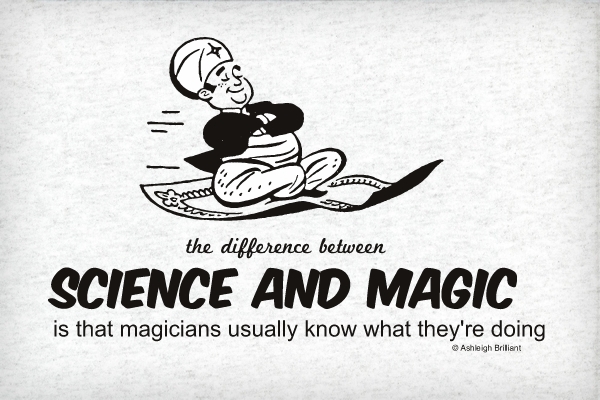
It is said, Lewis Lapham tells us, that Abbot John Trithemius of Sponheim, a fifteenth-century scholar and mage, devised a set of incantations to carry “messages instantaneously… through the agency of the stars and planets who rule time.” In 1962, Lapham adds, Bell Labs “converted the thought into Telstar, the communications satellite relaying data, from earth to heaven and back to earth, in less than six-tenths of a second.” Magic had become science. Today, the Pentagon is picking up the centuries old gauntlet, asking the brightest minds in academe — through its far-out research arm, the Defense Advanced Research Projects Agency or DARPA — to come up with a means for a 20-something-kid-cum-lieutenant or perhaps the military’s much-lauded “strategic corporal” to be wired into unprecedented amounts of information beamed down from the heavens above.
At some level, even the language of DARPA’s solicitation for its SeeMe program seems to conjure up the visions that danced in Trithemius’s head. Its goal, we are told, “is to provide useful on-demand imagery information directly to the lowest echelon warfighter in the field from a very low cost satellite constellation launched on a schedule that conforms to DoD [Department of Defense] operational tempos.” Those heavenly-sounding constellations are, however, tempered by the reality of what the Pentagon is really after.
Yesterday’s future of high-tech satellites that would allow our thoughts to slip “the surly bonds of Earth,” while connecting the far reaches of the planet and linking minds globally in ways even Trithemius couldn’t imagine, is now being exchanged for a low-bid, low-rent system of military satellites. These will be capable of allowing a kid just out of high school to more efficiently target a kid who probably never went to high school — all courtesy of a well-educated university scientist who never bothered to think of the implications of his tenure-producing, tax-payer-funded research. This can’t be what Trithemius had in mind. And yet, that’s where we’re at.
If the Pentagon has its way, SeeMe will eventually fill the skies with cheap, disposable “satellites at very low altitudes, networked to existing fielded communications systems and handheld platforms.” So much for the “the high untrespassed sanctity of space.” But let Lewis Lapham explore further the borderlands of science and magic that have somehow been fused into the very center of our lives. The famed former editor of Harper’s Magazine now edits Lapham’s Quarterly, which, four times a year, brilliantly unites some of the most provocative and original voices in history around a single topic. (You can subscribe to it by clicking here.) TomDispatch thanks the editors of that journal for allowing us to offer an exclusive online first look at Lapham’s elegant history of unreason in this techno-age of ours. Nick Turse
oooOOOooo
Magic and the Machine Living in an American Age of Techno-Wonder and Unreason
By Lewis H. Lapham
[A longer version of this essay appears in “Magic Shows,” the Summer 2012 issue of Lapham’s Quarterly, and is posted at TomDispatch.com with the kind permission of that magazine.]
As between the natural and the supernatural, I’ve never been much good at drawing firm distinctions. I know myself to be orbiting the sun at the speed of 65,000 miles per hour, but I can’t shake free of the impression shared by Pope Urban VIII, who in 1633 informed Galileo that the earth doesn’t move. So also the desk over which I bend to write, seemingly a solid mass of wood but in point of fact a restless flux of atoms bubbling in a cauldron equivalent to the one attended by the witches in Macbeth.
Nor do I separate the reality from the virtual reality when conversing with the airy spirits in a cell phone, or while gazing into the wizard’s mirror of a television screen. What once was sorcery maybe now is science, but the wonders technological of which I find myself in full possession, among them indoor plumbing and electric light, I incline to regard as demonstrations magical.
This inclination apparently is what constitutes a proof of being human, a faculty like the possession of language that distinguishes man from insect, guinea hen, and ape. In the beginning was the word, and with it the powers of enchantment. I take my cue from Christopher Marlowe’s tragical drama Doctor Faustus because his dreams of “profit and delight,/Of power, of honor, of omnipotence,” are the stuff that America is made of, as was both the consequence to be expected and the consummation devoutly to be wished when America was formed in the alembic of the Elizabethan imagination. Marlowe was present at the creation, as were William Shakespeare, the navigators Martin Frobisher and Francis Drake, and the Lord Chancellor Francis Bacon envisioning a utopian New Atlantis on the coast of Virginia.
It was an age that delighted in the experiment with miracles, fiction emerging into fact on the far shores of the world’s oceans, fact eliding into fiction in the Globe Theatre on an embankment of the Thames. London toward the end of the sixteenth century served as the clearinghouse for the currencies of the new learning that during the prior 150 years had been gathering weight and value under the imprints of the Italian Renaissance and the Protestant Reformation in Germany. The Elizabethans had in hand the writings of Niccolò Machiavelli and Martin Luther as well as those of Ovid and Lucretius, maps drawn by Gerardus Mercator and Martin Waldseemüller, the observations of Nicolaus Copernicus, Johannes Kepler, Giordano Bruno, and Paracelsus.
The medieval world was dying an uneasy death, but magic remained an option, a direction, and a technology not yet rendered obsolete. Robert Burton, author ofThe Anatomy of Melancholy, found the air “not so full of flies in summer as it is at all times of invisible devils.” To the Puritan dissenters contemplating a departure to a new and better world the devils were all too visible in a land that “aboundeth with murders, slaughters, incests, adulteries, whoredom, drunkenness, oppression, and pride.”
Think Tanks of the Sixteenth and Twentieth Centuries
In both the skilled and unskilled mind, astronomy and astrology were still inseparable, as were chemistry and alchemy, and so it is no surprise to find Marlowe within the orbit of inquisitive “intelligencers” centered on the wealth and patronage of Henry Percy, “the Wizard Earl” of Northumberland, who attracted to his estate in Sussex the presence of Dr. John Dee, physician to Queen Elizabeth blessed with crystal showstones occupied by angels, as well as that of Walter Raleigh, court poet and venture capitalist outfitting a voyage to Guiana to retrieve the riches of El Dorado.
The earl had amassed a library of nearly 2,000 books and equipped a laboratory for his resident magi, chief among them Thomas Hariot, as an astronomer known for his improvement of the telescope (the “optic tube”), and as a mathematician for his compilation of logarithmic tables. As well versed in the science of the occult as he was practiced in the study of geography, Hariot appears in Charles Nicholl’s book The Reckoning as a likely model for Marlowe’s Faustus.
During the same month last spring in which I was reading Nicholl’s account of the Elizabethan think tank assembled by the Wizard Earl, I came across its twentieth-century analog in Jon Gertner’s The Idea Factory: Bell Labs and the Great Age of American Innovation. As in the sixteenth century, so again in the twentieth: a gathering of forces both natural and supernatural in search of something new under the sun.
The American Telephone and Telegraph Company undertook to research and develop the evolving means of telecommunication, and to that end it established an “institute of creative technology” on a 225-acre campus in Murray Hill, New Jersey, by 1942 recruiting nearly 9,000 magi of various description (engineers and chemists, metallurgists, and physicists) set to the task of turning sand into light, the light into gold.
All present were encouraged to learn and borrow from one another, to invent literally fantastic new materials to fit the trajectories of fanciful new hypotheses. Together with the manufacture of the laser and the transistor, the labs derived from Boolean algebra the binary code that allows computers to speak to themselves of more things in heaven and earth than were dreamed of in the philosophies of either Hamlet or Horatio.
Gertner attributes the epistemological shape-shifting to the mathematician Claude Shannon, who intuited the moving of “written and spoken exchanges ever deeper into the realm of ciphers, symbols, and electronically enhanced puzzles of representation” — i.e., toward the “lines, circles, scenes, letters, and characters” that Faustus most desired. The correspondence is exact, as is the one to be drawn from John Crowley’s essay, “A Well Without a Bottom,” that recalls the powers of the Abbot Trithemius of Sponheim, a fifteenth-century mage who devised a set of incantations “carrying messages instantaneously… through the agency of the stars and planets who rule time.” Bell Labs in 1962 converted the thought into Telstar, the communications satellite relaying data, from earth to heaven and back to earth, in less than six-tenths of a second.
Between the 1940s and the 1980s, Bell Labs produced so many wonders both military and civilian (the DEW line and the Nike missile as well as the first cellular phone) that AT&T’s senior management was hard put to correct the news media’s tendency to regard the Murray Hill estate as “a house of magic.” The scientists in residence took pains to discount the notion of rabbits being pulled from hats, insisting that the work in hand followed from a patient sequence of trial and error rather than from the silk-hatted magician Eisenheim’s summoning with cape and wand the illusions of “The Magic Kettle” and “The Mysterious Orange Tree” to theater stages in nineteenth-century Paris, London, and Berlin.
The disavowals fell on stony ground. Time passed; the wonders didn’t cease, and by 1973 Arthur C. Clarke, the science-fiction writer believed by his admirers to be the twentieth-century avatar of Shakespeare’s Prospero, had confirmed the truth apparent to both Ariel and Caliban: “Any sufficiently advanced technology is indistinguishable from magic.”
As chairman of the British Interplanetary Society during the 1950s, Clarke had postulated stationing a communications satellite 22,300 miles above the equator in what is now recognized by the International Astronomical Union as “The Clarke Orbit,” and in 1968 he had co-written the film script for 2001: A Space Odyssey. The opening sequence — during which an ape heaves into thin air a prehistoric bone that becomes a spaceship drifting among the stars — encompasses the spirit of an age that maybe once was Elizabethan but lately has come to be seen as a prefiguration of our own.
The New World’s Magical Beginnings (and Endings)
New philosophies call all in doubt, the more so as the accelerating rates of technological advance — celestial, terrestrial, and subliminal — overrun the frontiers between science, magic, and religion. The inventors of America’s liberties, their sensibilities born of the Enlightenment, understood the new world in America as an experiment with the volatile substance of freedom. Most of them were close students of the natural sciences: Thomas Paine an engineer, Benjamin Rush a physician and chemist, Roger Sherman an astronomer, Thomas Jefferson an architect and agronomist.
Intent upon enlarging the frame of human happiness and possibility, they pursued the joy of discovery in as many spheres of reference as could be crowded onto the shelves of a Philadelphia library or a Boston philosophical society. J. Hector St. John de Crèvecoeur, colonist arriving from France in 1755, writes in his Letters from an American Farmer to express gratitude for the spirit in which Benjamin Franklin’s invention of the lightning rod — “by what magic I know not” — was both given and received: “Would you believe that the great electrical discoveries of Mr. Franklin have not only preserved our barns and our houses from the fire of heaven but have even taught our wives to multiply their chickens?”
A similar approach to the uses of learning informed Jefferson’s best hopes for the new nation’s colleges and schools, and for the better part of the last two centuries it has underwritten the making of America into what the historian Henry Steele Commager named “the empire of reason.” An empire that astonishes the world with the magnificence of its scientific research laboratories, but one never safe from frequent uprisings in the rebel provinces of unreason.
Like England in the late sixteenth century, America in the early twenty-first has in hand a vast store of new learning, much of it seemingly miraculous — the lines and letters that weave the physics and the metaphysics into strands of DNA, Einstein’s equations, Planck’s constant and the Schwarzschild radius, the cloned sheep and artificial heart. America’s scientists come away from Stockholm nearly every year with a well-wrought wreath of Nobel prizes, and no week goes by without the unveiling of a new medical device or weapons system.
The record also suggests that the advancement of our new and marvelous knowledge has been accompanied by a broad and popular retreat into the wilderness of smoke and mirrors. The fear of new wonders technological — nuclear, biochemical, and genetic — gives rise to what John Donne presumably would have recognized as the uneasy reawakening of a medieval belief in magic.
We find our new Atlantis within the heavenly books of necromancy inscribed on walls of silicon and glass, the streaming data on an iPad or a television screen lending itself more readily to the traffic in spells and incantation than to the distribution of reasoned argument. The less that can be seen and understood of the genies escaping from their bottles at Goldman Sachs and MIT, the more headlong the rush into the various forms of wishful thinking that increasingly have become the stuff of which we make our politics and social networking, our news and entertainment, our foreign policy and gross domestic product.
How else to classify the Bush administration’s invasion of Iraq if not as an attempt at alchemy? At both the beginning and end of the effort to transform the whole of the Islamic Middle East into a democratic republic like the one pictured in the ads inviting tourists to Colonial Williamsburg, the White House and the Pentagon issued press releases in the voice of the evil angel counseling Faustus, “Be thou on earth as Jove is in the sky,/Lord and commander of these elements.”
Charles Krauthammer, neoconservative newspaper columnist and leading soloist in the jingo chorus of the self-glorifying news media, amplified the commandment for the readers of Time magazine in March 2001, pride going before the fall six months later of the World Trade Center: “America is in a position to reshape norms, alter expectations, and create new realities. How? By unapologetic and implacable demonstrations of will.”
So again four years later, after it had become apparent that Saddam Hussein’s weapons of mass destruction were made of the same stuff as Eisenheim’s projection of “The Vanishing Lady.” The trick had been seen for what it was, but Defense Secretary Donald Rumsfeld emerged from the cloud of deluded expectation, unapologetic and implacable, out of which he had spoken to the groundlings at a NATO press conference in 2002: “The message is that there are no ‘knowns.’ There are things we know that we know. There are known unknowns… but there are also unknown unknowns… The absence of evidence is not evidence of absence.”
“Perform What Desperate Enterprise I Will”
The Rumsfeldian message accounts not only for what was intended as a demonstration magical in Iraq, but also for the Obama administration’s current purpose in Afghanistan, which is to decorate a wilderness of tribal warfare with the potted plant of a civilized and law-abiding government that doesn’t exist. Choosing to believe in what isn’t there accords with the practice adopted on Wall Street that brought forth the collapse of the country’s real-estate and financial markets in 2008.
The magnitude of the losses measured the extent to which America assigns to the fiction of its currency the supernatural powers of a substance manufactured by a compensation committee of sixteenth-century alchemists. The debacle was not without precedent. Thomas Paine remarked on the uses of paper money (“horrid to see, and hurtful to recollect”) that made a mess of America’s finances during its War of Independence, “It is like putting an apparition in place of a man; it vanishes with looking at, and nothing remains but the air.”
Paine regarded the “emissions” of paper money as toxic, fouling the air with the diseases (vanity, covetousness, and pride) certain to destroy the morals of the country as well as its experiment with freedom. A report entitled “Scientific Integrity in Policy Making,” issued in February 2004 by the Union of Concerned Scientists, advanced Paine’s argument against what it diagnosed as the willed ignorance infecting the organism of the Bush administration.
Signed by more than 60 of the country’s most accomplished scientists honored for their work in many disciplines (molecular biology, superconductivity, particle physics, zoology), the report bore witness to their experience when called upon to present a federal agency or congressional committee with scientific data bearing on a question of the public health and welfare. Time and again in the 40-page report, the respondents mention the refusal on the part of their examiners to listen to, much less accept, any answers that didn’t fit with the administration’s prepaid and prerecorded political agenda.
Whether in regard to the lifespan of a bacteria or the trajectory of a cruise missile, ideological certainty overruled the objections raised by counsel on behalf of logic and deductive reasoning. On topics as various as climate change, military intelligence, and the course of the Missouri River, the reincarnations of Pope Urban VIII reaffirmed their conviction that if the science didn’t prove what it had been told to prove, then the science had been tampered with by Satan.
The report spoke to the disavowal of the principle on which the country was founded, but it didn’t attract much notice in the press or slow down the retreat into the provinces of unreason. The eight years that have passed since its publication have brought with them not only the illusion of “The Magic Kettle” on Wall Street, but also the election of President Barack Obama in the belief that he would enter the White House as the embodiment of Merlin or Christ.
To the extent that more people become more frightened of a future that calls all into doubt, they exchange the force of their own thought for the power they impute to supernatural machines. To wage the war against terror the Pentagon sends forth drones, robots, and surveillance cameras, hard-wired as were the spirits under the command of Faustus, “to fetch me what I please,/Resolve me of all ambiguities,/Perform what desperate enterprise I will.”
Wall Street clerks subcontract the placing of $100 billion bets to the judgment of computer databanks that stand as silent as the stones on Easter Island, while calculating at the speed of light the rates of exchange between the known unknowns and the unknown unknowns. By way of projecting a federal budget deficit into both the near and distant future, the season’s presidential candidates float cloud-capped towers of imaginary numbers destined to leave not a rack behind.
The American body politic meanwhile dissolves into impoverished constituencies of one, stripped of “profit and delight” in the realm of fact, but still sovereign in the land of make-believe. Every once and future king is possessed of a screen like the enchanted mirror that Lady Galadriel shows to Frodo Baggins in the garden at Caras Galadhon; the lost and wounded self adrift in a sea of troubles but equipped with the remote control that once was Prospero’s; blessed, as was the tragical Doctor Faustus, with instant access to the dreams “of power, of honor, of omnipotence.”
Lewis H. Lapham is editor of Lapham’s Quarterly. Formerly editor of Harper’s Magazine, he is the author of numerous books, including Money and Class in America, Theater of War, Gag Rule, and, most recently, Pretensions to Empire. The New York Times has likened him to H.L. Mencken; Vanity Fair has suggested a strong resemblance to Mark Twain; and Tom Wolfe has compared him to Montaigne. This essay, shortened for TomDispatch, introduces “Magic Shows,” the Summer 2012 issue of Lapham’s Quarterly.
The most amazing ancient site, possibly in the world.
I know this is a bit of a giant leap from yesterday’s Post but bear with me. A short while ago, my friend Suzann sent me a link to some information about the archaeological site in Eastern Turkey known as Göbekli Tepe. Suzann, as many regular readers will know, was the person who caused me to meet Jeannie back in December 2007 when Su invited me to spend Christmas with her and Don, her husband, at their home down in San Carlos, Mexico.
Before I go on to write about Göbekli Tepe let me also muse on another fascinating connection between Suzann and me. That is that Su and I were sharing the same waters in the Eastern Mediterranean around 1991. Here’s an extract from a recent email from Su.,
Don’s brother’s boat was Hana Ho.from Honolulu, Hawaii, a Tayana 55…gorgeous thing! They sailed in the Med for years around that time…it is possible you could have run into them…..
When we first flew in to Cyprus June of 1991, Bob’s boat was up on the hard. It took another 5 days to finish, and we had to climb straight up and down a steep, rickety ladder each time we went out, because we slept on the boat every night….was it ever hot and muggy! and no bathroom facilities in use!! But had a lovely time in Cyprus and really got out and saw things there. Delicious food!!
Then we sailed over toward the Turkey/Syrian border area and then gunk-holed west along the coast, ending up at Izmer, after visiting places like Antalya, Kekova Roads,Fethiya and the magnificent Rock Tombs, Marmaris, Bodrum, Kisadasi, Ephesus to name a few….
I, too, was living on a yacht, over-wintering in Cyprus, and cruising the Turkish and Greek coasts during the summer. Anyway, enough of these musings.
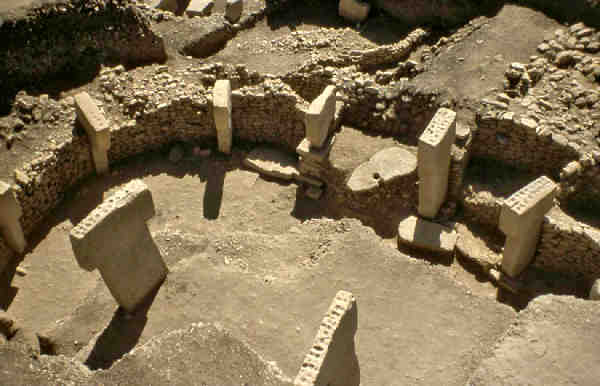
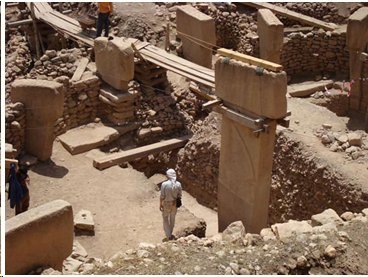
A scene from Gobekli Tepe
Göbekli Tepe is old. I mean seriously old. For example, I’m very familiar, being an Englishman, with the mystery and antiquity of Stonehenge. But even the revised estimates of Stonehenge’s age, now believed to be 3,000 B.C., don’t measure up to the age of Göbekli Tepe.
The Smithsonian website explains much in a fascinating article about Gobekli Tepe, (do click on that link as the Smithsonian article is extremely interesting).
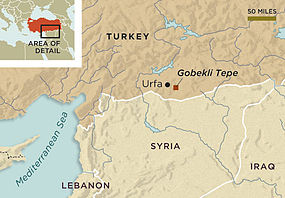
Six miles from Urfa, an ancient city in southeastern Turkey, Klaus Schmidt has made one of the most startling archaeological discoveries of our time: massive carved stones about 11,000 years old, crafted and arranged by prehistoric people who had not yet developed metal tools or even pottery. The megaliths predate Stonehenge by some 6,000 years. The place is called Gobekli Tepe, and Schmidt, a German archaeologist who has been working here more than a decade, is convinced it’s the site of the world’s oldest temple.
[my italics]
Imagine, there are fewer years between today and the building of Stonehenge than there are between the construction of Göbekli Tepe and Stonehenge! Think about that!
Anyway, enjoy this video,
and if that grabs your interest then there is a longer 25-minute radio broadcast by Klaus Schmidt that is on YouTube, see below:
German archeologist Klaus Schmidt, from the German Archaeological Institute, who has been working as the head archeologist at Göbekli Tepe, a temple site located in southeastern Turkey close to the boarder to Syria. Klaus has been excavating there since 1994 and he joins us to talk about the excavation work, and to give us his impressions and theories about the site and the people who built it and worshiped at this ancient temple site. The temple is believed to have been erected in the 10th millennium BC (about 11,500 years ago). It is believed to be the oldest human-made place of worship, it’s even been called the Garden of Eden. Only about 3-5% of the site has been excavated so far, which has unveiled several stone circle rooms, only one of which has been dug down to the floor. As many as 20 such structures are thought to exist under the ground at the site, these have been detected by radar scans. These stone circles have large T-shaped pillars, some of the heaviest stones weigh up to 50 tons. The monoliths are decorated with carved reliefs of animals, abstract pictograms, sacred symbols and similarities to Neolithic cave paintings have been pointed out. The carefully carved figurative reliefs depict lions, bulls, boars, foxes, gazelles, donkeys, snakes and other reptiles, insects, arachnids, and birds, particularly vultures and water fowl. Göbekli Tepe means “Hill with a potbelly” although there already exists other interpretations of the name, connected to the word “Zep Tepi” or “The First Time” a period in beliefs of a mythological golden age when the gods lived amongst humanity together with half-divine offsprings of gods and humans. Is Göbekli Tepe the Garden of Eden? June 24, 2010
If you want more to read then I can do no better than recommend the article that Suzann linked to in her email. It’s here and it starts thus,
Gobekli Tepe: 12,000 Years Old and Rewriting Human History
“This time what came first was the temple and then the city.”
– Klaus Schmidt, Ph.D., German Archaeological Institute
12,000-year-old circles of limestone columns weighing from 7 to 15 tons or more have been excavated in Gobekli Tepe, Turkey, about 6 miles northeast of Urfa.
Older than Egypt, Sumeria and Stonehenge, 40 standing T-shaped columns have so far been uncovered in four circles 98 feet (30 meters) in diameter. To date, no metal tools have been found since meticulous digging and dating began in 1994. Only 5% of the temple complex in repeating circles has been uncovered.
Ground-penetrating radar surveys indicate there might be at least 250 more standing stones in 18 still-buried circles. Finely honed reliefs and some 3-dimensional sculptures on the limestone columns depict boars, foxes, lions, birds, snakes, scorpions, vultures, reptiles, humans and other figures.
Trying to make sense of the utter nonsense of the Rio+G20 summit.
I share the deep frustration that must be felt by millions around the globe at the outcome of the Rio summit meeting, if outcome is the appropriate word! Martin Lack summarised his anger in a post last Friday and I’m going to publish an extract from his writings because they so perfectly reflect not only his anger but, I suspect, the anger of millions of others.
“It would have been naïve to pin too many hopes on a single conference, but undeniably we expected more from the outcome document. Entitled ‘The Future We Want’, the text doesn’t live up to the aspirations of the title – it’s more a case of ‘The Future We’ll Get If We Rely On Politicians’. Full of weak phrases, and re-confirmations of previous aspirations which they haven’t realised, the text fails to commit governments to actions, targets, timeframes and finance to which we can hold them accountable….What we have is an agreement within the bounds of what they thought politically possible; what we needed was an agreement to address what is scientifically necessary. This is no way to manage our planet!”
“World leaders have spent 20 years bracing themselves to express ‘deep concern’ about the world’s environmental crises, but not to do anything about them…Several of the more outrageous deletions proposed by the United States – such as any mention of rights or equity or of common but differentiated responsibilities – have been rebuffed. In other respects the Obama government’s purge has succeeded, striking out such concepts as “unsustainable consumption and production patterns” and the proposed decoupling of economic growth from the use of natural resources.”
I would like to be able to dismiss this as facile criticism from the liberal left. However, in reality, to do so would be to second-guess the scientists who have been telling us for decades that we need action not words. Our children and grandchildren will not forgive us for failing to act.
BUT a conversation I had with Lew L. here in Payson last Friday afternoon helped crystalise some thoughts that I would like to share with you.
Representative democracy a la British House of Commons
The first is about democracy, or more accurately representative democracy. Lew pointed out that some US Towns still employ direct democratic processes where all the people who attend a Town meeting vote in person for or against the motion. The challenge for a representative democratic process is that those elected representatives are vulnerable to a wide range of influences and between elections may be taking decisions that the people would neither support nor approve of.
The idea of direct democracy goes back a very long time, as Wikipedia reveals,
The earliest known direct democracy is said to be the Athenian Democracy in the 5th century BC,
So it could be argued that the fundamental flaw in the Rio+G20 meeting was not the lack of any real progress by our ‘leaders’, but in our expectations, as in the expectations of ‘you and me’, all across the world. The money and power that must be intertwined in such games of international politics doesn’t bear thinking about. It was Lord Acton, the British historian, who said: ‘Power tends to corrupt, absolute power corrupts absolutely‘.
So rather than expecting our representatives and leaders to do what we what them to do and being bitterly disappointed, time and time again, there is another equally valid way of bringing about change – create the change you desire by changing yourself.
As my friend Jon Lavin expressed in a very recent email,
People like something solid to relate to in such changing and unpredictable times and a dogs view is brilliant because dogs just are because they are in the present. All that matters is the ‘now’. Most of our problems can be traced back to our lack of ability to be in the ‘now’. Driven by regrets about the past, and a fear of what the future holds, we carry on hoping that all our problems can be solved by amassing material possessions.
Oh, well. The best way to save the world is to work on our selves.
So that leads on to my second thought, the urgency in tackling what is happening to the Earth’s climate. In Martin’s second angry post over at Lack of Environment, he writes,
Global average temperatures are rising. Since the 1980s, every decade has been warmer than the last. 1998 was a very warm year, but global warming has not stopped; it has morphed into Anthropogenic Climate Disruption (ACD). Some even suggest we should call it Human Induced Rapid Global Overheating (HIRGO) but I prefer ACD, because that is what we are experiencing: It will be decades before it becomes obvious that HIRGO is happening and, if we wait for it to be obvious, there will be no way to stop it.
We need to accept that ACD is a reality; it is an inevitable consequence of a warming atmosphere; one with more moisture in it more of the time and – as I said – it is exactly what the climate models have being tell us would happen for decades. That being the case, how is it that our politicians – seemingly led by members of a supposedly left-of-centre Democratic Party administration in the USA – can have such monumental tunnel vision as to offer up the planet itself as a sacrifice upon the altar of the god of Growth?
But do you see the fundamental error? The idea that our leaders have to create change: “.. how is it that our politicians …. can have such monumental tunnel vision as to offer up the planet itself as a sacrifice upon the altar of the god of Growth?”
As Jon Lavin revealed in his email to me, the agency of change is within each of us. It is not a “thing.” There’s a huge amount of information revealed by a simple Google search on change, the change process, change management process, etc., etc., so I’m not going to add to the noise by quoting the experts. It’s as simple as Jon wrote:
“The best way to save the world is to work on our selves.”
OK, moving on to my second thought, and for this I want to play a little mind-game.
That is what would be the impact if 50% of the combined populations of North America and Europe decided to save the power of one 60-watt lamp, or equivalent, for 36 hours a year, i.e. turning off one 60-watt lamp for less than one hour a day for a year!
Let’s take this a step at a time.
The combined population of the USA, Canada and Europe is 1,090,487,000 people, i.e. a little over 1 billion.
Thus half that population is 545,243,500 persons.
Saving 60 watts for 36 hours a year is 60 X 36 = 2,160 watts.
Thus 545,243,500 people times 2,160 watts = 1,177,725,960,000 watts. Which is 1.178 trillion watts. (rounded up)
I say again: 1.178 trillion watts.
How can one get any notion of what that means? The best I could find from a web search was this:
The U.S. electric power industry’s total installed generating capacity was 1,119,673 megawatts (MW) as of December 31, 2009—a 1.0-percent increase from 2008.
Ergo, in 2009 the USA had the capability of generating 1,119,673 megawatts. A megawatt is one million watts so 1,119,673 megawatts is 1,119,673,000,000 watts, or 1.119 trillion watts.
Wow! switching off a 60-watt lamp for less than an hour a day would save 1.178 trillion watts, more than the combined generating capacity of the entire USA in 2009 of 1.119 trillion watts.
I suspect that the current USA generating capacity isn’t that much different and, of course, one can’t run away with the idea that all of that is generated by fossil fuels.
But if I have done my mathematics correctly (and do please check my sums), the simple expediency of turning off one 60-watt lamp for 36 hours a year, if done by just half the populations of North America and Europe, would be the equivalent of saving 105% of the total US generating capacity!
So thinkabout the change you want in your life, and the lives of your children and grandchildren, and get on with it. Turn out that light!
“The best way to save the world is to work on our selves.”
And I can do no better in terms of reflecting on the power of our minds, than courtesy of this fabulous video which Christine of 350orbust had last Saturday:
Final thought! If one thinks of the way that we trust the Internet for so much these days, and the huge number of people that are now ‘wired’, it doesn’t seem to be beyond the wit of man to come up with a reliable, secure method of direct voting electronically. Wonder why that hasn’t caught on?
I am indebted to Schalk Cloete who has been leaving some very thoughtful comments on Learning from Dogs. Schalk writes the blog, One in a Billion and more information about him can be learned here. One of the very generous aspects of Schalk’s Blog is that his material is free from copyright, so I gratefully offer the following from his blog.
oooOOOooo
Perfect health the traditional way
There are a number of very special traditional communities around the world that enjoy amazing health and longevity completely without the help of modern medicine. People still contribute actively to their communities in their 80′s and 90′s and often surpass the magical age of 100 sometimes without ever visiting a doctor.
The most well-documented of these communities is the Okinawa islands in Japan, but a number of other such communities also exist. These include the region of Abkhasia in the Soviet Union, the Symi island in Greece, the Italian village Campodimele, and the mountain communities of Hunza in Pakistan, Vilcabamba in Ecuador and Bama in China.
So, what are the secrets of these amazingly healthy people? Well, I don’t really think we can call them “secrets”, but here they are: these people simply eat a healthy, nutrient dense and predominately plant-based diet (Okinawan food pyramid given below), they never over-eat, they live very active lifestyles and they have a very strong sense of community. Basically, they live the polar opposite of the modern western lifestyle.
These healthy lifestyle choices have some pretty impressive results. One fun statistic about Okinawa is that they boast 15% of the world’s confirmed super-centenarians (those over 110) while having only 0.0002% of the worlds people, thereby giving them a concentration of super-elders close to 100,000 times greater than the rest of the world. Wow…
In John Robbins’ excellent book “Healthy at 100″, he discloses a lot of well documented research on Okinawa, stating that they are about 15% as likely to die of heart disease and cancer as Americans. They also live 5 years longer on average.
When it comes to healthcare spending, Okinawa has the lowest healthcare costs in all of Japan, which already has a three times smaller per-capita healthcare expense than the USA. Thus, they have about a 7 times smaller chance of dying from degenerative disease and live 5 years longer, all while incurring about 5 times fewer healthcare expenses. Not bad, I’d say.
Unfortunately, the younger generation of Okinawans are rapidly screwing up these awesome stats by succombing to the American lifestyle brought by the US troops stationed on Okinawa. It really is quite sad how many grandparents have to bury their grandchildren in Okinawa nowadays.
But this just shows how alluring our modern consumerist lifestyle really is. These young Okinawans saw the vibrant health of their parents and grandparents first hand, but still chose to consume their bodies into oblivion. Unthinking consumerism is indeed a very powerful enemy…
oooOOOooo
Fascinating article from Schalk, as I’m sure you will agree.
A further reflection on what has clearly been a wonderful occasion.
Last Sunday, I published a piece about The Queen’s Diamond Jubilee. Today, I wanted to add a couple of perspectives to this glorious and historic event.
The grand perspective
As seen by someone watching the 1,000 boats on the River Thames to mark The Queen’s Diamond Jubilee.
Then in stark contrast …
The local perspective
… as seen by the camera’s eye in the little village of Littlehempston, South Devon with many of the population of some 200 persons in front of Littlehempston Church.
Picture by Neil Kelly, standing to the right of John, see footnote.
Footnote: Not only is Littlehempston just a few miles from the village of Harberton where I used to live, before my new life with Jean here in Arizona, but both my sister and brother-in-law are in this photo; my sister, Corinne, is the first woman in from the right in the front row, and my brother-in-law, John, is standing just behind her (wearing the white hat).
Update:
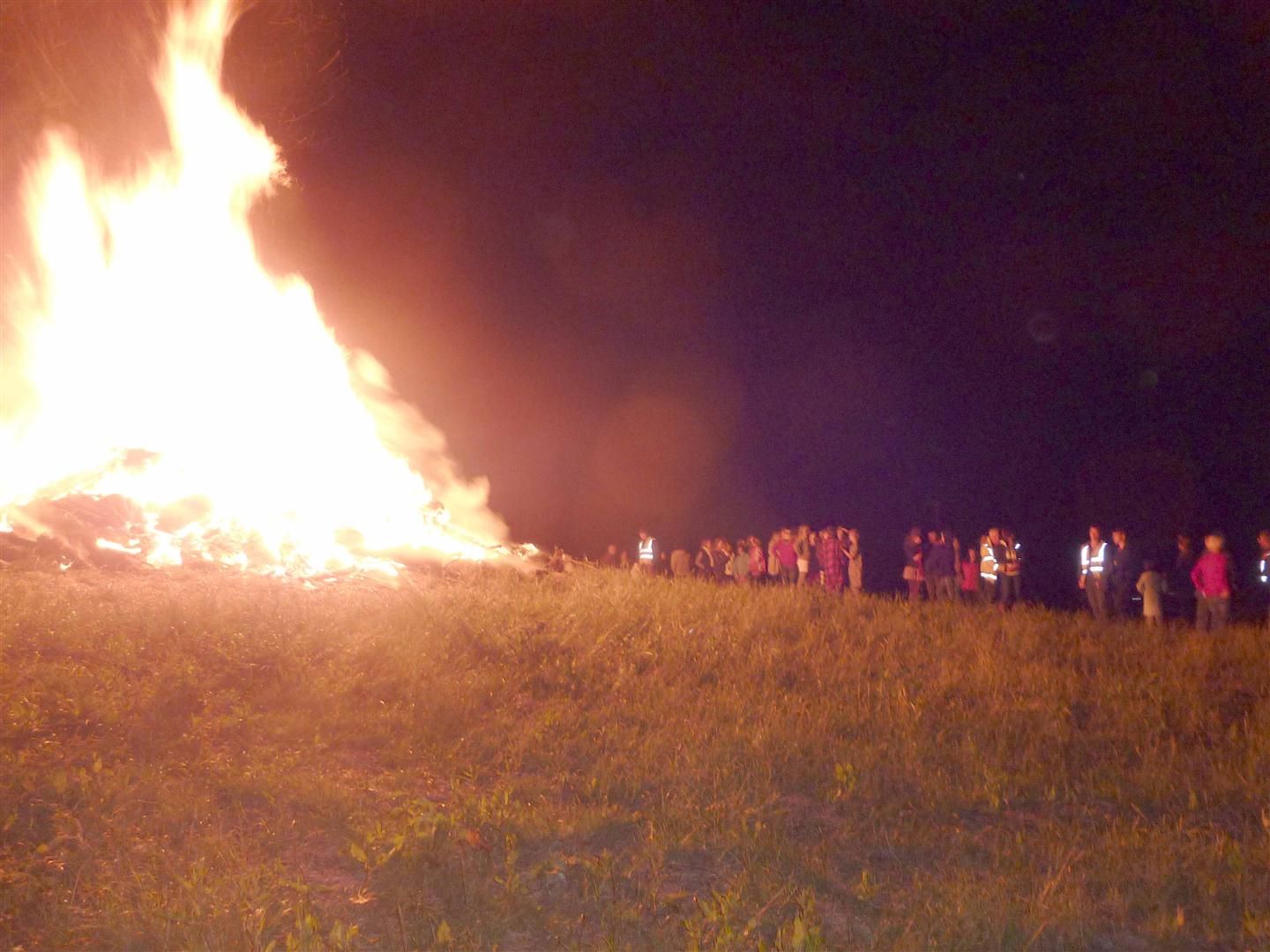
Neil sent me a further picture below of the village beacon alight for the Jubilee.
A small tribute from two of Her Majesty’s subjects!
Best wishes for many years ahead as our Queen!
Jean and I managed to watch the hour-long tribute by Prince Charles to his mother’s wonderful Diamond Jubilee week-end.
Here’s a small extract of that programme that appeared on ITN News.
Then thanks to Martin Lack’s latest Post, I discovered that You Tube have the full programme as well. Here it is – do watch it if you can, it is a lovely, personal and intimate reflection by Prince Charles.
At the end of the programme, both Jean and I felt very nostalgic about the long reign of Her Majesty Queen Elizabeth II. However much we appreciate the life that we have here in Payson, Arizona, these two old Londoners still feel proud to be British.
There’s a great website here full of all the details of this very special time for Britain.
Finally, the extreme dry conditions of our forest mean that lighting a Jubilee Beacon here at home is out of the question. The following is our alternative:
Beltane Fire Ritual, Edinburgh, Scotland
It’s what Jean and I do most Sunday evenings anyway!














 Learning from Dogs