This is an article that I saw on Mother Nature Network in the middle of June and thought at the time it would interest readers of this place.
ooOOoo
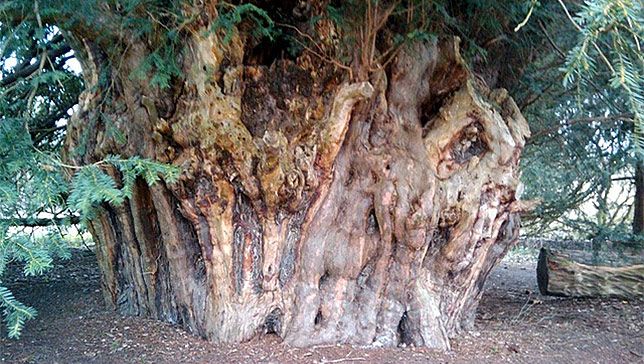
2,500-year-old tree witnessed Magna Carta signing
The Ankerwycke Yew in Berkshire, England, has been an important meeting spot for hundreds of years.
By: Michael d’Estries
June 15, 2015,
The Ankerwycke yew is estimated to be between 2,000-2,500 years old. (Photo: Wiki Creative Commons)
As the world celebrates the 800th anniversary of the signing of the Magna Carta, [Ed. That was on June 15th, 2015] a document that laid the foundation for modern liberties and law, it’s worth remembering that one silent witness to that historical event remains alive and well.
According to some historians, King John signed the Magna Carta beneath the Ankerwycke yew, a 30-foot-wide behemoth, which in June 1215 was already a well-known ancient landmark. Estimates of its age today range from 2,000-2,500 years — making it one of oldest trees in the United Kingdom and the world.
The famous yew is located along the banks of the River Thames on grounds previously occupied by a 12th-century nunnery called St. Mary’s Priory. Historians point to a 19th-century reference to the nunnery, now in ruins, that hints at its importance in the signing of the Magna Carta.
Here the confederate Barons met King John, and having forced him to yield to the demands of his subjects they, under the pretext of securing the person of the King from the fury of the multitude, conveyed him to a small island belonging to the nuns of Ankerwyke [the island], where he signed the Magna Carta, wrote J.J. Sheahen in 1822.
History credits the yew as playing host to several other important meetings, from a place of council for Saxon kings to secret meetings between Henry VIII and a young Anne Boleyn. Earlier this year, saplings grown from the cuttings of famous yews from all over the U.K., including the Ankerwycke, were planted in a hedge in Edinburgh’s Botanic Gardens.
‘We are losing ancient yews all the time, to climate change, development and vandalism,” said Martin Gardner, who is leading the preservation initiative. “These are the most iconic trees in the world. We have to conserve every single one.”
Published on Apr 9, 2013
A short film about a remarkable ancient tree in England. It is the oldest known tree on National Trust land and is believed to be the location where the Magna Carta was signed in 1215. Surrounded by myth and legend, this tree is also believed to be the place where King Henry VIII began his first liaisons with his future (ill-fated) wife, Anne Boleyn in the 1530’s.
ooOOoo
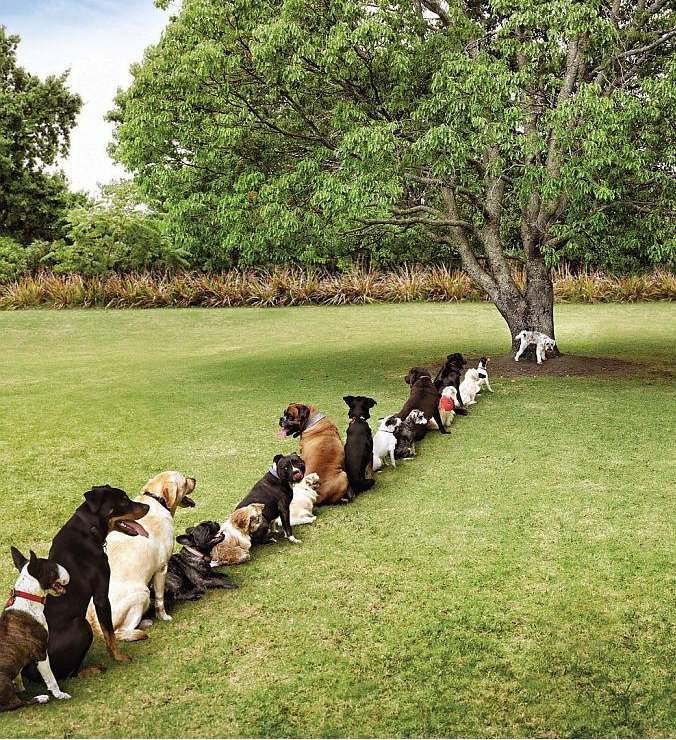
I will close the post with this much-circulated picture reinforcing the fact that trees have been an important meeting spot for hundreds of years.
When I first started writing this blog, more than six years ago now, I had no idea whatsoever that the community of friends who read and follow Learning from Dogs would develop to the point where the volume of ideas and suggestions sent in are, are by far, the biggest source of creative posts.
Take today’s for example. The link to the article was sent to me by Chris Gomez a little over a week ago and yesterday was the first time that I read the article in full.
It’s a fascinating and incredibly interesting piece.
Unlike a certain companion animal that will go unnamed, dogs lose their minds when reunited with their owners. But it’s not immediately obvious why our canine companions should grant us such an over-the-top greeting—especially considering the power imbalance that exists between the two species. We spoke to the experts to find out why.
Call of the Wild
In order to gain an appreciation for dog behavior, it’s important to understand that dogs are descended from wolves (or at least a common wolf-like ancestor). Clearly, the two species, separated by about 10,000 to 15,000 years, share a lot in common.
Like dogs, wolves greet each other with vigorous face licking (Credit: Sander van der Wel CC A-SA 2.0)
But there’s only so much we can extrapolate from wolves; dogs are categorically different by virtue of the fact that their ancestors actively sought out the company of humans. Making matters even more complicated is the realization that Paleolithic era wolves are not the same as the ones around today. Consequently, any inferences we make about dog behavior and how it relates to wolves is pure speculation.
Neuroscientist Gregory Berns, author of How Dogs Love Us, says there’s a fundamental difference between modern wolves and those that lived long ago.
“The most social of those ancestral dogs who were hanging around humans had to have been the most social of those wolves,” he told io9. “They joined humans and eventually evolved to become dogs. The remainder of the wolf population were among the most antisocial of those animals, and did not want to have anything to do with humans.”
That said, however, Berns says we can clearly see behaviors in wolves that are similar to those expressed by dogs. For instance, wolves greet each other by licking each others’ faces. For these pack animals, this licking behavior serves as an important social greeting, but also as a way to check out and determine what the other wolves have brought home in terms of food.
Wolves, says University of Trento neuroscientist Giorgio Vallortigara, greet each other in different ways depending on the type of individual relationships they’ve forged. Feral dogs, he says, behave in similar ways. But the big change in terms of adaptive sociality has been the ability of domesticated dogs to interact with humans using our own communicative signals, such as gazes and gestures.
Dog expert Jessica Hekman, who blogs at DogZombie, has witnessed greeting behaviors among wolves first hand.
“When I’m at Wolf Park in Battle Ground, Indiana, I am always struck by how much some of the specific wolf behaviors resemble behaviors I see in dogs—but so much more ritualized, and sort of writ large,” she told io9. “I witnessed one behavioral study there in which wolves who knew each other well had been separated for a few days and were put back together. The greeting rituals were fascinating, with lots of crouching and chin-licking from the subordinate wolves. You do see these behaviors in dogs, but more sporadically, without such intensity.”
At the same time, dogs exhibit behaviors that are markedly different from wolves. As Hekman explained to me, one of the most dramatic differences between dogs and wolves is the ability of dogs to accept novelty. Simply put, dogs are less fearful than wolves.
“It may sound a little odd to say that a wolf, who can easily kill you, is afraid of you, but that is precisely why they can be dangerous: because they may choose to take proactive measures to protect themselves, using their teeth,” says Hekman. “Dogs are a lot less likely to do this.”
Indeed, given their wolf ancestry, it’s remarkable that dogs get along with humans so well. But as Berns pointed out to me, sociability has turned out to be a rather powerful adaptation, one that has worked a lot better for dogs than it has wolves.
“I mean, look around the world and see how many dogs there are,” he says. “With dogs, it’s proven to be a highly effective evolutionary strategy. There are in the order of tens of millions of dogs in the world, so in many ways, dogs have out-evolved wolves.”
Berns says that whatever the sociality that dogs have evolved, one of the defining traits of a dog is the degree to which they will interact with humans as well as other animals.
How Dogs See Humans
A key aspect of Berns’ brain imaging research is to study how dogs perceive us. We humans know that dogs are a separate species, but are dogs cognizant of this as well? Or do they see us as members of their pack, or as some kind of weird dog?
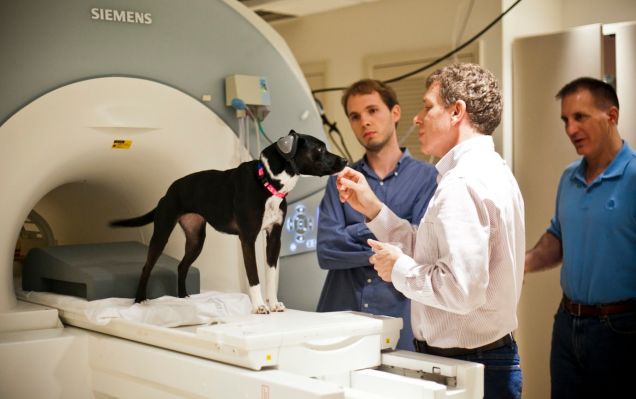
Callie gets outfitted with ear protection prior to entering the noisy fMRI machine. The research team includes, from left, Andrew Brooks, Gregory Berns and Mark Spivak. (Credit: Bryan Meltz, Emory University)
According to Berns’ research, dogs that are presented with certain smells in scanners can clearly tell the difference between dogs and humans, and also discern and recognize familiar and strange odors. In particular, the scent of a familiar human evokes a reward response in the brain.
“No other scent did that, not even that of a familiar dog,” Berns told io9. “It’s not the case that they see us as ‘part of their pack as dogs,’ they know that we’re something different— there’s a special place in the brain just for us.”
Berns stresses that dogs are social with us not just because of their scavenging tendencies.
“What we’re finding with the imaging work is that dogs love their humans—and not just for food,” he says. “They love the company of humans simply for its own sake.”
Hekman says it’s hard to know what dogs are thinking, but she suspects they understand that we’re not quite like them. As evidence, she points to aggressiveness in dogs as it’s directed to other dogs and humans—differences that aren’t correlated. She says it’s quite common for a dog to have a problem with one and not the other. In other words, dogs appear to perceive other dogs as one group, and humans as a separate group. What’s more, dogs will seek the help of humans and not other dogs—a possible sign that dogs understand that humans have resources that dogs do not, and are thus a different kind of social entity.
But do dogs see us as part of the pack?
“It’s important to note that a pack of wolves is a family—literally, usually mom, dad, puppies, and some young offspring from previous years who haven’t gone off on their own yet,” says Hekman. “Do dogs see us as part of their family? I think they do.”
So Happy to See Us
Virtually all experts agree that the happiness dogs feel is comparable to what humans experience, and that it’s similar to how humans feel towards each other.
One happy dog (Credit: Lars Curfs/CC-A-SA 3.0)
“All the things that we’ve done with the brain imaging—where we present certain things to the dogs and map their reward responses—we see analogous brain responses in humans,” says Berns. “Seeing a person that’s a friend or someone you like, these feelings are exactly analogous to what a dog experiences.”
Berns says that dogs don’t have the same language capacities as humans, and that they’re not capable of representing things in their memory like we can. Because dogs don’t have labels or names for people, he suspects that they have an even purer emotional response; their minds aren’t filled with all sorts of abstract concepts.
It’s also important to consider the dog-human bond and the degree of attachment each feels toward each other. When used with dogs, the “Strange Situation Test” devised by developmental psychologist Mary Ainsworth, suggests that during absence and then at the rejoining with the owners, a dog’s behavior is very similar to that observed in children and mothers in similar situations. As Vallortigara pointed out to me, it’s appropriate and correct to speak of the dyad dog/owner in terms of “attachment.”
A dog’s particular greeting, however, is dependent on several factors, such as the dog’s temperament, the personality of the owner, the nature of their relationship, the level of stress and anxiety, and the dog’s tendency/capacity for self-control.
It’s important to note, however, that stress manifests differently in dogs than it does in humans.
“The separation from the owner for the dog is not voluntary,” says Vallortigara. “It is always unnatural for a dog to detach and abandon the pack.”
Dogs will sometimes go solo on a temporary basis if they’re sufficiently motivated to do so, but they do it knowing that social contact can be resumed at virtually any time.
“The exaggerated level of greeting that can be observed in some dogs is likely due to the fact that they have not yet learned to accept the possibility of non-voluntary detachment,” says Vallortigara.
When trying to appreciate a dog’s over-the-top greeting, Hekman says we need to imagine what it was like for a dog to be alone all day while we were gone.
So bored. (Credit: Pixabay/Pinger/10 images/CC0 Public Domain)
“This dog probably had a pretty boring day without much enrichment, and moreover may have been alone all day, which is unpleasant for a social animal,” she told io9. “So in addition to being glad to see us, they are probably feeling some relief that they will get to do something interesting, like go for a walk, and have someone else around. Some people are able to have a dog walker come in or send their dogs to daycare—this is a great solution to what can otherwise be a difficult lifestyle for a dog.”
And as Berns points out, the greeting ritual is a social bonding mechanism—but it’s also a function of curiosity.
“When they jump up, they’re trying to lick you in the face,” says Berns. “Part of that is a social greeting, but they’re also trying to taste and smell you to figure out where you’ve been and what you’ve done during the day. So some of it is curiosity. If I’ve been with other dogs, for instance, my dogs know it, and they resort to sniffing intensely.”
How to Greet Your Dog Back
It’s obviously important to respond to your dog when you get home, but according to Marcello Siniscalchi, a veterinary physician from the University of Bari, how you should react will depend on the context of the situation and the needs of the dog itself.
“The greeting ritual will vary from dog to dog because any individual dog perceives and reacts to detachment from the owner in a very personal way,” he told io9. “Some dogs need to be greeted, in others it is better to avoid any escalation in the level of excitation, others need to learn strategies for coping with the stress associated with detachment.”
Hekman says there’s definitely a tension between our buttoned-down greeting rituals (“Hi, honey, I’m home!”) and theirs (“I want to lick you on the face repeatedly!”).
“My dog Jenny is a very enthusiastic greeter, and I hate having her jump all over me in her efforts to get at my face,” she says. “So I have taught her to get on a couch when I come home. I generally have to remind her to ‘get on your couch,’ but now she does with great enthusiasm, and waits for me to come over. The couch puts her more on my level, so she doesn’t have to jump, and I can bend forward and let her lick my cheek, which is a very important part of the ritual for her.”
Hekman stresses that, for any dog, it’s important for us not to tell them what not to do (e.g. “don’t jump on me!”), but to tell them what to do.
“Many is the retriever owner who has taught their dog to get a toy when they come home to channel their excitement,” she added.
The main point, she says, is that it’s important for dogs to have the greeting ritual, but it can be redirected in ways to make it easier on the owners such that everyone enjoys it.
ooOOoo
So a huge thank you to all of you that send in remarkable items for Learning from Dogs.
A few weeks ago, I read a book entitled The Republican Brain written by Chris Mooney and to quote WikiPedia:
The Republican Brain: The Science of Why They Deny Science — and Reality is a book by the journalist Chris Mooney that is about the psychological basis for many Republicans’ rejection of mainstream scientific theories, as well as theories of economics and history.
On page 83, Chris Mooney writes (my emphasis):
Here also arises a chief liberal weakness, in Lakoff’s view (*), and one that is probably amplified by academic training. Call it the Condorcet handicap, or the Enlightenment syndrome. Either way, it will sound very familiar: Constantly trying to use factual and reasoned arguments to make the world better and being amazed to find even though these arguments are sound, well-researched, and supported, they are disregarded, or even actively attacked by conservatives.
When glimpsed from a bird’s eye view, all the morality research that we’re surveying is broadly consistent. It once again reinforces the idea that there are deep differences between liberals and conservatives – differences that are operating, in many cases, beneath the level of conscious awareness, and that ultimately must be rooted in the brain.
(*) George Lakoff, Berkeley Cognitive Linguist and author of the book Moral Politics.
What Chris Mooney is proposing is that the difference between liberals and conservatives could be genetically rooted, at least in part.
That underlines in my mind how each of us, before even considering our gender differences, is truly a complex mix of ‘nature and nurture’ with countless numbers of permutations resulting.
That there are deep differences, apart from the obvious ones, between man and woman goes without saying. In earlier times, these differences were essential in us humans achieving so much and leading to, in the words of Yuval Noah Harari from yesterday’s post., ” … few would disagree that humans dominate planet Earth; we’ve spread to every continent, and our actions determine the fate of other animals (and possibly Earth itself).”
Speaking of earlier times, let me turn to dogs, for it is pertinent to my post, and I would like to quote an extract from what Doctor of Veterinarian Medicine, Jim Goodbrod, writes in the foreword of my forthcoming book:
But what exactly is this human-dog bond and why do we feel such an affinity for this species above all others? My feeling is that it may be associated with our deep but subconscious longing for that age of simple innocence and innate human goodness that we supposedly possessed before we became truly “human”: that child-like innocence or what Rousseau referred to as the “noble savage”, before being corrupted by civilization, before we were booted out of the Garden of Eden. We humans, for better or worse, somewhere along that evolutionary road acquired consciousness or so-called human nature and with it we lost that innocence. What we gained were those marvelous qualities that make us uniquely human: a sense of self-awareness, an innate moral and ethical code, the ability to contemplate our own existence and mortality, and our place in the universe. We gained the ability to think abstract thoughts and the intellectual power to unravel many of the mysteries of the universe. Because of that acquired consciousness and humans’ creative and imaginative mind we have produced the likes of Shakespeare, Mozart, and Einstein. We have peered deep into outer space, deciphered the genetic code, eradicated deadly diseases, probed the bizarre inner world of the atom, and accomplished thousands of other intellectual feats that hitherto would not have been possible without the evolution of our incredible brain and the consciousness with which it is equipped.
No other living species on this planet before or since has developed this massive intellectual power. But this consciousness was attained at what cost? Despite all the amazing accomplishments of the human race, we are the only species that repeatedly commits genocide and wages war against ourselves over political ideology, geographic boundaries, or religious superstition. We are capable of justifying the suffering and death of fellow human beings over rights to a shiny gold metal or a black oily liquid that powers our cars. We are the only species that has the capability to destroy our own planet, our only home in this vast universe, by either nuclear warfare, or more insidiously by environmental contamination on a global scale. Was it worth it? No matter what your or my opinion may be, Pandora’s Box has been opened and we cannot put the lid back on.
What can we do now to reverse this trend and help improve the quality of life for humanity and ensure the well-being of our planet? I think, if we recognize the problem and look very critically at ourselves as a unique species with awesome powers to do both good and bad, and put our collective minds to the task, it may be possible to retrieve some of the qualities of that innocence lost, without losing all that we have gained.
Dogs represent to me that innocence lost. Their emotions are pure. They live in the present. They do not suffer existential angst over who or what they are. They do not covet material wealth. They offer us unconditional love and devotion. Although they certainly have not reached the great heights of intellectual achievement of us humans (I know for a fact that this is true after having lived with a Labrador retriever for several years), at the same time they have not sunk to the depths of depravity to which we are susceptible. It could be argued that I am being overly anthropomorphic, or that dogs are simply mentally incapable of these thoughts. But nevertheless, metaphorically or otherwise, I believe that dogs demonstrate a simple and uncorrupted approach to life from which we all could benefit. I think the crux of Paul’s thesis is that, within the confines and limitations of our human consciousness, we can (and should) metaphorically view the integrity of the dog as a template for human behavior.
“Dogs demonstrate a simple and uncorrupted approach to life …”
I closed yesterday’s post with these words, “It is my contention that humankind’s evolution, our ability to “cooperate flexibly in large numbers”, is rooted in the gender differences between man and woman.”
The premise behind that proposition is that until, say one hundred years ago, give or take, that co-operation between large numbers of humans was critically important in so many areas: health; science; medicine; physics; exploration; outer space and more. (And whether one likes it or not: wars.) My proposition is that it is predominantly men who have been the ‘shakers and movers’ in these areas. Of course not exclusively, far from it, just saying that so many advances in society are more likely to have been led by men.
But (and you sensed a ‘but’ coming up, perhaps) these present times call for a different type of man. A man who is less the rational thinker, wanting to set the pace, and more a man capable of expressing his fears, exploring his feelings, defining his fear of failure, and more. I don’t know about you but when I read Raúl Ilargi Meijer words from yesterday, “And if and when we resort to only rational terms to define ourselves, as well as our world and the societies we create in that world, we can only fail.”, it was the male of our species that was in my mind. As in, “And if and when we [males] resort to only rational terms to define ourselves …”.
Staying with Raúl Meijer’s words from yesterday (my emphasis), “And those should never be defined by economists or lawyers or politicians, but by the people themselves. A social contract needs to be set up by everyone involved, and with everyone’s consent.”
Dogs demonstrate a simple and uncorrupted approach to life but that doesn’t extend to them making social contracts. Women do understand social contracts, they are predominantly caring, social humans. Less so for men. But for that social contract to be successfully set up by everyone it must, of course, include men. And that requires men, speaking generally you realise, to find safe ways to get in touch with their feelings, to tap into their emotional intelligence, using positive psychology to listen to their feelings and know the truth of what they and their loved ones need to guarantee a better future. What they need in terms of emotional and behavioural change. And, if I may say, sensing when they might need the support of subject experts to embed and sustain those behavioural changes.
It was the fickle finger of fate that led me to the arms, metaphorically speaking, of a core process psychotherapist back in Devon in the first half of 2007. That counselling relationship that revealed a deeply hidden aspect of my consciousness: a fear of rejection that I had had since December, 1956. That finger of fate that took me to Mexico for Christmas 2007 and me meeting Jean and all her dogs. That finger of fate that pointed me to the happiest years of my life and a love between Jeannie and me that I could hitherto never ever have imagined.
However, as much as I love and trust Jean, wholeheartedly, it comes back to dogs.
For when I curl up and wrap myself around a dog and sense that pure unconditional love coming back to me, I have access to my inner feelings, my inner joys and fears, in a way unmatched by anything else.
Where learning from dogs is a gateway to learning from me.
I did warn you, my dear reader, at the end of yesterday’s post that my introspective mood continues!
Over today and tomorrow, I want to explore why we humans can be so incredibly clever, especially in a group sense, yet the males of our species find it so difficult to express themselves, and what that means for the future of humanity (at the risk of sounding a tad pompous).
More or less at random, a dip into yesterday’s selection of blogs brought to light some deeply disturbing items.
Professor William Even, Professor of Economics at the Farmer School of Business at Miami University was reported in The Conversation saying that:
As of 2014, there were approximately 39 million people aged 16-24 in the US, and 5.4 million of them were neither employed nor in school. That’s almost 14% of the age cohort, or more than two-and-a-half times the national rate of unemployment.
In that same bulletin from The Conversation, John Shepherd, a Professorial Research Fellow in Earth System Science at the University of Southampton in England, in writing about the challenges of directly removing CO2 from the atmosphere, stated (my emphasis):
A new paper in Nature Communications shows just how big the required rates of removal actually are. Even under the IPCC’s most optimistic scenario of future CO2 emission levels (RCP2.6), in order to keep temperature rises below 2℃ we would have to remove from the atmosphere at least a few billion tons of carbon per year and maybe ten billion or more – depending on how well conventional mitigation goes.
We currently emit around eight billion tonnes of carbon per year, so the scale of the enterprise is massive: it’s comparable to the present global scale of mining and burning fossil fuels.
Time to tackle a topic that’s very hard to get right, and that will get me quite a few pairs of rolling eyes. I want to argue that societies need a social fabric, a social contract, and that without those they must and will fail, descend into chaos.
Then after referring to the European Union, he goes on to write (my emphasis):
Though it may look out of far left field for those of us -and there are many- who think in economic and political terms only, we cannot do without a conscious definition of a social contract. We need to address the role of compassion, morals, even love, in our societies. If Jesus meant anything, it was that.
There have been times through history when this subject would have been much easier to breach, but we today almost seem to think they are irrelevant, that we can do without them. We can’t. But in the US, people get killed at traffic stops every day, and in Europe, they die of sheer negligence. Developments like these will lead to ‘centers that cannot hold’.
In that part of the media whirlwind that we at the Automatic Earth expose ourselves to, virtually all discussions about our modern world, and what goes wrong with it, which is obviously a whole lot, are conducted in rational terms, in financial and political terminology.
But that’s exactly what we should not be doing. Because it’s never going to get us anywhere. In the end, let alone in the beginning too, we are not rational creatures. And if and when we resort to only rational terms to define ourselves, as well as our world and the societies we create in that world, we can only fail.
For a society to succeed, before and beyond any economic and political features are defined, it must be based solidly on moral values, a moral compass, compassion, humanity and simple decency among its members. And those should never be defined by economists or lawyers or politicians, but by the people themselves. A social contract needs to be set up by everyone involved, and with everyone’s consent. Or it won’t last.
How and why that most basic principle got lost should tell us a lot about where we are today, and about how we got here. Morals seem to have become optional. The 40-hour death struggle of Cecil the lion exemplifies that pretty well. And no, his is not some rare case. The lack of morals involved in killing Cecil is our new normal.
Let me now set the stage for what I want to write about tomorrow. And I’m going to do that by referring to a TED Talk that was recorded by historian and author Yuval Noah Harari. Here’s how that TED Talk was introduced:
Seventy thousand years ago, our human ancestors were insignificant animals, just minding their own business in a corner of Africa with all the other animals. But now, few would disagree that humans dominate planet Earth; we’ve spread to every continent, and our actions determine the fate of other animals (and possibly Earth itself). How did we get from there to here? Historian Yuval Noah Harari suggests a surprising reason for the rise of humanity.
Yuval Harari’s talk is based firmly on his thesis presented in his book: Sapiens: A Brief History of Humankind. (There’s a review of his book in The Guardian newspaper.) Namely:
The book surveys the history of humankind from the evolution of archaic human species in the Stone Age up to the twenty-first century. Its main argument is that Homo sapiens dominates the world because it is the only animal that can cooperate flexibly in large numbers. The book further argues that Homo sapiens can cooperate flexibly in large numbers, because it has a unique ability to believe in things existing purely in its own imagination, such as gods, nations, money and human rights. The author claims that all large scale human cooperation systems – including religions, political structures, trade networks and legal institutions – are ultimately based on fiction.
Other salient arguments of the book are that money is a system of mutual trust; that capitalism is a religion rather than only an economic theory; that empire has been the most successful political system of the last 2000 years; that the treatment of domesticated animals is among the worst crimes in history; that people today are not significantly happier than in past eras; and that humans are currently in the process of upgrading themselves into gods.
It is my contention that humankind’s evolution, our ability to “cooperate flexibly in large numbers”, is rooted in the gender differences between man and woman. A contention that I expand upon tomorrow.
That very ancient relationship between man and dog.
The website Eye Witness to History has a lovely item on Mount Vesuvius:
On August 24, 79 Mount Vesuvius literally blew its top, spewing tons of molten ash, pumice and sulfuric gas miles into the atmosphere. A “firestorm” of poisonous vapors and molten debris engulfed the surrounding area suffocating the inhabitants of the neighboring Roman resort cities of Pompeii, Herculaneum and Stabiae. Tons of falling debris filled the streets until nothing remained to be seen of the once thriving communities. The cities remained buried and undiscovered for almost 1,700 years until excavation began in 1748. These excavations continue today and provide insight into life during the Roman Empire.
An ancient voice reaches out from the past to tell us of the disaster. This voice belongs to Pliny the Younger whose letters describe his experience during the eruption while he was staying in the home of his Uncle, Pliny the Elder. The elder Pliny was an official in the Roman Court, in charge of the fleet in the area of the Bay of Naples and a naturalist. Pliny the Younger’s letters were discovered in the 16th century.
If you are keen to read the full article then it may be found here.
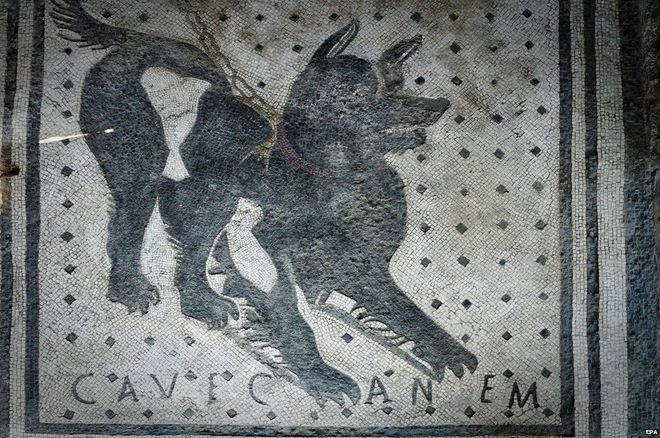
My reason for quoting those opening paragraphs is because they offer a good historical introduction to another item from the BBC News website. That item is about a dog mosaic that is back on show after its restoration at Pompeii.
ooOOoo
Pompeii guard dog mosaic back on show
One of Pompeii’s finest mosaics – a guard dog at the entrance to a villa.
A vivid Roman dog mosaic is back on show after restoration at Pompeii, despite Italy’s problems funding the historical site’s conservation.
A glass shield now protects the House of the Tragic Poet, where tourists can see the dog with the inscription “Cave Canem” – Latin for “Beware of the dog“.
Frescoes at the house’s entrance were also restored. Ash from a volcanic eruption buried Pompeii in AD79.
A staffing dispute caused long queues at Pompeii on Friday, in searing heat. Pompeii gives visitors an extraordinary insight into everyday life in ancient Rome because many buildings were protected from the elements under the thick blanket of ash from Mount Vesuvius.
The restored mosaic now has better protection.
The site, near the southern city of Naples, has suffered from funding problems for years. Staff unions at Pompeii have criticised a management reorganisation there.
The House of the Tragic Poet has some of Pompeii’s finest examples of interior decoration, including scenes from Greek mythology.
But the house’s owners remain unknown – they may have died in the eruption along with many other Pompeii citizens.
ooOOoo
Now we all know that the relationship between dogs and man goes way, way back before Pompeii but, nonetheless, it’s rather nice to see dogs commemorated in this way from 1,936 years ago.
Yesterday was heading to be a very hot day in Merlin, Oregon with top temperatures forecasted to be around the mid-90’s, or 34-36 deg. C in ‘new money’. The light westerly wind must have been generating some up currents, aided and abetted by the rising hot air, for there were a number of black ravens soaring in a thermal. Watching the birds circle and climb in the thermal current without needing to flap their wings took me back too many years.
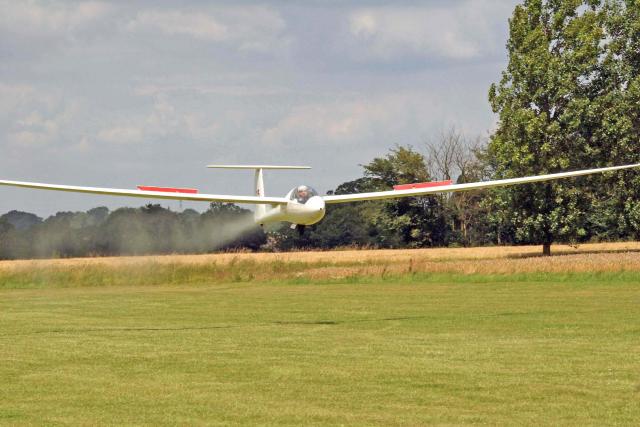
It took me back to a June day in 1981 where I experienced my first glider flight (sailplane in American speak) at the Rattlesden Gliding Club in Suffolk, East Anglia. I’m delighted to see that the Club is still an active one, as their website confirms. Although I subsequently went on to gain my private pilot’s licence (PPL) there are still times when I miss the magic, the pure magic, of gaining altitude in a glider in a beautiful thermal.
Modern fibreglass glider coming into land at Rattlesden G.C.
So what prompted this flood of flying nostalgia!! An item that was published on the BBC website earlier in the year.
ooOOoo
Fly like a bird: The V formation finally explained
By Victoria Gill, Science reporter, BBC News
The mystery of why so many birds fly in a V formation may have been solved.
Scientists from the Royal Veterinary College fitted data loggers to a flock of rare birds that were being trained to migrate by following a microlight. This revealed that the birds flew in the optimal position – gaining lift from the bird in front by remaining close to its wingtip.
A previous experiment in pelicans was the first real clue to the energy-saving purpose of V formations. It revealed that birds’ heart rates went down when they were flying together in V.
But this latest study tracked and monitored the flight of every bird in the flock – recording its position, speed and heading as well as every wing flap.
This was possible thanks to a unique conservation project by the Waldarappteam in Austria, which has raised flocks of northern bald ibises and trained them to migrate behind a microlight.
The aim of this unusual project is to bring the northern bald ibis back to Europe; the birds were wiped out by hunting, so the team is retraining the birds to navigate a migration route that has now been lost.
Fitting tiny data loggers to these critically endangered ibises showed that the birds often changed position and altered the timing of their wing beats to give them an aerodynamic advantage.
Lead researcher Dr Steven Portugal explained: “They’re seemingly very aware of where the other birds are in the flock and they put themselves in the best possible position.”
This makes the most of upward-moving air generated by the bird in front. This so-called “upwash” is created as a bird flies forward; whether it is gliding or flapping, it pushes air downward beneath its wings.
“Downwash is bad,” explained Dr Portugal. “Birds don’t want to be in another bird’s downwash as it’s pushing them down.” But as the air squeezes around the outside of the wings, it creates upwash at the wingtips.
“This can give a bit of a free ride for the bird that’s following,” said Dr Portugal. “So the other bird wants to put its own wingtip in the upwash from the bird in front.”
The other really surprising result, the researchers said, was that the birds also “timed their wing beats perfectly to match the good air off the bird in front”.
“Each bird [kept] its wingtip in the upwash throughout the flap cycle,” Dr Portugal explained.
oooo
In a sidebar to that BBC article there is this explanation about Flapping and Flying:
As a bird’s wings move through the air, they are held at a slight angle, which deflects the air downward. This deflection means the air flows faster over the wing than underneath, causing air pressure to build up beneath the wings, while the pressure above the wings is reduced. It is this difference in pressure that produces lift.
Flapping creates an additional forward and upward force known as thrust, which counteracts the weight and the “drag” of air resistance. The downstroke of the flap is also called the “power stroke”, as it provides the majority of the thrust. During this, the wing is angled downwards even more steeply.
You can imagine this stroke as a very brief downward dive through the air – it momentarily uses the animal’s own weight in order to move forward. But because the wings continue to generate lift, the creature remains airborne. In each upstroke, the wing is slightly folded inwards to reduce resistance.
ooOOoo
The BBC piece also included this wonderful short video:
This piece has nothing to do with dogs unless one extends the mindset to the magic of the complete natural world.
UPDATE
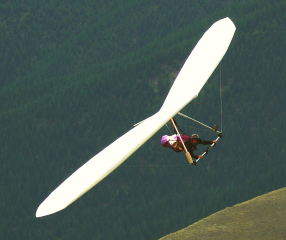
This is a photograph of George Ball hang-gliding – see his reply below.
From time to time I receive unsolicited emails asking if I would be interested in publishing posts from this or that particular person. They always strike me as suspicious and receive, in turn, a polite ‘no thank you’.
However, a few weeks ago, the following came in:
My name is Intan and I am a community team member at ShihTzu Web, a website dedicated to providing breed-specific information just for shih tzu owners. We share articles regularly about shih tzu grooming, training, and health.
We would love to help provide some free high-quality content for the shih tzu owners in your audience with a guest blog post. We have two specialist writers for our blog: veterinarian Jill Coleman, who writes about shih tzu health topics, and Sally Gutteridge, who writes about shih tzu grooming and training.
That website ShihTzu Web clearly sets out a part commercial proposition but after thinking about the offer, I decided to accept the guest post.
So here is that guest post, authored by Dr. Jill Coleman*:
Jill Coleman
ooOOoo
What to Do If Your Dog Is Pregnant
First things first: were you planning on your dog getting pregnant? There are many convincing arguments that until the pet overpopulation problem is under control, there should be no planned canine pregnancies. This article is not going get into that debate (although the last sentence pretty much wraps up my opinion).
Let’s first assume you did NOT mean for your dog to get pregnant. Oops! You will hear about “morning after” shots and pills. None of these are recommended because they all seem to have side effects that are far worse than having a litter of puppies. We’re talking life threatening uterine infections and bone marrow suppression– nasty stuff, so this definitely does not keep your dog healthy. An option if you are planning on spaying your dog anyway, is to have her spayed. Waiting until she is out of heat is a good idea because the surgery is considered safer when they aren’t in heat because they lose less blood.
Now we’ll assume that you either did plan on your dog getting pregnant and/or you just need advice for a pregnant dog: what should you do? Not a lot, really. Dogs have been successfully reproducing with no human intervention for many years. A good quality diet is important. For the first half of their pregnancy a normal adult, high quality diet is fine. Switch to puppy food (sometimes referred to as “growth”) for the second half of the pregnancy and the entire time she is nursing the puppies. Do NOT supplement with any vitamins. Studies have shown that not only is this unnecessary, it is detrimental. Supplementing with calcium for example can make the bitch produce less of her own and thus interfere with her normal milk production.
Dogs are pregnant for approximately 63 days. At about day 55, it’s a good idea to start taking their temperature twice a day. Rectal thermometers are more accurate, but I have never met a dog that enjoys this process. There are many non-rectal thermometers available now that work perfectly for this because even if they read a little low, what you look for is a drop from their normal temperature. So go ahead and get one and establish what “normal” is for your dog well before she is due to whelp. Dog’s temperatures drop about 2 full degrees approximately 24 hours before they give birth. This is a fantastic way to tell when they are about to give birth. A dog’s normal resting rectal temperature is 101.5*F +/- about 1*.
Go ahead and prepare a whelping box that is comfortable and tucked away in a safe, preferably familiar area to the bitch. It is important for it to be quiet to allow her to relax. The less people running around and stressing out the better. You can actually cause your bitch to go out of labor by freaking her out.
As far as exercise, she doesn’t have to be a couch potato but avoid strenuous exercise especially late in her pregnancy. Walks are fine, but be sure she doesn’t overheat. Be careful approaching other dogs, even if she has been fine with them in the past. Most dog’s personalities don’t really change significantly but some will become more aggressive during their pregnancy. (Almost all will become protective of the puppies once they are born.)
Check your flea and tick medications to be sure they are safe. You will probably have to check with your veterinarian because most flea and tick medications are not labeled for use on pregnant or lactating females because they simply didn’t conduct studies on pregnant bitches. Your veterinarian should know which ones are safe if you are having flea and tick issues.
Last but not least and possibly most important is to go ahead and put emergency numbers where you can easily find them. You don’t want to be trying to find the emergency clinics number in the middle of the night if your furry child is having problems.
ooOOoo
*Dr. Jill Coleman, DVM, is a small animal veterinarian with 20 years of clinical experience. She graduated from Furman University with a BA in English in 1991. She graduated with honors from The University of Georgia College of Veterinary Medicine in 1995. She loves small dogs like Shih Tzu and loves writing about them. She shares her experience about Shih Tzu at ShihTzu Web.
I will leave you with this delightful photograph …
… and the following few words from me.
Namely, that I have had no dealings with Shih Tzu Web or the organisation and people behind the website. Please don’t assume that the posting of this guest post offers any endorsement, or otherwise, of Shih Tzu Web. Any relevant feedback would be most welcome.
At the end of 2013, I published a post under the title of We must rewild. The core of that post was an essay from Patrice Aymes called Rewilding Us. Here’s a small extract from that essay:
In Africa, there are about 500,000 elephants. 25,000 to 30,000 are killed, a year, to send the ivory to east Asia (China, Vietnam). So African elephants may disappear. This is beyond tragic, it’s irreplaceable. Elephants understand people’s gestures, without any learning (they apparently learn to use trunk gestures among themselves). One is talking about extremely intelligent animals here. (In contrast, chimpanzees have great difficulties understanding human gestures.)
My post also included this photograph of young Cleo, just five months old, showing that her innate skills of being in the wild were alive and well, despite thousands of years of dogs being domesticated animals. Ergo, humans could manage just as well.
Photograph taken 25th April, 2012.
Last Friday, George Monbiot published an essay in The Guardian newspaper that stays with the theme of loving the wild. It is republished here with Mr. Monbiot’s very kind permission.
ooOOoo
Falling in Love Again
17th July 2015
Rebuilding our relationship with the natural world can re-animate our own lives, as well as the ecosystem.
When the robin was voted the UK’s national bird last month, we chose to celebrate half of a broken relationship. The robin is to the wild boar what the oxpecker is to the Cape buffalo: it has evolved to catch the worms and insects exposed by their grubbing. But boar are mostly absent from the UK, so its survival often depends on finding the next best thing: human gardeners. This is why the robin is so tame in this country. As far as the bird is concerned, you and I are just fake pigs.
We are surrounded by such broken relationships, truncated natural processes, cauterised ecologies. In Britain we lack almost all large keystone species: ecological engineers that drive the fascinating dynamics which allow other lifeforms to flourish. Boar, beavers, lynx, wolves, whales, large sharks, pelicans, sturgeon: all used to be abundant here, all, but for a few small populations or rare visitors, are missing.
The living systems that conservationists seek to protect in some parts of this country are a parody of the natural world, kept, through intensive management, in suspended animation, like a collection in a museum. An ecosystem is not just a place. It is also a process.
I believe their diminished state also restricts the scope of human life. We head for the hills to escape the order and control that sometimes seem to crush the breath out of us. When we get there, we discover that the same forces prevail. Even our national parks are little better than wet deserts.
Our seas were once among the richest on earth. A few centuries ago, you could have watched fin whales and sperm whales hammering the herring within sight of the shore. Shoals of bluefin tuna thundered up the North Sea. Reefs of oysters and other sessile animals covered the seabed, over which giant cod, skate and halibut cruised. But today, industrial fishing rips up the living fabric of all but 0.01% of our territorial waters. To walk or dive in rich environments we must go abroad.
Though not, I hope, for long. On Wednesday, a new organisation, Rewilding Britain, was launched. (It was inspired by my book Feral and I helped to found it, but I don’t have a position there). Its aim is to try to catalyse the mass restoration of the living world, bring trees back to bare hills, allow reefs to form once more on the seabed and to return to these shores the magnificent, entrancing animals of which we have so long been deprived. Above all it seeks to enhance and enrich the lives of the people of this nation. I hope that it might help to change the face of Britain.
Already, local projects hint at what could be achieved. In the southern uplands of Scotland, the Borders Forest Trust has bought 3000 hectares of bare mountainside and planted hundreds of thousands of native trees. The community of Arran seabed trust in the Firth of Clyde managed, after 13 years of campaigning, to persuade the government to exclude trawlers and scallop dredgers from one square mile of seabed. The result, in this tiny reserve, is an explosion of lobsters, crabs, scallops and fish. It’s now trying to extend the project to a larger area.
In Sussex, the Knepp Castle estate gave up its unprofitable wheat farming, released a few cattle and pigs and let natural processes take over. Now it hosts some of Britain’s highest populations of nightingales, purple emperor butterflies and turtle doves. Partly through ecotourism and accommodation and selling high-grade meat, it has become profitable. In south London, the Wandle Trust has turned a mangled and polluted urban river back into a beautiful chalkstream, supporting kingfishers and wild trout. Wonderful as these projects are, until now they have lacked a national voice. Britain remains in a state of extreme depletion.
Some people argue that we should not seek to re-establish missing species until we’ve protected existing wildlife. But nothing better protects our ecosystems than keystone species. Beaver dams provide habitats for fish, invertebrates, amphibians and waterbirds. In Ireland, resurgent pine martens appear to have pushed back the grey squirrel, allowing red squirrels to recolonise. One study suggests that our woodland ecology cannot recover unless half the country’s deer are culled every year. Lynx could do it for nothing. Functional ecosystems, in which dynamic living processes prevail once more, are likely to be more resistant to climate change than stagnant collections in virtual glass cases.
Over the past two years, there has been a surge of enthusiasm for change. A poll in Scotland found that 60% support the reintroduction of beavers, with only 5% opposed. 91% of respondents to a survey by the Lynx UK Trust supported a trial reintroduction. Researchers at the University of Cumbria digitally altered photographs of Borrowdale in the Lake District, adding or subtracting trees. 69% of the people who saw them favoured the images with extra trees. A video extracted from my TED talk, about the relationship between wolves and other wildlife, has been watched 18 million times.
But the interests of local people must never be overruled. Rewilding must take place only with active consent. Already, landowners are coming forward, proposing to rewild their own property. Community groups, such as Cambrian Wildwood in mid-Wales, are seeking to buy and restore surrounding land. What rewilding offers is a new set of options in places where traditional industries can no longer keep communities alive, where schools and shops and chapels and pubs are closing and young people are leaving the land to find work elsewhere.
In the hills of southern Norway, the return of trees has been accompanied by a diversification and enrichment of the local economy. There, the small income from farming is supplemented with eco-tourism, forest products, rough hunting, fishing, outdoor education, skiing and hiking. The governments of Britain now claim to be willing to pay for the protection of soils and watersheds. These are likely to be more resilient sources of income than the current farm subsidy system upon which all hill farming in this country depends, whose gross injustice – transferring vast sums from the poor to the rich simply for owning land – is as unsustainable politically as it is ecologically.
Perhaps most importantly, rewilding offers hope. It offers the hope of recovery, of the enhancement of wonder and enchantment and delight in a world that often seems crushingly bleak. My involvement with rewilding, to my own amazement, has made me much happier and more optimistic than I was before. I feel an almost evangelical sense of excitement about the prospects for change. I want other people to be able to experience it too.
In 2009, the rewilding pioneers Trees for Life released some wild boar into an enclosure at Dundreggan, in the Scottish Highlands. Within twenty minutes, robins came down from the trees and started following them. Their ecological memory was intact. When I’ve accompanied children from deprived London boroughs to the woods and rockpools for the first time in their lives, I have seen something similar: an immediate, instinctive re-engagement, the restoration of a broken ecological relationship. Once we have richer wild places to explore, we won’t need much prompting to discover their enchantments.
In the copy of George Monbiot’s essay that was published on his blogsite there were 25 links to other materials. I feel very bad that I just didn’t have the time to copy across all those links so my strong recommendation is that if you enjoyed reading this here then you go across to the essay on his blogsite and check out all the additional material available to you. My only exception was to insert the link to the organisation Rewilding Britain that was referred to in the sixth paragraph.
Dogs and humans go back even further than previously thought.
Humans and dogs were constant companions well before our ancestors settled in villages and started growing crops 10,000 years ago …
I have no doubt that thousands of dog owners all around the world must be enthralled by the way that dogs relate to us and, in turn, how we humans relate to dogs. More than once a day, one of our dogs will do something that has me and Jean marvelling at their way of living so close to us.
Then when one starts to reflect on how long dogs and humans have been together, perhaps it could be seen as the direct result of that length of relationship.
Now there’s nothing new in me writing this, after all the home page of Learning from Dogs states:
Yet they have been part of man’s world for an unimaginable time, at least 30,000 years. That makes the domesticated dog the longest animal companion to man, by far!
Back in May the website Livescience published an article that revealed more about the length of our relationship with dogs. This is how it opened:
Ancient Wolf DNA Could Solve Dog Origin Mystery
by Becky Oskin, Senior Writer
Humans and dogs were constant companions well before our ancestors settled in villages and started growing crops 10,000 years ago, a new study suggests.
Genetic evidence from an ancient wolf bone discovered lying on the tundra in Siberia’s Taimyr Peninsula reveals that wolves and dogs split from their common ancestor at least 27,000 years ago. “Although separation isn’t the same as domestication, this opens up the possibility that domestication occurred much earlier than we thought before,” said lead study author Pontus Skoglund, who studies ancient DNA at Harvard Medical School and the Broad Institute in Massachusetts. Previously, scientists had pegged the wolf-dog split at no earlier than 16,000 years ago.
The Livescience article referred to results that were published in the journal Current Biology on May 21st this year. One needs a subscription to read the full report but here is their summary:
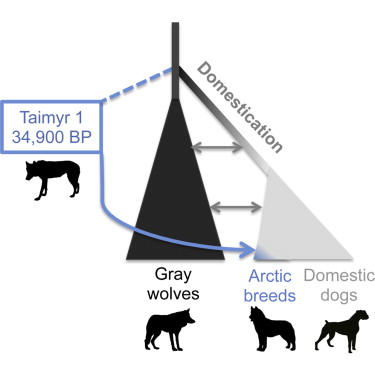
The origin of domestic dogs is poorly understood [ 1–15 ], with suggested evidence of dog-like features in fossils that predate the Last Glacial Maximum [ 6, 9, 10, 14, 16 ] conflicting with genetic estimates of a more recent divergence between dogs and worldwide wolf populations [ 13, 15, 17–19 ]. Here, we present a draft genome sequence from a 35,000-year-old wolf from the Taimyr Peninsula in northern Siberia. We find that this individual belonged to a population that diverged from the common ancestor of present-day wolves and dogs very close in time to the appearance of the domestic dog lineage. We use the directly dated ancient wolf genome to recalibrate the molecular timescale of wolves and dogs and find that the mutation rate is substantially slower than assumed by most previous studies, suggesting that the ancestors of dogs were separated from present-day wolves before the Last Glacial Maximum. We also find evidence of introgression from the archaic Taimyr wolf lineage into present-day dog breeds from northeast Siberia and Greenland, contributing between 1.4% and 27.3% of their ancestry. This demonstrates that the ancestry of present-day dogs is derived from multiple regional wolf populations.
That summary page also includes the following Graphical Abstract:
I don’t have permission to republish the Livescience article in full but would like to offer the closing paragraphs of this fascinating report.
“It is a very well-done paper,” Perry [George Perry, an expert in ancient DNA at Pennsylvania State University] told Live Science. “This topic is a critical one for our understanding of human evolution and human-environment interactions in the Paleolithic. Partnership with early dogs may have facilitated more efficient hunting strategies.”
If dogs first befriended hunter-gatherers, rather than farmers, then perhaps the animals helped with hunting or keeping other carnivores away. For instance, an author of a new book claims humans and dogs teamed up to drive Neanderthals to extinction. Skoglund also suggested the Siberian husky followed nomads across the Bering Land Bridge, picking up wolf DNA along the way.
“It might have been beneficial for them to absorb genes that were adapted to this high Arctic environment,” Skoglund said.
This is the first wolf genome from the Pleistocene, and more ancient DNA from prehistoric fossils could provide further insights into the relationship between wolves, dogs and humans, the researchers said.
Yes, our dogs have been part of man’s world for an unimaginable time – and Jean and I, as with tens of thousands of others, can’t imagine a world without dogs.
A colleague back in England was speaking to me recently about a series on BBC Television about forensics. The series is called Catching History’s Criminals: The Forensics Story.
Apparently, the third in the series Instruments of Murder (For UK readers the link is here.) included fire being used as a criminal act. That episode featured a dog named Gunner who was a fire forensics dog. To the surprise of both Jean and me, while we were very aware of the sniffer dogs used by the police in many countries, neither of us had previously been aware that dogs were used, at times, in the determination of the cause of fire.
Now listen to Nikki Harvey of Hertfordshire Fire and Rescue Service in this YouTube video:
Published on Jul 23, 2013
Trained from a puppy by his partner in crime and handler, Nikki Harvey, Reqs (pronounced Rex) qualified as Hertfordshire Fire and Rescue Service’s new fire investigation dog in April this year. At a special event on Monday (22 July) Reqs launched his Twitter account and demonstrated his skills at Longfield Training Centre, Stevenage.
The 22-month-old black Labrador is taking over responsibility for helping to investigate the cause of fires in Hertfordshire and surrounding counties. His predecessor, seven year old CC, will work alongside Reqs until he retires.
Richard Thake, Cabinet Member for Community Safety and Planning said: “The work that Reqs does is critical in assisting the Hertfordshire Fire and Rescue Service team and it plays an integral part in community fire safety. Reqs is exceptionally valuable and receives the same high degree of training that we afford all frontline fire personnel.”
From six months old Reqs was trained to sniff out traces of ignitable liquids such as petrol, white spirit and lighter fluid which can remain present even after the most severe fire. Fire investigation officers use Reqs to assist them in determining the cause and origin of fires – whether deliberate or accidental. At the event he proudly gave a demonstration of sniffing out accelerants in a house and a car, as well as riding on an Arial Ladder Platform (ALP) that reaches up to seven floors, can be used as a water tower to extinguish large fires, and forms a safe platform for working at height.
Hertfordshire’s Chief Fire Officer Roy Wilsher said: “Reqs helps out on serious and non-serious cases and knowing what starts a fire helps us enormously in getting important fire safety messages out to the public. We want to prevent fires and keep people safe and now that Reqs is on Twitter his followers will learn a lot of useful tips to prevent accidental fires.
“I use Twitter myself (@HertsFireChief) and social networking is a great way to spread our safety messages across Hertfordshire.”
Fire investigation dogs are used for their speed and accuracy and are proving very successful in their work. Reqs and CC have assisted in many high profile incidents including suicides, fatal fires, arson attacks and murder investigations.
Reqs’ handler, Nikki Harvey said: “We’ve been training together for nearly two years now, which has given us the opportunity to get to know each other and build up trust which is essential. Ongoing training is now part of Reqs’ daily routine and it’s important that he always enjoys the ‘game’. I’m really looking forward to putting Reqs’ new skills to use.”
Reqs is the third fire investigation dog for Hertfordshire Fire and Rescue Service and is sponsored by Hatfield based company Computacenter UK Ltd, who also sponsor CC and his predecessor Browza. Clare Rafferty, Head of Corporate Events, Computacenter (UK) Ltd said: “The Fire investigation dog is a valuable asset to the Fire and Rescue Service and we are yet again delighted to extend that sponsorship to Reqs who is very worthy of stepping into CC’s shoes.”
And to demonstrate that these wonderful dogs undertake these roles both sides of the “pond”, here is a video from Denver, Colorado:
Published on Feb 23, 2015
Victoria travels to Denver, Colorado to check in on experienced arson investigator Jerry Means and his third arson dog, Riley. Jerry shows Victoria how he continues to train Riley, visits his office at the Colorado Bureau of Investigation, and takes her to a burn building to demonstrate live fire and extended training for Riley. Part 1 of 2
All of which seems like a great nudge for me to republish a post from Learning from Dogs from September, 2012 that explained a little more about the incredible power of the dog’s nose! See you tomorrow.







 Learning from Dogs