Way back before I came into Jean’s life, or perhaps I should expand on that by saying way before Pharaoh and I came into the life of Jean, her 12 dogs and 6 cats, Jean had come across a feral litter of pups.
This was in 1998 when Jean was living with her husband, Ben, in San Carlos, Sonora State, Mexico. Jean had already been rescuing feral dogs for a number of years. This litter of four puppies had been born underneath a trailer parked on a dirt road near Ben and Jean’s house. They were all cute, healthy little pups and Jean quickly found homes for three of them. However, the fourth had ended up being taken in by Jean and Ben and named Sammy.
The picture below shows Jean holding Sammy when she was around 3 months old.
Jean and Sammy
Thus, as it does for all of us, time passed to the point where last Friday, Sammy’s back legs had become so arthritic that she was unable to walk without a great deal of pain and, at the grand old age of 13 1/2, it was time for her to go to that big dog prairie in the sky.
Sammy, January 6th 2012 - now forever out of pain.
For Jean especially, this was a tough loss as Ben had loved Sammy so much. Sammy was the most sweet and gentle of dogs. I know that all of you who have had experience of putting a dog or cat to sleep will share the angst that Jean endured last Friday.
Thank you Sammy for being such a loving animal throughout your entire life.
Last Friday, the 30th December, I published an hour-long video interview, introduced thus,
Toxic botulism in animals linked to RoundUp
Dr Mercola recently interviewed Dr Don Huber, whose letter to the USDA warning that Monsanto’s RoundUp, a broad-spectrum “herbicide” that has been linked with spontaneous abortion in animals, continues to be ignored by food and environmental safety authorities. In this important hour-long discussion, Huber, a plant pathologist for over 50 years, explains how RoundUp is destroying our healthy soils by killing needed microorganisms.
For those of you who watched that interview, you may like to watch the first few minutes of a documentary made by Journeyman Pictures that shows how right can overcome might!
Percy Schmeiser has his own website here and from there you can go to a section where Percy speaks about his experiences.
For reasons that I am not clear about, there is a mood of pessimism about my person. Whether it is the scale of global issues that I see ahead that drags me down, whether the year of an American Presidential election will remind me of the loss of reason that afflicts so many modern democracies, whether the messages in Kunstler’s book The Long Emergency still resonate in my mind well, who knows?
But when one does look at the broader picture of modern society, there is much that troubles.
So forgive me if I provide a couple of examples of these troubles. I do so on the grounds of communication – the more that understand the risks ahead of us, the more likely we, as in the peoples of this planet, will say to our leaders, “Enough of this! For the sake of my children, my grandchildren and all of humanity we have to change our priorities, and soon!”
Climate change increases the risk of record-breaking extreme weather events that threaten communities across the country. In 2011, there were at least 2,941 monthly weather records broken by extreme events that struck communities in the US.
That was backed up by an article on the Onearth website that opened,
By many measures, 2011 was the most extreme weather year for the United States since reliable record-keeping began in the 19th century — and the costs have been enormous. According to the National Oceanic and Atmospheric Administration, 2011 set a record for the most billion-dollar disasters in a single year. There were 12, breaking the old record of nine set in 2009. The aggregate damage from these 12 events totals at least $52 billion, NOAA found.
And that just for the USA. But will climate change be the Number One political issue in 2012? And if not in 2012, when will it be?
Let me move on to my second example, very different from the one above but, in a sense, just as scary. This is an interview that was in a recent article on the Food Freedom website ( brilliant website, by the way). Dr. Joseph Mercola, the leading natural health practitioner, interviews Dr. Don M. Huber, one of the senior scientists in the U.S about the area of science that relates to genetically modified organisms (GMO). Here’s an extract from the article on Food Freedom,
Toxic botulism in animals linked to RoundUp
Dr Mercola recently interviewed Dr Don Huber, whose letter to the USDA warning that Monsanto’s RoundUp, a broad-spectrum “herbicide” that has been linked with spontaneous abortion in animals, continues to be ignored by food and environmental safety authorities. In this important hour-long discussion, Huber, a plant pathologist for over 50 years, explains how RoundUp is destroying our healthy soils by killing needed microorganisms.
Not only did his team discover a new soil pathogen, but he reports that animals are coming down with over 40 new diseases, like toxic botulism. Huber explains that before the widespread use of herbicides, pesticides and genetically modified food and feed, natural probiota would have kept Clostridium botulinum in check
The video, below, of the interview is included in the article. Please don’t be put off by the length, the material covered is riveting and critical to our general knowledge about the threats to our society.
So that’s enough from me for one day! On Monday, I shall include another video relating to the RoundUp issue that reveals, both directly and metaphorically, how the only solution to pessimism is to embrace the need to make change happen. Be inspired by this poem by Sam Keen, included in the latest Sabbath Moment from Terry Hershey,
I Want to Surrender
God, I want to surrender
to the rhythm of music and sea,
to the seasons of ebb and flow,
to the tidal surge of love.
I am tired of being hard,
tight, controlled,
tensed against tenderness,
afraid of softness.
I am tired of directing my world,
making, doing, shaping.
Tension is ecstasy in chains.
The muscles are tightened to prevent trembling.
Nerves strain to prevent trust,
hope, relaxation….
Surrender is a risk no sane man may take.
Sanity never surrendered
is a burden no man may carry.
God give me madness
that does not destroy
wisdom,
responsibility,
love.
This important information came to hand an hour ago.
Stephanie from our local Payson Humane Society Thrift Shop sent me and Jean an email a short while ago. While the potential issue goes back to 2007 that is no reason not to keep this in mind when it comes to what commercial treats you give your dog. Indeed, the US FDA updated their recall information only last November.
Please circulate this to all dog owners that you know.
Jerky treats from China could be causing illness in pets
The AVMA staff has been in communication with veterinarians who believe certain brands of jerky treats from China could be causing illness in pets. Signs of illness have included vomiting, lethargy, and anorexia.
The Food and Drug Administration is aware of consumer complaints relevant to chicken jerky for dogs. Laura Alvey, director of the communications staff at the FDA Center for Veterinary Medicine, said the agency is actively investigating the situation.
Alvey said the FDA has analyzed products for multiple microbiologic and chemical contaminants, but the agency had not detected any contaminants as of Sept. 14.
Wal-Mart pulled a type of chicken jerky for pets off store shelves July 26 after receiving complaints about the product, manufactured by both Import-Pingyang Pet Product Co. and Shanghai Bestro Trading. A laboratory that tested the jerky product reported finding low concentrations of melamine, one of the contaminants that led to massive recalls of pet food earlier this year.
Alvey said the FDA has reviewed the laboratory report, which found 20 ppm of melamine in one sample. The agency has not been able to verify the finding. Alvey added that the FDA would not expect the low concentration of melamine to result in any illness.
Dr. Richard Goldstein, an associate professor of small animal medicine at Cornell University College of Veterinary Medicine, has been collecting data on cases of pets that became ill after ingesting jerky treats from China. He is the primary author of an informational document available on the Web site of the American College of Veterinary Internal Medicine, www.acvim.org.
According to the document, ACVIM diplomates who work in nephrology and urology became aware of an unusual number of dogs with similar presenting complaints and clinicopathologic testing results in association with the ingestion of various brands of jerky treats, mostly chicken jerky. The dogs are typically small and have a history of vomiting, lethargy, and anorexia.
Blood chemistry in many cases has revealed hypokalemia and a mild increase in liver enzymes. Blood gas analysis indicates acidosis. Urinalysis has consistently shown glucosuria and granular casts. The findings suggest an acquired Fanconi syndrome, according to ACVIM diplomates, and Fanconi screens on urine have been positive.
The ACVIM document recommends treatment consisting of supportive care, electrolyte supplementation, and blood gas monitoring. These cases appear to warrant liberal potassium supplementation. In some cases, veterinarians should consider long-term bicarbonate supplementation.
Most of the dogs have recovered from their acute disease and have not required long-term treatment. Dr. Goldstein at Cornell asks veterinarians who can contribute data on these cases to e-mail him at rg225@cornell.edu. The AVMA will provide updates about the situation at www.avma.org as new information becomes available.
Veterinarians who see any illnesses that they suspect might relate to a pet food should contact an FDA consumer complaint coordinator and the manufacturer or retailer. A list of phone numbers for FDA complaint coordinators in each state is available at www.fda.gov/opacom/backgrounders/complain.html.
As I mentioned, the US. Food and Drug Administration website updated their recall information on November 15th, 2011. The link is here, from which is reproduced,
List of recalls for Pet Food Products from Jerky Treats
Note: This compiled list represents all pet food recalled since March 2007. If and when new information is received, this list will be updated. The “Information Current as of” date provided above indicates when this Web page was updated; it does not indicate the date when the pet food recalls listed below were initiated. Once listed, each of the recalled pet food products remains listed, even if there are no new recalls associated with that product. Although we have taken care to make sure the information is accurate, if we learn that any information is not accurate we will revise the list as soon as possible. For initiation dates of specific recalls, click on the brand name and then product description links that appear on these pages. For recalls that occurred before September 1, 2008, a date range might appear in the initiation date field. The date range indicates the timeframe within which multiple recalls of this product were initiated. For recalls that occur September 1, 2008 and after, the actual initiation date of each recall event is provided for each product. If a new recall is initiated for a product that had previously been recalled before September 1, 2008, the food product will be listed again, with the new recall initiation date. If a new recall is initiated for a product that had previously been recalled after September, 1, 2008, the initiation date of the new recall event will be added to the previous date listed.
The recall number is V-095-2007 The Trade Name is Jerky Treats
The Product Description is: Jerky Treats Beef Flavor Dog Snacks. The product is sold in 3.75 oz bags and shipped in cases containing 12 bags; sold in 7.5 oz bags shipped in cases containing 6 bags & 12 bags; sold in 11.25 oz bags shipped in cases containing 8 bags; sold in 15 oz bags (which is buy one get one free of the 7.5 oz size) shipped in cases containing 12 bags; sold in 170 g bags shipped in cases containing 12 bags (Canadian only); and sold in 567 g canisters shipped in cases containing 8 canisters (Canadian only).
Check the label for country of origin, and be observant if you give your dog chicken jerky treats. The American Veterinary Medical Association was notified last week by the Canadian VMA that several Canadian veterinarians have seen dogs with a condition that resembles Fanconi syndrome, and it may be associated with the consumption of chicken jerky treats manufactured in China. Similar incidents were reported in the United States in 2007 and investigated by the U.S. Food and Drug Administration, which issued a further warning in 2008.
It’s unknown if the problem is limited to Canada. The AVMA reports that it has not received any recent reports from U.S. veterinarians about pets with illness that may be related to chicken jerky treats, and there have been no recalls of any chicken jerky treat products associated with the Canadian complaints. Brand names of the products involved are not available.
Fanconi syndrome affects the kidney tubes and can be heritable or acquired. The heritable form is rare and usually is seen only in certain breeds, including basenjis and Norwegian elkhounds. The acquired form can be caused by heavy metal poisoning or certain chemicals. Dogs affected with the acquired syndrome usually have signs that include vomiting, listlessness and lack of appetite. According to the FDA’s 2008 report, extensive chemical and microbial testing did not turn up any contaminant or a definitive cause for the reported illness. Most dogs recover, but some reports to the FDA involved dogs that died.
After checking the information on the Veterinary Information Network, Lake Forest veterinarian Scott Weldy of Serrano Animal and Bird Hospital said that so far, the reports have been anecdotal, with no evidence tying the problems to the chicken jerky treats.
“Right now they’re basically not blaming anything,” he says. “They’re saying it might be from chicken treats, but they don’t know yet.”
According to the comments on VIN, Weldy says, veterinarians are reporting cases infrequently, “maybe one case every week or two or three.” Some cases have a reasonably suspicious history.
“Right now it is speculation,” he says. “Everybody wants to jump on a cause for everything that happens, and they’ll look for some common link. Cheap treats and cheap foods are by far more popular than more expensive things because people are trying to save money. A lot more people are using cheaper products or are being sold products that are marketed better, so they’re more common in the market. Sometimes those get blamed first when they have nothing to do with anything.”
Nonetheless, it doesn’t hurt to be cautious.
“I would be skeptical to put a cause-and-effect relationship on the chicken treats right now, but I also wouldn’t feed my dog a chicken jerky treat right now,” he says. “It’s an easy thing to avoid.”
Limit the amount of jerky treats you give to a small dog. If you give your dog chicken jerky treats, pay attention if the dog’s appetite or activity level decreases, if it vomits or has diarrhea, or starts to drink more water and urinate more frequently. Signs can occur within hours to days of giving the treats.
Stop giving the jerky if your dog shows any of these signs, and take him to the veterinarian if the signs are severe or continue for more than a day. Blood tests should be run to check for kidney failure or an increase in liver enzymes and urine tests to check for increased glucose levels. Treatment involves supportive care, such as fluids and electrolyte supplements.
Disappointing news about the Keystone XL pipeline project.
I have previously written about the madness of this proposed project, in fact have written six or seven times before. You may like to dip back into this Post. This one, too, shows starkly how our relationship with oil is changing the world we live in.
So it is with some sadness that I reproduce in full a recent circulation from Duncan Meisel from 350.org.
Dear friends,
I’m writing to share some disappointing news: yesterday, the U.S. House of Representatives voted in favor of rushing approval of the Keystone XL oil pipeline.
This doesn’t mean the pipeline is getting built — not by a long shot. The bill would still have to pass the Senate and be signed by the President, neither of which are likely to happen. It does show that we need to be vigilant after our temporary victory to stop Keystone XL — the corporate polluters pushing this climate disaster never sleep.
Since we blocked the front door, Big Oil is now trying to bring Keystone in through the back — their representatives in Congress are attaching the pipeline as an amendment to a crucial bill about taxes and the economy. If we want to make sure the pipeline never gets built, once again we need to get loud and bring this fight back into the public.
Here’s the truth: much of our Congress is bought and sold by corporations. The 234 members of the House who supported this bill took $42,374,100 from corporate polluters in the last decade. If we want Congress to start working for us, and for the planet, we need to call them out on this corruption whenever it happens.
Can you share this image (with a quote from Bill McKibben) on Facebook or Twitter to show just how much this corrupt attempt to revive the pipeline stinks?
We’ll never have the money and the lobbyists of Big Oil, so we’ve got to use our voices and our bodies to make our point.
Over the past six months, we’ve signed petitions, led actions in communities coast-to-coast, and organized large-scale civil disobedience against this pipeline. All that work added up. President Obama’s announcement about the pipeline delay was HUGE, and gave us the chance to shut Keystone XL down for good.
Ultimately, we’re in a long term fight to save the planet from the polluters who would buy their way to total catastrophe. It’s up to us to use this moment to show just how dangerous they have become, and begin making the case that corporate control over government must end. Let’s make sure all of our friends know how much their latest Keystone XL stunt stinks.
P.S. In case you were wondering, we’re not only spreading the word online — folks in certain states are calling their senators and we’re continuing to ratchet up our actions across the country. As I type this, activists in Ohio are staging a “human oil spill” to House Speaker Boehner’s front door. We’ll need all sorts of creative tactics on the road ahead — more on that in a future email!
Please do everything to spread this message. Thank you.
Finally, go and put your arms around your dog, give him or her a very big hug, and pray that mankind might learn something about truth and integrity from the humble dog!
A reflection on the huge changes facing our global society.
I am reading James Howard Kunstler’s book The Long Emergency. On the front cover there is a quote from a review in The Independent newspaper, “If you give a damn, you should read this book.” On the back cover, the quote, “Stark and frightening. Read it soon.” – Daily Camera. The quotes are spot on!
Rather than give my own opinion at this stage (I should finish the book first!), let me quote from the opening of Chapter Five, Nature Bites Back.
I was a at a four-day conference called Pop Tech in the seaside village of Camden, Maine, at the peak of the fall foliage season in October 2003, having a pretty good time at the talks, and enjoyiong a series of extravagant dinners – one featuring a free oyster raw bar and gratis Grey Goose vodka – not to mention all the lobsters, steaks, and other products of our bountiful cheap-oil economy. Then, on Saturday afternoon, a scientist from the University of Washington, Peter D. Ward, got up in the old-time opera house where the conference was held and did a presentation about the life and death of the planet Earth, Using a series of vivid artist’s renderings delivered on PowerPoint, Ward showed us how, hundreds of millions of years hence, all land animals would become extinct, the green forests and grasslands would broil away, the oceans would evaporate, and eventually our beloved planet would be reduced to a pathetic ball of inert lifeless lint – prefatory to being subsumed in the expanded red giant heat cloud of our baking sun. Few members of the audience had any appetite for the spread of cookies and munchables laid out for the break that followed. Personally, I was so depressed that I felt like gargling with razor blades.
The human spirit is remarkably resilient, though. A few hours later, the horror of it all was forgotten and the conference-goers reported to the next supper buffet with the appetites recharged, happy to scarf more lobster and beef medallions and guzzle more liquor, while chatting up new friends about their various hopes and dreams for the continuing story of civilized life here on good old planet Earth, which, it was assumed, had quite a ways to go before any of us needed to worry about its fate, if ever.
Wasn’t it John Maynard Keynes who famously remarked to a group of fellow economists dithering about the long-term this and the long-term that: “Gentlemen, in the long term we’re all dead.” Our brains are really not equipped to process events on a geological scale – at least in reference to how we choose to live, or what we choose to do in the here-and-now. Five hundred millions years is a long time, but how about the mad rush of events in just the past 2,000 years starring the human race? Rather action-packed, wouldn’t you say? Everything from the Roman Empire to the Twin Towers, with a cast of billions – emperors, slaves, saviors, popes, kings, queens, navies, rabbles, conquest , murder, famine, art, science, revolution, comedy, tragedy, genocide, and Michael Jackson. Enough going on in a mere 2,000 years to divert anyone’s attention from the ultimate fate of the earth, you would think. Just reflecting on the events of the twentieth century alone could take your breath away, so why get bent out of shape about the ultimate fate of the earth? Yet, I was not soothed by these thoughts, nor by the free eats, and even the liquor failed to lift me up because I couldn’t shake the recognition that in the short term we are in pretty serious trouble, too.
OK, that’s enough for today – I’ll continue this important extract on Monday. Let me close by inviting you to watch James Kunstler in interview.
A reminder that other people in other places may not be so fortunate as you.
In that sub-heading is an assumption that everyone who calls by Learning from Dogs enjoys a life where they are, relatively speaking, free to make their own life decisions. My apologies if that is a false assumption.
Amnesty International have a December campaign Write for Rights. It is so worth supporting. Here are some details from that website,
YOUR WORDS CAN CHANGE LIVES.
Your words can be a SPOTLIGHT that exposes the dark corners of the torture chamber. They can bring POWER to a human rights defender whose life is in jeopardy. They can IGNITE hope in a forgotten prisoner.
Your words can SAVE LIVES.
Join hundreds of thousands of people around the world in marking International Human Rights Day this December by taking part in Amnesty International’s Write for Rights Global Write-a-thon – the world’s largest human rights event. Through letters, cards and more, we take action to demand that the human rights of individuals are respected, protected and fulfilled. We show solidarity with those suffering human rights abuses, and work to bring about positive change in people’s lives.
Will you write a letter to save a life?
Sign up now to Write for Rights!
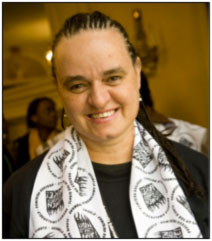
Jenni Williams
“I am alive today, after 34 arrests, because members of Amnesty International spoke out for me.”
– Jenni Williams, human rights defender in Zimbabwe
It really doesn’t make any difference which Amnesty case you support – just pick one and do it before the end of the month.
Amnesty also offer a full suite of resources, obtainable from here, to assist you with producing your letter.
Jean and I have decided to write in support of Jabbar Savalan, as described here and below,
AZERBAIJAN – Jabbar Savalan / Youth activist detained after using facebook
Jabbar Savalan
Hours after he posted a note on Facebook calling for protests against the government, Jabbar Savalan told his family that he was being followed. The next evening, February 5, 2011, police arrested him without explanation and took him to the Sumgayit police station, where they “discovered” marijuana in his outer coat pocket. Police questioned him without a lawyer for two days, reportedly hitting and intimidating him to make him sign a confession.
Authorities in Azerbaijan have a history of using trumped-up drug charges to jail perceived critics. Jabbar maintains that he does not use drugs and that the marijuana was planted on him. In May 2011, he was was convicted of possessing illegal drugs and sentenced to two-and-a-half years in prison. Amnesty International believes that authorities fabricated the drug charges against Jabbar to silence him. Amnesty considers him to be a prisoner of conscience.
A history student in college, Jabbar was an active member of an opposition political party. In January 2011, he posted on Facebook a newspaper article that described Azerbaijan’s President Ilham Aliyev as corrupt.
On February 4, Jabbar was inspired by the protests in the Middle East and North Africa to use Facebook to call for a “Day of Rage” to protest the government in Azerbaijan. The next day, police arrested him. He was 19 years old at the time.
Last Friday I published a Post under the title of The power of truth. Just 5 minutes long, the YouTube video was powerful, starkly so. I wrote at the end of that article, “The principal source for the footage was Yann Arthus-Bertrand’s incredible film HOME.”
Jean and I watched Yann Arthus-Bertrand’s film last Friday night and to say that we were moved would be pitiful compared to the emotional impact it really had. Take a look at the film trailer; it’s a little over 3 1/2 minutes long. (But please don’t use that as a substitute for watching the full film, see below!)
Home is a 2009 documentary by Yann Arthus-Bertrand. The film is entirely composed of aerial shots of various places around Earth. It shows the diversity of life on Earth and how humanity is threatening the ecological balance of the planet. The movie was released simultaneously on June 5th in cinemas all over the world, on DVD and on YouTube. Released on the same date in 50 countries is a world record for any film release in history. The film is 100% free, and no profits will be made from its release or future showings.
I wasn’t going to add anything other than a brief introduction to the main film. However, an article in The Economist The World in 2012 caught my eye and seemed especially relevant to promoting the message carried by the film. Sheryl Sandberg, chief operating officer of Facebook, wrote about the power of social media and how it would be even more evident in 2012. This is the paragraph that caught my eye,
Expressing our authentic identity will become even more pervasive in the coming year. Profiles will no longer be outlines, but detailed self-portraits of who we really are, including the books we read, the music we listen to, the distances we run, the places we travel, the causes we support, the videos of cats we laugh at, our likes and our links. And, yes, this shift to authenticity will take getting used to and will elicit cries about lost privacy. But people will increasingly recognise the benefits of such expression. Because the strength of social media is that it empowers individuals to amplify and broadcast their voices. The truer that voice, the louder it will sound and the farther it will reach.
That last sentence jumped out at me, “The truer that voice, the louder it will sound and the farther it will reach.” Mull on that as you watch the film and, please, please, please if you support the need to return to a harmonious relationship with the planet spread the word as far and wide as you can.
Please promise yourself to sit down quietly and watch it uninterrupted. And if you feel so minded to add comments to this Post please do – would be delighted to have your feedback.
We are living in exceptional times. Scientists tell us that we have 10 years to change the way we live, avert the depletion of natural resources and the catastrophic evolution of the Earth’s climate.
The stakes are high for us and our children. Everyone should take part in the effort, and HOME has been conceived to take a message of mobilization out to every human being.
For this purpose, HOME needs to be free. A patron, the PPR Group, made this possible. EuropaCorp, the distributor, also pledged not to make any profit because Home is a non-profit film.
HOME has been made for you : share it! And act for the planet.
A beautiful story of dog loyalty – to another dog, to another blind dog.
I first received this lovely story last Sunday from Dan G., dear friend of over 30 years. As is my want, did some research to discover the source of the story. It appeared on the website of Ross Parry Agency on the 22nd October, 2011 (note the pics are copyright rossparry.co.uk) But I have taken the liberty of reproducing the story as it appeared in the UK Daily Mail online site, on the same date. Enjoy.
Meet the blind Great Dane in need of a home (but you’ll need to make space for HER huge guide dog)
When illness forced vets to remove Great Dane Lily’s eyes, the prospects of a fulfilling life didn’t look good.
But then no one had reckoned on her pal Maddison stepping in to turn guide dog.
The pair have been inseparable for years but now find themselves looking for a new home because their owner could no longer cope.
The catch for anyone interested is that the Great Danes come as a package. They have been waiting at the Dogs Trust re-homing centre in Shrewsbury since July.
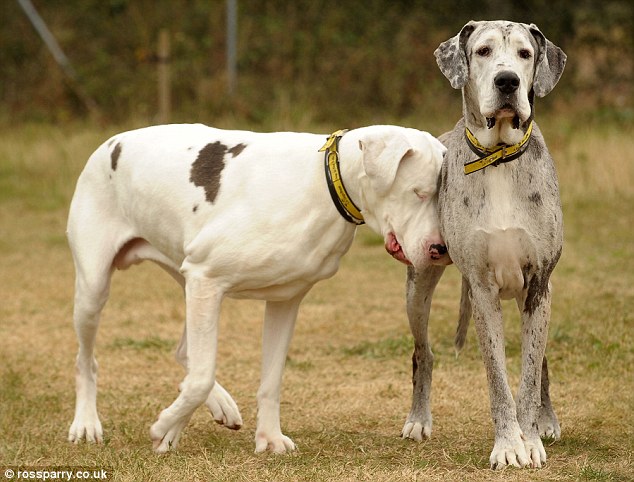
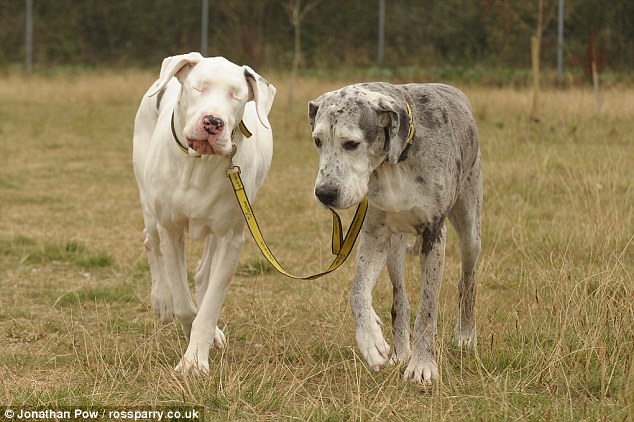
Homeless: Blind Great Dane Lily and her kind-hearted canine carer MaddisonForever friends: Lily, left, being guided while walking with Maddison right. The pair have been inseparable since Lily lost her sight
Manager Louise Campbell said: ‘Maddison is Lily’s guide dog. If they are out and about, for the majority of the time Maddison will lead and Lily will walk nearly touching her so she knows where to go. It’s lovely to watch. Maddison is always looking out for her.’
Lily, six, was barely a puppy when she was struck down by a condition that caused her eyelashes to grown into her eyeballs, damaging them beyond repair.
It was after this traumatic event that her relationship with seven-year-old Maddison developed as she took her under her wing.
The best buddies lived together until their owners decided they couldn’t look after them any more.
Miss Campbell said: ‘With her lack of sight, Lily’s other senses have heightened so although we don’t split them up often she can tell if Maddison is nearby.
‘They curl up together to go to sleep and they are very vocal with each other.
‘We haven’t analysed their different barks but if Lily wants to go forward and Maddison is in her way, the bark will have a different pitch.
‘They are very close to one another and enjoy each other’s company‘.
Playful: Lily's lack of sight has heightened her other senses so she can often tell if Maddison is nearby without the pair touching
Miss Campbell said that Lily does all the things normal dogs do and if you saw her from a distance you wouldn’t realise she had anything wrong with her eyes.
She added: ‘They are really happy with life, the glass is always half full with these two.
‘They have been with us for a considerable amount of time but they are quite happy and go about their daily routine – they are very affectionate.’
She believes the dogs’ size and advancing years, as well as the fact they have to come in a pair, may have put off potential owners and she warned that anyone contemplating taking the dogs in should look at their lifestyle and think of the responsibility involved.
‘They are not gigantic when you see them outside. These are two lovely big girls who deserve to live out the rest of their lives together in comfort‘, she said.
Dogs Trust cares for around 16,000 stray and abandoned dogs every year through a network of 17 re-homing centres.
The Great Dane is seeking an owner who would be willing to give both her and best friend Maddison a new home
Back to me. Must say that it was just fortuitous that Dan’s email came in to me a little while after I posted yesterday’s article by Robert Holden, The Gift of Happiness. Indeed, shortly after I had written, “Perhaps the art of happiness is yet another thing we can learn from dogs!”
Anyone in the UK who wants to contact the Dogs Trust click here.








 Learning from Dogs