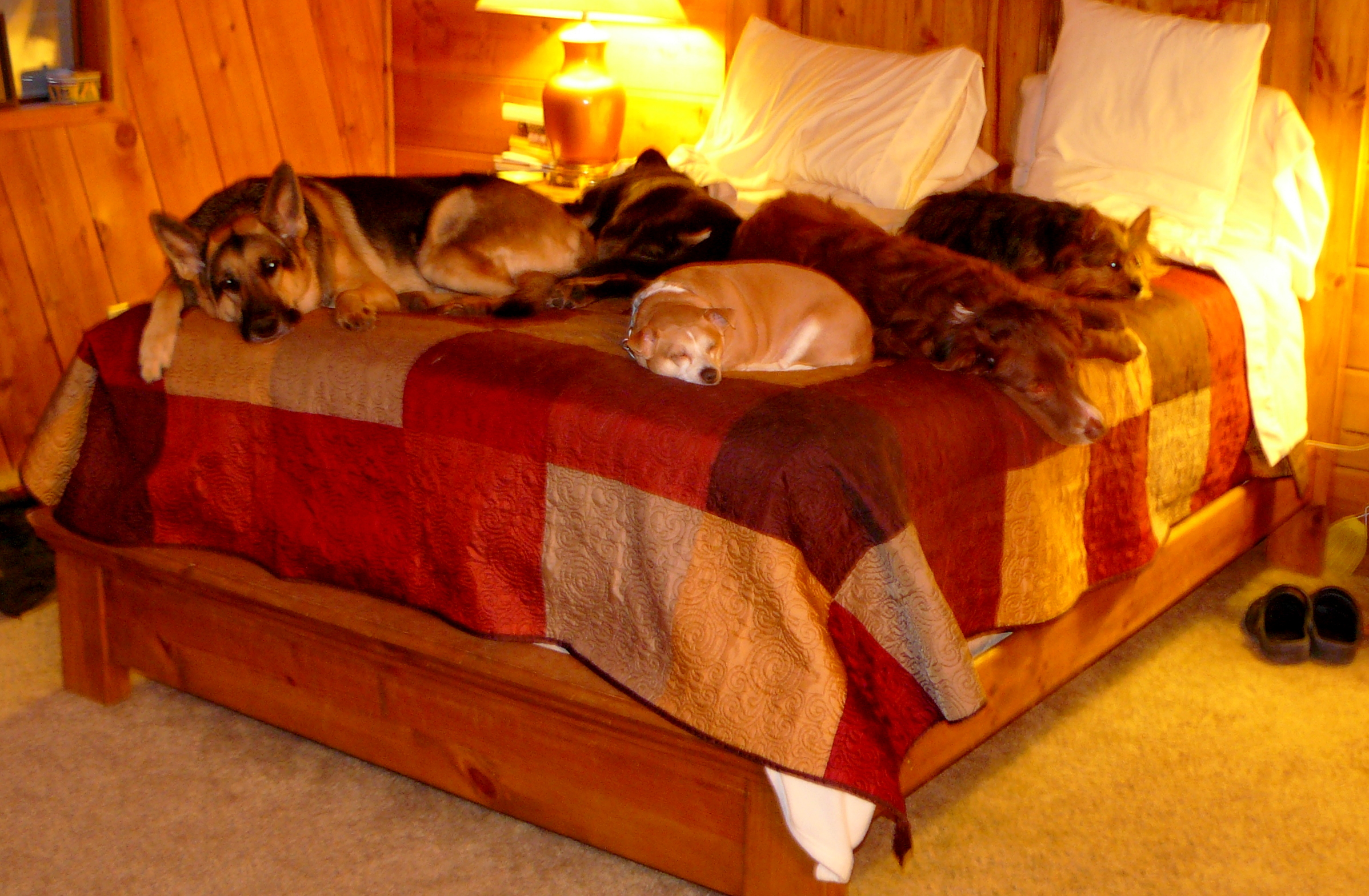
Anyone who has more than a single dog around them knows how a group of dogs, even just a couple, are fantastic companions. Extending that line of thought brings one immediately to the realisation that a person who lives on their own yet has a dog never experiences the loneliness of a person who lives on their own ‘sans chien’.
So hold that notion in your mind as I introduce an item that was recently published on the Care 2 Living Healthy blogsite. It was called, in part, What really makes us happy and is republished here within the terms of Care 2.
ooOOoo
A 75-Year Study Reveals What Really Makes Us Happy
Robert Waldinger directed a 75-year study looking at what makes us happy. It boils down to three things, and they’re not the things we tend to think are going to make us happy. His TED Talk about the study findings challenges our most common life goals.
When you ask most people what would make them happy, their answers tend to cluster around achievement. Maybe they think they’d be happier if they were rich or famous. Or maybe they feel like success in their careers would bring them true happiness.
Unlike many studies on happiness, the Harvard Study of Health Development happened in real time. The researchers didn’t rely on memories of past events. Instead, this project—passed down from research team to research team for 75 years—followed a group of 724 men through their lives. They were interviewed every two years, and got complete physicals at every check-in.
When the project began, 268 of the men were sophomores at Harvard University, where the study took place. The other 456 men were inner-city Boston high school students.
Waldinger was the study’s fourth director and in his talk he explains some of the interesting findings about happiness. He says happiness boils down to three things, but if you wanted to sum it up even more succinctly, you could say this: What really makes us happy is social connection.
Waldinger says there are three main lessons about what really makes us happy that come from this study:
Social connections are critical to our mental and physical health. Whether it’s relationships with family, friends or neighbors, people who have social connection are happier and healthier. In fact, he says, loneliness is toxic. People who want these relationships but lack them are not only not as happy but they experience worse health.
Your number of friends doesn’t matter. What matters most is the quality of your relationships, not the quantity. People with loving relationships in their lives, not just from spouses, but friends or other family members, had overall better health. Quality of relationships was a better predictor of later-life health than markers we tend to focus on, like cholesterol levels.
Quality relationships are good for brain health. People who have quality relationships in their lives have better memory as they age. People without quality relationships were more likely to experience cognitive decline as they grew older.
He defines a quality relationship as one where you feel like you can count on the other person. He says that doesn’t mean never fighting. It means an overall sense of security.
When you hear these results, they sort of seem like a no-brainer, right? But when the study began, 80 percent of participants said being rich would make them happy. We know on some level that relationships are a key to happiness, but we tend to discount their full importance. Why? Waldinger gets into that in his talk, as well (at around 12:15, if you want to skip ahead). You can watch it in full right here:
Published on Nov 30, 2015
What makes us happy and healthy as we go through life?
If you want to invest in “the good life,” where should you put your time and energy? Robert Waldinger answers these questions with lessons learned from a 75-year-long study of adult life that started in the late 1930s and continues to this day.
Robert Waldinger is a psychiatrist, psychoanalyst, and Zen priest. He directs the Harvard Study of Adult Development at Massachusetts General Hospital in Boston and teaches at Harvard Medical School.
ooOOoo
Thus while this study does not refer to dogs, nonetheless a dog or two (or nine!) does provide a wonderful social connection, as all those who know and love dogs will attest to.
Big Dog Natural of Brick, NJ, has announced it is voluntarily recalling select lots of its raw dehydrated dog food products because they have the potential to be contaminated with either Salmonella or Listeria monocytogenes bacteria.
To learn which products are affected, please visit the following link:
Please be sure to share the news of this alert with other pet owners.
Mike Sagman, Editor
The Dog Food Advisor
If you go to that link, you will read the following:
ooOOoo
January 4, 2015 — Big Dog Natural of Brick, NJ, has announced it is voluntarily recalling a select lot of its Big Dog Natural Chicken Supreme raw dehydrated dog food because it may be contaminated with Salmonella.
The affected products were shipped to online customers during the period from October 31, 2015 through November 13, 2015.
About Salmonella and Listeria
Salmonella and Listeria monocytogenes can affect animals eating the products.
And there is also risk to humans from handling contaminated pet products — especially if they have not thoroughly washed their hands after having contact with the products or any surfaces exposed to these products.
Healthy people infected with Salmonella and Listeria monocytogenes should monitor themselves for some or all of the following symptoms: nausea, vomiting, diarrhea or bloody diarrhea, abdominal cramping and fever.
Rarely, Salmonella and Listeria monocytogenes can result in more serious ailments, including arterial infections, endocarditis, arthritis, muscle pain, eye irritation, and urinary tract symptoms.
Consumers exhibiting these signs after having contact with this product should contact their healthcare providers.
Pets with Salmonella and Listeria monocytogenes infections may be lethargic and have diarrhea or bloody diarrhea, fever, and vomiting.
Some pets will have only decreased appetite, fever and abdominal pain.
Infected but otherwise healthy pets can be carriers and infect other animals or humans.
If your pet has consumed the recalled product and has these symptoms, please contact your veterinarian.
These products were sold directly to consumers through the company’s online website and in the US.
The recalled products include all weight volumes of the Big Dog Natural Chicken and Fish Supreme.
No additional products are affected by this recall.
What Caused the Recall?
Big Dog Natural became aware of a potential issue after receiving notification from the FDA that an investigative sample of Chicken Supreme tested positive for Salmonella.
And that an investigative sample of Fish Supreme tested positive for Listeria monocytogenes.
What to Do?
Consumers should discontinue feeding the affected product, monitor their pet’s health and contact their veterinarian if they have concerns.
Consumers who purchased the product can obtain a full refund or exchange by returning the product in its original packaging.
Consumers with questions should contact Big Dog Natural by calling 732-785-2600 from 9 AM to 4 PM ET.
U.S. citizens can report complaints about FDA-regulated pet food products by calling the consumer complaint coordinator in your area.
Please read, digest and share as widely as you can!
Fellow author, Deborah Taylor-French, recently posted a stark warning for all dog owners. Deborah wrote on her blog, Dog Leader Mysteries, the following:
1 thing more toxic than chocolate for dogs
More toxic than chocolate?
Yes, and it’s everywhere.
Please visit my guest blog post on 4Knines blog “One common thing that is more toxic than chocolate for dogs” Then please comment! Of course, after you comment, I’d love it if you would share far and wide for the love and lives of dogs. After working on this post for about a month I shared it as a guest post so that it may reach a larger audience of dog lovers, beyond my WordPress blog.
(I also can’t resist including the following photograph of Deborah and Syd that was in that post!)
Syd the kid!
So the balance of my post today is a full republication of Deborah’s guest post as it appeared over on 4knines blog.
ooOOoo
One Common Thing That is More Toxic Than Chocolate for Dogs!
Actually, I didn’t know the answer until I did the research. The startling fact that thousands of products contain this substance stymied me. There are no warning labels for pet owners. Because these products are made for people, hundreds of dogs and cats suffer when adults or children leave these foods and productswhere pets can ingest them.
This substance naturally develops in grapes and onions. Is also an ingredient often added to gum, candy, mouthwash, toothpaste, and ear medications for children, plus it is added to many prepared foods.
Gum, candy, peanut butter all harmless, right?
WRONG! What is okay for people to eat, proves toxic for pets. Chocolate and nuts are two examples of what people can eat, yet can be lethal for pets. Xylitol damages dogs’ livers. In both people and canines liver failure often means the end of life.
A Tiny Bit Could Kill Your Dog…
In an article in The Wall Street Journal, Mark Maremont reported that,“Besides gum, xylitol is used by manufacturers in products including mints, gummy vitamins, toothpaste, specialty peanut butter and melatonin sleep aids—in part because it has about two-thirds the calories of sugar and is safer than sugar for diabetics. Some gum makers cite studies showing dental-health benefits.”
“A type of sugar alcohol extracted from plants, xylitol is well-tolerated by humans, but in dogs causes a sudden release of insulin, resulting in low blood sugar and potentially leading to seizures and brain damage. It also can cause liver failure.” Xylitol has been added to literally thousands of products. It is safe in these many products for people, but it kills dogs and cats.”
Toxin Levels for Pets in Xylitol Products
Hershey’s Ice Breakers contain 10 times the pet toxic Xylitol level per piece
“Xylitol makes up more than half the weight in certain Ice Breakers flavors, about 1.2 grams of xylitol per piece, according to Hershey’s consumer helpline. That’s about 8 to 10 times the amount of xylitol in some other popular gums. A pack of the brand, introduced in 2006, contains 40 pieces.”
Hard candies, breath mints, toothpaste, tooth whiteners, mouthwash, some jams and jellies all contain xylitol. The U.S.A. Federal Drug Administration does not require warning labels on any of these sweet treats.
As reported in the Wall Street Journal article, “A toxic dose of xylitol—enough to potentially cause low blood sugar or other symptoms—is 0.1 grams per kilogram of the dog’s weight.”
one piece of Xylitol could be toxic for a 26-pound dog
one piece is 12 times as toxic as a piece of dark chocolate the same weight
“Xylitol is extracted from plant material and is available as an ingredient (additiive) in more and more foods, but the amount naturally occurring in foods is very small. In addition to gum, xylitol can now be found in some hard candies, chocolate, table syrup, jams, and jellies.”WebMD.com/ supplements/xylitol
What other health risks does xylitol pose for pets?
“…some animal studies have shown tumor growth resulting from high doses of xylitol over long periods.…” – WebMD Warning for Dog Owners
“If you are a dog owner, be aware that xylitol can be toxic to dogs, even in small amounts”
chewable vitamins
Nicorette Gum
IceBreakers
Peanut Butter (some brands)
chocolate
tooth paste
Xlear Nasal Spray
Note: This list is far from complete.
Please read the labels on anything you put on pet level in your car and home. Dogs love sweets.
Keep these foods containing xylitol away from pets:
onions
garlic
onion like shallots, green onions, etc.
peanut butter
grapes
raisins
chocolate
anything baked with xylitol
Xylitol Poisoning Affects Canine and Feline Livers
Xylitol may kill pets that ingest it. If you suspect your dog of eating any items made with this toxin, immediately rush your pet to a veterinarian.
Symptoms of Poisoning
loss of balance
difficulty breathing
difficulty walking
refusal to drink
refusal to eat
unconsciousness
Please help dog lovers and cat lovers by sharing.
Here’s hoping all dog lovers will receive benefit from my second guest post on 4Knines’ blog. Ready to save pets’ lives? Please share this with dog and cat lovers everywhere. Spread the word about this natural substance, artificially introduced to our homes in dozens of products. Please share and discuss the threat to pets’ health and lives from ingesting even a small amount of xylitol.
Have you had a pet that ingested xylitol? Add to our discussion in the comment section.
ooOOoo
As has been said, please share this as far and wide as you can!
Any experiences or other details that you have please make them known as a comment to this post.
Stella and Chewy’s of Oak Creek, Wisconsisn, has announced it is voluntarily recalling select lots of its raw dog and cat food due to the possible presence of Listeria monoyctogenes bacteria.
Please be sure to share the news of this alert with other pet owners.
Mike Sagman, Editor
The Dog Food Advisor
That link offers, in part:
December 11, 2015 — Stella and Chewy’s of Oak Creek, Wisconsin, has announced it is voluntarily recalling four of its products sold in the U.S. and Canada due to possible contamination with Listeria monocytogenes bacteria.
The recall affects a total of 990 cases — 964 cases in the U.S. and 26 cases in Canada. What’s Recalled?
As a precautionary measure, Stella and Chewy’s is voluntarily recalling selected products from Lot # 165-15, which includes:
Please go here to read all the details if this is a concern for you.
Please be sure to share the news of this alert with other pet owners.
Mike Sagman, Editor
The Dog Food Advisor
That link further discloses:
December 12, 2015 — MARS Petcare has issued a voluntary recall of select lots of its Nutro dog treats due to potential mold.
What’s Recalled?
The following product is affected by this recall event:
Nutro CHEWY Treats with Real Apples
Size: 4OZ
UPC: 7910511344
Lot Codes beginning with the following numbers and regardless of the Best By date:
4 50
5 02
5 03
5 05
What to Do?
Consumers are asked to stop feeding this product to your pet and to bring any remaining Nutro 4 ounce Nutro Apple Chewy Treats affected by this recall to your nearest PetSmart for a full refund.
If you have questions about this voluntary recall, customers are invited to call Nutro Customer Service at 800-833-5330.
Bravo Pet Foods of Manchester, Connecticut, has announced it is voluntarily recalling select lots of its raw food for dogs and cats due to the possible presence of Salmonella.
Yesterday, I offered the account of physicist Paul Dirac falling in love with Margit Wigner, the sister of a Hungarian physicist. It was my way of opening a window into the mind of one individual, albeit a very clever one, falling in love. However, the conclusion, that won’t surprise anyone, is that the state of love in us humans is more mystery than fact!
Dogs have no such problem in showing their state of love!
A few days ago, in comments to a recent post, the author, John Zande wrote:
We were so heartbroken after losing Arthur so unexpectedly (an astonishing dog we found with a massive tumor in his eye) in Sao Paulo we literally moved cities. I couldn’t stand being in the same neighbourhood. Too much reminded me of him.
Then in response to my reply went on to say:
They are amazing creatures. The dog across the street from us died almost a year ago to the day. Beautiful dog, not so good owners (never paid her any attention, fed her crap… we’d sneakily feed her mince and chicken and treats every night). She had many male visitors (they never neutered her), but one in particular, Hop-along, a crippled dog from a street over considered her his wife/girlfriend. When she died it was only us and Hop-along who grieved. It was amazing. He held vigil outside her house for 2 weeks solid after she died, day and night. He never left. He just stood there.
More than thirty-five years ago, when I was working in Colchester, Essex, England, I met Roger Davis. It was Roger that introduced me to gliding (sailplaning in American speak!) courtesy of Rattlesden Gliding Club. Roger and I have stayed in touch ever since including, of course, keeping in touch with Sheila, Roger’s wife, and much of the family.
Yesterday, in an exchange of emails, Roger sent this:
Just back from taking Ralph (now 89) to day surgery at Broomfields.His companion since Freda his wife died two years ago is Sasha, a blonde Alsatian. He always had Alsatians so no surprise when this one appeared.
The love and companionship offered by Sasha to Ralph.
I was moved equally by John’s love for Arthur, Hop-along’s love for his female canine love, and the love of Sasha for Ralph.
Today’s post is inspired by something I read that is very special.
The last time I published a post headed What is love?, back in 2012, I included this:
I would imagine that there are almost as many ideas about the meaning of love as there are people on this planet. Dictionary.com produces this in answer to the search on the word ‘love’.
love
[luhv] noun, verb, loved, lov·ing. noun
a profoundly tender, passionate affection for another person.
a feeling of warm personal attachment or deep affection, as for a parent, child, or friend.
sexual passion or desire.
a person toward whom love is felt; beloved person;sweetheart.
(used in direct address as a term of endearment, affection,or the like): Would you like to see a movie, love?
But, I don’t know about you, those definitions leave something missing for me. Here’s my take on what love is, and it’s only by having so many dogs in my life that I have found this clarity of thought.
“Love is trust, love is pure openness, love is knowing that you offer yourself without any barriers. Think how you dream of giving yourself outwardly in the total surrender of love. Reflect on that surrender that you experience when deeply connecting, nay loving, with your dog.“
One of the very special qualities of our dogs is their natural and instinctive ability to love, unconditionally, both us humans and other animals around them (with some notable exceptions; of course.)
Yet as much as we want to learn unconditional love from our dogs, there is something just too complex about us humans to manage that. Possibly rooted in our inability to really live in the present, another quality our dogs also demonstrate so perfectly.
“What is love” was the most searched phrase on Google in 2012, according to the company. In an attempt to get to the bottom of the question once and for all, the Guardian has gathered writers from the fields of science, psychotherapy, literature, religion and philosophy to give their definition of the much-pondered word.
So I sub-titled today’s post by saying that I was inspired by something.
Here it is, recently published over on The Conversation and republished within their terms. I think you are going to love it!
ooOOoo
The life-changing love of one of the 20th century’s greatest physicists
December 9, 2015
Author: Richard Underman, Chancellor’s Professor of Medicine, Liberal Arts, and Philanthropy, Indiana University
Love is for everyone. mawazeFL/Flickr, CC BY-NC
One of the great short stories of the 20th century is Nobel Laureate Isaac Bashevis Singer’s The Spinoza of Market Street. It tells of an aged scholar who has devoted his life to the study of Spinoza’s great work, Ethics. Protagonist Dr Fischelson has lost his library job and, like his hero, been expelled from his religious community for his heretical views. Looking down from his garret with disdain at the crowded street below him, he devotes his days to solitary scholarship. At night he gazes up through his telescope at the heavens, where he finds verification of his master’s wisdom.
Then one day Dr Fischelson falls ill. A neighbor, an uneducated “old maid,” nurses him back to health. Eventually, though the good doctor never understands exactly how or why, they are married. On the night of the wedding, after the unlikeliest of passionate consummations, the old man gazes up at the stars and murmurs, “Divine Spinoza, forgive me. I have become a fool.” He has learned that there is more to life than the theoretical speculations that have preoccupied him for decades.
The history of modern physics boasts its own version of Fischelson. His name was Paul Dirac. I first encountered Dirac in physics courses, but was moved to revisit his life and legacy through my service on the board of the Kinsey Institute for the Study of Human Sexuality and teaching an undergraduate course on sexuality and love.
A brilliant but very strange man
Born in Bristol, England, in 1902, Dirac became, after Einstein, the second most important theoretical physicist of the 20th century. He studied at Cambridge, where he wrote the first-ever dissertation on quantum mechanics. Shortly thereafter he produced one of physics’ most famous theories, the Dirac equation, which correctly predicted the existence of antimatter. Dirac did more than any other scientist to reconcile Einstein’s general theory of relativity to quantum mechanics. In 1933 he received the Nobel Prize in Physics, the youngest theoretical physicist ever to do so.
At the time Dirac received the Nobel Prize, he was leading a remarkably drab and, to most eyes,
Paul Dirac in 1933. Nobel Foundation via Wikimedia Commons
unappealing existence. As detailed in Graham Farmelo’s wonderful biography, The Strangest Man: The Hidden Life of Paul Dirac, Mystic of the Atom, on which I rely heavily in this article, Dirac was an incredibly taciturn individual. Getting him to utter even a word could prove nearly impossible, leading his mischievous colleagues to introduce a new unit of measure for the rate of human speech, the Dirac, which amounted to one word per hour.
Dirac was the kind of man who would “never utter a word when no word would do.” Farmelo describes him as a human being completely absorbed in his work, with absolutely no interest in other people or their feelings, and utterly devoid of empathy. He attributes this in part to Dirac’s tyrannical upbringing. His father ruthlessly punished him for every error in speech, and the young Dirac adopted the strategy of saying as little as possible.
Dirac was socially awkward and showed no interest in the opposite sex. Some of his colleagues suspected that he might be utterly devoid of such feelings. Once, Farmelo recounts, Dirac found himself on a two-week cruise from California to Japan with the eminent physicist Werner Heisenberg. The gregarious Heisenberg made the most of the trip’s opportunities for fraternization with the opposite sex, dancing with the flapper girls. Dirac found Heisenberg’s conduct perplexing, asking him, “Why do you dance?” Heisenberg replied, “When there are nice girls, it is always a pleasure to dance.” Dirac pondered this for some minutes before responding, “But Heisenberg, how do you know beforehand that the girls are nice?”
Love finds the professor
Then one day, something remarkable entered Dirac’s life. Her name was Margit Wigner, the sister of a Hungarian physicist and recently divorced mother of two. She was visiting her brother at the Institute for Advanced Study in Princeton, New Jersey, where Dirac had just arrived.
Known to friends and family as “Manci,” one day she was dining with her brother when she observed a frail, lost-looking young man walk into the restaurant. “Who is that?” she asked. “Why that is Paul Dirac, one of last year’s Nobel laureates,” replied her brother. To which she replied, “Why don’t you ask him to join us?”
Thus began an acquaintance that eventually transformed Dirac’s life. Writes Farmelo:
His personality could scarcely have contrasted more with hers: to the same extent that he was reticent, measured, objective, and cold, she was talkative, impulsive, subjective, and passionate.”
A self-described “scientific zero,” Manci embodied many things that were missing in Dirac’s life. After their first meeting, the two dined together occasionally, but Dirac, whose office was two doors down from Einstein, remained largely focused on his work.
After Manci returned to Europe, they maintained a lopsided correspondence. Manci wrote letters that ran to multiple pages every few days, to which Dirac responded with a few sentences every few weeks. But Manci was far more attuned than Dirac to a “universally acknowledged truth” best expressed by Jane Austen: “A single man in possession of a good fortune must be in want of a wife.”
She persisted despite stern warnings from Dirac:
I am afraid I cannot write such nice letters to you – perhaps because my feelings are so weak and my life is mainly concerned with facts and not feelings.
When she complained that many of her queries about his daily life and feelings were going unanswered, Dirac drew up a table, placing her questions in the left column, paired with his responses on the right. To her question, “Whom else should I love?” Dirac responded, “You should not expect me to answer this question. You would say I was cruel if I tried.” To her question, “Are there any feelings for me?” Dirac answered only, “Yes, some.”
Realizing that Dirac lacked the insight to see that many of her questions were rhetorical, she informed him that “most of them were not meant to be answered.” Eventually, exasperated by Dirac’s lack of feeling, Manci wrote to him that he should “get a second Nobel Prize in cruelty.” Dirac wrote back:
You should know that I am not in love with you. It would be wrong for me to pretend that I am, as I have never been in love I cannot understand fine feelings.
Yet with time, Dirac’s outlook began to change. After returning from a visit with her in Budapest, Dirac wrote, “I felt very sad leaving you and still feel that I miss you very much. I do not understand why this should be, as I do not usually miss people when I leave them.” The man whose mathematical brilliance had unlocked new truths about the fundamental nature of the universe was, through his relationship with Manci, discovering truths about human life that he had never before recognized.
Soon thereafter, when she returned for a visit, he asked her to marry him, and she accepted immediately. The couple went on two honeymoons little more than month apart. Later he wrote to her:
Manci, my darling, you are very dear to me. You have made a wonderful alteration in my life. You have made me human… I feel that life for me is worth living if I just make you happy and do nothing else.
A Soviet colleague of Dirac corroborated his friend’s self-assessment: “It is fun to see Dirac married, it makes him so much more human.”
In Dirac, a thoroughly theoretical existence acquired a surprisingly welcome practical dimension.
Paul and Manci in 1963. GFHund via Wikimedia Commons, CC BY
A man who had been thoroughly engrossed in the life of the mind discovered the life of the heart. And a human being whose greatest contributions had been guided by the pursuit of mathematical beauty discovered something beautiful in humanity whose existence he had never before suspected.
In short, a brilliant but lonely man found something new and wonderful that had been missing his entire life: love. As my students and I discover in the course on sexuality and love, science can reveal a great deal, but there are some aspects of reality – among them, love – that remain largely outside its ambit.
ooOOoo
Picking up on that last sentence, “there are some aspects of reality – among them, love – that remain largely outside its ambit.” all I can offer is to introduce dogs to the students!
I struggled for ages wondering how to close today’s post. In the end, decided on the following: