That last one was on December 3rd and concerned a recall for Dave’s Pet Food.
Well two days ago Purina announced a recall but it was only alerted by Dog Food Recall yesterday. Here are the details that you can also read here.
ooOOoo
March 10, 2016 — Nestle Purina has announced it is voluntarily recalling select lots of its Beneful and Purina Pro Plan wet dog foods because they may not contain the recommended level of vitamins and minerals.
Purina discovered through its own testing that the affected dog foods did not contain the recommended level of vitamins and minerals and voluntarily recalled the product.
What’s Being Recalled?
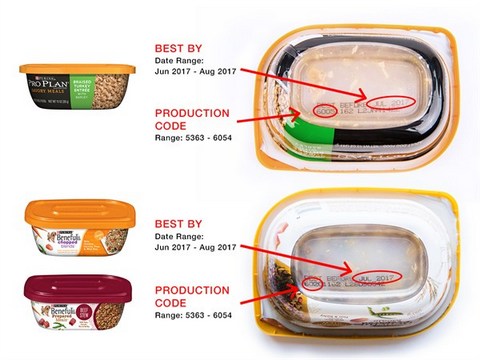
The recall includes select lots of wet dog food 10-oz. tubs under the Beneful Prepared Meals, Beneful Chopped Blends and Pro Plan Savory Meals brands.
No other Purina products or sizes are affected.
Lot Information
A complete list of included products by “Best Before” date and production code ranges are listed below:
What to Do?
Purina is conducting this voluntary recall as a precaution for those dogs who may have eaten the affected product as their only meal for more than several weeks.
If you have questions about your pet’s health, the company suggests that you contact your veterinarian.
Although most of the recalled product contains all of the vitamins and minerals your dog needs, Purina recommends that you discard any of the affected product you may have.
For more information or to request a refund, please call the company at 800-877-7919.
U.S. citizens can report complaints about FDA-regulated pet food products by calling the consumer complaint coordinator in your area.
What is deeply fascinating, at a number of levels, is how time only goes one way. At every single level of our experience, from the scale of the universe down to the tiniest particle known to science, it all flows forward. The arrow of time!
I was reminded of this interesting question of time in a book that has been published by a local Oregon author, John Taylor Our Curious UNIVERSE (the book is not available online otherwise I would have linked to it.)
It got me thinking of age. How we are all aging. How there is nothing that we can do to stop it. How the only thing we can do is to change our relationship with age. That then reminded me of an item that was published on The Conversation site a week ago that I wanted to share with you – share within the terms provided by The Conversation. The article was called It’s time to measure 21st century aging with 21st century tools.
ooOOoo
It’s time to measure 21st century aging with 21st century tools
These stories are dire, in part because the most widely used measure of aging – the old-age dependency ratio, which measures the number of older dependents relative to working-age people – was developed a century ago and implies the consequences of aging will be much worse than they are likely to be. On top of that, this ratio is used in political and economic discussions of topics such as health care costs and the pension burden – things it was not designed to address.
Turning 65 in 2016 doesn’t mean the same thing as hitting 65 in 1916. So instead of relying on the old-age dependency ratio to figure out the impact of aging, we propose using a series of new measures that take changes in life expectancy, labor participation and health spending into account. When you take these new realities into account, the picture looks a lot brighter.
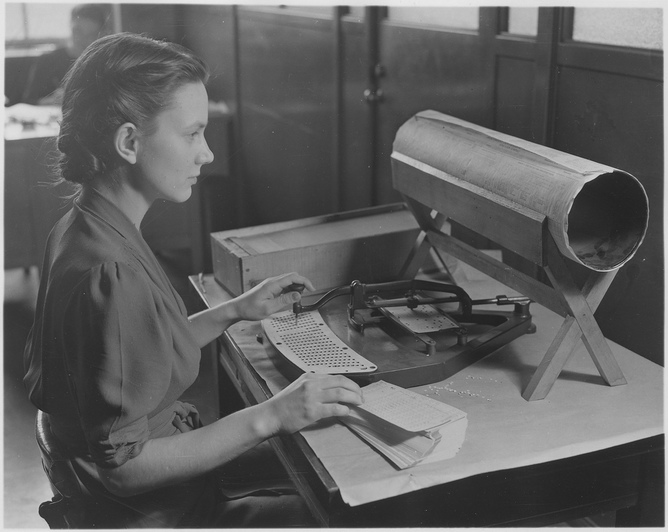
How facts from the census questionnaire were tabulated into statistics in 1950. The U.S. National Archives/Flickr
Our tools to measure aging have aged
The most commonly used measure of population aging is the “old-age dependency ratio,” which is the ratio of the number of people 65 years or older to those 20 to 64.
But, since the old-age dependency ratio was introduced in the early 1900s, most countries have experienced a century of rising life expectancy, and further increases are anticipated.
For instance, in 1914, life expectancy at birth in Sweden was 58.2 years (average for both sexes). By 2014, it had risen to 82.2 years. In 1935, when the U.S Social Security Act was signed into law, 65-year-olds were expected to live 12.7 more years, on average. In 2013, 65 year-olds may expect to live 19.5 years more.
But these changes aren’t reflected in the conventional statistics on aging. Nor is the fact that many people don’t just stop working when they turn 65, and that people are staying healthier for longer.
To get a better sense of what population aging really means today, we decided to develop a new set of measures that take these new realities into account to replace the old-age dependency ratio. And instead of one ratio, we created several ratios to evaluate health care costs, labor force participation and pensions.
Who retires at 65 anymore?
One of these new realities is that the number of people working into their late 60’s and beyond is going up. In 1994, 26.8 percent of American men aged 65-69 participated in the labor force. That figure climbed to 36.1 percent in 2014 and is forecast to reach 40 percent by 2024. And the trend is similar for even older men, with 17 percent of those aged 75-79 expected to still be working in a decade, up from just 10 percent in 1994.
Clearly, these older people did not get the message that they were supposed to become old-age dependents when they turned 65.
Depot Supervisor Eric Headley, 74, takes a call on his mobile phone while at work for Pimlico Plumbers in London July 29, 2010. Britain announced plans to scrap the fixed retirement age next year, saying it wanted to give people the chance to work beyond 65, but business leaders warned the move would create serious problems. REUTERS/Suzanne Plunkett.
This isn’t unique to the U.S. Rates like these in many countries have been rising. In the U.K., for instance, the labor force participation rate of 65- to 69-year-old men was 24.2 percent in 2014, and in Israel it was 50.2 percent, up from 14.8 percent and 27.4 percent, respectively, in 2000. In part this is because older people now often have better cognitive functioning than their counterparts who were born a decade earlier.
So, instead of assuming that people work only from ages 20 to 64 and become old-age dependents when they hit 65, we have computed “economic dependency ratios” that take into account observations and forecasts of labor force participation rates. This tells us how many adults not in the labor force there are for every adult in the labor force, giving us a more accurate picture than using 65 as a cutoff point. We used forecasts produced by the International Labour Organization to figure this out.
The old-age dependency ratio in the U.S. is forecast to increase by 61 percent from 2013 to 2030. But using our economic dependency ratio, the ratio of adults in the labor force to adults not in the labor force increases by just 3 percent over that period.
Clearly, doom and gloom stories about U.S. workers having to support so many more nonworkers in the future may need to be reconsidered.
Is the health care burden going to be so high?
Another reality is that while health care costs will go up with an older population, they won’t rise as much as traditional forecasts estimate.
Instead of assuming that health care costs rise dramatically on people’s 65th birthdays, as the old-age dependency ratio implicitly does, we have produced an indicator that takes into account the fact that most of the health care costs of the elderly are incurred in their last few years of life. Increasing life expectancy means those final few years happen at ever later ages.
In Japan, for example, when the burden of the health care costs of people aged 65 and up on those 20-64 years old is assessed using only the conventional old-age dependency ratio, that burden is forecast to increase 32 percent from 2013 to 2030. When we compute health care costs based on whether people are in the last few years of their lives, the burden increases only 14 percent.
Pension ages are going up
The last reality we considered concerns pensions.
In most OECD countries, the age at which someone can begin collecting a full public pension is rising. In a number of countries, such as Sweden, Norway and Italy, pension payouts are now explicitly linked to life expectancy.
In Germany, the full pension age will rise from 65 to 67 in 2029. In the U.S., it used to be 65, is now 66 and will soon rise to 67.
Instead of assuming that everyone receives a full public pension at age 65, which is what the old-age dependency ratio implicitly does, we have computed a more realistic ratio, called the pension cost dependency ratio, that incorporates a general relationship between increases in life expectancy and the pension age. The pension cost dependency ratio shows how fast the burden of paying public pensions is likely to grow.
For instance, in Germany, the old-age dependency ratio is forecast to rise by 49 percent from 2013 to 2030, but 65-year-old Germans will not be eligible for a full pension in 2030. Our pension cost dependency ratio increases by 26 percent over the same period. Instead of indicating that younger Germans will have to pay 49 percent more to support pensioners in 2030 compared to what they paid in 2013, taking planned increases in the full pension age into account, we see that the increase is 26 percent.
Pranom Chartyothin, a 72-year-old bus conductor, sells and collects bus tickets in downtown Bangkok, Thailand, February 3, 2016. Such scenes will only become more common in Thailand as its population rapidly ages, unlike its neighbours with more youthful populations. The World Bank estimates the working-age population will shrink by 11 percent by 2040, the fastest contraction among Southeast Asia’s developing countries. Thailand’s stage of economic development, the rising cost of living and education, and a population waiting longer to get married are among the reasons it is ageing more quickly than its neighbours. An effective contraception programme in the 1970s also played a part, said Sutayut Osornprasop, a human development specialist at the World Bank in Thailand. Picture taken February 3, 2016. REUTERS/Jorge Silva.
Sixty-five just isn’t that old anymore
In addition to this suite of measures focused on particular aspects of population aging, it is also useful to have a general measure of population aging. We call our general measure of population aging the prospective old-age dependency ratio.
People do not suddenly become old-age dependents on their 65th birthdays. From a population perspective, it makes more sense to classify people as being old when they are getting near the end of their lives. Failing to adjust who is categorized as old based on the changing characteristics of people and their longevity can make aging seem faster than it will be.
In our prospective old-age dependency ratio, we define people as old when they are in age groups where the remaining life expectancy is 15 years or less. As life expectancy increases, this threshold of old age increases.
In the U.K., for instance, the conventional old-age dependency ratio is forecast to increase by 33 percent by 2030. But when we allow the old-age threshold to change with increasing life expectancy, the resulting ratio increases by just 13 percent.
Populations are aging in many countries, but the conventional old-age dependency ratio makes the impact seem worse than it will be. Fortunately, better measures that do not exaggerate the effects of aging are now just a click away.
Let’s embrace those who seek out and love our lost dogs!
Just going to include today two videos from the Hope for Paws charity both of them about rescuing and restoring love to Pit Bulls.
Pit Bull rescue on the beach
Mountain rescue of an abandoned injured Pit Bull
I can’t close this post without thinking of the amazing quality of forgiveness that our dogs demonstrate. It would be a rare person who suffered this pain and rejection and wasn’t scarred for the rest of their days.
Back on the 24th of February I published a post under the title of Personal Journeys. It opened thus:
Life is a one-way track.
Those of you who follow this place on a regular basis know that last Friday I published a post under the title of Friday Fondess. You will also know that later that same day I left this comment to that post:
Sue, and everyone else, we returned from seeing Dr. Lee, the neurologist, a little under two hours ago. Dr. Lee’s prognosis is that Jean is showing the very early signs of Parkinson’s disease, and Jean is comfortable with me mentioning this.
Everyone’s love and affection has meant more than you can imagine. I will write more about this next week once we have given the situation a few ‘coatings of thought’.
Jean sends her love to you all!
Thus, as heralded, I am going to write some more.
You would not be surprised to hear that the last few days have been an emotional roller-coaster, for both Jean and me. Including on Monday Jean hearing from our local doctor here in Grants Pass, OR, that a recent urine test has shown that Jean has levels of lead in her bones some three times greater than the recommended maximum. While our doctor is remaining open-minded it remains to be seen whether Jean is exhibiting symptoms of lead poisoning, whether the lead is a possible cause of the Parkinson’s disease (PD), see this paper, or whether it is a separate issue to be dealt with.
Both my son and my daughter, Alex and Maija, have been very supportive. Alex has even decided to ride in the Ride London 2016 and raise funds for the notable charity Parkinson’s UK. Parkinson’s Disease is affecting more and more people and there is a great incentive to help any charity in pushing back against this disease. As the sub-title on that Parkinson’s UK home page declares, “CHANGE ATTITUDES, FIND A CURE, JOIN US.”
Alex has started a little blog to record his preparation for his charity ride:
ooOOoo
This is my blog about training for Ride London 2016, on it I will detail what I get up to, who I’m raising money for and also cycling kit reviews as well.
So I entered the ballot for ride London this year and was unlucky, probably as I’m one of 20,000 odd middle aged men in Lycra (MAMIL) who try to get in every year, so I got my lovely rejection magazine and a cycling top as well.
I then found out that my stepmum Jean, has just been diagnosed with Parkinson’s disease, so I thought I would enter on a charity place and raise some much needed funds for research into this disease. Found out last week that I have been lucky to get onto a charity place and so the training begins…
Please, please if anyone would like to chip in anything at all you can trust me that it will be greatly appreciated by Alex and all those around him. Donations, both from within the UK and overseas, may be made by going here.
To be honest, at a personal level I just don’t know the answer to that question. It seems to depend on the mood that Jean and I are in at any particular time. All I can fall back on is that well-used saying from me: “Never underestimate the power of unintended consequences”.
In other words, we shouldn’t underestimate the strength of millions of good people when their demands start reaching out to those in power. (And whatever your reaction to this post, please don’t miss watching the inspirational Al Gore speech towards the end of this post.)
Recently over on the Grist site there was an article about the critical changes that each and every one of us should be making. I want to share it with you in full.
ooOOoo
Want to fight climate change? Here are the 7 critical life changes you should make
A few months ago, the U.S. and 195 other countries signed this thing in Paris in which all parties involved kind of sort of agreed to stop messing with the world’s climate. It was very exciting.
So what if we, as Americans, were going to join in as individuals in order to help the U.S. meet its emissions goals? What would we do differently? Two researchers at the University of Michigan’s Transportation Research Institute, Michael Sivak and Brandon Schoettle, recently set out to answer those questions. (Here is the abstract of their report.) Their conclusion: The largest single source of greenhouse gas emissions is making things (industry, clocking in at 29 percent of greenhouse gas emissions). After that, there’s moving people and things around (transportation, 27 percent), then the energy we use at home (17 percent) followed by the energy used by non-industrial businesses (17 percent) and the energy used in agriculture (10 percent).
Most of this energy is stuff that you don’t have any control over: If you are looking at a row of lawn chairs at the store, you don’t have any way of knowing how much energy it took to produce each one. You cannot, on a personal level, decide to have your contact-lens solution delivered to your local pharmacy by cargo bicycle instead of long-haul trucker.
So, given the imperfections of this world, what is a lone wolf such as yourself to do? Here are some conclusions gleaned from this study:
1. Buy the most fuel-efficient car you can afford, then drive it as little as possible
You might notice that Sivak and Schoettle don’t even consider the option of going without a car — even though their own graph suggests that, if having an efficient car is good, having none at all is even better:
To be sure, many people live in cities and work at jobs where living without a car is virtually impossible — and these are the people who this report is written for.
Currently, the average car on the road gets about 21.4 miles per gallon. If that went up to just 31 mpg, Sivak and Schoettle claim that the amount of carbon that the U.S. emits would drop by 5 percent — as long as we didn’t go crazy and drive a lot more. If the average fuel economy rose to 56 mpg, total U.S. emissions would be reduced by 10 percent.
That said, I would like to see Sivak and Schoettle have a conversation with my (very nice) Motor City-born mom about why she should get the most fuel-efficient car she can afford when she loves her damn Jeep and gas right now is less than $2 a gallon. Since they both live in Michigan, maybe they have already.
2. Drive your fuel-efficient car until it’s so old that it turns into dust — actually, use everything you own for so long that it turns into dust
The average age of a car on the road right now is 11.5 years. The average 3,000-pound car takes the equivalent of 260 gallons of gasoline to make. It’s not like you can compare among different manufacturers to see which one is the most energy-efficient carmaker any more than you can compare lawn-chair makers or cellphone manufacturers.
But unless you’re trading it in for something that is significantly more energy efficient than what you have already, keep the old stuff around. That goes for cars, clothes, shoes, remodeling your kitchen, and so on and so forth. There is no law requiring you to buy a new cellphone every two years, and though that’s what we do in the U.S., in other countries people keep them much longer.
3. Drive your fuel-efficient car like it is a leaf on the breeze
According to Sivak and Schoettle, frequent hard stops and rapid acceleration have a dramatic effect on fuel efficiency. They assume that the average driver can reduce overall fuel consumption by 5 percent by chilling out a little while driving. Also: Since engines don’t use gasoline efficiently past a certain speed, a hypothetical driver could reduce emissions even more by never driving faster than 61 mph.
I will also say that, based on my experience growing up with a dad whose default driving speed was about 60, driving at that speed on many U.S. highways and backcountry roads is going to piss a lot of people off. They will honk, tailgate, flash their brights at you, and jokingly and not-so-jokingly pretend like they’re about to run you off the road when they do pass you. It’s a little harder to maintain zen composure under those circumstances, but that will just make those times that you do accomplish it even more impressive.
4. Fly coach
Or, well, don’t fly at all. But when taking a train from SF to NY takes four days, and flying takes about six hours, it’s not hard to see why a lot of people fly. In some cases, flying can produce less emissions than driving (if you drive alone — not if you take a train or the bus).
There’s also some information out there about which airlines are the most fuel efficient. (Spoiler: This more or less correlates precisely with which carriers pack flyers in like sardines and make them pay extra to check their bags.)
5. Fly nonstop
Planes use a disproportionate amount of fuel during takeoff, so minimizing the number of takeoffs is relatively easy (if more expensive). If you need to take a connecting flight, choose the option that gives you the least number of miles traveled.
6. Turn down the thermostat
Right. And put on a sweater. While people who use air conditioning inspire all those summer energy conservation think pieces, according to Sivak and Schoettle’s stats, it’s heating the air and water around us to a temperature that we like that is the greater problem.
7. Eat low on the food chain
Sivak and Schoettle cite stats (published in Climatic Change in 2014) suggesting that the average vegetarian diet produces 32 percent lower emissions than the average omnivore diet. Are there ways around this? Sivak and Schoettle don’t get into this, but yeah, it gets complicated. Some processed vegetarian food has a pretty hefty carbon footprint, and if you live somewhere with an abundant white-tailed deer or squirrel population, you’ve got some low-carbon meat nearby. Still, this is about averages, not your Hunger Games lifestyle.
Sivak and Schoettle also suggest that we all try reducing our collective caloric input by 1 percent, eating 25 fewer calories a day (if we’re men) or 20 fewer a day (for women) — about a tablespoon of hummus, or a single egg white, if you even think measuring things in calories makes sense (I don’t). Their excuse? “Given that 69 percent of American adults are overweight (CDC, 2015), most of us could safely lose some weight.” Dudes. Really. The low-carbon agricultural revolution will not come any faster because you fat-shamed America.
So: I have read a lot of reports like this one before. This one is particularly weird, though, because it focuses so much on personal choice, and ease of that choice. And because its definition of “ease” makes no sense.
As Sivak and Schoettle put it:
This study did not exhaustively examine all possible actions that an individual can take to reduce greenhouse gas emissions. The emphasis was on selected actions that do not require substantial effort and time, do not require much in the way of changing one’s lifestyle, and are relatively easy to quantify in terms of their effects. Examples of actions not considered are increasing home insulation (takes both substantial effort and time), eliminating the use of drive-through banks and restaurants, and thus eliminating the associated idling (requires a change, albeit small, in one’s lifestyle), and buying locally sourced products (effects are not easy to generalize because they vary from product to product).
I’m not quite sure what to make of the fact that the study’s authors have somehow decided that going vegetarian, or figuring out how to consistently eat a tablespoon less of hummus than you usually do, is less arduous than parking your car, getting out of it, and going into a building to order food.
Let’s take this study at face value. What can a hypothetical person do to cut emissions easily, when they are not trying very hard to do anything? The answer to that question is, by far and away, this one: Buy a more fuel-efficient car.
But here’s the thing. The only reason we have fuel-efficient cars to buy is because of political pressure, rather than individual choice — the first Corporate Average Fuel Economy (CAFE) standards were created by Congress in 1975. The newest CAFE standards, which are intended to get the average mpg up to 54.5 mpg by 2025, were the result of hard bargaining — and an auto industry that had been weakened by the recession. At the time that the standards were finalized in 2005, only two cars (the Chevy Volt and a thing called a Ford Focus BEV FWD) met that standard — even the much-hyped Toyota Prius didn’t qualify. Now there are a handful that get nearly double that — but the average mpg of cars sold actually fell slightly between 2014 and 2015, probably because of lower gas prices.
Meanwhile, for way too long, the low-income people with long commutes who would have the most practical incentive to drive a fuel-efficient car have been locked out of the market for one, even as the current housing status quo pushes them farther out into the suburbs. Individual choice only goes so far: Sometimes you need the whammy of regulation to change the available options before you can get to the point where you have a choice.
On paper, it’s totally possible for the U.S. to transition to lower carbon emissions and still have a strong economy. But looking at the numbers alone leaves out the huge political and social obstacles — angry oil barons, stick-in-the-mud utilities, car companies that would rather roll out old models than develop new tech — that have to be overcome to make that happen. You can’t buy fuel-efficient vehicles until companies are under pressure to actually make them — and to make them affordable. You can’t reduce the amount of time you spend driving unless your city or suburb actually has the infrastructure (sidewalks, transit, zoning that allows jobs and housing and shopping to coexist) that makes such changes possible.
Climate change is not something that we can conserve our way out of individually or easily. As Maggie Koerth-Baker put it in her excellent book Before the Lights Go Out, if we Americans were going to conserve our collective way out of climate change, we would have to reduce our emissions to less than one ton per person. While one ton seems like a big number, getting to it is much harder than it sounds:
One ton of greenhouse gas emissions buys a year’s worth of heat for one average home in the United States … That’s not including electricity, clothes, food, or transportation. Do you travel a lot for business? Maybe you could spend your one ton of emissions on airline flights instead. On that yearly budget, you can afford to fly 10 thousand miles in coach. Of course, again, that leaves you with no food to eat, no clothes to wear, and no house to come home to.
Getting to less than a ton per person — in the U.S., anyway — would involve a level of change that hasn’t been seen since WWII. Back then, tires, automobiles, typewriters, bicycles, gasoline, sugar, coffee, meat, cheese, butter, firewood, and coal were all rationed. Factories stopped making consumer products and concentrated on the war effort.
The national speed limit was set to 35 mph to conserve fuel. All forms of automobile racing were banned. Driving for “sightseeing” was banned. Special courts were set up to deal with those who broke the law — people who were found to be driving “for pleasure” had their gasoline rations taken away.
I’m not suggesting we go full WWII on climate change. (For one thing: We had more trains then. For another thing: We could get a lot done with just a Cold War approach.) What I am saying is that, yes, we can change our individual ways — and we should. But with a problem as big as climate change, we shouldn’t pretend that we can go it alone.
For example, that half of all urban water consumption is spent on landscaping seems to have sunk in, as has a greater appreciation for the hardiness of lawn grass. In Northern California at least, lawns that went brown in the summer and fall are now green — following the natural cycle of the foothills.
“It is hard to kill grass,” Marcus said. “And while I don’t think in the long run it’s realistic to think people are going to keep their lawns brown forever, I do think folks have learned they don’t need as much water as they have been dumping on them.… So that is a real ‘aha’ for people.” [Ed: Marcus refers to Felicia Marcus, chair of the state water board.]
Also demonstrated through eight months of mandatory cutbacks is that reducing consumption by nearly 25% is doable — a mark Marcus feared would be unattainable when the order went out.
Marcus grows most animated when discussing a movement underway at many local agencies up and down the state — one aimed toward integrating traditional water delivery with enhanced recycling, storm-water capture, underground storage and the like.
To conclude my proposition that only an optimistic attitude is going to sort this out for our heirs let me close with this recent TED Talk given by Al Gore. Mr. Gore supplies all the power we need to be optimistic about the future.
Al Gore has three questions about climate change and our future. First: Do we have to change? Each day, global-warming pollution traps as much heat energy as would be released by 400,000 Hiroshima-class atomic bombs. This trapped heat is leading to stronger storms and more extreme floods, he says: “Every night on the TV news now is like a nature hike through the Book of Revelation.” Second question: Can we change? We’ve already started. So then, the big question: Will we change? In this challenging, inspiring talk, Gore says yes. “When any great moral challenge is ultimately resolved into a binary choice between what is right and what is wrong, the outcome is foreordained because of who we are as human beings,” he says. “That is why we’re going to win this.”
Do drop across and consider joining. Because by so doing you will become, “… part of a growing community of millions of people worldwide who have come together in support of taking urgent steps to halt the growing climate crisis.”
Let this be the time of all of our lives where we say, “Enough is enough”, and vote and act, both individually and collectively, for positive change!
We found Kalu lying in a hole at a construction site in Udaipur on October 7, 2015. His face looked like a bomb had exploded between his forehead. The horrific gaping hole was infested with maggots that were literally eating him alive. As soon as our rescuers Ganpat and Kalu Singh brought him back to Animal Aid we decided that euthanizing him would be the best decision. But as Kalu stood there on the examining table, something in his spirit stopped us in our tracks and we knew we had to give him a chance.
So we began treatment on the most heartbreaking wound we had ever before seen.
We put a powder into the wound that kills the maggots and gave him IV fluids while we waited for the powder to do it’s job.
A few hours later we put Kalu under sedation and began to remove the dead maggots, debride and clean the wound.
Over the course of the next 3 months, Kalu astounded us with him strength of will, his incredible healing and all the love he had to give.
Click here to sponsor Kalu’s life-long sanctuary at Animal Aid.
If you would like to make a donation then the charity’s home page is here.
Animal Aid is a vital rescue center, hospital and sanctuary for injured and ill street animals in Udaipur, Rajasthan, India. We rescue thousands of hurt and sick animals each year and provide sanctuary to those who need life-long care.
According to YouTube that video has already been watched over 6.6 million times.
Those of you who follow this place on a regular basis know that last Friday I published a post under the title of Friday Fondness. You will also know that later that same day I left this comment to that post:
Sue, and everyone else, we returned from seeing Dr. Lee, the neurologist, a little under two hours ago. Dr. Lee’s prognosis is that Jean is showing the very early signs of Parkinson’s disease, and Jean is comfortable with me mentioning this.
Everyone’s love and affection has meant more than you can imagine. I will write more about this next week once we have given the situation a few ‘coatings of thought’.
Jean sends her love to you all!
Thus, as heralded, I am going to write some more.
You would not be surprised to hear that the last few days have been an emotional roller-coaster, for both Jean and me. Including on Monday Jean hearing from our local doctor here in Grants Pass, OR, that a recent urine test has shown that Jean has levels of lead in her bones some three times greater than the recommended maximum. While our doctor is remaining open-minded it remains to be seen whether Jean is exhibiting symptoms of lead poisoning, whether the lead is a possible cause of the Parkinson’s disease (PD), see this paper, or whether it is a separate issue to be dealt with.
However, I want to offer some more from the consultation that Jean had with the neurologist Dr. Eric Lee last Friday. Shared with the full support of Jean who has read the whole of today’s post yesterday evening; as she does with every post published in this place.
But before so doing, please understand that while I was present throughout the complete examination of Jean, what you are about to read carries no more weight than that of any casual onlooker. If you are at all affected by any of the following make an appointment to see your own doctor!
Jean’s examination lasted for about an hour. It consisted of a great number of checks and tests on how her body responded to many different tests and stimulations. At the end of the examination Dr. Lee said that while he wasn’t 100% certain the balance of probability was that Jean was demonstrating the very early signs of PD. For example, showing such signs as walking and not swinging both arms in a normal, balanced manner. Or having a very slow blink rate. Then she was exhibiting some difficulty with rapid finger-to-thumb taps.
However, Dr. Lee did say that Jean was at the very early stages of PD and that we would have to wait another six months to see if the PD indicators were firming up. He also said that he had PD patients who had had the disease for twenty, even thirty years. Some of the general indicators that PD is progressing include a stooped gait, decreasing size of handwriting, and a quieter speaking tone. The NINDS website has more information on this. Here’s a little of what they explain about PD:
What is Parkinson’s Disease?
Parkinson’s disease (PD) belongs to a group of conditions called motor system disorders, which are the result of the loss of dopamine-producing brain cells. The four primary symptoms of PD are tremor, or trembling in hands, arms, legs, jaw, and face; rigidity, or stiffness of the limbs and trunk; bradykinesia, or slowness of movement; and postural instability, or impaired balance and coordination. As these symptoms become more pronounced, patients may have difficulty walking, talking, or completing other simple tasks. PD usually affects people over the age of 60. Early symptoms of PD are subtle and occur gradually. In some people the disease progresses more quickly than in others. As the disease progresses, the shaking, or tremor, which affects the majority of people with PD may begin to interfere with daily activities. Other symptoms may include depression and other emotional changes; difficulty in swallowing, chewing, and speaking; urinary problems or constipation; skin problems; and sleep disruptions. There are currently no blood or laboratory tests that have been proven to help in diagnosing sporadic PD. Therefore the diagnosis is based on medical history and a neurological examination. The disease can be difficult to diagnose accurately. Doctors may sometimes request brain scans or laboratory tests in order to rule out other diseases.
But here’s the good news regarding my darling wife – there are three things that Dr. Lee strongly recommends:
Hang on to a positive mental attitude for the body actively produces dopamine when in a positive mental state.
At least 30-minutes of good aerobic exercise three times a week,
And physiotherapy.
In addition, Dr. Lee said to always THINK BIG! Big in voice, big in attitude, big in stature.
Finally, let me share with you what was posted on the Visible Procrastinations blog back in 2009. Reposted with the author’s permission.
Some notes from My Change Journey: This workshop is designed to help you understand your emotional and psychological needs during times of change and strategies you can use to take control of your own change journey. It also focuses on creating opportunities and seeing possibilities in the new world of work.
change – an event that occurs when something passes from one state or phase to another;
transition – the act of passing from one state or place to the next
The Big Picture
You are not always seeing the bigger picture;
Experiencing Transitions
When change is implemented at any level in an organisation, people typically respond by moving through a series of phases. People will spend different times in each phase.
William Bridges (1995) Bridges’ three-phase transition framework: The first phase, the Ending phase, is about letting go of an old identity, an old reality or an old strategy. The Neutral Zone is akin to crossing the wilderness between the old way and the new. The final phase is making a new beginning and functioning effectively in a new way.
The Process of Transition
John Fisher’s model of personal change – The Transition Curve – is an excellent analysis of how individuals deal with personal change.
John Fisher’s transition curve – the stages of personal transition – and introduction to personal construct psychology. http://www.businessballs.com
“You should only worry about things that are within your sphere of influence.”
From The Seven Habits of Highly Effective People – you should only worry about things in your “sphere of influence.” If you have no control over certain aspects of your life, why bother worrying about them?
Mental Models: our way of seeing the world
Mental models are usually tacit, existing below the level of awareness – they should be tested, examined and evaluated.
Joel Barker pioneered the concept of paradigm shifts to explain profound change and the importance of vision to drive change within organizations. View The Power of Paradigms [SWF].
Take 1000
add 40 to it
Now add another 1000
Now add 30
Add another 1000
Now add 20
Now add another 1000
Now add 10
What is the total?
Did you get 5000 ? The correct answer is actually 4100 .
Ethical work and life learning (Free online education for ethical work, business, career and life learning; training materials for entrepreneurs, organizations, seflf-development, business management, sales, marketing, project management, communications, leadership, time management, team building and motivation) www.businessballs.com
Let me close today’s post with the opening and closing paragraphs from Chapter 25 of my book: A Way into Our Own Soul.
“Happiness resides not in possessions, and not in gold, happiness dwells in the soul.”
So wrote the philosopher Democritus who was born in 460 BCE (although some claim his year of birth was 490 BCE). He acquired fame with his knowledge of the natural phenomena that existed in those times and history writes that he preferred a contemplative life to an active life, spending much of his life in solitude. The fact that he lived to beyond 100 suggests his philosophy didn’t do him any harm.
………..
In humans, that part of the brain in which self-awareness is thought to arise is called the ventromedial prefrontal cortex. Apparently, that just happens to be located behind the eyes. Ergo, we learn[1] to associate the identity of others with our eyes. Then as we mature, our eyes take on more importance because we develop awareness and a better understanding of the social cues that other people convey with their eyes.
Therefore, is it any surprise that dogs, being the intuitive creatures that they are, soon learn to read us humans and the feelings and emotions that we transmit from our eyes? There’s a knowing in my mind, albeit an unscientific knowing, that dogs, too, give out emotions and feelings from their own eyes.
That loving a dog and being loved back by that dog truly does offer us a way into our own souls. No better put than in the exquisite words of Anatole France,
“Until one has loved an animal, a part of one’s soul remains unawakened.“

[1] Refer to Christina Starmans and Paul Bloom of the Mind and Development Lab at Yale University.
ooOOoo
Oh, and a postscript. Having a loving contact with another person or your dog also releases dopamine within the body – so go and hug your partner or your dog! Now! 🙂
 Lot Information
 What to Do?





 To be sure, many people live in cities and work at jobs where living without a car is virtually impossible — and these are the people who this report is written for.
 Sivak and Schoettle also suggest that we all try reducing our collective caloric input by 1 percent, eating 25 fewer calories a day (if we’re men) or 20 fewer a day (for women) — about




 Learning from Dogs
Sue, and everyone else, we returned from seeing Dr. Lee, the neurologist, a little under two hours ago. Dr. Lee’s prognosis is that Jean is showing the very early signs of Parkinson’s disease, and Jean is comfortable with me mentioning this.
Everyone’s love and affection has meant more than you can imagine. I will write more about this next week once we have given the situation a few ‘coatings of thought’.
Jean sends her love to you all!