A fabulous example of how we reach out to others across the internet!
A week-and-a-half ago in came an email to me:
Hi Paul,
Just came across a post of yours for Earth Day 2014.
Absolutely love the fact that you’ve written about a “Green” topic!
In fact, I wanted to reach out and let you know that in honor of this year’s Earth Day (April 22), I just finished designing an infographic about 14 easy ways dog owners can become more environmentally friendly people.
Would it be okay with you if I passed it along? I’d love to hear your thoughts on it!
Best,
Mike
Mike was Mike Shannon, about which more at the bottom of this guest post. Of course, I was delighted to receive his lovely guest post and infographic. Over to Mike.
ooOOoo
In its 46th anniversary to date, Earth Day is bound to continue to do what it has always succeeded in doing, help raise awareness among† individuals from all across the globe about environmentally-friendly topics so they work together to make this† world a better place to live in for the future generations to come.
In honor of this year’s Earth Day, which happens to be on Friday, April the 22nd, Ultimate Home Life have designed an info-graphic† that explains the most important 14 steps you can take as of today to go green with your dog.
This topic is certainly nothing to be taken lightly, and most certainly nothing of the impossible. Just look at the statistic provided at the beginning of the info-graphic – nearly 50% of families in the United States alone have a dog at home, which makes for more than 70 million dogs!
Let’s kick off our “going green” mission this year by making our dogs greener, one dog at a time.
If you have any tips for going green with your dog, make yourself heard in the comments!
Bio: Michael is the creator, editor, webmaster – alright, let’s just say he runs the show over at UltimateHomeLife.Com! He regularly blogs about anything and everything dog related, with an emphasis on trying to cover all questions that dog owners tend to worry about. So, hop over and give him a bark!
ooOOoo
What a fabulous and highly pertinent post for these times.
Happy Earth Day to all of us and our wonderful dogs right across this magnificent planet.
So said Sophocles. But too slow a decision, or no decision is, of course, a decision in its own right.
Last Tuesday in my update on Hazel Of art, and science I wrote:
It seemed to make sense that until we had confirmation of whether or not Hazel had a lung fungal infection, for which taking Fluconazole would be an excellent course of action, we should pause in her dose until the results were in.
At 08:45 this morning we had to take Brandy in to Lincoln Road Clinic for his neutering operation (that we heard a short time ago has gone well with no complications – he will be collected in about an hour). Dr. Codd asked after Hazel and we said that she was brighter but still not eating sufficient for her to be taking her medications.
Dr. Codd then made the eminently sensible observation that by not having Hazel on her meds we were, of course, letting the fungal infection continue its damage.
In response to the query as to why a fungal infection from either Mexico or Arizona had taken so long to appear, Dr. Codd added more sense to the situation. Namely, that there was evidence that fungal infections can lay dormat for quite long periods of time. Possibly in Hazel’s case the trigger for the infection becoming active was the additional stress on Hazel’s body systems from her recently contracting an Ehrlichia Infection from a local tick.
The final element for the argument of not delaying any longer Hazel’s healing medications was that the titre results would only be a result of one particular ‘brand’ of fungal infection. Dr. Codd said that it may well have been one of many other fungal infections that took hold of Hazel’s lungs.
So the decision was made to try Hazel on an oral anti-nausea med that would be much easier to administer. It is Ondansetron Orally. Also to cut down the dosage of the Fluconazole so that it doesn’t dampen Hazel’s appetite for food, a known side effect of Fluconazole, in quite such a dramatic fashion. (Note: Fluconazole is the least appetite suppressant compared to alternatives.)
So there we are.
We hang on to the fact that Hazel is still with us and coping with what is ailing her, albeit with a heightened stomach sensitivity that is complicating eating. Time is on our side.
A thousand thanks to all of you that have shown so much love and concern for our dear hazel.
Dear people, I must add this: CAUTION: The following is offered by way of information reaching out to other loving dog owners. Please do not assume I have any specialist veterinarian knowledge and please do not take the following as a replacement for seeing your own vet.
Finally, Mike Shannon is my guest blogger with a lovely post for Earth Day 2016 that will be published in a little under 10 hours time. That is why this post has been published now.
Today’s post was inspired by something yesterday I read, not for the first time, over on The People Workshop site. (As an aside, I know that many regulars of this place are familiar with the history of my friendship with Jon.) On the page that explains more of Jon Lavin’s approach to his work with clients, he writes:
“We can’t solve problems by using the same kind of thinking we used when we created them.”
Thus said Albert Einstein (1879-1955).
Intuitively, it strikes one as correct. However, reflect for a few moments on how you think and very quickly it becomes clear that how you think is based on deep-seated experiences and the learnings that flow from those experiences.
As it is for all of us.
Just as relevantly, perhaps more so, is that how we behave is based on those same deep-seated experiences and subsequent learnings. This offers a clue as to why bringing about lasting, behavioural change can often feel like pushing water uphill!
That prompted me to look up a previous time when I had written a post about feelings. It was last December when in a post called Feelings – Of Both Humans and Animals, I wrote this:
There couldn’t have been a better answer to that ponder than a recent video that was presented by TED Talks. It was a talk by Carl Safina about what is going on inside the brains of animals: What are animals thinking and feeling? Or in the fuller words of that TED Talk page:
What’s going on inside the brains of animals? Can we know what, or if, they’re thinking and feeling? Carl Safina thinks we can. Using discoveries and anecdotes that span ecology, biology and behavioral science, he weaves together stories of whales, wolves, elephants and albatrosses to argue that just as we think, feel, use tools and express emotions, so too do the other creatures – and minds – that share the Earth with us.
So back to what inspired today’s post. It was the challenge of really knowing why we behave the way we do, both humans and dogs. With dogs, however, we accept they cannot speak to us clearly. Or as Esme put it in a recent reply to an update on Hazel: “Well you’re getting there, half the battle is diagnosis with dogs because they can’t actually tell us how they feel.” (My emphasis.)
Back to humans. When Jon wrote on his site, “…. how you think …… is based on deep-seated experiences ….”, what I heard is that for us humans there are many times when we cannot actually tell ourselves what we are feeling. That is why we need the counselling of someone who has the professional training and experience to expose those deep emotional and psychological drivers within us; those drivers that are normally out of sight from us.
In my own case, how my father’s death was managed by my mother back in December, 1956 left an emotional wound that was totally out of sight from my conscious mind for 50 years. The emotional crisis that I went through back then was discovered by Jon to have its roots back in December, 1956. By a massive stroke of fortune Jon gave me the insight into that mental place of old and a year later I met Jean down in Mexico.
In other words, to return to Albert Einstein:
“We can’t solve problems by using the same kind of thinking we used when we created them.”
The challenge is having sufficient self-awareness to know when an aspect of our behaviour requires the support of the Jon Lavins of this world.
So what would we require from a counsellor, from a therapist, who was working with us to uncover those hidden aspects? In other words, in terms of assessing that therapist what’s the difference that would make the difference?
Naturally, I don’t have the skills to answer that question in any direct, professional manner. But if I look down at our dogs then a form of answer does ‘speak’ to me. Dogs are creatures of integrity, openness and trust. They relate to us humans and other known dogs around them through friendship and love; frequently unconditional love.
A therapist who embraces those values; nay, lives those values, would display that very quickly after meeting with the ‘client’. Any person seeing that in a therapist would be seeing the difference that makes the difference.
Good people, I’m not asking any of you who read this to divulge any personal stuff but, nonetheless, I would love to hear your thoughts on what I have written today!
The learning and healing journey continues with Hazel.
The title to today’s post came from Dr. Jim Goodbrod, DVM. When he and I were taking a walk yesterday Jim mentioned that diagnosing exactly what an animal is suffering from is as much an art as it is a science.
Jim and Janet are close friends and neighbours who live a couple of roads away. Jim also attends the Lincoln Road Vet Clinic on a part-time basis. Off his own volition he has been speaking with Dr. Codd (Russ) about the situation with Hazel and the pair of them are showing incredible devotion to getting to the bottom of what is happening.
So, like yesterday’s post, today is being offered to you in the spirit of information. Forgive me if I repeat the caution from yesterday. (This is being written at 4pm on April 19th, 2016.)
CAUTION: The following is offered by way of information reaching out to other loving dog owners. Please do not assume I have any specialist veterinarian knowledge and please do not take the following as a replacement for seeing your own vet.
Late on Sunday afternoon Hazel was becoming so weak and lethargic that Jean and I feared that she wouldn’t make it through the night. So it was wonderful to see that she was alive and still connected to the world at 6am yesterday; Monday. Nonetheless, Hazel had not eaten since Saturday afternoon and was only drinking very small amounts of water. We made the decision to ring the Clinic as soon as they opened on Monday at 8am. They recommended that Hazel be brought in to go on to an IV drip to boost her anti-fungal intake and also to receive an anti-nausea intake to help her regain an appetite. But there was the question hanging over everyone that if this was a fungal infection, as in Coccidioidomycosis, that is not present in the Oregonian soil but is found in the drier parts of the USA and Mexico then why had it been such a long time before it brought Hazel down?
Jean also had this suspicion that Hazel might be suffering from a form of ‘Tick Fever’ that is very common in Mexico.
So off we went to the Clinic again. There were discussions about the whole situation.
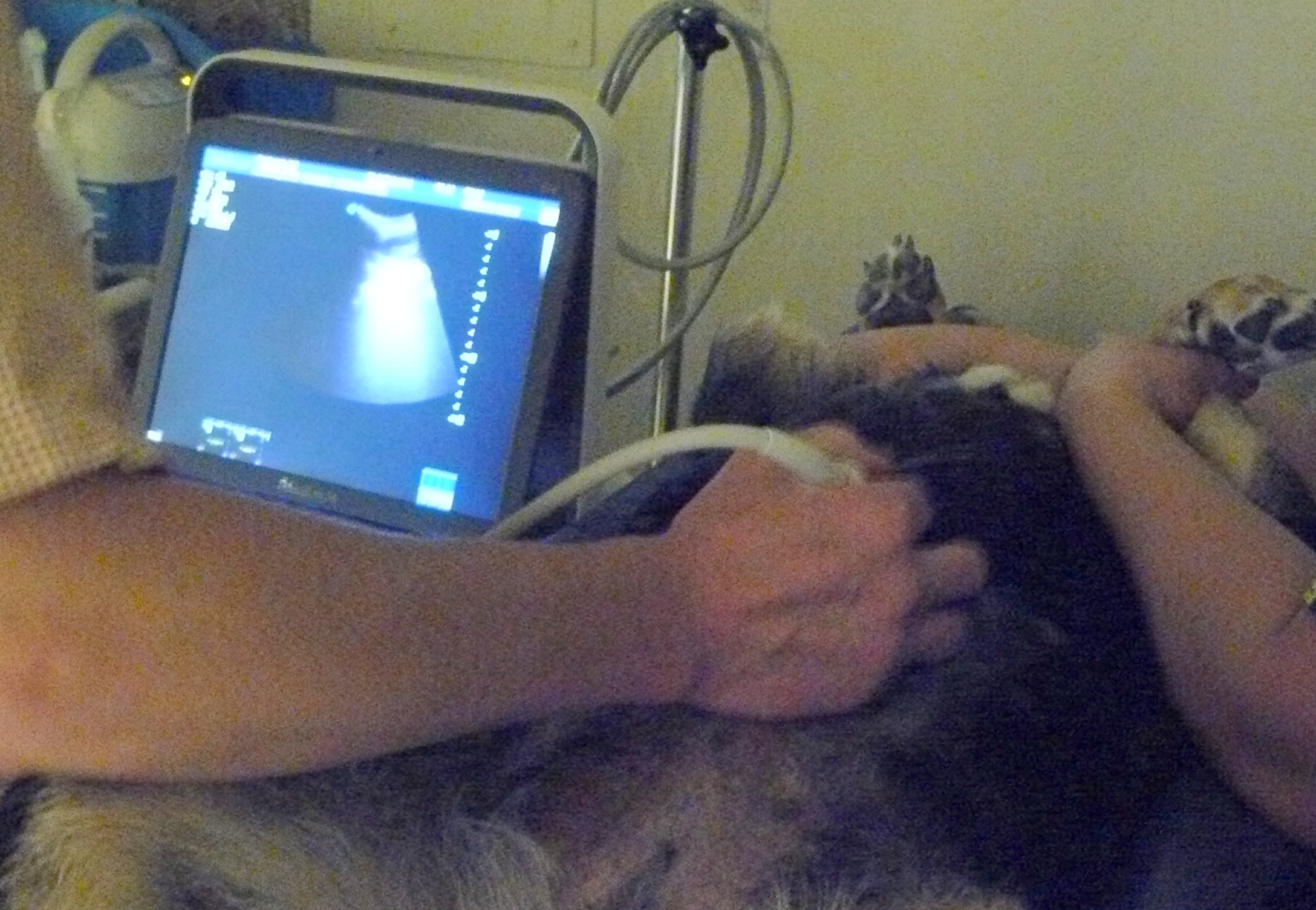
Dr. Codd (RHS) speaking with Jean at the Clinic.
Dr. Codd took a quick blood test and, bingo, it revealed that Hazel was showing that she had, or had had in the past, an Ehrlichia Infection; a tick-borne infection.
The lower of the left-hand spots is the indicator of a past or present Ehrlichia Infection.
The cure for that was a course of Doxycycline.
So now we are looking at battling two separate diseases.
The blood that was taken from Hazel last Friday, when she also had radiographs taken of her lungs, had been sent for a ‘titre’ that would confirm one way or another if her lungs were suffering from a fungal infection. Those results will be available on Wednesday or Thursday of this week.
One of the radiographs taken of Hazel.
Back to Hazel’s lack of appetite. One of the side-effects of Fluconazole is that it depresses appetite. Getting Hazel eating again was becoming a priority. It seemed to make sense that until we had confirmation of whether or not Hazel had a lung fungal infection, for which taking Fluconazole would be an excellent course of action, we should pause in her dose until the results were in. To speed up the return of an appetite Dr. Jim prescribed a short course of Mirtazipine.
So that’s about it for the time being. Except for Jean and me to say how much we appreciate the art and the science that is being so skillfully offered by the Clinic. (As of 19:00 PDT yesterday Hazel was eating again! 🙂 )
Great team effort!
Their “Special Love of Animals” comes over in spades!
CAUTION: The following is offered by way of information reaching out to other loving dog owners. Please do not assume I have any specialist veterinarian knowledge and please do not take the following as a replacement for seeing your own vet.
About three or four weeks ago we noticed that Hazel’s bark was changing, almost as though she had a sore throat. In every other way she continued being the happy, lively dog that she is.
Then very suddenly last Thursday she started sicking up white, foamy bile and went off her food. Hazel rapidly became lethargic and lacking any vigour. Last Friday we took Hazel to our local Lincoln Road Vet Clinic and she was seen by Dr. Russ Codd, DVM. He took xrays that showed that Hazel’s lungs were far from being as clear as they should be. Potentially, Dr. Codd said that we could be looking at one of three things:
Some form of bronchial pnemonia,
A fungal infection of the lungs,
Cancer.
In view of the fact that Hazel hadn’t been coughing that ruled out 1.
Dr. Codd forwarded the xray pictures to a specialist. Later came the information that the spherules in her lungs, as seen on the xray pictures, were not as would be expected with a cancer diagnosis. Dr. Codd concluded that Hazel was indicating a fungal lung infection. Especially as this is commonly found in hot, drier parts of the USA and Mexico. Hazel was an ex-rescue from Mexico and for a couple of years we lived in Payson, Arizona.
The medical term for the disease is Coccidioidomycosis and I republish a little of what may be read over on the Pet MD website:
Coccidioidomycosis in Dogs
Mycosis is the medical term for any disorder caused by a fungus. Coccidioidomycosis comes from inhalation of a soil-borne fungus which normally affects the dog’s respiratory system. However, it is known (even likely) to spread out into other body systems.
The fungus spores begin in the lungs as round spherules, and live in a parasitic stage in the lungs until they grow large enough to rupture, releasing hundreds of endospores, which then begin a parasitic stage in the tissues, growing and rupturing, spreading out (disseminating) into the body perpetually. Endospores can also take a faster route through the body by way of the lymphatic and blood vessel systems, resulting in systemic infection — meaning the entire body will be affected. Coccidioidomycosis sets in from 7 to 20 days after exposure, though some dogs can develop immunity and never show any symptoms, especially younger dogs.
Dogs that are susceptible to the infection can become ill from only a small amount of the Coccidioides fungus, and fewer than 10 fungus spores are needed to cause the disorder. And though uncommon, Coccidioidomycosis is a deadly disease that originates mainly in the arid, hot regions of the western and southwestern regions of the U.S., and in several Central and South American countries. Coccidioidomycosis affects many different types of mammals, but tends to occur more commonly in dogs than cats. This infection is also known as valley fever, California fever, Cocci, and desert fever.
The condition or disease described in this medical article can affect both dogs and cats. If you would like to learn more about how this disease affects cats, please visit this page in the PetMD health library.
Dr. Codd recommended getting Hazel on a course of antibiotics with Fluconazole being his first choice. That commenced on Friday afternoon.
Early today (Monday) Dr. Codd will be seeking to narrow down the diagnosis with further analysis of Hazel’s blood being undertaken because while he was confident that it is a fungal infection he wanted to confirm precisely the nature of the infection.
I will publish more information as it comes to hand and close with these photographs taken yesterday afternoon.
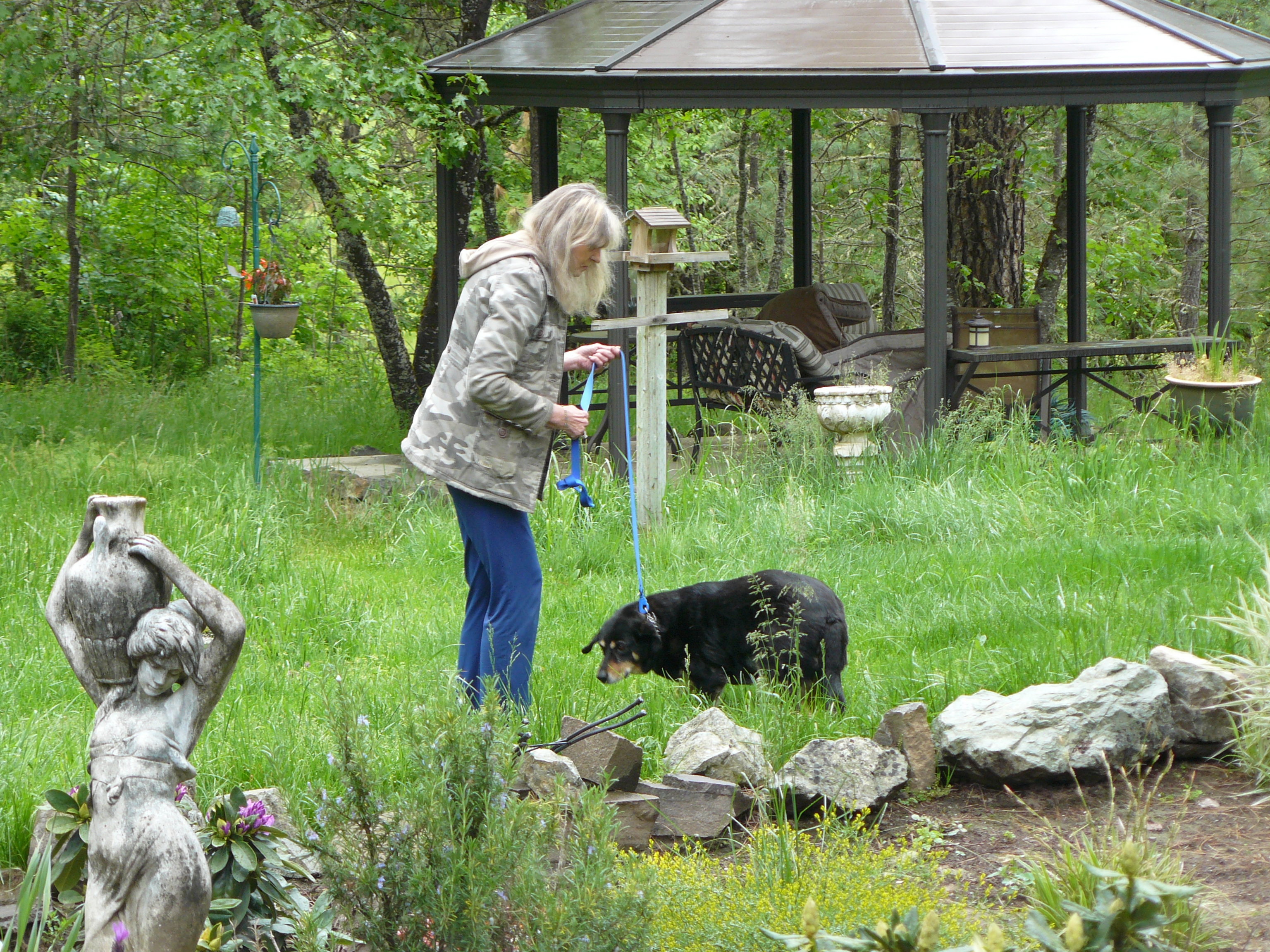
Hazel taking a very slow walk outside.
oooo
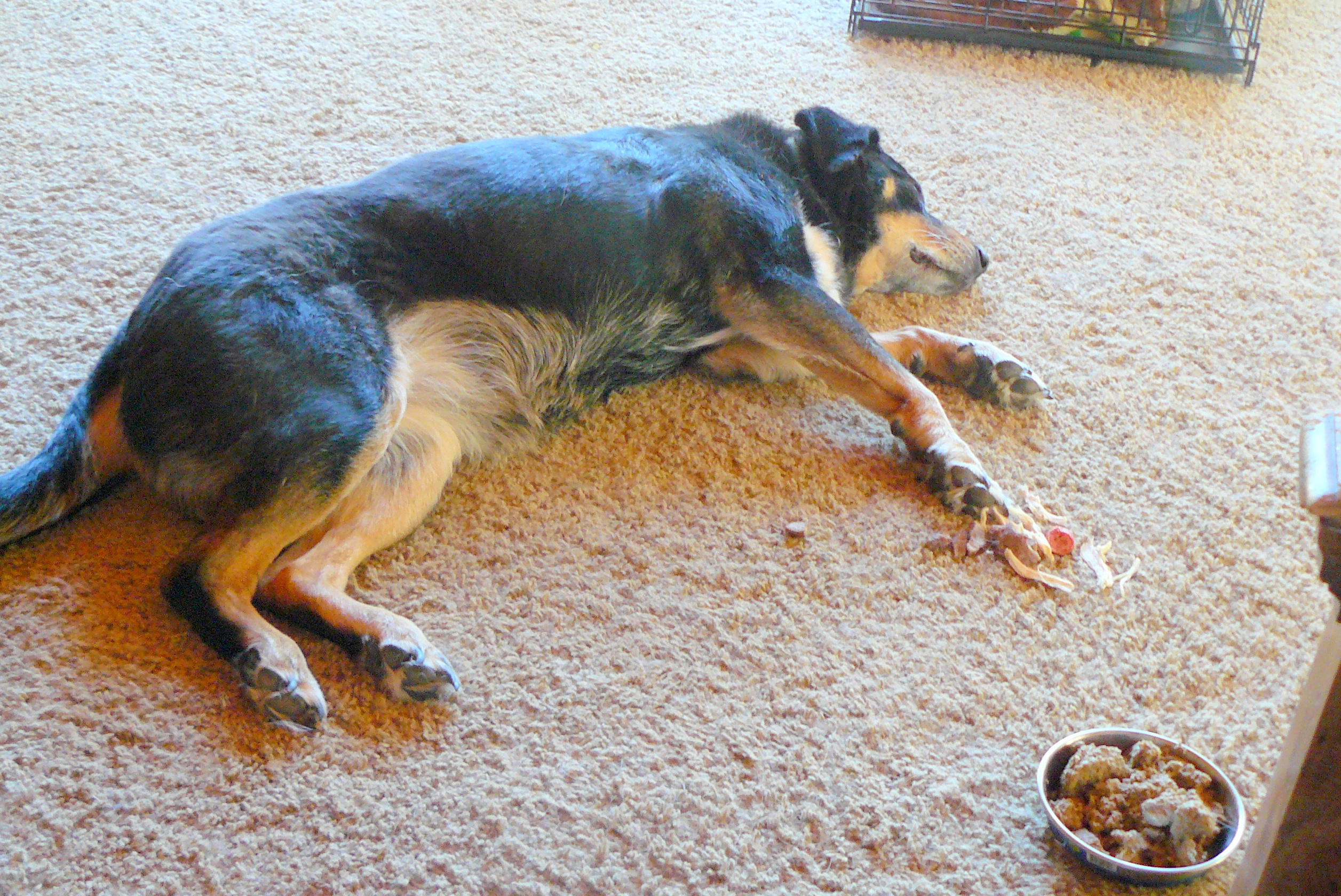
But most of the time she just wanted to be left on her own in our bedroom.
We are holding Hazel very close to our hearts just now.
Welcome to Territorio de Zaguates, or “Land of the Strays”.
When it comes to loving stray dogs I thought that the friends of John Zande and his wife were showing the rest of the world how to do it. For it is my understanding that Sandra and her partner down in Brazil are providing a home for around 300 ex-rescue dogs.
Dogs frolic in a lush green field at the Territorio de Zaguates dog sanctuary in Costa Rica. (Photo: Territorio de Zaguates)
Welcome to Territorio de Zaguates, or “Land of the Strays,” an amazing, privately funded, volunteer-run animal sanctuary in Costa Rica where no mutt is turned away.
Located less than an hour outside the bustling capital city of San José, this doggie safe haven is home to hundreds of abandoned canines that have been given a second chance at life.
This is no ordinary animal sanctuary, though. After all, when you live in a place as beautiful as Costa Rica, you take advantage of what the landscape provides. That’s why volunteers lead the ragtag pack of rescued mutts on scenic hikes through the gorgeous mountains nearly every day. It’s a sight to behold.
A volunteer at Territorio de Zaguates leads a pack of dogs up a hill. (Photo: Territorio de Zaguates)
Aside from the free-range mountain hikes with breathtaking scenery, Territorio de Zaguates functions just like any other animal rescue or sanctuary.
“First thing we do when a new dog gets here is spay/neuter, vaccinate and get rid of parasites,” the organization explains on its Facebook page. “Then we assess if the dog requires any other type of special treatment [and] put them in quarantine if necessary.”
Once this initial processing is completed, the new dog is released into the general population, where it can either be adopted by a loving human or spend the rest of its days frolicking in what is essentially a doggy paradise.
There are all kinds of mutts living at Territorio de Zaguates. (Photo: Territorio de Zaguates)
What makes Territorio de Zaguates even more special is the creative approach to finding the dogs forever homes.
To encourage adoption, every doggie resident at the sanctuary is not only given a name, but also a customized “breed” name based on the dog’s phenotypic traits. These one-of-a-kind breed monikers include memorable titles like “Alaskan collie fluffy terrier” and the “chubby-tailed German doberschnauzer.”
The resounding message behind this strategy is that when you adopt a mutt, you’re adopting a unique breed. Learn more about this clever campaign in the video below:
As any animal rescuer will know, maintaining such an massive sanctuary requires an enormous amount of time, money and labor. But thanks to a host of charitable donors and an eager base of volunteers, the sanctuary is a great success.
“We have a very small staff but still we manage to do everything from daily picking up the poo and disposing of it properly, to feeding and medicating the dogs, and everything in between,” a spokesperson for the organization writes.
Continue below for just a glimpse of what life is like for these adorable pups at Territorio de Zaguates:
Mattresses are provided for the dogs to lounge on throughout the day. (Photo: Territorio de Zaguates)
Mattresses provide natural lounge spots for the dogs throughout the day.
A pack of rescued dogs take a leisurely walk in the woods with a few of the sanctuary’s hard-working volunteers. (Photo: Territorio de Zaguates)
The pack takes a leisurely hike in the woods with a few of the sanctuary’s hard-working volunteers and some prospective dog adopters
Photo: Territorio de Zaguates)
Lunch time at Territorio de Zaguates means serious business, which is why kibble donations are so important!
Cushy bed donations are also very important for the sanctuary. (Photo: Territorio de Zaguates)
In addition to food, comfy dog beds are also a much welcomed donation item for the sanctuary!
A volunteer leads the pack downhill. (Photo: Territorio de Zaguates)
A sanctuary volunteer leads the pack downhill during a scenic hike through the mountains.
(Photo: Territorio de Zaguates)
In case you were wondering where all those yummy kibble donations went … behold the trough
(Photo: Territorio de Zaguates)
A few of the sanctuary’s senior residents rest on the steps of the facility. Even if the pups aren’t adopted out, they’ll always be guaranteed a luxurious forever home at the sanctuary.
(Photo: Territorio de Zaguates)
Concrete drainage pipes makes excellent (and sturdy!) makeshift dog houses
(Photo: Territorio de Zaguates)
Rescued dogs hang out in the shade of the sanctuary’s many trees
(Photo: Territorio de Zaguates)
A nice refreshing dip … in some drinking water
(Photo: Territorio de Zaguates)
After a long, fun-filled day of being a dog, there’s nothing like cuddling up with a friend and snoozing before dinner time
ooOOoo
Well it certainly puts our ten dogs in the shade!
In doing a trawl through YouTube I came across this video that I will use to close off today’s post. Chances are that, as with me, you won’t understand the voice-over but it won’t diminish your pleasure at looking at these dogs.
Published on Jul 3, 2014
“Territorio de Zaguates” ubicado en las hermosas montañas de Costa Rica, es un albergue de animales donde se le da casa, comida, atención veterinaria, ejercicio, esparcimiento y cariño a 700 perros callejeros víctimas del maltrato, el abuso, el abandono y la negligencia humana.
–ENGLISH– “Territorio de Zaguates” is a No-kill-shelter in the beautiful mountains of Costa Rica that provides home, food, vet care, exercise, recreation and affection to over 700 stray dogs, victims of neglect, abandonment and abuse.
Actually, let me close off today’s post with these two sets of words from the story above:
Once this initial processing is completed, the new dog is released into the general population, where it can either be adopted by a loving human or spend the rest of its days frolicking in what is essentially a doggy paradise.
“essentially a doggy paradise.”
The resounding message behind this strategy is that when you adopt a mutt, you’re adopting a unique breed.
That is so true! Each and every dog, especially an ex-rescue dog, is a unique breed.
A few weeks ago I was speaking to Larry, one of our lovely neighbours who, as with me, is the wrong side of 65 (as with me, by quite a lump) and he was bemoaning how more quickly time seems to pass by the older one gets. It had never previously crossed my mind but in that instant I knew exactly what Larry meant.
For today I have been a Permanent Resident (aka Green Card holder) for precisely five years. And in seven months time I will be 72 years old. Where did it all go!
As you know, exercise is essential for your heart and overall health. Now, a new study published in the journal Medicine & Science in Sports & Exercise has quantified the powerful impact exercise can have on the length of your life.
For this study, researchers looked at data collected in the National Health and Nutrition Examination Study which included 3,000 participants ages 50-79. All of the study participants wore highly sensitive activity trackers, called accelerometers, for seven days. Then, they compared the participants’ activity levels with recorded deaths during the following eight years. What they found is that the participants who had the lowest level of activity were five times more likely to have died during the follow-up period than those participants who had the highest activity level. Those with the lowest level of activity were also three times more likely to have died than those who had moderate activity levels.
There’s no question that inactivity is a prominent risk factor for many health problems, and even minimal amounts of regular activity can have immediate benefits. Plus, for seniors the benefits of exercise go far beyond good cardiovascular health, increasing strength and flexibility so you can stay independent in your senior years.
What Type of Exercise Should You Do?
My answer is always the one that you will enjoy and stick with for the long-term—whether it’s walking, tennis, dancing, swimming or another activity you enjoy. My personal favorites are pilates and yoga, which are good for range of motion, flexibility, and strength.
But regardless of the type of activity you choose, here are some tips to get you started:
If you haven’t exercised in a long time and you have a medical condition such as osteoarthritis or cardiovascular disease, talk to your doctor about what kind of limits you may need to abide by. You don’t want to take on more than your body can handle. Also, consider having your feet checked for irregularities that require shoe inserts.
Start slowly and pace yourself. Should you experience shortness of breath or pain in your chest or arms, see your doctor as soon as possible. If you feel ill, stop. If symptoms persist after 3–5 minutes of rest, seek medical attention immediately. Symptoms may occur up to an hour after exercising, so be mindful of how you feel as you cool down and resume your regular activities.
The joints, ligaments, tendons, and muscles aren’t as forgiving as they were when we were younger, and they require an appropriate level of training. If you train with weights—even light ones—you must use correct form to avoid microtrauma and aggravation to joints. A personal trainer who is experienced in working with middle-agers and seniors can help with this. Long term, strengthening the muscles around ailing joints can help reduce pain.
Warning signs that you may be doing too much exercise include light-headedness or dizziness, palpitations, jaw pain, tingling or numbness in the arms, a tight feeling in the lungs, and shortness of breath (being unable to carry on a conversation).
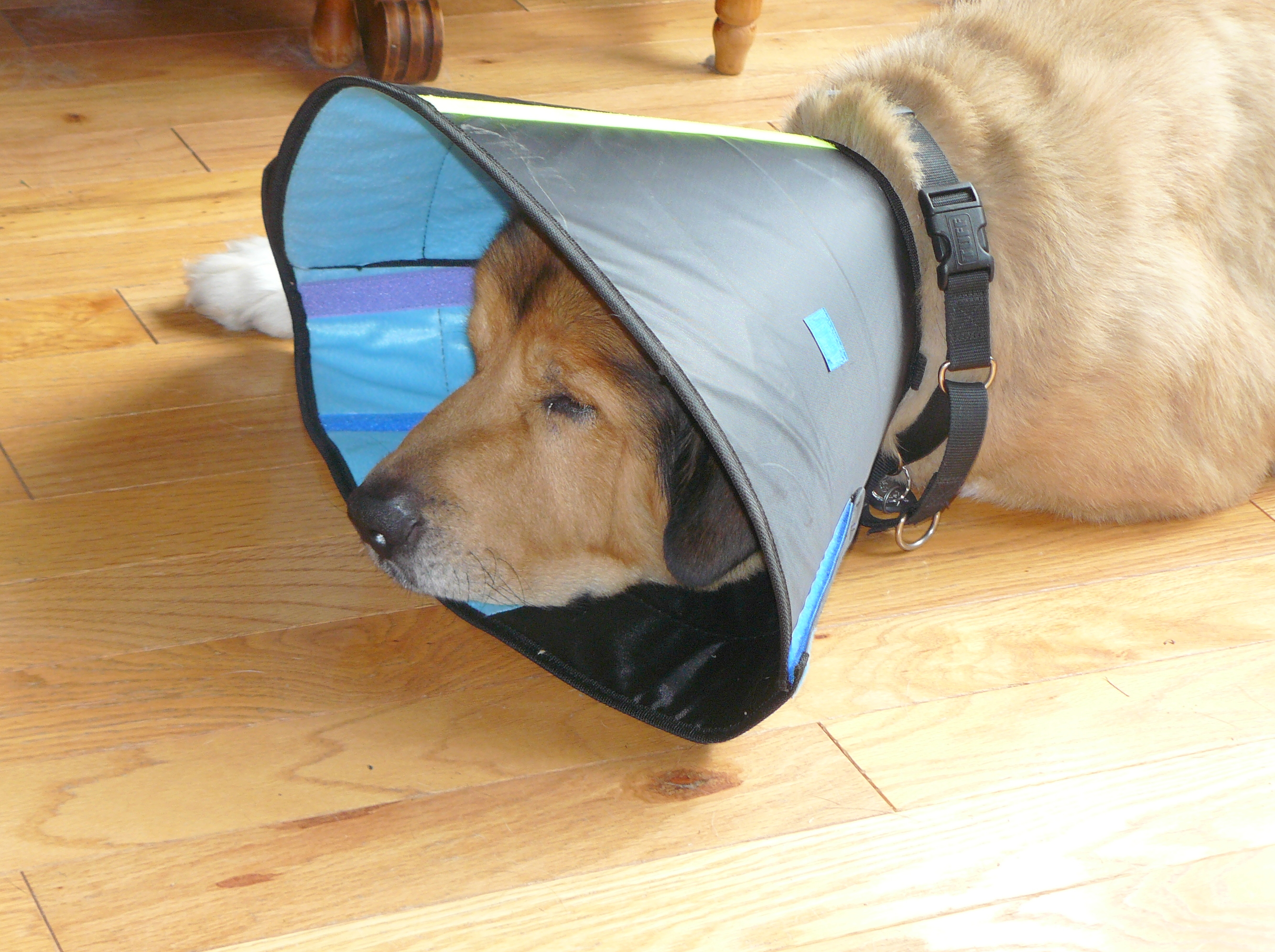
And to close this post with nothing at all to do with exercise but everything to do with loving a dog, here’s a picture of Brandy taken on Tuesday morning.
I was working outside until late afternoon and didn’t leave myself sufficient time for a new post for today. So, as I do on these occasions, I pick one from previous times. Like Meet Molly from this day three years ago.
ooOOoo
A most heart-warming story! Beats the heck out of murders, politics and terrorists!
This was sent in by John Hurlburt for Jean who has been a bit of a ‘horse lady’ in her times and is devoted to the two miniature horses we have here in Oregon.
oooOOOooo
Meet Molly
Molly is a gray speckled pony who was abandoned by her owners when Hurricane Katrina hit southern Louisiana . She spent weeks on her own before finally being rescued and taken to a farm where abandoned animals were stockpiled. While there, she was attacked by a dog and almost died. Her gnawed right front leg became infected and her vet went to Louisiana State University (LSU) for help.
However, LSU were overwhelmed and Molly became a ‘welfare’ case. You know where that goes, don’t you!
Then surgeon Rustin Moore met Molly and changed his mind. He saw how Molly was careful to lie down on different sides so she didn’t seem to get sores. He saw how Molly allowed people to handle her. She protected her injured leg. She constantly shifted her weight and didn’t overload her good leg. She was a smart pony with a serious survival ethic.
Surgeon Moore agreed to remove her leg below the knee and a temporary artificial limb was built. Molly walked out of the clinic and, in a very real sense, that’s where her story really begins.
“This was the right horse and the right owner!” Moore insisted.
Molly happened to be a one-in-a-million patient. She’s tough as nails, but sweet, and she was willing to cope with pain. She made it obvious she understood that she was in trouble. The other important factor, according to Moore , is having a truly committed and compliant owner who is dedicated to providing the daily care required over the lifetime of the horse.
Molly’s story turns into a parable for life in Post-Katrina Louisiana. The little pony gained weight and her mane finally felt a comb. Then, amazingly, a prosthesis designer built her a leg.
The prosthetic has given Molly a whole new life, Allison Barca DVM, Molly’s regular vet, reports:
And she asks for it. She will put her little limb out and come to you and let you know that she wants you to put it on. Sometimes she wants you to take it off too. And sometimes, Molly gets away from Barca. “It can be pretty bad when you can’t catch a three-legged horse,” she laughs.
Most important of all, Molly has a job now. Kay, the rescue farm owner, started taking Molly to shelters, hospitals, nursing homes, and rehabilitation centers. Anywhere she thought that people needed hope. Wherever Molly went, she showed people her pluck. She inspired people, and she had a good time doing it.
“It’s obvious to me that Molly had a bigger role to play in life,” Kay said. “She survived the hurricane, she survived a horrible injury, and now she is giving hope to others.”
Allison Barca concluded, “She’s not back to normal, but she’s going to be better. To me, she could be a symbol for New Orleans itself.”
This is Molly’s most recent prosthesis.
Wherever Molly goes, she leaves a smiley hoof print behind. Literally as well as metaphorically.
The photo shows that the bottom flat surface of the prosthesis has a smiley face embossed in it!
Leave you with that wonderful feeling of love for Molly? Feel free to share it with all the animal lovers that you know.
Yesterday, my good friend of over 40 years, Dan Gomez, left a reply to our introductory post for Brandy. Despite how long I have been blogging it’s rare for Dan to drop in. Indeed, yesterday may well have been his first comment in this place: “Beautiful animal, Paul and Jean! He’s going to have a wonderful country home too!”
Well it wasn’t that long ago that Dan’s previous dog, Bella, died tragically and about a month ago Dan sent me a couple of pictures and a short video of their new dog: Lexi.
So staying with the theme of new members of our respective families, here are a few glimpses of Lexi.
Lexi at Rancho Mirage.
oooo
oooo
Lexi at two months old – 26th March, 2016.
As Dan said in his covering email:
What a fine animal! Sweet, adventurous, obedient, beautiful and loves the wet!
Saved our life and Bella would be proud.
May all those across the world that welcome and treasure their dogs live happy, safe and peaceful lives.
On Saturday morning Jean and two girl friends, Janet and Pam from close by, went to a $1 Clothing Fair. The Fair sold off donated garments raising money for a local charity for abused women. After they had had their fill of clothes Janet suggested going to a garage sale about three miles from home.
It turned out to be a couple and their daughter that were selling off stuff in advance of having to move to a much smaller house including needing to re-home their dog.
There in the garage was the dog, a beautiful tan coloured Great Pyrenees, as they are known in North America. Or as Wikipedia explains:
Jean, of course, went up to fondle the dog and enquired as to how they were going to re-home him. Taking the dog to a local dog shelter was mentioned by way of reply.
I heard all about this when Jean returned and we quickly agreed we should offer the dog a new home.
So after a quick lunch we both went to meet the dog.
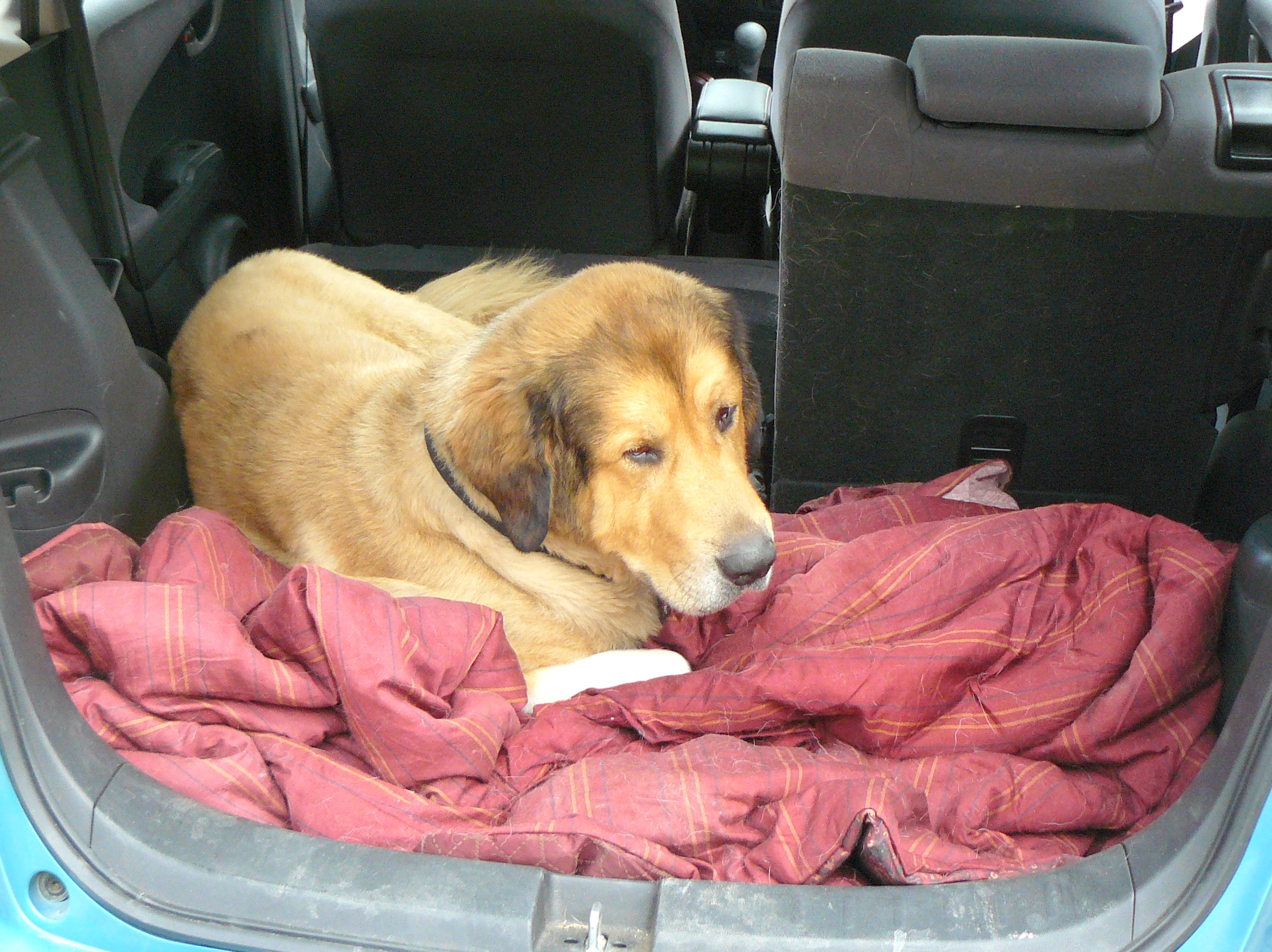
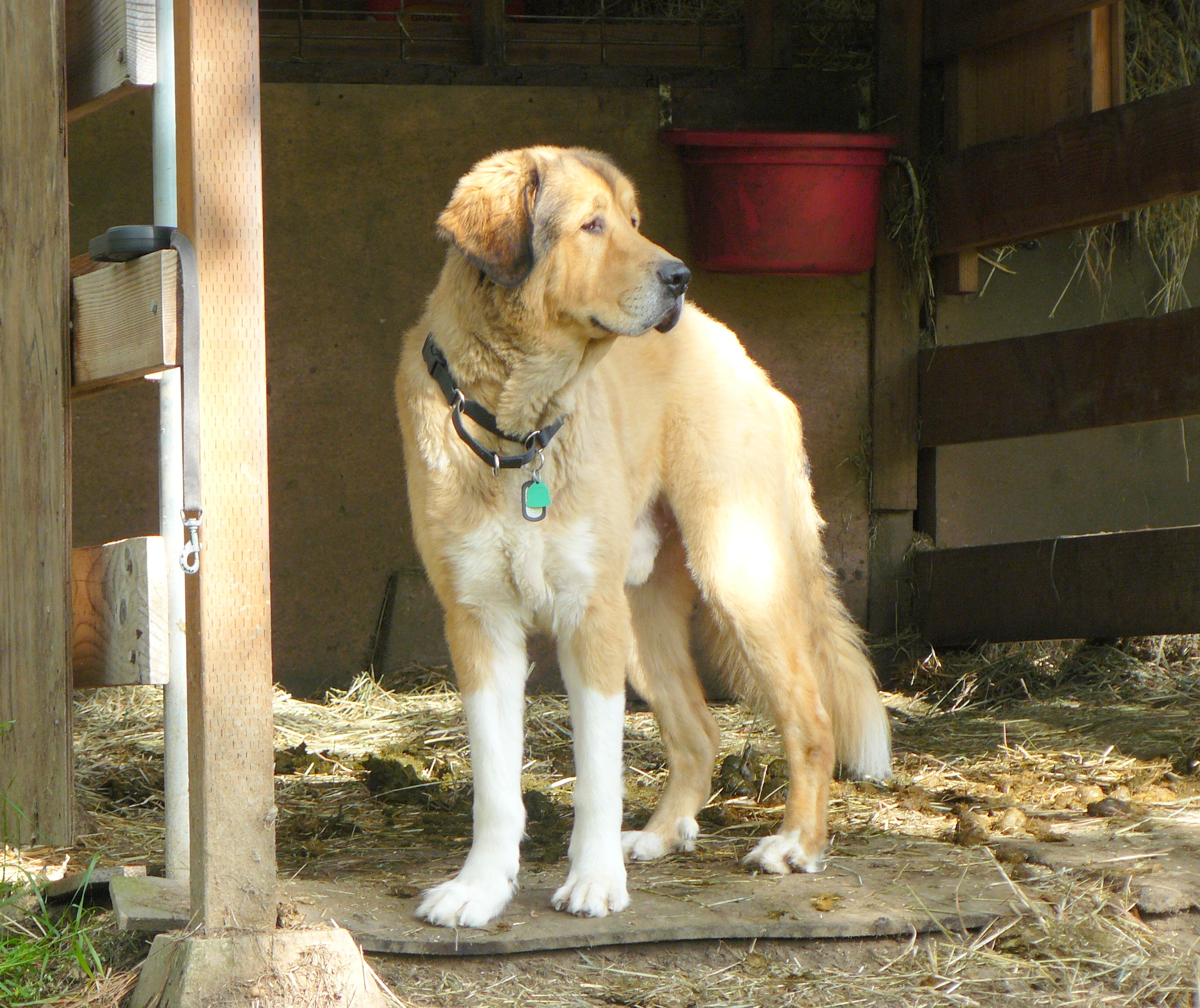
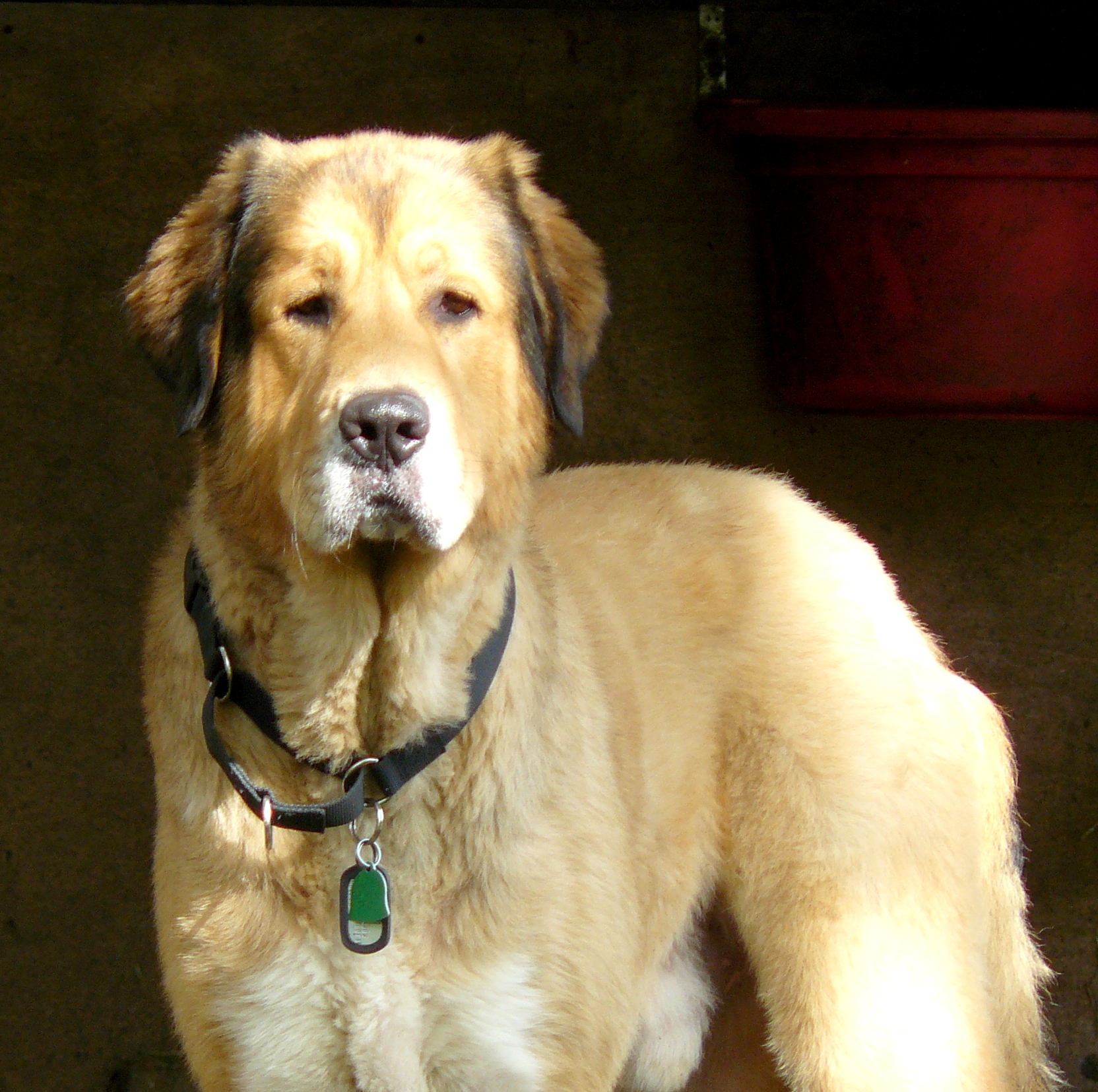
An hour later Jean and I returned home with Brandy! He is gorgeous and here are some photographs of the first few hours of welcoming Brandy to his new place. Note: Brandy was recently shaved by his owners thus coat-wise doesn’t quite look like the Great Pyrenees that he is (possibly with a slight cross with a Mastiff but Dr. Jim doesn’t think so).
Brandy’s first look at his new home from the back of the car in the garage.Brandy signalling that he is ready for big changes!First sniff of our grass.Brandy, welcome!So far, so very good!Now the meet and greet with, of course, first up being the old king!And it didn’t stop with Pharaoh!More smells than you could shake a stick at!Yet more new friends to meet!Then time to settle down at home.What an adorable boy he is going to be.Sunday morning and everything is still going well.Just another dog for Jeannie and me to love.
Apparently, Brandy is a three-year-old dog but hasn’t yet been neutered. As soon as Brandy has settled down we will get Dr. Jim to check him over thoroughly over at Lincoln Road Vet Clinic, make sure everthing is fine and perform the neutering. (It was neighbour Dr. Jim who wrote the foreword to my book, by the way.)