Category: Government

You couldn’t make it up!

However hard one tried to!

LfDFrontCoverebook
In Chapter Eight, Behaviours and Relationships, I speak of how the development of humans has been, unsurprisingly, the result of our human behaviours. Adding that it is likely that our behaviours have been damaging, in varying degrees, to the survival of our species and countless others for a very long time. Continuing:

But 2,000 years ago, the global population of man was only 300 million persons[1]. It took 1,200 years for that global population to become 1 billion persons; in 1800. Now track the intervals as we come forward in time.

In 1927, just 127 years later, the two-billionth baby was born. In 1960, only 33 years on, came the birth of the three-billionth baby. Just 16 years later, in 1974, the four-billionth baby was born. In 1987, now only 13 years later, we have a population of five billion persons. Around October 1999, the sixth-billionth baby was born.
The growth rate of global population is slowing[2] but nevertheless it is trending to a billion additional persons every decade. In other words, a 100-million population growth every year, or about 270,000 more persons every single day.

Combine man’s behaviours rooted in times way back with this growth in population and we have the present situation. A totally unsustainable situation for one basic and fundamental reason. We all live on a finite planet.

[1] http://en.wikipedia.org/wiki/Population_growth
[2] According to UN’s 2010 revision to its population projections, world population will peak at 10.1bn in 2100 compared to 7bn in 2011. A 2014 paper by demographers from several universities and the United Nations Population Division forecast that the world’s population will reach about 10.9 billion in 2100 and continue growing thereafter. However, some experts dispute the UN’s forecast and have argued that birthrates will fall below replacement rate in the 2020s. According to these forecasters, population growth will be only sustained till the 2040s by rising longevity but will peak below 9bn by 2050.

A growth of about 270,000 more persons every single day!

I am sure that I am not alone in seeing this growth in our population as something that is both unsustainable and a critical component of long-term damage to our planet.

But George Monbiot in a recent essay, in true Monbiot style, highlights an aspect of our human population and the damage resulting that would have never previously occurred to me.

Read it and see if you don’t agree likewise. (Again, there are just too many links in George’s essay to reconstruct in this republishing and, as the other day, I have highlighted those phrases that are a link to other material in red. Go here if you wish to further investigate those links.)

ooOOoo

Pregnant Silence

19th November 2015

It’s about time we discussed the real population crisis.

By George Monbiot, published in the Guardian 18th November 2015

This column is about the population crisis. About the breeding that’s laying waste to the world’s living systems. But it’s probably not the population crisis you’re thinking of. This is about another one, that we seem to find almost impossible to discuss.

You’ll hear a lot about population in the next three weeks, as the Paris climate summit approaches. Across the airwaves and on the comment threads it will invariably be described as “the elephant in the room”. When people are not using their own words, it means they are not thinking their own thoughts. Ten thousand voices each ask why no one is talking about it. The growth in human numbers, they say, is our foremost environmental threat.

At their best, population campaigners seek to extend women’s reproductive choices. Some 225 million women have an unmet need for contraception. If this need were answered, the impact on population growth would be significant, though not decisive: the annual growth rate of 83 million would be reduced to 62m (1). But contraception is rarely limited only by the physical availability of contraceptives. In most cases, it’s about power: women are denied control of their wombs. The social transformations they need are wider and deeper than donations from the other side of the world are likely to achieve.

At their worst, they seek to shift the blame from their own environmental impacts. Perhaps it’s no coincidence that so many post-reproductive white men are obsessed with human population growth, as it’s about the only environmental problem of which they can wash their hands. Nor, I believe, is it a coincidence that of all such topics this is the least tractable. When there is almost nothing to be done, there is no requirement to act.

Such is the momentum behind population growth, an analysis in the Proceedings of the National Academy of Sciences discovered, that were every government to adopt the one-child policy China has just abandoned, there would still be as many people on Earth at the end of this century as there are today. If two billion people were wiped out by a catastrophe in mid-century, the planet would still hold a billion more by 2100 than it does now.

If we want to reduce our impacts this century, the paper concludes, it’s consumption we must address. Population growth is outpaced by the growth in our consumption of almost all resources. There is enough to meet everyone’s need, even in a world of 10 billion people. There is not enough to meet everyone’s greed, even in a world of 2 billion people.

So let’s turn to a population crisis over which we do have some influence. I’m talking about the growth in livestock numbers. Human numbers are rising at roughly 1.2% a year. Livestock numbers are rising at around 2.4% a year. By 2050, the world’s living systems will have to support about 120m tonnes of extra human, and 400m tonnes of extra farm animals(2).

Raising them already uses three quarters of the world’s agricultural land. One third of our cereal crops are used to feed them. This may rise to roughly half by 2050. More people will starve as a result, because the poor rely mainly on grain for their subsistence, and diverting it to livestock raises the price. Now the grain that farm animals eat is being supplemented by oil crops, particularly soya, for which the forests and savannahs of South America are being cleared at shocking rates.

This might seem counter-intuitive, but were we to eat soya, rather than meat, the clearance of natural vegetation required to supply us with the same amount of protein would decline by 94%. Producing protein from chickens requires three times as much land as protein from soybeans. Pork needs nine times, beef 32 times.

A recent paper in the journal Science of the Total Environment suggests that our consumption of meat is likely to be “the leading cause of modern species extinctions”. Not only is livestock farming the major reason for habitat destruction and the killing of predators, but its waste products are overwhelming the world’s capacity to absorb them. Factory farms in the US generate 13 times as much sewage as the human population. The dairy farms in Tulare county, California produce five times as much as New York City.

Freshwater life is being wiped out across the world by farm manure. In England, as I reported last week, the system designed to protect us from the tide of crap has comprehensively broken down. Dead zones now extend from many coasts, as farm sewage erases ocean life across thousands of square kilometres.

Livestock farming causes around 14% of the world’s greenhouse gas emissions: slightly more than the output of the world’s cars, lorries, buses, trains, ships and planes. If you eat soya, your emissions per unit of protein are 20 times lower than eating pork or chicken, and 150 times lower than eating beef.

So why is hardly anyone talking about the cow, pig, sheep and chicken in the room? Why are there no government campaigns to reduce the consumption of animal products, just as they sometimes discourage our excessive use of electricity? A survey by the Royal Institute of International Affairs found that people are not unwilling to change their diets, once they become aware of the problem, but that many have no idea that livestock farming damages the living world.

It’s not as if eating less meat and dairy will harm us. If we did as our doctors advise, our environmental impacts would decline in step with heart disease, strokes, diabetes and cancer. British people eat, on average, slightly more than their bodyweight in meat every year, while Americans consume another 50%: wildly more, in both cases, than is good for us or the rest of life on Earth.

But while plenty in the rich world are happy to discuss the dangers of brown people reproducing, the other population crisis scarcely crosses the threshold of perception. Livestock numbers present a direct moral challenge, as in this case we have agency. Hence the pregnant silence.

www.monbiot.com

Footnotes:

  1. While the number of unintended pregnancies would fall by 52m (or 70%), this does not mean that the number of babies would fall by the same amount. The Guttmacher/UNFPA report breaks down the outcome thus: “21 million fewer unplanned births; 24 million fewer abortions; six million fewer miscarriages; and 0.6 million fewer stillbirths.”
  2. Additional global meat consumption by this date is estimated to be roughly 200 million tonnes. Boned meat comprises roughly half the weight of a living animal. So total additional livestock biomass will be in the order of 400 million tonnes, or 400 billion kg. The average human weight is 52 kg and the anticipated rise in population by 2050 is 2.3 billion (the median estimate is 9.7 billion by that date). So the additional human weight is likely to be somewhere around 120 billion kg.

ooOOoo

Powerful reasons to turn vegetarian or vegan. And well done if you are already there. Well done, indeed!
Our changing climate – what is the truth?

A video on YouTube raises some fundamental questions about our changing climate.

Let me say straight away that my belief in Anthropogenic Global Warming (AGW) is based on instinct, and not on me understanding the science, simply because I am not a scientist; far from it! As I share on this blog:

Paul Handover is a child of the post-war era in Great Britain having been born in London a few months before the end of WWII. After a rather shaky attempt at being educated, including 2 years studying for a Diploma in Electrical Engineering, Paul’s first job was as a commercial apprentice at the British Aircraft Corporation. He then joined the sales desk of British Visqueen, a polythene film and products manufacturer located in Stevenage, Hertfordshire, and part of ICI Plastics Division. In 1968, he travelled out to Sydney, Australia and became part of the sales team at ICIANZ’s Inorganic Chemicals Division.

I am a fundamentally a retired salesman/entrepreneur with a very out-of-date knowledge of electrical engineering and radio communications (G3PUK), and now struggling to be an author. 😉

Plus, my generally sceptical view of how countries are governed, my awareness of a terrible lack of integrity in politicians, plays to those instincts of mine that humanity is, indeed, responsible primarily for our changing climate. And there is no shortage of supporting evidence!

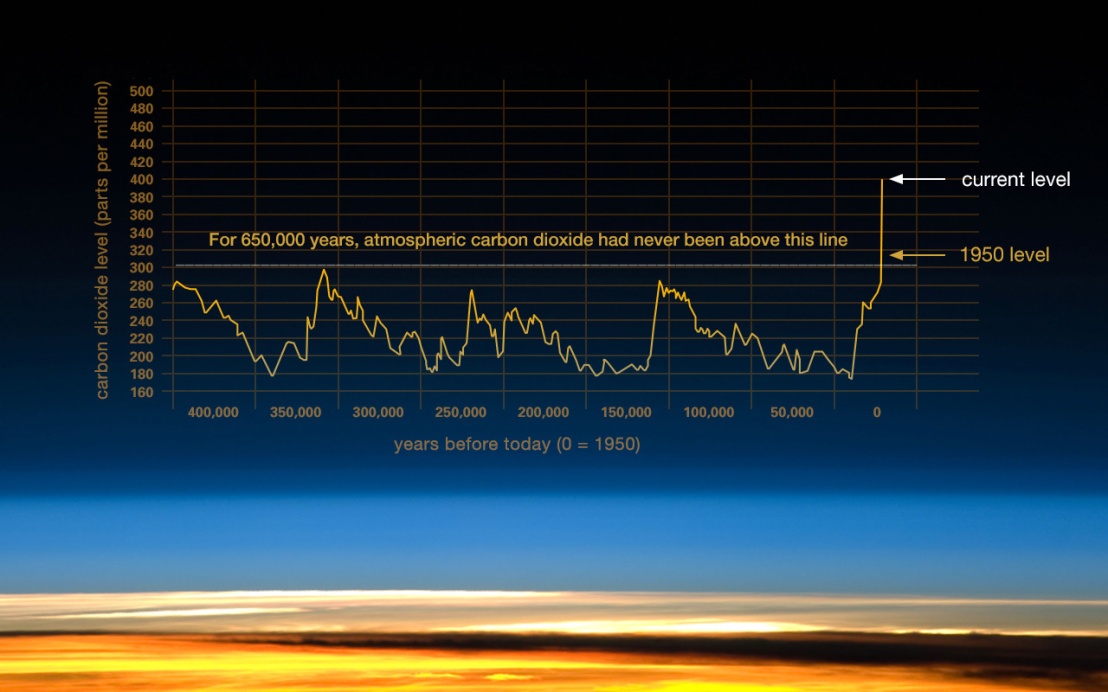
A very quick web search found this NASA site that included the following graph and text (in part):

This graph, based on the comparison of atmospheric samples contained in ice cores and more recent direct measurements, provides evidence that atmospheric CO2 has increased since the Industrial Revolution. (Credit: Vostok ice core data/J.R. Petit et al.; NOAA Mauna Loa CO2 record.)

The Earth’s climate has changed throughout history. Just in the last 650,000 years there have been seven cycles of glacial advance and retreat, with the abrupt end of the last ice age about 7,000 years ago marking the beginning of the modern climate era — and of human civilization. Most of these climate changes are attributed to very small variations in Earth’s orbit that change the amount of solar energy our planet receives.

Scientific Consensus
Ninety-seven percent of climate scientists agree that climate-warming trends over the past century are very likely due to human activities, and most of the leading scientific organizations worldwide have issued public statements endorsing this position.

Click here for a partial list of these public statements and related resources.

However, a dear and close friend of nearly 40 years, Dan Gomez, is sceptical and simply says to me: “Paul, follow the money!” Dan is a very widely-read person and a great thinker.

Plus, among our wonderful neighbours there is a couple, Dordie and Bill, that we get on with extremely well. Bill is a sceptic of AGW and recently sent me the link to the following video.

Please watch it. If you have evidence that all or many of the facts on this video are incorrect then I would love to hear from you.

For this is way too important for the truth not to be widely promoted.

Don’t let your dog swim in these waters!

Sometimes, one just has to hold one’s head in shame ….

… at the madness that we humans are capable of.

I included this sub-heading in the draft of this post last Thursday intending to make it Friday’s post then changed my mind. Hence the reason behind me writing in Friday’s post:

I was looking at a recent George Monbiot essay and getting myself all wound up about it, thinking that it should be today’s post. Then I thought, “Come on, Paul, end the week on a gentle tone.”

In the light of events in Paris last Friday, I had no idea how pertinent my sub-heading was!

What wound me up, so to speak, was a recent essay from George Monbiot about the damage being done to a Devon river; the River Culm. This river was known to me in the days that I lived in South Devon and had my Piper Super Cub based at Dunkeswell Airfield that was not far from the Culm.

Dunkeswell Airfield
Dunkeswell Airfield

So with no further ado, here is George Monbiot’s essay republished with Mr. Monbiot’s kind permission.

ooOOoo

Strategic Incompetence

12th November 2015

The agencies supposed to protect the living world have been neutered, and polluters and wildlife destroyers now have a free hand.

By George Monbiot, published on the Guardian’s website 12th November 2015

It could scarcely have been a starker case. The river I came across in Devon six weeks ago, and described in the Guardian, was so polluted that I could smell it from 50 metres away. Farm slurry pouring into the water, from a pipe that I traced back to a dairy farm, had wiped out almost all the life in the stretch of River Culm I explored.

All that now grew on the riverbed were long, feathery growths of sewage fungus. An expert on freshwater pollution I consulted told me that the extent of these growths showed the poisoning of the river was “chronic and severe”.

Here, as a reminder of what I saw, are some of the pictures I took:

Sewage fungus covering the river bed.

Slurry pouring from a pipe cut into the riverbank:

Slurry outfall just above the river.

And mingling with the clear water of the river:

The slurry entering the river.

I reported the pollution to the Environment Agency’s hotline. It told me it was taking the matter seriously. So when I received its report on the outcome of its investigation, I nearly fell off my chair.

It had decided to take no action against the farmer, as “the long term ecological impacts on the environment were fortunately low”. How did it know? Because there was “no evidence of a fish kill”.

Why in the name of all that’s holy should there be evidence of a fish kill? This is a chronic pollution case, not an acute one. Fish kills are what you see when a sudden poisoning occurs, as pollutants are flushed into a healthy living system. Chronic pollution deprives fish of their habitats and prey, but no investigator in their right mind would expect to see them floating belly up in the river as a result. They are simply absent from places where you would otherwise have found them.

And if a riverbed covered in nothing but sewage fungus suggests a “low” ecological impact, I dread to think what a high one looks like.

The same inability to distinguish between an acute event and a chronic one was revealed by another of the agency’s statements: the pollution “had a short term impact”. The slurry had plainly been pouring out of the pipe for months, as the luxuriant growths of sewage fungus show. It would doubtless have continued, had I not reported it.

The Environment Agency also told me that it had inspected the farm, and found no problems with the infrastructure, as there was plenty of space for slurry storage under the floor of the barn where the cows were kept. But, the problem, as I had explained to them, had nothing to do with slurry storage in the barn. It was caused by leakage from the outdoor slurry lagoons, where I found cow manure pouring down the hill.

They could scarcely have made a bigger mess of their investigation if they had tried. The mistakes the agency made are so fundamental and so obvious that it makes me wonder whether they are mistakes at all. What does a farmer have to do to get prosecuted these days, detonate an atom bomb?

If this were an isolated case, you could put it down to ineptitude, albeit ineptitude raised to the status of an Olympic sport. But responses like this are now the norm at the Environment Agency. It has been so brutally disciplined by cuts and by ministers’ demands that it leave farms and other businesses alone that it is now almost incapable of enforcement.

Even when the fish kills it appears to see as the only real proof of pollution do occur, in the great majority of cases it doesn’t even bother to assess them, let alone investigate and prosecute. Freedom of information requests by the environmental group Fish Legal reveal that the agency sent its investigators to visit just 16% of reported fish kills.

There was massive regional variation. While in the Anglian Central region, covering parts of Norfolk, Cambridgeshire and surrounding counties, the agency inspected 61% of these events, in Devon they investigated only 3%. (I suspect that it was only because I’m a journalist for a national newspaper that they came out at all in the case I reported). In the fishery areas on either side of it – Cornwall and Wessex – the inspection rate was, er, 0%. If you want to pollute rivers in these regions, there’s nothing stopping you.

The Environment Agency no longer prosecutes even some of the most extreme pollution events. In 2013, a farmer in Somerset released what the agency called a “tsunami of slurry” into the Wellow Brook. One inspector said it was the worst pollution she had seen in 17 years. But the agency dithered for a year before striking a private agreement with the farmer, allowing him to avoid prosecution, a criminal record, a massive fine and court costs, by giving £5000 to a local charity.

New rules imposed by the government means that such under-the-counter deals, which now have a name of their own – enforcement undertakings – are likely to become more common. They are a parody of justice: arbitrary, opaque and wide open to influence-peddling, special pleading and corruption.

I see the agency’s farcical investigation of the pollution incident I reported as strategic incompetence, designed to avoid conflict with powerful landowners. Were it to follow any other strategy, it would run into trouble with the government.

These problems are likely to become even more severe, when the new cuts the environment department (Defra) has just agreed with the Treasury take effect. An analysis by the RSPB and the Wildlife Trusts reveals that, once the new reductions bite, the government’s spending on wildlife conservation, air quality and water pollution will have declined by nearly 80% in real terms since 2009/10.

It’s all up for grabs now: if you want to wreck the living world, the government is not going to stop you. Those who have power, agency, money or land can – metaphorically and literally – dump their crap on the rest of us.

Never mind that the government is now breaking European law left right and centre, spectacularly failing, for example, to ensure that all aquatic ecosystems are in good health by the end of this year, as it is supposed to do under the water framework directive. It no longer seems to care. It would rather use your tax money to pay fines to the European Commission than enforce the law against polluters.

I’ve heard the same description of Liz Truss, the secretary of state for environment, who oversees the work of the Environment Agency, from several people over the past few months. “Worse than Owen Paterson”. At first, I refused to take it seriously. It’s the kind of statement that is usually employed as hyperbole, such as “somewhere to the right of Genghis Khan”, or “more deluded than Tony Blair”. But in this case, they aren’t joking. Preposterous as the notion of any environment secretary being worse than Mr Paterson might seem, they mean it.

Nowhere, as far as I can discover, in Liz Truss’s speeches or writing before she was appointed, is there any sign of prior interest in the natural world or its protection. What we see instead is perhaps the most extreme manifestation of market fundamentalism on this side of the Atlantic. She founded the Conservative Free Enterprise Group, and was co-author of the book Britannia Unchained, that laid out a terrifying vision of a nation run by raw economic power, without effective social or environmental protection. Now she has a chance to put that vision into practice.

Those who have tried to engage with her describe her as indissolubly wedded to a set of theories about how the world should be, that are impervious to argument, facts or experience. She was among the first ministers to put her own department on the block in the latest spending review, volunteering massive cuts. She seems determined to dismantle the protections that secure our quality of life: the rules and agencies defending the places and wildlife we love.

Bureaucracy and regulation are concepts we have been taught to hate, through relentless propaganda in the media. But they are essential pillars of civilisation. They make the difference between a decent society and a barbarous one.

www.monbiot.com

ooOOoo

While this essay from Monbiot clearly concerns a river in the South-West of England and may therefore not relate to readers in other parts of the UK or the world, those closing sentences [my emphasis] do relate to all of us wherever we are on this planet.

Bureaucracy and regulation are concepts we have been taught to hate, through relentless propaganda in the media. But they are essential pillars of civilisation. They make the difference between a decent society and a barbarous one.

Tomorrow, I will return to Piper Cubs flying out of Dunkeswell!

Having fun with history.

Nothing to do with dogs but, nonetheless, a neat way to finish the week.

I was looking at a recent George Monbiot essay and getting myself all wound up about it, thinking that it should be today’s post. Then I thought, “Come on, Paul, end the week on a gentle tone.”

So with that in mind, let me offer you an item on British history that Su sent me a week ago. I can’t authenticate the details but my instinct is that everything mentioned is correct.

ooOOoo

There is an old Pub in Marble Arch, London, which used to have a gallows adjacent to it. Prisoners were taken to the gallows (after a “fair” trial of course) to be hanged. The horse-drawn dray, carting the prisoner, was accompanied by an armed guard, who would stop the dray outside the pub and ask the prisoner if he would like ”ONE LAST DRINK.” If he said YES, it was referred to as ONE FOR THE ROAD. If he declined, that prisoner was ON THE WAGON.

So there you go … On with some more history.

They used to use urine to tan animal skins, so families used to all pee in a pot and then once a day the pot was taken and sold to the tannery. If you had to do this to survive you were “piss poor”, but worse than that were the really poor folk, who couldn’t even afford to buy a pot, they “didn’t have a pot to piss in” and were the lowest of the low. The next time you are washing your hands and complain because the water temperature isn’t just how you like it, think about how things used to be.

Here are some more facts about the 1500s:

Most people got married in June, because they took their yearly bath in May and they still smelled pretty good by June. However, since they were starting to smell, brides carried a bouquet of flowers to hide the body odor. Hence the custom today of carrying a bridal bouquet when getting married.

Baths consisted of a big tub filled with hot water. The man of the house had the privilege of the nice clean water, then all the other sons and men, then the women and finally the children. Last of all came the babies. By then the water was so dirty you could actually lose someone in it. Hence the saying, “Don’t throw the baby out with the bath water!”

Houses had thatched roofs, thick straw piled high on the rafters, with no wood underneath. It was the only place for animals to get warm, so all the cats and other small animals (mice, bugs) lived in the roof. When it rained it became slippery and sometimes the animals would slip and fall off the roof. Hence the saying “It’s raining cats and dogs.” There was nothing to stop things from falling into the house.

This posed a real problem in the bedroom, where bugs and other droppings could mess up your nice clean bed. Hence, a bed with four big posts and a sheet hung over the top afforded some protection. That’s how canopy beds came into existence.

The floor was dirt. Only the wealthy had something other than a dirt floor. Hence the saying, “dirt poor.” The wealthy had slate floors that would get slippery in winter when wet, so they spread thresh (straw) on floor to help keep their footing. As the winter wore on they added more thresh until, when you opened the door, it would all start slipping outside. A piece of wood was placed in the entrance. Hence: a threshold.

In those old days, they cooked in the kitchen with a big kettle that always hung over the fire. Every day they lit the fire and added things to the pot. They ate mostly vegetables and did not get much meat. They would eat the stew for dinner, leaving leftovers in the pot to get cold overnight, then start over the next day. Sometimes stew had food in it that had been there for quite a while. Hence the rhyme: ”Peas porridge hot, peas porridge cold, peas porridge in the pot, nine days old.” Sometimes they could get pork, which made them feel quite special. When visitors came over they would hang up their bacon, to show off.

It was a sign of wealth that a man could, “Bring home the bacon.” They would cut off a little to share with their guests and would all sit around talking and ”chew the fat.”

Those with money had plates made of pewter. Food with high acid content caused some of the lead to leach onto the food, causing lead poisoning and death. This happened most often with tomatoes, so for the next 400 years or so, tomatoes were considered poisonous.

Bread was divided according to status. Workers got the burnt bottom of the loaf, the family got the middle, and guests got the top, or ”The Upper Crust.”

Lead cups were used to drink ale or whisky. The combination would sometimes knock the imbibers out for a couple of days. Someone walking along the road would take them for dead and prepare them for burial. They were laid out on the kitchen table for a couple of days and the family would gather around and eat and drink and wait and see if they would wake up. Hence the custom of ”Holding a Wake.”

England is old and small and the local folks started running out of places to bury people, so they would dig up coffins and would take the bones to a bone-house and reuse the grave site. When reopening these coffins, 1 out of 25 coffins were found to have scratch marks on the inside and they realised they had been burying people alive. So they would tie a string on the wrist of the corpse, thread it out through the coffin and up through the ground and tie it to a bell. Someone would have to sit out in the graveyard all night (the graveyard shift) to listen for the a bell; thus someone could be, ”Saved by the Bell ”or was considered a ”Dead Ringer.” And that’s the truth.

Now, whoever said history was boring ! ! !
So ….. get out there and educate someone!

ooOOoo

Just out of curiosity, I did a web search on that Pub in Marble Arch. Quickly came across this, from which I quote, in part:

The site of the Tyburn Tree is said to be at what is now Marble Arch, at the north-east corner of Hyde Park. Some historians give a more precise location as slightly to the north-west at Connaught Square. In fact, many bodies were found there when the square was being built in the 1820s, so it’s possible that some Tyburn victims were buried right where they died.

Mass executions took place on Mondays, when prisoners were transported from Newgate Prison to Tyburn in an open wagon, often in their finest clothes. The procession, which was watched by a large and enthusiastic crowd, wound down Snow Hill, across Holborn Bridge into Holborn, down Broad St Giles into Oxford Street and on to Tyburn.

And it was but a moment to find a photograph of the place.

Tyburn

 You all have a wonderful, relaxing week-end and don’t lose your head over anything!

Rebooting an inmate’s life

This is no conundrum: a direct contrast to yesterday.

The benefits of having a dog or two (or nine) are boundless and have been documented for thousands of years. Indeed, a quick web search revealed that Alexander Pope, the 18th-century English poet, is the attributed author of the quote, “Histories are more full of examples of the fidelity of dogs than of friends.”

Nevertheless, it was still a joy to come across the documentary film Dogs On The Inside.

Filmed in a Massachusetts prison, DOGS ON THE INSIDE follows the birth of a relationship between abandoned rescue dogs and prison inmates as they work together toward a second chance at a better life. Giving a voice to a forgotten dog and a forgotten man, the film is a life-affirming testament to the power of second chances.

The film was released in February 2014, and here is the trailer.

In general, it seems to have gathered good reviews with this one from Amazon being typical of what I have seen.

I had tears in my eyes during several segments of this film. Such a lovely connection between the rescue workers and the dogs. Then, the inmates and the dogs. And, finally, the photos of their forever homes and families. Bravo to all at Don’t Throw Us Away. People like you, who work to save and rehab these animals, are amazing.

You are also recommended to read the review that is on the Ecorazzi website. Here’s a flavour of that review:

Two parties neglected and forgotten become the powerful emotional center of an uplifting new documentary, Dogs on the Inside.

We’re taken to Massachusetts, where there exists a unique, mutually-beneficial rehabilitation program that finds rescue dogs paired with prison inmates.

This documentary, from directors Brean Cunningham and Douglas Seirup, follows a handful of inmates at a correctional facility involved in Don’t Throw Us Away, a program that partners them with neglected dogs. For the animal, benefits include exercise, attention, and care while shelters remain crowded. For the prisoners, they have a chance to form connections and work towards parole.

It’s fascinating throughout watching both sides – scared dogs and (emotionally) guarded inmates – warm to one another, seemingly leaving their past behind.

That’s at the heart of this illuminating, heartwarming film: second chances. Early on, it’s easy to see the parallels between these two groups – with the comparisons handled tactfully throughout a film that never strays from its simple, honest goal. Dogs never preaches or calls for political or social change; it more so asks the viewer to be willing to forgive and welcome in those which have been cast aside. When an inmate says, ‘they come from a bad life, they haven’t seen love in while,’ he isn’t necessarily talking just about the dog.

Let me close with this heart-stirring photograph that was included in the above review.

Candido2-1

So much to learn from our precious, gorgeous dogs!

Indonesia – another example of kakistocracy?

What is happening in beautiful Indonesia is beyond imagination.

I am indebted to John Zande for introducing me to the word kakistocracy, that he explained means: “government by the worst persons; a form of government in which the worst persons are in power.”

For what is happening in Indonesia could well be an awful example of kakistocracy in action.

Like numerous others I knew that there were fires burning in Indonesia and that it was all somehow caught up in illegal logging, but knew little over and above that. And that is the crux of the title of a recent essay from George Monbiot: Nothing to See Here. It really is a “must read” essay and is republished below with Mr. Monbiot’s very kind permission. As with most of his essays, they are published in the Guardian newspaper. In this case, the Guardian version includes photographs that vividly underline the terrible situation out there. I agonised about copying them from the Guardian article, without explicit permission to so do, but have nevertheless done so on the basis of this story needing to make the maximum impact on readers. The photographs are inserted in Monbiot’s essay very closely to the format that is presented in the Guardian article.

ooOOoo

Nothing to See Here

30th October 2015

'Children are being prepared for evacuation in warships already some have choked to death. Species are going up in smoke at an untold rate.’ Photograph: Ulet Ifansasti/Getty Images
‘Children are being prepared for evacuation in warships already some have choked to death. Species are going up in smoke at an untold rate.’ Photograph: Ulet Ifansasti/Getty Images

In the greatest environmental disaster of the 21st Century (so far), Indonesia has been blotted out by smoke. And the media.

By George Monbiot, published in the Guardian 30th October 2015.

I’ve often wondered how the media would respond when eco-apocalypse struck. I pictured the news programmes producing brief, sensational reports, while failing to explain why it was happening or how it might be stopped. Then they would ask their financial correspondents how the disaster affected share prices, before turning to the sport. As you can probably tell, I don’t have an ocean of faith in the industry for which I work.

What I did not expect was that they would ignore it.

A great tract of the Earth is on fire. It looks as you might imagine hell to be. The air has turned ochre: visibility in some cities has been reduced to 30 metres. Children are being prepared for evacuation in warships; already some have choked to death. Species are going up in smoke at an untold rate. It is almost certainly the greatest environmental disaster of the 21st Century – so far.

[NB: The video that is embedded in the Guardian version is without sound. I have added one that is also a Greenpeace video, with sound, further on in the post.]

And the media? It’s talking about the dress the Duchess of Cambridge wore to the James Bond premiere, Donald Trump’s idiocy du jour and who got eliminated from the Halloween episode of Dancing with the Stars. The great debate of the week, dominating the news across much of the world? Sausages: are they really so bad for your health?

What I’m discussing is a barbeque on a different scale. Fire is raging across the 5000-kilometre length of Indonesia. It is surely, on any objective assessment, more important than anything else taking place today. And it shouldn’t require a columnist, writing in the middle of a newspaper, to say so. It should be on everyone’s front page.

It is hard to convey the scale of this inferno, but here’s a comparison that might help: it is currently producing more carbon dioxide than the US economy. In three weeks the fires have released more CO2 than the annual emissions of Germany.

 ‘The great debate of the week, dominating the news across much of the world? Sausages: are they really so bad for your health?’ Photograph: Abdul Qodir/AFP/Getty
‘The great debate of the week, dominating the news across much of the world? Sausages: are they really so bad for your health?’ Photograph: Abdul Qodir/AFP/Getty

But that doesn’t really capture it. This catastrophe cannot be measured only in parts per million. The fires are destroying treasures as precious and irreplaceable as the archaeological remains being levelled by Isis. Orang utans, clouded leopards, sun bears, gibbons, the Sumatran rhinoceros and Sumatran tiger, these are among the threatened species being driven from much of their range by the flames. But there are thousands, perhaps millions, more.

One of the burning islands is West Papua, a nation that has been illegally occupied by Indonesia since 1963. I spent six months there when I was 24, investigating some of the factors that have led to the current disaster. At the time, it was a wonderland, rich with endemic species in every swamp and valley. Who knows how many of those have vanished in the past few weeks? This week I have pored and wept over photos of places I loved, that have now been reduced to ash.

Nor do the greenhouse gas emissions capture the impact on the people of these lands. After the last great conflagration, in 1997, there was a missing cohort in Indonesia of 15,000 children under the age of three, attributed to air pollution. This, it seems, is worse. The surgical masks being distributed across the nation will do almost nothing to protect those living in a sunless smog. Members of parliament in Kalimantan (Indonesian Borneo) have had to wear face masks during debates. The chamber is so foggy that they must have difficulty recognising each other.

It’s not just the trees that are burning. It is the land itself. Much of the forest sits on great domes of peat. When the fires penetrate the earth, they smoulder for weeks, sometimes months, releasing clouds of methane, carbon monoxide, ozone and exotic gases like ammonium cyanide. The plumes extend for hundreds of miles, causing diplomatic conflicts with neighbouring countries.

Why is this happening? Indonesia’s forests have been fragmented for decades by timber and farming companies. Canals have been cut through the peat to drain and dry it. Plantation companies move in to destroy what remains of the forest to plant monocultures of pulpwood, timber and palm oil. The easiest way to clear the land is to torch it. Every year, this causes disasters. But in an extreme El Niño year like this one, we have a perfect formula for environmental catastrophe.

The current president, Joko Widodo, is – or wants to be – a democrat. But he presides over a nation in which fascism and corruption flourish. As Joshua Oppenheimer’s documentary The Act of Killing shows, leaders of the death squads that helped murder around a million people during Suharto’s terror in the 1960s, with the approval of the West, have since prospered through other forms of organised crime, including illegal deforestation.

They are supported by a paramilitary organisation with three million members, called Pancasila Youth. With its orange camo-print uniforms, scarlet berets, sentimental gatherings and schmaltzy music, it looks like a fascist militia as imagined by JG Ballard. There has been no truth, no reconciliation; the mass killers are still greeted as heroes and feted on television. In some places, especially West Papua, the political murders continue.

Those who commit crimes against humanity don’t hesitate to commit crimes against nature. Though Joko Widodo seems to want to stop the burning, his reach is limited. His government’s policies are contradictory: among them are new subsidies for palm oil production that make further burning almost inevitable. Some plantation companies, prompted by their customers, have promised to stop destroying the rainforest. Government officials have responded angrily, arguing that such restraint impedes the country’s development. That smoke blotting out the nation, which has already cost it some $30 billion? That, apparently, is development.

Our leverage is weak, but there are some things we can do. Some companies using palm oil have made visible efforts to reform their supply chains; but others seem to move slowly and opaquely. Starbucks, PepsiCo, Kraft Heinz and Unilever are examples. Don’t buy their products until they change.

On Monday, Widodo was in Washington, meeting Barack Obama. Obama, the official communiqué recorded, “welcomed President Widodo’s recent policy actions to combat and prevent forest fires”. The ecopalypse taking place as they conferred, that makes a mockery of these commitments, wasn’t mentioned.

Governments ignore issues when the media ignores them. And the media ignores them because … well there’s a question with a thousand answers, many of which involve power. But one reason is the complete failure of perspective in a deskilled industry dominated by corporate press releases, photo ops and fashion shoots, where everyone seems to be waiting for everyone else to take a lead. The media makes a collective non-decision to treat this catastrophe as a non-issue, and we all carry on as if it’s not happening.

At the climate summit in Paris in December, the media, trapped within the intergovernmental bubble of abstract diplomacy and manufactured drama, will cover the negotiations almost without reference to what is happening elsewhere. The talks will be removed to a realm with which we have no moral contact. And, when the circus moves on, the silence will resume. Is there any other industry that serves its customers so badly?

www.monbiot.com

ooOOoo

Here is that Greenpeace video I referred to above.

Published on Oct 30, 2015
URGENT: Forest fires are raging through Indonesia, putting endangered orangutans and human health at risk.

Join the call to stop the fires and prevent them from ever happening again – http://www.greenpeace.org.uk/forestfires

A quick web search will offer endless pictures of this great tragedy but I will leave you with three; two showing the extent of the smoke and one that is much more an intimate photograph of the suffering animals.

indonesia-fire-map

oooo

indonesian_haze

oooo

In this Thursday, March 1, 2012, Indonesian veterinarian Yenni Saraswati, top center, of Sumatran Orangutan Conservation Programme (SOCP) examines the condition of an injured Sumatran orangutan found by environmental activists at a palm oil plantation in Rimba Sawang village, Aceh province, Indonesia. Conservationists say fires in an Indonesian swamp forest may have killed a third of the rare Sumatran orangutans living there and all of them may be lost this year. Binsar Bakkara, Associated Press.
In this Thursday, March 1, 2012, Indonesian veterinarian Yenni Saraswati, top center, of Sumatran Orangutan Conservation Programme (SOCP) examines the condition of an injured Sumatran orangutan found by environmental activists at a palm oil plantation in Rimba Sawang village, Aceh province, Indonesia. Conservationists say fires in an Indonesian swamp forest may have killed a third of the rare Sumatran orangutans living there and all of them may be lost this year.
Binsar Bakkara, Associated Press.

Monbiot wrote: “Those who commit crimes against humanity don’t hesitate to commit crimes against nature.”

One cannot avoid reflecting that this would not have happened if there hadn’t been, “government by the worst persons; a form of government in which the worst persons are in power.”

Welcome to kakistocracy.


Picture parade one hundred and nineteen.

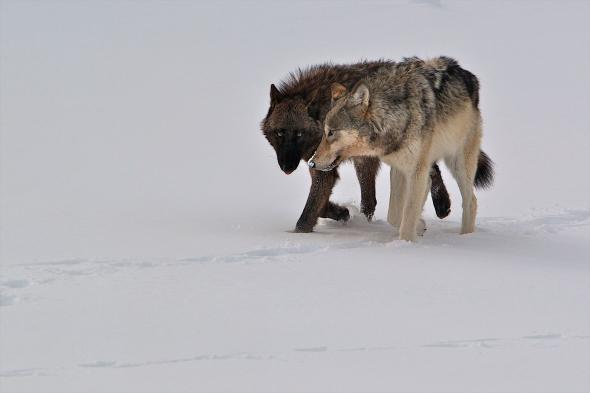
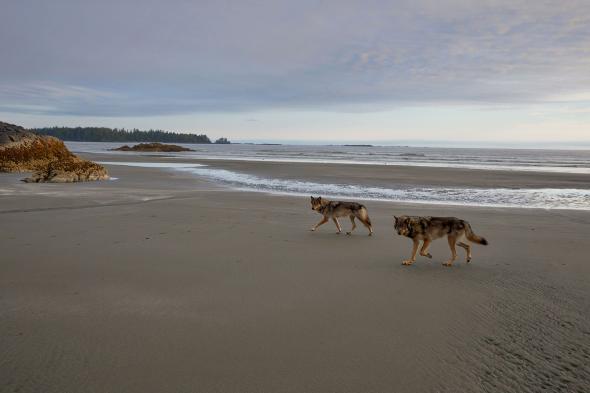
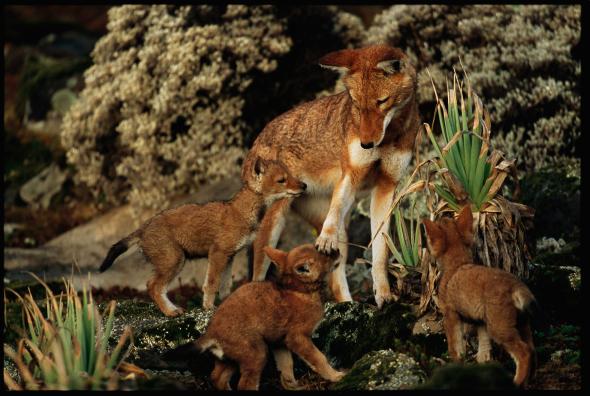
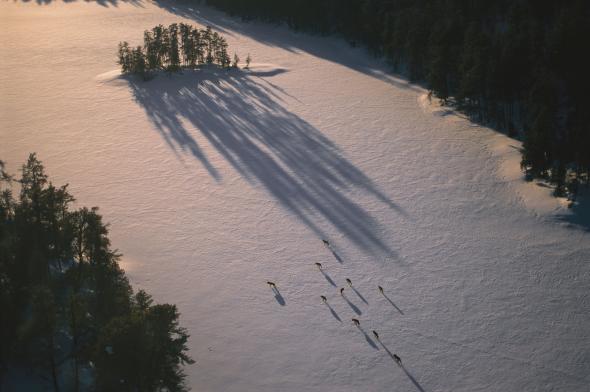
In further recognition of our wonderful wolves.

The background to these photographs, and the first set of six, was a week ago.

wolf7

oooo

wolf8

oooo

wolf9

oooo

wolf10

oooo

wolf11

oooo

wolf12

oooo

You all have a great week.


Forgive the introspection, Part One

This is not some intellectual exercise; far from it!

As often happens, a number of seemingly disconnected articles and reports seem to have provided a common theme. A theme that has previously been aired on Learning from Dogs yet a theme that always needs to be in the front of our faces: integrity.

Here are some of those articles.

Firstly, I presented recently in this place an essay from George Monbiot that proposed (my italics):

The revelation that humanity’s dominant characteristic is, er, humanity will come as no surprise to those who have followed recent developments in behavioural and social sciences. People, these findings suggest, are basically and inherently nice.

Patrice Ayme, however, pointed out in a reply:

Saying that “people are good, while tolerating bad things” is an ineffective morality. The crux, indeed, is the moral nature of institutions, controlled by a few, not whether humans are kind or not.

That struck me as central to the theme: it is the terrible lack of integrity that we see in those who hold positions of power that totally overrides the premise that people are fundamentally good.

The next article read was an essay by Professor Michael Perelman published on Naked Capitalism. Perelman is a professor of economics at California State University. He also writes at Unsettling Economics.  Here is a little from that essay:

The architecture of inequality must be carefully constructed. As the founding fathers of the United States clearly understood, democracy must be kept in check. For this purpose, they invented the Electoral College to prevent the president from being elected by popular vote.

To ensure an effective electoral system, an obsequious media must be skilled in drowning the public with a flood of misinformation to maintain a constant level of fear to make them more likely to side with the CS (corporate system).

If there is ever one example of how that lack of integrity manifests itself in our world it is through inequality. Professor Perelman’s essay is clearly written “tongue-in-cheek” but that doesn’t lessen the impact of his essay. Try his closing paragraphs: (CES = a subset of CS; WEM = The Wondrous Efficiency of Markets)

Regulators are not the only ones to see the benefits of working with the CES. Politicians who resign or are defeated are almost inevitably destined to enjoy the benefits of their dedication to the WEM with the returns from taking a rewarding position with a major corporation, lobbying, or even a lucrative contract to write a book that virtually no one would want to read.

When done correctly, this system works magnificently, although it periodically it seems to fall apart until the detested government apparatus rescues it. In the meantime, huge amounts of wealth and income fall into the hands of the top 1%, the people of greatest importance, while the rest of the public can enjoy watching the spectacular performance of the CES, a reward worthy of their place in society especially because envy of the wealthy brethren will obviously make them work harder to succeed, adding to WEM.

All power to WEM!

Does this have anything to do with dogs?

Yes!

Let me steal a little from Chapter 16: Community from my forthcoming book:

When dogs lived in the wild, their natural pack size was about fifty animals and there were just three dogs that had pack status: the mentor, minder and nanny dogs, as described in Chapter 5. [Pharaoh: the Teaching Dog] As was explained in that chapter, all three dogs of status are born into their respective roles and their duties in their pack are instinctive. There was no such thing as competition for that role as all the other dogs in that natural pack grouping would be equal participants with no ambitions to be anything else.

Anyone who has had the privilege of living with a group of dogs will know beyond doubt that they develop a wonderful community strength. Let’s reflect on the lessons being offered for us in this regard by our dogs.

To reinforce the fact that this is not a new phenomena, at the time I was drafting my book last November, a new report was issued by the Center of Economic Policy Research (CEPR) on the latest (American) Survey of Consumer Finances. It painted a picture very familiar to many: the rich becoming richer while those with less wealth are falling further and further behind.

David Rosnick of the CEPR, and one of the report co-authors, made this important observation:

The decline in the position of typical households is even worse than the Consumer Finances survey indicates. In 1989, many workers had pensions. Far fewer do now. The value of pensions isn’t included in these surveys due to the difficulty of determining what they are worth on a current basis. But they clearly are significant assets that relatively few working age people have now.

Sharmini Peries, of The Real News Network, in an interview with David Rosnick, asked:

PERIES: David, just quickly explain to us what is the Consumer Finance Survey. I know it’s an important survey for economists, but why is it important to ordinary people? Why is it important to us?

ROSNICK: So, every three years, the Federal Reserve interviews a number of households to get an idea of what their finances are like, do they have a lot of wealth, how much are their house’s worth, how much they owe on their mortgages, how much they have in the bank account, how much stocks do wealthy people own. This gives us an idea of their situations, whether they’re going to be prepared for retirement. And we can see things like the effect of the housing and stock bubbles on people’s wealth, whether they’ve been preparing for eventual downfalls, how they’ve reacted to various economic circumstances, how they’re looking to the long term. So it’s a very useful survey in terms of finding out how households are prepared and what the distribution of wealth is like.

PERIES: So your report is an analysis of the report. And what are your key findings?

ROSNICK: So, largely over the last 24 years there’s been a considerable increase in wealth on average, but it’s been very maldistributed. Households in the bottom half of the distribution have actually seen their wealth fall, but the people at the very top have actually done very well. And so that means that a lot of people who are nearing retirement at this point in time are actually not well prepared at all for retirement and are going to be very dependent on Social Security in order to make it through their retirement years.

PERIES: So, David, address the gap. You said there’s a great gap between those that are very wealthy and those that are not. Has this gap widened over this period?

ROSNICK: It absolutely has. As, say, the top 5 percent in wealth, the average wealth for people in the top 5 percent is about 66 percent higher in 2013, the last survey that was completed, compared to 1989. By comparison, for the bottom 20 percent, their wealth has actually fallen 420 percent. They basically had very little to start with, and now they have less than little.

PERIES: So the poorer is getting poorer and the richer is getting extremely richer.

ROSNICK: Very much so.

To my way of thinking, if in the period 1989 through to 2013 “the average wealth for (American) people in the top 5 percent is about 66 percent higher” and “for the bottom 20 percent, their wealth has actually fallen 420 percent” it’s very difficult not to see the hands of greed at work and a consequential devastating increase in inequality.

In other words, the previous few paragraphs seemed to present, and present clearly, the widening gap between the ‘haves’ and the ‘have-nots’, comparatively speaking, and that it was now time for society to understand the trends, to reflect on where this is taking us, if left unchallenged, and to push back as hard as we can both politically and socially.

I wrote that shortly before another item appeared in my email ‘in-box’ in the middle of November (2014), a further report about inequality that, frankly, emotionally speaking, just smacked me in the face. It seemed a critical addition to the picture I was endeavouring to present.

Namely, on the 13th October, 2014, the US edition of The Guardian newspaper published a story entitled: US wealth inequality – top 0.1% worth as much as the bottom 90%. The sub-heading enlarged the headline: Not since the Great Depression has wealth inequality in the US been so acute, new in-depth study finds.

The study referred to was a paper released by the National Bureau of Economic Research, Cambridge, MA, based on research conducted by Emmanuel Saez and Gabriel Zucman. The paper’s bland title belied the reality of the research findings: Wealth Inequality in the United States since 1913.

As the Guardian reported:

Wealth inequality in the US is at near record levels according to a new study by academics. Over the past three decades, the share of household wealth owned by the top 0.1% has increased from 7% to 22%. For the bottom 90% of families, a combination of rising debt, the collapse of the value of their assets during the financial crisis, and stagnant real wages have led to the erosion of wealth. The share of wealth owned by the top 0.1% is almost the same as the bottom 90%.

The picture actually improved in the aftermath of the 1930s Great Depression, with wealth inequality falling through to the late 1970s. It then started to rise again, with the share of total household wealth owned by the top 0.1% rising to 22% in 2012 from 7% in the late 1970s. The top 0.1% includes 160,000 families with total net assets of more than $20m (£13m) in 2012.

In contrast, the share of total US wealth owned by the bottom 90% of families fell from a peak of 36% in the mid-1980s, to 23% in 2012 – just one percentage point above the top 0.1%.

The report was not exclusively about the USA. As the closing paragraphs in The Guardian’s article illustrated:

Among the nine G20 countries with sufficient data, the richest 1% of people (by income) have increased their income share significantly since 1980, according to Oxfam. In Australia, for example, the top 1% earned 4.8% of the country’s income in 1980. That had risen to more than 9% by 2010.

Oxfam says that in the time that Australia has held the G20 presidency (between 2013 and 2014) the total wealth in the G20 increased by $17tn but the richest 1% of people in the G20 captured $6.2tn of this wealth – 36% of the total increase.

I find it incredibly difficult to have any rational response to those figures. I am just aware that there is a flurry of mixed emotions inside me and, perhaps, that’s how I should leave it. Nonetheless, there’s one thing that I can’t keep to myself and that this isn’t the first time that such inequality has arisen; the period leading up the the Great Depression of the 1930s comes immediately to mind.

What on earth is coming down the road this time!

If only we truly could learn from our dogs!

Picture parade one hundred and eighteen

In recognition that a week ago National Wolf Awareness Week started.

The photographs were seen here but the original source of both the text and photographs is the National Geographic website.

ooOOoo

Intelligent and highly social, wolves fascinate us as the untamed predecessors to Man’s Best Friend. But the relationship between humans and wolves has not always been so reverential, especially in the United States.

Through the early 1900s, populations of Canis lupus, the gray wolf, shrank from estimated historical highs of 2 million to near-extinction in the lower 48 states, largely a result of expanded human settlement in the western U.S. and large-scale poisonings meant to protect livestock.

In 1973, the gray wolf was classified as endangered under the Endangered Species Act, and after decades of conservation efforts, wolves are doing well in the U.S. Current estimates peg the gray wolf population in the lower 48 at around 5,500—with at least 7,000 more in Alaska. In fact, a pack of wolves recently planted roots in Siskiyou County, California, the first wolfpack in modern Californian history.

“The gray wolf is in no danger of being endangered, biologically,” says Dave Mech, a senior research scientist with the U.S. Geological Survey.

But controversy still swirls around the gray wolf’s conservation status. In 2013, the U.S. Fish and Wildlife Service proposed removing the gray wolf from the federal list of endangered species, a move it says reflects the wolves’ rebound. But animal rights groups and environmental organizations have decried the very thought, unsuccessfully petitioning the Service to maintain national protections for the gray wolf. Meanwhile, ranchers in the northwestern United States have pushed for rollbacks to state-level wolf protections.

In fact, the U.S. Fish and Wildlife Service declined to comment about the gray wolf, due to ongoing litigation with conservationists over the Mexican gray wolf, a rare subspecies. And given the wolf’s status as both a possible scourge to ranchers and an ecological marvel to environmentalists, the debate is “always going to be contentious,” says Mech.

Yet the allure of the wolf will endure, as it always has in the public’s imagination. “I think there’s a certain aesthetic beauty to [wolves],” says Mech, that defines “their charismatic nature.”

In honor of National Wolf Awareness Week, which begins October 11, we take a closer look at the fascinating ways in which wolves around the world eke out a living.

wolf1

oooo

wolf2

oooo

wolf3

oooo

wolf4

oooo

wolf5

oooo

wolf6

oooo

There are another six photographs that I will offer you in next Sunday’s Picture Parade.

The changing North Atlantic.

The vastness of the seas and the immensity of their influence over all of us.

This is an introduction, a rather long one I’m warning, to a republication of a recent post by Patrice Ayme. An introduction that offers a deeply personal memory of the Atlantic ocean.

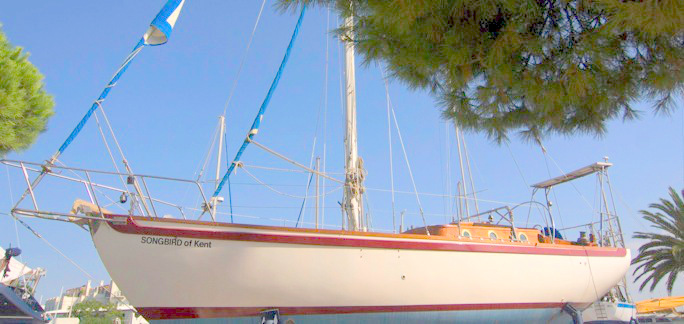
Many years ago, I spent 5 years living on a boat; a wonderful heavy-displacement ocean-going yacht of a type known as a Tradewind 33.

Tradewind 33 - Songbird of Kent.
My home for five years – Tradewind 33:  Songbird of Kent.

There is a place in my mind to which I can so easily travel; a memory of a dark night out in the Atlantic ocean one time in the Autumn of 1969. But first let me set the scene from almost fifty years ago.

The call of the open ocean

Those first few hours were utterly absorbing as I went through the whole business of clearing the yacht harbour at Gibraltar and heading out to the South-West hugging this unfamiliar coastline of Southern Spain. It was tempting to move out to deeper waters but the almost constant flow of large ships through the Straights of Gibraltar soon quashed that idea. Thankfully, the coastal winds were favourable for me and my single-masted sailing yacht.

After such a long time sailing in the relatively confined waters of the Mediterranean, it was difficult for me to imagine that in a few hours time the southern-most point of Spain would pass me by and the vastness of the Atlantic ocean would be my home for the next few weeks.

Soon the city of Tarifa was past my starboard beam and the Spanish coastline was rapidly disappearing away to the North-West. The horizon ahead of me was already approaching 180 degrees of raw, open ocean.  There was just a flicker of a thought that whispered across my mind: “Oh Paul, what have you gone and done” as slowly but persistently the coastlines of Spain to the North and of Africa to the South became more and more distant and fuzzy.  It was at 15:30 that I made an entry in my yacht’s log: “No land in sight in any direction!

Now was the time to make sure that my bunk was made up, flashlights to hand, and my alarm clock ready and set. Alarm clock? Set to go off every twenty minutes during the night! For this was the only way to protect me and my yacht from being hit by one of those gigantic container ships that seemed to be everywhere. It took at least twenty minutes from the moment a ship’s steaming lights appeared above the horizon to crossing one’s path!

It was in the early hours of my first morning alone at sea, when once again the alarm clock had woken me and I was looking around an ocean without a single ship’s light to be seen that more of Les’ words (see footnote) came to me. I remembered asking Les: “What’s the ­appeal of sailing?” Les replied without a moment’s hesitation: “It’s the solitude. When you’re out at sea on your own, there’s no government or bankers to worry about. You’re not ­responsible to anyone but yourself.

Yes, I could sense the solitude that was all around me but it was an intellectual sense not an emotional one. That would come later. Inside, I was still afraid of what I had let myself in for.

Remarkably quickly however, the pattern of solo life aboard a thirty-three-foot yacht became my world. Frankly, it staggered me as to how busy were my days. Feeding myself, navigating, trying to forecast the winds, staying in touch with other yachties via the short-wave radio, keeping the boat tidy and a zillion other tasks meant the first few days and nights just slipped by.

But it was a sight on my fourth night at sea that created the memory that would turn out to remain with me for all my life. The memory that I can go to anytime in my mind.

That fourth night I was already well into the routine of waking to the alarm clock, clipping on my harness as I climbed up the three steps that took me from my cabin into the cockpit, scanning the horizon with my eyes, checking that the self-steering had the boat at the correct angle to the wind and then, if no ships’ lights had been seen, slipping back down into my bunk and sleeping for another twenty minutes. Remarkably, I was not suffering from any long-term tiredness during the day.

It was a little after 3am that fourth night when the alarm clock had me back up in the cockpit once again. Then it struck me.

Songbird was sailing beautifully. There was a steady wind of around ten knots from the south-east, almost a swell-free ocean, and everything set perfectly.  Not a sign of any ship in any direction.

Then I lifted my eyes upwards. There was not a cloud in the night sky, not a single wisp of mist to dim a single one of the million or more stars that were above my head. For on this dark, moonless night, so far removed from any shore-based light pollution, the vastness, yet closeness of the heavens above was simply breath-taking. I was transfixed. Utterly unable to make any rational sense of this night splendour that glittered in every direction in which I gazed. This dome that represented a vastness beyond any meaning other than a reminder of the magic of the universe.

This magic of the heavens above me that came down to touch the horizon in all directions. Such a rare sight to see the twinkling of stars almost touching the starkness of the ocean’s horizon at night. A total marriage of this one planet with the vastness of outer space.

I heard the alarm clock go off again and again next to my bunk down below. But I remained transfixed until there was a very soft lightening of the skyline to the east that announced that another dawn was on its way.

I would never again look up at the stars in a night sky without being transported back to that wonderful night and the memory of a lonely sea and sky.

I did warn you it would be a long introduction!

ooOOoo

Non-Linear Cold Blob Rising Over North Atlantic

The reason life survived on Earth for so long, and blossomed into animals, and now mind, is that the planet is equipped with homeostatic mechanisms (homeo means similar in Greek, and stasis, standing still). However, those mechanisms tend to be geological.

Human civilization is now having an impact on the biosphere of a violence probably never seen before. The changes are faster than what geology, or even life, can accommodate.

Some will brandish the impact of the Yucatan asteroid, and claim that was worse; however that’s just a theory: the biosphere was clearly under stress at the time from the Deccan Traps eruptions, and had been under that stress for hundreds of thousands of years, if not millions. At its worst, the Asteroid was just the straw which broke the Camel’s back.

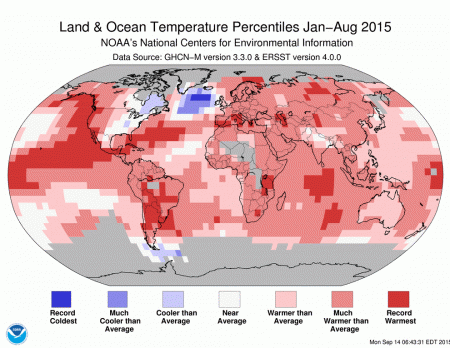
2015 will be the warmest year since the end of the Eemian, 115,000 years ago. So why are record low temperatures appearing just south of Iceland? Yes, record lows, lower than ever recorded.

While The Rest Of Planet Is At Record Warmth, Off Iceland, Record Colds Are Achieved!

That was fully expected, and a demonstration of Non-Linearity of the incipient global warming. A phenomenon is linear when it looks like a line. Global warming is not going up like a line, as some places are warming at a rate ten times higher than the average, and some regions are cooling (and some are cooling spectacularly, off Iceland and some seas around Antarctica, for reasons related to warming).

The Dryas events were extremely fast and pronounced cooling events which happened several times during the period 10,000 years to 15,000 Before Present. Some lasted around a millennium, others, just a century. They vanished as fast as they came. They are named after a tundra flower, the Dryas. In Scandinavia forests were replaced by tundra graced with Dryas (hence the name). In Britain, average temperature collapsed to minus 5 degree Celsius, and glaciers formed at elevation.

These spastic events of drastic cooling, while, overall, de-glaciation was going on, long remained a mystery. Overall, the great glaciation which had brought glaciers down to New York, was on its way out, the planet was globally, irresistibly warming. So why would temperatures collapse in some places around Greenland by 15 degrees Celsius? The solution to the Dryas events’ spastic glaciation riddle? The same as always! Warming is non-linear.

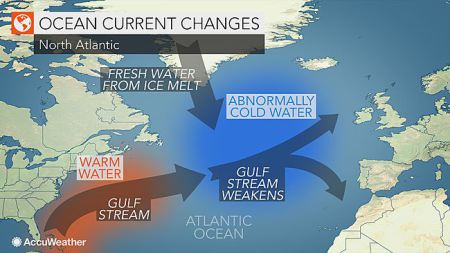
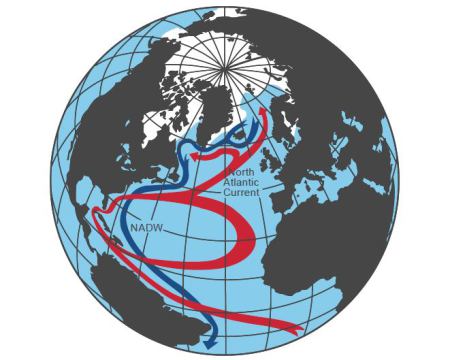
What’s the theory? The details are uncertain, but we know that the Gulf Stream (aka the North Atlantic “Conveyor”) shorted, literally: analyses of deep sea sediments have shown this. The conveyor sends an enormous current of warm tropical waters northward.

When the warm tropical waters become very cold between Iceland and Spitzbergen, they sink to the bottom of the sea, and head south. This sinking, plus the pushing by trade winds in the tropics, is what provides the energy of the Gulf Stream.

However, if the warm tropical waters are capped by a very cold, but light sweet(er) water lid, they will get cold early, and sink before Iceland. This is what happened in the Dryas events.

And It Is Happening Again, Albeit On A Smaller Scale.

Was it in response to a sudden influx of fresh water from Lake Agassiz and deglaciation in North America, and Greenland? Sudden freezing there would have removed the freshwater lid, hence the brutal switchback to warming after the brutal cooling. By the way, the sea level rising speed responded quickly, by a factor of three. After the typical Dryas cooling, oceanic rise rebounded to 18 millimeter per year right away (this shows that those who expect a slow rise of sea level rise are deluding themselves, or, more to the point, are trying to delude us!)

Nowadays a Dryas-like mechanism would have to rest on the melting of Greenland alone (that’s the only place with significant ice). This is, of course, insufficient, but summer 2015, cool and rainy over the northern North Atlantic is evidence that the effect is on. Scientific analysis confirms it. See: “Exceptional Twentieth Century Slow Down of Atlantic Ocean Overturning Circulation” (Nature, 23 March, 2015).

The exact nature of what is going on at this point is a matter of debate among experts. What is sure is that something is going on.

The Atlantic Conveyor Is A Subtle Thing, Yet Dominates Glaciation In The Arctic.

A similar situation beckons in Antarctica, where ice shield melting creates a freshwater lid all around which in turn freeze, extending the ice cap in the Austral winter.

When considering nonlinearity, subtlety and surprises are of the essence. This is true in physics, as it is in psychology, history, or politics.

And the morality in all this? The USA has played god. The European Union made a honest to goodness effort to reduce CO2 emission, while the USA, paying lip service to the opposite of what it was doing went right ahead, with its factory, the Plutocratic Republic of China, to use and abuse fossil fuels as never before.

So now what? Is god still American, as usual? At first it seems so: the USA started to frack massively and massive amounts of fossil fuels were extracted from the USA’s generous soil. When American companies tried the same in Poland, it failed: the underground god (Pluto?) did not cooperate: Polish soil is adverse to fracking.

Here comes the punchline: sea level has been rising fast along the Eastern seashore of the USA. Actually, three to four times faster than the world average. That’s more than one centimeter per year.

Why? Imagine a traffic jam. Or rather a crash ahead: things come to a halt, cars, water piles up behind. Maybe the Washington politicians will soon have to learn to swim, and not just against the tide of world public opinion.

The USA is going to be punished with its own instruments. Meanwhile 20 countries formed the V20, a group of twenty countries whose existence is immediately threatened by global warming, although they caused it not.

A Two Degree Celsius rise of temperature is indeed way too much: nonlinearity is upon us. Evil is always nonlinear.

Patrice Ayme’

ooOOoo

Footnote: The Les referred to is Les Powells, the yachtsman who sailed solo three times around the world. He and I became good friends when we met up at Larnaca Marina in Cyprus.


Les Powells book