Integrity and honesty should certainly apply to what we eat!
Published author Deborah Taylor-French has her own blog Dog Leader Mysteries. She and I follow each other’s blog and I’m very grateful for the connection, as indeed I am with so many other fellow bloggers.
Thus that was how I came to learn of a recent post from Deborah about how rabbit meat is being used for human consumption. On the face of it, nothing wrong in eating rabbit but wait until you have read Deborah post, that is republished here with her kind permission.
ooOOoo
Tell Whole Foods: Do not sell bunnies
Tell Whole Foods, “Don’t sell bunny meat!”
Farm animals suffer greatly in the United States of America. Plus this suffering comes to us well documented. Before the U.S. Congress passes laws allowing Ag-Gag [see my footnote] states to make it illegal for people to photograph, video or report animal abuse inside or outside their meat plants.
The disturbing truth? Pet rabbits now sold for meat at Whole Foods Market come from being raised in U.S.A. Ag-gag states. What’s wrong with that? Everything.
Big farms doing business in Ag-gag states operate free from animal welfare laws.
In fact these huge meat farms have made laws against taking photographs, video recording or any reporting of animal abuse. What have they got to hide?
Enough. All too many cruel animal farming practices already hurt farm animals, enough to make most of us sick. The Humane Society of the United States and the Animal Defense Fund continue working to legally raise farm animal welfare practices. Most Americans know that farm animals do not receive acceptable room for walking nor a humane standard of care. Before we let another category of animal become victims of Ag-gag farm cruelty, we need to improve farm animals welfare.
Adopted from Rohnert Park Animal Shelter.
Rabbits die of fright.
They share the species lagomorph.
There are about eighty species of lagomorph include thirty species of pika, twenty species of rabbit and cottontail, and thirty species of hare family. Wikipedia
I learned about this issue of Whole Foods Market, selling a new category of animal for meat through a volunteer at my local shelter. Kathy, along with volunteers from Save a Bunny and a Southern California group, are working to raise awareness pet rabbits should not end up as mainstream Big Farm meat products. Why?
Whole Foods Market buys meat rabbits from Ag-gag states. If Whole Foods succeeds, farm animal suffering will fall on whole other category of animals, pet rabbits.
It comes as no secret in United States that farm animals end up being raised inhumanely. If you have ever read about the Ag-gag states and how they are able to prosecute anyone willing to go undercover and take photographs and videos to report the truth on this ongoing unnecessary torture of farm animals. What meat animals endure in the U.S.A. is nothing less than cruelty, it’s time we changed that, before adding anymore farm animals.
Nine facts hidden in Ag-gag pig farms
Millions of meat pigs live, eliminate and sleep in cramped spaces.
The environment these pigs endure smell rank. Their wastes drain into a central open sewer and their housing is so unclean many of them die.
Meat pigs lack all exercise to the extreme point that their legs break.
Pigs housed in huge warehouses with thousands of other pigs, hear others screaming day and night from pain.
Female pigs, sows, live horrible lives in gestation crates.
Gestation crates built for female pigs force them to stand up for 24-hours per day. Farmers do not allow pigs to walk or lie down. Gestation crates, notoriously painful for animals, need to be banned. Often the pigs’ legs break because their bones grow soft, due to not being allowed to walk.
Big meat farms build bars underneath sows to brace broken legs.
The meat pig lives in constant physical pain, terror, fear and unhappiness. When piglets die, often in these unsanitary conditions, their bodies get ground up and mixed into the food the sows eat. So mother pigs eat their own young.Pigs do not live as cannibals. Why should they be forced to eat their own young?
What horrible animal welfare to make pigs eat their own young. It’s incomprehensible that animals must live like this so that people can eat pork barbecue, pork steak and pork ribs.
How can they call these farms? Not giving animals room to walk, sit or lie down? Meat farm animals get denied their normal and natural behaviors. They never see the light of the sun nor feel the earth nor wind.
What U.S.A. meat farms won’t let us see.
After four years of hesitation and never mentioning recordings of farm animals lack of good welfare, I break my silence.
Much of the time I avoid eating meat. From now on, I will be seeking out small sustainable and local farms. We have several nearby that do not inflict senseless cruelty on pigs, chickens and cows. After study of commercially farmed pork and chicken and beef, I have returned to my original vegetarian and fish eating ways.
My footnote. As a non-American I didn’t fully understand the phrase “Ag-gag”. Deborah kindly explained it as follows:
Several states have passed laws against anyone photographing, video recording or reporting on animal abuse inside massive meat farms. The Humane Society of the United States keeps working (under cover to film the truth of this unsanitary and cruel business) but now they can arrest anyone caught, send reporters to jail and sue anyone trying to inform the public.
ooOOoo
I know for a fact that Deborah would love that this item is shared and republished as far and wide as possible. Please help.
For spreading the word and being very careful about the meat that we eat are the only ways to put a stop to these unbelievably cruel practices, and the ‘Ag-gag’ laws.
A reposting of a blog from Dog Leader Mysteries about a dog food recall.
Quickly stepping over the observation that today’s post is about as far removed, topic wise, from yesterday’s post as one could possibly imagine, nonetheless this is important and needs to be widely shared.
ooOOoo
Raw food recall: J J Fuds Frozen Pet Food
J. J. Fuds Raw dog food recall expands
Dear Fellow Dog Lover,
Because you signed up on my website and asked to be notified, I’m sending you this special recall alert.
On January 27, 2015, J. J. Fuds of Valparaiso, Indiana, announced it is expanding its recall of select lots of J. J. Fuds Raw Frozen Pet Food to include 2 other products due to unspecified contamination.
I copied this email notice from The Dog Food Advisor. I highly recommend you sign up for this list.
Please share to save dogs’ lives
We don’t feed Sydney raw meat. We do feed organic raw vegetables in limited quantities. We care about pets and want our readers to share this important news. Also we want you to know that we receive the Dog Food Advisor’s updates. Mike Sagman never stuffs our email box, but sends out notices as fast as he receives them. We asked our local pet stores if they receive notices before opening each day. You can do that. Ask when and how pet foods get pulled from their shelves, your pet’s life depends on this.
Enough of the world of spying and whistleblowing and back to stuff that is really important!
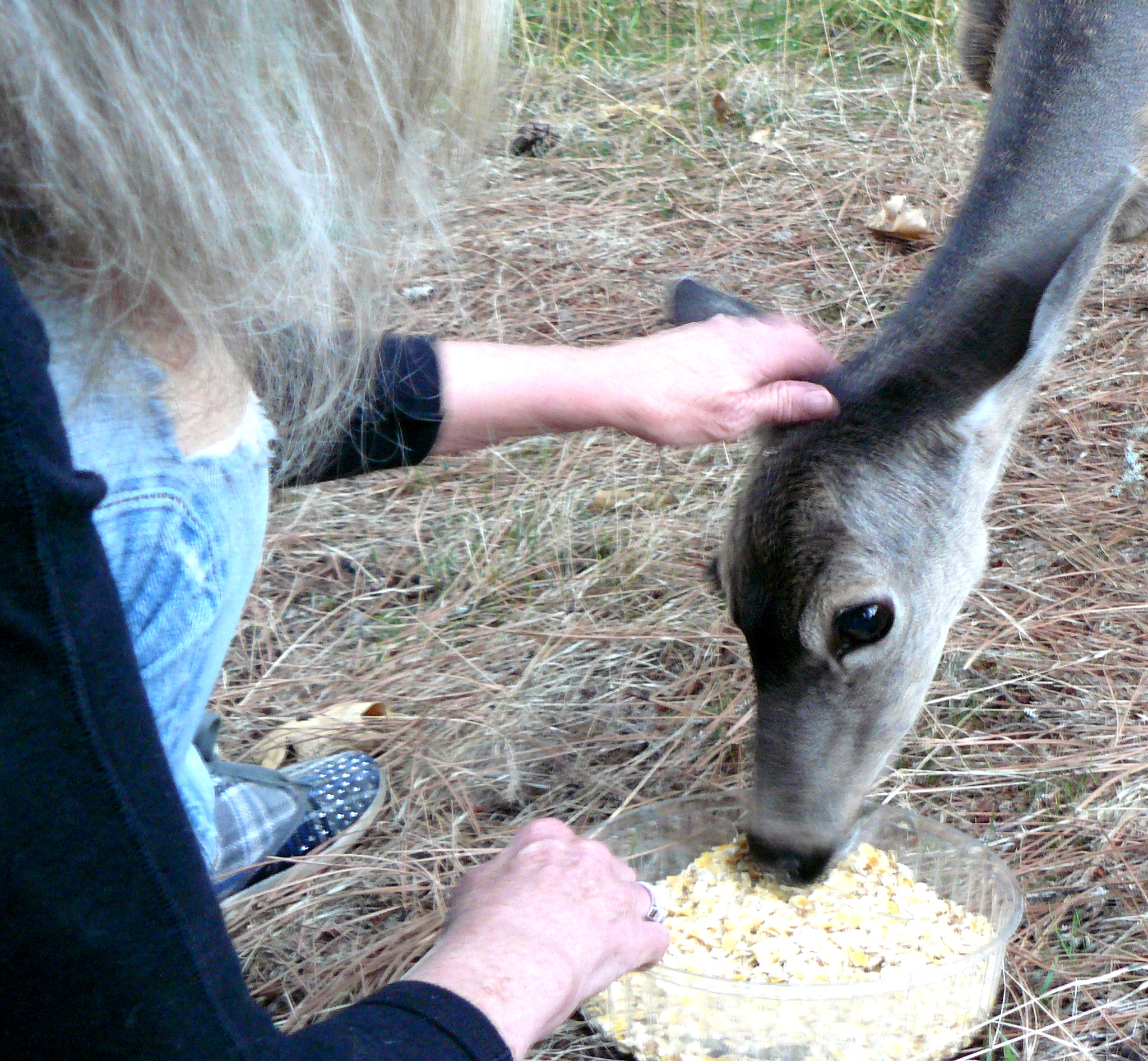
Many will recall that on the 10th October, under the heading of Utterly beyond words!, I wrote about a deer befriending us to the point that Jean was able to stroke its neck as it was feeding. The post included this photograph.
Then, unbelievably, the wild deer continues feeding as Jean fondles the deer’s ear.
Inevitably, being the softies that we are, we have continued to put out feed, in the form of cob or cracked corn, most days.
The word among the local deer population clearly has been passed around!
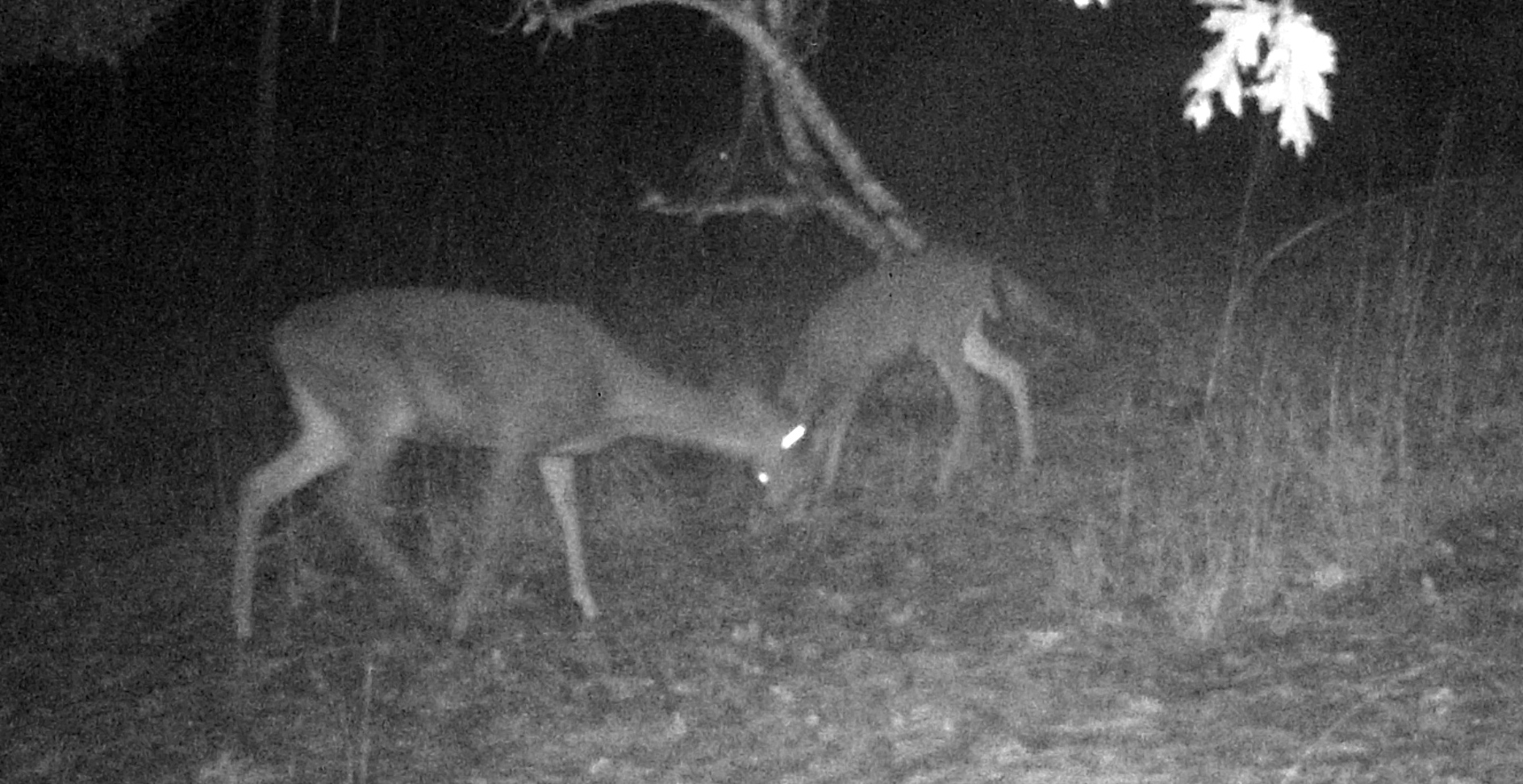
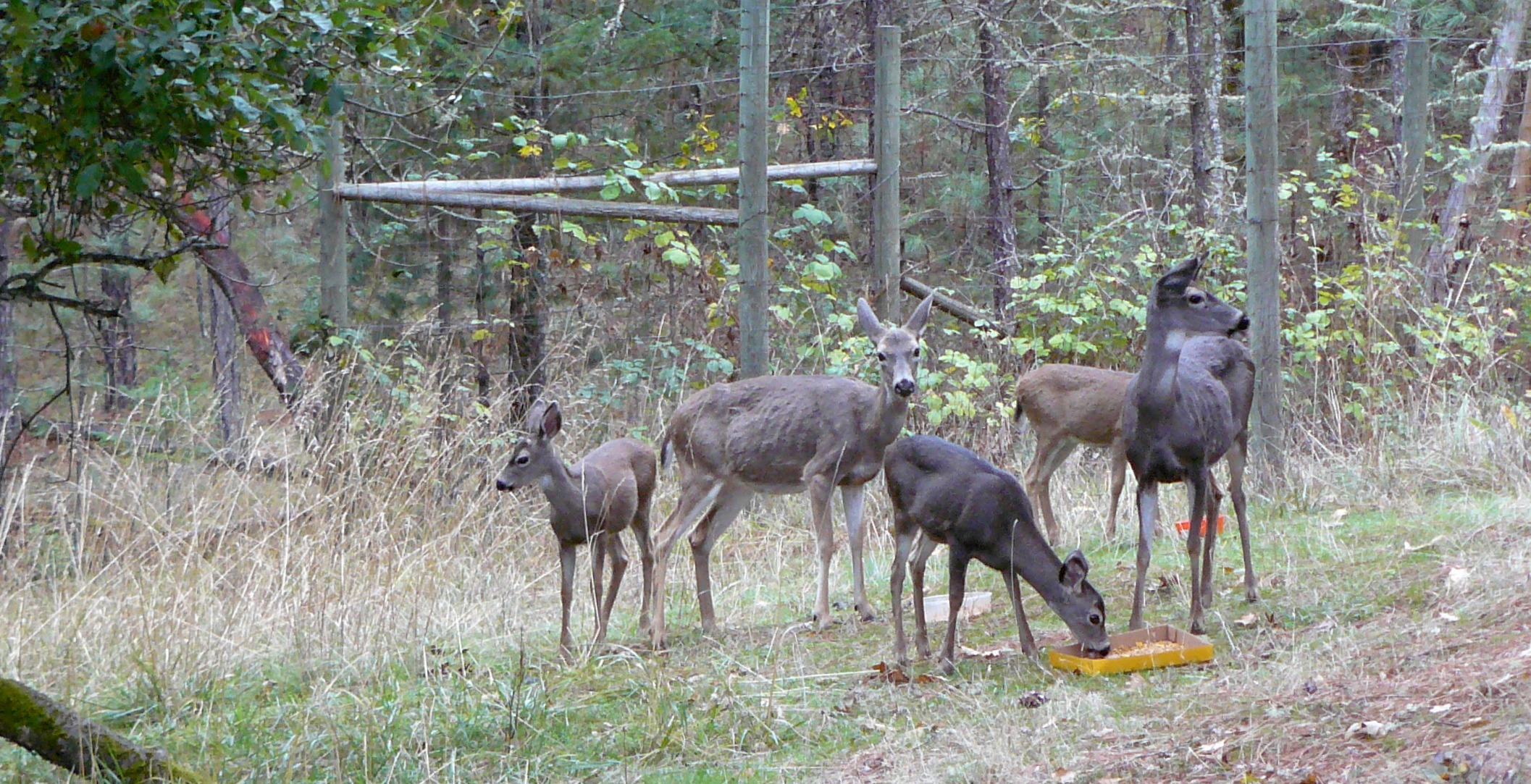
For here’s a photograph taken automatically on the night of the 19th October.
Time of the shot was a little before 5am.
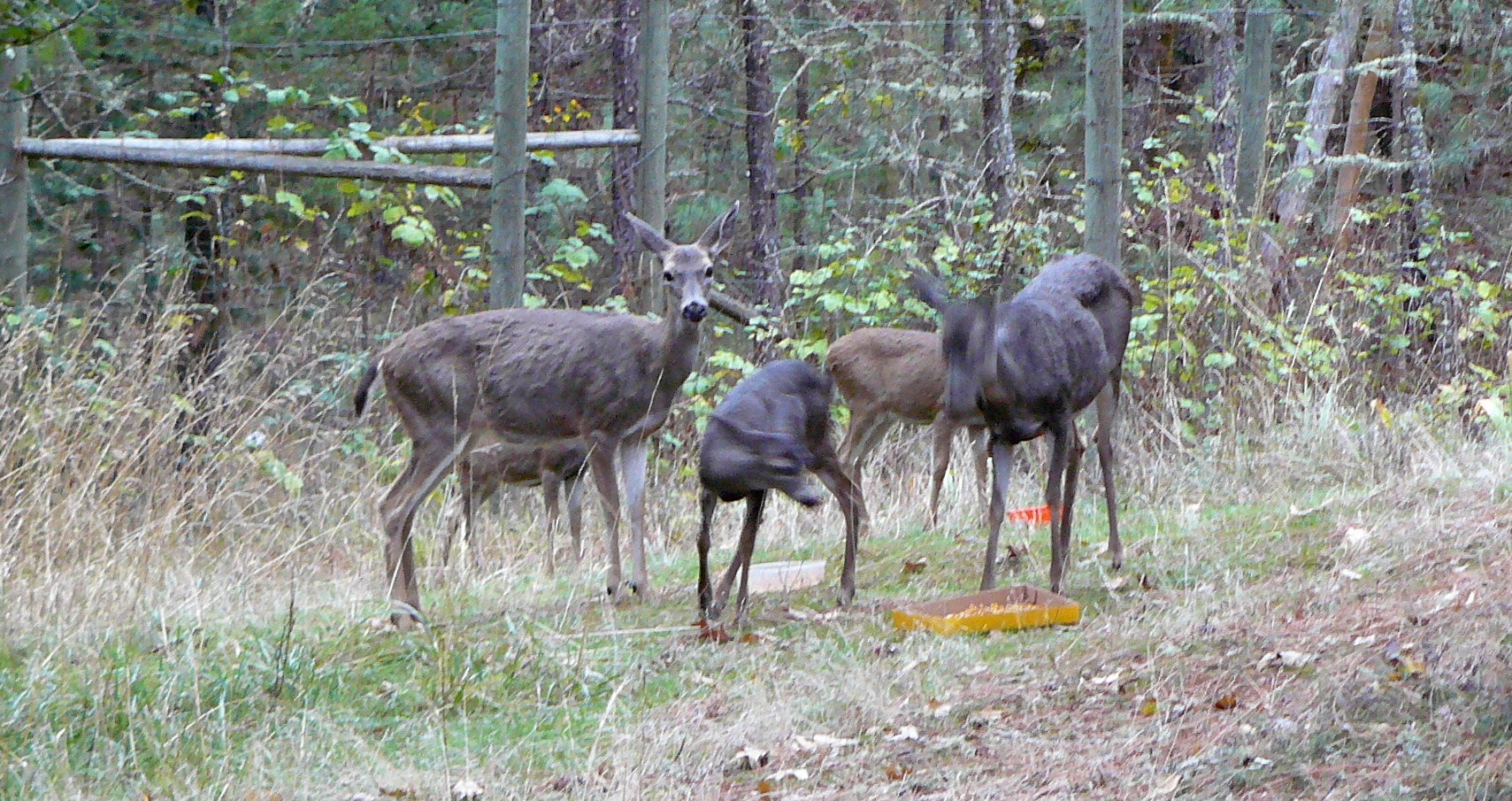
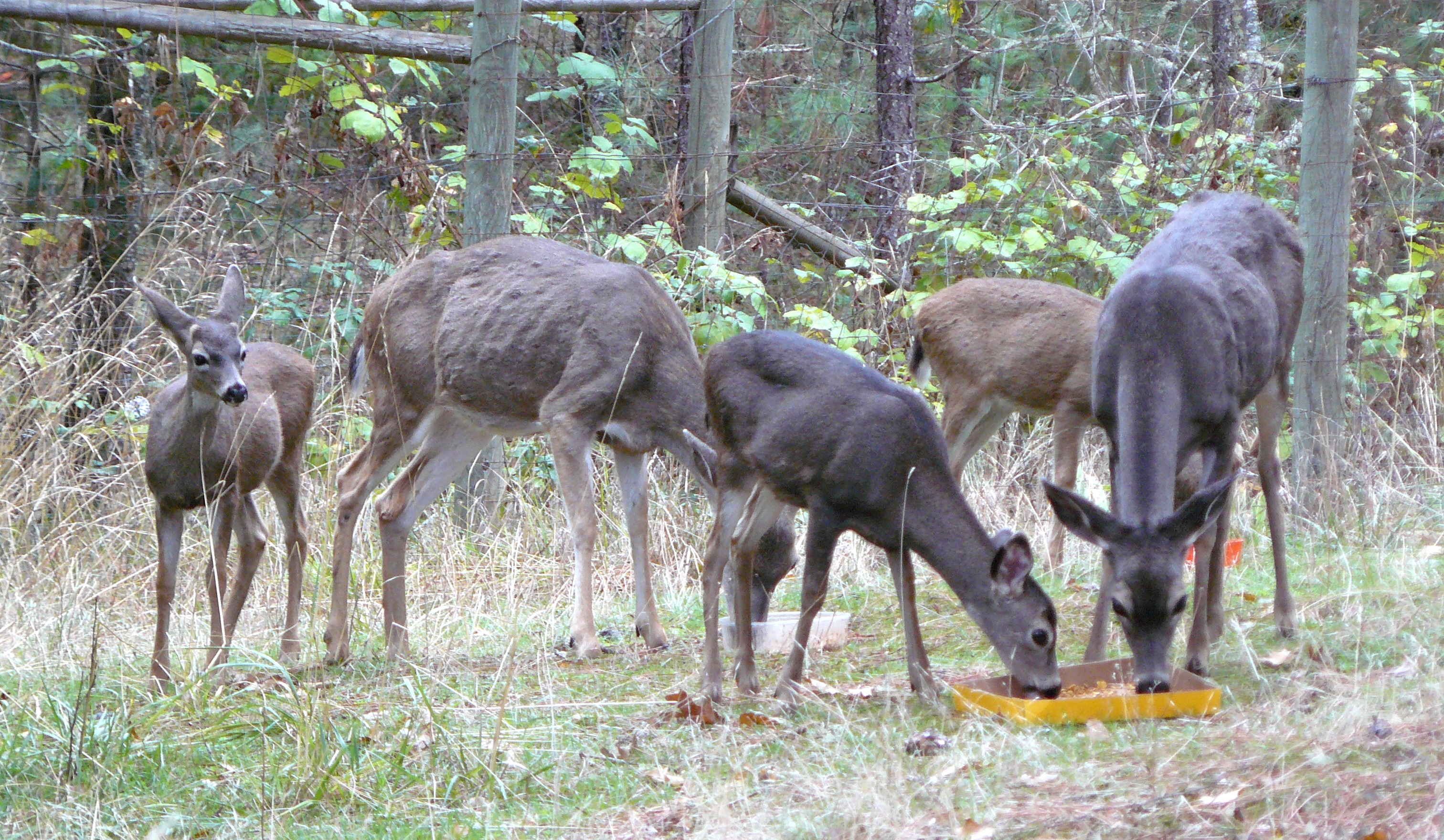
Then on the 22nd, just three days ago, these photographs were taken shortly after 10am.
More food and it isn’t even supper time!
oooo
Come on ladies, eat up! You never know when a dog will charge around the corner!
oooo
That’s more like it!
One fear that Jean and I had was that they would become vulnerable to an attack by our dogs. But the deer have quickly wised up to when dogs are being let out of the front or kitchen doors and are off like darts into the forest just a few yards away.
The wonderful BBC science programme, BBC Horizon, recently showed a fascinating programme entitled: Is your Brain Male or Female? The programme is introduced on the Horizon website:
Dr. Mosley and Prof. Roberts.
Dr Michael Mosley and Professor Alice Roberts investigate if male and female brains really are wired differently.
New research suggests that the connections in men and women’s brains follow different patterns, patterns which may explain typical forms of male and female behaviour. But are these patterns innate, or are they shaped by the world around us?
Using a team of human lab rats and a troop of barbary monkeys, Michael and Alice test the science and challenge old stereotypes. They ask whether this new scientific research will benefit both men and women – or whether it could drive the sexes even further apart.
Now I haven’t a clue as to how long this fascinating programme will remain on YouTube, but if you aren’t in the UK or don’t have access to the BBC iPlayer then don’t hesitate to watch it now.
Essentially, science shows that the ‘hard-wired’ differences are minute and the vast bulk of the preferences between the genders, trucks versus dolls, for example, is subtle conditioning from parents and the wider world; for instance, advertisements.
One thing that did jump ‘off the page’ at me was the evidence supporting how malleable or plastic is the brain. In other words, we are never too old to learn.
As if to reinforce that aspect of the flexibility of our brain, just yesterday morning I read an item on the BBC News website about memory.
As someone whose memory is a long way from where it used to be, this item really caught my attention:
Are there ways to stop yourself losing your memory? The latest brain research suggests there’s hope for the forgetful…
Memory loss has to be one of our biggest fears. Names, words, facts and faces – nothing is spared.
As the latest video from the Head Squeeze team describes above, mental deterioration was once thought to be an inevitable consequence of ageing, thanks to the steady erosion of our brain matter: we lose about 0.5% of our brain volume every year. The hippocampus – the region responsible for memory and learning – was thought to weather particularly badly; by the time we are 90, many of us have lost around a third of its grey matter.
Fortunately, recent research has shown that the brain is not concrete, but certain regions can adapt and grow. In 2000, a study of London taxi drivers, for instance, showed that the 4-year training of London’s 25,000 streets showed a remarkable growth in the hippocampus compared to bus drivers who early learnt a fixed number of routes. The scientists think that, by memorising the maps of London, the brain had built many more of the “synaptic connections” that allow the brain cells to communicate with each other. In other words, it may be possible to train the brain to compensate for some of the neural decline that accompanies our expanding waistlines and receding hairlines.
Challenging your brain could be one way of preserving your recollections – though the value of commercial brain training apps is debatable; some experiments seem to show that while people may become a whizz at the games on their screen, the improvements fail to transfer to daily life. But other, more traditional activities – like learning a musical instrument or a second language – do seem to have some protective benefits, at least on short-term recall. Ideally, it is probably best to keep your brain active throughout your life, well before you begin to approach your dotage.
Exercise and a healthy diet are also thought to offer some protection against dementia. As can an active social life – since regular contact with other people is also thought to excite our neurons and preserve our synapses. Ensuring that you regularly get a good night’s sleep helps too.
Of course, nothing can guarantee health and vitality in old age. But these few simple measures might give you the best possible chances of preserving your wits against the ravages of time.
For more videos subscribe to the Head Squeeze channel on YouTube. This video is part of a series produced in partnership with the European Union’s Hello Brain project, which aims to provide easy-to-understand information about the brain and brain health.
If you would like to comment on this video or anything else you have seen on Future, head over to our Facebook page or message us on Twitter.
So it’s clear now.
All I need to do is to learn a new language while in between my training to be the oldest trainee cabbie in London and applying for second violin position at the Royal Philharmonic Orchestra and I’ll never forget anything else in my life.
Oh, anyone seen where I left my car keys?
Or perhaps, harking back to the opening question of the differences between our sexes, I should be closing, thus:
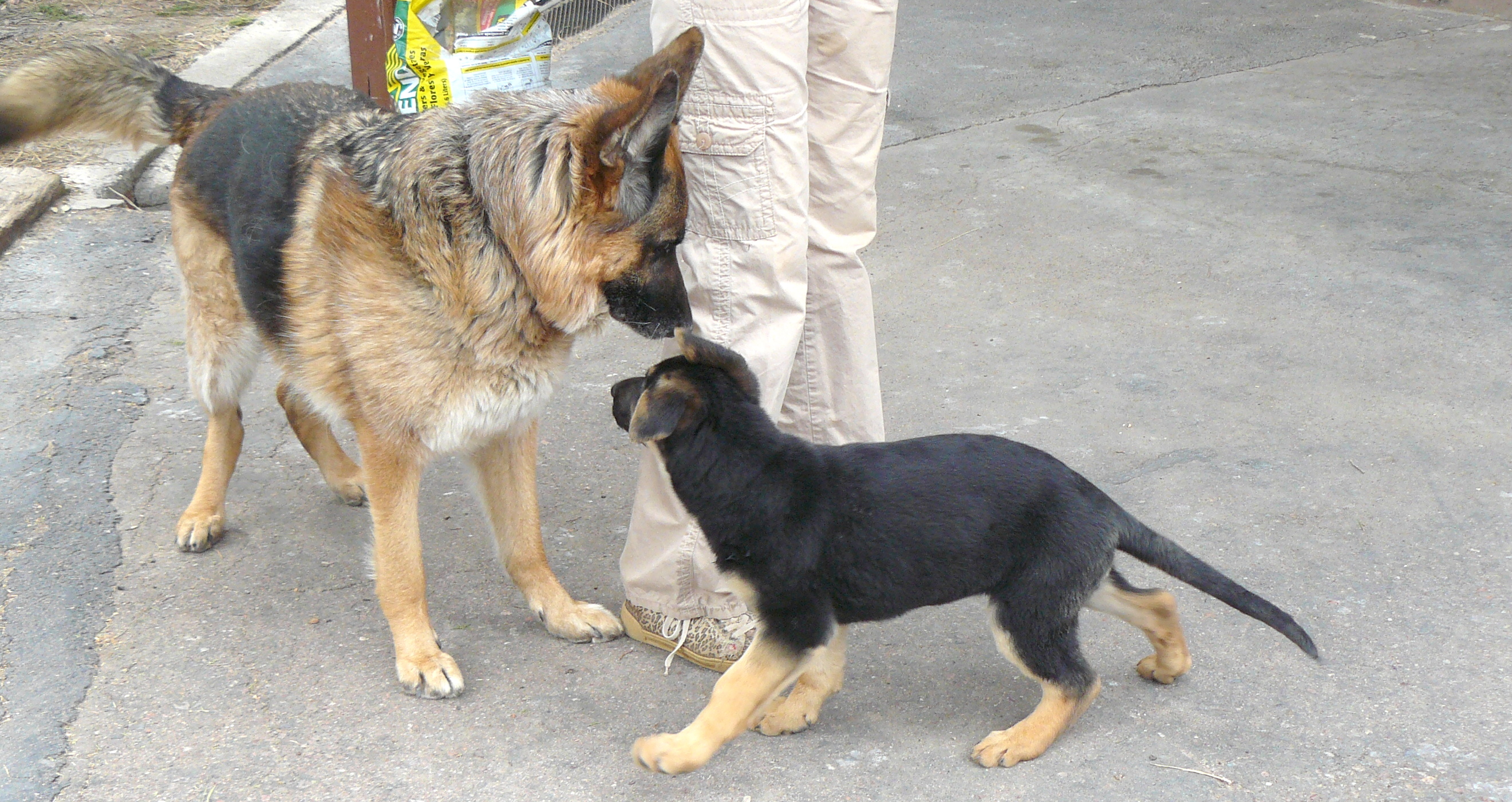
Among our group of nine dogs we have two German Shepherds. Dear old fellow Pharaoh and his much younger female playmate Cleo.
First meeting between Pharaoh and Cleo; April 7th, 2012.
Cleo was born in January, 2012 and came to us in early April that same year. From the start, Cleo has been a warm, loving and friendly dog.
For a long time, Jean has treated our dogs by giving them sawn sections, about 3/4 in thick, of beef leg bones. They love gnawing on the bone and the marrow at the centre is very good for dogs.
Thus it was on Saturday that all the dogs were enjoying their treat.
I was working outside the house and Jean and the dogs were inside.
All of a sudden Jean was calling to me, clearly stressed out, to come into the house straightaway.
I went in and found that Cleo had jammed her lower jaw through her piece of bone and that it was stuck hard behind her lower canines. Jean and I led Cleo outside so she was clear of all the other dogs.
We quickly discovered that once Cleo’s jaw was trapped in the bone, it had started rubbing against her gums, quickly creating a painful area. This made it very difficult to hold Cleo still, prise her jaw apart to try and gently remove the offending bone. The more we tried, the more agitated became Cleo.
In the end, I went inside the house to telephone a close neighbour who is also a veterinary doctor at the clinic in town where we take our dogs. Jim G. dropped everything and promised to be over in a few minutes.
As it happened, when I returned outside Jean had managed, somehow, to remove the trapped bone. I called Jim back immediately but he was already at our front gate and suggested he just take a quick look at Cleo
Here is the piece of bone after it was removed from Cleo’s jaw.
Smaller hole is about 1 & 5/8 in (4 cms) diameter.
Innocent mistake but, nevertheless, seemed like one that should be promulgated in this place just to make other dog owners aware of this tiny risk.
Cleo cautiously eying both me and the bone.
So you all take care out there!
And thank you Jim for being so responsive on what was your week-end afternoon at home.
My draft book of the same name as this blog is slowly coming together and I’m at the 30,000-word mark. A while ago, John Hurlburt, a good friend of this blog, was chatting to me and he spoke about the “interconnectedness of all conscious life”. It immediately appealed to me as a chapter in the book.
But while it was obvious to me that all conscious life is connected, for some time I struggled to achieve any clarity about what I wanted to write. Seeing that proverb kicked off the journey towards clarity.
Thus, today, I wanted to share the steps of that journey so far.
Over on the Skeptical Science blogsite there is a post, dated 15th April, 2010, with the title of Earth’s five mass extinction events. The author, John Cook, opens:
As climate changes, a major question is whether nature can adapt to the changing conditions? The answer lies in the past. Throughout Earth’s history, there have been periods where climate changed dramatically. The response was mass extinction events, when many species went extinct followed by a very slow recovery. The history of coral reefs gives us an insight into the nature of these events as reefs are so enduring and the fossil record of corals is relatively well known (Veron 2008). What we find is reefs were particularly impacted in mass extinctions, taking many millions of years to recover. These intervals are known as “reef gaps”.
Figure 1: Timeline of mass extinction events. The five named vertical bars indicate mass extinction events. Black rectangles (drawn to scale) represent global reef gaps and brick-pattern shapes show times of prolific reef growth (Veron 2008).
So what, one might ask?
Well, forget about millions of years ago. Just 12 days ago, there was a news item released by Stanford University. It read in full:
July 24, 2014
Stanford biologist warns of early stages of Earth’s 6th mass extinction event
Stanford Biology Professor Rodolfo Dirzo and his colleagues warn that this “defaunation” could have harmful downstream effects on human health.
The planet’s current biodiversity, the product of 3.5 billion years of evolutionary trial and error, is the highest in the history of life. But it may be reaching a tipping point.
In a new review of scientific literature and analysis of data published in Science, an international team of scientists cautions that the loss and decline of animals is contributing to what
Elephants and other large animals face an increased risk of extinction in what Stanford Biology Professor Rodolfo Dirzo terms “defaunation.” (Claudia Paulussen/Shutterstock)
appears to be the early days of the planet’s sixth mass biological extinction event.
Since 1500, more than 320 terrestrial vertebrates have become extinct. Populations of the remaining species show a 25 percent average decline in abundance. The situation is similarly dire for invertebrate animal life.
And while previous extinctions have been driven by natural planetary transformations or catastrophic asteroid strikes, the current die-off can be associated to human activity, a situation that the lead author Rodolfo Dirzo, a professor of biology at Stanford, designates an era of “Anthropocene defaunation.”
Across vertebrates, 16 to 33 percent of all species are estimated to be globally threatened or endangered. Large animals – described as megafauna and including elephants, rhinoceroses, polar bears and countless other species worldwide – face the highest rate of decline, a trend that matches previous extinction events.
Larger animals tend to have lower population growth rates and produce fewer offspring. They need larger habitat areas to maintain viable populations. Their size and meat mass make them easier and more attractive hunting targets for humans.
Although these species represent a relatively low percentage of the animals at risk, their loss would have trickle-down effects that could shake the stability of other species and, in some cases, even human health.
For instance, previous experiments conducted in Kenya have isolated patches of land from megafauna such as zebras, giraffes and elephants, and observed how an ecosystem reacts to the removal of its largest species. Rather quickly, these areas become overwhelmed with rodents. Grass and shrubs increase and the rate of soil compaction decreases. Seeds and shelter become more easily available, and the risk of predation drops.
Consequently, the number of rodents doubles – and so does the abundance of the disease-carrying ectoparasites that they harbor.
“Where human density is high, you get high rates of defaunation, high incidence of rodents, and thus high levels of pathogens, which increases the risks of disease transmission,” said Dirzo, who is also a senior fellow at the Stanford Woods Institute for the Environment. “Who would have thought that just defaunation would have all these dramatic consequences? But it can be a vicious circle.”
The scientists also detailed a troubling trend in invertebrate defaunation. Human population has doubled in the past 35 years; in the same period, the number of invertebrate animals – such as beetles, butterflies, spiders and worms – has decreased by 45 percent.
As with larger animals, the loss is driven primarily by loss of habitat and global climate disruption, and could have trickle-up effects in our everyday lives.
For instance, insects pollinate roughly 75 percent of the world’s food crops, an estimated 10 percent of the economic value of the world’s food supply. Insects also play a critical role in nutrient cycling and decomposing organic materials, which helps ensure ecosystem productivity. In the United States alone, the value of pest control by native predators is estimated at $4.5 billion annually.
Dirzo said that the solutions are complicated. Immediately reducing rates of habitat change and overexploitation would help, but these approaches need to be tailored to individual regions and situations. He said he hopes that raising awareness of the ongoing mass extinction – and not just of large, charismatic species – and its associated consequences will help spur change.
“We tend to think about extinction as loss of a species from the face of Earth, and that’s very important, but there’s a loss of critical ecosystem functioning in which animals play a central role that we need to pay attention to as well,” Dirzo said. “Ironically, we have long considered that defaunation is a cryptic phenomenon, but I think we will end up with a situation that is non-cryptic because of the increasingly obvious consequences to the planet and to human wellbeing.”
The coauthors on the report include Hillary S. Young, University of California, Santa Barbara; Mauro Galetti, Universidade Estadual Paulista in Brazil; Gerardo Ceballos, Universidad Nacional Autonoma de Mexico; Nick J.B. Isaac, of the Natural Environment Research Council Centre for Ecology and Hydrology in England; and Ben Collen, of University College London.
For more Stanford experts on ecology and other topics, visit Stanford Experts.
It hardly requires any imagination to realise that what we humans need in order to live, air, food, and clean water, is utterly dependant on us humans caring for the planet that sustains us. It’s all too easy just to take for granted that we will always have air, food and clean water. Now go back and read that last sentence from Professor Dirzo. [my emphasis]
We tend to think about extinction as loss of a species from the face of Earth, and that’s very important, but there’s a loss of critical ecosystem functioning in which animals play a central role that we need to pay attention to as well. Ironically, we have long considered that defaunation is a cryptic phenomenon, but I think we will end up with a situation that is non-cryptic because of the increasingly obvious consequences to the planet and to human wellbeing.
The tracks we leave! H’mmm.
Let me move on in my journey.
Over on the EarthSky blogsite there was an item about the mysterious giant crater that appeared suddenly in Siberia.
Mystery crater in Yamal peninsula probably caused by methane release
Thawing permafrost likely allowed methane gas to be released, creating the large hole in permafrost found in northern Russia, says the Russian team that investigated it.
UPDATE July 31, 2014.
Stories are popping up fast in various media this afternoon about a likely source of a reported, mysterious hole in permafrost in the Yamal region of northern Russia. This hole was
The first mysterious crater spotted by helicopter in the Yamal region of northern Russia. Image via Nature.
spotted by a helicopter pilot in mid-July; reindeer herders reported a second hole some days later. Eric Holthaus of Slate said that there is now:
… new (and definitive) evidence … that the Siberian holes were created via methane released from warming permafrost.
The evidence has come via the journal Nature, which published a story on its website today (July 31) featuring the findings of Andrei Plekhanov, a senior researcher at the Scientific Centre of Arctic Studies in Salekhard, Russia, and his team. This is the team that was sent in to investigate the first hole shortly after it was found. Holthaus said:
That team measured methane concentrations up to 50,000 times standard levels inside the crater.
The story in Nature said:
Air near the bottom of the crater contained unusually high concentrations of methane — up to 9.6% — in tests conducted at the site on 16 July … Plekhanov, who led an expedition to the crater, says that air normally contains just 0.000179% methane …
Plekhanov and his team believe that it is linked to the abnormally hot Yamal summers of 2012 and 2013, which were warmer than usual by an average of about 5°C. As temperatures rose, the researchers suggest, permafrost thawed and collapsed, releasing methane that had been trapped in the icy ground.
Holthaus pointed out:
Last week, the New York Times’ Andrew Revkin interviewed a Russian scientist who had also visited the hole and came to similar conclusions.
This newly reported evidence, just coming to light today, seems particularly scary given the story earlier this week about what the University of Stockholm called “vast methane plumes” found by scientists aboard the icebreaker Oden, which is now exploring and measuring methane release from the floor of the Arctic Ocean.
Build-up and release of gas from thawing permafrost most probable explanation, says Russian team.
My last step in the journey about our interconnectedness involves water.
Water scarcity may be the most underrated resource issue the world is facing today.
Seventy percent of world water use is for irrigation.
Each day we drink nearly 4 liters of water, but it takes some 2,000 liters of water — 500 times as much — to produce the food we consume.
1,000 tons of water is used to produce 1 ton of grain.
Between 1950 and 2000, the world’s irrigated area tripled to roughly 700 million acres. After several decades of rapid increase, however, the growth has slowed dramatically, expanding only 9 percent from 2000 to 2009. Given that governments are much more likely to report increases than decreases, the recent net growth may be even smaller.
The dramatic loss of momentum in irrigation expansion coupled with the depletion of underground water resources suggests that peak water may now be on our doorstep.
Today some 18 countries, containing half the world’s people, are overpumping their aquifers. Among these are the big three grain producers — China, India, and the United States.
Saudi Arabia is the first country to publicly predict how aquifer depletion will reduce its grain harvest. It will soon be totally dependent on imports from the world market or overseas farming projects for its grain.
While falling water tables are largely hidden, rivers that run dry or are reduced to a trickle before reaching the sea are highly visible. Among this group that has limited outflow during at least part of the year are the Colorado, the major river in the southwestern United States; the Yellow, the largest river in northern China; the Nile, the lifeline of Egypt; the Indus, which supplies most of Pakistan’s irrigation water; and the Ganges in India’s densely populated Gangetic basin.
(The rest of this important article including the many useful links may be read here.)
Now, despite the despondent theme of the contents of this post, I am not beating a ‘doom and gloom’ drum. What I am trying to point out is that we are all interconnected. Not just all of mankind but all conscious life. Ergo, the destruction of natural habitats, the loss of every species, even the unwarranted killing of a wild animal is, in a very real and tangible way, the destruction of our habitat, the loss of our species and the unwarranted killing of future generations of homo sapiens.
It seems that whichever way we look the interconnectedness of all conscious life is staring us full in the face. The utter madness of mankind’s group blindness is beyond comprehension.
It takes an ancient proverb from a people that lived in harmony with the planet to speak the truth. We ignore it at our peril.
Last Saturday, I published a post called Are you grounded?The essence of that post was that grounding our bodies on a very regular basis, as in daily, was the primary means of avoiding a wide range of illnesses. In that post was included the first part of a speech given by Dr. Stephen Sinatra M.D. and I promised to include today the full speech.
So here are the videos including that Part One that was included on Saturday. (I do hope I have them in order!)
Part One
Part Two
Part Three
A simple heart-healing exercise
Sharing the “secret” for living longer
The healing modality
ooOOoo
These further items also could be of interest to you.
Dr. Sinatra has his own website that may be found here.
There’s a 90-minute interview of Dr. Sinatra by Dr. Mercola; see below.
And much more if you spend a short while exploring the internet.
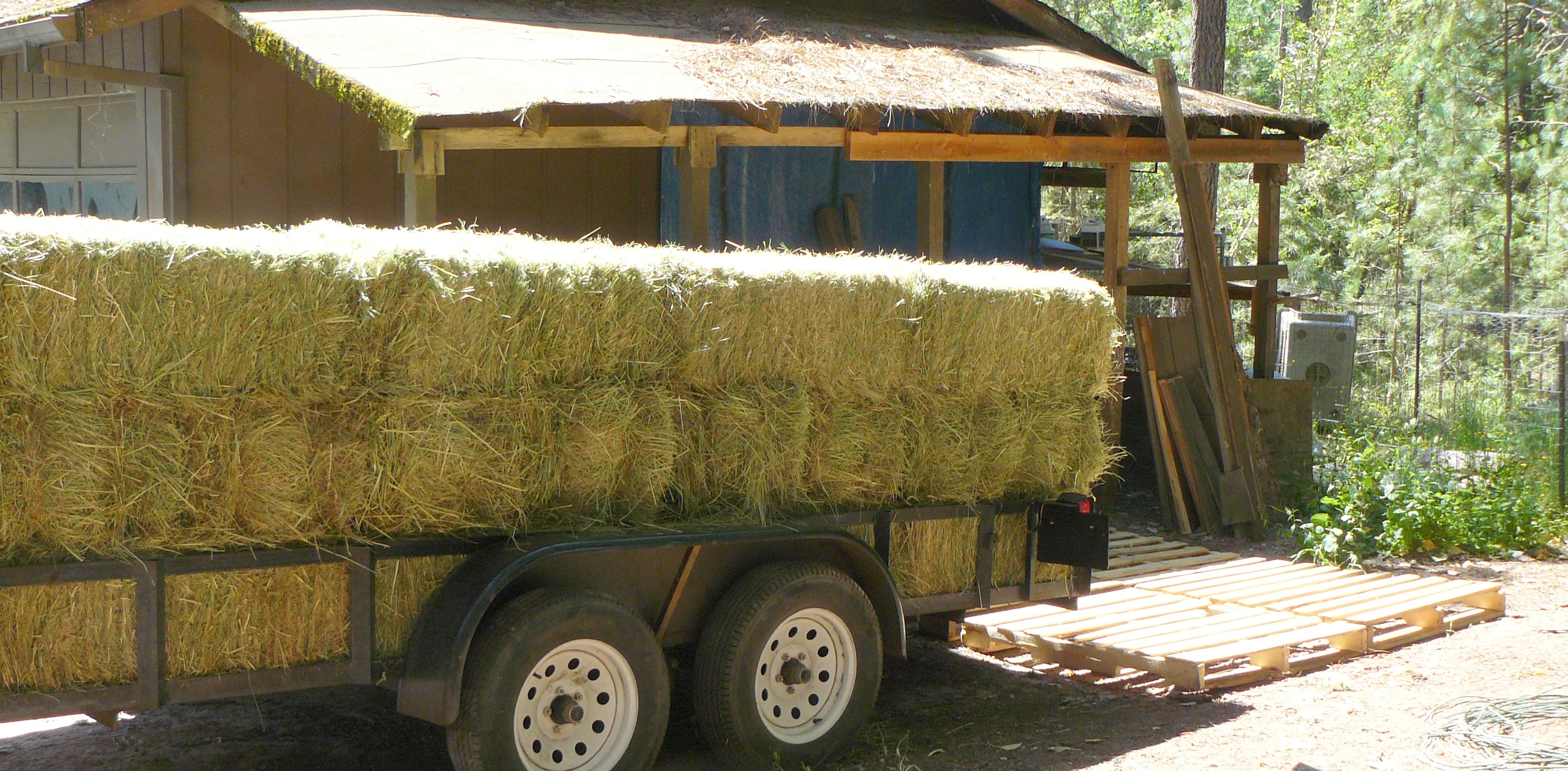
Then yesterday, around 2pm, we dropped everything to race up to a farmer at Wolf Creek, just a dozen miles North of us, to inspect some hay that was for sale. It was great quality and at $5 a bale the deal of the century. So by the time we had loaded up some bales onto the trailer and returned, unloaded them into the hay loft, organised a bigger trailer from neighbours Dordie and Bill, and I had recuperated under a shower, there was no time at all for today’s post.
Well that larger flatbed trailer was borrowed on Monday evening and early yesterday morning we set off again to Wolf Creek to purchase more bales of hay.
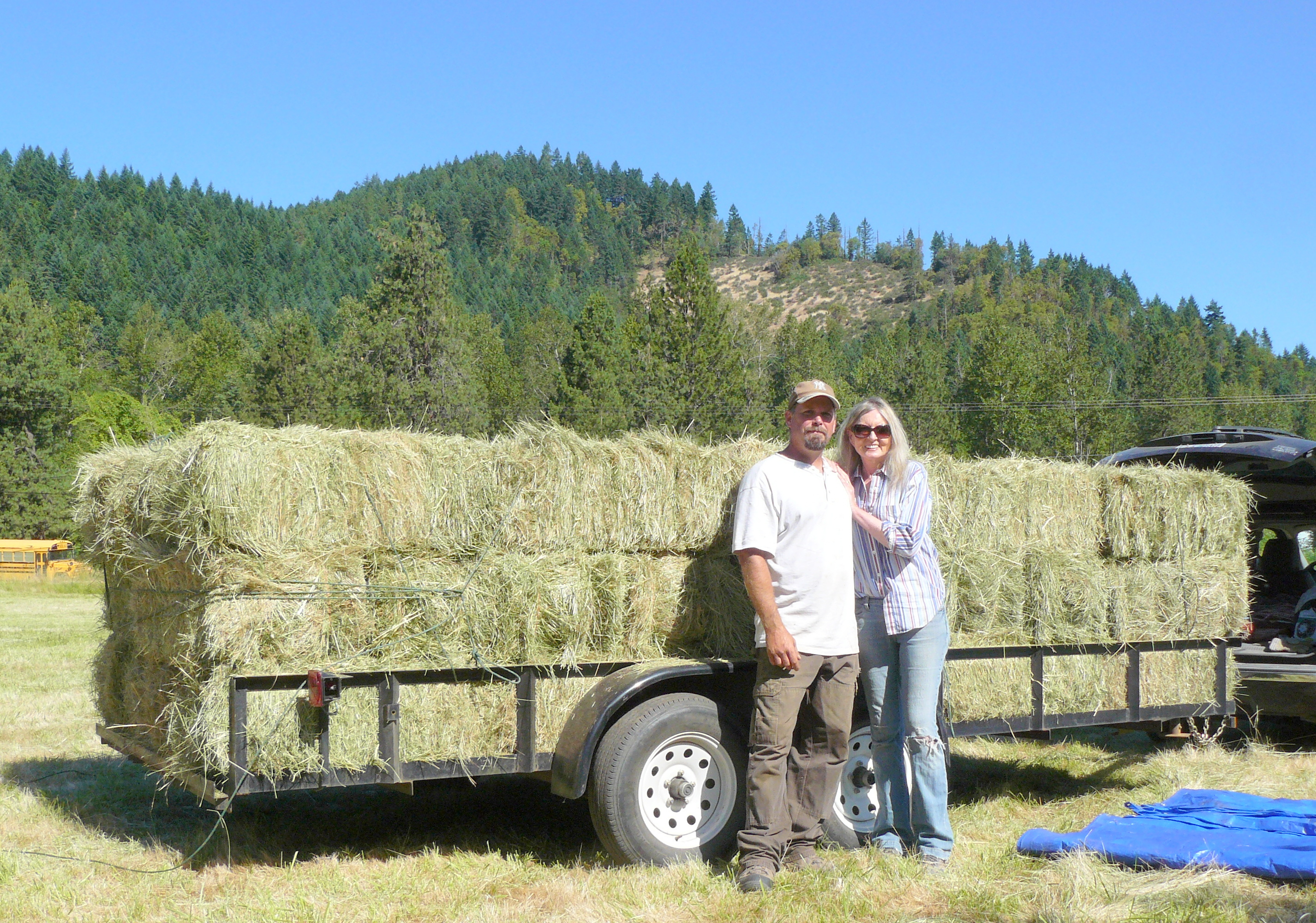
This time we had room for 60 bales, the equivalent of 4,200 lbs in weight. Each bale had to be lifted onto the trailer and stacked carefully.
But at last it was all done, great thanks to Robert who was up at Wolf Creek, and then it was time to head for home.
Jean thanking Robert for his great help in loading our 60 bales!
Impossible not to ignore the beautiful countryside that is so typical of this part of Southern Oregon. (Wolf Creek is less than 15 miles from home.)
The things we do for our horses!
Anyway, once back home somehow Jean and I managed to unload and stack all 60 bales, by which time my creative juices were no longer to be found.
Yesterday’s introduction to today’s essay was predominantly the film made by Rebecca Hosking investigating how to transform her family’s farm in Devon into a low-energy farm for the future. Rebecca discovering, unsurprisingly, that nature holds the key.
The film highlighted the degree to which our modern system of food production and distribution is dependent on oil. I am sure that Jean and I were far from alone in not fully appreciating just how much oil is used in agriculture. Let’s start with the UK.
Following the oil crisis in 1973, a book was published in 1978 by B.M. Green under the title of Eating Oil (1). In 2005, Norman Church wrote an essay over at the website 321energy.com in which he referred to that book. Here’s some of what he wrote.
The aim of the book [Eating Oil] was to investigate the extent to which food supply in industrialised countries relied on fossil fuels. In the summer of 2000 the degree of dependence on oil in the UK food system was demonstrated once again when protestors blockaded oil refineries and fuel distribution depots. The fuel crises disrupted the distribution of food and industry leaders warned that their stores would be out of food within days. The lessons of 1973 have not been heeded.
Today the food system is even more reliant on cheap crude oil. Virtually all of the processes in the modern food system are now dependent upon this finite resource, which is nearing its depletion phase.
The article is a ‘must-read’ for anyone who wants to understand better the approaching crisis and the madness of present behaviours. Take this, for example (my emphasis):
One indicator of the unsustainability of the contemporary food system is the ratio of energy outputs – the energy content of a food product (calories) – to the energy inputs.
The latter is all the energy consumed in producing, processing, packaging and distributing that product. The energy ratio (energy out/energy in) in agriculture has decreased from being close to 100 for traditional pre-industrial societies to less than 1 in most cases in the present food system, as energy inputs, mainly in the form of fossil fuels, have gradually increased.
However, transport energy consumption is also significant, and if included in these ratios would mean that the ratio would decrease further. For example, when iceberg lettuce is imported to the UK from the USA by plane, the energy ratio is only 0.00786. In other words 127 calories of energy (aviation fuel) are needed to transport 1 calorie of lettuce across the Atlantic. If the energy consumed during lettuce cultivation, packaging, refrigeration, distribution in the UK and shopping by car was included, the energy needed would be even higher. Similarly, 97 calories of transport energy are needed to import 1 calorie of asparagus by plane from Chile, and 66 units of energy are consumed when flying 1 unit of carrot energy from South Africa.
Just how energy inefficient the food system is can be seen in the crazy case of the Swedish tomato ketchup. Researchers at the Swedish Institute for Food and Biotechnology analysed the production of tomato ketchup (2). The study considered the production of inputs to agriculture, tomato cultivation and conversion to tomato paste (in Italy), the processing and packaging of the paste and other ingredients into tomato ketchup in Sweden and the retail and storage of the final product. All this involved more than 52 transport and process stages.
References:
1: Green, B. M., 1978. Eating Oil – Energy Use in Food Production. Westview Press, Boulder, CO. 1978.
2: Andersson, K. Ohlsson, P and Olsson, P. 1996, Life Cycle Assessment of Tomato Ketchup. The Swedish Institute for Food and Biotechnology, Gothenburg.
But, surprise, surprise, it’s no different here in the USA!
The miracle of the Green Revolution was made possible by cheap fossil fuels to supply crops with artificial fertilizer, pesticides, and irrigation. Estimates of the net energy balance of agriculture in the United States show that ten calories of hydrocarbon energy are required to produce one calorie of food. Such an imbalance cannot continue in a world of diminishing hydrocarbon resources.
References:
1: Dale Allen Pfeiffer is a geologist and writer from Michigan, U.S. who has investigated and written about energy depletion and potential future resource wars.
Over at The Wolf at the Door British website (1) author Paul Thompson, another Devonian, offered this article about peak oil and farming (and 1 hectare is 2.47 acres):
AGRICULTURE
When we think of the problems associated with peak oil, our first thoughts may turn to transport, electricity, or plastics. The use that tends not to come to mind, yet could be the most devastating of them all, is agriculture.
The Diesel Farm
Tractor Oil and gas are essential to modern farming. The most obvious use is to run the tractors and machines. Car drivers can switch to public transport, lorries can move their goods (partially, at least) to railways, but the only option for a tractor or combine harvester is a horse or an ox. Clearly modern agriculture could not switch to an animal-power-based system and hope to continue with modern yields. A tractor can plough in an hour an area that a horse would take a day to (0.9–1 hectare). The horse also needs more skill and you have to put aside some of your crop to feed it. Imagine trying to gather the harvests of the vast fields of maize and wheat of the USA using only horse- and human-power.
But diesel is only one of the uses for oil and gas. Another, possibly more important use, is petrochemicals.
Petrochemicals
Nitrogen is one of the most important elements in fertilisers. In the most common method, the Haber-Bosch process, hydrogen is combined with nitrogen to form ammonia. It requires high temperatures and strong atmospheric pressure, therefore a great deal of energy. The nitrogen is taken from the atmosphere while the hydrogen is obtained from natural gas. The process became economical in the 1920s and since then, fertilisers have become indispensable. Worldwide use of commercial fertiliser more than doubled between the late 1960s and early 1980s.
The use of fertilisers allows farmers to grow the same crops each year, rather than rotating (previously farmers planted fields with legumes that restored nitrogen to the soil.)
Oil and gas are also used in the production of many herbicides and pesticides.
References:
1: There is a note from Paul on the home page, “I created this site several years ago and do not have the time any longer to keep it updated. Therefore you will find that the data is only relevant up to around 2006 and some of the links will no longer be correct. However the principles of peak oil still apply and I have left the site online as a useful introduction to the problem that hasn’t gone away.”
Alright! That’s enough to upset anyone!
Thankfully, there are a number of positive moves going on all over the world and tomorrow I will conclude the essay with details of those positive happenings!






 Learning from Dogs