Category: Food

Yet another dog food alert

This came in yesterday.

The Food and Drug Administration has named 16 dog food brands with an increased risk of a type of canine heart disease known as dilated cardiomyopathy… or DCM.

To learn which dog food brands are affected and 8 things you can do right now to lower your dog’s risk, please visit the following link:FDA Investigating Possible Link Between Diet and Heart Disease in Dogs

Important Best Dry Dog Foods Update

We’ve recently updated our Best Dry Dog Foods page to reflect the FDA’s latest report. Here are 5 of The Advisor’s Top 20 Best Dry Dog Foods for July 2019.

  • Wellness Complete Health Dog Food
  • Victor Hi-Pro Plus Formula
  • Nulo Freestyle Dog Food
  • Eagle Pack Natural Dog Food
  • Canidae Grain-Free Pure

Please be sure to share the news of this alert with other pet owners.

Mike Sagman, Editor
The Dog Food Advisor

Now if one goes to that first link then you will read the following.

ooOOoo

FDA Investigating Potential Link Between Diet and Heart Disease in Dogs

This Report Has Been Updated

June 27, 2019 — The FDA has published its third status report regarding a potential connection between grain-free diets and a type of heart disease in dogs known as dilated cardiomyopathy… or DCM.

The Dog Food Advisor initially alerted readers about this issue on July 12, 2018, the day it was first announced by the FDA… and continues to update this report on an ongoing basis.

About DCM

DCM is a disease of a dog’s heart muscle that results in weakened contractions and poor pumping ability…

Which can lead to an enlarged heart and congestive heart failure.

Even death.

Which Breeds Are Affected?

Although the root cause of DCM remains unknown

And even though initially the condition appeared to be more common in certain breeds…

The FDA has received reports of DCM in a wide range of breeds, including many not genetically prone to the disease.
Likely Linked to Diet

Since announcing its investigation in July 2018…

FDA researchers have observed that most of these DCM cases were associated with animals eating dry dog foods.

However…

Dogs eating raw, semi-moist, and wet diets were also affected.
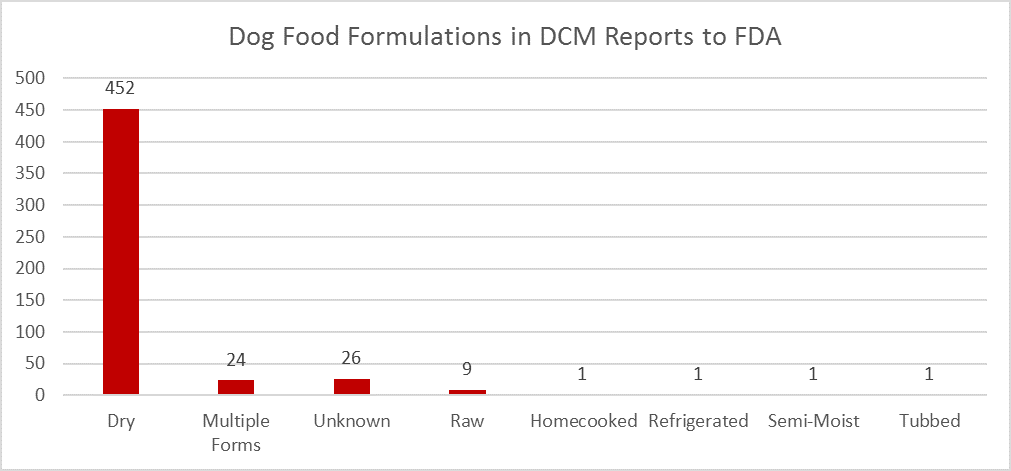
What Types of Dog Food?

Researchers found that over 90 percent of the reported recipes were grain-free.

And that…

Most of these animals ate diets that appeared to contain high concentrations of peas, chickpeas, lentils… or various types of potatoes.

Yet some dogs consumed diets that contained grain, too.

Which Brands?

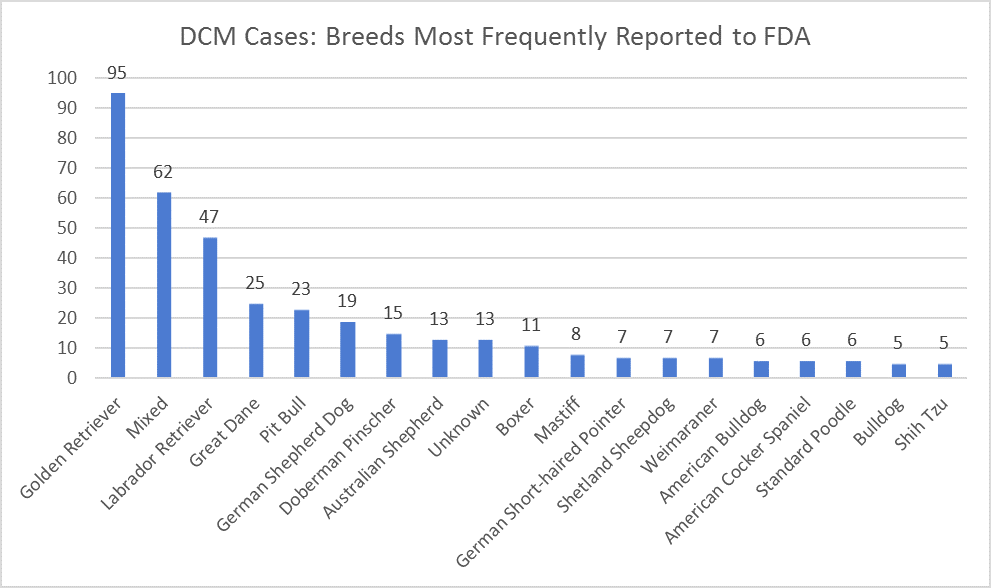
Brands named most frequently in these reports are depicted in the following FDA graphic…
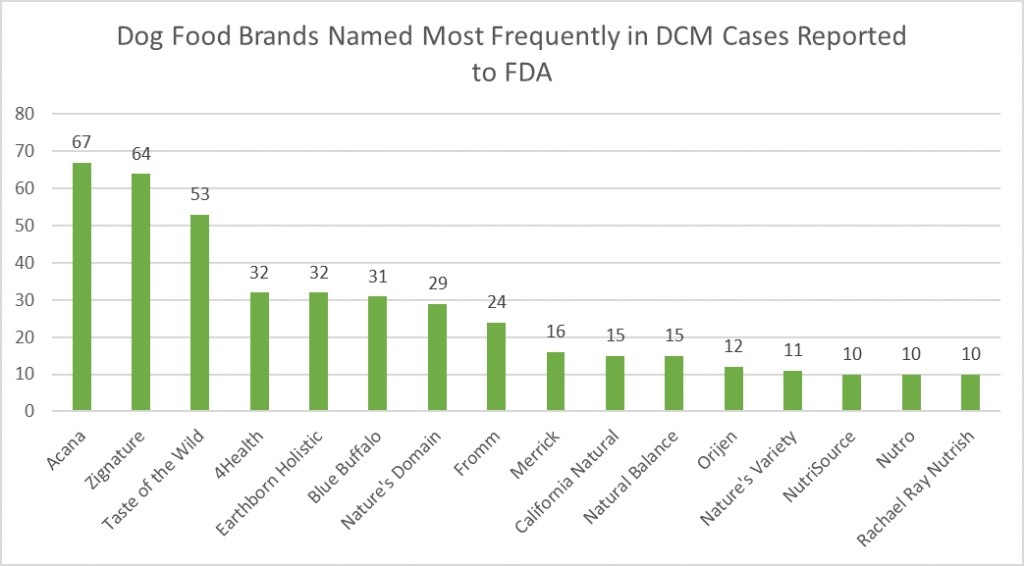
The FDA reminds readers…

“It’s important to note that the reports include dogs that have eaten grain-free and grain containing foods and also include vegetarian or vegan formulations. They also include all forms of diets: kibble, canned, raw and home-cooked.

“Therefore, we do not think these cases can be explained simply by whether or not they contain grains, or by brand or manufacturer.

The Agency goes on to assure dog owners…

“To put this issue into proper context, the American Veterinary Medical Association estimates that there are 77 million pet dogs in the United States.

“As of April 30, 2019, the FDA has received reports about 560 dogs diagnosed with DCM suspected to be linked to diet. Tens of millions of dogs have been eating dog food without developing DCM.”

The FDA also makes the following logical observation

The prevalence of reports in dogs eating a grain-free diet might correlate also to market share: these products have become exceedingly popular over the last several years.

Which would certainly explain the higher number of DCM cases associated with these same brands.

What’s the Cause?

Based on its latest update…

The FDA has still not discovered why certain dog foods may be associated with the development of DCM. In fact, the Agency now believes the connection between diet and DCM is a complex scientific issue involving multiple factors.

Still…

Even though it’s not clear exactly what it is about these diets that may be connected to DCM in dogs, there are a number of possible causes.

For example…

Taurine deficiency is a well-documented, potential cause of some cases of DCM. Yet it’s not likely to be the only cause.

In fact…

According to Dr. Lisa Freeman, a veterinary nutritionist at Tufts University, “most dogs being diagnosed with DCM do not have low taurine levels”.

Which means…

It’s not reasonable to assume a taurine deficiency is the definitive cause of DCM.

The One Common Thread

According to the FDA, researchers have uncovered one dietary feature common to a large number of DCM cases…

“The common thread appears to be legumes, pulses (seeds of legumes), and/or potatoes as main ingredients in the food. This also includes protein, starch and fiber derivatives of these ingredients…

“Some reports… indicate that the pets were not eating any other foods for several months to years prior to exhibiting signs of DCM.

Editor’s comment: As previously noted, most of these animals appeared to eat diets that contain high concentrations of plant-based protein “boosters”. These include items like pea protein, dried peas, and potato protein. Or a number of legumes (ingredient splitting) located near the top of the ingredients list.

8 Things You Can Do Right Now to Lower Your Dog’s Risk

Until the FDA completes its study and releases its final report…

The Dog Food Advisor believes it makes good sense to apply science and logic to all your feeding decisions.

So, consider these commonsense tips

  1. Since vegetable protein tends to be incomplete (deficient in certain essential amino acids needed by a dog to sustain life), avoid brands that derive most of their protein from legumes and other plant-based protein boosters
  2. Don’t avoid any brand just because it contains peas, legumes or potatoes. In reasonable amounts, studies have not found these ingredients to be toxic
  3. Avoid brands that list pea protein, potato protein, or other plant-based protein concentrates among their first few ingredients
  4. Avoid brands that use the deceptive practice of ingredient splitting to hide the fact their recipes are dominated by non-meat components… like corn, rice or legumes
  5. Consider switching your dog to a quality grain-inclusive product
  6. Focus on the recipe. Not the brand. To satisfy consumer demand, companies sometimes replace the meat in certain products with cheaper plant-based alternatives. Yet they still offer other recipes with superior, meat-rich designs
  7. Don’t put all your eggs in one basket. Diversify. Since no dog food can ever be perfect, consider using diet rotation to lower the risk of endlessly feeding your pet the same imperfect product
  8. Need help? Consider switching your dog’s current diet to one of the many found on our best dog foods lists

What We’re Doing to Help

Since the FDA’s latest status report was published on June 27, 2019, The Dog Food Advisor research team has been working on 3 important projects

  1. We’re updating all our Best Dog Foods lists to reflect the FDA’s latest findings. This process is tedious and time-consuming. So, please allow up to 3 weeks
  2. We’re revisiting all our grain-free dog food reviews and making changes (when appropriate). You can expect most recipes to retain their current ratings while others will be lowered by up to 1-star
  3. We’re creating a list of “Best Dog Foods with Grain” to help pet parents find a sensible alternative to grain-free diets

There are hundreds of painstakingly prepared reviews and lists that need to be manually edited. You should expect this total project to take months to complete.

The Bottom Line

Final results are still not available.

And there’s no way to know how long the FDA’s investigation will take. Yet the Agency is hopeful that as more data becomes known, its scientists will gain a better understanding of the possible connection between diet and DCM.

Until we know the answer…

Be patient.

Don’t overreact.

And don’t be frightened by all the well-meaning yet misguided advice you’ll surely encounter on the Internet.

Even from uninformed professionals.

Base your feeding decisions on facts and science.

Including accurate label analysis.

Keep in mind…

The Dog Food Advisor has never favored any recipe just because it’s grain free.

Nor should you.

Instead…

Our ratings are heavily weighted in favor of our estimate of each recipe’s apparent meat content.

In fact…

Ratings are automatically reduced anytime we find excessive amounts plant-based protein “boosters” (like peas, legumes or non-meat protein concentrates) too close to the top of any ingredients list.

Finally…

Many of the very best dog foods on the market are grain free…

And they’re made by some of the most respected companies in the USA and Canada.

We’re confident the industry will quickly adapt its recipes to any decisive conclusions reached by the FDA’s future findings.

And of course, we’ll make any relevant adjustments to our content as needed to reflect these scientific findings (once they become available).

In the meantime…

Our Very Best Advice

Since there’s no such thing as a perfect dog food

And because built-in flaws tend to be magnified when the same food is fed endlessly… day after day for a lifetime.

You may wish to consider diet rotation when feeding your pet.

Most importantly…

Stay informed.

Keep in mind…

We can update you the moment the FDA releases its findings.

Get free dog food recall alerts sent to you by email. Subscribe to The Dog Food Advisor’s emergency recall notification system.


Protect Your Dog

Get Free Dog Food Recall Alerts
Sent to You by Email
Click Here to Sign Up Now


Reflections on the future

Father’s Day ….

….. was OK in the morning but for some reason I was in a dark mood in the afternoon.

(And if you want to skip today’s post I don’t blame you at all. This is not my usual style albeit it is important.)

I was reflecting on the state of the world. Global population was well in excess of seven billion people. The longevity of those people was increasing. That’s good news. The health standards were increasing. That’s also good news.

However, the pressure on farming is intense. More and more land is required. The natural world is under supreme pressure. Extinction rates of many natural species are soaring.

Planet Earth has far too many people!

OK, maybe in time the population level will come down but right now it is too high.

Then in came Tom Engelhardt’s latest essay. I read it and reflected. Is it too dark to post? Then Jeannie said that if you really want to share it then publish it.

Here it is, published with Tom’s kind permission.

ooOOoo

Tomgram: Engelhardt, Trump Change

Posted by Tom Engelhardt at 4:23pm, June 16, 2019.
Follow TomDispatch on Twitter @TomDispatch.

If Donald Trump Is the Symptom…
Then What’s the Disease?

By Tom Engelhardt
Don’t try to deny it! The political temperature of this country is rising fast. Call it Trump change or Trump warming, if you want, but grasp one thing: increasingly, you’re in a different land and, whatever happens to Donald Trump, the results down the line are likely to be ever less pretty. Trump change isn’t just an American phenomenon, it’s distinctly global. After all, from Australia to India, the Philippines to Hungary, Donald Trumps and their supporters keep getting elected or reelected and, according to a recent CNN poll, a majority of Americans think Trump himself will win again in 2020 (though, at the moment, battleground-state polls look grim for him).

Still, whether or not he gets a second term in the White House, he only seems like the problem, partially because no president, no politician, no one in history has ever gotten such 24/7 media coverage of every twitch, tweet, bizarre statement, falsehood, or fantasy he expresses (or even the clothes he wears). Think of it this way: we’re in a moment in which the only thing the media can’t imagine saying about Donald Trump is: “You’re fired!” And believe me, that’s just one sign of a media — and a country — with a temperature that’s anything but 98.6.

Since you-know-who is always there, always being discussed, always @(un)realdonaldtrump, it’s easy enough to imagine that everything that’s going wrong — or, if you happen to be part of his famed base, right (even if that right isn’t so damned hot for you) — is due to him. When we’re gripped by such thinking and the temperature’s rising, it hardly matters that just about everything he’s “done” actually preceded him. That includes favoring the 1%, deporting record numbers of illegal immigrants, and making war (unsuccessfully) or threatening to do so across significant parts of the planet.

Here, then, is the question of the day, the sort you’d ask about any patient with a rising temperature: If Donald Trump is only the symptom, what’s the disease?

Blowback Central

Let me say that the late Chalmers Johnson would have understood President Trump perfectly. The Donald clearly arrived on the scene as blowback — the CIA term of tradecraft Johnson first put into our everyday vocabulary — from at least two things: an American imperium gone wrong with its never-ending wars, ever-rising military budgets, and ever-expanding national security state, and a new “gilded age” in which three men (Bill Gates, Jeff Bezos, and Warren Buffett) have more wealth than the bottom half of society and the .01% have one of their own, a billionaire, in the Oval Office. (If you want to add a third blowback factor, try a media turned upside down by new ways of communicating and increasingly desperate to glue eyes to screens as ad revenues, budgets, and staffs shrank and the talking heads of cable news multiplied.)

Now, I don’t mean to sell Donald Trump short in any way. Give that former reality TV star credit. Unlike either Hillary Clinton or any of his Republican opponents in the 2016 election campaign, he sensed that there were voters in profusion in the American heartland who felt that things were not going well and were eager for a candidate just like the one he was ready to become. (There were, of course, other natural audiences for a disruptive, self-promoting billionaire as well, including various millionaires and billionaires ready to support him, the Russians, the Saudis… well, you know the list). His skill, however, never lay in what he could actually do (mainly, in these years, cut taxes for the wealthy, impose tariffs, and tweet his head off). It lay in his ability to catch the blowback mood of that moment in a single slogan — Make America Great Again, or MAGA — that he trademarked in November 2012, only days after Mitt Romney lost his bid for the presidency to Barack Obama.

Yes, four years later in the 2016 election, others began to notice the impact of that slogan. You couldn’t miss the multiplying MAGA hats, after all. Hillary Clinton’s advisers even briefly came up with the lamest response imaginable to it: Make America Whole Again, or MAWA. But what few at the time really noted was the crucial word in that phrase: “again.” Politically speaking, that single blowback word might then have been the most daring in the English language. In 2016, Donald Trump functionally said what no other candidate or politician of any significance in America dared to say: that the United States was no longer the greatest, most indispensable, most exceptionable nation or superpower or hyper-power ever to exist on Planet Earth.

That represented a groundbreaking recognition of reality. At the time, it didn’t matter whether you were Barack Obama, Hillary Clinton, or Marco Rubio, you had to acknowledge some version of that formula of exceptionalism. Trump didn’t and, believe me, that rang a bell in the American heartland, where lots of people had felt, however indirectly, the blowback from all those years of taxpayer-funded fruitless war, while not benefitting from infrastructure building or much of anything else. They experienced blowback from a country in which new billionaires were constantly being created, while the financial distance between CEO salaries and those of workers grew exponentially vaster by the year, and the financing of the political system became a 1% affair.

With that slogan, The Donald caught the spirit of a moment in which both imperial and economic decline, however unacknowledged by the Washington political elite, had indeed begun. In the process, as I wrote at that time, he crossed a psychologically taboo line and became America’s first declinist candidate for president. MAGA captured a feeling already at large that tomorrow would be worse than today, which was already worse than yesterday. As it turned out, it mattered not at all that the billionaire conman spouting that trademarked phrase had long been part of the problem, not the solution.

He caught the essence of the moment, in other words, but certainly didn’t faintly cause it in the years when he financed Trump Tower, watched his five Atlantic City casinos go bankrupt, and hosted The Apprentice. In that election campaign, he captured a previously forbidden reality of the twenty-first century. For example, I was already writing this in June 2016, five months before he was elected president:

“In its halcyon days, Washington could overthrow governments, install Shahs or other rulers, do more or less what it wanted across significant parts of the globe and reap rewards, while (as in the case of Iran) not paying any price, blowback-style, for decades, if at all. That was imperial power in the blaze of the noonday sun. These days, in case you hadn’t noticed, blowback for our imperial actions seems to arrive as if by high-speed rail (of which by the way, the greatest power on the planet has yet to build a single mile, if you want a quick measure of decline).

“Despite having a more massive, technologically advanced, and better funded military than any other power or even group of powers on the planet, in the last decade and a half of constant war across the Greater Middle East and parts of Africa, the U.S. has won nothing, nada, zilch. Its unending wars have, in fact, led nowhere in a world growing more chaotic by the second.”

Mind you, three years later the United States remains a staggeringly powerful imperial force, with hundreds of military bases still scattered across the globe, while its economic clout — its corporations control about half the planet’s wealth — similarly remains beyond compare. Yet, even in 2016, it shouldn’t have been hard to see that the American Century was indeed ending well before its 100 years were up. It shouldn’t have been hard to grasp, as Donald Trump intuitively did, that this country, however powerful, was already both a declining empire — thank you, George W. Bush for invading Iraq! Mission Accomplished! — and a declining economic system (both of which still looked great indeed, if you happened to be profiting from them). That intuition and that slogan gave Trump his moment in… well, dare I call it “the afternoon sun”? They made him president.

MTPGA

In a sense, all of this should have been expectable enough. Despite the oddity of Donald Trump himself, there was little new in it, even for the imperial power that its enthusiasts once thought stood at “the end of history.” You don’t need to look far, after all, for evidence of the decline of empires. You don’t even have to think back to the implosion of the Soviet Union in 1991, almost three decades ago in what now seems like the Stone Age. (Admittedly, Russian President Vladimir Putin, a brilliant imagineer, has brought back a facsimile of the old Soviet Union, even if, in reality, Russia is now a rickety, fraying petro-state.)

Just take a glance across the Atlantic at Great Britain at this moment. And imagine that three-quarters of a century ago, that modest-sized island nation still controlled all of India, colonies across the planet, and an impressive military and colonial service. Go back even further and you’ll find yourself in a time when it was the true superpower of planet Earth. What a force it was — industrially, militarily, colonially — until, of course, it wasn’t.

If you happen to be looking for imperial lessons, you could perhaps say that some empires end not with a bang but with a Brexit. Despite all the pomp and circumstance (tweeting and insults) during the visit of the Trump royal family (Donald, Melania, Ivanka, Jared, Donald Jr., Eric, and Tiffany) to the British royals, led by a queen who, at 93, can remember better days, here’s something hard to deny: with Brexit (no matter how it turns out), the Earth’s former superpower has landed in the sub-basement of history. Great Britain? Obviously that adjective has to change.

In the meantime, across the planet, China, another once great imperial power, perhaps the greatest in the long history of this planet, is clearly on the rise again from another kind of sub-basement. That, in turn, is deeply worrying the leadership, civilian and military, of the planet’s “lone superpower.” Its president, in response, is wielding his weapon of choice — tariffs — while the U.S. military prepares for an almost unimaginable future war with that upstart nation, possibly starting in the South China Sea.

Meanwhile, the still-dominant power on the planet is, however incrementally, heading down. It’s nowhere near that sub-basement, of course — anything but. It’s still a rich, immensely powerful land. Its unsuccessful wars, however, go on without surcease, the political temperature rises, and democratic institutions continue to fray — all of which began well before Donald Trump entered the Oval Office and, in fact, helped ensure that he would make it there in the first place.

And yet none of this, not even imperial decline itself, quite captures the “disease” of which The Donald is now such an obvious symptom. After all, while the rise and fall of imperial powers has been an essential part of history, the planetary context for that process is now changing in an unprecedented way. And that’s not just because, since the 1945 atomic bombings of Hiroshima and Nagasaki, growing numbers of countries have come to possess the power to take the planet down in a cataclysm of fire and ice (as in nuclear winter). It’s also because history, as we’ve known it, including the rise and fall of empires, is now, in a sense, melting away.

Trump change, the rising political temperature stirred by the growing populist right, is taking place in the context of (and, worse yet, aiding and abetting) record global temperatures, the melting of ice across the planet, the rise of sea levels and the future drowning of coastlines (and cities), the creation of yet more refugees, the increasing fierceness of fires and droughts, and the intensification of storms. In the midst of it all, an almost unimaginable wave of extinctions is occurring, with a possible million plant and animal species, some crucial to human existence, already on the verge of departure.

Never before in history has the rise and decline of imperial powers taken place in the context of the decline of the planet itself. Try, for instance, to imagine what a “risen” China will look like in an age in which one of its most populous regions, the north China plain, may by century’s end be next to uninhabitable, given the killing heat waves of the future.

In the context of both Trump change and climate change, we’re obviously still awaiting our true transformative president, the one who is not a symptom of decline, but a factor in trying to right this country and the Earth before it’s too late. You know, the one who will take as his or her slogan, MTPGA (Make The Planet Great Again).

Tom Engelhardt is a co-founder of the American Empire Project and the author of a history of the Cold War, The End of Victory Culture. He runs TomDispatch.com and is a fellow of the Type Media Center. His sixth and latest book is A Nation Unmade by War (Dispatch Books).

Follow TomDispatch on Twitter and join us on Facebook. Check out the newest Dispatch Books, John Feffer’s new dystopian novel (the second in the Splinterlands series) Frostlands,Beverly Gologorsky’s novel Every Body Has a Story, and Tom Engelhardt’s A Nation Unmade by War, as well as Alfred McCoy’s In the Shadows of the American Century: The Rise and Decline of U.S. Global Power and John Dower’s The Violent American Century: War and Terror Since World War II.

Copyright 2019 Tom Engelhardt

ooOOoo

I’m 74. I don’t know how long I’ve got.

Part of me wants to live for a long time. That’s why I am vegan and trying to stay as fit as I can. (I’m also aware that Jeannie’s Parkinson’s Disease is a terminal disease and that in the latter stages she will need me to look after her.)

But then again I’m not sure I want to live in a world that continues to degrade especially continues to degrade in natural ways.

What’s the answer?

What do others who are on or around my age think about it?

What is the disease?

When did we come together?

A cache of animal bones 11,500 years old suggests an answer.

Brigit Katz of The Smithsonian wrote an article in January that revealed that dogs and humans hunted together many thousands of years ago.

Here it is:

ooOOoo

Humans and Dogs May Have Hunted Together in Prehistoric Jordan

Bones at a settlement called Shubayqa 6 show clear signs of having been digested—but were much too large to have been eaten by humans

Selection of gazelle bones from Space 3 at Shubayqa 6 displaying evidence for having been in the digestive tract of a carnivore. ( Credit: University of Copenhagen)

By Brigit Katz
SMITHSONIAN.COM
JANUARY 17, 2019

When and where dogs came to be domesticated is a subject of scientific debate, but there is a wealth of research that attests to the long, intertwined history of humans and their best animal buddies. One theory about the early origins of this relationship posits that dogs were used to help early humans hunt. And, as Ruth Schuster reports for Haaretz, a new study suggests that this may have been the case among prehistoric peoples of what is now Jordan.

A team of archaeologists from the University of Copenhagen and University College London studied a cache of animal bones at an 11,500-year-old settlement called Shubayqa 6, which is classified as “Pre-Pottery Neolithic A,” or belonging to the first stage of Neolithic culture in the Levant. In the Journal of Anthropological Archaeology, the researchers write that they found bones from a canid species, though they could not identify which one because the remains were poorly preserved. They also unearthed the bones of other animals that had been butchered. But perhaps most intriguing were the bones of animals—like gazelle, for instance—that bore clear signs of having passed through a digestive tract.

These bones were too big for humans to have eaten, leading the researchers to surmise that they “must have been digested by dogs,” says lead study author Lisa Yeomans, a zooarchaeologist at the University of Copenhagen. And the researchers don’t think this was a case of wild carnivores sneaking into the settlement to grab a bite.

For one, archaeological evidence indicates that Shubayqa 6 was occupied year-round, suggesting that “dogs were allowed to freely roam around the site picking over the discarded waste, but also defecating in the vicinity of where humans were inhabiting,” the study authors write.

There was also a noticeable surge in hare bones around the time that dogs started to appear at the site, and the researchers think this may be because the dogs were helping humans hunt small prey. Previously, the people of Shubayqa 6 might have relied on tools like netting to catch hares and other animals, says Yeomans, but it wouldn’t have been very effective. Dogs, on the other hand, could selectively target elusive prey.

Humans and dogs thus appear to have forged a reciprocal relationship in Jordan more than 11,000 years ago. There is in fact evidence to suggest that dogs were domesticated by humans in the Near East as early as 14,000 years ago, and some of that evidence seems to point to dogs being used during hunts. Rock art from a site near Shubayqa, for instance, seems to show dogs driving gazelle into a trap.

In light of such archaeological finds, “it would be strange not to consider hunting aided by dogs as a likely explanation for the sudden abundance of smaller prey in the archaeological record,” Yeomans says. Among the ancient peoples of Jordan, in other words, the complex history of dog domestication may have been well underway.

ooOOoo

That scientific debate mentioned in the first line of the article has been published in this place before. But I’m going to republish it tomorrow as it so perfectly goes with today’s post.

Hill’s Prescription Diet Recall

Please take note.

ooOOoo

Hill’s Prescription Diet and Science Diet Dog Food Recall Expands to Include 44 Varieties

Recall Updated 5/22/2019

March 20, 2019 — Hill’s Pet Nutrition is expanding its voluntary recall of canned dog food products due to elevated levels of vitamin D.

This recall expansion relates to the same vitamin premix that led to the January 31 voluntary recall previously announced on The Dog Food Advisor website.

Update: Additional expansion announced by the FDA May 20, 2019.

Vitamin D, when consumed at very high levels, can lead to serious health issues in dogs including kidney dysfunction.

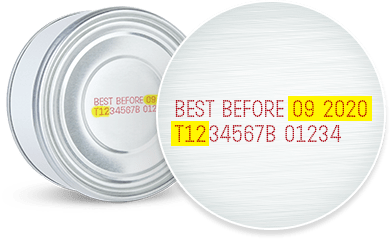
The following products and lot numbers are affected by the recall.

Items marked with * are new product SKUs that were added to the list on March 20, 2019. The item marked with ** is one additional lot code of recalled product updated on May 15, 2019.

Click here to view a text-based follow-up bulletin posted by the U.S. F.D.A. at a later date.

About Excessive Levels of Vitamin D

While vitamin D is an essential nutrient for dogs, ingestion of elevated levels can lead to potential health issues depending on the level of vitamin D and the length of exposure.

Dogs may exhibit symptoms such as vomiting, loss of appetite, increased thirst, increased urination, excessive drooling, and weight loss.

Pet parents with dogs who have consumed any of the products listed and are exhibiting any of these signs should contact their veterinarian.

In most cases, complete recovery is expected after discontinuation of feeding.

For More Complete Information

On March 21, 2019, the U.S. Food and Drug Administration published an announcement containing more complete information about this recall.

What to Do?

If your SKU, Date and Lot codes are found in the list above, you have an affected product.

You should stop feeding it and should return to the place of purchase for a full refund.

If you have questions, you may contact Hill’s Consumer Affairs at 800-445-5777.

U.S. citizens can report complaints about FDA-regulated pet food products by calling the consumer complaint coordinator in your area.

Or go to https://www.fda.gov/petfoodcomplaints.

Canadians can report any health or safety incidents related to the use of this product by filling out the Consumer Product Incident Report Form.

Get Dog Food Recall Alerts by Email

Get free dog food recall alerts sent to you by email. Subscribe to The Dog Food Advisor’s emergency recall notification system.

ooOOoo

Please, please read this and share it with your friends and colleagues who have dogs.

Guess what! Eating one’s vegetables is very good.

This article should be shared!

I wasn’t going to post a blog for today but in going through my emails found this from April 15th.

It’s nothing to do with dogs but everything to do with staying healthy.

ooOOoo

Eating Your Veggies Is a Better Way to Get Your Vitamins Than Taking Supplements, Study Shows

Vitamins in some supplements were actually harmful at high doses, while exceeding the daily nutritional limit in food didn’t show the same risk.

(barol16/istock)

By Jason Daley
smithsonian.com, April 15, 2019,
Dietary supplements, including daily vitamins, have been a part of life in the United States for decades. In fact, people spend $30 billion per year on various pills, powders, gummies and tinctures to help improve their health, boost their brain, lose weight, build muscle and strengthen their immune system.

But a new extensive study suggests many people may be better off spending all that disposable income at the farmer’s market or grocery store produce section to buy spinach, tomatoes and other vitamin-packed veggies instead, according to a paper published this week in the journal Annals of Internal Medicine.

Researchers analyzed data from 27,725 participants in the Centers for Disease Control’s National Health and Nutrition Examination Survey (NHANES). Each volunteer, all over the age of 20, logged what they ate for 24 hours and what supplements they took in the previous 30 days. The data was collected between 1999 and 2010.

Linda Carroll at NBC News reports that during the study’s six-year follow-up period, 3,613 participants died, including 945 from cardiovascular disease and 805 from cancer. Using that data, the study team found that getting enough vitamin K—found in leafy greens—and magnesium—found in legumes, nuts, whole grains, fish and meat—were associated with a lower mortality rate. Getting the recommended dose of vitamin K, zinc and vitamin A was linked to lower mortality rates associated with cardiovascular disease.

And it turned out that taking 1,000 milligrams of calcium per day in supplement form was associated with increased cancer risk, while getting excess calcium from food did not seem to increase those risks.

“Our results support the idea that, while supplement use contributes to an increased level of total nutrient intake, there are beneficial associations with nutrients from foods that aren’t seen with supplements,” Fang Fang Zhang of Tufts University, the study’s senior author, says in a statement. “This study also confirms the importance of identifying the nutrient source when evaluating mortality outcomes.”

At first glance, the data suggested that supplement users might have better outcomes than non-vitamin takers. But Beth Mole at Ars Technica reports that supplement users tend to be wealthier and more educated than non-users, smoke less, exercise more, and have an overall healthier diet. When those factors were accounted for, the benefits of supplements disappeared. (It’s possible that supplements are helpful for portions of the population that suffer from certain nutritional deficiencies.)

The study has some limitations. Mole reports that the NHANES data relies on participants self-reporting what they eat and what supplements they take, which means the data might not be entirely accurate. The study is observational, meaning any relationship between nutrients in food and certain diseases is merely an association and does not imply causation.

Still, the study’s overall message is that supplements are not a silver bullet for health.

“I don’t think you can undo the effect of a bad diet by taking supplements,” Rekha Kumar, an endocrinologist at NewYork-Presbyterian and Weill Cornell Medicine, who was not involved in the study tells NBC’s Carroll.

This isn’t the first study to question the power of nutritional supplements. A paper last year in the Journal of the American College of Cardiology found that using multivitamins did not provide any apparent benefits but did not cause any harm either.

In a 2017 paper, data from the Nurses’ Health Study, one of the longest and most comprehensive health studies conducted, suggested that multivitamin use did not decrease incidents of stroke.

In fact, taking some supplements have negative consequences. A 2011 study found that taking vitamin E, which was hypothesized to help prevent prostate cancer, actually increased the chances of developing the disease in men instead.

Zhang and her colleagues say that much more research needs to be undertaken to confirm and understand these findings since there are so many other factors that play a role in overall health.

ooOOoo

H’mmm. It would be a braver person than I to come off the range of supplements that I take. And we are vegan as well!

But very much not in the fountain of youth!


Dog Food Recall Update Report

I thought it would be useful to publish this.

Here is the text of an email that was received yesterday morning.

ooOOoo

Dear Fellow Dog Lover,

Because you signed up on our website, I’m sending you this recall update report. If you no longer wish to receive these emails, please click the “unsubscribe” link at the bottom of this message.
Over the past 60 days, the FDA has announced 2 dog food recalls:

  • Thogersen Family Farm recalled its raw frozen pet food due to contamination with Listeria bacteria (4/8/2019)
  • Hill’s Pet Nutrition recalled multiple lots of Prescription Diet and Science Diet wet dog foods due toxic levels of vitamin D(3/20/2019)

For details, please visit our Dog Food Recall Alerts Center.

Feeding Tip

Got a dog that’s 7 years… or older? Here are 5 of The Advisor’s Top 15 Best Senior Dog Foods for 2019:

  • Wellness Core Grain Free Senior Formula
  • Merrick Lil’ Plates Senior Dog Food
  • Purina Pro Plan Bright Mind Adult 7+
  • Diamond Naturals Senior Dog Food
  • Victor Senior Healthy Weight

Click here to see all 15 of The Dog Food Advisor’s top senior picks for May 2019.

Please feel free to share this recall update report with other dog lovers.

Mike Sagman, Editor
The Dog Food Advisor

P.S. Not already on our dog food recall notification list? Sign up to get critical dog food recall alerts by email. There’s no cost for this service. No spam. Cancel anytime.

ooOOoo

You are welcome to receive notifications via this web site but for a more reliable, long-term service then sign up to the email service.

Best wishes!

It’s time to change our habits.

Funny how things evolve!

A week ago I was casually reading a copy of our local newspaper, the Grants Pass Daily Courier, and inside was a piece by Kathleen Parker, a syndicated columnist, entitled It’s the end of everything – or not.

I found it particularly interesting especially a quotation in her piece by Robert Watson, a British chemist who served as the chair of the panel of the Intergovernmental Science-Policy Platform on Biodiversity and Ecosystem Services (IPBES). The IPBES had recently published the results of the three-year study by 145 authors from 50 countries.

So I wrote to Kathleen Parker asking if I might have permission to quote that excerpt and, in turn, received her permission to so do.

Here it is:

Robert Watson wrote in a statement that:

“the health of ecosystems on which we and all species depend is deteriorating more rapidly than ever. We are eroding the very foundation of our economies, livelihoods, food security, health and quality of life worldwide.”

But, Watson also said, it’s not too late to repair and sustain nature – if we act now in transformative ways.

It is time to change our habits both at an individual level and the level of countries working together.

Moreover we haven’t got decades. We have got to do it now!

Back to Coyotes!

Hunting, and not for food!

We hate hunting. Period.

It’s sort of alright when the person needs to hunt to stay alive. But in the Western world the incidence of that is pretty remote.

So when author Jim wrote about coyotes and hunting I had to share it with you (and, for the record, both Jean and I are atheists).  Published with Jim’s permission.

ooOOoo

The Incredible Coyote and Western Morality

How killing for fun is not only a Christian Right, but a value

By Jim, August 5th 2018.

Christian vulgarity has reigned it’s bullets down on the North American coyote for over 100 years. The longest standing extermination order in history has killed millions of coyotes and continues its bounty program in most states. Competitive hunts sponsored throughout the nation each year with cash prizes and trophies instill to our kids the right obligation to kill for fun.

“One morning in the late 1930s, the biologist Adolph Murie stood near a game trail in Yellowstone National Park and watched a passing coyote joyously toss a sprig of sagebrush in the air with its mouth, adroitly catch it, and repeat the act every few yards. At the time, Mr. Murie was conducting a federal study intended to prove, definitively, that the coyote was “the archpredator of our time.” But Mr. Murie, whose work ultimately exonerated the animals, was more impressed by that sprig-tossing — proof, he believed, of the joy a wild coyote took in being alive in the world” (1)

The majority of politicians have failed to address this with any passion, and being the good, high moral standard western value Christians that they are, continue the killing spree. A useless torture that drives the coyote without mercy and without effect. “Under persecution, the biologists argued, evolved colonizing mechanisms kicked in for coyotes. They have larger litters. If alpha females die, beta females breed. Pressured, they engage an adaptation called fission-fusion, with packs breaking up and pairs and individuals scattering to the winds and colonizing new areas. In full colonization mode, the scientists found, coyotes could withstand as much as a 70 percent yearly kill rate without suffering any decline in their total population”.

Hunters have their ultimate victim to hunt—one that can outbreed the continued onslaught. How fun is it? While the coyote is hunted for sport, they die in earnest. Leave them to experience their joy, and populations will mitigate in their own necessary way.

Christian values and morals once again are superior delayed in common decency and way off the mark—unless your talking killing for sport.

ooOOoo

I want to add a couple of comments that were left on the post:

Not many christians are bothered by this. Why should they, when you hear them quote from their holy book, that god commanded them to subdue the earth.

It is for this very reason that many christians are nonchalant when we talk about climate change

oooo

The price paid for pointlessly killing predators is a dear one. Moreover, all needless killing of animals is wrong, says the immoral, convinced atheist.

oooo

(to which Jim replied)

Part of the doctrine is to subdue and have dominion. To hell with inferior, soulless life. The ripple effect of what was once naturally flowing is tragic and painful.

Enough said!

Dog saved!

This was on the BBC News the other day!

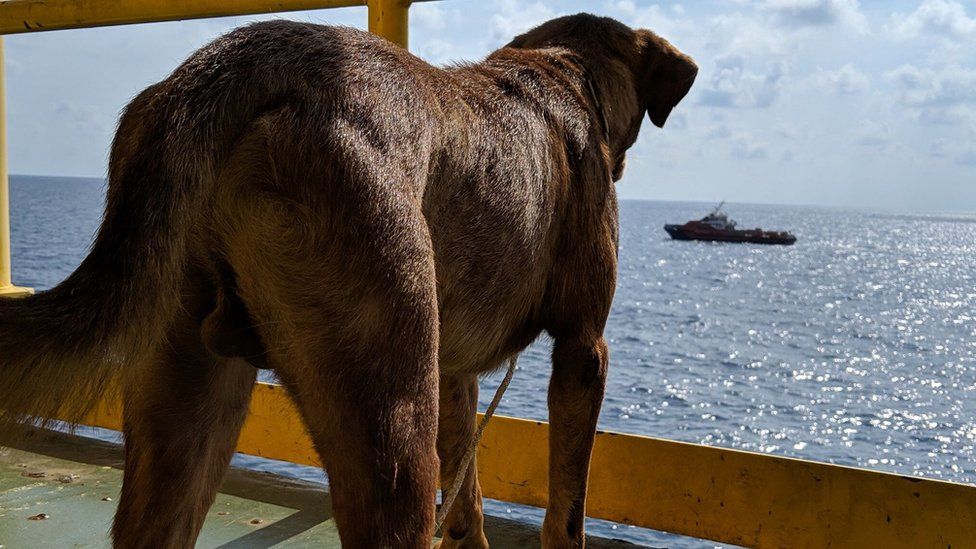
This remarkable story of a dog that was rescued some 200+ kilometres off the coast of Thailand was featured on the BBC news website.

It’s quite amazing and truly miraculous.

ooOOoo

Dog rescued 220km from Thai coast by rig workers

A dog discovered some 220km (135 miles) off the coast of Thailand has been rescued by a team of oil rig workers after the exhausted pooch was spotted paddling near a drilling platform.

The brown aspin swam towards the workers when they called out to him last Friday afternoon. He was then pulled to safety.

It is not clear how the dog became stranded so far out at sea. Some reports suggest he may have fallen from a fishing trawler.

The rig workers named the dog Boonrod, a Thai word that roughly translates as “the saved one” or “survivor”.

Boonrod was said to have been exhausted and in need of fresh drinking water and food.

He was nursed back to health on the rig while staff radioed for help, requesting the assistance of a tanker that was heading back to shore.

Boonrod had to have a proper wash to cleanse his fur of salt from the seawater. Afterwards, he had a nap.

The conditions were said to have been calm during the rescue, which workers said made it easier to spot Boonrod among the rusty metal bars of the rig.

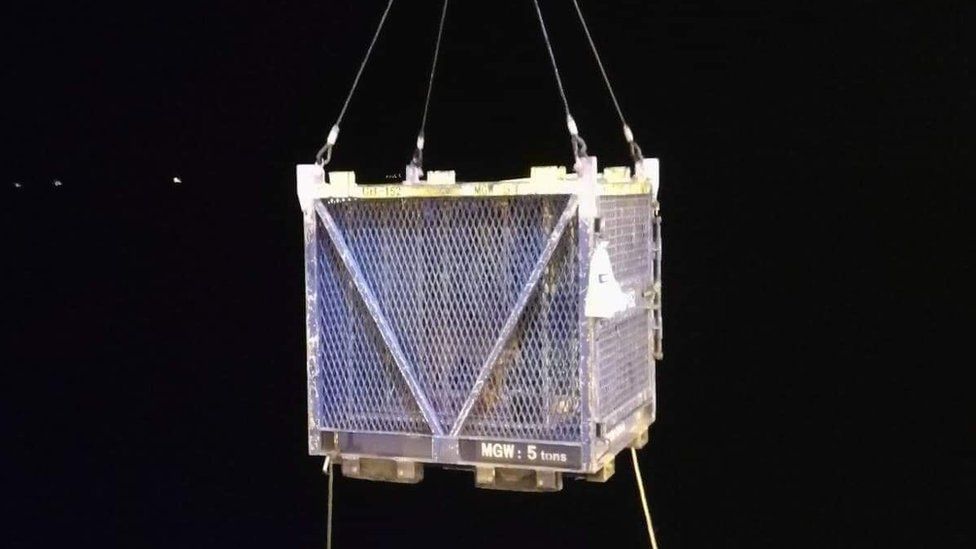
Boonrod was lifted by crane on to an oil vessel that was passing through the area on Sunday to be transported to a veterinary practice in southern Thailand.

The dog was said to have been in good spirits when he arrived on land to be taken to the vet.

(All images are copyright Viralpress.)

ooOOoo

The fact that this dog was rescued so far out to sea is incredible. Clearly, the poor dog had fallen off another vessel but the details of that incident are not known and it is purely conjecture.

But what is really important was that the dog was rescued and returned to health.

Burn Baby, Burn.

A rather depressing essay from Tom Englehardt.

The world is getting hotter. That’s a fact!

And no amount of stuffing one’s head under the pillow is going to change that fact.

We must take note of all the many articles and stories about the warming of the planet. Because we need to change the way we are responding. Not from climate change but to climate crisis.

I’m republishing a recent essay from Tom Engelhardt, with his permission, because he articulates perfectly where we are heading.

ooOOoo

Suicide Watch on Planet Earth

As the Flames Began to Rise, the Arsonists Appeared
By Tom Engelhardt, April 25th, 2019

As Notre Dame burned, as the flames leapt from its roof of ancient timbers, many of us watched in grim horror. Hour after hour, on screen after screen, channel after channel, you could see that 850-year-old cathedral, a visiting spot for 13 million people annually, being gutted, its roof timbers flaring into the evening sky, its steeple collapsing in a ball of fire. It was dramatic and deeply disturbing — and, of course, unwilling to be left out of any headline-making event, President Trump promptly tweeted his advice to the French authorities: “Perhaps flying water tankers could be used to put it out. Must act quickly!” No matter that water from such planes would probably have taken the cathedral’s towers down and endangered lives as well — “the equivalent,” according to a French fire chief, “of dropping three tons of concrete at 250 kilometers per hour [on] the ancient monument.”

Still, who could doubt that watching such a monument to the human endeavor being transformed into a shell of its former self was a reminder that everything human is mortal; that, whether in a single lifetime or 850 years, even the most ancient of our artifacts, like those in Iraq and Syria recently, will sooner or later be scourged by the equivalent of (or even quite literally by) fire and sword; that nothing truly lasts, even the most seemingly permanent of things like, until now, Notre Dame?

That cathedral in flames, unlike so much else in our moment (including you-know-who in his every waking moment), deserved the front-and-center media attention it got. Historically speaking, it was a burning event of the first order. Still, it’s strange that the most unnerving, deeply terrifying burning underway today, not of that ancient place of worship that lived with humanity for so many tumultuous centuries but of the planet itself, remains largely in the background.

When the cathedral in which Napoleon briefly crowned himself emperor seemed likely to collapse, it was certifiably an event of headline importance. When, however, the cathedral (if you care to think of it that way) in which humanity has been nurtured all these tens of thousands of years, on which we spread, developed, and became what we are today — I mean, of course, the planet itself — is in danger of an unprecedented sort from fires we continue to set, that’s hardly news at all. It’s largely relegated to the back pages of our attention, lost any day of the week to headlines about a disturbed, suicidal young woman obsessed with the Columbine school massacre or an attorney general obsessed with protecting the president.

And let’s not kid ourselves, this planet of ours is beginning to burn — and not just last week or month either. It’s been smoldering for decades now. Last summer, for instance, amid global heat records (Ouargla, Algeria, 124 degrees Fahrenheit; Hong Kong, over 91 degrees Fahrenheit for 16 straight days; Nawabsha, Pakistan, 122 degrees Fahrenheit; Oslo, Norway, over 86 degrees Fahrenheit for 16 consecutive days; Los Angeles, 108 degrees Fahrenheit), wildfires raged inside the Arctic Circle. This March, in case you hadn’t noticed — and why would you, since it’s gotten so little attention? — the temperature in Alaska was, on average, 20 degrees (yes, that is not a misprint) above normal and typical ice roads between villages and towns across parts of that state were melting and collapsing with deaths ensuing.

Meanwhile, in the Antarctic, ice is melting at a rate startling to scientists. If the process accelerates, global sea levels could rise far faster than expected, beginning to drown coastal cities like Miami, New York, and Shanghai more quickly than previously imagined. Meanwhile, globally, the wildfire season is lengthening. Fearsome fires are on the rise, as are droughts, and that’s just to begin to paint a picture of a heating planet and its ever more extreme weather systems and storms, of (if you care to think of it that way) a Whole Earth version of Notre Dame.

The Arsonists Arrive

As was true with Notre Dame, when it comes to the planet, there were fire alarms before an actual blaze was fully noted. Take, for example, the advisory panel of scientists reporting to President Lyndon Johnson on the phenomenon of global warming back in 1965. They would, in fact, predict with remarkable accuracy how our world was going to change for the worse by this twenty-first-century moment. (And Johnson, in turn, would bring the subject up officially for perhaps the first time in a Special Message to Congress on February 5, 1965, 54 years before Alexandria Ocasio-Cortez’s Green New Deal proposal.) As that panel wrote at the time, “Through his worldwide industrial civilization, Man is unwittingly conducting a vast geophysical experiment. Within a few generations he is burning the fossil fuels that slowly accumulated in the earth over the past 500 million years…” In other words, the alarm was first sounded more than half a century ago.

When it comes to climate change, however, as the smoke began to appear and, in our own moment, the first flames began to leap — after all, the last four years have been the hottest on record and, despite the growth of ever less expensive alternative energy sources, carbon dioxide emissions into the atmosphere are still rising, not falling — no firemen arrived (just children). There were essentially no adults to put out the blaze. Yes, there was the Paris climate accord but it was largely an agreement in principle without enforcement power of any genuine sort.

In fact, across significant parts of the planet, those who appeared weren’t firefighters at all, but fire feeders who will likely prove to be the ultimate arsonists of human history. In a way, it’s been an extraordinary performance. Leaders who vied for, or actually gained, power not only refused to recognize the existence of climate change but were quite literally eager to aid and abet the phenomenon. This is true, for instance, of the new president of Brazil, Jair Bolsonaro, who came to power prepared to turn the already endangered carbon sink of the Amazon rain forest into a playground for corporate and agricultural destroyers. It is similarly true in Europe, where right-wing populist movements have begun to successfully oppose gestures toward dealing with climate change, gaining both attention and votes in the process. In Poland, for instance, just such a party led by President Andrzej Duda has come to power and the promotion of coal production has become the order of the day.

And none of that compared to developments in the richest, most powerful country of all, the one that historically has put more greenhouse gas emissions into the atmosphere than any other. On taking office, Donald Trump appointed more climate-change deniers to his cabinet than might have previously seemed possible and swore fealty to “American energy dominance,” while working to kneecap the development of alternative energy systems.  He and his men tried to open new areas to oil and gas drilling, while in every way imaginable striving to remove what limits there had been on Big Energy, so that it could release its carbon emissions into the atmosphere unimpeded. And as the planetary cathedral began to burn, the president set the mood for the moment (at least for his vaunted “base”) by tweeting such things as “It’s really cold outside, they are calling it a major freeze, weeks ahead of normal. Man, we could use a big fat dose of global warming!” or, on alternative energy, “You would be doing wind, windmills, and if it doesn’t if it doesn’t blow you can forget about television for that night… Darling, I want to watch television. I’m sorry, the wind isn’t blowing.”

Among those who will someday be considered the greatest criminals in history, don’t forget the Big Energy CEOs who, knowing the truth about climate change from their own hired scientists, did everything they could to increase global doubts by funding climate-denying groups, while continuing to be among the most profitable companies around. They even hedged their bets by, among other things, investing in alternative energy and using it to more effectively drill for oil and natural gas.

Meanwhile, of course, the planet that had proven such a comfortable home for humanity was visibly going down. No, climate change won’t actually destroy the Earth itself, just the conditions under which humanity (and so many other species) thrived on it. Sooner or later, if the global temperature is indeed allowed to rise a catastrophic seven degrees Fahrenheit or four degrees Celsius, as an environmental impact statement from the Trump administration suggested it would by 2100, parts of the planet could become uninhabitable, hundreds of millions of human beings could be set in desperate motion, and the weather could intensify in ways that might be nearly unbearable for human habitation. Just read David Wallace-Wells’s The Uninhabitable Earth, if you doubt me.

This isn’t even contestable information anymore and yet it’s perfectly possible that Donald Trump could be elected to a second term in 2020. It’s perfectly possible that more right-wing populist movements could sweep into power in Europe. It’s perfectly possible that Vladimir Putin’s version of great powerdom — a sagging Russian petro-state — could continue on its present globally warming path well into the future.

Understand this: Trump, Bolsonaro, Duda, Putin, and the others are just part of human history. Sooner or later, they will be gone. Climate change, however, is not part of human history (whatever it may do to civilization as we know it). Its effects could, in human terms, last for almost unimaginable periods of time. It operates on a different time scale entirely, which means that, unlike the tragedies and nightmares of human history, it is not just a passing matter.

Of course, the planet will survive, as will some life forms (as would be true even if humanity were to succumb to that other possible path to an apocalypse, a nuclear holocaust resulting in “nuclear winter”).  But that should be considered small consolation indeed.

Putting the Planet on a Suicide Watch

Consider global warming a story for the ages, one that should put Notre Dame’s near-destruction after almost nine centuries in grim perspective. And yet the planetary version of burning, which should be humanity’s crisis of all crises, has been met with a general lack of media attention, reflecting a lack of just about every other kind of attention in our world (except by those outraged children who know that they are going to inherit a degraded world and are increasingly making their displeasure about it felt).

To take just one example of that lack of obvious attention, the response of the mega-wealthy to the burning of Notre Dame was an almost instantaneous burst of giving. The euro equivalent of nearly a billion dollars was raised more or less overnight from the wealthiest of French families and other .01%ers. Remind me of the equivalent for climate change as the planet’s spire threatens to come down?

As for arsonists like Donald Trump and the matter of collusion, there’s not even a question mark on the subject. In the United States, such collusion with the destroyers of human life on Planet Earth is written all over their actions. It’s beyond evident in the appointment of former oil and gas lobbyists and fellow travelers to positions of power. Will there, however, be the equivalent of a Mueller investigation? Will the president be howling “witch hunt” again? Not a chance. When it comes to Donald Trump and climate change, there will be neither a Mueller Report, nor the need for a classic Barr defense. And yet collusion — hell, yeah! The evidence is beyond overwhelming.

We are, of course, talking about nothing short of the ultimate crime, but on any given day of our lives, you’d hardly notice that it was underway. Even for an old man like me, it’s a terrifying thing to watch humanity make a decision, however inchoate, to essentially commit suicide. In effect, there is now a suicide watch on Planet Earth. Let’s hope the kids can make a difference.

Tom Engelhardt is a co-founder of the American Empire Project and the author of a history of the Cold War, The End of Victory Culture. He runs TomDispatch.com and is a fellow of the Type Media Center. His sixth and latest book is A Nation Unmade by War (Dispatch Books).

Follow TomDispatch on Twitter and join us on Facebook. Check out the newest Dispatch Books, John Feffer’s new dystopian novel (the second in the Splinterlands series) Frostlands,Beverly Gologorsky’s novel Every Body Has a Story, and Tom Engelhardt’s A Nation Unmade by War, as well as Alfred McCoy’s In the Shadows of the American Century: The Rise and Decline of U.S. Global Power and John Dower’s The Violent American Century: War and Terror Since World War II.

Copyright 2019 Tom Engelhardt

ooOOoo

Tom and I are of the same age, give or take a year or two, and I have long been worried about the state of things. Part of me thinks that I won’t live long enough to experience the worst of this climate crisis and that my grandchild will have to sort it out. But then another part of me thinks that this is accelerating and we are already experiencing weather and climate that is strange and …..

I don’t know!