Category: Food

Dog saved!

This was on the BBC News the other day!

This remarkable story of a dog that was rescued some 200+ kilometres off the coast of Thailand was featured on the BBC news website.

It’s quite amazing and truly miraculous.

ooOOoo

Dog rescued 220km from Thai coast by rig workers

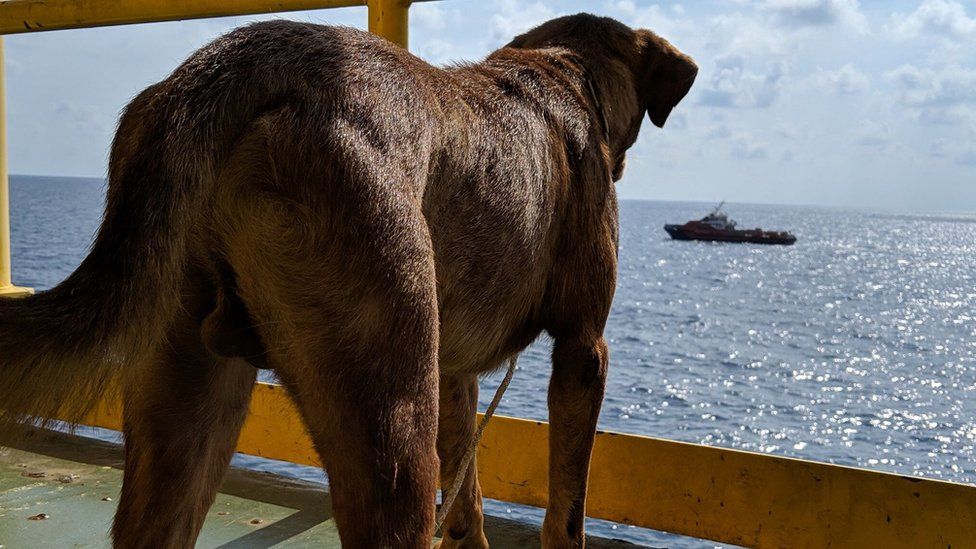
A dog discovered some 220km (135 miles) off the coast of Thailand has been rescued by a team of oil rig workers after the exhausted pooch was spotted paddling near a drilling platform.

The brown aspin swam towards the workers when they called out to him last Friday afternoon. He was then pulled to safety.

It is not clear how the dog became stranded so far out at sea. Some reports suggest he may have fallen from a fishing trawler.

The rig workers named the dog Boonrod, a Thai word that roughly translates as “the saved one” or “survivor”.

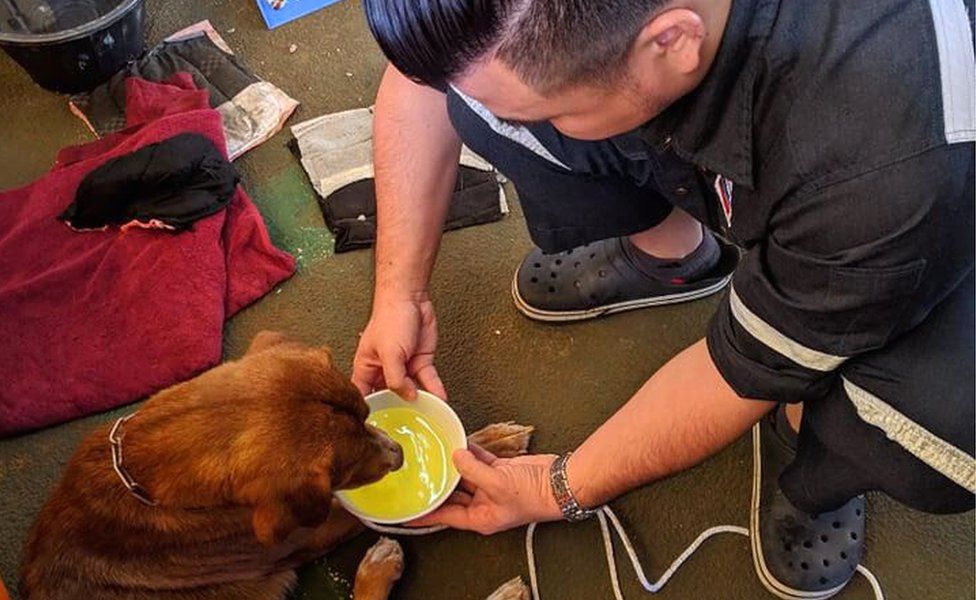
Boonrod was said to have been exhausted and in need of fresh drinking water and food.

He was nursed back to health on the rig while staff radioed for help, requesting the assistance of a tanker that was heading back to shore.

Boonrod had to have a proper wash to cleanse his fur of salt from the seawater. Afterwards, he had a nap.

The conditions were said to have been calm during the rescue, which workers said made it easier to spot Boonrod among the rusty metal bars of the rig.

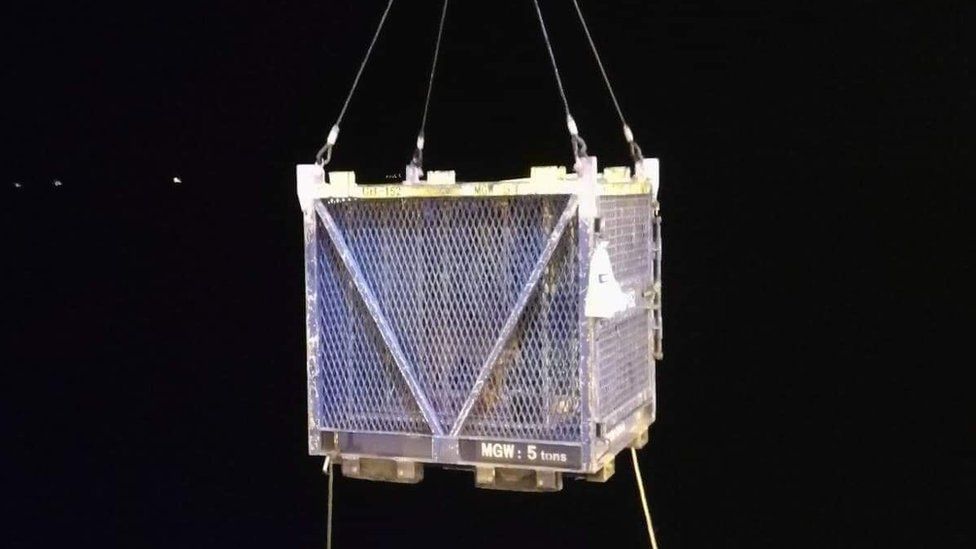
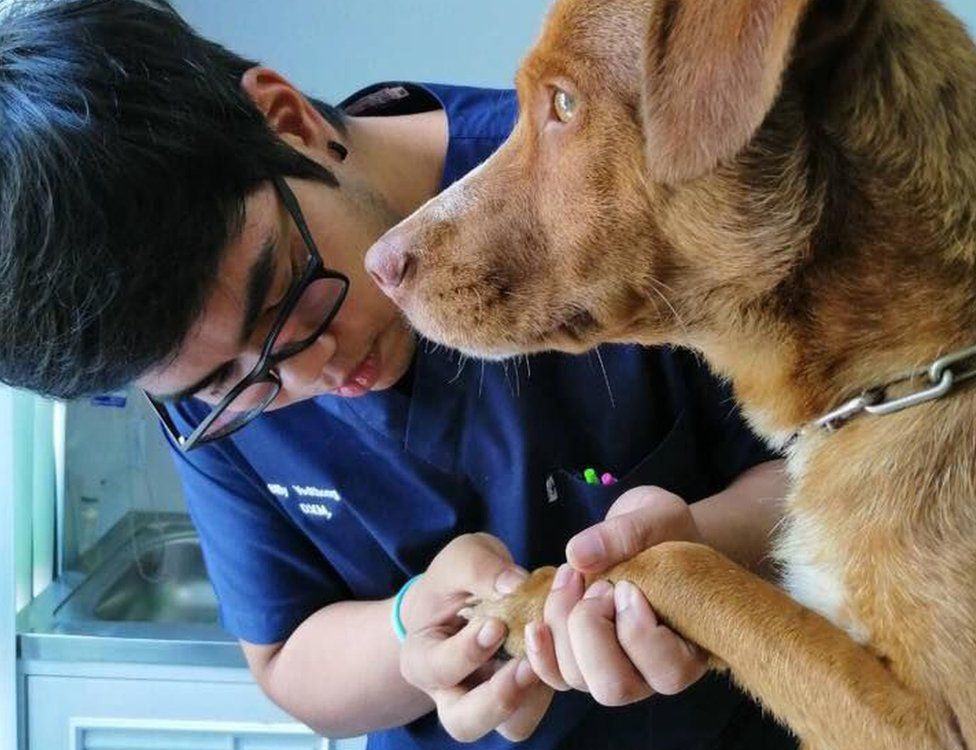
Boonrod was lifted by crane on to an oil vessel that was passing through the area on Sunday to be transported to a veterinary practice in southern Thailand.

The dog was said to have been in good spirits when he arrived on land to be taken to the vet.

(All images are copyright Viralpress.)

ooOOoo

The fact that this dog was rescued so far out to sea is incredible. Clearly, the poor dog had fallen off another vessel but the details of that incident are not known and it is purely conjecture.

But what is really important was that the dog was rescued and returned to health.

Burn Baby, Burn.

A rather depressing essay from Tom Englehardt.

The world is getting hotter. That’s a fact!

And no amount of stuffing one’s head under the pillow is going to change that fact.

We must take note of all the many articles and stories about the warming of the planet. Because we need to change the way we are responding. Not from climate change but to climate crisis.

I’m republishing a recent essay from Tom Engelhardt, with his permission, because he articulates perfectly where we are heading.

ooOOoo

Suicide Watch on Planet Earth

As the Flames Began to Rise, the Arsonists Appeared
By Tom Engelhardt, April 25th, 2019

As Notre Dame burned, as the flames leapt from its roof of ancient timbers, many of us watched in grim horror. Hour after hour, on screen after screen, channel after channel, you could see that 850-year-old cathedral, a visiting spot for 13 million people annually, being gutted, its roof timbers flaring into the evening sky, its steeple collapsing in a ball of fire. It was dramatic and deeply disturbing — and, of course, unwilling to be left out of any headline-making event, President Trump promptly tweeted his advice to the French authorities: “Perhaps flying water tankers could be used to put it out. Must act quickly!” No matter that water from such planes would probably have taken the cathedral’s towers down and endangered lives as well — “the equivalent,” according to a French fire chief, “of dropping three tons of concrete at 250 kilometers per hour [on] the ancient monument.”

Still, who could doubt that watching such a monument to the human endeavor being transformed into a shell of its former self was a reminder that everything human is mortal; that, whether in a single lifetime or 850 years, even the most ancient of our artifacts, like those in Iraq and Syria recently, will sooner or later be scourged by the equivalent of (or even quite literally by) fire and sword; that nothing truly lasts, even the most seemingly permanent of things like, until now, Notre Dame?

That cathedral in flames, unlike so much else in our moment (including you-know-who in his every waking moment), deserved the front-and-center media attention it got. Historically speaking, it was a burning event of the first order. Still, it’s strange that the most unnerving, deeply terrifying burning underway today, not of that ancient place of worship that lived with humanity for so many tumultuous centuries but of the planet itself, remains largely in the background.

When the cathedral in which Napoleon briefly crowned himself emperor seemed likely to collapse, it was certifiably an event of headline importance. When, however, the cathedral (if you care to think of it that way) in which humanity has been nurtured all these tens of thousands of years, on which we spread, developed, and became what we are today — I mean, of course, the planet itself — is in danger of an unprecedented sort from fires we continue to set, that’s hardly news at all. It’s largely relegated to the back pages of our attention, lost any day of the week to headlines about a disturbed, suicidal young woman obsessed with the Columbine school massacre or an attorney general obsessed with protecting the president.

And let’s not kid ourselves, this planet of ours is beginning to burn — and not just last week or month either. It’s been smoldering for decades now. Last summer, for instance, amid global heat records (Ouargla, Algeria, 124 degrees Fahrenheit; Hong Kong, over 91 degrees Fahrenheit for 16 straight days; Nawabsha, Pakistan, 122 degrees Fahrenheit; Oslo, Norway, over 86 degrees Fahrenheit for 16 consecutive days; Los Angeles, 108 degrees Fahrenheit), wildfires raged inside the Arctic Circle. This March, in case you hadn’t noticed — and why would you, since it’s gotten so little attention? — the temperature in Alaska was, on average, 20 degrees (yes, that is not a misprint) above normal and typical ice roads between villages and towns across parts of that state were melting and collapsing with deaths ensuing.

Meanwhile, in the Antarctic, ice is melting at a rate startling to scientists. If the process accelerates, global sea levels could rise far faster than expected, beginning to drown coastal cities like Miami, New York, and Shanghai more quickly than previously imagined. Meanwhile, globally, the wildfire season is lengthening. Fearsome fires are on the rise, as are droughts, and that’s just to begin to paint a picture of a heating planet and its ever more extreme weather systems and storms, of (if you care to think of it that way) a Whole Earth version of Notre Dame.

The Arsonists Arrive

As was true with Notre Dame, when it comes to the planet, there were fire alarms before an actual blaze was fully noted. Take, for example, the advisory panel of scientists reporting to President Lyndon Johnson on the phenomenon of global warming back in 1965. They would, in fact, predict with remarkable accuracy how our world was going to change for the worse by this twenty-first-century moment. (And Johnson, in turn, would bring the subject up officially for perhaps the first time in a Special Message to Congress on February 5, 1965, 54 years before Alexandria Ocasio-Cortez’s Green New Deal proposal.) As that panel wrote at the time, “Through his worldwide industrial civilization, Man is unwittingly conducting a vast geophysical experiment. Within a few generations he is burning the fossil fuels that slowly accumulated in the earth over the past 500 million years…” In other words, the alarm was first sounded more than half a century ago.

When it comes to climate change, however, as the smoke began to appear and, in our own moment, the first flames began to leap — after all, the last four years have been the hottest on record and, despite the growth of ever less expensive alternative energy sources, carbon dioxide emissions into the atmosphere are still rising, not falling — no firemen arrived (just children). There were essentially no adults to put out the blaze. Yes, there was the Paris climate accord but it was largely an agreement in principle without enforcement power of any genuine sort.

In fact, across significant parts of the planet, those who appeared weren’t firefighters at all, but fire feeders who will likely prove to be the ultimate arsonists of human history. In a way, it’s been an extraordinary performance. Leaders who vied for, or actually gained, power not only refused to recognize the existence of climate change but were quite literally eager to aid and abet the phenomenon. This is true, for instance, of the new president of Brazil, Jair Bolsonaro, who came to power prepared to turn the already endangered carbon sink of the Amazon rain forest into a playground for corporate and agricultural destroyers. It is similarly true in Europe, where right-wing populist movements have begun to successfully oppose gestures toward dealing with climate change, gaining both attention and votes in the process. In Poland, for instance, just such a party led by President Andrzej Duda has come to power and the promotion of coal production has become the order of the day.

And none of that compared to developments in the richest, most powerful country of all, the one that historically has put more greenhouse gas emissions into the atmosphere than any other. On taking office, Donald Trump appointed more climate-change deniers to his cabinet than might have previously seemed possible and swore fealty to “American energy dominance,” while working to kneecap the development of alternative energy systems.  He and his men tried to open new areas to oil and gas drilling, while in every way imaginable striving to remove what limits there had been on Big Energy, so that it could release its carbon emissions into the atmosphere unimpeded. And as the planetary cathedral began to burn, the president set the mood for the moment (at least for his vaunted “base”) by tweeting such things as “It’s really cold outside, they are calling it a major freeze, weeks ahead of normal. Man, we could use a big fat dose of global warming!” or, on alternative energy, “You would be doing wind, windmills, and if it doesn’t if it doesn’t blow you can forget about television for that night… Darling, I want to watch television. I’m sorry, the wind isn’t blowing.”

Among those who will someday be considered the greatest criminals in history, don’t forget the Big Energy CEOs who, knowing the truth about climate change from their own hired scientists, did everything they could to increase global doubts by funding climate-denying groups, while continuing to be among the most profitable companies around. They even hedged their bets by, among other things, investing in alternative energy and using it to more effectively drill for oil and natural gas.

Meanwhile, of course, the planet that had proven such a comfortable home for humanity was visibly going down. No, climate change won’t actually destroy the Earth itself, just the conditions under which humanity (and so many other species) thrived on it. Sooner or later, if the global temperature is indeed allowed to rise a catastrophic seven degrees Fahrenheit or four degrees Celsius, as an environmental impact statement from the Trump administration suggested it would by 2100, parts of the planet could become uninhabitable, hundreds of millions of human beings could be set in desperate motion, and the weather could intensify in ways that might be nearly unbearable for human habitation. Just read David Wallace-Wells’s The Uninhabitable Earth, if you doubt me.

This isn’t even contestable information anymore and yet it’s perfectly possible that Donald Trump could be elected to a second term in 2020. It’s perfectly possible that more right-wing populist movements could sweep into power in Europe. It’s perfectly possible that Vladimir Putin’s version of great powerdom — a sagging Russian petro-state — could continue on its present globally warming path well into the future.

Understand this: Trump, Bolsonaro, Duda, Putin, and the others are just part of human history. Sooner or later, they will be gone. Climate change, however, is not part of human history (whatever it may do to civilization as we know it). Its effects could, in human terms, last for almost unimaginable periods of time. It operates on a different time scale entirely, which means that, unlike the tragedies and nightmares of human history, it is not just a passing matter.

Of course, the planet will survive, as will some life forms (as would be true even if humanity were to succumb to that other possible path to an apocalypse, a nuclear holocaust resulting in “nuclear winter”).  But that should be considered small consolation indeed.

Putting the Planet on a Suicide Watch

Consider global warming a story for the ages, one that should put Notre Dame’s near-destruction after almost nine centuries in grim perspective. And yet the planetary version of burning, which should be humanity’s crisis of all crises, has been met with a general lack of media attention, reflecting a lack of just about every other kind of attention in our world (except by those outraged children who know that they are going to inherit a degraded world and are increasingly making their displeasure about it felt).

To take just one example of that lack of obvious attention, the response of the mega-wealthy to the burning of Notre Dame was an almost instantaneous burst of giving. The euro equivalent of nearly a billion dollars was raised more or less overnight from the wealthiest of French families and other .01%ers. Remind me of the equivalent for climate change as the planet’s spire threatens to come down?

As for arsonists like Donald Trump and the matter of collusion, there’s not even a question mark on the subject. In the United States, such collusion with the destroyers of human life on Planet Earth is written all over their actions. It’s beyond evident in the appointment of former oil and gas lobbyists and fellow travelers to positions of power. Will there, however, be the equivalent of a Mueller investigation? Will the president be howling “witch hunt” again? Not a chance. When it comes to Donald Trump and climate change, there will be neither a Mueller Report, nor the need for a classic Barr defense. And yet collusion — hell, yeah! The evidence is beyond overwhelming.

We are, of course, talking about nothing short of the ultimate crime, but on any given day of our lives, you’d hardly notice that it was underway. Even for an old man like me, it’s a terrifying thing to watch humanity make a decision, however inchoate, to essentially commit suicide. In effect, there is now a suicide watch on Planet Earth. Let’s hope the kids can make a difference.

Tom Engelhardt is a co-founder of the American Empire Project and the author of a history of the Cold War, The End of Victory Culture. He runs TomDispatch.com and is a fellow of the Type Media Center. His sixth and latest book is A Nation Unmade by War (Dispatch Books).

Follow TomDispatch on Twitter and join us on Facebook. Check out the newest Dispatch Books, John Feffer’s new dystopian novel (the second in the Splinterlands series) Frostlands,Beverly Gologorsky’s novel Every Body Has a Story, and Tom Engelhardt’s A Nation Unmade by War, as well as Alfred McCoy’s In the Shadows of the American Century: The Rise and Decline of U.S. Global Power and John Dower’s The Violent American Century: War and Terror Since World War II.

Copyright 2019 Tom Engelhardt

ooOOoo

Tom and I are of the same age, give or take a year or two, and I have long been worried about the state of things. Part of me thinks that I won’t live long enough to experience the worst of this climate crisis and that my grandchild will have to sort it out. But then another part of me thinks that this is accelerating and we are already experiencing weather and climate that is strange and …..

I don’t know!

We go back a very long time

The ancient history of man and dog!

And when I say ‘man’ I am of course referring to the species.

For a couple of weeks ago Meilan Solly of The Smithsonian wrote about the relationship 4,500 years ago of man and dog.

In Neolithic times there was an important relationship, as there is today. Maybe our dogs have become more of the ‘pet’ rather than the working dog that they are assumed to be then.

But here’s the article.

ooOOoo

Thanks to Facial Reconstruction, You Can Now Look Into the Eyes of a Neolithic Dog

The collie-sized canine was buried in a cavernous tomb on Scotland’s Orkney Islands around 2,500 B.C.

Experts believe the Neolithic dog is the first canine to undergo forensic facial reconstruction (Santiago Arribas/Historic Environment Scotland)
By Meilan Solly
SMITHSONIAN.COM, 

Some 4,500 years ago, a collie-sized dog with pointed ears and a long snout comparable to that of the European grey wolf roamed Scotland’s Orkney Islands. A valued member of the local Neolithic community, the canine was eventually buried alongside 23 other dogs and at least eight humans in a cavernous tomb known as the Cuween Hill Chambered Cairn.

Now, 118 years after archaeologists first chanced upon its resting place, the prized pup’s image is being reimagined. As Esther Addley reports for the Guardian, experts believe the dog is the first canine to undergo forensic facial reconstruction. Its likeness, commissioned by Historic Environment Scotland (HES) and the National Museum of Scotland, is set to go on view in Orkney later this year.

“Just as they’re treasured pets today, dogs clearly had an important place in Neolithic Orkney, as they were kept and trained as pets and guards and perhaps used by farmers to help tend sheep,” Steve Farrar, interpretation manager at HES, explains in a statement. “But the remains discovered at Cuween Hill suggest that dogs had a particularly special significance for the farmers who lived around and used the tomb about 4,500 years ago.”

It’s possible, Farrar adds, that the Neolithic group viewed dogs as their “symbol or totem,” perhaps even dubbing themselves the “dog people.”

Cuween Hill dates to around 3,000 B.C., Sky News reports, but radiocarbon dating places the dog’s actual interment some 500 years later. It remains unclear why the animal was buried so many centuries after the tomb’s creation, but archaeologists posit the timing may point toward the ceremony’s ritual value within the community. As HES observes, the fact that the Orkney residents placed canine remains alongside those of humans could also speak to their belief in an afterlife for both parties.

According to the Scotsman, forensic artist Amy Thornton drew on a CT scan to create a 3-D print of the animal’s skull. After layering clay approximations of muscle, skin and hair onto this base, she cast the model in silicone and added a fur coat designed to mimic that of the European grey wolf. Interestingly, Thornton notes, the process played out much as it would for a human facial reconstruction, although “there is much less existing data” detailing average tissue depth in canine versus human skulls.

The model is the latest in a series of technologically focused initiatives centered on Orkney’s Neolithic residents. Last year, HES published 3-D digital renderings of the chambered cairn on Sketchfab, enabling users to explore the tomb’s four side cells, tall central chamber and entrance passage. First discovered in 1888 but only fully excavated in 1901, the impressive stone structure held 24 canine skulls and the remains of at least eight humans.

In an interview with the Guardian’s Addley, Farrar explains that the reconstruction aims “to bring us closer to who [the dog’s owners] were and perhaps give a little hint of what they believed.”

“When you look at a Neolithic dog, it somehow communicates human relationships,” Farrar concludes. “… I can empathise with the people whose ingenuity made Orkney such an enormously important place. When this dog was around, north-west Europe looked to Orkney.”

ooOOoo

“When you look at a Neolithic dog, it somehow communicates human relationships,” Farrar concludes.

That’s a powerful statement.

Now if one goes across to the website for Cuween Hill Chambered Cairn one reads this:

History

An ancient site for burials

Built between 3000 and 2400 BC, this is an excellent example of a Neolithic chambered tomb. It has four cells opening off a central chamber, which is accessed down a passage. Entrance into the tomb today is through the original passage.

Secondary burials at the Cuween Hill could reflect a continued reverence for the site. A recently discovered settlement nearby is probably contemporary with the cairn, and would likely have been connected.

Tomb of the dogs

Exploration at the tomb in 1901 found:

  • Remains of at least eight humans – five skulls on the floor of the chamber, one at the entrance and two in side cells
  • The skulls of 24 dogs on the chamber floor

The dog remains suggest the local tribe or family perhaps had a dog as their symbol or totem, or there may have been a belief in an afterlife for animals.

The tomb is completely unlit, which serves to both add to the atmosphere and discourage vandalism and graffiti. It also means the tomb is largely free of green algal growth.

The stonework at Cuween Hill is of particularly high quality. The roof of one of the cells is likely to be original, elsewhere the walls and corbelled roofs have survived to a considerable height.

As I said, we go back a very long time!

Sir David Attenborough.

A very great man!

For someone born on May 8th, 1926 he, perhaps, should be slowing down. But none of it. He is passionate about how we are endangering our planet. And having a public profile he is the right position to do something about it, albeit a warning statement.

Plus, he is not the only one doing something about it. For Extinction Rebellion are protesting in the London streets.

But back to Sir David.

I’m assuming that it is OK to republish in full an item that appeared on BBC News yesterday. And according to their terms it is OK.

ooOOoo

Climate change: Sir David Attenborough warns of ‘catastrophe’

By Matt McGrath, Environment correspondent

(There is a video on the webpage that I am unable to copy across. Please go here to watch it. Update: I think I have got it.)

Sir David Attenborough has issued his strongest statement yet on the threat posed to the world by climate change.

In the BBC programme Climate Change – The Facts, the veteran broadcaster outlines the scale of the crisis facing the planet.

Sir David says we face “irreversible damage to the natural world and the collapse of our societies”.

But there is still hope, he says, if dramatic action to limit the effects is taken over the next decade.

Sir David’s new programme lays out the science behind climate change, the impact it is having right now and the steps that can be taken to fight it.

“In the 20 years since I first started talking about the impact of climate change on our world, conditions have changed far faster than I ever imagined,” Sir David states in the film.

“It may sound frightening, but the scientific evidence is that if we have not taken dramatic action within the next decade, we could face irreversible damage to the natural world and the collapse of our societies.”

Speaking to a range of scientists, the programme highlights that temperatures are rising quickly, with the world now around 1C warmer than before the industrial revolution.

“There are dips and troughs and there are some years that are not as warm as other years,” says Dr Peter Stott from the Met Office.

“But what we have seen is the steady and unremitting temperature trend. Twenty of the warmest years on record have all occurred in the last 22 years.”

The programme shows dramatic scenes of people escaping from wildfires in the US, as a father and son narrowly escape with their lives when they drive into an inferno.

Scientists say that the dry conditions that make wildfires so deadly are increasing as the planet heats up.

Greenland is losing ice five times as fast as it was 25 years ago – Getty Images.

Some of the other impacts highlighted by scientists are irreversible.

“In the last year we’ve had a global assessment of ice losses from Antarctica and Greenland and they tell us that things are worse than we’d expected,” says Prof Andrew Shepherd from the University of Leeds.

“The Greenland ice sheet is melting, it’s lost four trillion tonnes of ice and it’s losing five times as much ice today as it was 25 years ago.”

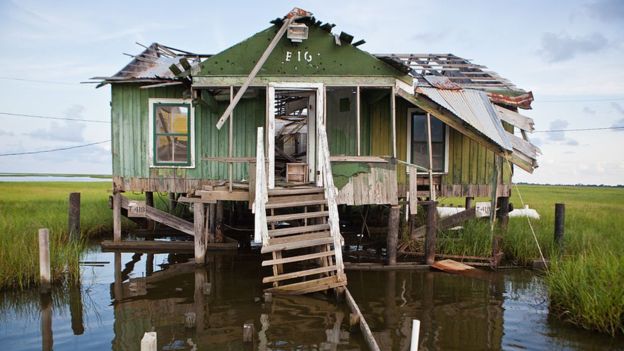
These losses are driving up sea levels around the world. The programme highlights the threat posed by rising waters to people living on the Isle de Jean Charles in Louisiana, forcing them from their homes.

“In the US, Louisiana is on the front line of this climate crisis. It’s losing land at one of the fastest rates on the planet – at the rate of of a football field every 45 minutes,” says Colette Pichon Battle, a director of the Gulf Coast Center for Law & Policy.

People are moving from parts of Louisiana in the US as a result of rising waters. – Julie Dermansky

“The impact on families is going to be something I don’t think we could ever prepare for.”

Hope rising

Sir David’s concern over the impacts of climate change has become a major focus for the naturalist in recent years.

This has also been a theme of his One Planet series on Netflix.

His new BBC programme has a strong emphasis on hope.

Sir David argues that if dramatic action is taken over the next decade then the world can keep temperatures from rising more than 1.5C this century. This would limit the scale of the damage.

“We are running out of time, but there is still hope,” says Sir David.

“I believe that if we better understand the threat we face the more likely it is we can avoid such a catastrophic future.”

The programme says that rapid progress is being made in renewable energy, with wind now as cheap as fossil fuels in many cases. It shows how technologies to remove and bury carbon dioxide under the ground are now becoming more viable.

But politicians will need to act decisively and rapidly.

“This is the brave political decision that needs to be taken,” says Chris Stark from the UK’s Committee on Climate Change.

Teenage campaigner Greta Thunberg has helped spark school strikes all over the world. – Getty Images.

“Do we incur a small but not insignificant cost now, or do we wait and see the need to adapt. The economics are really clear on this, the costs of action are dwarfed by the costs of inaction.”

The programme also highlights the rising generation of young people who are deeply concerned about what’s happening to the planet.

Swedish teenager Greta Thunberg explains that things can change quickly, despite the scale of the challenge on climate change.

“The first day I sat all alone,” she says, speaking of her decision to go on strike from school and sit outside the Swedish parliament to highlight the climate crisis.

“But on the second day, people started joining me… I wouldn’t have imagined in my wildest dreams that this would have happened so fast.”

“Change is coming whether you like it or not.”

Follow Matt on Twitter@mattmcgrathbbc

Climate Change – The Facts is on BBC One on Thursday 18 April at 9pm

ooOOoo

There are so many quotes in this item that one can hardly pick out the most pertinent one.

Change is coming whether you like it or not.

The impact on families is going to be something I don’t think we could ever prepare for.

… irreversible damage to the natural world and the collapse of our societies“.

But this is the most powerful one! “We are running out of time, but there is still hope,” says Sir David.

Thogersen Family Farm Pet Food Recall

The name says it all!

ooOOoo

Thogersen Family Farm Pet Food Recall

April 7, 2019 — Thogersen Family Farm of Stanwood, WA is voluntarily recalling raw frozen ground pet food because it has the potential to be contaminated with Listeria monocytogenes.

What’s Recalled?

The following 2-pound packaged varieties are included in this recall:

  • Coarse ground rabbit frozen raw pet food
  • Coarse ground mallard duck frozen raw pet food
  • Ground llama frozen raw pet food
  • Ground pork frozen raw pet food

Recalled product labels did not contain any lot identification, batch codes, or expiration dates.

Products were packaged in 2-pound flattened, rectangular clear plastic packages and stored frozen.

The front of each package contains one large white square label with the company name, product type and weight.

About Listeria

Listeria monocytogenes can affect animals eating the products and there is risk to humans from handling contaminated pet products, especially if they have not thoroughly washed their hands after having contact with the products or any surfaces exposed to these products.

Listeria monocytogenes infections can cause serious and sometimes fatal infections in young children, frail or elderly people, and others with weakened immune systems.

Although healthy individuals may suffer only short-term symptoms such as high fever, severe headache, stiffness, nausea, abdominal pain and diarrhea, Listeria infection can cause miscarriages and stillbirths among pregnant women.

Anyone experiencing these symptoms should immediately contact a health care provider.

Pets with Listeria monocytogenes infections may be lethargic and have diarrhea or bloody diarrhea, fever, and vomiting.

Some pets will have only decreased appetite, fever and abdominal pain.

Infected but otherwise healthy pets can be carriers and infect other animals or humans.

If your pet has consumed the recalled product and has these symptoms, please contact your veterinarian.

Recalled product labels did not contain any lot identification, batch codes, or expiration dates. Products were packaged in two pound flattened, rectangular clear plastic packages and stored frozen.
The front of the package contains one large white square label with the company name, product type and weight.

Where Was It Sold?

Thogersen Family Farm stated the affected products were either sold to individual customers or two retail establishments that have been notified.

Some of the product has not been distributed and held at the manufacturing location.

What Caused the Recall?

The recall is the result of samples collected by the Washington State Department of Agriculture and revealed the finished products contained the bacteria.

No illnesses have been reported to date.

What to Do?

Consumers who have purchased affected product should discontinue use.

For questions, consumers may contact the company at 360-929-9808.

U.S. citizens can report complaints about FDA-regulated pet food products by calling the consumer complaint coordinator in your area.

Or go to https://www.fda.gov/petfoodcomplaints.

Canadians can report any health or safety incidents related to the use of this product by filling out the Consumer Product Incident Report Form.

ooOOoo

As per usual, please share this post as far and wide as you feel able.

Back to our regular posts tomorrow.

Territtorio de Zaguates

A compelling Netflix documentary.

There is a series on Netflix called Dogs. It consists of a series of 1-hour films showing many different qualities of our special dogs.

Last Monday evening we watched the episode that took the viewer to Costa Rica.

Territorio de Zaguates – Land of the Strays

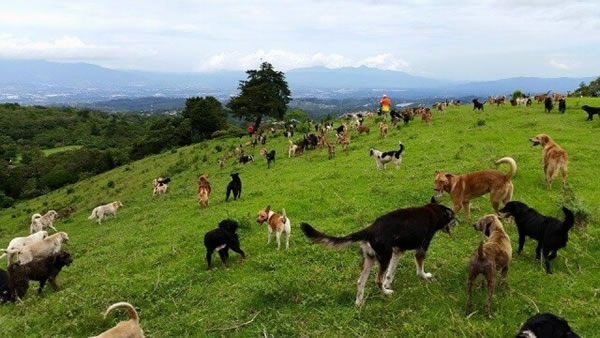
Territorio de Zaguates is an extraordinary dog shelter located in the mountains above Heredia Costa Rica an hour from downtown San José.

Dog Walk at Territorio Zaguates

It was incredible. Almost too much to put into words.

Firstly, there were the huge number of homeless dogs, in all states of health, that roamed Costa Rica.

Secondly, the dog sanctuary was founded by Lya Battle and Alvaro Saumet who are still hard at it.

Thirdly, they have somewhere between 700 and 1,100 dogs in the sanctuary.

Finally, let me let them say it in their own words.

WE ARE…

A non profit organization, founded by Lya Battle and Alvaro Saumet. During the last eight years we’ve been promoting well-being and respect for animals.
HOW WE DO IT?
Veterinarian: We take care of our mutts with deworming, sterilization and any other care they need. The cost of maintaining a dog healthy is $5 per month.

Shelter: Territorio is home for hundreds of doggies. We give them here a safe place to live, free of maltreatment, and full of love. The cost of providing a home is $11 per month for each of our unique specimens.

Food: Each mont we consume thousands of kilos of dog food, to keep our pack healthy. Giving a full small plate to each mutt cost us $20 per month.

There is much, much more on their website that I encourage you to go to. Here are some photographs of the dogs that they rescue.

oooo

oooo

oooo

oooo

oooo

oooo

There are a number of videos on YouTube to watch.

Here’s a short one.

And here’s a slightly longer one by National Geographic.

Finally, if you feel so minded here is the donate page. It’s a good cause and, for example, for just $36 you can sponsor one dog. That’s what Jeannie and I did.

Anyway, we hope you can spare something.


End the Yulin Dog Meat Festival – now!

This was forwarded to me by John Zande.

ooOOoo

Dogs in the cage in animal shelter.

Tens of Thousands of Dogs Die Each Year During China’s Dog Meat Festivals. This Is Our Chance To End The Slaughter!

John,

The yearly Yulin Dog Meat Festival is responsible for the slaughter of tens of thousands of dogs each year. Now, we have a chance to end it once and for all.

Two Chinese governing bodies plan to introduce new legislation that will provide special protections to canines by classifying them as companion animals. This would exclude dogs from being used for human consumption.

Sign and show your support for this new measure to protect dogs and help end the Yulin Dog Meat Festival.

If you are unfamiliar with the festival, it is notorious for its bloodshed and cruelty. Because dog meat consumers believe that the meat tastes better when dogs have more adrenaline in their blood, dog meat butchers torture the animals. Dogs are beaten, burned alive with blowtorches, or tossed into pots of boiling water.

Thanks to public outcry, the festival’s popularity has decreased and restrictions have been set, however, that hasn’t been enough to end the festival for good. Now’s our chance.

John, will you sign the petition today and help end the Yulin Dog Meat Festival and save thousands of dogs?

Thank you,
Ashley A.
The Care2 Petitions Team

ooOOoo

Now you will want to go to the page where you can sign this important petition.

You will go here.

Thank you, thank you, and thank you!

Darwin’s Natural Dog Food

Yet another dog food alert.

Dear Fellow Dog Lover,
The U.S. Food and Drug Administration is warning pet owners not to feed 3 specific lots of Darwin’s Natural dog food because Salmonella bacteria were discovered in the product.
To learn which products are affected, please visit the following link:

FDA Warning: Do Not Feed These Lots of Darwin’s Natural Dog Food

Please be sure to share the news of this alert with other pet owners.

If you go to that link then you will see the following:

FDA Warning: Do Not Feed These Lots of Darwin’s Natural Dog Food

March 26, 2019 — The U.S. Food and Drug Administration is cautioning pet ownersnot to feed their pets 3 lots of Darwin’s Natural Pet Products raw dog food after samples from these lots tested positive for Salmonella.

No images were provided by the FDA in its announcement.

The following image was previously retrieved from the brand’s website and is provided in good faith by The Dog Food Advisor. It may not be an accurate representation of the affected products.

What Products Are Affected?

The codes for each product affected are listed in the second group of numbers found just below the barcode on the package.

Here are the affected products:

  • Darwin’s Natural Pet Products Natural Selections Chicken Recipe with Organic Vegetables for Dogs
    Package: 5309(11)181019
    Manufacture Date: October 19, 2018
  • Darwin’s Natural Pet Products Natural Selections Chicken Recipe with Organic Vegetables for Dogs
    Package: 5375(11)181106
    Manufacture Date: November 11, 2018
  • Darwin’s Natural Pet Products Natural Selections Turkey Recipe with Organic Vegetables for Dogs
    Package: 5339(11)181026
    Manufacture Date: October 26, 2018

These products are manufactured by Arrow Reliance Inc., doing business as Darwin’s Natural Pet Products.

They are sold online direct to consumers.

What Caused This Alert?

The FDA is issuing this alert because the affected lots of Darwin’s raw dog food represent a serious threat to human and animal health.

They are are considered adulterated under the Federal Food, Drug, and Cosmetic Act because they contain Salmonella bacteria.

The FDA collected and analyzed unopened samples of products from these 3 lots in response to a consumer complaint.

Samples from all three lots tested positive for Salmonella.

Because these products are sold and stored frozen, the FDA is concerned that people may still have them in their possession.

About Salmonella

Salmonella is a bacterium that can cause illness and death in humans and animals, especially those who are very young, very old, or have weak immune systems.

According to the Centers for Disease Control and Prevention (CDC), people infected with Salmonella can develop diarrhea, fever and abdominal cramps.

Most people recover without treatment. But in some people, the diarrhea may be so severe that they need to be hospitalized.

In these patients, the Salmonella infection may spread from the intestines to the blood stream and then to other body sites unless the person is treated promptly with antibiotics.

Consult your health care provider if you have symptoms of Salmonella infection.

Pets do not always display symptoms when infected with Salmonella, but signs can include vomiting, diarrhea (which may be bloody), fever, loss of appetite and/or decreased activity level. If your pet has these symptoms, consult a veterinarian promptly. You should also be aware that infected pets can shed the bacteria in their feces without showing signs of being sick.

Consult a veterinarian if your pet has symptoms of Salmonella infection.

What to Do?

If you have any of the affected Darwin’s Natural Pet Products in your possession, stop feeding it to your pets.

Discard the product in a secure container where other animals, including wildlife, cannot access it.

Consumers who have had the affected products in their homes should clean refrigerators and freezers where they were stored.

Clean and disinfect all bowls, utensils, food prep surfaces, pet bedding, toys, floors, and any other surfaces that the food or pet may have had contact with.

Clean up the pet’s feces in yards or parks where people or other animals may become exposed.

Consumers should thoroughly wash their hands after handling the recalled product or cleaning up potentially contaminated items and surfaces.

U.S. citizens can report complaints about FDA-regulated pet food products by calling the consumer complaint coordinator in your area.

Or go to https://www.fda.gov/petfoodcomplaints.

Canadians can report any health or safety incidents related to the use of this product by filling out the Consumer Product Incident Report Form.

Get Dog Food Recall Alerts by Email

Get free dog food recall alerts sent to you by email. Subscribe to The Dog Food Advisor’s emergency recall notification system.

ooOOoo

Please do all your best to ensure the news gets out!

A dog food advisory.

This came in late yesterday.

ooOOoo

Dear Fellow Dog Lover,

Because you signed up on our website and asked to be notified, I’m sending you this special recall alert. If you no longer wish to receive these emails, please click the “unsubscribe” link at the bottom of this message.

Hill’s Pet Nutrition is expanding its recall of specific lots of its Prescription Diet and Science Diet dog foods due to elevated levels of vitamin D.

Very high levels of vitamin D can lead to serious health issues in dogs, including kidney dysfunction.

To learn which products are affected, please visit the following link:

Hill’s Prescription Diet and Science Diet Dog Food Recall Expands

Please share the news of this alert with other pet owners.

Mike Sagman, Editor
The Dog Food Advisor

If one then follows up that link then you will see this:

Hill’s Prescription Diet and Science Diet Dog Food Recall Expands

March 20, 2019 — Hill’s Pet Nutrition is expanding its voluntary recall of canned dog food products due to elevated levels of vitamin D.

This recall expansion relates to the same vitamin premix that led to the January 31 voluntary recall previously announced on The Dog Food Advisor website.

Vitamin D, when consumed at very high levels, can lead to serious health issues in dogs including kidney dysfunction.

What’s Recalled?

The following products and lot numbers are affected by the recall.

Items marked in blue are new SKUs that were added to the list on March 20, 2019.

About Excessive Levels of Vitamin D

While vitamin D is an essential nutrient for dogs, ingestion of elevated levels can lead to potential health issues depending on the level of vitamin D and the length of exposure.

Dogs may exhibit symptoms such as vomiting, loss of appetite, increased thirst, increased urination, excessive drooling, and weight loss.

Pet parents with dogs who have consumed any of the products listed and are exhibiting any of these signs should contact their veterinarian.

In most cases, complete recovery is expected after discontinuation of feeding.

What to Do?

If your SKU, Date and Lot codes are found in the list above, you have an affected product.

You should stop feeding it and should return to the place of purchase for a full refund.

If you have questions, you may contact Hill’s Consumer Affairs at 800-445-5777.

U.S. citizens can report complaints about FDA-regulated pet food products by calling the consumer complaint coordinator in your area.

Or go to https://www.fda.gov/petfoodcomplaints.

Canadians can report any health or safety incidents related to the use of this product by filling out the Consumer Product Incident Report Form.

Get Dog Food Recall Alerts by Email

Get free dog food recall alerts sent to you by email. Subscribe to The Dog Food Advisor’s emergency recall notification system.

ooOOoo

Hopefully, there are not people that are affected by this alert. But, nonetheless, it needs promulgating.

Mera, a peak dog!

This is an astounding story of bonding.

This is an amazing story. Utterly amazing! Taken from Mother Nature Network.

ooOOoo

This stray tagged along with mountain climbers and set an elevation record for dogs

Mera, a street dog, climbed 23,389 feet to the top of Baruntse in Nepal.

By MARY JO DILONARDO

March 6, 2019

Mera seemed to have little trouble in the snow and ice. (Photo: Don Wargowsky)

When Seattle-based mountain guide Don Wargowsky was leading an expedition to Mera Peak and Baruntse in Nepal’s Himalayas last November, he picked up an extra member on his team. A stray dog noticed the climbers somewhere around 17,500 feet and decided to stick around with the group.

The climbers had just summited Mera Peak, and when they were coming down around Mera La pass, they saw the pup going up.

“What struck me was to get to that pass, there were a few hundred feet of fixed rope which means the terrain was so difficult that most climbers need rope to help themselves up,” Wargowsky tells MNN. “To see a dog up there just running by all these climbers in their $2,000 down suits and crampons was very unusual. When she came up to me, I gave her a bit of beef jerky and she didn’t leave for 3 1/2 weeks.”

The team dubbed their newest four-legged member “Mera” and she tagged along on the way back down the mountain. Wargowsky realized he had seen her in the town of Kare a few days earlier, but she had made no effort then to get close. He thinks that’s because street dogs aren’t treated very well in Nepal due to the fear of rabies.

“Dogs are shooed away pretty aggressively,” he says. “So, she was naturally pretty shy.”

A new climbing partner

Climbing is hard work. (Photo: Don Wargowsky)

But once Mera decided to join the expedition, she gradually lowered her guard. The first night, Wargowsky tried to encourage her to sleep in his tent, but she wouldn’t come inside. The next morning, he found her curled up outside the flaps covered in a layer of snow. After that, he was able to coax her inside. He gave her one of his sleeping pads and a coat to keep her warm.

Wargowsky was in a difficult position with his uninvited guest. The elements were unforgiving, and he was worried about the dog who had no protection for her paws or her body in conditions that likely reached minus 20 or minus 30 degrees Fahrenheit at times. But he had no luck getting her to leave … and where would she go?

“Obviously my responsibility was to the group, but I was super happy to have her with us. I didn’t encourage her to come along, but I wasn’t going to have her starve, so I would feed her,” he says. “I really tried to persuade her to stay at camp as we got into steeper and more dangerous terrain. Where we were was a more remote part of Nepal. If we didn’t feed her, she was going to starve.”

Mera stuck with the expedition the entire time, never venturing far from Wargowsky’s side. Or technically, his knee.

“She would walk with her nose almost in the back of my knee when we would walk,” he says. “But she wanted to be up front. If I would drop back to hang out with a slower client, she would go up and walk with whoever was up front. She didn’t get out of sight pretty much the entire time we were there.”

‘No clue what her motivation was’

Mera celebrates with her fellow climbers. (Photo: Don Wargowsky)

There was only one time when Mera was gone for several days.

While Wargowsky was working on training with some members of the expedition, showing them how to climb the ice with rope, Mera followed the team’s sherpas instead. They were working to set up ropes to “camp one” at around 20,000 feet. She scrambled up the steep terrain but seemed afraid to go back down and wouldn’t return with them to base camp.

“She ended up spending two nights alone on a glacier at 20,000 feet. I really thought she was going to freeze to death,” Wargowsky says. The sherpas went up to continue working and she was there. But instead of going back down right away, she followed them to 22,000 feet as they continued working before going back to base camp.

The next day when the entire team went to make the climb, Wargowsky tried to keep her at base camp because he didn’t want her to make the steep climb again. He tied her up but she got out of her rope and quickly caught up with them. Wargowsky couldn’t leave his human clients to take her back, so Mera was allowed to stay with the group.

“I have no clue what her motivation was,” he says. “We were feeding her at base camp, so it wasn’t the food. It’s not like there was anything up there for her, but it was amazing to see.”

Tackling the ice and snow

Mera often trotted ahead of the climbers, waiting for them to catch up. The temperatures didn’t seem to faze her. (Photo: Don Wargowsky)

Early on, Mera started to slide and Wargowsky was able to catch her and save her from what could’ve been a dangerous fall. When the team moved to camp two at around 21,000 feet, they were sidelined there for four days because of bad weather. Mera stayed with Wargowsky, who shared his tent and his food with the pup.

“I split all my meals with her 50/50 so we both lost weight,” he says. He guesses the scruffy brown-and-tan stray weighed probably 45 pounds to start with but lost maybe five or 10 pounds during the trip. Wargowsky says Mera looked like a combination of a Tibetan mastiff and a Nepali sheepdog.

Wargowsky was impressed with how well Mera navigated the snow and ice and handled the cold.

“She did very very well like 98 percent of the time. There were certain slopes very early in the morning or late at night when the snow was very crusty and icy when it was very slippery and you could see her kind of struggle with it,” he says. “Her paws got beat up and it was hard to see her paws bleeding a little. But everything healed up that evening and it was all superficial.”

He says it was also hard to believe she didn’t go snow-blind. The humans were all wearing expensive glacier goggles while she trotted along with no protection.

The highest a dog has ever climbed

In one particularly harrowing descent, Mera was clipped to a rope to keep her safe. (Photo: Don Wargowsky)

There was only one part of the descent where she was assisted by a rope. Somehow, she had climbed the vertical 15-foot-tall section without incident but when it was time to go back down, she didn’t want to do it. The humans were rappelling, so to coax the dog down safely, they tied a rope harness to her so she could half-run, half tumble. You can see it in the photo above, but Wargowsky points out that the truly harrowing part of the mountain isn’t even visible in the shot.

In the end, when the team — along with their canine mascot — had come down from their completed 23,389-foot climb of Baruntse, Mera was hailed as a bit of a hero. Word had spread about her alleged feat and Wargowsky had to show off photos from his phone to prove she had been with them.

“She was the first dog to ever have climbed that mountain,” he says. “We can’t find anything that says a dog has ever been that high. I believe that is the highest that a dog has ever climbed ever at any point in the world.”

“I am not aware of a dog actually summiting an expedition peak in Nepal,” Billi Bierling of the Himalayan Database, an organization that documents climbing expeditions in Nepal, told Outside. “I just hope that she won’t get into trouble for having climbed Baruntse without a permit.” Bierling told Outside that there have been a few reported cases of dogs at Everest Base Camp (17,600 feet) and some who’ve trailed teams through the Khumbu Icefall up to Camp II (21,300 feet) on Mount Everest, but Mera’s adventure is perhaps the highest-recorded elevation by a dog anywhere in the world.

‘This dog wants to climb mountains’

Wargowsky shares his food with his climbing buddy. (Photo: Don Wargowsky)

After all that climbing and bonding, Wargowsky was tempted to bring his new friend home with him to the U.S.

“I really would’ve loved to adopt her. But I live in a 700-square-foot unit in Seattle and this dog wants to climb mountains. I gave it a lot of consideration. I didn’t care what it cost. Despite how much I loved this dog, I thought it would’ve been a very selfish thing to do to bring her to such a small space.”

But he didn’t want to leave what he calls “this hero of a dog” out on the streets. Fortunately, the expedition’s base camp manager was also smitten with the adventurous dog. Because dogs can’t fly, NirKaji Tamang paid someone $100 to walk three days to pick her up until they could get her on a bus and get her to his home in Kathmandu.

After what she had accomplished on Baruntse, Tamang changed the athletic dog’s name to Baru. He took her to the vet to make sure she was healthy. Her injuries quickly healed, and she gained weight.

Wargowsky, who told his remarkable Mera story online, was thrilled recently to receive photos of her. He will be back in Nepal several times this year for expeditions, and he plans on visiting his canine climbing partner.

“With what we had available, I don’t know what more I could’ve done to prevent her from climbing. She was definitely there of her own free will,” he says. “I truly loved that dog.”

ooOOoo

This is such a wonderful account of a stray dog coming into contact with a group of such loving people. Plus, the photographs are wonderful especially the fourth one; just following the Tackling the Ice and Snow sub-heading. I could look at that photograph for ever!

Dogs are the most amazing creatures ever!