Category: Food

A book about a terrible happening!

A massive cull of pet cats and dogs in the UK during WW11.

Out of the blue the other day Margaret from Tasmania sent me an email.

Hi Paul,
I happened to come across this rather sad but interesting story.
Thought you might like to read it.
Warm regards
– Margaret (from Tasmania)

The email contained a link to this very sad information.

ooOOoo

The little-told story of the massive WWII pet cull

By Alison Feeney-Hart
BBC News Magazine

12th October, 2013

This dog was treated by a vet, but many were put down at the outbreak of WWII

At the beginning of World War II, a government pamphlet led to a massive cull of British pets. As many as 750,000 British pets were killed in just one week. This little-discussed moment of panic is explored in a new book.

The cull came as the result of a public information campaign that caused an extraordinary reaction among anxious Britons.

In the summer of 1939, just before the outbreak of war, the National Air Raid Precautions Animals Committee (NARPAC) was formed. It drafted a notice – Advice to Animal Owners.

The pamphlet said: “If at all possible, send or take your household animals into the country in advance of an emergency.” It concluded: “If you cannot place them in the care of neighbours, it really is kindest to have them destroyed.”

The advice was printed in almost every newspaper and announced on the BBC. It was “a national tragedy in the making”, says Clare Campbell, author of new book Bonzo’s War: Animals Under Fire 1939 -1945.

Campbell recalls a story about her uncle. “Shortly after the invasion of Poland, it was announced on the radio that there might be a shortage of food. My uncle announced that the family pet Paddy would have to be destroyed the next day.”

After war was declared on 3 September 1939, pet owners thronged to vets’ surgeries and animal homes.

An RAF serviceman delivers a stray to Battersea

“Animal charities, the PDSA, the RSPCA and vets were all opposed to the killing of pets and very concerned about people just dumping animals on their doorsteps at the start of the war,” says historian Hilda Kean.

Battersea Dogs and Cats Home opened its doors in 1860 and survived both wars. “Many people contacted us after the outbreak of war to ask us to euthanise their pets – either because they were going off to war, they were bombed, or they could no longer afford to keep them during rationing,” a spokesman says.

“Battersea actually advised against taking such drastic measures and our then manager Edward Healey-Tutt wrote to people asking them not to be too hasty.”

But Campbell cites an Arthur Moss of the RSPCA who, “gloomily pronounced that the primary task for them all would be the destruction of animals”.

In the first few days of war, PDSA hospitals and dispensaries were overwhelmed by owners bringing their pets for destruction. PDSA founder Maria Dickin reported: “Our technical officers called upon to perform this unhappy duty will never forget the tragedy of those days.”

In Memoriam notices started to appear in the press. “Happy memories of Iola, sweet faithful friend, given sleep September 4th 1939, to be saved suffering during the war. A short but happy life – 2 years, 12 weeks. Forgive us little pal,” said one in Tail-Wagger Magazine.

The first bombing of London in September 1940 prompted more pet owners to rush to have their pets destroyed.

Many people panicked, but others tried to restore calm. “Putting your pets to sleep is a very tragic decision. Do not take it before it is absolutely necessary,” urged Susan Day in the Daily Mirror.

But the government pamphlet had sowed a powerful seed.

“People were basically told to kill their pets and they did. They killed 750,000 of them in the space of a week – it was a real tragedy, a complete disaster,” says Christy Campbell, who helped write Bonzo’s War.

Historian Hilda Kean says that it was just another way of signifying that war had begun. “It was one of things people had to do when the news came – evacuate the children, put up the blackout curtains, kill the cat.”

It was the lack of food, not bombs, that posed the biggest threat to wartime pets. There was no food ration for cats and dogs.

As war approached, families increasingly worried about feeding their animals

But many owners were able to make do. Pauline Caton was just five years old at the time and lived in Dagenham. She remembers “queuing up with the family at Blacks Market in Barking to buy horsemeat to feed the family cat”.

And even though there were just four staff at Battersea, the home managed to feed and care for 145,000 dogs during the course of the war.

In the middle of the pet-culling mayhem, some people tried desperately to intervene. The Duchess of Hamilton – both wealthy and a cat lover – rushed from Scotland to London with her own statement to be broadcast on the BBC. “Homes in the country urgently required for those dogs and cats which must otherwise be left behind to starve to death or be shot.”

“Being a duchess she had a bit of money and established an animal sanctuary,” says historian Kean. The “sanctuary” was a heated aerodrome in Ferne. The duchess sent her staff out to rescue pets from the East End of London. Hundreds and hundreds of animals were taken back initially to her home in St John’s Wood. She apologised to the neighbours who complained about the barking.

But at a time of such uncertainty, many pet owners were swayed by the worst-case scenario.

“People were worried about the threat of bombing and food shortages, and felt it inappropriate to have the ‘luxury’ of a pet during wartime,” explains Pip Dodd, senior curator at the National Army Museum.

“The Royal Army Veterinary Corps and the RSPCA tried to stop this, particularly as dogs were needed for the war effort.”

Ultimately, given the unimaginable human suffering that followed over the six years of the war, it is perhaps understandable that the extraordinary cull of pets is not better known.

But the episode brought another sadness to people panicked and fearful at the start of hostilities.

The story is not more widely known because it was a difficult story to tell, says Kean.

“It isn’t well known that so many pets were killed because it isn’t a nice story, it doesn’t fit with this notion of us as a nation of animal lovers. People don’t like to remember that at the first sign of war we went out to kill the pussycat,” she says.

Follow @BBCNewsMagazine on Twitter and on Facebook

Bonzo’s War: Animals Under Fire 1939 -1945 is written by Clare Campbell with Christy Campbell.

ooOOoo

Now there’s a little bit more information on the Duchess of Hamilton, namely:

The Duchess of Hamilton, 1878-1951

  • Nina Mary Benita Douglas-Hamilton, notable animal rights campaigner
  • Established animal sanctuary in a heated aerodrome in Ferne during war
  • Founded Scottish Society for Prevention of Vivisection in 1911

The Duchess at the National Portrait Gallery

It’s very difficult to make one’s mind up. As was written there were no food ration cards for pets.

But at the same time this huge pet cull was too much, too soon.

As was written, “The story is not more widely known because it was a difficult story to tell, says (Hilda) Kean.

“It isn’t well known that so many pets were killed because it isn’t a nice story, it doesn’t fit with this notion of us as a nation of animal lovers. People don’t like to remember that at the first sign of war we went out to kill the pussycat,” she says.

It was a most interesting link albeit a very sad one.

It’s been hot here in recent days.

And not just here!

This story comes from Mexico, a country renowned for being a hot place. Even in Northern Mexico it can be flipping hot (and that’s putting it nicely). Let’s face it I met Jeannie in San Carlos, Mexico in 2007. San Carlos is in the county of Sonora, just along the coast from Guaymas and about 270 miles South from Nogales on the Arizona border.

Anyway, back to the story which comes from The Dodo.

ooOOoo

Nice Store Opens Its Doors To Homeless Dog During Heat Wave

“He came to us for help.”
BY

PUBLISHED ON THE 27th August, 2019.

Recently, on a scorching hot day in northern Mexico, Adolfo Pazzi Ahumada witnessed love in its purest form.

After noticing he was out of milk at home, Ahumada decided to brave the 104°F weather to make a quick stop at his local market. When he arrived, he saw sweet scene unfolding out front.

“A stray dog was being fed and getting water from the [store] clerk,” Ahumada told The Dodo. “Then I saw they let the dog inside.”

Google Maps

Once Ahumada entered the store, he decided to ask the clerk about the dog. Ahumada recounted that conversation to The Dodo: “He has been here the past [few] days. We suspect he was left behind by his owner. He came to us for help,” the clerk told Ahumada. “We could only provide him with food, water and some toys from the store that we paid with our money.”

But the shop’s kindness doesn’t end there.

“We let him inside because the temperature outside is really hell-like. We feel bad for him, but he looks happier around the store,” the clerk said.

Peeking down one of the aisles, Ahumada observed that firsthand:

Adolfo Pazzi Ahumada

The downtrodden dog had found people who cared.

In the time he’s been there, the dog has shown kindness to the clerks and customers in return. The store hopes perhaps a shopper will see fit to adopt him into their home.

Unable to be that person, Ahumada paid for his milk and bought a treat for the dog to enjoy after his nap — resting assured the pup was in safe and caring hands until that day comes.

Adolfo Pazzi Ahumada

“I felt bad for what the dog has passed through,” Ahumada said. “But he is now receiving the love he deserves.”

ooOOoo

 I find myself staggered at what this dog has endured yet at the same time how very quickly he settled in at the store. Well done to all the staff at the OXXO store. It would have been so easy to let the dog suffer and in all probability die in the heat.

Please, let the sweet dog find a loving home as soon as possible!

Pig Ears Dog Treats Recall

Because they have the potential to be contaminated with Salmonella bacteria.

Yet another recall.

ooOOoo

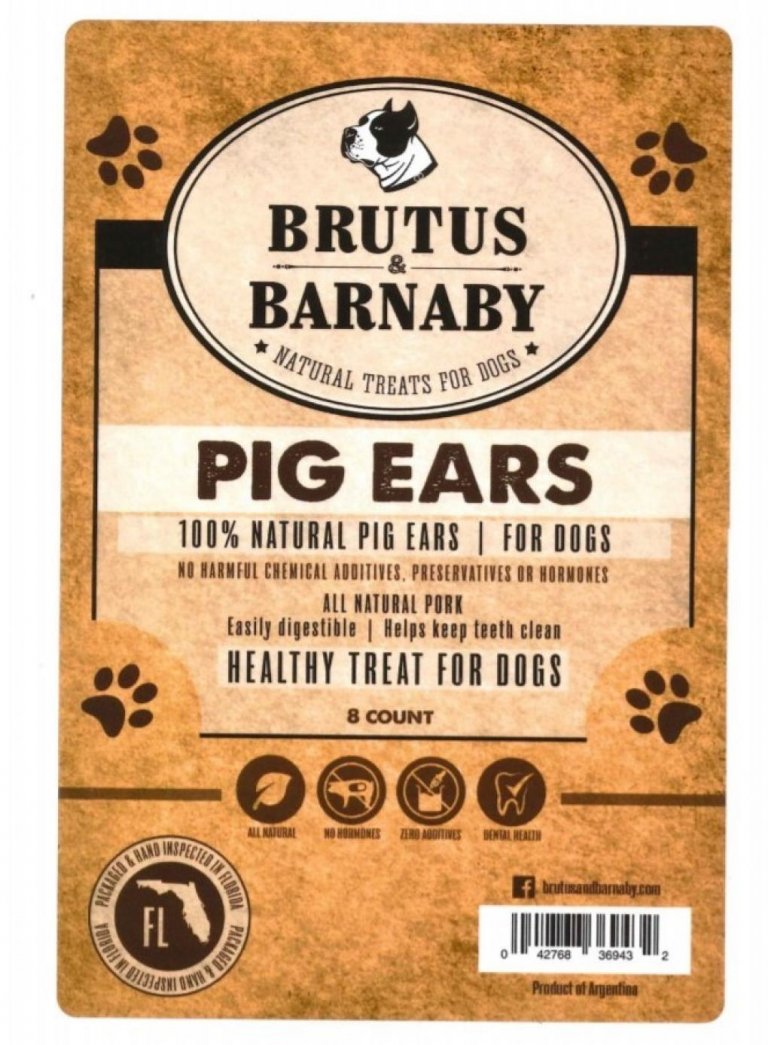
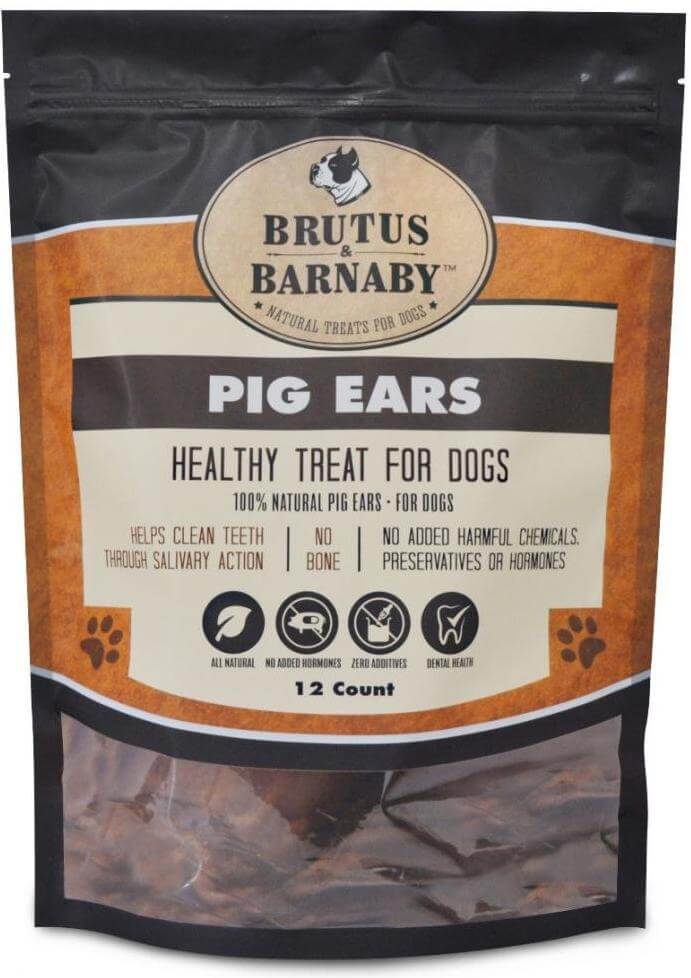
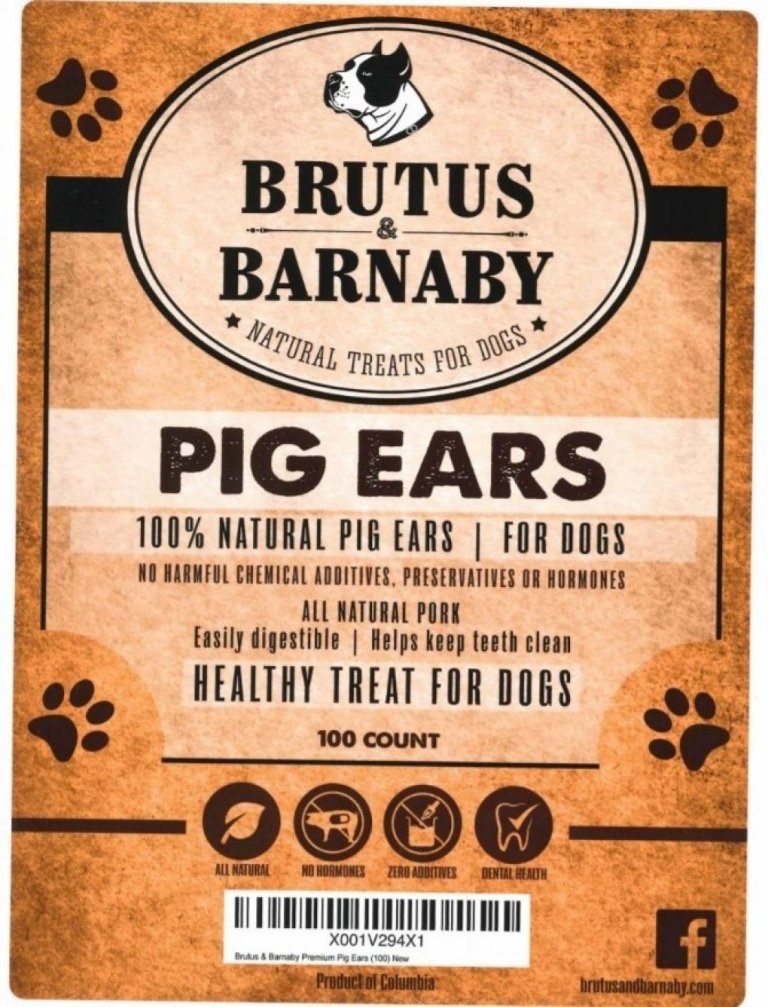
Brutus & Barnaby Pig Ears Dog Treats Recall

August 27, 2019 — Brutus & Barnaby LLC of Clearwater, Florida, is recalling all size variations of its Pig Ears for Dogs because they have the potential to be contaminated with Salmonella bacteria.

What Products Are Recalled?

Bags of Brutus & Barnaby Pig Ears were distributed throughout all states via Amazon.com, Chewy.com, Brutusandbarnaby.com and the brick and mortar Natures Food Patch in Clearwater, Florida.

The product label is identified by the company’s trademarked logo and reads “Pig Ears 100% Natural Treats for Dogs”.

The affected products were available in 4 sizes:

  • Brutus & Barnaby Pig Ears (8 Count)
  • Brutus & Barnaby Pig Ears (12 Count)
  • Brutus & Barnaby Pig Ears (25 Count)
  • Brutus & Barnaby Pig Ears (100 Count)

Brutus & Barnaby has ceased the production and distribution of the product as FDA and the company continue their investigation as to what caused the problem.

About Salmonella

Salmonella can affect animals eating the products and there is risk to humans from handling contaminated pet products, especially if they have not thoroughly washed their hands after having contact with the products or any surfaces exposed to these products.

Healthy people infected with Salmonella should monitor themselves for some or all of the following symptoms: nausea, vomiting, diarrhea or bloody diarrhea, abdominal cramping and fever.

Rarely, Salmonella can result in more serious ailments, including arterial infections, endocarditis, arthritis, muscle pain, eye irritation, and urinary tract symptoms.

Consumers exhibiting these signs after having contact with this product should contact their healthcare providers.

Pets with Salmonella infections may be lethargic and have diarrhea or bloody diarrhea, fever, and vomiting.

Some pets will have only decreased appetite, fever and abdominal pain.

Infected but otherwise healthy pets can be carriers and infect other animals or humans.

If your pet has consumed the recalled product and has these symptoms, please contact your veterinarian.

What to Do?

Consumers who have purchased Brutus & Barnaby pig ears are urged to destroy any remaining product not yet consumed and to contact the place of purchase for a full refund.

Consumers with questions may contact the company at 800-489-0970 Monday through Friday, 9 am to 5 PM ET.

U.S. citizens can report complaints about FDA-regulated pet food products by calling the consumer complaint coordinator in your area.

Or go to https://www.fda.gov/petfoodcomplaints.

Canadians can report any health or safety incidents related to the use of this product by filling out the Consumer Product Incident Report Form.

ooOOoo

Once again, please share this as much as possible. One dog with salmonella is one dog too many!


Chef Toby Pig Ears Recall for dog treats.

Yet another dog food (treats) recall.

There seem to be more than normal just at present.

But anyway let’s go directly to the recall.

ooOOoo

Dog Goods USA Recalls Chef Toby Pig Ears Dog Treats

August 16, 2019 — Dog Goods USA LLC of Tobyhanna, PA, is recalling its Chef Toby Pig Ears Treats due to possible contamination with Salmonella bacteria and its associated health risks.

Chef Toby Pig Ears Treats
Product Images

The images below represent the labels of the recalled products:

What Caused the Recall?

Dog Goods bought the affected products from a single supplier in Brazil from September 2018 through August 2019 and distributed them nationwide in retail stores.

The FDA sampled pig ears manufactured by its supplier in Brazil and one sample tested positive for Salmonella.

As previously reported on this website, the U.S. Food and Drug Administration (FDA), together with the Centers for Disease Control and Prevention (CDC) and State partners, is investigating a suspected link between pig ear pet treats and human cases of salmonellosis.

What’s Being Recalled?

Dog Goods USA LLC is conducting a voluntary recall of the following bulk and packaged pig ears branded Chef Toby Pig Ears.

Product lot codes include: 428590, 278989, 087148, 224208, 1168723, 428590, 222999, 074599, 1124053, 226884, 578867, 224897, 1234750, 444525, 1106709, 215812, 230273, 224970, 585246, 327901, 052248, 210393, 217664, 331199, 225399, 867680, 050273, 881224, 424223, 225979, 431724, 226340, 880207, 334498.

About Salmonella

Healthy people infected with Salmonella should monitor themselves for some or all of the following symptoms: nausea, vomiting, diarrhea or bloody diarrhea, abdominal cramping and fever.

Rarely, Salmonella can result in more serious ailments, including arterial infections, endocarditis, arthritis, muscle pain, eye irritation, and urinary tract symptoms.

Consumers exhibiting these signs after having contact with this product should contact their healthcare providers.

Pets with Salmonella infections may be lethargic and have diarrhea or bloody diarrhea, fever and vomiting.

Some pets will have only decreased appetite, fever and abdominal pain. Infected but otherwise healthy pets can be carriers and infect other animals and humans.

If your pet has consumed the recalled product and has these symptoms, please contact your veterinarian.

For more information about Salmonella and its symptoms and health risks, please refer to the following link: FDA Investigates Contaminated Pig Ear Pet Treats Connected to Human Salmonella Infections.

Company Statement

Dog Goods has also launched an internal investigation to determine if, when and where the Products may have been contaminated.

To date, this internal investigation has not indicated any vulnerability in the company’s practices, including but not limited to the inspection, handling and storage of the Products.

No illnesses have been linked to the products to date.

Nonetheless, Dog Goods will continue to investigate the matter, collaborate fully with the FDA and the CDC, and provide further information to its customers and the public as appropriate.

What to Do?

Consumers who have purchased the products are urged to return them to the place of purchase for a full refund.

Consumers with questions may contact the company at 786-401-6533 (ext 8000) from 9 am ET through 5 pm ET.

U.S. citizens can report complaints about FDA-regulated pet food products by calling the consumer complaint coordinator in your area.

Or go to https://www.fda.gov/petfoodcomplaints.

Canadians can report any health or safety incidents related to the use of this product by filling out the Consumer Product Incident Report Form.

ooOOOo

As always, please share this as far and wide as you can.

Eating organic food!

The jury is still out with regard to organic food being better for you, but …

Jeannie has been a vegetarian for years and I subscribed as soon as we met some eleven years ago.  About two years ago we became vegan and non-dairy.

But that doesn’t necessarily mean that being vegetarian or vegan means eating organically; it’s an assumption.

Now as it happens we also do our best to eat organically.

Is it healthier, all things being equal?

Well The Conversation recently published a post exploring this subject.

ooOOoo

Organic food health benefits have been hard to assess, but that could change

By

Assistant Professor, Boise State University

August 16th, 2019

“Organic” is more than just a passing fad. Organic food sales totaled a record US$45.2 billion in 2017, making it one of the fastest-growing segments of American agriculture. While a small number of studies have shown associations between organic food consumption and decreased incidence of disease, no studies to date have been designed to answer the question of whether organic food consumption causes an improvement in health.

I’m an environmental health scientist who has spent over 20 years studying pesticide exposures in human populations. Last month, my research group published a small study that I believe suggests a path forward to answering the question of whether eating organic food actually improves health.

What we don’t know

According to the USDA, the organic label does not imply anything about health. In 2015, Miles McEvoy, then chief of the National Organic Program for USDA, refused to speculate about any health benefits of organic food, saying the question wasn’t “relevant” to the National Organic Program. Instead, the USDA’s definition of organic is intended to indicate production methods that “foster cycling of resources, promote ecological balance, and conserve biodiversity.”

While some organic consumers may base their purchasing decisions on factors like resource cycling and biodiversity, most report choosing organic because they think it’s healthier.

Sixteen years ago, I was part of the first study to look at the potential for an organic diet to reduce pesticide exposure. This study focused on a group of pesticides called organophosphates, which have consistently been associated with negative effects on children’s brain development. We found that children who ate conventional diets had nine times higher exposure to these pesticides than children who ate organic diets.

Our study got a lot of attention. But while our results were novel, they didn’t answer the big question. As I told The New York Times in 2003, “People want to know, what does this really mean in terms of the safety of my kid? But we don’t know. Nobody does.” Maybe not my most elegant quote, but it was true then, and it’s still true now.

Studies only hint at potential health benefits

Health-conscious people want to buy organic for its health benefits, but it’s not yet clear whether such benefits exist. Goran Bogicevic/Shutterstock.com

Since 2003, several researchers have looked at whether a short-term switch from a conventional to an organic diet affects pesticide exposure. These studies have lasted one to two weeks and have repeatedly shown that “going organic” can quickly lead to dramatic reductions in exposure to several different classes of pesticides.

Still, scientists can’t directly translate these lower exposures to meaningful conclusions about health. The dose makes the poison, and organic diet intervention studies to date have not looked at health outcomes. The same is true for the other purported benefits of organic food. Organic milk has higher levels of healthy omega fatty acids and organic crops have higher antioxidant activity than conventional crops. But are these differences substantial enough to meaningfully impact health? We don’t know. Nobody does.

Some epidemiologic research has been directed at this question. Epidemiology is the study of the causes of health and disease in human populations, as opposed to in specific people. Most epidemiologic studies are observational, meaning that researchers look at a group of people with a certain characteristic or behavior, and compare their health to that of a group without that characteristic or behavior. In the case of organic food, that means comparing the health of people who choose to eat organic to those who do not.

Several observational studies have shown that people who eat organic food are healthier than those who eat conventional diets. A recent French study followed 70,000 adults for five years and found that those who frequently ate organic developed 25% fewer cancers than those who never ate organic. Other observational studies have shown organic food consumption to be associated with lower risk of diabetes, metabolic syndrome, pre-eclampsia and genital birth defects.

The problem with drawing firm conclusions from these studies is something epidemiologists call “uncontrolled confounding.” This is the idea that there may be differences between groups that researchers cannot account for. In this case, people who eat organic food are more highly educated, less likely to be overweight or obese, and eat overall healthier diets than conventional consumers. While good observational studies take into account things like education and diet quality, there remains the possibility that some other uncaptured difference between the two groups – beyond the decision to consume organic food – may be responsible for any health differences observed.

What next?

Often, new medical and health knowledge comes from carefully designed clinical trials, but no such trial has been conducted for organic food. Anyaivanova/Shutterstock.com

When clinical researchers want to figure out whether a drug works, they don’t do observational studies. They conduct randomized trials, where they randomly assign some people to take the drug and others to receive placebos or standard care. By randomly assigning people to groups, there’s less potential for uncontrolled confounding.

My research group’s recently published study shows how we could feasibly use randomized trial methods to investigate the potential for organic food consumption to affect health.

We recruited a small group of pregnant women during their first trimesters. We randomly assigned them to receive weekly deliveries of either organic or conventional produce throughout their second and third trimesters. We then collected a series of urine samples to assess pesticide exposure. We found that those women who received organic produce had significantly lower exposure to certain pesticides (specifically, pyrethroid insecticides) than those who received conventional produce.

On the surface, this seems like old news but this study was different in three important ways. First, to our knowledge, it was the longest organic diet intervention to date – by far. It was also the first to occur in pregnant women. Fetal development is potentially the most sensitive period for exposures to neurotoxic agents like pesticides. Finally, in previous organic diet intervention studies, researchers typically changed participants’ entire diets – swapping a fully conventional diet for a fully organic one. In our study, we asked participants to supplement their existing diets with either organic or conventional produce. This is more consistent with the actual dietary habits of most people who eat organic food – occasionally, but not always.
Even with just a partial dietary change, we observed a significant difference in pesticide exposure between the two groups. We believe that this study shows that a long-term organic diet intervention can be executed in a way that is effective, realistic and feasible.

The next step is to do this same study but in a larger population. We would then want to assess whether there were any resulting differences in the health of the children as they grew older, by measuring neurological outcomes like IQ, memory and incidence of attention-deficit disorders. By randomly assigning women to the organic and conventional groups, we could be sure any differences observed in their children’s health really were due to diet, rather than other factors common among people who consume organic food.

The public is sufficiently interested in this question, the organic market is large enough, and the observational studies suggestive enough to justify such a study. Right now, we don’t know if an organic diet improves health, but based on our recent research, I believe we can find out.

ooOOoo

Fingers crossed that new research takes place.

Because good health at any age is precious!

Texas Tripe Recall

Yet another Dog Food Advisory.

This one from Texas Tripe Inc.

ooOOoo

Texas Tripe Recalls Pet Food Due to Salmonella and Listeria

August 14, 2019 — The U.S. Food and Drug Administration is warning dog owners not to feed certain lots of Texas Tripe raw pet food after samples tested positive for Salmonella and/or Listeria monocytogenes.

The FDA is issuing this alert because these lots of Texas Tripe Inc. raw pet food represent a serious threat to human and animal health.

Because these products are sold and stored frozen, FDA is concerned that people may still have them in their possession.

What’s Being Recalled?

The recalled products are sold frozen in 20-pound and 40-pound cases.

Each case contains multiple plastic pouches.

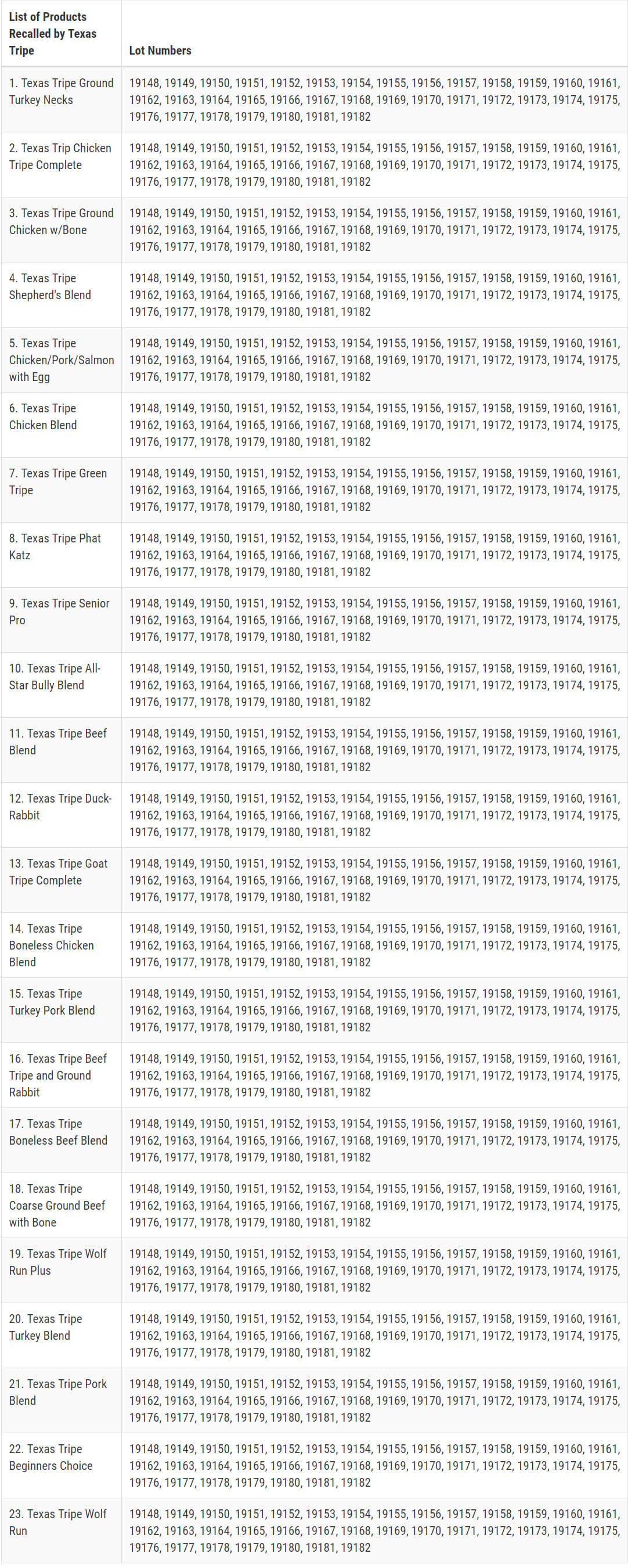
Lot codes to help identify recalled product are printed on the outside of the cases. But the lot codes are not printed on the individual sealed plastic pouches, also known as chubs.

So, if the case has been discarded, there are no unique identification numbers on the individual chubs that allow customers to determine that they possess the recalled products.

These products are manufactured by Texas Tripe Inc. and were sold direct to consumers online and by phone.
The chart below lists the recalled products and lot numbers provided by the firm to FDA on 8/6/2019. These include 35 lots for each of the following 23 product varieties.

The FDA-sampled products below tested positive for Salmonella and/or Listeria monocytogenes (as of 8/13/19) but have not been recalled.

  • Texas Tripe Chicken Blend: Lot 19196-6
  • Texas Tripe Pork Blend: Lot 19190-09
  • Texas Tripe Beef Blend: Lot 19191-05

Where Were the Products Sold?

According to the company, recalled products have been sold directly to consumers in the following states:

  • Alabama
  • Arizona
  • Arkansas
  • California
  • Colorado
  • Florida
  • Georgia
  • Illinois
  • Kansas
  • Kentucky
  • Louisiana
  • Michigan
  • Mississippi
  • Missouri
  • New Jersey
  • New Mexico
  • New York
  • North Carolina
  • Ohio
  • Oklahoma
  • Pennsylvania
  • Tennessee
  • Texas
  • Virginia

What Caused the Recall?

The Office of the Texas State Chemist (OTSC) collected 23 finished product samples at Texas Tripe Inc. Of the 23 samples, 16 tested positive for Listeria and/or Salmonella.

The FDA followed up these findings with an inspection and collected and analyzed samples of unopened finished product, after the firm performed corrective actions, from additional lots of some of the same products tested by OTSC.

FDA testing showed some of the samples contained Salmonella and/or L. mono.

FDA and OSTC shared their test results with Texas Tripe Inc. The firm initiated a recall on July 3, 2019 by directly notifying some of its customers via email.

Why FDA Is Concerned

Pet foods and treats contaminated with Salmonella and L. mono are of particular public health importance because they can affect both human and animal health.

Pets can get sick from these pathogens and may also be carriers of the bacteria and pass it on to their human companions without appearing to be ill.

People can get sick from handling contaminated pet foods and treats or touching surfaces that have had contact with the contaminated pet foods and treats.

Additionally, if a person gets Salmonella or L. mono on their hands, they can spread the bacteria to other people, objects, and surfaces.

The FDA is aware of recent cases in which humans and/or animals have gotten sick from exposure to Salmonella-contaminated pet foods (Salmonella-human cases, Salmonella-kitten, Salmonella-kitten and dog).

Although FDA is not aware of a documented case of a person acquiring L. mono infection from a pet food, once Salmonella or L. mono get established in the pet’s gastrointestinal tract, the animal can shed the bacteria in the feces when it has a bowel movement, and the contamination may continue to spread.

Because animals can shed the bacteria in the feces when they have bowel movements, it’s particularly important to clean up the animal’s feces in yards or parks where people or other animals may become exposed, in addition to cleaning items in the home.

The Federal Food, Drug, and Cosmetic Act requires that all animal food, like human food, be safe to eat, produced under sanitary conditions, contain no harmful substances, and be truthfully labeled.

Without an effective control for pathogens, such as cooking, animal food is more likely to contain pathogens such as Salmonella and L. mono.

Refrigeration or freezing does not kill the bacteria.

About Salmonella

Salmonella is a bacterium that can cause illness and death in humans and animals, especially those who are very young, very old, or have weak immune systems.

According to the CDC, people infected with Salmonella can develop diarrhea, fever and abdominal cramps.

Most people recover without treatment, but in some people, the diarrhea may be so severe that they need to be hospitalized.

In some patients, the Salmonella infection may spread from the intestines to the blood stream and then to other body sites unless the person is treated promptly with antibiotics.

Consult your health care provider if you have symptoms of Salmonella infection.

Pets do not always display symptoms when infected with Salmonella, but signs can include vomiting, diarrhea (which may be bloody), fever, loss of appetite and/or decreased activity level.

If your pet has these symptoms, consult a veterinarian promptly.

You should also be aware that infected pets can shed the bacteria in their feces and saliva without showing signs of being sick, further contaminating the household environment.

About Listeria

Listeria monocytogenes (L. mono) is a bacterium that can cause illness and death in humans and animals, especially those who are pregnant, very young, very old, or have weak immune systems.

According to CDC, listeriosis in humans can cause a variety of symptoms, depending on the person and the part of the body affected.

Symptoms can include headache, stiff neck, confusion, loss of balance, and convulsions in addition to fever and muscle aches.

Pregnant women typically experience only fever and other flu-like symptoms, such as fatigue and muscle aches.

However, infections during pregnancy can lead to miscarriage, stillbirth, premature delivery, or life-threatening infection of the newborn.

Pregnant women and their newborns, adults age 65 and older, and people with weakened immune systems are more likely to get sick with listeriosis.

Anyone with symptoms of listeriosis should contact a health care provider.

L. mono infections are uncommon in pets, but they are possible.

Symptoms may include mild to severe diarrhea, anorexia, fever, nervousness, muscular and respiratory signs, abortion, depression, shock and death.

Pets do not need to display symptoms to be able to pass L. mono on to their human companions.

Once L. mono gets established in the pet’s gastrointestinal tract, the animal can shed the bacteria in the feces when it has a bowel movement…

And the contamination may continue to spread, further contaminating the household environment.

What to Do?

If you have any recalled product, stop feeding it to your pets and throw it away in a secure container where other animals, including wildlife, cannot access it.

Consumers who have had this product in their homes should clean refrigerators/freezers where the product was stored and clean and disinfect all bowls, utensils, food prep surfaces, pet bedding, toys, floors, and any other surfaces that the food or pet may have had contact with.

Clean up the pet’s feces in yards or parks where people or other animals may become exposed.

Consumers should thoroughly wash their hands after handling the recalled product or cleaning up potentially contaminated items and surfaces.

If you believe you have symptoms of Salmonella and L. mono, consult your health care provider.

People who think their pets have become ill after consuming contaminated pet food should first contact their veterinarians.

Veterinarians who wish to have pets tested for Salmonella may do so through the Veterinary Laboratory Investigation and Response Network (Vet-LIRN Network) if the pet is from a household with a person infected with Salmonella.

U.S. citizens can report complaints about FDA-regulated pet food products by calling the consumer complaint coordinator in your area.

Or go to https://www.fda.gov/petfoodcomplaints.

Canadians can report any health or safety incidents related to the use of this product by filling out the Consumer Product Incident Report Form.

ooOOoo

Yet again, share this as far and wide as you can.

And, please, check that you aren’t continuing to use a Texas Tripe product from the above list.

Dog in the road!

An incident yesterday serves as an introduction to today’s post.

I went biking yesterday morning.

I decided to go down Azalea Drive to the end and return the same way; a total of 19.5 miles.

Now about 2 miles into my return I came across a dog playing in the road. Azalea Drive is a pretty busy road and as I approached the dog I had to wave down cars. Soon I was up to it and I noticed it wasn’t wearing a collar but it looked well-fed. It was incredibly friendly and came instantly up to me and allowed me to caress it around its head and ears. It was a black Labrador.

Now not wanting to leave it and the two gates alongside where I was, on the same right-hand side of the road, being padlocked shut I decided to walk a good half-mile down an opposite drive to find someone. I was pushing the bike in my righthand and the dog was walking very happily by my left leg. Eventually I got to the house and rang the bell. Pat and Earl came to the door; it wasn’t their dog as evidenced by the barking of their own dogs. Pat suggested trying the next house South. I left my bike there and Pat gave me a leash to walk the dog with.
So the dog and I walked back down the drive and up the next driveway South. I knocked on the front door.  Several people came to the door. It wasn’t their dog either but a young man kindly offered to take the dog and return it to the property where it lived across the road. Apparently it wasn’t the first time that this had happened; the owners worked all day and the dog had found a gap in the fence.
So I left the beautiful Lab with the young man, thanked him profusely and walked the three-quarters of a mile back to fetch my bike. Thinking that some people didn’t deserve such a beautiful dog!
Now to my post for the day, courtesy of The Dodo.

ooOOoo

Dog Left Tied To Tree Gave The Biggest Smile To Rescuers

PUBLISHED ON 07/31/2019
Photo Credit: Facebook/Patrick Harden

As a group of road workers were collecting trash along a highway in Dutchess County, New York, they suddenly heard barking. They were basically in the middle of nowhere, and couldn’t imagine why a dog would be wandering around there. Still, they knew they had to investigate, and so they followed the barking — and found a dog tied to a tree, deep in the woods away from the highway.

The workers were shocked to find the poor dog tied to the tree, away from where anyone could have spotted him, and he was just as shocked — and overjoyed — to see them too.

Photo Credit: Facebook/Patrick Harden

“He was very happy and excited to see anyone,” Lynne Meloccaro, executive director of the Dutchess County SPCA, told The Dodo. “He had been there for quite a while in 100-plus [degree] weather. He’s clearly got a strong will to live.”

After the New York State Police were contacted, the very excited dog was taken in by the Dutchess County SPCA, who decided to name him Pesci. The staffers there were dumbfounded by how anyone could have abandoned such a happy, upbeat dog. Even after everything he’d been through, he was so thrilled to meet all of his new friends, and didn’t seem to be scared of people one bit.

Photo Credit: Lynne Meloccaro

“He is a very sweet soul,” Meloccaro said. “He’s happiest when he’s with people — he loves to play and get cuddles.”

Besides being dehydrated, Pesci was surprisingly healthy. He’s now thriving in the care of all his new rescue friends, and simply can’t get enough of all the love and attention he suddenly has. The police are now actively investigating how he came to be abandoned, so they can hold whoever did it responsible.

“That he was so far off the road suggests that whoever put him there did not intend for him to be found easily,” Meloccaro said.

Photo Credit: Lynne Meloccaro

Luckily, Pesci is safe now and is already so loved, and the shelter has a feeling he won’t have to wait long before he’s adopted into the best forever home.

“He will be ready for adoption very soon, and given the public interest in this case, I think he will find his forever home in a shorter amount of time than he spent tied to that tree,” Meloccaro said.

ooOOoo

The contrast between the dog I found, or rather the owners, and Dutchess County SPCA is stark!

As I said some people have no right to a loving dog.

Diya’s story

With thanks to Michelle Orcutt.

I am not a great Facebook user. I have nothing against the app just prefer not to be active in terms of my comings and goings. However, I do automatically send posts from this blog across to Facebook. Some of my followers come from FB.

As was the case with Michelle Orcutt.

I went across to her FB ‘page’ to leave my thanks for her follow and read a wonderful account of Diya.

Michelle kindly gave me permission to republish the article in this place. Here it is.

ooOOoo

Diya’s Story

By Michelle Orcutt

Most of my friends know I adopted Diya, originally a street puppy from India (aka a desi dog, an Indie, a native Indian dog, pariah dog, or a streetie), almost 4 years ago. I wrote this for her rescue’s private Facebook group a year ago, in hopes of encouraging a better understanding of street dogs, and have had some requests to make it public, so here it is:

What follows are my own musings, not anything coming from ISDF. I think about dogs a lot!😁 Through Diya’s rescuer’s visit to the Twin Cities, I was able to meet and observe 7 other Indian-Minnesotan dogs. Thinking about some common difficulties voiced by these dogs’ people, and also about some of the worries and frustrations recently expressed in group and my own challenges with Diya, I feel like sharing my perspective.

To a person, the Desi adopters I met here have been patient and accommodating towards their dogs, yet most of the dogs continue to have difficulty in certain situations. These are dogs, working from what their DNA and experience gives them to go on, in a wholly other environment from where they emerged into the world. Especially with random-bred, pariah type dogs like many from India, Oman, and Thailand, these dogs’ lives center around finding food and water, protecting themselves and their territory, avoiding harm, and successfully breeding, bearing, and raising pups. Certainly the pursuit of pleasure and comfortable resting spots plays into their lives too.

We ask these dogs, who are dogs as dogs are truly meant to be—to become “ours” when they arrive in America. We subject them to foreign constraints like crates and leashes, and saddle them with our own expectations. We spend a lot of time telling dogs they are good and that they are bad. But bottom line, they’re dogs, not just our fur babies, or our charges, but entities deserving of respect in their own right. This isn’t to minimize the difficulty and emotional toll of trying to change worrisome behaviors.

Our dogs think hard to get a handle on us; they interpret and build their own sense of the meanings behind our facial expressions, movements, words, tone, touch, habits, clothing, and smells. Their language is far broader than English, Hindi, Arabic, or Thai. They are another form of intelligent life in our midst, in our cars, on our sofas, under the covers and curled into the bend of our knees. Yet they can also be incredibly distressing as they bark at our friends, growl at our guests, lung at terriers, chase cats, and destroy door frames.

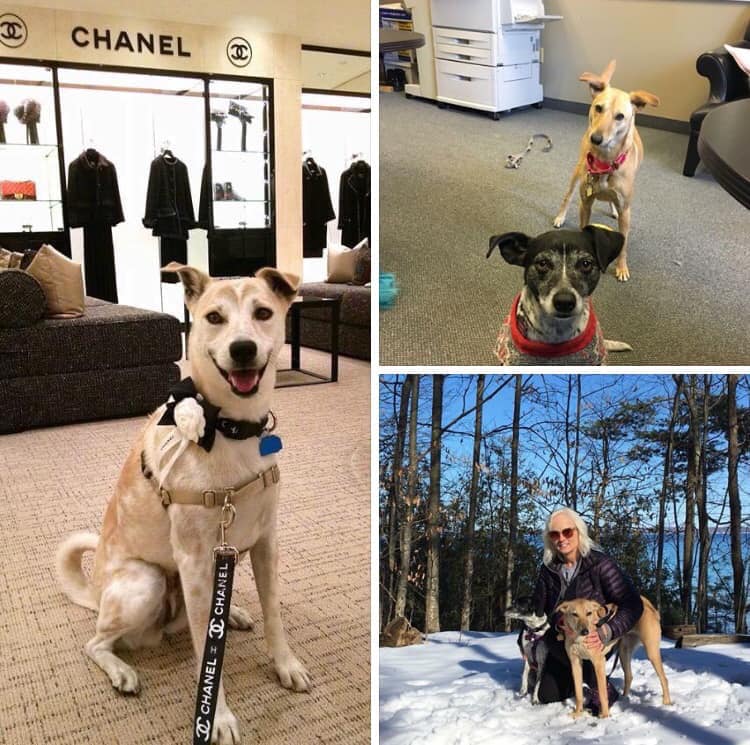
Dogs are incredibly adaptable; this is one of the reasons for their success as a species. A terrified dog rescued from meat trade smugglers in Thailand can transform into a remarkable beauty at ease in a Chanel boutique (😉😉Sparkle Stern); a dog from torrid Muscat can thrive in snow (you Omani pups know who you are). A Delhi puppy fated to starve in the same spot her mother died, can instead run miles through the Michigan woods and “go to work” in an air-conditioned office with her human mom and other people with their own dogs (yes, that’s you, Miss Lily). These changes don’t happen magically or automatically (except in the case of snow), but through initial acts of grace followed by steady and hope-fueled progression.

The things that come easiest to most of these former street puppies and dogs, are the ones that overlap with their natural instincts. Bonding with people who treat them well and provide their food, comfort, and positive mental stimulation is relatively straightforward, though many of our dogs retain more of a capacity for independence than common American companion breeds. Diya is always watching for suspicious people and crows; I live in a part of St. Paul where it’s not uncommon for neighborhood Facebook group posts to start out, “Was that gunshots or fireworks?” so I appreciate her sharp eyes and formidable-sounding bark (I love my city neighborhood, by the way. I love crows too—this is one of the points at which Diya and I differ).

It’s the things that are really weird for street dogs that are hard: being expected to be outgoing, friendly, and trusting of all people and other dogs…always having to stifle your growl…tolerating being left in a wire or plastic box for hours…not being able to run away when you get nervous or to sniff as many spots as you think you need to gather information…to have people decide what you need…going to the vet, going to dog parks, etc. Dogs are social animals, but their idea of social life is different from ours (and also very different from wolves’), and each has their own unique relationship with their person or people, and to the other animals in the household.

So when you are flustered and upset by your dog’s behavior, step back, and think of all we are expecting them to learn and all we are asking them to put aside. Learning new things can be very uncomfortable and anxiety-provoking, especially when going against strong instincts. Living alone with my dogs and cats, and being an introvert by nature, I’ve tended to avoid some trying situations that other families have to work through, but Diya and I have still come a long way. I look forward to finding out where all we’ll go and what we’ll teach each other.

ooOOoo

If you just glanced at this post then make a note, a firm note, to come back and read it fully and carefully.

For Michelle captures precisely what it is to be a dog, especially a street dog.

It is a profoundly wise article and it is a great honour to be able to republish it in this place.

20 Best Dry Dog Foods

Once again it’s time for this review.

This was the email that I received yesterday.

Dear Fellow Dog Lover,

You’re getting this alert because you signed up on our website and asked to be notified. If you no longer wish to receive these emails, please click the “unsubscribe” link at the bottom of this message.

After posting 2 recalls in 4 weeks, the U.S. Food and Drug Administration is now warning consumers to avoid buying or feeding ALL pig ears pet treats.

The outbreak of human Salmonella caused by exposure to the contaminated treats has now spread to 33 states.

To learn which states are included in the outbreak, please visit the following link: FDA: Do Not Buy or Feed ANY Pig Ears Pet Treats

Updated: Best Dry Dog Foods

The Dog Food Advisor has updated its Best Dry Dog Foods page. The list includes BOTH grain-free and grain-inclusive brands.
Check out our 20 Best Dry Dog Foods for August 2019

Please be sure to share the news of this alert with other pet owners.

Mike Sagman, Editor
The Dog Food Advisor
Saving Good Dogs from Bad Dog Food

Do really note that link from the FDA about not feeding any pig ears pet treats.

Please note that not all of the data for each dry dog food can be brought across. I recommend that any products of deep interest are researched online and the information is primary and this page is secondary.

oooooh

On to the August 2019 list of best dry dog foods.

Best Dry Dog Foods 2019

The best dry dog foods listed below have been selected by The Dog Food Advisor because of their exceptional ingredient quality, nutritious design, and the superior safety practices of their manufacturers.

In addition, the labels of these products reveal…

  • Above-average meat content
  • Safe fat-to-protein ratio
  • Moderate carb levels
  • No high-risk ingredients
  • No anonymous meat

Tip: Please don’t overlook our 4-star selections. Many are made by some of the best companies in the industry. They also offer exceptional value for those on a budget.

The Best Dry Dog Foods
August 2019

Here are The Dog Food Advisor’s top 20 best dry dog foods for August 2019.

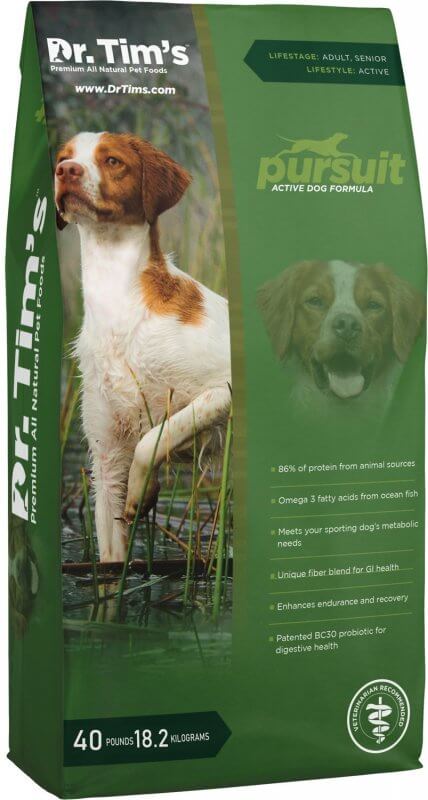
Dr. Tim’s Pursuit Active Dog Formula

Rating: *****

Dr. Tim’s Pursuit Active Dog Formula is one of 8 recipes included in our review of Dr. Tim’s dog food.

  • First 5 ingredients: Chicken meal, brown rice, chicken fat, whole oat groats, dried beet pulp
  • Type: Grain-inclusive (contains grain)
  • Profile: All life stages
  • Best For: All adults and small/medium breed puppies
  • See all 8 available recipes

Dr. Tim’s Pursuit Active Dog Formula derives the bulk of its animal protein from chicken meal. Our dry matter label analysis reveals the recipe contains 33% protein, 22% fat and 36% estimated carbs… creating a fat-to-protein ratio of about 67%.

oooo

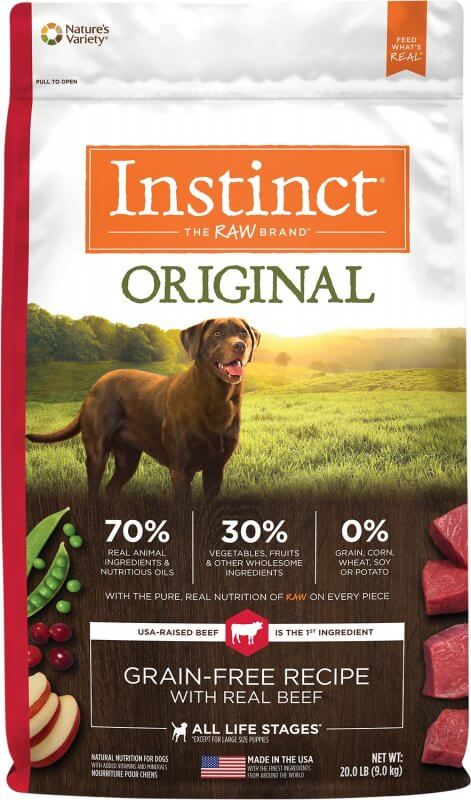
Instinct Original with Real Beef Dry Dog Food

Rating: *****

Instinct Original with Real Beef is one of 6 recipes included in our review of Instinct Original dog food.

  • First 5 ingredients: Beef, chicken meal, white fish meal, peas, chicken fat
  • Type: Grain-free
  • Profile: All life stages
  • Best For: All adults and puppies
  • See all 6 available recipes

Instinct Original with Real Beef derives most of its animal protein from beef, chicken meal and fish meal. Our dry matter label analysis reveals the recipe contains 40% protein, 21% fat and 31% estimated carbs… producing a fat-to-protein ratio of about 53%.

oooo

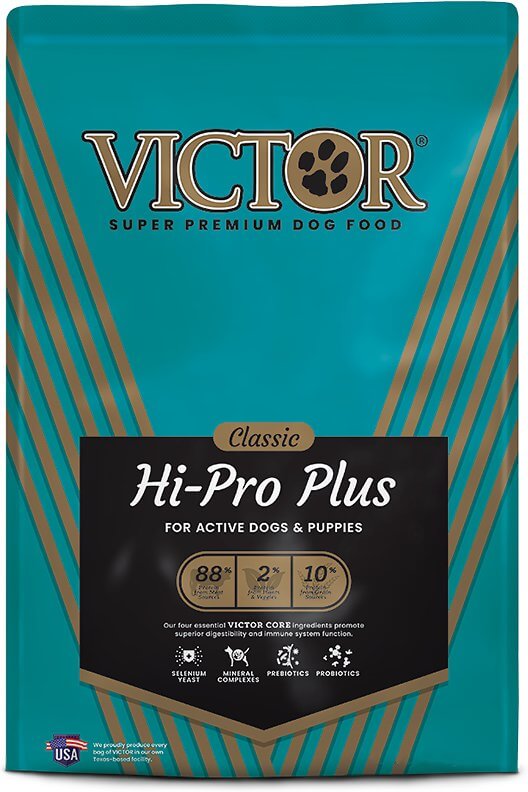
Victor Hi-Pro Plus Formula Dry Dog Food

Rating: *****

Victor Hi-Pro Plus is one of 4 recipes included in our review of Victor Classic dog food.

  • First 5 ingredients: Beef meal, grain sorghum, chicken fat, pork meal, chicken meal
  • Type: Grain-inclusive (contains grain)
  • Profile: All life stages
  • Best For: All adults and small/medium breed puppies
  • See all 4 available recipes

Victor Hi-Pro Plus derives the majority of its animal protein from beef meal. Our dry matter label analysis reveals the recipe contains 33% protein, 22% fat and 37% estimated carbs… which results in a fat-to-protein ratio of about 67%.

oooo

Annamaet Ultra Dry Dog Food

Rating: *****

Annamaet Ultra is one of 7 recipes included in our review of Annamaet dog food.

  • First 5 ingredients: Chicken meal, brown rice, chicken fat, whole dry eggs, herring meal,
  • Type: Grain-inclusive (contains grain)
  • Profile: All life stages
  • Best For: All adults and puppies
  • See all 7 available recipes

Annamaet Ultra derives most of its animal protein from chicken meal. Our dry matter label analysis reveals the recipe contains 36% protein, 22% fat and 34% estimated carbs… yielding a fat-to-protein ratio of about 63%.

oooo

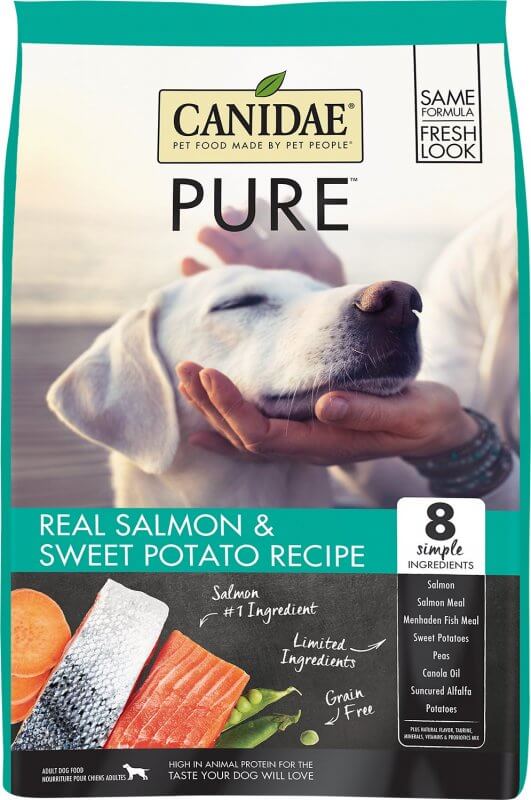
Canidae Pure Real Salmon and Sweet Potato

Rating: *****

Canidae Pure Real Salmon and Sweet Potato is one of 11 recipes included in our review of Canidae Grain-Free Pure dog food.

  • First 5 ingredients: Salmon, salmon meal, menhaden fish meal, sweet potatoes, peas
  • Type: Grain-free
  • Profile: Maintenance
  • Best For: Adults only (not for puppies)
  • See all 11 available recipes

Canidae Pure Real Salmon and Sweet Potato derives the bulk of its animal protein from salmon. Our dry matter label analysis reveals the recipe contains 36% protein, 20% fat and 36% estimated carbs… resulting in a fat-to-protein ratio of about 56%.

oooo

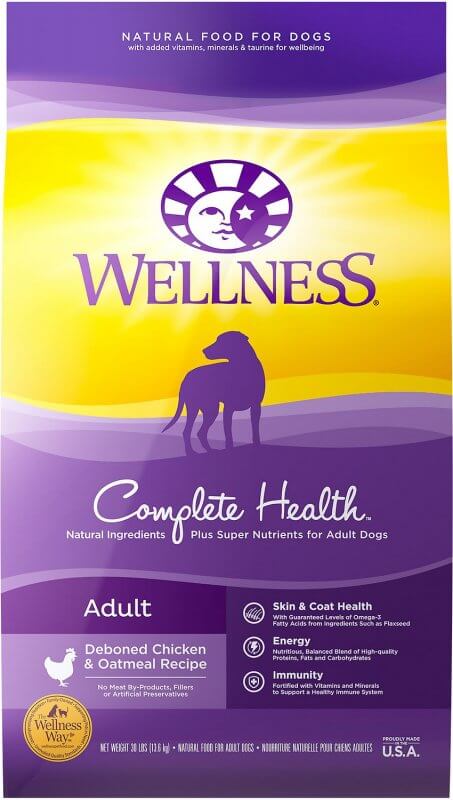
Wellness Complete Health Adult Dry Dog Food

Rating: ****

Wellness Complete Health Adult is one of 14 recipes included in our review of Wellness Complete Health dog food.

  • First 5 ingredients: Deboned chicken, chicken meal, oatmeal, ground barley, peas
  • Type: Grain-inclusive (contains grain)
  • Profile: Maintenance
  • Best For: Adults only (not for puppies)
  • See all 14 available recipes

Wellness Complete Health Adult derives most of its animal protein from chicken. Our dry matter label analysis reveals the recipe contains 27% protein, 13% fat and 52% estimated carbs… which yields a fat-to-protein ratio of about 50%.

oooo

Orijen Original Dry Dog Food

Rating: *****

Orijen Original is one of 8 recipes included in our review of Orijen dog food.

  • First 5 ingredients: Deboned chicken, deboned turkey, Atlantic flounder, cage-free eggs, whole Atlantic mackerel
  • Type: Grain-free
  • Profile: All life stages
  • Best For: All adults and puppies
  • See all 8 available recipes

Orijen Original derives the majority of its animal protein from deboned poultry and Atlantic fish. Our dry matter label analysis reveals the recipe contains 43% protein, 21% fat and 28% estimated carbs… which produces a fat-to-protein ratio of about 47%.

oooo

Diamond Naturals Extreme Athlete

Rating: *****

Diamond Naturals Extreme Athlete is one of 12 recipes included in our review of Diamond Naturals dog food.

  • First 5 ingredients: Chicken meal, chicken, ground white rice, chicken fat, cracked pearled barley
  • Type: Grain-inclusive (contains grain)
  • Profile: Maintenance
  • Best For: Adults only (not for puppies)
  • See all 12 available recipes

Diamond Naturals Extreme Athlete derives the bulk of its animal protein from chicken. Our dry matter label analysis reveals the recipe contains 36% protein, 28% fat and 29% estimated carbs… resulting in a fat-to-protein ratio of about 78%.

oooo

Nature’s Logic Canine Chicken Meal Feast

Rating: *****

Nature’s Logic Canine Chicken Meal Feast is one of 9 recipes included in our review of Nature’s Logic dog food.

  • First 5 ingredients: Chicken meal, millet, chicken fat, pumpkin seed, yeast culture
  • Type: Grain-inclusive (contains grain)
  • Profile: All life stages
  • Best For: All adults and puppies
  • See all 9 available recipes

Nature’s Logic Canine Chicken Meal Feast derives most of its animal protein from chicken meal. Our dry matter label analysis reveals the recipe contains 40% protein, 17% fat and 36% estimated carbs… which creates a fat-to-protein ratio of about 42%.

oooo

Nulo Freestyle Adult Turkey and Sweet Potato

Rating: *****

Nulo Freestyle Turkey and Sweet Potato is one of 8 recipes included in our review of Nulo Freestyle dog food.

  • First 5 ingredients: Deboned turkey, turkey meal, salmon meal, chickpeas, chicken fat
  • Type: Grain-free
  • Profile: Maintenance
  • Best For: Adults only (not for puppies)
  • See all 8 available recipes

Nulo Freestyle Turkey and Sweet Potato derives the bulk of its animal protein from poultry meal and salmon meal. Our dry matter label analysis reveals the recipe contains 37% protein, 20% fat and 35% estimated carbs… creating a fat-to-protein ratio of about 55%.

oooo

Nutro Ultra Adult Dry Dog Food

Rating: ****

Nutro Ultra Adult is one of 10 recipes included in our review of Nutro Ultra dog food.

  • First 5 ingredients: Chicken, chicken meal, whole brown rice, brewers rice, rice bran
  • Type: Grain-inclusive (contains grain)
  • Profile: Maintenance
  • Best For: Adults only (not for puppies)
  • See all 10 available recipes

Nutro Ultra Adult derives most of its animal protein from chicken and chicken meal. Our dry matter label analysis reveals the recipe contains 28% protein, 16% fat and 49% estimated carbs… producing a fat-to-protein ratio of about 56%.

oooo

Go! Solutions Carnivore Chicken, Turkey and Duck

Rating: **** and a half star!

Go! Solutions Carnivore Chicken, Turkey and Duck is one of 5 recipes included in our review of Go! Solutions Carnivore dog food.

  • First 5 ingredients: Chicken meal, turkey meal, salmon meal, de-boned chicken, de-boned turkey
  • Type: Grain-free
  • Profile: Maintenance
  • Best For: Adults only (not for puppies)
  • See all 5 available recipes

Go! Solutions Carnivore Chicken, Turkey and Duck derives the majority of its animal protein from poultry meal, salmon meal and deboned poultry. Our dry matter label analysis reveals the recipe contains 38% protein, 18% fat and 36% estimated carbs… yielding a fat-to-protein ratio of about 47%.

oooo

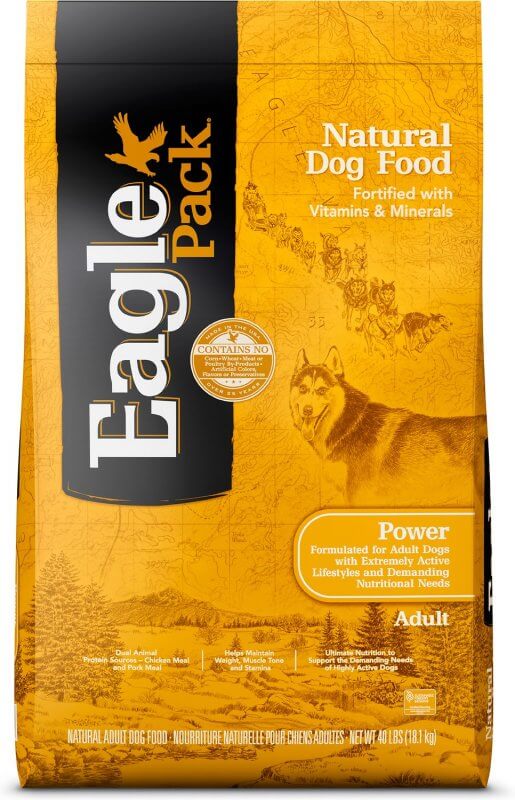
Eagle Pack Power Adult Dry Dog Food

Rating: *****

Eagle Pack Power Adult is one of 7 recipes included in our review of Eagle Pack dog food.

  • First 5 ingredients: Chicken meal, pork meal, ground brown rice, peas, chicken fat
  • Type: Grain-inclusive (contains grain)
  • Profile: Maintenance
  • Best For: Adults only (not for puppies)
  • See all 7 available recipes

Eagle Pack Power Adult derives most of its animal protein from chicken meal and pork meal. Our dry matter label analysis reveals the recipe contains 33% protein, 21% fat and 38% estimated carbs… resulting in a fat-to-protein ratio of about 63%.

oooo

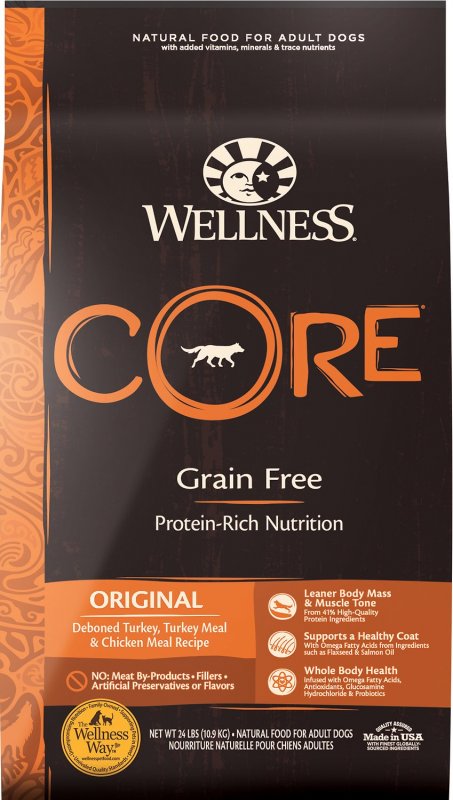
Wellness Core Original Formula Dry Dog Food

Rating: *****

Wellness Core Original is one of 12 recipes included in our review of Wellness Core dog food.

  • First 5 ingredients: Deboned turkey, turkey meal, chicken meal, peas, potatoes
  • Type: Grain-free
  • Profile: Maintenance
  • Best For: Adults only (not for puppies)
  • See all 12 available recipes

Wellness Core Original derives the bulk of its animal protein from chicken. Our dry matter label analysis reveals the recipe contains 38% protein, 18% fat and 36% estimated carbs… which produces a fat-to-protein ratio of about 47%.

oooo

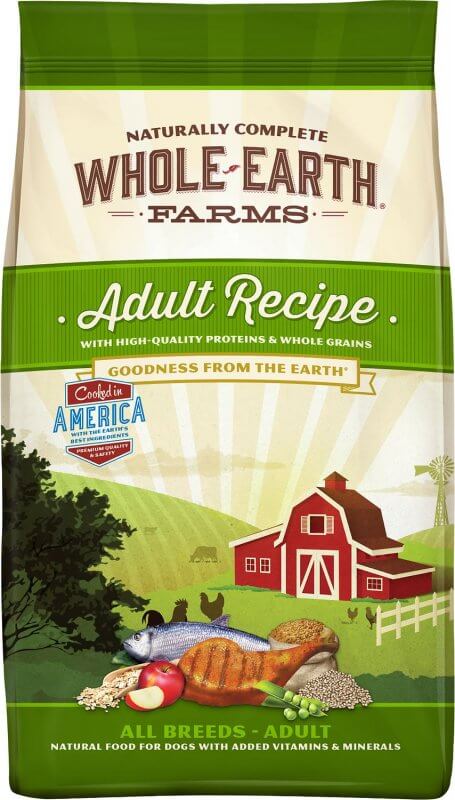
Whole Earth Farms Adult Recipe

Rating: ****

Whole Earth Farms Adult Recipe is one of 2 recipes included in our review of Whole Earth Farms dog food.

  • First 5 ingredients: Chicken meal, turkey meal, brown rice, oatmeal, barley
  • Type: Grain-inclusive (contains grain)
  • Profile: Maintenance
  • Best For: Adults only (not for puppies)
  • See both available recipes

Whole Earth Farms Adult Recipe derives the majority of its animal protein from poultry meal. Our dry matter label analysis reveals the recipe contains 29% protein, 15% fat and 48% estimated carbs… resulting in a fat-to-protein ratio of about 50%.

oooo

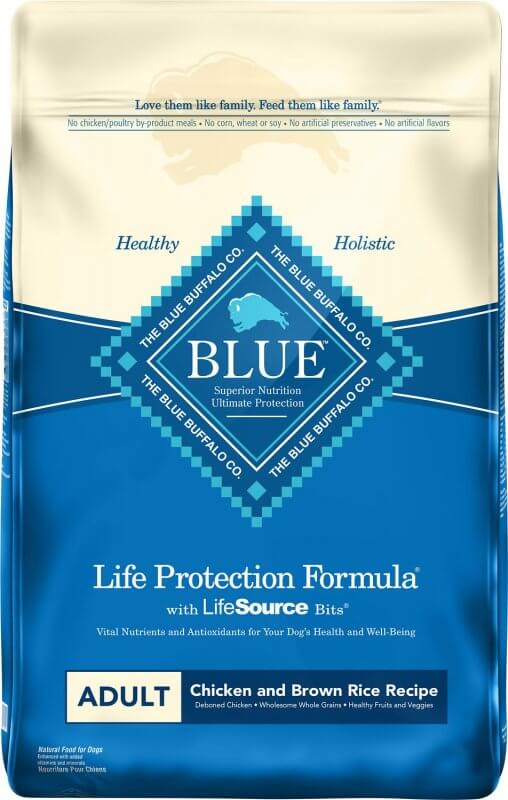
Blue Buffalo Life Protection Chicken and Brown Rice

Rating: ****

Blue Buffalo Life Protection Chicken and Brown Rice is one of 23 recipes included in our review of Blue Buffalo Life Protection dog food.

  • First 5 ingredients: Deboned chicken, chicken meal, brown rice, barley, oatmeal
  • Type: Grain-inclusive (contains grain)
  • Profile: Maintenance
  • Best For: Adults only (not for puppies)
  • See all 23 available recipes

Blue Buffalo Life Protection Chicken and Brown Rice derives the majority of its animal protein from deboned chicken and chicken meal. Our dry matter label analysis reveals the recipe contains 27% protein, 16% fat and 50% estimated carbs… which creates a fat-to-protein ratio of about 58%.

oooo

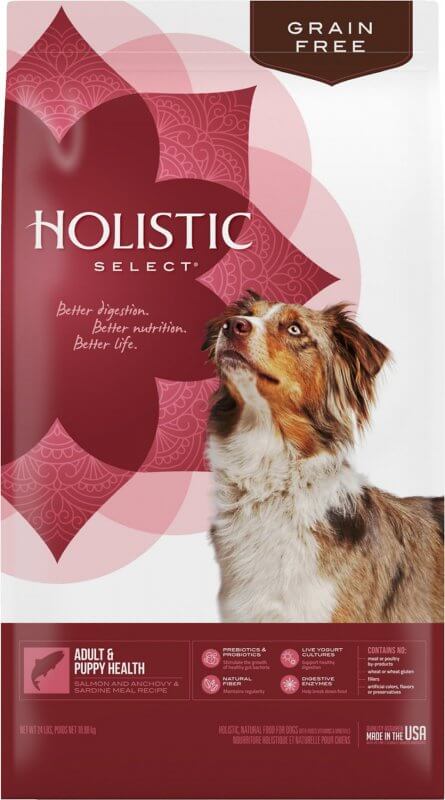
Holistic Select Grain-Free Adult and Puppy Health

Rating: **** and a half star.

Holistic Select Grain-Free Adult and Puppy Health is one of 10 recipes included in our review of Holistic Select Grain-Free dog food.

  • First 5 ingredients: Salmon, anchovy and sardine meal, potatoes, peas, menhaden fish meal
  • Type: Grain-free
  • Profile: All life stages
  • Best For: All adults and small/medium breed puppies
  • See all 10 available recipes

Holistic Select Grain-Free Adult and Puppy Health derives most of its animal protein from salmon and fish meal. Our dry matter label analysis reveals the recipe contains 32% protein, 16% fat and 44% estimated carbs… producing a fat-to-protein ratio of about 48%.

oooo

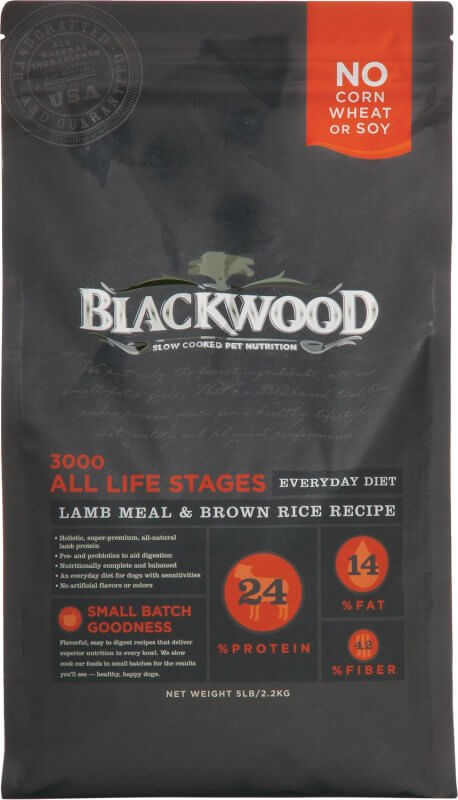
Blackwood 3000 All Life Stages Everyday Diet Dry Dog Food

Rating: ****

Blackwood 3000 All Life Stages Everyday Diet is one of 5 recipes included in our review of Blackwood Everyday Recipes.

  • First 5 ingredients: Lamb meal, brown rice, oat groats, millet, chicken meal
  • Type: Grain-inclusive (contains grain)
  • Profile: All life stages
  • Best For: All adults and puppies
  • See all 5 available recipes

Blackwood 3000 All Life Stages Everyday Diet derives the majority of its animal protein from lamb meal. Our dry matter label analysis reveals the recipe contains 27% protein, 16% fat and 50% estimated carbs… creating a fat-to-protein ratio of about 58%.

oooo

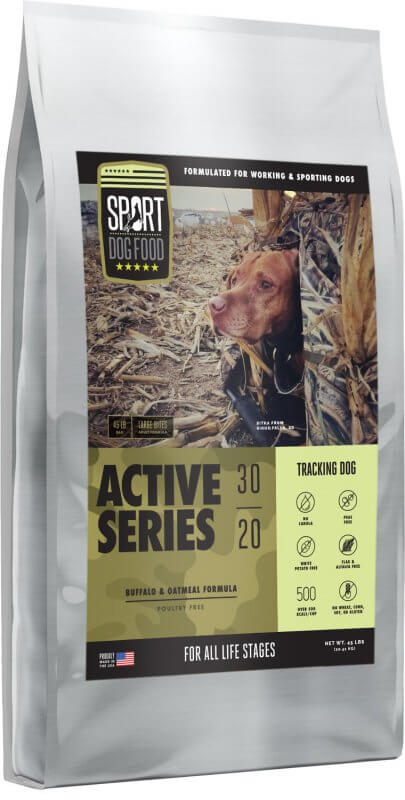
Sport Dog Food Active Series Tracking Dog

Rating: **** and a half star.

Sport Dog Food Active Series Tracking Dog is one of 5 recipes included in our review of Sport Dog Active Series dog food.

  • First 5 ingredients: Buffalo meal, oatmeal, dried sweet potato, pork meal, coconut oil
  • Type: Grain-inclusive (contains grain)
  • Profile: Maintenance
  • Best For: Adults only (not for puppies)
  • See all 5 available recipes

Sport Dog Active Series Tracking Dog derives most of its animal protein from buffalo meal. Our dry matter label analysis reveals the recipe contains 33% protein, 22% fat and 37% estimated carbs… yielding a fat-to-protein ratio of about 67%.

oooo

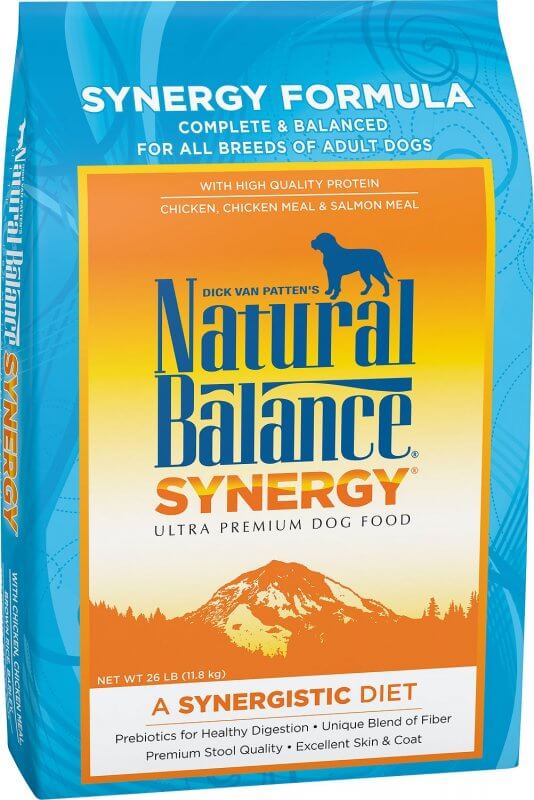
Natural Balance Synergy Dry Dog Food

Rating: **** and a half star.

This sole recipe is included in our review of Natural Balance Synergy dog food.

  • First 5 ingredients: Chicken, chicken meal, brown rice, chicken fat, dried beet pulp,
  • Type: Grain-inclusive
  • Profile: Maintenance
  • Best For: Adults only (not for puppies)

Natural Balance Synergy derives the bulk of its animal protein from chicken and chicken meal. Our dry matter label analysis reveals the recipe contains 31% protein, 18% fat and 43% estimated carbs… which results in a fat-to-protein ratio of about 57%.

ooOOoo

Phew!

That was quite a ‘copy and paste’.

Yet another dog food recall.

The end of the month brings yet another recall.

It’s salmonella again.

ooOOoo

Lennox International Recalls Pig Ears Dog Treats

July 26, 2019 — The Lennox International, Inc., of Edison NJ, is voluntary recallingits Natural Pig Ears dog treats because they may be contaminated with Salmonella.

What’s Recalled?

The affected pig ears product is supplied in an 8-pack branded pouch under UPC 742174 995163 and 742174994166.

It is also available in an individually shrink-wrapped package under UPC 0385384810 and 742174P35107.

All UPC codes are located on the front label of the package.

Package Image

The following low resolution product image was supplied by the company along with its announcement.

About Salmonella

Salmonella can affect animals eating the product and there is risk to humans from handling contaminated products, especially if they have not thoroughly washed their hands after having contact with the products or any surfaces exposed to these products which are solely for the consumption by dogs.

Healthy people infected with Salmonella should monitor themselves for some or all of the following symptoms: nausea, vomiting, diarrhea or bloody diarrhea, abdominal cramping and fever.

Rarely, Salmonella can result in more serious ailments, including arterial infections, endocarditis, arthritis, muscle pain, eye irritation, and urinary tract symptoms.

Consumers exhibiting these signs after having contact with this product should contact their healthcare providers.

Pets with Salmonella infections may be lethargic and have diarrhea or bloody diarrhea, fever, and vomiting.

Some pets will have only decreased appetite, fever and abdominal pain.

Infected but otherwise healthy pets can be carriers and infect other animals or humans.

If your pet has consumed the recalled product and has these symptoms, please contact your veterinarian.

About the Recall

The recalled products were shipped nationwide to distributors and retail stores between May 1 and July 3, 2019.

To date, Lennox is aware of two cases of its pig ears causing illnesses in dogs.

These cases may be related to the ongoing FDA investigation of Salmonella illness associated with what appears to be a multiple source.

What to Do?

Consumers who have purchased the product and have proper receipt may return product. Or they may contact the company at 800-538-8980, Monday to Friday, 9 to 5 pm, for a refund or additional information.

Consumers may also email the company at usaoffice@lennoxpets.com.

U.S. citizens can report complaints about FDA-regulated pet food products by calling the consumer complaint coordinator in your area.

Or go to https://www.fda.gov/petfoodcomplaints.

Canadians can report any health or safety incidents related to the use of this product by filling out the Consumer Product Incident Report Form.

Get Dog Food Recall Alerts by Email

Get free dog food recall alerts sent to you by email. Subscribe to The Dog Food Advisor’s emergency recall notification system.

ooOOoo

Again, please share this with other dog owners.