On April 2nd, I published an account of a flight in a Hawker Hunter that my dear cousin, Richard, experienced in 2003, the 50th anniversary of Neville Duke’s breaking of the existing world speed record on September 7th, 1953. Neville Duke died in 2007 at the age of 85.
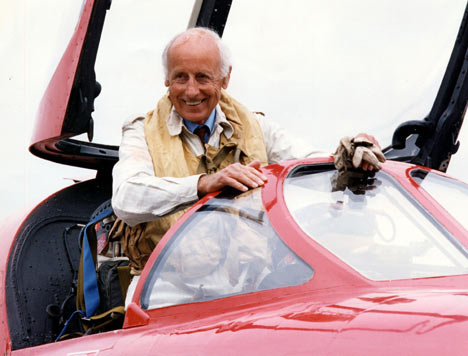
Squadron Leader Neville Duke, 85, flew 485 operational sorties during the war
It seemed fitting to add a little more information about this marvellous aircraft from an era when Britain built some of the best aircraft in the world.
As always, WikiPedia has an excellent account of the history of the aircraft. So this Post will just present a few images for readers to ooh, aah over!
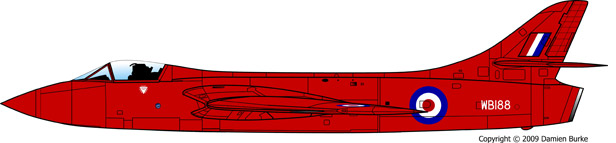
Thunder and Lightnings has some excellent images of all the different types including WB188 that Duke broke the speed record in.
Copyright 2009 Damien Burke
F.3 WB188, Hawker Aircraft, RAF Tangmere, 1953; author As at 7th September 1953, when World Absolute Speed Record of 722.2 mph gained by Neville Duke; pointed nose, reheated engine, additional curved/raked windscreen
Later scheme of Scarlet Red
There is also a distant connection with our erstwhile editor, Paul. Paul used to fly a TB2o from Exeter Airfield in SW England which is where the Hunter Club is based. Jonathan Whaley, who commanded the Hunter that Richard flew in, has his own personal Hunter – Miss Demeanour – registration G-PSST so during the summer months it was not uncommon to see Hunters in the sky above Exeter.
Hawker Hunter 'Miss Demeanour'
Finally, a couple of videos to drool over.
and a lovely display at RAF Waddington in rather unpleasant weather conditions
I have hit a man only once in my adult life. Only once, but this was a full-out, closed-fist, knock-you-off-your-feet slug that dared him to come back for more. And he didn’t. One slug did it! How empowering!
Bob (name changed) took me and George (my then-fiancé and now ex-husband) for a ride in a four-seat plane above the skyline in downtown Dallas, Texas late one summer night when the skies were dark and the stars were bright.
Private Plane
Bob was a friend of Allen, who was a very good friend of mine and an accomplished private pilot who had introduced me to the joys of flying. Allen trusted Bob and I trusted Allen, so I was not unusually concerned about Bob’s ability to get us back down safely. But I hadn’t factored in Bob’s judgment, or lack thereof.
I think, in hindsight, that Bob had hoped I would show up for the ride alone despite the fact that I had arranged it as a surprise for George. The plan was for George to sit up front and play co-pilot. Upon arrival at the hanger, however, Bob promptly stuck George in the back seat of the plane and then turned his full attention to me. I’m usually fairly dense to these things, but it was apparent even to me that Bob considered this to be a “date.” He was charming, animated and very friendly, while virtually ignoring George’s very existence. We reviewed the safety measures, checked out the plane, and away we went.
Bob was showing me a series of maneuvers, swooping and banking and it was all lovely and exciting until…..a sudden plunge…..and everything instantly blacked out. It was very disorienting — even though my eyes were wide open and I was totally conscious, I could not see a thing.
The sirens started blaring; a recorded voice shouted “Stall! Stall! Stall!” I called to George but he didn’t answer. Either he was unconscious or couldn’t hear me over the noise, but I wasn’t sure which. I reached out to Bob, but he was unresponsive and felt limp. Now I was really worried. Momentarily terrified, actually, with that cold feeling of raw fear in the pit of my stomach. I thought to myself, “If I am blacked out and cannot see, then HE, the, um, PILOT, might be blacked out as well!”
I had what seemed like a very long time to ponder what I could do to survive this emergency, and keep George alive, who was there because of me! I tried to feel my way along the control panel to find the radio to call out “May Day,” but that wasn’t going too well. Somehow — I don’t know how because I still could not see! — Bob got us out of the descent, pulling the nose up and righting the plane. The sirens and warnings stopped. After a few more moments, my vision came back, and my stomach returned to its rightful place. We landed in one piece.
But when ole’ Bob got out of the pilot’s seat and walked around the plane to help me exit, I had a little surprise for him. Actually, it was a surprise for me, too, because I didn’t plan it and didn’t “see” or “feel” it coming. The next thing I knew I had drawn my right arm back, made a fist, and threw it into his left shoulder with everything I had. POW!
He stumbled, grabbed his arm, and said “Ow! What did you do THAT for?” Well, I didn’t think I had to explain how I thought he had just put my life and that of a friend in danger just to show off. I didn’t think he would see it the way I did, that he had flown that plane beyond his ability to control it. And even if he was in control the entire time, which I doubted, he scared the bajeebees out of me which was reason enough for me to sock him one!
I don’t recommend physical violence, even if the assailant is half the size of the perpetrator, but I have to tell you that to my knowledge, Bob never took another unsuspecting victim up for a little spin around the tops of buildings in downtown Dallas. And I know that if I ever really need to wind it up and let her go, I do have it in me.
A personal story about a wonderful flying experience.
This is a tale about my cousin Richard. He has never been a pilot but has always been fascinated in flying. He was reminiscing the other day about an event in a lifetime, flying in a military jet. But this was no ordinary jet, this was the iconic Hawker Hunter.
These are Richard’s words.
It all started early in 2003. Lynne and I decided to take her son Henry and his friend to Tangmere Air Museum.
We were looking around, and were particularly taken by the bright red Hawker Hunter (WB188), in which Neville Duke had broken the world speed record on 7th September 1953, between Littlehampton and Worthing piers.
The curator of the museum was listening to us, and said – ‘Sad, isn’t it, we were hoping to have a 50th anniversary re-run of the flight. We have the aeroplane and the pilot, but nobody will sponsor us the fuel‘.
In the way that Lynne does, she just said ‘That’s alright, Richard will sponsor you the fuel!’
Well, that was all very well, but how much would it cost?
Anyway, to cut a long story short, a cheque for £1,600 ($2,400) was sent to the Hunter Flying Club at Exeter, which was followed by a telephone call from them. Basically, they said they were going to use a 2 seat Hunter, and as I had paid for the fuel, would I like the left hand seat!!!
On the morning of 7th September, I drove to Exeter Airport, and was introduced to the ground crew, and to the pilot Jonathan Whaley, who has his own multi-coloured Hunter ‘Miss Demeanor’, which I am sure you will have seen on the air display circuits.
WV322 looked stunning with newly painted top, tail and fuel tanks in gleaming red to remind us of WB188, which was painted bright red so that it could be easily seen by the timekeepers.
Settling into the LH seat!
After an hours tuition on the use of the ejector seat, the time came to be shoe-horned into the cockpit, and we taxied out. Special permission had been given for us to take-off towards the East, even though the pattern for the day was to the West. This was to save as much fuel as possible, as we had a long way to go!
A very smooth take-off, and a cruise at approx 3000 feet along the south coast to Chichester, followed by a sudden turn to the left and a dive into Goodwood, where the Revival Meeting was taking place. After nearly taking the roof off the Grandstand, a climbing turn and a low pass over Tangmere (where Neville Duke was watching), and on towards Selsea Bill.
Hunter and me!
A sharp left turn, and we were on our way past Littlehampton, and on towards Worthing Pier, where family and friends were waiting.
Well! We passed Worthing Pier at about 400 knots and at 400 feet, immediately going up into a Derry turn and pulling 4G!
It was unbelievable. I remember seeing the sea a few feet above my head, followed by the pebbles on the beach, at which point I thought ‘He’s never going to get round to the end of the pier – he’s going straight across the town!’
Of course, I was wrong, and we made a slower run back past the pier, and Jonathan gave a nice little ‘Wing Waggle’ for the people watching.
Back to Selsea Bill, and Jonathan said to me that he had heard that Neville Duke had actually done three Victory rolls across Tangmere to celebrate. ‘O.K., we’ll do the same‘
Three very sharp rolls later, and he realised he had ‘rolled’ over the wrong greenhouses!. (Tangmere these days is covered in greenhouses). So, three more very tight rolls – this time in the correct place – before a fast run back into Goodwood before a sharp climb and three more rolls – wow! Nine rolls in a matter of seconds!
A turn towards the Solent, and we formated with a Russion Yak, with rear cockpit open, and a photographer giving Jonathan instructions so that he could get a good variety of shots.
YAK - photo platform!
Then, with limited fuel, it was time to go. Imagine how I felt when Jonathan handed me the controls! All my birthdays had come at once!
As we approached Exeter, the weather was closing in. We just had time for Jonathan to play his favourite game – Up over a big cumulus cloud, down the other side, banking hard through a small gap between the clouds.
At this point, I confess that the negative ‘G’ had the cold sweat appearing on my forehead. Then it was back into Exeter and a smooth landing, braking hard before the end of the runway.
‘That’s fine‘ said Jonathan, ‘We’ve still got 7 minutes fuel left‘. Sensing my concern, he added, ‘Don’t worry – You can go a long way in 7 minutes in one of these!!‘
Taxiing back to our stand, followed by being told to keep still while the ‘seat’ was disarmed, and a shaky me made my way down the ladder onto the ground, where I was offered a cup of tea – it was wonderful. The grin on my face stretched from ear to ear.
The total flight was 70 minutes, and it is 70 minutes of my life that I will never forget
Rather than dilute Richard’s account here, I will add another article with some general background information on the Hunter in the next few days.
There are many famous names in aviation but I would wager that Elinor Smith, despite being one of the greats in the history of flying, is not a name that falls off the lips of thousands. It ought to.
Last Friday, just a week ago, Elinor Smith died at the amazing age of 98.
Elinor Smith
There are many accounts of her life accessible online. Here’s an extract from an obituary published by the Wall Street Journal.
Ms. Smith, who died Friday at age 98, was one of the last survivors of aviation’s early barnstorming days. She flew with such legends as Amelia Earhart and James Doolittle. She recalled Charles Lindbergh seeing her off from Roosevelt Field in 1928 on her most notorious exploit, flying under four of New York City’s East River bridges.
and also from the WSJ:
Over the next few years, Ms. Smith would set numerous records, spurred on by a handful of other aviatrices, including Ms. Earhart, Bobbi Trout, and Pancho Barnes. All were trumpeted by the media. Ms. Smith’s “Flying Flapper” moniker was matched by “The Flying Cashier” and “The Flying Salesgirl.” Each strove to break free of the pack.
“That’s how you got jobs, by setting records,” said Dorothy Cochrane, a curator at the National Air and Space Museum. “Women had to take what they could get since careers in the military were closed to them.”
Ms. Smith set several endurance records, and once flew so high in an attempt to set the altitude record that she blacked out above 30,000 feet.
There is also a comprehensive account of her life on WikiPedia.
Plus a few days ago, someone posted a brief clip on YouTube.
Born August 17, 1911 in New York City. In 1917, at the age of six, Smith took her first flight in a Farman pusher biplane and from then on she was hooked on aviation.Growing up in Freeport, Long Island during the heyday of the golden age of flight, Elinor Smith had access to some of the best flying fields in the country and some of the most famous flyers.
At the age of fifteen, Smith flew her first solo flight and one year later in 1928 she received her pilot’s license to become the world’s youngest licensed pilot.
One of her earliest and most famous stunts in 1928 was flying under all four East River suspension bridges—a feat never accomplished by another pilot.
In 1928, Smith set a light plane altitude record of 11,889 feet, the first of many records she was to set during her career. In 1929, alone she set four world records.
The following year Smith set the women’s solo endurance record after spending thirteen hours, sixteen minutes flying an open cockpit Brunner Winkle Bird on a frigid January night over Roosevelt Field.
Smith toured the U.S. air show circuit in 1929, piloting a Bellanca Pacemaker for a group of parachutists promoting the Irvin Parachute Company.
Flying with co-pilot Bobbie Trout, she set the first Women’s Refueling Record of 42 _ hours over Los Angeles.
Smith was the first woman test pilot for both Fairchild Aviation Corporation and Bellanca Corporation.
Set Woman’s World Speed Record of 190.8 miles per hour in 1929 in a Curtiss Falcon over a closed course, Motor Parkway, Long Island.
In 1930, Elinor Smith received one of the greatest honors in her life when she was voted the best woman pilot in the United States.
From 1930 to 1935, Smith she worked as a radio commentator on aviation events for NBC.
After retiring from flying, Elinor Smith worked to preserve the history of Long Island aviation. She was a founding member of the Long Island Early Fliers and promoted the creation of an aviation museum on Long Island.
In 1960, she piloted a T-33 jet trainer at Mitchel Field.
Wikipedia have an interesting, and well referenced, entry on Air Safety. Within that entry is a table showing comparing deaths by air to other forms of travel.
The table in Wikipedia is much easier to read, it’s here, but the data is shown below for those that do not want to click through.
—————–
There are three main statistics which may be used to compare the safety of various forms of travel:
It is worth noting that the air industry’s insurers base their calculations on the number of deaths per journey statistic while the industry itself generally uses the number of deaths per kilometre statistic in press releases.
————————
Interesting to see how air travel varies in terms of comparative safety depending on how it is measured. But also interesting to see that however it is measured, riding a motorbike doesn’t come out so well.
Finally, that word’ billion’ is too easy to throw away, as it were. A billion hours ago was over a 114,000 years ago – when mankind was living in the Stone Age. A billion kilometres would represent 114,285 trips between London and Los Angeles.
The American magazine Popular Mechanics had an interesting piece on some of the more bizarre airports around the world. As the article says,
Engineers tasked with building an airport are faced with countless challenges: The ideal location needs ample space, endless flat ground, favorable winds and great visibility. But spots in the real world are rarely ideal, and engineers are forced to work with what they have, making sure that the end product is the safest possible structure for pilots. A survey of airports around the world turns up a mixed bag, ranging from dangerous and rugged landing strips to mega-size facilities that operate like small cities.
Apart from the general interest in these airports, there is also a personal resonance as three of them are in my aviation log-book: Barra; Gibralter; Courchevel. Indeed my experiences of flying into Barra were the subject of a Post on this Blog a few months ago.
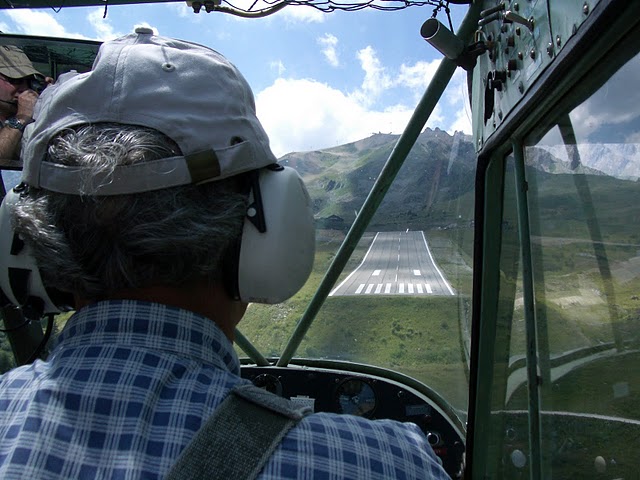
Courchevel in the French Alps is, for all pilots, one of the most amazing, butt-clenching arrivals one could ever imagine.
Courchevel’s airport also has a certain degree of infamy in the aviation industry as home to one of the shortest runways in the world, with a length of 525 metres and a gradient of 18.5% in order to help slow landing aircraft. The airport has a dangerous approach through deep valleys which can only be performed by specially certified pilots. On landing there is no go-around procedure, as most of the worlds airports have – there is merely a very steep hill which has seen a few accidents since the airport first opened.
Quite so!
Here’s an interesting video from YouTube
and a few personal memories:
Start of the approach into Courchevel'short final' CourchevelAuthor & aircraft on the apron - Courchevel
It is quite normal now to have diagnosis in hospital, by machine, the same as we have come to accept for cars and aircraft, but how about English Language Proficiency testing?
In aviation, the international language is English, and in 1997 the International Civil Aviation Organization recognised the need to establish a level of English Proficiency as it had been established that there had been numerous accidents and incidents as a result of a poor level of understanding between Pilots and Air Traffic controllers.
As of March 2008, a system of testing was introduced covering Comprehension, Pronunciation, Fluency, Structure, Vocabulary, and Interaction, with a rating of 1-6 where Level 4 is considered Operational. If of Level 5 you gain an extended period of 6 years between testing; and at Level 6 you are considered an expert, and the validity period is indefinite.
The method of testing is by an on-line computer voice activated exercise. You have a headset, and computer screen, and a keyboard, and a series of activities lasting around 30 minutes, and at the end you are marked by the machine and given your result.
The program is of American origin, my invigilator was from the Philippines, and the person in charge of the testing was German. Continue reading “Assessment by machine”→
Three of the authors on Learning from Dogs are or have been pilots although only one, Bob Derham, is a real pilot! I.e. he does it for a living!
Most pilots and many wannabes love the atmosphere of a good air show but after a few visits they can become rather predictable and that applies as much to the flying displays. After all there is only so much that one can do to an aeroplane.
Here’s a YouTube video showing Kyle Franklin ‘stealing’ a Piper Cub. As a past owner of a Piper Super Cub, I have to tell you that the skills being used in this display are supremely clever.
Back in 1955, air travel was an adventure and the age of the jet airliner had already dawned in the UK, albeit with some major setbacks along the way.
As the US prepared to enter the market that summer, there is the well known incident of Boeing test pilot “Tex” Johnston rolling a prototype Boeing 707.
From today’s perspective, under those circumstances , the integrity of the people involved was impressive. As the pilot describes, he was called into the office of the president of Boeing to explain his actions. For me, the most telling comment is his final line:
The Los Angeles Times update on this wonderful story.
The Los Angeles Fire Department firefighter who rescued a panicked dog from the brown, rushing waters of the Los Angeles River this afternoon said that unless firefighters acted, someone else was likely to have ventured into the concrete wash and wound up a casualty.
Joe St. Georges, 50, the firefighter who captivated much of Los Angeles as he was lowered by a tether into the churning waters to rescue the hound, told reporters late Friday that he suffered a bite to his thumb but was otherwise OK.
“I didn’t have time to establish a rapport with the dog,” St. Georges said, in a classic understatement, as he held his heavily bandaged hand in the air. “He did what dogs do.”
Joe St. Georges and 'Vernon' the dog!
The dog was taken by [human] ambulance to a Downey shelter run by the Southeast Area Animal Control Authority, which serves 14 cities, including Vernon.
Animal Control Officer Justin Guzman said the 6-year-old German shepherd mix was cold and wet, but otherwise unhurt. He showed no further aggression, and shelter staff named him Vernon.
“He’s really lovable,” Guzman said. “He’s appreciating all the attention he’s getting here.“
Guzman said there were a “million” ways and reasons Vernon could have gotten into the river channel.
“Whether he got scared by the thunderstorm and jumped the fence, we don’t know,” he said.
The dog was never really swept away, but managed for the most part to maintain his footing on a slender ledge in the middle of the river, the officer said.
The dog will be quarantined and watched for signs of rabies.
Marcia Mayeda, director of the Los Angeles County Department of Animal Care and Control, said the disease is extremely rare in domestic animals. Untagged and loose, the dog was technically in violation of city codes, but the owners will face no repercussions if they step forward and take him home, Guzman said.
If they don’t, the shelter by early evening already had a list of 20 people who want to adopt Vernon.
Mayeda said she was very impressed by St. Georges’ actions.