Category: Flying

Elinor Smith, pilot extraodinaire

A remarkable woman who died a week ago

There are many famous names in aviation but I would wager that Elinor Smith, despite being one of the greats in the history of flying, is not a name that falls off the lips of thousands.  It ought to.

Last Friday, just a week ago, Elinor Smith died at the amazing age of 98.

Elinor Smith

There are many accounts of her life accessible online.  Here’s an extract from an obituary published by the Wall Street Journal.

Ms. Smith, who died Friday at age 98, was one of the last survivors of aviation’s early barnstorming days. She flew with such legends as Amelia Earhart and James Doolittle. She recalled Charles Lindbergh seeing her off from Roosevelt Field in 1928 on her most notorious exploit, flying under four of New York City’s East River bridges.

and also from the WSJ:

Over the next few years, Ms. Smith would set numerous records, spurred on by a handful of other aviatrices, including Ms. Earhart, Bobbi Trout, and Pancho Barnes. All were trumpeted by the media. Ms. Smith’s “Flying Flapper” moniker was matched by “The Flying Cashier” and “The Flying Salesgirl.” Each strove to break free of the pack.

“That’s how you got jobs, by setting records,” said Dorothy Cochrane, a curator at the National Air and Space Museum. “Women had to take what they could get since careers in the military were closed to them.”

Ms. Smith set several endurance records, and once flew so high in an attempt to set the altitude record that she blacked out above 30,000 feet.

There is also a comprehensive account of her life on WikiPedia.

Plus a few days ago, someone posted a brief clip on YouTube.

More about Elinor Smith, courtesy of Cradle of Aviation:

Facts:

  • Born August 17, 1911 in New York City. In 1917, at the age of six, Smith took her first flight in a Farman pusher biplane and from then on she was hooked on aviation.Growing up in Freeport, Long Island during the heyday of the golden age of flight, Elinor Smith had access to some of the best flying fields in the country and some of the most famous flyers.
  • At the age of fifteen, Smith flew her first solo flight and one year later in 1928 she received her pilot’s license to become the world’s youngest licensed pilot.
  • One of her earliest and most famous stunts in 1928 was flying under all four East River suspension bridges—a feat never accomplished by another pilot.
  • In 1928, Smith set a light plane altitude record of 11,889 feet, the first of many records she was to set during her career. In 1929, alone she set four world records.
  • The following year Smith set the women’s solo endurance record after spending thirteen hours, sixteen minutes flying an open cockpit Brunner Winkle Bird on a frigid January night over Roosevelt Field.
  • Smith toured the U.S. air show circuit in 1929, piloting a Bellanca Pacemaker for a group of parachutists promoting the Irvin Parachute Company.
  • Flying with co-pilot Bobbie Trout, she set the first Women’s Refueling Record of 42 _ hours over Los Angeles.
    Smith was the first woman test pilot for both Fairchild Aviation Corporation and Bellanca Corporation.
  • Set Woman’s World Speed Record of 190.8 miles per hour in 1929 in a Curtiss Falcon over a closed course, Motor Parkway, Long Island.
  • In 1930, Elinor Smith received one of the greatest honors in her life when she was voted the best woman pilot in the United States.
  • From 1930 to 1935, Smith she worked as a radio commentator on aviation events for NBC.
  • After retiring from flying, Elinor Smith worked to preserve the history of Long Island aviation. She was a founding member of the Long Island Early Fliers and promoted the creation of an aviation museum on Long Island.
  • In 1960, she piloted a T-33 jet trainer at Mitchel Field.

By Paul Handover

Lies, damn lies and statistics

How safe is flying?

Safe?

Wikipedia have an interesting, and well referenced, entry on Air Safety.  Within that entry is a table showing comparing deaths by air to other forms of travel.

The table in Wikipedia is much easier to read, it’s here, but the data is shown below for those that do not want to click through.

—————–

There are three main statistics which may be used to compare the safety of various forms of travel:

Deaths per billion journeys
Bus 4.3
Rail 20
Van 20
Car 40
Foot 40
Water 90
Air 117
Bicycle 170
Motorcycle 1640
Deaths per billion hours
Bus 11.1
Rail 30
Air 30.8
Water 50
Van 60
Car 130
Foot 220
Bicycle 550
Motorcycle 4840
Deaths per billion kilometres
Air 0.05
Bus 0.4
Rail 0.6
Van 1.2
Water 2.6
Car 3.1
Bicycle 44.6
Foot 54.2
Motorcycle 108.9

It is worth noting that the air industry’s insurers base their calculations on the number of deaths per journey statistic while the industry itself generally uses the number of deaths per kilometre statistic in press releases.

————————

Interesting to see how air travel varies in terms of comparative safety depending on how it is measured.  But also interesting to see that however it is measured, riding a motorbike doesn’t come out so well.

Finally, that word’ billion’ is too easy to throw away, as it were.  A billion hours ago was over a 114,000 years ago – when mankind was living in the Stone Age.  A billion kilometres would represent 114,285 trips between London and Los Angeles.

If you are interested!

By Paul Handover

Not your average airport!

The world’s 18 strangest airports

The American magazine Popular Mechanics had an interesting piece on some of the more bizarre airports around the world.  As the article says,

Engineers tasked with building an airport are faced with countless challenges: The ideal location needs ample space, endless flat ground, favorable winds and great visibility. But spots in the real world are rarely ideal, and engineers are forced to work with what they have, making sure that the end product is the safest possible structure for pilots. A survey of airports around the world turns up a mixed bag, ranging from dangerous and rugged landing strips to mega-size facilities that operate like small cities.

Apart from the general interest in these airports, there is also a personal resonance as three of them are in my aviation log-book: Barra; Gibralter; Courchevel.  Indeed my experiences of flying into Barra were the subject of a Post on this Blog a few months ago.

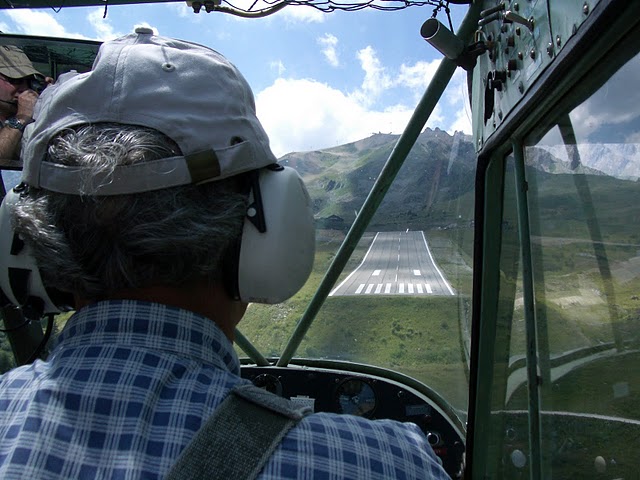
Courchevel in the French Alps is, for all pilots, one of the most amazing, butt-clenching arrivals one could ever imagine.

As Wikipedia puts it:

Courchevel’s airport also has a certain degree of infamy in the aviation industry as home to one of the shortest runways in the world, with a length of 525 metres and a gradient of 18.5% in order to help slow landing aircraft. The airport has a dangerous approach through deep valleys which can only be performed by specially certified pilots. On landing there is no go-around procedure, as most of the worlds airports have – there is merely a very steep hill which has seen a few accidents since the airport first opened.

Quite so!

Here’s an interesting video from YouTube

and a few personal memories:

Start of the approach into Courchevel
'short final' Courchevel
Author & aircraft on the apron - Courchevel

By Paul Handover

Assessment by machine

We have ways of making you listen!

It is quite normal now to have diagnosis in hospital, by machine, the same as we have come to accept for cars and aircraft, but how about English Language Proficiency testing?

In aviation, the international language is English, and in 1997 the International Civil Aviation Organization recognised the need to establish a level of English Proficiency as it had been established that there had been numerous accidents and incidents as a result of a poor level of understanding between Pilots and Air Traffic controllers.

As of March 2008, a system of testing was introduced covering Comprehension, Pronunciation, Fluency, Structure, Vocabulary, and Interaction, with a rating of 1-6 where Level 4 is considered Operational. If of Level 5 you gain an extended period of 6 years between testing; and at Level 6 you are considered an expert, and the validity period is indefinite.

The method of testing is by an on-line computer voice activated exercise. You have a headset, and computer screen, and a keyboard, and a series of activities lasting around 30 minutes, and at the end you are marked by the machine and given your result.

The program is of American origin, my invigilator was from the Philippines, and the person in charge of the testing was German. Continue reading “Assessment by machine”

Crazy flying

This is not your usual air-show display

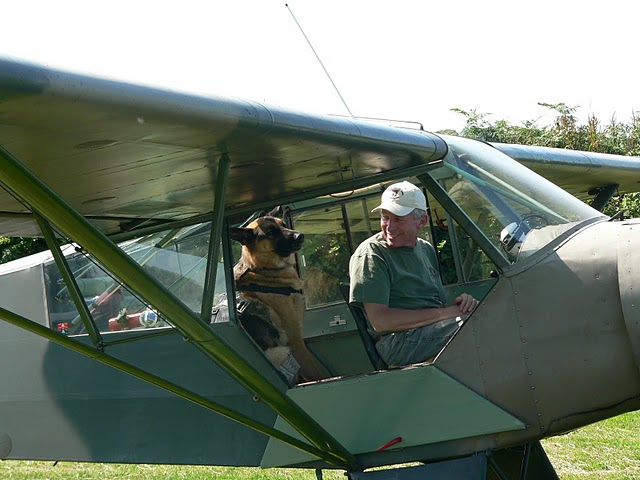
Author & author's dog in Piper Super Cub, R151

Three of the authors on Learning from Dogs are or have been pilots although only one, Bob Derham, is a real pilot!  I.e. he does it for a living!

Most pilots and many wannabes love the atmosphere of a good air show but after a few visits they can become rather predictable and that applies as much to the flying displays.  After all there is only so much that one can do to an aeroplane.

Not so the good people who comprise the Franklin’s Flying Circus.

Here’s a YouTube video showing Kyle Franklin ‘stealing’ a Piper Cub.  As a past owner of a Piper Super Cub, I have to tell you that the skills being used in this display are supremely clever.

Enjoy!

By Paul Handover

Selling airplanes!

Jet airliners any way up!

Back in 1955, air travel was an adventure and the age of the jet airliner had already dawned in the UK, albeit with some major setbacks along the way.

As the US prepared to enter the market that summer, there is the well known incident of Boeing test pilot “Tex” Johnston rolling a prototype Boeing 707.

From today’s perspective, under those circumstances , the integrity of the people involved was impressive. As the pilot describes, he was called into the office of the president of Boeing to explain his actions. For me, the most telling comment is his final line:

It was fine!

By John Lewis

And a P.S. to the Thanks, Guys.

The Los Angeles Times update on this wonderful story.

The Los Angeles Fire Department firefighter who rescued a panicked dog from the brown, rushing waters of the Los Angeles River this afternoon said that unless firefighters acted, someone else was likely to have ventured into the concrete wash and wound up a casualty.

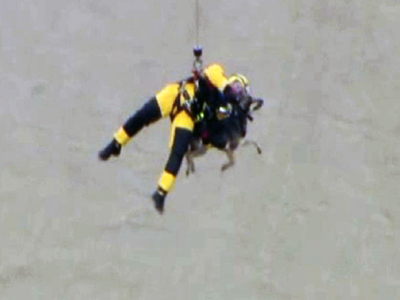
Joe St. Georges, 50, the firefighter who captivated much of  Los Angeles as he was lowered by a tether into the churning waters to rescue the hound, told reporters late Friday that he suffered a bite to his thumb but was otherwise OK.

“I didn’t have time to establish a rapport with the dog,” St. Georges said, in a classic understatement, as he held his heavily bandaged hand in the air. “He did what dogs do.”

Joe St. Georges and 'Vernon' the dog!

The dog was taken by [human] ambulance to a Downey shelter run by the Southeast Area Animal Control Authority, which serves 14 cities, including Vernon.

Animal Control Officer Justin Guzman said the 6-year-old German shepherd mix was cold and wet, but otherwise unhurt. He showed no further aggression, and shelter staff named him Vernon.

“He’s really lovable,” Guzman said. “He’s appreciating all the attention he’s getting here.“
Guzman said there were a “million” ways and reasons Vernon could have gotten into the river channel.

“Whether he got scared by the thunderstorm and jumped the fence, we don’t know,” he said.
The dog was never really swept away, but managed for the most part to maintain his footing on a slender ledge in the middle of the river, the officer said.

The dog will be quarantined and watched for signs of rabies.

Marcia Mayeda, director of the Los Angeles County Department of Animal Care and Control, said the disease is extremely rare in domestic animals. Untagged and loose, the dog was technically in violation of city codes, but the owners will face no repercussions if they step forward and take him home, Guzman said.

If they don’t, the shelter by early evening already had a list of 20 people who want to adopt Vernon.

Mayeda said she was very impressed by St. Georges’ actions.

It’s a great and lovely story.

By Paul Handover

Thank you, guys!

Fire-fighters rescue dog from flooded Los Angeles river.

Tomorrow on Learning from Dogs there is part one of a six-part Post about The Secret Life of the Dog.  It includes the amazing proposition that our relationship with dogs was instrumental in early man becoming civilised.  (Assuming, of course, that you believe mankind is civilised!)

Thus it is with great pride that today’s Post presents the courageous and successful efforts of LA Fire Fighters rescuing a German Shepherd dog, scared out of its wits, from drowning in a river.

Here’s an extract from the Los Angeles Times:

We don’t know about you, but we were glued to our TV screen earlier this afternoon as the effort to rescue a large dog trapped in the flooded Los Angeles River was broadcast live.  The rainstorms that have been pummeling L.A. over the past few days have caused the river to swell.  It’s unclear who, if anyone, owns the dog, or how it managed to fall into the fast-moving river in Vernon.

The full article and a video of the rescue may be seen here. The article goes on to say:

Firefighters first attempted to rescue it by dangling flotation devices from a bridge overhead, to no avail.  The dog then evaded firefighters who tried to approach it, sloshing further down the river.  Around 12:30 p.m., it managed to reach the edge of the river and attempted to climb up a steep concrete wall to safety, but several times fell back into the river.

Finally, a firefighter dangling beneath a helicopter managed to grab hold of the terrified dog, who responded (rather predictably) by biting its rescuer and thrashing about.  Despite the inherent difficulty of rescuing an animal that doesn’t want to be rescued, the firefighter managed to lift the dog to safety; both were deposited on a nearby bridge.  The dog was transferred to an ambulance for veterinary care and its rescuer was taken to a hospital for treatment of bite wounds, KTLA reported.

The BBC also has a nice video clip here

And a great set of pictures here. Such as this one …

Well done, all involved.

Fantastic effort.

By Paul Handover

A Government’s “Economy with the truth”

Citizens being let down by the standards of their governments.

Every so often – but sadly with a certain inevitability and one senses greater frequency – there descends from above the nasty stench of hypocrisy, cover-up and fraud.

No, I am not referring to the conviction recently of a British Minister for using a mobile telephone while driving, even though she was Minster of Justice when the law banning this was passed.

No, the case in question is that of the RAF Chinook Mark 2 helicopter that crashed on 2 June 1994 en route from Northern Ireland to Inverness, killing the special forces crew and 25 senior members of Northern Ireland’s intelligence community in the worst RAF helicopter accident in peacetime.

Now accidents happen, but from what has been said very clearly in a variety of sources (SEE HERE IN PARTICULAR), there seems no doubt that the pilots were made the scapegoats in the ensuing enquiry.

This is the key question. Of course, NOBODY may have been “to blame” OR it may be impossible to determine who was to blame, but on the other hand, someone MAY have been to blame, and if that person or persons is in the Ministry of Defence or the Government then it is clear that there may have been the temptation to fix it so that someone ELSE took the blame, in this case the dead and therefore defenceless pilots.

A synopsis of the official report passed to me by a fellow old-boy (alumnus!) with a scientific background in avionics summarizes the main points in this tragedy:

a) There is certainly no evidence to suggest that the pilots were at fault.

b) There is a lot of evidence to suggest that the Government hindered the enquiry.

Some key points:

  • The pilots were worried about the MKII aircraft and asked for a MKI version for this mission. The MoD declined this request.
  • The aircraft was flying low, in a straight line towards the Mull. 18 seconds before impact the pilot requested a left hand turn to miss the Mull. The aircraft never turned.
  • The FADECs (Full Authority Digital Engine Control) were programmed to record ‘failures in flight’. Looking at the FADEC’s memory after the crash showed no failures. This was the main evidence against the pilots. However, there had been several instances where other MKII pilots had lost control of the aircraft and the FADEC showed no ‘failures’. In their assessment of the code after the crash, EDS said that the error reporting software had been coded incorrectly.
  • The problem with the FADEC that had been seen by several pilots was the fact that the rotors started to rotate to 120%. (Faster than they should).
  • Two key personnel who should have given evidence at the enquiry (an engineer FADEC expert and a pilot who had experienced problems whilst flying the aircraft) were not allowed to give evidence.
  • Prior to the accident the Government were actually in the process of suing the FADEC manufacturer because of its failings.

Two points in particular strike me personally:

A) Point SIX above; the government was AT THE TIME of the accident SUING the FADEC manufacturer because the electronics were defective in some way. Now, as a layman, it seems to me bleedin’ obvious that modern aircraft are extremely dependent on their electronics. If there were such severe faults with the fundamental instruments on this plane as there seem to have been with the FADEC (the top pilot refused to fly the craft and the govt were suing the software providers; does it get more serious than that??!!) then WHY WAS IT ALLOWED TO FLY IN THE FIRST PLACE?

B) So, KNOWING all the above, WHO authorised this aircraft to fly in poor weather conditions (it was foggy) with 25 KEY intelligence personnel on board? Apart from the personal tragedy for so many families, the loss of these key people was a devastating blow to the then government in its campaign against terrorism in Northern Ireland.

Well, despite all the above it was the two dead pilots who got the blame for what seems to have been appalling management over a long period. The Chinook’s electronics were clearly known to be dodgy yet the machine had not been grounded. You cannot imagine this happening in the civil aviation business (I HOPE!), but this is not the first time that the British government has sought to exempt itself from the strict standards it imposes on the private sector.

But the bottom line is, it is pretty clear that JUSTICE has not been done and those whose poor management and decisions almost certainly led to the accident have never been brought to account.  The British Conservative party has pledged to re-examine the case. One has to ask why the CURRENT party has refused to do this. Could they themselves have something to hide?

IS this – as it seems to be – a genuine Government cover-up? and if so, do they do this sort of thing because they think that:

A) the public are idiots or B) they can get away with it? Or of course both.

We are not talking about a faceless, fascist bureaucracy here, but about BRITAIN, where standards of decency, honesty, openness and Justice are supposed to apply – or at least once applied. As for the MOD (Ministry of Defence) not only has it NOT accepted any responsibility for this accident but they are now paid BONUSES! Yes, just like City Bankers ….. And this at a time when I am unaware of bonuses being paid to soldiers fighting and often dying in Iraq and Afghanistan.

The families of those killed deserve the truth. Without the truth being primordial in our society, we descend into the realms of a banana republic or Central Asian dictatorship.

By Chris Snuggs

Frozen in ice

Serendipity

Vickers aircraft

Thanks to a small piece on AOPA Online (Aircraft Owners and Pilots Association), a wonderful insight into a hitherto unheard of organisation and a most charming story.

That organisation is Mawson’s Huts Foundation, an Australian organisation that describes itself as:

The Mawson’s Huts Foundation has been established to conserve in perpetuity for the Australian people the unique, historical buildings known as Mawson’s Huts, base for one of the most significant expeditions in Antarctic history. The Foundation’s website provides a variety of resources concerning current and future efforts to conserve the huts and information about the archaeology and heritage of the site.

Sir Douglas Mawson was an Australian Antarctic explorer and geologist born in 1882.  More background from the Mawson’s Huts website:

Sir Douglas Mawson, a geologist, who led the Australasian Antarctic Expedition of 1911, landed a party of

Sir Douglas Mawson

18 at Cape Denison on Commonwealth Bay in January, 1912, and remained there until December 1913. The site was not visited again until Mawson returned in 1931 with the British, Australian and New Zealand Antarctic Research Expedition and then not again until the 1950’s. Only a concerted public campaign would save and conserve this historic site for all Australians, and the Mawson’s Huts Foundation was formed in 1996 for this purpose.

Read more about this story