The origins of this saying seem to have disappeared in the mists of time but it’s a rare person that doesn’t write a list from time to time. But when it comes to critical processes, having a list, or better known as a ‘checklist’ is essential to completing the process correctly.
With that in mind, then let me introduce you to a story recently sent to me by old friend Dan Gomez.
oooOOOooo
I’ve always done it this way!
This is an example of what happens when we do not pay attention to detail, and do not follow instructions and checklists!
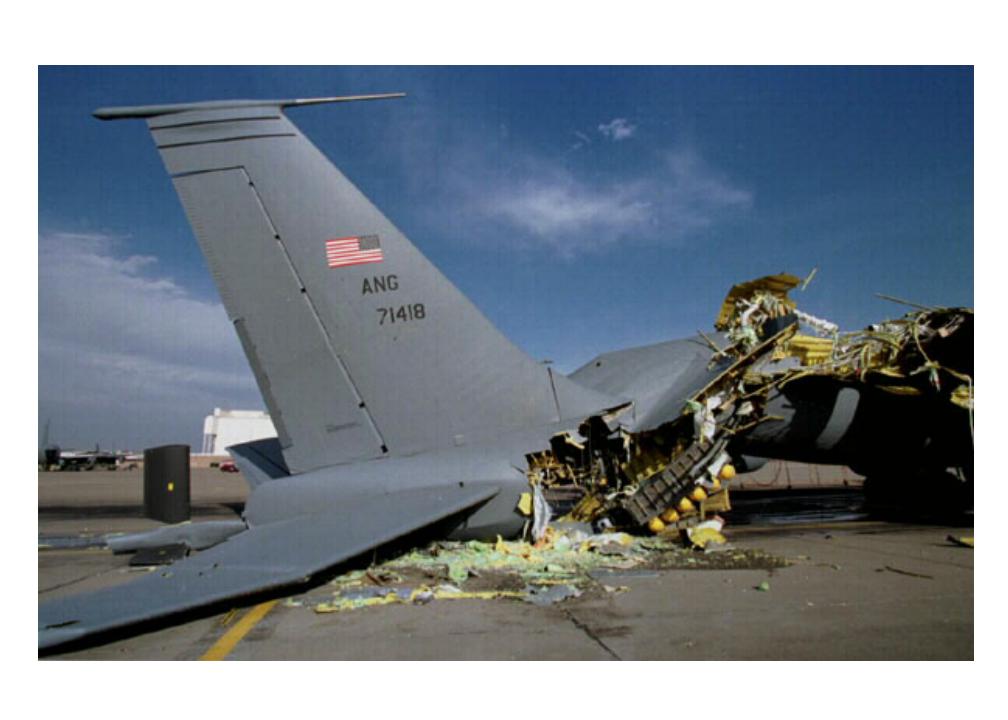
A KC-135 Aircraft was being pressurized at ground level. The outflow valves which are used to regulate the pressure of the aircraft were capped off during a 5-year overhaul and never re-opened. The post-investigation revealed that a civilian depot technician who “had always done it that way” was using a homemade gauge, and no procedure.
Apparently, the technician’s gauge didn’t even have a max “peg” for the needle, so it was no surprise he missed it when the needle went around the gauge the first time.
As the technician continued to pressurize the aircraft with the needle on its second trip around the gauge there was a “boom”. One KC-135 went bang! Indeed, the rear hatch was blown over 70 yards away, through a blast fence!
An incident like this is never funny and is further regrettable when we consider that this mistake is one that we taxpayers will end up paying for. Fortunately, no one was reported as being injured.
This was a good “Lessons Learned” for making sure we have trained people, with the correct tools, and who are following detailed procedures. It should serve as a reminder that just because you’ve always done it that way, it does not make it the “right” way!
Like millions of others on this planet, I was held spellbound by the historic and epic moment of man placing his mark on another heavenly body, the Moon. I had been so wrapped up in NASA’s space missions that I took a holiday from work (I was working at the time for ICIANZ in Sydney, Australia) for the week of July 16th, 1969.
It was, of course, July 16th when the Apollo 11 Mission launched from the Kennedy Space Center culminating at precisely 20:17:39 UTC on July 20, 1969, the moment when the Lunar Module made lunar contact.
But in terms of me writing my own obituary for Neil, what could I offer?
Then a couple of items changed my mind.
Neil Armstrong (August 5, 1930 – August 25, 2012)
The first was reading the obituary printed in The Economist. I have long admired the many, many beautiful obituaries that have been published by this newspaper and this one was no exception. Take this extract from the Neil Armstrong obituary,
He had an engineer’s reserve, mixed with a natural shyness. Even among the other astronauts, not renowned for their excitability, he was known as the “Ice Commander”. Mike Collins, one of his crew-mates on the moon mission, mused that “Neil never transmits anything but the surface layer, and that only sparingly.” He once lost control of an unwieldy contraption nicknamed the Flying Bedstead that was designed to help astronauts train for the lunar landing. Ejecting only seconds before his craft hit the ground and exploded, he dusted himself off and coolly went back to his office for the rest of the day. There was work to be done.
Then the beautiful words that bring the obituary to a close,
Earth’s beauty
Over half a century, the man who never admitted surprise was surprised to observe the fading of America’s space programme. The Apollo project was one of the mightiest achievements of the potent combination of big government and big science, but such enterprises came to seem alien as well as unaffordable. Mr Armstrong, who after his flight imagined bases all over the moon, sadly supposed that the public had lost interest when there was no more cold-war competition.
Yet the flights had one huge unintended consequence: they transformed attitudes towards Earth itself. He too had been astonished to see his own planet, “quite beautiful”, remote and very blue, covered with a white lace of clouds. His reserve, after all, was not limitless. One photograph showed him in the module after he and Buzz Aldrin had completed their moon-walk, kicking and jumping their way across the vast, sandy, silver surface towards the strangely close horizon. He is dressed in his spacesuit, sports a three-day beard, and is clearly exhausted. On his face is a grin of purest exhilaration.
” … they transformed attitudes towards Earth itself. He too had been astonished to see his own planet, “quite beautiful”, remote and very blue, covered with a white lace of clouds.” For that reason alone, we need to celebrate the achievement of the Apollo 11 mission for putting our own planet into perspective within the enormity of the universe.
The second item that persuaded me to write this was a wonderful historic insight into how a potential catastrophy on the surface of the Moon would have been handled by President Nixon. This historic item was published on Carl Milner’s blog the other day, the specific item being What if the Moon Landing Failed? Republished with the very kind permission of Carl.
When Richard Nixon was the President of the United States, they had a speech ready for him to deliver to the world just in case the 1969 moon landing had ended in disaster. In fact many experts believed there was a big chance that Neil Armstrong and Edwin ‘Buzz’ Aldrin could have really gotten stuck on the moon. It’s something we don’t really think about now because we all know it was such a success. American Archives have unearthed the speech that would have been delivered if the late great Armstrong and Aldrin had never made it back to earth. This is such a great piece of history that I thought I might never see.
Give it a read, It’s such a moving and well prepared speech, and such a good thing that President Nixon never had to delivered it.
So, as with millions of others, I am delighted that this speech remained unspoken and instead we experienced: “At 5:35 p.m. (US EDT), Armstrong and Aldrin successfully docked and rejoined Collins, and at 12:56 a.m. on July 22 Apollo 11 began its journey home, safely splashing down in the Pacific Ocean at 12:50 p.m. on July 24.”
Neil Armstrong’s legacy is not only being part of the wonderful team that allowed man to make the first footprint on the Moon but also bringing into our human consciousness that this blue, wonderful planet we all live on is the only home we have.
First Full-View Photo of Earth Photograph courtesy NASA Johnson Space Center This famous “Blue Marble” shot represents the first photograph in which Earth is in full view. The picture was taken on December 7, 1972, as the Apollo 17 crew left Earth’s orbit for the moon. With the sun at their backs, the crew had a perfectly lit view of the blue planet.
Strikes me that celebrating July 20th each year as Blue Planet Day might not be a bad idea! Any takers? Now that would be a legacy for Neil!
A stirring set of pictures from the Queen’s Jubilee
At the end of June, pilot friend Bob Derham sent me an email which contained all of what follows. I ‘filed’ it away and then forgot I had received it! My apologies. But as Europe was the subject of yesterday’s post, then maybe this can be seen as remaining on theme. Enjoy.
oooOOOooo
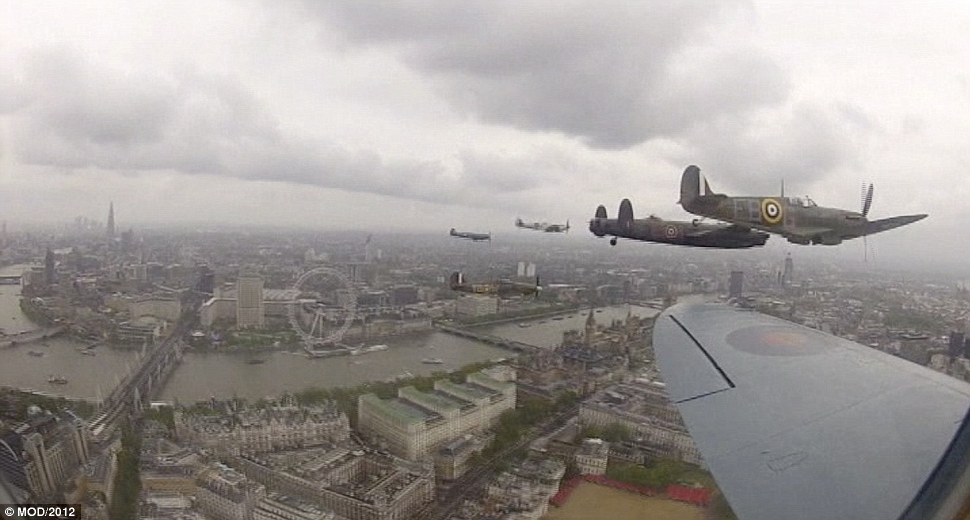
One last look back at those amazing Jubilee celebrations . . . as seen by the ‘Tail-end Charlie’ in Britain’s last airworthy Lancaster
Incredible footage has been released showing the bird’s eye view enjoyed by the crew aboard a Lancaster bomber flying over London for the Queen’s Diamond Jubilee celebrations.
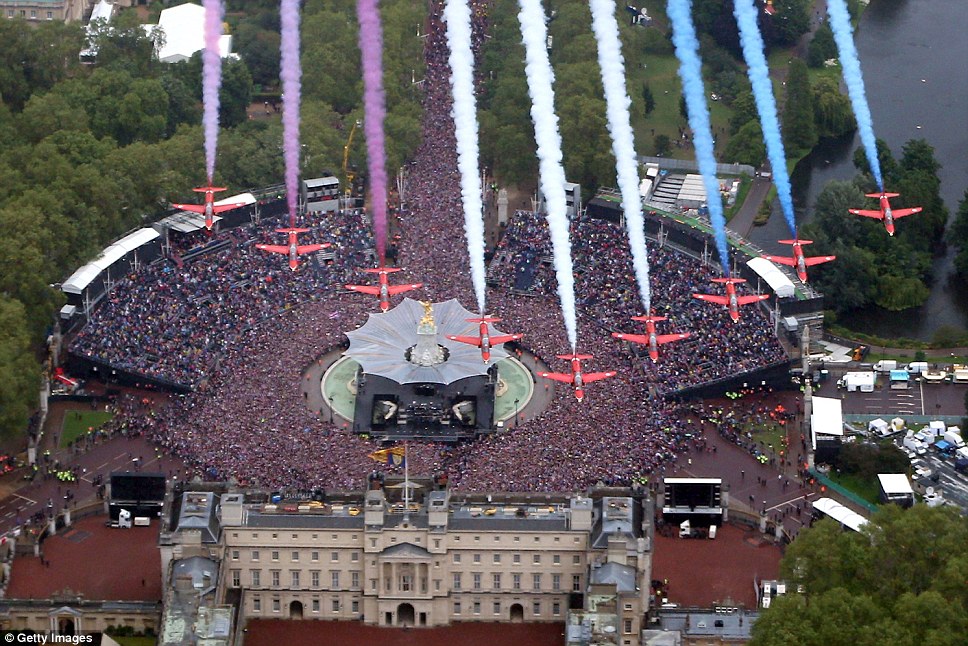
The aeroplane, which is part of the RAF’s Battle of Britain Memorial Flight (BBMF), flew in formation with aircraft including a Spitfire, Hurricane and Dakota transport aircraft down The Mall, followed by the Red Arrows aerobatic team – to the delight of crowds and the Royal Family at Buckingham Palace below.
As well as preserving a fleet of priceless aircraft and keeping them in tip-top flying condition, the BBMF reminds the nation of the sacrifices made during World War Two.
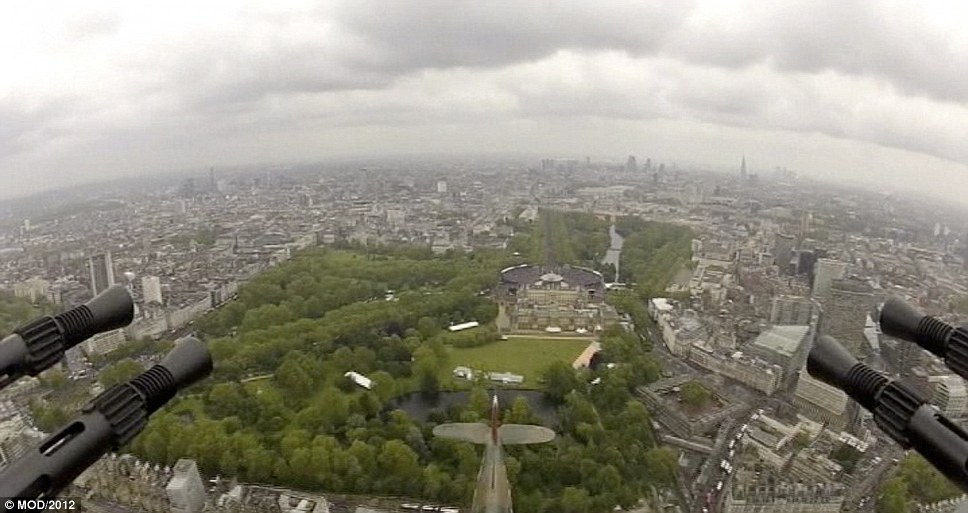
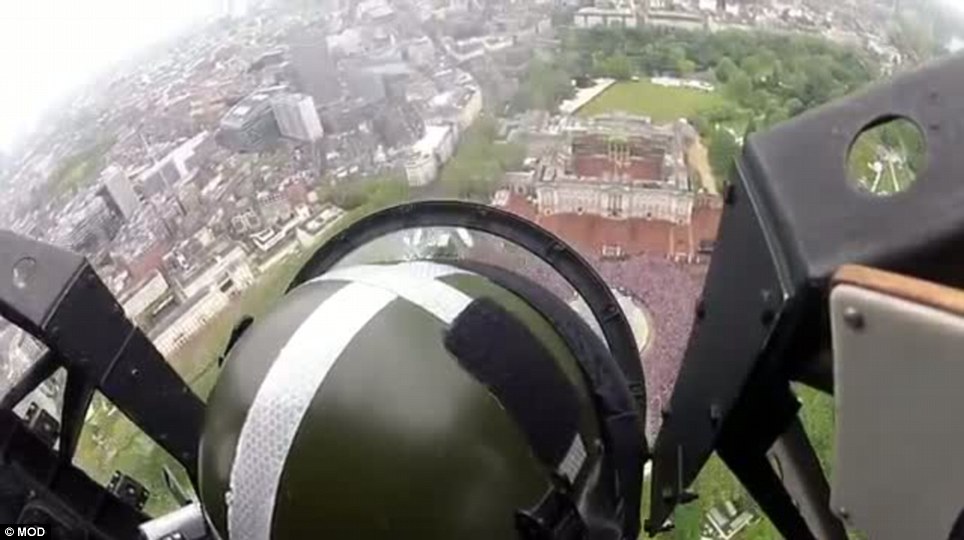
Spectacular: The tail gunner’s view from the Lancaster bomber, as it completed the Diamond Jubilee flypast. Buckingham Palace Gardens can be seen behind the tail of a Hurricane fighter, also of the Battle of Britain Memorial Flight, which flew in formation with the LancasterFinal approach: Having lined up on The Mall, the RAF Battle of Britain Memorial Flight Lancaster flies towards Buckingham Palace with St James’ Park on the left and Birdcage Walk beyond.The nose of the Lancaster passes over the Memorial to Queen Victoria in front of Buckingham Palace.
The BBMF is based at RAF Coningsby in Lincolnshire with many of its personnel, including pilots, acting as volunteers; the flight costs about £3m a year to run.
Squadron Leader Ian Smith, who is in charge of the BBMF, is the only permanent member, with all of the remaining pilots, navigators, air engineers and other crew coming from different airbases and ordinarily flying several different types of aircraft; from Typhoon fighters to the huge Hercules transport plane.
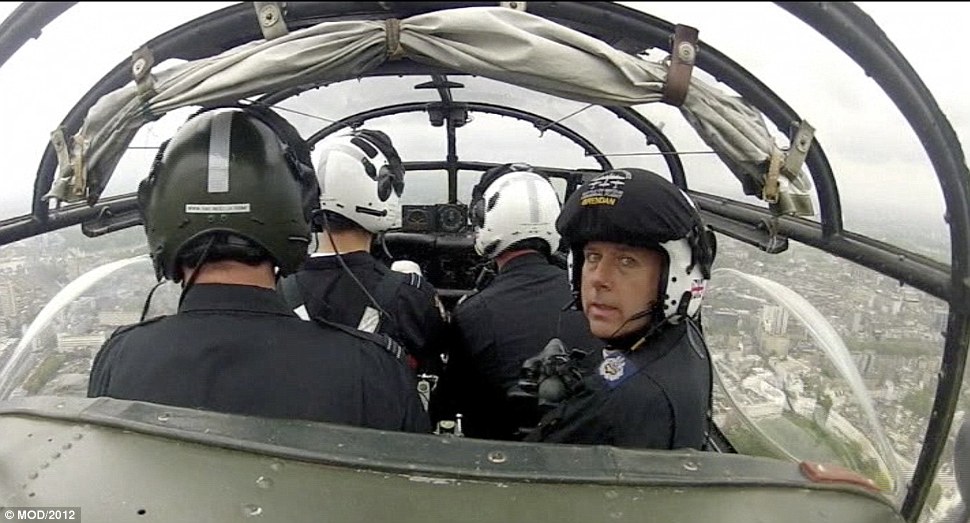
Cramped: The footage shows just how tight a fit it can be aboard a vintage aircraft and what a tight squeeze it is for the crew aboard the Lancaster bomber.
The aircrew give up three out of every four weekends from May to the end of September in order to fly and display the historic aircraft.
The footage, released by the Ministry of Defence, shows just how tight a fit it can be aboard a vintage aircraft, with the crew – clearly eager to catch a glimpse of the Queen – taking up most of the available space.
The historic flight includes the Lancaster, which first saw service in 1942. The ‘Lanc’ was the most famous of the Second World War bombers and gained renown for its starring role in the momentous ‘Dambuster’ raid on Germany’s Ruhr Valley in 1943.
Carrying a payload of 22,000lb and with a 1,500-mile range, the RAF bomber wreaked havoc on Germany. Some 3,500 were lost in action during the war.
The view of Buckingham Palace and The Mall beyond from the Lancaster bomber.In formation: Incredible footage has been released showing the view enjoyed by crew aboard a Lancaster bomber flying over London for the Queen’s Diamond Jubilee celebrations.
Hurricane single-seater fighters played a crucial role in the Battle of Britain. Heavier and slower than the Spitfire, it was considered the RAF’s ‘workhorse’ against the Luftwaffe.
A remarkable total of 14,533 Hurricanes were built and served operationally on every day and in every theatre during the war. Only 12 are still airworthy worldwide.
The Spitfire is the iconic fighter that won legendary status against the Luftwaffe in the Battle of Britain. It possessed a top speed of 378mph, an altitude of 35,000ft and armed with two 20mm cannons, four Browning machine guns and two 250lb bombs.
One of the four that flew yesterday was P7350 – the oldest airworthy Spitfire in the world and the only one which actually fought in the Battle of Britain. It was shot up by a Messerschmitt 109 during combat in October 1940 but its wounded Polish pilot Ludwik Martel managed to crash-land it, wheels up, near Hastings.
The pride of Britain: The vintage planes – all powered by classic World War Two Merlin engines – roar across the London sky.Flypast: The Duchess of Cornwall, the Prince of Wales, the Queen, the Duke and Duchess of Cambridge and Prince Harry watch the aerial action.Aerobatic aces: The Red Arrows display team fly in formation over Buckingham Palace.Stirring image: The Lancaster, centre, was accompanied by two Spitfires on both flanks and tailed by a Hurricane.
oooOOOooo
A wonderful and incredibly nostalgic set of photographs. Finally, let me close with a short piece of video of that Lancaster Bomber in flight.
A wonderful investment in studying America’s ecology is just starting.
I am indebted to The Economist for including in their issue of the 25th August a story about NEON, something I had previously not heard about.
It was then an easy step to locate the main website for the National Ecological Observatory Network, or NEON. (Just an aside that I can’t resist – NEON is such a fabulous acronym that one wonders how much push and shove there was to come up with the full name that also fitted the word ‘NEON’! Sorry, it’s just me!)
Anyway, back to the plot. The following video gives a very good idea of the projects aims. When I watched it, I found it inspiring because it seemed a solid example of how the nation, that is the USA, is starting to recognise that evolving to a new, sustainable way of life has to be built on good science. NEON strikes me as excellent science. You watch the video and see if you come to the same conclusion.
There’s also a comprehensive introduction to the project from which I will republish this,
In an era of dramatic changes in land use and other human activities, we must understand how the biosphere – the living part of earth – is changing in response to human activities. Humans depend on a diverse set of biosphere services and products, including air, water, food, fiber, and fuel. Enhancements or disruptions of these services could alter the quality of human life in many parts of the world.
To help us understand how we can maintain our quality of life on this planet, we must develop a more holistic understanding of how biosphere services and products are interlinked with human impacts. This cannot be investigated using disconnected studies on individual sites or over short periods of observation. Further, existing monitoring programs that collect data to meet natural resource management objectives are not designed to address climate change and other new, complex environmental challenges.
NEON, the first continental-scale ecological observatory, will provide comprehensive data that will allow scientists to address these issues.
Later on there’s more detail, as follows,
NEON has partitioned the U. S. into 20 eco-climatic domains, each of which represents different regions of vegetation, landforms, climate, and ecosystem performance. In those domains, NEON will collect site-based data about climate and atmosphere, soils and streams and ponds, and a variety of organisms. Additionally, NEON will provide a wealth of regional and national-scale data from airborne observationsand geographical data collected by Federal agencies and processed by NEON to be accessible and useful to the ecological research community. NEON will also manage a long-term multi-site stream experiment and provide a platform for future observations and experiments proposed by the scientific community.
The data collected and generated across NEON’s network – all day, every day, over a period of 30 years — will be synthesized into information products that can be used to describe changes in the nation’s ecosystem through space and time. It will be readily available in many formats to scientists, educators, students, decision makers and the general public.
For some reason I couldn’t find on the NEON website the informative map that was included in The Economist so I grabbed that one, and offer it below:
These eco-climatic domains are fully described here on the NEON website.
The benefits of this fabulous project are described thus, “The data NEON collects and provides will focus on how land use change, climate change and invasive species affect the structure and function of our ecosystems. Obtaining this kind of data over a long-term period is crucial to improving ecological forecast models. The Observatory will enable a virtual network of researchers and environmental managers to collaborate, coordinate research, and address ecological challenges at regional, national and continental scales by providing comparable information across sites and regions.”
As they say in business, if you can’t measure it, you can’t manage it! So reading in the above the sentence, ‘Obtaining this kind of data over a long-term period is crucial to improving ecological forecast models.‘ is cheering to the soul.
The United States quite rightly gets a huge bashing over it CO2 emissions but to condemn the USA for that and not to applaud this sort of wonderful research is utterly unjustified. As I have hinted before, America has, more than any other country in the world, the energy to make things better over the coming years.
As Professor Sir Robert Watson highlighted here recently said, ‘… deep cuts in CO2 emissions are possible using innovative technologies without harming economic recovery.’
I’m writing this as 5.40 am on the 6th. I let our ‘bedroom’ dogs out for their early-morning pee some 20 minutes ago and then jumped back in bed, turned on my Kindle and went to the BBC News website. There I read,
Nasa’s Curiosity rover successfully lands on Mars
The US space agency has just landed a huge new robot rover on Mars.
It will now embark on a mission of at least two years to look for evidence that Mars may once have supported life.
A signal confirming the rover was on the ground safely was relayed to Earth via Nasa’s Odyssey satellite, which is in orbit around the Red Planet.
The success was greeted with a roar of approval here at mission control at the Jet Propulsion Laboratory (JPL) in Pasadena, California.
As David Shukman, Science Editor of the BBC, wrote,
The day I watched Curiosity being built in a clean room at Nasa’s Jet Propulsion Laboratory in Pasadena last year, the rover’s six wheels were lying on one work bench while the chassis stood on another and it was hard to believe the white-suited engineers could make sense of the maze of tubes and cabling.
But what they’ve created now stands on the red soil of Mars – and it’s in one piece. In the hallway of a JPL building we were shown a full-size replica. Walking around it made me realise something difficult to grasp from the pictures and video: this is a beast of a machine, a kind of cosmic Humvee with instruments instead of weapons.
Sometimes Nasa public relations can appear bragging. Today it feels justified. Curiosity is all set to discover something remarkable about our strangest neighbour.
Well said and people from all around the world will echo those sentiments.
When I read what Patrice wrote in my Setting the scene post not so many hours ago,
Well, OK, keeping my fingers, and even my arms, crossed here. Seems to me the “sky crane” is over-complex, and I was not reassured when one of the physicist-engineers boasted that they had run the landing millions of time on simulator. Yeap, OK, how many times for real in Earth’s gravity?
I don’t see why they could not have landed normally, LEM style. Especially as they have wheels and could have rolled away to find undistrubed land.
There are no back-ups…
OK, let’s hope I’m wrong to be suspicious…
PA
I instinctively agreed and hoped his worries were misplaced. They were! The Curiosity rover is down! Good luck to the Rover and all those who made it possible. Well done, the team!
While going through previously published Posts, I came across two, first shown on the 17th & 18th August, 2009, that seemed a better fit being rolled into one.
So here they are.
oooOOOooo
This is not my dog but it brings out the same feelings in me as if I was looking at my German Shepherd.
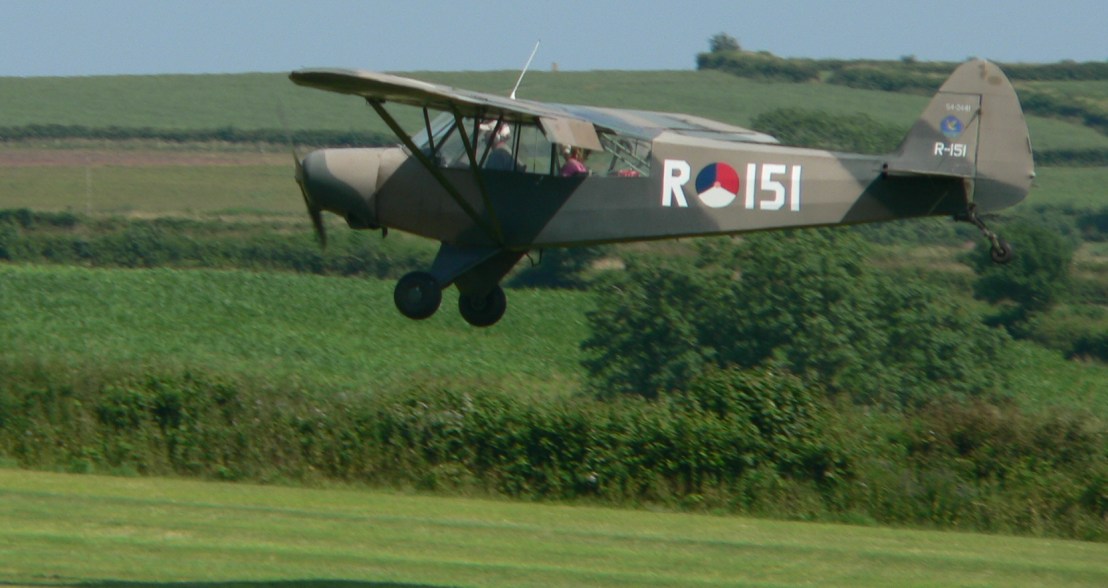
And this is my German Shepherd! The photograph was taken in 2006 when Pharaoh was 3 years old. The aircraft, by the way, is an L21B, the military variant of the Piper Super Cub. The aircraft was originally delivered to the Dutch Air Force in 1954 and has dispensation from the UK CAA to retain the original registration and callsign of R151.
oooOOOooo
More on the aircraft.
Originally when the first half of today’s Post was published separately readers asked for more information on the aircraft.
So here it is.
Piper Super Cub, L-21B, R-151
A/C Construction No. 18-3841, Frame No. 18-3843
Original Engine, Lycoming 135 Type 0-290-D2, 54/2441
Romeo 151 was one of a batch of 298 L-21’s delivered in 1954. There were 584 L-21B’s produced by Piper for military use, the ‘L’ standing for Liaison. The L-21B’s were PA-18-135’s with civil Lycoming 0-290-D2 engines, glasswork as most L-21A’s and L-18’s and a gross weight of 1760 lbs.
This aircraft was delivered to Koninklijke Luchtmacht, Dutch Air Force, on the 1st July, 1954 and registered R-151. After various homes R-151 transferred to the Dutch civil register as PH-GER, 1st April 1976 with 4,458 hours and shortly thereafter was registered to Vlieclub Hoogeveen, Certificate Number 2380.
On the 27th March, 1981 the aircraft was delivered to the UK with a total time of 5,043 hours and in September, 1981 became G-BIYR. In April, 1983 YR was the first of type to be given a Public Transport CofA and was used for training at Tollaton. YR reverted to a Private CofA in January, 1984 when purchased by Mike and Barbara Fairclough at 5,120 hours.
In 1992 YR was re-engined with a Lycoming 150HP, 0320-A2B No. L49809-27A (zero hours). Finally on the 2nd June, 1995 the a/c was repainted in original Dutch insignia and given CAA (UK Civil Aviation Authority) permission to use the original call-sign, Romeo 151.
The aircraft is based in South Devon, England and owned by the five members of the Delta Foxtrot Flying Group.
A few photos of the aircraft.
Approaching home airfield in South Devon, EnglandFlying in the French Alps, Mt Blanc in sight9,300 ft up in the French Alps
Don Tapscott presents what might just be humanity’s salvation.
Millions of us, of all ages, are linked together in this new ‘wired’ world. For old crusties such as myself, it’s all too easy to recall the days when the mention of the word ‘chip’ immediately brought to mind fried fish! But we struggled into this new world and now can’t imagine how it was in those earlier days – anyone want to buy my old quill pen? 😉
There are huge benefits to this wonderful networked world and most days I read something on a website here or a blog there that opens my mind in unfathomable ways. Not only that, but the number of friends, new and old, who co-operate with my attempts to show how integrity is the only way forward is humbling.
Thus it was that an old friend of many years, Lee C., sent me a link to a recent TED talk that revealed in just 17 minutes a message of hope for all of us. It reminded me that our younger generation have their own knowledge, their own aspirations, their own fears and dreams.
Without more ado, watch it now!
The recent generations have been bathed in connecting technology from birth, says futurist Don Tapscott, and as a result the world is transforming into one that is far more open and transparent. In this inspiring talk, he lists the four core principles that show how this open world can be a far better place.
And weren’t those flocks of starlings just breathtaking?
Lee also sent me this:
Don Tapscott’s recent TED talk ends with footage of starlings in vast numbers which is referred to as a ‘murmuration’. I watched it just two nights or so ago. Tonight I went outside for a breath of fresh air (ok a call of nature) and this is part of what I saw. So pleased to have had my mobile phone in my shirt pocket.
Finally, I hadn’t come across Don Tapscott before but thanks again to this amazing world of shared information, a quick Google search finds Don’s own website here.
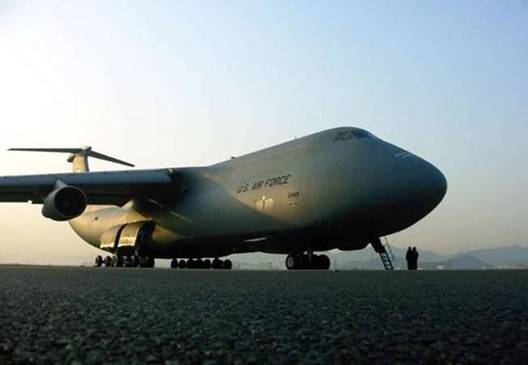
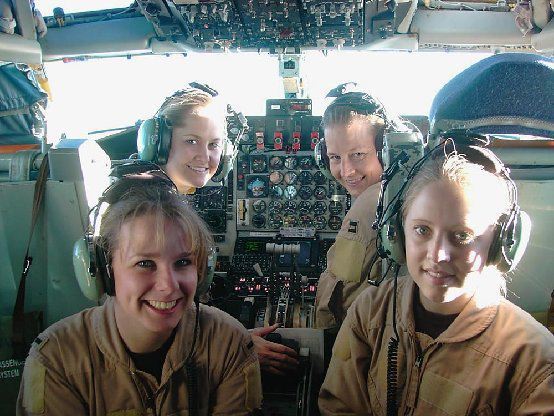
While the C-5 was turning over its engines, a female crewman gave the G.I.s on board the usual information regarding seat belts, emergency exits, etc.
Finally, she said, ‘Now sit back and enjoy your trip while your captain, Judith Campbell, and crew take you safely to Afghanistan‘
An old Master Sergeant sitting in the eighth row thought to himself, ‘Did I hear her right? Is the captain a woman? ‘
When the attendant came by he said ‘Did I understand you right? Is the captain a woman?‘
‘Yes,’! said the attendant, ‘In fact, this entire crew is female.’
‘My God,’ he said, ‘I wish I had two double scotch and sodas. I don’t know what to think with only women up there in the cockpit.’
‘That’s another thing, Sergeant,’ said the crew member, ‘We No Longer Call It The Cockpit‘
‘It’s The Box Office.’
oooOOOooo
Quote for today:
‘Whatever you give a woman, she will make greater. If you give her sperm, she’ll give you a baby. If you give her a house, she’ll give you a home. If you give her groceries, she’ll give you a meal. If you give her a smile, she’ll give you her heart. She multiplies and enlarges what is given to her. So, if you give her any crap, be ready to receive a ton of shit.’
Don’t know about you but I find that it is all too easy to get wound up by so much that is going on in this crazy world. That’s not to marginalise the threats to society that are all around us and there are some powerful writers out there who work so hard to inform the world as to the truth of those threats. (As an aside, one of my favourite authors is this context is Patrice Ayme, just see this recent Post of his as an example of his depth of analysis.)
But my dear friend of over 40 years, Dan Gomez, recently sent me a link to a video of the 10 most extreme airports in the world. That stirred some memories from my own flying days.
First settle back and enjoy 7 minutes of reasons why you don’t want to think about flying! 😉
The YouTube video has this information, which I republish below,
Pictures and videos of the top 10 most extreme airports in the world!
San Diego: Busy airspace lots of buildings on approach
Madeira: Difficult approach and did have a short runway
Eagle Vail: High altitude, short runway & mountainous approach & departure
Courchevel: Short runway, bumpy runway, high altitude
Kai Tak: Difficult approch, fly through tall buildings, short runway
Gibraltar: Short runway, building on approach, winds from the Gibraltar rock
St Maarten: Short runway, has to fly over the beach with alot of people on there, steep takeoff because of mountains
St Barts: Short runway, has to dive.
St Barts: To land, the low approach on that hill thingy
Toncontin: Difficult approach, short runway
Lukla, short runway, only was cemented a few years ago, no go around, if land too low you land into a cliff
First song: La Perla by Kobojsarna
Second song: Feel It – Explicit Album Version by Three 6 Mafia vs Tiesto with Sean Kingston and Flo Rida
Now to a personal recollection.
I was a private pilot for many years, first learning to fly at the Suffolk Aero Club at Ipswich Airport in Suffolk, England. My first lesson was on the 3rd March, 1984!
Some twenty years later, on the 13th August 2004 to be exact, I was checked out to land at Courchevel Airport in an aircraft type known as a TB20, a French-built aircraft. Here’s the page from my log book with the necessary authorisation stamp affixed.
Cleared to land at Courchevel, LFLJ!
The following year, 19th July, 2005, I added my wonderful Piper Super Cub to that authorisation. (See here for a part picture of the aircraft.)
So thanks to YouTube as someone has uploaded a film of a light aircraft operating into Courchevel. It really is rather thrilling!
Finally, back to Dan. Here’s his recollections included in the email that he sent with that first film.
Just found this. I’ve landed at two of these. Eagle Vail was a piece of cake compared to Toncontin as Marty and Bruce know. BAE146 and small Boeing jets. I flew in and out of Toncontin 5 times in the 90’s and had no idea it was as scary as it was. That is to say, I knew it was scary because my palms sweated and heartbeat was about 140 but when I look at it now I go “what was I thinking?”
Take offs were like Orange County, Full brake power straight up. The big difference was you were shuttling along the runway and then down the runway and finally, up the runway to get the wheels up.
One time, on a connecting flight from Medellin, we taxied in, were boarded by military police with drug dogs who sniffed their way through the aisle. Bags were searched while everyone waited in intense heat. It took about 2 hours, three time longer than necessary. Then the interior was fumigated with everyone aboard. All the big machine guns too. Nobody said a word!
There’s one thing about flying a light aircraft, especially into ‘interesting’ airfields, you don’t have a moment to worry about the state of the world!
Please indulge me with this purely personal reflection.
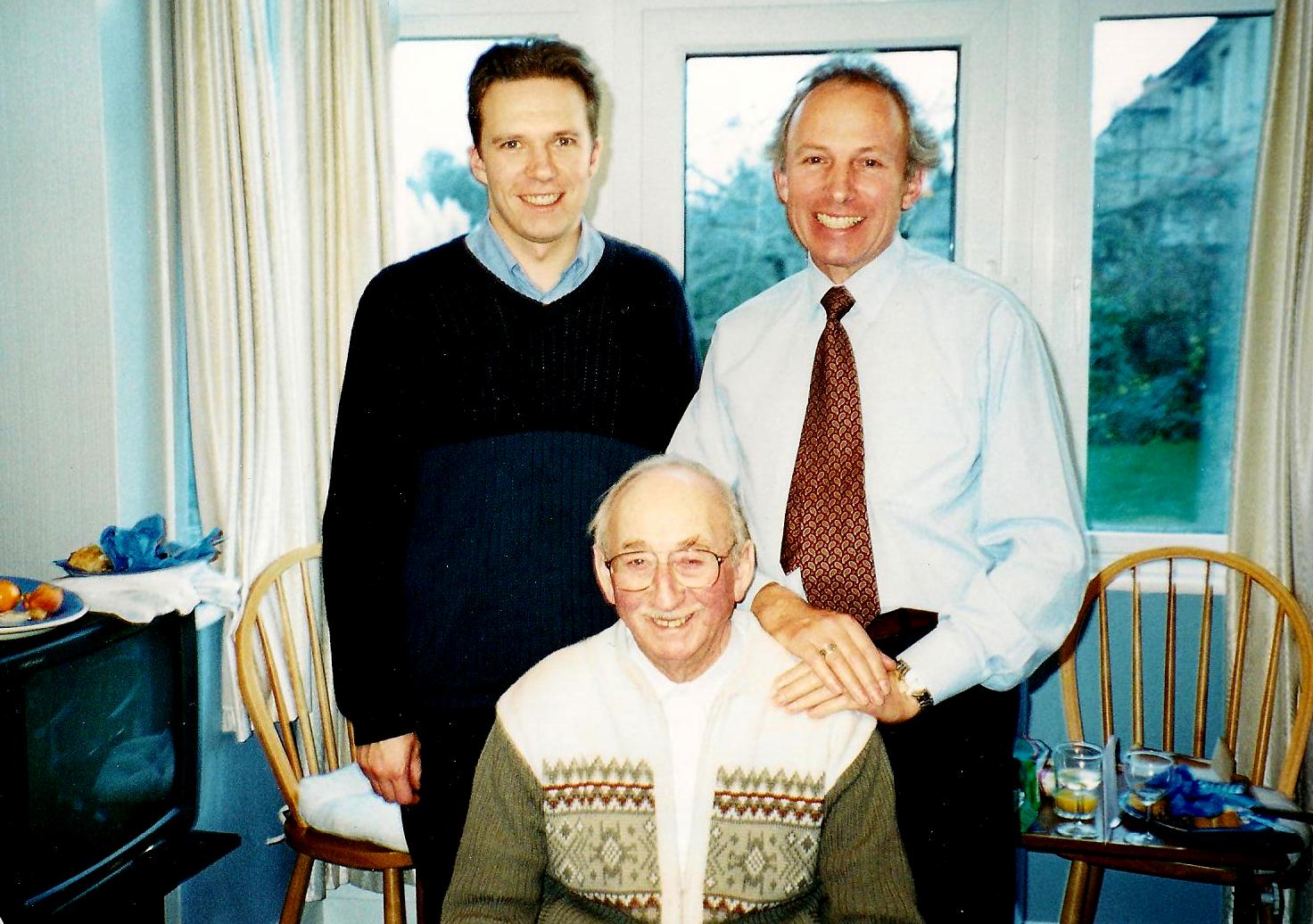
My Uncle Peter died in his sleep at 1.30am UK time on Monday, the 21st May, 2012. He was 91 and had been suffering from declining health for a while.
As my parting gift from across the seas, I just wanted to record the great inspiration that he was to both me and my son, Alex.
Peter was a great gliding fan (sailplane in American speak!). He must have started gliding not many years after the end of the war in 1945. Anyway, when I was a young lad, back in the mists of time, my Uncle Peter took me for a glider flight. That left a memory in me that lay dormant for many years until the late 1970s when a colleague, Roger Davis, introduced me to the Rattlesden Gliding Club and that started a 25-year interest in gliding and later power flying.
My son, Alex, also when he was a young boy was taken up for his first flight in a glider by Uncle Peter and later flew with me many times both in gliders and power aircraft. Today he is a Senior Captain with a British airline.
So, dear Uncle Peter, what an aviation inspiration you have been for two generations.
Uncle Peter and two generations of pilots.
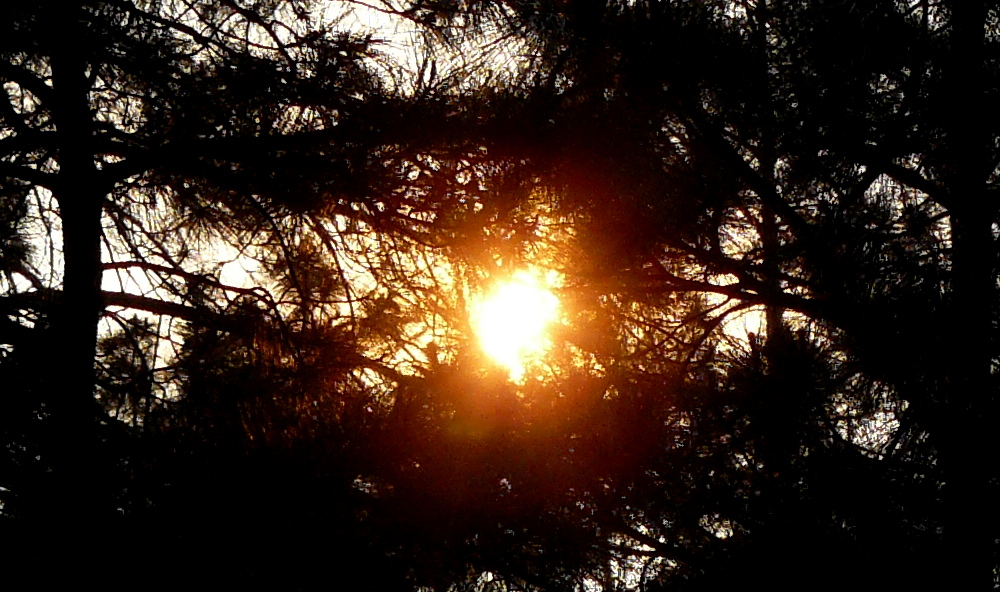
As it happens, 1.30 am UK time on Monday the 21st was 5.30pm Arizonan time on Sunday the 20th. At that very moment, well 5.26pm to be precise, Jean and I were watching the solar eclipse and I took the photograph below of what was the partial eclipse here in Payson.
Partial solar eclipse partly hidden by the pine trees.
A tribute to a wonderful family man with a great sense of humour.