Category: Finance

Well done, Bill Moyers!

A giant of US television retires from the screen

One of the fascinating aspects of my new American life is seeing how loud the volume of dissent is from the American

Bill Moyers

people about the shenanigans on Wall Street and the Too Big To Fail banks.  There is an intensity and passion that I can’t see happening on the other side of the Pond.  Maybe this is the cultural legacy of a people that just a short time ago, relatively speaking, were opening up this giant country seeking a better way of life than the ‘old countries’.

This intensity and passion is why, in the end, I believe that the solution to the huge crisis that still awaits us will start from this side of the Atlantic.  But it will get a whole lot worse before it gets better, such is the complexity and depth of the fraud that is being visited on decent, ordinary folks in this and many other fine countries.

Bill Moyers of the Bill Moyers Journal on PBS is retiring.  He’s approaching 76 and that’s a grand age to be dealing with the workload and stress of a weekly television presentation.  His last Journal was broadcast on the 23rd April, a week ago today airing two really important topics.  My only regret is that I haven’t been here sufficiently long to view many more of his Journals.

William K Black

In that last broadcast on the 23rd, Bill had two key interviews.  In this Post, I want to bring to your attention his first report, which was an interview with William K Black, now an academic but, just as importantly, a former bank regulator.  William Black really understands what is going on in banking.

The interview is both fascinating and captivating because, well to me anyway, it explains in terms that us laymen can understand, exactly what is going on and why it is so terribly important that legislation and regulations are brought into force to stop this fraud ever happening again.

This interview has not yet made it’s way onto YouTube so I can only post the link to the Bill Moyers website.

But, please, if you care about what is happening to us in whatever country you live in, click on this link and watch the interview.

And if you want to watch the earlier interview that Bill Moyers had with William Black then here it is.

By Paul Handover

Should you invest in U.S. bonds? Part 4

This is the concluding part four of a multipart series on the factors that drive U.S. and foreign bond prices and yields.

[Part One is here, Part Two here, Part Three here Ed.]

Bond’s in a weak or faltering economy will generate a lower return to lenders than bonds in a strong economy, absent inflation or any other material changes in the purchasing power of the currency.  Weak demand for goods and services means weak demand for financial capital which means low rates of return on financial capital.

The policies of the government can increase the borrowing costs of private industry.  Fiscal policy that increases taxes reduces the profitability of projects and undermines the ability of companies to pay coupons and repay principal.  Monetary policy that increases the money supply may lead to inflation, which also increases the cost of borrowing and reduces economic activity.

Lastly, and of the greatest concern of late, is the level of borrowing by the U.S. government.   Debt levels are at record highs, with no relief in sight. The AAA rating of U.S. debt is reportedly in jeopardy (Chicago Tribune editorial).

Moody's Corporate Logo

Both existing and new lenders worry about the ability of the U.S. government to repay. Yes, the can simply roll over existing debt by raising taxes or creating money to retire old debt and replace it with new, but the interest rate required by new lenders goes up as the ability of the private economy to sustain tax revenues falls and the risk of inflation rises (Moody’s explains U.S. bond ratings).

Both factors are in play now: an anemic economy with little hope that this administration will undertake policies that support business, and a ballooning money supply and weak dollar that undermine the purchasing power of the returns to lenders.  The returns to U.S. debt may still be healthy relative to those one can earn in other countries, but the spread is shrinking. The private economy remains fundamentally strong, thanks to the work ethic of the American people and the profit motive of the capitalistic system, but the policies of the U.S. government are straining those resources.

By Sherry Jarrell

Should you invest in U.S. bonds? Part 3

This is part three of a multipart series on the factors that drive U.S. and foreign bond prices and yields.

[Part One is here, Part Two here, Ed.]

The yield on a bond is made up of several components. Some think of the return on a bond as the sum of the risk-free rate of interest (how impatient we are to get our money back, or how much we need to be compensated to delay consumption) and a risk premium (the additional return we require to compensate us for the risk of default, the risk the bond will be called, the risk of inflation reducing the purchase power of the repaid dollars, and many other sources of risk as outlined in the most recent article in this series).

Another useful way of thinking of the return on a bond is as the sum of the real rate of interest and the expected rate of inflation.  But what is the real rate of interest?  We never actually observe that rate, unless of course the inflation rate is zero and then the real rate is just the nominal rate set in the market.

It is useful, however, to think about what drives the ability of a company to generate a real rate of return to lenders, for this is essence of capitalism and risk-taking and creating economic value and growth.

Bond traders

A firm’s asset cash flows support the real returns to its lenders – all kinds of lenders (debt, equity, hybrid, and derivative security holders). A firm will want to borrow more, and is willing to pay a higher interest rate for those funds, the more profitable are the projects they want to undertake, or the greater the number of profitable projects. Profitability, in turn, is determined by the relationship between demand and supply:  how much does society value a good or service, and how many resources does the business use in producing the good or service.  As the marginal productivity or efficiency of a business goes up, it can afford to profitably fund more projects.  So the core driver of the real return on bonds is the strength of the underlying economic activity of the private economy.

Or, when viewed from the investor’s side, note that an investor will purchase a bond, or lend money to a company, if they expect to earn a return sufficient to compensate them, first, for delaying consumption and, second, for bearing the various sources of risk or uncertainty associated with the bond’s cash flows or return.

By Sherry Jarrell

US incomes

This isn’t just about America, it’s affecting us all!

Yesterday, Learning from Dogs published in full a Stratfor report about China.  The thrust of the report was:

U.S.-Chinese relations have become tenser in recent months, with the United States threatening to impose tariffs unless China agrees to revalue its currency and, ideally, allow it to become convertible like the yen or euro. China now follows Japan and Germany as one of the three major economies after the United States. Unlike the other two, it controls its currency’s value, allowing it to decrease the price of its exports and giving it an advantage not only over other exporters to the United States but also over domestic American manufacturers. The same is true in other regions that receive Chinese exports, such as Europe.

What Washington considered tolerable in a small developing economy is intolerable in one of the top five economies. The demand that Beijing raise the value of the yuan, however, poses dramatic challenges for the Chinese, as the ability to control their currency helps drive their exports. The issue is why China insists on controlling its currency, something embedded in the nature of the Chinese economy. A collision with the United States now seems inevitable. It is therefore important to understand the forces driving China, and it is time for STRATFOR to review its analysis of China.

(My italics)

So the state of US incomes is crucial, not only to Chinese exports to America but for global trade in general.

Karl Denninger

We have often congratulated Karl Denninger of Market Ticker for his commitment in analysing and reporting on the American economic scene and a recent piece on US Incomes was typical of his excellent reporting.  I am taking the liberty of publishing his Post in full because, frankly, this information is of importance to us all, wherever we live.

Where Did The Income Go?

It appears that the Federal Tit Pump is running out of power…

Personal income increased $1.2 billion, or less than 0.1 percent, and disposable personal income (DPI) increased $1.6 billion, or less than 0.1 percent, in February, according to the Bureau of Economic Analysis.  Personal consumption expenditures (PCE) increased $34.7 billion, or 0.3 percent.

Oh boy, now the $1.3 trillion in additional deficit spending is no longer contributing to personal income!  That’s not so positive – indeed, it’s not positive at all.

Private wage and salary disbursements increased $2.0 billion in February, compared with an increase of $16.6 billion in January.  Goods-producing industries’ payrolls decreased $3.5 billion, in contrast to an increase of $5.2 billion; manufacturing payrolls decreased $1.4 billion, in contrast to an increase of $5.0 billion.  Services-producing industries’ payrolls increased $5.5 billion, compared with an increase of $11.4 billion.

Goods down…. uh, where’s our so-called economic recovery?

Proprietors’ income decreased $6.1 billion in February, the same decrease as in January. Farm proprietors’ income decreased $7.1 billion, the same decrease as in January.  Nonfarm proprietors’ income increased $1.0 billion, the same increase as in January.

Very little change in proprietor’s income ex farming, but farmer income is down significantly.

Rental income of persons increased $2.2 billion in February, compared with an increase of $1.9 billion in January.  Personal income receipts on assets (personal interest income plus personal dividend income) decreased $16.5 billion, the same decrease as in January.

Rents up a bit, but dividends are down huge, continuing a trend.  This is not positive at all, and implies that assets are being sold to continue lifestyle choices.  This leads to a question that has begun to gnaw at me: Have we begun to cross into where boomers start pulling funds out of asset classes to live on?

Personal current transfer receipts increased $16.6 billion in February, compared with an increase of $29.8 billion in January.  The January change reflected the Making Work Pay Credit provision of the American Recovery and Reinvestment Act of 2009, which boosted January receipts by $19.8 billion. The Act provides for a refundable tax credit of up to $400 for working individuals and up to $800 for married taxpayers.  When an individual’s tax credit exceeds the taxes owed, the refundable tax credit payment is classified as “other” government social benefits to persons.

Government to the rescue!  $45 billion worth in the last two months, to be specific.  That’s a direct $270 billion in handouts, or 2% of GDP – and that’s only the direct handouts!  So subtract that off GDP and….. (oh, and don’t forget the rest of the $1.3 trillion too.)

Nothing to see here folks, as in “no evidence of sustainability in the recovery.”  We have a government that continues to “prime the pump” but there’s no water at the bottom of the well to generate self-sustaining economic growth.

By Paul Handover

Unwinding $1 trillion in Toxic Assets

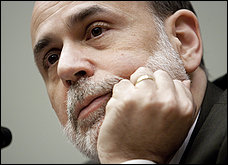
Ben S. Bernanke, Chairman of the Federal Reserve

Used toxic assets, anyone?

Ben Bernanke, Chairman of the U.S. Federal Reserve, announced that the Fed was likely to begin to sell some of the $1 trillion in mortgages, the so-called “toxic assets,” that it purchased over the last fifteen months to help stave off a total credit market meltdown. Those purchases essentially doubled the U.S. money supply, igniting fears of potential inflation should the underlying real economy recover before the money supply could be drawn back down. See earlier post.

Well, the process of tightening the money supply may be just around the corner. And increases in interest rates and the cost of everything purchased on credit – homes, cars, durable goods, and business capital expenditures – are not far behind. Increases in interest rates dampen economic activity, an unfortunate development given the current lethargic state of the U.S. economy. But it has to be done sometime – we cannot sustain such a huge increase in the money supply without paying an even higher price in terms of inflation and a weak dollar.

It will be interesting to see who buys the toxic assets and how much they will pay. Regardless, the sale will reduce the money supply which, if done in a slow, orderly manner, is a good thing for the economy. Getting the Fed out of the business of buying and selling private market securities will be an even better thing for the U.S. economy. Now more than ever we need a monetary authority that is focused on the best policies for our economy, not those that help Fannie Mae, the White House, or the Treasury Secretary save face.

By Sherry Jarrell

The GPS and the AAAs

Welcome Per Kurowski Egerström

On the 22nd March, Learning from Dogs had the pleasure of a Post from our first Guest Author, Elliot Engstrom.  We are doubly delighted to have Per Kurowski join us as our second Guest Author.

Per Kurowski

Per is a prolific blogger.  He has had a full career including serving as an Executive Director of the World Bank from 2002 until 2004 for Costa Rica, El Salvador, Guatemala, Honduras, Mexico, Nicaragua, Spain and Venezuela.  More about Per’s life experiences can be found here.

Here is Per’s first Guest Post for Learning from Dogs.

——————-

The GPS and the AAAs

Not so long ago I asked my daughter to key in an address in the GPS and then even while I continuously heard a little voice inside me telling me I was heading in the wrong direction I ended up where I did not want to go.

Whither we are led?

Something similar caused the current financial crisis.

First the financial regulators in Basel decided that the only thing they would care about was the risk of individual financial defaults and not one iota about any other risks.

Second then, though they must have known these were humanly fallible they still empowered some few credit rating agencies to be their GPS on default risks.

Finally, by means of the minimum capital requirements for banks, they set up all the incentives possible to force them to heed what the GPS said and to ignore any internal warning voices.

Of course, almost like if planned on purpose, it all ended up in a crisis. In just a couple of years, over two trillion dollars followed some AAA signs over the precipice of badly awarded mortgages to the subprime sector. Today, we are still using the same financial risk GPS with the same keyed in instructions… and not a word about it in all recent Financial Regulatory Reform proposals

I hate the GPS type guidance of any system since I am convinced that any kid brought up with it will have no clue of what north, south, east or west means; just as the banker not knowing his client’s business or how to look into his client’s eyes or how to feel the firmness of his client’s handshake, can only end up stupidly following someone else’s opinion about his client on a stupid monitor.

I hate the GPS type guidance system because, on the margin, it is making our society more stupid as exemplified by how society, day by day, seems to be giving more importance to some opaque credit scores than to the school grades of their children. I wait in horror for some DNA health rating scores to appear and cause a total breakdown of civilization as we know it.

Yes, we are buried under massive loads of information and these systems are a tempting way of trying to make some sense out of it all, but, if we used them, at least we owe it to ourselves to concentrate all our efforts in developing our capacity to question and to respond adequately when our instincts tell us we’re heading in the wrong way.

Not all is lost though. I often order the GPS in my car to instruct me in different tongues so as to learn new languages, it gives a totally new meaning to “lost in translation”, and I eagerly await a GPS system that can describe the surroundings in more extensive terms than right or left, AAA or BBB-, since that way not only would I get more out of it but, more importantly, I would also be more inclined to talk-back.

By Per Kurowski

The Fed’s Exit Strategy

The Federal Reserve finally addresses how it plans to unwind trillions in toxic assets

Finally, we hear from the Federal Reserve about how they plan to unwind the billions of dollars of toxic assets they purchased over the last 18 months or so without creating further distortions in the U.S. and world financial markets (Fed lays out exit detail). This after the Fed barely acknowledged one of the most dramatic runups in the money supply in U.S. history.

Brian Sack, EVP Markets Group, Federal Reserve
The announcement came in a speech by Brian P. Sack, the executive Vice President of the Markets Group at the Fed.  I am impressed by this guy. He seems to know what he’s talking about and seems to understand how markets and fed policy interact.

In earlier posts I wondered aloud how the Fed might accomplish this tricky task. It is a very delicate balance between reducing the money supply too quickly, which would spike short term rates, and too slowly, which would increase long-term rates due to worries about inflation (which occurs when money growth is higher than the economy’s real growth, even if money growth is falling).

The Fed, the article explains, apparently intends to let $200 billion of the estimated $1.25 trillion in new money supply simply “mature” by the end of 2011 without replacing it. This represents largely toxic assets. The Fed might let another $140 billion of Treasuries it purchased during normal open market operations mature at the end of 2011, but they aren’t committing to that.  So that’s about $340/$1,250 or about 35% of the historic increase in money supply that may be vaporized over the next 21 months. What about the rest?  It would be nice to know but….

The Fed is doing the right thing by explaining its policy intentions — ANY of its policy intentions — to the markets.  Markets want, need, and deserve information from our officials, something that has been sorely lacking of late. With information, lenders and borrowers can plan, they can optimize. Without information, guessing, withdrawing from the market, and fear rule the day. Not a good environment for economic recovery.

by Sherry Jarrell

Should you invest in U.S. bonds? Part 2

Sources and types of risk in U.S. and other bonds.

This is part 2 of a multipart [Part One is here, Ed.] series on the factors that drive U.S. and foreign bond prices and yields.

Recall that a bond’s price is the present value of its coupons (if any) and face value (or principal or par value).  Let’s keep things simple for now and assume a zero-coupon or “discount” bond.

One thing of interest to note first: As we move forward in time from the issue date toward the maturity date, and the number of periods between now and the maturity date falls, the price of a discount bond rises toward the face value of the bond, even with no changes in the interest rate.  At maturity, the price of the bond equals the face value. Only unexpected changes in the effective return on a bond can change the natural upward progression of its price toward face value between the issue and maturity dates.

This example makes clear that the (annual) yield on a bond, simply put, is driven by the difference between the price paid for the bond and the cash flows it generates, that is, the difference between “dollars out” today and “dollars in” later.

The “dollars out” are known because we pay a given price for the bond today.  The “dollars in,” consisting of coupons (if any) and the face value of the bond, are also “known” in that they are specified in a contract at the time the bond is issued.  The realized value of these dollar returns is, however, subject to many different sources of uncertainty or risk. A short list includes:

Interest rate risk: how sensitive the price of the bond is to changes in interest rates over the life of the bond.  Interest rate risk is higher for bonds with a longer maturity (more time for the unexpected to happen), a lower coupon (more of the value of the bond is tied up in the principal), and a lower initial yield (a 1 percentage point change in interest rates represents a higher relative change in low yields).  Floating-rate notes and bonds have much lower, though not zero, interest rate risk.

Reinvestment rate risk.  Bondholders may reinvest their coupons at the then-prevailing rate of interest. As those market rates of interest change, the return on reinvested coupons becomes more uncertain. The higher the coupons, the more frequently they are paid, and the longer the maturity of the bond, the higher reinvestment rate risk.

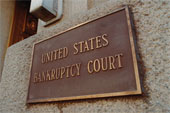
Bankruptcy Court: Destination for issuers in default

Credit or default risk:  the risk that the issuer will default on the payments of the bond, which reduces the amount and value of “dollars in” relative to price paid, lowering the earned yield on the bond.   Credit risk is frequently measured as the credit spread over like Treasuries, which are assumed to have zero credit risk.  Credit risk includes downgrade risk, where a credit rating agency lowers the rating on an issuer as their ability to repay the debt is brought into question.

Call risk:  the risk that a callable bond will be called by the issuer. Since a bond is typically called only when it’s in the best interest of the issuer, the call feature is systematically harmful to the bondholder.  Prepayment risk reverses these risks:  prepayment is good for the bondholder, and bad for the issuer.

Exchange rate risk (that the value of the repaid currency will be lower), inflation risk (that the value of the repaid dollar will be lower), and event risk (natural disasters, corporate restructurings, regulatory changes, sovereign or political changes) round out the list of broad types of risks that drive bond yields.

Next time: why the types and level of risks are so difficult to measure and predict.

by Sherry Jarrell

In praise of Yves Smith

Helping thousands better understand this crisis

Yves’ Blog Naked Capitalism has been mentioned many times on Learning from Dogs.  Indeed, she was one of the Blog authors highlighted recently in this Post.

Yves Smith

I fail to understand how she finds the hours in the day to write in such detail – but those of us interested in getting under the skin of our present economic situation are all the better for it.  Here’s a great example that was published on the 23rd February.  I quote the opening paragraphs and then link to the rest of her post. From here on is her piece:

———————–

Martin Wolf, the Financial Times’ highly respected chief economics editor, weighs in with a pretty pessimistic piece tonight. This makes for a companion to Peter Boone and Simon Johnson’s Doomsday cycle post from yesterday.

Let us cut to the chase of Wolf’s argument:

Now, after the implosion, we witness the extraordinary rescue efforts. So what happens next? We can identify two alternatives: success and failure.

By “success”, I mean reignition of the credit engine in high-income deficit countries. So private sector spending surges anew, fiscal deficits shrink and the economy appears to being going back to normal, at last. By “failure” I mean that the deleveraging continues, private spending fails to pick up with any real vigour and fiscal deficits remain far bigger, for far longer, than almost anybody now dares to imagine. This would be post-bubble Japan on a far wider scale.

Yves here. Notice he associates success and failure with polar options. But how can you “reignite the credit engine” when the financial system is undercapitalized even before allowing for the need to take further writedowns? The IMF has found the converse in its study of 124 banking crises, that purging bad debt is a painful but necessary precursor to growth. So I fail to understand how Wolf envisages that “skip Go, collect $200″ of releveraging quickly comes about. And in fact, it turns out that Wolf’s “success” is a straw man:

[to read the rest click here, Ed]

By Paul Handover

Now this IS smart!

A very good idea from the Canadians

Read this quote:

“Time and again we see behaviour by people – we are talking highly educated, high income people – who are making less than ideal financial decisions for themselves and their families,” said one source. “Other countries that have developed a strategy have focused on education in high schools. This task force has come to the early conclusion that, while enhanced financial education is vital over the long term, it is insufficient.”

The first sentence is so important, to my mind, that it is worth repeating, “Time and again we see behaviour by people – we are talking highly educated, high income people – who are making less than ideal financial decisions for themselves and their families,

This comes from a piece published by the Canadian newspaper, The Globe and Mail, about a Canadian taskforce that is

Group will be headed by Sun Life's Don Stewart

looking into ways of making Canadians “more savvy” about their personal finances.

The financial industry is very adept at producing complex financial products that are almost beyond the limits of the understanding of good common people.  We, the people, need to be much smarter and that’s why this initiative from the Canadians seems, on the surface, to be such an excellent idea.

By Paul Handover