Category: Finance

Drink-Driving

Amazed they don’t just tax Fun and leave it at that!

Lemonade isn't a substitute!

Once again the British Politically Correct nanny-state lobby seems about to pounce by reducing the drink-driving limit to 50 mg. This is yet another fatuous knee-jerk “Let’s give the image that we are responsible and doing something” initiative.

No, I do NOT favour driving while drunk, but at 80 mg per ml you are not “drunk” or even impaired. The introduction of the 80 mg limit was a great step, but more would be a mg too far.

I know for an absolute fact that if I drink one pint of beer I am in no way more dangerous than if I drink nothing. Don’t ask me how I know; I just do. I’ve been driving all over Europe for 40 years; and experience counts for something after all.

Yes, I do want to see road accidents reduced, but let’s see something REALISTIC and EFFECTIVE. Why are most accidents caused? (apart from people way over the limit, unlicenced or driving unroadworthy cars and so on)

  • arrogance and lack of imagination: “It can’t happen to me.”
  • impatience: overtaking dangerously to save 45 seconds on a two-mile journey
  • driving too fast in the wrong place at the wrong time.
  • driving without consideration for others
  • not driving as if every other driver was an idiot
  • failing to give yourself enough of a margin for error
  • failing to understand statistics

The last two points are perhaps crucial. Drive on the périphérique in Paris and you’ll see examples of both. Of course, the French are, in general, brilliant drivers and 99.9% of the time they can get away with driving up someone’s boot, but statistics tell us that there is 0.01% of the time when this will NOT be OK.

What steps COULD be taken instead of clobbering the one pinter?

  • Start with the apparent ONE MILLION people in Britain driving either unlicensed and/or in uninsured or unroadworthy cars.
  • Ban rich Daddy’s boys from driving high-powered sports cars: nobody under 25 should be able to drive anything over 80 bhp for a start.
  • Where is the logic in manufacturing cars that can drive at three times the speed limit? BAN THEM. BE LOGICAL.
  • Make the viewing of video of the aftermath of accidents a compulsory part of the driving test so that people came reeling out of the room white and vomiting at the sight of accident victims with their faces smashed up and/or their heads severed. This is the REALITY of accidents. Let’s GET REAL.
  • Prevent people from driving for TOO LONG. Tiredness is a MAJOR factor in accidents, but there is ABSOLUTELY NO CONTROL over the hours that private motorists can drive. Modern technology could do something here.
  • Make the punishments for careless and/or dangerous driving SEVERE.
  • Make people AFRAID of causing an accident.

The truth is that a car is as dangerous as a gun and people should treat them as such. Sadly, familiarity breeds contempt and people too often forget the basic principles.

Every time I get in my car I tell myself the following:

  • Drive with as much care as when you first drove so nervously and gingerly on your first trip with your new licence.
  • Every journey could be your last. Just because the last n days have been trouble-free it doesn’t mean that today will. (statistics again)
  • There could be an idiot around the next corner, so drive defensively. (there is always a percentage of idiots, so statistically you are CERTAIN to meet one now and again)
  • Going too fast in the wrong place and/or conditions isn’t worth the risk. (stats again)
  • You have no right to maim or kill anyone else by bad driving and causing “an accident”‘.
  • Be afraid – think of what a serious injury or even your death would mean to your family.
  • It’s no good being “sorry” afterwards ……

Let’s hope the new British government has a bit of commonsense about this.

PS The Police could do their bit, too. A significant number of people are killed by policemen rushing about.

By Chris Snuggs

IAM Logo

A P.P.S. from the Editor. In fact, one of the best things that could be done is create an


incentive for passing the Institute of Advanced Driving driving test.  I passed the test in 1966 and it has been the best investment I have ever made.

Why doesn’t the UK Government give a free year’s road-tax for every person who passed the IAM test.  All this proposed change in the drink/drive limit will do is to put yet more British pubs out of business.  G’rrr.

A Government Motors IPO?

Alice in Wonderland?

Does anyone else see how perverted this story is?  A company which is 60% owned by the U.S. Treasury, in other words, 60% owned by taxpayers — not voluntary shareholders, but TAXPAYERS, has hired a private investment banking company to take the company public.

That is, to be sold to public stockholders.  For a profit.  Which is going to be distributed to whom?  The government.  Who took the company over by edict, essentially by force, ignoring lawfully binding financial contracts in the process.  Oh, yes, technically G.M. went through a “banktuptcy,” but when one of the two involved parties is the federal government — the one who makes up the rules of the game — then it isn’t a game anymore.  It’s “do it, or else!”

GM Headquarters

Absolutely unbelievable.  This IPO should not be happening.  The bailout should not have happened. None of this should have happened.  If the company cannot generate a profit in the marketplace, then it should go bankrupt and its resources freed up to be used where they are most valued by the marketplace.

by Sherry Jarrell

Gold or Dollars?

Is Gold Really A Superior Investment?

I’m sure you’ve heard about the steady rise in gold prices over the last several months. You may have also seen the advertisements from gold investment companies pushing the purchase of gold, or heard predictions about even higher gold prices as world currencies struggle.

And just yesterday, the world’s first “Gold ATM” machine was unveiled in Abu Dhabi (Gold ATM Machine, Financial Times).

Gold dispensing machine in Abu Dhabi

We have to take a step back and ask ourselves about the true underlying value of gold.

Why is it valuable?  Because people demand it, and there is a relatively limited world supply.  Why do people demand gold?

It’s not like gold will sustain you: you can’t eat or drink it, nor does it have utility in and of itself.

No, the reason gold has value is because it can be exchanged for money which, in turn, can be exchanged for goods or services.  So the value of gold is derived from the very same place as is the value of money:  access to underlying goods and services.

The actual value of gold, however, is entirely dependent on other people’s demand for gold, given limited supply, much like fine art.  Unlike money, you cannot actually use gold for transactions:  have you tried to use a bar of gold at your local restaurant or car dealer, for example?

Think about it: if for some reason gold fell out of favor — let’s say someone discovered it was toxic — then gold would no longer be desired as an indirect means of exchange — having to first be exchanged for currency — and its price would drop to nothing, quite independently of the value of money itself.

The value of money it also dependent on its demand, which in turn depends on the acceptability of the currency on the world stage as a unit of exchange.

Dollars are accepted as currency and retain their value as long as the underlying real U.S. economy continues to be productive, and as long as the world supply of dollars does not outstrip the world demand for dollars.

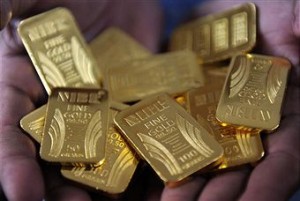
Gold bars

Dollars are suffering at the moment for two primary reasons:  the attack on private industry by Obama’s policies, and the excessive world supply of dollars.  Both of these factors drive down the value of a dollar, and drive up the number of dollars that a bar of gold commands.

by Sherry Jarrell

Derivatives are Not Evil

Are Derivatives Really to Blame?

Derivative securities are not inherently evil, though the media would have you think otherwise. It seems that any

Are they evil?

type of investment that does not directly involve commodities is an easy target these days.

But derivatives are just another type of investment, those whose value is derived from some underlying security or asset or event.   Insurance is a type of derivative investment, as a matter of fact. If the bad event happens (a car accident, flood, or fire, for example), then a claim is made against the policy.  If not, the policy expires.   The value of the policy is derived from the insured asset or event.

If derivatives are bad, then so too is insurance.  If derivatives are bad, then so too are leases with the option to own.  If derivatives are bad, then so too is the equity in any type of company, small or large, private or public, including those that produce real products and commodities, for stock is nothing more than an option to buy the underlying assets of the company for the price of the face value of its debt.  If derivatives are bad, then so too are convertible securities and most every other type of financial innovation we’ve witnessed in the last 30 years, and for decades to come.

by Sherry Jarrell

I am scared!

Guest author, Per Kurowski, on a rather sobering topic!

I do not know what worse, the arrogance of the regulators thinking they can squeeze out the risk in banking by imposing different and completely arbitrary capital requirements based on the opinions of some few human fallible credit rating agencies, or their childish innocence not knowing this creates systemic risks of gigantic proportions.

What I do know is that an amazing number of intelligent people have fallen for this absurd and extremely dangerous regulatory paradigm. Honestly… I am truly scared!

How could I not be with regulators who can authorize banks to leverage up 62.5 to 1 on public debts like Greece’s while at the same time placing a 12.5 to 1 ceiling on the lending to the small businesses and entrepreneurs whom we depend so much on for our jobs.

Better hope they don't need funding!

All those financial and regulatory experts who kept mum when they should have spoken out on the financial crisis about to happen are now, quite effectively, circling their wagons in order to promote the myth that no one knew. False many did! In order to benefit from the lessons we must learn, they should not be allowed to succeed.

On October 19, 2004, as an Executive Director of the World Bank (2002-2004) I presented a written formal statement at the Board and that included the following:

We [I] believe that much of the world’s financial markets are currently being dangerously overstretched through an exaggerated reliance on intrinsically weak financial models that are based on very short series of statistical evidence and very doubtful volatility assumptions.

And I was no investment banker, nor a regulator, nor an investor, and so to me it is clear that all of them, had they done their job right, should have known… and that this crisis should have been nipped in the bud much earlier, as

Per Kurowski

the real explosion in truly bad mortgages took off in 2004, when the SEC in April delegated the setting of the capital requirements for the investment banks to the Basel Committee, and the G10 in June approved Basel II.

In order to understand it all don’t follow the money… follow the AAAs.  In case you missed “The Financial Crisis explained to dummies, non-experts and financial regulators” you can read it here.

By Per Kurowski

PS. I have put up a document that resumes most of what I said before and during my term as an Executive Director.

“Wild” Swing in the Dow Jones?

Market Swings are Normal…nay…Desirable!

Roller coaster?

Just to try to help put stock market swings into perspective, consider this:

  • the 347.8 point fall in the Dow Jones Industrial Average last week, from 10868.12 at the start of the trading day on Thursday, May 6, 2010 to 10520.32 at the close of trading, can be COMPLETELY explained by an increase in the perceived cost of capital from 12% to 12.23%.
  • do the math.  Using the constant dividend growth model, a very simplified model of the market value of equity, or Market Value = Current Dividend/(cost of equity capital – dividend growth rate), and assuming a long-term average cost of U.S. equity capital of 12% and average growth rate of 5%, we find that the opening level of 10868.12 = 760.77/(.12 -.05), and the closing level of 10520.32= 760.77/(.1223 -.05).
  • I think it is entirely possible that the chaos in Greece and surrounding nations, and the interconnections between worldwide supplies of liquidity and financial capital, that an increase in the perceived risk and uncertainty of the returns to equity from 12% per year to 12.23% per year makes perfect sense.
  • The market’s are working.  Market participants, from the individual investor using on-line trading at 2:00 in the morning from their living room to the most sophisticated computerized large-scale institutional trader, understands that a borrower’s ability to pay back its investors depends on the real productivity and growth of private industry, whether the borrower is a company or a country.

by Sherry Jarrell

Breaking up the big banks

There are so many excellent Blogs out there that it is difficult at times to keep track of key articles.  But here’s one reproduced from Washington’s Blog.  It was published on the 30th April and sets out some powerful reasons why the so-called Too Big To Fail banks should, and must, be broken up.  It is reproduced with permission. Ed.

5 Reasons We Must Break Up the Giant Banks

As everyone from Paul Krugman to Simon Johnson has noted, the banks are so big and politically powerful that they have bought the politicians and captured the regulators.

But the giant banks are not only dangerous because they skew the political system. There are five economic arguments against the mega-banks as well.

Impaired Competition

Fortune pointed out last February that the only reason that smaller banks haven’t been able to expand and thrive is that the too-big-to-fails have decreased competition:

Growth for the nation’s smaller banks represents a reversal of trends from the last twenty years, when the biggest banks got much bigger and many of the smallest players were gobbled up or driven under…

As big banks struggle to find a way forward and rising loan losses threaten to punish poorly run banks of all sizes, smaller but well capitalized institutions have a long-awaited chance to expand.

So the very size of the giants squashes competition.

Less Loans, More Bonuses

Small banks have been lending much more than the big boys.

The giant banks which received taxpayer bailouts actually slashed lending more, gave higher bonuses, and reduced costs less than banks which didn’t get bailed out.

Lack of Transparency in Derivatives

Too Big!

JP Morgan Chase, Bank of America, Goldman Sachs, Citigroup, and Morgan Stanley together hold 80% of the country’s derivatives risk, and 96% of the exposure to credit derivatives.

Experts say that derivatives will never be reined in until the mega-banks are broken up.

Increased Debt Problems

As I pointed out in December 2008:

The Bank for International Settlements (BIS) is often called the “central banks’ central bank”, as it coordinates transactions between central banks.

BIS points out in a new report that the bank rescue packages have transferred significant risks onto government balance sheets, which is reflected in the corresponding widening of sovereign credit default swaps:

The scope and magnitude of the bank rescue packages also meant that significant risks had been transferred onto government balance sheets. This was particularly apparent in the market for CDS referencing sovereigns involved either in large individual bank rescues or in broad-based support packages for the financial sector, including the United States. While such CDS were thinly traded prior to the announced rescue packages, spreads widened suddenly on increased demand for credit protection, while corresponding financial sector spreads tightened.

In other words, by assuming huge portions of the risk from banks trading in toxic derivatives, and by spending trillions that they don’t have, central banks have put their countries at risk from default.

Now, Greece, Portugal, Spain and many other European countries – as well as the U.S. and Japan – are facing serious debt crises. See this, this and this.

By failing to break up the giant banks, the government is guaranteeing that they will take crazily risky bets again and again and again.

We are no longer wealthy enough to keep bailing out the bloated banks. We have serious debt problems. See this, this and this.

(Anyone who claims that Chris Dodd’s proposed “reform” legislation will prevent banks from getting bailed out again is wrong. If the giant banks aren’t broken up now – when they are threatening to take down the world economy – they won’t be broken up next time they become insolvent, either. And see this.)

Unfair Competition and Manipulation of Markets

Moreover, Richard Alford – former New York Fed economist, trading floor economist and strategist – recently showed that banks that get too big benefit from “information asymmetry” which disrupts the free market.

Nobel prize winning economist Joseph Stiglitz noted in September that giants like Goldman are using their size to manipulate the market:

“The main problem that Goldman raises is a question of size: ‘too big to fail.’ In some markets, they have a significant fraction of trades. Why is that important? They trade both on their proprietary desk and on behalf of customers. When you do that and you have a significant fraction of all trades, you have a lot of information.”

Further, he says, “That raises the potential of conflicts of interest, problems of front-running, using that inside information for your proprietary desk. And that’s why the Volcker report came out and said that we need to restrict the kinds of activity that these large institutions have. If you’re going to trade on behalf of others, if you’re going to be a commercial bank, you can’t engage in certain kinds of risk-taking behavior.”

The giants (especially Goldman Sachs) have also used high-frequency program trading which not only distorted the markets – making up more than 70% of stock trades – but which also let the program trading giants take a sneak peak at what the real (aka “human”) traders are buying and selling, and then trade on the insider information. See this, this, this, this and this. (This is frontrunning, which is illegal; but it is a lot bigger than garden variety frontrunning, because the program traders are not only trading based on inside knowledge of what their own clients are doing, they are also trading based on knowledge of what all other traders are doing).

Goldman also admitted that its proprietary trading program can “manipulate the markets in unfair ways”. The giant banks have also allegedly used their Counterparty Risk Management Policy Group (CRMPG) to exchange secret information and formulate coordinated mutually beneficial actions, all with the government’s blessings.

Again, size matters. If a bunch of small banks did this, manipulation by numerous small players would tend to cancel each other out. But with a handful of giants doing it, it can manipulate the entire economy in ways which are not good for the American citizen.

No wonder virtually every independent economist and financial expert is calling for the big banks to be broken up.

Some argue that it is logistically impossible to break up the behemoths. But if we broke up Standard Oil, we can break up the giant banks as well.

Well done, Bill Moyers!

A giant of US television retires from the screen

One of the fascinating aspects of my new American life is seeing how loud the volume of dissent is from the American

Bill Moyers

people about the shenanigans on Wall Street and the Too Big To Fail banks.  There is an intensity and passion that I can’t see happening on the other side of the Pond.  Maybe this is the cultural legacy of a people that just a short time ago, relatively speaking, were opening up this giant country seeking a better way of life than the ‘old countries’.

This intensity and passion is why, in the end, I believe that the solution to the huge crisis that still awaits us will start from this side of the Atlantic.  But it will get a whole lot worse before it gets better, such is the complexity and depth of the fraud that is being visited on decent, ordinary folks in this and many other fine countries.

Bill Moyers of the Bill Moyers Journal on PBS is retiring.  He’s approaching 76 and that’s a grand age to be dealing with the workload and stress of a weekly television presentation.  His last Journal was broadcast on the 23rd April, a week ago today airing two really important topics.  My only regret is that I haven’t been here sufficiently long to view many more of his Journals.

William K Black

In that last broadcast on the 23rd, Bill had two key interviews.  In this Post, I want to bring to your attention his first report, which was an interview with William K Black, now an academic but, just as importantly, a former bank regulator.  William Black really understands what is going on in banking.

The interview is both fascinating and captivating because, well to me anyway, it explains in terms that us laymen can understand, exactly what is going on and why it is so terribly important that legislation and regulations are brought into force to stop this fraud ever happening again.

This interview has not yet made it’s way onto YouTube so I can only post the link to the Bill Moyers website.

But, please, if you care about what is happening to us in whatever country you live in, click on this link and watch the interview.

And if you want to watch the earlier interview that Bill Moyers had with William Black then here it is.

By Paul Handover

Should you invest in U.S. bonds? Part 4

This is the concluding part four of a multipart series on the factors that drive U.S. and foreign bond prices and yields.

[Part One is here, Part Two here, Part Three here Ed.]

Bond’s in a weak or faltering economy will generate a lower return to lenders than bonds in a strong economy, absent inflation or any other material changes in the purchasing power of the currency.  Weak demand for goods and services means weak demand for financial capital which means low rates of return on financial capital.

The policies of the government can increase the borrowing costs of private industry.  Fiscal policy that increases taxes reduces the profitability of projects and undermines the ability of companies to pay coupons and repay principal.  Monetary policy that increases the money supply may lead to inflation, which also increases the cost of borrowing and reduces economic activity.

Lastly, and of the greatest concern of late, is the level of borrowing by the U.S. government.   Debt levels are at record highs, with no relief in sight. The AAA rating of U.S. debt is reportedly in jeopardy (Chicago Tribune editorial).

Moody's Corporate Logo

Both existing and new lenders worry about the ability of the U.S. government to repay. Yes, the can simply roll over existing debt by raising taxes or creating money to retire old debt and replace it with new, but the interest rate required by new lenders goes up as the ability of the private economy to sustain tax revenues falls and the risk of inflation rises (Moody’s explains U.S. bond ratings).

Both factors are in play now: an anemic economy with little hope that this administration will undertake policies that support business, and a ballooning money supply and weak dollar that undermine the purchasing power of the returns to lenders.  The returns to U.S. debt may still be healthy relative to those one can earn in other countries, but the spread is shrinking. The private economy remains fundamentally strong, thanks to the work ethic of the American people and the profit motive of the capitalistic system, but the policies of the U.S. government are straining those resources.

By Sherry Jarrell

Should you invest in U.S. bonds? Part 3

This is part three of a multipart series on the factors that drive U.S. and foreign bond prices and yields.

[Part One is here, Part Two here, Ed.]

The yield on a bond is made up of several components. Some think of the return on a bond as the sum of the risk-free rate of interest (how impatient we are to get our money back, or how much we need to be compensated to delay consumption) and a risk premium (the additional return we require to compensate us for the risk of default, the risk the bond will be called, the risk of inflation reducing the purchase power of the repaid dollars, and many other sources of risk as outlined in the most recent article in this series).

Another useful way of thinking of the return on a bond is as the sum of the real rate of interest and the expected rate of inflation.  But what is the real rate of interest?  We never actually observe that rate, unless of course the inflation rate is zero and then the real rate is just the nominal rate set in the market.

It is useful, however, to think about what drives the ability of a company to generate a real rate of return to lenders, for this is essence of capitalism and risk-taking and creating economic value and growth.

Bond traders

A firm’s asset cash flows support the real returns to its lenders – all kinds of lenders (debt, equity, hybrid, and derivative security holders). A firm will want to borrow more, and is willing to pay a higher interest rate for those funds, the more profitable are the projects they want to undertake, or the greater the number of profitable projects. Profitability, in turn, is determined by the relationship between demand and supply:  how much does society value a good or service, and how many resources does the business use in producing the good or service.  As the marginal productivity or efficiency of a business goes up, it can afford to profitably fund more projects.  So the core driver of the real return on bonds is the strength of the underlying economic activity of the private economy.

Or, when viewed from the investor’s side, note that an investor will purchase a bond, or lend money to a company, if they expect to earn a return sufficient to compensate them, first, for delaying consumption and, second, for bearing the various sources of risk or uncertainty associated with the bond’s cash flows or return.

By Sherry Jarrell