Category: Environment

The book! Part Three: Materialism

Money has never made man happy, nor will it, there is nothing in its nature to produce happiness. The more of it one has the more one wants.” Thus, it is reputed, spoke Benjamin Franklin, one of the Founding Fathers of the United States and who in many ways could be regarded as “the First American”.

In my previous chapter on short-termism, I quoted from an article by Larry Elliot, Economics Editor of The Guardian newspaper. The closing paragraphs of that article read:

“The premise of the Global Commission on the Economy and Climate is that nothing will be done unless finance ministers are convinced of the need for action, especially given the damage caused by a deep recession and sluggish recovery.

Instead of preaching to the choir the plan is to show how to achieve key economic objectives – growth, investment, secure public finances, fairer distribution of income – while at the same time protecting the planet. The pitch to finance ministers will be that tackling climate change will require plenty of upfront investment that will boost growth rather than harm it.”

“ …. the plan is to show how to achieve key economic objectives ……. while at the same time protecting the planet.” [My italics]

That those two paragraphs and the phrase “key economic objectives” seem perfectly reasonable statements to me and, I don’t doubt, many, many others, illustrates how deeply we are entrenched in the money, or materialistic, world.

I have spent my whole life hearing the term ‘Gross Domestic Product’, or GDP as it is commonly described, and never ever stopped to wonder about the history of this well-known measure. Thus I was genuinely surprised to learn that the term is not yet one hundred years old, by some years. On the website Foreign Policy one finds a brief history of GDP: “One stat to rule them all.” It offers the following:

Out of the carnage of the Great Depression and World War II rose the idea of gross domestic product, or GDP: the ultimate measure of a country’s overall welfare, a window into an economy’s soul, the statistic to end all statistics. Its use spread rapidly, becoming the defining indicator of the last century. But in today’s globalized world, it’s increasingly apparent that this Nobel-winning metric is too narrow for these troubled economic times.

1937: Simon Kuznets, an economist at the National Bureau of Economic Research, presents the original formulation of gross domestic product in his report to the U.S. Congress, “National Income, 1929-35.” His idea is to capture all economic production by individuals, companies, and the government in a single measure, which should rise in good times and fall in bad. GDP is born.

1944: Following the Bretton Woods conference that established international financial institutions such as the World Bank and the International Monetary Fund, GDP becomes the standard tool for sizing up a country’s economy.

1959: Economist Moses Abramovitz becomes one of the first to question whether GDP accurately measures a society’s overall well-being. He cautions that “we must be highly skeptical of the view that long-term changes in the rate of growth of welfare can be gauged even roughly from changes in the rate of growth of output.”

1962: But GDP evangelists reign. Arthur Okun, staff economist for U.S. President John F. Kennedy’s Council of Economic Advisers, coins Okun’s Law, which holds that for every 3-point rise in GDP, unemployment will fall 1 percentage point. The theory informs monetary policy: Keep growing the economy, and everything will be just fine. [My italics]

Keep growing the economy and everything will be fine! Thank goodness we have unlimited resources on this planet! Please forgive my irony!

Management thinker Peter Drucker is often quoted as saying that “you can’t manage what you can’t measure” but my understanding was that the saying came from William Edwards Deming; October 1900- December 1993. Deming was fundamentally an American statistician although his bio reveals many other talents: engineer; professor; author; lecturer; and management consultant.

Irrespective of the origins of the saying, it misses one fundamental point! That is of being certain that what you wish to manage is being measured appropriately. Not measuring pears if you wish to manage apples!

Stay with this idea for a while longer.

There is an organisation known as the Social Progress Imperative. The organisation is described on their website, as follows:

THE IMPERATIVE
Numerous studies have found a high correlation between economic growth and a wide variety of social indicators, yet there is growing awareness that economic measures alone do not fully capture social progress.

The Social Progress Imperative’s mission is to improve the quality of lives of people around the world, particularly the least well off, by advancing global social progress. The Social Progress Index provides a robust, holistic and innovative measurement tool to guide countries’ choices to enable greater social progress and foster research and knowledge-sharing on the policies and investments that will best achieve that goal. Social progress is defined as the capacity of a society to meet the basic human needs of its citizens, establish the building blocks that allow citizens and communities to enhance and sustain the quality of their lives, and create the conditions for all individuals to reach their full potential.

The Social Progress Index is a tool that we hope will be widely used to inform and influence policies and institutions around the world. The Index is founded on the principle that what we measure guides the choices we make. By measuring the things that really matter to people — their basic needs, their food, shelter and security; their access to healthcare, education, and a healthy environment; their opportunity to improve their lives — the Social Progress Index is an attempt to reshape the debate about development.

…. what we measure guides the choices we make.” Pretty flippin’ obvious when you think about it! As is understanding the “things that really matter to people”!

Michael Green is the Chief Executive Office (CEO) of the Social Progress Imperative. He gave a TED Talk in November, 2014 that is introduced:

The term Gross Domestic Product is often talked about as if it were “handed down from god on tablets of stone.” But this concept was invented by an economist in the 1920s. We need a more effective measurement tool to match 21st century needs, says Michael Green: the Social Progress Index. With charm and wit, he shows how this tool measures societies across the three dimensions that actually matter. And reveals the dramatic reordering of nations that occurs when you use it.
As Michael Green said at the October, 2014 TED Global conference: “GDP is imperfect and incomplete: The world urgently needs a measurement revolution.”

If now writing about the BBC radio show, The Goon Show, suggests I have lost the plot, just hang in with me for a few more moments.

The Goon Show ran from 1951 to 1960 and was broadcast by what was then known as the BBC Home Service. It was hilariously funny and became a comedy legend. It starred Spike Milligan, Peter Sellers and Harry Secombe, not forgetting the wonderful narratives from Wallace Greenslade. The Goon Show was an integral part of my ‘education’ during my formative years; I was seven in November of 1951 and the radio was the source of news, current affairs, education, and humour. Spike Milligan was an outstanding actor in The Goon Show and became a comedy legend in his own right.

A quotation from dear, dear Spike seems a very fitting way to round off this chapter on materialism. Namely: “All I ask is the chance to prove that money can’t make me happy.

1,272 words. Copyright © 2014 Paul Handover

oooo

Now although it is not part of the book, I was so impressed by Michael Green’s TED Talk, that it now follows. You will love it!

Published on Nov 11, 2014
The term Gross Domestic Product is often talked about as if it were “handed down from god on tablets of stone.” But this concept was invented by an economist in the 1920s. We need a more effective measurement tool to match 21st century needs, says Michael Green: the Social Progress Index. With charm and wit, he shows how this tool measures societies across the three dimensions that actually matter. And reveals the dramatic reordering of nations that occurs when you use it.
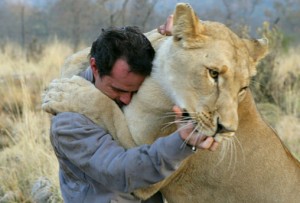
Kevin Richardson – a repeat posting.

Taking a shortcut and reposting something from 2009

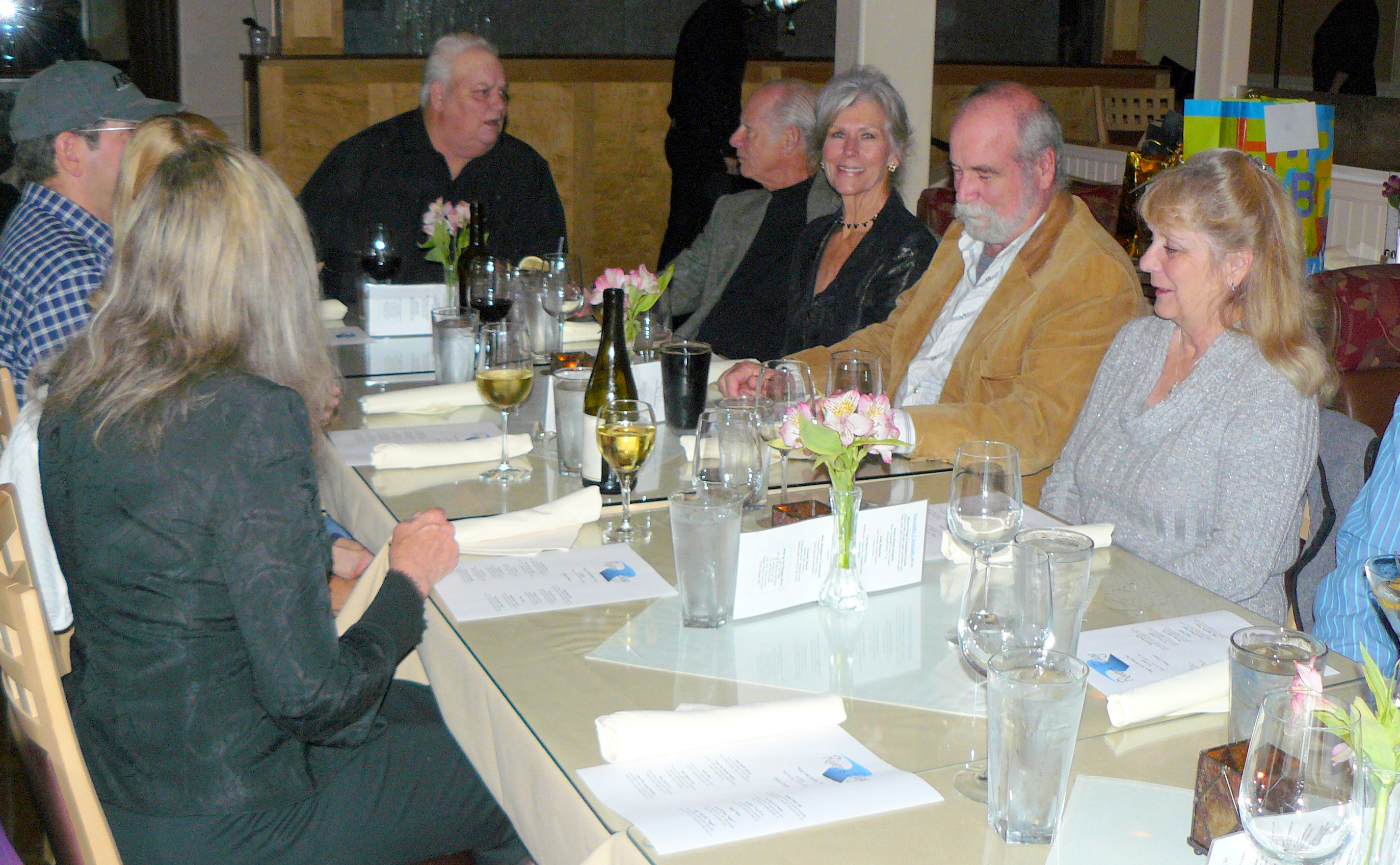
Yesterday, Sunday, was a quiet day. For several good reasons.  Firstly, on Saturday evening Jean and I and eleven of our close neighbours enjoyed a glorious birthday meal at the River’s Edge restaurant in Grants Pass.

P1150242

That meant, inevitably, that Jean and I were a little jaded yesterday.

Secondly, I needed to get my head down and put a few thousand words under my belt in terms of NaNoWriMo and ‘the book’.

Lastly, a comment from a new reader to a post that was published nearly five years ago reminded me of how special a person is Kevin Richardson.  Here’s that comment:

Paul, this article is amazing. Thank you so much for taking the time to write this, I’m a huge fan of Kevin. So is my Marine boyfriend who actually told me to look him up, this man is truly remarkable. I’ve always wanted to work with animals, my dream is to be a veterinary pathologist but lately I’ve been so stressed with school and college I wasn’t sure if I could make it. But Kevin is the one who has motivated me to continue to pursue my dream, so you think there’s a way I could contact him? I know it’s kinda crazy but I would love to get to speak to him. My boyfriend looks up to him alot too and I’ve tried looking for it but I had no luck. If there’s the possibility that you may know where I could find it or somehow contact him I would greatly appreciate it. Thank you so much. Maria.

So here is that post, and can anyone find a way to help Maria? (I have her email address.)

oooo

Remarkable people – Kevin Richardson

December 30th, 2009

Trust is both taught and learnt!

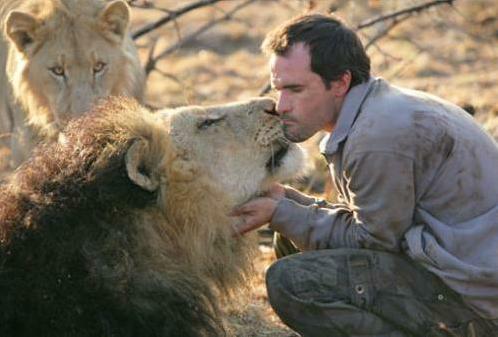
Thanks to Naked Capitalism, we posted an item on the 19th December about an unknown wild-life ranger working in the wildlife refuge area of Lanseria, South Africa.  Here was one of the pictures included in that Post:

The Post finished with an appeal to anyone that knew the name of this Ranger.  Many of you did and responded; thank you!

His name is Kevin Richardson and there is an interesting account of how he works and some of his ‘experiences’ in Revolution Magazine, luckily with online content.  That article is here.  It starts thus:

To do this he does not use the common methods of breaking the animal’s spirit with sticks and chains, instead he uses love, understanding and trust. With this unusual method of training he has developed some exceptionally personal bonds with his students. He sleeps with lions, cuddles newborn hyenas, swims with lionesses.  Kevin can confidently look into their eyes, crouch to the their level and even lie down with them – all taboos in the normal world of wild animal handling – yet he doesn’t get  mauled or attacked.

The article goes on to say that Kevin often works with the animals when they are very young.  Thus he is demonstrating very powerfully that how we behave, especially with our children when they are young, creates the environment for building trust out of consistency of deed and thought.  (By the way, do read some of the comments posted at the end of that Magazine article – some of them make for powerful reading.)

Kevin Richardson at ‘work’.

Luckily, thanks to this wired world we now live in, there is also video of Kevin available on YouTube.  A quick search under Kevin Richardson on YouTube will quickly find a number of videos but here are two that I wanted to share with you.

The first will leave you speechless and possibly wet-eyed!

The second is a promotional video by Kevin encouraging us to buy his recent book – and why not!

This is a very remarkable person and it’s an honour to share this with you.  We have so much to learn from all animals.

oooo

Beats many ‘day’ jobs!

Picture parade sixty-nine

Breathtakingly beautiful planet of ours!

National Geographic’s annual photo contest brings in some of the most extraordinary images from around the globe. Professional and amateur photographers alike submit shots in the categories of people, places, and nature and deliver a visual feast of the world in all its splendor.

Winners of the competition will be announced later this year, but in the meantime, here are some of the striking scenes (along with captions from the photographers) that Nat Geo was kind enough to share with us. Have a look.

"In the Strezlecki desert of Australia, a flock of galahs replenish on the only small water available at the base of this lonely tree. It’s a rare photo opportunity to get such a clear and symmetrical shot of these beautiful birds in flight in the middle of the desert." Location: Strezlecki Desert, Australia.
“In the Strezlecki desert of Australia, a flock of galahs replenish on the only small water available at the base of this lonely tree. It’s a rare photo opportunity to get such a clear and symmetrical shot of these beautiful birds in flight in the middle of the desert.” Location: Strezlecki Desert, Australia. Photo by Christian Spencer.

oooo

"I was finishing up a photo shoot when a wild kangaroo appeared out of nowhere and bounded onto the lake, as if walking on water. This, along with the picturesque sunset combined to create an absolute visual treat!" Location: Noosa, Queensland, Australia.
“I was finishing up a photo shoot when a wild kangaroo appeared out of nowhere and bounded onto the lake, as if walking on water. This, along with the picturesque sunset combined to create an absolute visual treat!” Location: Noosa, Queensland, Australia. Photo by Dave Kan.

oooo

"An early morning ride through Yellowstone National Park in the winter is always a treat. On this very chilly morning, hardly a sound was heard as this herd of bison reminded us that we are the visitors in their land." Location: Yellowstone National Park, Wyoming, United States.
“An early morning ride through Yellowstone National Park in the winter is always a treat. On this very chilly morning, hardly a sound was heard as this herd of bison reminded us that we are the visitors in their land.” Location: Yellowstone National Park, Wyoming, United States. Photo by Karoline Sleichter.

oooo

"This disorienting photo was taken from a cliff overlooking Lake Louise. Two people are enjoying a canoe ride on the lake's turquoise waters. Even boulders the size of large cars seem like pebbles from a high vantage point." Location: Lake Louise, Banff National Park, Alberta, Canada. Photo by Ben Leshchinsky.
“This disorienting photo was taken from a cliff overlooking Lake Louise. Two people are enjoying a canoe ride on the lake’s turquoise waters. Even boulders the size of large cars seem like pebbles from a high vantage point.” Location: Lake Louise, Banff National Park, Alberta, Canada. Photo by Ben Leshchinsky.

oooo

"Blue Ghost fireflies are unique because they stay lit and only hover about a foot off the ground." Location: Brevard, North Carolina. Photo by Spencer Black.
“Blue Ghost fireflies are unique because they stay lit and only hover about a foot off the ground.” Location: Brevard, North Carolina. Photo by Spencer Black.

oooo

"Before dawn [and] 25 degrees below zero. Just a short while [earlier], the rabbit seems to have walked across the snowy field." Location: Biei Hokkaido JAPAN. Photo by Mitsuhiko Kamada.
“Before dawn [and] 25 degrees below zero. Just a short while [earlier], the rabbit seems to have walked across the snowy field.” Location: Biei Hokkaido JAPAN. Photo by Mitsuhiko Kamada.

oooo

"I headed out one night to photograph the Milky Way. As I reached the top of the mountain, this magnificent scene presented itself to me. I immediately wanted to photograph it in all its glory. After trying out a few different exposure times, I settled on duration of roughly 16 minutes. This allowed me to capture the intense glow of the fire along with the surreal star trails seen in the sky." Location: Advancetown Lake, Gold Coast Hinterland, Australia. Photo by Dave Kan.
“I headed out one night to photograph the Milky Way. As I reached the top of the mountain, this magnificent scene presented itself to me. I immediately wanted to photograph it in all its glory. After trying out a few different exposure times, I settled on duration of roughly 16 minutes. This allowed me to capture the intense glow of the fire along with the surreal star trails seen in the sky.” Location: Advancetown Lake, Gold Coast Hinterland, Australia. Photo by Dave Kan.

Utterly stunning photographs.

Wherein lays the truth?

It is said that the first casualty in war is truth!

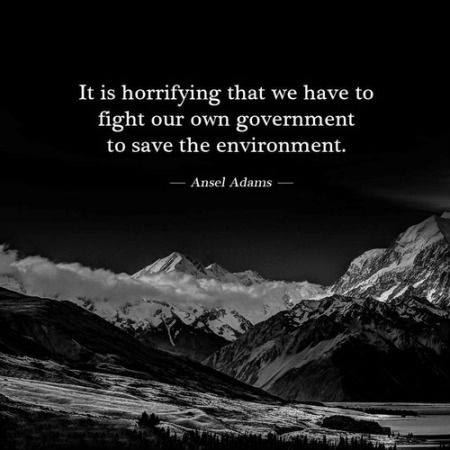
Ansel Adams

In yesterday’s post Vested interests, perhaps, I featured an article brought to my attention by dear friend, Dan Gomez. Namely an article featured in the UK’s Daily Mail newspaper that was headlined: ‘There is NO climate crisis’: Man-made global warming is a lie and not backed up by science, claims leading meteorologist.

Dan’s strong belief is that labelling the natural change in the world’s climate as anthropogenic global warming (AGW) serves governments and many large institutions incredibly well because it offers greater leverage to raise taxes.  In other words, Dan has no doubt that the climate is changing, but as a result of natural forces that go back long before the days of man.  In other words, it is being ‘sold’ as the direct result of man’s activities because it makes it easier to apply taxes and levies for purposes not related to climate matters.

As John Coleman was reported as saying:

John Coleman, who co-founded the Weather Channel, claims that the belief humans are causing climate change is not backed up by science.

In an open letter attacking the UN, the 80-year-old from San Diego, said that what ‘little evidence’ there is for global warming points to natural cycles in temperature.

‘There is no climate crisis,’ he wrote. ‘The ocean is not rising significantly. The polar ice is increasing, not melting away. Polar bears are increasing in number. ‘Heat waves have actually diminished, not increased. There is not an uptick in the number or strength of storms.

‘I have studied this topic seriously for years. It has become a political and environment agenda item, but the science is not valid.’

Now I am as sceptical about the workings of governments as the next man. But I find it incredibly difficult to believe that AGW is a myth, hoax or conspiracy.  There is a wall of science to say that we, as in man, are dangerously close to going over the edge, going beyond ‘tipping points’ from which there is no returning.

A quick dip into Wikipedia tells us [my emphasis]:

Scientific understanding of the cause of global warming has been increasing. In its fourth assessment (AR4 2007) of the relevant scientific literature, the Intergovernmental Panel on Climate Change (IPCC) reported that scientists were more than 90% certain that most of global warming was being caused by increasing concentrations of greenhouse gases produced by human activities. In 2010 that finding was recognized by the national science academies of all major industrialized nations.

Affirming these findings in 2013, the IPCC stated that the largest driver of global warming is carbon dioxide (CO2) emissions from fossil fuel combustion, cement production, and land use changes such as deforestation.

Only last Wednesday there was an item on Naked Capitalism that opened [again, my emphasis]:

J.D. Alt: Have We Passed the Tipping Point of Biological Collapse?

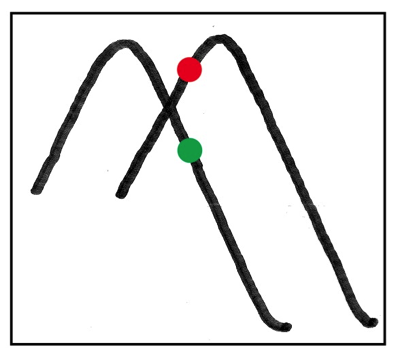
alt1The squiggle illustrated here may look like the Ebola virus, but it isn’t. The resemblance is just an eerie coincidence. It’s actually a graphical snapshot of the classic “Predator-Prey Model.” This mathematical exercise, first developed in the 1920s, serves as the introductory basis for a more recent NASA funded effort which produced—amidst a brief flurry of news and commentary last spring—the startling conclusion that a complete collapse of modern civilization may now be “irreversible.”

The NASA study involved the creation and running of a more elaborate model—HANDY (Human and Nature Dynamics)—which simulates the human consumption of naturally replenishing systems, as well as (intriguingly, given today’s news cycle) wealth and income inequality between two classes of citizens: “Elites” and “Commoners.” Now a new study, just released by the World Wildlife Fund, reports a grim statistic suggesting the abstract mathematics of the HANDY Model may be more than just a theoretical exercise. According to the WWF, in the last forty years—from 1970 to 2010—the Earth has lost over HALF (52%) of its wildlife population.

There are yards and yards of solid information all over the internet about our changing climate. The loss of wildlife, the destruction of forests and wild lands is beyond argument, and those aspects of this ‘modern’ world are most certainly the direct result of man’s activities!  Our inability to stop growing as a global population is insane.  Our inability to stop seeing continual economic and material growth as a ‘good thing’ is insane. We need massive change  – now!

Therein lays the problem.  Because, whether or not there is an approaching climate catastrophe as a result of man’s activities is, in a very real sense, irrelevant. If that seems a bizarre thing to write, I mean it is irrelevant in terms of what you and I, ordinary people trying to lead civilised lives, can do to make a difference.

Patrice Ayme recently published a post under the title of Total Plutocracy covering the death of Christophe de Margerie when his jet hit a snow plough on a Moscow runway at midnight, flipped on its back, caught fire, and skidded across. All four on board died.

Now the accidental death of any person is a tragedy, make no mistake, but as Patrice revealed in his post, this particular accident did raise some interesting aspects.  Here’s a little of what Patrice wrote:

With 200 billion Euros in revenue, TOTAL SA is not far behind the French government budget. TOTAL’s profits are 14 billion Euros (“Soyons serieux!” laughed Margerie). It pays nearly no tax in France, having concentrated there its money losing refineries.

Other countries get nearly all their fuel from French refineries; TOTAL has also a green light to frack in Britain. So this is not just a French situation. TOTAL is one of the five great oil companies concentrating the fossil fuel firepower. Those companies have the best technology. Some of TOTAL’s specialties are very deep water drilling, and using steam to extract tar oil in Canada.

What was de Margerie doing at midnight? Flying back to France, after meeting with Putin and Medvedev, late at night.

That’s how these guys are: great fun. Putin was recently invited to Milan for a big time European meeting. He arrived several hours late to visit with Merkel, who was not amused. After keeping her up past midnight, he motored to Berlusconi’s mansion, and the two plutocrats reveled together until 4 am. (We don’t know how many female teenagers were in attendance to further their studies.)

The next European meeting was at 8am, and Putin showed up.

Supposedly Margerie had just told Medvedev and Putin to cool it with Ukraine. At least that’s the massaging message Margerie’s minions floated after his death.

Why was Margerie so important to the Russian dictators? Because the six “supermajor” oil companies have the advanced technology. After all, they recruit from the best universities in the world (that’s paid by taxpayers). TOTAL SA was the spearhead of high tech development for hydrocarbon production in Russia. Among other things, it’s helping to build a gas liquefaction plant in the far north, to load special ships with methane (something TOTAL does with Qatar, in the world’s largest such installation).

Once a ship is fully loaded, it has several times the explosive power deployed at Hiroshima (such a catastrophic accident has not happened yet, but it’s just a matter of time).

When citizen Lambda dies, Mr. Anybody, nobody official cares. When a major plutocrat dies, our leaders, even our socialist leaders, weep, and present the accident as a national, even international tragedy.

Is the death of a plutocrat worth that much more, that all this public weeping has to occur?

And, by the way, who and what has authorized Mr. Margerie to lead his own foreign policy? Who authorized him to make nice with thermonuclear dictators? To the point of allowing their survival?

I recommend that you read it in full for it says so much about what is wrong with these present times: so much inequality and so many abuses of power.

Just the other day the Guardian newspaper published an article under the title of: Richest 1% of people own nearly half of global wealth, says report.

The richest 1% of the world’s population are getting wealthier, owning more than 48% of global wealth, according to a report published on Tuesday which warned growing inequality could be a trigger for recession.

According to the Credit Suisse global wealth report (pdf), a person needs just $3,650 – including the value of equity in their home – to be among the wealthiest half of world citizens. However, more than $77,000 is required to be a member of the top 10% of global wealth holders, and $798,000 to belong to the top 1%.

“Taken together, the bottom half of the global population own less than 1% of total wealth. In sharp contrast, the richest decile hold 87% of the world’s wealth, and the top percentile alone account for 48.2% of global assets,” said the annual report, now in its fifth year.

On October 8th, George Monbiot published an essay in The Guardian newspaper under the title of The Toll-Booth Economy.  The opening lines set the theme.

Corporate power is the real enemy within, but none of the major parties will confront it.

The more power you possess, the more insecure you feel. The paranoia of power drives people towards absolutism. But far from curing them of the conviction that they are threatened and beleaguered, it becomes only stronger.

On Friday, the Chancellor of the Exchequer, George Osborne, claimed that business is under political attack on a scale it has not faced since the fall of the Berlin wall. He was speaking at the Institute of Directors, where he was introduced with the claim that “we are in a generational struggle to defend the principles of the free market against people who want to undermine it or strip it away.” A few days before, while introducing Osborne at the Conservative party conference, Digby Jones, formerly the head of the Confederation of British Industry, warned that companies are at risk of being killed by “regulation from Big Government” and of drowning “in the mire of anti-business mood music encouraged by vote-seekers.” Where is that government and who are these vote-seekers? They are a figment of his imagination.

Read the full essay here.

Yes, one could go on and on.

Indeed, I will. Go on with just one more reference.  From the Smithsonian. An article that started, as follows:

Five Conflicts and Collapses That May Have Been Spurred by Climate Change

Earth’s changing climate has been a spectre in centuries of civil conflict and, at times, the collapse of whole civilizations

By Natasha Geiling
smithsonian.com
October 20, 2014

Is climate change a matter of national security? In a warming world, sea-level rise, drought and soil degradation are putting basic human needs such as food and shelter at risk. In March, the U.S. Department of Defense called climate change a “threat multiplier,” saying that competition for resources “will aggravate stressors abroad such as poverty, environmental degradation, political instability and social tensions—conditions that can enable terrorist activity and other forms of violence.”

Connecting climate change to a global increase in violence is tricky, and attempts to make such a link receive a fair amount of criticism. A hotter planet doesn’t automatically become a more conflict-ridden one. The 2000s, for instance, saw some of the highest global temperatures in recorded history—and some of the lowest rates of civil conflict since the 1970s.

But there are historical examples of civilizations that did not fare well when faced with drastic environmental change, and those examples may offer a window into the future—and even help prevent catastrophe. “We can never know with 100-percent certainty that the climate was the decisive factor [in a conflict],” says Solomon Hsiang, assistant professor of public policy at the University of California, Berkeley. “But there’s a lot of cases where things look pretty conspicuous.”

Read the five historical examples and realise that we are not immune.

Earlier on I ventured the idea that whether or not an approaching climate catastrophe was a result of man’s activities was, in a very real sense, irrelevant.  Because of the lack of individual power to make a real difference, especially a political difference.

What is relevant is improving the way we govern ourselves. The abuses of money and power are too widespread to be ignored.  We need to start with strong local democracies and thence building a system of global governance that really is of the people by the people for the people.

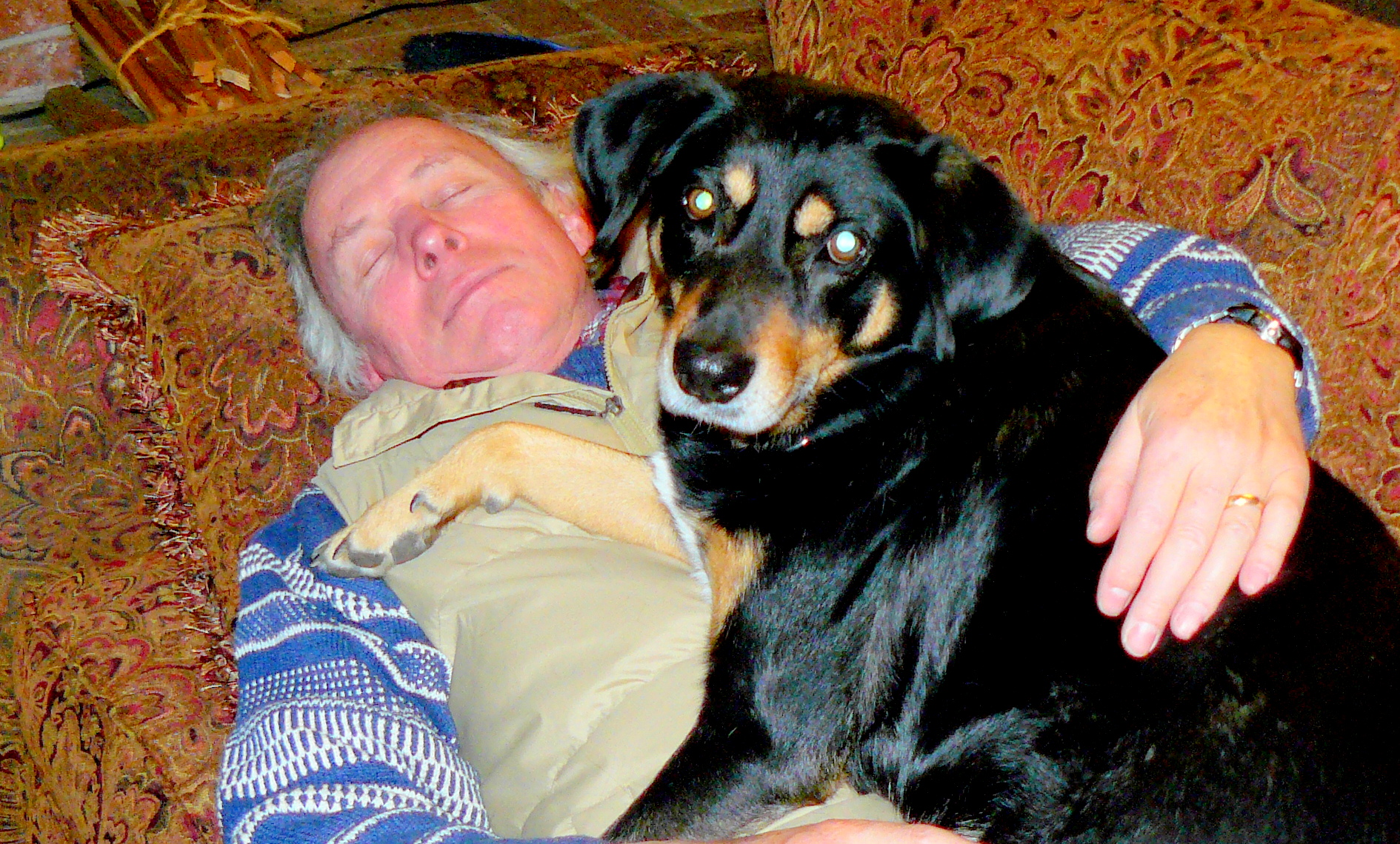
Phew – I need a dog to hug!

The truest of love between a man and a dog!
Hazel providing the ‘love-in’.

Vested interests, perhaps.

I’m being very brave and stepping into the climate change cauldron!

Learning from Dogs has been posting a wide range of items for well over five years. Indeed, today’s post is number 2,238!

Over those five years, my position regarding climate change or global warming has been pretty clear: a belief in the proposition that man’s behaviours are changing the very climate of our planet.  For instance, a little over a year ago I posted under the title Sceptical about global warming?  It opened:

Learning from Dogs is not a blogsite about climate change!

Why, you may ask, do I start today’s post with that sub-heading?  Because, I am conscious that many of my posts do touch on this subject.  For example, just two days ago there was Breaking news.  Then there was the piece about the climate implications for Phoenix, Arizona.  Followed the next day by the changes in the flow of the jet stream across the North Atlantic with all the weather implications for North-West Europe.

Indeed, as the heading to today’s post makes clear, this is also about the changes going on to our planet.

Learning from Dogs is about a different way of living and behaving.  A campaign, if one wants to call it that, to show that the way that modern man is living is corrupt.  Not with a big ‘C’ but still in the sense of living a dishonest life.  Learning from Dogs attempts to show that our wonderful dogs, a source of so much love and pleasure for so many millions, offer us an example of a life in and of this planet.

If there was ever a time in the history of man when we needed being reminded of our frailty and vulnerability, it is now.  As the following so starkly illustrates.

Peter Sinclair of Climate Crocks recently republished an item from Skeptical Science that opened up as follows:

A new study of ocean warming has just been published in Geophysical Research Letters by Balmaseda, Trenberth, and Källén (2013).  There are several important conclusions which can be drawn from this paper.

  • Completely contrary to the popular contrarian myth, global warming has accelerated, with more overall global warming in the past 15 years than the prior 15 years.  This is because about 90% of overall global warming goes into heating the oceans, and the oceans have been warming dramatically.

Then last week-end, Dan Gomez, friend for over 40 years, sent me the following:

Weather Channel Founder: Global Warming Science ‘Not Valid’

Meteorologist John Coleman, who co-founded The Weather Channel, says the claim that human activity is leading to global warming is no longer scientifically credible.

Instead, the “little evidence” there is for rising global temperatures points to a “natural phenomenon,” Coleman asserts.

In an open letter to the United Nations’ Intergovernmental Panel on Climate Change (IPCC), he wrote: “There is no climate crisis. The ocean is not rising significantly. The polar ice is increasing, not melting away. Polar bears are increasing in number.

“Heat waves have actually diminished, not increased. There is not an uptick in the number or strength of storms.

“I have studied this topic seriously for years. It has become a political and environmental agenda item, but the science is not valid.”

Coleman says he based his views on the findings of the Nongovernmental International Panel on Climate Change (not to be confused with the U.N. panel), a body of scientists and scholars who assess the science of global warming.

“There is no significant man-made global warming at this time. There has been none in the past and there is no reason to fear any in the future,” says Coleman, who was the original meteorologist on “Good Morning America.”

“Efforts to prove the theory that carbon dioxide is a significant greenhouse gas and pollutant causing significant warming or weather effects have failed.

“There has been no warming over 18 years.”

The U.N.’s IPCC argues that their research shows man-made global warming will lead to extreme weather events becoming more frequent and unpredictable, the Express in Britain reported.

Climate expert William Happer, a professor at Princeton University, expressed support for Coleman’s claims.

“No chemical compound in the atmosphere has a worse reputation than CO2, thanks to the single-minded demonization of this natural and essential atmospheric gas by advocates of government control [of] energy production,” Happer said.

“The incredible list of supposed horrors that increasing carbon dioxide will bring the world is pure belief disguised as science.”

What Dan had seen was an article in the UK Daily Mail that, in turn, was echoed on the US WesternJournalism blogsite.  Here’s how that Daily Mail story opens:

Climate change has been proven to be a lie, according to a leading meteorologist.

John Coleman, who co-founded the Weather Channel, claims that the belief humans are causing climate change is not backed up by science.

In an open letter attacking the UN, the 80-year-old from San Diego, said that what ‘little evidence’ there is for global warming points to natural cycles in temperature.

‘There is no climate crisis,’ he wrote. ‘The ocean is not rising significantly. The polar ice is increasing, not melting away. Polar bears are increasing in number. ‘Heat waves have actually diminished, not increased. There is not an uptick in the number or strength of storms.

‘I have studied this topic seriously for years. It has become a political and environment agenda item, but the science is not valid.’

The WesternJournalism post runs with the story explaining (in part):

John Coleman, the original meteorologist for ABC’s Good Morning America and the founder of The Weather Channel, which launched in 1982, wrote an open letter to the UCLA’s Hammer Forum urging them “to re-examine their plan” for their forum, scheduled for this past Thursday, after they announced their experts, both of whom believe in climate change science.

Coleman has made his position against climate change science clear in the past.

“There is no significant man-made global warming at this time, there has been none in the past and there is no reason to fear any in the future. Efforts to prove the theory that carbon dioxide is a significant ‘greenhouse’ gas and pollutant causing significant warming or weather effects have failed. There has been no warming over 18 years.”

The Weather Channel founder cites professors from Princeton University, Massachusetts Institute of Technology (MIT), Harvard Smithsonian Observatory, and the University of Alabama, along with “9,000 Ph.D scientists” who agree with him.

“Yet at your October 23 Hammer Forum on Climate Change you have scheduled as your only speakers two people who continue to present failed science as though it is the final and complete story on global warming/climate change. This is a major mistake.”

Coleman urged the UCLA group to reconsider, noting he is not a “flat Earther,” or a “paid shill of the Koch Brothers.”

In a discussion yesterday with Dan, he was of the clear mind that, yes, the climate is changing, as it always has over eons of time, but that the degree of change that is directly attributed to man’s affairs is minute.  Then all around me I see sign after sign, read article after article, that we, as in mankind, are relentlessly ‘fouling our own nest’ and the time left for us to learn how to live sustainably on this planet is fast running out.

Can we get to the truth? The topic will be continued tomorrow!

Returning to the land – a guest essay.

A question of a possible catastrophe

Note: As tomorrow’s post will explain, the next few weeks will be encroaching seriously on my blogging time. So it was very timely to receive this guest essay from John in the last couple of days and even more generous of him to give me permission to republish it.

It will make an interesting comparison to an item from Dan Gomez being published on Thursday.

ooOOoo

Notes on Dealing With Imminent Catastrophe

We know that our world economy is leveraged at least twenty-five times beyond any earthly material foundation. Regardless of this reality, we have made an artificial global economy more real than our physical world. This situation only makes sense when we recognize that we’re being encouraged to re-establish our awareness of reality. It’s a final exam time for a leading edge species of clever monkeys.

Nature has tolerated human activities for millions of years. Now that our demographics ravenously swarm the globe, belch poisons into the five mile band of air that sustains surface life on earth, dumps wastes and toxins into streams, rivers, lakes and oceans, and arrogantly refuses to understand obvious warnings; Nature is reacting.

For those who are inclined to either or choices, in accordance with the physical Law of Entropy, the decision is between pursuing constructive or destructive actions. For those who are more spiritually oriented, there is no question. In either case, we know what needs to be done.

Our first order of business is to stabilize our inclusive global economy through green initiatives that are operated for profit without damage to the eco-system. Yes, this sounds impossible the first time we think about it. Can we come up with a better plan? Not really, when we stop and honestly consider our situation. We’re poised on the brink of a material, economic and cultural collapse created by human beings.

Wars continue to be waged world wide over territory and rapidly diminishing fossil fuel resources. We have essentially lost trust in each other as equal members of a common community we call Earth. And, we are rapidly losing faith in the unsustainably inflated symbol of trust we call Money.

A green economy is our best solution for the multiple problems that plague us. Here’s why and a few suggestions about how we go about the process. Essentially, our critical need for renaissance is a process of education, formation and transformation.

When we return to the land as a global priority, the use of solar energy can replace massive industrial electrical generators running on fossil fuel derivatives. Most industrial generators may be easily converted to bio-diesel fuel. Industrial diesel generators worldwide can be converted to bio-fuel overnight. No mechanical adaptation is required.

Electric cars already set speed records at Europe’s classic racetracks. Solar electric cars are on the horizon. A bio-diesel engine to power a golf cart costs about $500 today and is available from Amazon.

There’s a natural need for co-operation when we return to the land and collectively re-establish our financial roots. First, we recognize that each of our actions affects the well being of the earth and its inhabitants. Second we realize that we are responsible for the well being of the Earth which sustains our being.

Third, we re-establish our natural connection with the unity of a living universe. We begin with the community gardens and farmer’s markets that are already operational, and rebuild accordingly.

When we are foolish, we act independently for our personal well being. When we are wise, we act together for the well being of the earth and each other. Growing our own food not only assures that what we eat will be free of chemical by-products; it also makes us aware of how fragile our consumer supply lines have become. Recycling our food waste as fertilizer completes a natural growth cycle.

By the way, a back yard greenhouse can produce enough bio-fuel to operate a diesel vehicle and a solar panel array can generate enough energy to charge your electric car. How much money does this save each year?

We don’t need nuclear reactors that sometimes melt down and sicken us with a continual stream of radiation carried by the tides and the winds of an integrated planet. We don’t need the wastes of nuclear reactors that poison the earth for millennium.

We don’t need nuclear weapons capable of destroying most, if not all, of the life on earth in an all out suicidal war. The only creatures to survive the holocaust of nuclear war would need to be radiation resistant; shielded deep underground or deep under the sea.

Harnessing wind, water and geothermal energy are wiser ways to keep our world energized in a green economy. A combination of habitats and communities powered by solar and geothermal energy will produce a new building boom as we shed the skin of our former infrastructure and a green architectural industry emerges.

Recycling the components of our technological world not only reduces our industrial waste, it decreases the cost of manufacture. Similarly, adapting and reusing what we already have decreases our personal expenses and reduces our demands on the earth.

These are only a few of the ideas which are already possible. Many more are already in the process of becoming our greater reality.

Still think such a massive transformation is impossible? If so, please know that you remain in our prayers.

There is hope for tomorrow. Science consistently opens new doors. Faith in the Nature of God of which we are each an infinitesimal part makes us unified and strong as a consciously aware biological species.

John Hurlburt

an old lamplighter

ooOOoo

Saturday special!

Enough of the world of spying and whistleblowing and back to stuff that is really important!

Many will recall that on the 10th October, under the heading of Utterly beyond words!, I wrote about a deer befriending us to the point that Jean was able to stroke its neck as it was feeding.  The post included this photograph.

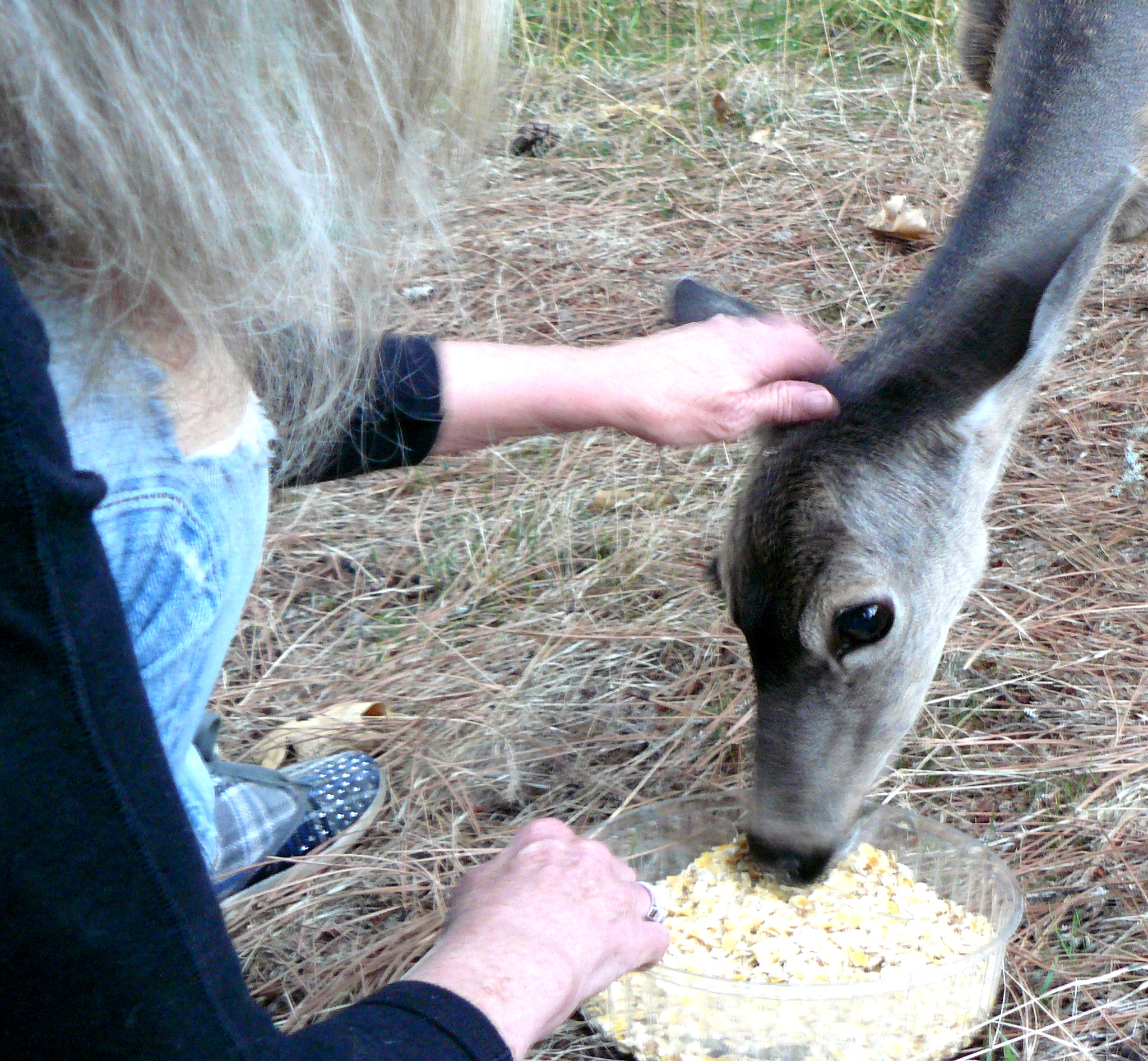
Then, unbelievably, the wild deer continues feeding as Jean fondles the deer's ear.
Then, unbelievably, the wild deer continues feeding as Jean fondles the deer’s ear.

Inevitably, being the softies that we are, we have continued to put out feed, in the form of cob or cracked corn, most days.

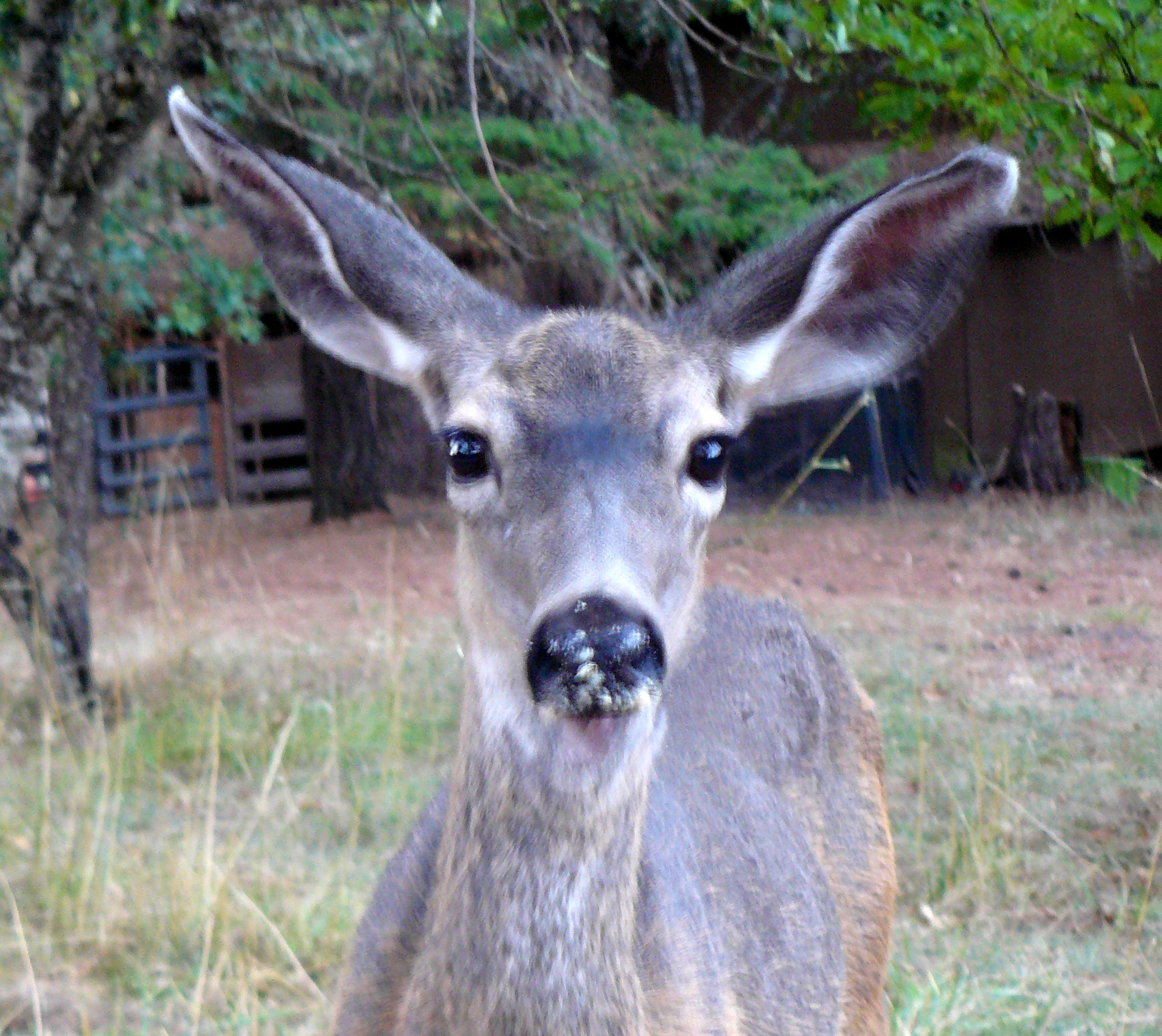
The word among the local deer population clearly has been passed around!

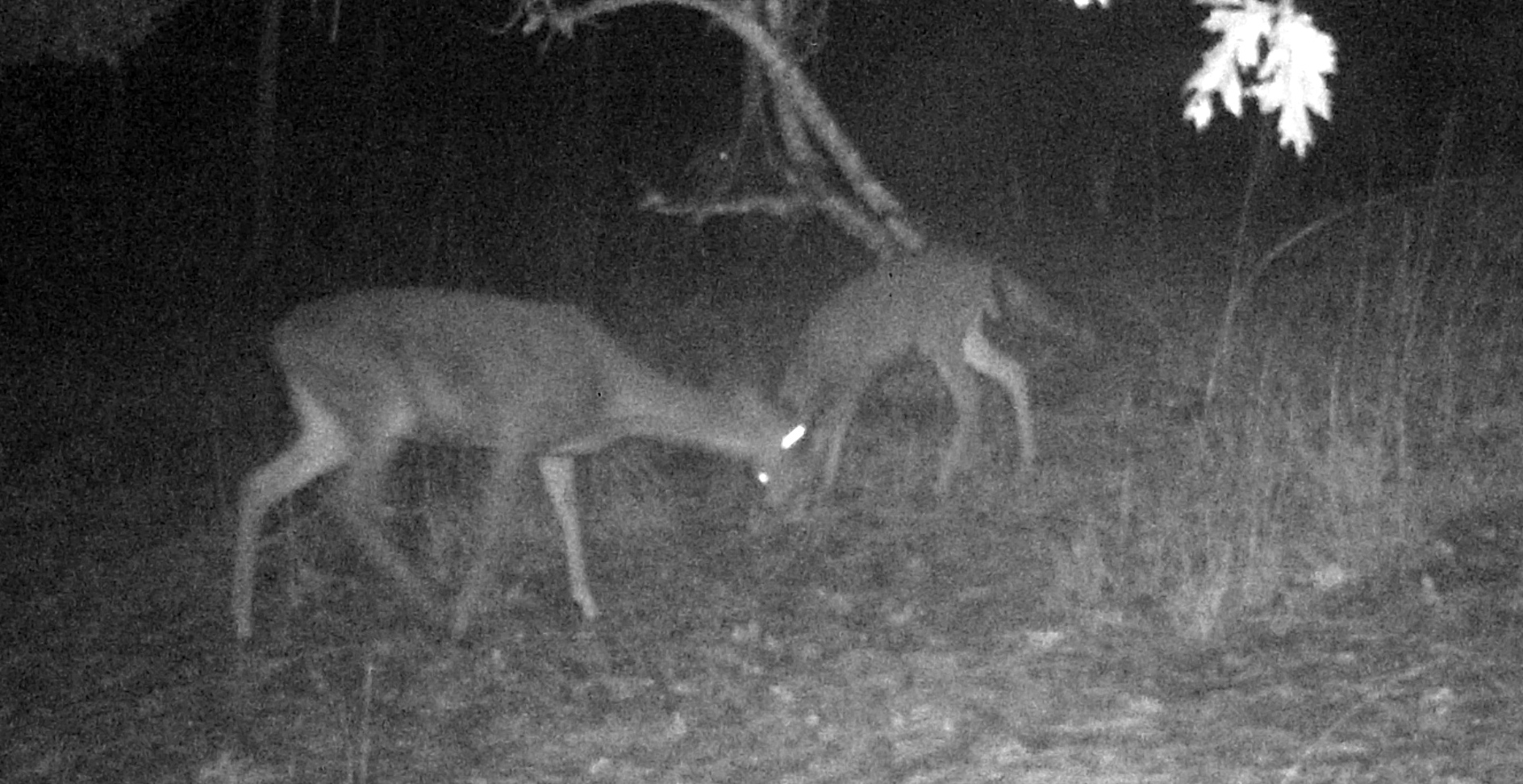
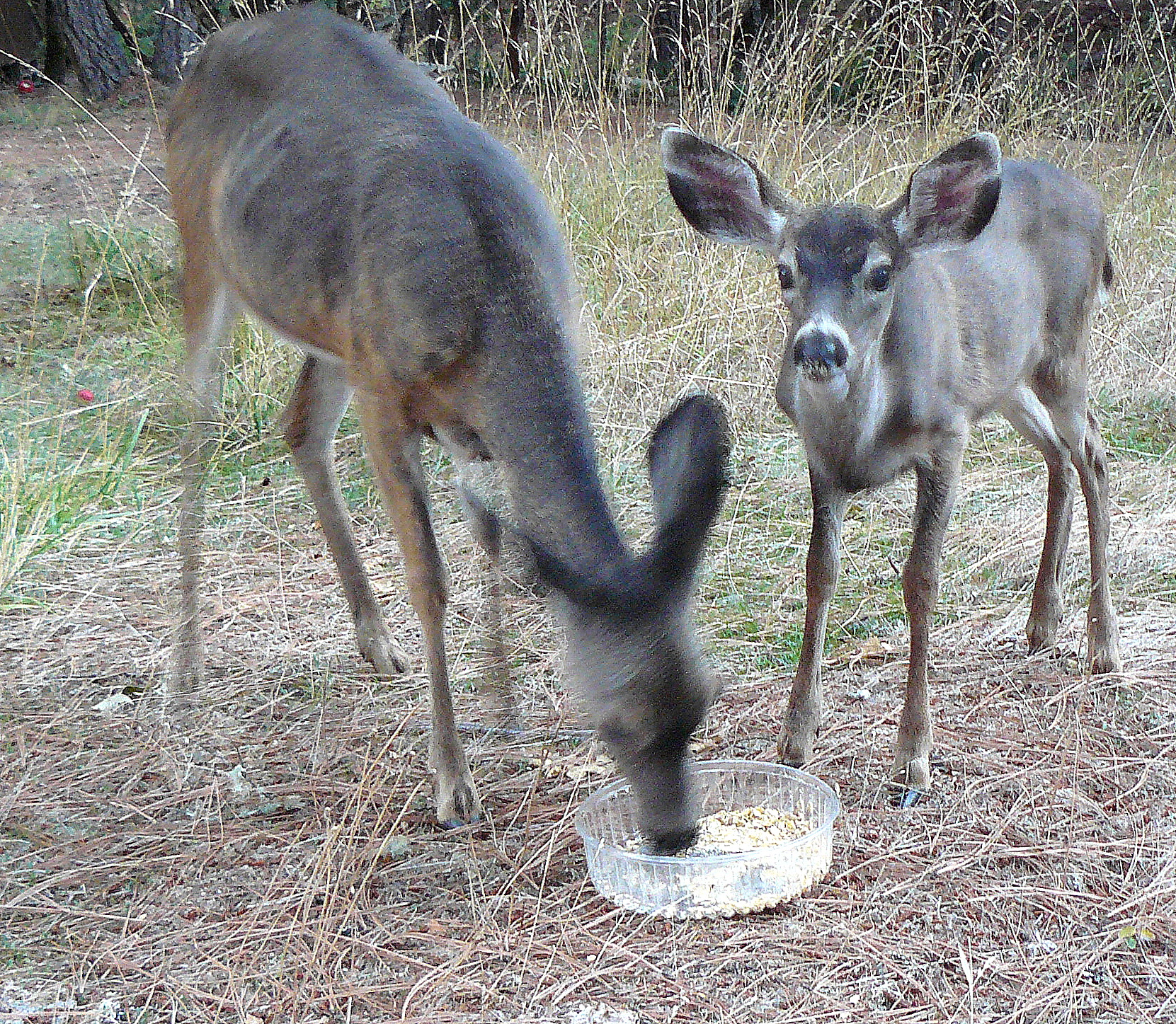
For here’s a photograph taken automatically on the night of the 19th October.

Time of the shot was a little before 5am.

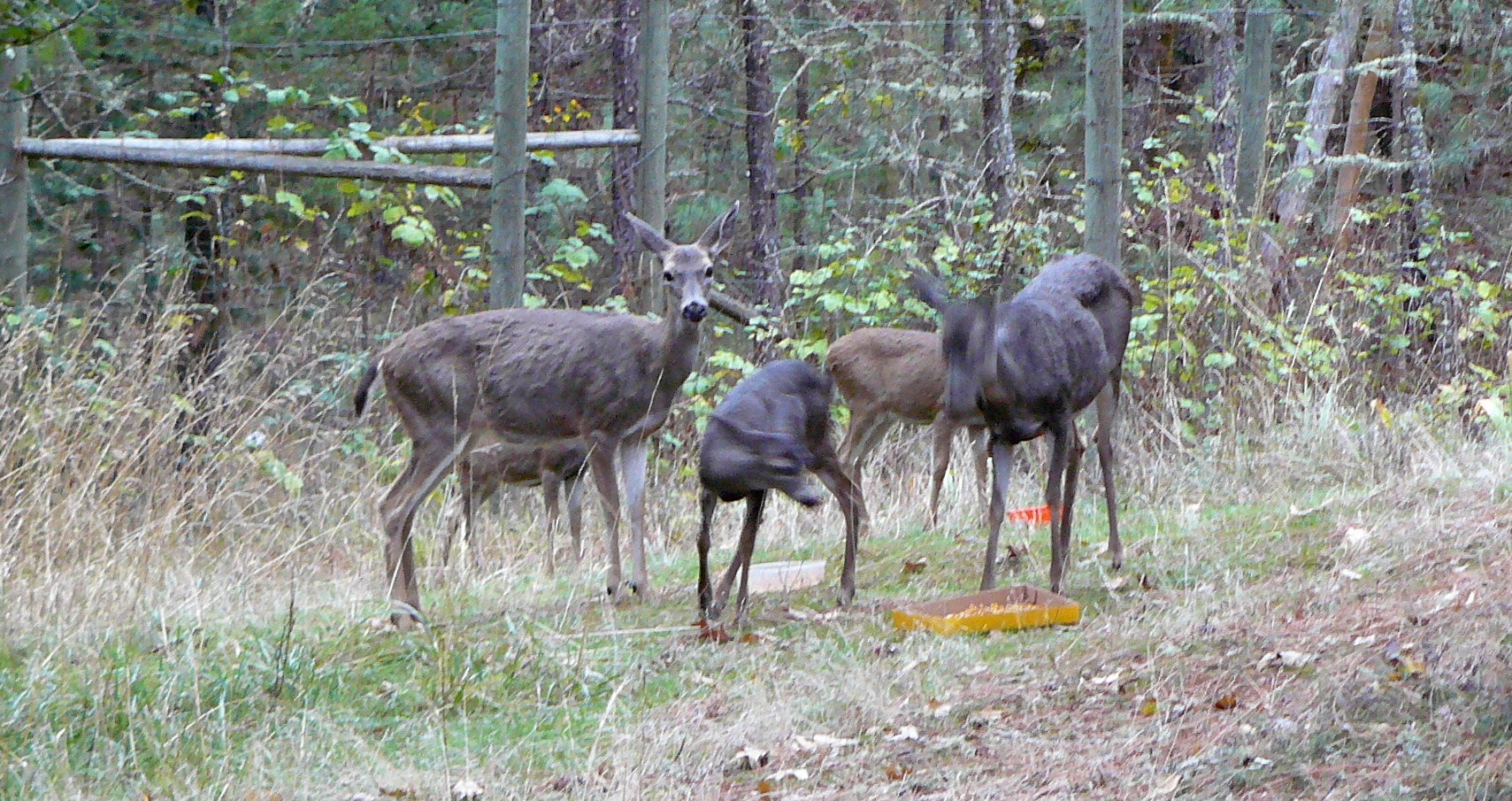
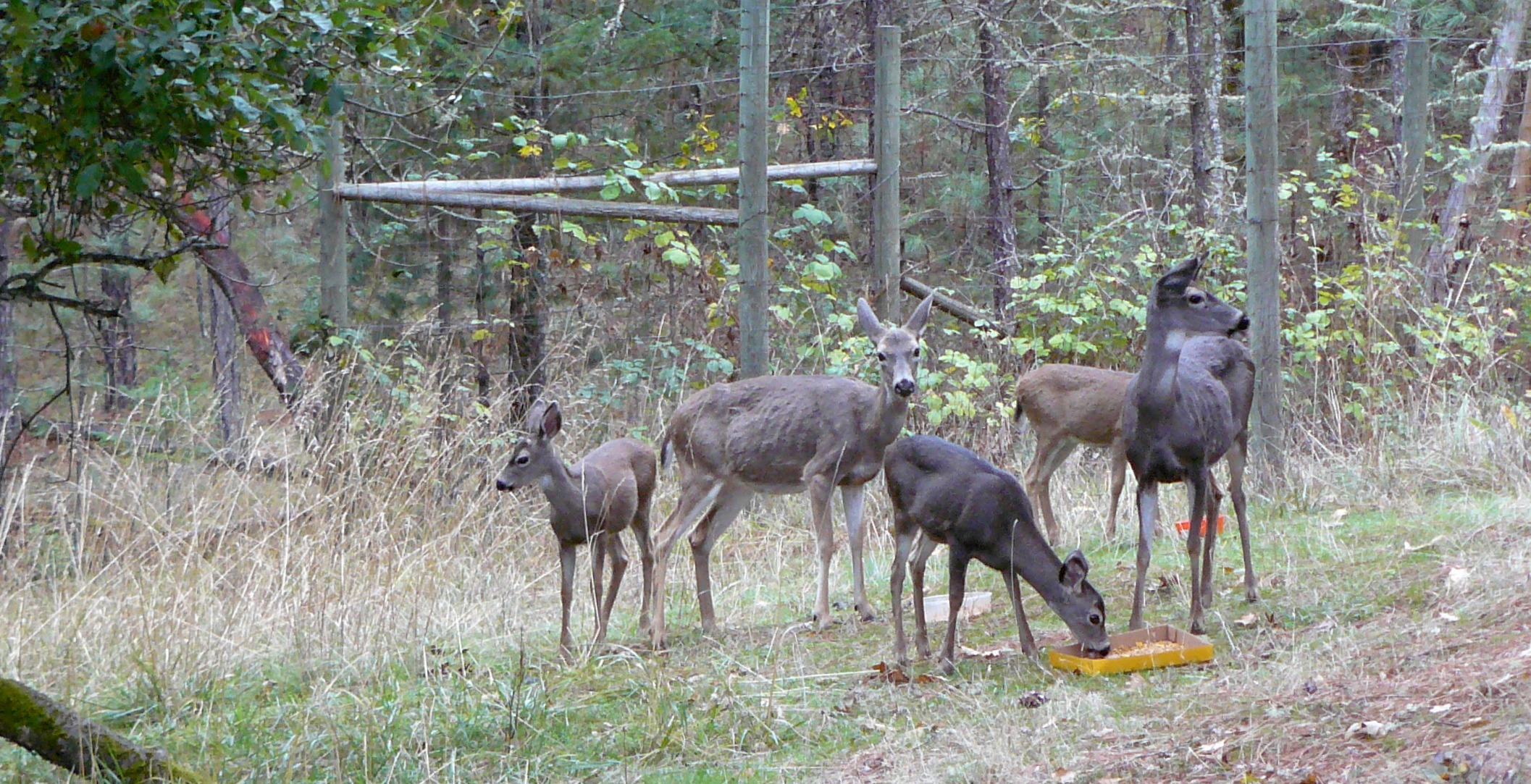
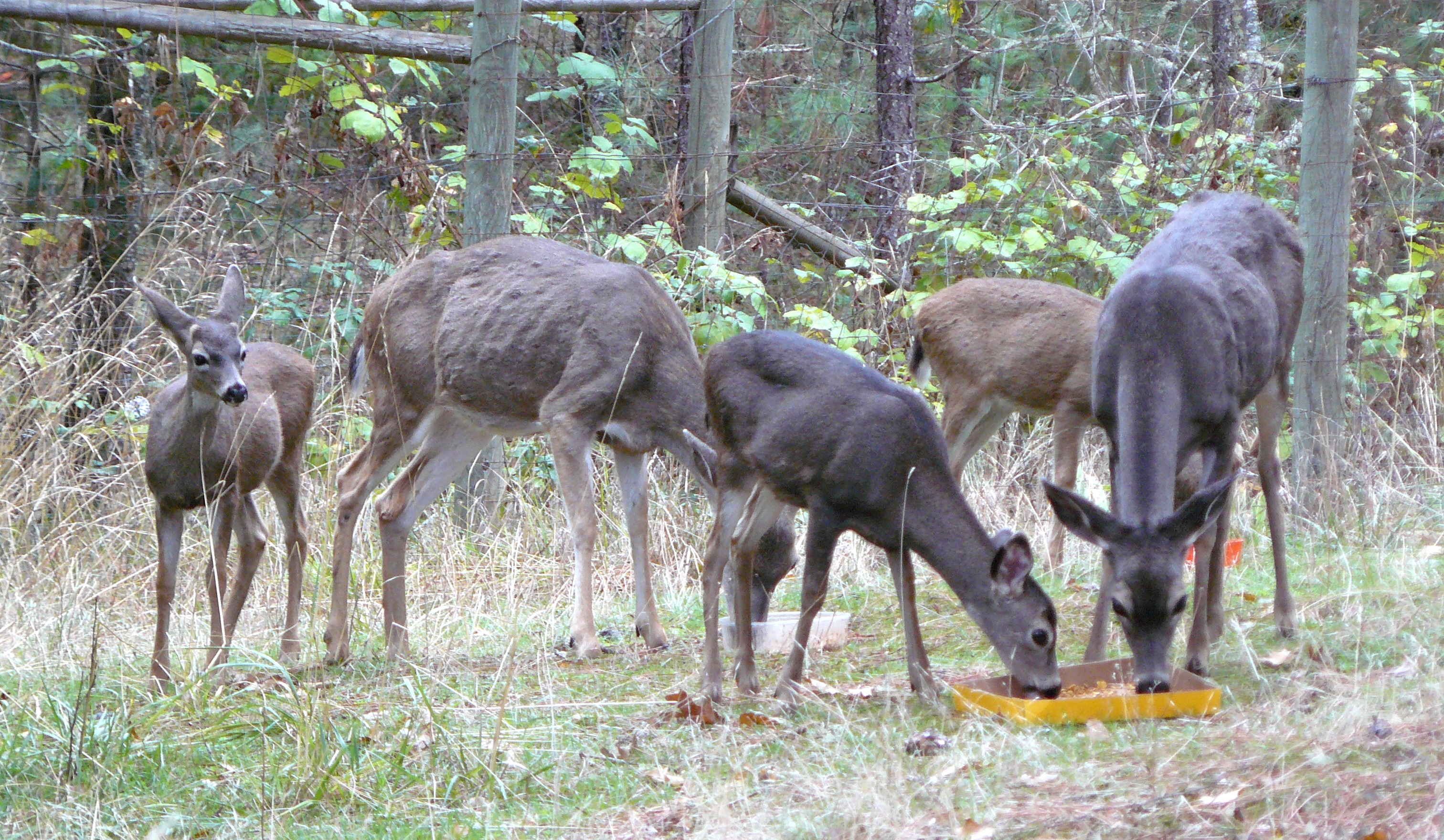
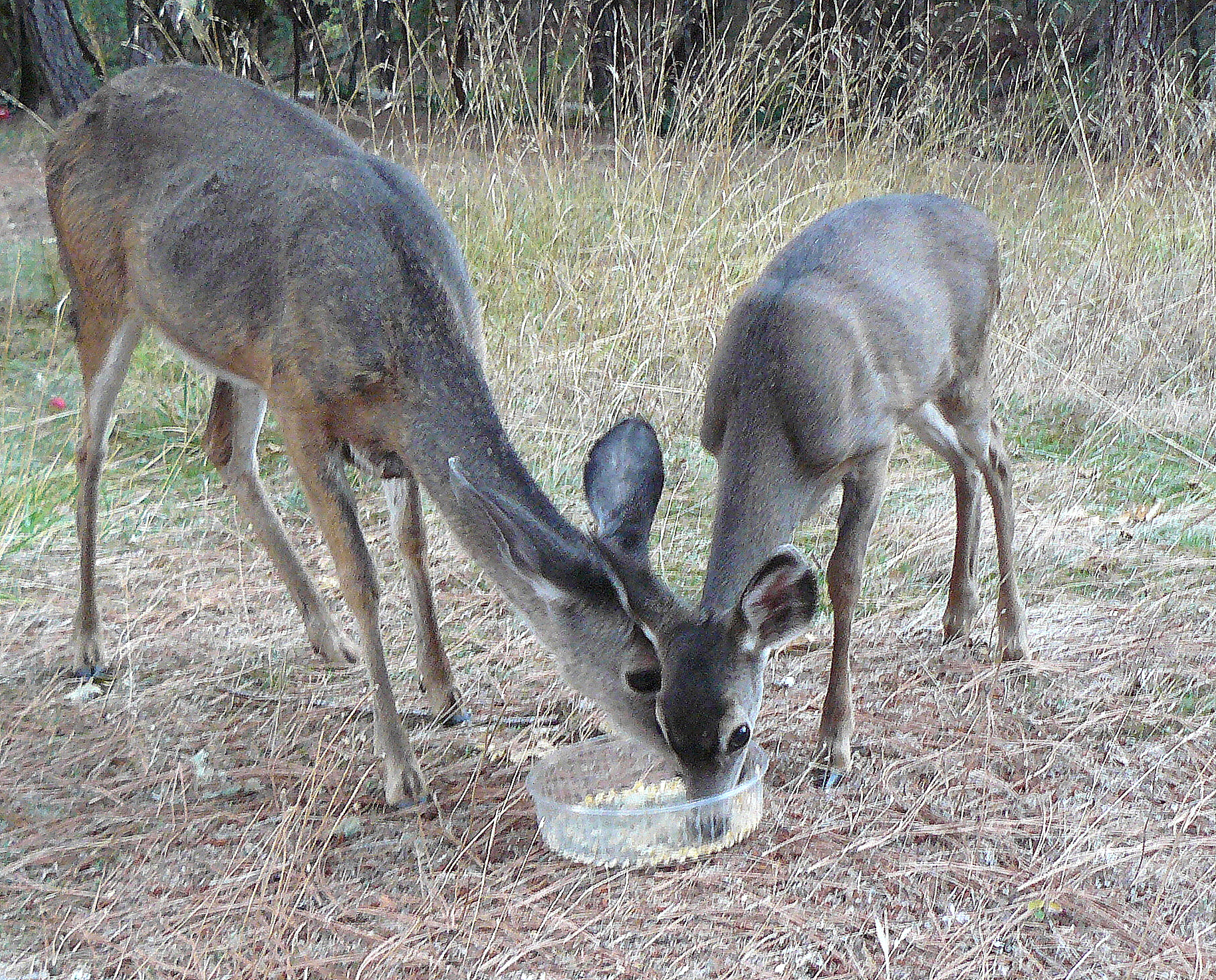
Then on the 22nd, just three days ago, these photographs were taken shortly after 10am.

Party time!
More food and it isn’t even supper time!

oooo

Come on ladies, eat up! You never know when a dog will charge around the corner!

oooo

P1150220
That’s more like it!

One fear that Jean and I had was that they would become vulnerable to an attack by our dogs.  But the deer have quickly wised up to when dogs are being let out of the front or kitchen doors and are off like darts into the forest just a few yards away.

We treasure seeing them each day.

The struggle between the forces of light and dark.

At least dogs can go off and find new homes!

Let’s start with the Ebola outbreak with the latest news from the BBC suggesting:

The death toll from the Ebola virus outbreak has risen to 4,447, with the large majority of victims in West Africa, the World Health Organization (WHO) says.

WHO assistant director-general Bruce Aylward also said there could be up to 10,000 new cases a week within two months if efforts were not stepped up,

But the rate of new infections in some areas has slowed down, he added.

Next up.

I’ve been musing as to whether or not I was going to republish a recent essay from George Monbiot.  The one in question being The Kink in the Human Brain.  It opens, thus:

Pointless, joyless consumption is destroying our world of wonders.

By George Monbiot, published in the Guardian 2nd October 2014

This is a moment at which anyone with the capacity for reflection should stop and wonder what we are doing.

If the news that in the past 40 years the world has lost over 50% of its vertebrate wildlife (mammals, birds, reptiles, amphibians and fish) fails to tell us that there is something wrong with the way we live, it’s hard to imagine what could. Who believes that a social and economic system which has this effect is a healthy one? Who, contemplating this loss, could call it progress?

In fairness to the modern era, this is an extension of a trend that has lasted some two million years. The loss of much of the African megafauna – sabretooths and false sabretooths, giant hyaenas and amphicyonids (bear dogs), several species of elephant – coincided with the switch towards meat eating by hominims (ancestral humans). It’s hard to see what else could have been responsible for the peculiar pattern of extinction then.

My spirits continued downward, especially when I clicked on that first link and read this from the Guardian website:

Rubbish dumped on the tundra outside llulissat in Greenland stand in stark contrast to icebergs behind from the Sermeq Kujullaq or llulissat Ice fjord – a Unesco world heritage site. Photograph: Global Warming Images/WWF-Canon

The number of wild animals on Earth has halved in the past 40 years, according to a new analysis. Creatures across land, rivers and the seas are being decimated as humans kill them for food in unsustainable numbers, while polluting or destroying their habitats, the research by scientists at WWF and the Zoological Society of London found.

“If half the animals died in London zoo next week it would be front page news,” said Professor Ken Norris, ZSL’s director of science. “But that is happening in the great outdoors. This damage is not inevitable but a consequence of the way we choose to live.” He said nature, which provides food and clean water and air, was essential for human wellbeing.

“We have lost one half of the animal population and knowing this is driven by human consumption, this is clearly a call to arms and we must act now,” said Mike Barratt, director of science and policy at WWF. He said more of the Earth must be protected from development and deforestation, while food and energy had to be produced sustainably.

Then a few days ago, one of our neighbours sent me an email with his latest news about ISIS.  This is what he sent:

Got this from one of my closest friends today, it came from his brother so I’m pretty confident that it’s true. There is some really bad stuff on the horizon and it’s probably gonna come this way like a runaway train!! Everybody better start thinking about where they want to stand when push comes to shove!

With “this’ being in part:

Missionaries who are in the areas that are being attacked by ISIS. ISIS has taken over the town they are in today. He said ISIS is systematically going house to house to all the Christians and asking the children to denounce Jesus. He said so far not one child has. And so far all have consequently been killed. But not the parents. The UN has withdrawn and the missionaries are on their own. They are determined to stick it out for the sake of the families – even if it means their own deaths. They are very afraid, have no idea how to even begin ministering to these families who have had seen their children martyred. Yet he says he knows God has called them for some reason to be His voice and hands at this place at this time. Even so, they are begging for prayers for courage to live out their vocation in such dire circumstances. And like the children, accept martyrdom if they are called to do so. These brave parents instilled such a fervent faith in their children that they chose martyrdom. Please surround them in their loss with your prayers for hope and perseverance.

One missionary was able to talk to her brother briefly by phone. She didn’t say it, but I believe she believes it will be their last conversation. Pray for her too. She said he just kept asking her to help him know what to do and do it. She told him to tell the families we ARE praying for them and they are not alone or forgotten — no matter what. Please keep them all in your prayers.

I didn’t and still don’t know how to reply.  That is until Maria Matthews left a comment to yesterday’s post.

Love the poem/verse Illusion. The lines, Following the herd, bleating like sheep, Held captive, half asleep. hit a strong note with me.

As we often wonder why people can’t think for themselves outside the box but then again maybe that is part of being human. Life is a mystery isn’t it? Enjoyed the post,

Maria’s comment about life being a mystery was interpreted by me as humans being a mystery and the realisation that it has ever been so. For it resonated with a recent programme over on the BBC that included information on the ancient Teotihuacan people who ruled in what is present-day Mexico some 2,000 years ago.  From Wikipedia:

View of the Avenue of the Dead and the Pyramid of the Sun, from Pyramid of the Moon (Pyramide de la Luna).

Teotihuacan /teɪˌoʊtiːwəˈkɑːn/, also written Teotihuacán (Spanish About this sound teotiwa’kan (help·info)), was a pre-Columbian Mesoamerican city located in the Valley of Mexico, 30 miles (48 km) northeast of modern-day Mexico City, known today as the site of many of the most architecturally significant Mesoamerican pyramids built in the pre-Columbian Americas. Apart from the pyramids, Teotihuacan is also anthropologically significant for its complex, multi-family residential compounds, the Avenue of the Dead, and the small portion of its vibrant murals that have been exceptionally well-preserved. Additionally, Teotihuacan exported a so-called “Thin Orange” pottery style and fine obsidian tools that garnered high prestige and widespread utilization throughout Mesoamerica.

The city is thought to have been established around 100 BC, with major monuments continuously under construction until about AD 250. The city may have lasted until sometime between the 7th and 8th centuries AD, but its major monuments were sacked and systematically burned around 550 AD. At its zenith, perhaps in the first half of the 1st millennium AD, Teotihuacan was the largest city in the pre-Columbian Americas, with a population estimated at 125,000 or more, making it at minimum the sixth largest city in the world during its epoch. Teotihuacan began as a new religious center in the Mexican Highland around the first century AD. This city came to be the largest and most populated center in the New World. Teotihuacan was even home to multi-floor apartment compounds built to accommodate this large population. The civilization and cultural complex associated with the site is also referred to as Teotihuacan or Teotihuacano.

That BBC programme also included the fact that almost on a daily basis the Teotihuacan authorities viewed the assassinations of often hundreds of lower class people as perfectly normal.

In other words, despicable cruelty of man upon man, not to mention an utter disregard for the natural world, has been going on for thousands of years!

Thus it underlined to me, in spades, that what ‘other people’ get up to is, to a very great extent, irrelevant.  Because whatever the circumstances we have a choice: we always have a choice.  Or if you will forgive me for repeating my closing sentences in yesterday’s post:

Whatever is going on in the world, whatever has the power to create fear in our minds, in the end it comes down to another power, the power of thought, and our choice of the behaviors that we offer the world.

That is why dogs are so important. Because they almost predominantly love sharing and living their lives in the company of humans.


evil

Picture parade sixty-five.

The final set of wonderful pictures, courtesy of Su Reeves.

The first set is here and the second set here.

Reeve16

oooo

Reeve17

oooo

Reeve18

oooo

Reeve19

oooo

Reeve20

oooo

Reeve21

oooo

Reeve22

oooo

Reeve23

oooo

What incredible photographs.

Wow!


Utterly beyond words!

A connection with a wild animal doesn’t get better than this.

You may wonder, dear reader, how I “square the circle” in terms of a post title, Utterly beyond words, and then reaching out to you with the use of words!  My answer to that legitimate question is that if I reflected for the rest of my life, I couldn’t verbalise adequately the feelings (but note p.s. at the end of the post) that went through me, and through Jean, when a mother deer and her young fawn, crossed the boundary between their wild, animal world and our human world.

This is what happened.

Last Sunday afternoon, around 4pm, I was pottering around the area of fruit trees just above our stables.  We were fully aware that deer were coming in to our property to eat fallen apples as many times we had caught a glimpse of them through a window.

Anyway, on this particular afternoon outside by the stables, I noticed a deer eating some fallen apples and, somehow, picked up the idea that this gorgeous, wild animal was not stressed-out by me standing there looking at her from some twenty feet away.

After a few minutes of just watching, I quietly went across to the garage where we keep a bag of cob, or cracked corn, that we use to feed the deer during tough winter times.  I collected a small amount in a round plastic tray and went back into the orchard area and sat with my back against the trunk of an old oak tree, spread my legs apart and placed the tray with the cob in between my knees.

The mother deer was still hunting around for fallen apples but within a couple of minutes looked across at me, clearly smelling the cob.

Slowly but steadily the beautiful creature came towards me and, miracle of miracles, trusted me sufficiently to eat from the tray.  Her head was well within arm’s reach of me!

I was totally mesmerised by this beautiful, fragile, wild animal, head down, eating cob less than three feet from my face!  I had the urge to touch her.

Slowly, I reached forward and took a small handful of the cob from the tray and with my other hand pulled the tray to one side.  My hand with the cob was fully outstretched; my heart was whispering to the deer that I would never, ever harm her.

Softly, gently the deer reached towards me and nibbled the cob from my left hand.

Later on, when I relayed this incredible event to Jean, I said that if it was at all possible we must try and take a photograph of a wild deer feeding from our hands.

Moving on to Monday afternoon, camera ready if necessary, we kept an eye out for the return of the deer.  There was no sign of her.  Looked as though it wasn’t going to happen.

Then just before 7pm, I looked up from my desk and there, just outside the window, was the deer.  But even better, this time the mother was accompanied by her young fawn.

I grabbed the camera and quickly told Jean to meet me outside with a refill of cob in the same plastic tray.  We both sat down on the flat concrete cover of the septic tank; me with the camera, Jean with the tray of cob.

Over to the photographs!  The daylight was fading fast and I was hand-holding the camera, thus these are not the sharpest of pictures.  But so what!

The mother deer not even startled by the sound of the camera shutter!

oooo

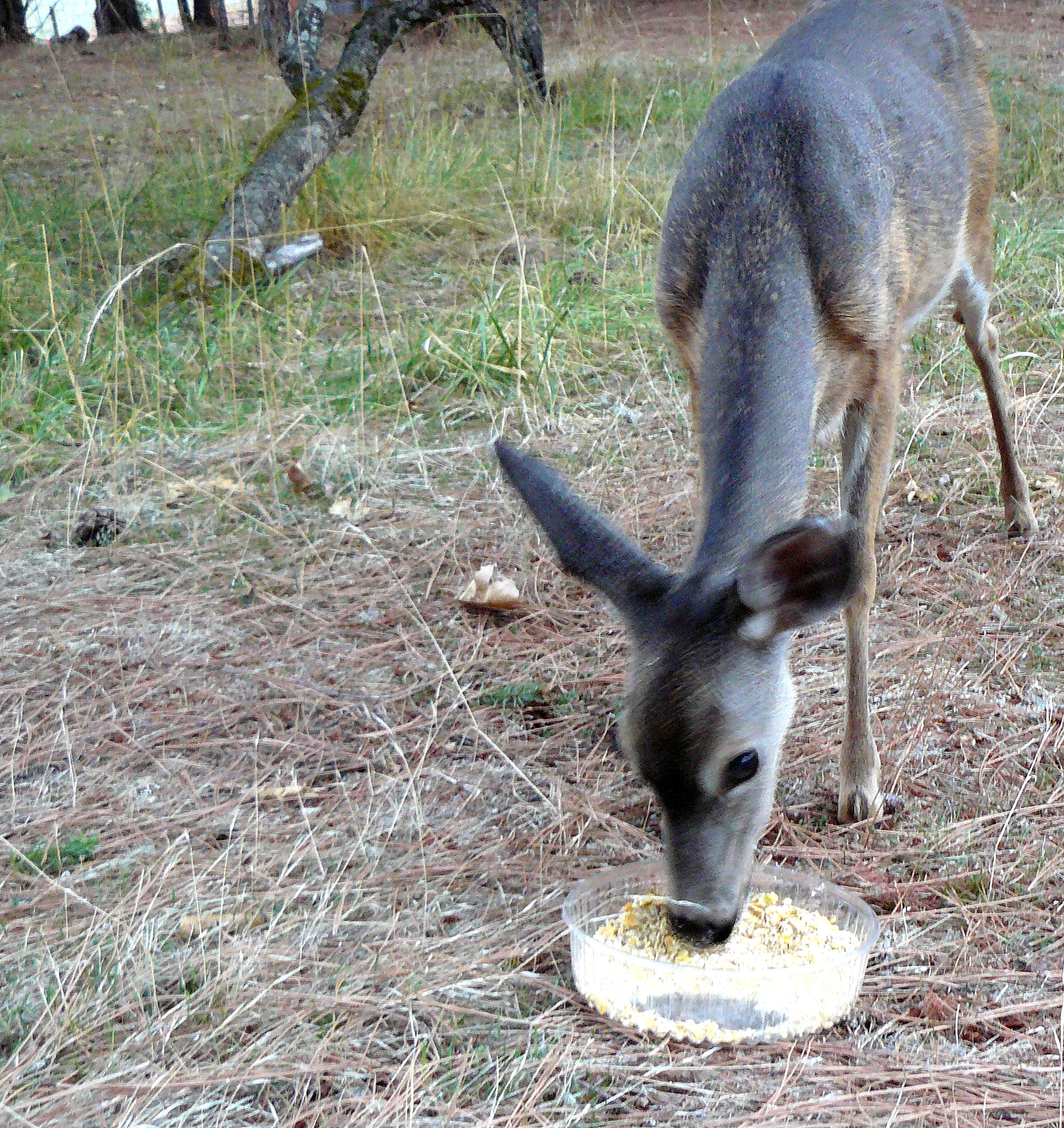
Mother deer reaches down to feed; the tray is about three feet in front of Jean and me.

oooo

Jean reaches forward and gently draws the tray closer to us. Mother deer continues to feed.

oooo

Then, unbelievably, the wild deer continues feeding as Jean fondles the deer's ear.
Then, unbelievably, the wild deer continues feeding as Jean fondles the deer’s head and neck.

oooo

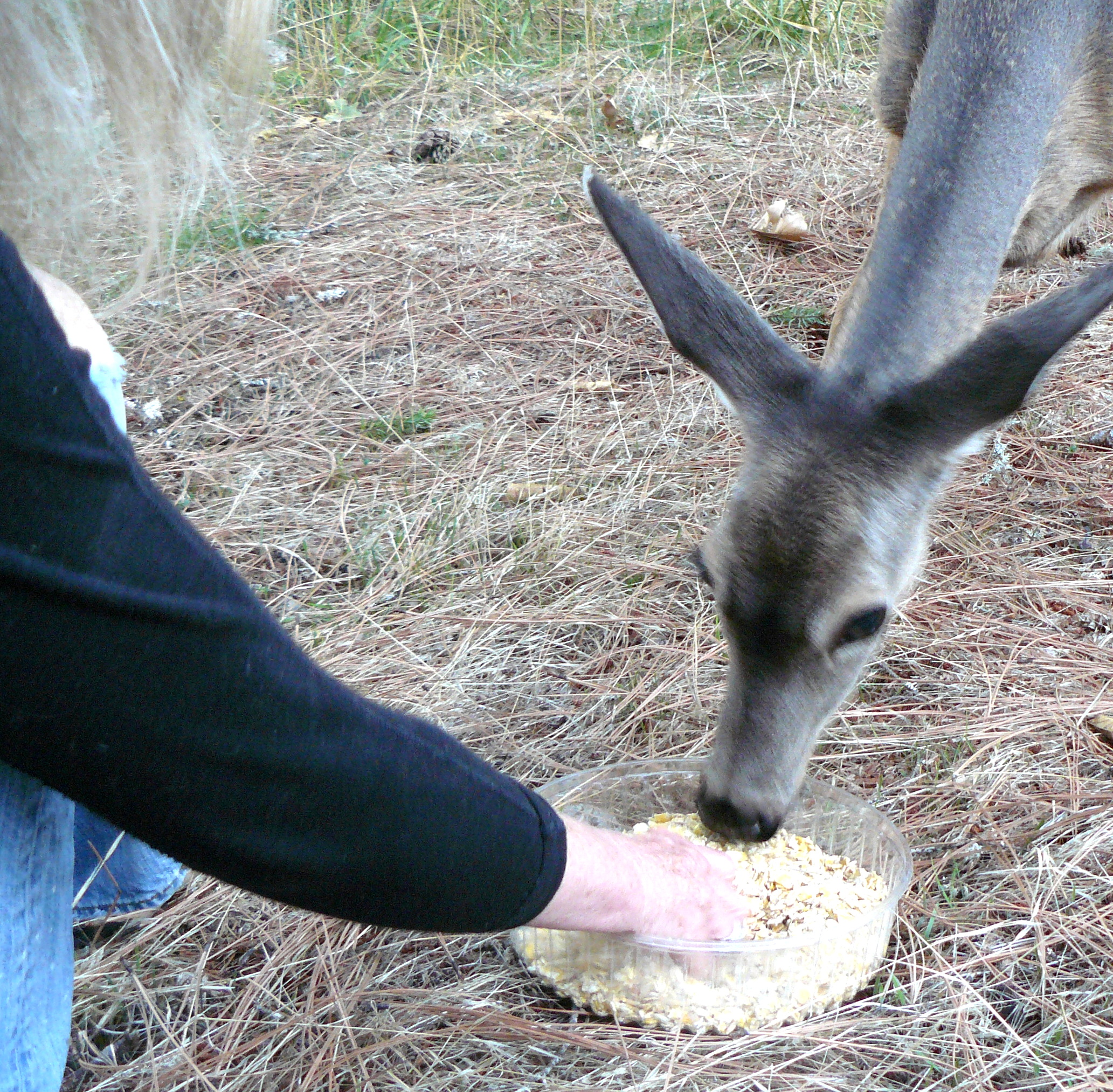
The trust between the deer and Jean then enabled the deer to feed from Jean's hand.
The trust between the deer and Jean then enabled the deer to feed from Jean’s hand.

oooo

There was a rustle in the leaves some twenty feet away and we saw the fawn watching her mother feeding on the cob. Jean pushed the tray away, just by a few feet, and the fawn came right up to her mother.

oooo

The culmination of the most magical of experiences: mother deer and her fawn eating together some three feet in front of us.

When I published my post Space for Nature a little over a week ago, a post that included a photograph of two deer some thirty feet from Jean’s car, never in my wildest dreams could I have imagined what took place last Tuesday afternoon.

Words truly do seem inadequate.

P.S. It is at times like this that we need poetry.  So how about it: Sue? Kim? How would you describe in poetry what Jean and I experienced?