Category: Environment

Still in the month of May!

Figurative and literal cracks!

My rather cryptic sub-heading will make sense very soon.

Just ten days ago I published a post The Month of May. It explained why May had always been a special month in my life and then went on to introduce an article published by The Smithsonian Using a New Roadmap to Democratize Climate Change.

That article featured the former president of Iceland, Olafur Grimsson, and how he was encouraging new solutions to climate change. Primarily via a new organisation called RoadMap. (Did you sign up??)

There is change in the air. People are starting to make a better future. Cities across the USA (and elsewhere undoubtedly) are pledging to go 100 percent renewable. Here’s what Grist published on May 4th.

ooOOoo

Cities all over the U.S. are pledging to go 100 percent renewable.

Atlanta, Georgia (Shutterstock)

On Monday, Atlanta lawmakers voted unanimously to power the city entirely with clean energy sources by 2035.

Atlanta is the 27th city to make the pledge, according to the Sierra Club. These kinds of municipal promises have been popping up nationwide over the past few months. Here’s a recap:

“We know that moving to clean energy will create good jobs, clean up our air and water, and lower our residents’ utility bills,” said Kwanza Hall, an Atlanta City Council member and mayoral candidate, in a statement. “We have to set an ambitious goal or we’re never going to get there.”

A round of applause for local climate progress!

ooOOoo

Lovely to see the city of Portland on that list.

Keep it coming. For we need to see cracks of change; cracks of hope.

Cracks to counter literal cracks.

ooOOoo

The crack that’s redrawing the world’s map.

(From the BBC Culture Newsletter 5th May.)
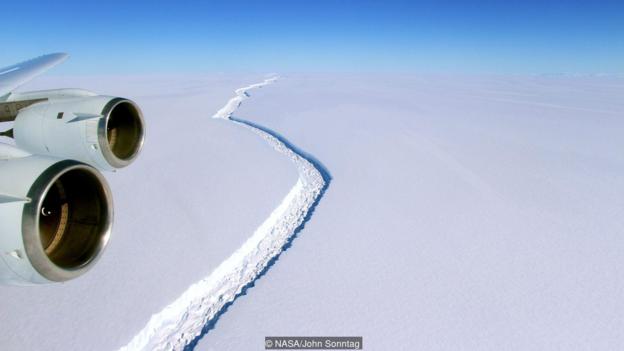
The shape of the world is hanging by a thread – or rather, according to experts, by a 110 mile-long (177km) rift. That’s the extent of a rapidly expanding crack in an enormous ice shelf in Antarctica. When the Larsen C shelf finally splits, the largest iceberg ever recorded (bigger than the US state of Rhode Island and a third the size of Wales) will snap off into the ocean. Widening each day by 3 ft (1 m), the groaning cleft is on the verge of dramatically redrawing the southern-most cartography of our planet and is likely to lead, climatologists predict, to an acceleration in the rise of sea levels globally.

 An aerial photo of the frigid fissure, taken late last year when it was discovered that the pace of the icy tear was quickening, was suddenly back in the news this week with the announcement that a second rift in the shelf had been detected. The fracture leads our eye along a zig-zagging path – from the backward gaze of the plane’s right engines to the pristine polar blue of the horizon in the distance. The jaggedness of the cleft, which takes our vision on a journey whose ultimate destination is unfathomable, seems at once monumental and terrifyingly fragile. The photo intensifies our helplessness in the face of cataclysmic change. It freezes the potential destruction in the blink of a camera’s shutter, while at the same time hinting at a catastrophe that we can witness unfolding but are utterly powerless to stop.
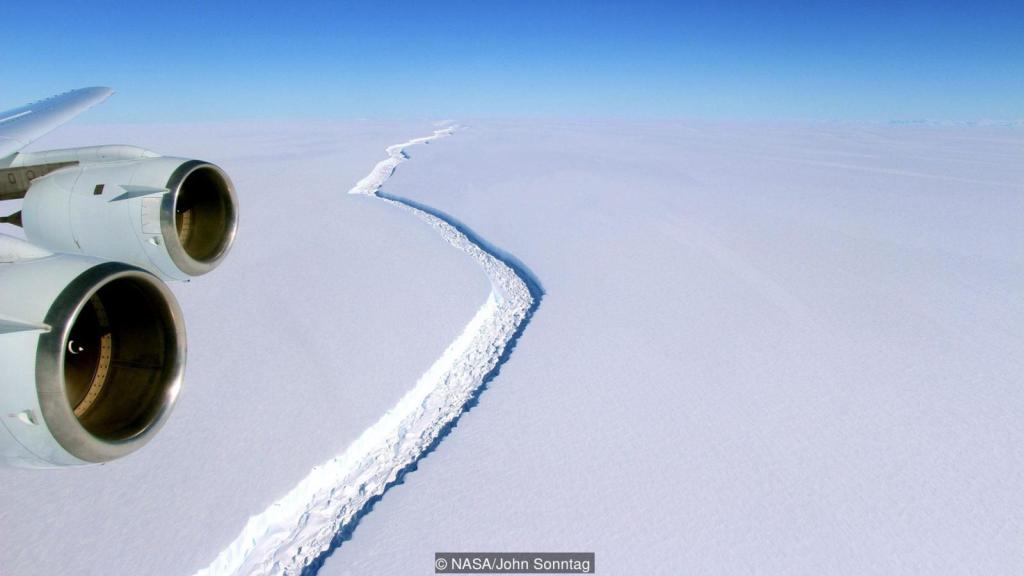
A second rift was recently discovered in the Larsen C ice shelf on the Antarctic peninsula (Credit: NASA/John Sonntag)

As a visual statement, the aerial photo of the Larsen C crack is, by definition, incomparable; never before has the world marked the glacial advance of such a sublime and fearsome fracture in its very fabric. Yet the reemergence of the image in the news anticipates the ten-year anniversary of one of the most intriguing and innovative large-scale works in contemporary art – a work whose power relies for its thought-provoking effect on the peculiar poetry of ruinous rifts. In October 2007, the Colombian-born artist Doris Salcedo unveiled in London an ambitious installation in the cavernous space of Tate Modern’s Turbine Hall – a piece that split reaction down the middle.

Inviting gallery-goers into the otherwise empty and austere interior of the former Bankside Power Station, Salcedo subverted expectations. Rather than offering visitors a hall of temporarily installed sculptures, she orchestrated the contemplation instead of a ragged subterranean breach that appeared to rip open the concrete floor of the structure – a crevice that extended from one end of the yawning space to the other.
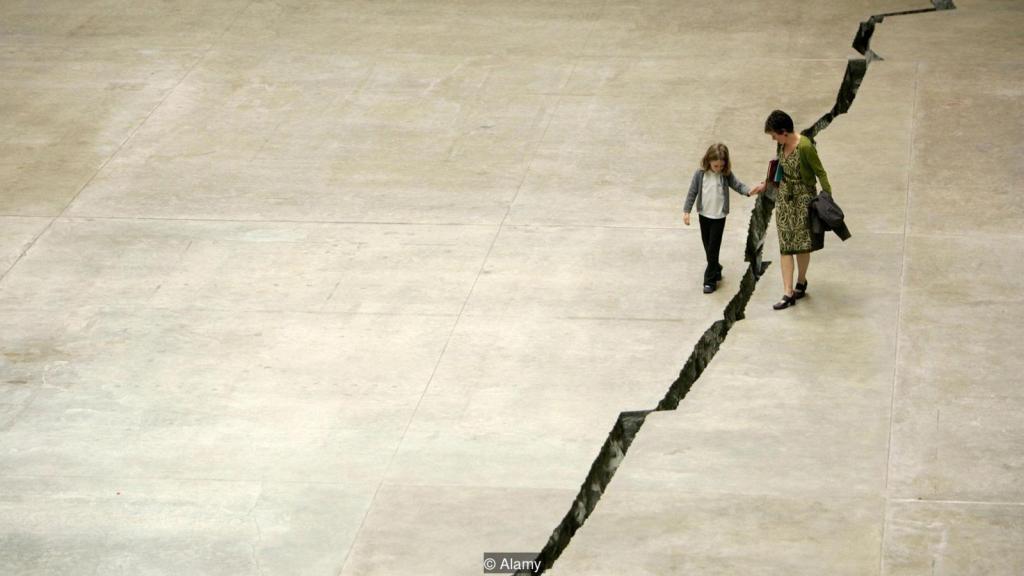
For the Colombian artist Doris Salcedo’s 2007 work, Shibboleth, a giant crack was made in the concrete floor of Tate Modern’s Turbine Hall (Credit: Alamy)

Salcedo deepened the mystery of her bold and experimental conceptual work by giving to it the curious title Shibboleth – a biblical word which, when mispronounced, was said to have exposed the outsider status of individuals. Complicating matters still further, the artist insisted that her work was a comment not on the folly of material ambitions, but on racism – that deep cultural scar that tears at the foundations of humanity. Placed side-by-side, this week’s photo from Antarctica and the image captured a decade ago of Doris Salcedo’s challenging Shibboleth share both a brutal beauty and a common theme: the brittleness of being.

If you would like to comment on this story or anything else you have seen on BBC Culture, head over to our Facebook page or message us on Twitter.

And if you liked this story, sign up for the weekly bbc.com features newsletter, called “If You Only Read 6 Things This Week”. A handpicked selection of stories from BBC Future, Earth, Culture, Capital and Travel, delivered to your inbox every Friday.

ooOOoo

“the brittleness of being.”

Please, all of us, let’s make a positive difference so that we can soften the edges of that brittleness.

Picture Parade One Hundred and Ninety-Four

More from Janet ….

But first a couple from closer to home.

Soaking up the afternoon sunshine.
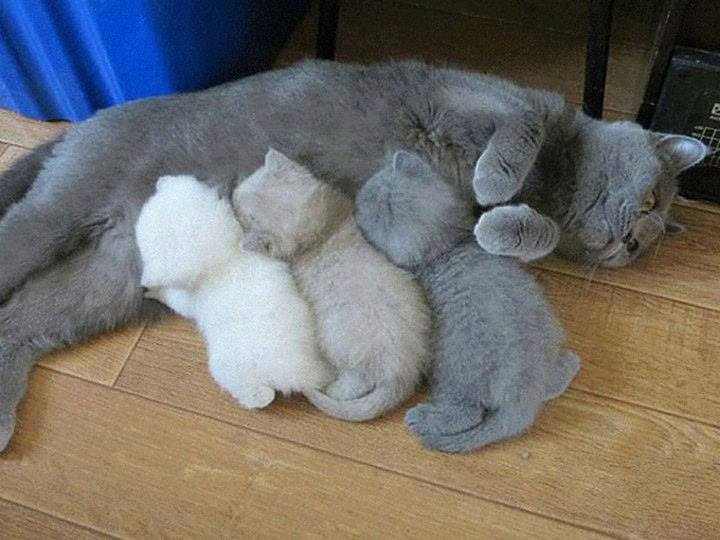
Our babies will be three weeks old next Tuesday.

oooo

oooo

oooo

oooo

oooo

oooo

Yet more to come in a week’s time.

You and your lovely animals please take care out there!

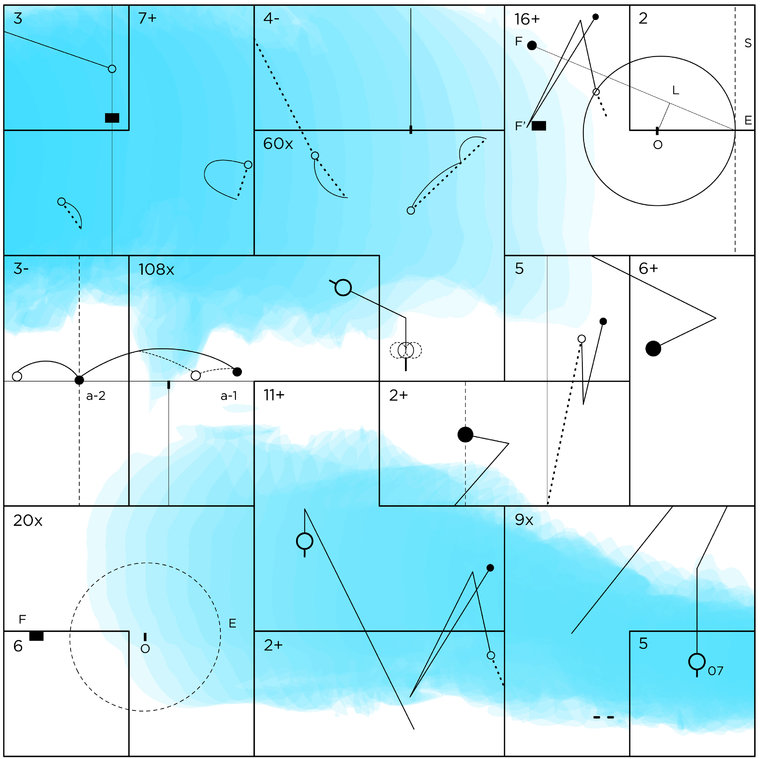
The aesthetic beauty of mathematics!

Sorry! Did you say the beauty of mathematics?

Those of you that read this blog fairly regularly know that from time to time I drift away from all things dog and potter in the garden of simply fascinating ideas.

Such is the case today.

It is an article on mathematics that was sent to me by Jim Goodbrod. He had read it in The New York Times in April.

Read it and see if you, too, find it as fascinating as I did!

ooOOoo

The World’s Most Beautiful Mathematical Equation

Loyalty with a capital ‘L’.

This is almost too beautiful for words.

Recently Jean was sent a link to an item on Mother Nature Network by Trish, a close friend living down in Tucson, AZ. It shows the strength of character of one particular dog but easily serves as a reminder of the power of love, commitment, endurance and loyalty that thousands of dogs exhibit so many times. Qualities that we humans may so easily overlook because our dogs fit so comfortably into the relationship with us.

The article, on Mother Nature Network, was originally published in 2014 and, as the Editor explains:

Editor’s note: This story has been updated since it was originally published in November 2014.

The article is also presented with the enclosed video at the end of the text. But when Jean and I watched the video last night we were so taken by it that I am making an ‘executive’ decision to present the article slightly differently.

In that I think that watching this beautiful, incredible, video first is better.

Now on to the full article that was published on Mother Nature Network.

ooOOoo

Stray dog follows adventure race team for 430 miles

The harrowing story of how the dog finished the race with his adopted companions will melt your heart

Bryan Nelson    March 6, 2017

A stray dog named Arthur made an amazing trek with his new companions. (Photo: TrendingVideos/YouTube)

The Adventure Racing World Series might be the most fraught and challenging sports event in the world. It usually involves teams of four navigating through a vast wilderness terrain while utilizing adventure skills from a range of disciplines including trekking, adventure running, mountain biking, paddling and climbing.

During the 2014 competition, for the first time ever, an exception was made so that one team could finish the race with five members instead of four. That fifth member? A stray dog, named Arthur by his adopted companions, who decided to follow one team for 430 harrowing miles through the Amazon jungle, according to the Daily Mail. If this story doesn’t warm your heart, you don’t have one.

Team Peak Performance, hailing from Sweden, happened upon Arthur while sharing a meal in advance of a 20-mile race stage through rough terrain in Ecuador. Mikael Lindnord, one of the team’s members, felt sorry for the scruffy, lonely stray, and decided to share a meatball with him. It was an innocent gesture — Lindnord had no intention but to lift the poor pooch’s spirits — but it was a gesture that would earn him a friend for life.

As the team got up to continue their race, Arthur tagged along. The team suspected he would eventually turn back around, but Arthur kept following them. He trailed them through muddy jungle, across vast distances of the Amazon river, all the way to the finish line.

The sport of adventure racing is not for the faint of heart — no more for dogs than for humans. During the most harrowing stages of the race, the team tried to shrug off their canine companion over concerns for his safety, but Arthur would have none of it. He was determined to stick with his adopted companions.

For instance, one crucial stage of the race requires the team to kayak along the coast for 36 miles. Understandably, the team was required to leave Arthur behind on the shore. But as they paddled away, Arthur broke free and leaped into the water and began swimming after the team. Realizing that the dog was willing to drown in order to stay with his friends, the team lifted Arthur onto the kayak so the dog could complete the race with them, to sounds of ovation from bystanders watching from the shore.

Arthur’s loyalty paid off in the end; Lindnord was able to adopt him and bring him back to his home in Sweden, where the dog is currently living, healthy and happy.

“I almost cried in front of the computer, when receiving the decision from Jordbruksverket (Board of Agriculture) in Sweden!” reported Lindnord when he first heard that his request to adopt Arthur was granted. “I came to Ecuador to win the World Championship. Instead, I got a new friend.”

ooOOoo

Loyalty with a capital “L”.

Love with a capital “L”.

This picture of Arthur speaks for itself.

The Month of May!

For all my life this has felt like a very special month.

And, dear friends, at the risk of repeating myself to many of you, this is why the month of May is special for me.

Simply that I was born in London during the closing months of the Second World War. Inevitably, I was unaware of the number of German bombs that were falling on London during those last few months. But there were thousands.

On May 8th. 1945, the day that WWII ended and six months to the day from when I was born, my mother looked down at me and said aloud to me: “You are going to live”. Despite the fact that I don’t recall my mother saying that, it was verified many times later when I was growing up.

Now here we are approaching May 8th. 2017 and in a very real sense it seems that we are in another war.

A war of consequence.

A war that we have been engaged in for many, many years.

A war where we are inadvertently fighting on a global battlefield.

A war where 99.99% of us don’t consciously identify the weapons we are using. Weapons that are incredibly effective. So much so that we are in sight of winning the last battle; winning the war.

Yet a war where winning is no win at all. Indeed, where winning this war, this global war, spells the end. The end of life for 99.99% of us humans (and much else besides).

Now what on earth has got me so fired up?

Two things have:

The first is that I am living in my 73rd year of life. I have no idea of when my life comes to an end. But that death is a guarantee. Indeed, if one takes note of the average life expectancy of a male today in the USA (75.6 years) , it may not be that far away.

The second thing is that before my death I truly want to know that humankind has laid down its weapons of war against our planet and that there really is an unstoppable mission, a united wave of passion, to live in peace on this planet. Perhaps better put to live in peace with this planet.

Or in the words of an organization that I now want to introduce:

A mission which will require the hard work and dedication of each and every one of us as we do everything in our power as individuals, but also as we galvanize businesses, entrepreneurs, innovators, city planners, communities, people and politicians—all those who share our purpose.

OK! Thank you if you are still reading this! (Someone give Fred in that soft arm-chair over there a nudge; I can hear his snores from here!)

In the last Smithsonian electronic newsletter that I was reading yesterday morning there was a reference to an organization that I hadn’t previously come across. Here is the link to that item on The Smithsonian website. I am republishing it in full in this place. As you read it you will understand why I am republishing it.

ooOOoo

Using a New Roadmap to Democratize Climate Change

A new tool aims to bypass governments and put the power of climate action in the people’s hands

By Anne Glusker    Smithsonian.com     April 28, 2017

Olafur Grimsson, who was president of Iceland from 1996 to 2016 and saw his country through the worst economic crisis in its history, making headlines all over the world as banks collapsed and the country fell into a depression, is the very picture of an urbane statesman. Collected and poised, with a striking full head of white hair, as comfortable in English as in his native Icelandic, he seems an unlikely revolutionary, not the sort of person you’d look at and immediately find yourself thinking: “Power to the People.”

 But Grimsson is one of the primary architects of a quietly radical new idea whose aim is to facilitate action on climate change without any of the usual suspects—governments, countries, international bodies, negotiating parties.

He and several other veterans of the historic 2015 Paris Agreement on climate change were in Washington, D.C., last year, just before COP22, the climate meeting held in Marrakesh in 2016. They were pondering next steps when the conversation took a new and interesting turn, Grimsson says, addressing the question: “Was it possible to have the success of Paris without governments necessarily being in the leading role?”

The group included movers and shakers such as Peter Seligmann, the chairman of Conservation International; Laurene Powell Jobs, president of the philanthropic organization the Emerson Collective; and Andy Karsner, an assistant energy secretary during the administration of George W. Bush. Galvanized by their own query, they decided to try to answer it—to set about creating a new tool to aid in achieving the goals of the Paris accord.

At the Smithsonian’s Earth Optimism Summit, a gathering this past weekend of conservation-minded citizens, scientists and activists, Grimsson explained: “You get governments that are opposed or even hostile to climate action. We decided to bring together in Marrakesh a gathering of thinkers and scientists and innovators and policymakers from different countries in order to discuss a new model of securing the success of the future of the climate movement.”

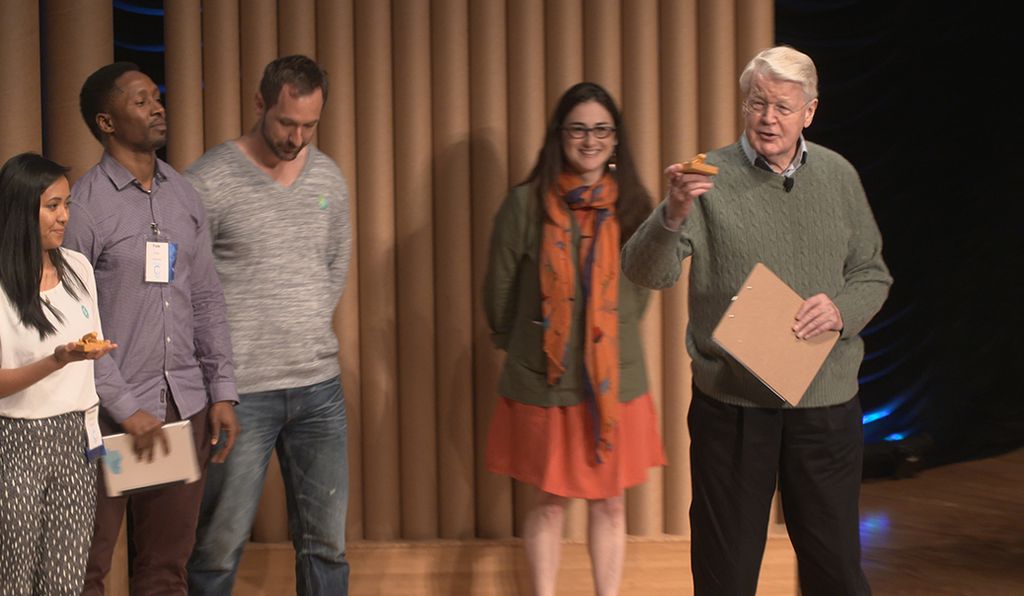
At the Smithsonian’s Earth Optimism Summit, the former president of Iceland Olafur Grimsson encouraged new solutions to climate change, awarding cash prizes to the winners of the “Make for the Planet” challenge. (The Roadmap)

Grimsson’s group felt that due to changes in information technology and social transformations, the large organizations and structures that used to be necessary to effect change were now not needed. And thus was born Roadmap, a new crowdsourcing tool for anyone and everyone interested in climate action. Still in its very early stages, Roadmap’s founders envision it as a platform for those working on climate issues—from scientist and policymaker to farmer and fisherman—to facilitate the sharing of knowledge and ideas, methods and techniques.

“A new political model is possible—where everyone can be a doer, where you no longer need big government or big enterprises to bring about success,” Grimsson says.

This new model for social change that skips the usual cumbersome channels and processes has been seen everywhere from public health, where the Bill & Melinda Gates Foundation has redefined the sector, to the hospitality industry, which is working to combat the human trafficking that plagues its businesses, to perhaps most famously the Arab Spring, where the role of social media in bringing about political change is still being debated today.

And this new model is complemented by technological changes. “The innovation in energy technology is such that we no longer have to wait for the big energy breakthrough,” Grimsson says. “We already have the available technologies. Every individual, home, village, community, town and region can execute change. The good news from the climate point of view is that, in addition to the information technology revolution, there has now also taken place an energy revolution. A house can be a power station: If the people who live in that house have extra energy, they can sell their energy through the smart grid. The notion that every house can be a power station is as revolutionary as saying that every mobile phone can be a media company.”

Grimsson admits that it may seem odd for someone in his position to be advocating that ordinary citizens take action apart from the conventional corridors of governmental power.

“For me to say that these traditional political organizations and positions are somewhat outdated is perhaps a strange statement: I was a professor of political science, I’ve been a member of parliament, I’ve been a minister of finance, I was president for 20 years,” he says.

It was during Iceland’s financial meltdown that he first experienced this new kind of social change: “I saw this very strongly through the financial crisis in my own country, which led to a big social economic uprising. All those activities were engineered by unknown people, people who were not part of a big organization, who used Facebook and the information media to bring thousands of people together in one day.”

Right now, Roadmap consists of a website and a lofty manifesto that speaks of raising the value of “moral currency” and creating a “best practices warehouse.” Visitors to the site can fill out a form if they want to become part of its community of “doers.” The practical part of the manifesto speaks of identifying the best methodologies and models; implementing a “real-time system of measurement” and a way to “gauge and understand what is working, what is not, and exactly what is being achieved.” As the platform develops, it will be interesting to see exactly what form these gauges, measurement systems, and warehouses take.

After the Paris Agreement, Grimsson says of himself and his Roadmap co-founders, “We were all optimistic, but we are all also realists.” It is his belief that if you “give people the tools, they can execute the transformation and the change—without governmental leadership.” Perhaps Roadmap will be one of those tools.

 ooOOoo

Here’s a video that spells it out in ways that I find impossible to ignore. (And, yes, I signed up, as in joining, yesterday afternoon.)

Because in hundreds of years time I want others to look at the following picture of Troutbeck Valley in England and know how precious is this one and only planet we live on.

Or in the words of Sue Dreamwalker that I read yesterday evening:

We are witnessing more storms, more unseasonal weather patterns, and I just hope that we wake up soon to the damage we are doing to our beloved Mother that has held us in her eternal arms for so long..

Photo credit: Getty Images

Enjoy the month of May wherever you are in the world!

Closing by repeating a key pronouncement in that RoadMap video above:

Why We? Who Else!

Picture Parade One Hundred and Ninety-Three

Janet Goodbrod just keeps giving and giving!

oooo

oooo

oooo

oooo

oooo

More next Sunday and, thanks to Janet, for quite a few Sundays thereafter.

Natalie exploring the meaning of peace.

Another delightful travel account from Natalie Derham-Weston.

Albeit perhaps travels of a more inward nature.

ooOOoo

Travel Blog: Installment 3: Living on a boat.

Simple Peace

I fancied an interlude this week to share a morning I enjoyed over the weekend. It isn’t often that the chance arises to enjoy our local surroundings without time limits, overdue deadlines or inconvenient meetings. However, I had a day off Saturday; a concept becoming more and more valued having since started a new full-time job, which is quite demanding on my time. I have requested this high load of hours but after months of travelling and not having regular work, it is taking a while for me to adjust to the mental and physical demands.

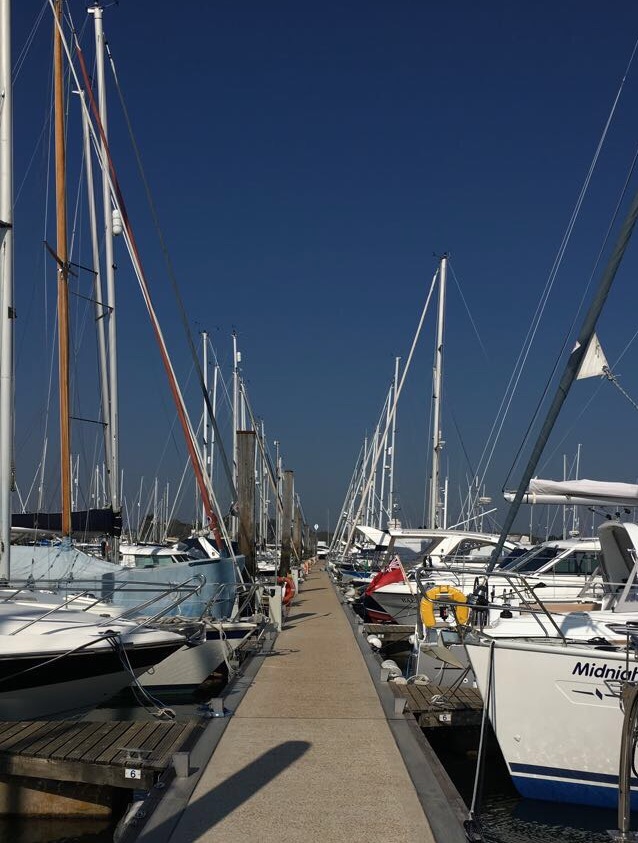
Anyway, without going into the irrelevant details, I have been spending my time living on a boat in a marina in Lymington, a small sea side town in the New Forest on the South Coast of England. This means my commute to work is a 2 minute walk and although I do not know the first notion about sailing, I have quickly fallen for the lifestyle of boats and water. I have found it to be extremely sociable and relaxing and I have all I need around me. This includes a bicycle, a car, swimming facilities, work, grocery shops and a very modest yet comfortable boat.

So last Saturday, I woke up early, as I was already in the routine of being awake from my work shifts and saw the sun streaming in through the port hole windows. This immediately buoyed me and I pulled the curtains and opened the hatch to let in the fresh air. I had a few items on a to do list but I certainly didn’t intend on wasting the valuable time I had.

I did have an appointment I couldn’t shirk but made it as quick as possible and on the way back picked up some lunch items. Back on the boat, I had a quick tidy and clean as I firmly believe an orderly workspace leads to a clearer mind.

I pre-empt this by saying I am usually accompanied by my father on the boat but this specific day was the first time I had been left in solo charge and this gave me somewhat of an independent free feeling. So my next mission was to cook some eggs which I did on our very small gas camping stove. I took some cushions out on deck and had my lunch in the warm April sunshine. Our pontoon seems to be quite an active mooring site and there were people constantly wandering along it all day, carrying tools, bags and equipment back and forth. So although I was alone, I did not feel isolated.

I then left everything behind on the boat, including my phone and took my bicycle around the headland on a trail I had never been on before. The channel was extremely clear and I had a wonderful view over to the Isle of Wight and watched the bustle of boats going to and fro. I passed lots of families, dogs, bird watchers and couples but kept going at a steady pace along the gravel track headed towards Keyhaven, the next fishing village along.

There is no specific reason why I enjoyed this so much, just the whole atmosphere and surroundings made for a very encompassing uplifting day. I continued along the path, and had no care as to where I was or where I was going. I was confident enough that I knew I’d always find my way back somehow and so without that pre-conditioned feeling of panic, I cycled on along the back roads and hauled my bicycle over fences and gates.

Two hours later I cycled back in to the marina and abandoned the bike next to the boat. The boat is never locked, another aspect I really appreciate. I don’t think this would be possible everywhere, but it allows for a very open way of life. So I grabbed a cushion and headed to the bow of the boat, lying in the sun, drinking a beer, watching the world go by.

This just proved to me how easy it is to be happy sometimes. We need very little but that day will stay in my memory for a long time as a point in time where I was 100% content.

ooOOoo

I had the great fortune of living on a yacht Songbird of Kent, a Tradewind 33, for five years in the late ’80s early ’90s based out of Larnaca on the Greek side of Cyprus. I can fully vouch for the peace that Natalie has written about.

Growing babies.

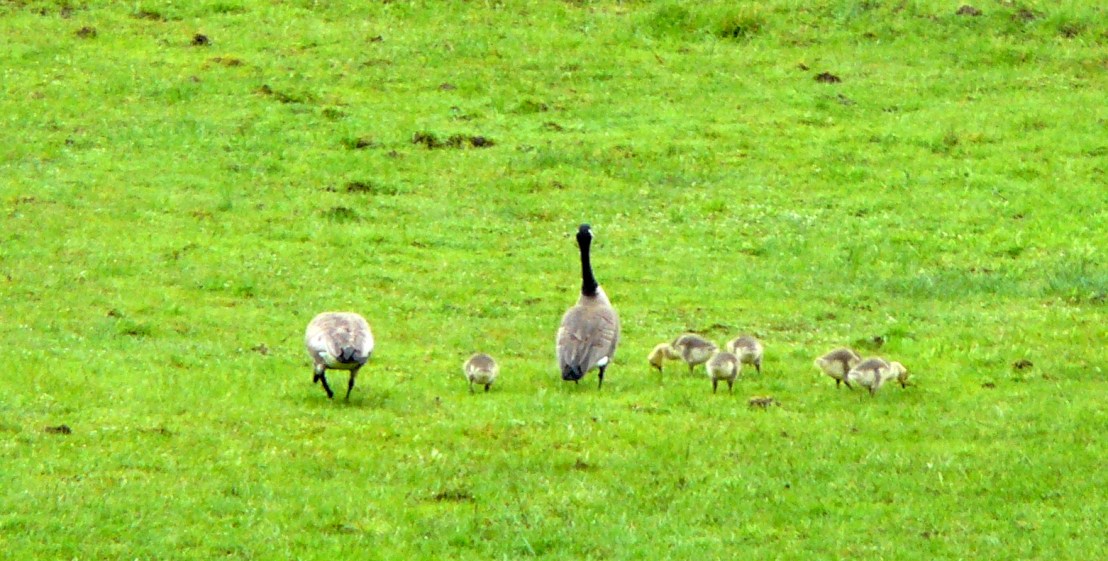
Just thought I would share the latest pictures of our family of Canadian Geese.

First up, let me again show you a picture or two from the day when the goslings were born on the 11th April (and there were six born):

oooo

Mum and Dad and what looks like 5 goslings.

So now to how they are getting along just two weeks on from when they hatched out from their eggs.

oooo

oooo

oooo

Next thing the youngsters will be all grown up and wondering, like yours truly, where all the years went!

Dogs are saving our lives!

Literally, not just emotionally!

Over on my website, under My Writings, I mention my recently published booklet, The Amazing World of Dogs.

Here’s an extract from pages 17-18 of that booklet.

Finally, Dr. Morten Kringelbach of the Department of Psychiatry at Oxford University1 explains that the need to nurture is very deep in us humans and that dogs produce an instinctive parental response in us that is very similar to our nurturing instinct for our children.

If the magic of having dogs in our lives for such a long time ended there it would still be breathtakingly wonderful. But dogs could now be offering us humans the capacity to understand many human diseases. Literally, our dogs could be saving our lives!

The challenge in understanding human diseases is that within our ‘breed’ there is a great variability of genes. Not surprising when one considers the incredible diversity and variation within us humans.

But when we turn to dogs then we have a bonus. For despite there being, as mentioned earlier, 400 or more different breeds of dog, within each breed dogs are very similar to each other. In other words, that narrow gene pool within a specific dog breed makes if far easier to pinpoint genetic mutations than it is in humans.

Elinor Karlsson is the director of the Vertebrate Genomics Group at the Broad Institute of MIT and Harvard.2 As a geneticist, Dr. Karlsson has identified, “hundreds of diseases common to dogs and humans”. In 2005, the dog’s genome was fully mapped; all 2.4 billion letters of the dog’s genome

Among those common diseases between us humans and our wonderful dogs are diabetes, cardiac diseases, epilepsy, many cancers especially bone cancers, and breast cancer and even brain tumours.

So it was an obvious thing to do to republish the following article that appeared on the Care2 site a few days ago.

ooOOoo

 Could a Dog Vaccine Help Save Kids With Brain Cancer?

By: Laura Goldman April 17, 2017

About Laura Follow Laura at @lauragoldman

The statistics are grim: About 60 to 70 percent of children who have glioblastoma, a form of brain cancer, do not survive more than two years. This fast-growing cancer is resistant to traditional treatments like radiation and chemotherapy.

For dogs, cancer statistics are also grim. More than 6 million dogs are diagnosed with cancer every year, and one out of four dogs will get cancer during their lifetime. It’s the leading cause of death for dogs after the age of two.

But there could be hope for both dogs and kids. A vaccine being developed that destroys cancer cells in dogs could also be successful in fighting glioblastoma in children.

Researchers at Children’s Mercy Hospital in Kansas City, Mo., have started a partnership with ELIAS Animal Health, a company that’s testing treatments for osteosarcoma (bone cancer) and B cell lymphoma in dogs.

“If we take advantage of the resources we have in this region and get behind those collaborations, this could be a mecca for advanced, exciting, innovative therapies for cancer and lots of other diseases,” Dr. Doug Myers, an oncologist at Children’s Mercy, told the Kansas City Star.

ELIAS Cancer Immunotherapy (ECI) uses the dog’s own immune system to destroy the cancer. “Research has shown that ex vivo activated T cells have the machinery to effectively kill cancer cells, including cancer stem cells,” according to the company’s website. “ELIAS Cancer Immunotherapy utilizes adoptive cell therapy to deliver an army of activated T cells.”

The dog is vaccinated with his own cancer cells to produce an immune response, then the generated white blood cells destroy the cancer cells.

“Personalized T cells are then safely obtained from the patient through apheresis [the removal of blood] and then ‘super charged’ to produce a large population of killer T cells that are reinfused into the patient to kill the cancer,” the company explains.

ELIAS Animal Health is currently conducting clinical trials of ECI at Kansas State University, the University of Missouri-Columbia and a few animal hospitals across the country. The success rates of using ECI along with surgery on dogs with cancer are being compared with those of patients that are treated with surgery alone.

“Early clinical study results already show positive outcomes,” Tammie Wahaus, CEO of ELIAS Animal Health, said in November 2016.

Among the ECI success stories is that of Dakota, a German shorthaired pointer who continues to survive a year after she was diagnosed with osteosarcoma. This is twice as long as her original prognosis. X-rays taken during a follow-up examination showed no signs of the cancer spreading.

Could ECI also successfully treat children with glioblastoma? Dr. Kevin Ginn, a pediatric oncologist at Children’s Mercy, and other researchers are currently developing protocols for trials. They’re planning to apply for a Phase II clinical trial with the U.S. Food and Drug Administration, using the results of ECI’s studies on safety and effectiveness as far as dogs are concerned. The Phase II trial would give ECI to a large group of children to see if it’s effective and further evaluate its safety.

Animal health trials are regulated by the U.S. Department of Agriculture. They are less expensive and proceed faster than FDA-regulated human trials, the Kansas City Star reports, “but successful human health treatments often bring a larger return on investment.”

In this case, a larger return on investment could be a win-win for children as well as dogs with cancer.

Photo credit: cgordon8527

ooOOoo

My booklet closes thus:

Many would extend that proficiency of dogs to include their sense of loyalty and forgiveness, to and of us humans, but that all pales into insignificance when compared to what our understanding of dogs is giving us.

No less than the capacity to help cure many of our diseases, to deeply understand the workings of the human mind, and above all else, to offer insight into our very existence.

That’s quite a relationship!

Quite a relationship indeed!

Further travels with Natalie

Natalie returns with her second travel installment.

Almost a month ago, the 18th March to be exact, I introduced Natalie Derham-Weston:

Those who take a close interest in this place (you poor, lost souls!) will have noticed from time to time me posting items that have been sent to me by Bob Derham. He and I first met when we were both based in Larnaca, Cyprus in the late 80’s/early 90’s and we have remained good and close friends ever since.

Natalie is Bob’s beautiful daughter and recently contacted me to ask if she might offer a guest post on her traveling experiences. Natalie has ambitions to be a travel writer and, as you are about to see, would make an excellent one.

On that day Natalie presented the first installment of her travel blog. It was very well received by you good people. Many of you left great comments.

Thus it is with great pleasure that I present Natalie’s next travel  installment.

ooOOoo

Travel Blog: Installment 2: Laos

After having set the standard so high in Thailand, there was a lot riding on our following section of the journey. However before moving on to Laos, the logical next step and easiest route to take, we had a few metaphorical “bridges” to cross. Looking back, the process seems an enormous chore but at the time we didn’t question the operation. Although tiredness did sometimes set in heavily, Hannah and I had to mentally overcome this and remind ourselves how this beat office day jobs hands down.
Our last evening in Thailand was spent in Chang Mai. After some deliberation and consulting of maps and Google facilities, we booked a slow boat trip down to Mekong to take us into Laos. The evening was then free to be spent at our leisure. Pre-travelling I was naïve, and perhaps still am. Though even I had heard tell of the Thai “lady boys” and we had the greatest pleasure of spending an afternoon in their company after having looked lost and forlorn at a cross roads and took up their offer of a pool side beer. They spoke openly about their choice to change gender and what they had to undergo. This meeting was purely circumstantial but very memorable all the same. After this curious incident we caught up in town with a friend I had been to school with in South Africa. Carmen was in Thailand teaching English and had an evening to spare, which was such a lovely chance to assemble and to chew the fat as some may say.
On our wander back to our hostel we happened to bump into Nadine, a girl we had met previously on an overnight train. This is one of my most favourite parts of travelling, crossing paths with friends, having had no plans and no inkling of the others location.
The following morning consisted of some organising, dollars had to be sourced for the Laos border and check out was an early evacuation, drying our towels on the outside of our bags and heaving them downstairs to be left for the later pickup. In the meantime, we bought up some supplies to support us through the epic bus journey that we had to embark upon that afternoon. Fortunately, these snacks barely amounted to anything, and certainly made a welcome change to our expensive sandwiches and bottles of water back in the UK!
Our bus was a 7 hour journey, taking us through minute villages and stopping at temples along the way. One in particular stood out, which was pure white. The only colour was a singular red nail on a hand protruding from a statue of swarming limbs surrounding the building.
That night was our first sighting of the vast Mekong, a fast flowing murky, brown mass of water with grassy banks and elephants grazing alongside. Children were running down to the shore to bathe and play and generally splash around as much as was possible.
Our accommodation had been part of the ticket and so was basic to say the least. Dinner went untouched due to the extensive family of flies feasting on it. In the morning, the pre stated time of 8:30 got blown out the window and there was a quick panic to depart at 8. After yet more busses, there was a process in place at the border for visa stamps and signing of papers. The long queues were hot and felt much longer than they probably were.

At another stop we convened with a load of other tourists. At this point it dawned on us that neither Hannah nor I had any local currency, which was apparently an issue. So the solution to this was for me to jump on the back of a bike belonging to a tour guide within the group and find the nearest ATM and hope for the best. I sauntered back with 500,000 kip, the equivalent of about £50, and felt very wealthy! 12 of us were stuffed into an open tuktuk, with our bags precariously perched on top and sent down a steep slope to a load of boats tied up, surrounded by pigs in baskets, goats running lose and a huge swarm of blue butterflies milling around the general vicinity.

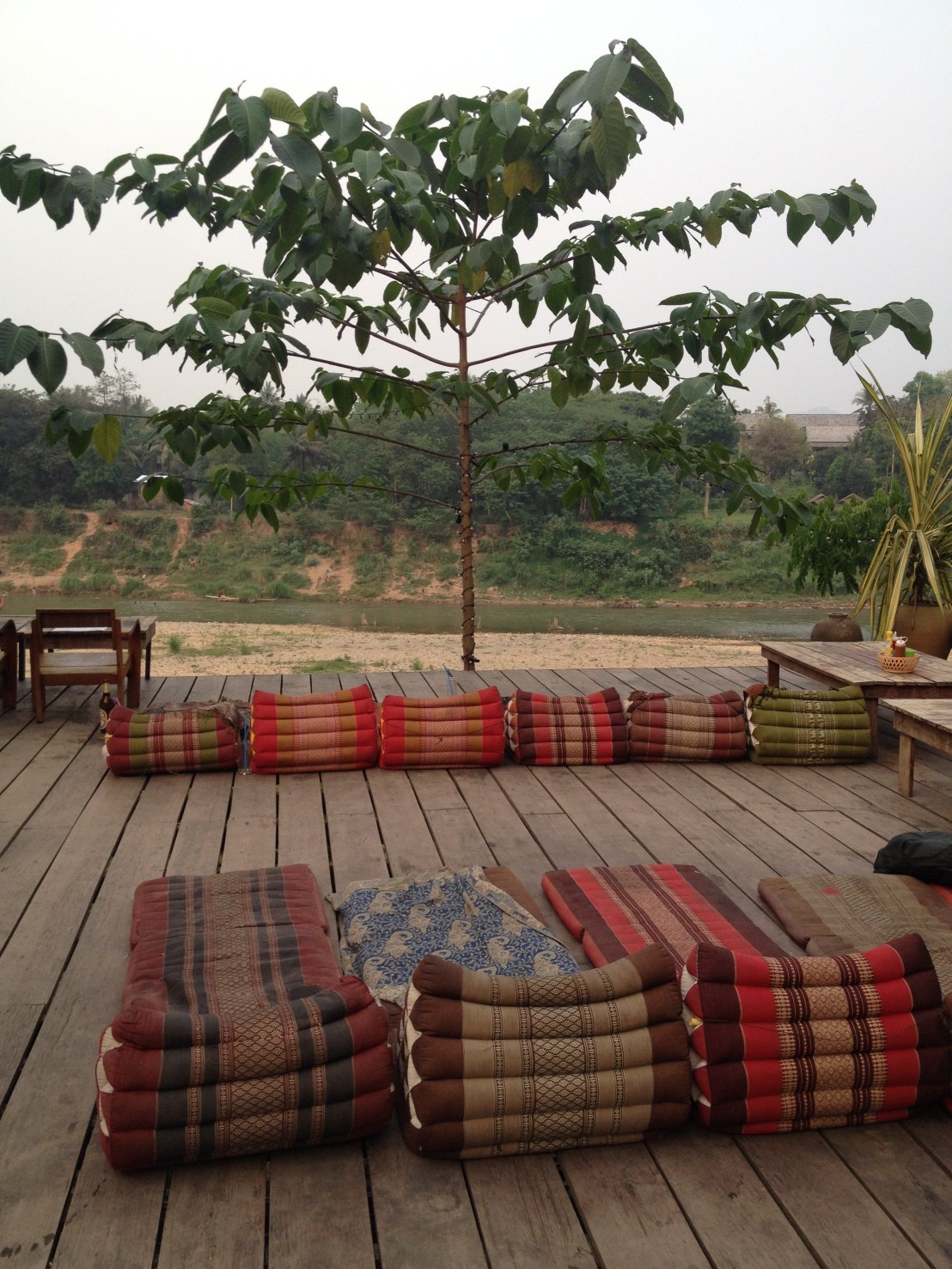
Nobody seemed able to direct us to the correct boat so after half an hour of debating and questioning, we finally got some sense out of someone and all started to engross ourselves into a comfortable fashion on a long boat. The seats had previously been in a minibus by the looks of them but made for a relatively pleasant crossing. We exhausted every possible game we could think of, including eye spy and cards and took to gazing out the open windows at the scenery, with our legs dangled over the side, dozing in the sun.
Late afternoon time saw us arriving at our overnight spot, a very small village, running solely on the likes of us, temporary tourists. Our newly made friends were mainly from Europe and we stuck together choosing a hostel on the hillside and later all enjoyed a joint dinner out. I remember this being 79,000 kip = £6.50 and what I thought was fantastic value! The shower back at the hostel was nonexistent so I made do with crouching underneath an outside tap arrangement. As it was Easter Sunday, I took some time to have a phone call back home and caught up on the news of England.
The next day entailed an 8 hour boat journey further down the Mekong into the town of Luang Prabang. Still in our group, we found a local bus into the main high street and found our hostel. We ended up in a mixed dorm with a Japanese man we had shared a bus with a few days prior, who made us endless origami frogs, two Dutch girls we had met in Pai and some others from the boat.
We had a quick nap and were out again that evening to try out the local foods and to witness the night market. I added to my collection of foreign art work with a bright Buddha head painting and some more elephant trousers. These really are the way forward, they are light, don’t crease, are breezy and make long journeys far more pleasurable. The food stalls were a sight to behold, full of black eggs, chicken intestines, heads and feet so I opted for some fresh looking fruit. Later we sat as a huge group at a popular bar called Utopia and as happens when travelling, skipped the polite introductions and befriended each other quickly. This is another part of the whole “travel” life that I appreciate. Nobody judges on mundane things that don’t matter, people just seem to mould more easily and quicker.
In the next couple of days we visited waterfalls and woke up at 5 am to witness the “Giving of Alms”. This is a procession of monks who come to receive gifts of food. We found bookshops and read on recliners overlooking the Mekong. It felt like a world away from parents and friends back home.

Collectively, our group made the decision to bus to Vang Vieng shortly after. The main attraction of this town is “tubing”, an activity for the brave and resilient. An all day drinking marathon down the river in rubber rings. I can’t deny, it was fun. The weather was glorious, and everybody was in good spirits. At each stop down the river, we were pulled in by event staff and were given bracelets (this became an obsession with some of us over our travelling time. Some sort of victorious achievement was to have as many travel bracelets as possible.)
The quick interlude in this popular backpacker location included much watching of ‘Friends’, a tradition even cited in the Lonely Planet books. Although after a couple of days, we craved some more brain stirring activities and more cultural action. So again, we took a bus to Vientiane, the capital of Laos, holding up the piles of bags in the back of the bus and awaited our next mode of transport into our next country…

ooOOoo

Please, all of you, wherever you are, have a wonderful weekend.