Category: Environment

The breathtaking Grand Canyon

Powerful prose, stunning pictures and an insight into the last 1.8 billion years of our planet.

The Payson Roundup is the local newspaper for Payson.  To be frank, most weeks it’s a fairly quick read.  That’s not a reflection of the quality of the newspaper, just an acknowledgement that Payson is a small American city some 80 miles NE of Phoenix up in the high desert.  Indeed, the Roundup has a good record of winning awards.

However on the 6th January, there was a stunning article about the Grand Canyon, less than 4 hours driving from Payson.  It was written by Pete Aleshire, a Staff Reporter with the Roundup.  I can vouch for Pete’s literary skills as he teaches the creative writing course at the local college that Jean and I attended last term (semester) and will be restarting  tomorrow.

I am very grateful to the Payson Roundup for their permission to republish this wonderful work.  So here it is.

Woe and beauty on an ancient edge

by Pete Aleshire
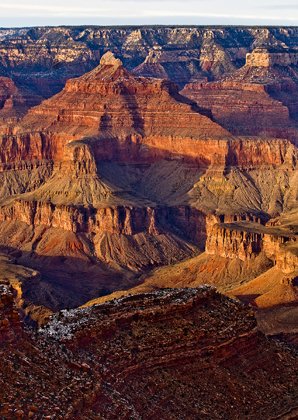
This view of the canyon reveals the layers of limestones and sandstones that testify to vanished seas and deserts. Note the strong, narrow white layer of Coconino Sandstone near the top, composed of 260-million year-old sand dunes. Also note in the center of the photo the 500-foot-tall cliff of Redwall Limestone formed on a seabottom 300-400 million years ago. Photo Tom Brossart/Roundup

I took a step — a long step — a million years step. Then I stopped, turned and faced north. Perched on the jagged edge of my life, I looked down deep into the shadowed layers of lost worlds — terrible deaths, fractured continents, vanished seas, mass extinctions.

Taking a breath, I took another step — a long step — another million years.

Curiously, I felt better — my troubles for the moment shrunk to no more than a ledge of Tapeats Sandstone in the wall of the Grand Canyon opposite. A layer of fossilized beach sand laid down 570 million years ago, the Tapeats Sandstone lies atop a mystery of missing stone — dubbed the “Great Unconformity.”

I studied that light, crumbling layer of sandstone in the canyon wall just across the way, knowing that all the great, riotous thrust of life that took us from pond scum to troubled writers has taken place since the lapping waves of a vanished sea left that layer of crumbling gray stone on a barren beach.

Perched on the wind-tormented branch of a twisted juniper nearby, a glossy black raven croaked at me.

“Nevermore,” he gurgled in my mind’s ear.

“You raise a good point,” I said to the raven and the wind that rose up out of the canyon’s 1.8-billion-year gash of time. I let loose a breath, a sigh, a puff of steam — frail and fleeting as life in the shadow of so much time. It should have depressed me, to stand so mite-like on the edge of such immensity. All I had dreamed or hoped or failed to do would not amount to a swirl of dust on this crumbling edge. I ought to have felt insignificant. Instead, I felt obscurely better.

So I took another step. A long step — a million years.

They had not built the Trail Through Time along the edge of the Grand Canyon between the El Tovar and Yaqui Point the last time I lingered on this edge. Now, it offers the most exciting crash course in geology I’ve ever encountered, although I’ve sought after rocks and unconformities all my life — and have even written geology books for confused people.

The 1.2-mile-long trail presents sliced and polished rocks representing almost all of the 24 major rock layers laid bare in the canyon wall from the 240-million-year-old limestone, siltstone, gypsum and chert layers of the Kaibab Formation to the 1.8-billion-year-old Vishnu Schist in the canyon bottom, among the oldest exposed rock’s on the planet’s surface.

Each step along the 1.2-mile path represents a million years, starting in the present and ending up at the 1.8-billion-year-old start of everything.

The Grand Canyon reveals a 1.8-billion year glimpse into Earth’s past from views like these along the 1.2-mile-long Trail of Time, with displays of rocks from each of the two dozen rock layers in the mile-deep canyon. A juniper catches the last light. Photo by Pete Aleshire

The Grand Canyon represents the most vividly revealed slice of Earth’s history anywhere on the planet. That makes the canyon one of the few places a person can grasp both the astonishing violence and the tormented timescale of the planet that sustains us all. This unique cross-section of time comes as a result of the relatively level uplift of the Colorado Plateau in the past 5 million to 8 million years. In most places, such a vast uplift would jumble the buried rock layers. But much of the 130,000 square miles of the Colorado Plateau rose at the rate your fingernails grow without deforming the miles-deep layers of sandstones, limestones and shales laid down on the bottoms of long-vanished seas and deserts.

As the Colorado Plateau rose, the northern edge crumpled into the Rocky Mountains. The southern edge dropped away along a 200-mile-long chain of 1,500-foot cliffs — which north of Payson forms the Mogollon Rim. Oak Creek cut back into that rising edge of the plateau to uncover the striking red rock formations of Sedona.

The Colorado River did the same thing, but on a grand scale. Many geologists believe the Colorado River originally ran north into a vast, interior sea. But as the Colorado Plateau rose, another river that ran south cut backward until it captured the north-flowing ancestral Colorado River, reversing the flow so that it now ran south into the Gulf of California.

This capture some 6 million years ago began the process of carving out the Grand Canyon. As the plateau rose, the flood-prone Colorado River cut down through it, like pressing a log up against a chain saw. Meanwhile, the steep tributaries widened the canyon by carrying those soft layers of sedimentary rock down to the main stem of the Colorado.
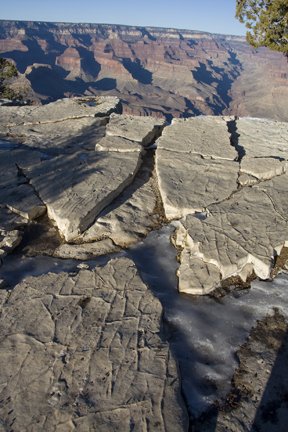
A layer of 230-million year old Kaibab Limestone caps the rim. The Grand Canyon reveals a 1.8-billion year glimpse into Earth’s past from views like these along the 1.2-mile-long Trail of Time, with displays of rocks from each of the two dozen rock layers in the mile-deep canyon. Photo by Pete Aleshire

That process started at about the time the genetic evidence suggests humans, chimps and gorillas last shared a common ancestor and continues to this day.

As a result of this vast uplift, the relatively young Colorado River has revealed in the walls of the Grand Canyon the long buried history of the Earth going back nearly halfway to its creation. That encompassed the entire period in which life progressed from single celled organisms in the ocean to its present, dazzling complexity.

The meander down that Trail Through Time reveals much of that history, preserved in the rock layers and the fossils they contain. Of course, erosion has already removed more than 200 million years of that history, so that the youngest rocks on the rim of the canyon are older than the dinosaurs.

A few dominant layers stand out.

Near the top, the fossilized desert sand dunes of the light Coconino Sandstone bear witness to a vast desert that covered the Southwest some 260 million years ago. At that time, what would become North America was part of a “supercontinent” that gathered almost all the dry land on the planet into a single mass.

In the middle of the canyon, lies the great, blood-red wall of Redwall Limestone, formed on the bottom of a shallow sea between 300 million and 400 million years ago. Today, the fused layers of microscopic skeletons of ancient sea creatures forms a sheer 500-foot-tall band of cliffs that pose the greatest single barrier to reaching the canyon bottom from the rim. All of the trails to the bottom must pass through fault lines in the Redwall Limestone, stained red by iron oxides leaching out of the layers above.

Farther down, the easily eroded Bright Angel Shale forms the shelf above the 1,800-foot-deep inner gorge. Shales form on shallow sea bottoms, compared to the deeper marine environments that create limestones. Most of the trails in the canyon run along its wide shelf. Formed 530 million years ago, the Bright Angel Shale represents the era when trilobites ruled the world.

Just below the Bright Angel Shale lies the Great Unconformity, where erosion in the inconceivably distant past removed 1.2 billion years worth of rock. This records another period of uplift, when erosion carried off layers of rock many times higher than Mt. Everest.

Below that unconformity, the story continues — down through a dozen more layers in the inner gorge, each one mounted alongside the trail and polished smooth. The Grand Canyon Supergroup spans the period between 570 million and 1.2 billion years ago, again recording the meanderings of the continents and the ebb and flow of oceans, as the planet breathes in, breathes out.

After another, smaller unconformity, the river finally reveals the inconceivably ancient Vishnu Schist and Zoraster Granite. The schists started as sandstone, limestone and shale, before they were buried, reheated and fused into this dense, primordial rock. The Zoraster Granite ooze up from the molten depths of the Earth, forming veins revealed finally by the relentlessly downcutting river.

I could not see the metamorphosed Vishnu Schist from my perch atop the rim, but I have seen it on raft trips in the dark heart of the canyon where it has been fluted and carved and sandblasted by eons of floods.

Finally I stood stock still, my breath coming still in moist, warm, puffs as the planet spun so that the dust of the atmosphere gave the sun’s long light a warm red glow, reflected off the ancient worlds across the way.

My raven friend — or one of his kin — flew past with an audible whoosh of his wings, then banked to consider the possibilities. He croaked, that guttural warble that only ravens dare.

Odds are, he noted my proximity to the edge and so paused to ponder my potential as carrion.

But I prefer to think that he felt our shared pulse of life and caught the updraft of my yearning.

In either case, he settled on the branch of a weirdly stunted ponderosa pine nearby and we shared the sunset.

The shadows rose up out of the canyon, swallowing continents and oceans.

I kept my gaze on the glow of the Redwall Limestone until the shadow took it, then shifted to the luminous yellow of the Coconino Sandstone.

For I came to the canyon full of woe holding my life in my fingernails, my heart in the shadows. But now my troubles seemed fleeting, the world full of marvels, my life aglow like that desert turned to sandstone in the last light of day.

My breath came in a puff, transparent but warm in the still, cold air.

“Nevermore,” quoth the raven, “nevermore.”
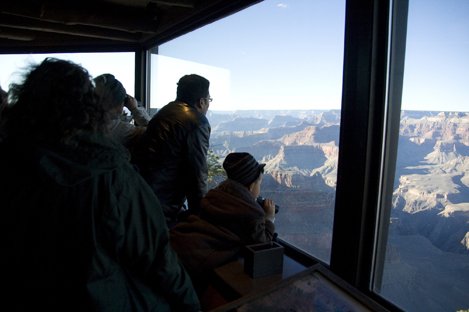
Visitors study the colorful layers of the Grand Canyon from the observation window in the geology museum at Yaqui Point. Photo by Pete Aleshire

oooOOOooo

Such beautiful words. Any additional thoughts from yours truly are utterly superfluous.

The truth about (pet) food!

We are what we eat! A sobering assessment of the food industry this Friday, the 13th!

This saying, which has been around for some time, reminds us that the foods we eat break down into elements that our bodies absorb. What we eat literally becomes part of us, and not just us humans but our dogs and cats as well.  That’s why I haven’t differentiated between us humans and our pets in this Post.

Let’s start off with our pets.

On the 28th December, just a couple of weeks ago, I wrote an article about the possible harm to dogs from Jerky treats coming in to the USA from China.  Kenneth Bryant of TriPom Chews added a comment that included a link to a news story about 353 dogs possibly being made sick.  Since then he and I have been in email correspondence including Ken passing the web address of Susan Thixton’s website Truth about Pet Food.  If you have a pet, go to this website!

I’m sure Susan wouldn’t mind me giving you a flavour (pardon the pun!) of what she has on this important website.  Try this.

Is there Chicken in Chicken Pet Foods?

One of the newest trends of pet food marketing is a tag line something like ‘Chicken is the first ingredient’.  Sounds good doesn’t it?  Chicken, first or second on the ingredient list surely means this pet food contains lots of quality meat doesn’t it?  No wonder this ‘chicken’ pet food is a little more expensive – it contains more meat.  Right?  Maybe not.

Just because petsumers think meat when the ingredient ‘chicken’ is listed on a label, doesn’t mean the pet food actually contains chicken meat.  Pet food can have a very different definition of ‘chicken’.  Thanks to very broad Association of American Feed Control Officials (AAFCO) ingredient definitions, the ingredient ‘chicken’ listed on a pet food label could be nothing more than skin, bone, cartilage, and maybe a few tiny fragments of meat.

Here is the AAFCO definition of poultry (quoting the 2011 AAFCO Official Publication): “Poultry is the clean combination of flesh and skin with or without accompanying bone, derived from the parts or whole carcasses of poultry or a combination thereof, exclusive of feathers, heads, feet and entrails.  It shall be suitable for use in animal food.  If it bears a name descriptive of its kind, it must correspond thereto.”

Problems with this pet food ingredient definition…
#1  This ingredient (which includes all types of poultry including chicken) can be “a combination thereof” of any part of poultry.  This means that a pet food, proudly claiming Chicken as the #1 ingredient, can include ONLY chicken bones and/or skin (left over from the human food industry).

#2  “It shall be suitable for use in animal food” means that animals rejected for use in human food for reasons including (but not limited to) disease and drug residues are approved for use in pet food.  This we can thank the FDA for.  Federal Food Safety Laws should make it illegal for pet food to include whole or parts of diseased or rejected animals, but FDA Compliance Policies tell pet food it is acceptable to use diseased and drugged animals in pet food [My emboldening, PH.] (“it shall be suitable for use in animal food”).

Chicken Meal/Poultry Meal is very similarly defined – except ‘meal’ implies moisture removed.  However the very same end result can apply – the meal can consist of little more than skin and bones — no meat.

Other pet food meat ingredient definitions are a bit more descriptive, however all meat pet food ingredient definitions include the “it shall be suitable for use in animal food” disclaimer.  Thus any pet food meat ingredient – thanks to FDA Compliance Policies and AAFCO ingredient definitions – can be the same quality as human meats or can be sourced from diseased, rejected animals.  But, regulations do NOT provide petsumers with a means to determine which is which.

Read the rest of this article on Susan’s website.  Even better subscribe to her newsletters.

I could go on and on but will close this section by saying ‘thanks’ to Ken of TriPom for providing this awareness of what we all may be feeding our beloved cats and dogs.

So, humans next!

Just a few days ago there was an article on The Atlantic magazine website about The Very Real Danger of Genetically Modified Foods.  It’s a detailed article that, nonetheless, needs to be read by the widest possible audience.  Here are some extracts,

Chinese researchers have found small pieces of ribonucleic acid (RNA) in the blood and organs of humans who eat rice. The Nanjing University-based team showed that this genetic material will bind to proteins in human liver cells and influence the uptake of cholesterol from the blood.

The type of RNA in question is called microRNA, due to its small size. MicroRNAs have been studied extensively since their discovery ten years ago, and have been linked to human diseases including cancer, Alzheimer’s, and diabetes. The Chinese research provides the first example of ingested plant microRNA surviving digestion and influencing human cell function.

Should the research survive scientific scrutiny, it could prove a game changer in many fields. It would mean that we’re eating not just vitamins, protein, and fuel, but information as well.

Later on the article says,

Monsanto’s claim that human toxicology tests are unwarranted is based on the doctrine of “substantial equivalence.” This term is used around the world as the basis of regulations designed to facilitate the rapid commercialization of genetically engineered foods, by sparing them from extensive safety testing.

According to substantial equivalence, comparisons between GM and non-GM crops need only investigate the end products of DNA translation: the pizza, as it were. “There is no need to test the safety of DNA introduced into GM crops. DNA (and resulting RNA) is present in almost all foods,” Monsanto’s website reads. “DNA is non-toxic and the presence of DNA, in and of itself, presents no hazard.”

The Chinese RNA study threatens to blast a major hole in that claim. It means that DNA can code for microRNA, which can, in fact, be hazardous.

And the closing two paragraphs,

The OECD’s 34 member nations could be described as largely rich, white, developed, and sympathetic to big business. The group’s current mission is to spread economic development to the rest of the world. And while that mission has yet to be accomplished, OECD has helped Monsanto spread substantial equivalence to the rest of the world, selling a lot of GM seed along the way.

The news that we’re ingesting information as well as physical material should force the biotech industry to confront the possibility that new DNA can have dangerous implications far beyond the products it codes for. Can we count on the biotech industry to accept the notion that more testing is necessary? Not if such action is perceived as a threat to the bottom line.

Please read the whole article as my extracts do not give justice to the importance of these findings.

Finally, let me turn to a recent item on the BBC website about the decline of brain function from as soon as age 45!  (I’m 67!)  The item starts,

The brain’s ability to function can start to deteriorate as early as 45, suggests a study in the British Medical Journal.

University College London researchers found a 3.6% decline in mental reasoning in women and men aged 45-49.

What caught my eye were these concluding paragraphs,

Dr Simon Ridley, head of research at Alzheimer’s Research UK, said he wanted to see similar studies carried out in a wider population sample.

He added: “Previous research suggests that our health in mid-life affects our risk of dementia as we age, and these findings give us all an extra reason to stick to our New Year’s resolutions.

“Although we don’t yet have a sure-fire way to prevent dementia, we do know that simple lifestyle changes – such as eating a healthy diet, not smoking, and keeping blood pressure and cholesterol in check – can all reduce the risk of dementia.”

Professor Lindsey Davies, president of the Faculty of Public Health, said that people should not wait until their bodies and minds broke down before taking action.

“We need only look at the problems that childhood obesity rates will cause if they are not addressed to see how important it is that we take ‘cradle to grave’ approach to public health.”

Let me repeat this sentence, “we do know that simple lifestyle changes – such as eating a healthy diet, not smoking, and keeping blood pressure and cholesterol in check – can all reduce the risk of dementia.”

Understanding what food is healthy for us and our animals ought to be straightforward.  But it’s not, when one understands the terrible lack of integrity in the industries that make our food!

The Goldilocks Planet.

Neither too close nor too far from the Sun.

Towards the end of the lecture that Lord Martin Rees gave at  University of Melbourne’s Medical School in 2010, he spoke of the way that Planet Earth has warmed up these last 100 years, warmed up uniquely.  Why the word ‘uniquely’?  Because, for the first time in the ancient life of our planet, that warming is the result of the activity of a life species living on that planet; mankind.  It’s difficult to comprehend how special, how fragile and, therefore, how vulnerable is mankind’s ability to survive on Planet Earth.  That’s why a recent item on Martin Lack’s excellent blogsite Lack of Environment is published on Learning from Dogs with Martin’s kind permission.  But first let me quote a little from WikiPedia about the ‘goldilocks principle’,

In astronomy and astrobiology, the habitable zone is the region around a star where a planet with sufficient atmospheric pressure can maintain liquid water on its surface.[1]1 Since liquid water is essential for all known forms of life, planets in this zone are considered the most promising sites to host extraterrestrial life. The terms “ecosphere” and “Liquid Water Belt” were introduced by Hubertus Strughold and Harlow Shapley respectively in 1953.[2] Contemporary alternatives include “HZ”, “life zone”, and “Goldilocks Zone.”[3]

“Habitable zone” is sometimes used more generally to denote various regions that are considered favorable to life in some way. One prominent example is the Galactic habitable zone’ (the distance from the galactic centre). Such concepts areinferred from the empirical study of conditions favorable for life on Earth. If different kinds of habitable zones are considered, their intersection is the region considered most likely to contain life.

The location of planets and natural satellites (moons) within its parent’s star’s habitable zone (and a near circular orbit) is but one of many criteria for planetary habitability and it is theoretically possible for habitable planets to exist outside the habitable zone. The term “Goldilocks planet” is used for any planet that is located within the CHZ[4][5] although when used in the context of planetary habitability the term implies terrestrial planets with conditions roughly comparable to those of the Earth(i.e. an Earth analog). The name originates from the story of Goldilocks and the Three Bears, in which a little girl chooses from sets of three items, ignoring the ones that are too extreme (large or small, hot or cold, etc.), and settling on the one in the middle, which is “just right”. Likewise, a planet following this Goldilocks Principle is one that is neither too close nor too far from a star to rule out liquid water on its surface. While only about a dozen planets have been confirmed in the habitable zone, the Kepler spacecraft has identified a further 54 candidates and current estimates indicate that there are “at least 500 million” such planets in the Milky Way.[6]

So now to Martin Lack’s post.

Goodbye Goldilocks Planet?

Is it time to say goodbye to the Goldilocks Planet?

I hope not, because the next-nearest one yet discovered is 600 light years away! However, if we are indeed now passing a tipping point (i.e. as the widespread rapid thawing of Siberian permafrost suggests) both mitigation and adaptation will be almost impossible. Therefore, if we cannot reverse the damage already done (i.e. how can we make permafrost re-freeze or reverse the retreat of mountain glaciers?), we may have to accept that temperatures will eventually rise to a level at which the Antarctic first became glaciated 35 million years ago; and that sea levels will now rise continuously for several centuries – making any permanent settlement anywhere near the coast impossible (seeJames Hansen in Storms of my Grandchildren).

If your response to all this is to accuse me of being alarmist, all I can say is that I am afraid denial is definitely not a good evolutionary survival mechanism. Furthermore, as American high school science teacher – and now climate change activist – Greg Craven has said,“Unfortunately, the experiment is already running; and we are all in the test-tube!” I believe we must therefore hope that humanity will not repeat the folly of the former inhabitants of Easter Island; who chopped down all their trees for firewood and allowed all the decent soil to be washed away so they could not grow anything.

I think it is fair to say that 2011 was a difficult year for humanity and the planet; and 2012 could be worse. We now seem to be facing both a financial and an environmental crisis: Even at the tender age of 46, I can appreciate that the prospect of 6 years of austerity measures (here in the UK) is completely without precedent; worse even than the great depression of the 1920s. In the UK, public sector workers have been demanding a better pension! What about a better economic system, or even a better planet? If necessary, please forgive my impertinence but, how can people demand justice for themselves whilst ignoring all the injustices we are inflicting on those least able to adapt; and/or bequeathing to our descendants?

This is almost as pessimistic as my recent answer on ClimateSight to the question “Why are people who want to reduce – and possibly eliminate pollution – and create a safer world, considered obstructionist naysayers?“, which is… “If everyone lived as we do in ‘the West’, the planet’s ecological carrying capacity would only be about 3 billion [Paul and Anne Ehrlich (1996)]. Therefore we cannot solve poverty without allowing a lot of people to die or by wealthy people agreeing to moderate their over-consumption of the Earth’s resources. Sorry to be so blunt but, this is the simple answer to the question.” …Despite what detractors say this is not misanthropic eco-Socialism, it is reality. There is not enough decent farmland and/or resources of every kind for 7 billion people or more to live like we currently do in ‘the West’. If we are not going to deny the legitimate aspirations of poorer peoples to attain a better standard of living, we will have to moderate our over-consumption and/or pollution of the Earth’s resources. We cannot have it both ways.

Conclusion
If we continue to burn all the Earth’s fossil fuels – just because they are there and because we can – we will most certainly have to say good bye to our Goldilocks Planet. However, now that we know that what we are doing is causing the problem, would it not be a good idea to stop doing it? You know: When in a hole, stop digging, etc… As the Good Book says, “As a dog returns to its vomit, so a fool repeats his folly” (Proverbs 26:11).

Suggested New Year’s Resolution:
If we want things to change, I believe we must acknowledge that Clive Hamilton is right: climate change is a failure of modern politics – representative democracy is not working! Therefore, we must all take a much more active role in the process of government – this is called participatory democracy – and we must start by demanding that our politicians dismantle (or at least stop being misled by) the fossil fuel lobby who do not want their business as usual programme interrupted.

Having said all that, I would still like to sincerely wish you all the best for 2012 (although I hope the Mayan Calendar is wrong).

Just a beautiful photograph

Pray for our planet this year!

This was emailed to me a couple of weeks ago.  Have no background information as to where the photograph was taken and, indeed, what type of bird it is!  But, nonetheless, just a beautiful reminder of the wonderfully, precious planet that we all, and I mean all, live on.

Nature in all her glory.

Keystone XL pipeline

Spread the word as far and wide as possible!

Yesterday I received an email from 350.org as part of their mailing to all 350.org supporters.  I have previously written a number of times, for example see here and here, about this proposed project and why it is so important to have it rejected.

Yesterday I published a lecture given in Melbourne by Britain’s eminent Astronomer Royal, Lord Martin Rees.  Lord Rees concluded his lecture with the call for us to take better care of our own planet. He, like many others, recognises the unique place in history that we occupy. For the first time a single species is capable of exerting profound changes on the Earth’s natural and physical environments.

Over and over again, scientists are reporting the rise in climate temperature of Planet Earth and the implications thereof if we do not wakeup soon to changing our ways.  The Keystone pipeline is a huge potential mistake!

Bill McKibben of 350.org

Anyway, to the letter issued by 350.org – note the link to send a message to President Obama works – please use it!

Direct threats from Big Oil over Keystone XL

01/05/12, 11:43am

Here’s the email that Bill McKibben just sent to US 350.org supporters who have been working on Keystone XL:

Just in case you thought there was anything subtle about the Keystone battle, you need to hear what the president of the American Petroleum Institute — the oil industry’s #1 front group — said yesterday: if the President doesn’t approve the project there will “huge political consequences.”

That’s as direct a threat as you’re ever going to hear in DC, and it shows just how mad you made the oil industry last year by exposing Keystone for the climate-killing danger it is.  And the oil industry can obviously make good on their threats — they’ve got all the money on earth, and thanks to Citizens United they can use it without restriction in our elections. They’re not used to ever losing.So far the Obama administration is standing firm in the face of Big Oil’s bullying — the White House made it completely clear last month that if the oil industry and its harem in Congress forced a speeded-up review, it would lead to an outright rejection of the permit for the pipeline. We expect they’ll keep their word.

Here’s what I think we need to do.

1- Let the president know you’ve got his back when he rejects the pipeline. Tell him that addressing climate change is the key to our future, and that you’re glad he’s not bending.

2- Take the offensive against the oil industry. If they’re going to try and ram Keystone down our throats we’re going to try and take away something they hold dear, the handouts that Congress gives them each and every year. They’re the richest industry on earth, they’re doing great damage to the planet — and they expect us to pay for it with our tax dollars.

Can you send a quick note to President Obama covering those two key points? 

Click here to send a message to the President: www.350.org/stand-strong

Here’s the note I’m sending:

President Obama: Thank you for opposing the rushed Keystone XL pipeline permit. Responding to climate change is critical to preserving our collective future, and I hope this is a first step towards the dramatic changes we need to avoid catastrophe. PS: Please take handouts for the fossil fuel industry out of next year’s budget. There are people in America who need that money more.

There’s lots more to be done, of course. In the slightly longer run, we’ve got to take on the greatest subsidy of all: the special privilege that Congress gives the fossil fuel industry to use the atmosphere as an open sewer into which to dump its carbon for free.But today — right now, in the face of this kind of straight-up bullying — it’s time to punch back. We’re nonviolent, but we’re not wimps.

Bill

Life and the cosmos

A powerful lecture by the eminent Lord Martin Rees

Martin Rees at Jodrell Bank, 2007

I came across this interview a few days ago in connection with some book research that I was undertaking.  Please don’t be put off by the 56 minute length because Martin Rees is one of the most pre-eminent cosmologists around today, as well as being the UK’s Astronomer Royal since 1995.

Make a promise to yourself to settle down sometime soon and watch the lecture, given at the University of Melbourne’s Medical School in 2010.  And a warning! I going to pick up on some of the important points made by Martin Rees in a couple of posts next week.

Here’s how the lecture was reported by the Australian science website, SixOne Science,

Lord Rees in Melbourne

In a packed Sunderland Lecture Theatre in the University of Melbourne’s Medical School, Lord Martin Rees gave the inaugural Derek Denton Lecture in Science and the Arts. Lord Rees, an eminent and accomplished astrophysicist and cosmologist, is coming to the end of his five year tenure as the president of The Royal Society. The event even managed to attract or Prime Minister, Kevin Rudd, who entered without a noticeable entourage and with no fanfare, and the Governor of Victoria, Professor David de Kretser, a scientist himself.

The lecture was entitled “Life and the Cosmos”, a grand and sweeping title if ever there was one. It seemed like an impossible amount of material to cover in the allotted hour. However, Rees delivered an entertaining, humorous account of life from the big bang, through the formation of stars and galaxies, to the origins of life and perhaps the biggest crowd pleaser, the search for extra-terrestrial life. Most in the lecture theatre would not have learnt anything new, but this lecture was aimed at a general audience and the material was interesting enough to keep everyone interested for the hour despite being squashed into an ageing undergraduate lecture theatre complete with squeaky desks and a slightly musty smell. Perhaps Mr. Rudd was sufficiently uncomfortable to increase university funding, we can hope.

Whist this was predominately an overview of the subject material, Rees expressed some opinions about space exploration. He seemed torn between his human curiosity and the cost of human exploration. Given the advances in robotic exploration vehicles, Rees has difficulty in justifying the cost of sending humans on planetary exploration missions. Perhaps the best case for robotic exploration was made by the amazing photos he showed from the surfaces of Mars (photos) and Titan (photos), a moon of Saturn. Interestingly, Rees believes that if human exploration does proceed in the future it will be led by the Chinese or groups of private individuals. He also raised the issue of exploitation of other planets, something not often mentioned in the debate over human space travel. We need to decide if other bodies in our solar system are open for exploitation or if they should be preserved as wilderness, in a similar way to Antarctica. Given the pressures faced by places like Antarctica and the Amazon this will be an important debate should human exploration resume.

Rees concluded his lecture with the almost obligatory call for us to take better care or our own planet. He, like many others, recognises the unique place in history that we occupy. For the first time a single species is capable of exerting profound changes on the Earth’s natural and physical environments (although it might be argued that the first photosynthesizing cyanobacteria had a similarly singular influence by increasing the proportion of oxygen in the atmosphere). It is interesting to note that he does not see colonisation of other planets as a solution as the Earth is still the only known planet capable of sustaining us. Although he did discuss the likelihood of discovering Earth-like planets (pretty good given advances in technology). However, Rees did not paint an overly pessimistic picture and he generally came across as optimistic and enthusiastic about the future.

The organisers of the Derek Denton Lecture series should be commended for attracting such a high profile speaker for the first of the series. Hopefully the series will be successful, and if so may need to be moved to a bigger venue. If you want to see the lecture it will soon be available here. The next lecture of this series hasn’t been announced yet, it will be on the Arts, but you can check here for future public events at The University of Melbourne.

Round-Up Ready.

An update to my piece last year!

Last Friday, the 30th December, I published an hour-long video interview, introduced thus,

Toxic botulism in animals linked to RoundUp

Dr Mercola recently interviewed Dr Don Huber, whose letter to the USDA warning that Monsanto’s RoundUp, a broad-spectrum “herbicide” that has been linked with spontaneous abortion in animals, continues to be ignored by food and environmental safety authorities. In this important hour-long discussion, Huber, a plant pathologist for over 50 years, explains how RoundUp is destroying our healthy soils by killing needed microorganisms.

For those of you who watched that interview, you may like to watch the first few minutes of a documentary made by Journeyman Pictures that shows how right can overcome might!

Percy Schmeiser has his own website here and from there you can go to a section where Percy speaks about his experiences.

Funny old world!

The coming new year!

Be warned, one of my more reflective muses!

Tomorrow is the last day of the year 2011.

For reasons that I am not clear about, there is a mood of pessimism about my person.  Whether it is the scale of global issues that I see ahead that drags me down, whether the year of an American Presidential election will remind me of the loss of reason that afflicts so many modern democracies, whether the messages in Kunstler’s book The Long Emergency still resonate in my mind well, who knows?

But when one does look at the broader picture of modern society, there is much that troubles.

So forgive me if I provide a couple of examples of these troubles.  I do so on the grounds of communication – the more that understand the risks ahead of us, the more likely we, as in the peoples of this planet, will say to our leaders, “Enough of this!  For the sake of my children, my grandchildren and all of humanity we have to change our priorities, and soon!”

Here’s my first example.

The US National Resources Defense Council recently published an item about severe weather including an interactive Extreme Weather Map, introduced thus,

Climate change increases the risk of record-breaking extreme weather events that threaten communities across the country. In 2011, there were at least 2,941 monthly weather records broken by extreme events that struck communities in the US.

That was backed up by an article on the Onearth website that opened,

By many measures, 2011 was the most extreme weather year for the United States since reliable record-keeping began in the 19th century — and the costs have been enormous. According to the National Oceanic and Atmospheric Administration, 2011 set a record for the most billion-dollar disasters in a single year. There were 12, breaking the old record of nine set in 2009. The aggregate damage from these 12 events totals at least $52 billion, NOAA found.

And that just for the USA.  But will climate change be the Number One political issue in 2012?  And if not in 2012, when will it be?

Let me move on to my second example, very different from the one above but, in a sense, just as scary.  This is an interview that was in a recent article on the Food Freedom website ( brilliant website, by the way).  Dr. Joseph Mercola, the leading natural health practitioner, interviews Dr. Don M. Huber, one of the senior scientists in the U.S about the area of science that relates to genetically modified organisms (GMO). Here’s an extract from the article on Food Freedom,

Toxic botulism in animals linked to RoundUp

Dr Mercola recently interviewed Dr Don Huber, whose letter to the USDA warning that Monsanto’s RoundUp, a broad-spectrum “herbicide” that has been linked with spontaneous abortion in animals, continues to be ignored by food and environmental safety authorities. In this important hour-long discussion, Huber, a plant pathologist for over 50 years, explains how RoundUp is destroying our healthy soils by killing needed microorganisms.

Not only did his team discover a new soil pathogen, but he reports that animals are coming down with over 40 new diseases, like toxic botulism. Huber explains that before the widespread use of herbicides, pesticides and genetically modified food and feed, natural probiota would have kept Clostridium botulinum in check

The video, below, of the interview is included in the article.  Please don’t be put off by the length, the material covered is riveting and critical to our general knowledge about the threats to our society.

So that’s enough from me for one day!  On Monday, I shall include another video relating to the RoundUp issue that reveals, both directly and metaphorically, how the only solution to pessimism is to embrace the need to make change happen.  Be inspired by this poem by Sam Keen, included in the latest Sabbath Moment from Terry Hershey,

I Want to Surrender

God, I want to surrender
to the rhythm of music and sea,
to the seasons of ebb and flow,
to the tidal surge of love.

I am tired of being hard,
tight, controlled,
tensed against tenderness,
afraid of softness.
I am tired of directing my world,
making, doing, shaping.

Tension is ecstasy in chains.
The muscles are tightened to prevent trembling.
Nerves strain to prevent trust,
hope, relaxation….

Surrender is a risk no sane man may take.
Sanity never surrendered
is a burden no man may carry.

God give me madness
that does not destroy
wisdom,
responsibility,
love.

Sam Keen

The story of transition, part three

Final four short films about Transition.

PLEASE read the closing comment by Rob Hopkins!

A series of 10 delightful short films, courtesy of Transition Culture – For the introduction and the first three films, click here, for the next three click here.

Film Seven – Transition Town Totnes’s Transition Streets Origin: Transition Town Totnes

In December 2009, Transition Town Totnes, the UK’s first Transition initiative, was chosen as one of 20 community  groups in England and Wales to win the ‘Low Carbon Communities Challenge’. Its project, ‘Transition Streets’, was awarded £625,000. In the last 18 months, nearly 500 households have participated in Transition Streets, each, on average, cutting their carbon emissions by 1.5 tonnes.

About a third of those have gone on to install solar photovoltaic systems. However, the main benefits that people who have participated talk about are the social connections they have made and how they now feel so much more a part of their community. It has also acted as a platform for all kinds of other initiatives as neighbours start to get a taste for working together.

Film Eight – A Small Pennant Flag Origin: Transition Town Monteveglio (Bologna, Italy)

Transition Town Monteveglio (TTM) was the first Italian Transition initiative. In 2009 its local Comune (local Council) passed an amazing resolution that offers a stateof-the-art taste of what it looks like when a council really ‘gets’ peak oil and climate change, stating: “… a view of the future (the depletion of energy resources and the significance of a limit to economic development), methods (bottom-up community participation), objectives (to make our community more resilient, i.e. better prepared to face a low energy future) and the optimistic approach (although the times are hard, changes to come will include great opportunities to improve the whole community’s quality of life)”.

It has led to all kinds of initiatives and projects, including a local currency and renewable energy installations. Our object here is the Comune’s official pennant.

Film Nine – A Small Bag of Topsoil Origin: Transition Norwich’s food initiatives

It is one thing to start local food projects, but quite another to think strategically about how those projects sit in the larger context of the intentional relocalisation of the area. Transition Norwich, together with East Anglia Food Link, produced a study called ‘Can Norwich Feed Itself?’ which worked out that it could, albeit with a simpler diet, but that it would need certain new infrastructures put in place. This included a new mill to enable locally produced grains to be milled, two CSA farms (hence our object, a soil sample from their first CSA site), community gardens and research into varieties of beans and oats that will grow well in the area.

A successful application to the Local Food Fund enabled these to become a reality. It is a fascinating example of why we need to think strategically about the localisation of food. As Tully Wakeman, one of the co-ordinators, told me: “A trap a lot of NGOs fall into is over-thinking about vegetables (yet) only one tenth of what we consume, in calorific terms, comes from fruit and vegetables… where is the other 90% going to come from? Growing vegetables in gardens, allotments, community gardens and so on offers a degree of food security and can happen relatively rapidly.

However the other 90% requires the rebuilding of the infrastructure required for growing, processing, cleaning, storing, milling and distributing grains and cereals, and that takes longer and requires more planning”.

Film Ten – Beer, A Bottle of Sunshine Ale Origin: The Lewes Community Power Station

The Ouse Valley Energy Service Company (OVESCO) is one of the offshoots of Transition Lewes focused on the installation of renewables in and around the town as well as promoting energy conservation and local economic resilience. In 2011 it took on its most exciting and ambitious project to date installing a 98kW solar photovoltaic array on the roof of local brewery, Harveys. This will turn the building into one of the first community-owned solar power stations in the country.

The 544 photovoltaic (PV) panels will generate 93,000kWh of green electricity each year – enough to save more than 40 tonnes of CO2 annually.

A community share launch event took place in April 2011 attended by 300 people. Within five weeks the target of £307,000 had been reached. Money invested will be repaid in full at the end of the 25 year scheme, or earlier at the request of the investor and subject to conditions. While the investment is held a dividend will be paid after the first year which is expected to be around 4%.

Our object is a bottle of ‘Sunshine Ale’, a special commemorative beer brewed to celebrate the launch of the scheme. Very nice it is too.

A final few words from Rob Hopkins.

Whittling down to these 10 objects has been very difficult but I hope what you have gained is a sense of something infectious, reaching beyond the idea of small individual initiatives, and arguing that localisation is the best way for the places in which we live to return to health. Various learned writers and academics have tried to encapsulate what Transition is, but I still think the best description of its spirit comes from Tove Jansson in Comet in Moominland in 1946, who wrote: “It was a funny little path, winding here and there, dashing off  in different directions, and sometimes even tying a knot in itself from sheer joy. (You don’t get tired of a path like that, and I’m not sure that it doesn’t get you home quicker in the end).”

Rob Hopkins is the co-founder of Transition Town Totnes and Transition Network and blogs at www.transitionculture.org

Dog treats – possible harm for your dog!

This important information came to hand an hour ago.

Stephanie from our local Payson Humane Society Thrift Shop sent me and Jean an email a short while ago.  While the potential issue goes back to 2007 that is no reason not to keep this in mind when it comes to what commercial treats you give your dog.  Indeed, the US FDA updated their recall information only last November.

Please circulate this to all dog owners that you know.

Here’s a full copy of the release made by the American Veterinary Medical Association,

Jerky treats from China could be causing illness in pets

The AVMA staff has been in communication with veterinarians who believe certain brands of jerky treats from China could be causing illness in pets. Signs of illness have included vomiting, lethargy, and anorexia.

The Food and Drug Administration is aware of consumer complaints relevant to chicken jerky for dogs. Laura Alvey, director of the communications staff at the FDA Center for Veterinary Medicine, said the agency is actively investigating the situation.

Alvey said the FDA has analyzed products for multiple microbiologic and chemical contaminants, but the agency had not detected any contaminants as of Sept. 14.

Wal-Mart pulled a type of chicken jerky for pets off store shelves July 26 after receiving complaints about the product, manufactured by both Import-Pingyang Pet Product Co. and Shanghai Bestro Trading. A laboratory that tested the jerky product reported finding low concentrations of melamine, one of the contaminants that led to massive recalls of pet food earlier this year.

Alvey said the FDA has reviewed the laboratory report, which found 20 ppm of melamine in one sample. The agency has not been able to verify the finding. Alvey added that the FDA would not expect the low concentration of melamine to result in any illness.

Dr. Richard Goldstein, an associate professor of small animal medicine at Cornell University College of Veterinary Medicine, has been collecting data on cases of pets that became ill after ingesting jerky treats from China. He is the primary author of an informational document available on the Web site of the American College of Veterinary Internal Medicine, www.acvim.org.

According to the document, ACVIM diplomates who work in nephrology and urology became aware of an unusual number of dogs with similar presenting complaints and clinicopathologic testing results in association with the ingestion of various brands of jerky treats, mostly chicken jerky. The dogs are typically small and have a history of vomiting, lethargy, and anorexia.

Blood chemistry in many cases has revealed hypokalemia and a mild increase in liver enzymes. Blood gas analysis indicates acidosis. Urinalysis has consistently shown glucosuria and granular casts. The findings suggest an acquired Fanconi syndrome, according to ACVIM diplomates, and Fanconi screens on urine have been positive.

The ACVIM document recommends treatment consisting of supportive care, electrolyte supplementation, and blood gas monitoring. These cases appear to warrant liberal potassium supplementation. In some cases, veterinarians should consider long-term bicarbonate supplementation.

Most of the dogs have recovered from their acute disease and have not required long-term treatment. Dr. Goldstein at Cornell asks veterinarians who can contribute data on these cases to e-mail him at rg225@cornell.edu. The AVMA will provide updates about the situation at www.avma.org as new information becomes available.

Veterinarians who see any illnesses that they suspect might relate to a pet food should contact an FDA consumer complaint coordinator and the manufacturer or retailer. A list of phone numbers for FDA complaint coordinators in each state is available at www.fda.gov/opacom/backgrounders/complain.html.

As I mentioned, the US. Food and Drug Administration website updated their recall information on November 15th, 2011.  The link is here, from which is reproduced,

List of recalls for Pet Food Products from Jerky Treats

Information current as of noon November 15, 2011
1065 entries in list

Recalls & Withdrawals for Animal & Veterinary Products
Melamine Pet Food Recall of 2007: Main Page

The recalls on this list are primarily Class I. Definitions of Class I, II, and III recalls. Additional information about how recalls are conducted can be found at FDA 101: Product Recalls – From First Alert to Effectiveness Checks.

Note: This compiled list represents all pet food recalled since March 2007. If and when new information is received, this list will be updated. The “Information Current as of” date provided above indicates when this Web page was updated; it does not indicate the date when the pet food recalls listed below were initiated. Once listed, each of the recalled pet food products remains listed, even if there are no new recalls associated with that product. Although we have taken care to make sure the information is accurate, if we learn that any information is not accurate we will revise the list as soon as possible. For initiation dates of specific recalls, click on the brand name and then product description links that appear on these pages. For recalls that occurred before September 1, 2008, a date range might appear in the initiation date field. The date range indicates the timeframe within which multiple recalls of this product were initiated. For recalls that occur September 1, 2008 and after, the actual initiation date of each recall event is provided for each product. If a new recall is initiated for a product that had previously been recalled before September 1, 2008, the food product will be listed again, with the new recall initiation date. If a new recall is initiated for a product that had previously been recalled after September, 1, 2008, the initiation date of the new recall event will be added to the previous date listed.

The recall number is V-095-2007  The Trade Name is Jerky Treats

The Product Description is: Jerky Treats Beef Flavor Dog Snacks. The product is sold in 3.75 oz bags and shipped in cases containing 12 bags; sold in 7.5 oz bags shipped in cases containing 6 bags & 12 bags; sold in 11.25 oz bags shipped in cases containing 8 bags; sold in 15 oz bags (which is buy one get one free of the 7.5 oz size) shipped in cases containing 12 bags; sold in 170 g bags shipped in cases containing 12 bags (Canadian only); and sold in 567 g canisters shipped in cases containing 8 canisters (Canadian only).

Finally, I reproduce an item on the Animal Health Foundation website about Treats for Dogs.

Treats for Dogs are Potentially Dangerous

Check the label for country of origin, and be observant if you give your dog chicken jerky treats. The American Veterinary Medical Association was notified last week by the Canadian VMA that several Canadian veterinarians have seen dogs with a condition that resembles Fanconi syndrome, and it may be associated with the consumption of chicken jerky treats manufactured in China. Similar incidents were reported in the United States in 2007 and investigated by the U.S. Food and Drug Administration, which issued a further warning in 2008.

It’s unknown if the problem is limited to Canada. The AVMA reports that it has not received any recent reports from U.S. veterinarians about pets with illness that may be related to chicken jerky treats, and there have been no recalls of any chicken jerky treat products associated with the Canadian complaints. Brand names of the products involved are not available.

Fanconi syndrome affects the kidney tubes and can be heritable or acquired. The heritable form is rare and usually is seen only in certain breeds, including basenjis and Norwegian elkhounds. The acquired form can be caused by heavy metal poisoning or certain chemicals. Dogs affected with the acquired syndrome usually have signs that include vomiting, listlessness and lack of appetite. According to the FDA’s 2008 report, extensive chemical and microbial testing did not turn up any contaminant or a definitive cause for the reported illness. Most dogs recover, but some reports to the FDA involved dogs that died.

After checking the information on the Veterinary Information Network, Lake Forest veterinarian Scott Weldy of Serrano Animal and Bird Hospital said that so far, the reports have been anecdotal, with no evidence tying the problems to the chicken jerky treats.

“Right now they’re basically not blaming anything,” he says. “They’re saying it might be from chicken treats, but they don’t know yet.”

According to the comments on VIN, Weldy says, veterinarians are reporting cases infrequently, “maybe one case every week or two or three.” Some cases have a reasonably suspicious history.

“Right now it is speculation,” he says. “Everybody wants to jump on a cause for everything that happens, and they’ll look for some common link. Cheap treats and cheap foods are by far more popular than more expensive things because people are trying to save money. A lot more people are using cheaper products or are being sold products that are marketed better, so they’re more common in the market. Sometimes those get blamed first when they have nothing to do with anything.”

Nonetheless, it doesn’t hurt to be cautious.

“I would be skeptical to put a cause-and-effect relationship on the chicken treats right now, but I also wouldn’t feed my dog a chicken jerky treat right now,” he says. “It’s an easy thing to avoid.”

Limit the amount of jerky treats you give to a small dog. If you give your dog chicken jerky treats, pay attention if the dog’s appetite or activity level decreases, if it vomits or has diarrhea, or starts to drink more water and urinate more frequently. Signs can occur within hours to days of giving the treats.

Stop giving the jerky if your dog shows any of these signs, and take him to the veterinarian if the signs are severe or continue for more than a day. Blood tests should be run to check for kidney failure or an increase in liver enzymes and urine tests to check for increased glucose levels. Treatment involves supportive care, such as fluids and electrolyte supplements.