I struggled for a while to decide what to call this post, the first of three. Explain why in just a moment.
The post is predominantly from the hand of a professional writer who goes under the name of Gaius Publius. He is described as contributing editor on AMERICAblog from where one also learns that:
Gaius Publius
Gaius Publius is a professional writer living on the West Coast of the United States. Gaius has written in a variety of genres and styles. He’s published short stories and poetry, books on education & technology, and is currently working on two book-length projects, including one novel.
In addition to writing, Gaius has been a professional educator and currently manages a small publishing consultancy. He holds a Bachelors degree in Great Books with a side concentration in physics and math, and a Masters in English and Communication.
A web search soon comes across a blog where there is a collection of the gentleman’s works.
OK, back to the theme.
Five days ago I read an essay on Yves Smith’s Naked Capitalism blog that struck me as a fabulously bold and clear presentation of the climate crisis. The essay, written by Gaius, also derived a positive message from the boldness and clarity of the argument. I dropped Yves an email asking for permission to republish on Learning from Dogs and not only did I get a quick reply from Yves, that reply included approval for the reposting from Mr. Publius. Thank you both.
The essay was called: The climate crisis in three easy charts. However, I was uncomfortable that the word ‘crisis’ might be a turn-off in a blog post title, so opted for The story of carbon. So with that off my chest, let me go straight to the essay as it appeared on Naked Capitalism.
oooOOOooo
The Climate Crisis in Three Easy Charts
Yves here. This post is the first in a series by Gaius. It starts by looking at the larger climate picture over larger swathes of time and showing what level of temperature changes led to mass extinction events.
I’m preparing to pivot back to climate crisis, starting with some reformatting of the earlier Climate Series posts — the transition to WordPress wasn’t kind to them — and the organization of this material into book form. (There’s also a climate-themed novel in the works; thriller fans, stay tuned.)
As a result, I’m doing serious study to refine both the concepts (or rather, the explanation of them) and the dating of coming events (the crisis in its various stages).
The first part of that pivot includes two media appearances this week. I’ll be on Virtually Speaking With Jay Ackroyd this Thursday (May 2) at 9 pm ET to discuss climate crisis for a full hour, followed by a Sunday appearance with Avedon Carol as part of the Virtually Speaking Sundays weekly media panel.
It’s the climate discussion I want to focus on here, and I’d like to do it by focusing on three diagrams and a few references back to my earlier climate pieces.
Climate catastrophe will usher in a new geologic era
Long-scale earth history is divided into Eons, then Eras, then Periods. But in fact, prior to the Cambrian Period, when life on earth exploded in number and variety, earth history is the story of non-life or small single- or multi-celled life. And starting with the Cambrian period, there’s just one “eon” anyway. It’s eras and periods we care about.
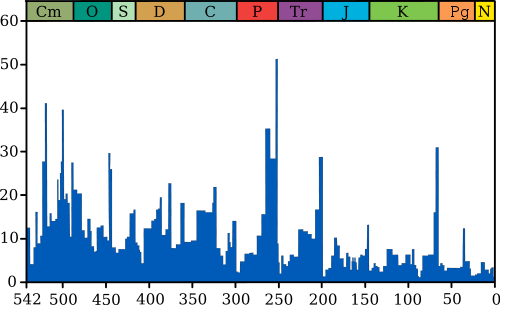
So let’s start there, with the Cambrian Period and the flourishing of life on earth. Consider the chart below:
The divisions across the top are geologic periods, starting with the Cambrian (“Cm”), the period of “visible life”‘ — meaning a proliferation of hardshelled species. It’s the big explosion of life on earth. The numbers across the bottom are millions of years ago. The spikes show extinction events, with the percentage of marine species going extinct expressed on the vertical or Y axis.
The chart doesn’t call them out, but starting with the Cambrian period, we’ve had three geologic eras (the larger divisions):
Paleozoic Era — “old life” Mesozoic Era — “middle life” or the Age of Reptiles (dino days) Cenozoic Era — “new life” or the Age of Mammals (including us)
The Paleozoic Era runs from the start of the graph to the big spike at 250 million years ago on the X axis. It encompasses six geologic periods and ended in the greatest mass extinction event on the planet — geologists call it the “Great Dying”.
The Mesozoic Era runs from the Great Dying at 250 million years ago to the big spike at 65 million years ago, the event that wiped out the dinosaurs — and every other large species. That cleared the way for mammals to grow big and thrive.
We’re now in the Cenozoic Era. Keep those transitions in mind — when mass extinctions change which groups of species can evolve and rule, it’s the end of an era and the start of another. Now look at the chart again. The whole chart shows 540 million years, and just three geologic eras. The next extinction event on the scale of the one at 250 million years ago, or the one at 65 million years ago, will change the shape of life on earth and usher in a new era. Ready for that?
Great question — where does man fit in? Answer: We come in very late.
First, notice the last three geologic “periods” at the top-right in the chart above. The period marked “K” is the Cretaceous, the period at the end of the Mesozoic Era. The next period (“Pg”) is the Paleogene, the one that marks the start of the Cenozoic (new life) Era. The period after that (“N”) is the Neogene, which ended just 2 million years ago. The period after that, not shown, is the Quarternary Period, our current one.
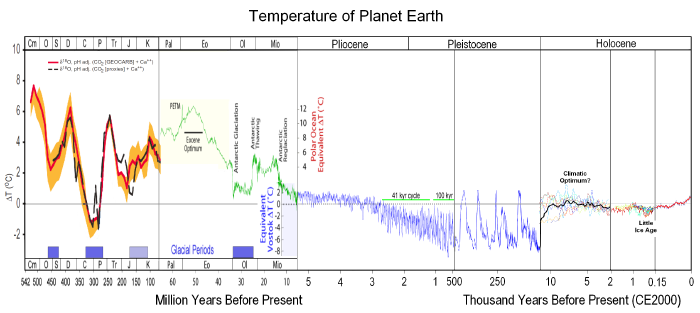
The Neogene-Quarternary boundary is the start of the time of great glaciers, and the best way to show that is with the chart below, showing earth temperatures mapped across the geologic periods (at the left end) and geologic epochs (the rest of the chart).
Click here to open the full version in another tab. It’s a big, interesting chart. (Source here.)
First, get oriented. On the Y axis is global temperature using change — in °C — from global temperature in the year 1800 as the norm or zero mark. (The global pre–Industrial Revolution temperature is generally the mark from which other global temperatures are measured, unless otherwise noted. To convert from °C to °F, just double the number; you’ll be pretty close.)
On the X axis, the first big division — from 542 million years ago to 65 million years ago — represents the first two geologic eras, the Paleozoic and Mezozoic (which unfortunately aren’t called out on this chart). “K” at the top and bottom is still the Cretaceous Period, and the end of the Cretaceous Period is also the end of the dinos and the end of the Mesozoic Era.
In this respect, both charts are the same. Man hasn’t showed up yet — our mammal ancestors were the equivalent of field mice in that world, small prey with soft shells and hiding skills.
But before we look at the rest of the X axis, notice that in the left-most part of the chart, the Y axis shows a huge change in global temperature relative to pre-Industrial norms. Looks like a monster spike, especially the first one, doesn’t it?
The Cambrian temperature spike is 6–8°C (about 11–14°F) higher than pre-Industrial levels.
It’s also the temperature we’re headed for by 2100.
But let’s not get distracted. Let’s set some markers in this chart in the horizontal (time) dimension. The whole rest of the chart — the part after the period called “K” — shows the Cenozoic Era (“new life” or Age of Mammals). From here to the right, the chart’s subdivisions show Epochs, which are sub-parts of Periods.
[Update: For a chart that shows the relationship between eras, periods and epochs, click here. it will help you stay oriented.]
Jump through the next five divisions — the epochs marked “Pal” through “Pliocene”. That takes you through the Neogene Period (“N” in the first chart) and to the start of the modern Quarternary Period, the one we’re in, and the one we’re interested in.
The epoch of the Pleistocene, which starts the Quarternary Period (again, see the chart), is the great age of glaciers. Homo habilis evolves at this time, a little over 2 million years ago. Homo erectus evolves shortly afterward. Each starts in Africa — now you can probably guess why — and each leaves Africa and spreads across the globe. (Homo erectus, by the way, lasts a long time on this earth. Longer than us by a lot.)
Homo sapiens evolved much later, in the Pleistocene — the age of glaciers, remember — just 250 thousand years ago, almost died out in Africa, but rebuilt our numbers, then spread out of Africa like our cousins. Because that was the glacier age, we’re still hunter-gatherers like the the rest of our cousins. The big beasts of the earth are creatures like woolly mammoths and sabre-tooth tigers, and we’re all alive on a fairly frozen planet with glaciers coming and going.
At the end of the Pleistocene is another extinction event. At the same time that the last glaciers recede (see chart), the big mammoths and tigers (et al) die off. Simultaneous with a noticeable change in climate, what we call “human civilization” begins. You can see that above, around 12–10 thousand years ago as the planetary temperature stabilizes. From then until almost now, planetary temperature is pretty stable. Notice it doesn’t take much of a wobble to mark the “Little Ice Age”.
Just two more points to make in this piece and I’m done.
First the bad news
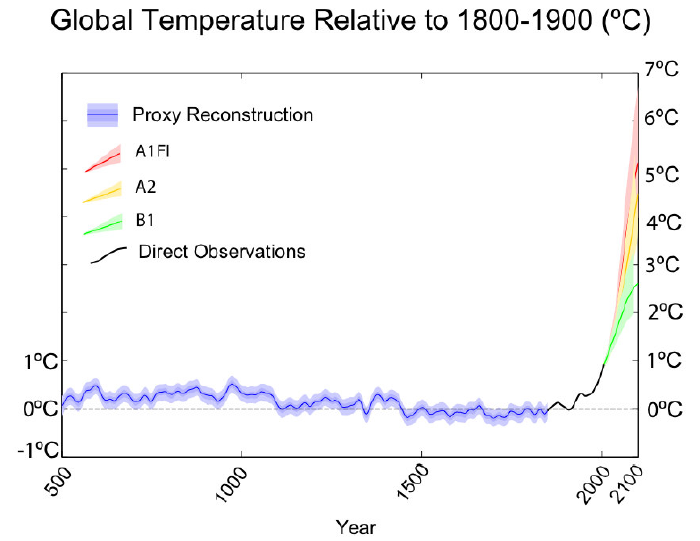
Folks, that little climb in temperature you see near the right end of the graph above is just the beginning. Remember the Cambrian spike at the left end of the graph? Take another look and note the increase — about 7°C. Now here’s Figure 21 from the Copenhagen Diagnosis, a report prepared by … oh … every single one of the world’s top climate scientists for the benefit of our world’s “leaders,” who met in 2009 to discuss how to pass the climate buck one more time:
What you see is temperatures from 500 AD to about 2000, with a number of prediction scenarios going forward. See the scenario called “A1FI”? It’s the one in red. That’s the one we’re on if we don’t stop spewing carbon. I call it the “do nothing” scenario — otherwise known as the “Keep David Koch Happy” scenario.
All you need to know? We’re on track for about +7°C — the peak temperature in the big Cambrian spike — by the year 2100.
Now the good news
Despite all this doom-and-gloom, it’s not over yet. Truly. By my calculation, we have a 5–10 year window to avoid the catastrophe. It won’t be easy — we’re past the point where any transition will be smooth — but we can make the transition and survive as a civilized species, humans in a recognizable world.
But two things are needed:
This has to be our top priority, which means you and everyone you know has to be fully aware and in full battle gear. (For reference, it’s called “hugging the monster.”)
It’s us vs. David Koch and all of his friends and enablers. Tackling any other enemy is tackling a dummy while the game is being played.
Educate your friends, and put a wrench into the Koch machine. How’s that not a plus?
If the Koch Bros keep getting rich, we move backward. If Barack “Hope & Change” Obama approves Keystone, we move backward. If the U.S. develops “domestic oil” resources, we move backward. For every new car (“carbon-delivery system”) sold, we move backward. People need to know this and think like this. We can stop the crisis, but only if we stop carbon. It’s that simple; and that stark.
But it’s also doable, and we’re the species that’s most equiped for “doable.” It’s what our big brains are for.
I’ll have more in the weeks and months ahead. I haven’t given up, not by a long shot. But you can’t pull out of a tail spin if you don’t admit you’re in one. Me, I think we can pull out.
oooOOOooo
So presumably if you are reading this, you have read the essay above. I hope so because while at first sight there appears to be much to take in, the story is clear, informed and powerful. You are unlikely to change the mind of a committed ‘denier’ but if there’s a little part of you that isn’t utterly clear about the risks ahead, then this essay is a fabulous opportunity to embrace clarity – and not to give up hope! Remember those words in the essay:
“By my calculation, we have a 5–10 year window to avoid the catastrophe. It won’t be easy — we’re past the point where any transition will be smooth — but we can make the transition and survive as a civilized species, humans in a recognizable world.”
I subscribe to two blogs: Pendantry’s Wibble and Christine’s 350 or bust. But a temporary lack of quiet reading time has meant that recent posts from each of them were initially only briefly skimmed. I made a mental note to read the one from Pendantry, Where oceans meet, because I have always had a love affair with the oceans. When I did read it, I was blown away, to use the modern vernacular. Why? Stay with me.
Where oceans meet opened thus:
I’ve recently been introduced to two things that demonstrate (to my satisfaction, anyway) that the universe is much stranger than I first thought. Mind you, my first thought was quite some time ago, now.
Then after showing a wonderful photograph of where the Indian Ocean meets the Southern Ocean, (this one below) …
Even vast oceans come together.
…. Pendantry goes on:
The other one of those ‘strange universe’ things is something that I find even more surprising: after decades of eating meat, an hour watching just one film has persuaded me to reconsider the habits of a lifetime.
That really jumped off the page at me because Jeannie has been a vegetarian for most of her life and I have been flirting with the idea.
That ‘one film’ was Vegucated. Here’s the rest of that Wibble post republished with Pendantry’s kind permission.
oooOOOooo
A TED talk highlighted yesterday over on 350orbust (well worth watching — thanks, Christine) included a reference to the film Vegucated. Intrigued, was I, so I trundled off to watch it, and returned a changed man. Well, maybe that’s a bit ambitious, but I do now feel motivated to think more about what I eat, why I’m eating it, and to actively seek out vegan alternatives — something that I have never considered before.
More meat equals more disease.
Vegucated reinforces the betrayal of a society that has sold us all on the idea of having ‘consumer choice’ — but continues to withhold from us the information necessary to make informed choices. And on that point: don’t just take my word for it that this is a film well worth watching: there are many other reviews and quotes about it.
Einstein deliberated, and chose a vegetarian lifestyle
Our world is changing, and, one way or another, we must change with it. I believe that films like Vegucated are essential to help us to choose to move in the direction of a healthier, happier world.
“If slaughterhouses had glass walls, everyone would be vegetarian. “— Paul McCartney.
Naturally I was curious and wandered across to that post. Here are Christine’s own words,
It’s TED Talk Tuesday on 350orbust, and today’s presenter is Zoe Weil who spoke to the young people who gathered at the TEDx Youth symposium held at Cape Elizabeth, Maine, last December. Ms. Weil is the co-founder and president of the Institute for Humane Education. Ms. Weil’s inspiring talk is entitled “How To Be A Solutionary.” Enjoy!
I tell you what! That 11 minute presentation by Zoe Weil was not just inspirational, it was one of the most inspirational speeches I have ever heard! That’s EVER!
Take this quote that comes in less than 2 minutes from the start of the speech, “Never before have we had the capacity to cause the breakdown of so many ecological systems that sustain our life.”
Now if that doesn’t have you gagging for the rest of what Zoe talks about, nothing will. So here it is.
Published on Jan 11, 2013
Zoe Weil is the co-founder and president of the Institute for Humane Education and is considered a pioneer in the comprehensive humane education movement, which provides people with the knowledge, tools, and motivation to be conscientious choicemakers and engaged changemakers for a better world. Zoe created the first Master of Education and Certificate Program in Humane Education in the U.S. covering the interconnected issues of human rights, environmental preservation, and animal protection. She has also created acclaimed online programs and leads workshops and speaks at universities, conferences, and events across the U.S. and Canada. She has taught tens of thousands students through her innovative school presentations, and has trained several thousand teachers through her workshops and programs. Zoe’s most recent book, Most Good, Least Harm: A Simple Principle for a Better World and Meaningful Life, won the 2010 Nautilus silver medal in sustainability and green values. She is the author of several other books including Above All, Be Kind: Raising a Humane Child in Challenging Times for parents; The Power and Promise of Humane Education for educators; and Claude and Medea: The Hellburn Dogs, winner of the Moonbeam gold medal in juvenile fiction, which follows the exploits of two seventh graders who become clandestine activists in New York City, righting wrongs where they find them. Zoe received a Master of Theological Studies from Harvard Divinity School and a Master of Arts from the University of Pennsylvania.
So from the meeting of vast oceans to the meeting of minds.
A few days ago, dear friend Dan Gomez sent me a link to an article in the March/April edition of Maui Magazine (must admit not heard of it before).
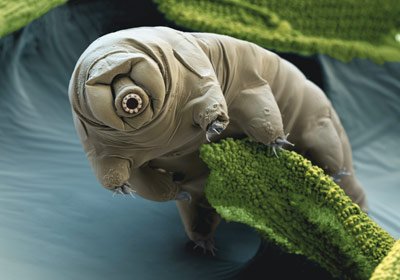
It was a story written by Shannon Wianecki under the title of ‘Eight Tiny Steps for Tardigrades‘. Here’s how it opened;
Eight Tiny Steps for Tardigrades
It might sound like a fairy tale, but it’s fact: Haleakala National Park is home to a troupe of tiny bears. But don’t bother searching for these wee creatures. Tardigrades, better known as water bears, are miniscule, ranging from 50 to 1,200 microns. Which means a couple of water bears could fit into the period ending this sentence.
Water bears are so named for their appearance and form of locomotion. Like microscopic grizzlies, they pad along on eight stumpy legs, brandishing claws and short snouts. Another name — moss piglet — refers to the animal’s most common habitat. Tardigrades are aquatic, but to creatures of their size, suitable swimming holes include the moisture clinging to mosses, or the capillary water between grains of sand. They are found all over the globe: in the arctic, desert, deep sea, and — most of all — in Hawai‘i.
Now if I blow the dust off my aged brain, I recall that a micron is a millionth of a metre (or meter in American speak). Whatever the spelling, that is small.
So even if this little creature can be up to 1,200 microns ‘big’ that would still only be 1.2 thousandths of a metre.
The article is well-worth reading in full. However, I will take the small liberty of republishing the final paragraph;
In 2007, water bears joined astronauts in space to see how they handled cosmic rays. Exposed for ten days to the vacuum of space, without oxygen, water, or heat, and zapped by intense solar radiation, water bears became the first animals to survive in space.
Back on Earth, the mini-cosmonauts continued to breed successfully. Investigating the molecular makeup of these amazing creatures may show humans how to survive future space explorations.
Now without wishing to be too basic, I would love to have this question answered: How does something that small breed? Indeed, how could they ever find each other?
So if you are a pet owner and a bit worried about the costs of feeding and looking after your beloved animal, don’t worry! There’s something else in town a little bit smaller!
Off the coast of Honduras, on a small island called Utila, lives a guy called Shane. Shane has broken away from all the social restraints and has built his own house. He is now building his own garden. However, he is doing it slightly different from most people — he uses cardboard boxes! This short film by Serena Aurora talks about Shane’s key concepts and tips on permaculture.
I can remember everything, except the things I forget!
Today’s post is about something that at it’s heart is no laughing matter; loss of memory. But the opportunity to open in a slightly frivolous manner is simply too tempting!
Because I admit to not remembering when I started to lose my memory! 🙂
But somewhere along the way during the last 5 or 6 years others around me, especially Jeannie, started noticing that my mental recall wasn’t so good. In November, I shall be 69 and have been told (I forget by whom!) that the sort of life changes that these last few years have delivered would be classic causes of declining memory in a person in their sixties.
OK, on with the show.
Some time ago, I received an email from a Daniel Strauss. This is what Daniel wrote:
Hi,
I’m a contributor to an education improvement resource and I recently published an article providing many tips about improving your memory I think you would be interested in. I found your site and your item, Let’s do nothing, during my research and would like to invite you to take a look at my published piece.
Please let me know if you would be interested in taking a look and possibly sharing with your readers.
Thanks,
Daniel
My reply was to query Daniel’s motivation before saying ‘yeah’ or ‘nay’. A further email subsequently arrived:
I am one of many contributors on a research project and recently completed work on resource that provides quick and easy tips to keep your mind sharp and be able to remember things you’ve learned. I reached out because I thought you and your readers would be interested in my resource. Here is the link to the resource. Take a look and let me know if you would consider including it among the other resource links that you’ve provided on your site.
Look forward to hearing from you.
Thanks for your help.
I was happy to feature these memory tips.
The 75 tips are on a website that is called the Open Education Database, from which one learns “We’ve compiled the Open Education Database (OEDb) to help ambitious or prospective students find the most convenient, valuable, and relevant education programs to fulfill their academic and career objectives.”
Not entirely sure why a feature on memory is part of the OEdb website, but so what! The tips strike me as fabulous advice.
The memory feature is called The Memory Toolbox: 75 Tips and Resources to Go from Amnesic to Elephantic, and is introduced, thus:
Many people expect increasing memory loss as they age, but this memory loss can be reduced or stalled with some simple memorization techniques, physical exercise, and a reduction of stress. In fact, impaired memory has more to do with chemicals that are released in the brain when an individual suffers from chronic stress. But, you can reduce the obstacles and increase your memory capacity with the seventy-five tips and resources listed below. In fact, you can go from amnesic to elephantic within a few short weeks.
Some of the tips you may already know, but we’ve repeated them because they may have slipped your mind. Other tips are from recent news stories that contained information you may not have heard. The links will take you to those news items and to other resources that you can use to increase your capacity to remember anything you deem important.
The 75 tips and resources are sorted into 10 groupings; here are some of the recommendations:
Be in the Moment
You can’t remember something if you’ve never learned it, so focus on learning.
It only takes about eight seconds to process data through your hippocampus into the appropriate memory center, so it doesn’t take long to absorb information.
To learn how to stay in the moment, don’t focus on the past or worry about the future while you’re learning.
Don’t multitask, as you create a “brain drain” when you focus on more than one activity.
Create a Learning Environment
Create a learning environment at home. This is crucial for adult learners who will be taking online courses, while balancing work, family, and other factors.
Use All Your Senses
If you’re learning something, involve as many senses as possible to help retain the experience.
Drawing and writing includes the use of motor skills that help you to remember information as you stimulate motor pathways.
If you utilize these motor skills in a task, don’t try something new for a few days. Instead, repeat some of the exercises listed immediately below a few times during the first week so that they become ingrained with your learning habits.
Talk with another person about the information you’ve gathered. This action will incorporate more than one sense and it will help you to categorize information as well.
Attach your ideas to an inert object for your learning process. For instance, connect the introduction of a speech to the entrance of the house, move on to the next room to connect the introduction to the next idea, and so on throughout a building.
Use Mnemonic Devices
Mnemonic (the initial “m” is silent) devices can provide clues to help you remember things. For instance, you can use visual images to memorize names, places, and events. If you wanted to remember Tom’s name, think of a tom cat and connect that person to that image. Or, use something more obvious, like Queen Victoria for Victoria. Just place an imaginary crown on Victoria’s head and you might remember that person’s name the next time you meet them.
“Every Good Boy Does Fine” is a sentence that many musicians use to remember the lines in a treble staff (E, G, B, D, and F). Medical students use silly sentences to remember anatomical features. Try this tool when you need to memorize a sequence of difficult words or a series like the biological taxonomy (Kingdom, Phylum, Class, Order, Family, Genus, Species): “Kids Played Cards On Furry Gray Skins.”
Connect new data to information you already know. For example, if you already know how to cook a turkey, use that information to relate to how you might cook a goose. You’re merely building on information you’ve already retained and relating it to a new recipe. The new recipe will be easier to remember.
Organize
Disorganized people report more memory problems than those individuals who are accustomed to organization. This ability to organize is external as well as internal…External organization can free your brain up for more creative endeavors. Internal organization requires a less stressful lifestyle.
Write things down, but write them down in appropriate places. For instance, write addresses in address books, and write grocery lists in a special notebook that you’ve designated for that list. Accordingly, use specific places in the house for certain items. For instance, if you hang the keys on a hook by the door when you enter, you won’t need to sap your time or brain power to find those keys.
Use online or paper calendars to remember important dates. This will help you to be more social, on time, and employed. Plus, you can free up your mind for more creative endeavors.
Keep a pad, pencil and small flashlight by your bed to write down ideas that you have at night. If you forget these tools, just move something out of place so that you’ll remember that idea in the morning (just throw a tissue or book on the floor so you see it in the morning – those items will trigger memories of the previous evening).
Increase your scholarly productivity with tools that will help you stay organized online.
Overlearn
Spend some time with new material a few hours after you’ve been introduced to it. Review notes and try to consolidate the notes into a broad concept or idea.
Review notes and other information at intervals throughout the next few days. This is called “Spaced Rehearsal” or “Spaced Repetition,” and it’s a more effective method for learning than cramming.
When you use overlearning, you improve recall speed.
Retain a Positive Attitude
Tell yourself that you want to learn and that you can learn and remember the information at hand.
A positive outlook and positive mental feedback sets up an expectation for success.
Exercise Regularly
Exercise increases oxygen to the brain, and oxygen is important for brain function.
Physical exercise reduces the risk for many disorders that relate to memory loss, such as dementia and cardiovascular disease.
The hippocampus is especially vulnerable to age-related deterioration that can affect how well you retain information, so it’s important to maintain an exercise routine as you age.
Walking is not strenuous (unless you power walk), so your leg muscles don’t take up extra oxygen and glucose like they do during other forms of exercise. If you find yourself stressed, take a few minutes to oxygenate your brain with a leisurely walk.
Manage stress
Cortisol, the stress hormone secreted under stress by the human adrenal gland, near the kidneys, can damage the hippocampus if stress is unrelieved.
Physical exercise can help to relieve stress. Even a simple walk can help to clear the mind.
Jokes, soothing music, and even a short nap can help to break the stress.
On the other hand, arousing, exciting, momentous occasions, including stressful ones, get filed away very readily. If you can remember your first date, your first job, 9/11, or when Kennedy was shot, these examples prove that some stressful occasions can create vivid memories.
Other Good habits
A good night’s sleep is necessary for memory consolidation. Sleep disorders (especially in aging women) can leave you tired and unable to concentrate during the day.
Quit smoking – smoking constricts arteries that deliver oxygen to the brain. Research has proven this memory loss in smokers.
Relaxation through meditation, tai chi, yoga, or other techniques that slow respiration, slow metabolism, and release muscle tension can make a huge difference in your overall health and stress levels. Invest about ten to fifteen minutes per day with these techniques.
Staying properly hydrated can do more for your body and mind than eating, at times. Drink your recommended 8-10 glasses per day.
So if you, like me, find the loss of one’s memory to be frustrating, or worse, make a note of the Memory Toolbox website and work your way through all 75 excellent tips and recommendations. It’s a fabulous resource.
I’ll shall be adding the link to my ‘blogroll’ – so long as I don’t forget! 😉
Yesterday, I reposted 12 stunning photographs of the world we live on that had been published on Mother Nature Network on the 19th.
Coincidentally, I also saw something on the 19th that was just as breathtaking as those pictures of Planet Earth. Here’s the picture that took my breath away.
Copyright: ESA/Herschel/PACS, SPIRE/N. Schneider, Ph. André, V. Könyves (CEA Saclay, France) for the “Gould Belt survey” Key Programme
Description: Stunning new view from ESA’s Herschel space observatory of the iconic Horsehead Nebula in the context of its surroundings. The image is a composite of the wavelengths of 70 microns (blue), 160 microns (green) and 250 microns (red), and covers 4.5×1.5 degrees. The image is oriented with northeast towards the left of the image and southwest towards the right.The Horsehead Nebula resides in the constellation Orion, about 1300 light-years away, and is part of the vast Orion Molecular Cloud complex. The Horsehead appears to rise above the surrounding gas and dust in the far right-hand side of this scene, and points towards the bright Flame Nebula. Intense radiation streaming away from newborn stars heats up the surrounding dust and gas, making it shine brightly to Herschel’s infrared-sensitive eyes (shown in pink and white in this image).To the left, the panoramic view also covers two other prominent sites where massive stars are forming, NGC 2068 and NGC 2071.
Extensive networks of cool gas and dust weave throughout the scene in the form of red and yellow filaments, some of which may host newly forming low-mass stars.
Don’t know about you but I found that description a little dry, so to speak.
By Jonathan Amos, Science correspondent, BBC News.
Europe’s Herschel space telescope has imaged one of the most popular subjects in the sky – the Horsehead Nebula – and its environs.
The distinctively shaped molecular gas cloud is sited some 1,300 light-years from Earth in the Constellation Orion.
It is in a region of space undergoing active star formation – something Herschel has been most keen to study.
The Hubble space observatory has also returned to the Horsehead scene, to celebrate 23 years in orbit.
Together, these two great facilities give scientists a much broader insight into what is taking place in this familiar patch of the heavens.
“You need images at all scales and at all wavelengths in astronomy in order to understand the big picture and the small detail,” said Prof Matt Griffin, the principal investigator on Herschel’s SPIRE instrument.
“In this new Herschel view, the Horsehead looks like a little feature – a pimple. In reality, of course, it is a very large entity in its own right, but in this great sweep of a picture from Herschel you can see that the nebula is set within an even larger, molecular-cloud complex where there is a huge amount of material and a great range of conditions,” the Cardiff University, UK, researcher told BBC News.
To provide a sense of scale, the Horsehead Nebula, also known in the catalogues as “Barnard 33”, is about five light-years “tall”.
Hubble’s new view of the Horsehead Nebula, a large cloud of hydrogen laced with dust.
Hubble sees the Horsehead in near-infrared light. Herschel, on the other hand, goes to much longer wavelengths. This allows it to see the glow coming directly from cold gas and dust – the material that will eventually collapse under gravity to form the next generation of stars.
Scientists are particularly keen to understand the mechanisms that drive the production of the biggest stars – objects much more massive than our own Sun that form relatively fast, burn bright but brief lives, and interact strongly with their environment, influencing the next round of star formation.
Anyway, that’s more than enough to copy directly from that BBC article. Read the rest by going here. All I will add is Jonathan’s last sentence, “A scholarly paper describing Herschel’s investigation of the Orion Molecular Cloud Complex has been published in the journal Astrophysical Journal Letters.”
Oh, and ponder on how far away from Earth is that Constellation Orion. Remember it was stated as 1,300 light-years.
Well, one light-year is just under 10 million, million kilometres (or about 6 million, million miles). Apparently defined by the IAU, or to give its the full name, the International Astronomical Union, a light-year is the distance that light travels in a vacuum in one Julian year.
So brace yourself! 1,300 light-years is just under 13,000,000,000,000,000 kilometres or in old money, 7,800,000,000,000,000 miles.
Rather puts pottering to the shops in Grants Pass into perspective!
A new study of ocean warming has just been published in Geophysical Research Letters by Balmaseda, Trenberth, and Källén (2013). There are several important conclusions which can be drawn from this paper.
Completely contrary to the popular contrarian myth, global warming has accelerated, with more overall global warming in the past 15 years than the prior 15 years. This is because about 90% of overall global warming goes into heating the oceans, and the oceans have been warming dramatically.
As suspected, much of the ‘missing heat’ Kevin Trenberth previously talked about has been found in the deep oceans. Consistent with the results of Nuccitelli et al. (2012), this study finds that 30% of the ocean warming over the past decade has occurred in the deeper oceans below 700 meters, which they note is unprecedented over at least the past half century.
Some recent studies have concluded based on the slowed global surface warming over the past decade that the sensitivity of the climate to the increased greenhouse effect is somewhat lower than the IPCC best estimate. Those studies are fundamentally flawed because they do not account for the warming of the deep oceans.
The slowed surface air warming over the past decade has lulled many people into a false and unwarranted sense of security.
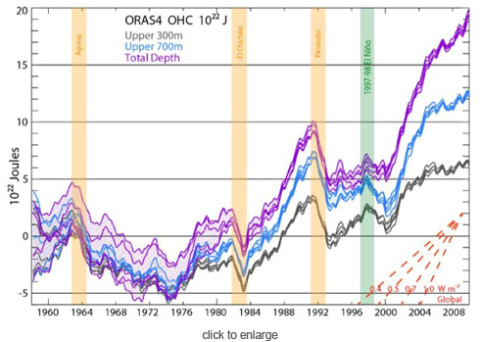
The main results of the study are illustrated in its Figure 1.
Figure 1: Ocean Heat Content from 0 to 300 meters (grey), 700 m (blue), and total depth (violet) from ORAS4, as represented by its 5 ensemble members. The time series show monthly anomalies smoothed with a 12-month running mean, with respect to the 1958–1965 base period. Hatching extends over the range of the ensemble members and hence the spread gives a measure of the uncertainty as represented by ORAS4 (which does not cover all sources of uncertainty). The vertical colored bars indicate a two year interval following the volcanic eruptions with a 6 month lead (owing to the 12-month running mean), and the 1997–98 El Niño event again with 6 months on either side. On lower right, the linear slope for a set of global heating rates (W/m2) is given.
The Data
In this paper, the authors used ocean heat content data from the European Centre for Medium-Range Weather Forecasts’ Ocean Reanalysis System 4 (ORAS4). A ‘reanalysis’ is a climate or weather model simulation of the past that incorporates data from historical observations. In the case of ORAS4, this includes ocean temperature measurements from bathythermographs and the Argo buoys, and other types of data like sea level andsurface temperatures. The ORAS4 data span from 1958 to the present, and have a high 1°x1° horizontal resolution, as well as 42 vertical layers. As the authors describe the data set,
“ORAS4 has been produced by combining, every 10 days, the output of an ocean model forced by atmospheric reanalysis fluxes and quality controlled ocean observations.”
Accelerated Global Warming
As illustrated in Figure 1 above, the study divides ocean warming into three layers for comparison – the uppermost 300 meters (grey), 700 meters (blue), and the full ocean depth (violet). After each of the Mt. Agung, Chichón, and Pinatubo volcanic eruptions (which cause short-term cooling by blocking sunlight), a distinct ocean cooling event is observed in the data. Additionally, after the very strong El Niño event of 1998, a cooling of the upper 300 and 700 meters of oceans is visible as a result of heat being transfered from the surface ocean to the atmosphere.
One of the clearest features in Figure 1 is the rapid warming of the oceans over the past decade. As we have previously discussed, the warming of the shallower oceans has slowed since around 2003, which certain climate contrarians have cherrypicked to try and argue that global warming has slowed. However, more heat accumulated in the deeper oceans below 700 meters during this period. The authors describe the ocean warming since 1999 as,
“the most sustained warming trend in this record of OHC. Indeed, recent warming rates of the waters below 700m appear to be unprecedented.”
Their results in this respect are very similar the main conclusion of Nuccitelli et al. (2012), in which we noted that recently, warming of the oceans below 700 meters accounts for about 30% of overall ocean and global warming. Likewise, this new study concludes,
“In the last decade, about 30% of the warming has occurred below 700 m, contributing significantly to an acceleration of the warming trend.”
Kevin Trenberth past comments about ‘missing heat’ drew considerable attention. The phrase refers to the fact that the heat accumulation on Earth since about 2004 (e.g. from warming oceans, air, and land, and melting ice) that instruments were able to measure could not account for the amount of global heat accumulation we expected to see, based on the energy imbalance caused by the increased greenhouse effect, as measured by satellites at the top of the Earth’s atmosphere.
These new estimates of deeper ocean heat content go a long way towards resolving that ‘missing heat’ mystery. There is still some discrepancy remaining, which could be due to errors in the satellite measurements, the ocean heat content measurements, or both. But the discrepancy is now significantly smaller, and will be addressed in further detail in a follow-up paper by these scientists.
So what’s causing this transfer of heat to the deeper ocean layers? The authors suggest that it is a result of changes in winds related to the negative phase of the Pacific Decadal Oscillation and more frequent La Niña events.
Good News for Climate Sensitivity? Probably Not
Recently there have been some studies and comments by a few climate scientists that based on the slowed global surface warming over the past decade, estimates of the Earth’s overall equilibrium climate sensitivity may be a bit too high. However, as we previously discussed, these studies and comments tend to neglect the warming of the deep oceans below 700 meters.
Does the warming of the deep ocean support these arguments for lower equilibrium climate sensitivity? Probably not, as Trenberth explained (via personal communication),
“it contributes to the overall warming of the deep ocean that has to occur for the system to equilibrate. It speeds that process up. It means less short term warming at the surface but at the expense of a greater earlier long-term warming, and faster sea level rise.”
So the slowed warming at the surface is only temporary, and consistent with the ‘hiatus decades’ described by Meehl et al. (2011). The global warming end result will be the same, but the pattern of surface warming over time may be different than we expect.
The real problem is that in the meantime, we have allowed the temporarily slowed surface warming to lull us into a false sense of security, with many people wrongly believing global warming has paused when in reality it has accelerated.
Global Warming Wake Up Call
Perhaps the most important result of this paper is the confirmation that while many people wrongly believe global warming has stalled over the past 10–15 years, in reality that period is “the most sustained warming trend” in the past half century. Global warming has not paused, it has accelerated.
The paper is also a significant step in resolving the ‘missing heat’ issue, and is a good illustration why arguments for somewhat lower climate sensitivity are fundamentally flawed if they fail to account for the warming of the oceans below 700 meters.
Most importantly, everybody (climate scientists and contrarians included) must learn to stop equating surface and shallow ocean warming with global warming. In fact, as Roger Pielke Sr. has pointed out, “ocean heat content change [is] the most appropriate metric to diagnose global warming.” While he has focused on the shallow oceans, actually we need to measure global warming by accounting for all changes in global heat content, including the deeper oceans. Otherwise we can easily fool ourselves into underestimating the danger of the climate problem we face.
oooOOOooo
“Global warming has not paused, it has accelerated.”
Now I should end it there. But I can’t!
American readers worried about the drought? Do watch this short video from Paul Douglas. (Apologies for the ad. at the start.)
For worldwide readers who have seen the massive changes in ‘normal’ weather this winter, take a look at this, first published on the NASA Earth Observatory website:
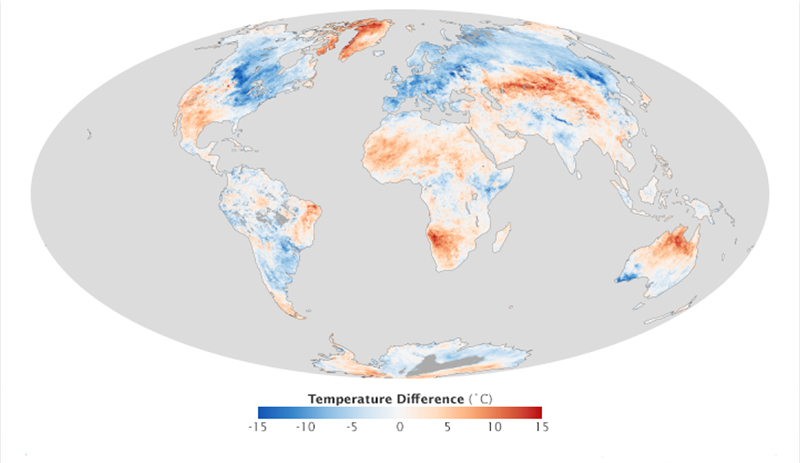
While a high-pressure weather system brought warmer than normal temperatures to Greenland and northern Canada in March 2013, much of North America, Europe, and Asia shivered through weeks of unseasonably cool temperatures. The contrasting temperatures are no coincidence: the same unusual pressure pattern in the upper atmosphere caused both events.
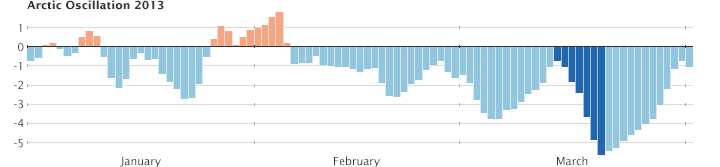
Atmospheric pressure patterns are constantly in flux, as air masses of differing temperatures and densities move around the skies. One key measure of pressure that meteorologists track closely is known as the Arctic Oscillation (AO) index, the difference in relative pressure between the Arctic and the mid-latitudes. Changes in the AO have can major impacts on weather patterns around the world.
When the AO index is in its “positive” phase, air pressure over the Arctic is low, pressure over the mid-latitudes is high, and prevailing winds confine extremely cold air to the Arctic. But when the AO is in its ”negative“ phase, the pressure gradient weakens. The pressure over the Arctic is not as low and pressure at mid-latitudes is not as high. In this negative phase, the AO enables Arctic air to flow to the south and warm air to move north.
In late March, the AO dropped as low as -5.6. (See this chart published by the Washington Post’s Capital Weather Gang to see how this compares with other periods when AO values reached record-low levels).
The temperature anomaly map above, based on data from the Moderate Resolution Imaging Spectroradiometer (MODIS) on NASA’s Aqua satellite, shows how this affected temperatures in the Northern Hemisphere. The map displays land surface temperature anomalies between March 14–20, 2013, compared to the same dates from 2005 to 2012. Areas with above-average temperatures appear in red and orange, and areas with below-average temperatures appear in shades of blue. Much of Europe, Russia, and the eastern United States saw unusually cool temperatures, while Greenland and Nunavut Territory were surprisingly warm for the time of year.
Many parts of the Northern Hemisphere saw near record-breaking cool temperatures as the value of the AO fell. The United Kingdom experienced its 4th coldest March since 1962. In late-March, two-thirds of weather stations in the Czech Republic broke records. Germany saw its coldest March since 1883. And Moscow had its coldest March since the 1950s.
I have long been a subscriber to CASSE, The Center for the Advancement of the Steady State Economy. As Casse’s home page sets out, “Perpetual economic growth is neither possible nor desirable. Growth, especially in wealthy nations, is already causing more problems than it solves. Recession isn’t sustainable or healthy either. The positive, sustainable alternative is a steady state economy.” Do take a minute to see the sense and power of this fundamentally and obvious position by reading a little more here.
But as the title of today’s post sets out, all the ideas and actions and commitments come to naught if the outcomes aren’t delivered. This recent essay by Michael Lewis on the CASSE website explores the issue of outcomes and I am very grateful for being granted permission to republish it here on Learning from Dogs.
oooOOOooo
The Resilience Imperative and Civil Disobedience
by Michael Lewis
As I was making a speech in Alberta, Canada, to a business audience, mainly from the finance and energy industries, a fully engaged participant in the front row caught my eye. He was the first to approach me after the question period and the first to get my autograph on The Resilience Imperative: Cooperative Transitions to a Steady-State Economy, the book that I co-authored with Pat Conaty.
During my talk, I had argued that economic growth and a casino-like financial system were taking us to the edge of a deadly precipice. I made the case that societies urgently need to navigate the turn to a steady-state economy, based on local and regional trade. I also offered suggestions on how we might accomplish this. The thesis has a bit of an edge to it, especially in a business crowd accustomed to globalization and growth, so I was anxious to learn more about the front-row enthusiast.
He turned out to be a warm, charming, and open senior manager at Cenovus Energy, a large player in the Athabasca Tar Sands. The corporation seems to be respected in Alberta and Saskatchewan because of its health and safety, community, and environmental initiatives. He rapidly brought the discussion to the issue of “social license,” a condition he acknowledged was a big problem for the tar sands operators. But his view, after many years around boardroom tables, is that the industry is becoming more transparent and responsible, and its performance is improving.
I believe this to be true; certainly Cenovus has been doing a lot of things right. However, I argued that he was missing the point; social license in this industry could only be understood in a global context, and it is not going to be forthcoming for two simple reasons: (1) economic growth produces carbon and (2) carbon is going to kill a lot of us and thousands of other creatures.
If the oil and gas sector wants to explore the potential for broadening its social license, it would have to stand shoulder to shoulder with scientists, governments, businesses, and civil society and argue for a stiff tax on carbon. Only by taking such responsibility can Cenovus and its fellow corporations expand their social license. At the same time they would be helping to set the stage for the transition to a steady-state economy.
“Nothing less would do,” I proclaimed.
“Well you know, Mike,” he replied, “I have not seen much evidence of such a move afoot.”
Why am I not surprised? “I know,” I said. “Shareholder interests are framed by the ideology of growth and profit maximization, and even when these interests are complemented by an ethic of corporate social responsibility, the ideology does not exactly encourage this vital and necessary conversation.”
A few days later I attended the launch conference of the New Economics Institute at Bard College in Upstate New York. It was a remarkable convergence of practitioners, researchers, and activists engaged in debates about economics, analysis of mindboggling challenges (both local and planetary in scale), and exploration of hopeful transformational pathways.
Bill McKibben delivered a Friday evening keynote speech to a packed audience. His laser focus on greenhouse gas emissions was at once absorbing, terrifying, and hopeful, precisely the kind of dynamic that is motivating more and more people to step up to the front lines of civil disobedience, including many scientists and even a few economists. Mark Jaccard, a well-known energy economist in Vancouver, is hardly considered to be a radical, but he joined the front-line battle as part of a 350.org action. He was arrested in May of this year [Ed: 2012] for blocking a coal train headed north to Vancouver’s coal port.
McKibben and Jaccard are picking up on the analysis of James Hansen et al. that oil and gas are a problem, but we do not have enough of it left to take us over 450 parts per million of carbon dioxide in the atmosphere. Coal is the real threat. Unless we phase out coal completely by 2050, we will blast beyond this concentration, and that’s an event that many climate scientists believe will trigger catastrophic consequences. What are we to do?
McKibben and Jaccard are showing us part of the answer. But to make real progress, we need to pay much more attention to Herman Daly, the outstanding chronicler of our economic and ecological lunacy. He concluded one recent essay with this strident statement befitting of our circumstances:
Even though the benefits of further growth are now less than the costs, our decision-making elites have figured out how to keep the dwindling extra benefits for themselves, while “sharing” the exploding extra costs with the poor, the future, and other species. The elite-owned media, the corporate-funded think tanks, the kept economists of high academia, and the World Bank — not to mention Gold Sacks and Wall Street — all sing hymns to growth in perfect unison, and bamboozle average citizens.
Dr. Daly has clarified and expanded the arguments for a steady-state economy that go back to John Stuart Mill, John Ruskin, Frederick Soddy, Kenneth Boulding, and Ghandi. In the same essay referenced above, Daly also noted that in spite of all the evidence of the growing crisis, “our economists, bankers, and politicians still have unrealistic expectations about growth. Like the losing gambler they try to get even by betting double or nothing on more growth.”
Well then, perhaps we need to follow the leads of McKibben, Jaccard, and Hansen, and go get arrested. Perhaps we need to breathe deeply and act courageously to make hope more concrete and despair less convincing. Perhaps those of us in the 50 to 90-year-old set need to commit to civil disobedience to honor our children, grandchildren and our hopes for their survival. The time has arrived for all of us, but especially the post-war “growth generation” to break out of our too-comfortable zones. Stopping carbon emissions is a pre-condition, but nothing will change unless we are prepared to put ourselves on the line.
Of course, this is not enough. We have many questions to answer. How are we going to meet basic needs for energy, food, and shelter? How are we going to finance the economic transition? How do we restructure property rights to overcome the pervasive me-first culture? How do we achieve more local and democratic ownership of the means of production? How do we share jobs and income in a transition that will require less stuff and thus less making of stuff?
These are the questions we concentrate on in The Resilience Imperative. Pat Conaty and I put 42 months of serious forehead pressing into the book, and the early results are gratifying. People as divergent as John Fullerton, former managing director of JP Morgan whose focus is now on resilience and transition (good-bye Wall Street), and Robin Murray from the London School of Economics have endorsed it — they believe we have presented hopeful ideas for getting the transition going.
After presenting numerous positive examples of how people are changing the economy today, we end the book on this note:
The tasks of transition are many. The challenges are daunting. The outcomes are uncertain. Our courage remains untested. But we are a resilient species. We are not alone; there is “blessed unrest” all about. If we but open our eyes, we will SEE change is possible. If we act in ways that recognize we are interdependent, we will continue to innovate co-operative transitions to a steady-state economy.
There is one key question we need to ask ourselves. What stories will we be able to tell our loved ones about what we did to advance the Great Transition?
oooOOOooo
One sentence really jumped out at me from Michael’s essay and it was this one, “Perhaps we need to breathe deeply and act courageously to make hope more concrete and despair less convincing.” Reminds me of the quotation ascribed to Napoleon Bonaparte:
Courage isn’t having the strength to go on, it is going on when you don’t have strength.
I won’t let on why I called this post ‘2020 vision’ but if you watch the video below to just before the 7-minute mark the use of the number 2020 will become clear.
This video came to my attention from a recent post on Climate Crocks. It’s a strongly powerful message about the changes going on in Arctic region and the profound effect those changes will have on the rest of the planet. Indeed, many experiencing the recent weather in North-West Europe will amend the future tense of my sentence to present tense!
You can read more here about Professor Ken Dunton at the University of Texas where he is Professor, Department of Marine Science.
Professor Dunton
He is the sort of person that we should be listening to very carefully as the world changes in ways not seen for tens of thousands of years.
Recent news items reinforce messages from yesterday’s book review.
In my review published yesterday of Martin Lack’s book Denial of Science, I wrote, “the continuing and accelerating loss of the Arctic ice-cap“. Back on the 22nd in More new tomorrows, I included:
A study published in 2012 showed that by changing the temperature balance between the Arctic and mid-latitudes, rapid Arctic warming is altering the course of the jet stream, which steers weather systems from west to east around the northern hemisphere. The Arctic has been warming about twice as fast as the rest of the Northern Hemisphere, due to a combination of human emissions of greenhouse gases and unique feedbacks built into the Arctic climate system. The jet stream, the study said, is becoming “wavier,” with steeper troughs and higher ridges.
A new study published in the journal Environmental Research Letters shows that reduced sea ice cover can favor colder and stormier winters in the northern midlatitudes. [my emphasis – UK readers will need no reminding of this!]
So bear those references in mind as you read:
Breaking News (Literally): NOAA Video Confirms Early Breakup
A series of intense storms in the Arctic has caused fracturing of the sea ice around the Beaufort Sea along the northern coasts of Alaska and Canada. High-resolution imagery from the Suomi NPP satellite shows the evolution of the cracks forming in the ice, called leads, from February 17 — March 18 2013. The general circulation of the area is seen moving the ice westward along the Alaskan coast
“Intense storms” are not an unheard of thing in the arctic. What’s new is that the ice is so fragile that normal storm activity is breaking it up much earlier than has been seen in the past.
To recapitulate: It is normal for the ice to crack and for leads to occur. However, this is very extensive cracking and there are some very big leads, and all of it seems to come earlier than expected. Given last year’s melting mayhem and the low amount of multi-year ice, it makes one wonder whether this early cracking will have any effect in the melting season to come.
There are still several weeks to go before this part of the Arctic is going to start melting, up till then the ice will actually thicken some more, even when the Sun’s rays start to reach the ice. But the ice is already getting broken up in smaller pieces, which means that 1) the pack becomes more mobile (like we saw last year), and 2) the thin ice that now grows to fill up the leads will go first when the melting starts, potentially leading to more open water between floes to absorb solar energy and convert it to heat.
But maybe not. Maybe this will have zero influence. We don’t know. That’s why we watch.
Nothing more to add except to ponder on what strange weather we will be experiencing this year! Actually, no need to ponder. The UK Met Office issued a weather warning last Sunday that included this sentence, “Cold easterly winds will persist through the coming week with bitterly cold conditions.” That came on the back of a blog entry from the Met Office that same day that included:
Many areas also saw strong winds, with a gust of 61 mph recorded at Shap, Cumbria and 48 mph recorded at Machrihanish, Argyll . These winds have caused even deeper drifts of snow in some areas. [my emphasis].
61mph? That’s Storm Force 10 under the Beaufort scale and 3mph under the lower boundary of a Violent Storm; Beaufort Force 11!
oooOOOooo
The next item that caught my eye was some ‘goodish’ news from the US Senate via a recent post on 350.org.
After a very chaotic week on Capitol Hill, I wanted to write you with an update on what just happened in the Senate today.
First and foremost: the oil industry’s Senators did not manage to pass legislation that would force President Obama to build Keystone XL.
Because you — and people like you, all across the country — jumped into action this week, they backtracked and instead held a vote on a nonbinding resolution that says it would be nice to build the pipeline, but doesn’t actually do much about it. For that vote, they got the stomach-churning number of 62 Senators to vote with them. As usual, the ones who had taken the most money from the fossil fuel industry lined up to cast their votes—the cosponsors of the bill, on average, had taken $807,000 in dirty energy money.
Now, this amounts to symbolic chest thumping by the oil industry: showing just how many Senators they can get to jump when told to. It’s not the worst thing that could have happened, but it reminds everyone why, in one recent poll, congress had approval ratings lower than head lice and colonoscopies — even on the symbolic stuff, they can’t get it together to stand up to the oil industry guys cutting them checks.
In a certain way though, this vote couldn’t come at a better time. Congress is going on break, and for the next two weeks, these 62 Senators will be back in their home states, doing things like meeting with constituents — people like you.
Home states are where some of the most heroic work took place the last week — in Minneapolis, say, where 150 350MN.org activists showed up on very short notice at Sen. Klobuchar’s office in a snowstorm to tell her to vote no on Keystone (and she did, it should be added).
If you’re interested in following in the fine example of those leaders who held actions at their senators offices, you have a chance in the next two weeks.
We’re looking for people who can step up to lead, and then we’ll put the 350 network into action to get people to join you. If you want to lead an action, just click here to tell us when you’d like to do so: act.350.org/survey/kxl-senate-accountability-2013/
Look, there are two ways to react to a democracy for sale. One is to walk away in disgust, which is what the Koch Brothers count on. The other is to stand up and say: no more. If you visit your Senator, take some pictures or some video so we can share them around. It’s time to build this broader fossil fuel resistance.
And remember, Capitol Hill is not the center of the world. Around the country this week our friends at Tar Sands Blockade have been actively targeting Keystone investors; faith groups have been hauled off to jail in front of the White House to protest the pipeline; and the divestment campaign has expanded off college campuses and into municipal and state governments.
The movement is doing amazing stuff — we just need more of it. We can’t outspend the oil industry, but we can out-organize them. In fact, we have to.
Forward,
Bill McKibben
oooOOOooo
“the cosponsors of the bill, on average, had taken $807,000 in dirty energy money.” Words utterly fail me!