Category: Education

In the sky with diamonds!

A fascinating item recently published by Yale University.

Apologies, time pressure allows me little more than to repeat this in full.  But still no less interesting.

oooOOOooo

Nearby super-Earth likely a diamond planet
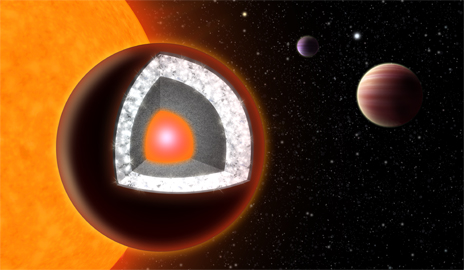
Illustration of the interior of 55 Cancri e — an extremely hot planet with a surface of mostly graphite surrounding a thick layer of diamond, below which is a layer of silicon-based minerals and a molten iron core at the center. (Image by Haven Giguere)

October 11, 2012

New research led by Yale University scientists suggests that a rocky planet twice Earth’s size orbiting a nearby star is a diamond planet.

“This is our first glimpse of a rocky world with a fundamentally different chemistry from Earth,” said lead researcher Nikku Madhusudhan, a Yale postdoctoral researcher in physics and astronomy. “The surface of this planet is likely covered in graphite and diamond rather than water and granite.”

The paper reporting the findings has been accepted for publication in the journal Astrophysical Journal Letters.

The planet — called 55 Cancri e — has a radius twice Earth’s, and a mass eight times greater, making it a “super-Earth.” It is one of five planets orbiting a sun-like star, 55 Cancri, that is located 40 light years from Earth yet visible to the naked eye in the constellation of Cancer.

The planet orbits at hyper speed — its year lasts just 18 hours, in contrast to Earth’s 365 days. It is also blazingly hot, with a temperature of about 3,900 degrees Fahrenheit, researchers said, a far cry from a habitable world.

The planet was first observed transiting its star last year, allowing astronomers to measure its radius for the first time. This new information, combined with the most recent estimate of its mass, allowed Madhusudhan and colleagues to infer its chemical composition using models of its interior and by computing all possible combinations of elements and compounds that would yield those specific characteristics.

Star map showing the planet-hosting star 55 Cancri in the constellation of Cancer. The star is visible to the naked eye, though better through binoculars. (Image by Nikku Madhusudhan; created using Sky Map Online

Astronomers had previously reported that the host star has more carbon than oxygen, and Madhusudhan and colleagues confirmed that substantial amounts of carbon and silicon carbide, and a negligible amount of water ice, were available during the planet’s formation.

Astronomers also thought 55 Cancri e contained a substantial amount of super-heated water, based on the assumption that its chemical makeup was similar to Earth’s, Madhusudhan said. But the new research suggests the planet has no water at all, and appears to be composed primarily of carbon (as graphite and diamond), iron, silicon carbide, and, possibly, some silicates. The study estimates that at least a third of the planet’s mass — the equivalent of about three Earth masses — could be diamond.

“By contrast, Earth’s interior is rich in oxygen, but extremely poor in carbon — less than a part in thousand by mass,” says co-author and Yale geophysicist Kanani Lee.

The identification of a carbon-rich super-Earth means that distant rocky planets can no longer be assumed to have chemical constituents, interiors, atmospheres, or biologies similar to those of Earth, Madhusudhan said. The discovery also opens new avenues for the study of geochemistry and geophysical processes in Earth-sized alien planets. A carbon-rich composition could influence the planet’s thermal evolution and plate tectonics, for example, with implications for volcanism, seismic activity, and mountain formation.

“Stars are simple — given a star’s mass and age, you know its basic structure and history,” said David Spergel, professor of astronomy and chair of astrophysical sciences at Princeton University, who is not a co-author of the study. “Planets are much more complex. This ‘diamond-rich super-Earth’ is likely just one example of the rich sets of discoveries that await us as we begin to explore planets around nearby stars.”

In 2011, Madhusudhan led the first discovery of a carbon-rich atmosphere in a distant gas giant planet, opening the possibility of long-theorized carbon-rich rocky planets (or “diamond planets”). The new research represents the first time that astronomers have identified a likely diamond planet around a sun-like star and specified its chemical make-up. Follow-up observations of the planet’s atmosphere and additional estimates of the stellar composition would strengthen the findings about the planet’s chemical composition.

The authors of the paper are Madhusudhan, Lee, and Olivier Mousis, a planetary scientist at the Institut de Recherche en Astrophysique et Planetologie in Toulose, France.

The paper is titled “A Possible Carbon-rich Interior in Super-Earth 55 Cancri e.”

The research was supported by the Yale Center for Astronomy and Astrophysics (YCAA) in the Yale Department of Physics through Madhusudhan’s YCAA postdoctoral prize fellowship.

oooOOOooo

Dead easy to know how to finish this post off!

Lets try not to get stuck in a rut…

A fascinating look back at making tracks!

This came in from Suzann, Su to her friends, a few days ago.  Suzann is Dan Gomez’s sister and if Dan’s name is familiar it’s because he, too, sends in items for Learning from Dogs, the recent Tad too much cabin pressure being an example.  It was Su that invited me out to San Carlos, Mexico for Christmas 2007 which resulted in me meeting Jean, a long-time friend of Su, and, as they say, the rest is history!  OK, to the article from Su.

oooOOOooo

Here’s a question?

Think about railroad (railways in ‘English’!) tracks.  The US standard railroad gauge (distance between the rails) is 4 feet, 8.5 inches.  That’s an exceedingly odd number.

Why was that gauge used? Because that’s the way they built them in Scotland, and Scots expatriates designed the US railroads.

Why did the Scots build them like that? Because the first rail lines were built by the same people who built the pre-railroad tramways, and that’s the gauge they used.

Why that gauge then?  Because the people who built the tramways used the same jigs and tools that they had used for building wagons, which used that wheel spacing.

Why did the wagons have that particular odd wheel spacing?  Well, if they tried to use any other spacing, the wagon wheels would break on some of the old, long-distance roads in Scotland, because that’s the spacing of the wheel ruts.

So who built those old rutted roads?  Imperial Rome built the first long distance roads in Europe (including Scotland) for their legions.  Those roads have been used ever since. [And rarely repaired! 😉 Ed. ]

And the ruts in the roads? Roman war chariots formed the initial ruts.  Which forever more everyone else had to match for fear of destroying their wagon wheels.

Since the chariots were made for Imperial Rome, they were all alike in the matter of wheel spacing.  Therefore the United States standard railroad gauge of 4 feet, 8.5 inches is derived from the original specifications for an Imperial Roman war chariot.

Bureaucracies live forever….

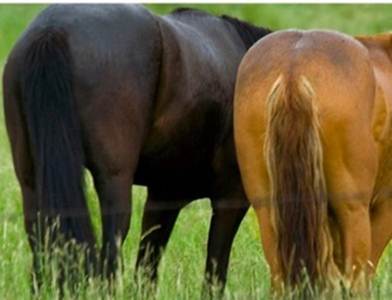
So the next time you are handed a specification or a procedure or process and wonder ‘What horse’s ass came up with this?‘, you may be exactly right.  Imperial Roman army chariots were made just wide enough to accommodate the rear ends of two war horses.

Now, the twist to the story. When you see a Space Shuttle sitting on its launch pad, there are two big booster rockets attached to the sides of the main fuel tank. These are solid rocket boosters, or SRBs.  The SRBs are made by Thiokol at their factory in Utah.

The engineers who designed the SRBs would have preferred to make them a bit fatter, but the SRBs had to be shipped by train from the factory to the launch site. The railroad line from the factory happens to run through a tunnel in the mountains, and the SRBs had to fit through that tunnel.

The tunnel is slightly wider than the railroad track, and the railroad track, as you now know, is about as wide as two horses’ behinds.

oooOOOooo

Just a fabulously interesting account of something we all take for granted, or had done until now! Thank you so much, Su, for sharing that with everyone.

Extreme weather events

Nature is really starting to speak to mankind!

I started writing this post back on the 25th September.  Why so far back?  Because that day something came into my in-box that deserved the widest circulation.  It’s an event being held just under a month from today, November 14th.  But it seemed worthwhile to give this amount of notice.  However, the reason why I wanted to start it back in September was because in the last 24 hours of that day, the 25th, the UK offered very good evidence of the significant increase in severe weather.

From the UK’s Met Office blog on the 25th September, 2012, (I have included the inches equivalent of the mm figures)

Rainfall figures: over a month’s worth of rain in two days

Rainfall totals for the past few days – from 1:00 am Sunday morning to 8:00 am this morning [Tuesday] – show some areas have already had more than twice their usual September rainfall. Ravensworth, in North Yorkshire, has seen the highest total, with 107.8 mm [4.24 in] falling, over 200 % of its average September rainfall.

The rainfall has been widespread, with many areas across the United Kingdom receiving large totals. Killylane, in Antrim Northern Ireland saw 98.2 mm [3.87 in], and high totals were also recorded in the south-west, with 72.4 mm [2.85 in] in Filton and 65.2 mm [2.57 in] at Dunkeswell Aerodrome.

Dunkeswell Aerodrome in Devon was where I used to fly our group-owned Piper Super Cub, still in military markings.

Piper Super Cub at Dunkeswell Aerodrome
A carriage made for two!

Anyway, back to the plot!

Also on that day (September 25th) the website Think Progress released this item,

Markey/Waxman Report: Carbon Pollution Creating A ‘Cocktail Of Heat And Extreme Weather’

By Climate Guest Blogger and Stephen Lacey on Sep 25, 2012 at 3:31 pm

by Katie Valentine and Stephen Lacey

Two House Democrats have released a report that aims to connect the dots on climate change and extreme weather events.

The staff report, issued by Henry Waxman (D-Calif.) and Edward Markey (D-Mass.), outlines the past year’s record-setting temperatures, storms, droughts, water levels and wildfires, and is being circulated in an attempt to rebuild congressional momentum to address climate change.

“The evidence is overwhelming — climate change is occurring and it is occurring now,” said Rep. Waxman, a Ranking Member of the Energy and Commerce Committee, in a statement.

The report outlines the stunning array of record-breaking extreme weather events throughout 2012 within five categories:

Extreme temperatures

  • July was the hottest month ever recorded in the continental U.S.  Some areas were 8 degrees warmer than average, with the average temperature in the lower 48 states at 77.6 degrees Fahrenheit, 3.3 degrees above the 20th century average.
  • Spring 2012 saw the warmest March, third-warmest April and second-warmest May in history, and was approximately 5.2 degrees Fahrenheit above average overall.
  • Through late June 2011, daily record highs were outnumbering daily record lows by 9-to-1.

Drought

  • As of September, 64 percent of the continental U.S. is experiencing drought, with August and September 2012 comparable to the worst months of the 1930s Dust Bowl.
  • By the beginning of August, more than half the counties in the U.S. had been designated disaster zones because of drought.
  • As of August, 51 percent of corn and 38 percent of soybeans grown in the U.S. were rated as poor or very poor by the U.S. Department of Agriculture. Some states’ corn fared worse – Indiana had 70 percent of its corn rated as poor or very poor, and Missouri had 84 percent.

Wildfires

  • This fire season 8.6 million acres – roughly the size of Connecticut and New Jersey combined – have burned in the U.S., with fires still burning in parts of the West.
  • Wildfires in Colorado have killed six people, destroyed 600 homes and caused about $500 million in property damage.
  • There has been nearly a four-fold increase in large wildfires in the West in recent decades, with fires burning longer and more intensely and wildfire seasons lasting longer.

Storms

  • Tropical Storm Debby caused Florida to have its wettest June on record. The storm killed at least seven people and also damaged more than 7,500 homes and businesses.
  • In July, the “derecho” storm system killed at least 23 people and left more than 3.7 million people without power.
  • In August, Hurricane Isaac caused storm surges of up to 15 feet in some places and contributed to Louisiana and Mississippi experiencing their second-wettest August on record and to Florida experiencing its wettest summer on record.

Extreme water levels and water temperatures

  • In July, water in the Great Lakes reached temperatures of 60 and 65 degrees Fahrenheit – more than 10 degrees warmer than the same time last year.
  • In August, water temperatures of up to 97 degrees and low water levels caused tens of thousands of fish to die in Midwestern lakes and rivers.
  • Low water levels in the Mississippi watershed have caused some barge companies to reduce their loads by 25 percent and have caused harbor closures in Tennessee, Missouri, Arkansas and Mississippi.

According to the report, 2012 natural disasters (not including wildfires or drought) have caused $22 billion in insured losses and more than 220 deaths as of August. The full cost of 2012’s extreme weather events isn’t yet known, but it’s expected to rival 2011’s record-breaking $55 billion.

The document outlines what scientists following the link between extreme weather and climate change have been saying for years: more carbon pollution adds extra energy in the atmosphere, thus warming the planet and making extreme weather events more likely.

Read the full report here.

So what came into my in-box?  An announcement from The Climate Reality Project: 24 HOURS OF REALITY: The Dirty Weather Report.

NOVEMBER 14-15, 2012

A lot can change in a day. This November 14, we hope you can help us make big change happen.

Join The Climate Reality Project for 24 Hours of Reality: The Dirty Weather Report. This will be our second annual, online event showing how global climate change is connected to the extreme weather we experience in our daily lives. The entire 24-hour event will be broadcast live over the Internet.

We’ll move between our home studio in New York City and into each region of the world, bringing voices, news and multimedia content across all 24 time zones. We’ll feature videos from around the globe, man-on-the-street reports, music, and most importantly, stories from communities moving forward with solutions.

Most of all, we’ll generate new energy and urgency around the fact that we must — and we can — work together to address the climate crisis.

GET INVOLVED

Sign up today to be a part of the global community taking part in 24 Hours of RealityRSVP on Facebook. Share this event with your friends. Submit your own video about the impacts of climate change where you live. And keep checking this page: We’ll post further details as the event draws closer.

Millions of people around the world know that the weather, their climate is changing.  But if you can take some more powerful evidence of just how it’s all changing then go and read a recent report on the Grist website, entitled ‘Deadly connection: New report on extreme weather and climate change’

So one more video to close.

Creativity, John Cleese style

The art and magic of being creative.

I can’t recall who it was that mentioned this TED video which is a great shame as I really should pay credit to a wonderful examination of the business of being creative.

“Telling people how to be creative is easy – being creative is difficult.” John Marwood Cleese (born 27 October 1939) is an English actor, comedian, writer and film producer. He achieved success at the Edinburgh Festival Fringe and as a scriptwriter and performer on The Frost Report.

In the late 1960s he became a member of Monty Python, the comedy troupe responsible for the sketch show Monty Python’s Flying Circus and the four Monty Python films: And Now for Something Completely Different, The Holy Grail, Life of Brian and The Meaning of Life. In the mid 1970s, Cleese and his first wife, Connie Booth, co-wrote and starred in the British sitcom Fawlty Towers. Later, he co-starred with Kevin Kline, Jamie Lee Curtis and former Python colleague Michael Palin in A Fish Called Wanda and Fierce Creatures.

He also starred in Clockwise, and has appeared in many other films, including two James Bond films as Q, two Harry Potter films, and three Shrek films. With Yes Minister writer Antony Jay he co-founded Video Arts, a production company making entertaining training films. It was founded in 1972 by John Cleese, Sir Antony Jay, and a group of other television professionals. The videos feature well known British actors, and humorously explain business concepts. Productions include Meetings, Bloody Meetings and More Bloody Meetings, and have featured Cleese, Dawn French, Prunella Scales, Hugh Laurie, and Robert Hardy.

In December 1977, Cleese appeared as a guest star on The Muppet Show. Cleese was a fan of the show, and co-wrote much of the episode. He appears in a “Pigs in Space” segment as a pirate trying to hijack the spaceship Swinetrek, and also helps Gonzo restore his arms to “normal” size after Gonzo’s cannonball catching act goes wrong. During the show’s closing number, Cleese refuses to sing the famous show tune from Man of La Mancha, “The Impossible Dream”. Kermit the Frog apologises and the curtain re-opens with Cleese now costumed as a Viking trying some Wagnerian opera as part of a duet with Sweetums. Once again, Cleese protests to Kermit, and gives the frog one more chance. This time, he is costumed as a Mexican maraca soloist. He has finally had enough and protests that he is leaving the show, saying “You were supposed to be my host. How can you do this to me? Kermit — I am your guest!”. The cast joins in with their parody of “The Impossible Dream”, singing “This is your guest, to follow that star…”. During the crowd’s applause that follows the song, he pretends to strangle Kermit until he realises the crowd loves him and accepts the accolades. During the show’s finale, as Kermit thanks him, he shows up with a fictional album, his own new vocal record John Cleese: A Man & His Music, and encourages everyone to buy a copy. This would not be Cleese’s final appearance with the Muppets. In their 1981 film The Great Muppet Caper, Cleese does a cameo appearance as Neville, a local homeowner. As part of the appearance, Miss Piggy borrows his house as a way to impress Kermit the Frog. Cleese won the TV Times award for Funniest Man On TV — 1978-79.

Many people think you are either born with creativity or you aren’t. But John Cleese explains how to become creative and in the video, he talks about such thing as the unconscious mind.

John Cleese has his own website here.

Changing the mathematics of the climate!

An important plea to support a major road tour by the 350.org team.

Bill McKibben

There are a number of key players in the movement to arrest the affects of man on the world’s future climate and one of those is Bill McKibben.  His organisation, 350.org, has been at the forefront of raising the public’s awareness as to the terrible consequences of not changing our ways pretty damn soon.

As Wikipedia puts it,

William Ernest “Bill” McKibben (born 1960) is an American environmentalist, author, and journalist who has written extensively on the impact of global warming. He is the Schumann Distinguished Scholar at Middlebury College. In 2010, the Boston Globe called him “probably the nation’s leading environmentalist”  and Time magazine described him as “the world’s best green journalist.”

Anyway, something came in to my ‘in-box’ the other day that I wanted to share with all Learning from Dogs readers.  This is what was said,

Friends,

The reaction to our announcement of our national “Do the Math” road tour has been utterly pheneomenal.

Case in point: the event in Boston sold out in 24 hours. We’re trying to find another, larger venue to seat everyone, but the main point is this: this tour is going to be huge, and you need to be part of it.

Get your tickets here (math.350.org), and please do spread the word to everyone you know.

See you on the road,

Bill for the 350.org team

P.S. If you haven’t gotten a chance to read our first announcement, I’ve included it below.

 oooOOOooo

Dear Friends,

We’re getting ready for our most ambitious venture yet.

From November 7th to December 3rd, I’ll be on the road, visiting 20 cities in 20 nights (with a few days for travel in between) to help bring together the movement we need to make sure this planet has a future that we can all appreciate.

We’re calling it the Do the Math tour, but it’s not (thank heaven) just going to be me standing in front of a microphone.The goal is to jump-start the kind of movement that I discussed in the article I wrote for Rolling Stone about the scary new math of climate change. We will bring together musicians, artists and voices from across the movement to work together on directly confronting the financial and political might of the fossil fuel industry.

If you are near one of our stops, I want to make sure you’re there with us. You’re exactly the people we need to be there — folks who understand the climate math already, have experience in the movement, and are willing to step up to do more.


Click to check out the tour and RSVP

These events will need to be big, and reach beyond our normal circle of friends. That’s why we need to make sure that everyone knows that something big is underway. Can you take a moment to share the Do the Math tour site with your social networks?

       
Click to share on Facebook                 Click to share on Twitter

Also, just a heads up — we’re going to be putting together a live web event so that everyone who doesn’t happen to be near a tour stop can still get together and get a campaign started in their community. Our team is still hammering out the details for the exact date and time, but please keep an eye out — we absolutely need you in this fight.

I do a lot of talks to big groups, but this is a new kind of undertaking for me, and for 350.org. We’re trying to quickly build up some serious momentum, which is why we’ve gone to great lengths to make this a very different kind of event.

Not only will we have music and guests like Naomi Klein, Jim Hansen, Desmond Tutu, in person and via video, this event is also the kickoff to some serious organizing in your community. This tour will launch our next big mission — a campaign to directly confront the economic power of the fossil fuel industry. Our message will be crystal clear: it’s not OK to sacrifice our future for the sake of one industry’s bottom line. Divestment is one important tool that we’ll discuss, but we’re ready for many other tactics as well.

Over the past few months our planet gave stark warning signs that humans have never seen before. The Arctic melted, breaking every record. The Great Plains sweltered. The West burned. This roadshow is the next big step — but the price of admission, besides the ticket, is a willingness to really go to work to change the world in the year ahead. That’s why we need you this November.

The stakes have never been this high, and I’ve never been more serious.

Please join us: math.350.org

–Bill McKibben for 350.org

So go across to that Tour site, where you will read this,

On November 7th, we’re hitting the road to jumpstart the next phase of the climate movement.

It’s simple math: we can burn 565 more gigatons of carbon and stay below 2°C of warming — anything more than that risks catastrophe for life on earth. The only problem? Fossil fuel corporations now have 2,795 gigatons in their reserves, five times the safe amount. And they’re planning to burn it all — unless we rise up to stop them.

This November, Bill McKibben and 350.org are hitting the road to build the movement that will change the terrifying math of the climate crisis.

and see the link to the Tour locations and dates.

TOUR DATES & TICKETS

***Click a city to sign up and buy tickets.***

Don’t see your town on the map? You can still get involved by signing up here.

ABOUT THE TOUR

This won’t be your typical lecture.

Each event will be a unique and interactive experience, unlike any talk you’ve been to before. It will pick up where Bill McKibben’s landmark Rolling Stone article left off — and everyone who comes will be asked to join a growing movement that is strong enough to stand up to the fossil fuel industry. Together we’ll mount an unprecedented campaign to cut off the industry’s financial and political support by divesting our schools, churches and government from fossil fuels.

This won’t be easy: we’re up against the most profitable, powerful, and dangerous industry in history. But we have our own currency: creativity, courage and if needed, our bodies.

Never let it be said that we, as in all of us, don’t have the power to change the world.  Oh, and feel free to circulate today’s post.

Tad too much cabin pressure!

A short pencil is better than a long memory.

The origins of this saying seem to have disappeared in the mists of time but it’s a rare person that doesn’t write a list from time to time.  But when it comes to critical processes, having a list, or better known as a ‘checklist’ is essential to completing the process correctly.

With that in mind, then let me introduce you to a story recently sent to me by old friend Dan Gomez.

oooOOOooo

I’ve always done it this way!

This is an example of what happens when we do not pay attention to detail, and do not follow instructions and checklists!

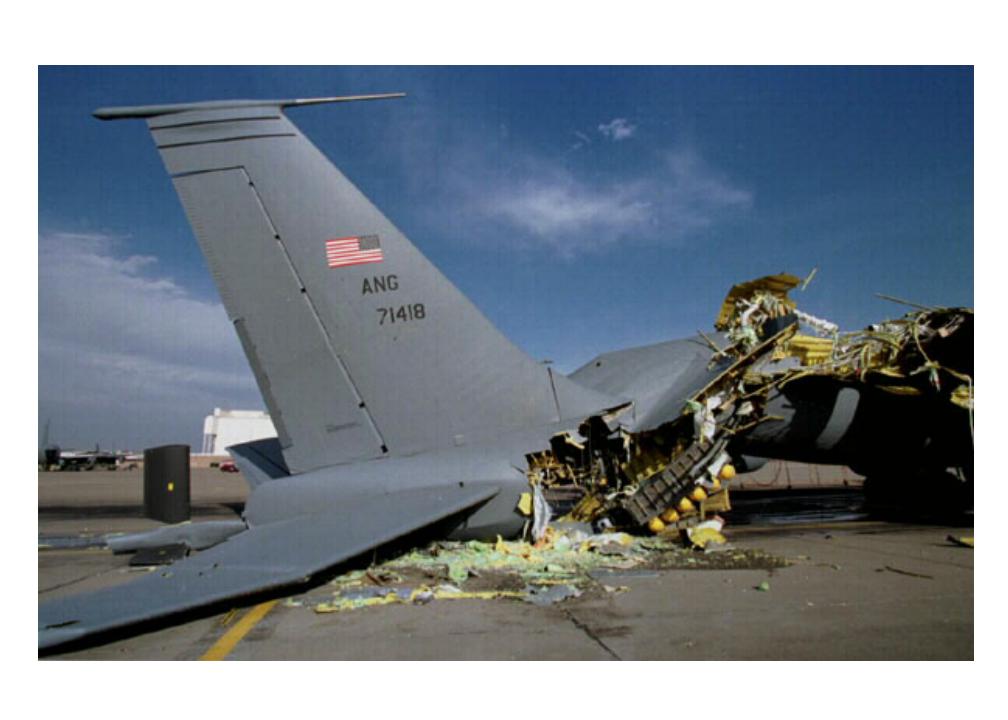
A KC-135 Aircraft was being pressurized at ground level. The outflow valves which are used to regulate the pressure of the aircraft were capped off during a 5-year overhaul and never re-opened. The post-investigation revealed that a civilian depot technician who “had always done it that way” was using a homemade gauge, and no procedure.

Apparently, the technician’s gauge didn’t even have a max “peg” for the needle, so it was no surprise he missed it when the needle went around the gauge the first time.

As the technician continued to pressurize the aircraft with the needle on its second trip around the gauge there was a “boom”.  One KC-135 went bang!  Indeed, the rear hatch was blown over 70 yards away, through a blast fence!

An incident like this is never funny and is further regrettable when we consider that this mistake is one that we taxpayers will end up paying for. Fortunately, no one was reported as being injured.

This was a good “Lessons Learned” for making sure we have trained people, with the correct tools, and who are following detailed procedures. It should serve as a reminder that just because you’ve always done it that way, it does not make it the “right” way!

oooOOOooo

Now where did I leave that pencil!

Getting a good night’s sleep

Some fascinating insights into the nature of sleep.

Of the eleven dogs that we have at home, five are in what Jean and I call our bedroom group.  That group consists of Pharaoh, he of the LfD home page, young puppy GSD Cleo, little Jack Russell cross Sweeny, ex-Mexican rescue dogs Dhalia and Hazel.

Dhalia
Puppy Cleo

Most nights all of them except Pharaoh compete for space on the bed.  Turning over, as we all do during our sleep, is a challenge and I often have to be awake to accomplish the task.  Plus Cleo especially loves to wake me for an early-morning pee around 5am.  Don’t get me wrong, I wouldn’t have it any other way as much of the night, when I have turned to face the edge of the bed, my arm is around either Hazel or Dhalia.  To sleep with an arm around a dog that is cuddled into one’s chest is to stir wonderings of early man sleeping with his (her) dogs many thousands of years ago.

Plus one of the consequences of our regular fasting on Thursday and Friday of each week is that the reduced calorie intake seems to act as a diuretic for me; ergo, I am taking regular trips to the bathroom during the night!

Anyway, the result of these disturbed patterns of ‘sleeping’ is that my ambition of an unbroken 8 hours of sleep is rarely achieved.  So it was with great interest that I saw an article on the Big Think website, “Rethinking the 8-Hour Sleep Imperative, or Why You Should Take Naps“.  Here’s how it opened,

A restful night that includes eight hours of uninterrupted sleep is now more of a fallacy than ever before, partially because technology has demanded we attend to work, family and friends at all hours of the day. “[R]oughly 41 million people in the United States—nearly a third of all working adults—get six hours or fewer of sleep a night, according to a recent report from the Centers for Disease Control and Prevention.” But our own rigidity with respect to sleep patterns may be causing us harm, too, as we demand our bodies conform to the eight-hour regimen rather than observing more natural rhythms.

At the bottom there was a link to an article on The New York Times Sunday Review called Rethinking Sleep.  That set out, following from above,

And sleep deprivation is an affliction that crosses economic lines. About 42 percent of workers in the mining industry are sleep-deprived, while about 27 percent of financial or insurance industry workers share the same complaint.

The author, David K. Randall*, went on to write,

The idea that we should sleep in eight-hour chunks is relatively recent. The world’s population sleeps in various and surprising ways. Millions of Chinese workers continue to put their heads on their desks for a nap of an hour or so after lunch, for example, and daytime napping is common from India to Spain.

One of the first signs that the emphasis on a straight eight-hour sleep had outlived its usefulness arose in the early 1990s, thanks to a history professor at Virginia Tech named A. Roger Ekirch, who spent hours investigating the history of the night and began to notice strange references to sleep. A character in the “Canterbury Tales,” for instance, decides to go back to bed after her “firste sleep.” A doctor in England wrote that the time between the “first sleep” and the “second sleep” was the best time for study and reflection. And one 16th-century French physician concluded that laborers were able to conceive more children because they waited until after their “first sleep” to make love. Professor Ekirch soon learned that he wasn’t the only one who was on to the historical existence of alternate sleep cycles. In a fluke of history, Thomas A. Wehr, a psychiatrist then working at the National Institute of Mental Health in Bethesda, Md., was conducting an experiment in which subjects were deprived of artificial light. Without the illumination and distraction from light bulbs, televisions or computers, the subjects slept through the night, at least at first. But, after a while, Dr. Wehr noticed that subjects began to wake up a little after midnight, lie awake for a couple of hours, and then drift back to sleep again, in the same pattern of segmented sleep that Professor Ekirch saw referenced in historical records and early works of literature.

Later on, Mr. Randall highlights a NASA study …

In a NASA-financed study, for example, a team of researchers led by David F. Dinges, a professor at the University of Pennsylvania, found that letting subjects nap for as little as 24 minutes improved their cognitive performance.

then reports that,

Robert Stickgold, a professor of psychiatry at Harvard Medical School, proposes that sleep — including short naps that include deep sleep — offers our brains the chance to decide what new information to keep and what to toss. That could be one reason our dreams are laden with strange plots and characters, a result of the brain’s trying to find connections between what it’s recently learned and what is stored in our long-term memory. Rapid eye movement sleep — so named because researchers who discovered this sleep stage were astonished to see the fluttering eyelids of sleeping subjects — is the only phase of sleep during which the brain is as active as it is when we are fully conscious, and seems to offer our brains the best chance to come up with new ideas and hone recently acquired skills. When we awaken, our minds are often better able to make connections that were hidden in the jumble of information.

Anyway, do go and read the full article or, perhaps, follow the example of your dog!

Meanwhile, I think I will just take a little …….. nap!

* David K. Randall is a senior reporter at Reuters and the author of “Dreamland: Adventures in the Strange Science of Sleep.”

The best and the worst of mankind – the worst.

This makes me so sick I can’t find an appropriate heading!

Just read this from the October edition of The National Geographic magazine!

Ivory Worship

Thousands of elephants die each year so that their tusks can be carved into religious objects. Can the slaughter be stopped?

By Bryan Christy

Photographs by Brent Stirton, Reportage by Getty Images

IN JANUARY 2012 A HUNDRED RAIDERS ON HORSEBACK CHARGED OUT OF CHAD INTO CAMEROON’S BOUBA NDJIDAH NATIONAL PARK, SLAUGHTERING HUNDREDS OF ELEPHANTS—entire families—in one of the worst concentrated killings since a global ivory trade ban was adopted in 1989. Carrying AK-47s and rocket-propelled grenades, they dispatched the elephants with a military precision reminiscent of a 2006 butchering outside Chad’s Zakouma National Park. And then some stopped to pray to Allah. Seen from the ground, each of the bloated elephant carcasses is a monument to human greed. Elephant poaching levels are currently at their worst in a decade, and seizures of illegal ivory are at their highest level in years. From the air too the scattered bodies present a senseless crime scene—you can see which animals fled, which mothers tried to protect their young, how one terrified herd of 50 went down together, the latest of the tens of thousands of elephants killed across Africa each year. Seen from higher still, from the vantage of history, this killing field is not new at all. It is timeless, and it is now.

The full terrible article is here – if you have the stomach to read it.

Photograph by Brent Stirton, Reportage by Getty Images
To keep the ivory from the black market, a plainclothes ranger hacks the tusks off a bull elephant killed illegally in Kenya’s Amboseli National Park. In the first half of this year six park rangers died protecting Kenya’s elephants; meanwhile, rangers killed 23 poachers.

Integrity, part two.

A lifting of the importance of integrity is the key to our survival.

Let me start by reflecting on the difference between ‘truth’ and ‘integrity’.

Here’s one of the definitions of Truthconformity with fact or reality; verity: the truth of a statement.

Here’s one of the definitions of Integrityadherence to moral and ethical principles; soundness of moral character; honesty.

So while in yesterday’s article, I frequently referred to the word ‘truth‘, determining the ‘fact or reality‘ of a wide range of issues associated with anthropogenic climate change is not always straightforward.  Many of us probably have a strong intuition of the ’cause and effect’ of man’s footprint on this planet but a strong intuition is not the same as truth.

Then let’s turn to the notion of integrity. This is a much bigger issue, to my mind, the appalling lack of integrity!  Illustrated by one simple example.  How many leading politicians from any number of countries have demonstrated soundness of moral character; honesty with regard to the changing climate, even offering something as simple as “I don’t know!

There’s a saying that pilots use, “If there’s any doubt, there’s no doubt!”  Come on, politicians and leaders, at the very least there is doubt!

OK, let me move on!

If integrity is partly defined as honesty, then while it’s easy to take a pot-shot at the world’s politicians maybe we need to look closer at home; ourselves.  Are we as honest with our own self as we now need to be?

Here’s an example that supports that question.

A few days ago there was a report on the website The Daily Impact about the crash of US fisheries.  Let me show you how that report opens,

Report: US Fisheries Crashing

We live in a country in which every household has two TV sets, most of them receiving hundreds of channels, and two cell phones, many of them “smart.” One of every two households has a computer connected to the Internet. This country is currently in the middle of a hotly contested presidential election. And yet among the things that have almost completely escaped public attention is this: last week the US government declared fisheries disasters on four coasts.

Reflect on that paragraph.  Surely it’s a reflection about the lack of integrity, of honesty, about our society?

The report ends thus,

The disaster declaration covering all these dire situations makes them eligible for Congressional aid, along with drought-stricken farmers in the Midwest and Southwest, flooded-out homeowners in New Orleans and along the Gulf, the fire-ravaged states of the far West, and the derecho-pounded Northeast. Congress will no doubt be delighted by the opportunity to help.

We eat nearly five billion pounds of seafood every year — about 16 pounds for each of us — and 85 per cent of it is imported (according to NOAA). Yet in the wake of this grim assessment of a large proportion of the domestic industry, and the questions it raises about the future sources of seafood, there is no discussion of “fisheries independence” or “peak fish” in politics or the media. Only in such outposts as this website and Mother Jones will the dire warning from the Commerce Department be reported as what it is — a dire warning.

Then there was a recent article on the Australian Permaculture news website about the US food and dairy industry.  Here’s how that opened,

Americans’ right to access fresh, healthy foods of their choice is under attack. Farmageddon tells the story of small, family farms that were providing safe, healthy foods to their communities and were forced to stop, sometimes through violent action, by agents of misguided government bureaucracies, and seeks to figure out why.

Filmmaker Kristin Canty’s quest to find healthy food for her four children turned into an educational journey to discover why access to these foods was being threatened. What she found were policies that favor agribusiness and factory farms over small family-operated farms selling fresh foods to their communities. Instead of focusing on the source of food safety problems — most often the industrial food chain — policymakers and regulators implement and enforce solutions that target and often drive out of business small farms that have proven themselves more than capable of producing safe, healthy food, but buckle under the crushing weight of government regulations and excessive enforcement actions.

I’m not going to insert that YouTube video into this post but you can link to both the full article and the film here.  For anyone interested in the fate of the family farm in the USA, the film is a ‘must see’!  Once again, the theme of integrity, of adherence to moral and ethical principles; honesty, comes to mind!

How I do want to close this rather personal reflection on present times (some may call it an indulgent reflection!) is by including a video from this seasons TED Talks.  It was brought to my attention by Christine over at her excellent blog 350 or bust.  The video is about resolving conflict,

William Ury, author of “Getting to Yes,” offers an elegant, simple (but not easy) way to create agreement in even the most difficult situations — from family conflict to, perhaps, the Middle East.

The reason why this seems like a very appropriate way to close this is because the way things are going at the moment, avoiding conflict could become rather important, rather soon!

It really is about integrity

A reflection on truth.

This is not the first time that I have wandered through this subject.  Indeed, Learning from Dogs would never have seen the light of day if, all those years ago, Jon Lavin hadn’t raised the fascinating idea that dogs are integrous animals.  As the quote says in the sidelink Purpose of Learning from Dogs;

There is nothing to fear except the persistent refusal to find out the truth, the persistent refusal to analyse the causes of happenings. Dorothy Thompson.

So what is it that has rocked my boat again?  A number of things, to be honest.  So much so, please forgive me for running these musings over to tomorrow!

Regular readers may have noticed that both Tuesday’s post Modelling the future and yesterday’s A study of man’s behaviours explored determining truth; frequently a fickle beast to track down!  Then last Monday, I read the latest post from Climate Denial Crock of the Week that was about Sea Ice Slowing to Minimum.  It was yet another reminder that embracing the truth of what is happening to our planet is vital, I mean VITAL, for anyone who has a reasonable expectation to be alive in 20 years time.

Here’s how Peter opened that post (published with Peter’s kind permission):

Not there yet, but in an interview with Dr. Jennifer Francis of Rutgers last week, the message was clear – the ice has retreated so much that at this point, we will already be experiencing the impacts of a low or no-ice arctic minimum, including “very interesting” weather in the northern hemisphere this fall and winter. Wow. I can’t wait.

Peter then included an update in that post, a reference to a report published in the Australian newspaper The Sydney Morning Herald.  I requested permission to republish the SMH article but that wasn’t granted, well to be factual it was offered at a fee of $420.75 – say no more.  Here is how that report from on board the Greenpeace ice-breaker Arctic Sunrise opened,

We are a few hundred miles from the north pole. The air temperature is -3C, the sea freezing. All around us in these foggy Arctic waters at the top of the world are floes – large and small chunks of sea ice that melt and freeze again with the seasons.

Arne Sorensen, our Danish ice pilot, is 18 metres up in the crow’s nest of the Arctic Sunrise vessel. Visibility is just 200 metres and he inches the 1,000-tonne Greenpeace ice-breaker forward at two knots through narrow passages of clear water.

A few paragraphs later come this:

More than 600,000 sq km more ice has melted in 2012 than ever recorded by satellites. Now the minimum extent has nearly been reached and the sea is starting to refreeze.

‘‘This is the new minimum extent of the ice cap,’’ [Sorensen] says – the frontline of climate change. ‘‘It is sad. I am not doubting this is related to emitting fossil fuels to a large extent. It’s sad to observe that we are capable of changing the planet to such a degree.’’

British, Italian and American scientists on the Arctic Sunrise say they are shocked at the speed and extent of the ice loss.

Over at the Guardian newspaper, their reporter John Vidal, also aboard the Arctic Sunrise, reports:

One of the world’s leading ice experts has predicted the final collapse of Arctic sea ice in summer months within four years.

In what he calls a “global disaster” now unfolding in northern latitudes as the sea area that freezes and melts each year shrinks to its lowest extent ever recorded, Prof Peter Wadhams of Cambridge University calls for “urgent”   consideration of new ideas to reduce global temperatures.

In an email to the Guardian he says: “Climate change is no longer something we can aim to do something about in a few decades’ time, and that we must not only urgently reduce CO2 emissions but must urgently examine other ways of slowing global warming, such as the various geoengineering ideas that have been put forward.”

Professor Peter Wadhams is head of the Cambridge University Polar Ocean Physics Group, from which one may learn,

Sea ice covers 7% of the surface of our planet. It is one of the most important and variable components of the planetary surface and is the key to understanding many basic questions about the energy balance of the Earth. The ice-covered seas represent the cold end of the enormous heat engine that enables the Earth to have temperatures suitable for human life over most of its surface.

Just go back and re-read, “.. the enormous heat engine that enables the Earth to have temperatures suitable for human life over most of its surface.”

So determining the truth of what is happening to our planet is not some elegant academic exercise, it is about determining the likelihood of human life surviving or not!

Doesn’t that put everything else we are doing into some form of perspective?  Let me rant on tomorrow!