Yesterday, I reposted 12 stunning photographs of the world we live on that had been published on Mother Nature Network on the 19th.
Coincidentally, I also saw something on the 19th that was just as breathtaking as those pictures of Planet Earth. Here’s the picture that took my breath away.
Copyright: ESA/Herschel/PACS, SPIRE/N. Schneider, Ph. André, V. Könyves (CEA Saclay, France) for the “Gould Belt survey” Key Programme
Description: Stunning new view from ESA’s Herschel space observatory of the iconic Horsehead Nebula in the context of its surroundings. The image is a composite of the wavelengths of 70 microns (blue), 160 microns (green) and 250 microns (red), and covers 4.5×1.5 degrees. The image is oriented with northeast towards the left of the image and southwest towards the right.The Horsehead Nebula resides in the constellation Orion, about 1300 light-years away, and is part of the vast Orion Molecular Cloud complex. The Horsehead appears to rise above the surrounding gas and dust in the far right-hand side of this scene, and points towards the bright Flame Nebula. Intense radiation streaming away from newborn stars heats up the surrounding dust and gas, making it shine brightly to Herschel’s infrared-sensitive eyes (shown in pink and white in this image).To the left, the panoramic view also covers two other prominent sites where massive stars are forming, NGC 2068 and NGC 2071.
Extensive networks of cool gas and dust weave throughout the scene in the form of red and yellow filaments, some of which may host newly forming low-mass stars.
Don’t know about you but I found that description a little dry, so to speak.
By Jonathan Amos, Science correspondent, BBC News.
Europe’s Herschel space telescope has imaged one of the most popular subjects in the sky – the Horsehead Nebula – and its environs.
The distinctively shaped molecular gas cloud is sited some 1,300 light-years from Earth in the Constellation Orion.
It is in a region of space undergoing active star formation – something Herschel has been most keen to study.
The Hubble space observatory has also returned to the Horsehead scene, to celebrate 23 years in orbit.
Together, these two great facilities give scientists a much broader insight into what is taking place in this familiar patch of the heavens.
“You need images at all scales and at all wavelengths in astronomy in order to understand the big picture and the small detail,” said Prof Matt Griffin, the principal investigator on Herschel’s SPIRE instrument.
“In this new Herschel view, the Horsehead looks like a little feature – a pimple. In reality, of course, it is a very large entity in its own right, but in this great sweep of a picture from Herschel you can see that the nebula is set within an even larger, molecular-cloud complex where there is a huge amount of material and a great range of conditions,” the Cardiff University, UK, researcher told BBC News.
To provide a sense of scale, the Horsehead Nebula, also known in the catalogues as “Barnard 33”, is about five light-years “tall”.
Hubble’s new view of the Horsehead Nebula, a large cloud of hydrogen laced with dust.
Hubble sees the Horsehead in near-infrared light. Herschel, on the other hand, goes to much longer wavelengths. This allows it to see the glow coming directly from cold gas and dust – the material that will eventually collapse under gravity to form the next generation of stars.
Scientists are particularly keen to understand the mechanisms that drive the production of the biggest stars – objects much more massive than our own Sun that form relatively fast, burn bright but brief lives, and interact strongly with their environment, influencing the next round of star formation.
Anyway, that’s more than enough to copy directly from that BBC article. Read the rest by going here. All I will add is Jonathan’s last sentence, “A scholarly paper describing Herschel’s investigation of the Orion Molecular Cloud Complex has been published in the journal Astrophysical Journal Letters.”
Oh, and ponder on how far away from Earth is that Constellation Orion. Remember it was stated as 1,300 light-years.
Well, one light-year is just under 10 million, million kilometres (or about 6 million, million miles). Apparently defined by the IAU, or to give its the full name, the International Astronomical Union, a light-year is the distance that light travels in a vacuum in one Julian year.
So brace yourself! 1,300 light-years is just under 13,000,000,000,000,000 kilometres or in old money, 7,800,000,000,000,000 miles.
Rather puts pottering to the shops in Grants Pass into perspective!
A new study of ocean warming has just been published in Geophysical Research Letters by Balmaseda, Trenberth, and Källén (2013). There are several important conclusions which can be drawn from this paper.
Completely contrary to the popular contrarian myth, global warming has accelerated, with more overall global warming in the past 15 years than the prior 15 years. This is because about 90% of overall global warming goes into heating the oceans, and the oceans have been warming dramatically.
As suspected, much of the ‘missing heat’ Kevin Trenberth previously talked about has been found in the deep oceans. Consistent with the results of Nuccitelli et al. (2012), this study finds that 30% of the ocean warming over the past decade has occurred in the deeper oceans below 700 meters, which they note is unprecedented over at least the past half century.
Some recent studies have concluded based on the slowed global surface warming over the past decade that the sensitivity of the climate to the increased greenhouse effect is somewhat lower than the IPCC best estimate. Those studies are fundamentally flawed because they do not account for the warming of the deep oceans.
The slowed surface air warming over the past decade has lulled many people into a false and unwarranted sense of security.
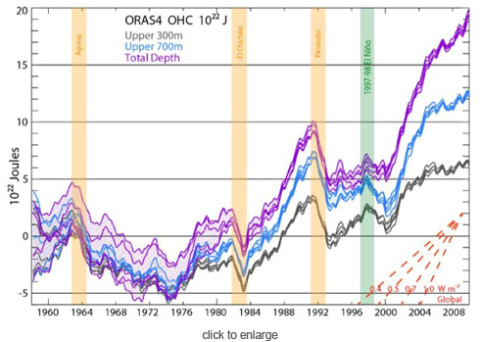
The main results of the study are illustrated in its Figure 1.
Figure 1: Ocean Heat Content from 0 to 300 meters (grey), 700 m (blue), and total depth (violet) from ORAS4, as represented by its 5 ensemble members. The time series show monthly anomalies smoothed with a 12-month running mean, with respect to the 1958–1965 base period. Hatching extends over the range of the ensemble members and hence the spread gives a measure of the uncertainty as represented by ORAS4 (which does not cover all sources of uncertainty). The vertical colored bars indicate a two year interval following the volcanic eruptions with a 6 month lead (owing to the 12-month running mean), and the 1997–98 El Niño event again with 6 months on either side. On lower right, the linear slope for a set of global heating rates (W/m2) is given.
The Data
In this paper, the authors used ocean heat content data from the European Centre for Medium-Range Weather Forecasts’ Ocean Reanalysis System 4 (ORAS4). A ‘reanalysis’ is a climate or weather model simulation of the past that incorporates data from historical observations. In the case of ORAS4, this includes ocean temperature measurements from bathythermographs and the Argo buoys, and other types of data like sea level andsurface temperatures. The ORAS4 data span from 1958 to the present, and have a high 1°x1° horizontal resolution, as well as 42 vertical layers. As the authors describe the data set,
“ORAS4 has been produced by combining, every 10 days, the output of an ocean model forced by atmospheric reanalysis fluxes and quality controlled ocean observations.”
Accelerated Global Warming
As illustrated in Figure 1 above, the study divides ocean warming into three layers for comparison – the uppermost 300 meters (grey), 700 meters (blue), and the full ocean depth (violet). After each of the Mt. Agung, Chichón, and Pinatubo volcanic eruptions (which cause short-term cooling by blocking sunlight), a distinct ocean cooling event is observed in the data. Additionally, after the very strong El Niño event of 1998, a cooling of the upper 300 and 700 meters of oceans is visible as a result of heat being transfered from the surface ocean to the atmosphere.
One of the clearest features in Figure 1 is the rapid warming of the oceans over the past decade. As we have previously discussed, the warming of the shallower oceans has slowed since around 2003, which certain climate contrarians have cherrypicked to try and argue that global warming has slowed. However, more heat accumulated in the deeper oceans below 700 meters during this period. The authors describe the ocean warming since 1999 as,
“the most sustained warming trend in this record of OHC. Indeed, recent warming rates of the waters below 700m appear to be unprecedented.”
Their results in this respect are very similar the main conclusion of Nuccitelli et al. (2012), in which we noted that recently, warming of the oceans below 700 meters accounts for about 30% of overall ocean and global warming. Likewise, this new study concludes,
“In the last decade, about 30% of the warming has occurred below 700 m, contributing significantly to an acceleration of the warming trend.”
Kevin Trenberth past comments about ‘missing heat’ drew considerable attention. The phrase refers to the fact that the heat accumulation on Earth since about 2004 (e.g. from warming oceans, air, and land, and melting ice) that instruments were able to measure could not account for the amount of global heat accumulation we expected to see, based on the energy imbalance caused by the increased greenhouse effect, as measured by satellites at the top of the Earth’s atmosphere.
These new estimates of deeper ocean heat content go a long way towards resolving that ‘missing heat’ mystery. There is still some discrepancy remaining, which could be due to errors in the satellite measurements, the ocean heat content measurements, or both. But the discrepancy is now significantly smaller, and will be addressed in further detail in a follow-up paper by these scientists.
So what’s causing this transfer of heat to the deeper ocean layers? The authors suggest that it is a result of changes in winds related to the negative phase of the Pacific Decadal Oscillation and more frequent La Niña events.
Good News for Climate Sensitivity? Probably Not
Recently there have been some studies and comments by a few climate scientists that based on the slowed global surface warming over the past decade, estimates of the Earth’s overall equilibrium climate sensitivity may be a bit too high. However, as we previously discussed, these studies and comments tend to neglect the warming of the deep oceans below 700 meters.
Does the warming of the deep ocean support these arguments for lower equilibrium climate sensitivity? Probably not, as Trenberth explained (via personal communication),
“it contributes to the overall warming of the deep ocean that has to occur for the system to equilibrate. It speeds that process up. It means less short term warming at the surface but at the expense of a greater earlier long-term warming, and faster sea level rise.”
So the slowed warming at the surface is only temporary, and consistent with the ‘hiatus decades’ described by Meehl et al. (2011). The global warming end result will be the same, but the pattern of surface warming over time may be different than we expect.
The real problem is that in the meantime, we have allowed the temporarily slowed surface warming to lull us into a false sense of security, with many people wrongly believing global warming has paused when in reality it has accelerated.
Global Warming Wake Up Call
Perhaps the most important result of this paper is the confirmation that while many people wrongly believe global warming has stalled over the past 10–15 years, in reality that period is “the most sustained warming trend” in the past half century. Global warming has not paused, it has accelerated.
The paper is also a significant step in resolving the ‘missing heat’ issue, and is a good illustration why arguments for somewhat lower climate sensitivity are fundamentally flawed if they fail to account for the warming of the oceans below 700 meters.
Most importantly, everybody (climate scientists and contrarians included) must learn to stop equating surface and shallow ocean warming with global warming. In fact, as Roger Pielke Sr. has pointed out, “ocean heat content change [is] the most appropriate metric to diagnose global warming.” While he has focused on the shallow oceans, actually we need to measure global warming by accounting for all changes in global heat content, including the deeper oceans. Otherwise we can easily fool ourselves into underestimating the danger of the climate problem we face.
oooOOOooo
“Global warming has not paused, it has accelerated.”
Now I should end it there. But I can’t!
American readers worried about the drought? Do watch this short video from Paul Douglas. (Apologies for the ad. at the start.)
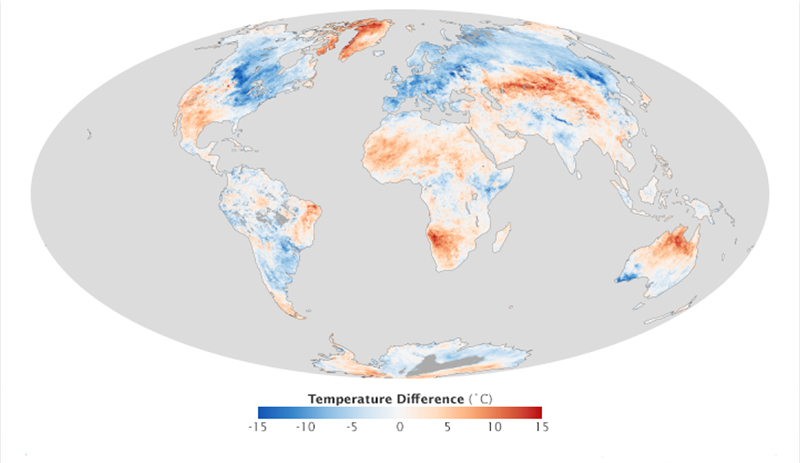
For worldwide readers who have seen the massive changes in ‘normal’ weather this winter, take a look at this, first published on the NASA Earth Observatory website:
While a high-pressure weather system brought warmer than normal temperatures to Greenland and northern Canada in March 2013, much of North America, Europe, and Asia shivered through weeks of unseasonably cool temperatures. The contrasting temperatures are no coincidence: the same unusual pressure pattern in the upper atmosphere caused both events.
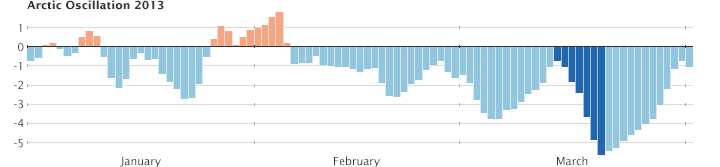
Atmospheric pressure patterns are constantly in flux, as air masses of differing temperatures and densities move around the skies. One key measure of pressure that meteorologists track closely is known as the Arctic Oscillation (AO) index, the difference in relative pressure between the Arctic and the mid-latitudes. Changes in the AO have can major impacts on weather patterns around the world.
When the AO index is in its “positive” phase, air pressure over the Arctic is low, pressure over the mid-latitudes is high, and prevailing winds confine extremely cold air to the Arctic. But when the AO is in its ”negative“ phase, the pressure gradient weakens. The pressure over the Arctic is not as low and pressure at mid-latitudes is not as high. In this negative phase, the AO enables Arctic air to flow to the south and warm air to move north.
In late March, the AO dropped as low as -5.6. (See this chart published by the Washington Post’s Capital Weather Gang to see how this compares with other periods when AO values reached record-low levels).
The temperature anomaly map above, based on data from the Moderate Resolution Imaging Spectroradiometer (MODIS) on NASA’s Aqua satellite, shows how this affected temperatures in the Northern Hemisphere. The map displays land surface temperature anomalies between March 14–20, 2013, compared to the same dates from 2005 to 2012. Areas with above-average temperatures appear in red and orange, and areas with below-average temperatures appear in shades of blue. Much of Europe, Russia, and the eastern United States saw unusually cool temperatures, while Greenland and Nunavut Territory were surprisingly warm for the time of year.
Many parts of the Northern Hemisphere saw near record-breaking cool temperatures as the value of the AO fell. The United Kingdom experienced its 4th coldest March since 1962. In late-March, two-thirds of weather stations in the Czech Republic broke records. Germany saw its coldest March since 1883. And Moscow had its coldest March since the 1950s.
I have long been a subscriber to CASSE, The Center for the Advancement of the Steady State Economy. As Casse’s home page sets out, “Perpetual economic growth is neither possible nor desirable. Growth, especially in wealthy nations, is already causing more problems than it solves. Recession isn’t sustainable or healthy either. The positive, sustainable alternative is a steady state economy.” Do take a minute to see the sense and power of this fundamentally and obvious position by reading a little more here.
But as the title of today’s post sets out, all the ideas and actions and commitments come to naught if the outcomes aren’t delivered. This recent essay by Michael Lewis on the CASSE website explores the issue of outcomes and I am very grateful for being granted permission to republish it here on Learning from Dogs.
oooOOOooo
The Resilience Imperative and Civil Disobedience
by Michael Lewis
As I was making a speech in Alberta, Canada, to a business audience, mainly from the finance and energy industries, a fully engaged participant in the front row caught my eye. He was the first to approach me after the question period and the first to get my autograph on The Resilience Imperative: Cooperative Transitions to a Steady-State Economy, the book that I co-authored with Pat Conaty.
During my talk, I had argued that economic growth and a casino-like financial system were taking us to the edge of a deadly precipice. I made the case that societies urgently need to navigate the turn to a steady-state economy, based on local and regional trade. I also offered suggestions on how we might accomplish this. The thesis has a bit of an edge to it, especially in a business crowd accustomed to globalization and growth, so I was anxious to learn more about the front-row enthusiast.
He turned out to be a warm, charming, and open senior manager at Cenovus Energy, a large player in the Athabasca Tar Sands. The corporation seems to be respected in Alberta and Saskatchewan because of its health and safety, community, and environmental initiatives. He rapidly brought the discussion to the issue of “social license,” a condition he acknowledged was a big problem for the tar sands operators. But his view, after many years around boardroom tables, is that the industry is becoming more transparent and responsible, and its performance is improving.
I believe this to be true; certainly Cenovus has been doing a lot of things right. However, I argued that he was missing the point; social license in this industry could only be understood in a global context, and it is not going to be forthcoming for two simple reasons: (1) economic growth produces carbon and (2) carbon is going to kill a lot of us and thousands of other creatures.
If the oil and gas sector wants to explore the potential for broadening its social license, it would have to stand shoulder to shoulder with scientists, governments, businesses, and civil society and argue for a stiff tax on carbon. Only by taking such responsibility can Cenovus and its fellow corporations expand their social license. At the same time they would be helping to set the stage for the transition to a steady-state economy.
“Nothing less would do,” I proclaimed.
“Well you know, Mike,” he replied, “I have not seen much evidence of such a move afoot.”
Why am I not surprised? “I know,” I said. “Shareholder interests are framed by the ideology of growth and profit maximization, and even when these interests are complemented by an ethic of corporate social responsibility, the ideology does not exactly encourage this vital and necessary conversation.”
A few days later I attended the launch conference of the New Economics Institute at Bard College in Upstate New York. It was a remarkable convergence of practitioners, researchers, and activists engaged in debates about economics, analysis of mindboggling challenges (both local and planetary in scale), and exploration of hopeful transformational pathways.
Bill McKibben delivered a Friday evening keynote speech to a packed audience. His laser focus on greenhouse gas emissions was at once absorbing, terrifying, and hopeful, precisely the kind of dynamic that is motivating more and more people to step up to the front lines of civil disobedience, including many scientists and even a few economists. Mark Jaccard, a well-known energy economist in Vancouver, is hardly considered to be a radical, but he joined the front-line battle as part of a 350.org action. He was arrested in May of this year [Ed: 2012] for blocking a coal train headed north to Vancouver’s coal port.
McKibben and Jaccard are picking up on the analysis of James Hansen et al. that oil and gas are a problem, but we do not have enough of it left to take us over 450 parts per million of carbon dioxide in the atmosphere. Coal is the real threat. Unless we phase out coal completely by 2050, we will blast beyond this concentration, and that’s an event that many climate scientists believe will trigger catastrophic consequences. What are we to do?
McKibben and Jaccard are showing us part of the answer. But to make real progress, we need to pay much more attention to Herman Daly, the outstanding chronicler of our economic and ecological lunacy. He concluded one recent essay with this strident statement befitting of our circumstances:
Even though the benefits of further growth are now less than the costs, our decision-making elites have figured out how to keep the dwindling extra benefits for themselves, while “sharing” the exploding extra costs with the poor, the future, and other species. The elite-owned media, the corporate-funded think tanks, the kept economists of high academia, and the World Bank — not to mention Gold Sacks and Wall Street — all sing hymns to growth in perfect unison, and bamboozle average citizens.
Dr. Daly has clarified and expanded the arguments for a steady-state economy that go back to John Stuart Mill, John Ruskin, Frederick Soddy, Kenneth Boulding, and Ghandi. In the same essay referenced above, Daly also noted that in spite of all the evidence of the growing crisis, “our economists, bankers, and politicians still have unrealistic expectations about growth. Like the losing gambler they try to get even by betting double or nothing on more growth.”
Well then, perhaps we need to follow the leads of McKibben, Jaccard, and Hansen, and go get arrested. Perhaps we need to breathe deeply and act courageously to make hope more concrete and despair less convincing. Perhaps those of us in the 50 to 90-year-old set need to commit to civil disobedience to honor our children, grandchildren and our hopes for their survival. The time has arrived for all of us, but especially the post-war “growth generation” to break out of our too-comfortable zones. Stopping carbon emissions is a pre-condition, but nothing will change unless we are prepared to put ourselves on the line.
Of course, this is not enough. We have many questions to answer. How are we going to meet basic needs for energy, food, and shelter? How are we going to finance the economic transition? How do we restructure property rights to overcome the pervasive me-first culture? How do we achieve more local and democratic ownership of the means of production? How do we share jobs and income in a transition that will require less stuff and thus less making of stuff?
These are the questions we concentrate on in The Resilience Imperative. Pat Conaty and I put 42 months of serious forehead pressing into the book, and the early results are gratifying. People as divergent as John Fullerton, former managing director of JP Morgan whose focus is now on resilience and transition (good-bye Wall Street), and Robin Murray from the London School of Economics have endorsed it — they believe we have presented hopeful ideas for getting the transition going.
After presenting numerous positive examples of how people are changing the economy today, we end the book on this note:
The tasks of transition are many. The challenges are daunting. The outcomes are uncertain. Our courage remains untested. But we are a resilient species. We are not alone; there is “blessed unrest” all about. If we but open our eyes, we will SEE change is possible. If we act in ways that recognize we are interdependent, we will continue to innovate co-operative transitions to a steady-state economy.
There is one key question we need to ask ourselves. What stories will we be able to tell our loved ones about what we did to advance the Great Transition?
oooOOOooo
One sentence really jumped out at me from Michael’s essay and it was this one, “Perhaps we need to breathe deeply and act courageously to make hope more concrete and despair less convincing.” Reminds me of the quotation ascribed to Napoleon Bonaparte:
Courage isn’t having the strength to go on, it is going on when you don’t have strength.
I won’t let on why I called this post ‘2020 vision’ but if you watch the video below to just before the 7-minute mark the use of the number 2020 will become clear.
This video came to my attention from a recent post on Climate Crocks. It’s a strongly powerful message about the changes going on in Arctic region and the profound effect those changes will have on the rest of the planet. Indeed, many experiencing the recent weather in North-West Europe will amend the future tense of my sentence to present tense!
You can read more here about Professor Ken Dunton at the University of Texas where he is Professor, Department of Marine Science.
Professor Dunton
He is the sort of person that we should be listening to very carefully as the world changes in ways not seen for tens of thousands of years.
Recent news items reinforce messages from yesterday’s book review.
In my review published yesterday of Martin Lack’s book Denial of Science, I wrote, “the continuing and accelerating loss of the Arctic ice-cap“. Back on the 22nd in More new tomorrows, I included:
A study published in 2012 showed that by changing the temperature balance between the Arctic and mid-latitudes, rapid Arctic warming is altering the course of the jet stream, which steers weather systems from west to east around the northern hemisphere. The Arctic has been warming about twice as fast as the rest of the Northern Hemisphere, due to a combination of human emissions of greenhouse gases and unique feedbacks built into the Arctic climate system. The jet stream, the study said, is becoming “wavier,” with steeper troughs and higher ridges.
A new study published in the journal Environmental Research Letters shows that reduced sea ice cover can favor colder and stormier winters in the northern midlatitudes. [my emphasis – UK readers will need no reminding of this!]
So bear those references in mind as you read:
Breaking News (Literally): NOAA Video Confirms Early Breakup
A series of intense storms in the Arctic has caused fracturing of the sea ice around the Beaufort Sea along the northern coasts of Alaska and Canada. High-resolution imagery from the Suomi NPP satellite shows the evolution of the cracks forming in the ice, called leads, from February 17 — March 18 2013. The general circulation of the area is seen moving the ice westward along the Alaskan coast
“Intense storms” are not an unheard of thing in the arctic. What’s new is that the ice is so fragile that normal storm activity is breaking it up much earlier than has been seen in the past.
To recapitulate: It is normal for the ice to crack and for leads to occur. However, this is very extensive cracking and there are some very big leads, and all of it seems to come earlier than expected. Given last year’s melting mayhem and the low amount of multi-year ice, it makes one wonder whether this early cracking will have any effect in the melting season to come.
There are still several weeks to go before this part of the Arctic is going to start melting, up till then the ice will actually thicken some more, even when the Sun’s rays start to reach the ice. But the ice is already getting broken up in smaller pieces, which means that 1) the pack becomes more mobile (like we saw last year), and 2) the thin ice that now grows to fill up the leads will go first when the melting starts, potentially leading to more open water between floes to absorb solar energy and convert it to heat.
But maybe not. Maybe this will have zero influence. We don’t know. That’s why we watch.
Nothing more to add except to ponder on what strange weather we will be experiencing this year! Actually, no need to ponder. The UK Met Office issued a weather warning last Sunday that included this sentence, “Cold easterly winds will persist through the coming week with bitterly cold conditions.” That came on the back of a blog entry from the Met Office that same day that included:
Many areas also saw strong winds, with a gust of 61 mph recorded at Shap, Cumbria and 48 mph recorded at Machrihanish, Argyll . These winds have caused even deeper drifts of snow in some areas. [my emphasis].
61mph? That’s Storm Force 10 under the Beaufort scale and 3mph under the lower boundary of a Violent Storm; Beaufort Force 11!
oooOOOooo
The next item that caught my eye was some ‘goodish’ news from the US Senate via a recent post on 350.org.
After a very chaotic week on Capitol Hill, I wanted to write you with an update on what just happened in the Senate today.
First and foremost: the oil industry’s Senators did not manage to pass legislation that would force President Obama to build Keystone XL.
Because you — and people like you, all across the country — jumped into action this week, they backtracked and instead held a vote on a nonbinding resolution that says it would be nice to build the pipeline, but doesn’t actually do much about it. For that vote, they got the stomach-churning number of 62 Senators to vote with them. As usual, the ones who had taken the most money from the fossil fuel industry lined up to cast their votes—the cosponsors of the bill, on average, had taken $807,000 in dirty energy money.
Now, this amounts to symbolic chest thumping by the oil industry: showing just how many Senators they can get to jump when told to. It’s not the worst thing that could have happened, but it reminds everyone why, in one recent poll, congress had approval ratings lower than head lice and colonoscopies — even on the symbolic stuff, they can’t get it together to stand up to the oil industry guys cutting them checks.
In a certain way though, this vote couldn’t come at a better time. Congress is going on break, and for the next two weeks, these 62 Senators will be back in their home states, doing things like meeting with constituents — people like you.
Home states are where some of the most heroic work took place the last week — in Minneapolis, say, where 150 350MN.org activists showed up on very short notice at Sen. Klobuchar’s office in a snowstorm to tell her to vote no on Keystone (and she did, it should be added).
If you’re interested in following in the fine example of those leaders who held actions at their senators offices, you have a chance in the next two weeks.
We’re looking for people who can step up to lead, and then we’ll put the 350 network into action to get people to join you. If you want to lead an action, just click here to tell us when you’d like to do so: act.350.org/survey/kxl-senate-accountability-2013/
Look, there are two ways to react to a democracy for sale. One is to walk away in disgust, which is what the Koch Brothers count on. The other is to stand up and say: no more. If you visit your Senator, take some pictures or some video so we can share them around. It’s time to build this broader fossil fuel resistance.
And remember, Capitol Hill is not the center of the world. Around the country this week our friends at Tar Sands Blockade have been actively targeting Keystone investors; faith groups have been hauled off to jail in front of the White House to protest the pipeline; and the divestment campaign has expanded off college campuses and into municipal and state governments.
The movement is doing amazing stuff — we just need more of it. We can’t outspend the oil industry, but we can out-organize them. In fact, we have to.
Forward,
Bill McKibben
oooOOOooo
“the cosponsors of the bill, on average, had taken $807,000 in dirty energy money.” Words utterly fail me!
The title of today’s post comes from that silly anecdote as to why Planet Earth has never been visited by a species of intergalactic explorers from a far, distant world?
Answer: Because as they passed by and looked down upon our planet they saw no signs of intelligent life!
So what triggered all this?
Well last Wednesday, Christine over at 350 or bust published a review of the recently released film Greedy Lying Bastards. Christine offered an insightful review of the film but more importantly went on to reveal a whole raft of issues that deserve to be widely promoted. She has been generous in allowing me to republish her post on Learning from Dogs.
What has this to do with dogs? On the face of it, very little. But then again, everything. Because if humans reverted to the standards of trust, loyalty and openness that we see every day in our dogs then we wouldn’t be in the mess that we are in!
oooOOOooo
Greedy Lying Bastards: Exposing The Fossil Fools Who Put Profit Before Human Lives
GreedyLyingBastards.com
*
One of the few-and-far-between perks of being a climate blogger is that occasionally I get access to books and movies before the general public does. This past weekend I got to watch “Greedy Lying Bastards” before it hit movie screens across the U.S. on Monday. Sunday night I, along with some fellow Citizens Climate Lobby volunteers, got together to watch this 90 minute documentary. This movie exposes the American fossil fuel interests that have been blocking action on climate change for decades, taking a page – and some of the same PR firms and lobbyists – right out of the tobacco companies’ playbook. Like the tobacco lobby, these fossil fools have opposed government action on the science showing their product is harmful and have actively disseminated lies about the science.
After the movie, I surveyed group members for their responses; we all gave it 10 out of 10 for its topic, but for actual delivery the movie was rated between 6 to 8 out of 10.
Some of the comments were:
“I really appreciated the whistle-blowing, the naming of names. I also really appreciated first-hand accounts of people in the U.S. who are already suffering the consequences of climate change.”
“I haven’t watched a documentary about this topic before, and really appreciated the great graphics. They made the connections for me.”
Two viewers had recently watched “The Age of Stupid” and felt that it spelled out the greed and petro-corruption as well as the consequences of inaction on climate change more clearly than did GLB.
I enjoyed the movie. Of course as a climate hawk I’m thrilled that this corruption and interference in democracy is receiving more attention at this critical juncture in the planet’s history, and for that I want to give a big shout-out to writer and director Scott Rosebraugh and producer Darryl Hannah. Compared to “Age of Stupid” which totally overwhelmed and depressed me and my companion, GLB left me riled up and ready to fight back at these soulless corporate monsters. One critique I have is that the movie ended with a whimper. Rosebraugh offers – in 60 seconds – four actions for people to take in response to the information they’ve just heard (possibly for the first time). It’s not that the actions mentioned (boycotting Exxon & Koch products, asking your Congressional representatives to take action to curb greenhouse gases, “joining the campaign” to stop fossil fuel subsidies and campaigning to overturn Citizens United) aren’t important, they are but to spend 89 minutes of the movie focused on the fossil fools who are destroying U.S. democracy as well as our children’s future without giving viewers more information on taking action may well foster more futility and despair. And, frankly, just signing a petition or writing a letter to your congressperson isn’t going to cut it at this point. The movie doesn’t give enough specifics on responses; the shocking amount of fossil fuel subsidies companies are given every year ($4 Billion in the United States, $775 Billion globally) isn’t even mentioned even while people are encouraged to get active on this issue. To move people from outrage to action, more information and empowerment is necessary. For example, viewers should know that there are governments (Australia, and the Canadian province of British Columbia) who have enacted a tax on carbon pollution, one of the first actions that governments can take to counter the fossil fuel stranglehold on our democracies and our economies.There are groups like 350.org and Citizens Climate Lobby (to name the ones I’m most familiar with) who are working to mobilize people at the grassroots; these important resources are not mentioned in the movie or on the movie’s “take action” website. This silo mentality is one of the biggest stumbling blocks to climate action, so I would beg the fine people involved in GLB and its website to expand their resources and “take action” focus. For that reason I would give the movie a ranking of 7.5 out of 10. Having said that, get out and watch the movie if it’s showing in a theatre near you, and take some friends with you.
For my part as a Canadian, I’d like to add a few more GLBs to the rogues’ gallery compiled by Rosebraugh:
Tim Ball worked as a professor of geography at the University of Winnipeg for eight years between 1988 and 1996. I am personally offended by Mr. Ball because not only did he work at my alma mater, and employed a family member for several years as his research assistant, he has been quoted back to me by acquaintances of mine from rural Manitoba where he’s gone on paid lecturing junkets. I hear that he can be very persuasive, and he’s told these good people that climate change is nothing to worry about (“the climate has always changed”), and so they don’t worry, even while this inaction puts their children’s future at risk. He even lies about his credentials – in this 2007 movie that purports to debunk climate science, you can see he’s identified as being from a department that never existed, in the university that he left 11 years earlier. Now that’s what I call a GLB!
And this Canadian GLB gallery wouldn’t be complete without a portrait of our current prime minister, Stephen Harper, son (spawn? LOL) of an Imperial Oil employee who went on to work for the oil company himself. Harper and his party’s ties to Big Oil are well-documented and are clearly playing themselves out in the current federal government’s policy decisions (see Murray Dobbin’s “Stephen Harper and the Big Oil Party of Canada, or DesmogBlog’s new series, Blame Canada).
Prediction is very difficult, especially if it involves the future. Niels Bohr
I have seen a number of versions of this quotation from Niels Bohr but no matter the inference is clear. My way of putting it is that the future has a habit of observing the law of unintended consequences!
This gentle immersion into today’s muse is on the back of two events. The first was the reading of Guy McPherson’s book, Walking Away from Empire, that I reviewed last week. The second was watching a fascinating presentation about reversing climate change.
Just stay with Guy McPherson for a moment longer. He is of the very firm opinion that we face imminent environmental collapse and the collapse of the industrial economy. His bet is that the environment is already in the grip of ten feedback loops that guarantee making the environment unsustainable for the majority of species on this planet within a couple of decades. If you want more then take a mouse click across the Guy’s blog Nature Bats Last.
So, given that one embraces this prediction, free of the clouds of delusion that it couldn’t possibly come to that, then what? (I’m assuming that you have the basic motivation to get out of bed in the morning!)
(Clifford) Allan Redin Savory (born September 15, 1935) is a Zimbabwean biologist, farmer, soldier, exile, environmentalist, and winner of the 2003 Banksia International Award and the 2010 Buckminster Fuller Challenge. He is the originator of holistic management.
Savory had begun working on the ancient problem of land degradation (desertification) in 1955 in Northern Rhodesia, where he served in the Colonial Service as Provincial Game Officer, Northern and Luapula Provinces. He subsequently continued this work in Southern Rhodesia first as a research officer in the Game Department, then as an independent scientist and international consultant. When in exile, Savory worked from the Cayman Islands into the Americas introducing his new discoveries about both the cause of desertification and how to reverse it using increased numbers of livestock.
He subsequently wrote up this work in the book Holistic Management: A New Decision Making Framework, written with his wife Jody Butterfield and published by Island Press (1989; 1999 2nd edition).
In 1992, he co-founded the Africa Center for Holistic Management with his wife Jody Butterfield and, in 2009, the Savory Institute, headquartered in Boulder, Colorado, which he currently heads. The Savory Institute works globally with individuals, government agencies, NGOs, and corporations to restore the vast grasslands of the world through the teaching and practice of holistic management and decision making.
The institute’s consulting and training activities are turning deserts into thriving grasslands, restoring biodiversity, bringing streams, rivers, and water sources back to life, combating poverty and hunger, and increasing sustainable food production, all mitigating global climate change through carbon sequestration. In 2010, Savory and the Africa Center for Holistic Management won The Buckminster Fuller Challenge.
In a 2012 address to the International Union for Conservation of Nature World Conservation Congress, on the urgent need to bring agriculture and conservation back together, Prince Charles lauded Savory’s nature based approach.
OK, enough from me. Watch Allan Savory’s fascinating and potentially life-saving idea, as presented to the TED2013 conference.
Something each and every one of us has to absorb – but without going in to space!
“No problem can be solved from the same level of consciousness that created it.“
So said Albert Einstein. As with so many wise men from all times, what gets uttered strikes as such obvious common-sense. But it took a wise person to utter it!
We need a change of consciousness. About the world we live on. This single, fragile, vulnerable rock in space that was featured in last Sunday’s post, Just a small white dot, and in yesterday’s post about Carl Sagan.
Climate Crocks, a ‘must follow’ blogsite for those that are concerned about the state of our planet, recently published a post that revealed how astronauts upon viewing the Planet Earth from Space had a profound Consciousness Change. Take this example;
“I think you start out with this idea of what it’s going to be like…and then when you do finally look at the Earth for the first time…you’re overwhelmed by how much more beautiful it really is, when you see it for real.
It’s just like it’s this dynamic, alive place, ..that you see glowing all the time..”
-Nicole Stott, Shuttle, ISS Astronaut
Or this from Ron Garan;
“When we look down on the Earth from space, we see this amazing, indescribably beautiful planet, ..it looks like a living, breathing organism..”
– Ron Garan, Suttle, ISS Astronaut
Wonderfully, that Climate Crocks piece quickly led to a new organisation called Planetary Collective.
Planetary Collective is a group of filmmakers, visual media creatives and thinkers who work with cosmologists, ecologists, and philosophers to explore some of the big questions facing our planet at this time.
Embracing a multidisciplinary, multi-media approach, we brings scientists, philosophers, and researchers together with designers, coders, and creatives to bring new perspectives to audiences around the world in fresh and innovative ways.
It was this group that last December released the short, but incredibly powerful film, Overview. Here it is:
Released 7th December 2012
At the end of 2011, we filmed a short documentary called OVERVIEW about astronauts’ experiences in space, due for release in the last quarter of 2012. The film is both a stand-alone short film and a prelude to CONTINUUM, introducing many of the key ideas expanded upon in the feature documentary.
SYNOPSIS
Astronauts who have seen the Earth from space have often described the ‘overview effect’ as an experience that has transformed their perspective of the planet and mankind’s place upon it, and enabled them to perceive it as our shared home, without boundaries between nations or species.
OVERVIEW is a short film that will explore this perspective through interviews with astronauts who have experienced the overview effect. The film also features insights from commentators and thinkers on the wider implications and importance of this understanding for humanity as a whole, and especially its relevance to how we meet the tremendous challenges facing our planet at this time.
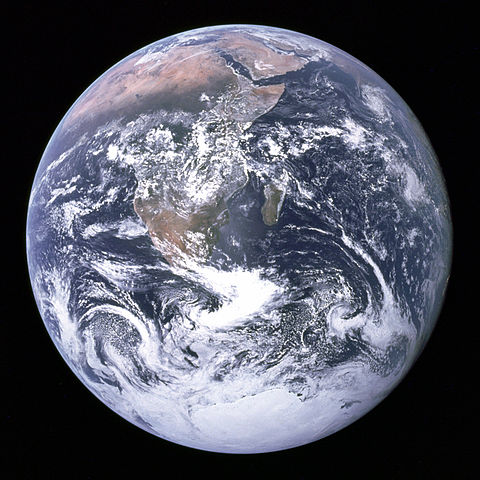
That film release date of the 7th December, 2012 was the 40th anniversary of the most famous photograph of Planet Earth taken on the 7th December, 1972: The Blue Marble.
The Earth seen from Apollo 17.
Original caption: “View of the Earth as seen by the Apollo 17 crew traveling toward the moon. This translunar coast photograph extends from the Mediterranean Sea area to the Antarctica south polar ice cap.
This is the first time the Apollo trajectory made it possible to photograph the south polar ice cap. Note the heavy cloud cover in the Southern Hemisphere. Almost the entire coastline of Africa is clearly visible. The Arabian Peninsula can be seen at the northeastern edge of Africa. The large island off the coast of Africa is Madagascar. The Asian mainland is on the horizon toward the northeast.”
The Blue Marble is a famous photograph of the Earth, taken on December 7, 1972, by the crew of the Apollo 17 spacecraft, at a distance of about 45,000 kilometres (28,000 mi).
The snapshot — taken by astronauts on December 7, 1972, at 5:39 a.m. EST (10:39 UTC) — is one of the most widely distributed photographic images in existence.
The image is one of the few to show a fully illuminated Earth, as the astronauts had the Sun behind them when they took the image. To the astronauts, Earth had the appearance and size of a glass marble, hence the name.
Back to that Overview film. Slightly confusing is the fact that the Planetary Collective website, where that Overview film is highlighted, is a different one to the associated Overview Institute website, from where one can read this Declaration:
A Critical Time
We live at a critical moment in human history. The challenges of climate change, food, water and energy shortages as well as the increasing disparity between the developed and developing nations are testing our will to unite, while differences in religions, cultures, and politics continue to keep us apart.
The creation of a “global village” through satellite TV and the Internet is still struggling to connect the world into one community. At this critical moment, our greatest need is for a global vision of planetary unity and purpose for humanity as a whole.
And to my mind the greatest need, the ONLY need, for that global vision is to move rapidly beyond our industrial and materialistic way of life to one where we live in harmony with our planet.
To pick up on what Ron Garan was quoted as saying, Planet Earth is a living, breathing organism. If the species man and thousands of other non-human species are to stand a chance of remaining on this living, breathing organism then You, Me and every other person out there, has to have a change of consciousness about the one and only place we live on.
So don’t flick over from those last words to the next thing in your life. Go back and look at the picture of our home, taken from Apollo 17. Make sure that you ask as many as you can to watch the Overview film above.
Finally, you be a person who makes a change in your consciousness. The rest is easy.
Back to dear old Albert E.
“No problem can be solved from the same level of consciousness that created it.“
How very precious, vulnerable and fragile is this precious place we call home.
Today’s consciousness perambulation is the fault of Mr. P., as I like to call him. I refer to Pendantry as he is on his blog, Wibble.
You see on Sunday he added a comment to my post Just a small, white dot! that included the beautiful and awe-inspiring film made by the late Carl Sagan called Pale Blue Dot.
Like millions of others, I came to admire Carl Sagan through watching the fabulous, the truly fabulous, television series Cosmos: A Personal Voyage.(NB. All the episodes are on YouTube, Episode One is at the end of this Post, Ed.) Here’s how WikiPedia opens their reference to Carl.
Carl Edward Sagan (November 9, 1934 – December 20, 1996) was an American astronomer, astrophysicist, cosmologist, author, science popularizer and science communicator in astronomy and natural sciences. He spent most of his career as a professor of astronomy at Cornell University where he directed the Laboratory for Planetary Studies.
He published more than 600 scientific papers and articles and was author, co-author or editor of more than 20 books. He advocated scientifically skeptical inquiry and the scientific method, pioneered exobiology and promoted the Search for Extra-Terrestrial Intelligence (SETI).
Sagan is known for his popular science books and for the award-winning 1980 television series Cosmos: A Personal Voyage, which he narrated and co-wrote. The book Cosmos was published to accompany the series. Sagan wrote the novel Contact, the basis for a 1997 film of the same name.
He died far too young and was a tragic loss to humanity. The Carl Sagan web portal is here.
That 3:30 minute video Pale Blue Dot has, likewise, been seen by millions. If you or someone you know hasn’t seen it, then you must pause now …
It’s practically impossible to watch that video and not embrace the central message from Mr. Sagan. Here’s the transcript:
Our home from 6 billion kilometres. A very tiny dot against the vastness of space.
From this distant vantage point, the Earth might not seem of any particular interest. But for us, it’s different.
Consider again that dot. That’s here. That’s home. That’s us.
On it everyone you love, everyone you know, everyone you ever heard of, every human being who ever was, lived out their lives.
The aggregate of our joy and suffering, thousands of confident religions, ideologies, and economic doctrines, every hunter and forager, every hero and coward, every creator and destroyer of civilization, every king and peasant, every young couple in love, every mother and father, hopeful child, inventor and explorer, every teacher of morals, every corrupt politician, every “superstar,” every “supreme leader,” every saint and sinner in the history of our species lived there – on a mote of dust suspended in a sunbeam.
The Earth is a very small stage in a vast cosmic arena.
Think of the rivers of blood spilled by all those generals and emperors so that in glory and triumph they could become the momentary masters of a fraction of a dot.
Think of the endless cruelties visited by the inhabitants of one corner of this pixel on the scarcely distinguishable inhabitants of some other corner. How frequent their misunderstandings, how eager they are to kill one another, how fervent their hatreds.
Our posturings, our imagined self-importance, the delusion that we have some privileged position in the universe, are challenged by this point of pale light. Our planet is a lonely speck in the great enveloping cosmic dark. In our obscurity – in all this vastness – there is no hint that help will come from elsewhere to save us from ourselves.
The Earth is the only world known, so far, to harbor life. There is nowhere else, at least in the near future, to which our species could migrate. Visit, yes. Settle, not yet. Like it or not, for the moment, the Earth is where we make our stand.
It has been said that astronomy is a humbling and character-building experience. There is perhaps no better demonstration of the folly of human conceits than this distant image of our tiny world. To me, it underscores our responsibility to deal more kindly with one another and to preserve and cherish the pale blue dot, the only home we’ve ever known.
Tomorrow, I will stay with the theme of our beautiful planet. Hope you can join me.
Now spoil yourself and watch Episode One of Cosmos.
“Fear comes from uncertainty. When we are absolutely certain, whether of our worth or worthlessness, we are almost impervious to fear.”William Congreve, English playwright and poet.
It’s Sunday (i.e. yesterday). I woke around 6am to a cold morning (28 deg F/-2.2 deg C), the result of a clear, moonlit night.
Then as the night sky lightened with the coming dawn, the green, forest-cloaked valleys, visible to the East through the bedroom windows filled with a white, morning mist. In a metaphorical sense that descending mist matched a mood of gloom that was trying to descend on me.
Early morning mist, taken 7:15 am Sunday, 24th Feb.
As I lay back against the headboard of the bed, Jean still sleeping close to me, dogs Cleo, Hazel and Sweeny snoozing on and around me, I pondered on my mood. It came to me that I might be picking up the growing sense of anxiety, of uncertainty, that seems to be ‘in the air’. Me reading too many blog articles about global warming, climate change, et al. Being three-quarters through Professor Guy McPherson’s book Walking Away from Empire: A Personal Journey wasn’t helping either!
Then I recalled a recent conversation with dear friend and colleague from our Payson, AZ. days, John Hurlburt, who said that fear is the absence of faith. That if we trust what will be will be, then we can counter the fear of the unknown and embrace the present day, one day at a time. Living in the now as, you’ve guessed it, that dogs do so supremely well. Something else to learn from dogs!
I made a decision to take a stroll in the forest, emotionally speaking, for this week, so far as Learning from Dogs is concerned. Enjoy the beauty of the world around me and offer a few essays on the meaning of life. No blog posts at all about anything that engenders fear from any quarter!
And if that doesn’t slash the readership figures, I don’t know what will! So there! You have been warned.
So let me start by offering this essay from John. John is one of those rare people who has been through more than his fair share of ‘challenges’ over the years, yet has grown from those experiences.
Here’s John – I’m turning over and going back to sleep!
oooOOOooo
Education, Formation and Transformation
Most Americans remain comfortably complacent despite world economic brinksmanship, the escalating deterioration of our planetary environment and raging world discontent. Although we may be caring and compassionate in our personal lives, we are often reluctant to take any risk of reducing our personal comfort.
Education is a process. A process of learning how to think life through in order to become aware of whom we are, what we are, where we are, and why we exist. Education has always been the human gateway to a better future.
Knowledge does not guarantee wisdom. Education, formation and transformation are an integrated process which includes studying to gain knowledge, making natural connections based on the best information available, and experiencing the higher levels of conscious awareness we recognize as wisdom. The educational process works best when it is open minded, factual and sustained. We learn best when we learn together.
The human wisdom tradition is rich in myth, mysticism, symbols, imagination and creativity. It tells a common story of emergence through centuries of sacred writings stretching back through time to the earliest human cave scratchings roughly 17,000 years ago, and the beauty of the prayers of the Rig-Veda 12,000 years ago which all begin with an homage to the natural energy of the Sun.
We’re conscious components of a living planet. We’re surface dwellers with exposure to universal and planetary energies. Our species is only 200,000 years old. The universe is roughly 13 billion years old. Our planet is deteriorating and we’ve lost our collective moral compass. What can we do to make a local difference?
We only recently learned to hunt woolly mammoths in packs using bows, arrows and spears as tools. A perception of God in relation to our responsibility to each other and creation exists as the foundation of a human wisdom tradition which, relatively speaking, has just began.
In many ways, nothing seems to have changed as we have passed through successive cyclic waves of emergence and contraction. It becomes simultaneously increasingly more complex and exquisitely simple to understand. That is as we begin to realize how our metanexus emerges, contracts and turns inside out without breaking … like a pulse.
The next ten years are more important than the next several thousand years in respect to the choices we make about our biosphere.
There seems to be little doubt that our world problems are steadily increasing. What’s the next right thing to do? It’s time to grow our conscious connection in God. It’s time to share the spring of human wisdom from the ground up. It’s time to develop a world economy which is gentle to the earth.
The Clearing Rests in Song and Shade
The clearing rests in song and shade.
It is a creature made
By old light held in soul and leaf.
By humans joy and grief,
By human work,
Fidelity of sight and stroke,
By rain, by water on
The parent stone.
We join our work to Heaven’s gift,
Our hope to what is left,
That field and woods at last agree
In an economy
Of widest worth.
High Heaven’s Kingdom come on earth,
Imagine Paradise
O dust, arise!
Wendell Berry; 1909
oooOOOooo
“The illiterate of the future will not be the person who cannot read. It will be the person who does not know how to learn.” Alvin Toffler







 Learning from Dogs
