Regular visitors to this blog probably now don’t notice my home page where I state, in part:
Dogs live in the present – they just are! Dogs make the best of each moment uncluttered by the sorts of complex fears and feelings that we humans have. They don’t judge, they simply take the world around them at face value. Yet they have been part of man’s world for an unimaginable time, at least 30,000 years.
Just as likely, I expect, readers do not go across to my sideline Dogs and integrity that includes, in part:
Dogs are part of the Canidae, a family including wolves, coyotes and foxes, thought to have evolved 60 million years ago. There is no hard evidence about when dogs and man came together but dogs were certainly around when man developed speech and set out from Africa, about 50,000 years ago. See an interesting article by Dr. George Johnson.
Recently Patrice Ayme published a post under the title of Neanderthal Superiority. In that post he set out very convincing arguments about the origins of the Neanderthals and I do recommend you read it in full.
However, what I would like to republish is the part of Patrice’s essay that explains the origins of the domesticated dog, as it is very different to what I have been presenting on Learning from Dogs. Here it is:
Previously unknown Neanderthal technologies are found every year. Neanderthals invented needle and thread, way back (80,000 years ago, at least; probably much older). Necessity was the mother of invention: Europeans (aka Neanderthals) needed clothing more than Africans did, as the latter wore none. Moreover, appropriate fibers are more easily found in the temperate zone (everything rots quickly in the very warm, wet tropics, including DNA).
NEANDERTHALS INVENTED DOGS, COAL BURNING, SHELL FISH DINING:
Some of the arguments against Neanderthals have been outright ridiculous: not only we were told, without any evidence, that they could not talk, but that the superiority of Africans came from eating shell fish, about 70,000 years ago (along the East Coast of Africa).
Neanderthals also used coal, as long ago as 73,000 years. Once again, making a fire in present day France, then suffering from a pretty bad glaciation, made more sense than trying to stay warm in the Congo.
Earlier and earlier prehistoric art has been found. It’s getting ever harder to claim that Neanderthals had nothing to do with it. This is from the enormous Chauvet cave in France, at least 32,000 years old:
If Not Neanderthal, Probably Mostly Neanderthal
(42,000 year old art was also found in Spain.)
Neanderthals also domesticated, and genetically engineered dogs, from European wolves. That’s very clear.
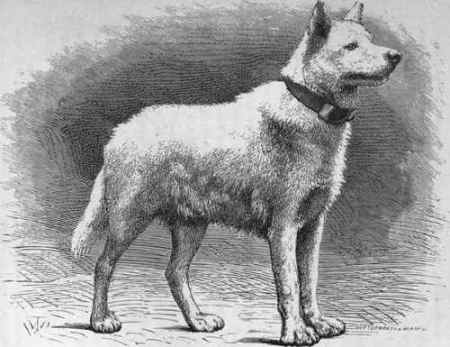
How do I know this? Simple. The Goyet dog, pictured below was dated around 32,000 years. In 2010, an even older dog was found in the Altai mountains. Both dogs were derived from Canis Lupus Familiaris, the European wolf, but were quite distant from it, genetically, they had been evolved probably on a time scale of more than 10,000 years, thus well before any arrival of Sapiens Sapiens from Africa.
Those dogs were completely compatible with people, just as contemporary dogs are. Proof? Ancient, 26,000-year-old footprints made by a child and a dog deep in the Chauvet Cave, France. (OK, by then Neanderthals had been deemed “extinct” by some… However, these are still the same dogs Neanderthals invented.)
It Took Many Thousands Years To Breed Such Large Dogs From European Wolves.
It is perplexing that other human groups did not domesticate the local canids. There are (still!) wolves in Africa and India. And also Lycaons (“African Wild Dogs”). Those are supremely intelligent, and sort of domesticate readily in the wild (I tried this myself as a child).
The argument that Africans would have moved to Europe to domesticate European wolves, when they had a similar fauna, including wolves, to domesticate in Africa, is simply extravagant.
In the next few days I will amend those static pages to incorporate this fascinating update to my knowledge. I shall also seek permission to republish the articles linked to by Patrice as they are full of detailed knowledge about the oldest man-animal relationship; by far!
Reflections on the Great March through Payson, Arizona.
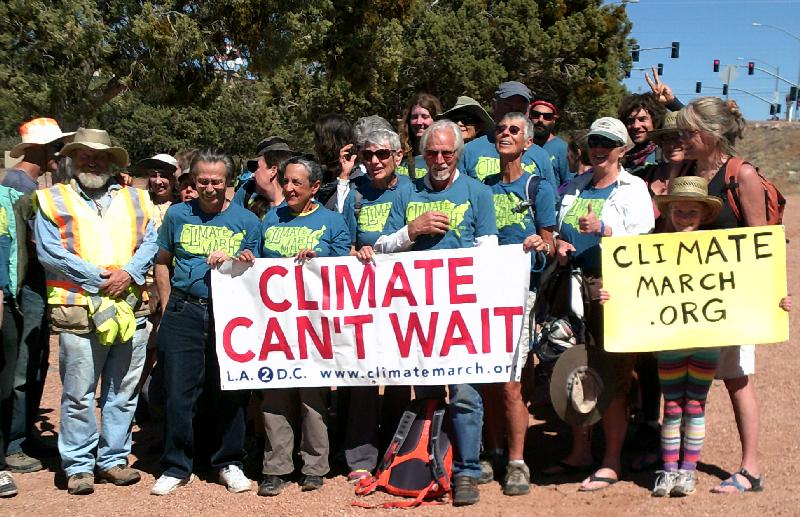
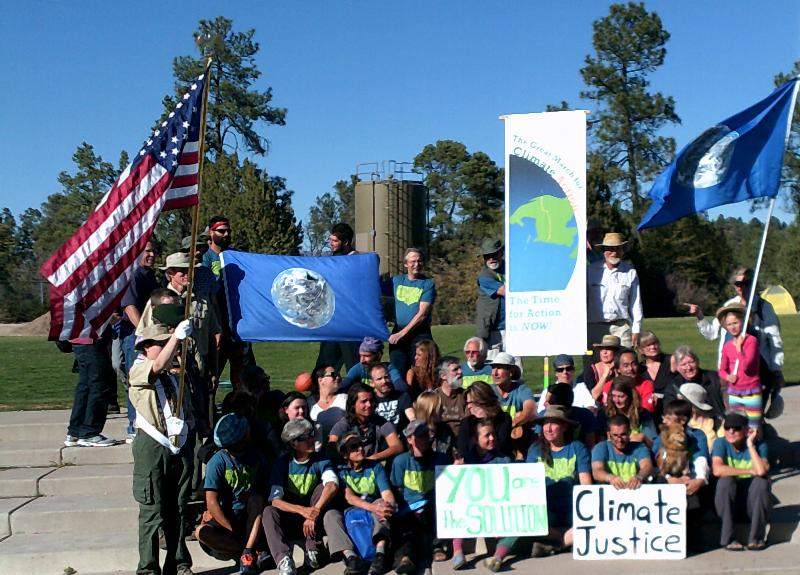
In yesterday’s post The Natural order I referred to Payson recently welcoming the Great March for Climate Action in their walk from Los Angeles to Washington D.C. I also referred to writing an essay on the event. That now follows, starting with a report from John Hurlburt, one of the organisers.
Thanks for your help for “the Great March for Climate Action”
“The Great March for Climate Action” arrived In Payson mid-afternoon on April 14. We had learned that the majority of the marchers are in the “younger” category (under 40), including two girls ages 10 and 12, walking for about a week of the journey with their Mom. But, impressively, quite a few are “AARP-ers”, in their 60’s and 70’s — walking all the way! Most of the group plans to continue on to Washington, D.C., being joined in various sections by hundreds of others! Our efforts aimed at making their brief visit to Payson as friendly and comfortable as possible.
They arrived at the meeting spot by the Event Center, having hiked up from near Rye, about twelve miles with significant elevation gain. Though weary, they were friendly and enthusiastic. Jim Speiser and family had set up their hot-dog cart, and we provided cold water and fresh fruit donated by Safeway — a case of huge premium oranges, and a case of bananas. The Marchers were delighted with the snacks, and extra fruit was given to their “chuck-wagon” for future days.
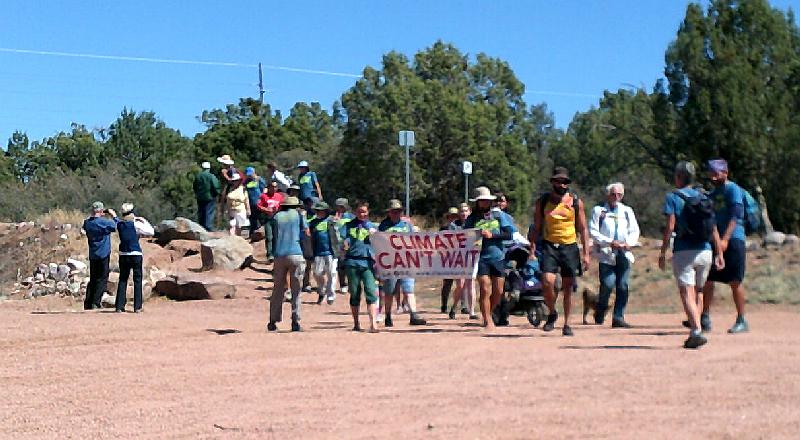
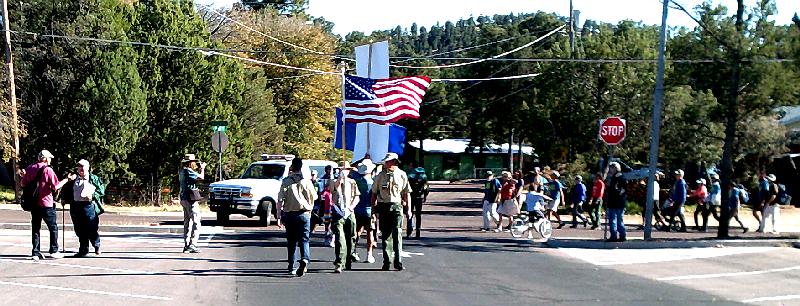
About ten local folk joined the Marchers on the two mile walk to the Payson Christian School, following their beautiful banners and signs. A local Boy Scout Color Guard led the procession and two Payson Police vehicles accompanied the March all the way. People in passing cars waved, smiled, honked and took pictures. Exhilarating and fun! A feature writer/photographer from the Payson Roundup covered the March, both along the route and at the school, where she took group photos and interviewed some of the participants.
Marchers who desired showers/clean laundry were transported to various Payson homes. Some of the group rested in their tents that were clustered on the sports field grass, and others helped with our dining room and kitchen set-up for the dinner. Food from our Payson volunteers began to arrive at five pm and by six the big buffet tables were loaded with delicious hot dishes, sides, snacks, beverages, salad and desserts, and the dining room was packed nearly to overflowing.
The evening opened with a Proclamation of welcome from the Mayor and Town Council, read by Ed Blair, and a prayer. John Hurlbert introduced the evening program that began with a talk about the History of Marches by Ray Spatti. Rob Ingram gave an overview of Payson, its achievements, water and forest issues, and future. Various participants in the March described their adventures, goals and dreams and asked about Payson’s outlook regarding environmental issues. Interacting with these dedicated Marchers was an education, a pleasure and an inspiration, perhaps motivating our Town to step ahead with sustainable solutions. In fact we heard that a young woman from here in Payson is going to join the “Great March”!
Our evening peaked with a delightful music performance by Cinnamon Twist and a sing-along. A number of Marchers were also musicians and they joined in with their instruments, resulting in a spontaneous “jam session” that brought the evening to a grand and joyful conclusion.
We couldn’t have done it without the amazing generosity and assistance from the Payson Christian School and their Staff, and without volunteers like you. Countless Marchers said they were overwhelmed by the friendly reception they received, and it was due to great team-work and local involvement. All the small things you did – offering showers, bringing food, walking with the Marchers, coming to the dinner – added up to a most memorable event. It is through small daily things that we can make a difference in our world — and all of you certainly have.
We can’t thank you enough!
The Organizational group for “The Great March for Climate Action” Payson visit 4-14-14: Ray Spatti, John Hurlburt, Jim Spieser, Dean Gooding and Vee Jeanne.
These were some photographs sent on by John.
oooo
oooo
oooo
But it’s no good just thinking how wonderful it was for Payson to be involved, and for the marchers in their nearly 3,000 mile walk from Los Angeles to Washington DC. Each of us who cares for a sustainable future on Planet Earth must make a difference. As is now a common plea: “Think globally: Act locally.”
One story that came out from the march through Payson struck me forcibly. MaryAnne, a good friend of this blog, offered, as did others, laundry and washing facilities to two young marchers. One of them, a young girl, was so committed to the message behind the march that she had vowed to remain silent from start to finish; the only exception being singing in the evenings. I was blown away by that commitment.
On March 1, 2014, 1,000 climate patriots will set-out from Los Angeles, CA, walking 2,980 miles across America to Washington, DC, inspiring and motivating the general public and elected officials to act now to address the climate crisis. This will be the largest coast-to-coast march in American history.
Credits:
Director, Producer and Chief Editor: Zach Heffernen
Script Writer: Melvin Baker
Studio Manager: Maddie Kain
Voice 1: Ed Fallon
Voice 2: Maddie Kain
Voice 3: Jami Bassman
Voice 4: Zach Heffernen
Editor: Ed Fallon
Editor: Shari Hrdina
Editor: Courtney Kain
Inspired by hearing a young boy shoot a wild turkey early on Saturday morning.
Preface
Because we have horses, friends living close to us called to warn that early on Saturday morning, a young lad, accompanied by his father, would be experiencing what it was like to shoot a wild turkey at close range. The turkeys are easy targets; almost pets.
So it was that around 6:30am last Saturday morning that a single shot rang out and we knew that a turkey had been killed. Now in fairness to American history it’s not that long ago that the early settlers relied on hunting to survive. The first permanent European settlement in Oregon wasn’t until 1811. Thus hunting may be something close to the American’s heart; so to speak. However, this eight-year-old lad is facing a future that demands that he and all his generation accept that embracing nature, totally and whole-heartedly, is their only hope of not being the last generation of humans on this beautiful planet.
Jean and I thought the following was an appropriate way of expressing our feelings.
ooOOoo
Dear Jimmy,
What was it like to point your gun at that turkey and pull the trigger? What did you feel as you saw the bullet hit and the turkey fall to the ground?
Now I wasn’t there with you, of course, but I could imagine the thrill and excitement that you would have felt. Not many young lads of your age get to handle a gun and shoot a turkey.
But Jimmy, what we feel as an eight-year-old is a very poor indicator for what we feel when we are much older. Possibly the only exception is love, which is a golden feeling at any age.
So, if you will forgive this sixty-nine-year old from reading an eight-year-old a very short bedtime story, I will get started.
The world, this enormous world, must seem infinitely huge to you. Even if you stand on the shoulders of your Dad, your eyes ten feet above the ground, the horizon is just four miles away. You could run to that horizon in less than an hour. However, to run all the way around the world at that same speed would take you, dear Jimmy, nearly two hundred and sixty days of running; running twenty-four hours a day! It’s a very big planet!
Look at this wonderful picture of our planet. Have you ever seen anything more beautiful!
It must seem to you that there is nothing an eight-year-old could do to harm this planet we all live on.
That’s true! There is nothing you could do to harm the planet.
However, when you get older and reach the point where you have a job, drive a car, fly to places on an aeroplane, heat your house and a million other things that we grown-ups do, then all of us together, all the millions of people living on this green planet can hurt it.
Indeed, Jimmy, you may have already heard of things like climate change and global warming being spoken about on the television. All of the people living on this planet are hurting it. And the people who are really going to see how we humans are hurting the planet, and how the planet is changing, are all the people who, like you Jimmy, are not yet even finished school.
So what does shooting a wild turkey have to do with caring for your planet throughout the many years ahead for you?
If we care for nature then we care for the health of our lands, for our forests and for our seas. We are careful with how we live our lives. If we care for nature then as we live our lives we do our best to leave things better for those that come after us.
Jimmy, sleep well my young man. Wake knowing the death of that turkey was not in vain. Wake with love in your heart. Love for every living creature.
Only love for all creatures will offer all creatures a future.
One might be forgiven for thinking that community is an odd bed-fellow with trust and truth. Many might think that faith would be a more logical third leg, so to speak.
However, I hope to show that in today’s world where trust and truth are beleaguered qualities a rethinking of community is critically vital for the long-term health of mankind.
Community
Can’t resist a third look-up in Roget’s Thesaurus.
community noun
Persons as an organised body: people, public, society.
For me two words jump out from that definition: persons; organised.
The challenge is that the word organised is easily interpreted as an organisation with leaders and followers. But that’s not how community is regarded in the context of this third essay.
“No man is an island”, John Donne wrote in 1624.
This is a quotation from John Donne (1572-1631). It appears in Devotions upon emergent occasions and seuerall steps in my sicknes – Meditation XVII, 1624:
“All mankind is of one author, and is one volume; when one man dies, one chapter is not torn out of the book, but translated into a better language; and every chapter must be so translated…As therefore the bell that rings to a sermon, calls not upon the preacher only, but upon the congregation to come: so this bell calls us all: but how much more me, who am brought so near the door by this sickness….No man is an island, entire of itself…any man’s death diminishes me, because I am involved in mankind; and therefore never send to know for whom the bell tolls; it tolls for thee.”
Thus for the vast majority of people on the face of this planet, we are linked to others and how we live our lives is fundamentally influenced by those others about us. In a past life, I lived in the village of Harberton in South Devon. The population of Harberton was 300 persons.
An E. M. Morison (Totnes) postcard, bearing a 3p stamp, which gives a sending date between Feb 1971 and Sept 1973.
Now I was lucky when I moved into Harberton because my two sisters, Rhona and Corinne, had lived in the area for many years and it was easy for me to be positioned as ‘the brother’. Nevertheless, the way that the village embraced all newcomers was wonderful and within a very short time one felt a settled member of the community.
Same for Jean and me as relative newcomers to our property just 4 miles from Merlin, Oregon. All of our neighbours have embraced us and helped us understand this new rural life that we have embarked on. We feel part of the local community.
Yet it doesn’t stop there.
Obviously, I’m a WordPress user! Learning from Dogs is a WordPress blog! But were you aware of the size of the WordPress community? (As of now!)
How many posts are being published?
Users produce about 44.5 million new posts and 56.7 million new comments each month.
How many people are reading blogs?
Over 409 million people view more than 14.7 billion pages each month.
Even my funny little blog has 959 followers!
What that figure doesn’t reveal is how many of my followers have offered support, openness and real loving friendship. None better demonstrated than by the comments left by readers when I announced the recent death of Dhalia.
Think of the way that untold numbers of internet users rely on that ‘worldwide web’ for referrals, opinions or knowledge about anything ‘under the sun’.
So while there might be many aspects of our new technological world that create unease, the opportunities for having ‘virtual’ friends to complement our social friends make this era unprecedented.
I would go so far as to say this. That the way that knowledge and information can be shared around the world in no time at all may be our ultimate protection against those who would seek to harm us and this planet.
How to close these essays? Perhaps no better than as follows:
On Wednesday evening we were joined by neighbours, Dordie and Bill. My post on truth came up in discussion. Bill mentioned that he had read about a person who had spent many years studying the texts of all the world’s major religions. What had emerged was that across all those great religions there was a common view as to what the long-term health and survival of societies requires.
It is this: the telling of truth and the keeping of promises!
Musings on truth and the corrosive nature of fear.
Yesterday, in Part One, I explored how easy it is to signal to the public that they are not to be trusted. I used the case of PayPal’s changes to their ‘privacy’ policy which, as Wolf Richter wrote, only partially tongue-in-cheek perhaps, made “the NSA, which runs the most expansive spying dragnet in history, is by comparison a group of choirboys.”
Truth
Again, back to Roget’s Thesaurus.
truth noun
1. Correspondence with fact or truth: accuracy, correctness, exactitude, exactness, fidelity, veraciousness, veracity
2. Freedom from deceit or falseness: truthfulness, veracity
So that’s all clear then!
If only it was that easy. So many aspects of our modern lives are exposed to complex issues. None more complex than, of course, the issue of humans having a damaging effect on the planet’s climate. Or if one wants something more esoteric then try the origins of the universe. (So far as the former is concerned, then my personal belief is that mankind is damaging the global climate. But do I have the scientific background to support that belief? No Sir!)
However, one thing that our complex society does offer is the opportunity to spread fear. Indeed, fear pervades popular culture and the media. I picked up that theme from an essay published by David L. Altheide and R. Sam Michalowski of Arizona State University.
Fear pervades popular culture and the news media. Whether used as a noun, verb, adverb, or adjective, an ongoing study finds that the word “fear” pervades news reports across all sections of newspapers, and is shown to move or “travel” from one topic to another. The use of fear and the thematic emphases spawned by entertainment formats are consistent with a “discourse of fear,” or the pervasive communication, symbolic awareness and expectation that danger and risk are a central feature of the effective environment. A qualitative content analysis of a decade of news coverage in The Arizona Republic and several other major American news media (e.g., the Los Angeles Times, and ABC News) reveals that the word “fear” appears more often than it did several years ago, particularly in headlines, where its use has more than doubled. Comparative materials obtained through the Lexis/Nexis information base also reveals that certain themes are associated with a shifting focus of fear over the years (e.g., violence, drugs, AIDS), with the most recent increases associated with reports about children. Analysis suggests that this use of fear is consistent with popular culture oriented to pursuing a “problem frame” and entertainment formats, which also have social implications for social policy and reliance on formal agents of social control.
No passion so effectually robs the mind of all its powers of acting and reasoning as fear. [my italics]
That last sentence offers the words of Edmund Burke, the Irish statesman and author from over 200 years ago. So, perhaps, nothing changes in this regard!
In my old country, the British press love to sell their newspapers on the back of fear. Here are some examples of lurid front pages.
oooo
oooo
However, it doesn’t end there. Fear of the unknown, of forces beyond our control, are behind the incredible number of conspiracy theories, many of them quite famous. WikiPedia lists dozens of them. One that was voiced by friends of ours concerned HAARP, which is an acronym for High Frequency Active Auroral Research Program. It was a perfectly legitimate research programme, one that was unclassified, albeit a program that was shut down in July, 2013.
But that didn’t stop it being regarded by many as deeply suspicious, “Many conspiracy theories surround HAARP. Some theorists believe that it is being used as a weather-controlling device that can trigger catastrophic events, such as floods, hurricanes, etc. Others believe that the government uses HAARP to send mind-controlling radio waves to humans.” Taken from here.
As it happens, this was a programme that I was acquainted with back in my UK days.
OK, time to round this off.
This new, digital world allows the sharing and spreading of information in a manner unimaginable from, say, 25 years ago. It has many positive attributes, as I will touch upon in tomorrow’s post. But it also has the power to spread fear and misinformation. In a world that is becoming more complex and more uncertain year by year, it takes effort by every one of us to stop, think and check on anything that has the potential to upset one.
It takes the power of community to keep us rooted in the stuff of our daily lives, to live calmly and stay in touch with the truth. More on the power of community tomorrow.
Yesterday, I posted about the prediction that in four billion years the Milky Way galaxy would collide with the Andromeda galaxy. I called the post Not of immediate concern.
Today, I am writing about something that is of immediate concern. That is if you regard the next couple of decades as ‘immediate’.
The post is prompted by an item that was published on the BBC News website two days ago. It carried the title Climate inaction catastrophic – US
Climate inaction catastrophic – US
By Matt McGrath
Environment correspondent, BBC News, Yokohama, Japan
The costs of inaction on climate change will be “catastrophic”, according to US Secretary of State John Kerry.
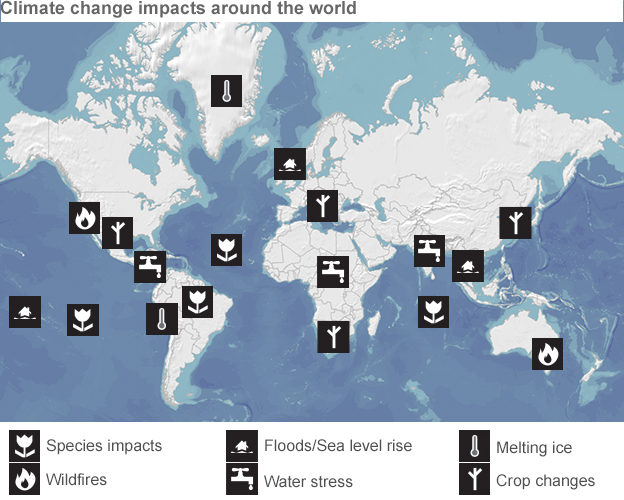
Mr Kerry was responding to a major report by the UN which described the impacts of global warming as “severe, pervasive and irreversible”.
He said dramatic and swift action was required to tackle the threats posed by a rapidly changing climate.
Our health, homes, food and safety are all likely to be threatened by rising temperatures, the report says.
Scientists and officials meeting in Japan say the document is the most comprehensive assessment to date of the impacts of climate change on the world.
In a statement, Mr Kerry said: “Unless we act dramatically and quickly, science tells us our climate and our way of life are literally in jeopardy. Denial of the science is malpractice. There are those who say we can’t afford to act. But waiting is truly unaffordable. The costs of inaction are catastrophic.”
Putting to one side the mild irony of a representative of the US Government wringing his hands about what mankind is doing to our climate, the report is valuable and potentially significant.
The report was from the Intergovernmental Panel on Climate Change (IPCC) which is, as their website explains:
The Intergovernmental Panel on Climate Change (IPCC) was established by the United Nations Environmental Programme (UNEP) and the World Meteorological Organization (WMO) in 1988 to assess the scientific, technical and socio-economic information relevant for the understanding of human induced climate change, its potential impacts and options for mitigation and adaptation.
Watch this 5-minute video of Stanford professor Dr. Chris Field, co-chair of that IPCC working group, addressing some of the key questions raised by this latest report. In particular, focus on Dr. Field discussing the potential of the loss of the Greenland ice cap around 3 min 30 seconds.
Back to the BBC report (which you should read in full!). Back to Dr. Chris Field being quoted as saying:
I think the really big breakthrough in this report is the new idea of thinking about managing climate change as a problem in managing risks. Climate change is really important but we have a lot of the tools for dealing effectively with it – we just need to be smart about it.
It would be easy to get into the mindset that humanity is not going to change its ways in time.
But, then again, the pace of growing awareness about what the changes are that we all need to make, and make relatively soon, is dramatic.
Maybe, just maybe, this will turn out alright!
For all the young people in the world, I do so hope!
But being careful about what our dogs eat is another story!
This is not the first time that I have used this title for a blog post. The previous time was almost eighteen months ago when I highlighted a fascinating talk about the green revolution by Raj Patel, the award-winning writer, activist, and academic.
However, today is a first in that it looks at what our dogs eat. It was inspired by a recent article by Brady Dennis in the Washington Post. Here’s how that article opened:
Mystery of pet deaths related to jerky treats made in China continues to stump FDA
By Brady Dennis, Published: March 28
Andy lost his appetite. Then came the vomiting, the unquenchable thirst, the constant need to urinate. Over several days last year, the spunky 4-year-old West Highland white terrier grew lethargic and lost more than 10 percent of his weight.
“It got bad,” said Andy’s owner, Alfredo Gude, a retiree in Cape Coral, Fla. “I knew that he was in trouble.”
Gude and his wife rushed Andy to their veterinarian, who referred him to a clinic 15 miles away. Doctors there sent a urine sample to a specialized metabolic lab at the University of Pennsylvania. Days later, test results confirmed the diagnosis: Fanconi syndrome, a rare, often fatal illness that affects the kidneys. The suspected cause: chicken jerky pet treats manufactured in China.
The incident is part of a troubling mystery lasting more than seven years, with reports of at least 600 dogs dying and thousands of others sickened. It has outraged unsuspecting pet owners, confounded the Food and Drug Administration and put the pet food industry’s manufacturing practices under a microscope.
A little later on in the article, Brady Dennis writes:
Bernadette Dunham, director of the FDA’s Center for Veterinary Medicine, has called it “one of the most elusive and mysterious outbreaks we’ve encountered,” a sentiment echoed by others at the agency.
“We are frustrated,” said Martine Hartogensis, who oversees the FDA’s ongoing investigation. “It’s been a long, winding, twisting road . . . [But] we haven’t given up.”
The FDA says it has tested more than 1,200 jerky treats in recent years, looking for salmonella, mold, pesticides, toxic metals, outlawed antibiotics, nephrotoxins and other contaminants. Federal officials have inspected factories in China that manufacture chicken jerky products for U.S. companies and sought input from academics, state and university research labs, foreign governments and the pet food industry. The agency even made its own jerky treats to try to duplicate the commercial process.
This is not some minor issue reinforced by the huge increase in dog food imports into the USA from China. Back to Brady:
The long-running investigation has paralleled a striking increase in the amount of pet food China exports to the United States. That volume increased from barely 1 million pounds in 2003 to an estimated 86 million pounds by 2011, according to the FDA.
Pet treats, including the jerky treats at the heart of the current investigation, have made up a fast-growing sliver of the pet food market. Part of the reason many U.S. companies have looked to China to produce chicken jerky treats, industry officials say, is that unlike in America, people in China overwhelmingly prefer dark meat. That leaves a larger supply of the white meat used in pet treats available for exporting.
Then a few paragraphs later, he adds:
“It’s maddening that it has gone on this long,” said Susan Thixton, who runs the Web site TruthAboutPetFood.com, which has repeatedly demanded that the agency do more. “If this were humans dying, and they couldn’t figure out a cause for seven years, members of Congress would be screaming at them.”
The home page of her site displays a clock tracking how long jerky treats from China have been killing and sickening pets. It asks: “When will FDA make this clock stop?” As of Friday, the count stood at 2,643 days.
“My job is to point out that they aren’t doing their job,” Thixton said. “I have a lot of respect for what they have to accomplish. They have huge responsibilities, but this is one of them.”
When I read out the article to Jean what then jumped ‘off the page’ was this paragraph [my emphasis]:
Angry pet owners also have heaped criticism on U.S. companies that continue to manufacture jerky treats with ingredients from China. The backlash includes everything from skepticism over the industry’s assurances that the treats have never posed health risks to lawsuits alleging harm.
As Susan Thixton was reported earlier: “If this were humans dying, and they couldn’t figure out a cause for seven years, members of Congress would be screaming at them.” Quite so!
Luckily, owners are responding as Brady highlights in these paragraphs:
Nina Leigh Krueger, head of the Waggin’ Train brand, said most retailers and customers have welcomed the treats back. “Thousands of consumers have been calling and asking us for Waggin’ Train treats to be back on the market,” she said.
Terry Safranek is not one of them.
“It’s a kick in the gut to see them back on the shelf,” said Safranek, whose 9-year-old fox terrier, Sampson, who had eaten jerky treats, died of kidney failure in 2012. Since then, Safranek has become a plaintiff in a class-action lawsuit against Nestlé Purina and retailers including Target and Wal-Mart. She helped create Animal Parents Against Pet Treats and Food Made in China, a group that has petitioned the FDA to do better in alerting people about the potential dangers of jerky treats produced in Chinese factories.
The link in the last paragraph takes the reader to the Facebook page for that group. Do go there and ‘Like’ the page.
I will close by recommending you read the Washington Post article in full and then spend some time perusing the website Truth about Pet Food. This is not just about ‘Made in America’ but fighting to ensure that animal treats made in the USA are also using ingredients from the USA!
Remember how Brady opened his article? With Alfredo Gude learning that their dog, Andy, had been diagnosed with Fanconi syndrome, a rare and often fatal illness that affects the kidneys of dogs.
Well last words left with Brady Dennis:
For now, on Florida’s west coast, Andy the terrier has returned to normal after months of treatments — about $3,500 worth — to restore his kidney function. “We feel very lucky,” said Gude, who has taken the advice of many vets around the country to steer clear of pet jerky treats altogether. “It could have gone another way.”
Our dogs (and cats) have a right to be fed to the same standards as us humans!
A whole clutch of things happened yesterday to conspire in me running out of creative time. Indeed, it was after 4pm when I sat down in front of my computer wondering about today’s LfD blog post.
Luckily (well for me!), amongst the list of draft posts was this one from January 1st, 2014. So I cheated by grabbing it and offering it for you today. I just hope you find it of interest. It was originally presented on Big Think on the 1st January, 2014.
According to the Anno Domini designation, the year is now 2014. But the Earth has been around a lot longer than that – about 4.567 billion years. The first evidence of life dates back to around 3.8 billion years ago. Homo sapiens first appeared on the planet around two hundred thousand years – or ten thousand generations – ago.
How’s that for perspective?
Kirk Johnson, director of the National Museum of Natural History, calls this perspective “deep time.” This is the story of our planet preserved in “the DNA of living things,” Johnson explains, as well as “in the fossils we find, in the geologic structures of our planet, in the meteorites we scavenge from the ice fields in Antarctica. Those things together give us an incredible manual for thinking about the planet.”
Why is this manual useful? We are facing a century that will be an incredibly challenging one for humanity. We now live on a planet with seven billion people, which is up from 1.7 billion people just three or four generations ago. So we have more people, and a greater need for resources.
Fortunately we have the bodies of extinct plants and animals that lived for the last three-and-a-half billion years. These fossils are not only a source of energy, but also a source of knowledge about how this planet works. Over its history the Earth has seen an incredible diversity of life – maybe as many as fifty million species. Johnson says we’re learning “as much about the evolution of life on Earth by looking at what happened in the past as we are at looking at the breakthroughs in genomics and DNA of living things.” Furthermore, Johnson sees the sequencing of the human genome as the vanguard for what will eventually be “the study of the genomics of all living things.”
We have the opportunity right now, Johnson says, to choose what our future will be. Our understanding of the diversity of life on this planet, he says, will be our guide. This story is being told at a current exhibition at the National Museum of Natural History called “Genome: Unlocking Life’s Code.”
In the video below, Johnson shares a unique perspective on deep time in the form of a timeline of life on this planet in just three minutes.
ooOOoo
Don’t know about you but I found the video fascinating.
Yesterday, I published a post and called it Dogs and wolves – fascinating research. Then blow me down in yesterday’s online BBC News, there was an article headlined: Dogs’ brain scans reveal vocal responses This is how it opened.
Dogs’ brain scans reveal vocal responses
By Rebecca Morelle, Science reporter, BBC World Service
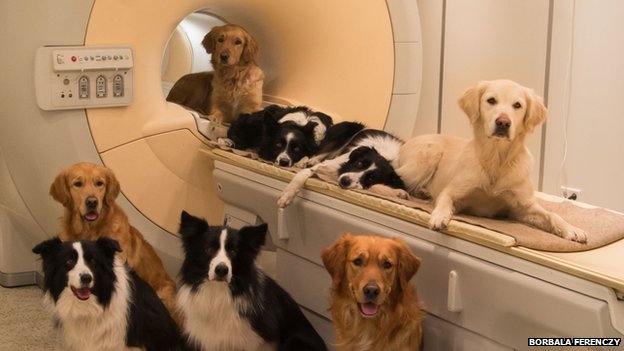
Pet dogs took part in the MRI scanning study.
Devoted dog owners often claim that their pets understand them. A new study suggests they could be right.
By placing dogs in an MRI scanner, researchers from Hungary found that the canine brain reacts to voices in the same way that the human brain does.
Emotionally charged sounds, such as crying or laughter, also prompted similar responses, perhaps explaining why dogs are attuned to human emotions.
Lead author Attila Andics, from the Hungarian Academy of Science’s Eotvos Lorand University in Budapest, said: “We think dogs and humans have a very similar mechanism to process emotional information.”
Eleven pet dogs took part in the study; training them took some time.
During the approximately 18–32 thousand years of domestication [1], dogs and humans have shared a similar social environment [2]. Dog and human vocalizations are thus familiar and relevant to both species [3], although they belong to evolutionarily distant taxa, as their lineages split approximately 90–100 million years ago [4]. In this first comparative neuroimaging study of a nonprimate and a primate species, we made use of this special combination of shared environment and evolutionary distance. We presented dogs and humans with the same set of vocal and nonvocal stimuli to search for functionally analogous voice-sensitive cortical regions. We demonstrate that voice areas exist in dogs and that they show a similar pattern to anterior temporal voice areas in humans. Our findings also reveal that sensitivity to vocal emotional valence cues engages similarly located nonprimary auditory regions in dogs and humans. Although parallel evolution cannot be excluded, our findings suggest that voice areas may have a more ancient evolutionary origin than previously known.
The canine brain reacted to voices in the same way that the human brain does.
“There were 12 sessions of preparatory training, then seven sessions in the scanner room, then these dogs were able to lie motionless for as long as eight minutes. Once they were trained, they were so happy, I wouldn’t have believed it if I didn’t see it.”
For comparison, the team looked at the brains of 22 human volunteers in the same MRI scanners.
The scientists played the people and pooches 200 different sounds, ranging from environmental noises, such as car sounds and whistles, to human sounds (but not words) and dog vocalisations.
The researchers found that a similar region – the temporal pole, which is the most anterior part of the temporal lobe – was activated when both the animals and people heard human voices.
“We do know there are voice areas in humans, areas that respond more strongly to human sounds that any other types of sounds,” Dr Andics explained.
“The location (of the activity) in the dog brain is very similar to where we found it in the human brain. The fact that we found these areas exist at all in the dog brain at all is a surprise – it is the first time we have seen this in a non-primate.”
Emotional sounds, such as crying and laughter also had a similar pattern of activity, with an area near the primary auditory cortex lighting up in dogs and humans.
Likewise, emotionally charged dog vocalisations – such as whimpering or angry barking – also caused a similar reaction in all volunteers,
Dr Andics said: “We know very well that dogs are very good at tuning into the feelings of their owners, and we know a good dog owner can detect emotional changes in his dog – but we now begin to understand why this can be.”
However, while the dogs responded to the human voice, their reactions were far stronger when it came to canine sounds.
They also seemed less able to distinguish between environmental sounds and vocal noises compared with humans.
About half of the whole auditory cortex lit up in dogs when listening to these noises, compared with 3% of the same area in humans.
Commenting on the research, Prof Sophie Scott, from the Institute of Cognitive Neuroscience at University College London, said: “Finding something like this in a primate brain isn’t too surprising – but it is quite something to demonstrate it in dogs.
“Dogs are a very interesting animal to look at – we have selected for a lot of traits in dogs that have made them very amenable to humans. Some studies have show they understand a lot of words and they understand intentionality – pointing.”
But she added: “It would be interesting to see the animal’s response to words rather than just sounds. When we cry and laugh, they are much more like animal calls and this might be causing this response.
For the full report, as it was posted on the BBC website, click here.
Plus, do watch this five-minute video abstract.
Published on Feb 20, 2014
The video presents the first study to compare brain function between humans and any non-primate animal. Scientists at MTA-ELTE Comparative Ethology Research Group in Hungary found that dogs and humans use similar neural mechanisms to process social information in voices. The fact that dogs can be trained to lie motionless during fMRI tests opens up the space for a new branch of comparative neuroscience.
The first study to compare brain function between humans and any non-primate animal shows that dogs have dedicated voice areas in their brains just as people do. Dog brains, like those of people, are also sensitive to acoustic cues of emotion, according to a study in the Cell Press journal Current Biology.
The findings suggest that voice areas evolved at least 100 million years ago, the age of the last common ancestor of humans and dogs, the researchers say. It also offers new insight into humans’ unique connection with our best friends in the animal kingdom, perhaps explaining how our two species have lived and worked together so effectively for tens of thousands of years.
“Our findings suggest that dogs and humans not only share a similar social environment, but they also use similar brain mechanisms to process social information,” said Atilla Andics of MTA-ELTE Comparative Ethology Research Group in Hungary. “This may help the successfulness of vocal communication between the two species.”
Andics and his colleagues trained eleven dogs to lay motionless in an fMRI brain scanner. That made it possible to run the very same neuroimaging experiment on dog and human participants — something that had never been done before. They captured both dogs’ and humans’ brain activities while they listened to dog and human sounds, ranging from whining or crying to playful barking or laughing.
The images show that dog and human brains include voice areas in similar locations. Not surprisingly, the voice area of dogs responds more strongly to other dogs, while that of humans responds more strongly to other humans. The researchers also noted striking similarities in the ways the dog and human brain processes emotionally loaded sounds. In both species, an area near the primary auditory cortex lit up more with happy sounds than unhappy ones. Andics said they were most struck by the common response to emotion across species.
There were some differences too: in dogs, 48 percent of all sound-sensitive brain regions respond more strongly to sounds other than voices. That’s in contrast to humans, in which only three percent of sound-sensitive brain regions show greater response to non-vocal versus vocal sounds.
The study is the first step to understanding how it is that dogs can be so remarkably good at tuning into the feelings of their human owners. “This method offers a totally new way of looking at neural processing in dogs,” Andics said. “At last we begin to understand how our best friend is looking at us and navigating in our social environment.”
I have been saving this report for a few weeks. Following yesterday’s great news about the latest concerning wolves in Oregon, today seemed a perfect follow-on with a report first published in online journal PLOS ONE. However, what follows is a full republication of the report as I read it on the Science Daily website.
ooOOoo
Teaching young wolves new tricks: Wolves are considerably better imitators than dogs
Date: January 31, 2014
Source: Veterinärmedizinische Universität Wien
Summary: Although wolves and dogs are closely related, they show some striking differences. Scientists have undertaken experiments that suggest that wolves observe one another more closely than dogs and so are better at learning from one another. The scientists believe that cooperation among wolves is the basis of the understanding between dogs and humans.
Wolves are considerably better imitators than dogs. Credit: Walter Vorbeck
Although wolves and dogs are closely related, they show some striking differences. Scientists from the Messerli Research Institute at the University of Veterinary Medicine, Vienna have undertaken experiments that suggest that wolves observe one another more closely than dogs and so are better at learning from one another. The scientists believe that cooperation among wolves is the basis of the understanding between dogs and humans.
Their findings have been published in the online journal PLOS ONE.
Wolves were domesticated more than 15,000 years ago and it is widely assumed that the ability of domestic dogs to form close relationships with humans stems from changes during the domestication process. But the effects of domestication on the interactions between the animals have not received much attention. The point has been addressed by Friederike Range and Zsófia Virányi, two members of the University of Veterinary Medicine, Vienna (Vetmeduni Vienna) who work at the Wolf Science Center (WSC) in Ernstbrunn, Niederösterreich.
Wolves copy other wolves solving problems
The scientists found that wolves are considerably better than dogs at opening a container, providing they have previously watched another animal do so. Their study involved 14 wolves and 15 mongrel dogs, all about six months old, hand-reared and kept in packs. Each animal was allowed to observe one of two situations in which a trained dog opened a wooden box, either with its mouth or with its paw, to gain access to a food reward. Surprisingly, all of the wolves managed to open the box after watching a dog solve the puzzle, while only four of the dogs managed to do so. Wolves more frequently opened the box using the method they had observed, whereas the dogs appeared to choose randomly whether to use their mouth or their paw.
Watch closely …
To exclude the possibility that six-month old dogs fail the experiment because of a delayed physical or cognitive development, the researchers repeated the test after nine months. The dogs proved no more adept at opening the box than they were at a younger age. Another possible explanation for the wolves’ apparent superiority at learning is that wolves might simply be better than dogs at solving such problems. To test this idea, the researchers examined the animals’ ability to open a box without prior demonstration by a dog. They found that the wolves were rarely successful. “Their problem-solving capability really seems to be based on the observation of a dog performing the task,” says Range. “The wolves watched the dog very closely and were able to apply their new knowledge to solve the problem. Their skill at copying probably relates to the fact that wolves are more dependent on cooperation with conspecifics than dogs are and therefore pay more attention to the actions of their partners.”
The researchers think that it is likely that the dog-human cooperation originated from cooperation between wolves. During the process of domestication, dogs have become able to accept humans as social partners and thus have adapted their social skills to include interactions with them, concomitantly losing the ability to learn by watching other dogs.












 Learning from Dogs