Category: Education

The making of a scent dog.

A guest post from Bryony Ravate.

To be honest there are times when I struggle to come up with something original in terms of blogging. And it is at these times of life that I am very grateful for the offer of a guest post. Take Bryony for example. This is not the first time that I have presented her work but I am forever grateful for her so doing.

This is her article on scent dogs.

ooOOoo

The making of a scent dog.

By Bryony Ravate, January 2nd, 2020

If you’ve been lucky enough to be around dogs, you will have probably noticed how their noses are always moving. By possessing a nose up to 15x times more sensitive than our own, with 600,00 neurones, they can sniff out different components in every room. When you’re cooking a meal, you will be able to recognise the smell of a dish. But when your dog smells the meal, he can smell each individual spice and seasoning, the oils, the crockery and even any water.
You can use your dogs’ keen sense of smell for play – laying out different scents for them to explore. But their noses can also be used for working environments– such as in airports, with the police and in search and rescue missions. They can track down suitcases hiding illegal substances, follow the suspect of a crime and sniff out the victims of a snowstorm. To become scent dogs, the canines go through vigorous training. However, although all dogs have an exceptional sense of smell, not all dogs make it through training.

It makes sense to analyse what leads to success and failure in scent dog training. So, a keen researcher at University College Cork, Ireland performed a literature review in which factors behind success and failure in scent dog training were analysed. A literature review is the process whereby you search a database full of information (usually research articles published in reputable journals) and you extrapolate the information to create your own source. Here, I’m going to pull together some of the points I found the most interesting, points you may not think would affect the making of a scent dog.

Personality

Dogs with strong motivation to play or search, dogs which were bold rather than shy, and dogs which can adapt and cope with stressful stimuli are more likely to become scent dogs. High motivation to play or search, makes a dog easier to train. Play can be used as a reward, by allowing the dog to pull on a chew toy after being successful in a trial. Finding scents may be perceived as a game to the dog, increasing his motivation to engage. Bold dogs are less unnerved by new surroundings and situations. A nervous dog may be hesitant about pursuing an unknown scent – but a bold dog will take little hesitation. Adaptable dogs may be able to apply their knowledge to different situations and they will be unphased by commotions and will keep working when faced with distractions.

Housing Standards

Dogs that live in enriched environments throughout their training have increased ability in trials. Like children, the more opportunities you offer your dogs to learn, explore and interact with their environment, the more it allows them to develop and grow. Dogs should feel secure in their home environment when not working; keeping them with other dogs and in bright rooms without using loud cleaning equipment (such as hoovers) will make them less anxious, leading to better accuracy in scent trials.

The Human Partner

Dogs emotions are often intertwined with their handlers. When a dog’s owner gets angry, the stress hormones in the dog increase as a result. If a dog handler is happy, the dogs will perform better. The bond between dogs and their handlers can affect the accuracy of scent trials. If the dog lives at the owners’ home when he’s not working, obedience and accuracy are increased. Although the bond between scent dog and handler is important, they must be independent thinkers. When faced with a problem- solving task, they must be able to manipulate the environment themselves to find a solution, rather than looking at their handler for cues about the answer.
These are some factors which can alter the likelihood of a dog being a successful, as reviewed by Camille A Trosi and her team. What we must keep in mind is that all dogs are individuals. We cannot use this information to ensure all dogs in the future will pass scent dog training. However, we can use this knowledge to give potential scent dogs the best possible start to life; providing enrichment, an affectionate bond with their handler, and a suitable home environment. Canine personalities are not always determined by genetics, and a suitable environment can give a dog a metaphorical push in the right direction to ensure he is the best he can be, whether that be as a scent dog, a guide dog or even a lap dog.

Original Source : Troisi, C. A., Mills, D. S., Wilkinson, A. and Zulch, H. E. 2019. Behavioral and Cognitive Factors That Affect the Success of Scent Detection Dogs. Comparative Cognition & Behavior Reviews, 14, pp. 51-76. doi: 10.3819/ccbr.2019.140007

ooOOoo

Now what I haven’t done before but intend to do straightaway is to reproduce an extract from Bryony’s CV.

I currently hold a Pass with Distinction in MSc Animal Behaviour and Welfare from Queen’s University Belfast. I also have a BSc in Animal Behaviour and Welfare from Plymouth University. As well as holding two degrees relevant to the field, I currently have 2+ years of work experience. I possess the core attributes required when pursuing a career in the scientific industry; dedication, independence and initiative. I am highly passionate and believe that with my unique skillset I can have a valuable impact in the field of Science Communication.

Plus Bryony has her own blog, BrynsteinScience, and is also on Instagram, of the same name.

We wish Bryony much success in her work life and in her caring and interest for animals in general and dogs in particular!

There is an extensive article on Wikipedia in the UK on scent dog and the link to that article is here.

Finally to close with this wonderful photograph of a scent dog.

By Taz80 / SEDIRI Eddy – Personal picture, CC BY-SA 3.0, https://commons.wikimedia.org/w/index.php?curid=15094727

That’s perfect!

A truly wonderful woman

I shall never tire of sharing these sorts of stories!

In the last hours of 2019 Margaret Krupinski sent us a story about this amazing woman and how she loved all the dogs in her care.

It’s a real pleasure to reproduce that article here.

ooOOoo

(SWNS)

Woman Dubbed ‘Miracle Worker’ for Helping Paralyzed, Injured Dogs Walk Again

By SWNS
December 30, 2019

A woman who cares for sick and disabled pooches from around the world has been dubbed a “miracle worker” after getting many of them back on their feet again.

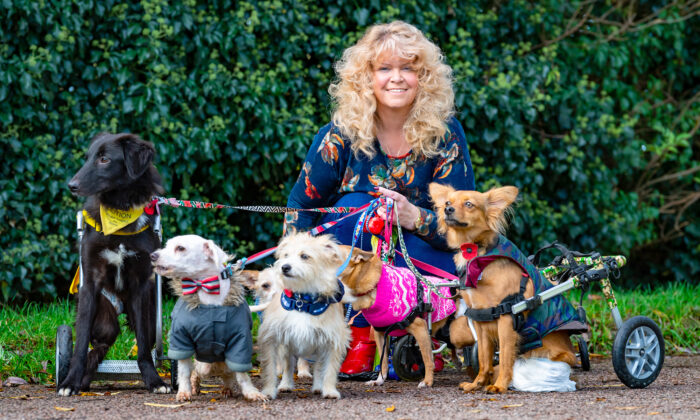
Claire-Louise Nixon, 48, is a dog lover and shares her modest home with 27 canines that no one else wants.

Claire walking with 8 out of the 27 dogs that she has helped to walk again. (©SWNS)
Claire-Louise Nixon, 51 out walking 8 of her 27 dogs that she has helped to walk again. See Cambridge copy SWCAdogs: Dog-lover Claire-Louise Nixon has told how she shares her semi-detached house with her family – and a staggering 27 rescued pooches.Claire-Louise, 48, rescues sick and paralysed dogs from around the world and looks after them at her humble home in Milton Keynes, Bucks.She says looking after the brood of canines is a full-time job and takes her from 6am until midnight.

Many of them are street dogs that have been abused or have lost limbs from mines and explosives in former war zones. But regardless of what conditions the dogs arrive in, Claire is determined to get them walking again through intense physio sessions and walks on wheels.

Her motley crew of dogs all live in her four-bedroom, semi-detached house in Milton Keynes with her husband, Gary, 50 and daughter, Rhia-Louise, 22. While Claire’s initial plan is usually to find forever homes for the dogs, quite often, their needs are too complex, with some even having to wear nappies.

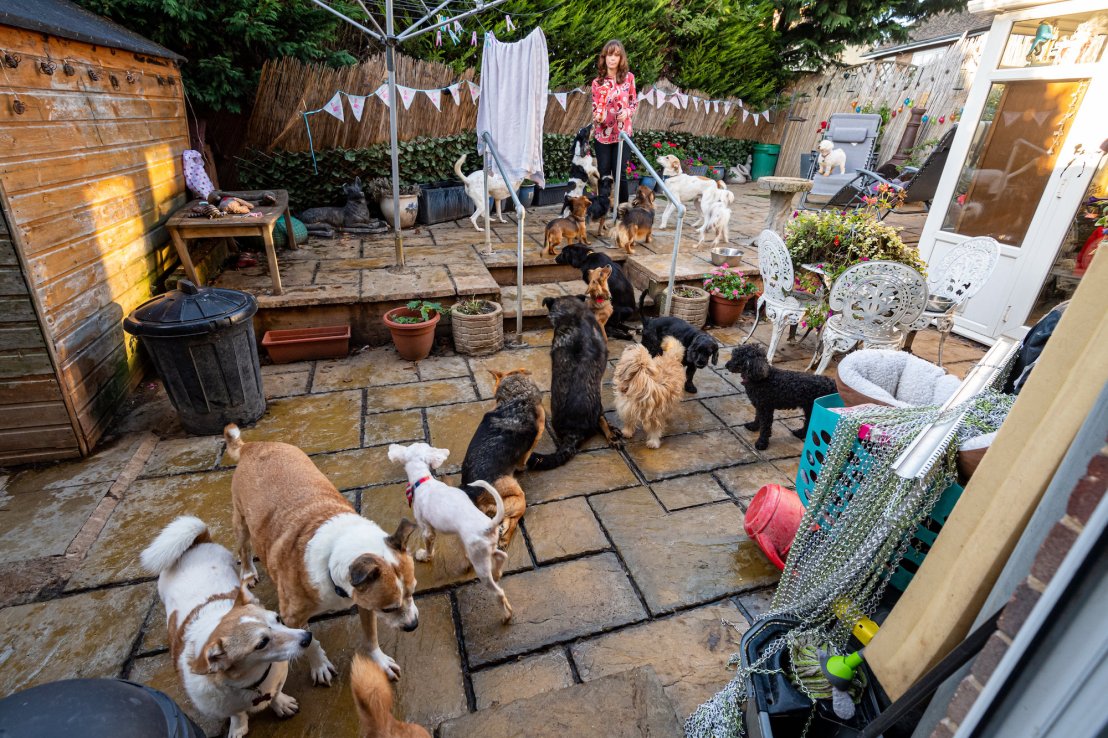
The home of Clarie-Lousie Nixon who has 27 dogs living in the house. See Cambridge copy SWCAdogs: Dog-lover Claire-Louise Nixon has told how she shares her semi-detached house with her family – and a staggering 27 rescued pooches.Claire-Louise, 48, rescues sick and paralysed dogs from around the world and looks after them at her humble home in Milton Keynes, Bucks.She says looking after the brood of canines is a full-time job and takes her from 6am until midnight.
Some of the 27 dogs that Clarie-Lousie Nixon has living at her home. See Cambridge copy SWCAdogs: Dog-lover Claire-Louise Nixon has told how she shares her semi-detached house with her family – and a staggering 27 rescued pooches.Claire-Louise, 48, rescues sick and paralysed dogs from around the world and looks after them at her humble home in Milton Keynes, Bucks.She says looking after the brood of canines is a full-time job and takes her from 6am until midnight.

She said: “When I get these dogs who are in such a bad way, the vet would say: ‘Claire, you won’t get them walking again.’

“But now they say nothing is impossible! They say we work miracles with them!

“I think all they need is love, kindness and patience. When they walk into my house they see other dogs like them so they don’t feel any different that’s why I think they do so well here.

“If you give them a reason to walk again then they will.”

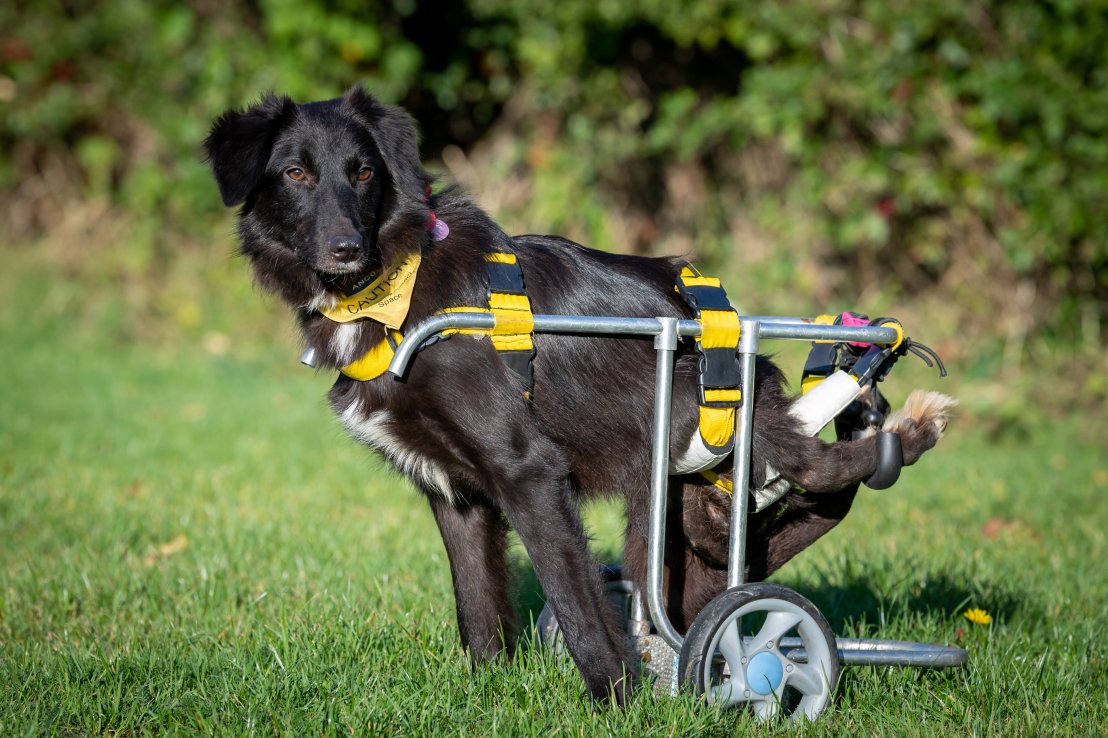
Rita Ora Collie from Romania who was abandoned on the roadside after beeing born deformed and was sent to Claire-Lousie Nixon as no one wanted her. See Cambridge copy SWCAdogs:Dog-lover Claire-Louise Nixon has told how she shares her semi-detached house with her family – and a staggering 27 rescued pooches.Claire-Louise, 48, rescues sick and paralysed dogs from around the world and looks after them at her humble home in Milton Keynes, Bucks.She says looking after the brood of canines is a full-time job and takes her from 6am until midnight.
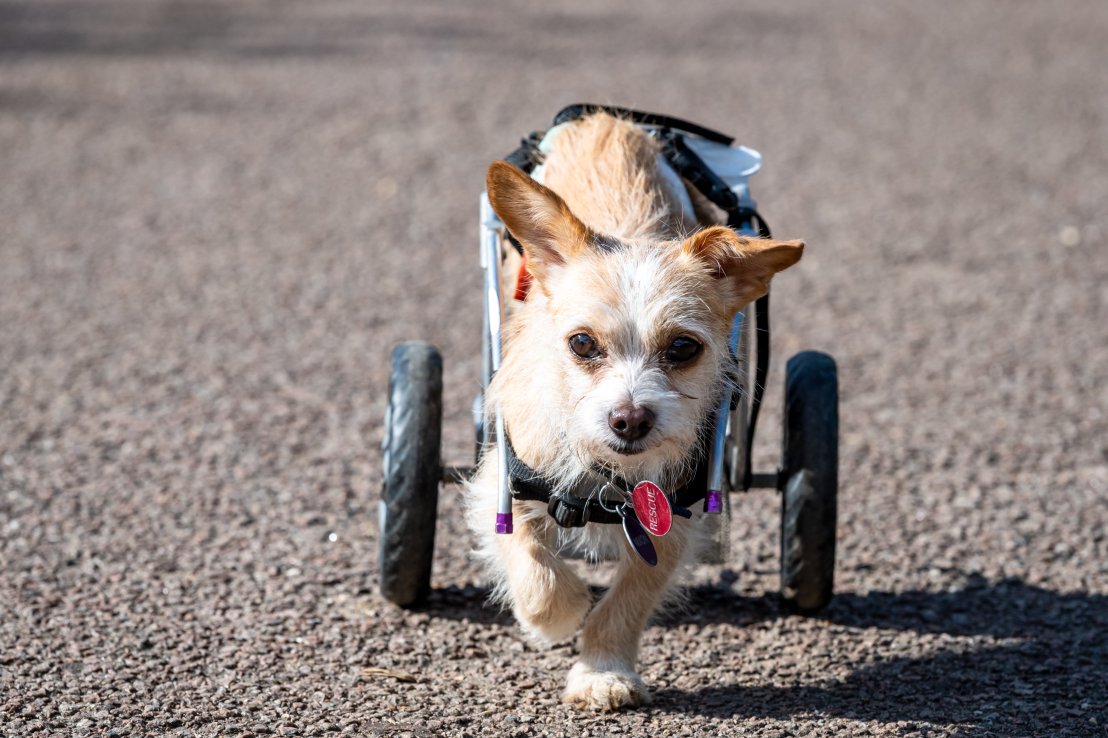
Forest Gump a small collie crossed pomeranian who was run over on an Army base in Romania. Men on the base found Clarie-Lousie Nixon on facebook and sent Forest Gump to her for treatment. See Cambridge copy SWCAdogs: Dog-lover Claire-Louise Nixon has told how she shares her semi-detached house with her family – and a staggering 27 rescued pooches.Claire-Louise, 48, rescues sick and paralysed dogs from around the world and looks after them at her humble home in Milton Keynes, Bucks.She says looking after the brood of canines is a full-time job and takes her from 6am until midnight.

Claire, who looks after the brood of canines—seven of which are paralyzed—says it’s a full-time job and takes her from 6 a.m. until midnight. Feeding them alone is a mammoth chore involving 15 kilograms (approx. 33 pounds) of biscuits and a complete crate of dog food every single day.

Eight of the dogs have to wear nappies, with little bodysuits to keep them in place, and they all need daily baths to keep them clean and infection-free. There’s a lot of cleaning up involved, and Claire is constantly trying to keep on top of the housework.

Feeding time at The home of Clarie-Lousie Nixon who has 27 dogs living in the house. See Cambridge copy SWCAdogs: Dog-lover Claire-Louise Nixon has told how she shares her semi-detached house with her family – and a staggering 27 rescued pooches.Claire-Louise, 48, rescues sick and paralysed dogs from around the world and looks after them at her humble home in Milton Keynes, Bucks.She says looking after the brood of canines is a full-time job and takes her from 6am until midnight.

Claire’s passion to care for sick dogs all started 12 years ago when a puppy named Thomas Cook, who was only a few days old, was brought to the vets to be put down. The puppy had a hair lip and cleft palate, which prevented him from suckling milk and feeding, but Claire was determined to save him.

Claire painstakingly hand-reared Thomas Cook by feeding him a bottle every few hours, and from there, it escalated to having 27 disabled and sick dogs.

She said: “It went into having paralyzed dogs and dogs that had their legs blown off in Bosnia and dogs that had been shot and still had bullets inside them.”

All of Claire’s dogs are named after celebrities that she feels describe their personalities.

Sir Elton John, who Nixon named because of the song “I’m still standing,” was rescued from Romania after he was run over and left on the road to die. This left him with a broken spine. However, with Claire’s help, he can now go on small walks.

Sir Elton John, a Jack Russell cross who Clarie-Lousie Nixon has helped to walk again. See Cambridge copy SWCAdogs: Dog-lover Claire-Louise Nixon has told how she shares her semi-detached house with her family – and a staggering 27 rescued pooches.Claire-Louise, 48, rescues sick and paralysed dogs from around the world and looks after them at her humble home in Milton Keynes, Bucks.She says looking after the brood of canines is a full-time job and takes her from 6am until midnight.

Sherlock Holmes, who was rightly named for his intelligence and curiosity, was a street dog in Oman who was shot by a security guard.

The other dogs to name a few are Patrick Swayze, who twitches all the time and was previously paralyzed, Freddie Mercury, who wanted to “break free,” and David Bowie, who was “under pressure.”

Claire said: “They’re part of the family. The dogs have a free run of the house.

“They sit where they want and they sleep wherever they happen to fall asleep—often on our beds.

“The dogs arrive with the most horrible past we give them love and [a] wonderful future. They come from all over the world but with me they are home forever.”

Doris Day the pomeranian cross who Claire-Louise Nixon is helping to walk again. See Cambridge copy SWCAdogs: Dog-lover Claire-Louise Nixon has told how she shares her semi-detached house with her family – and a staggering 27 rescued pooches.Claire-Louise, 48, rescues sick and paralysed dogs from around the world and looks after them at her humble home in Milton Keynes, Bucks.She says looking after the brood of canines is a full-time job and takes her from 6am until midnight.
Rylan Clark- neal theJack Russell cross Shih tzu who Claire-Louise Nixon helped to walk again. See Cambridge copy SWCAdogs: Dog-lover Claire-Louise Nixon has told how she shares her semi-detached house with her family – and a staggering 27 rescued pooches.Claire-Louise, 48, rescues sick and paralysed dogs from around the world and looks after them at her humble home in Milton Keynes, Bucks.She says looking after the brood of canines is a full-time job and takes her from 6am until midnight.

She further added: “I’m really lucky in that all the neighbors have dogs themselves so we don’t get complaints. And although 27 dogs sounds a lot, they are really quite well behaved.”

Claire raises funds through her organization, Wheels to Paws UK, to provide them with medical treatment, rehabilitation, and the equipment they need to walk again. Vets bills can be a huge drain on resources, but local vets are sympathetic to her cause and often offer a discount.

For long walks, the dogs are put in specially made harnesses with wheels to act as false legs so they can enjoy going out for walks. Meanwhile, those that can’t walk are put in buggies.

Other dogs are regularly taken for doggy hydrotherapy, while all those that can walk are taken out for exercise in rotation.

Claire-Louise Nixon, 51 out walking 8 of her 27 dogs that she has helped to walk again. See Cambridge copy SWCAdogs: Dog-lover Claire-Louise Nixon has told how she shares her semi-detached house with her family – and a staggering 27 rescued pooches.Claire-Louise, 48, rescues sick and paralysed dogs from around the world and looks after them at her humble home in Milton Keynes, Bucks.She says looking after the brood of canines is a full-time job and takes her from 6am until midnight.

Claire said: “The dog rescue charities abroad all know of me. So if they get a badly injured or disabled dog in need of specialist care they will pay to transport them to me in the UK. I can never say no.”

She further added: “It is tremendous hard work but I can’t tell you how rewarding it is. The love these dogs give back is amazing. I would not be without any single one of them.”

ooOOoo

There are some people around who do so much more than can be expected and Claire is very much one of those people.

To be impressed with her is only just the half of it.

Thank you Margaret for bringing this wonderful story to all our attentions.

A New Start!

This has nothing to do with dogs.

Well not in a direct manner.

But all dog owners know that the odds of anxiety or depression if you have a dog or two around one are greatly reduced.

I’m chairing a discussion on depression at our local Humanists and Freethinkers group in eighteen days time; on January 18th, 2020. The core of my talk is a TED Talk given journalist Johann Hari in July of 2019.

This is how the talk is introduced.

In a moving talk, journalist Johann Hari shares fresh insights on the causes of depression and anxiety from experts around the world — as well as some exciting emerging solutions. “If you’re depressed or anxious, you’re not weak and you’re not crazy — you’re a human being with unmet needs,” Hari says.

There are sufficient numbers of people who follow this blog that it is likely that this talk will really engage a few of you. It’s twenty minutes long and very interesting!

I hope you find it engaging!

A Very Happy New Year to you!

Can dogs count?

The answer may surprise you!

Dogs use a part of their brain for processing numbers. But more than that, dogs use a similar brain region to process numbers as we humans do.

I found that fascinating.

This was one the results of reading a very interesting article published by The Smithsonian magazine earlier on in December.

Let me share it with you.

ooOOoo

Dogs’ Brains Naturally Process Numbers, Just Like Ours

Scientists stuck 11 dogs in fMRI scanners to see if their brains had a knack for quantity

How many sheep? (Arbutus Photography / flickr)

Katherine J. Wu,   smithsonianmag.com
Dec. 19, 2019,

Sit. Stay. Fetch. Count?

Sort of. A team of scientists has found that dogs naturally process numbers in a similar brain region as humans, reports Virginia Morell for Science. While that doesn’t mean mutts can do math, it seems they have an innate sense of quantity, and may take notice when you put fewer treats in their bowl, according to a study published this week in Biology Letters.

Importantly, while other research has delved into similar stunts that scientists coaxed out of canines by rewarding them with treats, the new study suggests a knack for numbers is present in even untrained dogs—and could have deep evolutionary roots. This supports the idea that the ways in which animals process quantity in their brains may be “ancient and widespread among species,” Michael Beran, a psychologist at Georgia State University who wasn’t involved in the research, tells Morell.

To test pooches’ numerical prowess, a team led by Gregory Berns, a neuroscientist at Emory University, scanned the brains of 11 dogs of different breeds as they gazed at screens serially flashing different numbers of variably-sized dots. As the images flipped rapidly past, the researchers looked for activity in a region of the canine brain called the parietotemporal cortex, analogous to humans’ parietal cortex, which is known to help people rapidly process numbers. In humans, this region lights up on a functional magnetic resonance imaging (fMRI) scanner when numbers start to vary—a sign that cells are working hard to puzzle through the difference.

Something similar seems to apply to canines, the team found. When dogs hopped into the scanner, most of their parietotemporal cortices showed more activity when the numbers of dots flashed onto the screen changed (for instance, three small dots followed by ten big dots) than when they stayed the same (four small dots followed by four large dots).

The behavior wasn’t universal: 3 out of the researchers’ 11 test subjects failed to discern the difference. But it’s not surprising that the rest did, Krista Macpherson, a canine cognition researcher at Western University in Canada who wasn’t involved in the study, tells Morell.

Of course, approximating quantities of dots isn’t the same as solving complex mathematical equations, as our brains are equipped to do. But both behaviors stem from an inherent sense for numbers—something that appears to span the 80-million-year evolutionary gap between dogs and humans, the findings suggest.

Understanding how that basic ability might evolve into “higher” mathematical skills is a clear next step, study author Lauren Aulet, a psychologist at Emory University, says in a statement. Until then, we humans can count on the fact that we have plenty in common with our canine companions.

ooOOoo

An inherent sense for numbers. Wow!

This is yet another aspect of the relationship we have with our pooches that is deeper and closer than I imagined, and I’m sure I don’t only speak for myself.

The early beginnings.

Science has maybe found a clue to the ancestor of the dog and the wolf.

For an animal that means so much to us humans, the origins of the dog are still uncertain. Indeed, as this interesting article shows, the origins of the wolf are uncertain.

ooOOoo

Was This 18,000-Year-Old Puppy Frozen in Siberian Permafrost the Ancestor of Wolves, Dogs or Both?

DNA tests on the well-preserved remains can’t determine whether the little canine was wild or domestic

(Sergey Fedorov/NEFU)

By Jason Daley, smithsonianmag.com
Dec. 3, 2019, 10 a.m.”>December 3, 2019

Meet Dogor, an 18,000-year-old pup unearthed in Siberian permafrost whose name means “friend” in the Yakut language. The remains of the prehistoric pup are puzzling researchers because genetic testing shows it’s not a wolf or a dog, meaning it could be an elusive ancestor of both.

Locals found the remains in the summer of 2018 in a frozen lump of ground near the Indigirka River, according to the North-Eastern Federal University in Yakutsk. Parts of the animal are incredibly well-preserved, including its head, nose, whiskers, eyelashes and mouth, revealing that it still had its milk teeth when it died. Researchers suggest the animal was just two months old when it passed, though they do not know the cause of death.

The pup is so well-preserved that researchers at the Centre for Palaeogenetics in Sweden were able to sequence the animal’s DNA using a piece of rib bone. The results found that Dogor was male, but even after two rounds of analysis the team could not determine whether he was a dog or a wolf.

“It’s normally relatively easy to tell the difference between the two,” David Stanton, a Centre for Palaeogenetics research fellow, tells Amy Woodyatt at CNN. “We have a lot of data from it already, and with that amount of data, you’d expect to tell if it was one or the other. The fact that we can’t might suggest that it’s from a population that was ancestral to both—to dogs and wolves.”

The find is exciting, regardless of whether Dogor turns out to be a common canine ancestor, an early dog, or an early wolf. Hannah Knowles at The Washington Post reports that Dogor comes from an interesting time in canine evolution, when wolf species were dying out and early dogs were beginning to emerge.

“As you go back in time, as you get closer to the point that dogs and wolves converge, [it becomes] harder to tell between the two,” Stanton tells Knowles.

(Sergey Fedorov/NEFU)

The history of just how and when dogs split from wolves is unresolved. There’s a general agreement among scientists that modern gray wolves and dogs split from a common ancestor 15,000 to 40,000 years ago, explains Brian Handwerk previously for Smithsonian.com. How dogs became dogs, however, is contested. Some research suggests that dogs were domesticated by humans once, while other studies have found dogs were domesticated multiple times. Exactly where in the world wild canines became man’s best friend is also disputed. The origin of the human-animal bond has been traced to Mongolia, China and Europe.

Scientists disagree about how dogs ended up paired with people, too. Some suspect humans captured wolf pups and actively domesticated them. Others suggest that a strain of “friendly,” less aggressive wolves more or less domesticated themselves by hanging out near humans, gaining access to their leftover food.

Dorgor’s DNA could help unravel these mysteries. The team plans to do a third round of DNA testing that may help definitively place Dogor in the canine family tree, report Daria Litvinova and Roman Kutuko at the Associated Press.

ooOOoo

This is incredibly interesting, don’t you think?

Hopefully I will hear of that third round of DNA testing and, if so, will most definitely share it with you.

A most beautiful animal

From a discussion on Ugly Hedgehog

As regular readers know, I subscribe to Ugly Hedgehog, a photography forum.

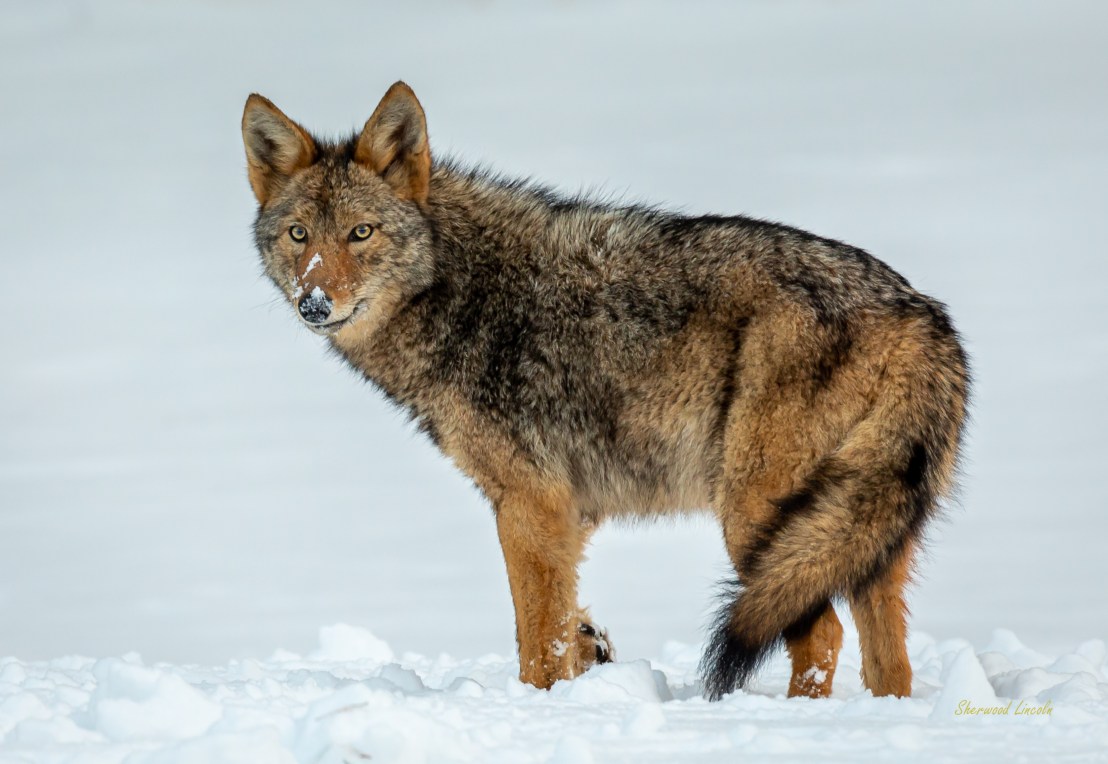
Once again, I want to share with you all a most stunning photograph.

It is this:

So what animal is it?

Back to that item on Ugly Hedgehog:

Whistletown Wilds, the author of the post, said:

Good boy! Call it what you will; Coydog, Eastern Coyote, or Coymolf. Up close and personal, Taken in East Lyme Ct.

Ecologist and evolutionary biologist Javier Monzón analyzed the DNA of eastern coyotes and found the genes contain all three canids — dog, wolf, and coyote.

According to Monzón’s research, about 64% of the eastern coyote’s genome is coyote (Canis latrans), 13% gray wolf (Canis lupus), 13% Eastern wolf (Canis lycaon), and 10% dog (Canis familiaris).

Later on he added:

All my bird and nature photos are taken in South Eastern Ct. most with a Canon 7D Mark II or 5D Mark IV and Canon 100 to 400II THANK YOU. About 20 yards.

Then followed in response to my request for permission to republish:

Feel free, no problem!

Whatever happens to me in the next year, I truly hope I can continue to share such incredibly photographs with you.

Nature in all her glory!

Tomorrow is Christmas Day and I will be taking a short break, probably back on December 27th.

You all have a wonderful, peaceful holiday.

A cat-food recall!

J.M. Smucker recall.

In terms of the Webformix internet cut-outs there has only been one noticeable break and that was yesterday early morning.

So I feel confident in posting this food recall notice that also came in yesterday.

ooOOoo

Dear Fellow Dog Lover,

I’m pleased to report there have been no dog food recalls since September 26.

However, for our many dog owners who also own a cat…

J. M. Smucker has recalled certain lots of Special Kitty canned cat food because the product contains ingredients that “do not meet the company’s quality and safety standards”.

Eating the affected food may cause nausea, vomiting or a host of other symptoms… some more severe… including death.

Click here to read the announcement.

Dog Food Recall Update

Some dog foods previously recalled may still be on store shelves… or in your own home. So, if you’ve missed any of the 11 recalls we’ve sent since July… be sure to visit our Dog Food Recalls page for full details.

9 Best Dog Food Lists
Recently Updated
Over the last 60 days, The Dog Food Advisor has updated the following best dog food pages:

  • Best Dry Dog Food
  • Best Puppy Food
  • Best Affordable Dog Food
  • Best Dog Food for Allergies
  • Best Grain-Free Dog Food
  • Best Dog Food Made with Grain
  • Best Dog Food for Sensitive Stomach
  • Best Senior Dog Food
  • Best Dog Food for Weight Loss

Click here to see our Best Dog Foods for December 2019
Please be sure to share this report with other pet owners.

Mike Sagman, Editor
The Dog Food Advisor
Saving Good Dogs From Bad Dog Food
P.S. Not yet on our recall notification list? Click here to get FREE lifesaving recall alerts by email. No spam. Cancel anytime.

ooOOoo

And here’s that J.M. Smucker announcement link:

The J. M. Smucker Company Issues Voluntary Recall of Specific Lots of Special Kitty® Wet, Canned Cat Food Due to Health Concerns

Murmuration!

Alex and Lisa have put together a remarkable video

Yesterday, in came an email from my son, Alex, about an amazing starling murmuration at the Royal Society for the Protection of Birds (RSPB).

Lisa took the video and together they uploaded it to YouTube.

Enjoy!

Having watched the amazing video I then did a little bit of research. I came quickly across the science of murmuration and have included it below.

Murmuration refers to the phenomenon that results when hundreds, sometimes thousands, of starlings fly in swooping, intricately coordinated patterns through the sky.

Maybe you’ve seen a murmuration video before. But this one is especially beautiful. It was shot earlier this month in Wales, at Cosmeston Lakes in the Vale of Glamorgan, and posted on Facebook by the BBC Cymru Wales. (It’s not included, Ed.)

It’s all about science. Just how do the starlings manage to fly in such an amazingly coordinated way?

A few years ago, George F. Young and his colleagues investigated starlings’ “remarkable ability to maintain cohesion as a group in highly uncertain environments and with limited, noisy information” — a nice description of what goes on in a murmuration.

Going in, Young et al. already knew that starlings pay attention to a fixed number of their neighbors in the flock, regardless of flock density — seven, to be exact. Their new contribution was to figure out that “when uncertainty in sensing is present, interacting with six or seven neighbors optimizes the balance between group cohesiveness and individual effort.”

Young et al. analyzed still shots from videos of starlings in flight (flock size ranging from 440 to 2,600), then used a highly mathematical approach and systems theory to reach their conclusion. Focusing on the birds’ ability to manage uncertainty while also maintaining consensus, they discovered that birds accomplish this (with the least effort) when each bird attends to seven neighbors.

Wonderful!

Now here’s a sight!

Walking improves vision!

Dogs are the masters of being on four legs. And, presumably, their sight benefits from being so active.

I have been following Tony who writes the blog One Regular Guy Writing about Food, Exercise and Living Past 100 for some time. Here is what he says about himself.

I’m Tony
I have been interested in eating healthy for more than 35 years. Unfortunately,  my actions haven’t always matched my aims. As Mae West said, “I used to be Snow White, but I drifted.”

I drifted too, for a long time, but after writing posts for this blog for nearly 10 years, I have gotten good at it. I used the Lose It! App for a while (iPhone, iPad, Touch) a calorie counter that also breaks down nutrients and gives you a daily weight chart to demonstrate your progress. It’s not the only tool like this around, but it’s a good one. I think you are better off using a tool than not using one, especially if you are just embarking on a weight loss program.

Using that tool and practicing some self discipline I now have complete confidence in my ability to maintain a healthy body weight. I still need to work on the lean muscle mass thing, though. I love riding my bicycle and have no problem logging lots of miles and putting calories into the bank to free up my eating. I average around 100 miles a week.  That covers a multitude of sins at the table. Biking is a wonderful cardio workout. Few people realize, however, it is also very stimulating for the brain. It’s a lot more fun than working with weights, but ya gotta do that, too. I write about the benefits of cardio exercise on the brain often in this blog as it is usually misunderstood and/or completely overlooked in most fitness writing. I had an aunt who died of Alzheimer’s, my mother who suffered from dementia in her final years, and my grandfather on my father’s side also had cognitive problems in his later years, so I am dead serious about protecting myself from mental decline. Check out my Page – Important facts about your brain – and exercise to read more about it.

I retired 19 years ago. I spent 20 years as a Reuters Correspondent and Editor after starting my career in men’s magazines. I taught journalism at Medill for a while and then wrote in the investment department of a major U.S. philanthropy where I spent my last few years managing $900 million in bond investments.

Now that I am retired, I have complete control over what I eat. My heart goes out to you folks who go to work every day. It is much harder to control your caloric intake. There are business lunches and dinners to attend, late days at the office, working through lunch as well as traveling. I think if I were still working I would seriously consider bringing lunch from home a day or two each week to keep a handle on my intake. With a fridge and microwave where you work, you are good to go.

When I started writing for this blog in March of 2010 I weighed 165 pounds, the lowest I had been in 15 years. I thought I had arrived at fitness and health. Now, in 2019, I weigh 155 pounds. That’s right, I have melted off a further 10 pounds from my best weight in years. My resting heart rate is under 50 beats per minute (bpm), a result of my cycling, but significantly under the ‘normal’ of 65 to 90 bpm for a guy in his upper 70’s. I have less than 16 percent body fat and a 31 inch waist (the first time since high school). I have reached this state of fitness and health following the ideas and techniques I write about in this blog. You can, too
When the blog started, I was talking the talk, over nine years later I am walking the walk. You can do the same. I am just a regular guy. If I can do it you can, too. Check out my page  How to Lose Weight and Keep it Off for a start. Lots of excellent, practical principles there that I have learned and now apply to my daily life.

Just over 20 years ago my weight got out of control and I ballooned over 220 pounds. I took off 50 pounds in a year, but that only got me down to the mid-170’s. You can read How I lost 50 pounds in 52 weeks if you want chapter and verse.

When I retired, I started taking courses from The Great Courses. They include “Nutrition Made Clear” by Professor Roberta Anding. She has an MS in Nutrition and is a registered Dietitian and a certified specialist in sports dietetics. Another superb course is “Lifelong Health: Achieving Optimum Well-Being at any Age” by Doctor Anthony Goodman. He also teaches “The Myths of Nutrition and Fitness.” By now, in 2019, I have probably taken more than a dozen courses on mental and physical health and wellness as well as  healthy aging.

I have about 40 games of backgammon going on the web. I was born January 26, 1940. I am an Aquarius and a senior citizen. At 79 years of age, I am healthier by far than I was over 20 years ago when I was in the work force and a relatively young man in my 50’s.

As a senior who presently is winning the war of the waistline,  I am also grappling with the experience of aging. As part of this blog’s focus on good health I look seriously into aging and what can be done about it. I know there is no fountain of youth, but there are techniques for aging gracefully and, more importantly, retaining one’s mental powers. I promise to share with you everything I can find out about it.

The masthead photo is a shot of me taken 40 years ago by a girlfriend when we were bike riding by the lakefront in Chicago. I had a lot more hair then.

Tony

Now Tony recently published a post that I found so interesting.

It’s all about improving one’s vision.

ooOOoo

Walking improves vision – Study.

By Tony, November 25th, 2019

As a big fan of walking I was thrilled to learn of this further benefit to the Cinderella of the exercise world. Walking leads to an increase of peripheral visual input, according to a study from the University of Wurzburg.

How do we perceive our environment? What is the influence of sensory stimuli on the peripheral nervous system and what on the brain? Science has an interest in this question for many reasons. In the long term, insights from this research could contribute to a better understanding of diseases such as ADHD and Parkinson’s disease.

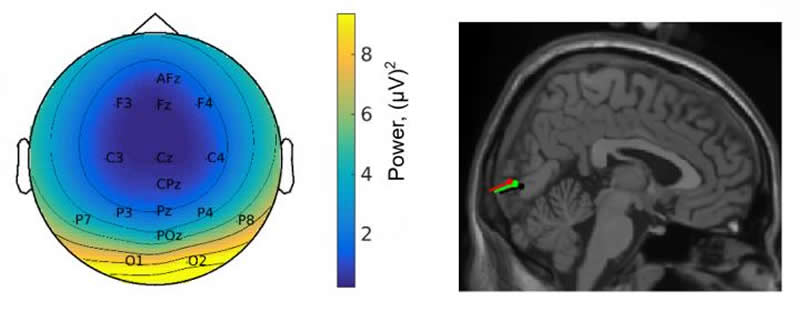
The topography of the EEG response (l) and its localization in the brain (r) show visual sensory processing during the walking conditions slow and normal – green and red, and standing – black. The image is credited to Barbara Händel.

Perception and the underlying neuronal activities are usually measured while subjects are sitting or lying, for example while doing magnetic resonance imaging. As a rule, the head is fixed and people are encouraged not to blink. The measurements therefore take place under well-controlled but rather unnatural conditions.

Shift of visual preference

When processing visual stimuli, however, it makes a difference whether the person is sitting or moving: When walking around, the peripheral part of the visual field shows enhanced processing compared to the central part. This can be proven both by the behaviorally measured perception of the test persons and by their brain response.

This shift in visual preference makes sense. “It is above all the peripheral visual input that provides information about the direction and speed of our movement and thus plays an important role for navigation,” says Dr. Barbara Händel. The neuroscientist from Julius-Maximilians-Universität (JMU) Würzburg in Bavaria, Germany, and her colleague Dr. Liyu Cao have published their findings in PLOS Biology

“It was known from animals that increased body movements lead to an increased firing rate in visual areas of the brain,” says Dr. Händel. So far, there are only a few behavioural experiments available for humans that investigate the influence of movement on sensory brain areas. However, there is evidence that cognitive processes are linked to the behavioural state. “For example, some studies show that people learn better when they move,” says the JMU researcher. However, the underlying neuronal mechanisms have not yet been tested in detail.

Mobile EEG, sensors and video glasses

It is precisely such gaps in knowledge that Barbara Händel wants to close with her work. In order to explore the link between movement and perception, sophisticated technical equipment is necessary. While the test subjects walk around, they wear electrode caps and a small amplifier that records their brain waves. The EEG data are sent wirelessly to a laptop, which the subjects carry in a backpack. Motion sensors, video glasses, and a mobile device for recording eye movements complete the setting.

Quite an effort. “But we have to take this step if we want to understand human perceptual strategies during natural behavior,” says Dr. Händel. Research into perception during movement is still in its infancy. It is now up to science to ask clever questions and find out which of them can be answered with mobile technical equipment.

Many exciting research questions

Next, the JMU scientist wants to further investigate the effect of altered perception during movement. Does it only occur for visual input or possibly also in other sensory areas? Does it, in addition to navigation, perhaps also play a role in other cognitive processes such as memory and creativity?

All this is possible: experiments with rats have shown that these animals learn better, when they are in motion. And the idea that walking increases creativity has existed since ancient times. “For example, the Peripatetics, a philosophical school around Aristotle, usually were discussing while walking, from which their name derives,” says Barbara Händel.

There is also a connection between creativity and eye movements: “It is known that people blink more often the more creatively they solve a task. And we found that people also blink more often when they walk around compared to being at rest.” Obviously, there are many connections between the movements of the body, the eyes and the mental performance. Their research could reveal many more interesting aspects.

To read further on the benefits of walking, check out my Page – Why you should walk more.

Tony

ooOOoo

I find this a very valuable article.

It shows that the benefits of walking are much more than the pure exercise.

I wonder if it applies to bike riding?

Finally, here’s wishing every one of you a Happy and Peaceful Thanksgiving Day!


More calculating your dog’s age.

Another trip round the buoy!

When I first published the post How old is your dog? I found it a little confusing plus the Input-Output section was screwed up.

So I was pleased when the Smithsonian Smart News published a different version of what is the same news.

Here it is:

ooOOoo

Calculate Your Dog’s Age With This New, Improved Formula

A study of the epigenetic clock in Labradors shows calculating a dog’s age is much more complicated than just multiplying by seven.

The study involved 104 Labrador retrievers between four weeks and 16 years old. (Herwig Kavallar via Wikimedia Commons under Public Domain)

By Jason Daley
smithsonian.com
November 19, 2019

One dog year is not equivalent to seven human years, despite widespread use of the ratio for calculating the age of canine companions. Presumably, the ratio is based on the average lifespan of dogs being 10 years and humans being 70 years, it’s not quite so simple. The formula is not based on any real science and it was debunked by veterinarians years ago.

But geneticists digging into the mysteries of ageing have developed a new calculation to understand how our canine companions’ ages correspond to our own.

(You will probably have to go across to the original article for this to work. PH)

To understand how dogs age, the team looked at a phenomenon called DNA methylation. As mammals get older, their DNA picks up methyl groups that “stick” to their DNA. While these groups don’t change the DNA itself, they attach to the genetic molecule and can turn certain genes on or off, which is an important part of epigenetics, or the way environmental factors cause certain genes to express themselves.

Methlyation occurs at a relatively steady rate as humans age, which allows researchers to estimate a person’s age, a process they’ve dubbed the “epigenetic clock.”

In the new paper on dog years, which has yet to be peer reviewed and is currently posted on the preprint server bioRxiv, a team led by Tina Wang of the University of California, San Diego, compared the epigenetic clocks in people to canines to better understand the genes associated with aging. They picked dogs because most live in the same environments as humans and also receive some degree of medical care, like humans do.

The team looked at methylation rates in 104 Labrador retrievers between the ages of four weeks and 16 years old, reports Michelle Starr at Science Alert. They then compared them to published methylation profiles of 320 humans from age one to 103. (They also compared both to 133 mice methylation profiles.)

It turns out some parts of a dog’s life follows the same pattern as humans, though other longevity milestones don’t link up quite as nicely. For instance, the methylation rate showed a seven-week-old pup corresponds to a 9-month-old human baby, and both species begin to get their first teeth at this time.

But the comparison breaks down after early puppyhood. The dog clock ticks much faster with pups speeding through puberty and reaching sexual maturity within their first year. Then, the dog’s epigenetic clock slows down as the dog ages, and begins to match up with humans again in its later years.

Overall, the average 12-year lifespan of a Labrador lined up with the average worldwide lifespan of humans, which is about 70 years.

While the study complicates the concept of “dog years,” it does show that the animals experience similar methylation processes as humans.

“We already knew that dogs get the same diseases and functional declines of aging that humans do, and this work provides evidence that similar molecular changes are also occurring during aging,” Matt Kaeberlein, a biogerontologist at the University of Washington who was not involved in the study, tells Virginia Morell at Science. “It’s a beautiful demonstration of the conserved features of the epigenetic age clocks shared by dogs and humans.”

The new formula for a dog’s ages based on the study requires a little more math than multiplying by seven. You multiply the natural logarithm of a dog’s age by 16, then add 31 [human_age = 16ln(dog_age) + 31].

According to the formula, a 2-year-old dog is the equivalent of a 42-year-old human, but things slow down after that. A 5-year-old dog is the equivalent of a 56.75 year old human, and a 10-year-old dog is the equivalent of 67.8-year-old person.

Evolutionary biologist Steve Austad of the University of Alabama in Birmingham, who was not involved in the study, tells Morell that he’s not too surprised that the epigenetic clock applies to dogs, too. He says that by studying different dog breeds with different lifespans the researchers may find some interesting results.

This formula is not the last word on dog years, however, especially since it only looked at one breed. Erika Mansourian, writing for the American Kennel Club, reports that the American Veterinary Medical Association says the accurate way to calculate dog years for a medium-sized dog is to assume the first year is equivalent to 15 years and age two adds another nine years. After that, each year of a dog’s life is equivalent to five human years. It doesn’t perfectly line up with the new formula, but both acknowledge that dogs age rapidly in their first years of life.

Whatever the case, dogs’ lives are all too short. That may be why people are excited about a project by the Dog Aging Project, which is currently recruiting 10,000 pets and their owners to participate in a new study that will look at the dogs’ health, gut microbes, diet and exercise to understand aging. And 500 lucky dogs will test out a new drug that may help slow the aging process, which could help us someday, too.

ooOOoo

I hope you found it worthwhile to publish what is, in essence, a duplication of the same story!