Last Friday saw the thirtieth anniversary of Carl Sagan’s iconic photograph, or rather NASA’s photograph, of Planet Earth. Carl persuaded NASA to turn Voyager 1, as it left the Solar System, and take the photo. It became famous almost instantly and became known as the pale blue dot.
Pale Blue Dot: A Vision of the Human Future in Space is a 1994 book by Carl Sagan. It is the sequel to Cosmos and was inspired by the famous 1990 Pale Blue Dot photograph, for which Sagan provides a poignant description. In this book, Sagan mixes philosophy about the human place in the universe with a description of the current knowledge about the Solar System. He also details a human vision for the future.
This updated version of the iconic “Pale Blue Dot” image taken by the Voyager 1 spacecraft uses modern image-processing software and techniques to revisit the well-known Voyager view while attempting to respect the original data and intent of those who planned the images. Credits: NASA/JPL-Caltech
For the 30th anniversary of one of the most iconic views from the Voyager mission, NASA’s Jet Propulsion Laboratory in Pasadena, California, is publishing a new version of the image known as the “Pale Blue Dot.”
The updated image uses modern image-processing software and techniques while respecting the intent of those who planned the image. Like the original, the new color view shows Planet Earth as a single, bright blue pixel in the vastness of space. Rays of sunlight scattered within the camera optics stretch across the scene, one of which happens to have intersected dramatically with Earth.
The view was obtained on Feb. 14, 1990, just minutes before Voyager 1’s cameras were intentionally powered off to conserve power and because the probe — along with its sibling, Voyager 2 — would not make close flybys of any other objects during their lifetimes. Shutting down instruments and other systems on the two Voyager spacecraft has been a gradual and ongoing process that has helped enable their longevity.
This simulated view, made using NASA’s Eyes on the Solar System app, approximates Voyager 1’s perspective when it took its final series of images known as the “Family Portrait of the Solar System,” including the “Pale Blue Dot” image. Move the slider to the left to see the location of each image. (You have to go here to see the full image. Ed.) Credits: NASA/JPL-Caltech
This celebrated Voyager 1 view was part of a series of 60 images designed to produce what the mission called the “Family Portrait of the Solar System.” This sequence of camera-pointing commands returned images of six of the solar system’s planets, as well as the Sun. The Pale Blue Dot view was created using the color images Voyager took of Earth.
The popular name of this view is traced to the title of the 1994 book by Voyager imaging scientist Carl Sagan, who originated the idea of using Voyager’s cameras to image the distant Earth and played a critical role in enabling the family portrait images to be taken.
Additional information about the Pale Blue Dot image is available at:
The Voyager spacecraft were built by JPL, which continues to operate both. JPL is a division of Caltech in Pasadena. The Voyager missions are a part of the NASA Heliophysics System Observatory, sponsored by the Heliophysics Division of the Science Mission Directorate in Washington. For more information about the Voyager spacecraft, visit:
Voyager 1 is now nearly 14 billion miles from Planet Earth and still going strong. It has a plutonium battery that will last for eighty years. A one-way radio signal from Earth takes about twenty hours to reach the probe.
And now for something different but still to do with space.
When she finally made it home, her beloved pup, LBD (Little Brown Dog), couldn’t contain her excitement.
Koch shared a video on Twitter of the moment she walked through her front door and LBD pounced to shower her with kisses.
“Not sure who was more excited,” she captioned the video. “Glad she remembers me after a year!”
“We call her LBD, little brown dog, she’s from the Humane Society and she couldn’t be sweeter,” Koch told Insider on a phone call with reporters from the Johnson Space Centre.
“And yes, she was very excited, I was very excited, I’m not sure who was more excited! … You know it’s just a symbol of coming back to the people and places that you love, to see your favourite animal.”
Now I can’t disappear without acknowledging the fantastic work of Carl Sagan.
And I can’t do better than republish the first bit of a wonderful piece on Carl put out by Wikipedia.
Carl Edward Sagan (/ˈseɪɡən/; November 9, 1934 – December 20, 1996) was an American astronomer, cosmologist, astrophysicist, astrobiologist, author, science popularizer, and science communicator in astronomy and other natural sciences. He is best known as a science popularizer and communicator. His best known scientific contribution is research on extraterrestrial life, including experimental demonstration of the production of amino acids from basic chemicals by radiation. Sagan assembled the first physical messages sent into space: the Pioneer plaque and the Voyager Golden Record, universal messages that could potentially be understood by any extraterrestrial intelligence that might find them. Sagan argued the now accepted hypothesis that the high surface temperatures of Venus can be attributed to and calculated using the greenhouse effect.[
He died far too young in my opinion!
But not without leaving a tremendous legacy – The Pale Blue Dot.
There really is no end to the sense of smell that a dog has.
I was browsing online The Smithsonian magazine and came across a long article that was all about the dog’s sense of smell in terms of sniffing out citrus greening disease.
There’s no end of articles about the dog’s sense of smell and I have written about it before. But first I’m going to reproduce the article on Animal Planet because it gets to the point.
Dogs rule. Or, at least, they do when it comes to their sense of smell, which crushes that of humans. According to the Alabama Cooperative Extension System (ACES), a dog’s sense of smell is about 1,000 times keener than that of their two-legged companions — and many dog experts claim it’s millions of times better — thanks to the construction of their often-slobbery, wet schnozzes. So what, exactly, is going on in there?
A dog sniffs at scents using his nose, of course, and also his mouth, which may open in a sort of grin. His nostrils, or nares, can move independently of one another, which helps him pinpoint where a particular smell is coming from. As a dog inhales a scent, it settles into his spacious nasal cavity, which is divided into two chambers and, ACES reports, is home to more than 220 million olfactory receptors (humans have a measly 5 million). Mucus traps the scent particles inside the nasal chambers while the olfactory receptors process them. Additional particles are trapped in the mucus on the exterior surface of his nose.
Sometimes, it takes more than one sniff for a dog to accumulate enough odor molecules to identify a smell. When the dog needs to exhale, air is forced out the side of his nostrils, allowing him to continue smelling the odors he’s currently sniffing.
Dogs possess another olfactory chamber called Jacobson’s organ, or, scientifically, the vomeronasal organ. Tucked at the bottom of the nasal cavity, it has two fluid-filled sacs that enable dogs to smell and taste simultaneously. Puppies use it to locate their mother’s milk, and even a favored teat. Adult dogs mainly use it when smelling animal pheromones in substances like urine, or those emitted when a female dog is in heat.
Top Sniffers
What all of this sniffing and processing really means is that a dog’s sense of smell is his primary form of communication. And it’s a phenomenal one, because dogs don’t just smell odors that we can’t. When a dog greets another dog through sniffing, for example, he’s learning an intricate tale: what the other dog’s sex is, what he ate that day, whom he interacted with, what he touched, what mood he’s in and — if it’s a female — if she’s pregnant or even if she’s had a false pregnancy. It’s no wonder, then, that while a dog’s brain is only one-tenth the size of a human brain, the portion controlling smell is 40 times larger than in humans.
So, who’s top dog when it comes to sniffing? While all canines have an incredible sense of smell, some breeds — such as bloodhounds, basset hounds and beagles — have more highly refined sniffers. This is a result of several factors. Dogs with longer snouts, for example, can smell better simply because their noses have more olfactory glands. Bloodhounds, members of the “scent hound” canine group, also have lots of skin folds around their faces, which help to trap scent particles. And their long ears, like those of Bassets, drag on the ground, collecting more smells that can be easily swept into their noses.
Of course, dogs are individuals as well, so it’s certainly possible to find a non-scent-hound who can outperform one. And as Dr. Sandi Sawchuk, a clinical instructor at the University of Wisconsin School of Veterinary Medicine, notes: “There are lots of breeds that can be trained to sniff out certain items — for example, cadaver-sniffing dogs, drug-sniffing dogs, etc.”
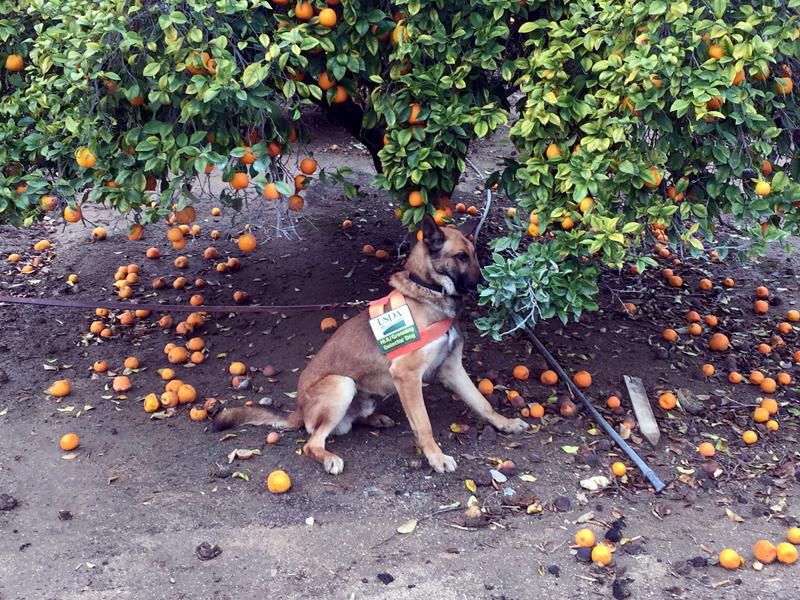
A detector dog named Szaboles, trained to sniff out the bacterial pathogen Candidatus Liberibacter asiaticus in a citrus orchard. (Courtesy of Tim R. Gottwald)
Tim Gottwald will never forget the sight: the mottled yellow leaves, the withered branches, the small, misshapen fruits, tinged with sickly green. These were the signs he’d learned to associate with huanglongbing, or citrus greening—a devastating and wildly infectious bacterial infection that slashed the United States’ orange juice yields by more than 70 percent in the span of a decade.
“It’s like a cancer,” says Gottwald, a plant pathologist with the United States Department of Agriculture. “One that’s metastasized, and can’t be eradicated or cured.”
Once they’ve begun to sport splotchy foliage and stunted fruit, trees can be diagnosed with a single glance. A symptomatic plant, Gottwald says, is a diseased one. Unfortunately, the converse isn’t true: Infected trees can appear normal for months, sometimes years, before visibly deteriorating, leaving researchers with few reliable ways to suss out sick citrus early on—and giving the deadly bacteria ample opportunity to spread unnoticed.
Now, Gottwald and his colleagues may have a creative new strategy to fill this diagnostic gap—one that relies not on vision, but smell. They’ve taught dogs to recognize the telltale scent of a huanglongbing infection—an odor that eludes the attention of humans, but consistently tickles the super-sensitive schnozz of a mutt. Once trained up, canines can nose out the disease within weeks of infection, trouncing all other available detection methods in both timing and accuracy, the researchers report today in Proceedings of the National Academy of Sciences.
“This is a major step in the development of what could be a really important early detection tool,” says Monique Rivera, an entomologist and citrus pest expert at the University of California, Riverside who wasn’t involved in the study. “It could give growers information about potential exposure … to the causative bacteria.”
First described in China in the early 1900s, huanglongbing has now crippled orchards in more than 50 countries around the globe. Fifteen years ago, the scourge took hold in Florida, where infected trees are now the norm; the state’s $9 billion citrus industry, once the second largest in the world, is now on the verge of collapse. From oranges to grapefruits to lemons, no variety of citrus is immune.
As the disease continues to creep into new regions, researchers worldwide are scrambling to contain it. But the task has proved difficult: No effective treatments, cures or vaccines exist for huanglongbing, the product of a bacterium called Candidatus Liberibacter asiaticus (or CLas, pronounced “sea lass”) that’s ferried from tree to tree by winged insects. Scientists have also found the microbes to be extraordinarily difficult to grow and study in the lab.
The 20 canines in the study trained to detect CLas-infected citrus trees. (Gottwald et al., PNAS, 2020)
Currently, the only surefire way to curb citrus greening’s spread is to extract and eliminate infected trees. This strategy depends entirely on early detection—“one of the biggest problems in the field right now,” says Carolyn Slupsky, a plant pathologist at the University of California, Davis who wasn’t involved in the study. Spotting an asymptomatic infection by eye is essentially impossible. And though genetic tests can sometimes pinpoint microbes in apparently healthy trees, their success rates are low and inconsistent, due in part to the patchiness with which CLas distributes itself in plant tissue.
In many ways, huanglongbing is “the perfect storm of a disease,” Slupsky says.
But canines may just be the perfect candidates to lend a helping paw. With a sense of smell that’s 10,000 to 100,000 times more powerful than a human’s, dogs are superstar sniffers, capable of nosing out everything from bombs to drugs. In recent years, they’ve even been deployed to detect pathogenic diseases like malaria. Infections, it turns out, stink—and dogs definitely take notice.
To see if pooches’ powers of perception might extend to huanglongbing, Gottwald and his team taught 20 dogs to pick up on the smell of citrus plants with known infections, rewarding the pups with toys when they identified the correct trees. After just a few weeks of training, the newly-minted citrus sniffers were picking out infected trees with about 99 percent accuracy. Put in pairs to corroborate each other’s results, the dogs got close-to-perfect scores.
Gottwald was floored. “I wasn’t surprised [the dogs] could do it,” he says. “But I was surprised by how well they could do it. It was pretty amazing.”
The team then pitted the pups against a common but expensive laboratory test that’s often used to verify the presence of CLas DNA in suspicious-looking citrus. After spiking the microbes into 30 trees, the researchers mixed the newly-infected plants into rows of healthy ones and allowed the dogs to inspect them on a weekly basis. Within a month, the canines had collectively homed in on every single CLas-positive plant.
The DNA test, on the other hand, had no such luck: Seventeen months into the infection, it was still failing to identify a third of the diseased trees.
If Gottwald’s team sees continued success, “this could be very exciting for [citrus] growers,” who could someday keep dogs around as a fast and relatively inexpensive way to survey their orchards, says Phuc Ha, a microbiologist at Washington State University who wasn’t involved in the study. For now, the most immediate applications lie in disease prevention. But, she adds, should researchers develop treatments for huanglongbing, canines could eventually play a role in curing the condition as well.
Gottwald and his team have already begun to send small teams of citrus-sniffer dogs to inspect vulnerable trees in California and Texas. In both locations, the canines have alerted the researchers to trees that have yet to test positive in the lab.
This, however, evokes the double-edged sword of early detection research: The dogs are so much faster at finding potentially diseased trees that their picks can’t actually be confirmed, Slupsky points out. Maybe they’re more sensitive than the molecular test, and the disease is more widespread than researchers feared. Or maybe the canine’s noses are leading them astray. “Specificity is always an issue,” Slupsky says, “because you’re comparing them to an imperfect test.”
Dogs also come with their own drawbacks. They can tire; they can be distracted. They’re not machines. And while they can make fast work of orchards where infections are rare, their performance will probably plummet in heavily afflicted groves. In an ideal world, Slupsky says, the dogs would serve strictly as a first line of defense, screening trees for further monitoring or testing in the lab. She and her colleagues are hard at work on one such diagnostic, built to detect the unique suite of chemicals infected leaves produce early on.
Many questions remain unanswered. Gottwald still isn’t sure what exactly the dogs are smelling on the plants, though a series of experiments indicate the scent is probably coming from the CLas bacteria themselves. That theory may be tough to test: Though researchers like Washington State’s Ha have now grown CLas in the presence of other microbes, no one has yet managed to isolate the strain in a pure culture, hampering efforts to understand its basic biology and develop precise treatments.
While exciting, the team’s dog-nostic developments ultimately underscore “just how distant we still are from understanding a lot of the mechanistic processes that are going on [with this disease],” Rivera says. But with more collaboration and multidisciplinary work, she adds, “I think we’ll keep heading toward solutions.”
ooOOoo
When one watches a dog closely it’s very clear that their nose is their primary sense. At least a thousand times better than our human sense of smell and some people put it much higher. That is impossible to understand. The best we can do is to wonder at the sort of world that dogs ‘see’ with their noses.
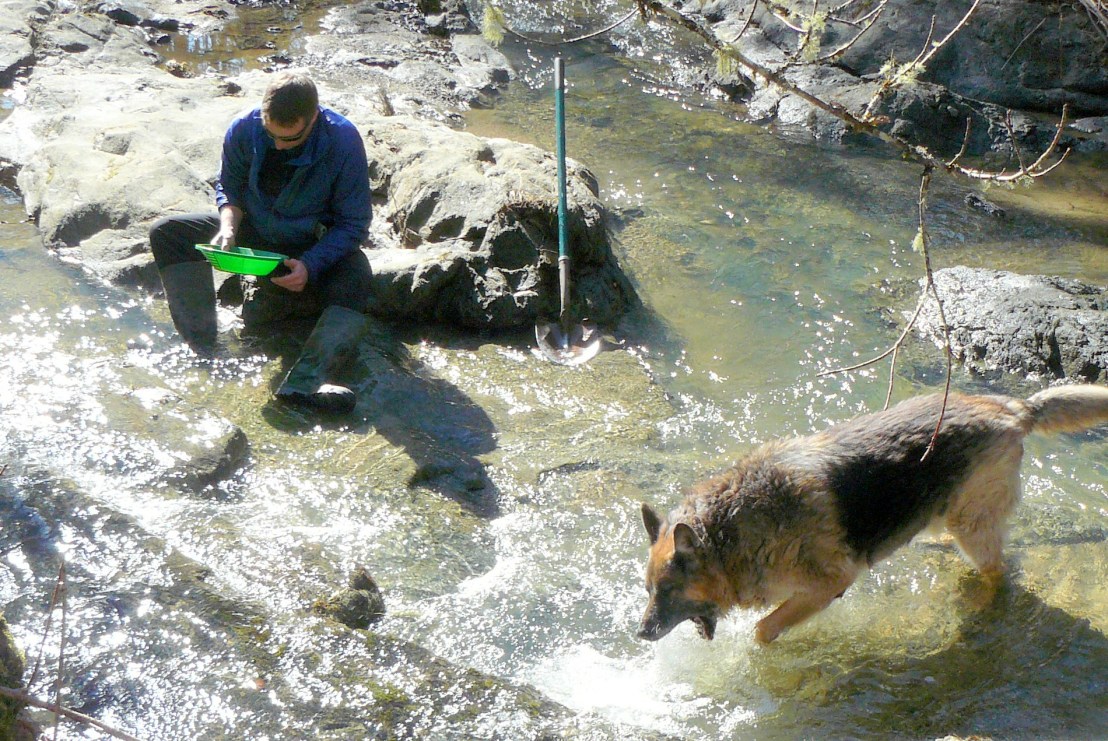
I will close with an old photograph of Pharaoh helping a prospector look for gold in our creek.
Pharaoh, instinctively, thought that a dog’s nose would raise the odds of a find.
I was discussing with Mr. P. (he of Wibble) yesterday the pros and cons of republishing material from The Conversation and I noticed this recent essay there.
It’s a very positive message but I will let you read it in full.
ooOOoo
Anthrax vs. cancer – researchers harness the deadly toxin to cure dogs and hopefully people
Can the feared anthrax toxin become an ally in the war against cancer? Successful treatment of pet dogs suffering bladder cancer with an anthrax-related treatment suggest so.
Anthrax is a disease caused by a bacterium, known as Bacillus anthracis, which releases a toxin that causes the skin to break down and forms ulcers, and triggers pneumonia and muscle and chest pain. To add to its sinister resumé, and underscore its lethal effects, this toxin has been infamously usedas a bioweapon.
However, my colleagues and I found a way to tame this killer and put it to good use against another menace: bladder cancer.
Among all cancers, the one affecting the bladder is the sixth most common and in 2019 caused more than 17,000 deaths in the U.S.
Of all patients that receive surgery to remove this cancer, about 70% will return to the physician’s office with more tumors. This is psychologically devastating for the patient and makes the cancer of the bladder one of the most expensive to treat.
To make things worse, currently there is a worldwide shortage of Bacillus Calmette-Guerin, a bacterium used to make the preferred immunotherapy for decreasing bladder cancer recurrence after surgery. This situation has left doctors struggling to meet the needs of their patients. Therefore, there is a clear need for more effective strategies to treat bladder cancer.
Anthrax comes to the rescue
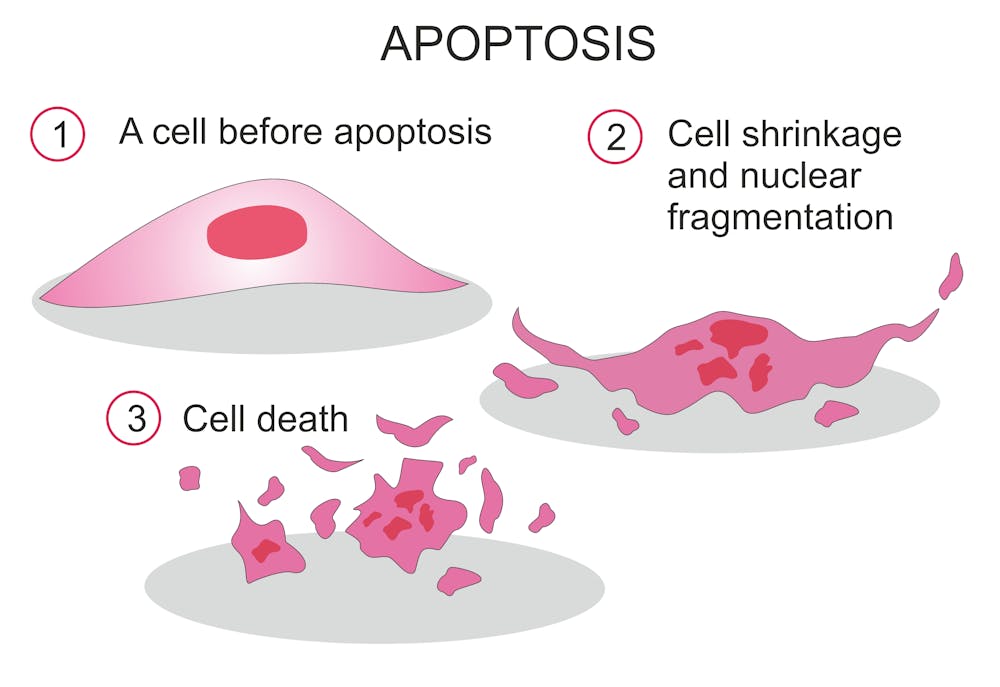
Years ago scientists in the Collier lab modified the anthrax toxin by physically linking it to a naturally occurring protein called the epidermal growth factor (EGF) that binds to the EGF receptor, which is abundant on the surface of bladder cancer cells. When the EGF protein binds to the receptor – like a key fits a lock – it causes the cell to engulf the EGF-anthrax toxin, which then induces the cancer cell to commit suicide (a process called apoptosis), while leaving healthy cells alone.
The EGF-anthrax protein binds to bladder cancer cells triggering apoptosis or programmed cell death, which is a regulated process leading to the death of cell. Soleil Nordic/Shutterstock.com
This highlights the potential of this agent to provide an efficient and fast alternative to the current treatments (which can take between two and three hours to administer over a period of months). I also think it is good news is that the modified anthrax toxin spared normal cells. This suggests that this treatment could have fewer side effects.
Helping our best friends
These encouraging results led my lab to join forces with Dr. Knapp’s group at the Purdue veterinary hospital to treat pet dogs suffering from bladder cancer.
Canine patients for whom all available conventional anti-cancer therapeutics were unsuccessful were considered eligible for these tests. Only after standard tests proved the agent to be safe in laboratory animals, and with the consent of their owners, six eligible dogs with terminal bladder cancer were treated with the anthrax toxin-derived agent.
Two to five doses of this medicine, delivered directly inside the bladder via a catheter, was enough to shrink the tumor by an average of 30%. We consider these results impressive given the initial large size of the tumor and its resistance to other treatments.
There is hope for all
Our collaborators at Indiana University Hospital surgically removed bladder cells from human patients and sent them to my lab for testing the agent. At Purdue my team found these cells to be very sensitive to the anthrax toxin-derived agent as well. These results suggest that this novel anti-bladder cancer strategy could be effective in human patients.
The treatment strategy that we have devised is still experimental. Therefore, it is not available for treatment of human patients yet. Nevertheless, my team is actively seeking the needed economic support and required approvals to move this therapeutic approach into human clinical trials. Plans to develop a new, even better generation of agents and to expand their application to the fight against other cancers are ongoing.
So I republished this from The Conversation in accordance with their republishing rules. As they put it:
You are free to republish this article both online and in print. We ask that you follow some simple guidelines.
Please do not edit the piece, ensure that you attribute the author, their institute, and mention that the article was originally published on The Conversation.
Regular readers of this place may notice some subtle differences because up until now I had just copied and pasted the article as posted.
From time to time I have an offer of a guest post. That is a person who wishes to write for Learning from Dogs. In nearly all cases I say ‘yes please’.
So it was with Adrian.
On the 15th January this year Adrian emailed me:
Hi Paul,
My name is Adrian and I am reaching out on behalf of Scott’s Police K9. I’ve followed your Learning from Dogs blog for a while now!
We write content for the family protection dog industry and love to share our expertise.
I’ll keep it short, I think I could be a valuable contributor and I would love to provide additional content to your site!
Please let me know if you are interested, I will send you a couple suggestions to choose from, which I feel would resonate with your readers’ interests. We’re also open to topic suggestions that you might want to touch upon on.
Thanks for your time and we hope to hear back from you soon.
I replied to say that I would love a guest post, and here it is!
ooOOoo
How to Get Your New Protection Dog Adjusted to the Family
By Steve Scott
If you’re the new parent of a protection dog, congratulations! You just made one of the best purchases for you and your family’s well being. Personal protection dogs are loyal animals that will happily become one of the “pack” and put all of its training, skills, and intelligence to work in looking after your family.
Should you be on the verge of bringing home your new family member, you’ll likely be wondering how to help them adjust to life at their new home. Read on for the best tips and tricks for a smooth adjustment for your trained K9 companion.
Visits with the Family
Dogs, even intelligent ones, prefer to be familiar with their surroundings, people, and environment. When your protection dog is being raised and trained, it will be beneficial to visit and begin bonding with the dog.
Bring each member of your family, and any important people your protection dog will be in charge of protecting once you take them home. If you have another dog and the trainer or foster allows it, provide some time for your protection dog to play with your current family pet.
Getting to know your protection dog before the big day when you take them home will help them, and you adjust to the new living arrangement. They will begin to associate you with someone they enjoy being around and when it comes time for you to train with the dog and the trainer, you’ll be a step ahead.
During this time, the dog shouldn’t leave the trainer or foster parent to spend time with you. Instead, you should visit the dog in the environment and surrounding it knows best with the trainer present.
Time of Day
When the big day comes, and it’s time to bring your personal protection dog home, plan to do so early in the day. Great protection dogs are raised to protect you and they’ll want to get a good look at their surroundings.
Moving a dog at night will cause a greater sense of unease and anxiety.
Introduce them to unfamiliar territory when there is plenty of daylight and the opportunity to explore together. Show them your house, the surrounding, and if you live in a place with property, walk the land with your new pup.
This will help them get oriented with the place they have sworn to protect and settle them in right away.
Be Ready for Their Arrival
When you bring your personal protection dog home, be ready for their arrival. Have their food bowl ready and filled. Ensure they have fresh water and a comfortable place to sleep. Acquaint them with their belongings, toys, dog bed, and everything related to their personal ownership.
Be prepared to spend most of the day with your dog, getting him used to your house, property, and your family. It’s important that you don’t bring your dog home then leave shortly after.
Adjusting your dog to your home and family takes time and is a crucial part of the bonding process.
Establish a Routine
All dogs thrive on routine. Help your new protection dog get to know yours. It’s a good idea to bring your protection dog home when life is normal, and you’re not planning on going on vacation in the following week.
Give them time to adjust to your routine. Protection dogs like knowing what to expect, what type of work they’ll regularly do, and the way your “pack” functions so they can better serve you.
Will you take them with you to work? Start taking them right away and put routines in place, so your protection dog knows this will happen regularly.
Will you leave them with your spouse and child at home? Have a ritual of letting them know you’re leaving and make sure they know that their job is to take care of your loved ones.
Plan regular times of continued training, running and playing daily after work and on the weekends. This will help them smoothly fit into the regular ebb and flow of your family’s work, school, and routine schedules. Also, protection dogs love to remain active.
Supervision Required
As you show your new protection dog around the house, yard, property, and introduce them to friends and family members they haven’t met, keep in mind that supervision is required.
They will still be getting used to their new location and the people they are supposed to protect, and introductions are best done in person with you by their side. Supervision is especially important when it comes to spending time with small children for the first several months.
Are You Ready?
Introducing your protection dog to its new home is an exciting and fun time. You alone have the opportunity to make its first impression the best one possible. How you begin life at home for your protection dog goes a long way in setting the tone for how it lives with you, your family, and your friends.
Are you ready for your protection dog to make its grand entrance?
ooOOoo
I asked for some background and this is what was sent:
Steve Scott – After his service in the Army, Steve pursued a career in Law Enforcement, earning honors as the head trainer of his Police Department’s K9 Unit. Steve’s real-world police K9 experience is what sets Scott’s Police K9 apart from other protection dog companies. With Steve’s dog training expertise and his access to the top European kennels, our Family Protection Dogs and trained Police Dogs are second to none.
This is a fabulous piece of advice. From, I have to say, someone who jolly well knows what he is talking about!
The serious consequence of exercising too much, too fast
Exercising too much, too hard can lead not only to burnout but sometimes to a serious condition that can harm the kidneys.
By Tamara Hew-Butler , Associate Professor of Exercise and Sports Science, Wayne State University, January 24th, 2020.
Every 365.25 days, when the Earth completes a full orbit around the Sun, we humans have the opportunity to hit the reset button and become fitter, finer versions of ourselves. As usual for January, social media is humming with advice on how to eat better, exercise regularly, lose weight and remain healthy. We feel particularly invincible at this time of year, armed with renewed vigor and motivation to purge ourselves from previous indulgences and our couch-potato ways.
The New Year is also the time when our overzealous, instant-gratification selves emerge, and we do too much exercise too soon to make up for lost time. Exhaustive muscular work, especially following a period of inactivity, can cause mechanical and chemical disruptions to muscle cell membranes which trigger the muscle cells to burst.
I am an exercise physiologist and sports medicine specialist who studies exercise-associated collapse. I am seeing and hearing of more incidents of skeletal muscle ruptures that are causing harm in other parts of the body.
This information is not designed to scare people back onto the couch. The key take-away from highlighting these cases is to remind athletes, coaches and mere mortals that the desired physiological response to a training stimulus requires both a gradual buildup period and period of recovery in between training sessions.
A cross-section of the human kidneys, which can be injured when muscle cells rupture and send toxic chemicals into the bloodstream. crystal light/Shutterstock.com
More than muscle injury
The medical term for skeletal muscle cell rupture is “rhabdomyolysis,” or “rhabdo” for short. When muscle cells rupture or explode, the intracellular contents are released into the bloodstream. These cellular contents include enzymes, such as creatine kinase; electrolytes, such as potassium; and proteins, such as myoglobin.
Myoglobin, in particular, is a big, red protein that can block the kidney filtration system, or renal tubules, that serve as kidney plumbing. It also can dissociate into toxic byproducts that injure kidneys. In rare cases, too much myoglobin in the bloodstream can stop kidney function altogether, as happened with a 27-year old marathon runner who died from kidney failure.
In a study we conducted on college swimmers, we saw a cluster of rhabdomyolysis, in which six out of 34 swimmers were hospitalized after participating in a 20-minute or so “arm competition” to see how many pull-ups, rows and bench presses they could complete. Cases of “symptomatic rhabdo,” or those needing medical treatment, appear to be increasing within collegiate sports teams at an alarming rate, with the characteristic appearance seen in football players returning to January practice after a season-ending holiday layoff.
To date, 17 cases of team rhabdo have occurred from doing “too much, too soon, too fast” and include a variety of sports such as football, swimming, lacrosse, soccer, track, basketball, softball, volleyball and golf.
Noncompetitive athletes affected too
So, what about us mere mortals trying to get back in shape? Any physical activity that is either new or excessive can cause symptomatic rhabdo. Excessive gardening, weightlifting, CrossFit type activities and even a routine Army physical fitness test have triggered symptomatic rhabdo with kidney injury.
Over 90 cases of rhabdo have been documented after spinning, while 119 high school students in Taiwan ended up in the emergency room after their teacher made them complete 120 push-ups within five minutes. Thus, harmful muscle cell rupture can occur after any degree five minutes to 36 hours of exuberant and/or unaccustomed physical activity.
In combination, gradual training and appropriate recovery allow beneficial muscular, cardiovascular and body composition adaptations to occur, such as building muscle, increasing fitness and losing body fat. Our research confirms that a two-week gradual introduction into training after a layoff is required for muscle cell membranes to fully adapt to training stress.
Subclinical rhabdo, or muscle breakdown without acute kidney injury or debilitating symptoms, is common and represents the typical response to training which does not require medical treatment. However, hard exercise, especially following a layoff, with the following signs or symptoms within one to two days requires an appropriate medical examination:
excruciating muscle pain that does not resolve over time
muscle swelling with limitations in movement
nausea or vomiting, or both
very dark (looks like Coca-Cola) or sparse urine.
There are risk factors which increase the likelihood of developing rhabdo following a workout. These risk factors include exercising in the heat, dehydration or overhydration, binge drinking, excessive coffee consumption, extreme dietary practices (vegetarian or high [protein] https://doi.org/10.1097/JSM.0000000000000310)) and possessing the sickle cell trait. Both men and women can develop symptomatic rhabdo, although we see more cases in men. Smaller arm muscles appear more susceptible to rupture after five to 30 minutes of exercise than bigger leg muscles for reasons that remain unclear.
Although symptomatic rhabdomyolysis is uncommon, this emergent complication of exercise should be on everyone’s radar since cases are on the rise. We coaches, trainers, scientists, practitioners and others encourage everyone to reap the joys and benefits of regular exercise training. However, we caution against exercising too much too soon. Self- (or coach-) inflicted skeletal muscle cell explosions are fully preventable with adherence to smart, physiologically sound approaches to training.
ooOOoo
Now there’s an element of me not really understanding this (and I haven’t yet watched the video) but that’s no reason not to share it with you.
What do you think? Wiser to share it or too much a case of worrying? Tamara Hew-Butler certainly knows all about this.
Researchers in India studied whether 160 stray dogs would react to commands like gesturing toward a bowl. This image, taken in 2012, shows street dogs surrounding an Indian tea vendor in Allahabad. (AP Photo / Rajesh Kumar Singh)
Dogs are famously good at interpreting human signals, whether communicated verbally or through gestures. But much of what we know about our furry friends’ comprehension of social cues focuses on pet dogs, which share close relationships with their owners and are trained to follow commands. Now, a study published in Frontiers in Psychology, suggests that stray dogs can also understand human gestures, indicating that this ability might be innate.
The new research took place on the streets of several regions in India, which is home to some 30 million stray dogs. Coexistence between canines and humans there is not always peaceful; people have been known to attack street dogs, and vice versa. Around 36 percent of the world’s annual rabies deaths occur in India, most of them children who came into contact with infected dogs.
To better manage the country’s street dogs, it’s essential to gain further knowledge of their behavior, Anindita Bhadra, study co-author and animal behaviorist at the Indian Institute of Science Education and Research Kolkata, tells Liz Langley of National Geographic. So she and her colleagues set out to discover whether strays, which have never undergone specific training, are able to understand humans in a similar way to their pet counterparts.
The researchers took to the streets equipped with two bowls; one contained chicken and the other was empty but had been rubbed with raw chicken, transferring the food’s scent. The bowls were covered with pieces of cardboard and handed to an experimenter who did not know which one contained the snack. This researcher would approach a stray dog, place the bowls on the ground and point at one of them, sometimes momentarily, sometimes repeatedly.
In total, the researchers studied 160 adult strays. Around half of them refused to get close to either bowl, perhaps because they had negative interactions with humans in the past, the researchers speculate. But of the dogs that did approach the bowls, approximately 80 percent went to the one to which the experimenter had pointed. Whether the researcher had pointed to the bowl briefly or repeatedly did not seem to matter. This response, according to the study authors, suggests that untrained stray dogs are “capable of following complex pointing cues from humans.”
Dogs share an intertwined evolutionary history with humans, with domesticated pooches emerging at least 10,000 to 15,000 years ago, though some experts have argued for an even earlier date. This close contact has prompted dogs to develop a number of skills that allow them to communicate with people, including interpreting human emotion. Still, Bhadra says, the researchers found it “quite amazing” that stray dogs without a history of close human interaction were able to “follow a gesture as abstract as momentary pointing.”
“This means that they closely observe the human, whom they are meeting for the first time, and they use their understanding of humans to make a decision,” Bhadra adds. “This shows their intelligence and adaptability.”
Because some dogs seemed anxious and were wary of approaching the researchers, it’s not clear how a dog’s personality—and past experiences—might affect its ability to interpret human signals. But this ability does not appear to be entirely dependent on training, the study authors say, which in turn should inform efforts to manage stray dogs.
“They are quite capable of understanding our body language and we need to give them their space,” Bhadra says. “A little empathy and respect for another species can reduce a lot of conflict.”
ooOOoo
Mother Nature News had a second picture in their broadly-similar article. Indeed, I’m going to republish this article as well. For although they are of the same story they offer a slightly different account.
ooOOoo
Even stray dogs understand human cues
A new study shows these feral canines are paying close attention.
Even untrained dogs can follow simple communications. (Photo: Abir Bhattacharya/Shutterstock)
Dogs were likely the first animals that human beings domesticated — scientific guesses vary as to whether that was 10,000 years ago in Europe or 30,000 years ago in Asia (or, as one theory goes, humans tamed grey wolves two separate times). Regardless, they have been our companions for much of human history, and all of modern history. We have evolved together.
And that longstanding connection shows up in feral dogs.
Behavioral biologist Dr. Anindita Bhadra of the Indian Institute of Science Education and Research in Kolkata, India, revealed this by studying stray dogs in several Indian cities. In the experiment, Bhadra and her colleagues would find a solo stray dog and put two covered bowls on the ground nearby. They they’d simply point to one of the bowls; some did this just once, others did it a few times.
The researchers, who published their work in Frontiers in Psychology, recorded the dogs’ reactions. Half the dogs seemed nervous, and didn’t look at or come close to either bowl. But the other half — noted as less anxious dogs by the researchers — approached the bowls. Of those friendlier dogs, about 80% went to the bowl the researcher pointed at. As long as the dogs weren’t too scared of the people, they were easily able to interpret what the pointing meant.
“We thought it was quite amazing that the dogs could follow a gesture as abstract as momentary pointing,” Bhadra said in a news release. “This means that they closely observe the human, whom they are meeting for the first time, and they use their understanding of humans to make a decision. This shows their intelligence and adaptability.”
Wolf puppies surprised researchers with their responses. (Photo: Bildagentur Zoonar GmbH/Shutterstock)
In another study, three out of 13 untrained 8-week-old wolf puppies spontaneously retrieved a ball for a person who threw it, as MNN’s Mary Jo DiLonardo explains. It was a small study, and a low percentage of retrieving puppies, but it was an unexpected result as these weren’t domesticated dogs. “It was so unexpected, and I immediately knew that this meant that if variation in human-directed play behavior exists in wolves, this behavior could have been a potential target for early selective pressures exerted during dog domestication,” Christina Hansen Wheat, a biologist at Stockholm University, said.
Her observations show that playing with people may be a very old trait for wolves, that could reflect how our human ancestors first got to know them. This playful behavior may have sparked humans’ interest in domestication. If a dog could fetch a stick or other thrown object, they could be quite useful to hunting humans.
Of course, their adorable, big puppy-dog eyes and floppy ears (both traits that have become accentuated over time as dogs evolved) are among the reason we are still drawn to dogs today. (It also helps that they’re great listeners.)
But long before that happened, dogs served an important purpose — assisting people in locating and retrieving prey, and serving as eyes and ears for an intruder. Simple tasks like showing they can follow directions or fetch an object may have moved prehistoric dogs from outside the fire circle to within it, which is why understanding these behaviors are so important.
ooOOoo
If we go back into the mists of time then prehistoric wolves (or dogs) learnt to bond with early humans because it served both their interests to so do. Humans became much more adept at hunting and wolves obviously became the benefactors of food!
Now dogs are so well bonded to human gestures that even non-domesticated dogs understand the signals that we humans put out. I say ‘non-domesticated’ but in a real sense all dogs are domesticated. It would be more accurate to say that these are dogs who do not have a home with humans.
Interesting article about calculating a dog’s age.
It’s a well-known ‘calculation’ that a dog’s age is seven years for every human year. But it’s wrong; the scientific result is more complex.
But rather than me say it, I’ll hand it over to Christian Yates of the BBC who on the 6th January this year published an article on this subject.
ooOOoo
Your pet clearly ages faster than you do, but new research is giving us a much clearer idea of just how old your dog really might be.
By Christian Yates, January 6th, 2020
If your dog has been alive and kicking its paws about for a decade, the widely held belief is it has aged as much as a human would have done over 70 years. This conversion factor – each year of a dog’s life accounting for seven human years – comes from dividing human life expectancy of around 77 by the canine life expectancy of around 11.
The underlying assumption is that each calendar year a dog lives through is equivalent to seven human years at any stage of a dog’s life. But new research suggests that things aren’t so simple. And if we look at some basic developmental milestones, it’s clear why.
For example, most dog breeds reach sexual maturity between the ages of six and 12 months – the upper end of that range corresponding, by the traditional conversion, to a human age of seven. And at the other end of the spectrum, although unusual, some dogs have been known to live for over 20 years. Under the “factor-of-seven” conversion rule, this would equate to an unfathomable 140 human-equivalent years.
New insights into how dogs age suggest our pets move into middle age more rapidly than most owners might suspect (Credit: Getty Images)
To make matters more complicated, dogs’ life expectancy depends significantly on the breed. Smaller dogs tend to live significantly longer, suggesting that they age more slowly than bigger dogs.
All of this raises the question of what exactly we mean by age. The most obvious way to describe it is simply the length of time that has passed since birth. This is known as the chronological definition of age.
When it comes to comparing animal ages across species, the biological definitions of age are far more useful than their chronological counterparts
However, there are other descriptions. Biological age, for example, is a more subjective definition, which relies on assessing physiological indicators to identify an individual’s development. These include measures like the “frailty index” – surveys that take into account an individual’s disease status, cognitive impairments and levels of activity.
Rather than celebrating chronological age, looking at the levels of methylation on a dog’s DNA is a much more accurate measure of aging (Credit: Getty Images)
For example, if you’ve spent a lot of time eating junk food and smoking cigarettes instead of taking exercise and eating healthily, the chances are your biological age will exceed your chronological age. Or, you might be a 60-year-old with the body of a 40-year-old if you’ve looked after yourself well.
A dog’s life
When it comes to comparing animal ages across species, the biological definitions of age are far more useful than their chronological counterparts. Knowing a hamster is six weeks old doesn’t give you a good picture of that animal’s life stage, even if you know the life expectancy of a hamster is only three years. Learning that a hamster has reached an age where it can reproduce gives a much better picture of its level of maturity.
In their first year of life, puppies grow up so quickly that they age the equivalent of 31 human years (Credit: Getty Images)
In particular, “methylation” – the addition of methyl groups (a carbon atom bonded to three hydrogen atoms) to DNA – seems to be a good indicator of age. Many prominent physiological markers, such as the development of teeth, seem to occur at the same levels of methylation across different species. So by matching the levels of methylation in Labrador retrievers and humans, the researchers derived a formula to map dog age to its human equivalent.
That formula is: human equivalent age = 16 x ln(dog’s chronological age) + 31.
Here “ln” represents a mathematical function known as the natural logarithm. The logarithm function is well-known in the non-linear scales for energy released during earthquakes (Richter) or for measuring sound (decibels). It comes in useful for measuring quantities whose sizes vary over many orders of magnitude. It’s even possible that a logarithmic experience of the passing of time might explain why we perceive time speeding up as we get older.
A handy short cut is to remember that the first dog year counts for 31 human years
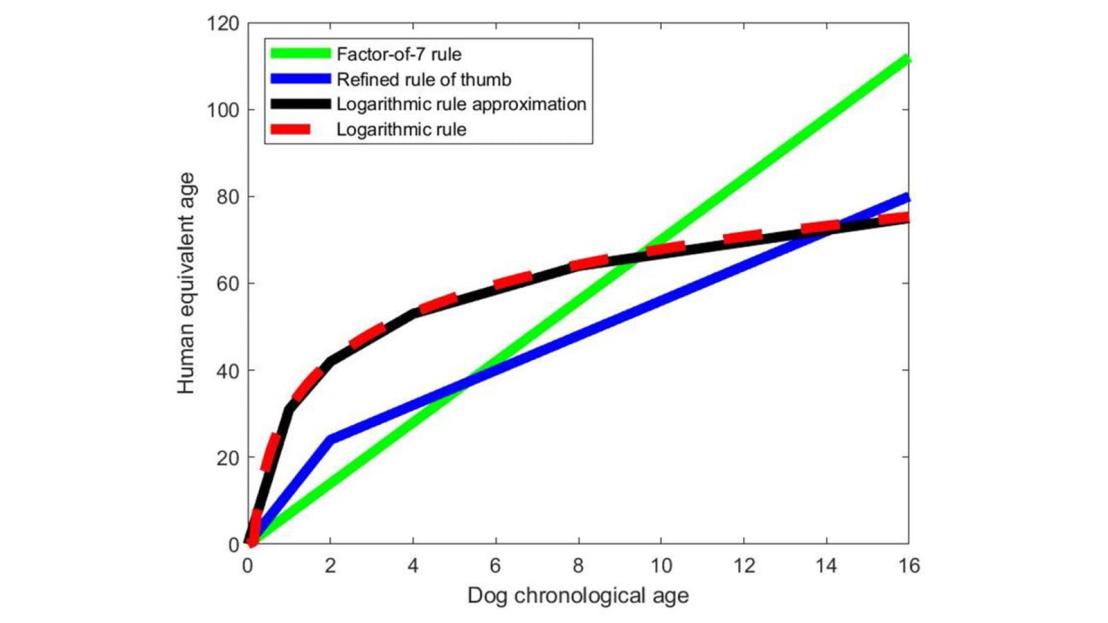
In the graph below, you can see how the natural logarithm works to convert the years a dog has lived (dog age) into the equivalent human age in the red dashed curve. The curve suggests that dogs mature extremely rapidly at first, but that their ageing then slows down, meaning that most of their lives are experienced as a form of protracted middle age.
A handy short cut is to remember that the first dog year counts for 31 human years. Then, after that, every time the dog’s chronological age doubles, the number of equivalent human years increases by 11. So eight calendar years represents three “doublings” (from one to two, two to four and then four to eight) giving a dog age equivalent of 64 (that’s 31 + 3×11).
This useful approximation is plotted as the black curve on the conversion figure below. The green line represents the discredited factor-of-seven rule that suggests unrealistic ages at the higher end of the dog age spectrum.
In eight calendar years a dog will approximately age the equivalent of 64 years (Credit: Christian Yates)
Most dog lovers will already have suspected that the human-to-dog age relationship is non-linear, having noticed that, initially, their pets mature much more quickly than the linear factor-of-seven rule suggests.
A more sophisticated refinement to the factor-of-seven rules has suggested that each of the dog’s first two years correspond to 12 human years while all subsequent years count for four human equivalents. The blue curve in the above figure, which represents this ad hoc rule, shows better agreement with the new logarithmic law.
In practice the new molecular insights into human-to-dog age conversion encapsulated by the logarithmic law suggest that dogs move into middle age even more rapidly than most dog-owners would have suspected. It’s worth bearing in mind, when you find that Rex is reluctant to chase the ball like he once did, that he’s probably got more miles on the clock than you’ve been giving him credit for.
Christian Yates is a senior lecturer in mathematical biology at the University of Bath. He is also the author of The Maths of Life and Death.
This articleoriginally appearedon The Conversation, and is republished under a Creative Commons licence.
ooOOoo
I don’t know about you but I found this article extremely interesting.
Playing a game of fetch with a dog means they are following a human social cue to recover the ball. But fetch isn’t just for dogs, wolf puppies are down to play too, which means they can also understand human communication cues, according to a new study.
Credit Wikipedia Commons
The findings, published in the journal iScience, were made after researchers put 13 8-week-old wolf puppies from three different litters through a series of tests usually used to assess dog-puppy behavior. Three of the pups were interested in playing fetch with a stranger, which included bringing a ball back when encouraged to.
The discovery was quite a surprise for the team as it was believed that the cognitive abilities necessary to understand communication cues given by a human were presented in dogs only after humans domesticated them 15,000 years ago. Dogs differ from wolves physically, genetically and behaviorally.
“When I saw the first wolf puppy retrieving the ball, I literally got goosebumps,” said Christina Hansen Wheat of Stockholm University in a press release. “I immediately knew that this meant that if variation in human-directed play behavior exists in wolves, this behavior could have been a potential target for early selective pressures exerted during dog domestication.”
Wanting to learn more about the effects of domestication on behavior, Hansen Wheat and her team raised wolf and dog puppies from the age of 10 days and put them through various behavioral tests. In one of them, the pup was thrown a ball by an unknown person, encouraging the wolf to get it and bring it back.
Expectations of the wolf pups catching on weren’t high, with the first two litters showing no interest in the balls, let alone of playing fetch. But everything changed with the third litter. A few of the puppies went for the ball and even responded to the social cues and brought it back.
“It was very surprising that we had wolves actually retrieving the ball,” said Hansen Wheat. “I did not expect that. I do not think any of us did. It was especially surprising that the wolves retrieved the ball for a person they had never met before.”
In the past, other research showed that domesticated and non-domesticated species will follow human gestures if a food reward is given, Hansen Wheat and her team said. But in those cases, the animals were previously trained to follow the cues or knew the person conducting the study.
While the new research has a limitation over the size of its sample, it could reassess our interpretation that understanding human social cues came from domestication. Instead, it could be possible that this behavior can be traced back to an ancestral population before wolves were domesticated into dogs.
ooOOoo
Despite this being the twenty-first century there are still things being discovered that cause us humans to be amazed.
Such as this story about the young wolves, way before they evolved into dogs.
The following was sent to me by Chris Gomez, brother of Dan, who I have known for nearly as long as Dan (and that’s a long time)!
The article appeared on ZME Science was published on the 15th January. It contains material that I, for one, didn’t know and I suspect I’m not the only one.
Have a read.
ooOOoo
Why do dogs have whiskers?
Whiskers allow dogs to “see” things that are literally under their noses.
Many mammals, including canines, have whiskers. Some dog owners think these whiskers are just longer unruly hairs that can be groomed and even snipped off entirely — but this would be a huge mistake. The whiskers, technically known as “vibrissae”, serve important specialized functions that help dogs sense the world around them and coordinate their movement.
Humans sense touch through millions of sensory receptors that line the skin and deeper tissue. Unlike humans, the follicles of the coarse hairs protruding from a dog’s muzzle, jaw and above its eyes are also packed with nerves that relay sensory information.
Essentially, these whiskers allow dogs to sense objects and the world around them as humans do with fingers.
What are a canine’s whiskers good for
Credit: Wikimedia Commons.
The tactile sensation is made possible thanks to Merkel cells, which are specialized skin receptors associated with nerve terminals. A dog’s mouth and snout are very rich in Merkel cells, according to a study published in the journal Veterinary Science.
According to researchers, these tactile hairs serve a variety of functions. For instance, the whiskers allow dogs to gather information from subtle changes in air currents about size, shape, and speed of nearby objects. Ultimately, this allows canines to see their surroundings better, even in dark. It’s well known that vision isn’t a dog’s strong point, so their vibrissae greatly assist them — especially when dealing with close objects (dogs are farsighted). Whiskers beneath the chin allow dogs to “see” objects obstructed by their snouts.
Whisker’s positioned immediately above the eyes are particularly important for vision. When an object or strong airflow causes these whiskers to flex, dogs will reflexively blink in order to protect their eyes.
It’s not clear whether dogs use their whiskers for food acquisition. However, if they’re anything like rats, seals, and walruses — all related species that have been shown to use their whiskers to find food — dogs might very well use their sensing hairs for this purpose, too.
A dog’s whiskers can also serve an important role in communication with other canines or other species. Like many other mammals, when a dog is threatened it will automatically flare its whiskers, pointing them in a forward direction. This signals to predators and other aggressive animals that the dog is ready to defend itself and respond with violence.
Dogs may use their whiskers to also disperse pheromones, keep their head upright when swimming, and monitor their environment.
About 40% of a canine’s visual cortex (the part of the brain responsible for processing vision) is devoted to mapping information from whiskers. They’re that important!
What you need to know about your dog’s whiskers
Credit: Pxfuel.
Although they might look similar, vibrissae are distinct from body hair. The main difference is that a dog’s whiskers are directed by the nervous system and contain nerves.
Unlike cats, which have four rows of whiskers on either side of a cat’s face, the placement of a dog’s whiskers is less predictable. Some have a multitude of vibrissae, others may have few or even none. You should find them above the eyes, on both sides of the muzzle, above the upper lip (pointing down) and beneath the dog’s chin.
According to scientists, there are no breed-specific differences in canine whiskers. An exception may involve hairless breeds, which have no whiskers at all.
That being said, you should never trim your dog’s whiskers. Some pet owners believe their dogs’ whiskers should be groomed and snip them for aesthetic purposes.
This practice won’t hurt the dog, because there are no pain receptors found in whiskers. However, given the multitude of functions they serve, a whisker-less dog will become confused, disorientated, and less able to navigate its spatial surroundings. If you cut your dog’s whiskers in the past out of ignorance, know at least that they will grow back naturally.
In summary, dogs use their whiskers as a sort of radar to detect objects that they cannot properly see with their own eyes.
ooOOoo
Apart from the fact that the photographs are gorgeous there is much material that is good to know. For instance, I never knew there were no breed-specific differences in canine whiskers. Just hadn’t thought about it before.
I came late to my desk yesterday afternoon so you will forgive me for launching straight into a piece I read on the BBC.
ooOOoo
Bow ties give dogs in shelters a ‘second chance’
When 13-year-old Sir Darius Brown (yes, his real name) heard about displaced dogs being euthanised after Hurricanes Harvey and Irma in 2017, he had an idea.
His sister had taught him how to make bow ties and he decided to donate some to local animal shelters. It helped the dogs to get adopted faster.
Now his handmade bow ties have helped around 200 dogs across the US, leading him to receive a letter of recognition from former President Barack Obama.









 Learning from Dogs