Category: Education

Days Thirteen and Fourteen of Tom and Chica’s walk

The photographs are stunning as well!

Dear people, I cannot really add anything to these beautiful posts that, as always, are republished from here.

ooOOoo

Days 13 and 14: Cuevas del Becerro to east of Ardeles* 32k

By Tom and Chica, 5th February, 2020

Written by Tom’s wife.

Authors note: As Tom is now having to send me the details of his walk, it seems better to write in his voice – so that is what I have done here.

Considerable pondering this morning over whether I should take Chica or Merlin. Chica seemed fine but this was going to be a four or five day stint with no chance of a change-over. In the end, decided best to let Merlin do this one. The next stretch would be much longer so best that Chica is in top form.

From the last drop off location, we all walked the first stretch through scrubby terrain with holme oaks and some abandoned road works. Here Gill, Arfy and Chica turned back, Chica looked pretty miffed. Me and Merlin carried on over a rise and down into the next valley.

A long walk along the valley followed, heading east and steadily climbing past a goat farm and some derelict buildings. The temperature was climbing too and we stopped for water and a rest. Hearing a low buzzing, I spotted hundreds of bee hives hidden in valley below.
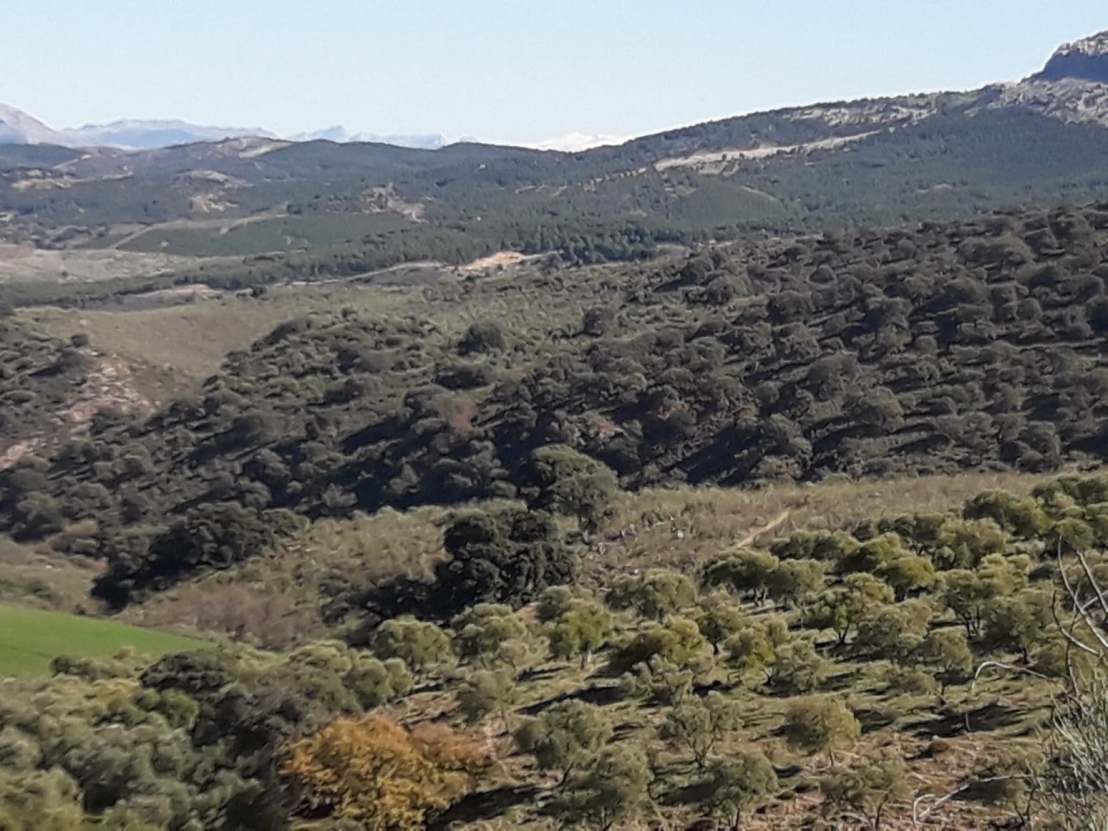
The rough track was now very exposed with more goats and olive groves. We were both very hot and I was getting worried; we were short of water and Merlin was looking a bit weary. Eventually we found a hole dug to pump water to crops so he was able to drink.

The village of Serrato had no bars or shops but we found a wrought iron bench in the shade by a fuente (fountain). I brewed up coffee whilst Merlin drank and ate treats and was quickly revived and happy again. A local farmer turned up to fill his water flagon and told me how good the water was, knocking some back to prove it. After a halting conversation in Spanish he walked off, but then came back to give me directions for the GR7. What a gent!

Rehydrated, we hiked out of village then up and up into the hills to a wonderful camp site above the tree line with great views in every direction. Merlin was very alert and on guard. Bolognese noodles for my supper, and chicken and treats for Merls. Absolutely knackered, everything aches!

Day 14

Made coffee at 8am then went back to the tent to do physio exercises, listen to my audio book and luxuriate in the quiet. Merlin also very chilled. Set off at 11 feeling fairly fit and strong as we climbed steadily.

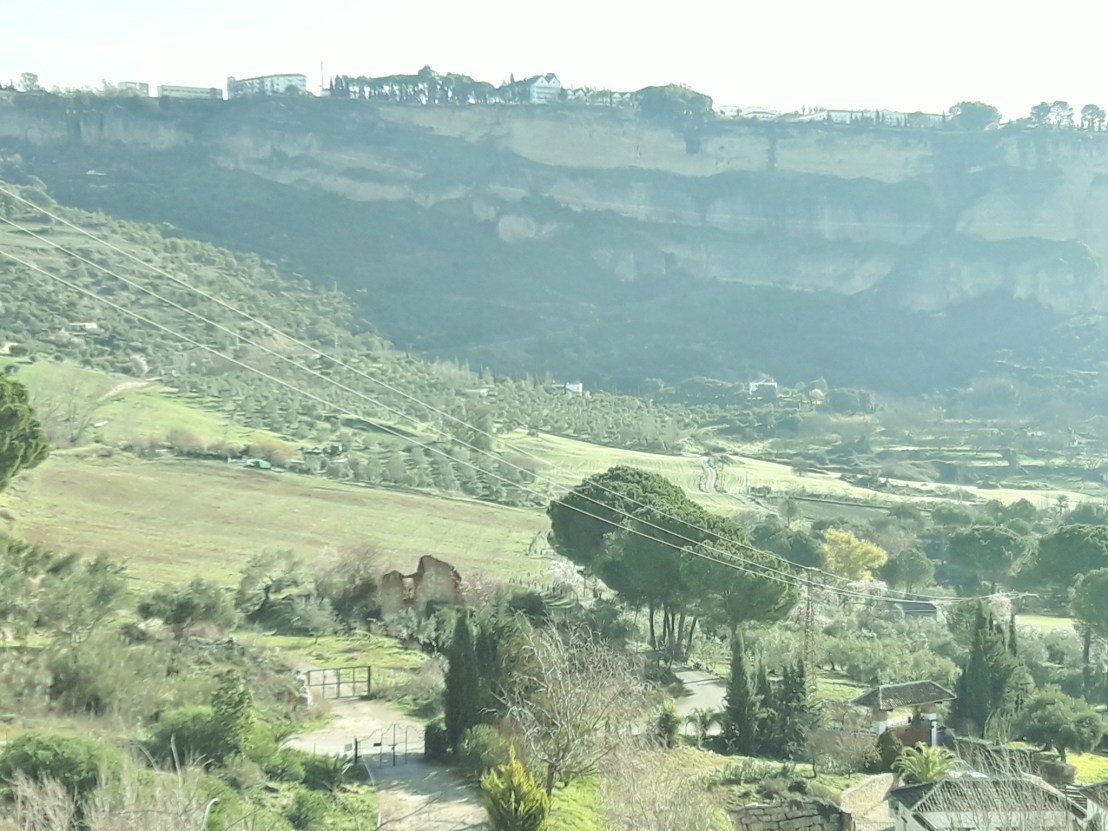
The Sierra Nevada came into view as we followed the washed out track. It then turned downhill out of pine trees towards open farmland, passing farms with more goats, free range and intensive chicken buildings and cultivated land.

There were fields of regimented rows of olives and blossoming almonds, and the sound of chain saws at work trimming and thinning the olives. It was now very hot and exposed, and water was at premium again. We were very grateful to reach the outskirts of Ardales and a welcome water tap by a shady stone seat.

Some friendly locals asked what I was doing and then directed me to a bar for food. Unfortunately, it was closed but we continued out of town to Hotel el Cruce for lunch. It was 3pm and 28deg.

Beer, olives, bread, fish and chips, coffee and cookie for €13.50. The lovely waitress filled my water bottles and it was with some reluctance that we went on our way at around 4pm. Another 1k on the road then upwards again on tracks for two hours to find an excellent camping spot with views in all directions. Merlin is getting into this camping lark! El Chorro tomorrow!

* Final location WTW bath.wrenches.presets

ooOOoo

The two photographs of Merlin are terrific. As Gilliwolfe writes:

Merlin is a tough little Patterdale and is loving being on the trail. He is getting on for nine years old so we didn’t really think he’d manage. But looks like we were wrong.

I know I am repeating myself but so what: The photographs are stunning!

More tomorrow!

Day Twelve of Tom and Chica’s walk

It continues to be perfect!

Once again, it is my pleasure to republish this and, as usual, it is taken from here.

ooOOoo

Day 12: Arriate to Cuevas del Becerro 10k

By Tom and Chica, 31st January, 2020

Written by Tom’s wife.

Day 12 saw a late start as Tom headed for the station with Chica for the 12.50 train. Again, no problem boarding with a dog. The guard even ruffled her ears as he collected the fare.

After a quick coffee in Arriate, the trail headed out into the countryside past large chicken sheds, piggeries and posh houses, one still apparently celebrating Navidad!

They reached the railway station at Parchit, all of which remains is the platform. The station house and bar were gone and a new road was in the process of construction. Nosing around here, Tom spotted a very grand entrance to a vineyard. Oddly here, gates are one extreme or another; either grandiose like this one or an old bedstead wired to a pole or even more rustic, a couple of strands of wire held up by small branches. You very rarely see a common-or-garden functional gate.

The route turned into a delightful country lane and with Chica breaking trail, still heading north-easterly, they continued through mostly holm oak and olive trees. Eventually meeting the main road they found the path ran alongside so they chose to keep to one a bit further away. Here stonemason Tom was happy to see a beautifully constructed dry stone wall, not unlike those seen at home on the Mendip Hills.

As the sun was going down, around 6pm, Tom texted to say they were somewhere on the A367. Fortunately, the What Three Words location (built.orangey.juicy) was more accurate and I was there shortly afterwards. Home before dark.

ooOOoo

It hardly seems relevant for me to add some words at the end. The description of the walk stands up on its own.

But what I will say is that there is another episode tomorrow!

Wow! What a stupendous sight!

Mars!

I’m not going to do anything other than launch straight into this post. Taken from EarthSky.

ooOOoo

Curiosity rover on Mars snags highest-resolution panorama yet

That nose! (Of the dogs.)

It is the most amazing aspect of the dog.

I have written previously about the dog’s nose and their ability to smell.

Dogs have millions of smell receptors that can detect countless smells, including the smells of changes going on inside our bodies. (Photo: RedTC/Shutterstock)

But there’s more to their nose that just the millions of smell receptors.

This article in The Smithsonian explains.

ooOOoo

Dogs’ Cool, Wet Noses May Be Able to Detect Heat

A new study has found that dogs can pick out objects that are warmer than ambient temperature

By Brigit Katz ,    smithsonianmag.com, March 4th, 2020

A dog’s cold nose could be used for heat seeking. (Photo by Angelika Warmuth/picture alliance via Getty Images)

If you’ve ever given a dog a boop on the snout, you may have noticed that its rhinarium—the furless patch of skin that surrounds the nostrils—is wet and cool. A new study published in Scientific Reports has found that these chilly rhinaria make dogs sensitive to radiating heat, which in turn might help them track down warm-blooded prey.

Dog noses are chock full of nerve endings—they have more than 100 million sensory receptor sites in their nasal cavities, compared to humans’ six million—making them extraordinarily keen sniffers. It thus seemed likely, according to the study authors, that dogs’ rhinaria serve some sort of sensory function.

Low tissue temperature seems to compromise sensory sensitivity in animals with one notable exception: crotaline snakes, also known as pit vipers, which seem to strike more accurately at warm-blooded prey when their heat-sensitive pit organs—located between each eye and nostril—are colder. Cool snakes are also more sensitive to thermal radiation. Perhaps, the researchers theorized, pooches deploy their noses for heat detection, too.

To test the theory, the researchers trained three pet dogs to choose the warmer of two panels. One, according to Gizmodo’s George Dvorsky, was heated to between 51 and 58 degrees Fahrenheit higher than the ambient temperature, similar to the body temperature of a fur-covered mammal. The other, which served as the control, had a “neutral” temperature close to that of the ambient environment. After the training, the dogs were put to the test in a double-blind experiment; neither they nor the people carrying out the trial knew from the get-go which object was warmer, since nothing visually distinguished them.

Still, all three dogs were able to home in on the warmer object, suggesting that they can detect even weak thermal radiation. “[T]he temperature of the mammalian bodies that emit [thermal radiation is not very high, unlike the Sun for instance,” first study author Anna Bálint, a biologist at Lund University in Sweden, tells Gizmodo. To pick up on the heat radiating from warm-blooded prey, dogs would need “very sensitive sensors.”

The nose seemed like the most likely candidate leading the dogs in the right direction. All other parts of a dog’s body are covered in insulating fur, with the exception of the eyes, which “are not suitable for receiving infrared radiation, because the sensitive structures are hidden behind a thick layer of tissue,” study co-author Ronald Kröger, also a Lund University biologist, tells Gizmodo. But to test their theory once again, the researchers conducted functional MRI scans of the brains of 13 pet dogs. The left somatosensory cortex in dogs’ brains—which “delivers input from the nose,” according to Virginia Morell of Science—was more responsive to objects emitting weak thermal radiation than neutral objects.

The researchers don’t know precisely how dog rhinaria convert energy into a nervous signal, and it’s not clear whether pups’ heat-detecting abilities are particularly effective if their hypothetical prey is far away. The test objects were placed around five feet from the dogs; Gary Settles, a mechanical engineer at Pennsylvania State University who was not involved in the study, tells Science that he doubts “dog rhinarium can distinguish patterns of hot and cold objects at a distance.”

But for shorter distances, at least, being able to sense the heat emanating from prey could help canines hunt even if their sight, smell or hearing is obscured. That may not matter much to domestic dogs, but their closest wild relative, the grey wolf, preys on large, warm-blooded animals. “[T]he ability to detect the radiation from warm bodies would be advantageous for such predators,” the authors note in the study. And perhaps most importantly, the study offers yet another reason as to why your dog is great: Its nose knows more than you might think.

ooOOoo

The more that we understand our favourite pooch, the more that we are in awe of them. Their noses are incredible. To be honest, it is very difficult to comprehend just what this primary sense of dogs means to a dog.

I will take the closing sentence of the article to close my own thoughts:

To be honest, it is very difficult to comprehend just what this primary sense of dogs means to a dog.

Indeed!

A coyote for you!

This is delightful.

Coyotes are not dogs but they are cousins to the dog.

All of which made the following story on Mother Nature News one that had to be shared. I just hope that a link to the original story is sufficient for copyright.

This is the story!

ooOOoo

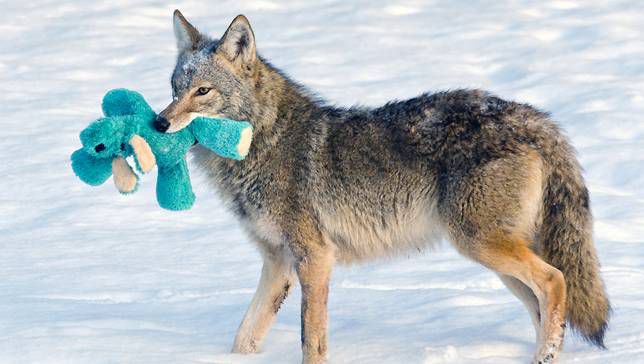
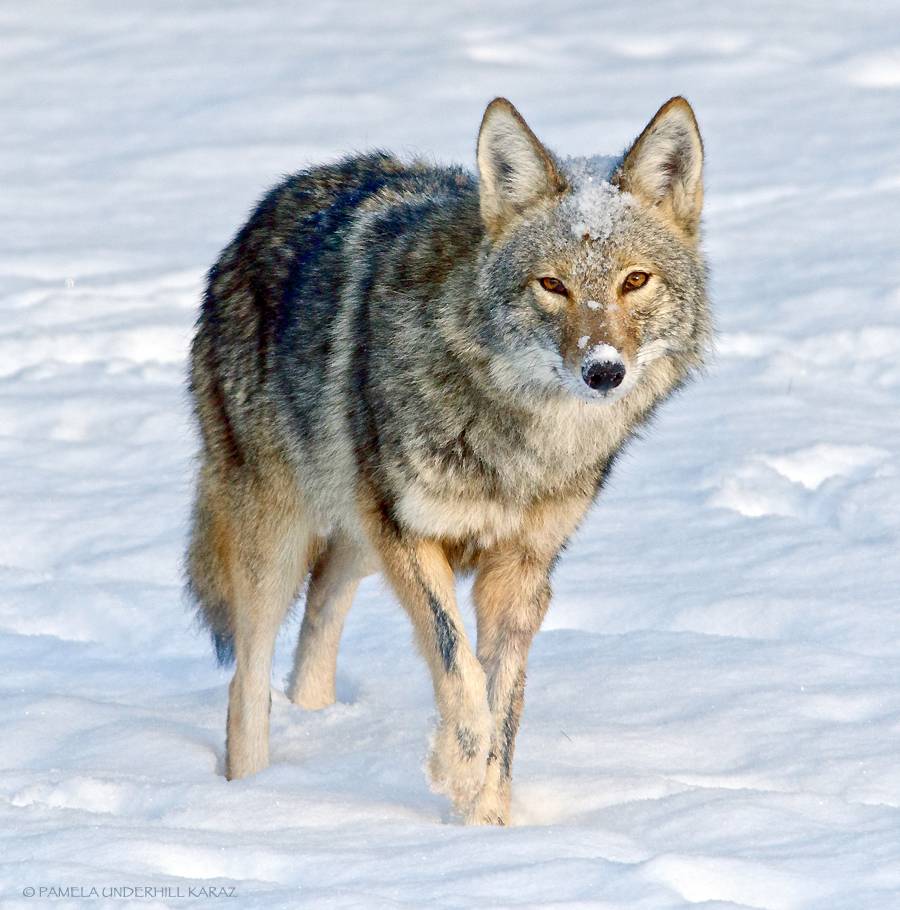
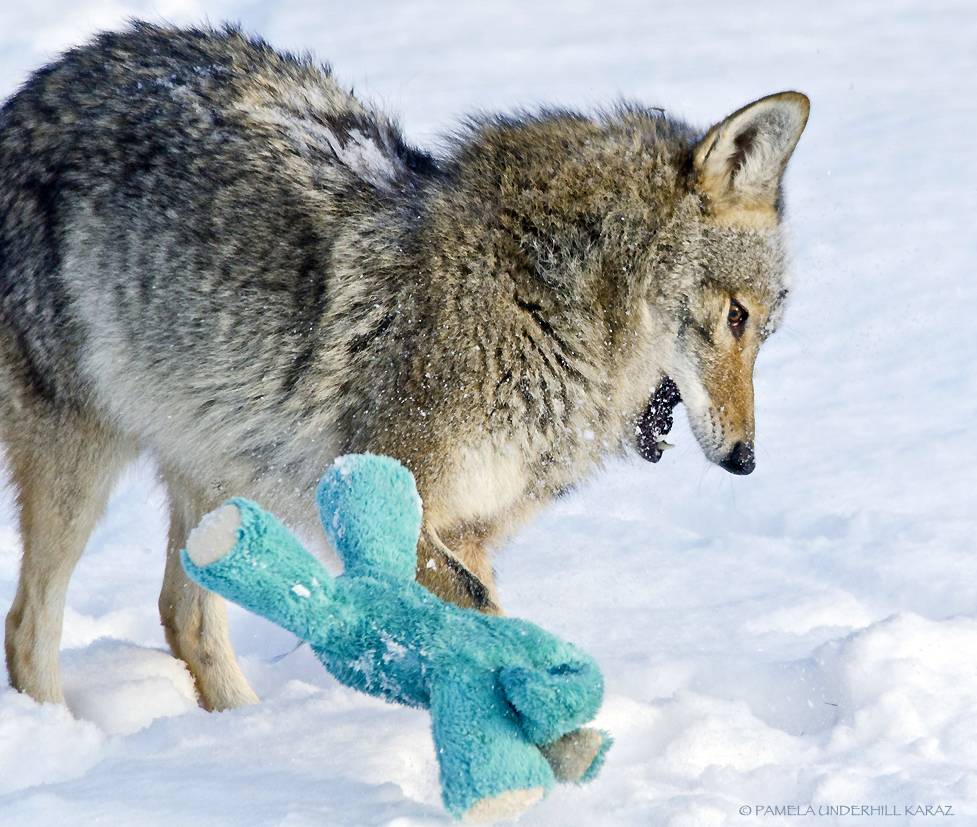
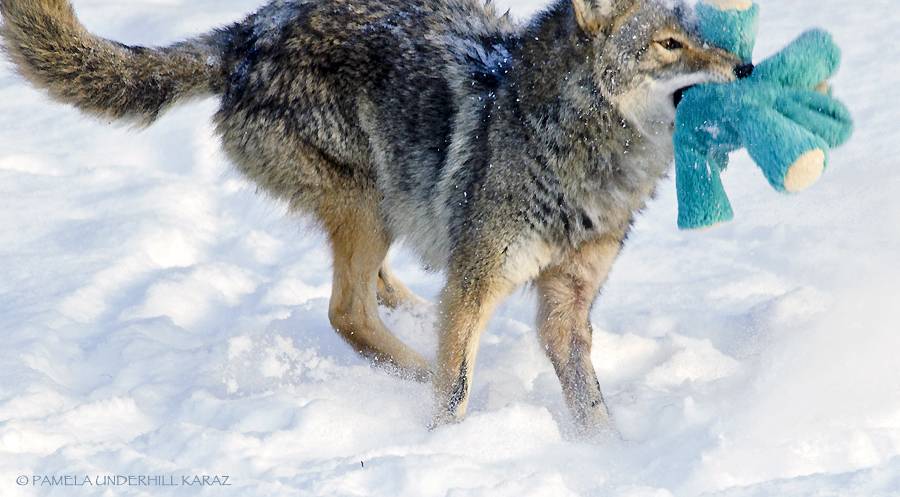
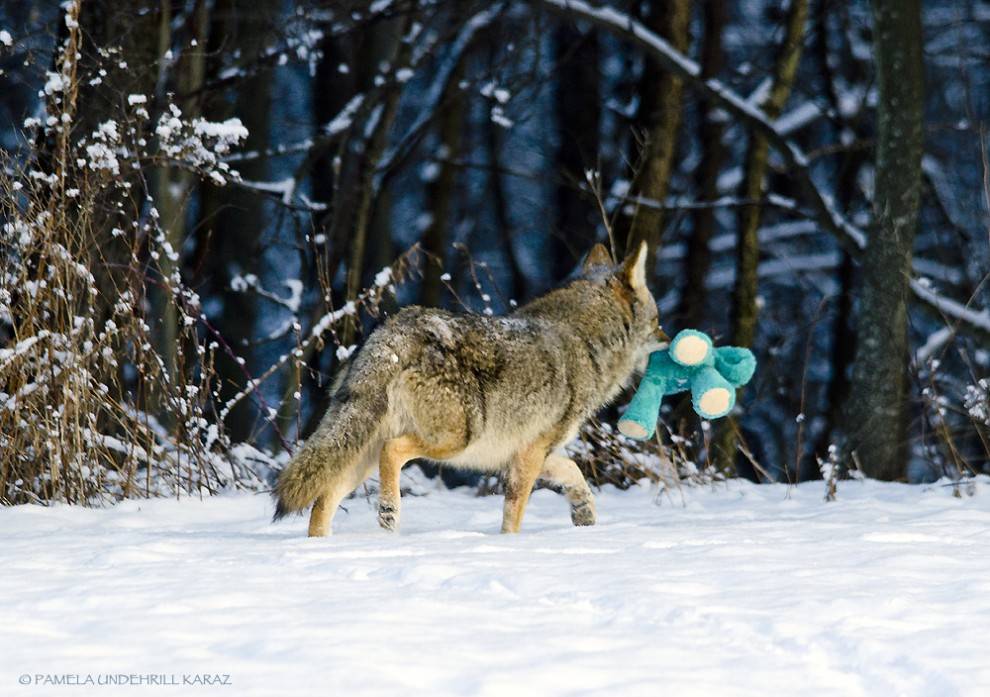
Coyote finds old dog toy, acts like a puppy

A photographer spotted a coyote as it trotted into her yard and explored a toy left in the snow. What she managed to capture on camera is the beauty of play.

By

Jaymi Heimbuch
Jaymi Heimbuch,   March 6, 2015.

This coyote took a liking to a blue stuffed dog toy and had a playful romp in the snow with it. (All photos: Pamela Underhill Karaz)

Photographer Pamela Underhill Karaz lives in Trenton Falls, New York, in a rural area. Her own property is 48 acres of forest and field, which means she gets to see her fair share of wildlife right in her own backyard. “We’ve had coyotes living around us for years. We hear them mostly during the summer evenings,” she told MNN. But something much more than simply hearing a few coyote howls happened two years ago.

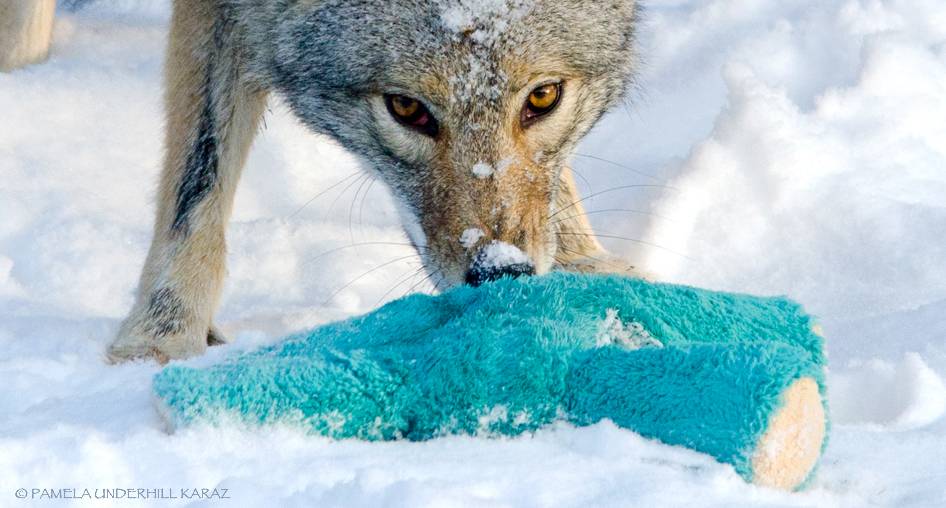
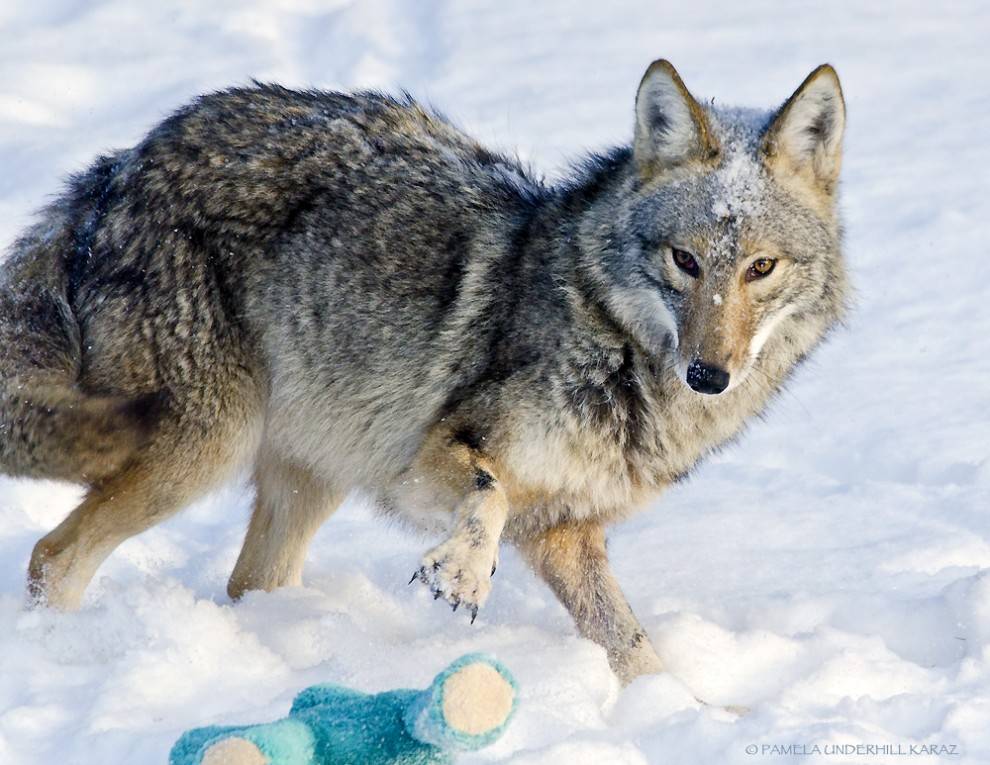
She tells us, “Our driveway is a quarter-mile long and lined with 45-year-old balsam trees. Being a photographer, I’m always on the lookout for wildlife activity. I spotted the coyote while having our morning coffee. He was one-third of the way down our driveway. He went to the middle, looked across then decided to come back up a bit. He left his scent on a downed branch (that’s how I know it was a male), then went into the trees and popped out up at the edge of our yard. Looked around, checked out and sniffed some tracks in our yard and when he was further along he noticed the toy. He made his way over to it, sniffed around it where our dog had rolled, sniffed the toy, picked it up, dropped it, sniffed it again.”

Then that’s when the magic happened. “[He] picked it up then proceeded to toss it up in the air and play with it, just like a dog would toss a toy around. It lasted perhaps five to 10 minutes, from picking up the toy, tossing it in the air, picking it up again and almost bucking around with it … then he just casually trotted off with it.”

Underhill Karaz notes that her dogs often leave their stuffed toys out in the yard and more than one has disappeared before. She guesses that this is perhaps not the first time the coyote had played (and run off with) her dogs’ toys.

Many animal species exhibit play, and yet we humans can’t help but look on in awe when we recognize it in species beyond the domestic dogs and cats we keep as companions. We get so used to thinking of wildlife as efficient and purposeful, wasting no energy. For the young of many species, play is indeed an essential part of growing up. Through play, juveniles learn everything they’ll need for adulthood from how to hunt to how to fight to how to navigate the social structure of their community. So we look on with joy but without much surprise when fox pups romp with each other and bear cubs tumble around together. But when the play carries on into adulthood, that’s when we stare with amazement, remembering we aren’t the only animals who like to inject a little joy into our day with silliness.

“This was such a wonderful reminder that all animals, the wild and the not so wild (our pets) are really not so different,” Underhill Karaz says. “They have personalities, they have feelings, and they do their best to survive in what is sometimes a very unfriendly world. They are not so very different than us.”

Check out more of Pamela Underhill Karaz’s photography on her Facebook page.

ooOOoo

Let me repeat that last paragraph that Pamela wrote:

“This was such a wonderful reminder that all animals, the wild and the not so wild (our pets) are really not so different,” Underhill Karaz says. “They have personalities, they have feelings, and they do their best to survive in what is sometimes a very unfriendly world. They are not so very different than us.”

I would just add that like dogs coyotes are creatures of integrity!

Enough said!

Day Eleven of Tom and Chica’s walk

What can I say but it’s beautiful!

Coming up to two weeks and thanks to Tom and Gilliwolfe we, too, have shared every step of the way. As usual, taken from here.

Enjoy Day Eleven!

ooOOoo

Day 11: Indiana to Arriate 14k

By Tom and Chica, 30th January, 2020

Written by Tom’s wife.

After her two day camping adventure, we gave Chica a day off and once again Merlin stepped into the breach. Also, Synnove, our lovely neighbour here in Jimera was going along for the day.

Starting from Indiana and heading towards the city of Ronda, this was gentler country of pasture and olive orchards. The cliffs that surround the city drew nearer and seemed particularly impressive when viewed from below.

A steep winding path took them up to the top of the cliffs and into the old town. They crossed the famous Puente Nuevo bridge which separates the ‘new’ town built around the 12th century from the ancient Moorish old town. The view is spectacular and you have to jostle for position the get the essential ‘me on the bridge in Ronda’ pic.

After a coffee here, they headed to the top of the town, past the railway station, through the industrial area and back into the countryside. Merlin took all this in his stride and it became clear that he was the better option for the urban parts of the journey. Chica would have found this quite stressful.

After a slight map reading error leading to an unscheduled tour of the surrounding area, they resorted to GPS and found their way back to the route, which headed north-east towards Arriete. The going was easy; tarmacked road though cultivated fields and grazing land. Every property here seems to be guarded by a gang of barking dogs and most have ‘Beware of the Dog’ signs of varying degrees of crudity, but this one was rather good, they thought.

Reaching Arriete, they headed to the station. Technically, dogs are not allowed on trains in Spain but we have managed to take ours a short distance by looking pathetic and saying “No entiendo” (I don’t understand) a lot. This was unnecessary here as the lady in the ticket office was clearly a dog lover and made a huge fuss of Merlin. We’ll see if they’re as lucky tomorrow when Tom and Chica try and get the train back to Arriate. Then I can have a lie-in!

ooOOoo

I love that about putting the dog on the train! 🙂

Just a small but fascinating item on this amazing walk. The walk along GR7.

Keep it coming, Tom!

A leap into the unknown!

A slight tongue-in-cheek title to today’s post.

Because it is a leap day!

So I’m going back a long time.

I was born towards the tail end of 1944; six months before the end of WWII in Europe.

As such I was in my early twenties when NASA came to the wider attention of millions of people with their effort to put a man on the moon. It was enthralling to look up at the night sky when a moon was present and think that in time there would be a man standing on the moon’s surface.

Now that I am 75 many things have changed. But one of them has not: Staring up at the night sky and getting lost in thought. Luckily we live in a rural location without artificial light anywhere nearby and the night skies are very clear.

All of which takes me back to my days of sailing. From 1986 until 1991 I lived on a deep-water ketch, a Tradewind 33, based in Larnaca, in Cyprus. Each Spring, I would solo across to the Turkish coast, or the Greek coast, and meet up with friends, or my son and daughter, and go coastal cruising. Then in the last year I sailed for England. I well recall seeing the night sky all around me with the stars practically down the watery horizon.

But more of that some other day. Now back to the moon.

All of which is to republish this post and I do hope you will be able to read it fully.

ooOOoo

NASA video reconstructs the harrowing lunar journey of Apollo 13

By Michael d’Estries, February 26, 2020

NASA’s reconstruction of the moon’s far side is based off images received by its Lunar Reconnaissance Orbiter spacecraft. (Photo: NASA/Snapshot from video/YouTube)

On April 15, 1970, NASA astronauts Jim Lovell, Jack Swigert and Fred Haise aboard Apollo 13 set a Guinness World Record for the highest absolute altitude attained by a crewed spacecraft at a distance of 248,655 miles from Earth. Nearly 50 years later, that unplanned record still stands as part of a mission beset by technical glitches and saved by engineering heroism.

“We didn’t slow down, unlike the others, when we got to the moon because we needed its gravity to get back, so we hold the altitude record,” Lowell told the Financial Times in 2011. “I never even thought about it. Records are only made to be broken.”

Gliding by the moon’s far side at an altitude of only 158 miles, the crew of Apollo 13 were, at the time, one of only a handful of humans to ever gaze upon this strange and relatively-unknown terrain of our closest neighbor. Because the moon is tidally locked, a phenomenon in which an orbiting body takes just as long to rotate around its own axis as it does to revolve around its partner, only one side ever faces the Earth.

Using imagery collected by its Lunar Reconnaissance Orbiter spacecraft, NASA has recreated views observed by Apollo 13 during the crew’s harrowing 25-minute journey around the moon’s far side.

“This video showcases visualizations in 4K resolution of many of those lunar surface views, starting with earthset and sunrise, and concluding with the time Apollo 13 reestablished radio contact with Mission Control,” the agency said in a release. “Also depicted is the path of the free return trajectory around the Moon, and a continuous view of the Moon throughout that path. All views have been sped up for timing purposes — they are not shown in ‘real-time.'”

This video uses data gathered from the Lunar Reconnaissance Orbiter spacecraft to recreate some of the stunning views of the Moon that the Apollo 13 astronauts saw on their perilous journey around the farside in 1970. These visualizations, in 4K resolution, depict many different views of the lunar surface, starting with earthset and sunrise and concluding with the time Apollo 13 reestablished radio contact with Mission Control. Also depicted is the path of the free return trajectory around the Moon, and a continuous view of the Moon throughout that path. All views have been sped up for timing purposes — they are not shown in “real-time.” Credits: Data Visualization by: Ernie Wright (USRA) Video Produced & Edited by: David Ladd (USRA) Music provided by Universal Production Music: “Visions of Grandeur” – Frederick Wiedmann

According to Lowell, despite the astronauts’ extremely close proximity, the moon was not the most awe-inspiring scene outside the spacecraft window.

“The impression I got up there wasn’t what the moon looked like so close up, but what the Earth looked like,” he said.

“The lunar flights give you a correct perception of our existence. You look back at Earth from the moon and you can put your thumb up to the window and hide the Earth behind your thumb. Everything you’ve ever known is behind your thumb, and that blue-and-white ball is orbiting a rather normal star, tucked away on the outer edge of a galaxy. You realize how insignificant we really all are. Everything you’ve ever known — all those arguments and wars — is right behind your thumb.”

ooOOoo

Did you watch the video? It’s amazing and is literally the dark side of the moon!

I will close by republishing a Wikipedia entry for Apollo 13.

Apollo 13 was the seventh crewed mission in the Apollo space program and the third meant to land on the Moon. The craft was launched from Kennedy Space Center on April 11, 1970, but the lunar landing was aborted after an oxygen tank in the service module (SM) failed two days into the mission. The crew instead looped around the Moon, and returned safely to Earth on April 17. The mission was commanded by Jim Lovell with Jack Swigert as command module (CM) pilot and Fred Haise as lunar module (LM) pilot. Swigert was a late replacement for Ken Mattingly, who was grounded after exposure to rubella.

Accidental ignition of damaged wire insulation inside the oxygen tank as it was being routinely stirred caused an explosion that vented the tank’s contents. Without oxygen, needed both for breathing and for generating electric power, the SM’s propulsion and life support systems could not operate. The CM’s systems had to be shut down to conserve its remaining resources for reentry, forcing the crew to transfer to the LM as a lifeboat. With the lunar landing canceled, mission controllers worked to bring the crew home alive.

Although the LM was designed to support two men on the lunar surface for two days, Mission Control in Houston improvised new procedures so it could support three men for four days. The crew experienced great hardship caused by limited power, a chilly and wet cabin and a shortage of potable water. There was a critical need to adapt the CM’s cartridges for the carbon dioxide removal system to work in the LM; the crew and mission controllers were successful in improvising a solution. The astronauts’ peril briefly renewed interest in the Apollo program; tens of millions watched the splashdown in the South Pacific Ocean by television.

An investigative review board found fault with preflight testing of the oxygen tank and the fact that Teflon was placed inside it. The board recommended changes, including minimizing the use of potentially combustible items inside the tank; this was done for Apollo 14. The story of Apollo 13 has been dramatized several times, most notably in the 1995 film Apollo 13.

Not quite got the idea!

A sheepdog puppy leads a flock of sheep into the house!

Maybe not all of you saw this item on the BBC News the other day.

Plus, it’s after 4pm and I have just opened up my PC. So much later than normal!

Into the story.

ooOOoo

Sheepdog puppy led a flock of sheep into his owners’ home

Imagine coming home to find a flock of sheep in your kitchen? That is what happened to farmer Rosalyn Edwards.

Her overzealous sheepdog pup Rocky guided a flock of sheep from their pen right into her kitchen.

The seven-month-old border collie took advantage of an open gate to lead nine sheep directly through the back door of his owners’ home.

Mrs Edwards said: “It was funny at the time, but then there was quite a lot of wee, poo and mud everywhere.”

She posted a video filmed by her children to Facebook, showing the sheep in the kitchen of her smallholding in Devon.

The sheep caused havoc in the house before leaving through the front porch

She said: “I was in the kitchen and heard a noise. I turned around and the sheep were just standing there. There were about nine of them.

“I took the children into another room and then tried to guide the sheep out. They went right around from the kitchen and left again through the porch.”

Mrs Edwards says the flock took a good look around the house before finally leaving at the front of the house.

Rocky guided a flock from the pen into the kitchen

Despite the mess she said it was funny, in part because of the eager little sheepdog’s efforts.

She said: “Rocky did look quite pleased with himself, but he’s going to need more training.

“He brought a whole new meaning to ‘bringing the sheep home’.”

ooOOoo

What a gorgeous story from the Beeb!
Sorry folks, that is all I have time for!

A further word about natural supplements

Stick to the major brands and you should be alright!

Following my republication of the article in The Conversation two days ago, I have now come to a conclusion. That is that if one sticks to major brands or supplements made in the USA then one should be perfectly safe.

Margaret of Tasmania made a recommendation to use ConsumerLab.com and it appears a brilliant suggestion.

What to make of natural supplements

Yet another dog-free post!

I read this a few days ago and vowed to republish it in this place. Because I had assumed that supplements were safe to take. This copy of a recent article in The Conversation suggests otherwise.

Read it and then let me know your thoughts.

ooOOoo

Natural supplements can be dangerously contaminated, or not even have the specified ingredients

February 14, 2020 5.23pm EST. Updated February 17, 2020 5.43pm EST
By Professor Michael White, Professor and Head of the Department of Pharmacy Practice, University of Connecticut

Some supplement products contain substances that are harmful. Getty Images / David Malan

More than two-thirds of Americans take dietary supplements. The vast majority of consumers – 84% – are confident the products are safe and effective.

They should not be so trusting.

I’m a professor of pharmacy practice at the University of Connecticut. As described in my new article in the Annals of Pharmacotherapy, consumers take real risks if they use diet supplements not independently verified by reputable outside labs.

What are the risks?

Heavy metals, which are known to cause cancer, dementia and brittle bones, contaminate many diet supplements. One study of 121 products revealed 5% of them surpassed the safe daily consumption limit for arsenic. Two percent had excess lead, cadmium and aluminum; and 1% had too much mercury. In June 2019, the Food and Drug Administration seized 300,000 dietary supplement bottles because their pills contained excessive lead levels.

Bacterial and fungal contamination in dietary supplements is not uncommon. In one assessment, researchers found bacteria in all 138 products they investigated. Toxic fungi were also in many of the supplements, and counts for numerous products exceeded the acceptable limits set by the United States Pharmacopeia. Fungal contamination of diet supplements has been linked to serious liver, intestinal and appendix damage.

From 2017-18, dozens were hospitalized with salmonella poisoning after ingesting kratom, a highly addictive natural opioid. Thirty-seven of the kratom products studied were contaminated.

There are ways consumers can verify the quality and safety of supplements. Getty Images / Tanya Constantine

Some dietary supplements contain drugs, yet the manufacturers don’t disclose that information to consumers. Frequently, the concealed drugs are experimental and, in some cases, removed from the market because they’re dangerous. Hundreds of weight-loss, sexual-dysfunction and muscle-building products are adulterated with inferior or harmful substances.

Sometimes, the herb you think you’re buying contains little to no active ingredient. Occasionally, another herb is substituted.

The consequences for consumers are considerable. When manufacturers replaced the herb Stephania tetrandra with the herb Aristolochia fangchi in 2000, more than 100 patients developed severe kidney damage; 18 more got kidney or bladder cancer. Although the herb is now banned by the U.S., a 2014 investigation found Aristolochia fangchi in 20% of the Chinese herbal products sold on the internet.

In an assessment of CBD products, only 12.5% of vaporization liquids, 25% of tinctures and 45% of oils contained the promised amount of CBD. In most cases they held far less. A few CBD products had enough THC to put the user in legal jeopardy of marijuana possession.

Embarrassed by a New York Attorney General’s Office investigation suggesting widespread and fraudulent under-dosing of active ingredients in dietary supplements, CVS pharmacies analyzed 1,400 products that it previously sold in its stores. Seven percent, or about 100 products, failed, resulting in updates to the supplement facts panel or removal of the product from shelves.

It can be difficult for the FDA to adequately oversee supplements. Associated Press / Andrew Harnik

What should consumers do?

The Dietary Supplement Health and Education Act of 1994 allows manufacturers to sell dietary supplements without providing proof of their quality to the FDA. Instead, it’s up to the FDA to prove a product is unsafe and take it off the market. That’s an incredibly tall order, and woefully inadequate. But it’s unlikely to change.

In the meantime, I recommend that consumers should not purchase supplements without verification from one of three highly regarded independent laboratories: the aforementioned United States Pharmacopeia, NSF International and ConsumerLabs.com. The United States Pharmacopeia is an organization that sets reference and quality standards for prescription medication and food in the U.S.; the NSF International is an independent group that assesses safety and risk for food, water and consumer products; and ConsumerLabs.com is a company started to verify product quality for consumers that are paying members. These laboratories conduct an initial analysis and then perform periodic unannounced assessments of the products; those with the appropriate amount of active ingredient, and without contamination or adulteration, can put the United States Pharmacopeia, NSF and ConsumerLabs.com seals on their bottles. CVS announced that all products sold at its stores going forward will need to provide the company proof of quality. Other major retailers should follow suit.

Some manufacturers conduct quality testing and post certificates of analysis on their websites. But the autonomy of the laboratory, and its standards, are often not known. Sometimes, labs may select an inappropriate testing method, intentionally or unintentionally. Sometimes they perform the test incorrectly, or simply make up results.

Because the FDA can’t fully protect you from quality issues in dietary supplements – at least not right now – you must protect yourself. Even if a celebrity or “health guru” recommends a product, that doesn’t mean it’s high-quality. Before you put any supplement into your body, demand proof.

[Deep knowledge, daily. Sign up for The Conversation’s newsletter.]

ooOOoo

I was about to close it there and then I saw another report, in the same vein, come up on the Harvard Health Blog.  Now I can’t republish it in full but essentially it is a reprint of the above. But here’s a taster:

Harmful effects of supplements can send you to the emergency department

Susan Farrell, MD

Contributing Editor

For many people, a healthy lifestyle means more than eating a good diet and getting enough exercise — vitamins, supplements, and complementary nutritional products are also part of the plan. But though there is much publicity about their potential benefits, there is less awareness of their possible harmful effects.

In fact, using these products can land you in the emergency department.

A study published today in The New England Journal of Medicine found that adverse effects of supplements were responsible for an average of about 23,000 emergency department (ED) visits per year. That’s a lot for something that is supposed to be good for you.

Now we too take a fair handful of supplements.

I’ve stopped all of them while I do more research.

I shall be happy to share our findings.