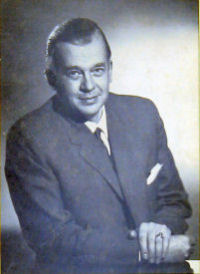
Ernst Friedrich “Fritz” Schumacher (16 August 1911 – 4 September 1977)
Ernst Friedrich "Fritz" Schumacher
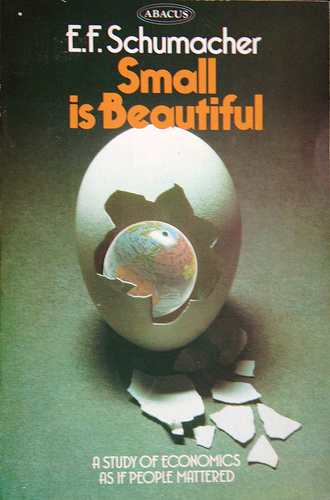
It seems amazing to realise both that this far-sighted man was born a century ago this day and that his incredibly influential book, Small is Beautiful, was published 38 years ago.
The book has been hugely influential. Indeed, my gut sense is that it probably started the whole ‘green’ movement. The Times Literary Supplement of October 6, 1995 regarded E.F. Schumacher’s 1973 book Small Is Beautiful: a study of economics as if people mattered as among the 100 most influential books published since the end of the Second World War.
Just a personal note that for many years I lived just a few miles from Dartington in Devon (UK) where Schumacher College was founded in 1991. Named after the great man, it provided, and still does, learning for sustainable living. Perhaps no surprise at all that nearby Totnes became the world’s first ‘transition town’.
Want to find out more? Then go to the New Economics Institute website here and discover,
The New Economics Institute is a US organization that uniquely combines vision, theory, action, and communication to effect a transition to a new economy — an economy that gives priority to supporting human well-being and Earth’s natural systems. Our multidisciplinary approach employs research, applied theory, public campaigns, and educational events to describe an alternative socio-economic system that is capable of addressing the enormous challenges of our times. Our premise is that a fair and sustainable economy is possible and that ways must be found to realize it.
The Institute, formerly the E. F. Schumacher Society, is working in close partnership with the New Economics Foundation from London to add the programs and experience developed in the UK to its own work in the US.
Finally, to get a flavour of this wonderful man and the amazing legacy that he has left the planet, watch this short video of E.F. Schumacher answering a question from the moderator about whether or not Buddhist Economics can work in the West. (Question & Answer Panel at Great Circle Center, 3/19/77. Peter Gillingham Collection, E. F. Schumacher Library Archives.)
Yesterday, I introduced a 50-minute film concerning the famous biologist E O Wilson, Lord of the Ants which, as well as being a wonderful tribute to Prof. Wilson, also allowed us humans to have a better understanding of our deeper human issues.
Coincidentally, around the same time of watching that film, I saw an article on the Grist website that referred to some research published in Nature magazine. This what I read, first from Grist, reprinted with the kind permission of Libby S., Senior Marketing Manager of Grist.
Scientists have been doing studies for years that show you are more likely to suffer from mental illness if you live in a city. What they haven’t figured out is why.
Now, researchers in Germany have conducted experiments that they believe might begin to get at the neuroscience behind the crazy-making nature of urban areas.
Publishing in the journal Nature, a group led by Andreas Meyer-Lindenberg of the University of Heidelberg’s Central Institute of Mental Health in Mannheim, Germany, looked at how social stress affected the minds of subjects, some city-dwellers and some not.
If we then turn to that article in Nature (to get access you will need to arrange prior free sign-up) we get to read this,
City living marks the brain
Neuroscientists study social risk factor for mental illness.
Epidemiologists showed decades ago that people raised in cities are more prone to mental disorders than those raised in the countryside. But neuroscientists have avoided studying the connection, preferring to leave the disorderly realm of the social environment to social scientists. A paper in this issue of Naturerepresents a pioneering foray across that divide.
Using functional brain imaging, a group led by Andreas Meyer-Lindenberg of the University of Heidelberg’s Central Institute of Mental Health in Mannheim, Germany, showed that specific brain structures in people from the city and the countryside respond differently to social stress (see pages 452 and 498). Stress is a major factor in precipitating psychotic disorders such as schizophrenia.
The work is a first step towards defining how urban life can affect brain biology in a way that has a potentially major impact on society — schizophrenia affects one in 100 people. It may also open the way for greater cooperation between neuroscientists and social scientists. “There has been a long history of mutual antipathy, particularly in psychiatry,” says sociologist Craig Morgan at the Institute of Psychiatry in London. “But this is the sort of study that can prove to both sides that they can gain from each others’ insights.”
I feel uncomfortable about reproducing more of this fascinating study without some formal permission to do so, therefore, if you want to read the full article then do sign up for access at the Nature website.
Back to the article from Grist written by Sarah Goodyear, Grist’s cities editor,
I called Dr. Meyer-Lindenberg to ask him more about the implications of his experiment, and what he thought might be the cause of heightened sensitivity to social stress among urban dwellers.
“On the neural level, we find two things,” he told me. “A, the neural effects are completely dissociated, so current urban living only affects the amygdala, urban upbringing only affects the cingulate. And B, these areas are associated with these illnesses. The amygdala is sort of a danger center, and it’s critically important for fear. And it is clear that the amygdala is a major player in depression. The cingulate is a prefrontal area regulating negative emotion, and it’s known to be one of the earliest areas affected by schizophrenia.”
So what accounts for the hyperactivity of the amygdala-cingulate circuit in urban dwellers? “That exact circuit that we found hyperactive has also shown to be activated when someone comes too close to you and crowds your personal space,” Meyer-Lindenberg told me.
But he cautioned against inferring that mere density of population is at fault. “It’s still speculation,” he said. “There could be myriad components of the urban experience that might or might not be bad for you from the point of your risk for mental illness. No one really knows. People are annoyed by noise or by traffic, or it could also be lead, or air pollution, but there’s no evidence base to say this is an important factor, this is not an important factor. Therefore there’s no basis for urban planning that’s grounded in human biology, at least with regard to mental illness.”
Later in the Grist article, Dr. Meyer-Lindenberg told Sarah Goodyear,
“Social status is closely linked to socioeconomic variables. What we found in our imaging studies is that if your social status becomes labile, and especially if you are in danger of losing it, a very similar brain circuit becomes active. There is a convergence of socially relevant risk factors on that circuit.”
Different types of urban environments might also affect people in different ways. “It’s very different if you live in Manhattan and you sort of live in a series of overlapping villages, if you will, or if you live in a city like Sao Paolo, in which no such microstructure is immediately available to you, or if you live in a large spread-out area,” said Meyer-Lindberg.
The social connections that are fostered in more walkable neighborhoods could help city dwellers from losing it. “A previous study found that that the size of your social support network is actually correlated to the size of the exact brain circuit we found in this study,” Meyer-Lindenberg said. “So that’s a protective factor. The more friends you have, the bigger those brain structures are.”
Already, more than half the human population lives in cities. That proportion will only increase. New cities are springing up all over the developing world, some built to order, some completely unplanned. The form they take could be crucial.
More knowledge about what exactly drives people could lead to concrete solutions that would make for better mental health — the same way the discovery of how disease was spread by waterborne germs finally ended the scourge of cholera in London.
“I think it would be important to make cities better, given that we can’t escape cities, given the dynamics of urbanization,” said Meyer-Lindenberg. “That’s a reality that we’re not going to get rid of.”
Fascinating article made doubly interesting by E O Wilson’s lifetime study of ants!
A passing visit to the American biologist, E. O. Wilson
E O Wilson
Edward Osborne Wilson was born in June 1929 thus making him, at this time of writing, just into his 82 year. His biological specialty is myrmecology. Got that? Myrmecology. And if you, like me, didn’t have a clue as to what myrmecology is and had to look it up, it is the study of ants. Blow me down, there is even a myrmecology blogsite!
So where is this all heading?
One of the things that we do know about dogs, especially if we go way back into the dim and distant times when they behaved more like the grey wolf, from which the species ‘dog’ genetically originates 100,000 years ago, is that their social order, their pack behaviour, was highly stable. As an aside, when Jean was rescuing dogs in San Carlos, Mexico during the years that she lived there with her late husband she readily observed that the stray dogs, of which there were too many, had a natural propensity to group up into their historic pack formations. (And as an aside to my aside, Jean’s close friend of many years, Dan’s sister Suzann, today carries on the splendid work of looking after stray dogs from her San Carlos house!)
OK, back to the plot!
E O Wilson’s study of ants has revealed much about social order and organisation. The following YouTube video was from a PBS programme, aired in May, 2008, from which I quote (that is the PBS website),
Program Description
At age 78, E.O. Wilson is still going through his “little savage” phase of boyhood exploration of the natural world. In “Lord of the Ants,” NOVA profiles this soft-spoken Southerner and Harvard professor, who is an acclaimed advocate for ants, biological diversity, and the controversial extension of Darwinian ideas to human society.
Actor and environmentalist Harrison Ford narrates this engaging portrait of a ceaselessly active scientist and eloquent writer, who has accumulated two Pulitzer Prizes among his many other honors. Says fellow naturalist David Attenborough: “He will go down as the man who opened the eyes of millions ’round the world to the glories, the values, the importance of—to use his term—biodiversity.”
It’s a fascinating film, truly engaging, so do settle down for a relaxing 53 minutes and watch,
Now there’s more to this and I do want to continue with the theme of this Post tomorrow.
So for now, look in on the E O Wilson Biodiversity Foundation’s website and I’ll see you tomorrow.
Unlike my recent review of Capt. Luis Montalvan’s book Until Tuesday which came about as a result of an invitation from the UK publishers, Headline Publishing, this review of Mr. Gilding’s book is totally off my own bat. I should also declare that I have recently been in email contact with Paul Gilding with some pleasant outcomes. To the review.
The way ahead.
Regular readers of Learning from Dogs will know that I have been making recent references to this book, which I have now finished reading. On the 25th I quoted from the book in a post that I called The blame game. I used a quote from Chapter 5, Addicted to Growth, namely “Growth goes to the core of the society we have built because it is the result of who we are and what we have decided to value.”
Then the next day again when writing about Tim Bennett’s movie, What a Way To Go, when I reflected on Paul Gilding’s opinion that, ” the quicker that mankind recognises the massive levels of denial presently in place, the quicker that mankind will commit to the scale of change that is required“.
Now if mankind’s efforts to change to a sustainable way of life were proportional to the number of books, films and essays written about the subject then, frankly, the task would be complete. There’s an awful lot out there! Here’s a list of the books that I have read in the last few years:
The Human Side of Enterprise – Douglas McGregor
Motivation and Personality – Abraham Maslow
The Power of Pause – Terry Hershey
Earth in the Balance – Al Gore
The Spectrum of Consciousness – Ken Wilber
Politics Lost – Joe Klein
Why America Doesn’t Work – Chuck Colson & Jack Eckerd
The Art of Happiness – HH Dalai Lama & Howard C Cutler
Eaarth – Bill McKibben
Stabilizing an Unstable Economy – Hyman P. Minsky
The Next 100 Years – George Friedman
World of the Edge – Lester Brown
and finally
The Great Disruption – Paul Gilding
And, of course, this doesn’t even scratch the number of online journals, essays and articles that have been read in conjunction with writing hundreds of posts on this Blog.
So what’s the point?
On p.260, Chapter 20 Guess Who’s in Charge?, Paul Gilding writes,
We need to fully acknowledge the challenging times and inevitable suffering ahead but stay focused and determined to move forward and past this. Easy to say, harder to do.
So yes, it is challenging to know how to respond to all this and what to do personally. It is easy to see what the world should do, but what should you do?
but what should you do? Talk about a thump on the back of the head!
This is about me!
Of all the books that have influenced how I see the world and my opinions, the one book that has rammed home to me that this is about me, about my attitudes and behaviours, is The Great Disruption. For a long time I haven’t needed convincing that man is screwing up the planet. For ages, I’ve been sure that our greed and materialism were fundamentally incompatible with the planet. I have been so good at ‘talking the talk’ ….. but ….
But the way that Mr. Gilding has so comprehensively approached every aspect of how my past behaviours have been incompatible with the future needs of my little grandson, Morten, (and all the grandchildren in the world) is powerfully inspiring. I now totally and utterly believe that only I am in charge of making a difference.
Why The Great Disruption touched me in this way when so many other books and articles haven’t done so isn’t clear. Perhaps it was in the opening paragraphs?
The earth is full.
[skip one paragraph]
This means things are going to change. Not because we will choose change out of philosophical or political preference, but because if we don’t transform our society and economy, we risk social and economic collapse and the descent into chaos. The science on this is now clear and accepted by any rational observer. While an initial look at the public debate may suggest controversy, any serious examination of the peer-reviewed conclusions of leading science bodies shows the core direction we are heading in is now clear. Things do not look good.
These challenges and the facts behind them are well-known by experts and leaders around the world, and have been for decades. But despite this understanding, that we would at some point pass the limits to growth, it has been continually filed away to the back of our mind and the back of our drawers, with the label “Interesting – For Consideration Later” prominently attached. Well, later has arrived.
I nodded silently in agreement when reading that.
Was it the opening paragraph to Chapter 4, Beyond the Limits – The Great Disruption?
The plans we have been making for our economies, our companies, and our lives have all been based on a key assumption that is clearly wrong. This assumption is that our current economic model will carry on unless we choose to change it – in other words, no action means more of the same.
This resonated strongly with me because I happen to believe, without any specialist economic skills to my name – just a gut sense, that the economic situation now afflicting so many economies across the world is not cyclical but the start of a breakdown of the policies and behaviours of the last 20 years or more. In other words, the Great Disruption was in my face already! As is written on p. 87 in Chapter 6, Global Foreshock – The Year That Growth Stopped,
My view, firmly held at the time and since, is that 2008 was the year that growth stopped. It was the year, as Thomas Friedman said, “when Mother Nature and Father Greed hit the wall at once”.
The Power of a New Future
But, in the end, the real power that I found in this book was the strength of Gilding’s argument that we will change, that seeing the future as hopeless is wrong, that man has the ability to commit to huge change when there is no alternative. Ergo, p121 Chapter 9 When the Dam of Denial Breaks,
To argue we are naturally greedy and competitive and can’t change is like arguing that we engage naturally in murder and infanticide as our forebears the chimps do and therefore as we did. We have certain tendencies in our genes, but unlike other creatures we have the proven capacity to make conscious decisions to overcome them and also the proven ability to build a society with laws and values to enshrine and, critically, to enforce such changes when these tendencies come to the surface.
So don’t underestimate how profoundly we can change. We are still capable of evolution, including conscious evolution. This coming crisis is perhaps the greatest opportunity in millennia for a step change in human society.
This quote is towards the end of the last chapter that spells out, as so many other books have done, that our global society Has a Very Big Problem. Thus from page 123 onwards, slightly less than half-way through the book, Paul Gilding devotes huge detail to describing how we will change. Frequently, the comparison used is World War II,
British poster from 1940
When Great Britain went to war in World War II, do you think they had clarity on all the details of transitioning into a war economy before they made the decision to act? Of course they considered it, as we must, but it wasn’t a determining issue because there was no choice. Do you think President Roosevelt calculated the United States could win the war by increasing military spending to 37 percent of U.S. GDP and producing a nuclear bomb before he decided to enter the war? Of course not: he just knew they had to succeed and so they would. He had confidence in human ingenuity delivering under pressure, when it’s given defined parameters and political support, and so must we.
From p. 164, Chapter 12 Creative Destruction on Steroids.
That’s what ended up being the real inspiration for me. That it’s not about the complex problems looming large; as so many that Jean and I chat to here in Payson, AZ, readily admit to being worried. It’s not news! The majority of the world’s citizens know the trends are not good.
No, what really socked me between the eyes was reading all the many and varied ways that we are changing (note present tense), that the Great Disruption is, in fact, mankind moving to a new era. One where we will have less inequality, less poverty, be happier, have extended life-spans and a future that goes on for thousand of years.
The Future is Here.
The phrase ‘life-changing’ is often used but this book is truly life-changing. The book will motivate you in ways that you can’t imagine. It will inspire you but, above all, it will show you the way ahead. Read it.
A focus on Tim Bennett’s movie, What a Way To Go: Life at the end of Empire
We first came across this film, made by independent film-maker Tim Bennett, on the Top Documentary Films website, see here. The title to this article comes from that introduction, from which is quoted,
Tim Bennett, middle-class white guy, started waking up to the global environmental nightmare in the mid-1980s. But life was so busy with raising kids and pursuing the American dream that he never got around to acting on his concerns. Until now…
Bennett journeys from complacency to consciousness in his feature-length documentary, What a Way To Go: Life at the End of Empire. He reviews his Midwestern roots, ruthlessly examines the stories he was raised with, and then details the grim realities humans now face: escalating climate change, resource shortages, degraded ecosystems, an exploding global population and teetering global economies.
Now to be honest, this is a film that is both captivating and, in parts, pretty grim. A couple of trailers and other background material were posted on Learning from Dogs back in February.
The film also has an excellent web site What a Way To Go Movie which contains much background material including the opportunity to watch the film for free, click here. Or a quick YouTube search will bring you to here.
My own view is that this is a ‘must see’ film. Not because I want all of you to wallow in doom and gloom, far from it, but because, as Paul Gilding writes in his book, The Great Disruption, the quicker that mankind recognises the massive levels of denial presently in place, the quicker that mankind will commit to the scale of change that is required. That’s where Paul Gilding’s approach differs from the movie, The End of Empire. Gilding is optimistic that man will bring about change simply because fairly soon, in just a few years, it will be obvious at all levels in our societies that there simply is no choice!
A retrospective muse about the present global challenges.
A few days back I posted an article by Tom Engelhardt called The Great American Carbon Bomb. It attracted a number of comments including a couple from Learning from Dogs supporter, Patrice Ayme. Here is one of those comments,
Dear Paul: There is a gentleman leading the Tour de France, right now. He was not given a chance, especially in the mountains. However, he has been going day by day, and has now worn the Yellow Jersey for more than a week, supported by his inferior, but dedicated team. His philosophy: humility, and do the job day by day, trying his best, although he strongly doubts that he is up to the task.
We, as humankind, or, rather, our hubristic leaders are doing the exact opposite. We are not doing our best, and it’s precisely because those leaders are not humble and not honest, and so very sure we are going to pull out OK, because that’s what we do best, and have always done, and thus will always do.
Verily all indicators are that of an unfolding catastrophe. All signals are loud and clear that way. So it’s really not the moment to say:”Oh, BTW, we are very resilient and totally great, so it’s just a matter of time before we put it all together OK. So now let’s all pull together, and it’s fine.”
In truth we are on the verge of an irreversible situation, as the CO2 poisoning will turn, within a decade or so, into a political, and then military issue.
PA
Patrice is an angry man (not a criticism by the way – so many of us are angry!) and anger is a great reason to find someone, something, anything, to blame! I suspect, wearing my cloak of an amateur psychologist, that a core reason why we feel anger is that, so often, the causes of our anger are our own errors. Anger at one’s self is much more difficult to deal with!
Anyway, back to the plot.
Like Patrice I also feel badly let down by our ‘leaders’. Especially with regard to the nightmare of economic and ecological issues fast approaching.
Then I read this in Paul Gilding’s book, The Great Disruption, that has been featured on this Blog a couple of times.
Our addiction to growth is a complex phenomenon, one that can’t be blamed on a single economic model or philosophy. It is not the fault of capitalism or Western democracy, and it is not a conspiracy of the global corporate sector or of the rich. It is not a bad idea that emerged in economics, and it is not the result of free market fundamentalism that emerged in the 1980s with globalization. While each of those factors is involved, it is too simple and convenient to blame any of them as the main driver. Growth goes to the core of the society we have built because it is the result of who we are and what we have decided to value. [Chapter 5, Addicted to Growth, p66]
That last half of that last sentence – ‘it is the result of who we are and what we have decided to value.‘ That strikes me as the core truth. It is the reason why Patrice, and me, and countless thousands of others across the globe, are so angry. At heart we all know that the circumstances we find ourselves in are, in great part and before we ‘saw the light’, the result of earlier personal values which we now know were not compatible with a sustainable relationship with the planet we all live on.
It is very good news. That anger is fuelling change. As Malcolm Gladwell writes in his book The Tipping Point societies change when something of the order of 18% of individuals emotionally commit to change.
William Rees discussing the disconnect between economics and ecology.
Yesterday, I wrote about Paul Gilding’s book The Great Disruption. In a sense today’s article continues the theme; the idea that the future is going to be very different to the past, indeed has to be if mankind is to have a viable future.
Dr. Bill Rees
Dr. William Rees is Professor at the University of British Columbia’s School of Community and Regional Planning. More details of Dr. Rees here.
The world economy is depleting the earth’s natural resources, and economists cling to models that make no reference whatsoever to the biophysical basis that underpins the economy. That’s why ecological economics is needed, says William Rees in this INET interview.
Standard economics portrays the economy as a circular flow: households pay money to firms in exchange for goods and services, and firms pay wages to households in exchange for labor. Textbooks describe this circular flow as self-perpetuating, capable of infinite expansion. William Rees argues that the textbooks get it wrong; he says the production of our goods and services depends on the extraction of material from ecosystems, causing resource depletion on the one hand, and excess pollution on the other.
William Rees, best known in ecological economics as the originator and co-developer of ‘ecological footprint analysis’, says the United States is using four or five times its fair share of the world’s total bio-capacity. In order to bring just the present world population up to the material standards enjoyed by North Americans, we would need the biophysical equivalent of about three additional planet earths.
There has been no time in history where income growth hasn’t been accompanied by increased material and energy consumption, Rees cautions. He says technologies exist that would enable us to enjoy our current lifestyles with perhaps as little as 20 percent of our current energy and material consumption, but we do not have the incentives in place to force that decoupling to take place.
Rees is as pessimistic on current culture and politics as he is optimistic on the technology. The global culture remains in denial, and people with vested interests in the status quo wield enormous power.
Want more from Dr. Rees? Over at the website West Coast Climate Equity is an eight-part series where Dr. Rees sets out the proposition that humanity’s survival depends on an 80% reduction in energy use.
Finally, on the Post Carbon Institute website there’s a link to an audio speech given by Dr. Rees summarised as follows.
Bill Rees speech to Vancouver World Federalist meeting on Radio Ecoshock Show
This is a speech by Dr. Bill Rees delivered April 15th at the World Federalist meeting in Vancouver. It goes a long way to explaining why we fail to act, even as the facts become clear and indisputable. He covers the three brain theory, the limits of evolution, memes, Peak Oil, and cultural myths, plus some thoughts on solutions – mostly contraction and convergence. Rees is one of the few academics more or less calling for a planned economic collapse.
The 53 minute speech is featured in this week’s Radio Ecoshock show, broadcast by 20 college and community radio stations in the U.S. and Canada, plus Green 960 AM in San Francisco.
Learning from Dogs first saw the light of day two years ago.
It all started on July 15th, 2009, during a very hot summer down in San Carlos, Mexico where I was first living with Jean.
Now, some 1,000 posts later life is very different. Jean and I are now married and living incredibly happily, with our twelve dogs and six cats, in Payson, Arizona, some 80 miles NE of Phoenix, up at 5,000 feet on the fringe of the world’s largest Ponderosa Pine forest.
Ponderosa pine forest
So apologies if today’s Post is partly reflective on the last two years. It also seems appropriate to revisit the reasons why so many articles on the Blog aren’t about dogs.
I feel the need to do that because the number of new readers now is just staggering.
The first full month was August 2009. Wordpress stats reveal that there were 1,172 unique viewers of the Blog. The last full month was, of course, June 2011. Wordpress figures were 31,664 unique viewers! That’s over a 1,000 viewers a day, and the trend is still upwards!
I am, of course, deeply moved by this response. Thank you, one and all!
In writing Learning from Dogs, I have tried to stay close to the theme that dogs are a metaphor for change for mankind. But that doesn’t mean that this is a doggy Blog.
As I wrote on the Welcome page, “Dogs live in the present – they just are! Dogs make the best of each moment uncluttered by the sorts of complex fears and feelings that we humans have. They don’t judge, they simply take the world around them at face value.”
Learning from Dogs is a Blog about the fundamental truths that we need to be reminded of, for our long-term survival. Dogs teach us the importance of integrity, of faith and loyalty and of unconditional love.
But just as importantly, dogs are a reminder that our evolution to Neolithic man may have been an evolutionary mistake. Stay with me for just a while.
Dogs were domesticated a mind-numbing number of years ago. There is good evidence that dogs were co-operating with man 30,000 years ago. However, one might speculate why the DNA of the dog separated from the grey wolf approximately 100,000 years ago. Was it because they evolved even that far back as domesticated companions to man? Science can’t tell us that yet.
But 30,000 years ago man was most definitely a hunter-gatherer. Archaeologists have pondered whether the domesticated dog allowed man to be so successful as a hunter-gatherer that, in time, man was able to evolve into farming which, of course, we describe more accurately as the Neolithic Revolution.
The “Neolithic” Revolution is the first agricultural revolution—the transition from hunting and gathering to agriculture and settlement. Archaeological data indicate that various forms of domestication of plants and animals arose independently in six separate locales worldwide ca. 10,000–7000 years BP (8,000–5000 BC), with the earliest known evidence found throughout the tropical and subtropical areas of southwestern and southern Asia, northern and central Africa and Central America.
However, the Neolithic Revolution involved far more than the adoption of a limited set of food-producing techniques. During the next millennia it would transform the small and mobile groups of hunter-gatherers that had hitherto dominated human history, into sedentary societies based in built-up villages and towns, which radically modified their natural environment by means of specialized food-crop cultivation (e.g., irrigation and food storage technologies) that allowed extensive surplus food production.
These developments provided the basis for concentrated high population densities settlements, specialized and complex labor diversification, trading economies, the development of non-portable art, architecture, and culture, centralized administrations and political structures, hierarchical ideologies and depersonalized systems of knowledge (e.g., property regimes and writing).
There’s one sentence that just jumps off the ‘page’. It’s this one. “During the next millennia it would transform the small and mobile groups of hunter-gatherers that had hitherto dominated human history”
Here’s a quick bit of history about Homo Sapiens, from here,
Neanderthal man: from 230,000 years ago
Around 250,000 years ago Homo erectus disappears from the fossil record, to be followed in the Middle Palaeolithic period by humans with brains which again have increased in size. They are the first to be placed within the same genus as ourselves, as Homo sapiens(‘knowing man’).
By far the best known of them is Neanderthal man — named from the first fossil remains to be discovered, in 1856, in the Neander valley near Dusseldorf, in Germany. The scientific name of this subspecies is Homo sapiens neanderthalensis. The Neanderthals are widely spread through Europe and the Middle East, and they thrive for an extremely long period (from about 230,000 to 35,000 years ago). Bones of animals of all sizes, up to bison and mammoth, and sophisticated stone tools are found with their remains.
Thus as a species we, as in H. sapiens, survived for approximately 200,000 years as hunter-gatherers!
Now after just 12,000 years, give or take, as ‘farmers’ we are facing the real risk of extinction. Go back to that WikiPedia extract above and re-read “concentrated high population densities settlements, specialized and complex labor diversification, trading economies, the development of non-portable art, architecture, and culture, centralized administrations and political structures, hierarchical ideologies and depersonalized systems of knowledge (e.g., property regimes and writing)“.
If you want to fully comprehend the mess we, as in man, have got ourselves into, then watch the stunning movie What a Way To Go: life at the end of the empire. That movie website is here or you can watch it from here. (I will be reviewing the film on Learning from Dogs in the next couple of weeks.)
The filmmakers, Tim Bennett and Sally Erickson, towards the end of the film muse if mankind must go back to some form of hunter-gatherer society, not literally, of course, but ‘back’ to a form of society that is fundamentally sustainable with the world upon which we live. As successful as Neanderthal man. Here’s where dogs may have critically important lessons for mankind.
Dogs form small packs, up to a maximum of 50 animals
They have a simple hierarchy within the pack; the alpha female (who has first choice of breeding male and makes the very big decisions about whether the pack should move to a better territory), the beta male (always a dominant male that teaches the young pups their social skills and breaks up fights within the pack – my Pharaoh, as seen on the home page, is a beta GSD), and the omega dog (the clown dog, male or female. whose role is to keep the pack happy through play).
They survive through an extraordinary relationship with humans but if they have to revert to the ‘wild’ they survive as hunter-gatherers.
Maybe humans, at heart, also share certain similar characteristics:
We are happiest in social groups of less than 50
We much prefer simple methods of group order, where rules and discipline are managed within the group. (Think about how easily we form all sorts of local clubs and groups.)
A ‘local’ approach to survival through deep and extensive group co-operation would be so much more effective than what most of us presently experience in our societies.
That’s why so many of the articles that appear on Learning from Dogs focus on the madness of what we experience so often in our present enormous, faceless, distant societies.
Back to Sally Erickson, one of the film makers mentioned earlier. Here’s what she wrote in her Blog
Our world is in need of healing at every level. We as a species aren’t going to survive, the way we are going. If we don’t heal ourselves, evolve a new consciousness, and fundamentally change the way we live, human beings won’t make it.
Where’s it all heading? Who knows? I am reminded of that wonderful quote attributed to Niels Bohr but, more likely, from an unknown author (although Mark Twain is often suggested), “Prediction is very difficult, especially about the future.”
Happy Birthday, Learning from Dogs. Thank you to all of you that have supported this venture over the last two years.
Dr. Michael Shermer is the Founding Publisher of Skeptic magazine, the Executive Director of the Skeptics Society, a monthly columnist for Scientific American, the host of the Skeptics Distinguished Science Lecture Series at Caltech, and Adjunct Professor at Claremont Graduate University.
Finally, Joe Keohane (with thanks to Tom M. for the intro.)
Joe wrote a fascinating article that appeared in the Boston Globe last July that opens,
How facts backfire
Researchers discover a surprising threat to democracy: our brains
It’s one of the great assumptions underlying modern democracy that an informed citizenry is preferable to an uninformed one. “Whenever the people are well-informed, they can be trusted with their own government,” Thomas Jefferson wrote in 1789. This notion, carried down through the years, underlies everything from humble political pamphlets to presidential debates to the very notion of a free press. Mankind may be crooked timber, as Kant put it, uniquely susceptible to ignorance and misinformation, but it’s an article of faith that knowledge is the best remedy. If people are furnished with the facts, they will be clearer thinkers and better citizens. If they are ignorant, facts will enlighten them. If they are mistaken, facts will set them straight.
This is a very smart article and much recommended, do read it fully here.
Herman Daly, Ph.D, makes some very powerful points at his keynote address to the AMS workshop on Federal Climate Policy, 13th November, 2007.
Note: This video is only the first 8 minutes from what is clearly a longer address. I have struggled to find the subsequent parts of this address, although there appear to be other versions of the address on YouTube. However, the points raised in these first few minutes are compelling,
Complexity stifles policy
The danger of overwhelming the decision of what to do now
Leave it until it’s perfectly clear and the likelihood is that it will be too late
Enjoy this most stimulating speech.
If you are stimulated to dig a little deeper into Hermon E. Daly here are some snippets I came across.
Herman Daly’s Ecological Economics – An Introductory Note
By John Attarian
Mainstream opinion has it that economic growth, the democratization of affluence, and ever-increasing consumption are the formula for individual and social happiness. A thoughtful and well-informed minority emphatically disagrees. Few have contributed more to this dissent than Herman E. Daly, widely regarded as the founding father of ecological economics.
Born in 1938, Daly earned his B.A. at Rice University (1960) and Ph.D. at Vanderbilt University (1967). From 1968 to 1988 he taught economics at Louisiana State University. Then he served as Senior Economist in the World Bank’s Environmental Department until 1994, when he became a professor at the University of Maryland’s School of Public Affairs, his current position.
As a graduate student, Daly believed that growth would solve mankind’s problems, but three experiences radically transformed his outlook. He studied under the economist Nicholas Georgescu-Roegen (1906-1994), whose book The Entropy Law and the Economic Process (1971) explained the decisive economic importance of the second law of thermodynamics (the entropy law) in a closed system, the availability of useful energy always declines. Georgescu-Roegen argued that the economic process transforms natural resources into waste — that is, transforms matter-energy from a state of low entropy into a state of high entropy. Georgescu-Roegen’s great contribution, Daly observes, was “reuniting economics with its biophysical foundations.” Teaching in Brazil in the late 1960s, Daly observed explosive population growth firsthand. Reading Rachel Carson’s Silent Spring was also influential.
Wrong to publish more but if this catches your eye, then the full article is here. Oh, perhaps I can just include the last two paragraphs of John Attarian’s fine piece ….
Daly co-founded the scholarly journal Ecological Economics in 1989 and still serves as an associate editor. His thought is slowly attracting appreciative notice, and some honors have come his way. For the Common Good won the 1991 Grawenmeyer Award for Ideas for Improving World Order, and in 1996 Daly received the Honorary Right Livelihood Award and the Royal Netherlands Academy of Arts and Sciences Heineken Prize for Environmental Science.
Integrating theology, ethics, science, and economics, Daly’s ecological economics is the kind of comprehensive vision we too seldom see, and one of the most important and promising intellectual developments of our time. Our selection of Daly’s works is a concise yet comprehensive introduction to his thought. May he find the audience he deserves.