Category: Economics

More on using our minds.

Interesting sequel to yesterday’s post.

Yesterday,  I published a post under the title of Just to focus our minds.  It featured a chart that demonstrated how long Planet Earth would take to ‘recover’ if the human race disappeared today.

Why today’s post seemed a perfect companion was because it explores how we could think better.  For if the human race doesn’t quickly find a way to think better, then that aforementioned chart may not be such an academic abstract after all.

The post is more or less a copy of what appeared on the Big Think blogsite, a site I have been following for some time now.

ooOOoo

Want to Make a Difference in the World? Think Small

Stephen Dubner
Stephen Dubner

Ambition can work against you by leading you to set unrealistic and overwhelming goals. Want to make a difference in the world? Think small. It’s much less complicated, you’ll have easier access to the data that you’ll need. Most importantly, you will preserve one of your most precious resources: optimism.

Having the will to attack an issue at its root—from launching a socially conscious business to demanding more green spaces in your neighborhood—requires energy and enthusiasm to see the project through. By being less ambitious in your plans you’re more likely to stick with them and be successful.

Besides, when you first developed your problem-solving skills you were small—a child. Stephen Dubner, the co-author, with economist Steven Levitt, of Freakonomics and Think Like a Freak, wants you to go back to that way of thinking:

One of the most powerful pieces of thinking like a child that we argue is thinking small. So I realize that this runs exactly counter to the philosophy of the arena in which I’m appearing which is thinking big, Big Think, but our argument is this. Big problems are by their nature really hard to solve for a variety of reasons. One is they’re large and therefore they include a lot of people and therefore they include a lot of crossed and often mangled and perverse incentives. But also a big problem – when you think about a big problem like education reform. You’re dealing with an institution or set of institutions that have gotten to where they’ve gotten to this many, many years of calcification and also accidents of history. What I mean by that is things have gotten the way they’ve gotten because of a lot of things a few people did many, many years ago and traditions were carried on.

Want to break those traditions and build something new and forward-thinking? Then curb your ambition. Start to look at the world again with the eyes of a child.

 Stephen Dubner talks about [that YouTube link reveals the transcript of the talk. PH] the importance of thinking small in order to tackle some of the world’s biggest problems piece by piece. Dubner is the co-author of Think Like a Freak

ooOOoo

Stephen Dubner and economist Steven Levitt co-authored the book Freakonomics. If you are interested, the Freakonomics website is here.

Interesting approach.

Climate Change and Humanity

A powerful essay by Tom Engelhardt from his blogsite TomDispatch.

Regular readers of Learning from Dogs know that essays from TomDispatch often find their way onto these pages.  They are republished with the generous permission of Tom and I endeavour to select those essays that shine a new light on a current issue.   No less so than with today’s essay, first published over on TomDispatch on May 22nd, 2014.

Just a note before you start reading Tom’s very important essay.  That there are many links to papers, articles and other references throughout the essay.  (I know, they took me a couple of hours to set up!)  Could I recommend strongly that you ‘click’ on each link and make a note of the references you wish to read at a later time.  I shall be referring to some of them next week when I comment more generally on this fabulous essay.

ooOOoo

Tomgram: Engelhardt, Is Climate Change a Crime Against Humanity?

The 95% Doctrine

Climate Change as a Weapon of Mass Destruction 

By Tom Engelhardt

Who could forget? At the time, in the fall of 2002, there was such a drumbeat of “information” from top figures in the Bush administration about the secret Iraqi program to develop weapons of mass destruction (WMD) and so endanger the United States. And who — other than a few suckers — could have doubted that Saddam Hussein was eventually going to get a nuclear weapon? The only question, as our vice president suggested on “Meet the Press,” was: Would it take one year or five? And he wasn’t alone in his fears, since there was plenty of proof of what was going on. For starters, there were those “specially designed aluminum tubes” that the Iraqi autocrat had ordered as components for centrifuges to enrich uranium in his thriving nuclear weapons program. Reporters Judith Miller and Michael Gordon hit the front page of the New York Times with that story on September 8, 2002.

Then there were those “mushroom clouds” that Condoleezza Rice, our national security advisor, was so publicly worried about — the ones destined to rise over American cities if we didn’t do something to stop Saddam. As she fretted in a CNN interview with Wolf Blitzer on that same September 8th, “[W]e don’t want the smoking gun to be a mushroom cloud.” No, indeed, and nor, it turned out, did Congress!

And just in case you weren’t anxious enough about the looming Iraqi threat, there were those unmanned aerial vehicles — Saddam’s drones! — that could be armed with chemical or biological WMD from his arsenal and flown over America’s East Coast cities with unimaginable results. President George W. Bush went on TV to talk about them and congressional votes were changed in favor of war thanks to hair-raising secret administration briefings about them on Capitol Hill.

In the end, it turned out that Saddam had no weapons program, no nuclear bomb in the offing, no centrifuges for those aluminum pipes, no biological or chemical weapons caches, and no drone aircraft to deliver his nonexistent weapons of mass destruction (nor any ships capable of putting those nonexistent robotic planes in the vicinity of the U.S. coast). But what if he had? Who wanted to take that chance? Not Vice President Dick Cheney, certainly. Inside the Bush administration he propounded something that journalist Ron Suskind later dubbed the “one percent doctrine.” Its essence was this: if there was even a 1% chance of an attack on the United States, especially involving weapons of mass destruction, it must be dealt with as if it were a 95%-100% certainty.

Here’s the curious thing: if you look back on America’s apocalyptic fears of destruction during the first 14 years of this century, they largely involved three city-busting weapons that were fantasies of Washington’s fertile imperial imagination. There was that “bomb” of Saddam’s, which provided part of the pretext for a much-desired invasion of Iraq. There was the “bomb” of the mullahs, the Iranian fundamentalist regime that we’ve just loved to hate ever since they repaid us, in 1979, for the CIA’s overthrow of an elected government in 1953 and the installation of the Shah by taking the staff of the U.S. embassy in Tehran hostage. If you believed the news from Washington and Tel Aviv, the Iranians, too, were perilously close to producing a nuclear weapon or at least repeatedly on the verge of the verge of doing so. The production of that “Iranian bomb” has, for years, been a focus of American policy in the Middle East, the “brink” beyond which war has endlessly loomed. And yet there was and is no Iranian bomb, nor evidence that the Iranians were or are on the verge of producing one.

Finally, of course, there was al-Qaeda’s bomb, the “dirty bomb” that organization might somehow assemble, transport to the U.S., and set off in an American city, or the “loose nuke,” maybe from the Pakistani arsenal, with which it might do the same. This is the third fantasy bomb that has riveted American attention in these last years, even though there is less evidence for or likelihood of its imminent existence than of the Iraqi and Iranian ones.

To sum up, the strange thing about end-of-the-world-as-we’ve-known-it scenarios from Washington, post-9/11, is this: with a single exception, they involved only non-existent weapons of mass destruction. A fourth weapon — one that existed but played a more modest role in Washington’s fantasies — was North Korea’s perfectly real bomb, which in these years the North Koreans were incapable of delivering to American shores.

The “Good News” About Climate Change

In a world in which nuclear weapons remain a crucial coin of the realm when it comes to global power, none of these examples could quite be classified as 0% dangers. Saddam had once had a nuclear program, just not in 2002-2003, and also chemical weapons, which he used against Iranian troops in his 1980s war with their country (with the help of targeting information from the U.S. military) and against his own Kurdish population. The Iranians might (or might not) have been preparing their nuclear program for a possible weapons breakout capability, and al-Qaeda certainly would not have rejected a loose nuke, if one were available (though that organization’s ability to use it would still have been questionable).

In the meantime, the giant arsenals of WMD in existence, the American, Russian, Chinese, Israeli, Pakistani, and Indian ones that might actually have left a crippled or devastated planet behind, remained largely off the American radar screen. In the case of the Indian arsenal, the Bush administration actually lent an indirect hand to its expansion. So it was twenty-first-century typical when President Obama, trying to put Russia’s recent actions in the Ukraine in perspective, said, “Russia is a regional power that is threatening some of its immediate neighbors. I continue to be much more concerned when it comes to our security with the prospect of a nuclear weapon going off in Manhattan.”

Once again, an American president was focused on a bomb that would raise a mushroom cloud over Manhattan. And which bomb, exactly, was that, Mr. President?

Of course, there was a weapon of mass destruction that could indeed do staggering damage to or someday simply drown New York City, Washington D.C., Miami, and other East coast cities. It had its own efficient delivery systems — no nonexistent drones or Islamic fanatics needed. And unlike the Iraqi, Iranian, or al-Qaeda bombs, it was guaranteed to be delivered to our shores unless preventive action was taken soon. No one needed to hunt for its secret facilities. It was a weapons system whose production plants sat in full view right here in the United States, as well as in Europe, China, and India, as well as in Russia, Saudi Arabia, Iran, Venezuela, and other energy states.

So here’s a question I’d like any of you living in or visiting Wyoming to ask the former vice president, should you run into him in a state that’s notoriously thin on population: How would he feel about acting preventively, if instead of a 1% chance that some country with weapons of mass destruction might use them against us, there was at least a 95% — and likely as not a 100% — chance of them being set off on our soil? Let’s be conservative, since the question is being posed to a well-known neoconservative. Ask him whether he would be in favor of pursuing the 95% doctrine the way he was the 1% version.

After all, thanks to a grim report in 2013 from the Intergovernmental Panel on Climate Change, we know that there is now a 95%-100% likelihood that “human influence has been the dominant cause of the observed warming [of the planet] since the mid-20th century.” We know as well that the warming of the planet — thanks to the fossil fuel system we live by and the greenhouse gases it deposits in the atmosphere — is already doing real damage to our world and specifically to the United States, as a recent scientific report released by the White House made clear. We also know, with grimly reasonable certainty, what kinds of damage those 95%-100% odds are likely to translate into in the decades, and even centuries, to come if nothing changes radically: a temperature rise by century’s end that could exceed 10 degrees Fahrenheit, cascading species extinctions, staggeringly severe droughts across larger parts of the planet (as in the present long-term drought in the American West and Southwest), far more severe rainfall across other areas, more intense storms causing far greater damage, devastating heat waves on a scale no one in human history has ever experienced, masses of refugees, rising global food prices, and among other catastrophes on the human agenda, rising sea levels that will drown coastal areas of the planet.
Buy the Book

From two scientific studies just released, for example, comes the news that the West Antarctic ice sheet, one of the great ice accumulations on the planet, has now begun a process of melting and collapse that could, centuries from now, raise world sea levels by a nightmarish 10 to 13 feet. That mass of ice is, according to the lead authors of one of the studies, already in “irreversible retreat,” which means — no matter what acts are taken from now on — a future death sentence for some of the world’s great cities. (And that’s without even the melting of the Greenland ice shield, not to speak of the rest of the ice in Antarctica.)

All of this, of course, will happen mainly because we humans continue to burn fossil fuels at an unprecedented rate and so annually deposit carbon dioxide in the atmosphere at record levels. In other words, we’re talking about weapons of mass destruction of a new kind. While some of their effects are already in play, the planetary destruction that nuclear weapons could cause almost instantaneously, or at least (given “nuclear winter” scenarios) within months, will, with climate change, take decades, if not centuries, to deliver its full, devastating planetary impact.

When we speak of WMD, we usually think of weapons — nuclear, biological, or chemical — that are delivered in a measurable moment in time. Consider climate change, then, a WMD on a particularly long fuse, already lit and there for any of us to see. Unlike the feared Iranian bomb or the Pakistani arsenal, you don’t need the CIA or the NSA to ferret such “weaponry” out. From oil wells to fracking structures, deep sea drilling rigs to platforms in the Gulf of Mexico, the machinery that produces this kind of WMD and ensures that it is continuously delivered to its planetary targets is in plain sight. Powerful as it may be, destructive as it will be, those who control it have faith that, being so long developing, it can remain in the open without panicking populations or calling any kind of destruction down on them.

The companies and energy states that produce such WMD remain remarkably open about what they’re doing. Generally speaking, they don’t hesitate to make public, or even boast about, their plans for the wholesale destruction of the planet, though of course they are never described that way. Nonetheless, if an Iraqi autocrat or Iranian mullahs spoke in similar fashion about producing nuclear weapons and how they were to be used, they would be toast.

Take ExxonMobil, one of the most profitable corporations in history. In early April, it released two reports that focused on how the company, as Bill McKibben has written, “planned to deal with the fact that [it] and other oil giants have many times more carbon in their collective reserves than scientists say we can safely burn.” He went on:

The company said that government restrictions that would force it to keep its [fossil fuel] reserves in the ground were ‘highly unlikely,’ and that they would not only dig them all up and burn them, but would continue to search for more gas and oil — a search that currently consumes about $100 million of its investors’ money every single day. ‘Based on this analysis, we are confident that none of our hydrocarbon reserves are now or will become “stranded.”‘

In other words, Exxon plans to exploit whatever fossil fuel reserves it possesses to their fullest extent. Government leaders involved in supporting the production of such weapons of mass destruction and their use are often similarly open about it, even while also discussing steps to mitigate their destructive effects. Take the White House, for instance. Here was a statement President Obama proudly made in Oklahoma in March 2012 on his energy policy:

Now, under my administration, America is producing more oil today than at any time in the last eight years. That’s important to know. Over the last three years, I’ve directed my administration to open up millions of acres for gas and oil exploration across 23 different states. We’re opening up more than 75% of our potential oil resources offshore. We’ve quadrupled the number of operating rigs to a record high. We’ve added enough new oil and gas pipeline to encircle the Earth and then some.

Similarly, on May 5th, just before the White House was to reveal that grim report on climate change in America, and with a Congress incapable of passing even the most rudimentary climate legislation aimed at making the country modestly more energy efficient, senior Obama adviser John Podesta appeared in the White House briefing room to brag about the administration’s “green” energy policy. “The United States,” he said, “is now the largest producer of natural gas in the world and the largest producer of gas and oil in the world. It’s projected that the United States will continue to be the largest producer of natural gas through 2030. For six straight months now, we’ve produced more oil here at home than we’ve imported from overseas. So that’s all a good-news story.”

Good news indeed, and from Vladmir Putin’s Russia, which just expanded its vast oil and gas holdings by a Maine-sized chunk of the Black Sea off Crimea, to Chinese “carbon bombs,” to Saudi Arabian production guarantees, similar “good-news stories” are similarly promoted. In essence, the creation of ever more greenhouse gases — of, that is, the engine of our future destruction — remains a “good news” story for ruling elites on planet Earth.

Weapons of Planetary Destruction

We know exactly what Dick Cheney — ready to go to war on a 1% possibility that some country might mean us harm — would answer, if asked about acting on the 95% doctrine. Who can doubt that his response would be similar to those of the giant energy companies, which have funded so much climate-change denialism and false science over the years? He would claim that the science simply isn’t “certain” enough (though “uncertainty” can, in fact, cut two ways), that before we commit vast sums to taking on the phenomenon, we need to know far more, and that, in any case, climate-change science is driven by a political agenda.

For Cheney & Co., it seemed obvious that acting on a 1% possibility was a sensible way to go in America’s “defense” and it’s no less gospel for them that acting on at least a 95% possibility isn’t. For the Republican Party as a whole, climate-change denial is by now nothing less than a litmus test of loyalty, and so even a 101% doctrine wouldn’t do when it comes to fossil fuels and this planet.

No point, of course, in blaming this on fossil fuels or even the carbon dioxide they give off when burned. These are no more weapons of mass destruction than are uranium-235 and plutonium-239. In this case, the weaponry is the production system that’s been set up to find, extract, sell at staggering profits, and burn those fossil fuels, and so create a greenhouse-gas planet. With climate change, there is no “Little Boy” or “Fat Man” equivalent, no simple weapon to focus on. In this sense, fracking is the weapons system, as is deep-sea drilling, as are those pipelines, and the gas stations, and the coal-fueled power plants, and the millions of cars filling global roads, and the accountants of the most profitable corporations in history.

All of it — everything that brings endless fossil fuels to market, makes those fuels eminently burnable, and helps suppress the development of non-fossil fuel alternatives — is the WMD. The CEOs of the planet’s giant energy corporations are the dangerous mullahs, the true fundamentalists, of planet Earth, since they are promoting a faith in fossil fuels which is guaranteed to lead us to some version of End Times.

Perhaps we need a new category of weapons with a new acronym to focus us on the nature of our present 95%-100% circumstances. Call them weapons of planetary destruction (WPD) or weapons of planetary harm (WPH). Only two weapons systems would clearly fit such categories. One would be nuclear weapons which, even in a localized war between Pakistan and India, could create some version of “nuclear winter” in which the planet was cut off from the sun by so much smoke and soot that it would grow colder fast, experience a massive loss of crops, of growing seasons, and of life. In the case of a major exchange of such weapons, we would be talking about “the sixth extinction” of planetary history.

Though on a different and harder to grasp time-scale, the burning of fossil fuels could end in a similar fashion — with a series of “irreversible” disasters that could essentially burn us and much other life off the Earth. This system of destruction on a planetary scale, facilitated by most of the ruling and corporate elites on the planet, is becoming (to bring into play another category not usually used in connection with climate change) the ultimate “crime against humanity” and, in fact, against most living things. It is becoming a “terracide.

Tom Engelhardt is a co-founder of the American Empire Project and author of The United States of Fear as well as a history of the Cold War, The End of Victory Culture (from which some of this essay has been adapted). He runs the Nation Institute’s TomDispatch.com. His latest book, co-authored with Nick Turse, is Terminator Planet: The First History of Drone Warfare, 2001-2050.

Copyright 2014 Tom Engelhardt

ooOOoo

There are so many strong and fundamental points raised in this essay from Tom that I am going to return to them next week.  (Will give it a rest for July 4th!)

Those annoying adverts on this blog!

Yes, I find them annoying too!

When you are a WordPress user, as is Learning from Dogs, you can pay $30 a year to stop advertisements from appearing on one’s blogsite.

This is how WordPress explain their policy on advertising:

We sometimes display advertisements on your blog to help pay the bills. This keeps free features free! We only run them in limited places, and we do not show ads to logged-in readers, which means only a very small percentage of your page views will actually contain ads. To eliminate ads on your blog entirely, you can purchase the No-Ads Upgrade for a single blog (per year).

I choose not to pay that upgrade, despite the ads being annoying; of that I have no doubt.

For this reason.

WordPress pay an amount of their advertising income to the owner of the blog.  Thus twenty-four hours ago, WordPress sent me an email:

Just thought you’d like to know WordPress.com sent you $106.23 USD.

I’m not sure but I think that covers the last twelve months.

That $106 will be divided into two with $53 staying with Jean and me and $53 going to our nearest humane society; Rogue Valley Humane Society.

Just wanted to let you know.

Market forces.

A powerful essay from Paul Gilding.

Having our good friends, Andy and Trish, with us for a few days means, quite rightly, that time with them is top of our list; so to speak.

Thus I want to republish a recent post from Paul Gilding that seems to me to be right on the mark.

But first an apology.  About 10 minutes ago (07:40 US PDT yesterday) I pressed the ‘reblog’ key over on Paul Gilding’s posting in error.  Subscribers to Learning from Dogs will have been sent an email to that reblog and then discovered that I had deleted it, in favour of this approach!

Mr Paul Gilding.
Mr Paul Gilding.

ooOOoo

THE GLOBAL ENERGY MARKET’S MOMENT OF TRUTH

If you want to know what addressing climate change will really be like for business and investors, then take a look at today’s electricity and energy markets. Driven by climate policy, technology development, business innovation, NGO campaigns and investment risk analysis, creative destruction is inflicting itself upon the sector with a vengeance – and the process has just begun.

Value is being destroyed at an incredible scale with just one example being European utilities losing $750 billion in market cap in recent years. Another is the huge losses in value for coal companies and the cancellation of a large number of new coal mining projects around the world as the forecast growth in China and India evaporates. As I argued in my last Chronicle, Carbon Crash Solar Dawn, this is not a temporary market blip but a fundamental shift. Company strategies and business models that have been working for generations are collapsing. In parallel we see the creative side of the process, with new industries being built, entrepreneurs flourishing and massive wealth being created. Now the market is working, as it should, allocating capital to the places where risk and return are best aligned. It is at once a beautiful and brutal process to observe.

This is an important inflection point to acknowledge, with significant implications that should reframe our thinking about these issues.

For a start it means, climate policy and its economic consequences have now shifted from future forecasts to present reality. This reality, with all its brutality for existing businesses, give us important insights into what to expect as the world wakes up to climate change. Business is already waking up to what that means in a market economy – creative destruction unleashed to destroy slow responders.

This suggests that traditional corporate responsibility, which argued sustainability was good for all businesses, is outmoded and not helpful. We have moved into an era of win/lose rather than win/win, and with that, sustainability is shifting from ‘environmentalists vs business’ to ‘business vs business’ as I covered in this earlier Chronicle.

Taken together this means we need to change the way we talk and think about climate change and business. Sustainability is not good for many businesses – in fact it means they’ll have to go out of business. This is what sustainability at its core is all about – things that are unsustainable will stop.

While on the one hand this is blindingly obvious, it is a conversation many in business and politics don’t want to acknowledge. So when the previous Australian government brought in its carbon pricing scheme, it went to great lengths to argue that Australia would still have a healthy coal industry. And President Obama’s new regulations on CO2 emissions in the US power industry are likewise being positioned as being as much about health and air pollution as climate policy.

But as Michael Grunwald argues in this Time Magazine piece on “Obama’s War on Coal” – a phrase used by the coal industry to suggest this is unfair and unreasonable – it’s time to face up to the reality of climate action. It is a war on coal, pure and simple. Grunwald calls it the “just but undeclared war ”. But rather than “just” with its moral overtones, we could simply argue it is “necessary” based on any objective analysis of what’s good for the economy and for society. What is necessary is to move a range of companies out of the economy and replace them.

Coal is first in the firing line. As a major cause of CO2 emissions and with the lack of market support for Carbon Capture and Storage suggesting “clean coal” is either a delusion or at best an expensive PR campaign, coal simply has to go. That means coal companies will go out of business, and then oil companies and gas companies will follow them.

This is not a problem at all for the economy, as they will be replaced with new companies and new industries, which will create new jobs, new wealth and new innovations. But it is a major problem for the incumbents who will cease to exist and for their owners who will lose their money. Unless we have that conversation honestly and openly, we are setting ourselves up for pain and suffering we can easily avoid or at least minimise by thinking through the consequences and being better prepared for their departure.

Of course the best way to minimise the pain would be for fossil fuel companies to transition to new areas of business, to use the great wealth they have created to diversify into sustainable sources of profit. But most of them won’t. It’s not that they couldn’t – it’s just that they won’t. And it’s not just coal but also oil and gas who are, for the most part, in strong denial about what’s coming and so won’t be prepared, as well explained in this article by Giles Parkinson at RenewEconomy.

We shouldn’t be surprised. History shows how rare it is for companies to transform and survive major market and technology shifts. That’s why the average life expectancy of a successful multinational is only 40-50 years. And that’s why the financial markets – who act without ideology based on looking at the data – are rapidly responding. They are stripping value from fossil fuel exposed utilities and the resource companies that provide their fuel. They are also downgrading credit risk, with Barclays recently issuing a warning the investors should no longer see utilities as a “sturdy and defensive subset of the investment grade universe”. The report concluded: “We see near-term risks to credit from regulators and utilities falling behind the solar plus storage adoption curve.” No doubt Deutche Bank considered these risks when they recently announced they wouldn’t consider funding a major new coal port next to Australia’s Great Barrier Reef.

So while the idea of “war on coal” is in some ways an accurate summary of the momentous threats the industry faces from a range of forces that are consciously and deliberately coming after them, we could also just see this as how markets work.

Fossil fuels provide us with energy, but they also destroy value across the economy – by driving climate change, damaging health and increasing costs for taxpayers while imposing unmanageable risks on other companies who rely on a stable climate for their business success. So the market is simply doing its job, pricing in some of these costs using the proxies of regulatory, credit and technology risk.

The market is working …. and fossil fuels are losing.

ooOOoo

Hope you agree with me that it’s a great essay and, also, I hope you followed the links – they are all very interesting.

Those of you who are not familiar with Paul Gilding can find out more about him here.  Plus the following TED Talk by Paul is highly recommended viewing.

The future of food – introduction.

How food and carbon-based energy are irresistibly woven together.

Farm-for-Future

Jean and I watched this BBC Nature programme the other evening.  Not directly from the BBC but because it has been uploaded to YouTube and thence was promoted on Top Documentary Films.

The film is 48-minutes long and, frankly, there’s not much point in reading the rest of the post until you have viewed the film!

Wildlife film maker Rebecca Hosking investigates how to transform her family’s farm in Devon into a low energy farm for the future, and discovers that nature holds the key.

With her father close to retirement, Rebecca returns to her family’s wildlife-friendly farm in Devon, to become the next generation to farm the land. But last year’s high fuel prices were a wake-up call for Rebecca. Realising that all food production in the UK is completely dependent on abundant cheap fossil fuel, particularly oil, she sets out to discover just how secure this oil supply is.

Alarmed by the answers, she explores ways of farming without using fossil fuel. With the help of pioneering farmers and growers, Rebecca learns that it is actually nature that holds the key to farming in a low-energy future.

Nature holds the key!

So, rather than tempt you to read on and not watch the film, that’s all you are getting for today! 😉

Settle yourself down somewhere comfortable and watch the film.

Trust me, it will open your eyes!

My main essay follows tomorrow!

Running on empty!

Is it just me?

It is my usual pattern to awake around 5am, sit upright in bed and browse the latest news on my tablet computer. Jean sleeps on most times next to me.

Thus it was last Friday morning that I am sitting in bed reading the latest goings on around the world.

But, unusually, that morning’s wanderings left a bleak mark on me. See if you feel the same way when I share the stories that I read.

From Naked Capitalism.

The Tragedy of the Soma Mine-Workers: A Crime of Peripheral Capitalism Unleashed

Posted on May 16, 2014 by Yves Smith

Yves here. This post explains how the horrific mine explosion in Western Turkey, which has officially claimed nearly 300 lives as the death count continues to rise, was not an accident but the direct result of privatization and circumvention of safety standards. And unlike the West, where industrial and mining accidents are met with short-term sympathy but little if any real change in working conditions, protests have broken out, not just in the mine town of Soma but also in major cities. As Mark Ames has pointed out, American has airbrushed out much of the history of labor’s struggles for safe workplaces and better pay. Violence against efforts to organize workers was common. Henry Ford had a private army of thugs for just this purpose. The tragedy in Turkey should serve as a reminder of what has been won, and how fragile those gains are.

By Erinç Yeldan, Dean of the faculty of Economics and Administrative Sciences, Yasar University and an executive directors of the International Development Economics Associates. Cross posted from Triple Crisis

One of the greatest work-crimes in mining industry occurred in Soma, a little mining village in Western Turkey. At noon-time on Tuesday, May 13, according to witnesses, an electrical fault triggered a transformer to explode causing a large fire in the mine, releasing carbon monoxide and gaseous fumes. (The official cause of the “accident” was still unknown, at this writing, after nearly 30 hours.) Around 800 miners were trapped 2 km underground and 4 km from the exit. At this point, the death toll has already reached 245, with reports of another 100 workers remaining in the mine, yet unreached.

Turkey has possibly the worst safety record in terms of mining accidents and explosions in Europe and the third worst in the world. Since the right-wing Justice and Development Party (AKP) assumed power in 2002, and up to 2011, a 40% increase in work-related accidents has been reported. The death toll from these accidents reached more than 11,000.

(Read the rest here.)

From the BBC News website:

In just over five years Britain will have run out of oil, coal and gas, researchers have warned.

A report by the Global Sustainability Institute said shortages would increase dependency on Norway, Qatar and Russia.

There should be a “Europe-wide drive” towards wind, tidal, solar and other sources of renewable power, the institute’s Prof Victor Anderson said.

The government says complete energy independence is unnecessary, says BBC environment analyst Roger Harrabin.

The report says Russia has more than 50 years of oil, more than 100 years of gas and more than 500 years of coal left, on current consumption.

‘Decisive action’

By contrast, Britain has just 5.2 years of oil, 4.5 years of coal and three years of its own gas remaining.

France fares even worse, according to the report, with less than year to go before it runs out of all three fossil fuels.

(Read the rest here)

Again from Naked Capitalism:

UK Survey Finds High Levels of Depression and Desperation Among the Young

Posted on May 16, 2014 by Yves Smith

If you’ve been keeping half an eye on economic news, the UK has of late been looking pretty spiffy relative to its advanced economy peers, with 2014 growth forecast at 3%. Even though unemployment in the UK is at its lowest level in five years, the young and the long-term unemployed haven’t benefitted to the same degree.

One issue that doesn’t get the attention that it merits is the destructive psychological impact of being out of work. Work doesn’t just provide money, as critical as that is. It provides a way of organizing your time, social interaction, and a place in society, even if that place is not really where you’d like to be. Being unanchored is extremely taxing. Recall that the Japanese get people to quit by giving them a desk and nothing to do. The lack of legitimacy, the implicit shaming of being isolated is sufficiently punitive as to induce workers to give up their pay and being able to tell their families they have a job.

The BBC reports on the results of a survey by the Prince’s Trust called the Macquarie Youth Index, which is based on a survey of roughly 2200 16 to 25 year olds. 13% were what the survey called Neet: not in employment, education, or training.

I will return to the terrible implications of this report after I declare a past interest.  Before I left England in 2008, I was an active volunteer with the Prince’s Trust. My years of being associated with the Trust taught me that helping young persons discover their strengths, enable them to maintain and defend a positive self-image, and offer them real hope for their future lives, was and is the most important role of society; without doubt!

Now back to that report:

The survey found high levels of suicidal thoughts and self harm among this group, and high levels of stress among the young generally. Key excerpts from the article:

The report found 9% of all respondents agreed with the statement: “I have nothing to live for”…

Among those respondents classified as Neet, the percentage of those agreeing with the statement rose to 21%.

The research found that long-term unemployed young people were more than twice as likely as their peers to have been prescribed anti-depressants.

One in three (32%) had contemplated suicide, while one in four (24%) had self-harmed.

The report found 40% of jobless young people had faced symptoms of mental illness, including suicidal thoughts, feelings of self-loathing and panic attacks, as a direct result of unemployment.

Three quarters of long-term unemployed young people (72%) did not have someone to confide in, the study found.

Martina Milburn, chief executive of the Prince’s Trust, said: “Unemployment is proven to cause devastating, long-lasting mental health problems among young people.

(Read the full report here and the BBC report here.)

Then there was the report from the NASA study team that key glaciers in West Antarctica are in an irreversible retreat. First seen by me on the BBC News website, from where the following photograph was taken.

Thwaites Glacier is a huge ice stream draining into the Amundsen Bay.

To really understand the message that Planet Earth is sending out to us humans, I would recommend reading Antarctica’s Glaciers Disintegrating over on Patrice Ayme’s blog.  Here’s how Patrice finishes that essay:

We imparted acceleration to the biosphere. We are pushing the biosphere around. And we know that the force we are applying is only augmenting. That means the acceleration, and even more the speed of the change, is going to get worse quick. That’s basic dynamics, first quarter of undergraduate physics.

Of course, neither the leaders of France, Great Britain, or the USA has taken such a course: they are basically ignoramuses at the helm (and Angela Merkel, who knows plenty of physics, made a risky bet she seems to be losing).

Clearly, we should instead apply the brakes to the maximum (instead of flooring the accelerator). What would be the price of this cautious? None, for common people: hard work to de-carbonize the world economy would require dozens of millions to be employed that way, in the West alone.

That, of course, is a scary thought for plutocrats, who much prefer us unemployed, impotent, and despondent.

Patrice Aymé

All of this is sending out a message. The message that if we are not very, very careful this could be the end-game for human civilisation on this Planet.

But do you know what really puzzles me?

It’s that this message is increasingly one that meets with nods of approval and words of agreement from more and more people that one sees going about one’s normal life.  Perhaps, because there’s more and more reporting from a wider and wider range of sources. Like The Permaculture Research Institute website recently publishing This Collapse is a ‘Crisis of Bigness’.  Like Grist publishing Walmart is the last place Obama should be making a clean energy speech.

Like Ian Welsh publishing Equal Rights to Profit from Impoverishing People and Causing a Great Extinction Event. Like Patrice in an essay last Friday about the way in which Main Stream Media is Manipulated. Viz:

Main Stream Media (MSM) has been the instrument of control of the People ever since there were oligarchies. It used to be about temples and priests, now it’s more about controlling papers, radio, TV, and the Internet.

and later on:

This crudeness, and vigilance of censorship by the owners [of the New York Times], is why the Obamas, Clintons, Krugmans, and Stiglitzs have to be careful. After all, they are just employees enjoying the perks of the system. Yes, they don’t own it. Ownership is everything. If the servants want to keep on thriving, those “leaders” will have to please the owners. So they “lead” where the real owners are willing us all, the herd, to be led.

Patrice rounds his essay off, thus:

The plutocracy focuses on direct control of the world imperial system, and that means controlling the giants (especially the three military leaders of the West). This is where the propaganda is the thickest.

The New York Times is considered to be the “newspaper of record” in the USA. However, the bottom line is that this is the third century during which it is owned and controlled by a particular family. How can these two elements be compatible? Why is that particular family “of record”?

Even in the Middle Ages, the most absolute kings there were, those of France, actually owned relatively little property. Francois I himself may have worn expensive clothes, but Italian bankers paid for his trips around France. Francois I did not own the media of the time.

What we have now is different. We have an ascending plutocracy that tries to grab the minds ever more. What Putin is doing in Russia is just a particular case, part of a whole.

Hopefully, people will see through this, and get their news from somewhere else than plutocratically owned media, thus bankrupting the MSM (the Internet can support journalists directly: see the successful Mediapart in France).

But I haven’t answered my earlier rhetorical question.  “But do you know what really puzzles me?” Implying that a growing number of people sense there is a problem with today’s world.

That question will be answered tomorrow. Do please return.

The Natural order – fairness.

I sense the levels of inequity in today’s world reaching crisis levels!

This is the next essay in my irregular series of The Natural order.  The last one, on life and death, was published a couple of weeks ago.

Now it would be tempting to rant on at great length about the ‘haves’ and the ‘have-nots’ but there’s a sense of caution about so doing.  Because, to be blunt about it, the lifestyle that Jean and I enjoy here on our rural retreat in Southern Oregon is, compared to millions, a blissful luxury.

So all I will do is to refer to some recent articles and essays that seem, to me anyway, to speak volumes about the terrible and growing levels of inequity between the majority of citizens and ‘the 1%‘!

Patrice Ayme of the blog Patrice Ayme’s Thoughts has long written about inequality.  I recommend you browse his many essays on the subject of plutocracy but this one, USA: Rich Plutos, Poor People, comes to mind fairly quickly; from which I quote:

Plutocracy is a redistribution of wealth, power, income, from We The People to a small minority of controlling parasites. Plutocracy paralyzes the minds with a warped case of inverted decency. Plutocracy is neither optimal for the society, nor the economy.

Plutocracy affects the USA more than Europe, and the minds, even more than the stomachs. The fact that average Americans feel that they are much better off than in the rest of the world reinforces the plutocratization of the USA. Including astounding tolerance for the amazingly corrupt so-called Supreme Court (Supremely plutocratic!).

I’m “Black”, Mom Was White, & Thus We’re In The Black.

Turning back to this place, not so long ago I published a two-part essay on the loss of democracy.  In the first part, I wrote:

But if you think this is an American problem, let me take you back a couple of days to my post that reflected the feeling that it was all getting too much: I just want to throw up! Reason? Because in that post I referred to a recent essay by George Monbiot called The Shooting Party.  Here are the opening chapters (and you will have to go here to read the numbered references):

As the food queues lengthen, the government is giving our money to the super-rich.
By George Monbiot, published in the Guardian 29th April 2014

So now you might have to buy your own crutches, but you’ll get your shotgun subsidised by the state. A few days after False Economy revealed that an NHS group is considering charging patients for the crutches, walking sticks and neck braces it issues (1), we discovered that David Cameron has intervened to keep the cost of gun licences frozen at £50: a price which hasn’t changed since 2001 (2).

The police are furious: it costs them £196 to conduct the background checks required to ensure that shotguns are issued only to the kind of dangerous lunatics who use them for mowing down pheasants, rather than to the common or garden variety. As a result they – sorry we – lose £17m a year, by subsidizing the pursuits of the exceedingly rich (3). The Country Land and Business Association – the armed wing of the Conservative party – complains that it’s simply not fair to pass on the full cost of the licence to the owners of shotguns (4); unlike, say, the owners of passports or driving licences, who are charged on the basis of full cost recovery.

Three days later – on Friday – the government announced that it will raise the subsidy it provides for grouse moors from £30 per hectare to £56 (5). Yes, you read that right: the British government subsidises grouse moors, which are owned by 1% of the 1% and used by people who are scarcely less rich. While the poor are being forced out of their homes through government cuts, it is raising the payments – across hundreds of thousands of hectares – that some owners use to burn and cut the land (helping to cause floods downstream), shoot or poison hen harriers and other predators, and scar the hills with roads and shooting butts (6). While the rest of us can go to the devil, the interests of the very rich are ringfenced.

Shortly, I’m going to refer to another Monbiot essay recently published that underscores, once again, the corruption of fairness that is happening in the United Kingdom.

Before that, let me remind all you great readers the lesson we should, and must, learn from Nature. Again, using something recently posted:

OK, I opened today’s post with the sub-heading “Probably just now the most important lesson to be learnt from dogs!” Let me expand on that.

Dogs, like many other ‘pack’ animals, have a relatively flat hierarchy across their group.  Typically, a wild dog pack numbered upwards of 30 animals although in modern times we have only the African Wild dog left to study.  Nevertheless, the African Wild dog offers mankind the key lesson about cooperation and social equality.  Here’s an extract from a National Geographic article [my emphasis]:

African Wild Dog Lycaon pictus

Known as African wild, painted, or Cape hunting dogs, these endangered canines closely resemble wolves in their pack-oriented social structure. Photograph by Chris Johns
Known as African wild, painted, or Cape hunting dogs, these endangered canines closely resemble wolves in their pack-oriented social structure.
Photograph by Chris Johns

The African wild dog, also called Cape hunting dog or painted dog, typically roams the open plains and sparse woodlands of sub-Saharan Africa.

These long-legged canines have only four toes per foot, unlike other dogs, which have five toes on their forefeet. The dog’s Latin name means “painted wolf,” referring to the animal’s irregular, mottled coat, which features patches of red, black, brown, white, and yellow fur. Each animal has its own unique coat pattern, and all have big, rounded ears.

African wild dogs live in packs that are usually dominated by a monogamous breeding pair. The female has a litter of 2 to 20 pups, which are cared for by the entire pack. These dogs are very social, and packs have been known to share food and to assist weak or ill members. Social interactions are common, and the dogs communicate by touch, actions, and vocalizations.

African wild dogs hunt in formidable, cooperative packs of 6 to 20 (or more) animals. Larger packs were more common before the dogs became endangered.

So back to the domesticated dog.  There are just three ‘roles’ to be found: the female alpha dog, the male beta dog and the omega dog that can be of either gender. Even though in a group of dogs (we have eight here at home) the alpha and beta dogs are dominant and will eat first, there is no question of denying the other dogs in the group access to food, water and love from us humans.

The lesson we must learn from dogs is obvious and there’s no need for me to spell it out!

This, then, is the power of the natural order as it applies to animal ‘communities’.

Nature, one way or another, will show us that the natural order is the only ruling order on this natural planet.

So with those tones of mine hopefully ringing in your ears, have a read of this recent Monbiot essay republished with Mr. Monbiot’s kind permission.

ooOOoo

Land of Impunity

May 5, 2014

Politicians and government contractors now seem to be able to get away with almost anything.
By George Monbiot, published in the Guardian 6th May 2014.

What do you have to do to fall out of favour with this government? Last month, the security company G4S was quietly rehabilitated (1). It had been banned in August 2013 from bidding for government contracts (2), after charging the state for tagging 3,000 phantom criminals (3). Those who had died before it started monitoring them presented a particularly low escape risk. G4S was obliged to pay £109m back to the government.

Eight months later, and before an investigation by the Serious Fraud Office has concluded, back it bounces, seeking more government business. Never mind that it almost scuppered the Olympics (4). Never mind Jimmy Mubenga, an asylum seeker who died in 2010 after being “restrained” by G4S guards(5), or Gareth Myatt, a 15-year-old who died while being held down at a secure training centre in 2004(6). Never mind the scandals and crises at Oakwood, the giant prison it runs(7). G4S, recently described by MPs as one of a handful of “privately-owned public monopolies”(8), is crucial to the government’s attempts to outsource almost everything. So it cannot be allowed to fail.

Was it ever banned at all? Six days after the moratorium was lifted, G4S won a new contract to run services for Her Majesty’s Revenue and Customs(9). A fortnight later, it was chosen as one of the companies that will run the government’s Help to Work scheme(10). How did it win these contracts if, in the preceding months, it wasn’t allowed to bid?

When I first worked in Brazil, in the late 1980s, the country was widely described as o pais de impunidade: the land of impunity. What this meant was that there were no political consequences. Politicians, officials and contractors could be exposed for the most flagrant corruption, but they remained in post. The worst that happened was early retirement with a fat pension and the proceeds of their villainy safely stashed offshore. It’s beginning to look a bit like that here.

This is not to suggest that the people or companies I name in this article are crooked or corrupt. It’s to suggest that the political class no longer seems to care about failure.

The failure works both ways of course. As Polly Toynbee has shown, the pilot projects for the Help to Work scheme which G4S will run reveal that it’s a complete waste of time and money(11). Yet the government has decided to go ahead anyway, subjecting the jobless to yet more humiliation and pointlessness. Contrast the boundless forgiveness of G4S to the endless castigation for being unemployed.

A record of failure reflects the environment in which such companies are hired: one in which ministers launch improbable schemes then look the other way when they go wrong. G4S had to pay back so much money for the phantom criminals it wasn’t monitoring because it had been doing it for eight years, and no one in government had bothered to check(12). There is no such thing as failure any more, just lessons to be learnt.

Accountability has always been weak in this country, but under this government you must make spectacular efforts to lose your post. At the Leveson inquiry in April 2012, the relationship between the then culture secretary Jeremy Hunt and the Murdoch empire that he was supposed to be regulating was exposed in gory detail(13,14). Though he was meant to be deciding impartially whether or not to allow the empire to take over the broadcaster BSkyB, he was secretly exchanging gleeful messages with James Murdoch and his staff(15).

We all knew what it meant. The emails, the Guardian observed, were likely to “sever the slim thread connecting Hunt to his cabinet job.”(16) “After this he’s toast … it’s over for Hunt,” wrote Tom Watson MP(17). “He cannot stay in his post,” said Ed Miliband. “And if he refuses to resign, the prime minister must show some leadership and fire him.”(18) We waited. Hunt remained culture secretary for another four months, then he was promoted to secretary of state for health.

On 2 September 2012, the Guardian revealed that the housing minister, Grant Shapps, had founded a business which “creates web pages by spinning and scraping content from other sites to attract advertising”: a process that looks to me like automated plagiarism(19). He had been promoting the business under the name of Michael Green, who claimed to be an internet marketing guru. Again it looked fatal. Two days later, in the same reshuffle that elevated Hunt, he was promoted to Conservative party chairman.

A real Mr Green – Stephen this time – was ennobled by David Cameron and appointed, democratically of course, as minister for trade and investment. In July 2012, a US Senate committee reported that while Lord Green was chief executive and chairman of HSBC, the bank’s compliance culture was “pervasively polluted”(20). Its branches had “actively circumvented US safeguards … designed to block transactions involving terrorists, drug lords, and rogue regimes.” Billions of dollars from Mexican drug barons, from Iran and from “obviously suspicious” travellers’ cheques “benefiting Russians who claimed to be in the used car business” sluiced through its tills(21). Out went dollars and financial services to banks in Saudi Arabia and Bangladesh linked to the financing of terrorists. The Guardian reported that HSBC “continued to operate hundreds of accounts with suspected links to Mexican drug cartels, even after Green and fellow executives were told by regulators that HSBC was one of the worst banks for money laundering.”(22)

Green refused to answer questions and sat tight(23). He remained in post for another 17 months, until he gracefully retired in December 2013.

After it had become obvious to almost everyone that it was impossible for them to remain in the Cabinet, David Cameron refused to sack either Liam Fox or Maria Miller. Forgiveness and redemption, by all means. But they are not unconditional: without contrition or even acknowledgement that wrong has been done, there’s no difference between giving people a second chance and engaging in an almighty cover-up.

There has seldom, in the democratic era, been a better time to thrive by appeasing wealth and power, or to fail by sticking to your principles. Politicians who twist and turn on behalf of business are immune to attack. Those who resist are excoriated.

Here’s where a culture of impossible schemes and feeble accountability leads: to cases like that of Mark Wood, a highly vulnerable man who had his benefits cut after being wrongly assessed by the outsourcing company Atos Healthcare as fit for work, and starved to death(24) – while those who run such companies retire with millions. Impunity for the rich; misery for the poor.

http://www.monbiot.com

References:

1. http://www.bbc.co.uk/news/uk-politics-26958650

2. http://www.bbc.co.uk/news/uk-23596541

3. http://www.theguardian.com/business/2014/mar/12/g4s-repay-overcharging-tagging-contracts

4. http://www.theguardian.com/business/2012/sep/11/g4s-failed-olympic-security-lord-coe

5. http://www.theguardian.com/uk-news/2013/jul/09/jimmy-mubenga-unlawfully-killed-inquest-jury

6. http://www.theguardian.com/society/2007/jun/29/youthjustice.law

7. http://www.theguardian.com/society/2014/apr/29/tales-from-inside-oakwood-prison

8. http://www.publications.parliament.uk/pa/cm201314/cmselect/cmpubacc/777/777.pdf?utm_source=rss&utm_medium=rss&utm_campaign=contracting-out-public-services-to-the-private-sector-forty-seventh-report-of-session-2013-14-report-together-with-formal-minutes-oral-and-written-evidence

9. http://www.telegraph.co.uk/finance/newsbysector/supportservices/10768641/G4S-wins-first-central-Government-contract-since-tagging-scandal.html

10. http://www.ft.com/cms/s/0/4f9118a6-ceed-11e3-9165-00144feabdc0.html#ixzz30pVTWOXh

11. http://www.theguardian.com/commentisfree/2014/apr/15/help-to-work-punishing-jobless

12. http://www.publications.parliament.uk/pa/cm201314/cmselect/cmpubacc/777/777.pdf?utm_source=rss&utm_medium=rss&utm_campaign=contracting-out-public-services-to-the-private-sector-forty-seventh-report-of-session-2013-14-report-together-with-formal-minutes-oral-and-written-evidence

13. http://www.theguardian.com/media/2012/apr/24/leveson-inquiry-jeremy-hunt

14. http://www.theguardian.com/politics/2012/apr/24/jeremy-hunt-murdochs-bskyb-bid

15. http://www.theguardian.com/politics/2012/may/31/jeremy-hunt-james-murdoch-bskyb

16. http://www.theguardian.com/politics/2012/may/24/leveson-inquiry-memo-hunt-murdoch

17. http://www.theguardian.com/commentisfree/2012/apr/24/jeremy-hunt-must-resign

18. http://www.theguardian.com/politics/2012/apr/24/jeremy-hunt-calls-resign-bskyb

19. http://www.theguardian.com/politics/2012/sep/02/grant-shapps-google-howtocorp-adsense

20. http://www.hsgac.senate.gov/subcommittees/investigations/media/hsbc-exposed-us-finacial-system-to-money-laundering-drug-terrorist-financing-risks

21. http://www.hsgac.senate.gov/subcommittees/investigations/hearings/us-vulnerabilities-to-money-laundering-drugs-and-terrorist-financing-hsbc-case-history

22. http://www.theguardian.com/business/2012/jul/22/hsbc-lord-green-mexico-drugs-cash

23. http://www.theguardian.com/business/2012/jul/24/lord-green-hsbc-scandal

24. http://www.oxfordmail.co.uk/news/11112129.Government_admits_Mark_Wood_s_benefits_cut_before_he_starved_to_death__was_wrong_/

ooOOoo


I just want to throw up!

Apologies for feeling very dispirited!

Normally, there’s always a selection of bits and pieces in my LfD Blog folder from which to construct a new post.

But yesterday afternoon as I trawled a number of articles and blog sites I ended up feeling sick to the back teeth. Disgusted about the inequalities and injustices that seem to be in the news just now. (I use the word ‘news’ liberally!)

It started with me reading, even before I was out of bed, the latest essay from George Monbiot entitled The Shooting Party.

As the food queues lengthen, the government is giving our money to the super-rich.

Then I went back to re-read an essay from Patrice Ayme that came out on the 22nd called USA: Rich Plutos, Poor People.  Here’s a snippet from there:

Plutocracy is a redistribution of wealth, power, income, from We The People to a small minority of controlling parasites. Plutocracy paralyzes the minds with a warped case of inverted decency. Plutocracy is neither optimal for the society, nor the economy.

Plutocracy affects the USA more than Europe, and the minds, even more than the stomachs. The fact that average Americans feel that they are much better off than in the rest of the world reinforces the plutocratization of the USA. Including astounding tolerance for the amazingly corrupt so called Supreme Court (Supremely plutocratic!).

On to another of Patrice’s essays.  Or more specifically to a comment left by Eugen to a post from Patrice published yesterday.

I would like to share with you my thought about the major defaults of the economic system called “Market economy” or “Capitalism”, or in the language of this blog, the moral deficiency of the system run by Plutocracy.

The major problem of the contemporary economic system on the macro level is that it enabled on one hand to pour into the economy too much financial liquidity at times of boom and overheated economy, by investing too much money in wrong and too expensive assets, and on the other hand at times of bust, when the economy needs liquidity to sustain employment, the system is rather greedy with helping investments in the same assets for even very reduced price. This system a-priory has to cause bust and boom, situations.

The economist since the great depression of 1929-1933 which had disastrous consequences learned from the lesson, and since then the governments and the central banks took as their major task in economy (and be the price whatever it takes), to act as anti bust and boom instrument. This is why they made the economic stimulus of trillions that saved the banks and financial system from total collapse (luckily the collapse came during the time of republican presidency and they couldn’t resist this decision), and the quantitative easing that poured liquidity of government money into the economy as alternative to the private money from banks who stopped to borrow.

So if it is so easy to solve the economic crisis situations, what is the problem? Let the economy run on the waves of bust and boom, and whenever the bust comes the government interferes, and at the times of booms let the boys play and enjoy themselves. If economics would be only about mathematical formulas, probably it could work, but the truth is all the economic decisions have their moral-political aspects. [Ed. My emphasis] And here lies the problem.

Because it is morally and politically very hard to neglect the principle of punish those who do wrong and give tribute to those who has done good. And this is actually what happens when the government comes to rescue the “credit boomers”, the bankers who created a distorted financial system, that channeled the financial and material resources to wrong places to invest in wrong assets, and when the D day came, they did not have to pay the price for their wrong doings. The same happened to those who took the loans, without to ask themselves if and when are they going to pay them back.

These Financiers and their creditors, who get loans of other peoples’ money enjoy free lunch twice. Once when they give and get these loans with knowledge that it will never be repaid, and second time when they enjoy the debt reduction, when the governments come to rescue them.

On the other hand those who use the wealth generated at times of boom to accumulate reserves for the bad times have to pay twice. First time when they restrain their activities during the times of prosperity and reduce by it their profits, second time at times of bust, when still they have to fulfill all their obligations, and get no praise for their responsible behavior in the times of boom.

Of course this system of Boom and Bust causes with each wave a major shift of wealth from one sector to the other, and generally from the decent and responsible entrepreneurs to the irresponsible gamblers, who happen to make bid on other people’s money.

This is one of the reasons why the pension systems are all in deficit, the wages stagnate while the profits and mainly the rewards of corporate managers of publicly traded companies surge.

Isn’t this just unfair?

Then I forget how I ended up on the Animal Spirits blogsite.  But I did.  To read a short essay Sanctions salami tactics.

Sanctions salami tactics

Plutocrats have a certain grudging respect for one another. Naturally, they would like to put each other out of business unless it impacted their own business adversely. So I conclude that Obama’s sanctions are an attempt to isolate Putin from his plutocratic supporters (although perhaps supporters is too strong a word; Putin keeps his plutocrats on a pretty tight leash, just ask Mikhail Khodorkovsky).

But what if under the table the West is inviting Putin’s plutocrats to join them, where the grass is greener and you don’t have old Vlad busting your chops. We’re not going to mention that we’re going to give you a haircut on the way, but are you really ready for the rebirth of the Soviet Union? The London bankers must certainly be for it.

On the other hand, you have the Chinese promising big business… but China’s biggest real estate investor is unloading everything as China replicates the Western real estate bubble and collapse….

It’s tough being a Russian plutocrat these days. It’s tough being a plutocrat anywhere, really, with all this talk that plutocrats are *too* wealthy (and are actually mass murdering their fellow humans with their insatiable greed by hording wealth and depriving others of health care, education and jobs).

Come to America! Come to the UK! Plutocrats rule! This is the subtext of what the Russian plutocrats are hearing.

Finally, an essay published on Naked Capitalism had me reaching for the bowl. It was by Rob Johnson on the Breakdown of Democracy.  Read it.  It included this video.

Published on Apr 26, 2014
Rob Johnson: The influx of additional campaign finance dollars and central bank policies have contributed to the destruction of democratic institutions

That was enough for me.

Couldn’t take any more. Certainly wasn’t feeling inspired and creative.  Just wanted to go out and find a horse to kiss.

Sanity is a warm, loving horse!

Sorry! Hopefully back to being more positively creative tomorrow!

Immediate concern? Try this!

Talk about extreme ends of the spectrum!

Yesterday, I posted about the prediction that in four billion years the Milky Way galaxy would collide with the Andromeda galaxy.  I called the post Not of immediate concern.

Today, I am writing about something that is of immediate concern. That is if you regard the next couple of decades as ‘immediate’.

The post is prompted by an item that was published on the BBC News website two days ago.  It carried the title Climate inaction catastrophic – US

Climate inaction catastrophic – US

By Matt McGrath
Environment correspondent, BBC News, Yokohama, Japan

The costs of inaction on climate change will be “catastrophic”, according to US Secretary of State John Kerry.

Mr Kerry was responding to a major report by the UN which described the impacts of global warming as “severe, pervasive and irreversible”.

He said dramatic and swift action was required to tackle the threats posed by a rapidly changing climate.

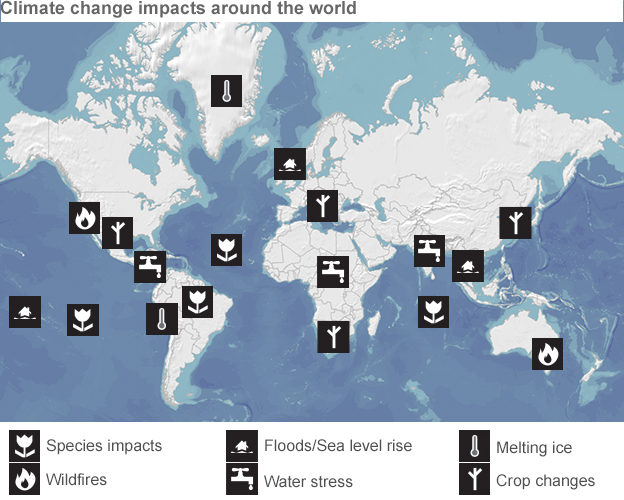
Our health, homes, food and safety are all likely to be threatened by rising temperatures, the report says.

Scientists and officials meeting in Japan say the document is the most comprehensive assessment to date of the impacts of climate change on the world.

In a statement, Mr Kerry said: “Unless we act dramatically and quickly, science tells us our climate and our way of life are literally in jeopardy. Denial of the science is malpractice. There are those who say we can’t afford to act. But waiting is truly unaffordable. The costs of inaction are catastrophic.”

Putting to one side the mild irony of a representative of the US Government wringing his hands about what mankind is doing to our climate, the report is valuable and potentially significant.

The report was from the Intergovernmental Panel on Climate Change (IPCC) which is, as their website explains:

The Intergovernmental Panel on Climate Change (IPCC) was established by the United Nations Environmental Programme (UNEP) and the World Meteorological Organization (WMO) in 1988 to assess the scientific, technical and socio-economic information relevant for the understanding of human induced climate change, its potential impacts and options for mitigation and adaptation.

Watch this 5-minute video of Stanford professor Dr. Chris Field, co-chair of that IPCC working group, addressing some of the key questions raised by this latest report.  In particular, focus on Dr. Field discussing the potential of the loss of the Greenland ice cap around 3 min 30 seconds.

Back to the BBC report (which you should read in full!).  Back to Dr. Chris Field being quoted as saying:

I think the really big breakthrough in this report is the new idea of thinking about managing climate change as a problem in managing risks. Climate change is really important but we have a lot of the tools for dealing effectively with it – we just need to be smart about it.

BBC climate-change-impacts_v2

It would be easy to get into the mindset that humanity is not going to change its ways in time.

But, then again, the pace of growing awareness about what the changes are that we all need to make, and make relatively soon, is dramatic.

Maybe, just maybe, this will turn out alright!

Fingers-crossed1

For all the young people in the world, I do so hope!


The long heist!

Suddenly, it all makes sense!

Washing one’s hands of the conflict between the powerful and the powerless means to side with the powerful, not to be neutral.” –Paulo Freire

Dear neighbours, Dordie and Bill, lent us a documentary video to watch on Sunday night.  It was called “HEIST: Who Stole the American Dream?

As the film’s website explains:

HEIST: Who Stole the American Dream? is stunning audiences across the globe as it traces the worldwide economic collapse to a 1971 secret memo entitled Attack on American Free Enterprise System. Written over 40 years ago by the future Supreme Court Justice Lewis Powell, at the behest of the US Chamber of Commerce, the 6-page memo, a free-market utopian treatise, called for a money fueled big business makeover of government through corporate control of the media, academia, the pulpit, arts and sciences and destruction of organized labor and consumer protection groups.

But Powell’s real “end game” was business control of law and politics. HEIST’s step by step detail exposes the systemic implementation of Powell’s memo by BOTH U.S. political parties culminating in the deregulation of industry, outsourcing of jobs and regressive taxation. All of which led us to the global financial crisis of 2008 and the continued dismantling of the American middle class. Today, politics is the playground of the rich and powerful, with no thought given to the hopes and dreams of ordinary Americans. No other film goes as deeply as HEIST in explaining the greatest wealth transfer of our time. Moving beyond the white noise of today’s polarizing media, HEIST provides viewers with a clear, concise and fact- based explanation of how we got into this mess, and what we need to do to restore our representative democracy.

It’s an incredibly interesting film, but more of that later.  For me, what was stunningly enlightening was at last understanding the powerful forces at work since Lewis Powell published ‘the memo’ back on August 23, 1971.  Because for me over in Britain, the era of the ’70s’ and ’80s’ were incredibly fulfilling.  First, as a salesman for IBM UK – Office Products Division, from 1970 through to 1978, and then forming and managing my own company through to 1986 when I succumbed to an attractive purchase offer.  Then, when my company was sold, taking a few years off cruising a sailboat in the Mediterranean; based out of Larnaca, Cyprus.

Thus I was immune to the global money and power plays, albeit enjoying rising house prices!  Only Lady Luck protected me from the collapse of 2008 in that I had sold my Devon home in early 2007 and was renting.  Then Lady Luck arranging for me to meet Jean in Mexico, Christmas 2007 (we were born 23 miles apart in London) and subsequently moving out to Mexico with Pharaoh in September, 2008, to be with Jean and all her dogs.  Lady Luck’s magic continued in that we came to Merlin, Oregon because we were able to take advantage of a bank-owned property; moving there in October, 2012.

Of course, the scale of the downturn was obvious and there were many instances of people that I knew losing jobs or homes, or both, and generally having a very rough time.

So back to the film.  Here’s the official trailer.

Uploaded on Feb 17, 2012

Please watch the newly updated trailer for “Heist: Who Stole the American Dream?,” the new, explosive documentary from Frances Causey and Donald Goldmacher exposing the roots of the American economic crisis and the destruction of the American dream. Visit www.Heist-TheMovie.com for more information on how to see the feature film and how to Take Action in restoring democracy and economic justice in the United States.

But here’s another thing that now makes sense: The legitimate anger of so many people, especially those who have some insight into what had been taking place.  No, amend that!  What is still taking place!

Just one example of that legitimate anger, that of Patrice Ayme. Just go across and read his blog post of two days ago: American Circus.

My strong recommendation is that you take an evening off and watch the film. Here’s another preview:

Frances Causey, Co-producer & co-director-Heist & Donald Goldmacher, Co-producer & co-director-Heist join Thom Hartmann. Corporate America is the biggest Welfare reciepient in the country – but that wasn’t always the case. The makers of Heist will tell you how organized money has been able to pull off the biggest “Heist” of the American Dream!

The film also concludes by offering many ways in which individuals can take back control of their lives, reinvigorate local communities, actively show that people-power is unstoppable. As it always has been and always will be.

This post started with a quote and I’m going to close with another.

The day the power of love overrules the love of power, the world will know peace.” -Mahatma Gandhi