Category: Economics

Starting a business

Looks like a nice series from USA Today newspaper.

Just happened to be staying in a hotel last week that offered free copies of USA Today.  Too mean to buy my own copies!

Anyway, that Monday was the start of a small business entrepreneur’s series running for 6 weeks.

Don’t worry if you missed the paper version, all available online.  Week One is here, Week Two here.  Bookmark it if you want to follow all 6 weeks – seems well thought out and mostly relevant to both sides of the Pond.

By Paul Handover
Unemployment, Part Three

How much is “too much” Unemployment?

How much unemployment “should” our economy have?  How much unemployment is too much, and how much is just right?  How high does the unemployment rate have to go before significant changes are made in government policy and approaches?

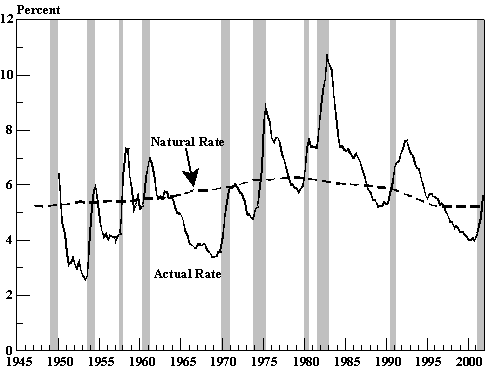
The question of the optimal level of unemployment has generally been answered by reference to the so-called “natural rate” of unemployment.  The natural rate of unemployment is measured as the long-run average rate of actual unemployment in an economy over time; it is a “trend line,” as seen in this graph below:

unemployment3

Read more of this Essay

Understanding unemployment, Part Two

Examining unemployment in more depth.

In an earlier post, I explained how the reported U.S. unemployment rate, which was 9.6% in August of 2009, is unemployedmeasured. This post will explore the reported unemployment rate in more depth, distinguishing between the short-term, temporary sources of unemployment and the long-term, more structural, and troubling aspects of the unemployment rate.


The 9.6% U.S. unemployment rate remains the same next month if no one changes their employment status.  But the rate also remains unchanged if the same number of people hired get fired.  In truth, the U.S. unemployment rate nets out enormous flows of people into and out of the labor force and, for those in the labor force, between being employed and unemployed.

A representative month in the unemployment statistic tells the story.

Read more about unemployment

Unfamiliar territory for stockmarkets

Stockmarkets in very foreign territory

On August 6th, a Post was published on this Blog with the title of This is going to end in tears!

It was prompted by an article by Karl Denninger and a footnote piece from Dave Rosenberg of Gluskin Sheff.

Also included were the US and UK prices for 4th August (about 7am MT) more for my own curiosity than anything else.  They were:

Dow Jones 9295, S&P 500 1,001, NASDAQ 2002, FTSE 100 (now closed) 4671.

By comparison, here are the figures for these markets (all closed at time of writing) for the 18th September.

Dow Jones 9820, S&P 500 1,068, NASDAQ 2133, FTSE 100 5173.

Well another fascinating muse from Mr Rosenberg was in this morning’s inbox and important extracts are below:

Read Rosenberg’s comments

Lehman Brothers – whoops!

Wonderful article in the Financial Times about the importance of IT documentation!

Unwinding derivatives is a complex task at the best of times. In the case of Lehman, one of the biggest dealers in some of the most complex derivatives markets, this has been even more so. Lehman’s global derivatives book included contracts with a notional face value of $39,000bn and deals with 8,000 different counterparties when it went bust. The derivatives business was actually split into multiple strands, backed up by between 20 and 30 different systems.

Once it went bankrupt, the staff who supported these systems “evaporated”, according to Steven O’Hanlon, president of Numerix, a pricing and valuation company which is working with Lehman Brothers Holding Inc to unwind the derivatives portfolio.

Say no more! Full article is here.

By Paul Handover

Lehman – 1 year on.

Exactly a year ago, Lehman Brothers filed for bankruptcy.

I shall avoid the temptation of pontificating on the subject as many, many others, far better qualified, will be doing so!Leyman

But two published articles seem to me to be worth visiting, one from October of 2008 from The Economist, and one from The New York Times.

Lastly, a personal comment from friend Dan that shows powerfully how the last year has affected him.

Read more of this Post

Understanding unemployment, Part One

The Unemployment Rate: how it’s measured; what it means.

The unemployment rate is often used as a signal of how well an economy uses its resources.

The social costs of involuntary unemployment are evidence of a poorly functioning economy. The unemployment rate

(c) AP Photo
(c) AP Photo

in the U.S. currently stands at about 9.7%, causing deep concern about the overall health and viability of our economy.

Let’s first make sure we know how this reported unemployment statistic is measured.

Read more of this Post

Now this makes sense, not!

US Government Policy encourages next round of foreclosures!

Call me crazy but I thought that the sudden rise in single-family home mortgage foreclosures that began a year or so back was one of the main causes of the current financial crisis.

And that many of these foreclosures resulted from families over-extending themselves, taking on too much debt given debttheir income and other financial obligations, in part because of incentive programs designed to reduce the upfront cost of the home and the monthly mortgage payments during the first several years of home ownership.

So why is Washington pushing to expand and extend the first-time home buyer tax credit?

Read more of this Post

The Fed’s Bond Purchases and Inflation

Fed’s Kohn on Lessons from Buying Government Bonds….in Britain

Preface:

Recently Dr Jarrell, now a fellow author of this Blog as well as her own, debated the meaning of inflation.  That essay, in three parts, may be found in the list of Essays on the right hand side of this Blog.  This Post is an extract from a recent Post that Dr Jarrell presented on her own site and is presented here with the hope that, following the essay on inflation, this Post is more widely accessible to you, the reader.  Paul Handover.

Do read on

Essay One – Inflation – Part Three

Inflation, deflation, economic crisis and so on, getting to the bottom of meanings.

Inflation – Part three

Part One was published on the 23rd.

Part Two was published on the 24th.

Sherry writes:

I think we are getting somewhere!

You’ve zeroed in on the key question, I believe: why is there an inflation risk while the outlook remains so grim?

Inflation is a (sustained) increase in the equilibrium price of goods and services.

The price results from the interaction between two completely independent sides of the market: the demanders and the suppliers. Think of money (or a debit card, whatever form money takes) as an enabler of demand — it makes transactions easier, quicker, and thus more transactions result. The higher the supply of money, the more enhanced the underlying demand for goods and services (by consumers, business, and government).

So more money, higher demand. Higher demand, higher prices. Higher prices, higher inflation.

Read more of Dr Jarrell’s concluding essay