Fed’s Kohn on Lessons from Buying Government Bonds….in Britain
Preface:
Recently Dr Jarrell, now a fellow author of this Blog as well as her own, debated the meaning of inflation. That essay, in three parts, may be found in the list of Essays on the right hand side of this Blog. This Post is an extract from a recent Post that Dr Jarrell presented on her own site and is presented here with the hope that, following the essay on inflation, this Post is more widely accessible to you, the reader. Paul Handover.
You’ve zeroed in on the key question, I believe: why is there an inflation risk while the outlook remains so grim?
Inflation is a (sustained) increase in the equilibrium price of goods and services.
The price results from the interaction between two completely independent sides of the market: the demanders and the suppliers. Think of money (or a debit card, whatever form money takes) as an enabler of demand — it makes transactions easier, quicker, and thus more transactions result. The higher the supply of money, the more enhanced the underlying demand for goods and services (by consumers, business, and government).
So more money, higher demand. Higher demand, higher prices. Higher prices, higher inflation.
My first realisation is that I don’t really understand what “money growth” really means. In fact I am little uncertain about money, as a concept!
Are we talking ‘growth’ as in more and more money being lent to the US Treasury Department from the [ever increasing] sale of US Treasury Bonds?
If the sale of these Bonds is to banks or institutions outside the US then there is a flow of money coming into the US via the Treasury Department that then comes into the economy via various Government programmes. Is that correct?
But this is money lent to the US. That means that in order for the US to pay it back (plus interest) there has to be the expectation of taxation income in the future sufficient to meet these debts. As my Pension advisor said, “More credit also means more debt.”
Inflation, deflation, economic crisis and so on, getting to the bottom of meanings.
The background.
Not so long ago there was an exchange between me and Dr Sherry Jarrell about the meaning of inflation. Dr Jarrell is, in every meaning of the words, a qualified economist so when I had the courage/stupidity/ignorance to query her views I could not have been more surprised to receive this:
You won’t reveal a lack of understanding of economics — there are co-existing opposing points of view on the topic – that’s why it made for an interesting discussion! (My italics)
This got me thinking. If your author, who is reasonably well-read about many things especially protecting what little wealth he has, can miss such a fundamental point, then there must be a huge number of other people who, likewise, miss the point and, even more important, don’t even realise it!
Dr Sherry Jarrell
Over the last few weeks Dr Jarrell has not only found time to debate with me, she, too, has realised that a more rigorous exploration of what many economic and financial terms mean has real value for readers of this Blog as well her own Blog.
Therefore I am delighted to welcome Sherry Jarrell to the team of authors.
These essays will attempt to distil clarity out of a number of basic economic ideas, starting with inflation. That seems to be a worry widely ‘predicted’ in the general media as well as elsewhere.
The essay is in the form of a debate format, albeit virtually. We hope it is both informative and educational. Please let us know by leaving a comment!
Not being either a US Citizen or even a resident takes away my right to contribute an opinion. The matter is entirely a domestic one for those living in the USA.
But my life-long Californian buddy, Dan, recently sent me an article published in the Wall Street Journal on the 12th August. The article was written by John Mackey, the CEO of Whole Foods Market Inc. so this isn’t an impartial perspective. (And see an important foot-note at the end of this Post)
But the last part of the article is good common sense, as you can read:
My son, who is a commercial pilot flying with a company that have a number of Boeing 787s on order, sent me a YouTube clip that is a re-subtitled version of the film Downfall. That film, by the way, is an excellent portrayal of the last days of Hitler in 1945 and well recommended.
Anyway, it appears that the art of substitution is alive and well because a YouTube search reveals film clips of Hitler learning about Michael Jackson’s death, Hitler being banned from playing XBox Live, Hitler loves his waffles and more.
This particular clip is about Hitler learning of delays in the delivery of the Boeing 787. It’s funny (but does include some minor vulgarity).
The first from Prof. Nouriel Roubini in his RGE Monitor of today’s date:
A number of economic and financial variables have exhibited signs of improvement recently even if macro indicators are still mixed. The pace of economic deterioration has slowed significantly, and after four quarters of severe contraction in economic activity, RGE Monitor now forecasts that the U.S. will display positive real GDP growth in the second half of 2009. As discussed below, however, that does not mean that the recession in the U.S. is already over, as many analysts have argued. Indeed, all the variables used by the National Bureau of Economic Research (NBER) to date recessionary periods will continue to contract or display sub-par growth. However, RGE Monitor now anticipates that policy measures and other factors will boost real GDP growth, albeit in a temporary manner, in the second half of 2009. Yet the shape of the recovery (will it be V, U or W?) and other challenges will influence the U.S. economic outlook going forward. According to RGE Monitor, growth will remain well below potential in 2010, while the shape of the recovery will be closer to a U.
The second is from David Rosenberg in yesterday’s Breakfast with Dave:
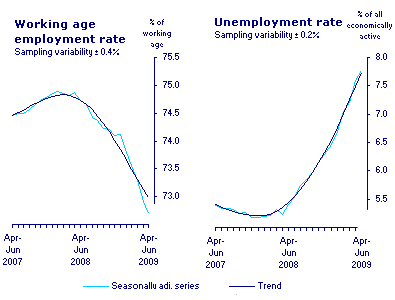
While these figures were published by the UK Office for National Statistics last Wednesday, first opportunity to comment on this Blog was today. It’s not a pretty sight!
Employment figures, as reported Aug 2009
These trends look really nasty and not a hint of an upturn in employment or a lessening of the rate of increase in unemployment.
One aspect of British culture is their dry sense of humour. In terms of satire, for over a decade three people have held pole positions: Rory Bremner, John Bird and John Fortune. WikiPedia has a very good summary.
Bird and Fortune have also recorded a series of ‘interviews’ focusing on some of the idiocies of life.
Here’s a classic about the sub-prime crisis. Slightly dated but no less funny for that.
More from these incredibly, clever guys from time to time.
It now costs more to insure California’s debt than Russia’s
There’s a rather technical piece published recently on Bloomberg.com about the cost of insuring debt in a number of countries.
Eleven years after Russia defaulted, investors want less to insure its debt than California’s. “This would have been impossible to imagine a year ago,” said Dimitry Sentchoukov, an emerging-market credit strategist at Dresdner Kleinwort in London.
Will the last person leaving the sunshine State, please close the door!
 Are we talking ‘growth’ as in more and more money being lent to the US Treasury Department from the [ever increasing] sale of US Treasury Bonds?
 last days of Hitler in 1945 and well recommended.