We have been looking for ways of cutting down our energy requirements and coupled with trying to grow as many of our own veggies as possible, 2 small flocks of chickens for eggs, we have now acquired a reconditioned, wood-burning cooker.
It arrived last Wednesday and weighs in at just under a third of a ton. It was manoeuvred into place by 2 men, some planks of wood and a few rollers made from off-cut, scaffolding poles.
Our youngest son and I fitted the flue and fired it up on Thursday evening. What a transformation!
The quality of heat and ambience it creates in the kitchen/dining room is amazing. It is like being transported back to a bygone era where everything seemed less stressed and slower. Whoever gets up in the morning lights it first and it seems to be able to rise from cold to a useful temperature in 20 minutes. It uses a very small amount of wood to keep it in all day and we have switched off all the heating in the adjoining rooms. We cooked a roast dinner in it on Sunday and a load of mince pies plus bread over the weekend.
It’s not instant and it has its own foibles but we love it – a bit like most of us, I expect!
As I visit some of my clients, I am becoming aware of an unusual phenomenon – I think some people are actually becoming less selfish. We are used to hearing stories of institutions reaching heights of greed and selfishness during this recession but not many that are about the other way round.
I don’t go to supermarkets very often because I’m usually out working when my wife goes but by a fluke, I kept her company recently. We have been trying to support the local farmer’s markets in the area but this is proving difficult as it’s much quicker to do a one-stop visit to a supermarket than lots of small visits since we both run our own businesses.
It is of course cheaper at the supermarket as they have systematically forced food prices down to a level that prohibits most small food producers from supplying them.
Anyway, I digress. In our local supermarket works an ex colleague and friend of mine. He was made redundant just over a year ago for the second time and decided that he would go for the stress-free, safe option. He used to organise procurement for a large, global communications company so he has his head screwed on around organising things. I guess the supermarket job means that he can just switch off away from work, something he could never do before.
I saw him with a large trolley, checking shelves and we stopped for a chat. He was fine and generally enjoying his work. He asked about mine and I mentioned that things were a bit tight at the moment. We got talking about how training is carried out at his work and how they work with developing employee’s interpersonal and communications skills. He mentioned that there was a new HR manager at the branch, or is it “in branch?”, and would I like an introduction as they were always recruiting new people and they needed training?
I was flabbergasted as we weren’t necessarily that good friends and he didn’t need to say or do anything but went out of his way to be helpful.
I have also noticed this phenomena in other companies from time to time, in the form of clients arranging meetings and spending time, something previously they really didn’t have time for. Maybe we get more of what we notice and by focusing on the positive, we attract more of the positive into our lives?
Is it because when the going gets really tough, for example, in times of national crisis or great hardship, that we remember that we are all interconnected?
Perhaps the housing market is the best economic indicator?
As an economist, I am frequently asked for my predictions on when the economy is going to turn around. Have we reached the bottom? Have we begun to recover? Might we go into a second, perhaps more severe recession?
Those are tough questions to answer. Business cycles are notoriously difficult to predict. In fact, about the only thing we know for sure is that no two business cycles are alike. Each is unique in some significant way.
Changes in the housing market may be one of the most meaningful indicators of a recovery, because housing stability is such a fundamental indicator of how households are budgeting their income. Notice that I did not say that the level of homeownership was a useful indicator; instead, I look to changes in the housing market, either away from or toward an apparently sustainable and affordable supply of homes, for evidence of where in the business cycle the economy may be.
Despite record low mortgage rates and first-time home buyer credits, the U.S. housing market remains anemic. Rising foreclosures in several major metropolitan areas will keep housing prices low for some time to come.
The U.S. currently has about 1.7 million excess housing units available. Typically, about 1.3 million new households are formed in the U.S. per year. But with the unemployment rate topping 10%, new household formation will fall to about 1 million per year. If new home construction remains at its current level of about 600,000 units per year, it will take over 4 years (1.7 million/400,000) for the excess supply of housing to be absorbed and housing prices to recover.
Recovery rates will be much slower in some markets, such as in Florida, Nevada, and California, but I believe that the rest of the U.S. along with most other developed economies are looking at a three- to four-year period of time before housing and thus the overall levels of output return to their pre-recession levels.
The U.S. banking system remains vulnerable to sizeable potential losses as the housing market struggles to recover.
Estimates of these losses range from $500 billion to $1 trillion (£312 bn – £625 bn). The Federal Reserve Board is especially concerned about the impact of commercial real estate on many regional and small banks across the country. Occupancy and rental rates continue to decline dramatically as 2009 draws to a close, and the worst seems yet to come.
Commercial real estate loans on banks’ balance sheets total almost $1.1 trillion dollars. With near-term commercial real estate losses topping $100 billion, the Wall Street Journal estimates that as many as one-third of small and mid-size U.S. banks could experience financial distress.
Troubled banks restrict lending until they can raise more capital. In this illiquid market, expect banks to fight for survival by raising lending rates, shortening maturities, and lowering loan amounts. Credit will continue to shrink in the U.S., which spells big trouble for any economic recovery.
As I was perusing the business press this morning, an article caught my eye: “That would make a great post!” I thought to myself. I continued reading through the rest of the articles, intending to go back to the one that piqued my interest to compose a comment. Of course, when I went back, I could not find it!
Trouble internally
But in the process of looking for that particular paragraph, I noticed something troubling. Something that, should my students’ papers include the same, would bring their score down by a full letter grade, if not more.
The almost surreal area where aircraft are ‘laid to rest’.
The Mojave Desert is one of the places in the world where aircraft, both military and civil, are placed when they are at the end of their life, whatever that means.
Anyway, came across some nice material and wanted to share it.
In an earlier copy of Mental Floss Magazine (seriously) there’s a very good article about this area. Fabulous pictures, by the way. (Both pics in this Post are from that article.)
Next this is a YouTube video using Google Earth in flyover mode:
A small challenge to a Nobel prize winner in Economics!
In a recent New York Times op-ed, Paul Krugman continues his boundless quest to become the “it” guy in the world of economics. I have taken issue with his command of basic economic facts in the past — a gutsy, if not insane thing to do given the man was awarded a Nobel Prize in Economics.
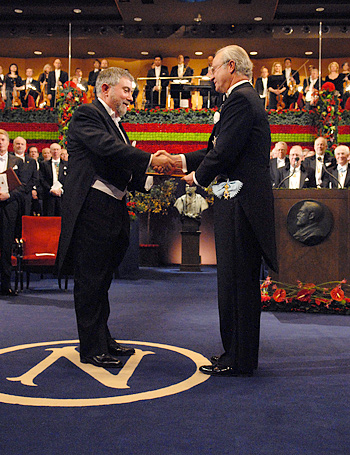
Krugman accepting the Nobel Prize
This post is more about ego than economics, however.
In this op-ed, Mr. Krugman says (and I kid you not),
…But after the debacle of the past two years, there’s broad agreement — I’m tempted to say, agreement on the part of almost everyone not on the financial industry’s payroll — with Mr. Turner’s assertion that a lot of what Wall Street and the City do is “socially useless.” And a transactions tax could generate substantial revenue, helping alleviate fears about government deficits. What’s not to like?
Well, I disagree with the idea that what Wall Street does is socially useless. And I am not on the financial industry’s payroll.
Nope, I’m just a simple economist, using my head, training, and experience to consider this idea, map out the pros and cons, and analyze the logical end-game of such a tax. I conclude that it is a really bad idea.
Why? There are lots of reasons, but I will mention only two.
One, raising taxes reduces private economic activity, which will curtail growth, reduce tax revenues and increase the deficit.
Two, taxes distort the price signal between suppliers and demanders of goods and services, including financial capital, reducing economic efficiency.
His reasons? Other than citing one academic study (while ignoring the many others that reach a different conclusion), he gives no economic reasons for his views. Instead, he make claims. He claims, for example, that “socially damaging behavior … caused our current crisis.” He says that the financial services industry is “bloated” and needs to be cut down to size. He says that the new tax is okay because it raises revenues for the government which, he claims, should make us all feel better about the deficit and, apparently, the size and nature of government spending under Obama. And, the lamest of all, for no other reason than to hide behind their skirt, he claims the existence of some phantom majority, apparently to create the impression that anyone with a different view is clearly in the minority. A tactic that should be beneath a Noble Prize winner, but one that runs through his work with increasing frequency over time.
But, Mr. Krugman, I so disagree with you. And even in an op-ed piece — perhaps especially in an op-ed piece – I believe that one needs to reign in an ego that would parade claims as facts, especially when each of those claims is disputed by your fellow economists, none of whom stooped so low as to imply that you were paid for your views.
A summary of the different collections is listed here, many of them wartime photographs that bring a multitude of emotions to the surface: incredible bravery of the pilots; photographic standards of 70 years ago, man’s inhumanity to man; and so on.
I pondered a bit about writing this Post because, well ….. well…, see what you make of it!
Author's Mum
Being born in England in the early part of November, 1944, World War 2 still resonates within me.
Early home in an industrial part of West London meant that my mother and father had a ring-side view of the German V1 and V2 rockets that were being visited on London at that time.
My mother, 90, still recounts her enormous sense of relief when VE Day was announced (May 8th, 1945) because she then thought that her son’s future life was more or less assured.
So back to these aerial photographs held in those collections.
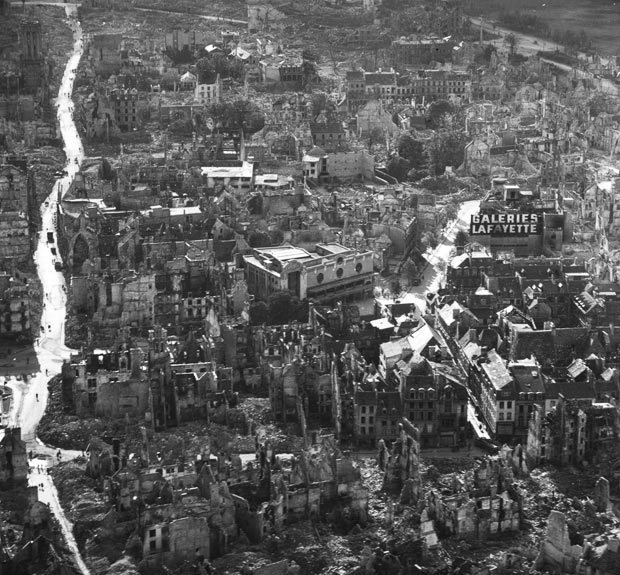
Here’s a picture of the visitation of war on the beautiful French town of Caen.
Linger a while and look at the damage, mostly to private homes. The photograph was taken just slightly more than a month before I was born.
These are very strange times: thank goodness for Blogs.
Learning from Dogs is a relatively young Blog (first Post was July 15th, 2009) but already it has opened the eyes of all the authors to the power of plain speaking. All of us involved in bringing you a dozen Posts a week find inspiration for our creative juices from the corners, far and wide, of the virtual world of digital communications, the World Wide Web.
Because we are in the midst of huge turmoil it’s very difficult to see the underlying trends of change at work. But see them we must if we are to be smart and work out, for the best, what needs to be done at the scale of the individual and the family.
So with that theme in mind, go to the Blog called Jesse’s Café Américain and read a recent Post about the behaviour of the price of gold. But also read beyond the subject of gold and reflect on the deeper message.
The Commerce Department has revised downward its estimate of the U.S. growth rate from the third quarter of 2009, see this report.
Citing weaker consumer spending than originally estimated (discussed in an earlier post here) the annualized growth rate is now 2.8%, down from 3.5%, far too weak to make any progress on the employment front.






 Learning from Dogs