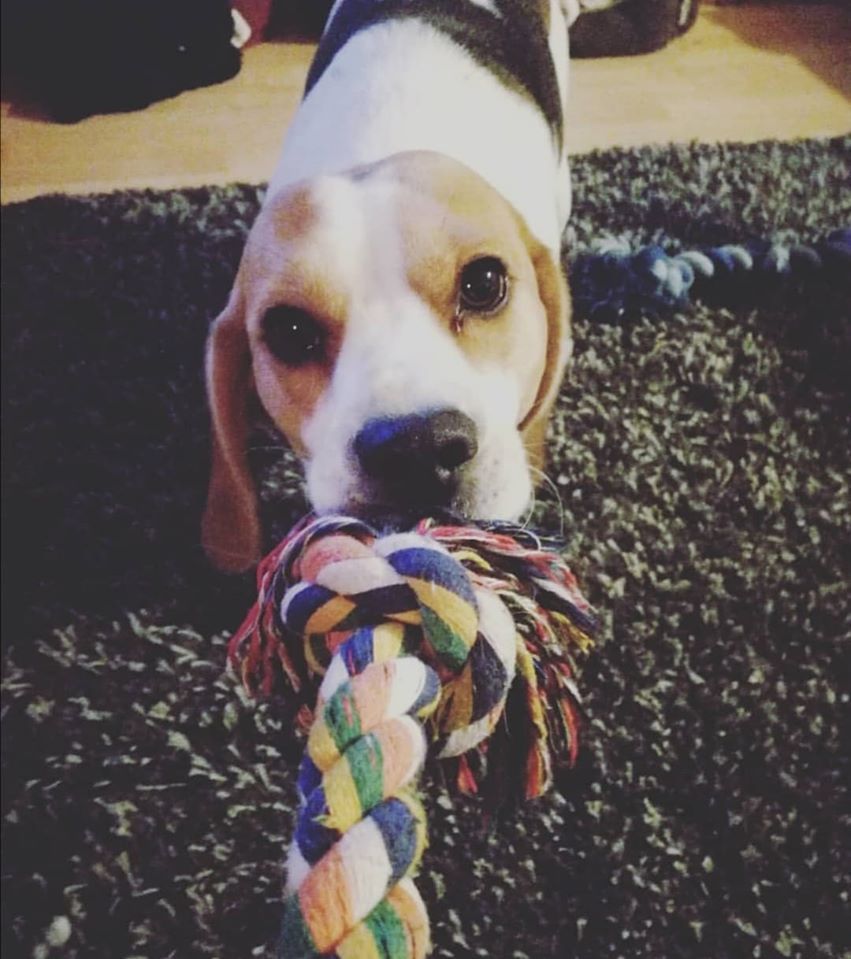
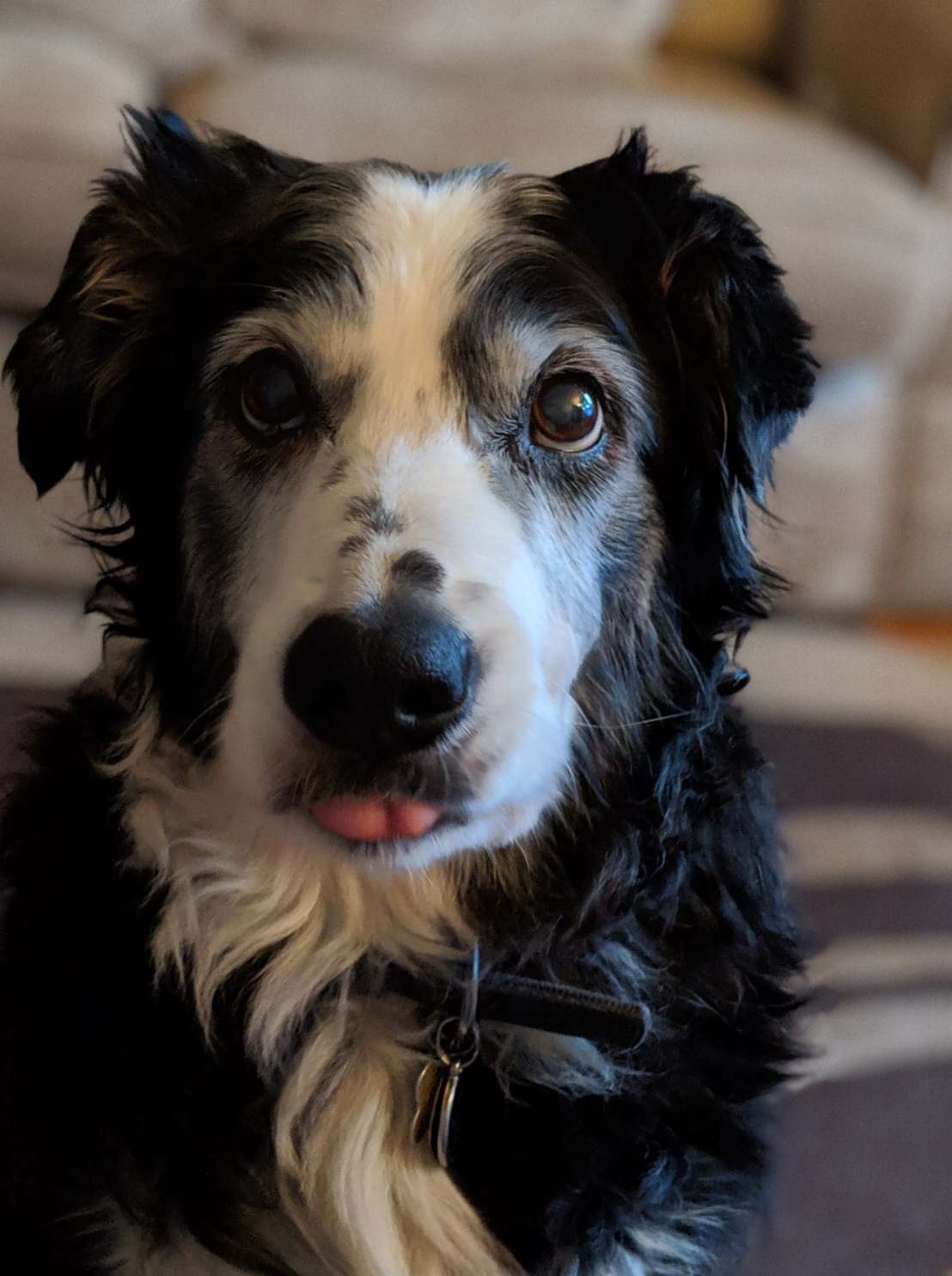
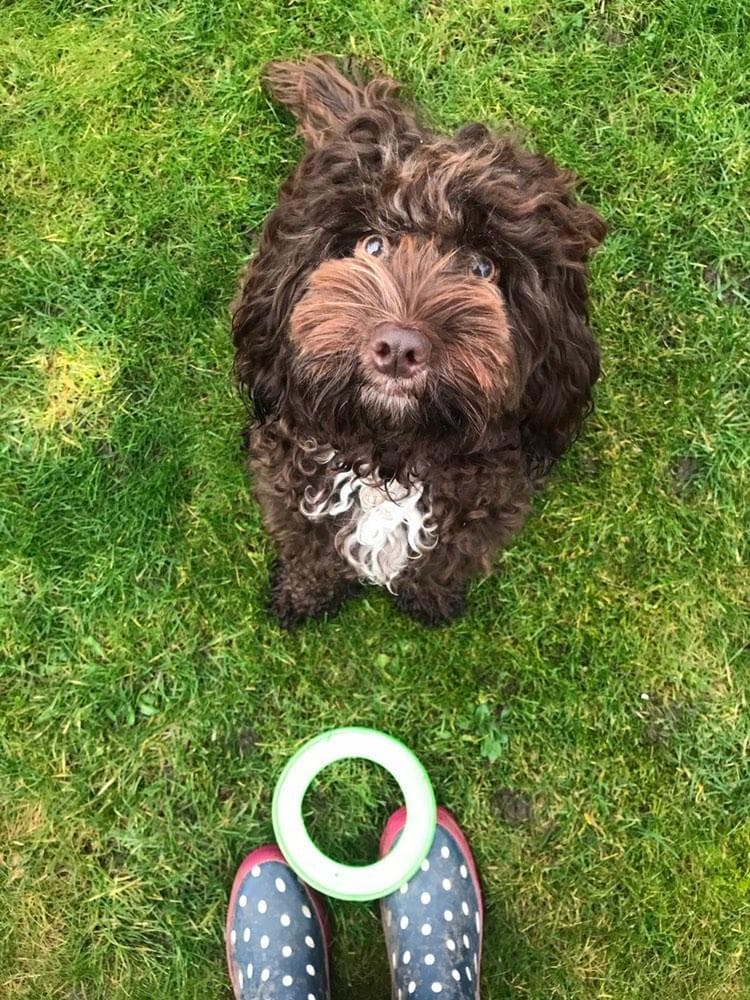
For my previous post was entitled Day Eight etc. and this one is also called Day Eight.
Ah well, it’s the content that counts!
Which is to say that the next three days are, again, devoted to Tom’s walk along GR7.
ooOOoo
Day 8: Cerra de la Fantasia to Benacoaz 16k
By Tom and Chica, 27th January, 2020.
Written by Tom’s wife.
Authors note: Because we have had such a long weather delay, I have decided to number only the days that Tom and Chica actually walk otherwise it is going to give a very unrealistic idea of how long it takes. That is why today is Day 8 and the last walking day was originally Day 10 (but is now Day 7). I have updated all the blog references to correspond.
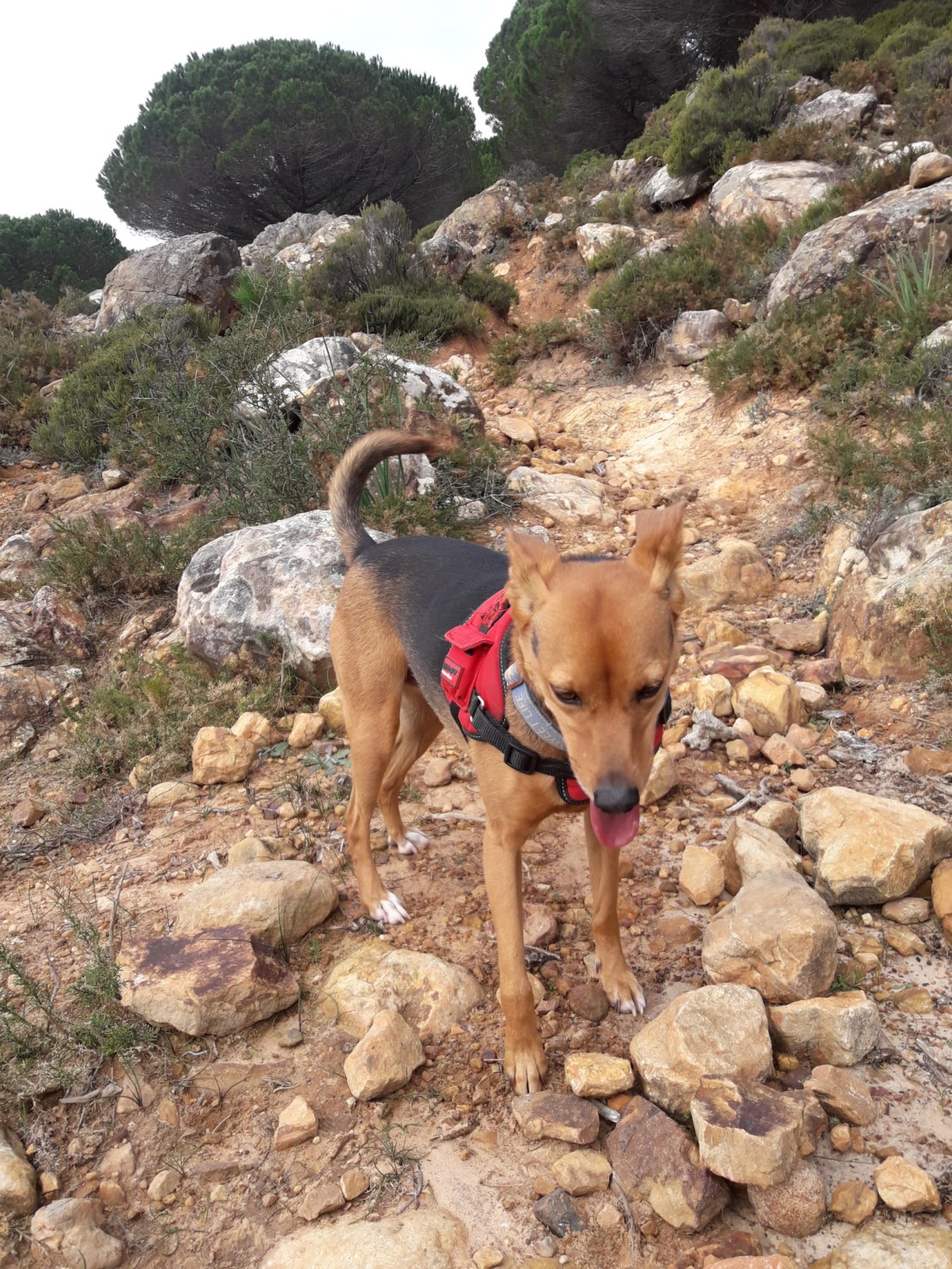
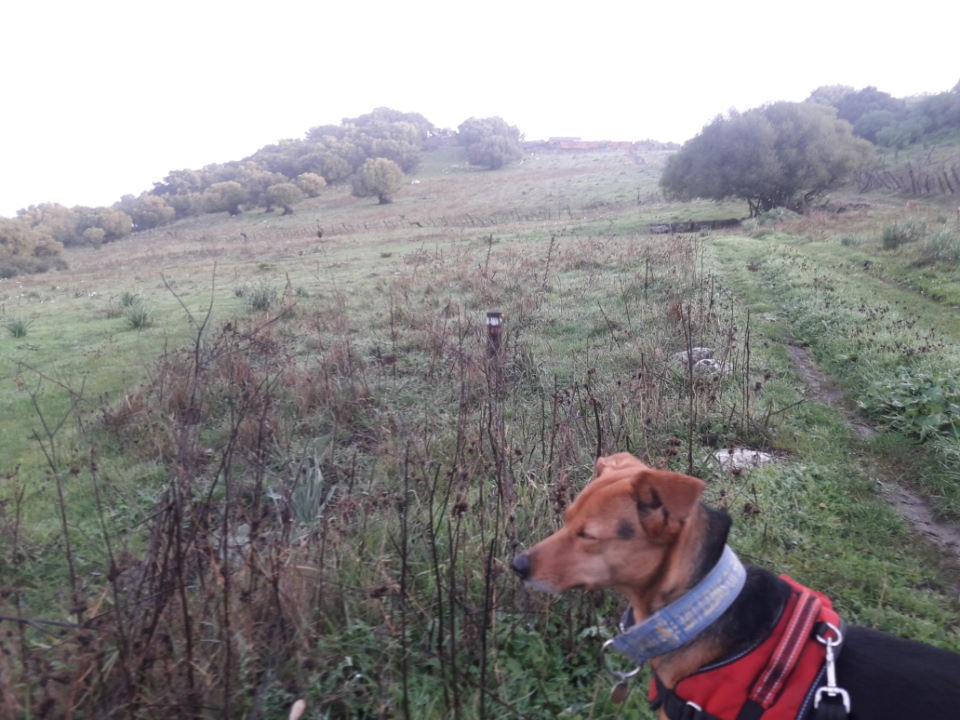
We were up with the lark this morning. Earlier in fact, as it was still dark but we were keen after such a long rain delay. We left the village in fog and went in and out of the sun and mist all the way up to the start point miles into the forest. It was still murky there too and we didn’t hang around as there was a gathering of hunters. Their dogs were in trailers, barking with excitement as this is probably the only time they ever get let out of their cages. But what happens to them after the end of the season next week? I can’t bear to think about it. But that’s why we’re doing this – so onwards and upwards my faithful duo!
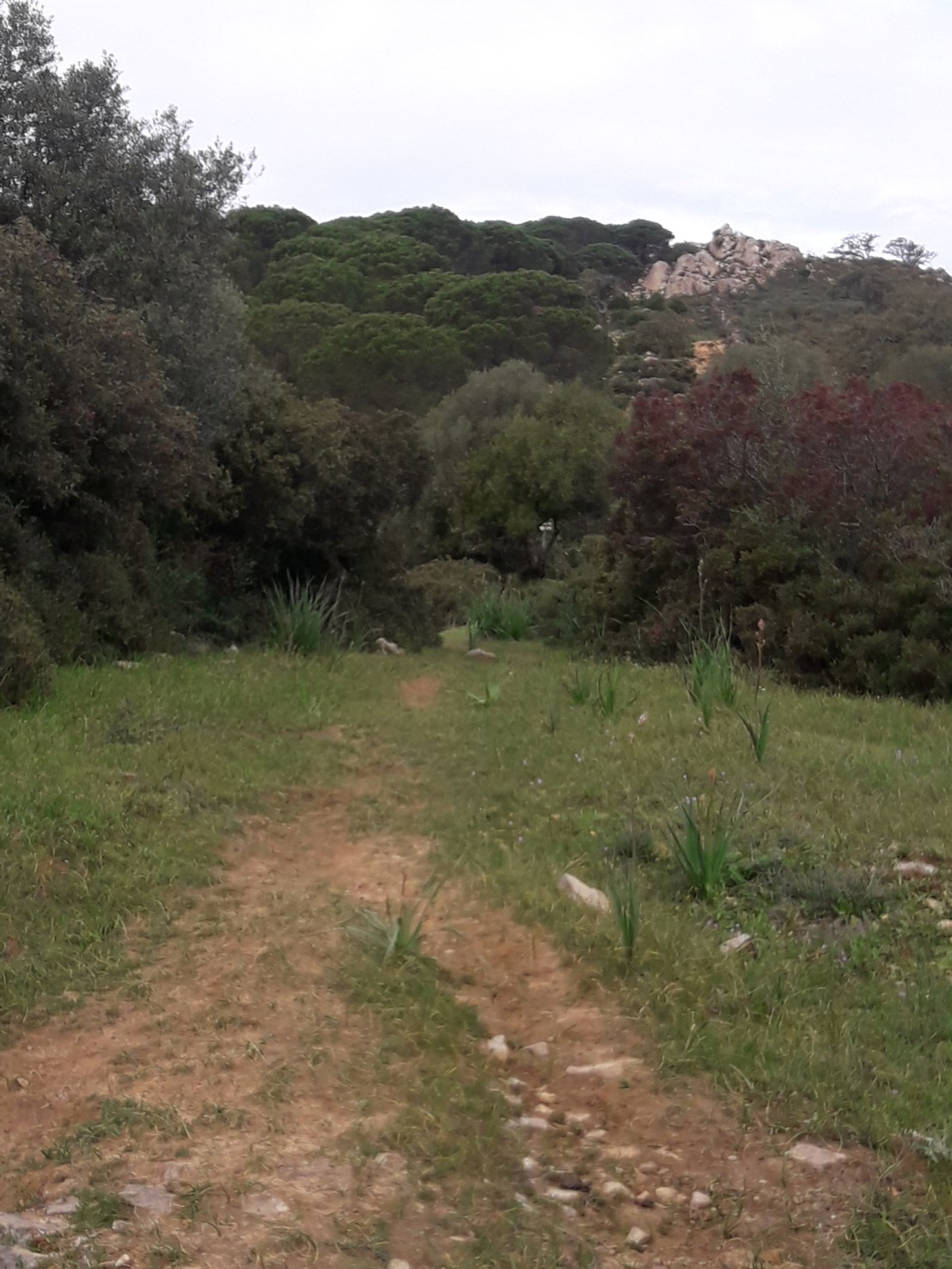
After coming out of the forest onto the road, the trees gave way to scrub and the track roughly followed the same route as the road. The mist made it hard to get a feel for the surrounding landscape at first but then as the mist became patchy there were glimpses of the majestic valley and surrounding mountains – a truly spectacular view but impossible to capture on a phone camera.
The track crossed the road and descended to the river – Rio de Ubrique – which heads towards the town of the same name. After a bit of a clamber up a steep, wet, rocky and rather unsavoury path between agricultural outbuildings, we popped out right next to the town sign.
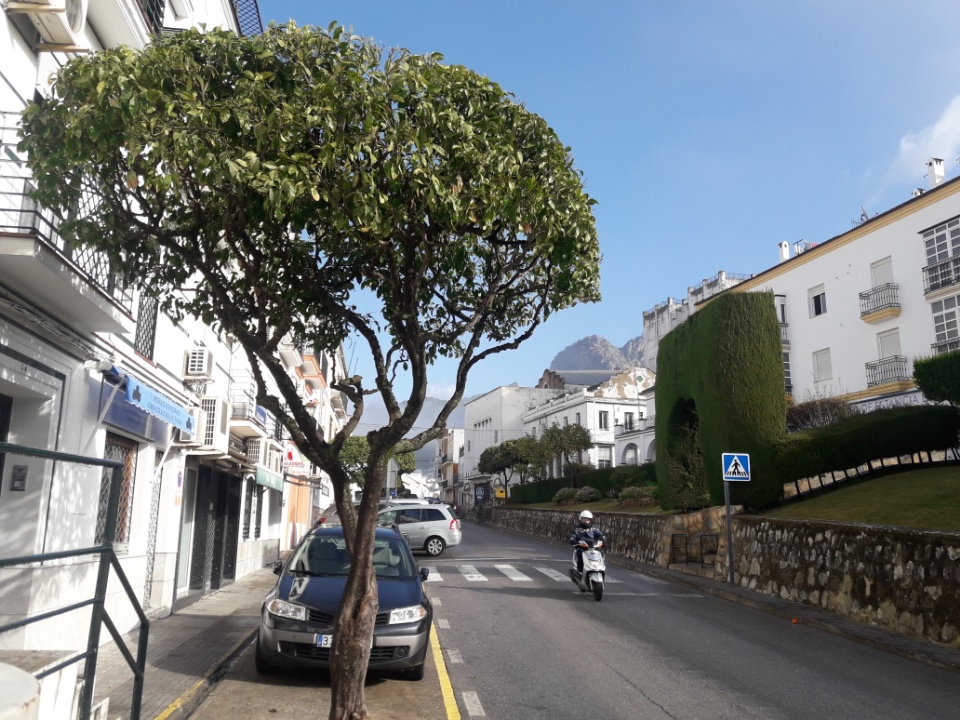
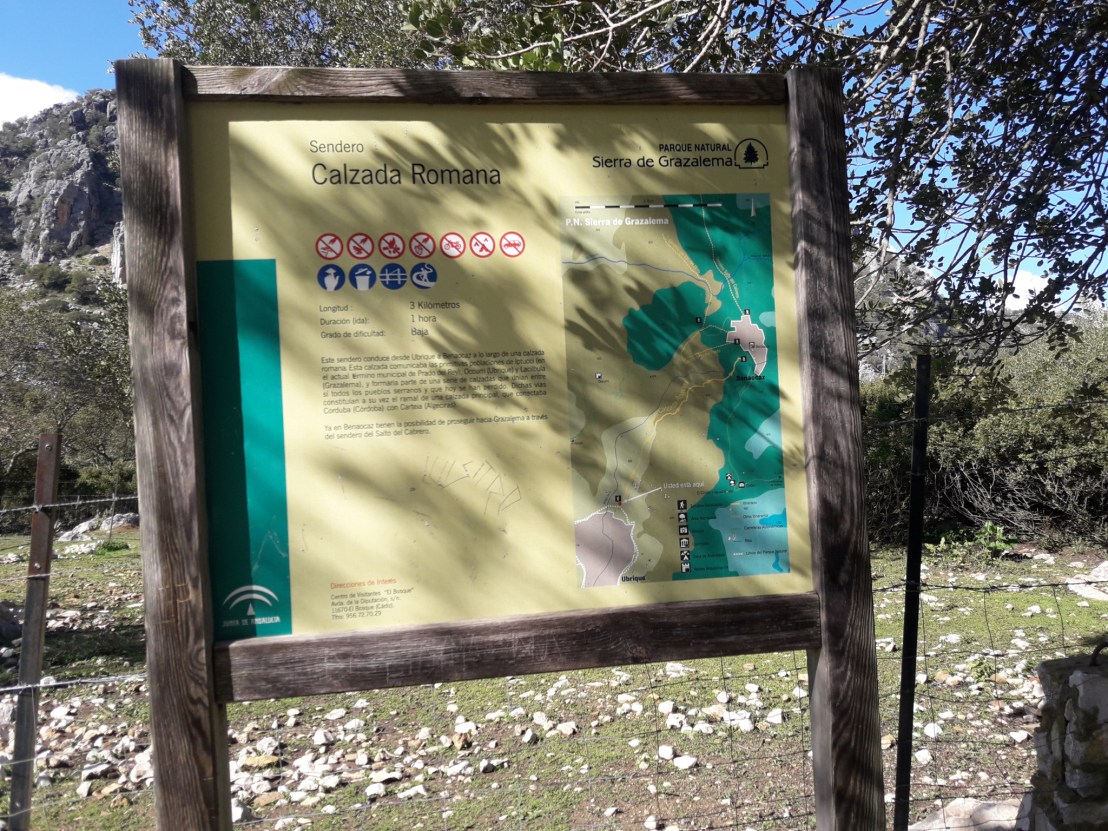
It was a pleasant stroll through the comparatively large and bustling town centre. The sun was now properly out and so Tom stopped in a plaza outside the Town Hall and had a coffee while Chica scrounged titbits by breathing in and contriving to look half starved! Carrying on up through the narrow streets, they arrived at the Convento de Capuchinos where a sign to Benacoaz pointed up a cobbled road: the Calzada Romana (Roman Road).
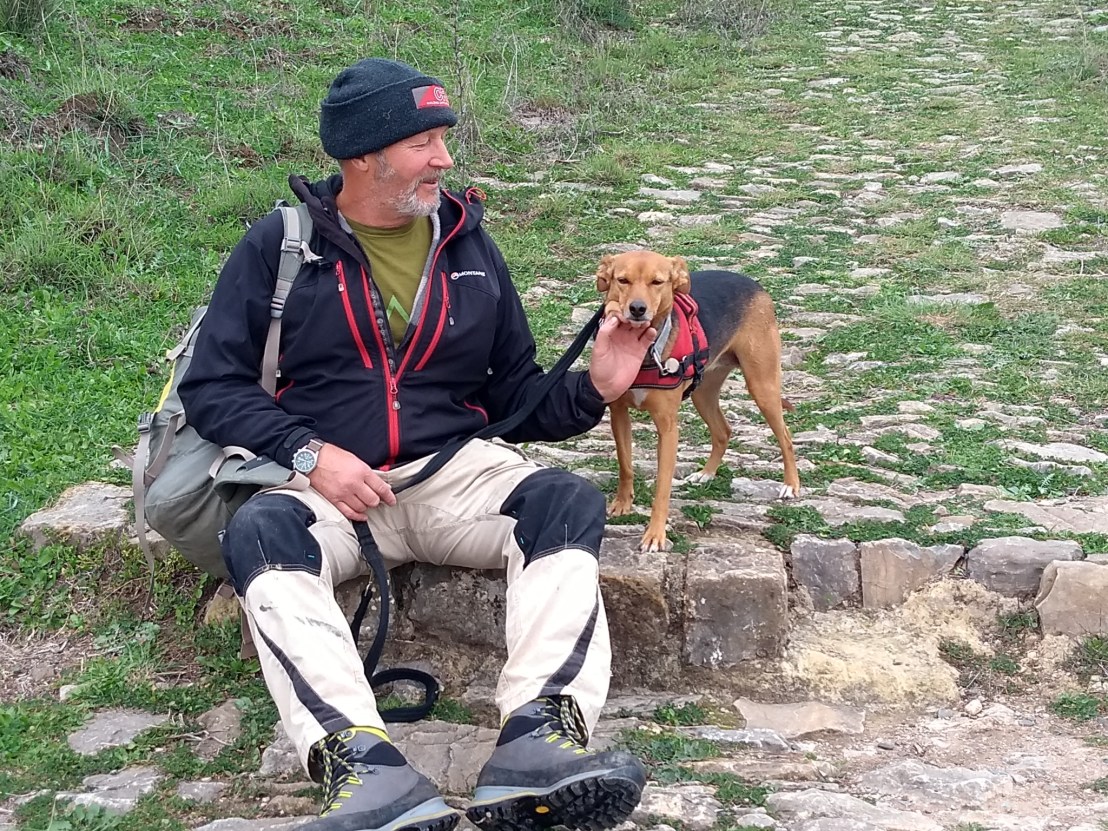
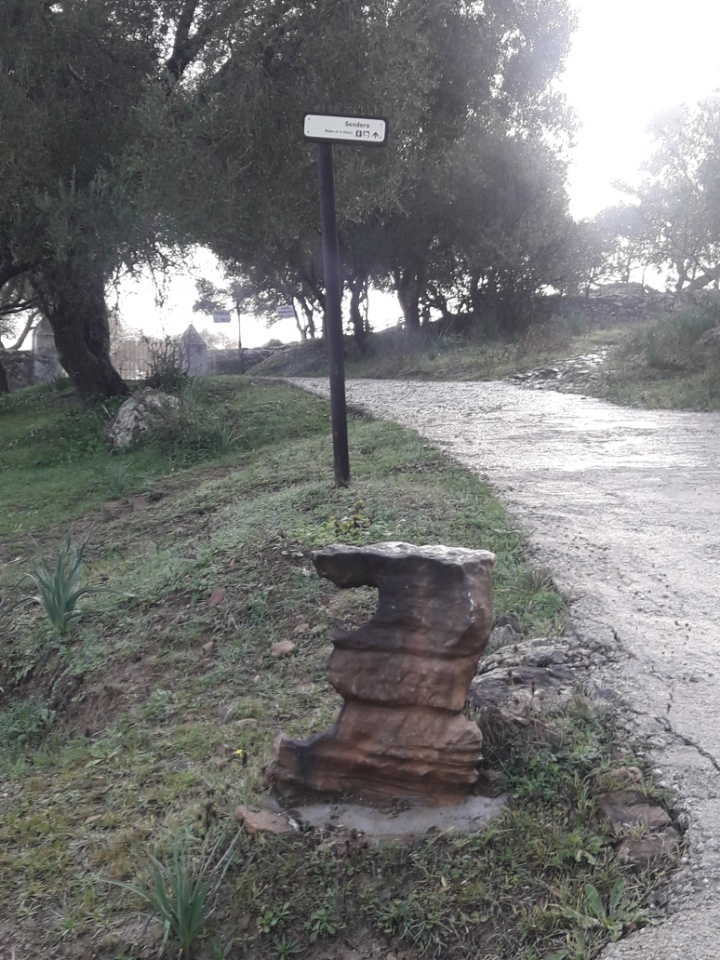
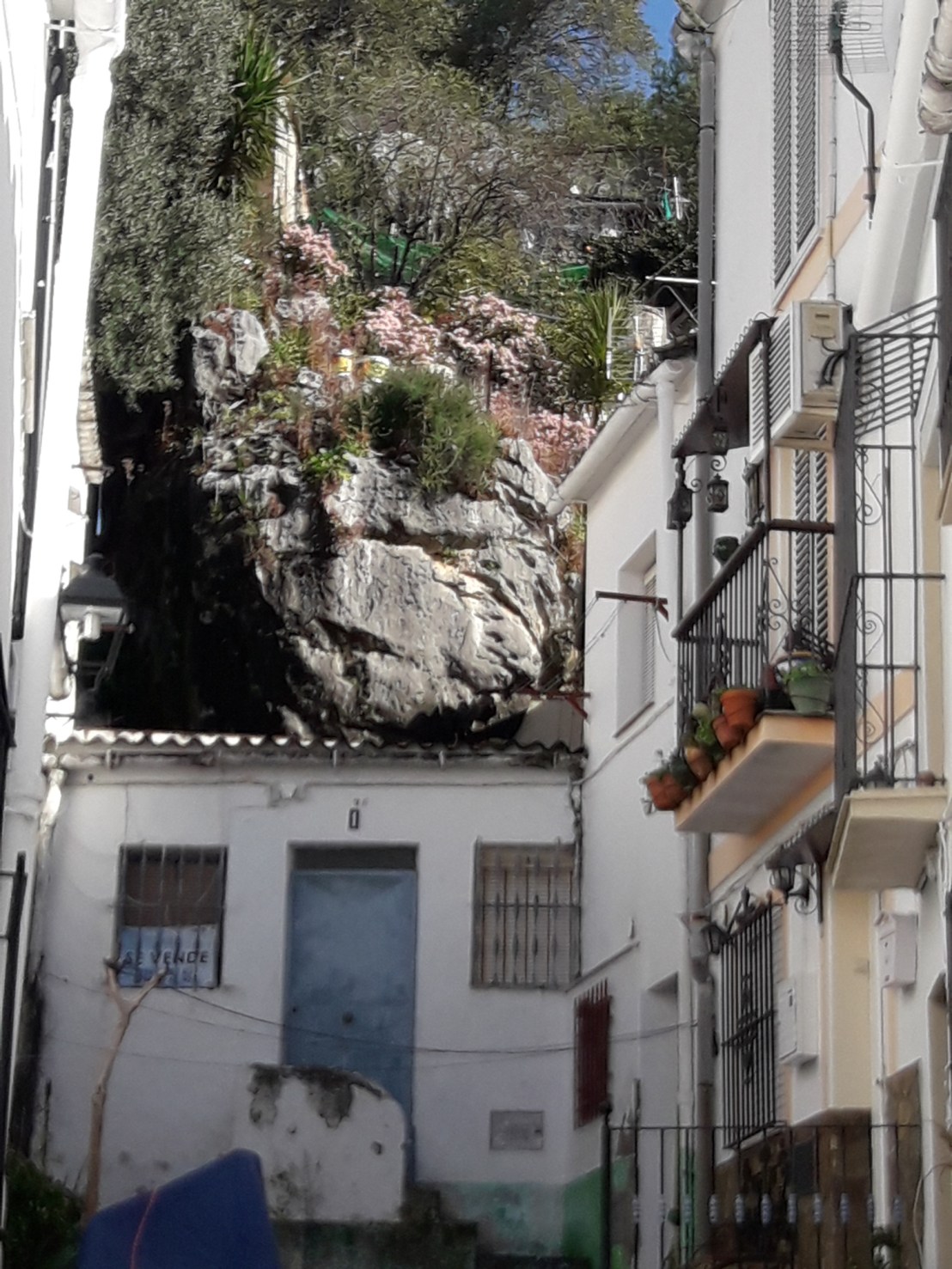
This proved quite tough on the feet as the cobbles were uneven and scattered but after 3.5k it emerged into the village of Bonacoaz, perched on the side of the mountain with vast panoramic views south – stunning end to today’s beautiful walk.
ooOOoo
I know I have said it before, and undoubtedly I will say it again, but this account of Tom’s walk with his two dogs is astounding! They have been walking for over a week and they are experiencing countryside and more that must be unique to Spain.
A sheepdog puppy leads a flock of sheep into the house!
Maybe not all of you saw this item on the BBC News the other day.
Plus, it’s after 4pm and I have just opened up my PC. So much later than normal!
Into the story.
ooOOoo
Sheepdog puppy led a flock of sheep into his owners’ home
Imagine coming home to find a flock of sheep in your kitchen? That is what happened to farmer Rosalyn Edwards.
Her overzealous sheepdog pup Rocky guided a flock of sheep from their pen right into her kitchen.
The seven-month-old border collie took advantage of an open gate to lead nine sheep directly through the back door of his owners’ home.
Mrs Edwards said: “It was funny at the time, but then there was quite a lot of wee, poo and mud everywhere.”
She posted a video filmed by her children to Facebook, showing the sheep in the kitchen of her smallholding in Devon.
The sheep caused havoc in the house before leaving through the front porch
She said: “I was in the kitchen and heard a noise. I turned around and the sheep were just standing there. There were about nine of them.
“I took the children into another room and then tried to guide the sheep out. They went right around from the kitchen and left again through the porch.”
Mrs Edwards says the flock took a good look around the house before finally leaving at the front of the house.
Rocky guided a flock from the pen into the kitchen
Despite the mess she said it was funny, in part because of the eager little sheepdog’s efforts.
She said: “Rocky did look quite pleased with himself, but he’s going to need more training.
“He brought a whole new meaning to ‘bringing the sheep home’.”
ooOOoo
What a gorgeous story from the Beeb!
Sorry folks, that is all I have time for!
Los Alcornacales – cork and pork and much, much more.
By Tom and Chica, 24th January, 2020
Written by Tom’s wife.
So far, during this part of the walk, Tom and Chica have been travelling through the unique habitat of Los Alcornacales. We fell in love with this beautiful area the first time we visited back in 2013. As we are rained off at the moment, I thought I’d take the opportunity to research more about the area, especially the amazing cork oaks which comprise large areas of the forest.
Granted natural park status in 1989, Natural Park Los Alcornacales occupies a protected area of 170,025 hectares in Andalusia. Soil, moisture and traditional uses have been the main factors in the conservation of the largest productive area of cork trees anywhere on the Iberian Peninsula. Located in the province of Cadiz and part of Malaga (mainly in the municipality of Jimena de la Frontera, where we have just been walking), it runs from the mountains down to the recently created Estrecho Nature Park on the coast and is home to a variety of landscapes, flora, fauna, history and folklore.
This rich diversity is mainly due to the many rivers, streams and reservoirs but also the moisture that comes from the coast. This latter accumulates to form banks of mist in the deep, narrow gorges known as ‘canutos’. In these conditions, the ancient laurel forest flora has flourished. Characterised by smooth, bright leaves, it can make the most of the moisture and limited light that penetrates the alders growing on the edge of the gorges. So, amidst the scent of laurel and the beauty of flowering rhododendrons, you can walk through this dense forest accompanied by the sound of dippers, kingfishers, blackcaps and finches.
Egyptian mongooseGriffon vulture
In the more clay-rich areas lower down you can see the wild olive tree, cleared from time immemorial to make way for pasture for the region’s most typical livestock, the brown Retinta cow. On the valley sides, the Mediterranean scrub of rockrose, heather, lavender, daphne and hawthorn is perfect for Andalusian deer, as well as buck, roe deer and carnivores such as genets, badgers and also the Egyptian mongoose – the largest population anywhere on the Iberian Peninsula.
Cork production
Los Alcornacales and the surrounding areas are home to the Iberian cork industry. As well as its most well-recognised use as bottle-stoppers, cork is also found in many products from car construction to aeroplane insulation.
The cork oak, quercus suber, is a native of both the northern and southern shores of the Mediterranean. Its age is unknown, but quercus suber or its ancestors have been around for at least 147 million years. It is a prophyte, ie a species adapted to survive fire. While other species rely on seed propagation to survive fires, the cork layer protects the stem of the tree so it only has to regenerate branches. This makes it very well adapted to the fire-prone forest of southern Spain.
Archaeologists have found evidence of tribes actively working with cork oak in northern Africa before 6,000 BC. Early man would have used the various species of oak for fire wood, tools, weapons; and for building as the hunter-gatherers began to settle. Similar evidence has been found in Andalucía and other parts of southern Spain dating back 4,000 years BC or more.
However, it would take a few thousands more years before the special sealant qualities of cork would be utilised. This property is due solely to the presence of one particular constituent: suberin. Suberin is a fatty substance found in the cells of the denser forms of cork which stops the passage of air or liquid.
Cork was probably first used as a sealant in containers by the Greeks and Phoenicians, for wines and other liquids in pottery containers but it would take the invention of the glass bottle, a fairly recent innovation in historical terms, for cork to finally meet glass. Legend claims that Friar Perignon, a French monk, discovered this use for cork on a slender glass bottle neck in the seventeenth century. As news of its efficacy spread, so a new industry appeared.
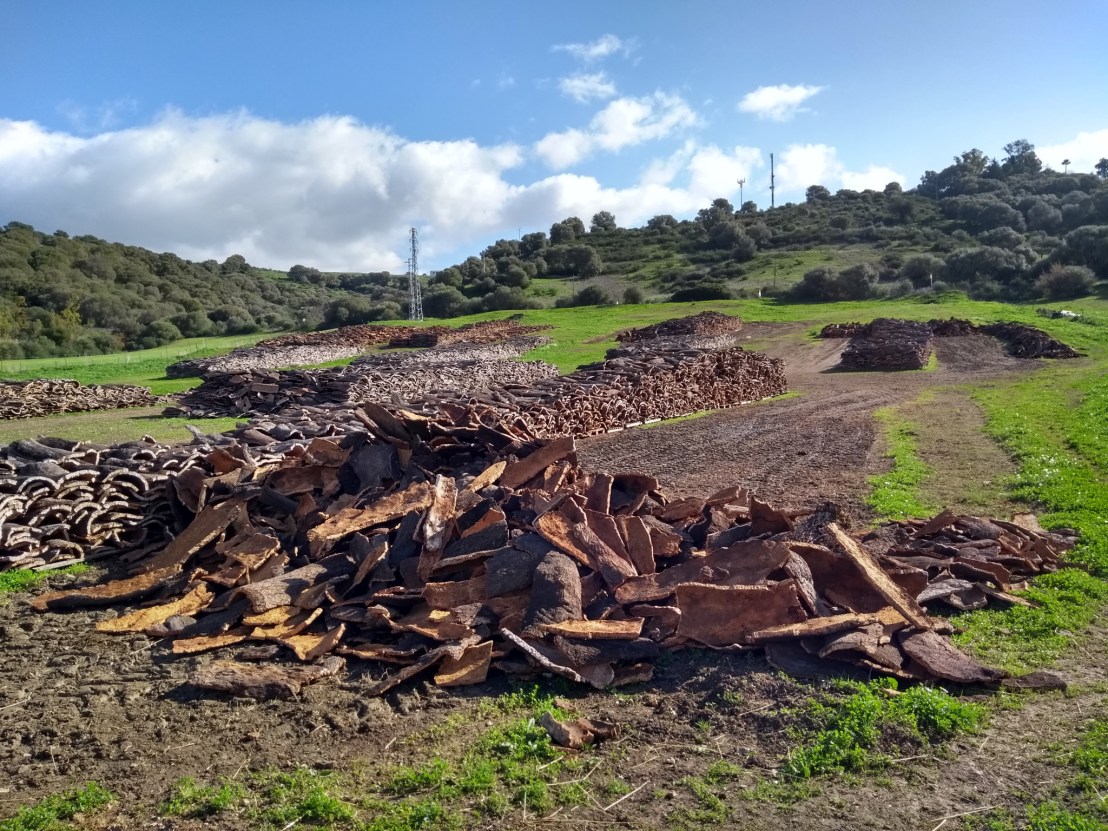
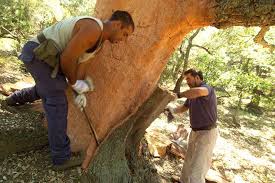
Cutting the cork is a highly skilled task and requires two years training. It is unusual for a tree to survive ring barking (the bark being removed around the complete circumference) and it needs to be done with care and at the right time. The cutters’ experience tells them how far to cut up the tree to avoid harming it. Cutting is only legally permitted between 15 June and 15 August which is when gangs roam the oak forests, each of the usually five members having a specific role, from chief cutter to lowly carrier.
These gangs traverse the forest in a nine-year cycle, allowing the trees they cut to regenerate the cork in the intervening period. Their mules roam free in the forest except for the two month harvest period when they trek back and forth between harvest site and cork factory. So expert is their knowledge of the routes that, once loaded, a tap on the back will send them off unaccompanied. The town of Cortes de la Frontera actually holds burro-loading contests at its annual summer feria, with a prize for the most ingenious loading of a burro.
What we see lying curled on the ground is still many stages away from fitting into the neck of a bottle. At the factory the cork is boiled in a vast, deep pool of water, which renders it malleable for flattening and then processing by machine. The cork then goes through several levels of compression, depending on its destination. It emerges as very thin sheets of varying sizes, perhaps thinner than a child’s little finger. It is then checked for quality – the oak trade has five levels, from excellent to poor – and the oak is assigned to an appropriate use.
Most interestingly, however, is how it does reach the bottles we uncork. Bottle corks are stamped out by machines at different widths for wine, champagne and cognac (Spanish cork is treasured by French brandy producers). When they pile up in the dumpers beneath the pressing machines, they look like big wooden pennies. These are graded by quality, and then carefully fed into further compressing machines. Cork makers reckon that it would be a waste of good cork to use it throughout a wine or champagne cork, so lower quality cork is placed in the middle, highest quality at either end, where the cork meets both wine and outside air. These layers are then compressed so tightly we do not even notice that a cork we pull is not one single unit but a compression of up to eight layers crushed together. The finished corks are then dispatched to bottling plants across Europe and beyond.
There have, of course, been concerns about the rise of the plastic cork. Its proponents say that it prevents a bottle being ‘corked’, ie, spoiled, by air penetrating the old-fashioned cork. Its detractors argue that, beyond the aesthetics of levering a wad of white plastic out of your favourite wine, it doesn’t allow the alcohol to breathe naturally. (French brandies breathe so profusely that the distilleries are wreathed in fumes which promote fungi on the roofs and keep nearby cattle happily sozzled year-round.) Yet with even the British supermarket buyer seemingly moving upmarket in their choice of corked drinks, and the Spanish and French keeping their noses in the air over plastic stoppers, it seems the Iberian peninsula can hold on to its two billion euro cork industry yet.
Other uses for cork include flooring. We have some of this in our bathroom at home. A long way from the basic dull cork tiles of old, now it comes in stunning patterns and looks beautiful. It is also sustainable, provides excellent insulation and is lovely and warm to walk on. If I could, I’d floor the whole house with this.
Iberian pigs
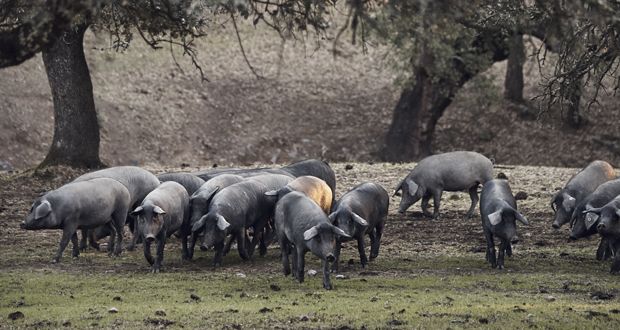
The Iberian pig is a traditional breed of the domestic pig (Sus scrofa domesticus) that is native to the Iberian Peninsula and is currently found in herds clustered in the central and southern part of Portugal and Spain. Its origins can probably be traced back to the Neolithic, when animal domestication started.
The most commonly accepted theory is that the first pigs were brought to here by the Phoenicians from the Eastern Mediterranean coast, probably along the old droving tracks one of which our route, the GR7, roughly follows. They interbred with wild boar and this cross gave rise to the ancestors of what are today’s Iberian pigs.
Prized Iberico ham
The production of Iberian pork is deeply rooted to the Mediterranean ecosystem. It is a rare example in world pig farming where the pig contributes so decisively to the preservation of the ecosystem. The Iberian breed is currently one of the few examples of a domesticated breed which has adapted to a pastoral setting where the land is particularly rich in natural resources, in this case acorns from the holm oak, gall oak and cork oak.
The numbers of the Iberian breed had been drastically reduced since 1960 due to several factors such as the outbreak of African swine fever and the lowered popularity of animal fats. In the past few years, however, the production of pigs of the Iberian type has increased to satisfy a renewed demand for top-quality meat and cured products. Now, though, there is controversy over the providence of the highly prized Iberico ham as breeders cash in on the market and produce a similar but much less sustainable product more cheaply, thus threatening this ancient livelihood.
The Iberian pig can be either red or black or in between. In traditional management, animals ranged freely in sparse oak forest (dehesa in Spain, montado in Portugal). They are constantly on the move and therefore burn more calories than confined pigs. This, in turn, produces the fine bones typical of this kind of jamón ibérico. At least a hectare of healthy dehesa is needed to raise a single pig. True dehesa is a richly diverse habitat with four different types of oak that are crucial in the production of prime-quality ham. The bulk of the acorn harvest comes from the holm oak (Quercus ilex) but also the Pyrenean oak (Quercus pyrenaica) and Portuguese or gall oak (Quercus lusitanica) and the late cork oak season, which extends the acorn-production period from September almost to April.
Some recent research from Cordoba university concluded {the translation isn’t perfect but you get the idea}:
‘The couple Iberian pig and dehesa has proved to be very effective; so much [so] the Iberian pig is called the dehesa jewel, but the first needs this agro-ecosystem to reach its highest quality properties (organoleptic and nutritional ones); and the second needs a clear commercial differentiation for Iberian pork and cured products in order to receive a high price to maintain and conserve the dehesa. Spanish authorities should be responsible for protecting this traditional system from fraud and unfair competition. In this way, farmers economy could be enough to conserve this unique ecosystem and its values for the whole society.’*
Whether you eat pork or not you may still believe as I do, that this traditional and sustainable way of producing it is better for the ecosystem and the pigs than intensive farming on a huge scale. And we love seeing the black pigs snuffling through the forest. I hope it can be protected along with the rest of this remarkable and stunningly beautiful area.
ooOOoo
Well I must say that this is a tremendous post and a privilege to be able to republish it.
Gilliwolfe did an incredible job in composing the post and inserting all the photographs. Well done!
I want to get further ahead in the story of this walk and I get the very clear impression that you are in agreement with this.
My readership numbers have been high and there have been no negative responses to the generous offer from Tom and his wife to republish Tom’s long and interesting walk along the Spanish pathway GR7.
So on we go!
ooOOoo
Day 7: Jimena de la Frontera to Cerra de la Fantasia 20k
By Tom and Chica, 22nd January, 2020
Written by Tom’s wife.
The last two days were non-walking days, one for bad weather and another to move base again. Now we have the luxury of being in a house for a while in Jimera de Libar, a village we know well.
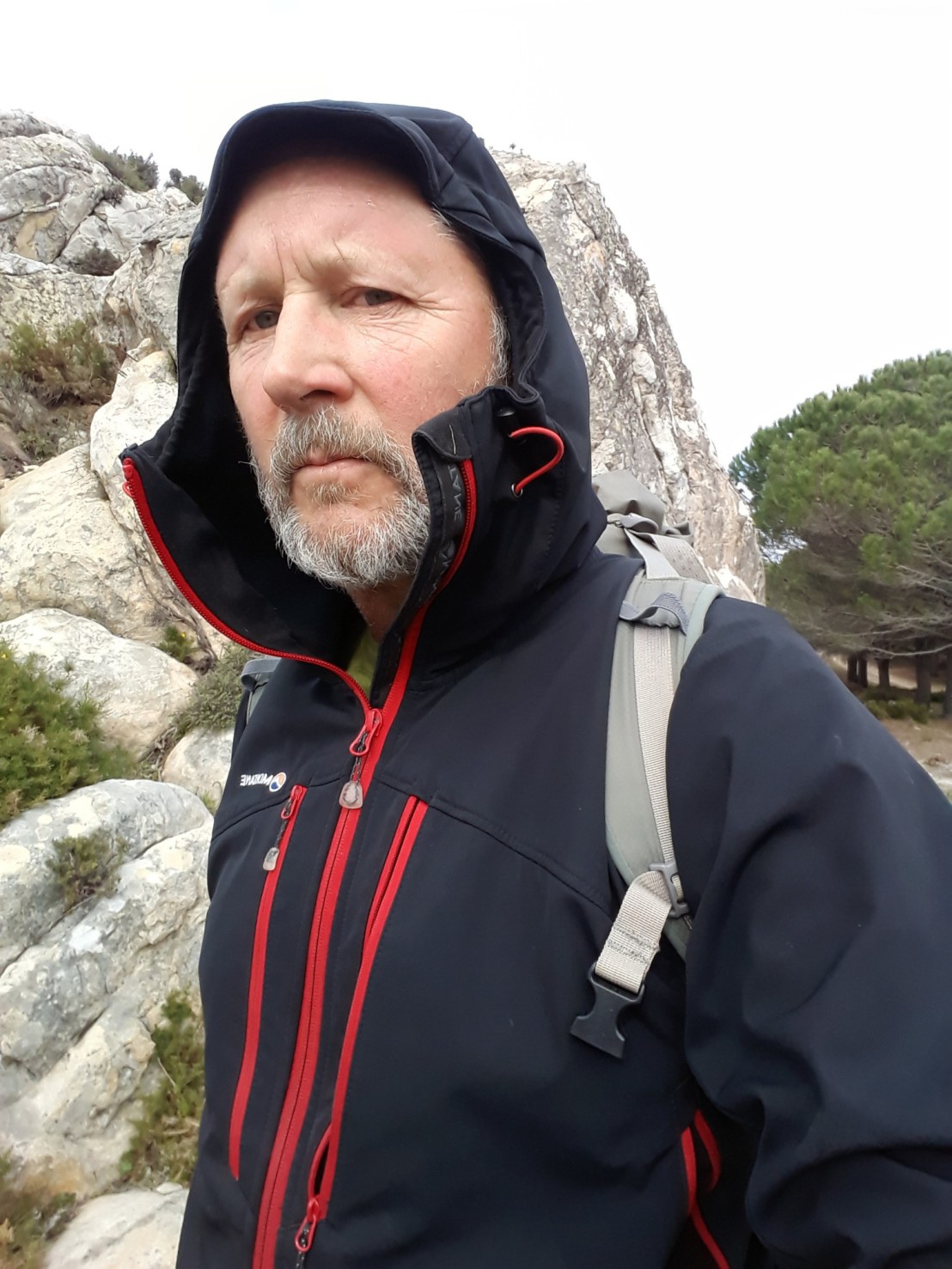
So the day started with the drive back to Jimena and the weather looked reasonable. Again, Merlin refused to be left so the three of them set off up the path, climbing steadily for the first hour and a half.
Climbing path.Spanish Fir / Pinsapo (Abies Pinsapo) in the background
The path eventually levelled out and passed beneath the rocky outcrops of the Altos de Paneron and Cerro de Marin. After a bare rocky sections where the route was harder to determine, they went into dense forest of oak and Spanish fir (we love these and call them lollipop trees because of their shape). Both dogs in great form, but Tom was mean and moody :).
Dark clouds were gathering from all directions but the view to the coast was still impressive. However, it wasn’t long before the rain began and the temperature dropped.
Looking south – you can just see the sea.
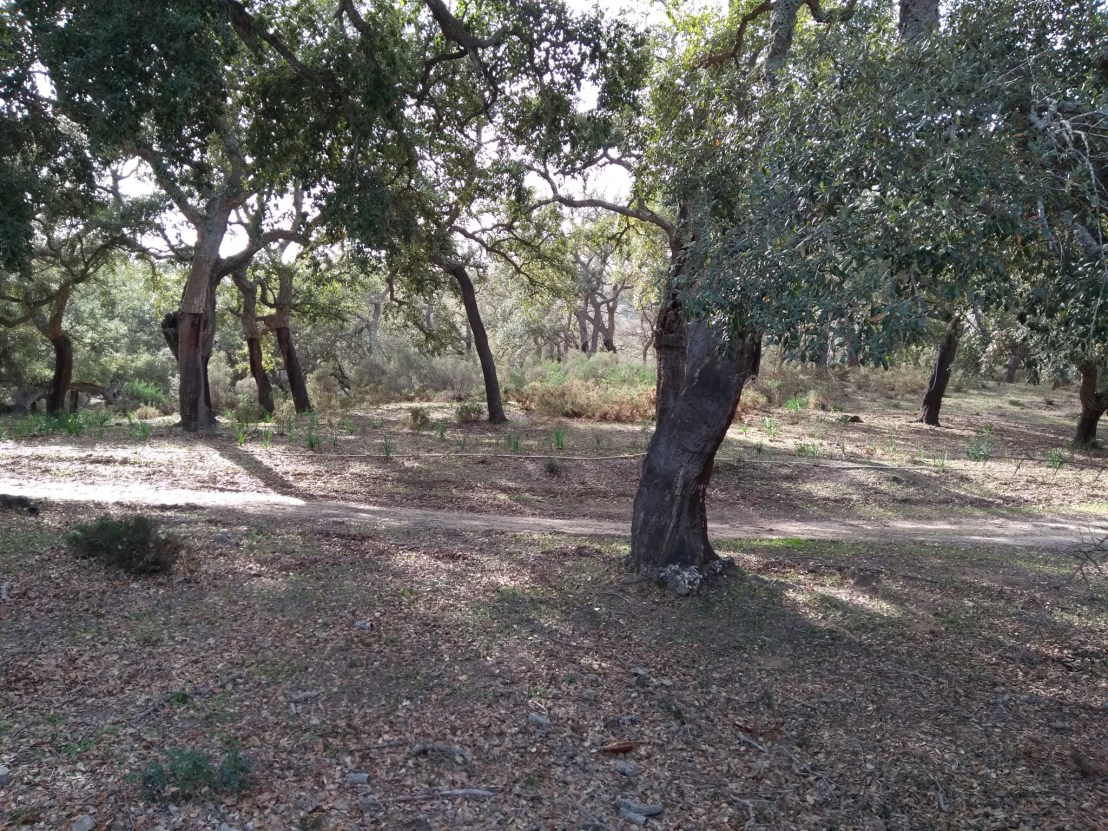
Fortunately the rest of the route was on a well-defined and signposted track, winding down through the cork oaks in the midst of the Los Alcornacales. It was here deep in the forest that I eventually picked them up. I had forgotten that smaller Spanish roads aren’t always roads as I know them and the last five and a half miles I was driving along a rough track with no mobile signal, not at all sure I was in the right place. Even though we have a 4×4, I made very slow progress and it was with considerable relief that I found them, damp but completely unconcerned.
ooOOoo
I wonder why Tom felt “mean and moody”? Gilliwolfe doesn’t say.
Once more I will keep my introduction very short. Except to say that the original was here.
It’s turning into a fabulous walk!
ooOOoo
Day 6: Castillo de Castellar to Jimena de la Frontera 22k
By Tom and Chica, 18th January, 2020
Written by Tom’s wife.
Today was the longest walk so far and didn’t actually start until late as we decided to shift base. By the time we had the caravan installed on a site in Jimena de la Frontera and I’d driven Tom and Chica back to Castillar it was 2pm. Chica was obviously refreshed after her day off and keen to go. Castillar again looked amazing and it was great to know the start is downhill on a tarmac path through more lovely woodland.
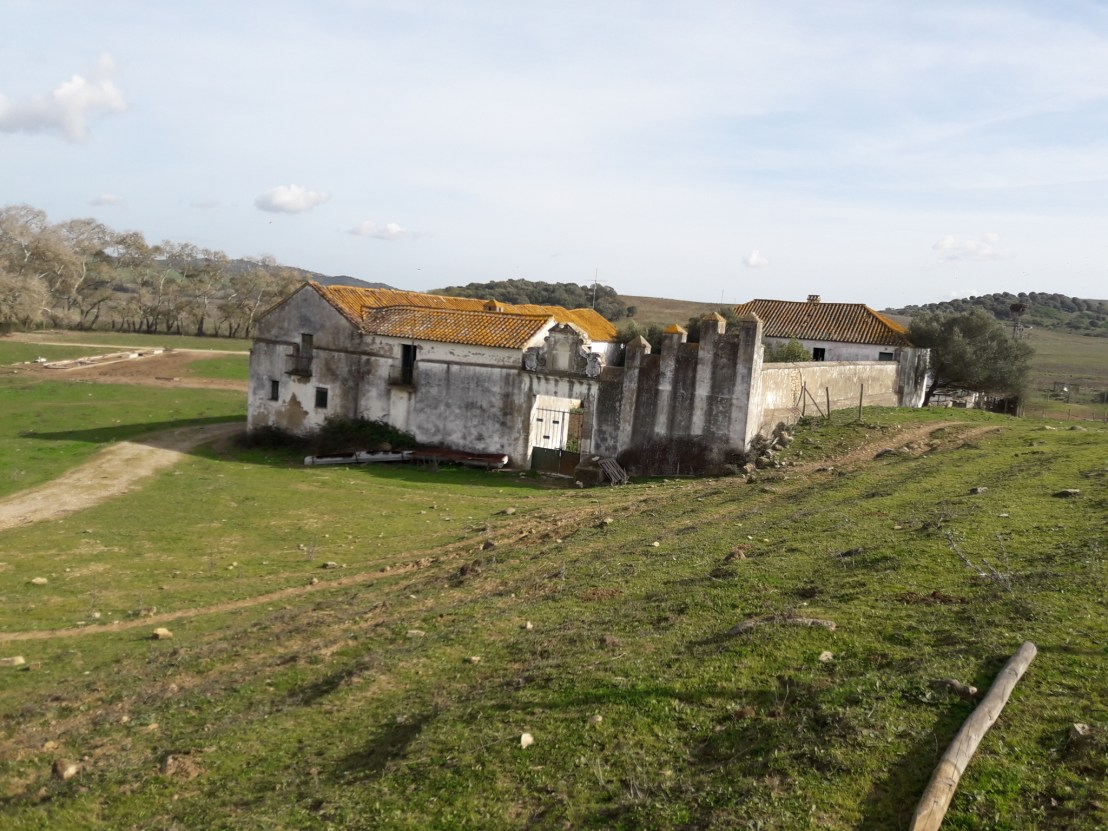
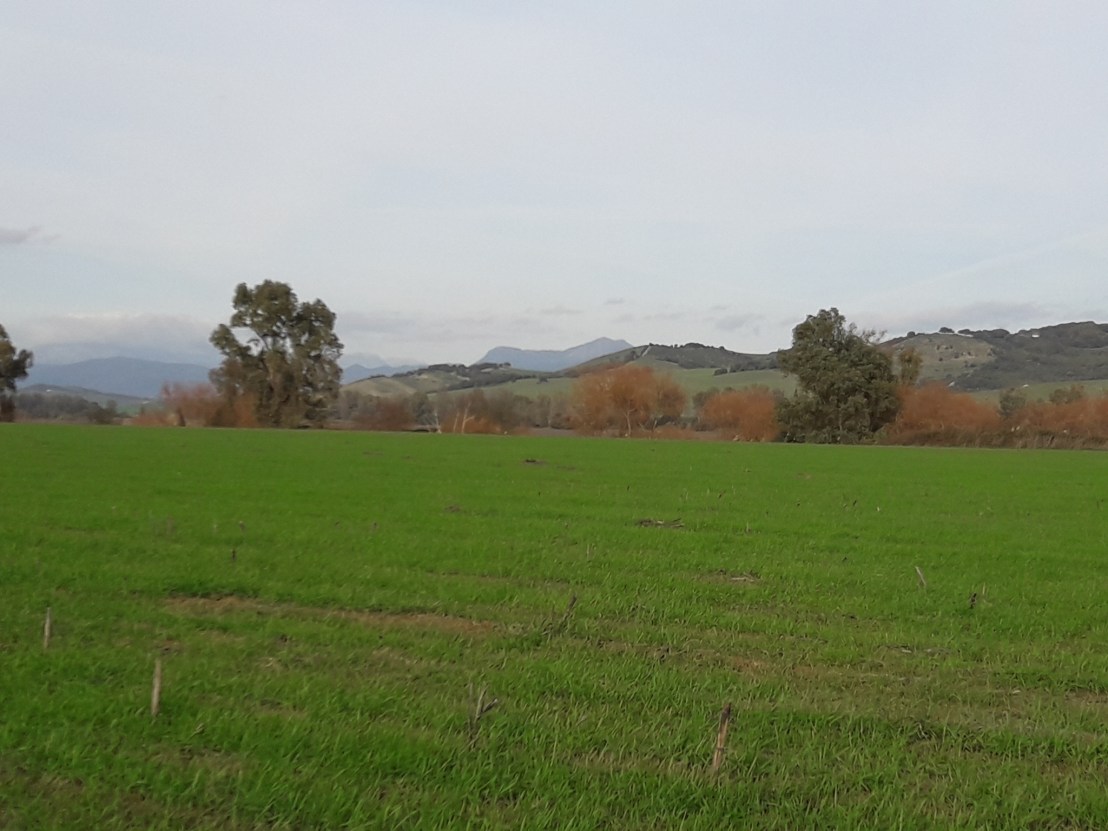
As it levelled out, the tarmac gave way to a gravel track through scrub and grazing land occupied mainly by local brown retinto beef cattle. A huge old farmhouse had seen better days and seemed unoccupied, at least by humans. The scenery changed again as they entered the first cultivated area they had come across since the start. No idea what the crop is though.
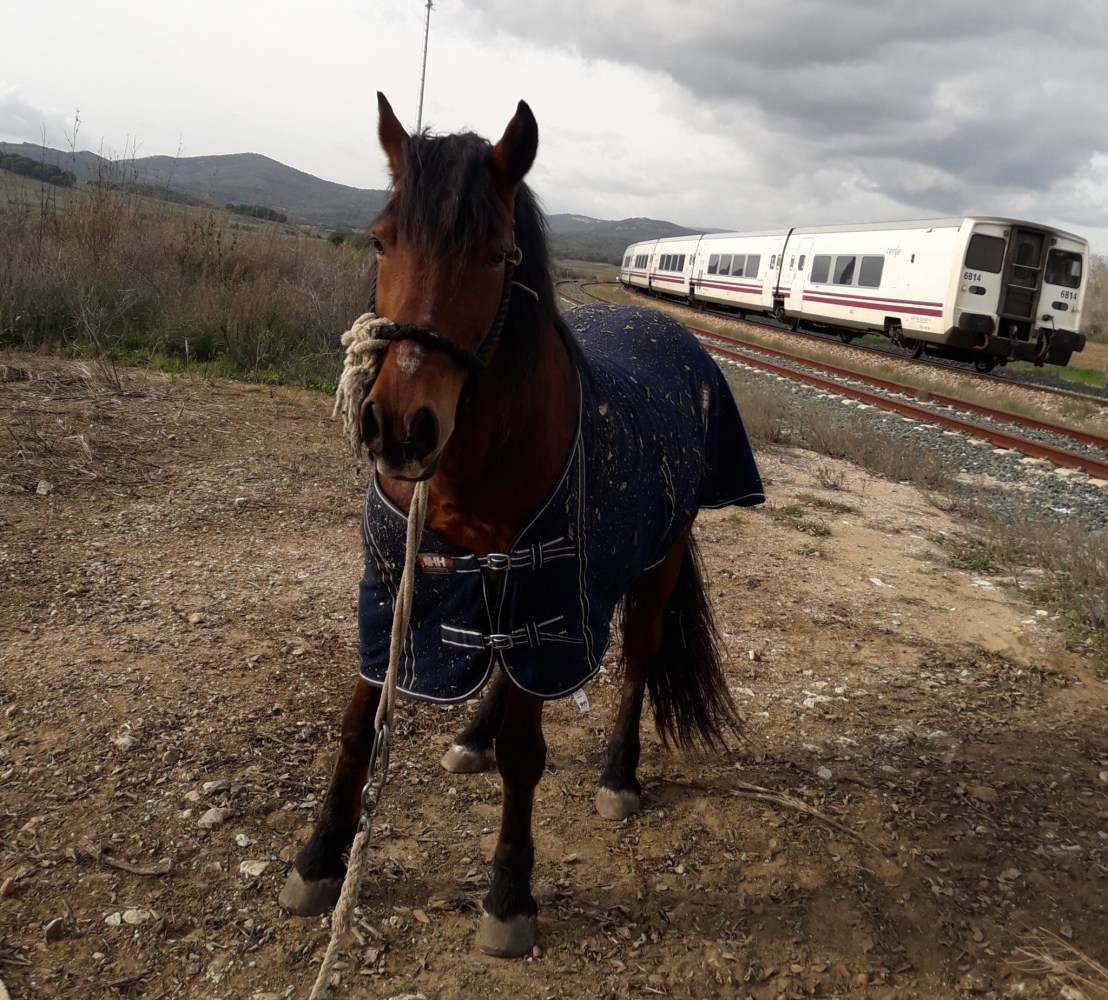
The route met up with the railway track and would stay with it all the way to Jimena. There was a pony grazing here. Despite having a rug and being quite friendly, the white hairs on its nose indicate it has been put in a seraton – a noseband with spikes that dig into the soft flesh of the muzzle. These are still used a lot in Spain. Nearby there was a donkey that was hobbled – which is now illegal. Equines get a rough deal here sometimes.
A grand entrance
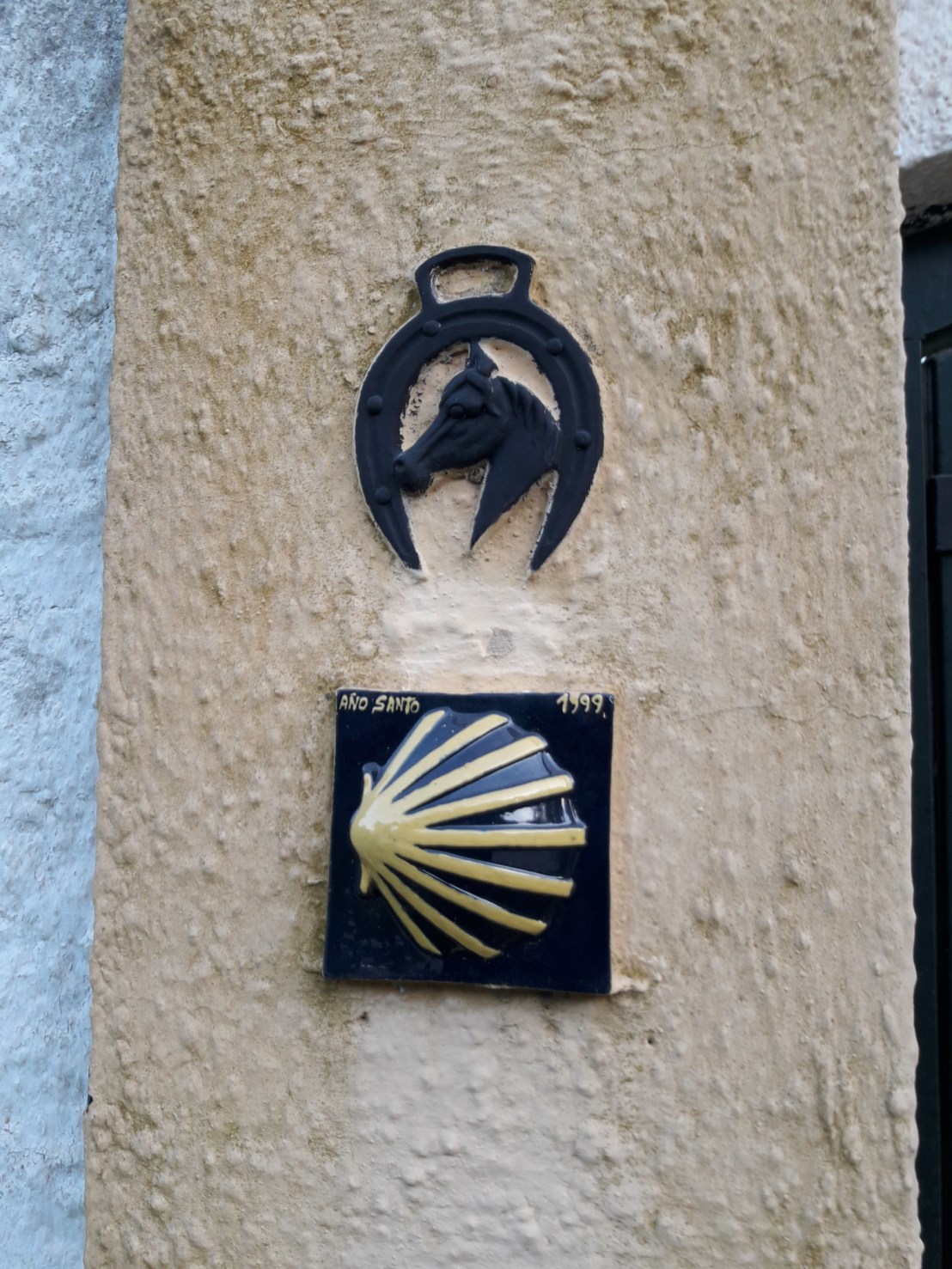
There were a few dwellings as they approached Jimena – one with a very impressive gate. The shell motif is associated with St James and is a common one on caminos (pilgrim trails) although more usually found on the famous Santiago de Compostela in northern Spain.
The light was fading fast and the last hour or so was done in virtual darkness with Jimena castle luminations acting as beacon to the weary traveller.
ooOOoo
Wonderful. And what a lovely job of writing it all up.
Seeing parts of Spain that the tourists rarely see.
Again, I’ll keep my introduction really short. After all you came here to read of Tom and Chica’s walk along GR7.
ooOOoo
Day 5: Castillo de Castellar (new town) to Castillo de Castellar (old town and castle) 14k
By Tom & Chica, 17th January, 2020
Written by Tom’s wife
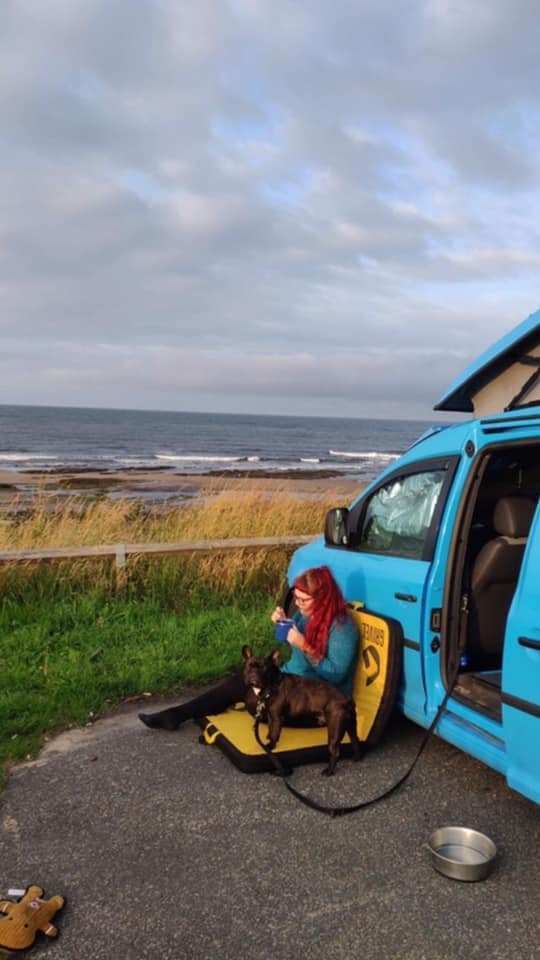
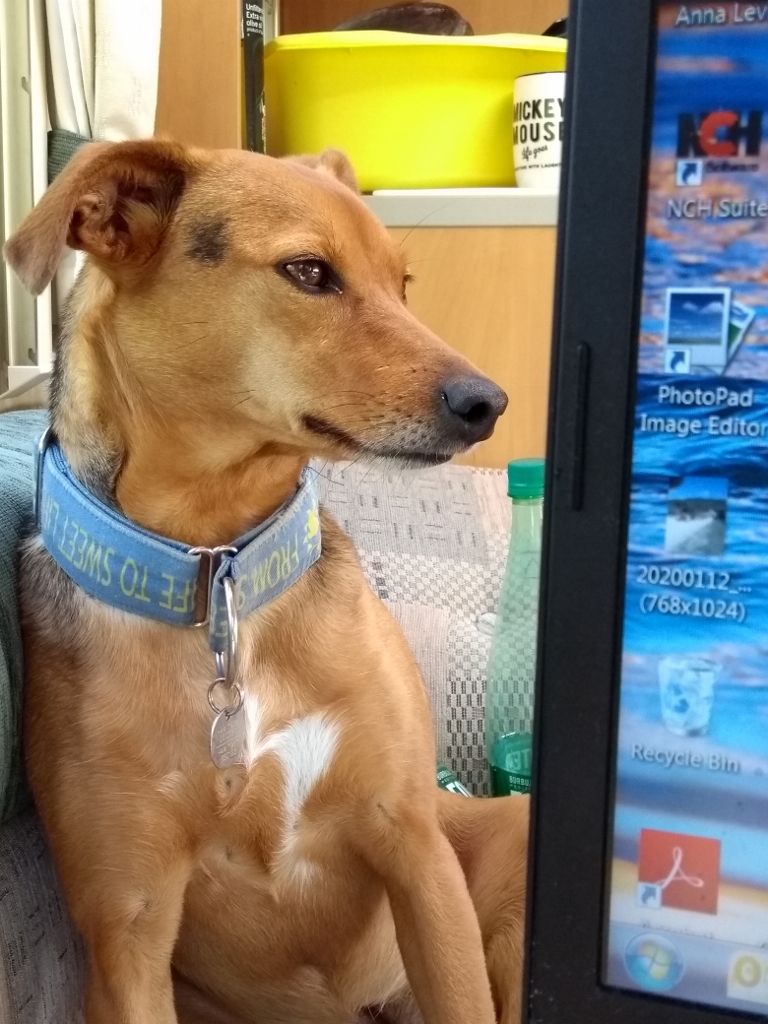
After his adventure yesterday, Merlin was up early this morning bounding around shouting ” Me! Me! Me!” Chica opened one eye (she’s not good in the morning) and made it clear that she was happy for him to deputise for her today. She had a lie-in while Tom and Merlin headed back up to Castillar and as you can see, later she helped me deal with her social media fans!
Day 6 started as day 5 ended, by the road. This proved less hazardous than the next section which was on a track by the main road along which groups of lycra-clad cyclists flew in both directions. It was with relief that T & C were able to turn onto a lovely quiet road that wound through the oak forest towards the castillo (castle) high on a rocky outcrop ahead.
Inviting pathsInviting paths
After a few kilometres, a very inviting track appeared to the right of the road and despite the marker not being for the GR7, Tom couldn’t resist, wanting to be off tarmac for a while. A bit further on, a post bearing the red and white stripes of the GR routes was a welcome sight and the path through the wood was cool and easy on the feet (all six).
A short cut.Yay, A cold beer after a steep climb.
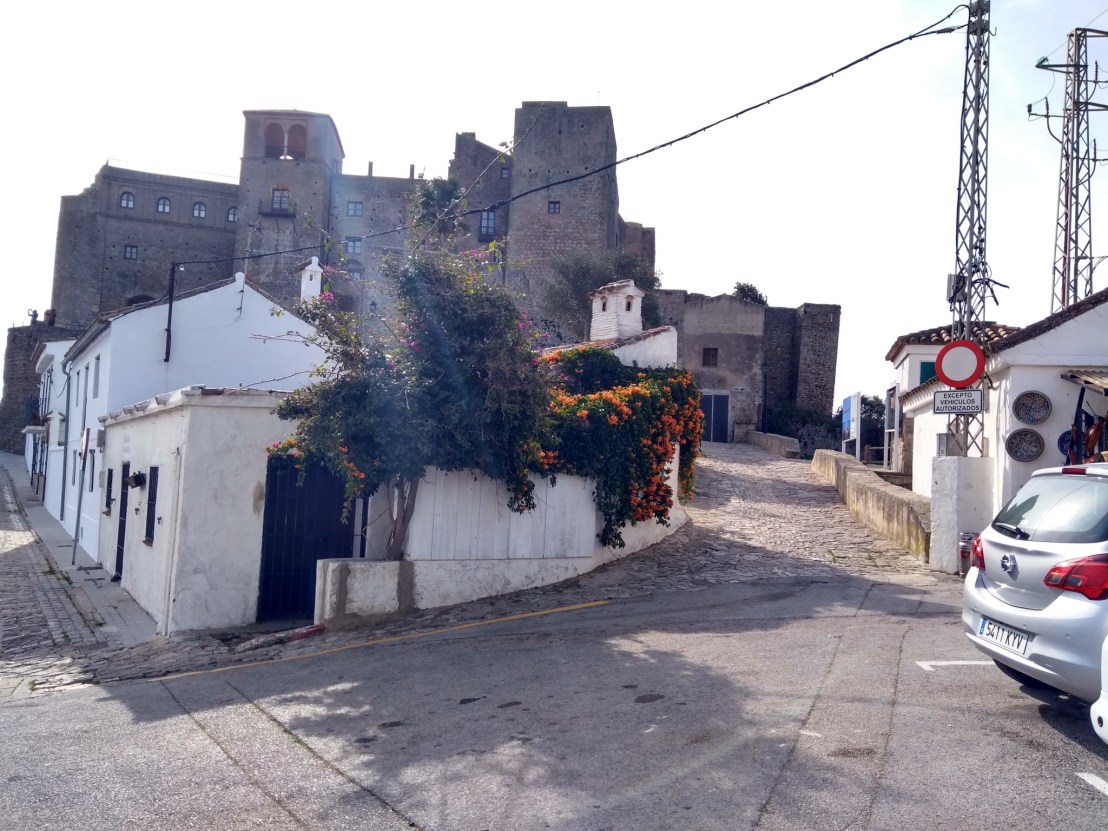
The path eventually came back out onto the road and the castle could now be seen high above. As it started to climb, the road also started to wind so Tom thought he’d try and cut off the corners. But we all know that cutting corners rarely works and sure enough, he soon had to retrace his steps. Eventually, a cobbled path did appear but it proved a steep slog. Plucky little Merlin who’d been trotting along happily up until now started to flag. His tail had been vertical all the way but now began to droop a little. Both were very pleased to see the bar at the top.
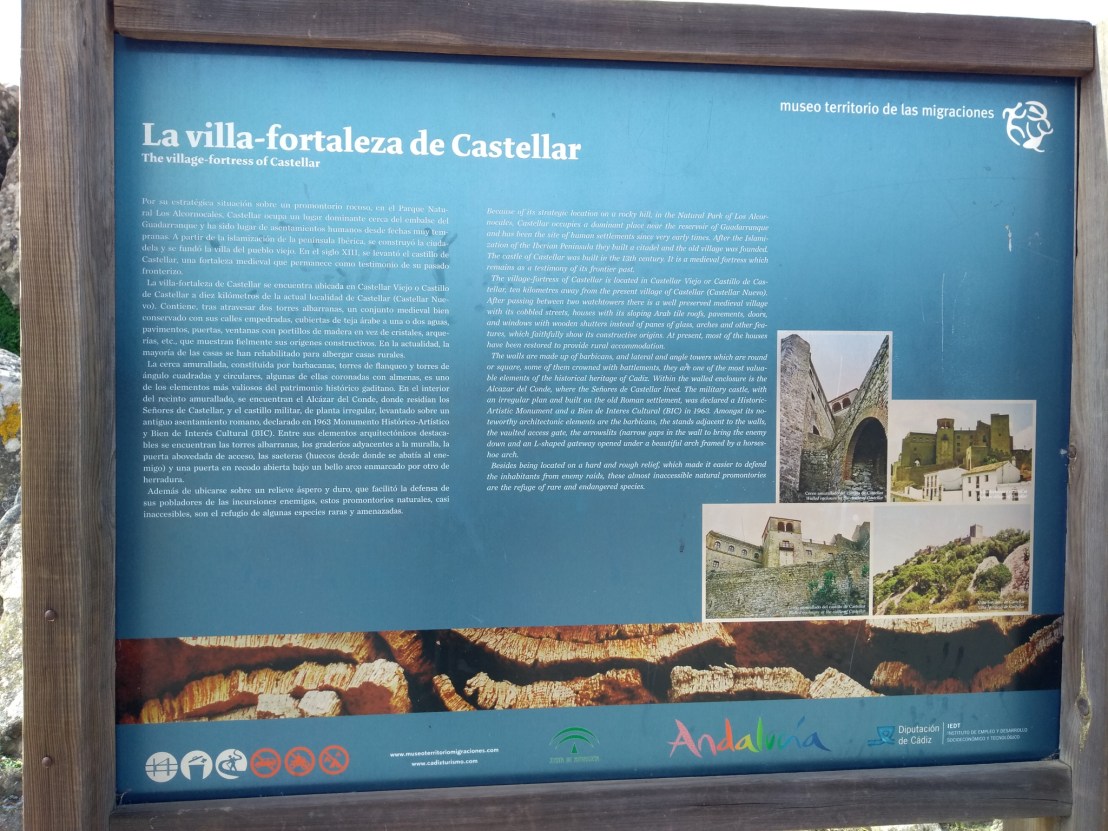
The castleInformation sign.
It is beautiful spot with wonderful views and the history of the village goes back to the Bronze Age. The prehistoric presence is still evident in the many caves around the area, where enthusiasts can see the wonderful cave drawings. It played an important role in the wars between the Spanish and the Muslims. In such an advantageous strategic position, many cultures wanted to control this strong vantage point.
In the 1960s the new town, where we started today, was built 7 km away in a more convenient location next to the road and the train station. This new model Andalucian town was inaugurated in 1971.
Two years later the Rumasa Group acquired the old village and in 1983 the Spanish government expropriated Castellar and declared it an ‘Historical and Artistic Monument’. By this time, the place was in a state of neglect and the Town Hall invested the equivalent of around £100,000 to restore the old castle and village.
If you ever find yourself in this part of Spain, we strongly recommend a visit.
ooOOoo
I can’t do any better than to repeat what I said after the last:
Keep it going, Tom. For the description of your walk is very engaging. To be honest, it is Tom’s wife, Gilliwolfe, who deserves as much credit. For without her then we would not be reveling in Tom’s walk.
Last Friday saw the thirtieth anniversary of Carl Sagan’s iconic photograph, or rather NASA’s photograph, of Planet Earth. Carl persuaded NASA to turn Voyager 1, as it left the Solar System, and take the photo. It became famous almost instantly and became known as the pale blue dot.
Pale Blue Dot: A Vision of the Human Future in Space is a 1994 book by Carl Sagan. It is the sequel to Cosmos and was inspired by the famous 1990 Pale Blue Dot photograph, for which Sagan provides a poignant description. In this book, Sagan mixes philosophy about the human place in the universe with a description of the current knowledge about the Solar System. He also details a human vision for the future.
This updated version of the iconic “Pale Blue Dot” image taken by the Voyager 1 spacecraft uses modern image-processing software and techniques to revisit the well-known Voyager view while attempting to respect the original data and intent of those who planned the images. Credits: NASA/JPL-Caltech
For the 30th anniversary of one of the most iconic views from the Voyager mission, NASA’s Jet Propulsion Laboratory in Pasadena, California, is publishing a new version of the image known as the “Pale Blue Dot.”
The updated image uses modern image-processing software and techniques while respecting the intent of those who planned the image. Like the original, the new color view shows Planet Earth as a single, bright blue pixel in the vastness of space. Rays of sunlight scattered within the camera optics stretch across the scene, one of which happens to have intersected dramatically with Earth.
The view was obtained on Feb. 14, 1990, just minutes before Voyager 1’s cameras were intentionally powered off to conserve power and because the probe — along with its sibling, Voyager 2 — would not make close flybys of any other objects during their lifetimes. Shutting down instruments and other systems on the two Voyager spacecraft has been a gradual and ongoing process that has helped enable their longevity.
This simulated view, made using NASA’s Eyes on the Solar System app, approximates Voyager 1’s perspective when it took its final series of images known as the “Family Portrait of the Solar System,” including the “Pale Blue Dot” image. Move the slider to the left to see the location of each image. (You have to go here to see the full image. Ed.) Credits: NASA/JPL-Caltech
This celebrated Voyager 1 view was part of a series of 60 images designed to produce what the mission called the “Family Portrait of the Solar System.” This sequence of camera-pointing commands returned images of six of the solar system’s planets, as well as the Sun. The Pale Blue Dot view was created using the color images Voyager took of Earth.
The popular name of this view is traced to the title of the 1994 book by Voyager imaging scientist Carl Sagan, who originated the idea of using Voyager’s cameras to image the distant Earth and played a critical role in enabling the family portrait images to be taken.
Additional information about the Pale Blue Dot image is available at:
The Voyager spacecraft were built by JPL, which continues to operate both. JPL is a division of Caltech in Pasadena. The Voyager missions are a part of the NASA Heliophysics System Observatory, sponsored by the Heliophysics Division of the Science Mission Directorate in Washington. For more information about the Voyager spacecraft, visit:
Voyager 1 is now nearly 14 billion miles from Planet Earth and still going strong. It has a plutonium battery that will last for eighty years. A one-way radio signal from Earth takes about twenty hours to reach the probe.
And now for something different but still to do with space.
When she finally made it home, her beloved pup, LBD (Little Brown Dog), couldn’t contain her excitement.
Koch shared a video on Twitter of the moment she walked through her front door and LBD pounced to shower her with kisses.
“Not sure who was more excited,” she captioned the video. “Glad she remembers me after a year!”
“We call her LBD, little brown dog, she’s from the Humane Society and she couldn’t be sweeter,” Koch told Insider on a phone call with reporters from the Johnson Space Centre.
“And yes, she was very excited, I was very excited, I’m not sure who was more excited! … You know it’s just a symbol of coming back to the people and places that you love, to see your favourite animal.”
Now I can’t disappear without acknowledging the fantastic work of Carl Sagan.
And I can’t do better than republish the first bit of a wonderful piece on Carl put out by Wikipedia.
Carl Edward Sagan (/ˈseɪɡən/; November 9, 1934 – December 20, 1996) was an American astronomer, cosmologist, astrophysicist, astrobiologist, author, science popularizer, and science communicator in astronomy and other natural sciences. He is best known as a science popularizer and communicator. His best known scientific contribution is research on extraterrestrial life, including experimental demonstration of the production of amino acids from basic chemicals by radiation. Sagan assembled the first physical messages sent into space: the Pioneer plaque and the Voyager Golden Record, universal messages that could potentially be understood by any extraterrestrial intelligence that might find them. Sagan argued the now accepted hypothesis that the high surface temperatures of Venus can be attributed to and calculated using the greenhouse effect.[
He died far too young in my opinion!
But not without leaving a tremendous legacy – The Pale Blue Dot.






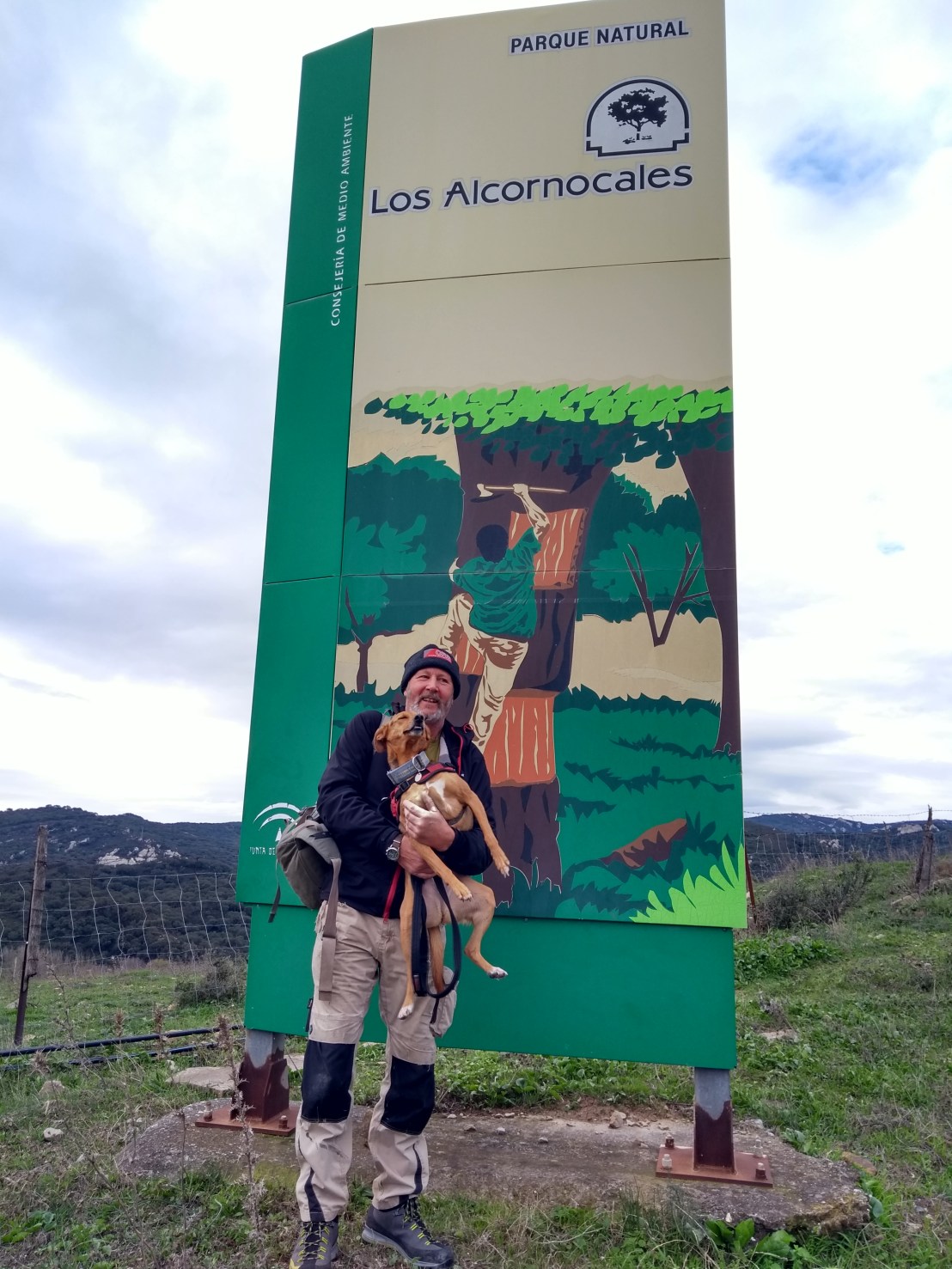

 Granted natural park status in 1989, Natural Park Los Alcornacales occupies a protected area of 170,025 hectares in Andalusia. Soil, moisture and traditional uses have been the main factors in the conservation of the largest productive area of cork trees anywhere on the Iberian Peninsula. Located in the province of Cadiz and part of Malaga (mainly in the municipality of Jimena de la Frontera, where we have just been walking), it runs from the mountains down to the recently created Estrecho Nature Park on the coast and is home to a variety of landscapes, flora, fauna, history and folklore.


 from the basic dull cork tiles of old, now it comes in stunning patterns and looks beautiful. It is also sustainable, provides excellent insulation and is lovely and warm to walk on. If I could, I’d floor the whole house with this.