Still more from Pexels!
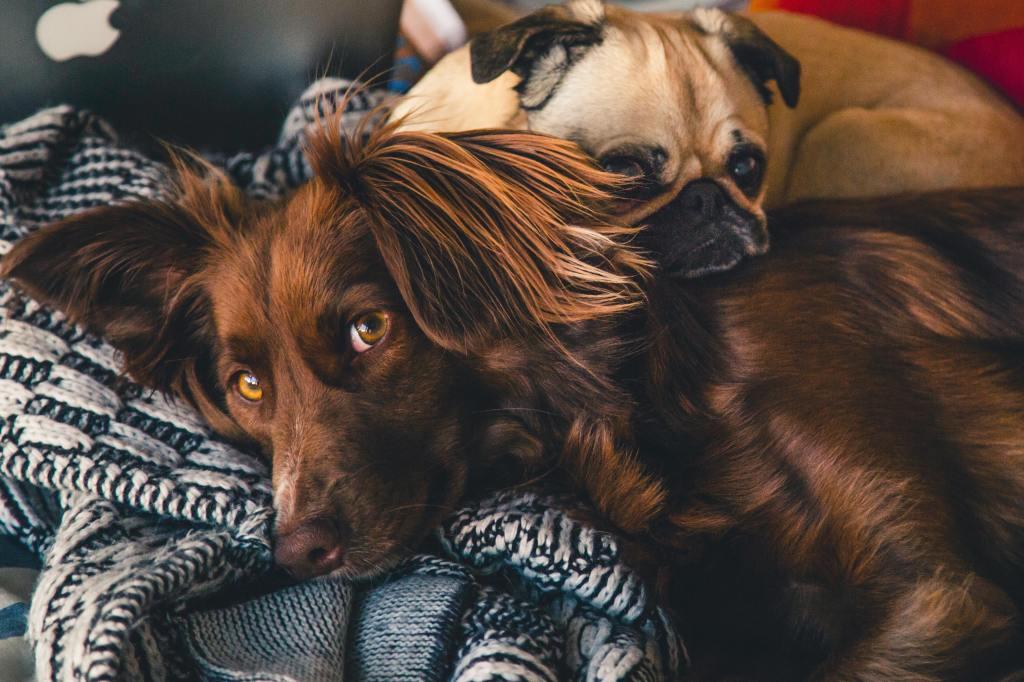
oooo

oooo

oooo

oooo

oooo

oooo

oooo

There!
And another set of fabulous photos in a week’s time.
Dogs are animals of integrity. We have much to learn from them.
Category: Dogs
Still more from Pexels!
oooo
oooo
oooo
oooo
oooo
oooo
oooo
There!
And another set of fabulous photos in a week’s time.
Can’t do better than post the Facebook page!
For some reason when one goes to “See more” it doesn’t stay that way.
So this is provided as follows:
Albert cries a lot and craves people around him. He is often found curled up in his basket but with his eyes open. If we could fix Alberts bereavement we would. Our Albert is a down hearted senior in kennels. This larger Staffy cross is nine years old and we are now working hard to find him a quiet and warm home and a very loving human. Life can be very cruel for hounds and humans and loss is a terrible thing for both. Although a painful story for a senior dog we now work towards finding a new chapter for Albert as soon as possible. We have visions of Albert curled up by an open fire this Christmas next to his new owners slippers. Happy are we that the heartbroken Albert face is gone and back is one happy staffy smile. Please support. Please share. Help us to find Albert the spark that lights his fire this Christmas. More details and applications forms are available at www.goodlifedogrescue.co.uk
I was first alerted to this by Lisa, my son’s partner.
Well done Lisa!
This year, 2020, has been unlike any other year.
I am not saying anything new but just reiterating what has been said before: 2020 is going to go down as the year from hell! And I don’t think that is too strong a word!
Part of it are the news stories that sweep the world: Covid-19; Brexit; Climate change; up until yesterday what was President Trump going to do in his last few weeks; etc; etc.
Also part of it is the way that news and more news and, yes, more news is flashed around the globe. Most of it bad news as we all know that bad news sells!
Finally, part of it is the new world of social media especially messaging on a smartphone. President Trump isn’t the only one to communicate greatly via Twitter.
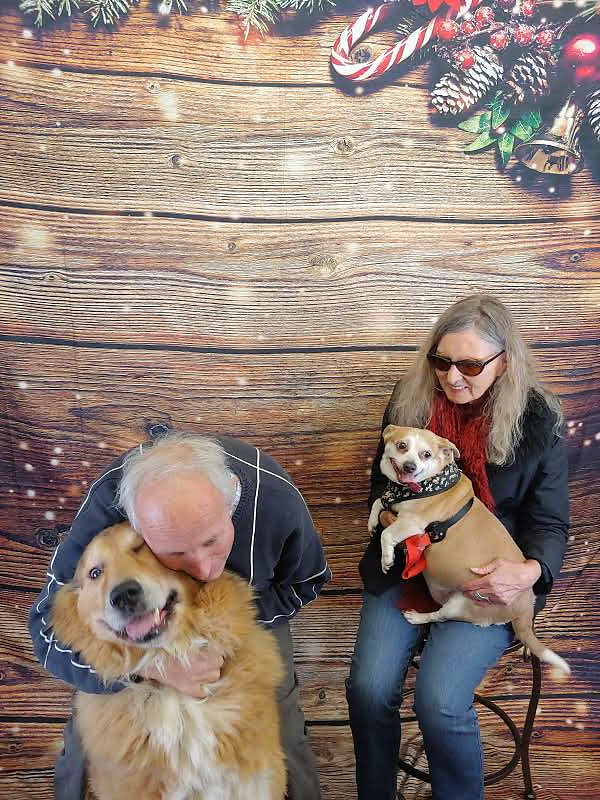
Now, speaking personally, I couldn’t have got through this year without Jeannie and our dogs.
But, nevertheless, something has changed and Mark Satta has written an article that tries to explain things.
ooOOoo
By Mark Satta, Assistant Professor of Philosophy, Wayne State University.
November 18th, 2020
An endless flow of information is coming at us constantly: It might be an article a friend shared on Facebook with a sensational headline or wrong information about the spread of the coronavirus. It could even be a call from a relative wanting to talk about a political issue.
All this information may leave many of us feeling as though we have no energy to engage.
As a philosopher who studies knowledge-sharing practices, I call this experience “epistemic exhaustion.” The term “epistemic” comes from the Greek word episteme, often translated as “knowledge.” So epistemic exhaustion is more of a knowledge-related exhaustion.
It is not knowledge itself that tires out many of us. Rather, it is the process of trying to gain or share knowledge under challenging circumstances.
Currently, there are at least three common sources that, from my perspective, are leading to such exhaustion. But there are also ways to deal with them.
1. Uncertainty
For many, this year has been full of uncertainty. In particular, the coronavirus pandemic has generated uncertainty about health, about best practices and about the future.
At the same time, Americans have faced uncertainty about the U.S. presidential election: first due to delayed results and now over questions about a peaceful transition of power.
Experiencing uncertainty can stress most of us out. People tend to prefer the planned and the predictable. Figures from 17th-century French philosopher René Descartes to 20th-century Austrian philosopher Ludwig Wittgenstein have recognized the significance of having certainty in our lives.
With information so readily available, people may be checking news sites or social media in hopes of finding answers. But often, people are instead greeted with more reminders of uncertainty.

2. Polarization
Political polarization is stressing many Americans out.
As political scientist Lilliana Mason notes in her book, “Uncivil Disagreement: How Politics Became Our Identity,” Americans have been increasingly dividing politically “into two partisan teams.”
Many writers have discussed the negative effects of polarization, such as how it can damage democracy. But discussions about the harms of polarization often overlook the toll polarization takes on our ability to gain and share knowledge.
That can happen in at least two ways.
First, as philosopher Kevin Vallier has argued, there is a “causal feedback loop” between polarization and distrust. In other words, polarization and distrust fuel one another. Such a cycle can leave people feeling unsure whom to trust or what to believe.
Second, polarization can lead to competing narratives because in a deeply polarized society, as studies show, we can lose common ground and tend to have less agreement.
For those inclined to take the views of others seriously, this can create additional cognitive work. And when the issues are heated or sensitive, this can create additional stress and emotional burdens, such as sadness over damaged friendships or anger over partisan rhetoric.
3. Misinformation
Viral misinformation is everywhere. This includes political propaganda in the United States and around the world.
People are also inundated with advertising and misleading messaging from private corporations, what philosophers Cailin O’Connor and James Owen Weatherall have called “industrial propaganda.” And in 2020, the public is also dealing with misinformation about COVID-19.
As chess grandmaster Garry Kasparov put it: “The point of modern propaganda isn’t only to misinform or push an agenda. It is to exhaust your critical thinking, to annihilate truth.”
Misinformation is often exhausting by design. For example, a video that went viral, “Plandemic,” featured a large number of false claims about COVID-19 in rapid succession. This flooding of misinformation in rapid succession, a tactic known as a Gish gallop, makes it challenging and time-consuming for fact checkers to refute the many falsehoods following one after another.
What to do?
With all this uncertainty, polarization and misinformation, feeling tired is understandable. But there are things one can do.
The American Psychological Association suggests coping with uncertainty through activities like limiting news consumption and focusing on things in one’s control. Another option is to work on becoming more comfortable with uncertainty through practices such as meditation and the cultivation of mindfulness.
To deal with polarization, consider communicating with the goal of creating empathetic understanding rather than “winning.” Philosopher Michael Hannon describes empathetic understanding as “the ability to take up another person’s perspective.”
[Deep knowledge, daily. Sign up for The Conversation’s newsletter.]
As for limiting the spread of misinformation: Share only those news stories that you’ve read and verified. And you can prioritize outlets that meet high ethical journalistic or fact-checking standards.
These solutions are limited and imperfect, but that’s all right. Part of resisting epistemic exhaustion is learning to live with the limited and imperfect. No one has time to vet all the headlines, correct all the misinformation or gain all the relevant knowledge. To deny this is to set oneself up for exhaustion.
ooOOoo
That last section, What to do?, is full of really sensible advice. In fact, the American Psychological Association has an article at the moment that appears to be freely available called Healing the political divide.
I intend to read it.
It finishes up saying:
Scientists must strive to share their research as broadly as possible. And they don’t have to do it alone. Organizations like More in Common work to conduct research and communicate findings to audiences where it can have the greatest impact.
Advocacy is essential as well. Other countries that have made strides in addressing the political divide relied heavily on government-led reconciliation efforts. The Truth and Reconciliation Commission, for example, in South Africa, has been fundamental in addressing disparities and conflict around Apartheid.
Were the United States to consider similar, government-backed efforts, psychologists must be part of the call to do so. And the behavioral expertise of the field would be central to success.
“The collective mental health of the nation is at risk,” says Moghaddam. “Just as we should rely on epidemiological science to tell us when there is a vaccine ready for mass use, we have to rely on psychological science to guide us through these mental health issues.”
And following an election that, for many, has felt like the most polarized of a lifetime, this piece seems critical. “ This is what our profession is all about,” says Moghaddam.
Good advice especially if you can take time off just losing oneself in nature.

Enough said!
Ancient genomes reveal the common history of human and dog.
At the end of October, 2020 Science magazine published an article about the evolutionary genetics of humans and dogs.
I am not allowed to republish the full text, despite being an AAAS member, but I am sure that selected quotes will be alright.
The article was written by Pavlos Pavlidis and Mehmet Somel.
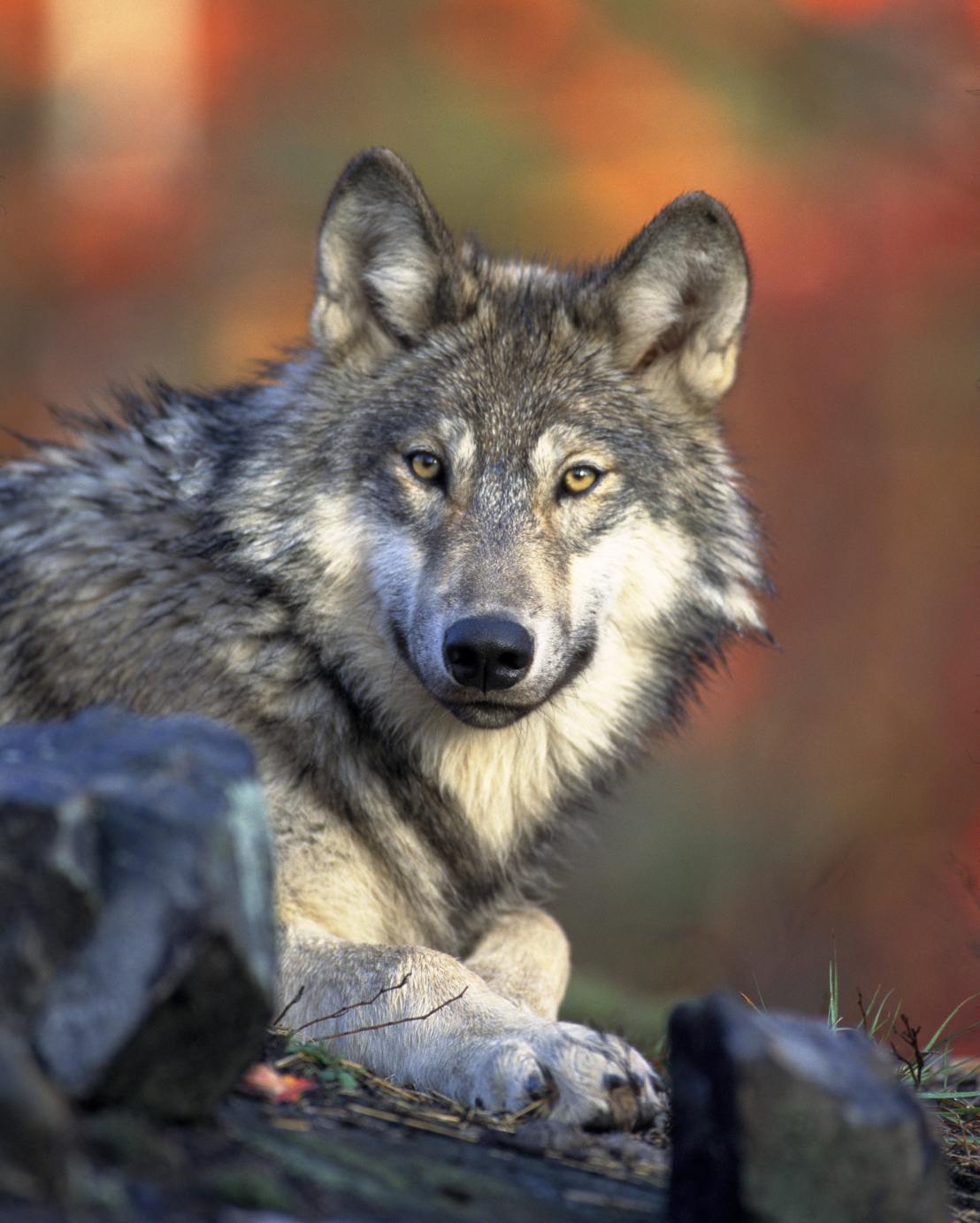
Dogs likely evolved from a wolf population that self-domesticated, scavenging for left-overs from Palaeolithic hunter-gatherers in Eurasia. However, the exact timing and geographic location where the dog lineage started remain unknown, owing to the scarcity of Palaeolithic dogs in the archaeological record. Analyses of genetic data suggest that dog-wolf divergence took place ~25,000 to 40,000 years ago, providing an earliest possible date for dog domestication.
The last paragraph in the short article is as follows:
For example, there is evidence that pigs were domesticated in both Anatolia and China. For dogs, however, the story is different. Dogs and modern-day Eurasian grey wolves appear as monophyletic groups; that is, any dog is genetically closer to another dog than to a wolf, and vice versa, Monophyly supports a single origin of dogs from a possible extinct wolf lineage.
Absolutely fascinating!
A couple of photographs, courtesy of Pexels, to close the piece.
oooo

See you tomorrow.
There’s a theme to this week’s Picture Parade.
First of all I must again thank Pexels for providing these photographs. They are from a grouping called Man’s Best Friend.
This is the theme. That dogs are our closest and longest animal companions by far. Indeed, the era that humans befriended wolves is so long ago that an exact time is far from settled. Here’s a piece in the August 2020 issue of Scientific American magazine:
In the 14,000 to 40,000 years during which this domestication process occurred, wild wolves were probably doing better than dogs in terms of numbers – after all, our dogs were probably another food source for humans when times became lean. The first written record of a wolf hunt was recorded in the sixth century B.C.E., when Solon of Athens offered a bounty for every wolf killed.
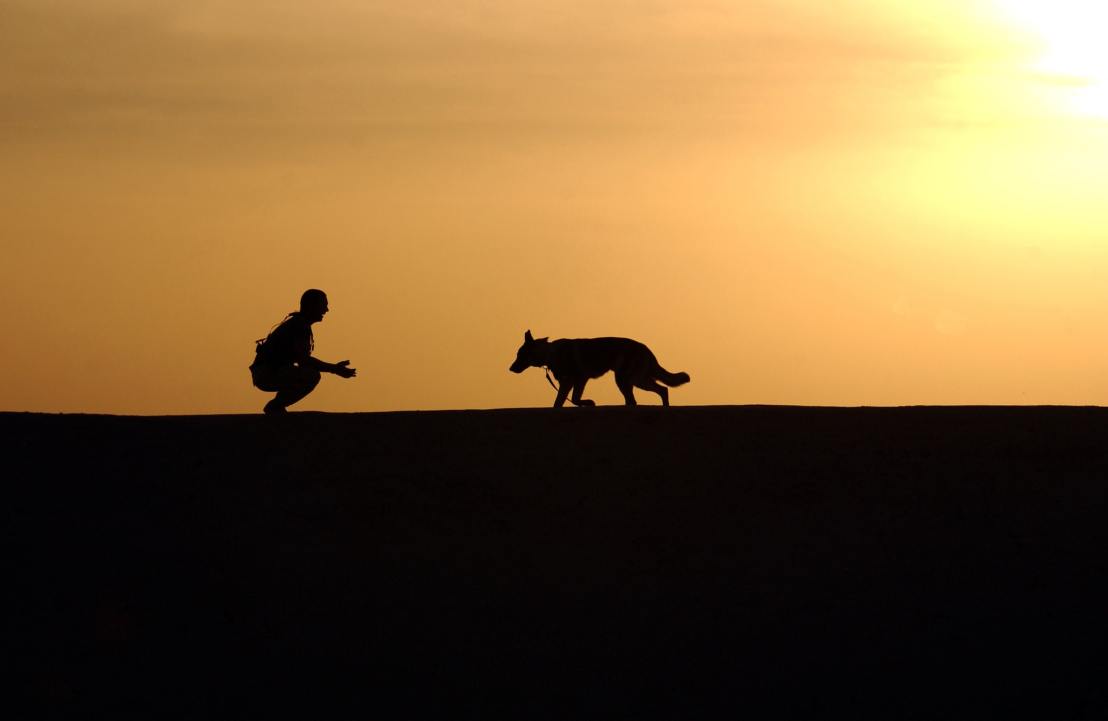
So in all these photographs today there is a human with the dog!
oooo
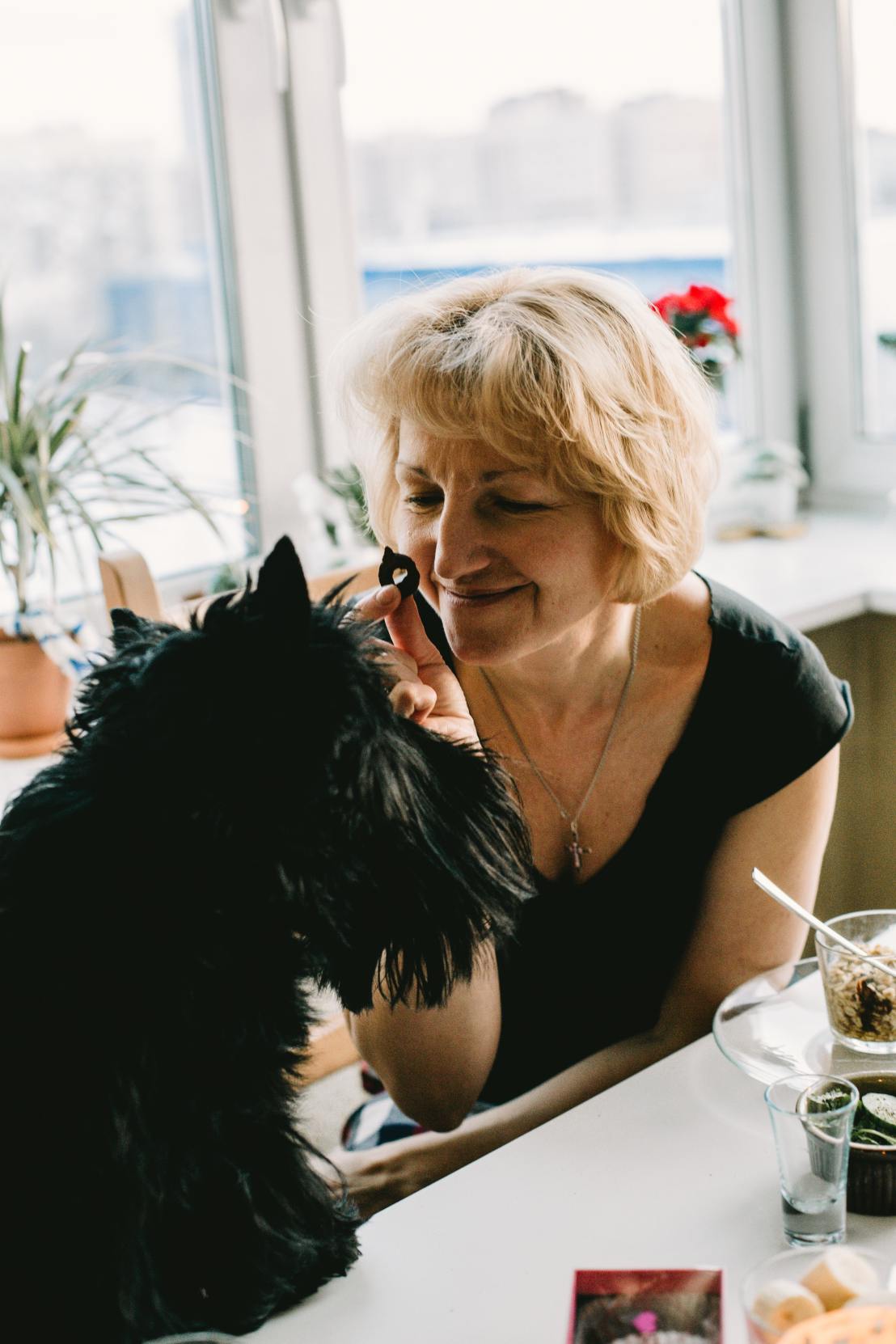
oooo
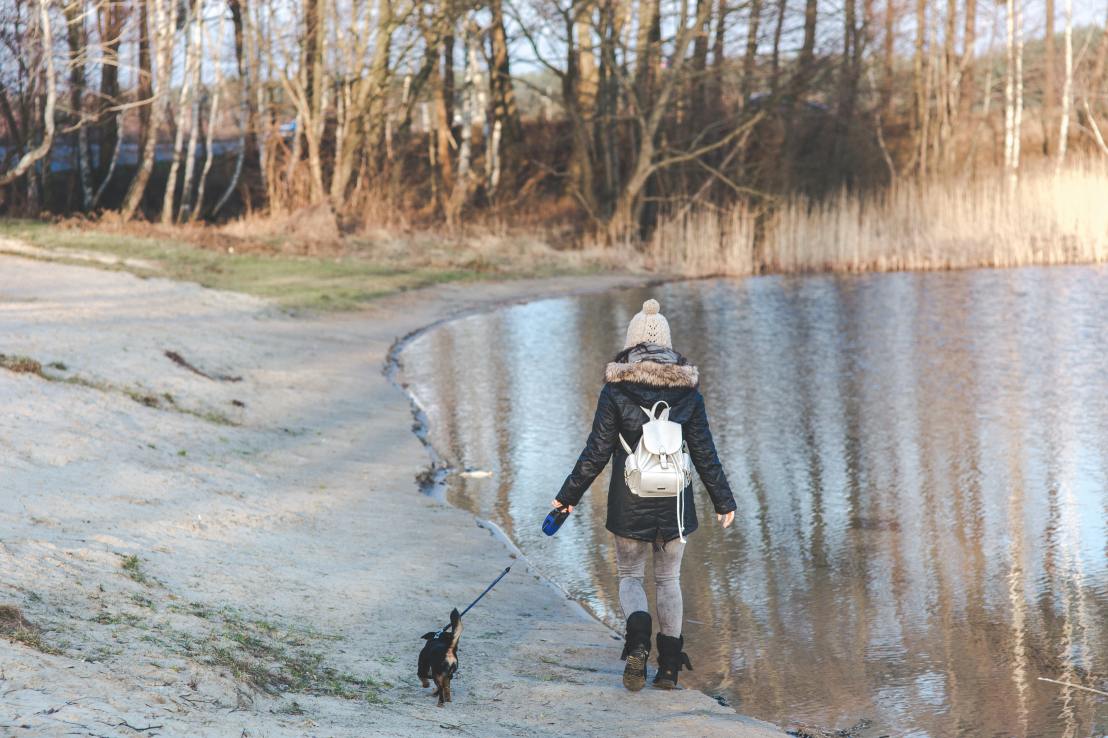
oooo
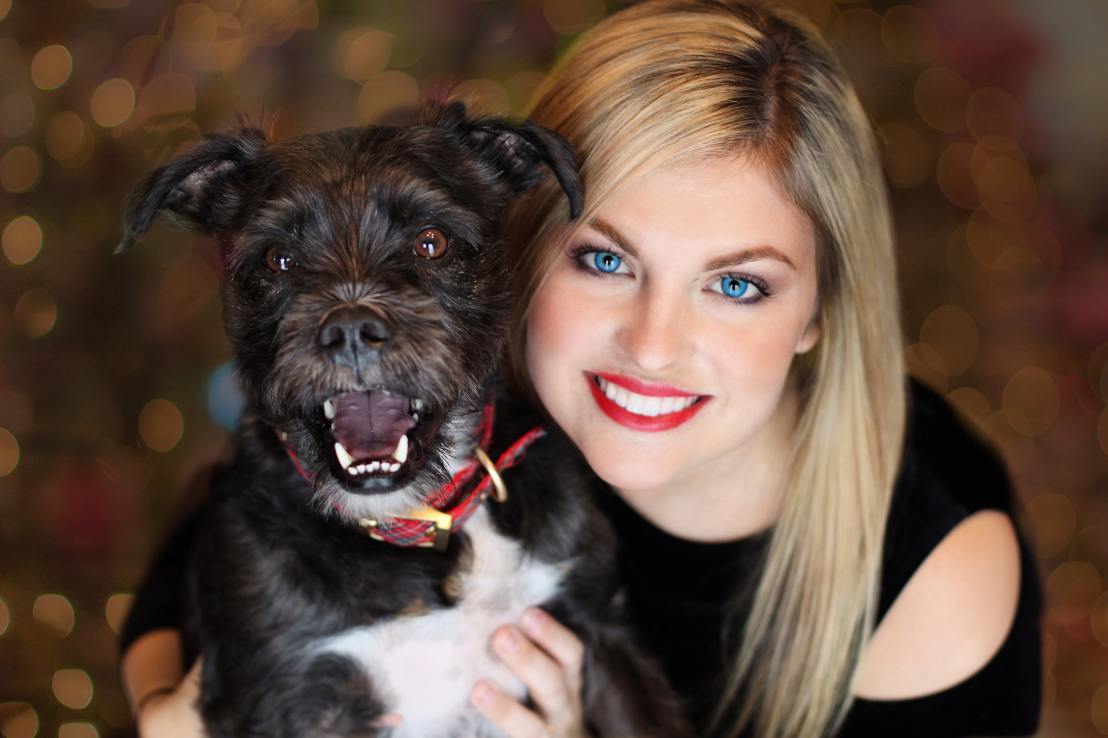
oooo

oooo
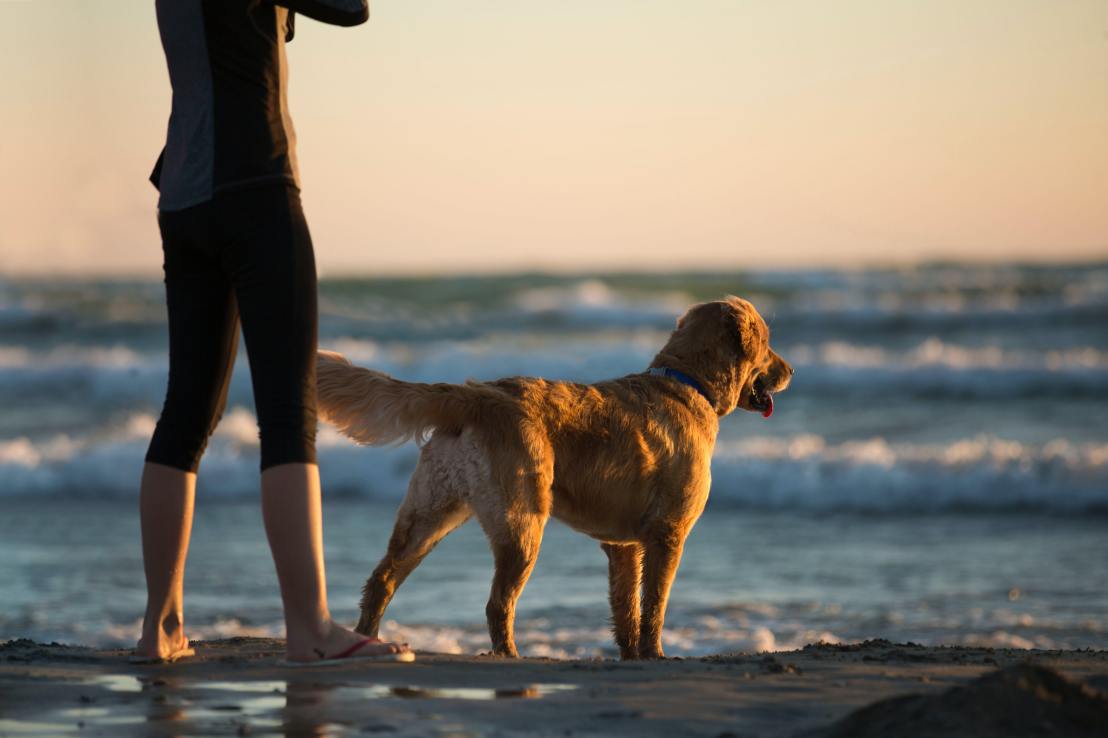
oooo

oooo

Fabulous even though I say it myself!
Doodle is not the only one we can think of!
Here at home our latest dog, Sheena, is rather obsessed with food. Actually not only Sheena but also Pedi.
But here’s another example of a dog who is led by their tummy! Once again, taken from The Dodo.
ooOOoo
“I knew that crunching sound was her but I didn’t know where it was initially coming from.”
By Caitlin Jill Anders>
Published on 11/12/2020
Doodle is a super happy, loving tripod dog who is absolutely obsessed with food. Her family has to keep an eye on her when she’s around food, because she’s always on a mission to try and steal it.

One day, Doodle’s mom was doing laundry when she suddenly realized that she had no idea where Doodle was.
“I first noticed she was missing after I didn’t see her next to me which she’s normally pretty close to me when I’m home,” Brandy Stenzel, Doodle’s mom, told The Dodo.
For the next half hour, Stenzel searched everywhere for Doodle. She ran all around the house, searching from top to bottom, and even checked outside to see if she’d somehow escaped. She was at a loss and starting to panic — when suddenly, she heard a crunching sound.
“I knew that crunching sound was her but I didn’t know where it was initially coming from,” Stenzel said.
Finally, the crunching sound led her to the food bin, and there was Doodle. She had somehow squeezed herself inside and was very happily eating to her heart’s content.

The lid had shut behind her, and while Doodle could have easily pushed it off and hopped out again, she was enjoying herself way too much. If her mom hadn’t found her, she may have never stopped eating.
“The food bin was hinged on one side so she easily could have hopped right out if she wanted to, but she’s a pork chop so she didn’t want to,” Stenzel said.

As soon as Doodle saw her mom, she knew she was in trouble, but of course, it was still worth it.
“She knew she got caught so when that happens she puts her ears back and it makes her look like Dobby the house elf of ‘Harry Potter,’” Stenzel said.

To avoid losing Doodle in the food bin again, her family got one that locks, much to her dismay. Whenever someone forgets to lock it, she’ll try to hop in and repeat her great food bin feast, but her mom is now always close by to stop her.
Doodle loves food, and she’ll never stop trying to steal it, no matter what.
ooOOoo
Yes, that’s a duplication of our Sheena.
Here’s a photograph of Sheena looking very serene and relaxed.

Sheena is the most friendly of dogs and while we are uncertain of her age that is of no consequence.
Yet another one.
This came in yesterday afternoon, Pacific time, and it is shared with you all.
ooOOoo

November 13, 2020 — Albright’s Raw Dog Food of Fort Wayne, Indiana, is voluntarily recalling 67 cases of Chicken Recipe for Dogs because it has the potential to be contaminated with Salmonella bacteria.
What’s Being Recalled?
The product is labeled Albright’s Raw Dog Food Chicken Recipe for Dogs and is packaged in 2-pound chubs/rolls (see image above).
Each chub/roll is printed with:
Product was sold frozen, and was distributed from the company to distributors from 7/8/20 to 8/27/20.
One animal illness has been reported. No human illnesses have been reported to date.
Where Was It Sold?
Albright’s Raw Dog Food Chicken Recipe for Dogs was distributed in CA, FL, IL, IN, NH, NJ, NV, NY, PA, and TN.
The affected product was also distributed through retail stores, mail order, and direct delivery.
What Caused the Recall?
The problem bacteria was revealed after testing conducted by the FDA.
The problem was confined to this batch and the company has ceased the distribution of the batch as FDA and the company continue their investigation as to what caused the problem.
About Salmonella in Humans
Salmonella can affect animals eating the products and there is risk to humans from handling contaminated pet products, especially if they have not thoroughly washed their hands after having contact with the products or any surfaces exposed to these products.
Healthy people infected with Salmonella should monitor themselves for some or all of the following symptoms: nausea, vomiting, diarrhea or bloody diarrhea, abdominal cramping and fever.
Rarely, Salmonella can result in more serious ailments, including arterial infections, endocarditis, arthritis, muscle pain, eye irritation, and urinary tract symptoms.
Consumers exhibiting these signs after having contact with this product should contact their healthcare providers.
About Salmonella in Pets
Pets with Salmonella infections may be lethargic and have diarrhea or bloody diarrhea, fever, and vomiting.
Some pets will have only decreased appetite, fever and abdominal pain.
Infected but otherwise healthy pets can be carriers and infect other animals or humans.
If your pet has consumed the recalled product and has these symptoms, please contact your veterinarian.
What to Do?
Due to the frozen condition of the product, it is possible that retailers and end users may still have the product in their freezers.
Consumers who have purchased Albright’s Raw Dog Food Chicken Recipe for Dogs are urged to return it to the place of purchase for a full refund.
Consumers with questions may contact the company at 260-422-9440 Monday through Friday, 8 AM to 4 PM ET.
U.S. citizens can report complaints about FDA-regulated pet food products by calling the consumer complaint coordinator in your area.
Or go to the FDA’s “Report a Pet Food Complaint” page.
Canadians can report any health or safety incidents related to the use of this product by filling out the Consumer Product Incident Report Form.
ooOOoo
Once again, please share this as far and wide as you can.
Still sharing more photographs of dogs!
The next wonderful batch of free photographs of dogs.

oooo

oooo

oooo

oooo

oooo

oooo

They continue to be so beautiful.
That last one, for example, is truly a work of art!
Yet another tale of smartness!
We have to be so careful here at home when we are speaking of anything to do with the dogs. For they listen even when they don’t appear to be so doing.
So, for example, me saying: “Jeannie, shall we let the dogs out?” is a no-no because almost before the sentence is finished they are up on their feet and crowding towards the front door. And there are plenty of other examples.
That requires speaking in code or sign language in an attempt to communicate something without the dogs cottoning on to what we are speaking about.
All of which is my introduction to yet another story from The Dodo to be shared with you.
ooOOoo
“He is a great actor!”
By Caitlin Jill Anders
Published on 11/11/2020
Titan was adopted by his family from Furry Friends Animal Refuge in Iowa at the end of August. His parents have had so much fun getting to know him over the past few months, and have learned that he’s pretty much the friendliest and most stubborn dog they’ve ever met.
“He has to say hello to EVERYONE when we go out,” Natalie Bretey, Titan’s mom, told The Dodo. “Everyone is his friend. While he does love being a big, friendly baby, he is also severely stubborn. He will frequently halt on walks until we go the way he has decided, or to stop and watch cars and people go by. We knew he was loving and friendly, but we had no clue how stubborn he was.”

Titan’s favorite thing in the world is going on walks, and his least favorite thing is when it’s time for his walk to end. He frequently tries to make his walks last longer, and he and his parents have already had many standoffs in the short time he’s been in their lives.
“He walks as if he has never had a walk before in his life,” Bretey said. “Which at first, may have been the case!”
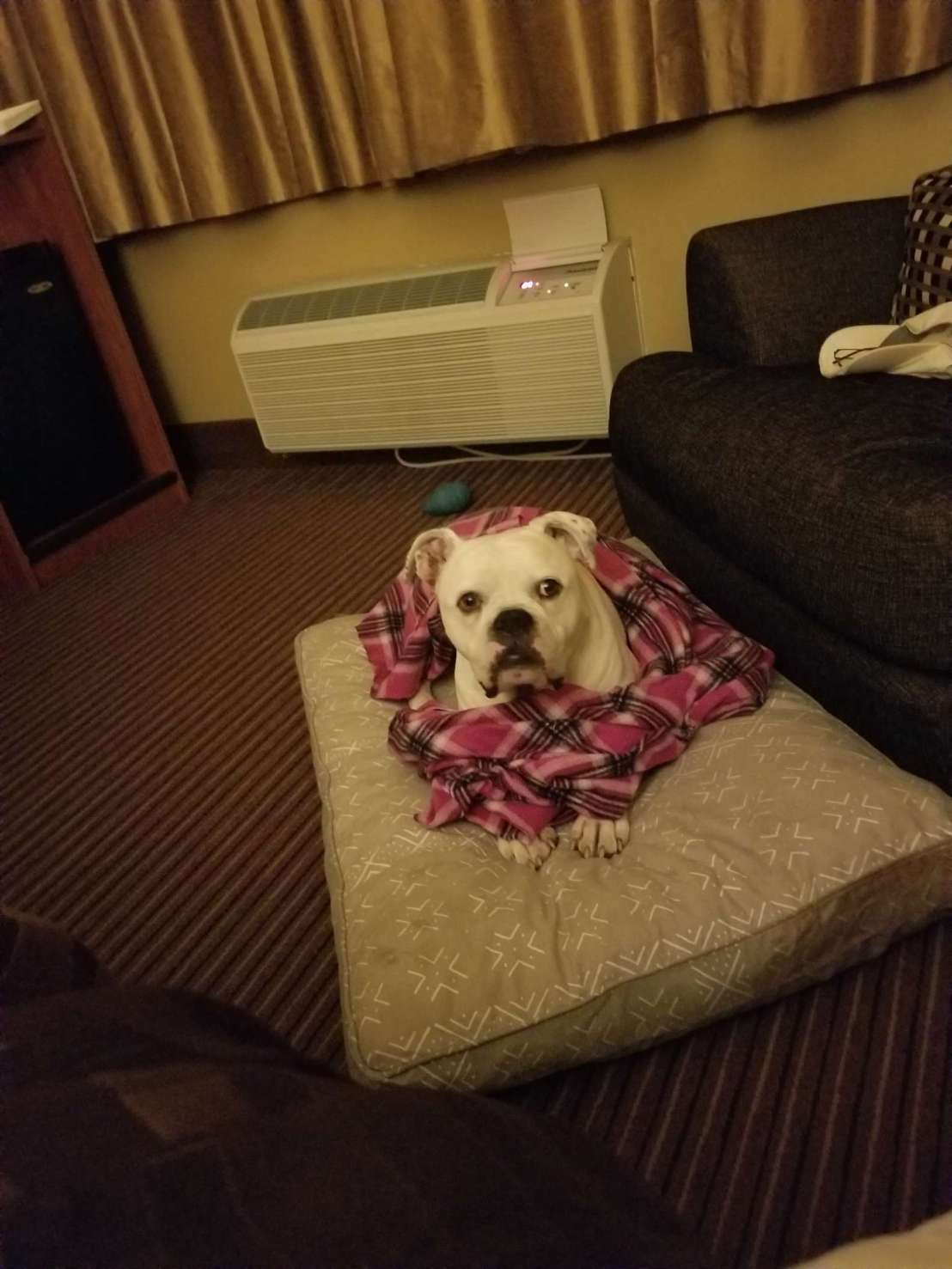
Titan is 7 years old and does have a few health issues, including chronic ear ulcers, mild hip dysplasia and allergies. While his parents are actively addressing his ear issues, his hip dysplasia hasn’t acted up yet — but they were worried it might be the very first time Titan encountered stairs.
“We realized he wasn’t a fan of stairs the very first day,” Bretey said. “We got back to my boyfriend’s apartment, and quickly realized that Titan had no intention of walking up the stairs. We started panicking; was this because of his hip dysplasia?!”
Titan’s parents were worried that his aversion to stairs might be because he was in pain — but quickly realized it was just because he didn’t feel like climbing them.

Now, every time Titan encounters the stairs, he tries to convince his parents to carry him up them. Sometimes he’ll even fake a limp, but as soon as his parents reach the top of the stairs and put him down again, the limp magically disappears and he runs down the hallway like the most athletic dog in the world.
“Titan pulls his limp trick at least once a week,” Bretey said. “This past week, he tripped on his new jammies going up the first step and stumbled back. He held his paw in the air and looked at me with the most pained look he could muster. I called his dad to come carry him up the stairs. Since he had stumbled this time, I was worried he wasn’t faking it for once! His dad came down and said, ‘He’s probably faking it again’ and hoisted him into his arms and up the stairs. Before we even reached the top, Titan was wiggling his way out of the set of arms and onto the floor. His limp was gone, and he jogged to the front door. We just laugh. He is a great actor!”
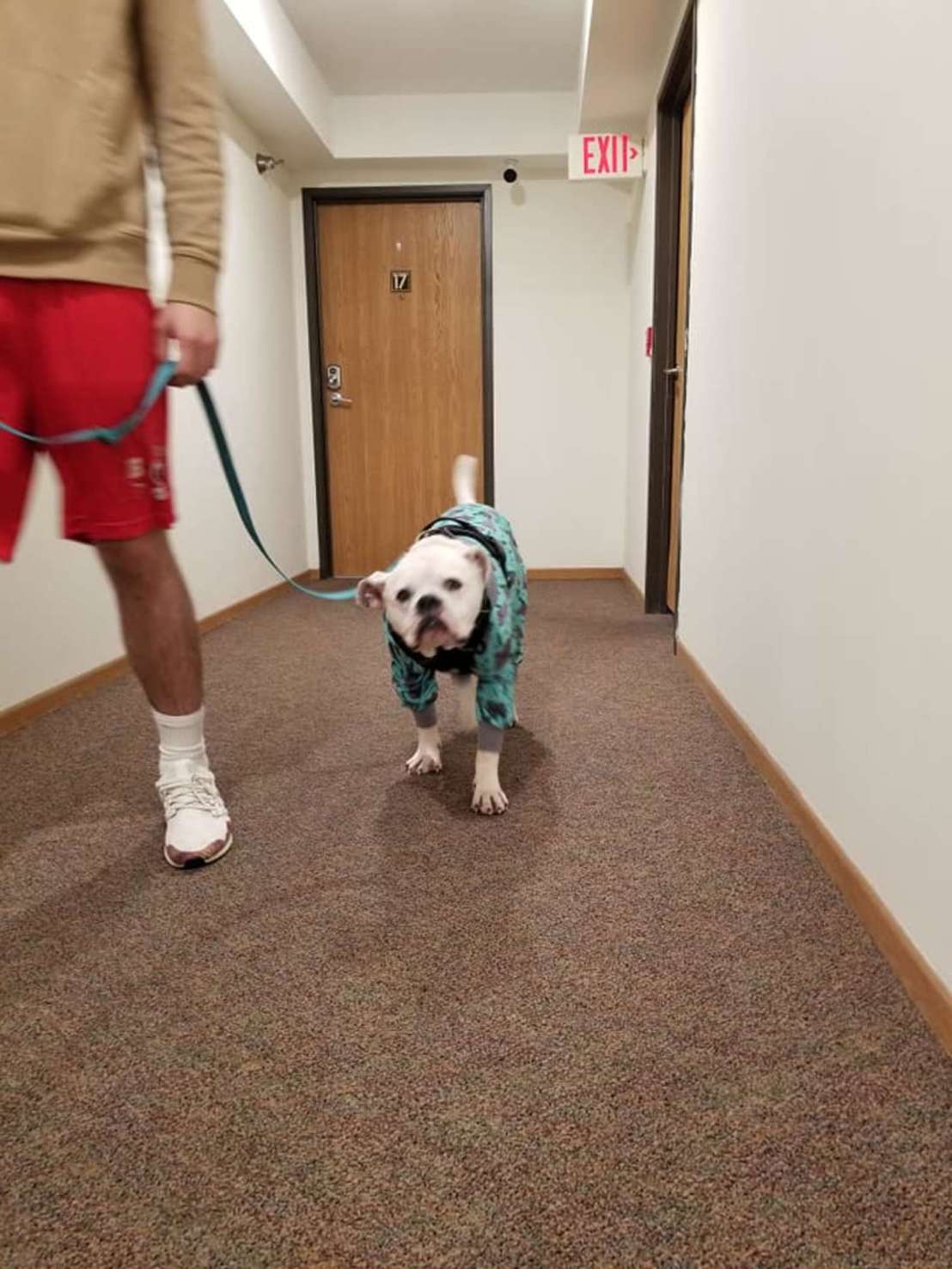
Titan’s parents are pretty sure he’d never encountered stairs before he came to live with them, and just never developed a taste for them. They’re very careful to listen and watch for any signs of actual pain and carry him up the stairs frequently — even though most of the time, it’s just Titan being Titan, but that’s OK. They love him enough to carry him anywhere.
When Titan was first adopted, there was a lot he had to learn about being a dog. His parents have absolutely adored watching him come out of his shell and explore the world around him. They want to give him the best life they possibly can, and are more than willing to put up with a little stubbornness along the way.
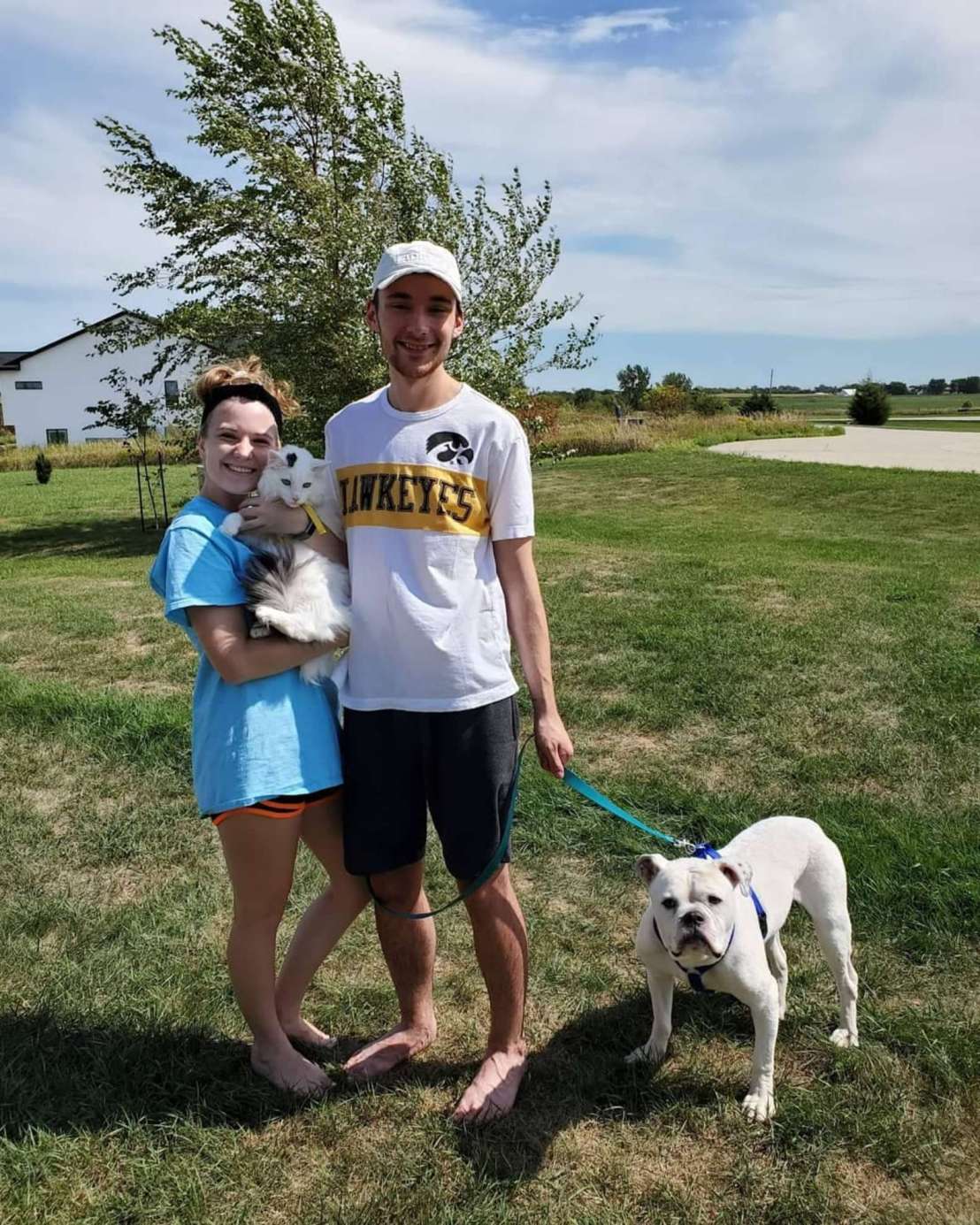
“We try not to think about all the things he went through, but have had fun watching him learn how to ride in a car, enjoy pup cups from coffee places, go on walks, and interact with everyone,” Bretey said. “His big heart has made every hard moment worth it.”
ooOOoo
It’s very true. Dogs can be stubborn. It often comes from their early days when they were unloved and had to decide what to do and what not to do.
I would like to think that over time Titan will display less stubbornness and, as was written at the end, learn lots of new things to do and, above all, to be loved.
This is yet another great story about a dog.
I came to my desk a little late in the day but wanted to share this article. Again it is from The Dodo and, apologies, I am going straight into it. It’s a very lovely story.
ooOOoo
“I think he was just really happy that someone was being nice to him.”
By Lily Feinn
Published on 10/31/2020.
On a cold rainy day, a little puppy named Chowder thought he’d found the perfect spot to stay dry. A garage behind an abandoned building had become a dumping ground for neighborhood furniture and trash, and that’s where Chowder discovered a discarded mattress and crawled underneath.
But things were about to get a whole lot better for the little stray.
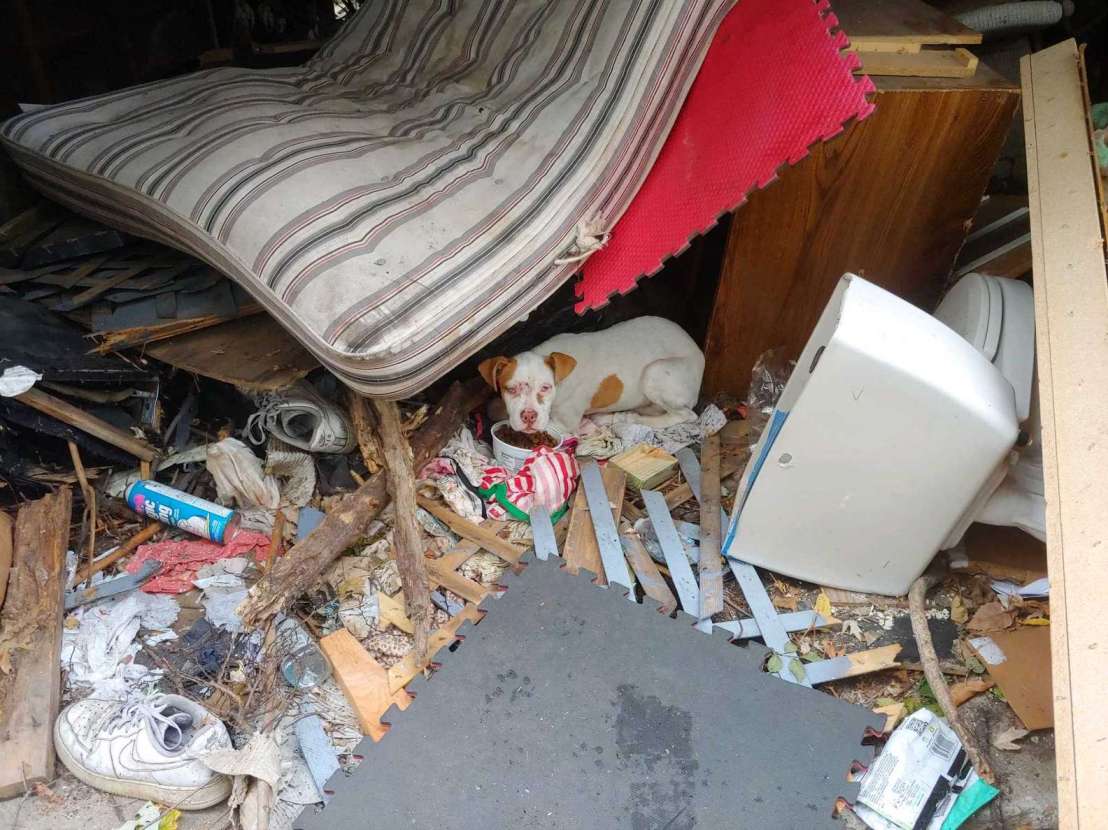
“[There’s a] super nice couple who lives in the area, and the husband had apparently gone out to the alley to throw some trash away,” Donna Lochmann, a rescuer with Stray Rescue of St. Louis, told The Dodo. “When the husband went out, he noticed that this white dog had found shelter underneath this corner of a mattress … and he gave him a little bit of food and water.”
The man called Stray Rescue of St. Louis, and Lochmann and her fellow rescuer rushed to the scene. When Lochmann met the 4-month-old puppy, she was shocked by how trusting he was.
“When we got out [of the car] he ran right up to me,” Lochmann said. “He was just the friendliest little guy. He wasn’t afraid of us or anything like that. I think he was just really happy that someone was being nice to him.”
Lochmann clipped a leash around Chowder’s neck, and the puppy was immediately excited. He put his paws on her shoulders as she picked him up to help him into the car and handed him over to her fellow rescuer.

“He went up and sat on her lap and just snuggled with her,” Lochmann said. “He had his head on her shoulder and just buried his face in her arm. He was just so thankful to be warm and to have people be nice to him.”

Chowder snuggled his rescuers the whole drive to the shelter as if he knew he was finally safe.
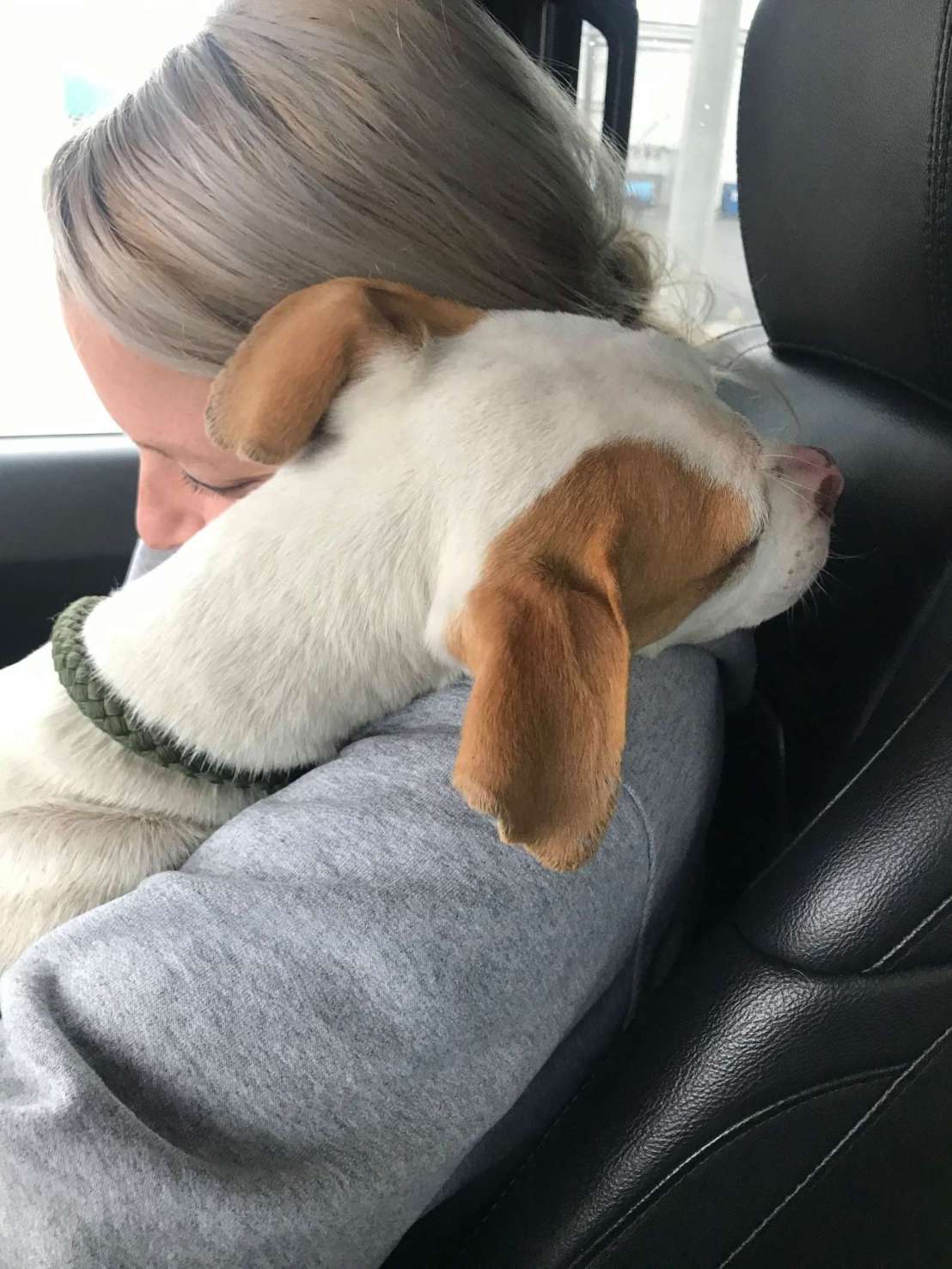
At the shelter, Chowder started to relax and let his puppy personality shine. The energetic dog became even happier to see people, get attention and play with toys.
Now in a foster home, Chowder is adjusting to indoor life and learning how to live with people.

Once he is neutered and his eye infection has cleared up, he will be ready to find his forever family. And his rescuers know whoever ends up adopting the grateful puppy will be in for plenty of snuggles and hugs in the years to come.
ooOOoo
Please, please someone adopt this puppy. He is a beautiful dog. That comes out even via these blog pages.
In case you or someone you know wants to know more then:
If you’re interested in adopting Chowder, you can fill out an adoption application here. To help other stray dogs like Chowder find their forever homes, you can make a donation to Stray Rescue of St. Louis.
Please!
 Learning from Dogs