Category: Dogs

Smart dogs in Russia

Dogs never stop learning

(With thanks to Dan Gomez for forwarding the email from Bill Wells)

A quick Google search will find lots of links to stories about how stray dogs in Moscow are learning new ways of looking after themselves.  My quotes and pictures have been taken from the English-Russia web site.

Russian scientists say that Moscow stray dogs became much smarter. The four legged oldest human’s friends demonstrate real smartness such as riding the Moscow metro every morning to get from their suburban places of living to the fat regions of Moscow center. Once they arrive to the downtown they demonstrate different new, previously unseen for the dog skills. Those skills can include “the hunt for shawarma” for example, the popular among Muscovites eastern cuisine dish. This hunt scene can be seen as this:

Regular Moscow busy street with some small food kiosks. A middle-aged man buys himself a piece of hot fast food and walks aside chewing it without a rush. Then just in a second he jumps up frightened – some doggy has sneaked up on him and barked out loudly. His tasty snack falls out from his hands down to the ground and the dog gets it. Just ten minutes later, on the same place, the teen youngster loses his dinner in exactly the same manner. The modern Russian dogs are on their urban hunt.

“This method of ambushing people from their back is widely exercised by Moscow dogs”, saying A. Poiarkov, working in Ecology and Evolution Institute of Moscow. “The main point here is to define who would drop the food scared and who won’t, but the dogs are great psychologists they can do it better than us”.
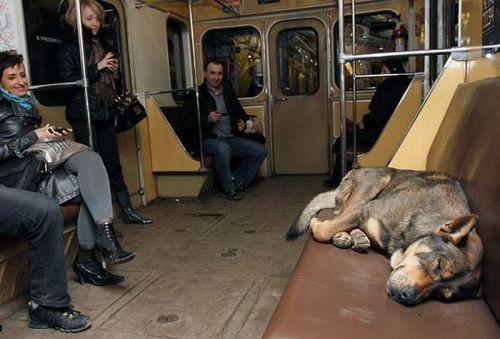
Cheap travelling!

Moscow ecologists think that dogs started acquiring this habits in 1990s, when the Soviet union collapsed and Moscow has fell into the hands of new class of Russian capitalists. They understood the true value of the downtown realty underestimated by previous Communist owners and became removing all the industrial complexes Moscow had in its centre to its outskirts. Those places were used by homeless dogs as a shelter often, so the dogs had to move together with their houses, so they had to learn how to travel Moscow subway – first to get to the centre in the morning then back home in the evening, just as us people.

The commercial revolution of Moscow made their usual feeding places like trash bins out of direct reach, so they had to get to know new ways of getting their piece of food. That’s how appeared those “Shawarma hunts”. Sometimes though they use more gentle methods. Young girl sits on the bench to eat her hot dog – a big cute looking dog appears from the surrounding bushes and puts her head on her knees. The girl can’t help herself sharing the hotdog with a dog.

Among some more amazing skill those Moscow dogs are the ability not to miss their stop while going on the subway train. Biologists say dogs have very nice sense of time which helps them not to miss their destination. Another skill they have is to cross the road on the green traffic light. “They don’t react on color, but on the picture they see on the traffic light”, Moscow scientist tells. Also they choose often the last or the first metro car – those are less crowded usually.

It’s funny but the ecologists studying Moscow stray dogs also tell the dogs don’t miss a chance to get some play while on their travel in the subway. They are fond of jumping in the train just seconds before the doors shut closed risking their tails be jammed. “They do it for fun, just they have enough food”, they conclude.
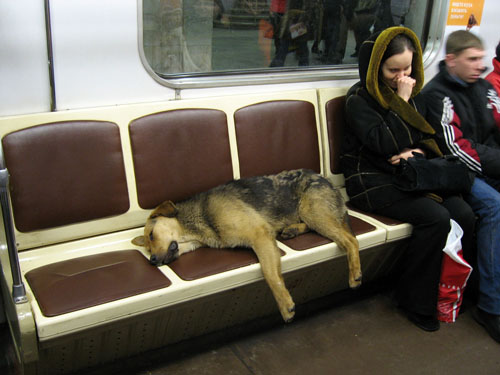
"Wake me up at the next stop, please!"

Here’s a video from YouTube courtesy of the Wall Street Journal – wet eye warning!

Jeannie and I would be helpless in Moscow!  Reason?  We have 12 ex-stray Mexican dogs living with us in Payson plus my beautiful German Shepherd dog, Pharaoh, that came with me when I left the UK in 2008.  We can’t resist helping these wonderful creatures.
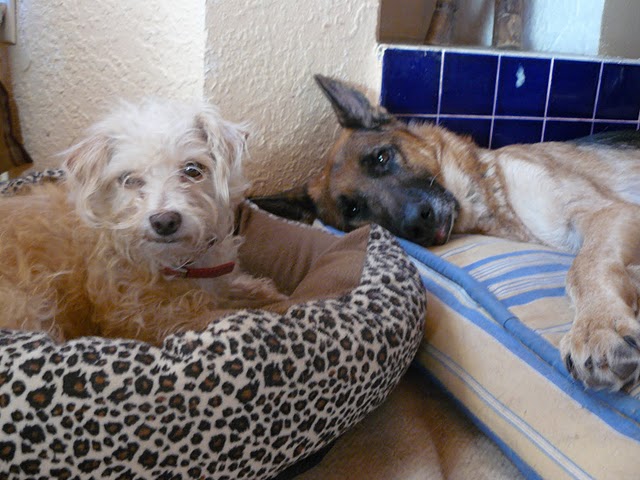
Pharaoh with little Poppy, a stray found on a Mexican building site

See more pictures from that English-Russia web site here.

By Paul Handover

Being in love

Science explains what our hearts feel

Love for all!

Yesterday, I posted an article based on a lecture given by Dr Helen Fisher presented to the TED Conference in 2006.  It included some fascinating evidence about the nature of love and why it is such a powerful human emotion.

Then in 2008, Dr Fisher gave a second lecture, again at the TED Conference, that continued to reveal more amazing findings about how the brain functions when in love.  As the presentation summary says:

Why do we crave love so much, even to the point that we would die for it? To learn more about our very real, very physical need for romantic love, Helen Fisher and her research team took MRIs of people in love — and people who had just been dumped.

Included in the lecture is something that I had wondered about and was delighted to see confirmed – animals fall in love as well.  Here’s the extract from that part of the presentation (min:sec 50:50):

I would also like to tell the world that animals love. There’s not an animal on this planet that will copulate with anything that comes along. Too old, too young, too scruffy, too stupid, and they won’t do it. Unless you’re stuck in a laboratory cage –and you know, if you spend your entire life in a little box,you’re not going to be as picky about who you have sex with –but I’ve looked in a hundred species,and everywhere in the wild, animals have favorites.

As a matter of fact ethologists know this. There’s over eight words for what they call animal favoritism:  selective proceptivity, mate choice, female choice, sexual choice. And indeed, there are three academic articlesin which they’ve looked at this attraction, which may only last for a second, but it’s a definite attraction, and either this same brain region, this reward system, or the chemicals of that reward system are involved. In fact, I think animal attraction can be instant — you can see an elephant instantly go for another elephant. And I think that this is really the origins of what you and I call, “love at first sight.”

Do watch it.

And a quote to conclude this post.

True happiness and a fullness of joy can be found only in the tender and intimate relationships of the family. However earnestly we may seek success and happiness outside the home through work, leisure activities, or large bank accounts, we will never be fully satisfied emotionally until we develop deep and loving relationships.
~ by James J. Jones Ph.D. ~

By Paul Handover

Friendship – alpaca style

Yet another beauty from Naked Capitalism

Regular readers will have run out of counting the number of times that I applaud Yves Smith and her amazing blog, Naked Capitalism.  Not only is it a fantastic source of many stories of real public concern, her daily antidote du jour is often delightful.  Here’s the one that came from her Blog posting of the 19th September.

Clarence and Cindy

Cattle dog Clarence plays with an alpaca named Cindy in “Alpaca Land” in Goeming, Austria. The two have lived together on the farm since they were 3 months old. Eighty-seven alpacas, the largest flock in Austria, live on the farm.

By Paul Handover

What next!

A dog playing pool in the USA!

(This week is a tough one for me with no internet access until the 18th.  So I’m quickly offering items from elsewhere that have caught my eye.)

Nothing to add!

By Paul Handover

Another dog leading the way

Very thin on time today – apologies.

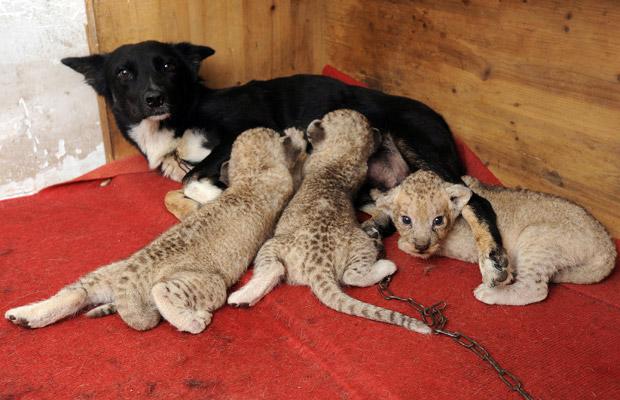
Three lion cubs feed on the milk of a mother dog after their mother abandoned them after birth, at the Safari Park in Hefei, China

Courtesy of The Daily Telegraph.  Just wonderful.

By Paul Handover

Not always as it seems

A dog retrieves another dog hit on a busy Chilean highway.

This video has been widely circulated to many television stations around the world.  Some commentators say that the rescued dog lived.

Most who watch it think that the rescuer is risking its own life to save or retrieve the wounded dog.

Most who watch it also think that it is an amazing example of the love of a dog for another dog.

But the truth is probably less romantic.  Feral dogs do eat their brethren when the opportunity arises.  Having watched feral dogs in Mexico, it beggars belief as to the lengths that they will go to in order to survive.

Most likely this was the poor dog’s next meal being dragged off the highway.

By Paul Handover

Working dogs!

No surprise really! Want to increase office productivity? Bring a dog to work!

Once again, this Blog is indebted to Naked Capitalism. There in the list of links was a story originally published in The

Different outcome!

Economist about some tests to see the effect of dogs in the office. Here’s the link to that Economist story.

http://www.economist.com/node/16789216?story_id=16789216.

Here’s a snippet:

THERE are plenty of studies which show that dogs act as social catalysts, helping their owners forge intimate, long-term relationships with other people. But does that apply in the workplace? Christopher Honts and his colleagues at Central Michigan University in Mount Pleasant were surprised to find that there was not much research on this question, and decided to put that right.

And the article concludes:

Mr Honts found that those who had had a dog to slobber and pounce on them ranked their team-mates more highly on measures of trust, team cohesion and intimacy than those who had not.

But do read the article in full because the conclusions are quite significant. Once again, the link is below:

http://www.economist.com/node/16789216?story_id=16789216.

Working effectively!

By Paul Handover

Remember Luna?

A couple of Posts from last September.

The wonderful news that US Gray Wolves are now back under protection reminded me of the beautiful story of Tim and his ‘pet’ wolf Luna that was published on Learning from Dogs September, 2009.

The first article opened up as follows:

An amazing true story of a relationship between a wild wolf and a man.

This is a story of a particular event in the life of Tim Woods told to me by his brother, DR.  It revolves around the coming together of a man sleeping rough, with his dog, on Mingus Mountain, and a fully grown female Gray or Grey Wolf. Mingus is in the Black Hills mountain range between Cottonwood and Prescott in Arizona, USA

You can read the full Post here.

But then I added a postscript which I am going to reproduce in full again.

The story of Luna has some interesting connections.

The person taking the picture in the Post about Tim Woods was Willie Prescott. He just happens to be the grandson of William H. Prescott from whom the town of Prescott is named. Here’s that picture again.

Luna, the wild wolf, taken in 2006.

Read more this postscript

Feeling whole, like a dog!

A Guest Post from Daniela Caride. Daniela writes the Blog The Daily Tail

Something about being a dog dazzles me. Maybe it’s the freedom. Dogs don’t care what others think of them. They do whatever pleases them most without guilt or worries.

This morning, it became so clear to me. My walk around Fresh Pond Reservation in Cambridge didn’t feel very pleasant. I was worried about my mother’s persistent headache.

Today promised to be the hottest day of the summer, and the heat was not helping my mood. It was only 9 a.m., and I was already convinced something had changed in our constellation, and the sun was about to barbeque the Earth.

But my dogs, Frieda, Geppetto and Lola, were oblivious to anything going on outside Fresh Pond. They trotted happily to the doggie pond awaiting them less than a mile away, stopping only to sniff around and greet other dogs.

At the pond, they refreshed themselves in the water, not minding that the water gets dirtier as the summer wears on. They love that stinky pond, from the day the ice starts cracking and we can finally see our reflections in the moving water, to the beginning of winter when the water turns into ice again.

We completed our lap and approached my car, parked in front of a huge grassy area, where dogs are not allowed. One

Dog days!

of the landscaping employees was testing the park’s brand new lawn sprinklers. He turned them on and watched as half a dozen sprinklers soaked the grass.

Geppetto ran toward the spinning sprinklers, ignoring leash laws, of course. He was dying for a sip. The water flowed so strong that Geppetto had to close his eyes when trying to get the spray into his mouth again and again.

Frieda and Lola followed him, first exploring the artificial rain until they felt comfortable enough to play beneath it. Soon they were romping under the sun without feeling the effects of the boiling heat.

I watched the beauty of that canine dance with envy. My dogs were free, living the moment, unfettered of any concern. Then I asked myself why we humans don’t act more like them, especially in situations like this, in which no harm would be done.

Geppetto and Daniela

First, I went into one of the sprinklers, wetting my hair and face. Then another sprinkler surprised me, showering me head to toe with a refreshing jet. I raised my arms to let the water reach the rest of my body.

Park regulars watched their dogs and me from careful distance, not wanting to get wet. I didn’t care any more. I felt whole.

Whole like a dog.

By Daniela Caride