Category: Dogs

The Book! A way into our own soul

To my dear readers.

The final two parts of the book, How the dog offers us a way into our own soul, and, And show us the way to embrace death, are offered today and tomorrow.

I can’t tell you what it has meant to me to have the many ‘Likes’ and comments along the way; just take it from me that it has been enormously inspiring and motivational and part of me can’t believe that the project that started in November 2013 under the NaNoWriMo-2013 umbrella was completed this November just gone, for a draft word count of a little over 104,000 words!

Come the New Year and the real work starts, that of the Big Edit.

So let me close by just saying, once again, thank you!

oooo

Not forgetting:

How the dog offers us a way into our own soul

Happiness resides not in possessions, and not in gold, happiness dwells in the soul.

So wrote the philosopher Democritus. Democritus, born in 460 BCE, although according to some in 490 BCE. He acquired fame with his knowledge of natural phenomena, and preferred a contemplative to an active life, spending much of his life in solitude. The fact that he lived to beyond 100 suggests he lived out what he philosophised about!

Now the last thing I am going to attempt is any rational, or even semi-rational, explanation of the soul; of what it is; of whatever it is. Despite the familiarity of the word, especially within religious circles, the notion of the soul remains an enigma. Indeed, it reminds me of that very clever quotation attributed to the German philosopher, Martin Heidegger: “Making itself intelligible is suicide for philosophy”, that with a little poetic licence might be rewritten: “In making itself intelligible does the soul become soulless.”

Thus having ‘bared my chest’ in terms of failing the test of knowing what a soul is, in any rational manner, I shall, nonetheless, continue to use the word. Simply because there will be sufficient bonding between me writing the word ‘soul’ and those reading the word ‘soul’, for those same readers to sense where I am coming from.

I’m going to stay with this wonderful concept of soul for just a little longer before adding our beautiful dogs into the dream. Staying with it courtesy of the writer; John O’Donohue. John’s name is not one known to the masses. Yet his writings are, without fail, beautifully moving. John’s first book was called Anam Cara: A Book of Celtic Wisdom., Anam Cara means ‘soul friend’ in Gaelic. The following passage, taken from Anam Cara, represents to my mind the most exquisite understanding of the human soul.

The secret heart of time is change and growth. Each new experience which awakens in you adds to your soul and deepens your memory. The person is always a nomad, journeying from threshold to threshold, into ever different experiences. In each new experience, another dimension of the soul unfolds. It is no wonder that from ancient times the human person has been understood as a wanderer. Traditionally, these wanderers traversed foreign territories and unknown places. Yet, Stanislavsky, the Russian dramatist and thinker, wrote: “The longest and most exciting journey is the journey inwards.”

There is a beautiful complexity of growth within the human soul. In order to glimpse this, it is helpful to visualise the mind as a tower of windows. Sadly, many people remain trapped at one window, looking out every day at the same scene in the same way. Real growth is experienced when you draw back from one window, turn and walk around the inner tower of the soul and see all the different windows that await your gaze. Through these different windows, you can see new vistas of possibility, presence and creativity. Complacency, habit and blindness often prevent you from feeling your life. So much depends on the frame of vision – the window through which we look.

Those are so wonderful words from John and a brilliant example of his exquisite creativity of thought. They also offer the most perfect ‘window’ to seeing how the dog offers us a way into our own human soul.
What do I mean by this?
When we have dogs in our lives there are many occasions when there is a link between us and our dog; a link that defies logical explanation. Let me offer some examples.

Let’s start with this one. As a human, that is you and me, out of the blue, with no rhyme or reason, you will surely experience finding your day a bit tough from time to time. The odds are that it doesn’t show to your loved ones and, you are pretty sure, that it is entirely an experience that is well hidden inside one. But you and I know you can’t hide it from your dog. You slump down in a chair and your dog comes over and lays its warm snout across your legs or offers a head for you to scratch. In any one of many familiar ways you have a caressing and loving contact with your dog. And you know, you know beyond doubt, that your dog is attracting the angst away from you.

Or how about the time when you might be standing somewhere in or around the house, trying to think how best to approach a task, and your dog comes up next to you and softly leans against you.

Or that most special of links between us and our dog. I have in mind the times when our dog links ‘eye-to-eye’ with us, when those beautiful, deep unblinking eyes of our dog look so deeply inside of us. Those are the times when you and your dog know, you both sense in a clear, unwritten language, the thousands of years of relationship, the very special relationship, that man and dog have had with each other. That at that moment of held eye contact there is a real, tangible connection between your two souls.
We know beyond doubt that dogs have emotions, that they are full of natural goodness and feelings, and that there is some part of a dog’s inner being that links to us and, in turn, that there is an inner being within us that links us back to our dog.

Let me return to the power of that eye-to-eye bond between us and a dog.

In humans, that part of the brain in which self-awareness is thought to arise is called the ventromedial prefrontal cortex. That just happens to be located behind the eyes. Ergo, we learn[1] to associate the identity of others with our eyes. Then as we mature, our eyes take on more importance because we develop awareness and a better understanding of the social cues that other people convey with their eyes.

Therefore, is it any surprise that dogs, such intuitive creatures that they are, young and old, soon learn to read us humans and the feelings and emotions that we give out via our eyes. There’s a knowing in my mind, albeit an unscientific ‘knowing’, that dogs, too, give out emotions and feelings from their own eyes.

That loving a dog and, in return, being loved by that dog truly does offer us a way into our own souls.

Until one has loved an animal, a part of one’s soul remains un-awakened.
~ Anatole France

1.089 words Copyright © 2014 Paul Handover

[1] Refer Christina Starmans and Paul Bloom of the Mind and Development Lab at Yale University.

Picture parade seventy-five

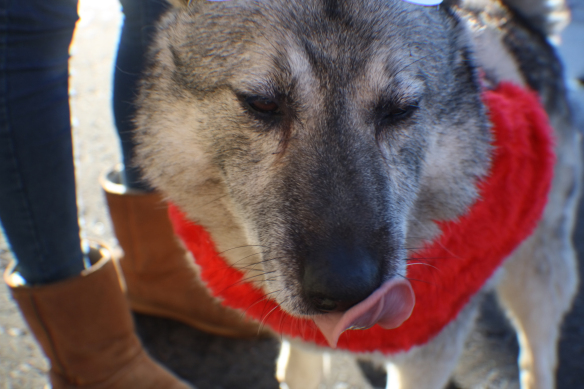
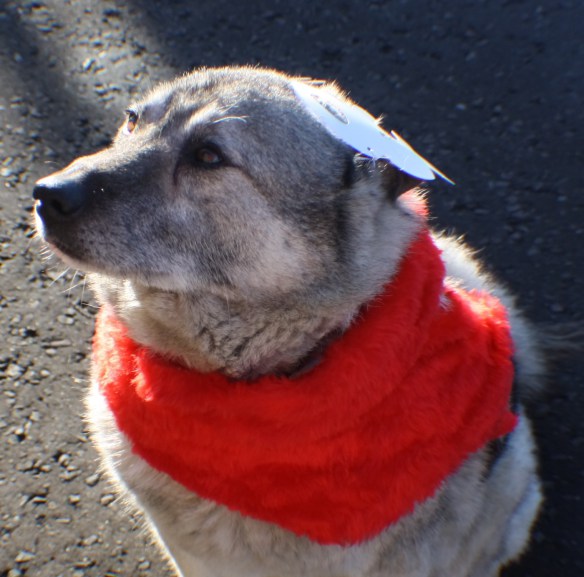
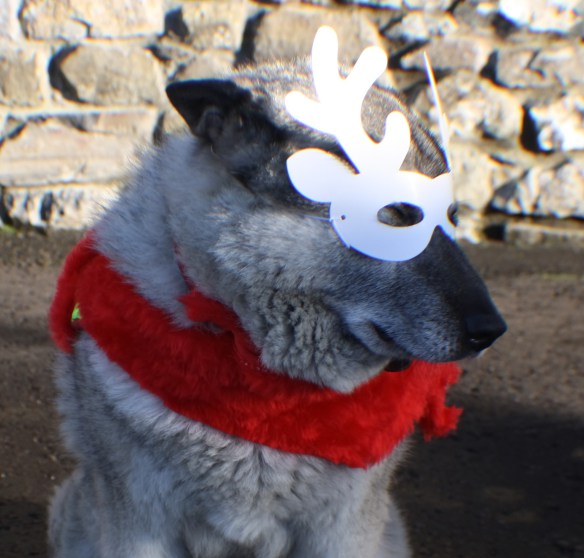
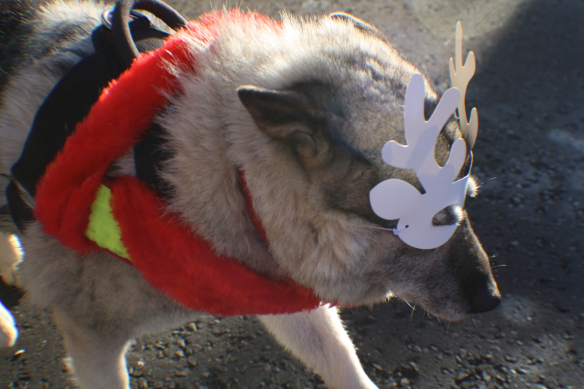
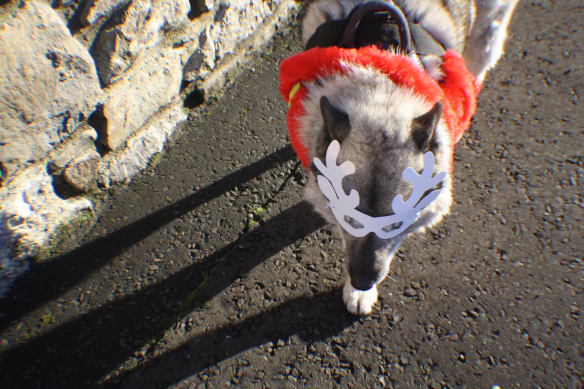
I saw the following images published over on the blogsite Decidingly Bob, that has the sub-heading of Life as I see it!  What was so perfect was that the ‘I’ is a dog! The post from which these images are taken, with Bob’s permission, was published on December 12th under the post title of “Bob’s Diary. ..I am not a Reindeer!

They seemed perfect for the last Picture parade before Christmas Day!

ooOOoo

Bob’s Diary. ..I am not a Reindeer!

“After the Christmas Reindeer story, I thought I was safe for a few weeks. Life can be cruel can’t it?

I knew there was trouble brewing when Maria and Sara offered me jelly babies.”

bob-1

oooo

But I didn’t expect this …

oooo

No sir, I got to talk to Sir Bob about this…

oooo

I am not a reindeer….

oooo

I have the answer..
I have the answer..

oooo

Bob-6

I am a Superhero.

ooOOoo

Listen everyone, have a wonderful week and please be safe out there.

The Book! Part Five: Adaptability.

Thanks to the wonders of the modern dictionary, I am able to understand that about two-hundred years ago, sometime around 1790 to 1800, the word ‘able’ that I just used was added to the word ‘adapt’ to make the word ‘adaptable’. I read that the word is an adjective and that from that comes a related word, a noun: adaptability. That same dictionary informs me that the meaning of adaptability is: “capable of being adapted” or “able to adjust oneself readily to different conditions: an adaptable person.

Now I would be the first to accept that the history of man, the long history of man, reveals a species, namely us, that is incredibly adaptable. Yet, (and you knew there was a ‘yet’ coming!) my sense of how adaptable any one person might be is inextricably wound up with change, and change is often a bitter fruit to taste.

You may recall that I closed the chapter on The process of change, in Part Four, with a snippet quotation from the film Interstellar: “We all want to protect the world, but we don’t want to change.”

That sentiment could be applied to so many aspects of our lives, especially to any form of change that heralded perceived uncertainty, or potential vulnerability; indeed anything that might be regarded as taking us outside our ‘comfort zone’. Granted not everyone, all of the time, yet not no-one at any one time.

Dogs, just like us humans, love routines. However, what strikes me from having lived for a number of years with a great many dogs in the home, variously from sixteen to the nine we have at present[1], is how amazingly easily a dog will adapt to new circumstances, both temporary and long-term changed circumstances.

Somewhere in my research, and I regret not being able to quote the reference, I came across a review of the author Jean Donaldson[2], in connection with her book Culture Clash. This book has shaped modern thinking about the behaviour of dogs and the relationship between dogs and humans.

The reviewer, in discussing the adaptability of dogs, proposes, “Maybe it’s the simple way they view their world. Each thing in their lives seems to fall neatly into its place in their world view. Things to seek out, things to avoid, things to keep, and things to leave behind.

Then a couple of sentences later, the reviewer adding: “I would guess that scavengers need that kind of mind set. Take it as it comes, deal with it, and move on. Dogs seem to have developed a sense of adaptation. They see what needs to be done and simply find a way to do it no matter what the impediments might be.

That last sentence describes an attitude towards adaptability that, in my opinion, would be very rare to find in a person.

I am going to devote the balance of this chapter to a true story. The true story about an Akita breed of dog that lived with its owner in Tokyo back in the first quarter of the 20th century. I included this account, despite the main theme of the story being about the extreme loyalty of the dog, because the dog’s ability to adapt is equally as impressive.

In 1924, Hidesaburō Ueno, a professor in the agriculture department at the University of Tokyo took in an Akita breed of dog as a pet and named him Hachikō. During his owner’s life, Hachikō not only saw Professor Ueno come out from the front door each morning but quickly learned to greet him at the end of the day by going to the nearby Shibuya Station. Hachikō continued this daily routine of going to the station until a day in May 1925, when that evening Professor Ueno did not return on his usual train. The reason being that the professor had suffered a cerebral haemorrhage at the university that day, had died and, therefore, never returned to the train station where his doggy friend was waiting.

Kind persons found Hachikō another home after his master’s death but he routinely escaped, showing up again and again at his old home. Eventually, Hachikō in some doggie manner realised that his master, Professor Ueno, clearly no longer lived at the house. So Hachikō went to look for his master at the train station, where he had accompanied him so many times before. Each day, Hachikō waited for Professor Ueno to return. And each day he did not see his friend among the commuters leaving the station.

Now almost a permanent fixture at the train station, Hachikō inevitably attracted the attention of other commuters. Many of the people who frequented the Shibuya train station had seen Hachikō and Professor Ueno together each day. They now brought Hachikō treats and food to nourish him during his long wait – Hachikō waiting at the train station at the end of every single day.

That same year, it happened that another of Ueno’s faithful students, who had become something of an expert on the Akita breed, saw the dog at the station and followed him when he went back to the home of the former gardener of Professor Ueno: Kikuzaboro Kobayashi. There the student learned the history of Hachikō’s life. Shortly after this meeting with Kikuzaboro, the former student published a documented census of Akitas in Japan. His research found only 30 purebred Akitas remaining, including Hachikō from Shibuya Station.

Professor Ueno’s former student returned frequently to visit the dog and over the years published several articles about Hachikō’s remarkable loyalty. In 1932, one of these articles, published in Tokyo’s largest newspaper, threw the dog into the national spotlight. Hachikō became a national sensation. His faithfulness to the memory of his master impressed the people of Japan as a spirit of family loyalty that all should strive to achieve. Teachers and parents used Hachikō’s vigil as an example for children to follow. A well-known Japanese artist rendered a sculpture of the dog, and throughout the country a new awareness of the Akita breed grew.

Hachikō was so loyal that every day for the next nine years he waited, sitting there amongst the town’s folk, appearing precisely when the train was due at the station.

Hachikō died on March 8, 1935. He was found on a street in Shibuya. His heart was infected with filarial worms and 3-4 yakitori sticks were found in his stomach. His stuffed and mounted remains are kept at the National Science Museum of Japan in Ueno, Tokyo. Hachiko’s legendary faithfulness became a national symbol of loyalty. There is a memorial statue of Hachikō in front of Shibuya Station.

This tale of Hachikō is an astounding tribute to the adaptability of the dog.

1,123 words. Copyright © 2014 Paul Handover

[1] December, 2014
[2] http://www.jeandonaldson.com

The smell of the North

The things science unearths!

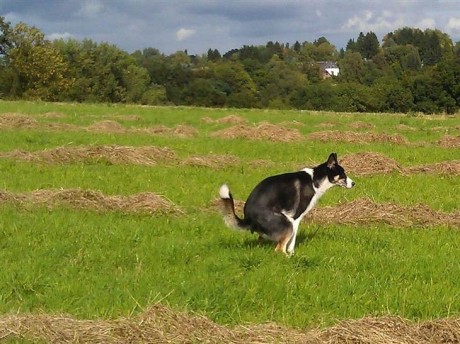
Having nine dogs here at home and quite a few acres of land, you can easily imagine that one needs to keep a good lookout for the numerous ‘land mines’.

But as much as they are a common and familiar sight, especially around the house, never in a thousand years would I have noticed a magnetic alignment!

All brought to my awareness by a wonderful article over on the ZME Science website.

Are you a dog lover? Did you know this?

ooOOoo

Dogs can sense Earth’s magnetic field… while pooping

Jenny Ricken / Univ. of Duisberg-Essen via AFP – Getty Images

Every dog owner can attest that canines are remarkable navigators, like some sort of living, breathing compasses. For some time, researchers have suspected that they can sense Earth’s magnetic field and use it in turn for navigation. A recent study confirmed this as a fact, however the findings came after studying the dogs in one of their most intimate poses – while pooping. Apparently, in stable conditions, dogs always relieve themselves while facing either north or south.

Led by zoologist Hynek Burda of Germany’s University of Duisburg-Essen, the researchers closely followed 70 dogs of 37 breeds for two years. Initially, the dogs didn’t seem to follow any particular pattern while going on with their business. After taking in account, however, things like the time of the day, the position of the sun, wind direction and, of course, the slight daily variation in the Earth’s magnetic field a whole new level of appreciation was revealed.

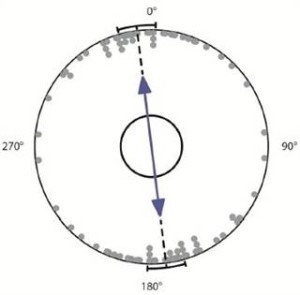
“The emerging picture of the analysis of the categorized data is as clear as [it is] astounding: Dogs prefer alignment along the magnetic north-south axis, but only in periods of calm magnetic field conditions,” said Burda.

Alignment of a sampling of dogs while defecating during stable geomagnetic conditions. Photo: Hart et al. / Frontiers in Zoology

Poop compass

So, dogs will always poop or pee facing north or south during stable conditions. The study not only proves that dogs can sense the Earth’s magnetic field, but also exhibit specific behavior in response to natural magnetic field variations. To our current knowledge, they’re the only mammals that do this. Previously it was shown that cattle, deer, foxes and other types of mammals sometimes line up preferentially along Earth’s magnetic field lines.

To some, dogs’ “sixth sense” might not come as a surprise, while others may view the present study as a complete waste of grant money. While it’s still unclear how dogs use this skill, it may be too early to dismiss the practical applications of the findings. If anything, however, this research proves yet again that dogs are extraordinary animals.

“To many dog owners who know about the good navigation abilities of their protégés, the findings might not come as a surprise, but rather as an explanation for the ‘supernatural’ abilities—although it is not clear to the researchers what the dogs might use their magnetic sense for,” Burda said.

Next, the researchers plan on studying how dogs use this ability and how magnetic storms affect their ability to orient themselves. Findings were reported in the journal Frontiers in Zoology.

ooOOoo

To say that I’m just a tiny bit sceptical wouldn’t be a lie.  But, trust me, I shall be outside tomorrow morning with my compass and camera and will report the results!

Picture parade seventy-four

The second set of wonderful pictures from Tricia.

(If you missed last week’s set they are here.)

Trish6

 oooo

Trish7

oooo

Trish9

oooo

Trish10

oooo

Trish11

oooo

Trish12

oooo

Trish13

oooo

What incredible, wonderful, loving animals they are!

The book! Part Five: Honesty.

In one very real sense, a chapter about the quality of honesty in dogs is bizarre. Surely, honesty, and dishonesty, are terms that exclusively describe human tendencies. When the term “dishonest” is used to describe a person, most often we are describing an effort by that person to deceive another. It is a description of someone who intentionally is trying to mislead or misinform us.

But in terms of honesty, or dishonesty, what I am about to say probably applies to all animals; I don’t know. Namely, that if there was one animal on Planet Earth that is incapable of guile or deceit, it has to be the dog. There is no doubt in my mind that dogs remain one of the most beautiful gifts nature has bestowed upon us humans.

Now that last bold statement is not to imply that dogs don’t try to manipulate us humans; far from it. Their attempts at manipulation would impress any three-year-old child! But there’s nothing dishonest about a dog trying to manipulate its owner into giving the dog whatever it wants; they are far too obvious in their motives and methods. As I read somewhere, dogs are: “Just scavengers looking for a way to get something with minimal effort.

Thus I think we can take it as a given that dogs are honest; fundamentally so.

OK, dear reader, you have no way of knowing that after writing that last sentence, I sat staring at the screen for a good ten minutes. I didn’t know how to continue the theme. I couldn’t think of anything to add to what every “good person and true” knows, and has known since time immemorial: honesty is a fundamental aspect of being a good person; the enviable of all titles, as George Washington is reputed to have said.

What was exercising my brain was to come at the subject of honesty in a way that offered a compelling reason for being honest; over and above the natural assumption about honesty, that it is so blindingly obvious not to require being spelt out; in a manner of speaking. It struck me that honesty is very different to the majority of the other qualities that we need to learn from dogs.
Different in the sense that the other qualities are open to being embraced as something that may be learnt, with clear rewards from so doing, whereas honesty seems a fundamental, core way of relating to the world around one. Mind you, there was a tiny voice in my head that was nagging away at me that said that honesty may not be so ‘black and white’. For example, the question of ‘white lies’. But, at heart, I was still lost as to how to proceed.

So, I spent another thirty minutes exploring the web looking for clarity; looking for some inspiration. Yet those web searches just ended up confusing me more. About the least confusing item I came across, more or less at random, was a section from an article read[1] on the website The New Atlantis. The full article was entitled: The truth about human nature.

The section that I read, and is reproduced below, seemed to confirm in my mind that honesty; something that, by rights, should be so fundamentally understood, was anything but simple.

Since Nietzsche, the choice of which version of ourselves we identify with has been widely understood as a choice between lying and truth-telling — to ourselves as much as to others. The moral ideal has become authenticity — a particular kind of honesty. Of course, just about any philosophical ideal is grounded in some sort of honesty: the search for Truth requires truth. Yet Aristotle describes honesty as a virtue only of self-presentation — the balance between self-deprecation and boastfulness. And Plato never lists honesty as a virtue at all, and even distinguishes between “true lies” and useful or noble lies. From the modern to the post-modern era, honesty and authenticity shifted to become much of the telos[2] of life, where before they had been but means in our progress toward that end.

Here was me looking for clarity only to find anything but that!

So what to make of all this?

I am going to fall back on the ideas expressed in the chapter on community. Rather on the closing words of that chapter, “… the power of sharing, of living a local community life, may just possibly be the difference between failure and survival of us humans.

There’s a sense of hope in me that we are heading for an era of new localism that will, in and of itself, reinforce a culture of honesty in one’s life. Why such hope? Because there are signs. Such as this one: the growing concern about factory farming, surfacing as increasingly more vibrant local food movements, demonstrating that people are really scrutinising where their food comes from. More than that! There are increasing concerns as to where our medicines are made and the possible side-effects, and a dawning awareness of how we are living on the backs of exploited third world workers (and poorly paid service workers here at home). Possibly all under a global umbrella of awareness that big government is no longer working as it should be; evidenced by falling voter turnout numbers at key elections in the USA and many other countries.

My hope is that this growing ‘honesty’ about the reality of our present world and where it appears to be heading is at the heart, in my opinion, of an expanding local consciousness permeating the hearts and minds of many people, leading them to want to become more “local.”

Should this come about, and I hope that it does in my lifetime, then an honesty of thought and deed will be, nay, has to be, a core attribute of life in a well-functioning local community.

982 words. Copyright © 2014 Paul Handover

[1] http://www.thenewatlantis.com/publications/the-truth-about-human-nature
[2] As in an end or purpose of life

The book! Part Five: Play

So what can we learn from dogs from the way that they play?

It’s a fair question yet one where it might be perfectly reasonable to wonder if we humans have anything to learn from the playing of dogs. The answers may surprise.

But first, let’s examine what is known about the playing of dogs.

Marc Bekoff, Professor Emeritus of Ecology and Evolutionary Biology at the University of Colorado, Boulder, is referred to extensively in The Washington Post; May 19th, 2014, in an article written by David Grimm, author of a new book: Citizen Canine.

David Grimm writes about the research undertaken by Marc Bekoff, who studies dog play and that, “studying dog play reveals more than the animals’ emotional lives. It could ultimately shed light on the evolution of human emotions and how we came to build a civilisation based on laws and co-operation, empathy and altruism.

Now that is a fascinating idea; that understanding why dogs play might help our understanding of how our emotions evolved. Up until this point, it had never occurred to me that our emotions evolved in just the same way that the rest of who we are today evolved. Sort of common-sense, I guess!

David Grimm goes on to write in that Washington Post article: “All of this suggests that dogs have a kind of moral code — one long hidden to humans until a cognitive ethologist named Marc Bekoff began to crack it.

As I read the article it started to dawn on me that possibly the reason that we humans devote so much time, energy, and frequently money, in playing, may have much deeper roots, as with our dogs.

Few people had studied animal play, but Bekoff was intrigued. “Play is a major expenditure of energy, and it can be dangerous,” he says. “You can twist a shoulder or break a leg, and it can increase your chances of being preyed upon. So why do they do it? It has to feel good.

Suddenly, Bekoff wasn’t interested just in behaviour; he was interested also in emotions and, fundamentally, what was going on inside these animals’ heads.

As the article reveals, Professor Bekoff, “wasn’t the first scientist to become intrigued by the canine mind”, reminding us that Charles Darwin was sure that dogs could engage in abstract thought, owned a sense of morality and used language. In Darwin’s lifetime he had thirteen dogs so had plenty of opportunity to become aware of what most of today’s dog owners know: that we humans and dogs can communicate with each other.

But back to emotions.

Back to David Grimm’s article:

Even morality hints at something deeper, however. To enforce moral conduct, dogs must be able to experience a spectrum of emotions, from joy to indignation, guilt to jealousy. They must also be able to read these emotions in others, distinguishing accident from intent, honesty from deceit. And indeed, recent studies by other scientists have shown evidence of these abilities (confirming what many dog owners already feel about their pets).

Scientists have found, for example, that dogs trained to shake hands with humans will stop shaking if they notice that they aren’t being rewarded for the trick although a nearby dog is — a sign, the researchers suggested, that dogs can sense inequity.

Thus from the playing of dogs (and wolves) comes great insight into the emotions and social conduct of humans. I will return to that idea at the end of the chapter.

Like millions of other dog lovers, I know from strong personal experience that dogs have a great sensitivity to how I am behaving and feeling. Even almost taking it for granted that when I yawn, the chances are that one of our dogs will yawn. Or believing, without any doubt, that dogs show empathy for us humans; I can easily recall my Pharaoh licking tears from my face. What I didn’t realise until reading the Washington Post article is that empathy is a rarely documented trait in the animal kingdom.

We know what our dogs are feeling from their behaviour and their vocal sounds. Know instinctively that when a dog nudges me awake in the early hours of the morning, it is because it needs to go outside for a ‘call of nature’ and can’t wait until the normal waking hour.

Our dogs know what we are feeling from our behaviours, our body ‘language’ and our vocal sounds.

We all, all of us dog owners that is, know this and take it for granted. Perhaps not quite in the clarity of Professor Bekoff’s recent work that “suggests another remarkable canine skill: the ability to know what another animal is thinking — a so-called “theory of mind.””

Back to play. Science is suggesting that play, as initially researched with dogs, is very important, incredibly so, to our species. That without play, us humans would have had an impossible task of learning or interacting with the world around us. That our insight into our human emotions and the way we conduct ourselves, in a social context, flows down from learning from dogs.

Leaving one inescapable conclusion, one that so perfectly links to community: never stop playing. Never stop playing with others; humans and dogs alike.

872 words Copyright © 2014 Paul Handover

The book! Part Five: Community

Dogs offer many beautiful examples of the benefits of community. For the powerful reason that their genes, from the days of wild dogs, still guide their behaviours. When dogs lived in the wild, their natural pack size was around fifty animals. As was explained in more detail in the chapter Understanding the dog’s world, only three dogs held positions of status. The leader of the pack, the female alpha dog, the ‘second-in-command’, the male beta or teaching dog, and the ‘omega’ dog, a dog of either gender whose role was to be the clown dog, keeping the pack happy and playful. It should be added that all three dogs of status were born into their respective roles. Their position in the pack was instinctive.

All the other dogs in that natural grouping would be equal participants with no ambitions to be anything else. There was no such thing as competition for a role, as how a dog fitted into his or her pack was a product of birth.

When we see how dogs are as the domesticated animals we humans know and love, we still come across, from time to time, a dog that is an alpha, beta or omega role dog. At the time of writing this, we have nine dogs in the house. Of those nine, two have an instinctive status. Lilly, a very old female dog, was born an alpha dog, and Pharaoh, was born a beta dog.

Let me explain more about Pharaoh and him being a beta or teaching dog.

In my early days of having Pharaoh in my life, I wondered if Pharaoh was an aggressive dog. My uncertainty with regard to Pharaoh followed a number of occasions when walking him in a public area, with other dogs around, and he had been very threatening, both in voice and posture, towards some of those other dogs.

I was put in contact with an Angela Stockdale who for years had helped owners with aggressive dogs. Helped them by retraining their dogs. This is what she arranged. I took Pharaoh up to her place at Wheddon Cross, near Minehead in Somerset. When we arrived, Angela was standing just by a gate that led into a fenced paddock, maybe a half-acre in size. In the far corner of the paddock were two dogs.

Angela asked me to bring Pharaoh to the gate and let him off the leash. It was clear that the intention was to let Pharaoh into the paddock. I cautioned that Pharaoh could be quite a handful with other dogs and, perhaps, it would be better that I walked him into the area still on his lead. Angela replied that it wouldn’t be necessary. So, as she held the gate open sufficient for Pharaoh to enter the paddock, I unclipped the lead from his neck chain and backed away, as requested.

Pharaoh had hardly taken two or three paces into the grassy paddock when Angela called out, “Paul, there’s nothing wrong with him!

I was astounded and stammered, “Er, er, how can you tell so quickly?

Because my two dogs haven’t taken any notice!”, came Angela’s immediate reply.

As we both watched the interaction taking place, Angela explained that in the paddock were her female Alpha dog, Leda, and her male Beta dog, whose name now escapes me. In other words, these two dogs were number one and two in terms of status, so far as dogs see other dogs.

In fact, Pharaoh was utterly subservient to these dogs, in a way that I had never witnessed before. Later on, as Pharaoh relaxed and started playing, Angela said that she thought that Pharaoh was a Beta dog and later was able to confirm that.

Anyone who has the privilege of owning a group of dogs will know without doubt that they develop a community strength that is an incredible model for us humans.

So now to turn to how we can learn from this aspect of dogs.

Many people think more and more that nations, governments, call it what you will, are less and less effective at understanding the needs of their people. I’m not even going to go down the road of the corruption of our leaders, both big ‘C’ and little ‘c’, in terms of power and money. No, I’m thinking of the top echelons in many societies being very disconnected from the needs and aspirations of their people. The widespread sense that representative democracy, as a process, is broken. As a quick aside, I must add an amusing comment that came from a neighbour: If one can bank online, we can certainly vote online! Does make one think about new ways of governing ourselves in this online world of ours.

Yet it would be very wrong to imagine that mankind has no experience of community living. Erik D. Kennedy wrote an essay: On the Social Lives of Cavemen[1]. Under the sub-heading of The Tribe, he offers:

Human beings are no strangers to group living. Call it a family trait. Our closest animal relatives spend a good bulk of their time eating bugs off their friends’ backs. While I’m overjoyed we’re not social in that manner, I’m less pleased that we’re not social more to that degree. In study after study, having and spending time with close friends is consistently correlated with happiness and well-being. And yet, the last few decades in America have seen a remarkable decline in many things associated with being in a tight-knit social circle — things like family and household size, club participation, and number of close friends. Conversely, we’ve seen an increase in things associated with being alone — TV, commutes, and the internet, for example.

This trend is quite unhealthy. It’s no surprise that humans are social animals — but it may be surprising that we’re such social animals that merely joining a club halves your chance of death in the next year — or that living in a close-knit town of three-generation homes can almost singlehandedly keep you safe from heart disease.

Thus, a sharing, community life is not just some cosy idea, it could be core to the sort of healthy society we need to return to. Erik’s essay continues to expand this idea by quoting the particular case of Roseto in Pennsylvania[2]:

In 1950’s Roseto, the incidence of heart disease in men over sixty-five was half the national average (and suicide, alcoholism, drug addiction, and serious crime were also basically unheard of [ii[3]]). Bewildered doctors searched for solutions in genetics, diet, exercise, and geography, but finding nothing, reached the conclusion that it was the close-knit social life of the community that kept its residents so healthy. Dinners with grandma, friendly chats between neighbors, and a precocious level of civic involvement were the driving factors in the health of a town that nothing but old age could kill.

The circumstances behind the remarkable and uncharacteristic happiness and health for the residents of Roseto came down to one fact: “The whole reason Roseto was an outlier is because it was a town whose inhabitants more or less collectively moved from rural Italy to the middle of Pennsylvania over a few decades.

That, essentially, Roseto became “an Italian village in the American countryside.

One doesn’t need to reflect for very long before the obvious question arises: If fifty dogs is the optimum number for a pack of dogs, is there a limit to the number of people we can have in the human equivalent of our pack?

Well, says anthropologist Robin Dunbar, that number is about 150 persons. Robin Dunbar achieved fame by drawing a graph that plotted primates’ social group size as a function of their brain sizes. He inputted the average human brain size into his model, and up came the number 150. Beyond that number is past the upper bounds for both hunter-gatherer tribes and Palaeolithic farming villages. More than that, it appears that everything from startup employee counts to online social networks show this number as a fairly consistent maximum for the number of close social ties.

Back to Erik Kennedy:

Regardless of the specific implementation, the point is this: we stand to gain a lot from living in larger, closer groups. That’s how we were kicking it in the monkey days; that’s how we should be kicking it now. I say that not because of a romantic attachment to our Palaeolithic forbearers, but because of the fact that a good deal of health and happiness is ripe for our picking.

Erik Kennedy offers advice as to how to translate that into practical actions. Such as watch less television, live in a bigger group, for example, dine with the same people more often, and always resolve any disputes that you have with close friends. Also, have your children spend more time with trusted adults and, in turn, spend time with the kids of adults who trust you. Not forgetting to mix up age groups and stay close to your parents and grand-parents.

In essence, adopting such a lifestyle is not without precedent; paleo-social lives are common all over the world. In fact, paleo-social lives may not only be common but an age-old wisdom in many other parts of the globe. However, in many parts of the ‘Western’ world chances are good that we have seen very few people living in anything vaguely resembling a tribe; to use the more common vernacular for the term paleo-social.

For one thing is clear: isolation and loneliness is taxing on our mental health. Humans are not designed to be alone.

Just another important way of living to learn from our dogs: the power of sharing, of living a local community life, may just possibly be the difference between failure and survival of us humans.

1,642 words Copyright © 2014 Paul Handover

[1] http://www.erikdkennedy.com/essays/social-lives-cavemen.php
[2] Referred to by Malcolm Gladwell in his book Outliers.
[3] I believe one of the surest signs that your lifestyle is aligned with your physiology in some way is that the benefits come in clumps.  Just as the paleo diet helps people with weight, energy levels, digestion, complexion, resistance to illness, and other areas of health, it’s no surprise that a proper paleo social life would be a holistic boon to health.

One clever man and his dog!

A reposting of a fascinating item regarding Ra Paulette.

As is the way of our interconnected world, I clicked on a link in a recent post over on Sue Dreamwalker’s blog that then took me to an item on a new blog site from Vision Keeper called World Metamorphosis. The item was about an American, Ra Paulette, who …

The American artist Ra Paulette has spent the last 10 years carving wondrous creations in the walls of a cave located in Northern New Mexico. For many years now, Paulette has walked to work into the hot desert, with only his faithful dog by his side. After much hard work, Paulette has finally allowed the public to view the incredible masterpiece he has been working on all of this time.

It all began with a mile long walk into the wilderness where Paulette discovered the cave. He has since transformed the everyday limestone walls into gorgeous hallways and spaces that are surprisingly full of light. Learn more about the man behind the carvings and check out the magnificent cave artwork here! (Source: Phoenix is Risen)

Caves1


Then it was a ‘hop, skip and a jump’ to go across to Ra Paulette’s website, where one reads such glorious details as:

Process

Process

Manual labor is the foundation of my self expression. To do it well, to do it beautifully, is a “whole-person” activity, engaging mental and emotional strengths as well as physical strength.

When digging and excavating the caves I break down all the movements into their simplest parts and reassemble them into the most efficient patterns and strategies that will accomplish the task while maintaining bodily ease. Like a dancer, I “feel” the body and its movement in a conscious way.

I’m fond of calling this “the dance of digging”, and it is the secret of how this old man can get so much done.

Then words that are more poem than anything else:

The Present

LUMINOUS CAVES
the world within the earth and ourselves

My final and most ambitious project is both an environmental and social art project that uses solitude and the beauty of the natural world to create an experience that fosters spiritual renewal and personal well being. It is a culmination of everything I have learned and dreamed of in creating caves.

A mile walk in the wilderness becomes a pilgrimage journey to a hand dug, elaborately sculpted cave complex illuminated by the sun through multiple tunneled windows. The cave is both a shared ecumenical shrine and an otherworldly venue for presentations and performances designed to address issues of social welfare and the art of well being.

In social art, creating the work of art is not the objective in itself, as in an exhibit, but is a means to bring about social change. The response to the artwork is not merely left to its audience as an endpoint in the process but is an element in a larger encompassing creative process. In the analogy of art being one of the colors on the social artist’s palette, the canvas would be society itself, its social conditions in a particular location. In using the aesthetic to address societal suffering, social art is not content with merely decorating the world; its intent is to change it.

Changing the world is a tall order. Art doesn’t attempt to force change through direct action but to catalyze it by affecting the emotional basis from which change can occur.

Begging the question, “How can we change what we do before we change how we feel?” Its underlying premise is that when through wonder and the sense of beauty we move from the emotional realm of our desires and fears to the more expansive and deeper feelings of thanksgiving and appreciation of life with a sense of its sacredness, our actions will automatically be modified, creating a better world – ‘like magic’.

This is the magic of art, music, theatre, and of the beauty of the natural world. We need for that magic to play a more direct role in our lives.

Please, please read the rest of these wonderful thoughts and ideas

Will close with another photograph of Ra working inside the caves.

Cave2