You may wonder about the title of this post? Stay with me for a moment.
As has been written before on Learning from Dogs, when dogs were living in the wild just three animals had pack roles. The leader of the pack, always a female animal, was the alpha dog. Second in command was the beta dog, always a dominant male, and the third role was the omega or clown dog. The wild dog pack was thought to have consisted, typically, of about 50 animals.
The wisdom of thousands of years showing clearly in Pharaoh’s eyes, our very own beta dog.
As leader of her pack an alpha dog had two primary functions . One was having first choice as to the male dog she was going to mate with – thus demonstrating how women always choose! 😉
Her second important duty was deciding that her pack’s home range was insufficient for the needs of her ‘family’. As wolves still do, wild dogs lived within small, well-defined territories when food was abundant. When food became less abundant then it was time to move to more fertile grounds. As an aside, research in South Africa as to the area requirements for a small pack of African wild dogs (Lycaon pictus) shows they require from 65 square kilometers (25 square miles) to 150 sq. km. (58 sq. mi.). (See footnote.)
Dogs, like all wild animals, instinctively live in harmony with nature. So the call from the alpha dog to find a new range didn’t mean they left their old one as a barren disaster area. You can see where this is heading!
Wild dogs were in contact with early man at least 50,000 years ago. (Just reflect for a moment on the length of that relationship between man and dog.) So each specie has had plenty of time to learn from the other.
Thus, as mankind is on the verge of discovering that our existing ‘territory’ is becoming unsustainable for the healthy life of the species, one fundamental learning point from dogs appears to have escaped us: Mankind doesn’t have a new range available to our species.
This preamble came to mind when I recently read a short but powerful essay on Alex Jones’ blog The Liberated Way. The essay was called A global leaky bucket. Alex has very kindly given me permission to republish it.
A global leaky bucket
Global weather extremes will force people to hard choices.
Nature will have the last word in the debate over sustainability.
I write this in despair, it is snowing again here in Colchester UK. I admit envy for those of you who live in California or Hong Kong area, I see your photographs where the seasons always seem to be warm and sunny. The northern Jet Stream refuses to move, Greenland enjoys growing strawberries as the lambs die in the fields of Britain from the winter that refuses to let go.
The extremes of weather are noted in the South of the world as well as the North. Argentina has had the worst floods in decades last week. The cause is that the systems such as the Jet Stream are paralysed in one place, thus everyone suffers flood, drought or winter in excess. Nobody is sure why this paralysis is going on with systems like the Jet Stream, some say it is climate change, the point is that we are experiencing this, and it appears to be more than a temporary issue.
My opinion is that these weather extremes are here to stay for the long duration. One is then left with a harsh reality of does one seek to control the weather or adapt to the weather? How does one control the weather, a chaotic energy system where even a small change can have great consequences? Perhaps adaptation is the better option, but does one know how huge those adaptations will have to be where drought and flood could be lasting decades?
Lets say food, water and energy are all contained in a bucket. We take a jug and scoop out from the bucket what we need. There is a tap that is constantly running filling the bucket with the food, water and energy. We waste those resources so the bucket leaks. We disrupt or destroy the renewal systems in the ecosystems so the tap is no longer running as fast as it should. We are greedy consumers so we take more than we need from the bucket with our jug. How will the bucket look now? Is this a sustainable future to you?
If our global weather extremes continue as they are it will be like a storm rocking the bucket spilling its contents, will our bucket future look even less sustainable? Extreme weather destroys harvests, kills animals, sends already distressed ecosystems into the abyss. What happens when the bucket is so empty that people can no longer enjoy their lifestyle of wasteful excess, or worse that people grow cold, hungry and thirsty? Do they sit there and do nothing but die? Will they fight? Who will fight who? As the bucket contents get ever smaller, who will win in the fighting for what is left?
Copyright (c) Alex Jones 2011-2013.
Colchester has a place in my past as I started and ran a business there between the years of 1978 to 1986. More about that some other day.
Back to Alex’s essay. It strongly resonated with a recent item on Peter Sinclair’s excellent blog Climate Denial Crock of the Week which I will refer to tomorrow.
So I will leave you with this tragic, emotional thought – where, oh where, is our alpha dog?
Footnote: The figures for the ranges of wild dogs were taken from a fascinating paper published by Lindsay, du Toit and Mills that may be read here.
I’m not sure that I should admit that my dearest Jeannie is my 4th wife! Long story that goes back to when I had just turned 12 years-old, back in 1956. I suffered an event that I interpreted as emotional rejection and promptly buried that deep into my subconscious where it stayed for over 50 years.
Then brought to the surface in 2007 (thanks Jon) after the failure of marriage number 3. I met Jean some 6 months later, in December 2007, and we were married in Payson, AZ in November, 2010. Being with Jean has been the happiest days of my life!
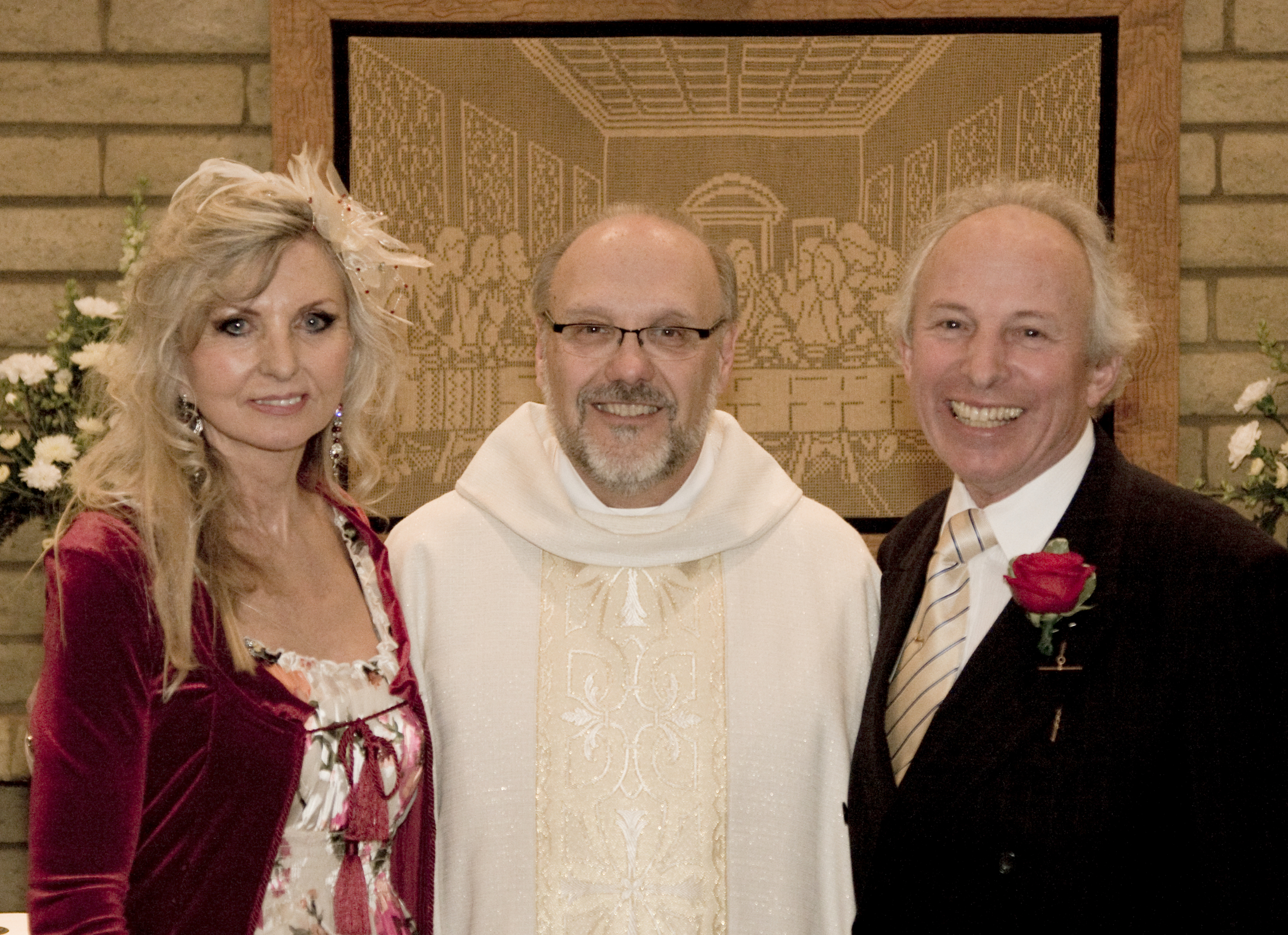
Jean, Father Dan and yours truly. St Paul’s Episcopal Church, Payson, AZ. November 20th, 2010.
Inevitably, while being married to Jean seems such a natural relationship, one is curious about what makes for a happy, lifelong relationship. Let’s face it, divorce is not uncommon. In fact, the Divorce Rate website reveals that in 2012, the divorce rate was 3.4 couples per 1,000 population in the USA; the sixth highest in the world.
So it was fascinating to listen to a recent radio programme broadcast under the BBC’s Point of View series. Just 10 minutes long, this particular programme was a talk by Adam Gopnik: The secret of a happy marriage 29th March 2013. (Adam Gopnik is an American commentator and writes for The New Yorker.)
You should be able to listen to the programme by going here. Or you can download the programme by going here, and following the instructions. (Not sure how long the programme will be available to listen/download, so don’t delay.)
The programme was also featured on the BBC News Magazine Website. From which I quote:
A Point of View: Is there a secret to a happy marriage?
Nobody can explain the secret to a happy marriage, says Adam Gopnik, but it doesn’t stop people trying.
Anyone who tells you their rules for a happy marriage doesn’t have one. There’s a truth universally acknowledged, or one that ought to be anyway.
Just as the people who write books about good sex are never people you would want to sleep with, and the academics who write articles about the disappearance of civility always sound ferociously angry, the people who write about the way to sustain a good marriage are usually on their third.
Nonetheless (you knew there was a nonetheless on its way) although I don’t have rules, I do have an observation after many years of marriage (I’ve promised not to say exactly how many, though the name “Jimmy Carter” might hold a clue).
Later, Adam Gopnik speaks about Charles Darwin whose marriage to Emma he describes “as something close to an ideal marriage.”
So what is it we learn from dogs?
So, marriages are made of lust, laughter and loyalty – but the three have to be kept in constant passage, transitively, back and forth, so that as one subsides for a time, the others rise.
Now Adam writes about the special form of loyalty that dogs offer us:
Be lit by lust, enlightened by laughter, settle into loyalty, and if loyalty seems too mired, return to lust by way of laughter.
I have had this formula worked out – and repeated it, waggishly, to friends, producing for some reason an ever more one-sided smile on the face of my beautiful wife.
Until, not long ago, I realised that there was a flaw in this idea. And that was that I had underestimated the reason that loyalty had such magnetic power, drawing all else towards it.
For I had been describing loyalty in marriage as though it were a neutral passive state – a kind of rest state, a final, fixed state at the end of the road of life.
And then, against our better wishes, and our own inner version of our marriage vows, at our daughter’s insistence we got a dog. And this is what changed my view.
“The expense and anxiety of children” indeed. Our daughter’s small Havanese dog, Butterscotch, has instructed us on many things, but above all on the energy that being loyal really implies.
Dogs teach us many things – but above all they teach us how frisky a state loyalty can be.
Dogs, after all – particularly spayed city dogs that have been denied their lusts – have loyalty as an overriding emotion. Ours will wait for hours for one of its family, and then patiently sit right alongside while there is work to be done.
Loyalty is what a dog provides. The ancient joke-name for a dog, Fido, is in truth the most perfect of all dog names – I am faithful. I am loyal. I remain.
Dogs are there to remind us that loyalty is a jumpy, fizzy emotion. Loyalty leaps up at the door and barks with joy at your return – and then immediately goes to sleep at your side. Simple fidelity is the youngest emotion we possess.
Repeat after me: We are of this planet! It’s really very simple!
There are times when I look back at my writings on Learning from Dogs, now well over 1,500 posts (1,633 as of today, to be anal about it!) and ponder if the fundamental message behind the name of the blog often gets overlooked. The Welcome page states:
As man’s companion, protector and helper, history suggests that dogs were critically important in man achieving success as a hunter-gatherer. Dogs ‘teaching’ man to be so successful a hunter enabled evolution, some 20,000 years later, to farming, thence the long journey to modern man. But in the last, say 100 years, that farming spirit has become corrupted to the point where we see the planet’s plant and mineral resources as infinite. Mankind is close to the edge of extinction, literally and spiritually.
Dogs know better, much better! Time again for man to learn from dogs!
Elsewhere on the blog, I underpin that proposition by listing the attributes of dogs:
value and cherish the ‘present’ in a way that humans can only dream of achieving
are, by eons of time, a more successful species than man.
Now this is all fine and dandy but of what relevance is this to the mess that homo sapiens now finds itself in? Two parts to that answer come to mind.
The first part is that watching a dog out in the open countryside quickly brings home the fact that these animals are part of nature and, if push comes to shove, can live in the wild and fend for themselves. Not saying that a domestic dog would enjoy the experience but that their wild dog and grey wolf roots still rest somewhere in a dog’s consciousness.
The second part of the answer is that all animals instinctively live in harmony, in balance, with their surroundings; with their environment.
For the incredibly obvious reason that dogs, as with all other animal species, are an evolutionary consequence of the natural history of Planet Earth. That evolutionary journey from the Grey Wolf (Canis lupus) part of the Canidae family, a family including wolves, coyotes and foxes, thought to have evolved 60 million years ago. That journey all the way to the domestic dog (Canis lupus familiaris).
That ancient journey where the African wild dog (Lycaon pictus – painted dog) came together with early man. No one knows when but the African wild dog was certainly around when man developed speech and set out from Africa, about 50,000 years ago!
Two vastly different natural species, dog and man, evolving compatibly with each other for so many thousands of years.
Back to the attributes of dogs, in particular a dog’s ability to cherish the present. Earlier this week I was chatting with Kevin Dick, friend from Payson, AZ days, about the ‘interesting’ times we are living in. Kevin thought there was a significant difference between the generations born in the 1940’s and 1950’s and those born in later times. Most people over the age of, say 55, were brought up to save for ‘a rainy day’ and, possibly, be able to leave a legacy to their offspring. Kevin then went on to reflect that more recent generations exhibit a ‘buy today, don’t delay’ mentality.
A by-product of this materialistic instant gratification approach is that the whole damn consumer machine has created a total disconnect with the fact that we humans are of this planet.
“The earth is the mother of all people..“
(Chief Joseph 1840 – 1904, leader of the Wallowa band, a Native American tribe
indigenous to the Wallowa Valley in northeastern Oregon)
Humans today fail to comprehend this fundamental fact: Our ability to harm the planet and think that it won’t affect our species is complete madness! If only we could learn how to cherish the present in the way that our dogs do!
I’m now going to offer an essay from John Hurlburt. I knew John had written this essay but didn’t get round to reading it properly until I had finished the introduction above. I’m blown away by the resonance between the two but, as always, John’s words are so much more eloquent.
Inside Out
Climate change, religion, economics, government, politics and social issues are topics which create strong personal opinions and cultural divisions. We have difficulty accepting ideas which may conflict with our personal understandings. As usual, it’s an ego thing. The arrogance of our species is inclusive. We all suffer the consequences.
To counter our ego, we know that everything fits together. We exist in a unified cosmos with fluctuations and diversities that emerge around and through us.
Our present transformative state is as a biological form of energy and matter which possesses a conscious awareness of the natural order. We choose to ignore or deny the essential nature of our being at our own peril. Do we live only for the moment or do we live to insure our species future? That’s our fundamental choice.
“Seek the truth and identify the common good.” Zoroaster [also known as Zarathustra, Ed.]
We are a consciously aware component of a living world in an isolated corner of a remote galaxy. Everything within and on the earth has an extraterrestrial origin. We live on an incubator we call the earth. We rarely truly communicate with or fully understand the energy of nature in our lives. Our critical thinking ability has become enveloped by an electronic cloud.
We generally agree that the actions of many religions and most politics are based upon short term human interests rather than upon the long term well being of our planet and its disappearing life forms. The fact is that we only began to emerge as a species about 100,000 years ago. Hubble telescope observations have dated our universal origin to roughly 13,002,000,000 years ago.
Could it be that we only imagine ourselves as independent beings? Could it be that beyond the mind games we play there is a vast reality greater that we can understand with our limited sensory apparatus and our finite minds?
Life is a transformative experience. All species, tribes, races and genders are united by the nature of life. We pass through a period of being selfish and ambitious during our journey. Many of us choose to move into these familiar ruts and furnish them. We do not always walk the way we talk.
Nature favors species which adapt to constant change in an emerging universe.
If we agree that our intelligence is judged by choices we make, there is some question about intelligent human life on earth. A recent Harvard University study of species in relation to change estimates that the life span of the human species is approximately 100,000 years. Sound familiar?
The wisdom of our brief human history tells us that we are on a careless and needless path to self destruction. All that’s necessary to verify this assertion is to turn on the news of the day. The systemic paradigm that has been imprinted on our psyches is in constant flux. As we live and learn, we realize that our purpose is to leave life better than we found it.
A delicate balance is necessary to maintain an even strain of faith in the natural process rather than dwelling upon our self centered fears of losing something we imagine we own or not attaining something we believe we want. The earth heals itself from the inside out. We can do the same as a species. Today is the tomorrow we dreamed of yesterday. What have we done to fulfill the true purpose of our lives?
an old lamplighter
So, yes, we have much to learn from dogs.
I will close as I started. We are of this planet! It’s really very simple!
We spent some enjoyable time with neighbours Dordie and Bill yesterday afternoon from where my sub-heading quote comes. Perhaps, a tad tongue-in-cheek, but only a tad!
Yesterday, the bulk of my post The new tomorrows consisted of a powerful essay from William deBuys ‘Phoenix in the Climate Crosshairs‘, courtesy of TomDispatch. It painted in very stark terms the impact of climate change on the metropolitan city of Phoenix in Arizona; a city of over 4 million people, indeed home to more than two-thirds of Arizona’s population.
So, today, I wanted to wander through some other aspects of this new world order.
Here’s a recent item on Climate Crocks examining the changes in March’s weather, 2013 vs 2012. From which I quote:
Much Different March. Same Reason?
Dittohead reasoning: “So when it’s warm, you blame it on climate change. When its cold, you blame it on climate change. It can’t be both.”
I think we’ve passed the point of tolerance with these ceaseless storms. Gone are the days when viewers would flood our inboxes with pretty pictures of their pets and kids frolicing in the snow. Constant cleanup has made us snippy and short – even a few plow guys have hoisted the white flag. The holidays are long past, the winter is stale, and the people just want spring…
…and accountability. Instead of pictures, I get questions in my inbox. “Why are we getting so much snow? Why did it turn on a dime? And when will it stop?”
Those are fair questions. But with the limits of the long range (10-14 day) forecasts, I’m not ready to answer the last question. We may sail out of this in April, but so far the first week of the month isn’t looking much different from the first week in March. The ultimate question is why.
The jetstream has taken on an odd path. [my emphasis]
Now just look at this:
Forecast sea level pressure departures from average from the GFS computer model. This shows the large area of unusually high atmospheric pressure over Greenland. Image from Weatherbell
Later on that article says:
Recent research suggests that rapid Arctic climate change, namely the loss of sea ice cover, may be contributing to blocking patterns like we’re seeing right now. That rapid decline in Arctic sea ice since the beginning of the satellite record in 1979 may be altering weather patterns both in the Far North and across the U.S.. Some studies have shown that sea ice loss favors atmospheric blocking patterns such as the pattern currently in place, while others have not shown statistically significant changes in blocking patterns across the Northern Hemisphere, at least not yet. Arctic sea ice extent declined to a record low during the 2012 melt season.
The last Winter in North-West Europe has been ‘interesting’, to say the least! A follow-up to that Climate Crock’s essay reports:
A study published in 2012 showed that by changing the temperature balance between the Arctic and mid-latitudes, rapid Arctic warming is altering the course of the jet stream, which steers weather systems from west to east around the northern hemisphere. The Arctic has been warming about twice as fast as the rest of the Northern Hemisphere, due to a combination of human emissions of greenhouse gases and unique feedbacks built into the Arctic climate system. The jet stream, the study said, is becoming “wavier,” with steeper troughs and higher ridges.
A new study published in the journal Environmental Research Letters shows that reduced sea ice cover can favor colder and stormier winters in the northern midlatitudes
Did you fully take in that paragraph? The one about “The Arctic has been warming about twice as fast as the rest of the Northern Hemisphere …“?
The other great ‘river’ in the North Atlantic is the thermohaline circulation or to put it in more familiar terms: The Gulf Stream. Has that been changing? You bet! In more ways than one might expect.
Here’s a snippet from an item from last October’s issue of Nature journal:
Recent changes to the Gulf Stream causing widespread gas hydrate destabilization
The Gulf Stream is an ocean current that modulates climate in the Northern Hemisphere by transporting warm waters from the Gulf of Mexico into the North Atlantic and Arctic oceans. A changing Gulf Stream has the potential to thaw and convert hundreds of gigatonnes of frozen methane hydrate trapped below the sea floor into methane gas, increasing the risk of slope failure and methane release.
How the Gulf Stream changes with time and what effect these changes have on methane hydrate stability is unclear. Here, using seismic data combined with thermal models, we show that recent changes in intermediate-depth ocean temperature associated with the Gulf Stream are rapidly destabilizing methane hydrate along a broad swathe of the North American margin.
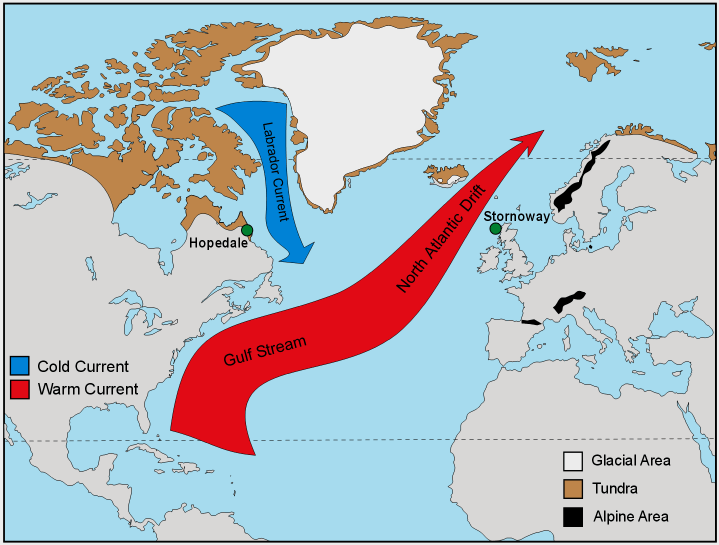
As the diagram below shows all too clearly, the cold waters from above the Arctic circle directly affect the Gulf Stream.
Average sea ice extent for February 2013 was 14.66 million square kilometers (5.66 million square miles). This is 980,000 square kilometers (378,000 square miles) below the 1979 to 2000 average for the month, and is the seventh-lowest February extent in the satellite record.
Less ice means more cold water. QED!
OK, moving on.
We met recently with Wayne over at Rogue Valley Firewood here in Merlin. Not to buy more firewood but because Wayne has started into hugelkultur. Jean and I hadn’t heard of the term before. Come back to that in a moment.
In musing with Wayne about how rapidly life is changing for us all, he spoke of the consequence of rising fuel prices and the rising costs of putting petrol (OK, he used the word ‘gas’!) in one’s car. Wayne pointed out the obvious. That the inevitable effect of those rising costs would be to steadily reduce one’s range for ‘affordable’ car journeys. Many people will no longer be able to afford to drive longer distances.
In other words, local will increasingly become more relevant to daily life. Or to use a better word than local, community will return to the centre stage of our world. And of all the things important to a community, none is more so than access to food.
Back to Hugelkultur. Watch this video:
Wayne is committed to seeing just what can be grown for the local community of Merlin using this form of raised garden bed. You can read more here.
The USDA’s new Food Access Research Atlas is a map of all the places in the country where people live in food deserts — places where it’s difficult to access fresh food.
The message that hits me from that map is the consequence for millions of people, especially those in rural areas or unable to afford a car, when it comes to getting hold of fresh food. Another reason why community food programs are going to be a feature of the new tomorrows.
Finally, take a look at a recent item on Paul Gilding’s blogsite.
Paul Gilding
Paul is an independent writer, advisor and advocate for action on climate change and sustainability. He recently published Victory at Hand for the Climate Movement?From which I offer:
There are signs the climate movement could be on the verge of a remarkable and surprising victory. If we read the current context correctly, and if the movement can adjust its strategy to capture the opportunity presented, it could usher in the fastest and most dramatic economic transformation in history. This would include the removal of the oil, coal and gas industries from the economy in just a few decades and their replacement with new industries and, for the most part, entirely new companies. It would be the greatest transfer of wealth and power between industries and countries the world has ever seen.
To understand this incredible potential we first have to step back and understand the unique structure of this social change movement, which may rank among the most influential in history. It is simplistic to characterise it as an alliance of grass roots organisations and activists pitched against a rich and well connected adversary. While that is part of the story, it is more accurately understood as an idea whose tentacles reach into every tier of government, the world’s largest companies and financial institutions, and throughout the academic and science communities.
Because of this, it is winning the battle from within: Its core arguments and ideas are clearly right; being endorsed by the world’s top science bodies and any significant organisation that has examined them.
Strikes me that in one very important way, we will be reverting to how our ancient hunter-gatherer ancestors lived. I mean reverting to living our lives as relatively small interdependent communities almost exclusively at the local level.
Guess what! Yet another aspect of learning from dogs. In the wild, dogs live in groups of about 50 animals with clear boundaries to their territory. Just like the ancestors of the domesticated dog and the wild dog: The grey wolf Canis Lupus.
I’m writing this at 3pm on the Tuesday, i.e. yesterday afternoon.
In under an hour’s time we have to leave to travel to Grants Pass to see the vet and have poor Lupe euthenised. She has been suffering from dementia since before Christmas and has got to the point where she has little or no quality of life left. Jeannie has been a saint in patiently administering to Lupe’s needs; feeding her, cleaning her up, and more. All for many weeks now. It was about 2 hours ago that Jean knew the time had come.
A few pictures from better times.
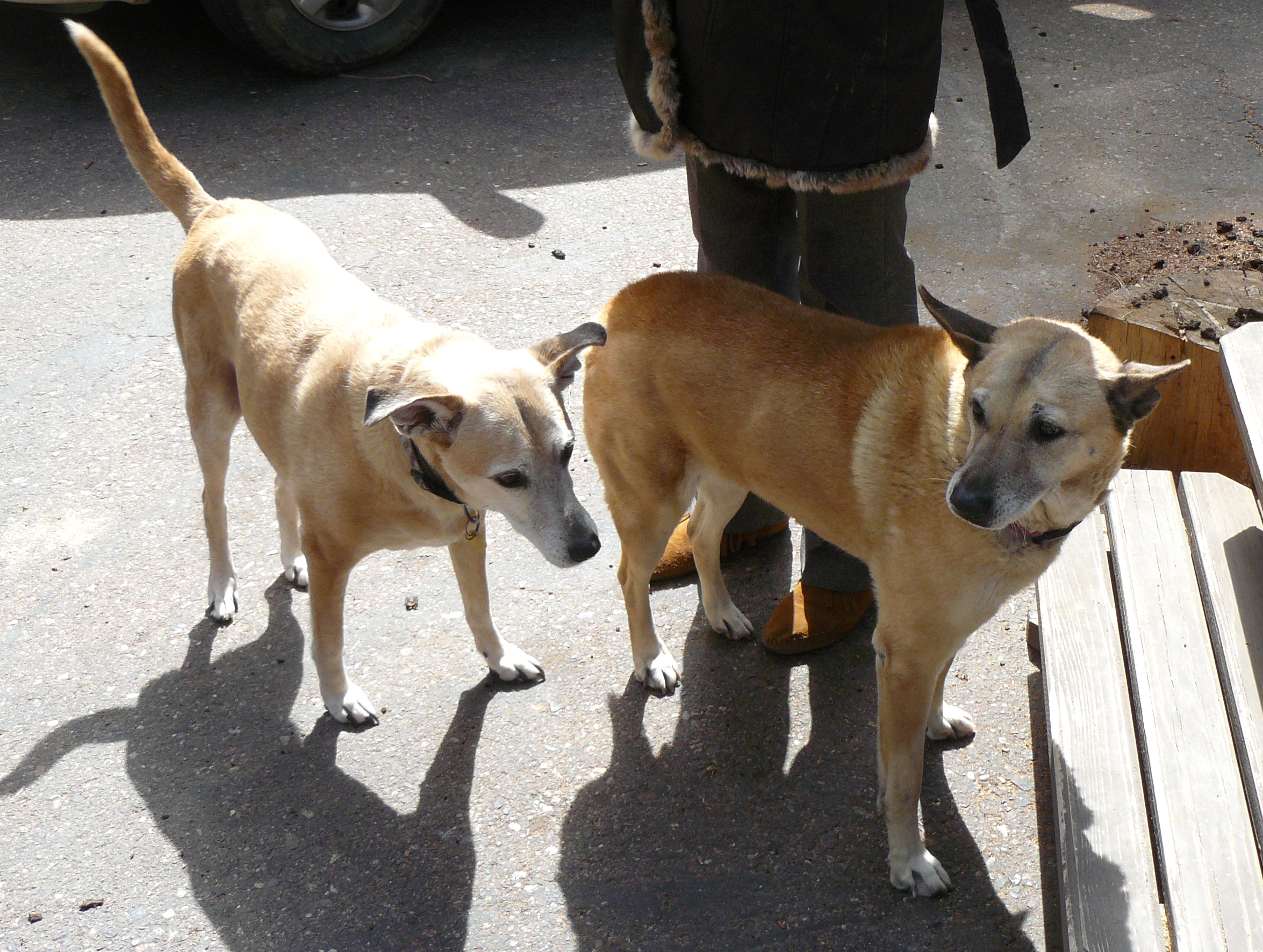
From Mexico days back in 2008. Lupe is second from the left.
Lupe leading Lilly, taken in February of 2012 at our home in Payson, AZ.
Picture of Lupe taken just 8 weeks ago, showing clearly the effects of the dementia in terms of her posture.
Lupe was always a challenge having been terribly treated as a feral dog in Mexico. In fact, it was 6 months before Jean could fondle her after she had been rescued by Jean. But slowly she learnt to trust Jean and then to offer Jean lots of doggie love. I, too, have fond memories of being cheek-to-cheek with Lupe; her love and trust overcoming all fears.
Yet another learning message from our animal kingdom.
As I wrote in Monday’s post, this week I was going to “Enjoy the beauty of the world around me and offer a few essays on the meaning of life.”
Hopefully the subsequent essays on Carl Sagan and how our beautiful planet can change our consciousness, under the title of To see is to understand, have partly achieved that aim.
We hear so much that is unsettling that it is easy to lose sight of the core qualities of a sustainable society. And one of the most fundamental requirements is that of trust.
A loving dog owner will most likely take their dog’s trust for granted.
However, think of the incredible differences, at so many levels, between man and dog. Then reflect on how a dog learns to trust a human.
This picture is of Dhalia taken less than a couple of months ago. She was found by Jean in 2005 running wild in the Mexican desert with a companion dog. As Jean explains,
With friend, Suzann, I was driving out to a fishing village to medicate and feed the many starving dogs. The two dogs were in a very desolate part of the desert prowling the roadside for road-kill. We stopped to feed them and give them water. One of the dogs ran off but as I put down food, I saw the smaller brown dog walking slowly towards me.
She was emaciated and full of mange. She looked up at me, ignoring the food. I reached out with my hand and she gently nudged it with her nose.
The food was irrelevant to her at this moment. She just seemed to know that I was there to help. I scooped her up and took her home, curled up in my arms as we drove away.
No better example of a dog instinctively trusting a human, almost immediately.
OK, from dogs to elephants.
I recently became aware of Lawrence Anthony. Here’s a brief extract from WikiPedia:
Lawrence Anthony (17 September 1950 – 7 March 2012) was an international conservationist, environmentalist, explorer, and bestselling author.
He was the long-standing head of conservation at the Thula Thula game reserve in Zululand, South Africa and the Founder of The Earth Organization, a privately registered, independent, international conservation and environmental group with a strong scientific orientation. He was an international member of the esteemed Explorers Club of New York and a member of the National Council of the Southern Africa Association for the Advancement of Science, South Africa’s oldest scientific association.
Anthony had a reputation for bold conservation initiatives, including the rescue of the Baghdad zoo at the height of the US lead Coalition 2003 invasion of Iraq, and negotiations with the infamous Lord’s Resistance rebel army in Southern Sudan, to raise awareness of the environment and protect endangered species, including the last of the Northern White Rhinoceros.
Lawrence Anthony died of a heart attack at the young age of 62. In just a short time that will be a year ago.
In doing research for today’s post, I quickly came across this story.
Lawrence Anthony, a legend in South Africa and author of 3 books including the bestseller The Elephant Whisperer, bravely rescued wildlife and rehabilitated elephants all over the globe from human atrocities, including the courageous rescue of Baghdad Zoo animals during the US invasion in 2003.
On March 7, 2012 Lawrence Anthony died. He is remembered and missed by his wife, 2 sons, 2 grandsons and numerous elephants.
Two days after his passing, a remarkable thing happened! The wild elephants showed up at his home led by two large matriarchs. Separate wild herds arrived in droves to say ”goodbye” to their beloved man-friend. A total of 20 elephants had patiently walked over 12 miles to get to his South African house. [my emphasis.]
Was this true? A quick web search came across this video, (overlook the last few seconds!)
Françoise Malby-Anthony, wife of the late Lawrence Anthony, talks about the entire herd of elephants returning to the main house to pay their respects to their rescuer and friend ‘The Elephant Whisperer’.
“Fear comes from uncertainty. When we are absolutely certain, whether of our worth or worthlessness, we are almost impervious to fear.”William Congreve, English playwright and poet.
It’s Sunday (i.e. yesterday). I woke around 6am to a cold morning (28 deg F/-2.2 deg C), the result of a clear, moonlit night.
Then as the night sky lightened with the coming dawn, the green, forest-cloaked valleys, visible to the East through the bedroom windows filled with a white, morning mist. In a metaphorical sense that descending mist matched a mood of gloom that was trying to descend on me.
Early morning mist, taken 7:15 am Sunday, 24th Feb.
As I lay back against the headboard of the bed, Jean still sleeping close to me, dogs Cleo, Hazel and Sweeny snoozing on and around me, I pondered on my mood. It came to me that I might be picking up the growing sense of anxiety, of uncertainty, that seems to be ‘in the air’. Me reading too many blog articles about global warming, climate change, et al. Being three-quarters through Professor Guy McPherson’s book Walking Away from Empire: A Personal Journey wasn’t helping either!
Then I recalled a recent conversation with dear friend and colleague from our Payson, AZ. days, John Hurlburt, who said that fear is the absence of faith. That if we trust what will be will be, then we can counter the fear of the unknown and embrace the present day, one day at a time. Living in the now as, you’ve guessed it, that dogs do so supremely well. Something else to learn from dogs!
I made a decision to take a stroll in the forest, emotionally speaking, for this week, so far as Learning from Dogs is concerned. Enjoy the beauty of the world around me and offer a few essays on the meaning of life. No blog posts at all about anything that engenders fear from any quarter!
And if that doesn’t slash the readership figures, I don’t know what will! So there! You have been warned.
So let me start by offering this essay from John. John is one of those rare people who has been through more than his fair share of ‘challenges’ over the years, yet has grown from those experiences.
Here’s John – I’m turning over and going back to sleep!
oooOOOooo
Education, Formation and Transformation
Most Americans remain comfortably complacent despite world economic brinksmanship, the escalating deterioration of our planetary environment and raging world discontent. Although we may be caring and compassionate in our personal lives, we are often reluctant to take any risk of reducing our personal comfort.
Education is a process. A process of learning how to think life through in order to become aware of whom we are, what we are, where we are, and why we exist. Education has always been the human gateway to a better future.
Knowledge does not guarantee wisdom. Education, formation and transformation are an integrated process which includes studying to gain knowledge, making natural connections based on the best information available, and experiencing the higher levels of conscious awareness we recognize as wisdom. The educational process works best when it is open minded, factual and sustained. We learn best when we learn together.
The human wisdom tradition is rich in myth, mysticism, symbols, imagination and creativity. It tells a common story of emergence through centuries of sacred writings stretching back through time to the earliest human cave scratchings roughly 17,000 years ago, and the beauty of the prayers of the Rig-Veda 12,000 years ago which all begin with an homage to the natural energy of the Sun.
We’re conscious components of a living planet. We’re surface dwellers with exposure to universal and planetary energies. Our species is only 200,000 years old. The universe is roughly 13 billion years old. Our planet is deteriorating and we’ve lost our collective moral compass. What can we do to make a local difference?
We only recently learned to hunt woolly mammoths in packs using bows, arrows and spears as tools. A perception of God in relation to our responsibility to each other and creation exists as the foundation of a human wisdom tradition which, relatively speaking, has just began.
In many ways, nothing seems to have changed as we have passed through successive cyclic waves of emergence and contraction. It becomes simultaneously increasingly more complex and exquisitely simple to understand. That is as we begin to realize how our metanexus emerges, contracts and turns inside out without breaking … like a pulse.
The next ten years are more important than the next several thousand years in respect to the choices we make about our biosphere.
There seems to be little doubt that our world problems are steadily increasing. What’s the next right thing to do? It’s time to grow our conscious connection in God. It’s time to share the spring of human wisdom from the ground up. It’s time to develop a world economy which is gentle to the earth.
The Clearing Rests in Song and Shade
The clearing rests in song and shade.
It is a creature made
By old light held in soul and leaf.
By humans joy and grief,
By human work,
Fidelity of sight and stroke,
By rain, by water on
The parent stone.
We join our work to Heaven’s gift,
Our hope to what is left,
That field and woods at last agree
In an economy
Of widest worth.
High Heaven’s Kingdom come on earth,
Imagine Paradise
O dust, arise!
Wendell Berry; 1909
oooOOOooo
“The illiterate of the future will not be the person who cannot read. It will be the person who does not know how to learn.” Alvin Toffler
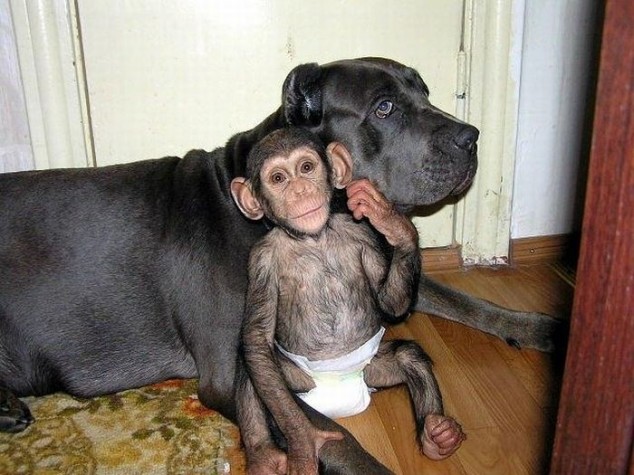
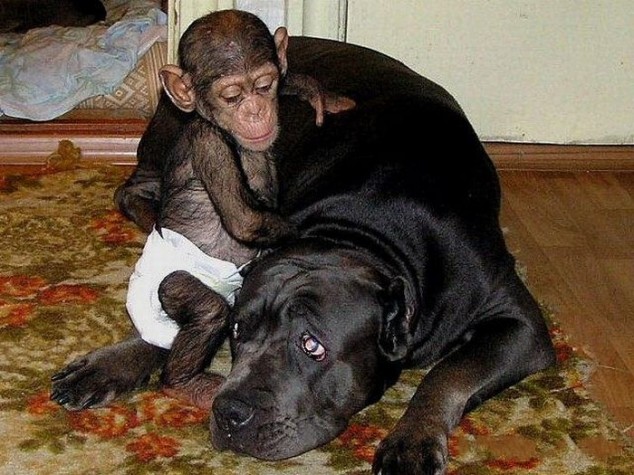
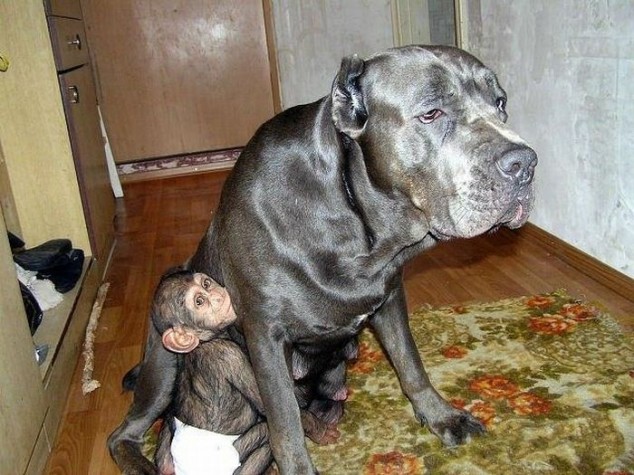
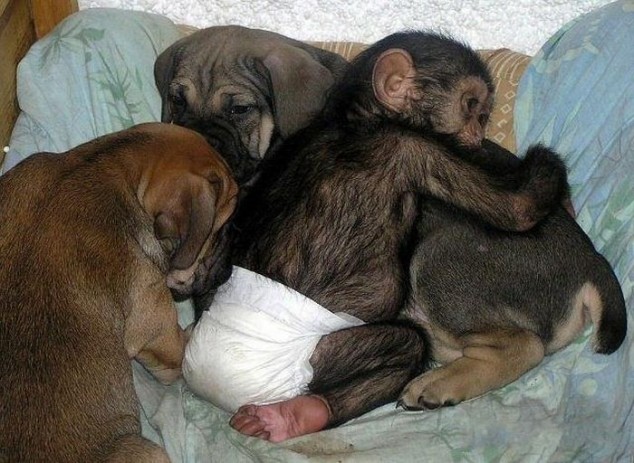
The widely reported story of a dog ‘adopting’ a baby chimpanzee.
(With big thanks to Chris Snuggs for sending me the pictures)
As a quick Google search finds:
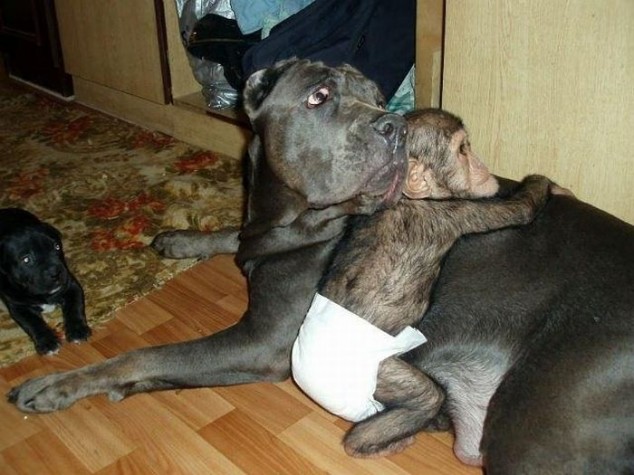
Two years ago in a Russian zoo a female chimpanzee for some reason repudiated and abandoned her baby chimpanzee. When one of the employees of the zoo took the little chimpanzee home it never crossed her mind that her dog, a mastiff, would become a mother for the orphaned chimpanzee and treat the baby as her own child.
Judging by the look on her face at times, she is not quite sure why this particular offspring has hands to grab her with!
The unconditional love of a dog.
Fascinating example of the power of upbringing.
What is so wonderful, and amazing, is how ‘mother’ accepts this strange looking and strange smelling creature as it’s own. Think how important smell is to dogs!
Words add nothing to the beauty of this photograph.
You can see the huge difference in body mass between these two. One swipe, one bite and the little chimp would be toast! The dog’s love for the chimp overrides all!
Just beautiful.
Mummy, what’s that on the wall?
Mummy, your feet are so big …. and not at all like mine!
oooOOOooo
Dear Chris, thank you so much for sending me these pictures. It’s a privilege to share them with LfD readers. It reminds us that in this difficult era, with so many challenges facing us, that there’s nothing that can’t be solved with love, compassion and understanding.
“A delusion is something that people believe in despite a total lack of evidence.” Richard Dawkins.
Yesterday, I started down the road of determining how one gets to the truth of a complex issue. I called the post Doggedly seeking the truth. My proposition was effectively saying that just because a person believes in argument ‘a’ or argument ‘b’ that doesn’t of itself make ‘a’ or ‘b’ the truth.
Unwittingly, Martin Lack of the blog Lack of Environment reinforced that point in spades. He wrote in a comment to yesterday’s post:
The deliberate spreading of misinformation is a fundamental part of the industry-led movement to deny the reality of anthropogenic climate disruption. Alex Rawls is just part of this campaign and I therefore do wish that you would consult me before deciding to help publicise and/or lend credence to such nonsense.
Now I have every sympathy for Martin’s outpourings of feelings; his blog is based on the conviction of his own beliefs. A position of integrity.
But taken literally, Martin’s words, “consult me before deciding to help publicise” mean that he wishes to influence what I choose to write. Of course he didn’t mean to convey that.
Back to yesterday’s post. With Dan’s permission, I reproduced the personal email that he sent me with those two articles. Dan isn’t on the payroll of the Koch brothers or blindly following an “industry-led movement to deny the reality of anthropogenic climate disruption“, he is a thinking human who is yet to be convinced that AGW is as rational a process as, say, gravity!
Humans are not fundamentally rational; we are emotional beings who even in this 21st century have little real understanding of what a human being is. (Must be honest and say that this last sentence is a tickler for a mind-opening video on the nature of human consciousness coming out on Friday.)
So if Dan is not convinced about the effects that mankind is having on Planet Earth, then spare a moment to ponder about the millions of others around the world who are far less capable, even if they had the time and inclination, to adopt a rational, open-minded view of the complexity of AGW.
It gets even more convoluted. In Professor McPherson’s video that was presented yesterday, this gets said, “If we act as if it’s too late, then we becomes a self-fulfilling prophesy”. On the face of it, that’s obvious. But on Guy McPherson’s blog Nature Bats Last the video has it’s own post and includes a comment left by Daniel, from which I quote:
Guy,
There are so many insoluble dilemmas concerning industrial civilization, it’s almost impossible for anyone to attempt to propose a “solution”, or attempt to describe the work that now needs to be done, without becoming a hypocrite.
At this stage, hypocrisy is unavoidable. Beyond the point of overshoot, at least in our culture, all that’s required to be a hypocrite, is to be alive.
I have watched your presentation evolve over the last few months, and with this latest one, something struck me as peculiar. You’ve added this line:
“If we act as if it’s too late, then we becomes a self-fulfilling prophesy”.
Basically, implying that we shouldn’t accept that it’s too late. Yes?
The evidence that now exists, has established an immovable catastrophe, which is now, well outside human agency ( aside from the looming boondoggle of geo-engineering). This is what the evidence shows. We have effectively already become a self-fulfilling prophesy. The most dire warnings of the last three decades, have now become prophetic. What are eight non-reversible feedbacks if not a physical manifestation of a self-fulfilling prophesy?
To which Guy replies:
Daniel, you’re asking the same questions many others have been asking lately. I’ll try to respond with my next essay, which I’ll complete and post in a couple days.
Seems to reinforce the message. That we really shouldn’t be surprised at the delusions, games and power interplays going on, especially in the corridors of power, so to speak.
Right! Time for me to show my hand!
I am totally convinced that we humans are responsible for the rising levels of CO2 in the atmosphere and that this accounts for the majority of the abnormal weather events being experienced in so many parts of the planet.
I think I’m right. Therefore I give more weight to the evidence that supports my view that, guess what, reinforces me thinking I’m right.
Is that scientific? Of course not! Science is about producing reproducible outcomes. With, say gravity, that’s a piece of cake.
I’m not a scientist, far from it. Therefore the following statement may be unreliable. That the problem with producing an uncontroversial, hard-wired proof that man is screwing up (you see, I did say that I wasn’t a scientist) our planet is that we don’t have other planets with which to test the thesis. When it surely is an uncontroversial, hard-wired proof it will be too late!
Having said all that, tomorrow I will present the best evidence that I can find to support the notion that Dan’s beliefs are wrong.
Back to Casey and that scent:
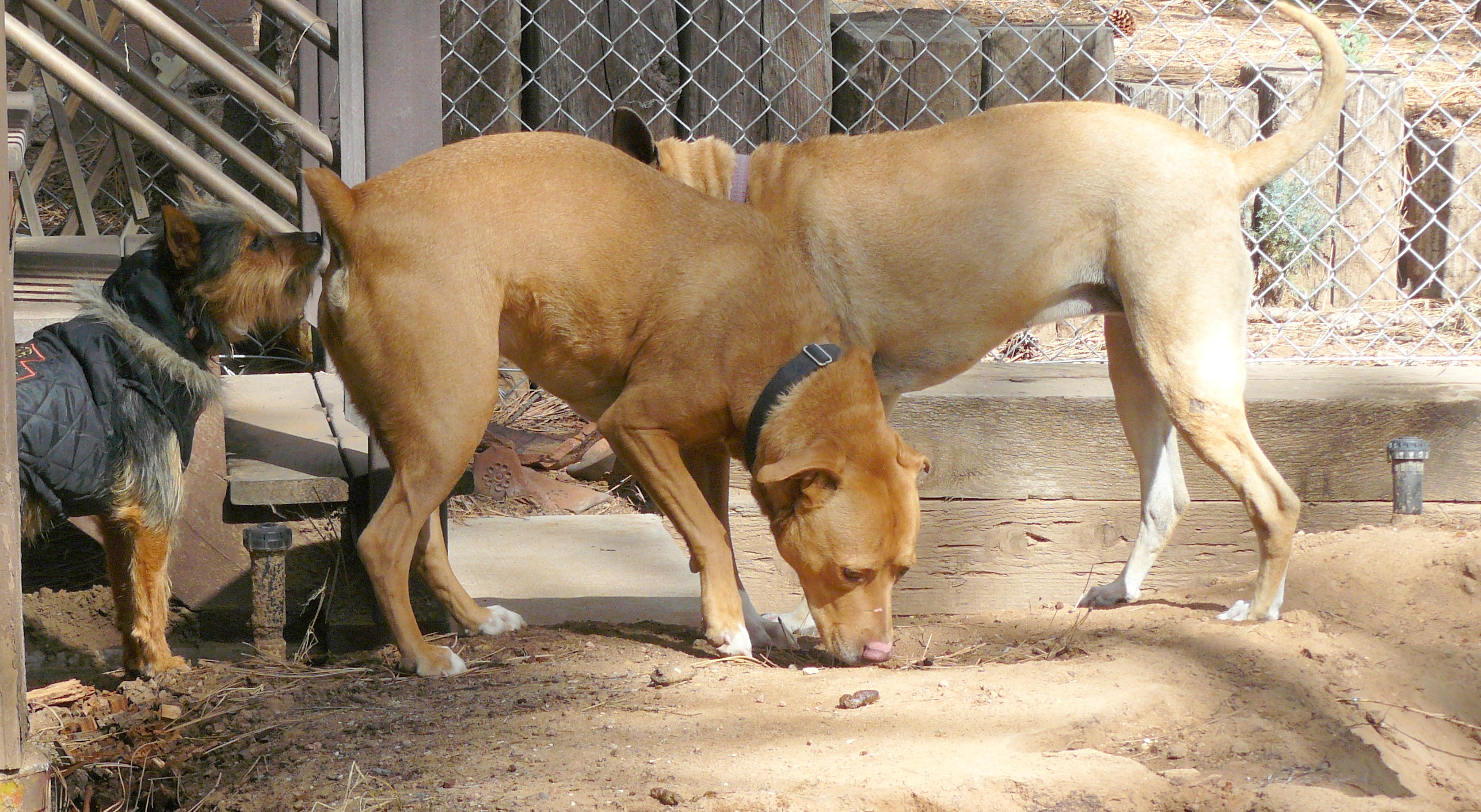
Now where’s that scent now? Sweeny, help me! Hang on, let me finish sniffing your bum! Ask Ruby to help, she’s just by the fence.
We can never be as rational as dogs. But maybe if we learnt to live more in the present, as dogs do so well, the world would be a much simpler and sustainable place.
On the road, there’s little possibility to develop a lasting relationship. I throw a Molotov cocktail into the conversation, and then I leave the area.
On the road, I describe how we live at the mud hut. I describe the importance of living for today.[my emphasis]
Dogs wouldn’t treat other members of their pack like this.
(I realise how the heading and the sub-heading don’t appear to have any correlation but stay with me please!)
It’s widely known, I’m sure, that the wolf, from which the wild dog and the domesticated dog evolved, lives in packs of around 50 animals. The size of the pack offers a cohesive, stable structure for the wolf, and other pack species, ensuring group survival and well-being. In a very real sense the way that wolves live is a fabulous example of the power of community.
My understanding of early hominids is pretty basic but if ‘Homo habilis‘ represents the evolution of modern man then our species goes back less than 3 million years.
The Dog linage began 37 million years ago in North America in predators that had distinctive pairs of shearing teeth and ran down prey. Early canids reached Europe seven million years ago.
Thirty-seven million years! Now that’s what I call an example of “group survival and well-being“. The power of community.
As stated elsewhere on this blog,
Dogs are part of the Canidae, a family including wolves, coyotes and foxes, thought to have evolved 60 million years ago. There is no hard evidence about when dogs and man came together but dogs were certainly around when man developed speech and set out from Africa, about 50,000 years ago. See an interesting article by Dr. George Johnson.
The ten dogs we have here at home are split into two groups of five. What we call the bedroom group: Pharaoh, Cleo, Sweeny, Hazel and Dhalia, and the kitchen group consisting of Lily, Casey, Ruby, Paloma and Loopy. Both groups are separated by wooden fences so are more than aware of each other.
Something that is clear is that whenever one of the dogs is hurt, all the other dogs take notice. Others in the same group will come up to their hurt ‘buddy’ and offer comfort in a variety of ways. Sadly, I can’t give you a better example than our poor Loopy who is suffering badly from the dog equivalent of dementia.
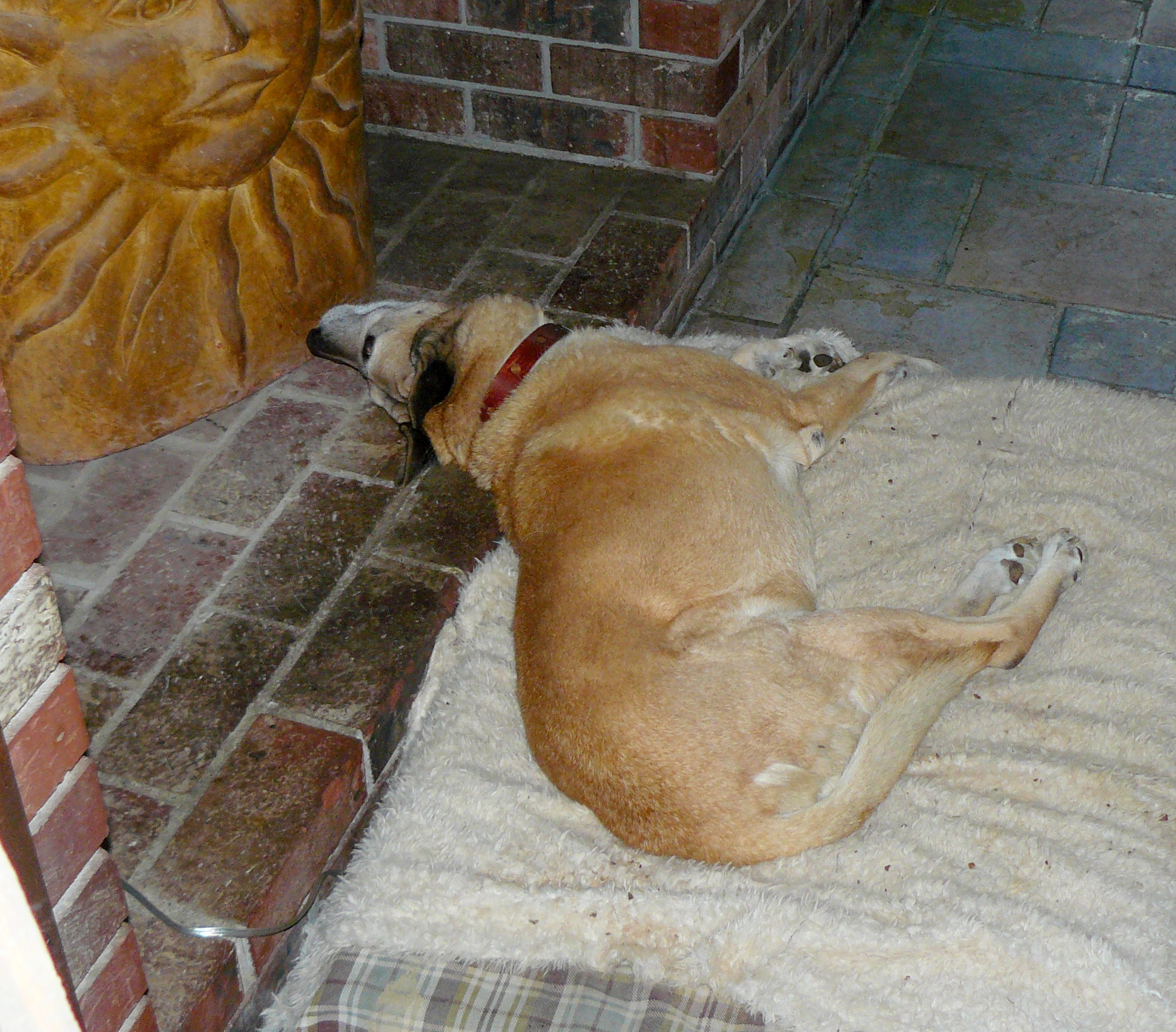
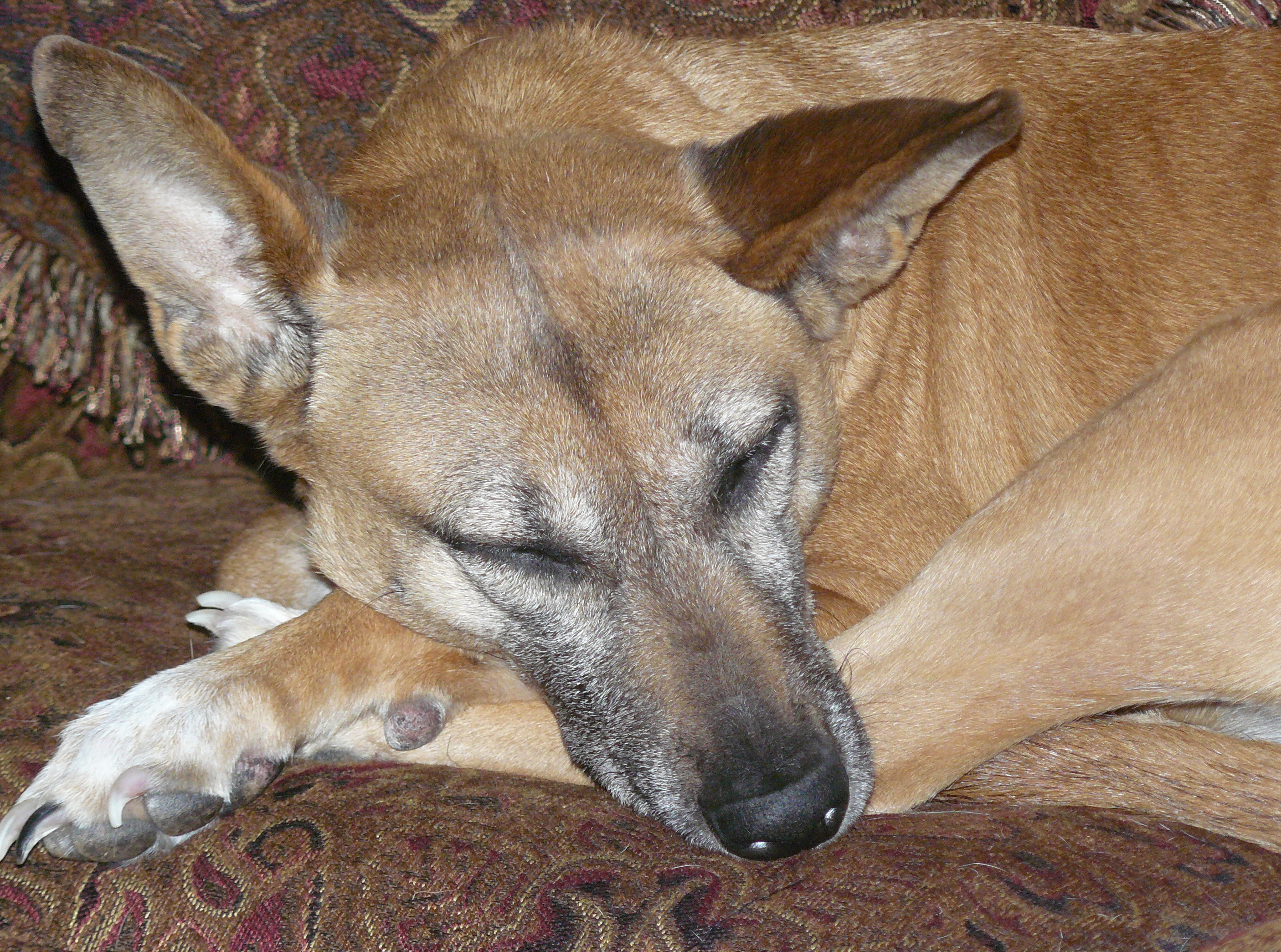
Here’s a picture taken of Loopy on Wednesday afternoon. You will notice the strange sleeping position that she frequently adopts. That’s an aspect of her dementia.
The other dogs in her group all give her special attention. Such as not grabbing her sleeping bed, not pushing or shoving near her, giving her a wide space in general. The other dogs sense there is something badly awry with Loopy and accommodate that.
So what on earth has this to do with yesterday’s post Who owns the World? Keep hanging in there!
A recent link in Naked Capitalism‘s daily news summary was to a story in the British Guardian newspaper. Written by the Guardian’s Kevin McKenna, it was about the likelihood of Scotland breaking away from the United Kingdom.
Scottish independence is fast becoming the only option
Even to a unionist like me, an Alex Salmond-led government is preferable to one that rewards greed and corruption
It’s an interesting article and I recommend you read it directly. But what jumped off the page at me were these paragraphs. Please focus deeply on the words and ponder on how foreign they are to the concept of community.
Yet we conveniently overlook the fact that London has already broken away from the United Kingdom and now exists as a world super-state governed by the greed of unhindered capitalism and recognisable as British only by its taxis and bad service. As the world’s most newly minted oligarchs continue to colonise the independent state of London, it becomes almost impossible for families on less than £250k to live decently there. Poor London families made homeless by the coalition benefit cuts are being evacuated as far north as Middlesbrough.
Last week, Goldman Sachs, one of the banks with its fingers in the till when global economic meltdown occurred, awarded an average bonus of £250,000 to each of its employees. The gap between the richest in our society and the poorest stretched a little more and we were reminded yet again that the UK government, despite its promises, allows greed, incompetence and corruption to be rewarded. (How many people do you think will go to jail for the Libor rate-fixing scandal?) Meanwhile, Westminster politicians are dividing the poor into categories marked “deserving” and “scum”.
Think a dog is just a cuddly animal that gives you a chance to do some dog-walking? Again, written elsewhere on Learning from Dogs.
value and cherish the ‘present’ in a way that humans can only dream of achieving
are, by eons of time, a more successful species than man.
Now compare that with the last sentence in Noam Chomsky’s essay from yesterday, “As long as the general population is passive, apathetic, diverted to consumerism or hatred of the vulnerable, then the powerful can do as they please, and those who survive will be left to contemplate the outcome.”
“Hatred of the vulnerable“; “those who survive will be left to contemplate the outcome” are not expressions that resonate with the values of loving communities. If we humans want “group survival and well-being” we had better learn from species lupus and canid. Pronto!














 Learning from Dogs