There was a wonderful reader reaction to yesterday’s post and it seemed so utterly appropriate to repost something back from November, 2012. Simply because it underscores the reasons why if anyone is looking for a dog, to please consider a rescue dog first.
oooo
More on the beautiful and inspiring ways of the dog.
(First posted on the 20th November, 2012.)
Back at the beginning of July, I wrote a post about Jasmine. Jasmine was a rescue dog that turned out to be a natural ‘Mother hen’. That post was called Letting go; a dog lesson and, as the post explains, “Jasmine was truly one of a kind. She mothered many of the sanctuary’s residents back to health including Bramble the roe deer, Humbug the badger and two of the other sanctuary dogs, just to mention a few.”
But, guess what? More evidence of the benefits of having a dog in your life (or in our case make that 10 dogs!). [Ed. Now 9 dogs.]
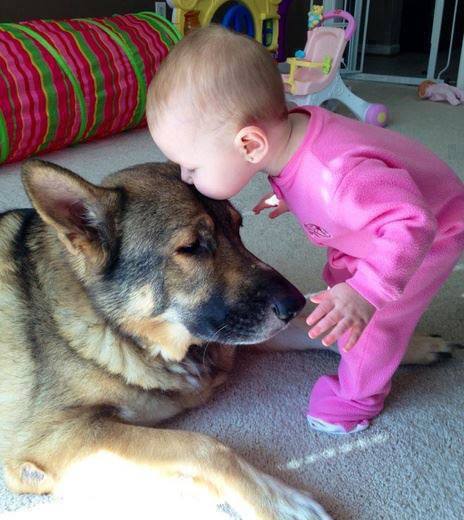
Babies who spend time around pet dogs have fewer ear infections and respiratory ailments than those whose homes are animal-free, reported a study.
The study, published in the US journal Pediatrics, did not say why but suggested that being around a dog that spends at least part of its day outdoors may boost a child’s immune system in the first year of life.
Cats, too, seemed to convey some protection to babies, though the effect observed was weaker than with dogs.
The article goes on to say,
The research was based on 397 children in Finland whose parents made diary entries each week recording the state of their child’s health during the infant’s first year, from nine weeks to 52 weeks of age.
Overall, babies in homes with cats or dogs were about 30 percent less likely to have respiratory infectious symptoms — which included cough, wheezing, rhinitis (stuffy or runny nose) and fever — and about half as likely to get ear infections.
And concludes,
The most protective association was seen in children who had a dog inside at home for up to six hours a day, compared to children who did not have any dogs or who had dogs that were always outside.
“We offer preliminary evidence that dog ownership may be protective against respiratory tract infections during the first year of life,” said the study.
“We speculate that animal contacts could help to mature the immunologic system, leading to more composed immunologic response and shorter duration of infections.”
The improvement was significant, even after researchers ruled out other factors that could boost infection risk, such as not having been breastfed, attending daycare, being raised by smokers or parents with asthma, or having older siblings in the household.
In addition to having less frequent ear infections and respiratory infections, babies near dogs tended to need fewer courses of antibiotics compared to those who were reared in pet-free households, it said.
Previous research has shown conflicting results, with some studies finding no benefit for young children being around furry pets and others finding that animal contact appears to offer some protection against colds and stomach ailments.
The study authors said their research differs from previous analyses because it focuses solely on the first postnatal year and does not include older children.
Yesterday evening we had close friend Don Reeve staying with us. To put this into context, it was Don and his wife, Suzann, who in 2007 invited me to spend Christmas with them at their Winter home down in San Carlos, Mexico. That, in turn, led me to meeting Jean, Suzann’s best friend, and look where that got me! 🙂
(Can’t resist adding that Jean and I were born in London, some 23 miles from each other!)
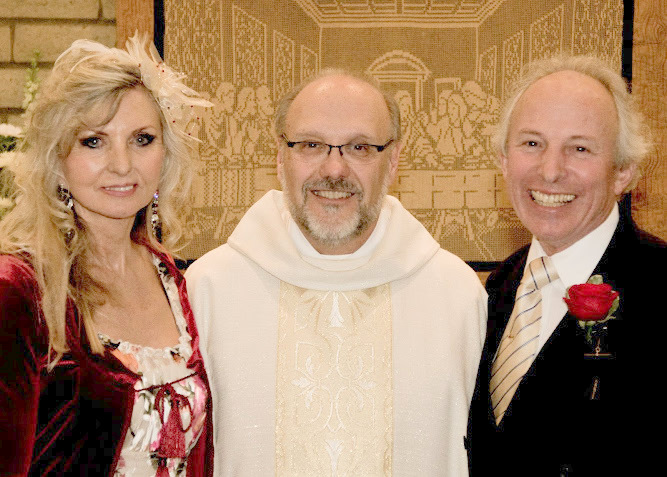
Fr. Dan Tantimonaco with the newly weds! Payson, AZ. November 20th., 2010.
Thus you can understand the pleasure it was for Jean and me again to see Don; albeit for a brief overnight stay.
What was an extra, unanticipated pleasure was meeting a young, rescue dog that Don had adopted in recent weeks. Her name is Margarita and she was found and rescued by Suzann from the streets in San Carlos. What was so glorious was to see the love and hope for a better future that flowed between Don and the sweet, young Margarita. It resonated so perfectly well with Suzan’s post published here on Monday: Rescued dogs are life-savers.
By the time I sat down at my desk yesterday, I was conscious of a) not having a clue as to what to write, and b) inspired by the sense of hope that dogs offer us humans. Serendipitously, the theme of hope led me to a post written by Jennifer Broudy de Hernandez over on her Transition Times blog. It was called Warriors for the Planet and was the most beautiful essay.
I’m delighted to reblog that here with Jennifer’s approval.
ooOOoo
Warriors for the Planet
Another summer, another war. I wonder how many summers there have been in the last 5,000 years when human beings were not occupied with killing each other?
Correction: not “human beings,” “men.”
Let’s be frank: even though there may be women in the armed forces of many countries now, war still remains a masculine activity and preoccupation. The women who serve as soldiers must adhere to the masculine warrior code and become honorary “bros,” for whom the worst insult is still be called a “girl” or a “pussy.”
I have been reading Anne Baring’s magisterial book The Dream of the Cosmos, in which she gives a detailed account of the shift, around the time of Gilgamesh, from the ancient, goddess- and nature-worshipping “lunar cultures” to the contemporary era of solar, monotheistic, warrior-worshipping cultures.
In her elaboration of this shift, I read the tragedy of our time, enacted over and over again all over the planet, and not just by humans against humans, but also by humans against the other living beings with whom we share our world. I quote at length from Baring’s remarkable book:
“The archetype of the solar hero as warrior still exerts immense unconscious influence on the modern male psyche, in the battlefield of politics as well as that of corporate business and even the world of science and academia: the primary aim of the male is to achieve, to win and, if necessary, to defeat other males. The ideal of the warrior has become an unconscious part of every man’s identity from the time he is a small child.
“With the mythic theme of the cosmic battle between good and evil and the indoctrination of the warrior went the focus on war and territorial conquest. War has been endemic throughout the 4000 years of the solar era. The glorification of war and conquest and the exaltation of the warrior is a major theme of the solar era—still with us today in George W. Bush’s words in 2005: ‘We will accept no outcome except victory.’ This call to victory echoes down the centuries, ensuring that hecatombs of young warriors were sacrificed to the god of war, countless millions led into captivity and slavery, countless women raped and widows left destitute. It has sanctioned an ethos that strives for victory at no matter what cost in human lives and even today glorifies war and admires the warrior leader. This archaic model of tribal dominance and conquest has inflicted untold suffering on humanity and now threatens our very survival as a species.
“The cosmic battle between light and darkness was increasingly projected into the world and a fascination with territorial conquest gripped the imagination and led to the creation of vast empires. It is as if the heroic human ego, identified with the solar hero, had to seek out new territories to conquer, had to embody the myth in a literal sense and as it did so, channel the primitive territorial drives of the psyche into a Dionysian orgy of unbridled conquest, slaughter and destruction. We hear very little about the suffering generated by these conquests: the weeping widows, the mothers who lost sons, the orphaned children and the crops and patterns of sowing and harvesting devastated and disrupted by the foraging armies passing over them, the exquisite works of art pillaged and looted….The long chronicle of conquest and human sacrifice, of exultation in power and the subjugation of enemies might truly be named the dark shadow of the solar age” (118;124).
Like Baring, I see our time as a critical era in the long history of homo sapiens on the planet. There is still hope that enough of us will be able to detach ourselves from the pressures and busyness of our lives—will become conscious of what is happening to the planet and human civilization writ large—will understand that there are other ways to relate to each other and to the Earth, ways that will seem increasingly possible and obvious once we focus on them and begin to put our energies into manifesting our visions of a creative, collaborative, respectful mode of being.
Baring ends her disturbing chapter on the ascendancy of the solar warrior culture with a hopeful quote from The Passion of the Western Mind by Richard Tarnas, from which she springs into her own positive vision of the potential of our time.
“’We stand at the threshold of a revelation of the nature of reality that could shatter our most established beliefs about ourselves and the world. The very constriction we are experiencing is part of the dynamic of our imminent release. For the deepest passion of the Western mind has been to reunite with the ground of its being. The driving impulse of the West’s masculine consciousness has been its quest not only to realize itself, to forge its own autonomy, but also, finally, to recover its connection with the whole, to come to terms with the great feminine principle in life; to differentiate itself from but then rediscover and reunite with the feminine, with the mystery of life, of nature, of soul. And that reunion can now occur on a new and profoundly different level from that of the primordial unconscious unity, for the long evolution of human consciousness has prepared it to be capable at last of embracing the ground and matrix of its own being freely and consciously.’
“As this deep soul-impulse gathers momentum, the ‘marriage’ of the re-emerging lunar consciousness with the dominant solar one is beginning to change our perception of reality. This gives us hope for the future. If we can recover the values intrinsic to the ancient participatory way of knowing without losing the priceless evolutionary attainment of a strong and focused ego, together with all the discoveries we have made and the skills we have developed, we could heal both the fissure in our soul and our raped and vandalized planet” (130-131).
My heart aches for the suffering of the innocent civilians trapped in the crossfire in Gaza this summer, and for the grieving families of the passenger plane heinously shot down by warriors who were either poorly trained or just plain evil.
I am heartsick when I think about the holocaust that is overtaking living beings on every quadrant of our planet as humans continue to ravage the forests and seas, to melt the poles with our greenhouse gases, and to poison the aquifers and soil with our chemicals.
This is where the solar cultures, with their “great” warrior kings, have led us. And yet, as Baring says, they have also presided over the most amazing advances in science and technology that humans have ever known in our long history on the planet.
We don’t need or want to go back to the simple innocence of ancient lunar societies. We don’t have to bomb ourselves back into the Stone Age.
What we need is to go forward, wisely and joyously, into a new phase of consciousness, in which the masculine warrior spirit is used for protection and stewardship rather than destruction, and the Earth is honored as the Mother of all that she is.
Never let anyone tell you it can’t be done. It is already happening.
ooOOoo
May I tempt you to go back and re-read that penultimate paragraph. A sentence that I cannot resist emphasising:
What we need is to go forward, wisely and joyously, into a new phase of consciousness, in which the masculine warrior spirit is used for protection and stewardship rather than destruction, and the Earth is honored as the Mother of all that she is.
It is the differences between us that are to be praised.
On the 10th August, Alex Jones, he of The Liberated Way, published a post under the title of Wisdom comes out of calm. I read it and approved of the sentiments expressed. Here’s a flavour of what Alex wrote:
My attitude towards dogs, and everything I do, is it is better to act in harmony with my world than impose violent control upon it. Nature is my teacher, and calm is one of its teachings. Calm is the sister of patience and tolerance, letting nature flow at its own pace and in its own way. When I planted acorns, I was unable to force them to grow, they acted in their own timing, at their own pace. I am like a parent rather than the master of eight strong oak saplings. I provide my saplings with opportunity through water, sun and good soil; protecting them from caterpillar and fungus; they follow their own nature in becoming fast growing little trees.
Well, Paul, the entire essay answered why it’s wrong to equate calm with wisdom, as Alex does. If it was only him, it would be an interesting quirk. However, it’s pretty much a mass mood.
That philosophy of boiled vegetable leaves the plutocrats free to do a home run, home being, for them, hell. Part of the program is biospheric annihilation.
I didn’t agree with Patrice and my immediate reaction was try and take sides. Yet both writers were the authors of many fine essays. What to do? As I expressed to Alex:
I have read both posts and, frankly, are bemused. It feels as though each is describing something utterly different to the other. I have a number of hours of electrical work today but will also give the matter a ‘coating of thought’ while working and offer my humble conclusions later on.
Serendipitously, the answered then arrived.
I’m about a third of the way through an audio course on Building Great Sentences delivered by Professor Brooks Landon, Professor at the University of Iowa English Department. Professor Landon talks about style and how difficult it is to define a particular author’s style.
It was at that moment that a flashbulb went off in my mind. Wouldn’t literature be incredibly plain and boring if there were no real differences in the styles of all the many authors; past and present!
It brought me back to Patrice and Alex and, by default, hundreds of other authors of blogs right across the ‘blogosphere’. Of course they express themselves differently! Of course they hold different opinions! It is those differences that are critical, utterly so, to each and every reader coming to their own conclusions; conclusions to a wide range of subjects and topics.
This was hammered home to me as I watched our dogs playing so well together. The differences in each dog’s backgrounds and experiences contributed to the wonderful, unconditional way that they played and lived together. The power of their unconditional love.
It is those differences that offer us insight into our own beliefs and prejudices. It is those differences that allow us, and dogs, to make sense of ourselves. One might argue that it is the differences that deliver truth.
Jean would be the first to tell you that I’m always remarking to her how this funny old world of blogging creates links and friendships right across the world. Many of the kind people who follow Learning from Dogs are themselves the authors of blogs and in the vast majority of cases when I read their posts I sense a kindred spirit.
T.O.R.A Rescue shelter to close – Dogs need homes Foster or Adopt
TORA will close. This is indeed sad news for me but devastating for the dogs still left at the rescue shelter. My beautiful Annie came from there. Rescued off the street as a frightened puppy: Just look at her now.
Beautiful Annie.
TORA, like many other rescue shelters in Romania have been fighting against all odds to get dogs off the streets, and now out of the public shelters since the killing law has been passed. Dogs are in public shelters for only a short time before they are put to sleep. There are horrific stories and pictures around. Some may see it as practical, culling the population. That’s a valid opinion but not one I and thousands upon thousands of dog/animal lovers can share.
All TORA asks now though is for people to view the site on Facebook or contact them [Ed. via that Facebook link] and foster or adopt one of the remaining dogs. If there are dogs left in October when they must close, then they will be returned to the public shelter to receive their fate.
EVEN IF YOU CANNOT HAVE A DOG YOURSELF, please share, someone somewhere will, and for each one that does, another beautiful dog is safe. They didn’t ask to be thrown on the streets. They didn’t ask to be cast out like vermin. All they want is a chance to have a human family and a life of kindness.
ABOUT ASOCIATIA
T.O.R.A. is a small non-profit dog rescue organization that is based in Bistrita, North of Romania (Transylvania). TORA is dedicated to the rescue and placement of stray dogs.
We are an animal charity of 2-4 volunteers, with funds available only from public support, with a shelter of 20 spacious kennels, 11 indoor & outdoor and 9 only outdoors ones. We have a vet attending the dogs daily and a caretaker.
All of our dogs get neutered, (with the exception of puppies under the age of 6 months old and very old dogs), vaccinated, microchipped , defleed and dewormed prior to adoption.
T.O.R.A. shelter cares for the rescued dogs entirely from donations received from private people, that’s why there is a constant need of support whether its financial, material (food or medicine donations, beds, dog clothes, etc) or by sharing and promoting the dogs to find good homes so that space becomes available to help others .
T.O.R.A. helps an average of 40-60 animals at any given time.
Many who follow my scribblings know that of the nine dogs we have here at home, seven are rescues. When I first met Jean down in Mexico she was rescuing feral dogs off the streets and finding homes for them. Over the many years, Jean estimates that well over two-hundred stray dogs had been found loving homes. Indeed, when Jean and I moved from Mexico to Payson, AZ., we came with fourteen dogs of which thirteen were ex-rescues! Pharaoh being the notable exception!
Anyway, back to Mrs Skeats.
I was so moved by what I read on her blogsite that I implored her to write a guest post for you, dear reader. Suzan was gracious enough to agree and here is her post.
ooOOoo
Rescued dogs are life-savers.
by Suzan.
Paul asked if I would post as a “guest” after reading my post(s) about dogs that have been or need to be rescued from some quite awful conditions. “OH here we go again” some of you will say. Well, then it is your choice to read on or close the page.
I hope you read on as this is not about begging for funds or equipment or even a home for these lovely creatures. It’s about what THEY can offer you.
I love animals – not just dogs. I’ve cared for many in my time, but dogs have to be top of my list. Dogs love to love. They don’t know how to be any other way until they are mistreated in some way.
Dog’s are like having a permanent 3 years old around you, with the exception they don’t answer back (often) and are usually not quite so stubborn. I’ve had 7 children under my roof in the years (hence the menagerie at times) – I know.
Dogs look to their human companion as leader, feeder, soul mate, room mate, walker, talker, and all they want to do is to please …. literally their life is lived for you. But rescued dogs do this to a deeper level than dogs raised from a pup. Not just me but thousands of others find this.
Raised dogs are no less loyal, please don’t think I say different. There’s just something about a dog that has had a bad start, lonely, captured, mistreated … whatever. These dogs reach deeper into your heart and aim to please as if they are desperate to say thank you. Perhaps they have a fear that the person who has been so lovely will leave if they misbehave. I can’t say, I’m not a dog.
I do know as I have had both kinds; from a pup and rescued from kennels. My last ‘pup raised’ dog, Dizzi, was with me 18 years and a star in her own right, but my rescues … it’s hard to say, but they love me in a different way, unique to rescues.
Take Joe. Joe had been sold on Facebook and bought by dog-baiters, bitten so severely vets thought he would die. You’d think that’s turned him off to humans? But no! He was a beautiful 6yr-old Collie. He was awesome. He obeyed, loved and cherished us, giving cuddles, playing gently … I’ve never had such a beauty under my roof. [Ed: Joe’s early and tragic death will be the subject of tomorrow’s post.]
Annie is a Romanian street dog, rescued age 9 months from under a pile of pallets in the cold Romanian winter, never having had a home. Now two, and she too has a special love for us. I swear if we’re annoyed with her she cries (not the doggy whine – I mean from the heart) and she’ll do ANYTHING to get a hug from us. Not once has she ever messed in the house from day 1, she goes to bed when told, sits politely for treats or her lead and wags herself to death when we come in the front door. Very rarely has she “got it wrong” and is so sorrowful if she does, her worst misdemeanour being chewing her bedding when she was about 14 months old, and obviously bored.
I could go on, I’ve had 5 rescues and two from pups…..
All I’ll now say is if you’re looking for a dog to share your life with – consider very carefully as they love you warts and all for a long time – then get a rescued dog. Once you look into those soulful eyes, and hold that paw, you’ll connect and feel the love and be very humbled ……. but you won’t regret it.
ooOOoo
Please share the message as much as possible! These dogs need to find loving homes. Thank you.
Undoubtedly, those of you that watched the George Monbiot speech in yesterday’s post will have been struck by at least two key aspects. The first being the utter absurdity in the way that we are being governed (UK and the USA) and the second that change can only come from people bonding at a local level. For it is within local communities that groups of people share their ideas and develop a vision for change that they can stand behind in an open and demonstrable manner.
The history of mankind is inseparable from the history of living in communities. It’s only in recent times that so many have chosen to live in cities and towns. Dogs, of course, offer a brilliant and wonderful example of the benefits of community life.
Back to George Monbiot. Here are some of Mr. Monbiot’s words towards the end of his speech. (My emphasis.)
As Lakoff has pointed out, these people are trying to do the right thing but they are completely failing to apply a frames analysis. A frame is a mental structure through which you understand an issue. Instead of framing the issue with our own values and describing and projecting our values – which is the only thing in the medium- to long-term that ever works – we are abandoning them and adopting instead the values of the people who are wrecking the environment. How could there be any long-term outcome other than more destruction?
There’s another way of looking at this, which says the same thing in different ways. All of us are somewhere along a spectrum between intrinsic values and extrinsic values. Extrinsic values are about reputation and image and money. They’re about driving down the street in your Ferrari and showing it to everyone. They are about requiring other people’s approbation for your own sense of well-being.
Intrinsic values are about being more comfortable with yourself and who you are. About being embedded in your family, your community, among your friends, and not needing to display to other people in order to demonstrate to yourself that you are worth something.
The desire for humans to belong to a community was highlighted in a recent article in Time Magazine under it’s Culture section (August 4th). The article was called Atheist “Churches” Gain Popularity—Even in the Bible Belt(again, my emphasis).
Jerry Dewitt (Left), A former Pentecostal minister, DeWitt now leads the secular Community Mission Chapel in Lake Charles, La. Mike Aus (Right), In September 2012, Aus began Houston Oasis, an atheist service that is considered a model for nonbelievers nationwide.
On a clear, Sunny July morning, as churchgoers all around Houston take to their pews, dozens of nonbelievers are finding seats inside a meeting room in a corporate conference center on the city’s west side to listen to a sermon about losing faith. But first there’s the weekly “community moment”–remarks on a chosen topic delivered by the group’s executive director, this time focused on how we’re hardwired to read sensationalized news–as well as announcements about an upcoming secular summer camp. In between, a musician sings softly of Albert Einstein.
The men speaking before the assembled gathering–executive director Mike Aus, who regularly leads the group, and Jerry DeWitt, a visitor who heads a similar gathering in Louisiana–are both deeply familiar with the idea of Sunday ritual.
Later in the article, Mike Aus (see picture above) goes on to say (once more, my emphasis):
There are a lot of people in the free-thought movement who say: Well, this is just mimicking church. But if we don’t offer regular human community and support for nonbelievers, it would be detrimental to the movement.
Whether we like it or not, change is being thrown at us by nature at an unprecedented scale; certainly unprecedented in the experience of homo sapiens. Our only hope is to turn away from the destructive agendas of our present governments all across the world and build change from the grassroots up.
There are so many aspects of the dog world that we have to learn. Top of the list of what we must learn from dogs is unconditional love.
You all know how if you approach a strange dog with love in your heart, how that dog senses your love immediately and responds in the same loving fashion.
So approach every conscious being in your life with love in your heart. It will truly change the world!
So with that in mind, it seemed very appropriate to follow up yesterday’s post that included the essay by Chris Johnstone on celebration with this short film from Rick Hanson. Especially just now.
Published on Nov 7, 2013
Hardwiring Happiness : The Hidden Power of Everyday Experiences on the Modern Brain. How to overcome the Brain’s Negativity Bias.
Rick Hanson is a neuropsychologist and the author of Hardwiring Happiness: The New Brain Science of Contentment, Calm, and Confidence, best selling author of Buddha’s Brain, founder of the Wellspring Institute for Neuroscience and Contemplative Wisdom and an Affiliate of the Greater Good Science Center at UC Berkeley, he’s been an invited speaker at Oxford, Stanford, and Harvard, and taught in meditation centers worldwide.
Yes, fifty-two Sundays ago, I had the idea of posting a set of photographs. That first set was published on the 30th June, 2013 and just for fun I’m going to repost them.
Plus, I can’t resist adding a photograph that Chris Snuggs sent me.
oooo
Sit back and be amazed!
A friend from Payson, Arizona, Lew Levenson, recently sent across a set of 38 astounding photographs, all on the theme of perfectly timed shots.
They are so fabulous that I have decided that for today and the following four Sundays I will post a selection.
So today, the first set of 8 photographs. Trust me you will love them, so a big thank you to Lew. Do say which are your best ones!
oooo
oooo
oooo
oooo
oooo
oooo
oooo
oooo
To close here is that picture courtesy of Chris Snuggs.
By the way, if you would like see again the rest of Lew’s photographs just leave a comment to that effect.
Such a fundamental aspect of all conscious life on Planet Earth.
As many of you know, weekend posts on Learning from Dogs are usually pretty innocuous. But two things came together to make me want to offer today’s central thoughts while they were fresh and clear in my mind.
The first thing flowed from good friend, John Hurlburt. Together with Jon Lavin, John had helped me develop my Statement of Purpose for my book. It was John who proposed a chapter under the heading of “The biological interconnectedness of all conscious earthly life“; a proposal I embraced with open arms.
The second thing was that Alex Jones, he of the blog The Liberated Way, published a post yesterday that, succinctly and beautifully, supported John Hurlburt’s thesis.
What do we mean by the idea that all of us are connected? (…. and ignoring the many of you who wonder why the question even has to be asked.)
I’m going to answer that most fundamental of all questions in this rather roundabout manner.
As someone who in previous times has been a glider pilot (aka sailplane in US speak), and a long-distance sailor (Tradewind 33), the weather about me was very much part of my life. Long ago I came to love clouds. Yesterday morning we had to take puppy Oliver to the vet and, unusually for this time of year in Southern Oregon, overhead there were beautiful grey stratus clouds covering 90% of the sky. There wasn’t the time to grab my camera but the following stock photograph found on the web is close to what we saw.
Still en-route in answer to the question, take a look at the next photograph; also from the web.
Now to the next photograph. (Hang on in there!)
See how the road, a man-made road stretching away to the horizon, is such an intimate part of the landscape and the sky.
Now to my final photograph.
I see a strong and clear theme behind these four beautiful images. A theme that answers the question of what we mean by the idea that all of us are connected.
It is this.
Our planet’s atmosphere gives us all that we need to live. All the oxygen and water and other essentials for all of life. Over millions of years it has provided all that life has needed to evolve and grow.
The land prospered. Beautiful animals arrived. Then came man and over time he left his mark on the lands of the planet. For aeons of time, man and animals shared their lives upon the land. Indeed, man and animals frequently demonstrated they had the capacity to love each other without denying the fact that both man and animals, in many cases, were also meat-eaters. To state the obvious, the beauty of the obvious, is to say that everything on this planet is connected under Nature. Man, animals, lands: all part of that same Nature.
Loving each other: woman and dog!
Let me close by republishing with Alex’s permission his post from yesterday.
ooOOoo
One in nature
The joy of knowing nature and self are one.
The butterfly and I enjoyed a common connection in the sun on a fallen tree – we became one.
Sitting upon a fallen dead tree, one that could have but did not kill me when it fell in the storms last year, an orange butterfly flew and settled next to me. Here we were, butterfly and I, enjoying the warm sun sitting on the same tree trunk like two people on a park bench. The butterfly would after a time fly away returning later to sit next to me. In this moment I shared something in common with this butterfly, different species, but living on and coming from the same planet earth.
Another day it is raining, I huddle under the garden conifers eating raspberries, watching the clouds empty their water upon a thirsty garden, my cat Pebbles sitting at my feet. Out of the fallen branches two little mice played, oblivious to me and the cat, which did not seem to notice them.
For many people there are degrees of separation from nature, us and them. For some like me, Ubuntu, I am because we are. There is only connection, the animals and I are one.
Camping in the rain, a knocking at the tent door. I looked out of the tent, I looked into the eyes of a frog, which then vanished into the rainy darkness.
A personal viewpoint after reading Tom’s essay Is Climate Change a Crime Against Humanity?
Last Thursday, July 3rd, I republished a post, what Tom calls a Tomgram, from TomDispatch comparing the USA’s attitude to the very small risk of a country exploding a weapon of mass destruction, WMD, over American soil to the 95% risk of the USA being harmed from the effects of climate change. Here’s an extract from the central part of Tom’s essay:
So here’s a question I’d like any of you living in or visiting Wyoming to ask the former vice president, should you run into him in a state that’s notoriously thin on population: How would he feel about acting preventively, if instead of a 1% chance that some country with weapons of mass destruction might use them against us, there was at least a 95% — and likely as not a 100% — chance of them being set off on our soil? Let’s be conservative, since the question is being posed to a well-known neoconservative. Ask him whether he would be in favor of pursuing the 95% doctrine the way he was the 1% version.
After all, thanks to a grim report in 2013 from the Intergovernmental Panel on Climate Change, we know that there is now a 95% -100% likelihood that “human influence has been the dominant cause of the observed warming [of the planet] since the mid-20th century.” We know as well that the warming of the planet — thanks to the fossil fuel system we live by and the greenhouse gases it deposits in the atmosphere — is already doing real damage to our world and specifically to the United States, as a recent scientific report released by the White House made clear. We also know, with grimly reasonable certainty, what kinds of damage those 95% -100% odds are likely to translate into in the decades, and even centuries, to come if nothing changes radically: a temperature rise by century’s end that could exceed 10 degrees Fahrenheit, cascading species extinctions, staggeringly severe droughts across larger parts of the planet (as in the present long-term drought in the American West and Southwest), far more severe rainfall across other areas, more intense storms causing far greater damage, devastating heat waves on a scale no one in human history has ever experienced, masses of refugees, rising global food prices, and among other catastrophes on the human agenda, rising sea levels that will drown coastal areas of the planet.
Tom’s essays had many great links to background research papers and other supporting material. The penultimate link was embedded (my italics) in this sentence: “In the case of a major exchange of such weapons, we would be talking about “the sixth extinction” of planetary history.” That linked to the Amazon page describing the book, released earlier this year, of the same name written by Elizabeth Kolbert, as follows:
A major book about the future of the world, blending intellectual and natural history and field reporting into a powerful account of the mass extinction unfolding before our eyes
Over the last half a billion years, there have been five mass extinctions, when the diversity of life on earth suddenly and dramatically contracted. Scientists around the world are currently monitoring the sixth extinction, predicted to be the most devastating extinction event since the asteroid impact that wiped out the dinosaurs. This time around, the cataclysm is us. In The Sixth Extinction, two-time winner of the National Magazine Award and New Yorker writer Elizabeth Kolbert draws on the work of scores of researchers in half a dozen disciplines, accompanying many of them into the field: geologists who study deep ocean cores, botanists who follow the tree line as it climbs up the Andes, marine biologists who dive off the Great Barrier Reef. She introduces us to a dozen species, some already gone, others facing extinction, including the Panamian golden frog, staghorn coral, the great auk, and the Sumatran rhino. Through these stories, Kolbert provides a moving account of the disappearances occurring all around us and traces the evolution of extinction as concept, from its first articulation by Georges Cuvier in revolutionary Paris up through the present day. The sixth extinction is likely to be mankind’s most lasting legacy; as Kolbert observes, it compels us to rethink the fundamental question of what it means to be human.
Here’s an interview of Elizabeth Kolbert taken from the Democracy Now programme. It’s a tad under 20 minutes so easy to put aside a little of your time to watch it.
PLEASE DO!
Published on Feb 11, 2014
February 2014 on Democracy Now!
In the history of the planet, there have been five known mass extinction events. The last came 65 million years ago, when an asteroid about half the size of Manhattan collided with the Earth, wiping out the dinosaurs and bringing the Cretaceous period to an end. Scientists say we are now experiencing the sixth extinction, with up to 50 percent of all living species in danger of disappearing by the end of the century. But unlike previous extinctions, the direct cause this time is us — human-driven climate change. In “The Sixth Extinction: An Unnatural History,” journalist Elizabeth Kolbert visits four continents to document the massive “die-offs” that came millions of years ago and those now unfolding before our eyes. Kolbert explores how human activity — fossil fuel consumption, ocean acidification, pollution, deforestation, forced migration — threatens life forms of all kinds. “It is estimated that one-third of all reef-building corals, a third of all fresh-water mollusks, a third of sharks and rays, a quarter of all mammals, a fifth of all reptiles, and a sixth of all birds are headed toward oblivion,” Kolbert writes. “The losses are occurring all over: in the South Pacific and in the North Atlantic, in the Arctic and the Sahel, in lakes and on islands, on mountaintops and in valleys.”
Elizabeth Kolbert, is well known for her reporting on global warming as a staff writer at The New Yorker magazine, which led her to investigate climate species extinction. Her new book is The Sixth Extinction: An Unnatural History. In 2006, she wrote Field Notes from a Catastrophe: Man, Nature, and Climate Change.
Make no mistake, that short video interview doesn’t pull any punches. Just as Kolbert’s book. It is very tempting to want to hide, to close one’s ears and eyes and pretend it’s all a bad dream and, soon, we will awaken to a bright, new dawn.
(Now for something really lovely! It’s 1:40pm on Sunday, 6th)
I took a quick break to think about my next sentence. I was looking for some words that would encourage us all to do something! Because as John Hurlburt recently wrote: “Failure to act condemns us to death as a species of fools.”
In that short break I saw that someone else had signed up to follow Learning from Dogs. That person describes herself as Elsie Bowen-Dodoo. Her blog is called BowenDiaries. On her About page, Elsie writes:
Elsie Bowen-Dodoo. Living life with a purpose. Persevering to inspire all races.
I write to inspire people hoping that they reading my articles and stuff will be touched to do something positive in their lives.
We really can all make this world a better place to live in.
Talent should not be wasted.
This is the picture on Elsie’s home page.
Positive inspiration!
So here’s my take on where we, as in all mankind, are at.
We have to turn our backs on growth, greed and materialism.
Each of us must place caring for our planet our highest priority in life.
Each of us must be alive to making a positive difference.
Being true to what we know is right will set us free.
This will also create ripples of positive energy that will set others free.
That is the only sustainable way to go.
Let me close by returning to dogs. After all this blog is called Learning from Dogs! By recognising, of course, that these are challenging times. As we are incessantly reminded by the drumbeat of the doom-and-gloom news industry every hour, frequently every half-hour, throughout the day. A symphony of negative energy.
Yet right next to us is a world of positive energy. The world of dogs. A canine world full of love and trust, playfulness and relaxation. A way of living that is both clear and straightforward; albeit far from being simple. As anyone will know who has seen the way dogs interact with each other and with us humans.
In other words, dogs offer endless examples of positive behaviours. The wonderful power of compassion for self, and others, and of loving joy. The way to live that we humans crave for. A life full of hope and positive energy that keeps the power of negativity at bay.
A powerful and compelling post from friend and follower: John Hurlburt.
Anyone who can compose phrases such as “an enlightened interest in the quality of the harvest of our transitory lives” deserves to be listened to! Our friend, John, from our Payson, AZ, days, is a regular author of essays that arrive here in Hugo Road via the mail. It’s always a pleasure to read John’s words and frequently I feel the need to share them with you, dear reader. So it was with John’s latest.
I’ll say no more except to promise you that you will be enthralled.
ooOOoo
Arrogance ‘R Us
We hear the drumbeat of steadily increasing global, national, state, regional and local problems every day. When common-sense solutions are offered for any of these problems, the solutions are immediately demonized as actions which would aggravate the problems they would logically solve. This sort of nonsensical circular argument is both a paralyzing paradox and a guaranteed death spiral for our relatively young biological species.
We imagine that we know far more than we do. The Earth doesn’t need living species in order to regenerate life. Human beings continue to need the Earth from which we are made and which sustains our consciously aware being. Some of us believe that having money is the answer to all our problems. Actually, the imaginary power of human “money” is killing life on Earth from the bottom of the food chain up.
Every government in the world competes with every other government in the world for power and control to one degree or another. The richer the nation, the greater it’s illusion of power. We’ve forgotten about responsibility, morality and faith in the power of Nature. Change is a constant. Failure to adapt to change is a death knell for living beings.
We live to learn. Why? Is death a finality or a new beginning? Both classic and quantum physics recognize Conservation of Information and the exchange of energy and matter at the level of fundamental forces. How much of the energy of our lives is absorbed by the cosmos and how much is recycled as life energy? We have no earthly idea of the answer.
Aye, there’s the rub.
We do know that everything fits together. Otherwise, we’d be random atoms. We also know that the cosmos does not exist for the pleasure of human beings. To the contrary, if the cosmos were even minimally different, life as we know it would not exist. We are an infinitesimally small part of Reality.
Statistically, we’re not alone as consciously aware life forms in our universe. When we release ourselves from the bondage of our biological limitations, we connect with the living energy of our planet in harmony with the geo-magnetic network of our planet, our living galaxy, and our living universe. We realize that other life on Earth shares conscious awareness in varying degrees.
Don’t believe it? That’s a matter of choice. Consider that denying the facts of reality is a foundation for ignorance. Letting go is a gateway to enlightenment.
Those who do not accept change profess to believe that the immensity of a universe beyond our inclusive comprehension has existed since the beginning of time solely for their personal benefit. Their corporate slogan is “Arrogance ‘R Us”.
More precisely, the statistical probability of human conscious awareness being unique in the universe is so infinitesimal that it would be laughable if it weren’t for our present species peril.
Not only have we amassed enough fire power to turn the earth into a burning sphere overnight, we are now proceeding to systematically and efficiently eliminate the natural resources we need to live.
We can’t eat computers or opinions. Clean air, clean water, clean food and clean energy are more than slogans. They’re essential for human life. Are we a swarm of predatory locusts or are we stewards of the blessings of a life we don’t fully understand?
Money has dissolved the human contract with Nature which began about 14 million years ago on a planet that’s been around in one form or another for roughly the last 14 billion years. Preservation, sustainability and natural efficiency are enemies of our present delusional global economic system. No living species on Earth is safe from the ecocide being committed by human insanity. We’re experiencing a systemic failure and treating it as a side-show.
We’re suffering from a fatally immoral addiction to what we may personally consider to be the good life. It’s time for our conscious awareness to transcend self and species. We need to combine our spiritual awareness, our natural awareness, our moral awareness, our cultural awareness, our social awareness and our common sense for the immediate purpose of preserving, sustaining and accepting the natural efficiency of our pale blue dot in a universally remote solar system.
So, where do we begin? We begin wherever we are. Today is the tomorrow we dreamed of yesterday. What is our vision of tomorrow? Is it an Earth that is unchanging in the midst of constant change? Is it an Earth that is scorched and barren? Perhaps it can become an Earth that continues to grow and nurture our existence.
The choice is made by our daily actions. Time is not currently in our favor. Freedom is not the exclusive privilege of wealth. Freedom is everyone’s responsibility. Poverty is the deadliest form of violence. Seven trillion dollars of worthless derivatives tick like a time-bomb in dank Wall Street sub-basements. Environmental bankruptcy threatens all life on Earth. It’s more than past half-time to face our shared Reality. There’s no place to hide.
We grieve our former lives. We begin with the suppressed anger we have self-generated through fear until it has become a traumatic syndrome. The antidote for fear is faith. What do we believe? What are our values? Are we moral, semi-moral, immoral or amoral? Do we believe we are the purpose of the Cosmos or a relatively young animal living on a garden planet far from the heart of an emerging universe? Is our immediate gratification more important than any long-term purpose?
Global recovery depends upon inclusive personal recovery and the ability to recognize the urgency of our common purpose. Personal and cultural recovery begin by surrendering the illusionary cocoon of “self”. Stepping stones include daily humility, hope, study, acceptance, inventory, amends, sharing and compassionate service. The result is a new lease on life.
We surrender our politics. We learn to think for ourselves. We question authority. We test our ideas and follow the evidence. Science belongs to all of us. We reserve judgment. We realize that our imagination is nothing in comparison to the majesty of the truth of our shared Reality. We become creative rather than destructive.
We build a global resource management system based on the concepts of common well-being, strategic preservation and strategic efficiency. Our objective is to maintain, grow and recycle natural resources utilizing our technology as a constructive tool rather than as a weapon.
The concept of ownership needs to be replaced by the idea of strategic access to what we need as opposed to what we may superficially believe or think we want. We stop competing and start co-operating as the result of an enlightened interest in the quality of the harvest of our transitory lives.
As we live and learn together, we realize that love is as important to life as air, food, water and shelter.
Peace beyond all understanding,
an old lamplighter
ooOOoo
Fabulous essay! Breathtakingly so! Making it clear that there is so much for us humans to learn! Yet offering a clear pathway to that learning. Starting with unconditional love and openness! Now where’s a dog to learn from!
Hazel teaching us openness and love through her eyes.
















 Learning from Dogs