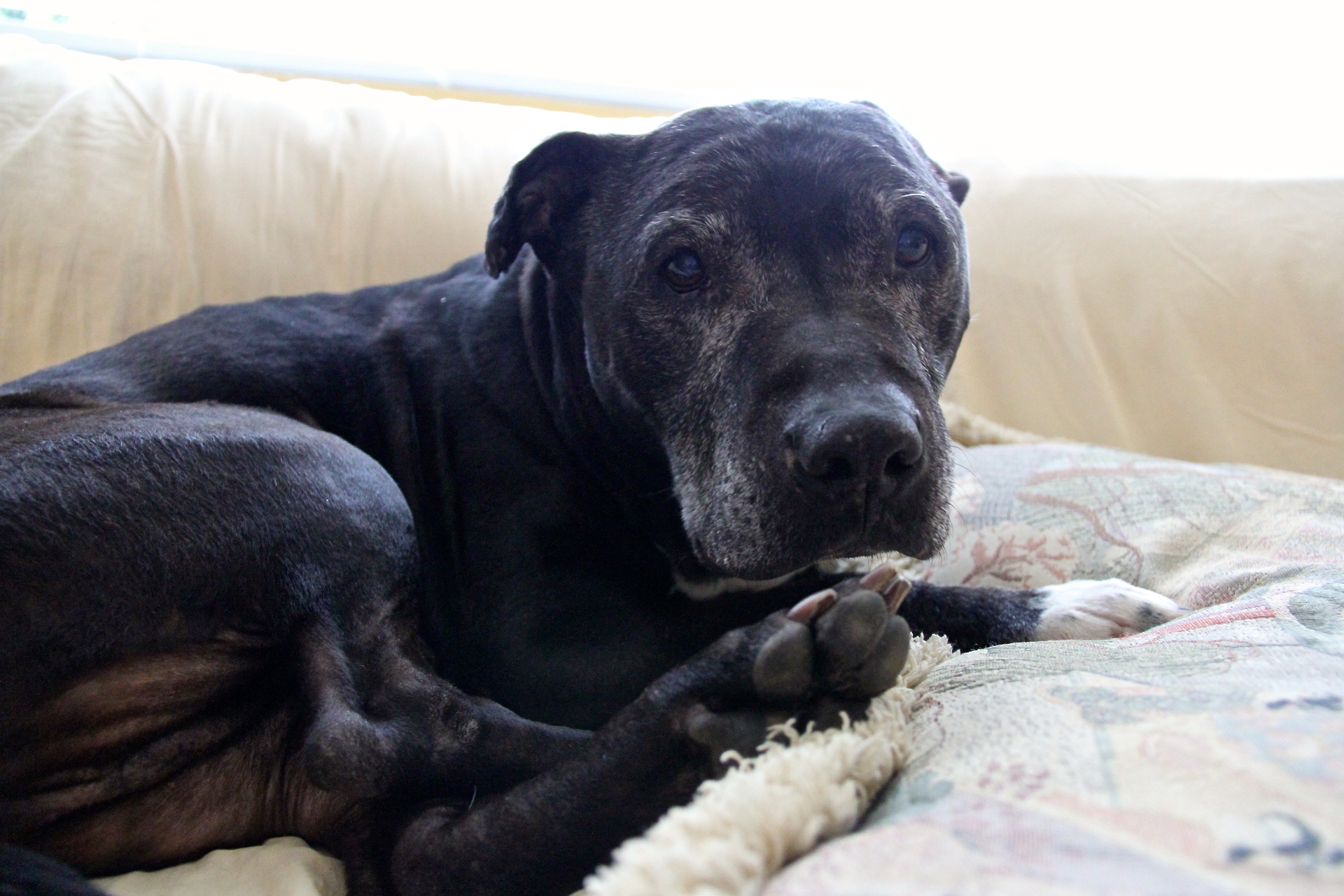
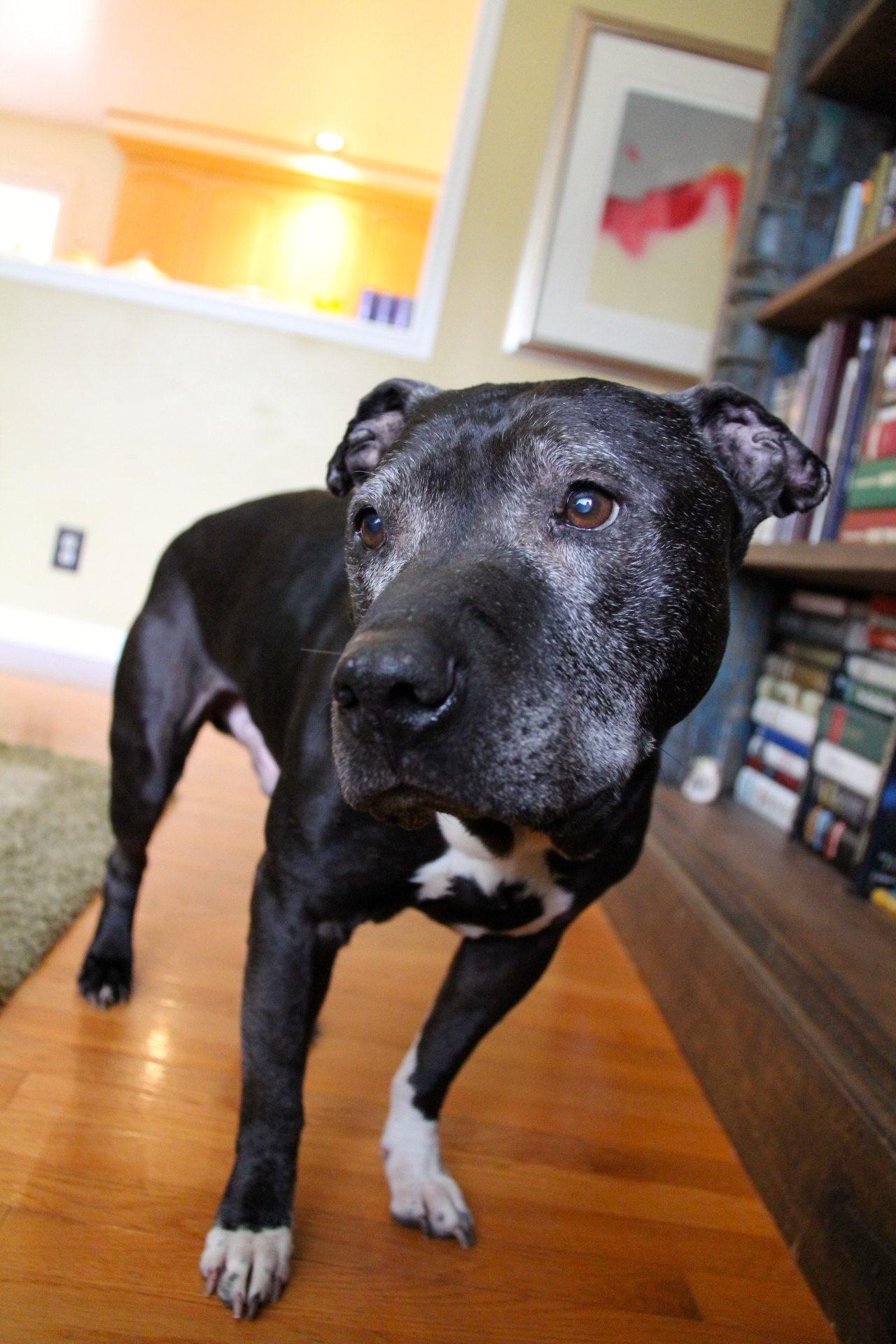
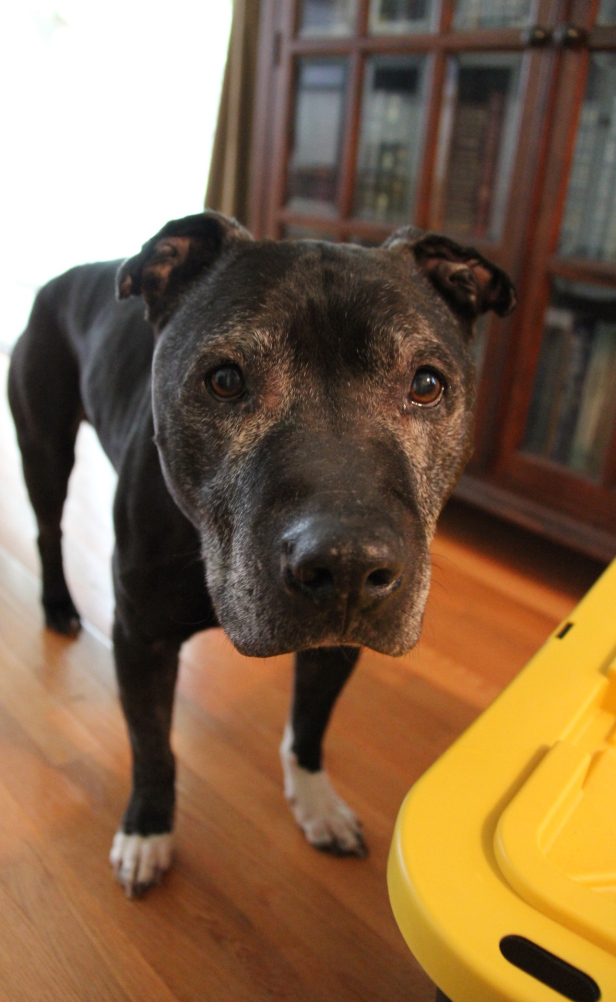
The story was that after a raw patch had appeared on Kenya’s back it had then become very itchy for the brave dog.
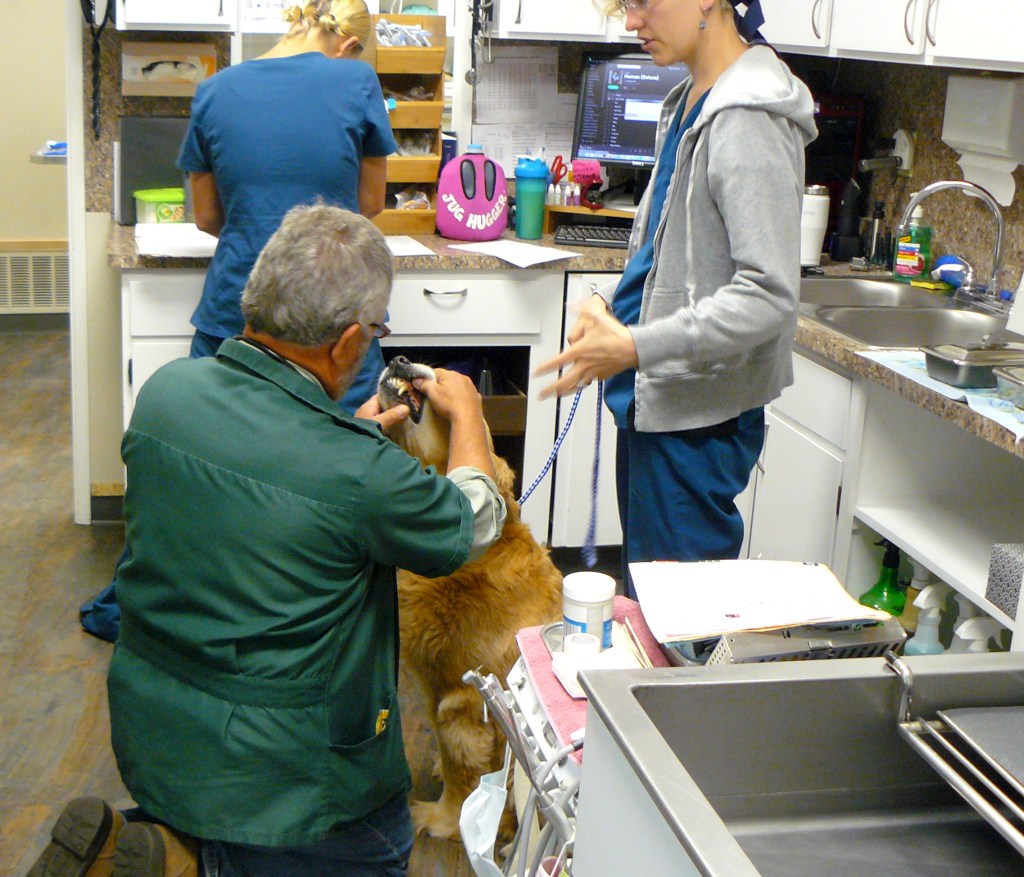
Jim shaved the area clear of fur and cleaned the skin to aid a closer examination.
Jim then explained that the challenge in these sorts of cases is that it is very easy to throw a lot of money at the problem without any guarantee of success. Not only were there cost considerations but also the question of whether to go down the route of injections or administer pills.
As an observer I was struck, but not surprised knowing Jim as a friend, to see how an open and honest assessment of the problem came way before any commercial implications.
Jim’s view was to leave it for the time being but he did recommend using a hypoallergenic shampoo. There were a number to choose from but Jim supported the shampoo manufactured by Bayer and sold under the brand name of Hylyt Shampoo.
There are a number of online sources for this shampoo. I chose, more or less at random, the one at Allvet Supply.
That website describes the shampoo, thus:
HyLyt Shampoo is a hypoallergenic dog shampoo and is perfect for routine use in bathing dogs and cats. The shampoo is safe for normal, dry or sensitive skin types and may be used in conjunction with topical therapeutics.
HyLyt shampoo contains a light fragrance that will leave your pets smelling clean and fresh. The gentle shampoo formula is ideal for bathing both dogs and cats. The soap-free formula is pH balanced and will not dry out delicate skin or fur.
In addition to the gentle formula, HyLyt shampoo also contains special emollients for moisturizing and proteins for conditioning. The hypoallergenic dog shampoo also contains fatty acids to reduce scaling and flaking of the skin. If your pet suffers from seasonal or acute dryness, HyLyt shampoo will help restore their skin and coat to optimal health and beauty.
Then it was time for a quick checkup underneath Kenya, so to speak, and that was it!
11:00 All done!
I am having trouble getting my head around the fact that I have only been watching proceedings for two-and-a-half hours! So much knowledge on show. So much experience. So much compassion for our beloved pets!
To be continued:
(Please note: These observations are mine alone and because of the busy environment it must be assumed that my interpretation of what was taking place might not be totally accurate. Nothing in this blog post should be used by a reader to make any medical judgment about an animal. If you have any concern about an animal do make an appointment to see a properly qualified veterinarian doctor.)
A fair question one might think. Because this blog is primarily about what we humans should be learning from our dogs. Well, I do see a connection, a message of learning for us. Stay with me for a while.
But first, here’s how I open up Chapter 18 Sharing in my book – Learning from Dogs.
Here’s a silly story that made me laugh when I first came across it.
A man in a casino walks past three men and a dog playing poker.
“Wow!” he says, “That’s a very clever dog.“
“He’s not that clever,” replies one of the other players.
“Every time he gets a good hand he wags his tail.“
This clever dog couldn’t hide his happiness and had to share it by wagging his tail. OK, it was a little bit of fictional fun but we all recognise that inherent quality in our dogs, how they share so much of themselves in such an easy and natural fashion.
Now if one was being pedantic one would say that sharing is not the same as equality. Yet I see them as two separate seats in life’s common carriage.
Many lovers of dogs know that when they lived a life in the wild, slowly evolving from the grey wolf, they replicated, naturally, the pack characteristics of wolves. As in the pack size was around 25 to 30 animals. Yes, there was a hierarchy in the pack but that really only presented itself in the status of three animals: the female ‘alpha’ dog; the male ‘beta’ dog; the ‘omega’ dog that could be of either gender. Ninety percent of the pack were animals on equal standing. If only that was how we humans lived.
A few days ago there was an essay published on The Conversation blogsite under the title of Why poverty is not a personal choice, but a reflection of society.
It opened with this photograph.
A homeless camp in Los Angeles, where homelessness has risen 23 percent in the past year, in May 2017. AP Photo/Richard Vogel
Let me emphasize this: “A homeless camp in Los Angeles, where homelessness has risen 23 percent in the past year, in May 2017.”
Here are two small extracts from that article:
Author: Shervin Assari Research Investigator of Psychiatry, Public Health, and Poverty Solutions, University of Michigan
As someone who studies poverty solutions and social and health inequalities, I am convinced by the academic literature that the biggest reason for poverty is how a society is structured. Without structural changes, it may be very difficult if not impossible to eliminate disparities and poverty.
About 13.5 percent of Americans are living in poverty. Many of these people do not have insurance, and efforts to help them gain insurance, be it through Medicaid or private insurance, have been stymied. Medicaid provides insurance for the disabled, people in nursing homes and the poor.
Four states recently asked the Centers for Medicare and Medicaid Services for permission to require Medicaid recipients in their states who are not disabled or elderly to work.
This request is reflective of the fact that many Americans believe that poverty is, by and large, the result of laziness, immorality and irresponsibility.
In yesterday’s post celebrating July 4th, where I shared that lovely picture sent to me by Neil Kelly from my Devon days, there was an exchange of comments between me and author Colin Chappell. Colin is the author of the book Who Said I Was Up For Adoption.
First, in response to Colin saying “That pic really says it all doesn’t it!”, I replied:
No question. Indeed, one might ‘read’ that picture at many levels. From the level of providing a smile for the day all the way through to a very profound observation on life itself.
Colin then replied to me:
I ‘ll go straight for the profound perspective! As I recently noted on another blog, I cannot recall anybody from history who became famous for their material possessions. In fact, I recently read an article written after an individual had surveyed a few thousand gravestones… and they drew the same conclusion. There was not a single epitaph which alluded to a material possession. Dogs know all that intuitively, so why does our superior (?) mind have trouble grasping such a simple perspective?
I then responded by saying that I thought it would make a fabulous introduction to today’s post. The heart of which I am now coming to.
Here in our local city, Grants Pass, there is a Freethinkers and Humanists group. They meet once a month. Jerry Reed from that group some time ago recommended to me reading the book The Spirit Level authored by Richard Wilkinson and Kate Pickett.
Jerry and I were exchanging emails in the last couple of days and he reminded me of that book.
There it was sitting on my bookshelf with a bookmark in at page 62. For reasons that escape me, I had become distracted and forgotten to stay with the book. Despite me being very interested in the proposition.
I said as much in an email reply to Jerry. He then replied to my email with this:
Hey, that happens to me a lot too, very frequently. So, I frequently settle for a video that might capture the essence of the book in considerably less time, while also maintaining my attention much better.
So, if you want a video about what Wilkinson has to say, here’s the one I recommend:
Here is that video. It is a little under 17 minutes long. Please watch it.
Published on Oct 24, 2011
http://www.ted.com We feel instinctively that societies with huge income gaps are somehow going wrong. Richard Wilkinson charts the hard data on economic inequality, and shows what gets worse when rich and poor are too far apart: real effects on health, lifespan, even such basic values as trust.
I haven’t got anything profound to say by way of closing today’s post.
But what I will say is that if our societies, especially in certain countries not a million miles from home, more closely emulated the sharing and caring that we see in our dogs then that really would be wonderful.
As soon as it was time to say ‘goodbye’ to Ace the cat then in came an entirely different case.
1020 – Back to dogs!
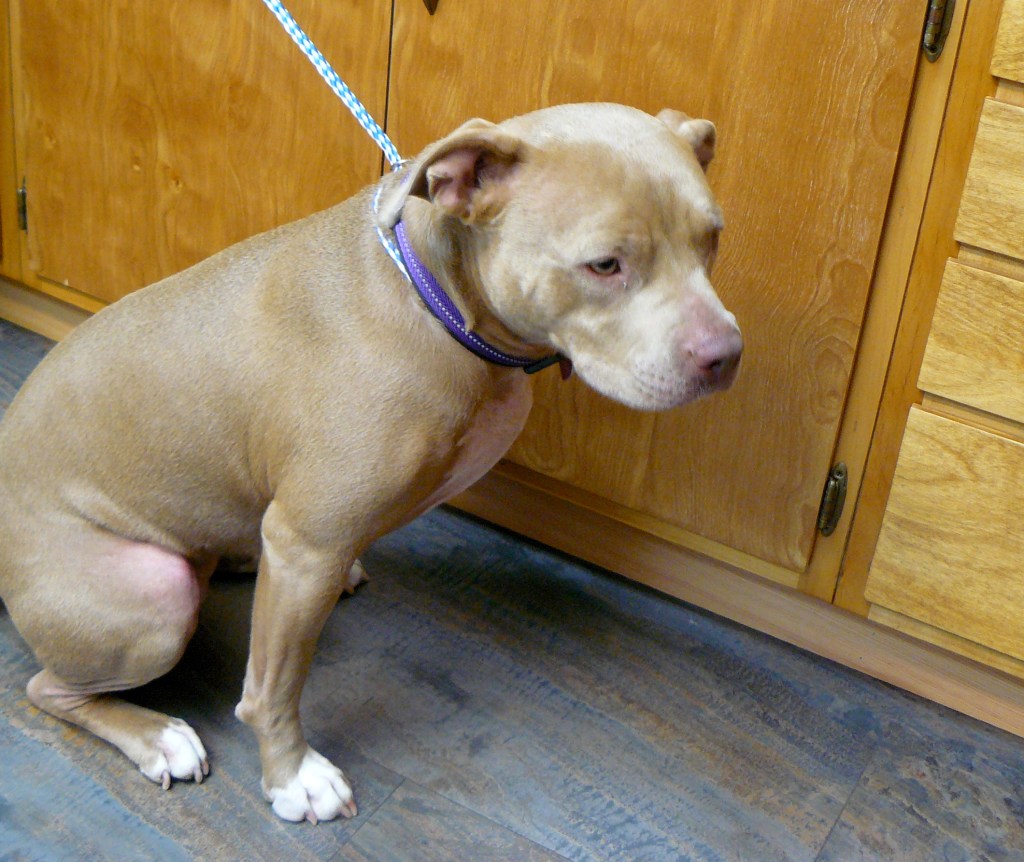
This was Millie, a pit mix, who had been dropped off at the Clinic earlier on. Millie’s owner said that there appeared to be something troubling Millie’s ears. Millie was, indeed, shaking her head a great deal.
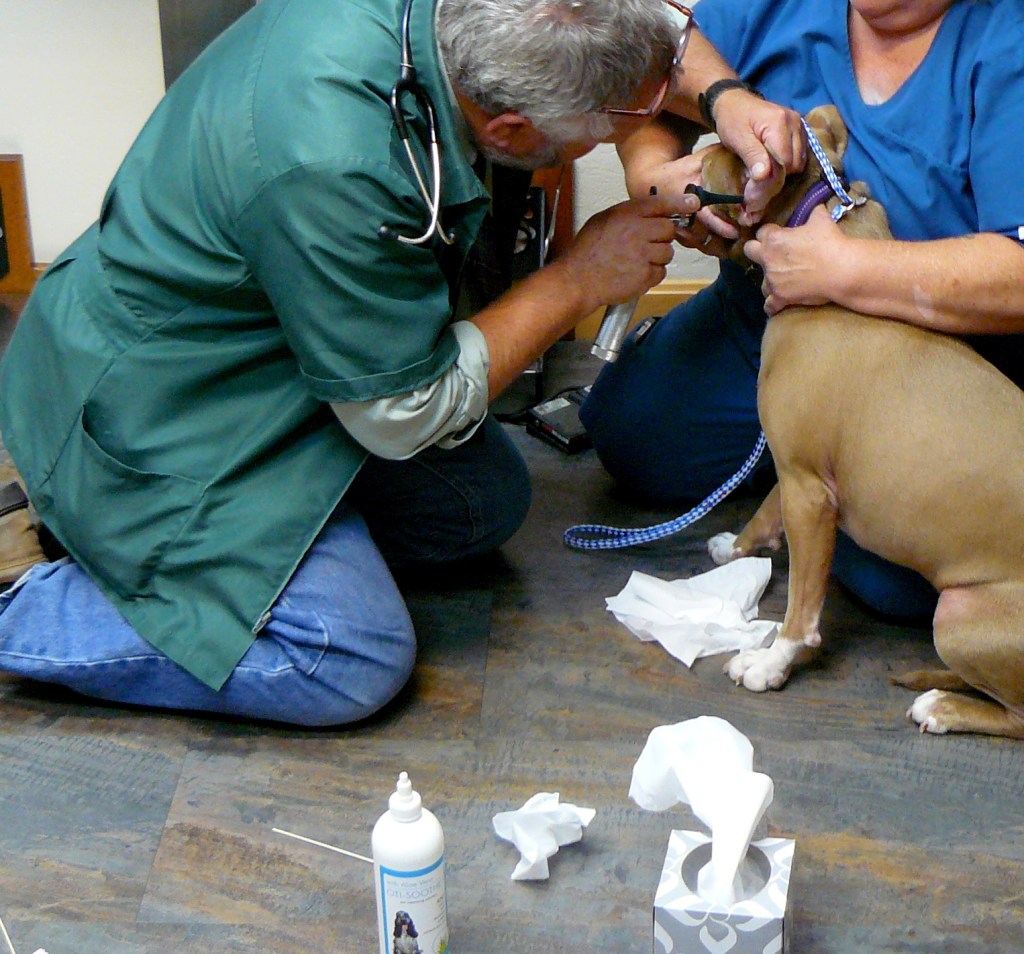
Jim established that it was Millie’s left ear that was the source of the irritation. This was immediately obvious since Millie cried as soon as Jim touched that left ear.
The first examination didn’t identify anything that might be the cause. But apparently the endoscope had such a narrow field of view that it was easy to miss an irritant. Time for another, more extensive examination using that same endoscope.
This time the problem was identified. A foxtail that had penetrated Millie’s ear so deeply that the seed-head had pierced Millie’s eardrum.
Carefully, oh so carefully, Jim pulled the foxtail out from Millie’s ear. I couldn’t believe just how large it was.
About an inch (2.5 cm) long.
I was unable to grab a photograph of Millie’s face once the foxtail had been removed. Trust me it was a face full of doggie smiles.
But I can’t move on to the next patient without remarking how Millie was so beautifully behaved. How maligned the Pitbull and Pitbull Mixes are!
10:45 All done with Millie!
To be continued:
(Please note: These observations are mine alone and because of the busy environment it must be assumed that my interpretation of what was taking place might not be totally accurate. Nothing in this blog post should be used by a reader to make any medical judgment about an animal. If you have any concern about an animal do make an appointment to see a properly qualified veterinarian doctor.)
On Thursday afternoon one of the residents not too far away from us telephoned asking if we might take in a dog that had recently been found lost on Hugo Road, our home road.
Despite the fact that we really didn’t want another dog, there was no question of turning our back on the lost soul.
As soon as we set eyes on the dog it was clear that it was used to people, understood a couple of commands and was in very good health albeit had not been castrated. There was no ID on the dog’s collar. Jean thought the dog was about a year old.
We placed the dog in our guest room that has a separate entrance.
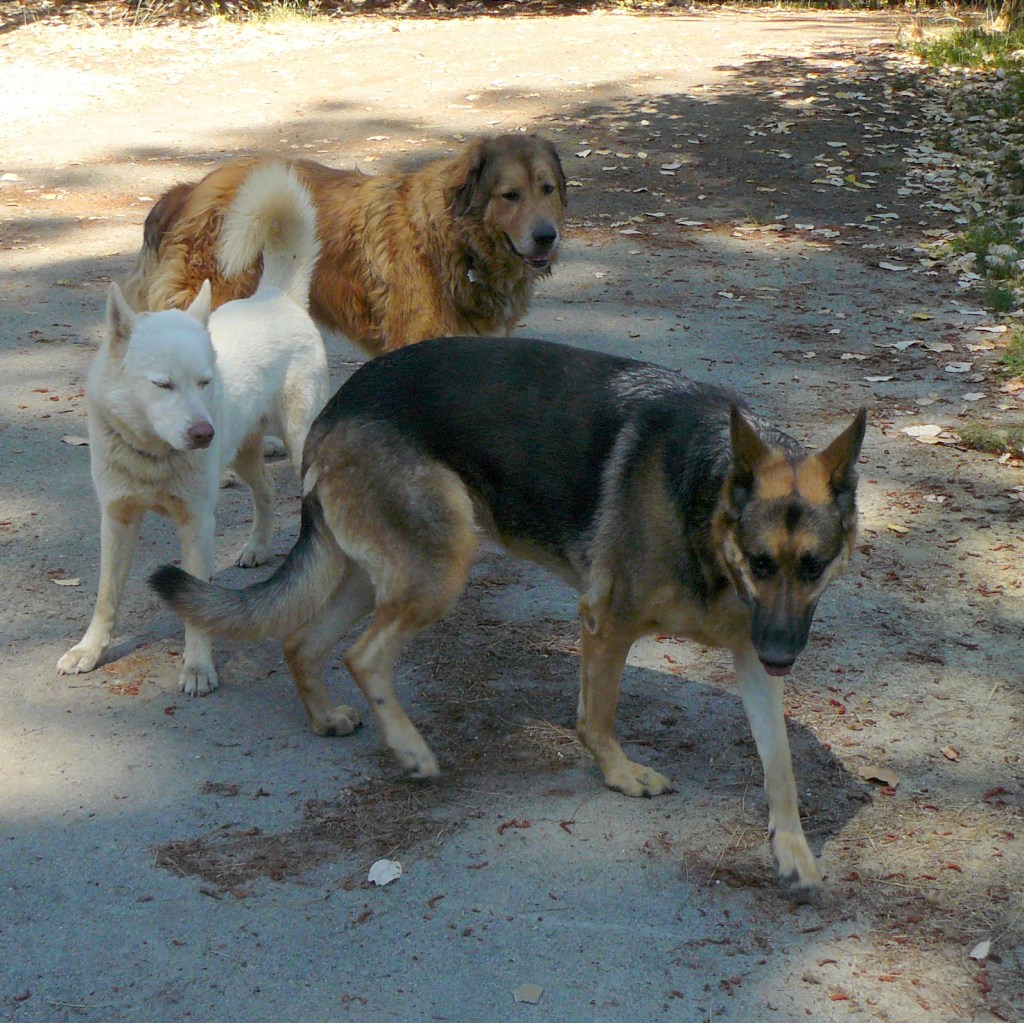
Then yesterday, Friday, it was time to see if the dog would integrate happily with the rest of the crew.
First up was a meeting with Brandy.
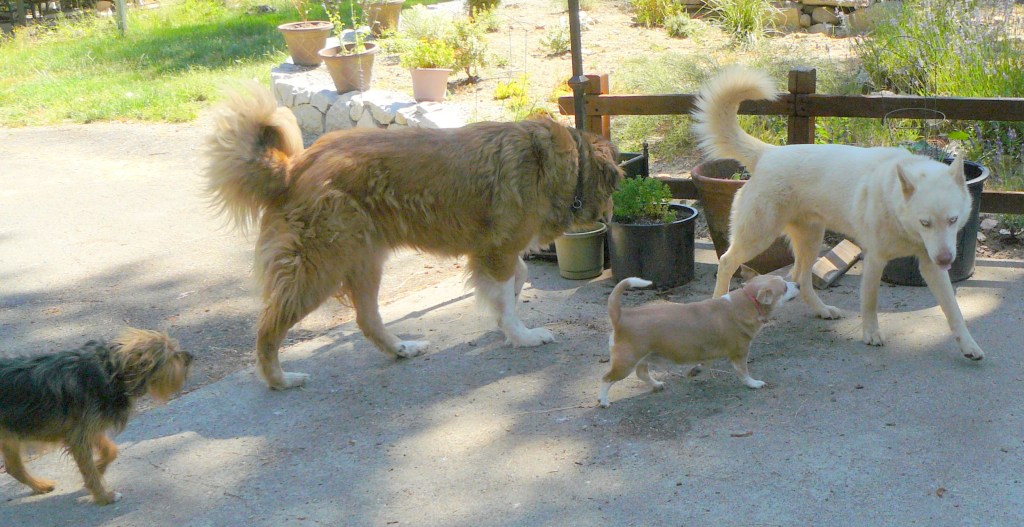
Then along came Sweeny (LHS) and Pedy (looking up at our visitor.)
Time for Cleo to say ‘Hello’.
So far, so good.
Then just before lunchtime yesterday we drove up along Quartz Creek Road that runs up into the hills behind us and is where a number of people live.
That led us to meeting a woman who thought that she knew the owner of the dog. Also that the dog’s name was Colt. This woman said that she would make contact with Colt’s owner.
Plus we have put out a ‘Dog Found’ notice both in our local paper, The Grants Pass Courier, and our local radio station KAJO.
We will see what happens!
Footnote: Around 4pm we received a call from a young woman who was the owner of Colt. Shortly thereafter we drove again along Quartz Creek Road but this time with Colt. Ten minutes later Colt was reunited with his owner.
That left Jean and me with mixed feelings for Colt was such a lovely boy. But it did turn out for the best.
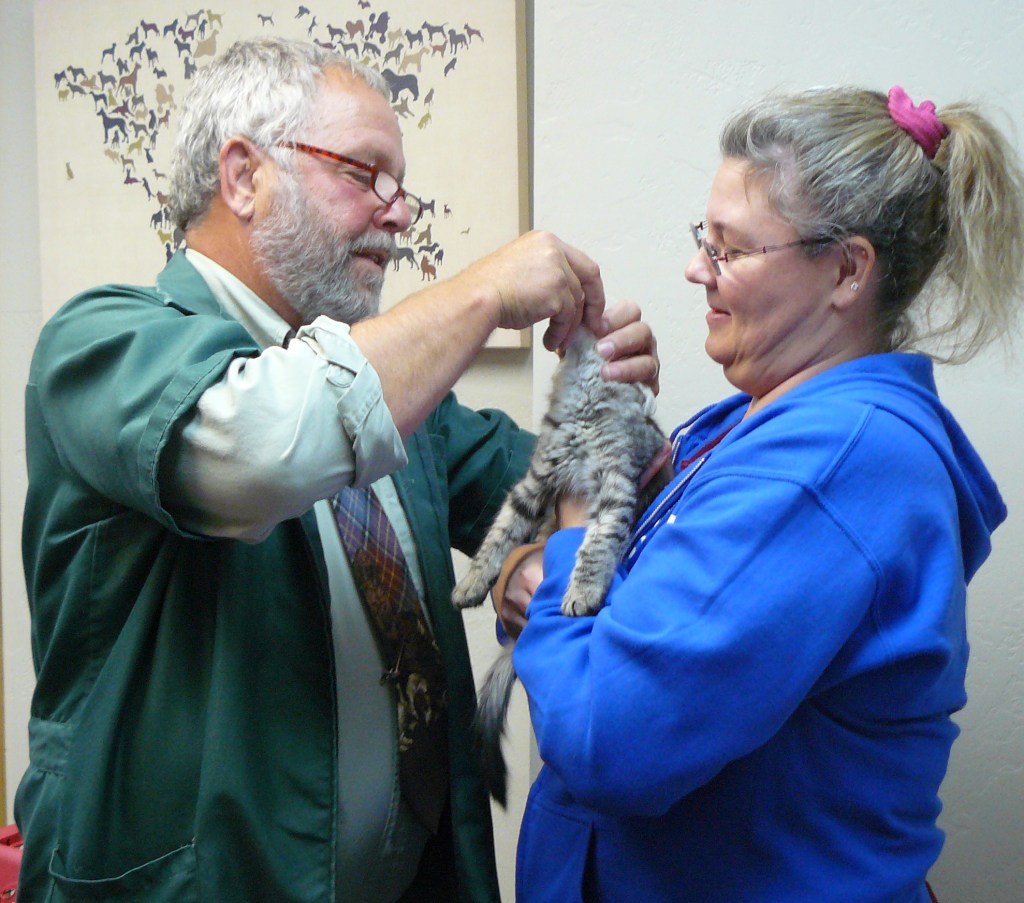
It’s 09:00 and the next animals to be brought in to see Dr. Jim are a couple of cats requiring vaccination.
The kittens are named Grace and Frankie and both were adopted from the Nevada Humane Society although I wasn’t familiar with the circumstances surrounding that adoption.
But great to see them being cared for by the two women and the degree of professional service that I saw in Jim’s briefing of these new cat owners.
That care included giving one of the kittens the necessary pills by mouth.
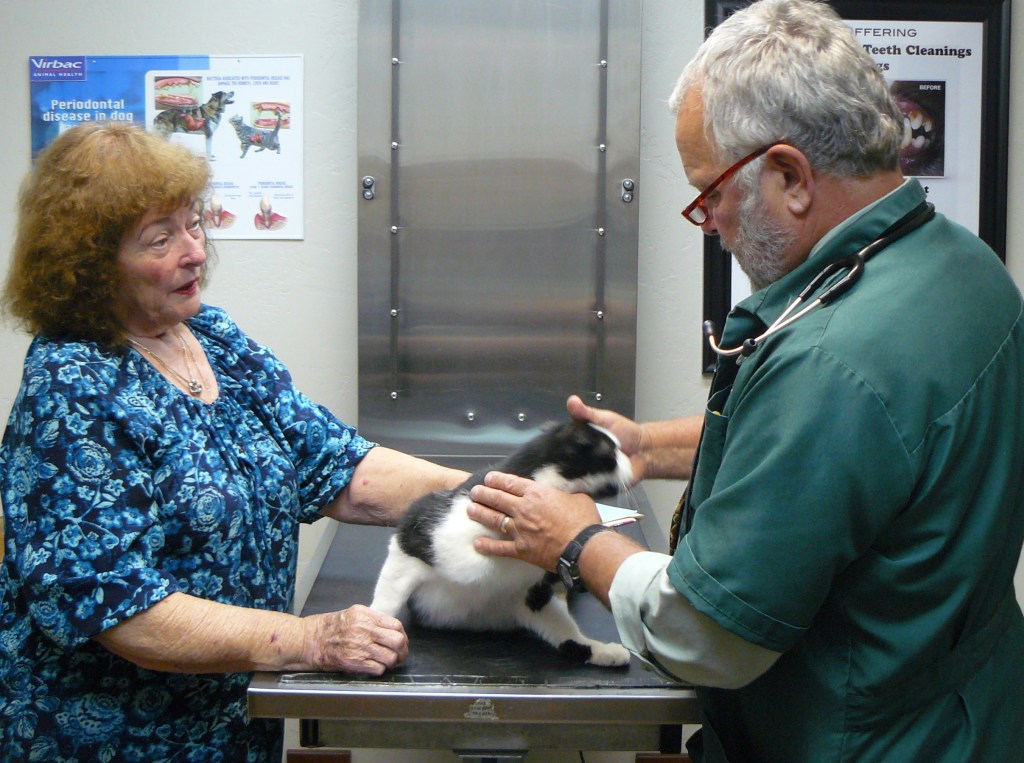
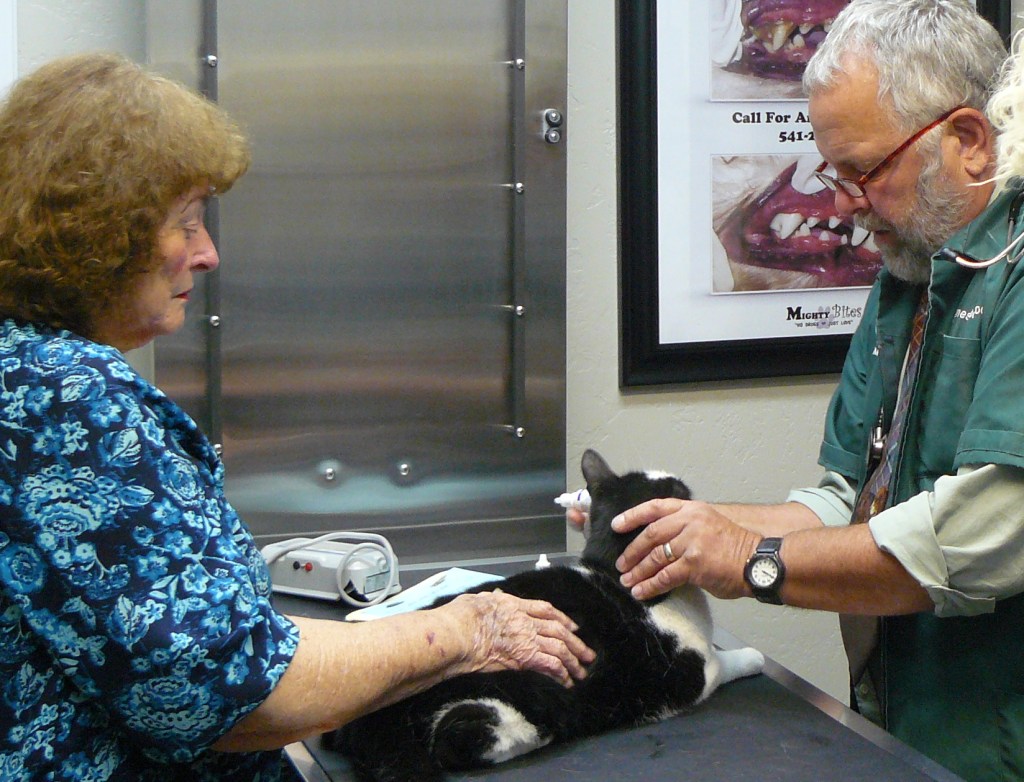
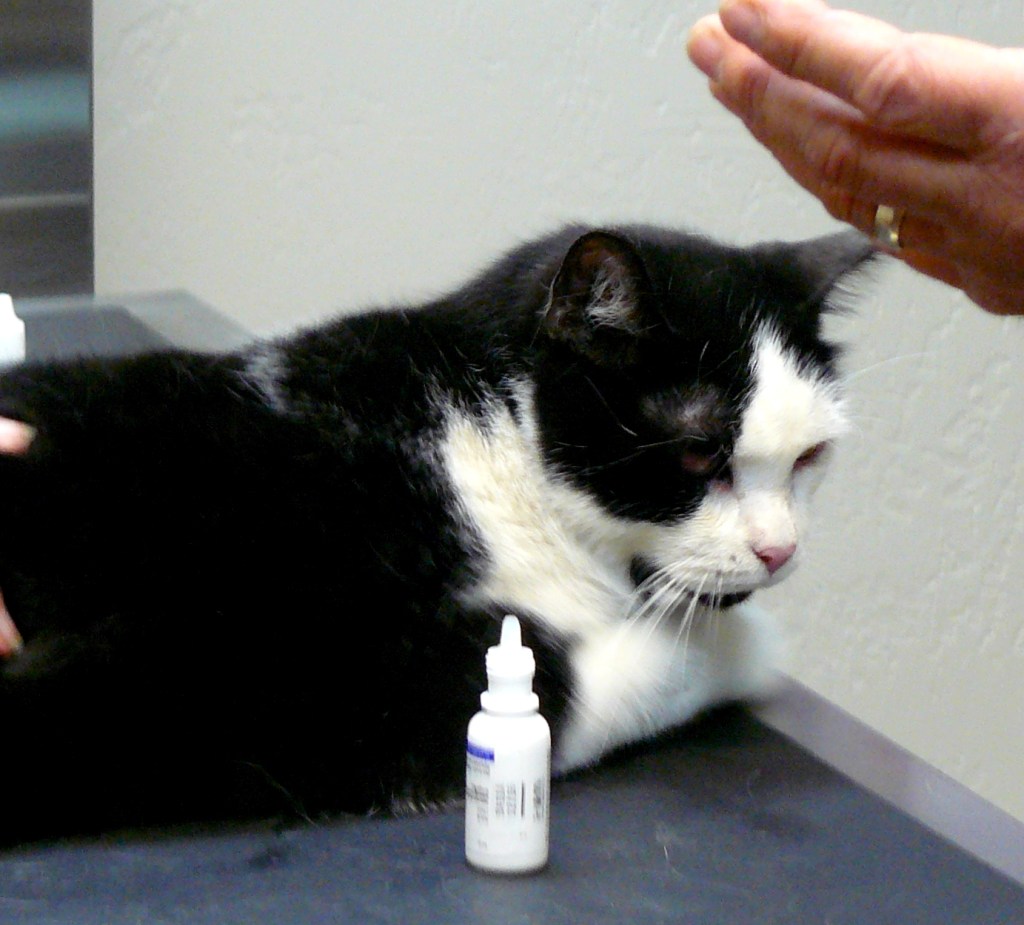
It is now 09:25 and the next case for Jim is another cat. In this case a cat, named Ace, that the owner thinks is having trouble seeing out of it’s right eye.
Jim applies a fluorescent stain to the Ace’s eye that then enables Jim to use a special UV lamp to determine the degree of damage to the eye.
It is determined that the pressure in Ace’s eyeball is normal and Jim is pretty certain that Ace has no sight at all in that right eye. He recommends giving the cat some antibiotics and explains to the owner that cat’s can function perfectly adequately with just one eye. Indeed, if necessary the eyeball could be removed, something that would not be a disadvantage for Ace.
The lady owner of Ace takes note of Jim’s advice and is clearly grateful for what has been explained to her.
It is 10:10.
To be continued:
(Please note: These observations are mine alone and because of the busy environment it must be assumed that my interpretation of what was taking place might not be totally accurate. Nothing in this blog post should be used by a reader to make any medical judgment about an animal. If you have any concern about an animal do make an appointment to see a properly qualified veterinarian doctor.)
I was left behind, abandoned by my owner who has had me for 14 years. He left me tied up on a 3-foot leash in a trailer for about two weeks (maybe longer) with little or no care by my owner’s parents who were unable to care for me daily. Luckily, a kind and lovely lady named Chrissy, found me after she heard my desperate cries. Chrissy spoke to my owner’s parents and was able to get me out of my filthy living condition and to my foster home, where I’m getting endless love and doggy playmates. Please help me find a forever, loving home!
Roman is old, but he’s still strong and playful. He hops, runs, and bounces around as if he were still a pup. If you’re interested, please contact me!
ooOOoo
Roman’s present home is in Seattle, Washington and if you know of anyone who might be interested then the contact details are here.
Plus, please share this as far and wide as possible.
Thank you!
UPDATE
In response to me querying what Roman was like with other dogs and how far he could be taken in terms of meeting up with a new owner:
He is great with other dogs 🙂 I have two other big pups and they all get along just fine.
It depends on the location. Within a 5hr drive is fair.
oooooooooo
On Monday, the following was left as a comment to that post” (my emboldening!)
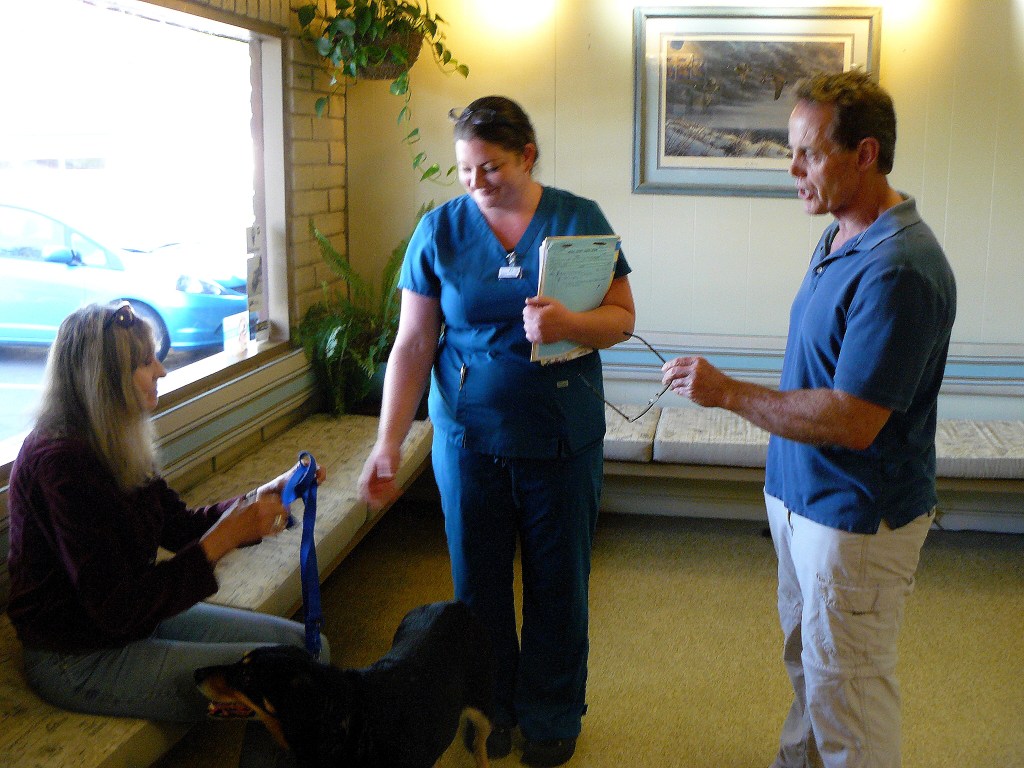
I arrived a little before 8:30 to find both receptionists busy on the telephone. They signaled for me to wait in the reception area until Dr. Jim came out to meet me.
As I waited it quickly became clear that Janice, one of persons behind the front desk, was speaking to someone who was having to make the decision to euthanize their dog. I hadn’t bargained for how that made me feel since it was so recently that Jean and I had trodden the same path. I had to give myself a stern reminder that I was here as the quiet, unobtrusive observer and that my own feelings had to be tucked out of sight.
Shortly thereafter, with Janice still on the telephone patiently and compassionately speaking with that dog’s owner, someone came in with Daisy who was here for teeth cleaning. Jim came out to meet her and advise the owner that one of the team would be doing Daisy’s teeth not himself.
Then it was time for me to go back with Jim and start the day with him. (Jim had arrived at 8:20am.)
Jim’s first case was Ginger. Ginger, a female Golden Retriever, had been brought in earlier on because she had lost weight, was lethargic and was generally off-color.
Jim started to examine Ginger assisted by Cianna, a veterinary technician at the clinic.
It was immediately clear to Jim when he listened to Ginger’s heart that it was racing; Jim thought at something like 200 beats per minute. Jim continued to check Ginger over although, as he told me later, he had an idea that Ginger’s medical problem was a cardiac issue. Jim arranged for Ginger to be given an X-ray as well as blood work.
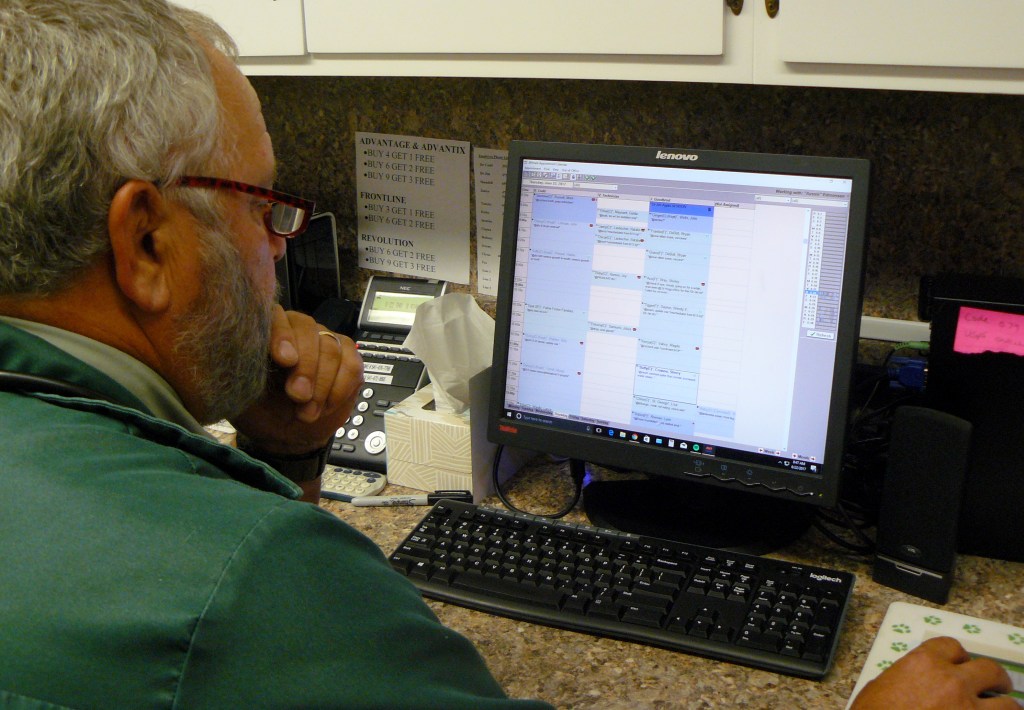
It would take a few minutes for the results of Ginger’s X-ray to come through so Jim showed me the primary software program used in the clinic to record all the details of each patient and all the individual medical details. The software was called AVImark.
I was impressed, very much so, but then again not surprised. For the veterinary business is big business in many countries. For instance, the American Veterinary Medical Association (AVMA) reports that in 2016 there were 107,995 veterinarians in the USA. Of course, there would be a wide range of software tools for the industry.
Back to Ginger’s status.
Her X-ray having been taken, the digital image of her heart was transferred electronically to Dr. Jim’s computer. It showed an extremely enlarged heart. Jim said that the owners of Ginger would be facing a potentially complex analysis but in the interim Ginger should be put on one of the ‘pril’ drugs to reduce the very high stress on Ginger’s heart: Lisinopril; Enalapril; Benazepril. That was arranged then and there. (I didn’t make a note of which drug was given to Ginger.)
Time to call Ginger’s owners and report the findings.
The owners said that they would be in to collect Ginger at 12:30.
I looked at my watch. It was 8:58!
Already the next patient is ready to be seen by the good Doctor.
To be continued:
(Please note: These observations are mine alone and because of the busy environment it must be assumed that my interpretation of what was taking place might not be totally accurate. Nothing in this blog post should be used by a reader to make any medical judgment about an animal. If you have any concern about an animal do make an appointment to see a properly qualified veterinarian doctor.)
Opening up the world of a busy veterinary practice.
Like the majority of pet owners, our experiences of taking a cat or a dog to the local vet clinic are gained entirely in regard to those particular animals. The only small difference between this household and most others is that we have the distinct privilege of having Jim and Janet Goodbrod as close friends just a short distance away. Jim is a Doctor of Veterinary Medicine (DVM) and thank goodness for that as it was more than wonderful that Jim was able to be on hand a week ago when it came to Pharaoh’s last few moments.
Jim is a regular DVM working at Lincoln Road Veterinary Practice in nearby Grants Pass. That practice is run by Dr. Russel Codd.
Dr. Russel Codd (RHS) speaking with Jean at the Clinic back in the days of our dear Hazel.
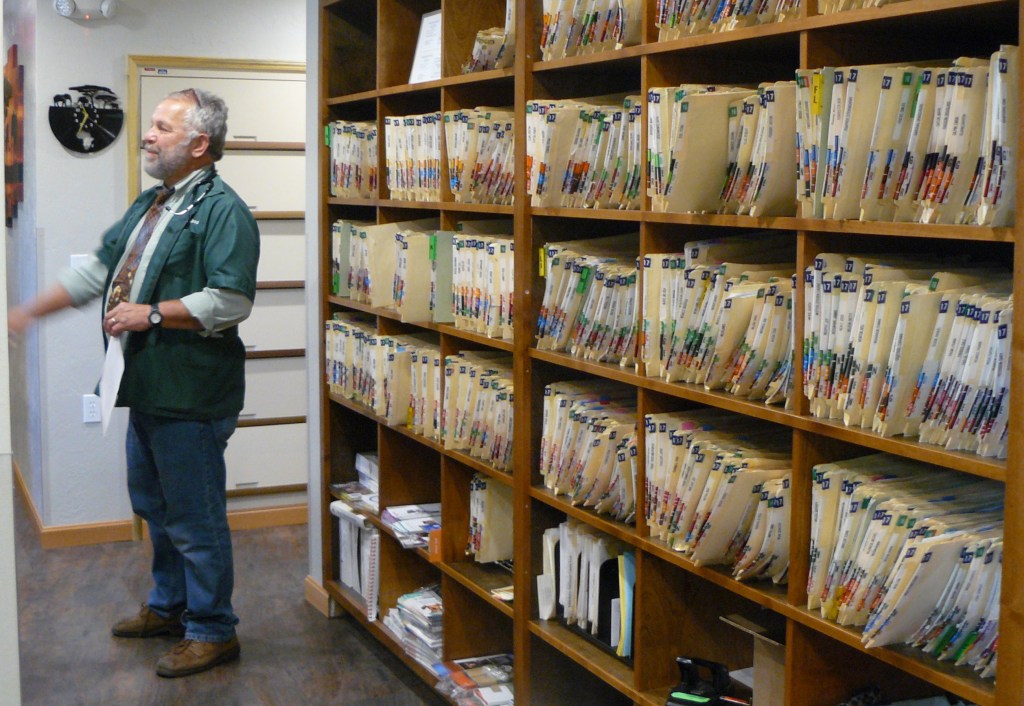
Some time ago, when we were visiting Lincoln Road, it struck me that the detail of what takes place ‘behind the counter’ of a busy vet clinic is most likely not commonly appreciated by those that visit said clinic.
I asked Russel one day if I might be allowed to spend time watching and listening to what goes on behind the scenes; so to speak. Russel said that he would be delighted for me to do that.
So it came to pass that last Thursday, June 22nd, I did just that.
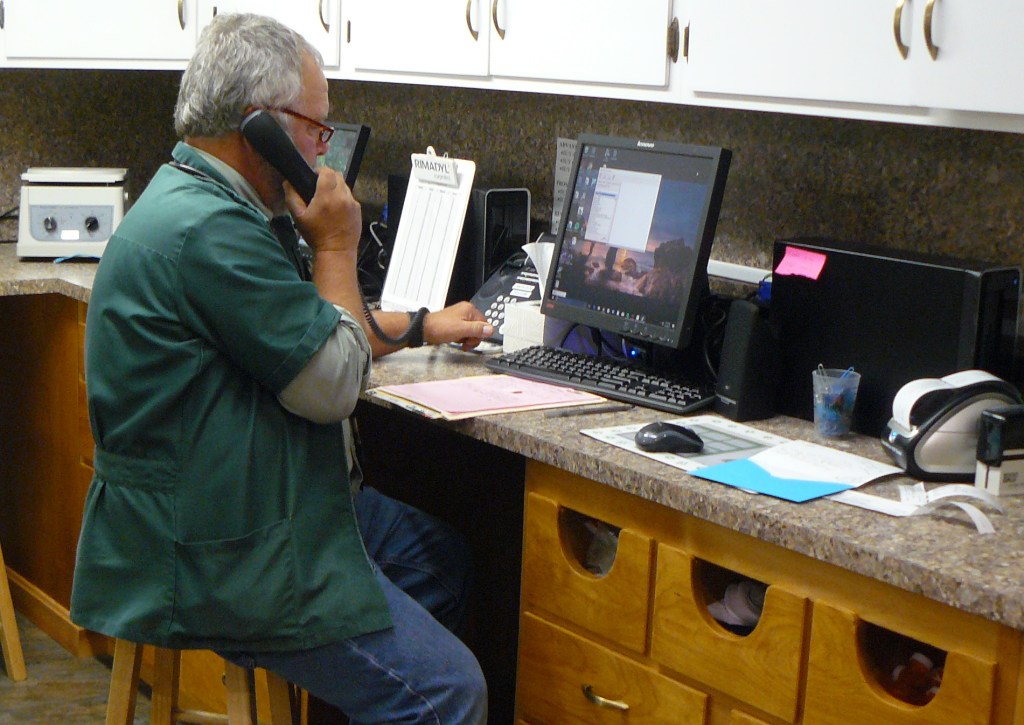
It was a day when Dr. Jim worked a half-day at the clinic and I spent the thick end of six hours listening and observing what took place. I had a camera with me but as was only fit and proper was very sensitive to what photographs were taken. Likewise, I didn’t interrupt the proceedings with my questions although each pet owner had specifically said it was alright for me to be in the same room. In other words, what I will be writing in each post is much more my impressions of the workings of a day in the life of a veterinary clinic.
So tomorrow I will publish the first of my articles and at regular intervals report more from my day at Lincoln Road.
They will be published under the overall heading of Visiting The Vet.
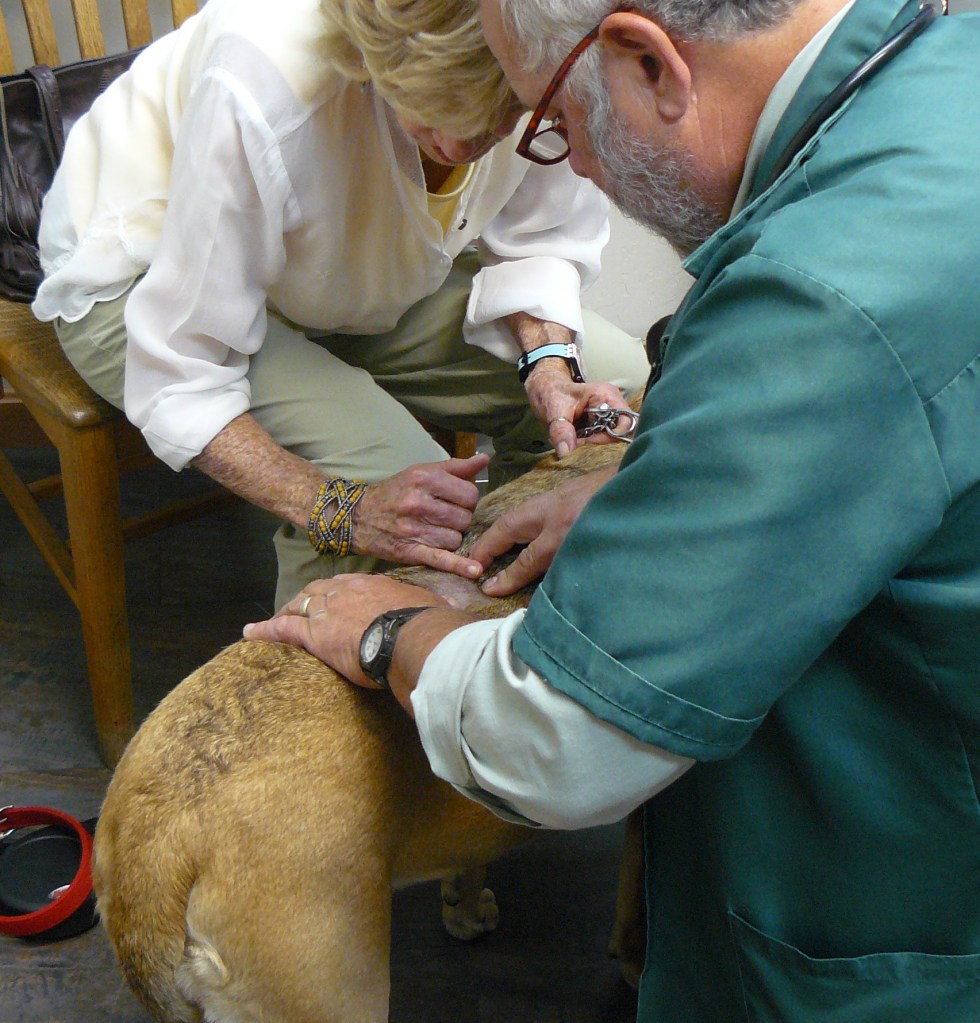
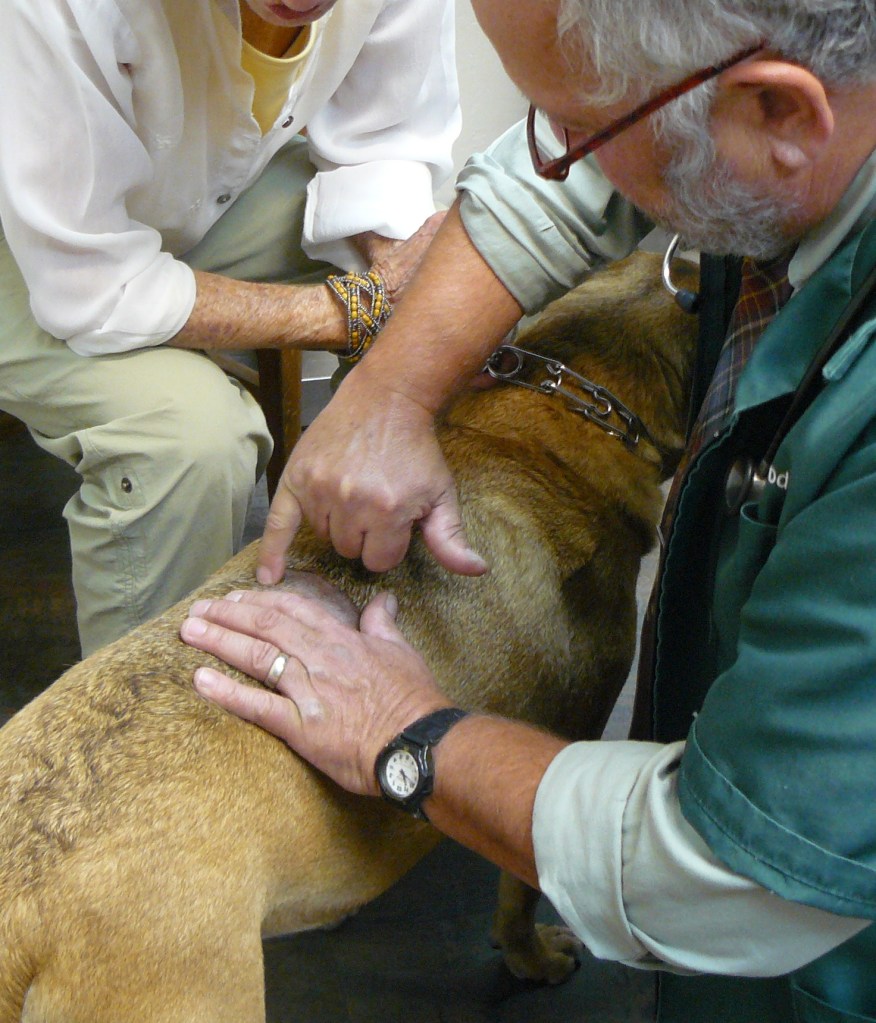
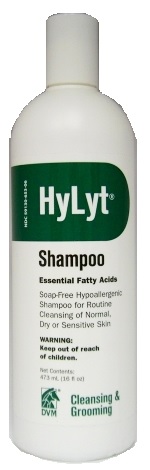 Jim’s view was to leave it for the time being but he did recommend using a hypoallergenic shampoo. There were a number to choose from but Jim supported the shampoo manufactured by Bayer and sold under the brand name of Hylyt Shampoo.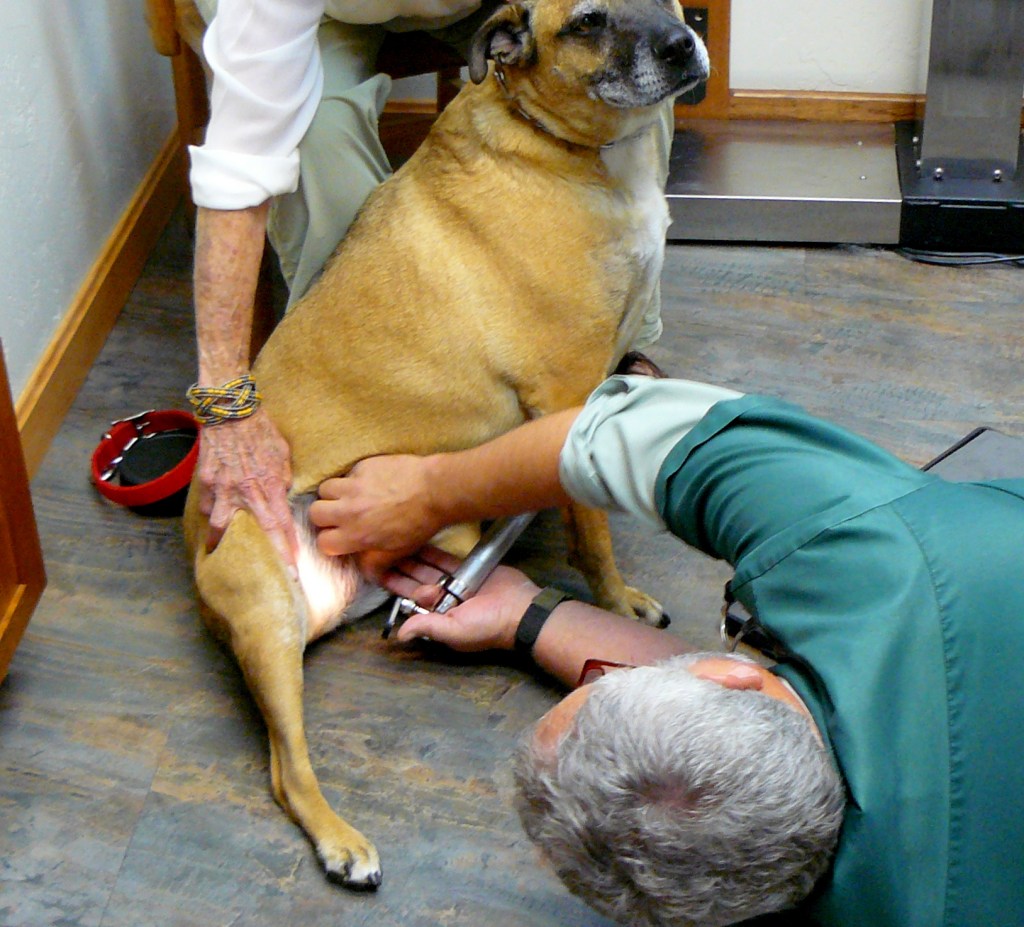

 In yesterday’s
  month. Jerry Reed from that group some time ago recommended to me reading the book The Spirit Level authored by Richard Wilkinson and Kate Pickett.









 Learning from Dogs