A non profit organization, founded by Lya Battle and Alvaro Saumet. During the last eight years we’ve been promoting well-being and respect for animals.
HOW WE DO IT?
Veterinarian: We take care of our mutts with deworming, sterilization and any other care they need. The cost of maintaining a dog healthy is $5 per month.
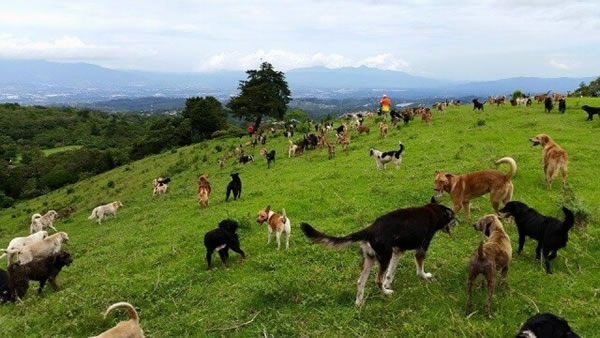
Shelter: Territorio is home for hundreds of doggies. We give them here a safe place to live, free of maltreatment, and full of love. The cost of providing a home is $11 per month for each of our unique specimens.
Food: Each mont we consume thousands of kilos of dog food, to keep our pack healthy. Giving a full small plate to each mutt cost us $20 per month.
There is much, much more on their website that I encourage you to go to. Here are some photographs of the dogs that they rescue.
oooo
oooo
oooo
oooo
oooo
oooo
There are a number of videos on YouTube to watch.
Here’s a short one.
And here’s a slightly longer one by National Geographic.
Finally, if you feel so minded here is the donate page. It’s a good cause and, for example, for just $36 you can sponsor one dog. That’s what Jeannie and I did.
Two Chinese governing bodies plan to introduce new legislation that will provide special protections to canines by classifying them as companion animals. This would exclude dogs from being used for human consumption.
If you are unfamiliar with the festival, it is notorious for its bloodshed and cruelty. Because dog meat consumers believe that the meat tastes better when dogs have more adrenaline in their blood, dog meat butchers torture the animals. Dogs are beaten, burned alive with blowtorches, or tossed into pots of boiling water.
Thanks to public outcry, the festival’s popularity has decreased and restrictions have been set, however, that hasn’t been enough to end the festival for good. Now’s our chance.
Photo above: Bruce Tennant captured the March 2014 full moon rising over Santiago Peak, Alamitos Bay, Long Beach, California.
The March 20-21, 2019, full moon ushers in the first full moon of spring for the Northern Hemisphere, and the first full moon of autumn for the Southern Hemisphere. This full moon is also a supermoon, particularly close to Earth. It comes less than four hours after the arrival of the March 20 equinox.
This is the closest coincidence of a full moon with the March equinox since March 2000 – 19 years ago. The full moon and March equinox won’t happen less than one day apart again for another 11 years, or until March 2030.
March 2000 full Moon: March 20 at 4:44 UTC
March 2000 equinox: March 20 at 7:35 UTC
March 2030 full moon: March 19 at 17:56 UTC
March 2030 equinox: March 20 at 13:51 UTC
This month’s full moon also presents the third and final supermoon of 2019. Will it appear bigger in your sky? No, not unless you happen to catch the moon just after it has risen in the east, around sunset. Then its larger-than-usual size has less to do with the supermoon, but more from a psychological effect known as the moon illusion.
Supermoons don’t look bigger to the eye to most people, but they do look significantly brighter. If you’re in the suburbs or a rural area, notice the bright moonlight cast on the landscape at this full moon.
Also, supermoons have a stronger-than-usual effect on Earth’s oceans. Watch for higher-than-usual tides to follow the supermoon by a day or so, especially if a coastal storm is happening in your part of the world.
At the equinox, the sun is at zenith (straight overhead) at the Earth’s equator. Because the Earth’s atmosphere refracts (bends) sunlight, a tiny bit more than half of the globe is covered over in daylight.Generally, the first full moon of a Northern Hemisphere spring heralds the imminent coming of the Christian celebration of Easter. Since Easter Sunday – by proclamation – occurs on the first Sunday after the first full moon in spring, some of us might expect the upcoming Sunday on March 24 to be Easter Sunday. However, by ecclesiastical rules, the equinox is fixed on March 21, so that places this year’s Easter Sunday (for Western Christendom) on April 21, 2019.
By the Gregorian calendar, the last time that an ecclesiastical Easter and an astronomical Easter didn’t occur on the same date was 38 years ago, in 1981. The next time won’t be until 19 years from now, in 2038.
(Easter Sunday for Eastern or Orthodox Christendom actually falls on April 28, 2019. That’s because the Eastern Church bases Easter on the old style Julian calendar, instead of the revised Gregorian calendar used by Western Christianity and most of the world.)
For our friends in the Southern Hemisphere, this March full moon counts as your Harvest Moon. The Harvest Moon is the full moon occurring closest to the autumnal equinox. On the average, the moon rises about 50 minutes later with each passing day. But for several days around the time of the Harvest Moon, the lag time between successive moonrises is reduced to a yearly minimum. For instance, at 40 degrees south latitude, the moon now rises some 30 to 35 minutes later (instead of the average 50 minutes later) each day for the next several days.
Like Earth, Saturn has equinoxes too! The ringed planet last had an equinox in 2009, and will have its next equinox in 2025. From Earth, Saturn’s rings disappear from view at a Saturn equinox, because these rings are then edge-on from our vantage point. But this near-equinox view of Saturn’s rings is readily visible from the Cassini spacecraft, because it’s 20 degrees above the ring plane. Image via NASA.
Here in the Northern Hemisphere, where it’s the closest full moon to the spring equinox, the lag time between successive moonrises is at a yearly maximum. At 40 degrees north latitude, the moon now rises around 70 to 75 minutes later daily. In the Northern Hemisphere, we ‘ll have to wait for the September full moon to bring forth our procession of early evening moonrises.
Last but hardly least, this March 2019 full moon gives us the first of four full moons in one season (between the March equinox and June solstice). Most of the time, a season – the time period between an equinox and a solstice, or vice versa – only harbors three full moons. But since this March full moon comes very early in the season, that allows for a fourth full moon to take place before the season’s end.
March 2019 equinox: March 20 at 21:58 UTC
March 2019 full moon: March 21 at 1:43 UTC
April 2019 full moon: April 19 at 11:12 UTC
May 2019 full moon: May 18 at 21:11 UTC
June 2019 full moon: June 17 at 8:31 UTC
June 2019 solstice: June 21 at 15:54 UTC
Some people call the third of four full moons in one season a Blue Moon. So our next Blue Moon (by the seasonal definition of the term) will fall on May 18, 2019.
The next Blue Moon by the monthly definition – second of two full moons in one calendar month – will come on October 31, 2020.
Bottom line: Enjoy the equinox full moon on March 20-21, 2019. It’s the third and final full supermoon of 2019, and the first of four full moons in the upcoming season (spring for the Northern Hemisphere, autumn for the Southern Hemisphere).
Bruce McClure has served as lead writer for EarthSky’s popular Tonight pages since 2004. He’s a sundial aficionado, whose love for the heavens has taken him to Lake Titicaca in Bolivia and sailing in the North Atlantic, where he earned his celestial navigation certificate through the School of Ocean Sailing and Navigation. He also writes and hosts public astronomy programs and planetarium programs in and around his home in upstate New York.
ooOOoo
It’s not about dogs. But then again maybe it is. For I’m thinking of dogs howling at the moon.
As I said in my email to her after Jeannie and I had listened to it:
OK. Have listened to it just now.
I don’t know what to say.
Frankly, I’m overwhelmed. I need some time to let it settle down but it’s going to be featured on the blog very soon.
Thank you
Paul
I’m still ‘processing’ it but that doesn’t stop me from sharing it with you.
ooOOoo
Ralph spends the whole hour with independent journalist, Dahr Jamail, author of “The End of Ice,” his first person report on the front lines of the climate crisis.
In late 2003, award-winning journalist, Dahr Jamail, went to the Middle East to report on the Iraq War, where he spent more than a year as one of only a few independent US journalists in the country. Mr. Jamail has also written extensively on veterans’ resistance against US foreign policy. He is now focusing on climate disruption and the environment. His book on that topic is entitled, The End of Ice.
“So much of what we talk about is so dire and so extreme and so scary and also disheartening that I quote Vaclav Havel, the Czech dissident writer and statesman. And he reminds us that as he said, ‘Hope is not the conviction that something will turn out well but the certainty that something is worth doing no matter how it turns out.” And that’s where I get into this moral obligation that no matter how dire things look, that we are absolutely morally obliged to do everything we can in our power to try to make this better.” Dahr Jamail, author of “The End of Ice”
I read this a few moments ago (10am PST Monday, 18th.) and, without question, knew that I had to republish it. It is done with George Monbiot’s kind permission.
ooOOoo
Re: generation
Why older people must stand in solidarity with the youth climate strikes.
By George Monbiot, published in the Guardian 15th February 2019
The Youth Strike 4 Climate gives me more hope than I have felt in 30 years of campaigning. Before this week, I believed it was all over. I thought, given the indifference and hostility of those who govern us, and the passivity of most of my generation, that climate breakdown and ecological collapse were inevitable. Now, for the first time in years, I think we can turn them around.
My generation and the generations that went before have failed you. We failed to grasp the basic premise of intergenerational justice: that you cannot apply discount rates to human life. In other words, the life of someone who has not been born will be of no less value than the life of someone who already exists. We have lived as if your lives had no importance, as if any resource we encountered was ours and ours alone to use as we wished, regardless of the impact on future generations. In doing so, we created a cannibal economy: we ate your future to satisfy our greed.
It is true that the people of my generation are not equally to blame. Broadly speaking, ours is a society of altruists governed by psychopaths. We have allowed a tiny number of phenomenally rich people, and the destructive politicians they fund, to trash our life support systems. While some carry more blame than others, our failure to challenge the oligarchs who are sacking the Earth and to overthrow their illegitimate power, is a collective failure. Together, we have bequeathed you a world that – without drastic and decisive action – may soon become uninhabitable.
Every day at home, we tell you that if you make a mess you should clear it up. We tell you that you should take responsibility for your own lives. But we have failed to apply these principles to ourselves. We walk away from the mess we have made, in the hope that you might clear it up.
Some of us did try. We sought to inspire our own generations to do what you are doing. But on the whole we were met with frowns and shrugs. For years, many people of my age denied there was a problem. They denied that climate breakdown was happening. They denied that extinction was happening. They denied that the world’s living systems were collapsing.
They denied all this because accepting it meant questioning everything they believed to be good. If the science was right, their car could not be right. If the science was right, their foreign holiday could not be right. Economic growth, rising consumption, the entire system they had been brought up to believe was right had to be wrong. It was easier to pretend that the science was wrong and their lives were right than to accept that the science was right and their lives were wrong.
A few years ago, something shifted. Instead of denying the science, I heard the same people say “OK, it’s real. But now it’s too late to do anything about it.” Between their denial and their despair, there was not one moment at which they said “It is real, so we must act.” Their despair was another form of denial; another way of persuading themselves that they could carry on as before. If there was no point in acting, they had no need to challenge their deepest beliefs. Because of the denial, the selfishness, the short-termism of my generation, this is now the last chance we have.
The disasters I feared my grandchildren would see in their old age are happening already: insect populations collapsing, mass extinction, wildfires, droughts, heat waves, floods. This is the world we have bequeathed to you. Yours is among the first of the unborn generations we failed to consider as our consumption rocketed.
But those of us who have long been engaged in this struggle will not abandon you. You have issued a challenge to which we must rise, and we will stand in solidarity with you. Though we are old and you are young, we will be led by you. We owe you that, at least.
By combining your determination and our experience, we can build a movement big enough to overthrow the life-denying system that has brought us to the brink of disaster – and beyond. Together, we must demand a different way, a life-giving system that defends the natural world on which we all depend. A system that honours you, our children, and values equally the lives of those who are not born. Together, we will build a movement that must – and will – become irresistible.
I confess to not having heard of this endangered species before.
But my son, Alex, sent me an email earlier in the week hoping I would post something on the blog.
ooOOoo
Dear Alex
Creating widespread awareness of the four African pangolin species is an important part of our mission, because if people don’t know what a pangolin is, why would they care enough to help save it?
It’s World Pangolin Day this Saturday and here are two easy ways you can get involved right now:
Share this newsletter
Forward this email to all your friends to encourage them to sign up and receive our updates too. Tag10ForPangolins
Share our latest Facebook campaign tagging at least 10 friends in your post, and help us reach our target of telling 100,000 people about pangolins by Saturday. We’ve just passed the 51,000 mark and with your help we can reach our goal!
With thanks,
Catherine and Team Pangolin
ooOOoo
Every little helps!
And guess what I found:
PANGOLIN – The Most Poached Animal in The World
Pangolins are the most heavily poached animal in the world, despite the fact that most people don’t even know that they exist.
The Pangolin is a small mammal, covered in large overlapping scales. It’s mainly a nocturnal animal with a diet consisting of insects such as ants and termites.
They may look like weird-scaly anteaters, but they are actually not part of the anteater family at all. The 2 most unique features of this animal are, that it is covered in plate armor scales from head to toe, and even though it has four legs, it walks predominantly on it’s hind legs, and uses it’s front legs for griping & digging.
So why are these creatures being so heavily poached? Well It’s all to do with their scales. The Pangolin’s scales & meat are used in traditional medicine, fashion and even eaten in high-end cuisine.
Thanks for watching
And then on Wednesday the BBC News had an extensive item about Pangolins. It’s a long article with a video. Please read it.
‘Brain tumour’ dog in Beauly had 7cm needle in neck
Toby the Yorkshire terrier had seizure symptoms before owners knew he had a needle lodged in his neck.
A dog that showed signs of a brain tumour was found to have a 7cm (3in) needle lodged in its neck.
Toby, a 13-year-old Yorkshire terrier, was taken to a vet in Nairn in the Highlands after he suffered neck pain, struggled to walk and showed seizure symptoms.
X-rays later showed the needle had pierced his spinal cord.
But surgeons in Edinburgh were able to extract it and Toby went on to make a full recovery.
X-rays revealed the 7cm metal sewing needle piercing Toby’s spinal cord
Owner Alexander Jamieson, from Beauly, near Inverness, said: “We feel that without the help of the experts in Edinburgh, Toby would not be here today.
“The care and attention he got was out of this world and we are delighted to see him back to his old self.”
Toby was referred to the specialist surgical clinic at the University of Edinburgh’s Hospital for Small Animals at the Royal (Dick) School for Veterinary Studies where vets performed a CT scan to assess any major damage to his spinal cord in August 2018.
They found that the sewing needle – which still had thread attached – was dangerously close to his brain.
Toby has now recovered to the point where he is able to walk and run normally.
Vets are delighted with Toby’s recovery
It is not known how the needle ended up in Toby’s neck but vets suspect that he could have eaten it or laid his head on it.
Samantha Woods, senior lecturer, and Jessica McCarthy, senior clinical training scholar in small animal surgery, said they were delighted with Toby’s progress.
Ms Woods added: “We are really pleased to see Toby back to full health, thanks to the combined efforts of his vets and our specialist teams here in Edinburgh.”
ooOOoo
That was fantastic! All kudos to the whole team that swung into action.
You may have already seen this because it was very widely shown.
In the tail end of Deep Adaptation there is reference to Greta’s video because it was so powerful. Young Greta Thunberg is a 16-year-old person who passionately wants this world to change and to change soon.
Here’s the piece that accompanied that video:
In this passionate call to action, 16-year-old climate activist Greta Thunberg explains why, in August 2018, she walked out of school and organized a strike to raise awareness of global warming, protesting outside the Swedish parliament and grabbing the world’s attention. “The climate crisis has already been solved. We already have all the facts and solutions,” Thunberg says. “All we have to do is to wake up and change.”


 Ralph spends the whole hour with independent journalist, Dahr Jamail, author of “The End of Ice,” his first person report on the front lines of the climate crisis.
 Dear Alex


 Learning from Dogs