Category: Culture

A Cherokee legend!

A precious and profound legend.

I follow Colin’s blog Wibble. It ranges across a myriad of thoughts and beliefs and it’s a good follow.

On June 9th, Colin published a post regarding The wolves within, a beautiful legend from the Cherokees. Colin readily and promptly gave me permission to share it with you.

The content isn’t mine, but of course it’s fine by me, Paul. You’re too polite by half! 😀

Here it is.

ooOOoo

The wolves within: a Cherokee legend

Posted on June 9, 2020

An old grandfather said to his grandson, who came to him with anger at a friend who had done him an injustice, “Let me tell you a story.

“I too, at times, have felt a great hate for those that have taken so much, with no sorrow for what they do.

“But hate wears you down, and does not hurt your enemy. It is like taking poison and wishing your enemy would die. I have struggled with these feelings many times.” He continued, “It is as if there are two wolves inside me. One is good and does no harm. He lives in harmony with all around him, and does not take offense when no offense was intended. He will only fight when it is right to do so, and in the right way.

“But the other wolf, ah! He is full of anger. The littlest thing will set him into a fit of temper. He fights everyone, all the time, for no reason. He cannot think because his anger and hate are so great. It is helpless anger, for his anger will change nothing.

“Sometimes, it is hard to live with these two wolves inside me, for both of them try to dominate my spirit.”

The boy looked intently into his grandfather’s eyes and asked, “Which one wins, grandfather?”

The grandfather smiled and quietly said, “The one I feed.”

With thanks to White Wolf Pack.

ooOOoo

So let all of us feed that wolf!

There are some more legends here!

These are very strange times!

A Grist article raises a core question.

On June 4th this year Grist published an article written by Eve Andrews. It is not about dogs at all. Yet, it seems to me to ask a fundamental question about us humans. The article speaks of America but certainly it applies to my old country, the U.K., and it probably applies to most of the countries in the world.

I recently wrote to Annelise McGough, the Growth and Engagement Editor at Grist asking if I could republish the article. She kindly said yes!

So here it is!

ooOOoo

Grist / Windy Kelly / EyeEm

Why is everything falling apart in 2020?

By on Jun 4, 2020

Dear Umbra,

Did any aspect of climate change cause the pandemic to happen this year (versus last year or next year)? Could pandemics happen more often?

— Which Oracle Read Rightly Imminent, Existential Doom?

A. Dear WORRIED,

2020: what a year so far! As anyone who witnessed the crowds of face mask-clad people show up in the middle of a deadly pandemic to protest police violence this weekend can attest, a lot seems to be terrible all at once. You’re asking, in a sense, why now? It almost seems like it must be a rhetorical question. But it’s not — by understanding how we got into this mess, we might presumably be able to find our way out.

This doesn’t just apply to the pandemic.

Let’s start by taking your question at face (mask) value: There are multiple factors that have contributed to the rise of zoonotic illnesses — those of animal origin — over recent years, as my very sharp colleague Shannon Osaka delineated in an article and video earlier in the spring. Scientists believe COVID-19, like several other SARS viruses, likely originated in a bat. It turns out many strains of coronavirus can be traced back to bats! Who knew those little guys were such harbingers of destruction?

It’s not really on the bats, of course. Warmer temperatures (an established feature of climate change) and environmental degradation (often attributed to climate change, industrialization, or other products of human development) have driven a lot of animals to migrate out of their normal habitats and into human ones. Those factors have also contributed to different species coming into close contact with each other, which makes viruses normally contained to one species more likely to “spill over,” or jump to a new type of animal.

So clearly, the lead-up to the novel coronavirus’s outbreak was a gradual one. But perhaps 2019 was just warm enough to kill off enough of the insect population that some COVID-19-carrying bat depended on for food, and that drove it out to wreak some (unintentional) havoc on humanity. The bat’s habitat could have been destroyed by a new coal mine development. It could have woken up one morning and thought: This is my time to fuck shit up! Revenge on those humans that messed up my home! (OK, there was also probably a pangolin involved, but let’s keep things simple.)

According to the Centers for Disease Control and Prevention, COVID-19 is the fourth major pandemic caused by a novel virus to hit the United States since the 1918 “Spanish flu” that killed 50 million people worldwide. And there are so many factors and variables that lead to the sprout of a pandemic that you could very well argue that, “Yes, of course it happened at this exact point in time” or “No, it could have happened at any point in time.” It’s impossible to know for sure. But climate change and habitat destruction are certainly working together to create circumstances more favorable to the spread of disease, and that means pandemics will likely become more common as the world grows warmer.

The thing is, highly contagious, devastating illnesses have always been a part of human life, even though a real pandemic is a few-times-per-century event. It’s a fact of sharing the Earth with other living things; it just happens. But humans are ostensibly equipped with the means to contain the spread of diseases and help heal those who become sick. At this moment, thanks to advances in medicine and information-sharing and communication, that’s more true than ever before!

And yet. The United States, an astonishingly wealthy nation with ostensibly the most advanced — certainly the most expensive! — medical system in the world, has lost around 100,000 people to COVID-19, with many more surely to come. That doesn’t even take into account the far-reaching hardship caused by an economic collapse as drastic, by some metrics, as the Great Depression. The current unemployment rate, for example, exceeds 20 percent.

The reality is that what some have referred to as “the lost spring” (and what could very well be “the lost year”) is not the product of a single infectious disease, but the boiling over of many long-standing crises, including structural forms of injustice. Like everything else in American society, the damage done by the coronavirus is unevenly distributed across race. The death rate of black Americans from COVID is three times that of whites, and 40 percent of black-owned businesses have shuttered due to social distancing measures. As of April, rates of black and Latino unemployment were 16.7 and 18.9 percent, respectively, compared to 14.2 percent for whites. These hardships continue to feed into the cycle of racial inequality in this country.

The devastation to American society that we are witnessing in real time, one could argue, could only have happened at the present moment. That’s due to the nightmarish confluence of horrific leadership, centuries of racial oppression, unprecedented wealth inequality, the erosion of the social safety net, privatization of medicine, a far-too-consolidated supply chain, politicization of science, a highly globalized economy, and one misguided or mischievous bat. Oh, and the climate change and environmental degradation that could have led to said bat’s misbehavior.

COVID-19 could have popped up at any time, as viruses do. The degree to which it’s ravaged American society, however, has little to do with the virus itself. Other countries such as New Zealand and South Korea, faced the same disease and came out the other side with far fewer deaths and less severe economic devastation. This is, to a significant degree, about governance and leadership.

It’s also a preview of what climate change can do. A very contagious respiratory virus is an unfortunate fact; it’s not going away, and it is a challenge to be dealt with. Climate change, just the same, is coming whether or not we pay attention to it. Communities, cities, and states are going to have to put measures into place to ensure that it doesn’t literally kill us all. That’s what adaptation means, and that’s why people talk about things like seawalls and tree cover and managed retreat.

But creating a climate-resilient society requires a lot more than just building or planting stuff! This is where I would normally tell you to vote for leaders who support all that building and planting and, more importantly, cutting carbon emissions in the first place. Yes, do that. And additionally, vote for leaders who will feed our starving public systems to make it so they actually support the people who need them. Vote for those who understand and want to change what non-white people experience, what poor people experience, what immigrants experience. Without all of these things, there cannot be a climate-resilient civilization.

If anything were made clear by the unique, mind-boggling suffering that the United States has seen in the past week, brought about by the collision of a viral pandemic and police brutality, it’s that voting is a necessary condition but it is not enough. You, WORRIED, wrote to me to ask why the pandemic happened right now, possibly because it seems like such a uniquely terrible moment for the country to have to deal with it. We not only have the worst possible leader, but also a general absence of leadership altogether.

Going back just a few months, I believe there was an opportunity for an alternate version of this moment in American history in which one incredibly dangerous virus did not kill as many people nor ruin as many lives. But even in that universe, it’s important to acknowledge that pre-pandemic life wasn’t so great for most people. Undoing this path and “restoring order” is a ridiculous hope, since the order that has existed for so long has created a society that is wholly unsustainable judging from almost any social, environmental, or economic perspective.

So what can we do with this knowledge? One, you should be angry. Be angry that leaders missed opportunities to fortify the nation beyond its military, to break down racist systems and promote equality, and to instate laws and policies designed to help prevent crises that, by all accounts, were utterly predictable.

Then I think you should show your anger, whether that’s through protesting, hurling money or your time or whatever you have at worthy organizations that will put it in the right hands, or just screaming and yelling, if you have to. And while voting might not feel like enough when so much feels so wrong, it’s a necessary condition for change — force people in power to know that they created that mess and that they are accountable for it.

Furiously,

Umbra

ooOOoo

Climate change or global warming is with us NOW. It is time to make fundamental changes to the way we live NOW. While many individuals are doing their bit we need international agreement, especially international support for the United Nations, for all the nations in the world NOW.

Thank you for reading this!

It breaks my heart.

Let me not stop with that. I want to hear from you. Are you worried? Or not quite as concerned as me and Umbra? Do you think it is in the hands of our leaders or is it an international problem?

Let’s have a bit of a discussion.

Other inhabited worlds, and the implications of finding one.

This is profoundly important.

Well it is to me and Jean and, I suspect, it will be to many other people.

I am an atheist. So is Jean. We have been all our lives. I think that many of you who follow this blog know that. The love that we have for our dogs, and all our animals, plus the beauty that is all around us in nature is enough. (Now I am not naive enough to realise that there are many, literally millions, that don’t have the same fortune in their lives.)

The Conversation recently republished an essay by David Weintraub that was first published in 2014. It is at the core of our existence and I am delighted to have the permission to republish it for you.

ooOOoo

Is your religion ready to meet ET

By
 Professor of Astronomy, Vanderbilt University

November 5th, 2014

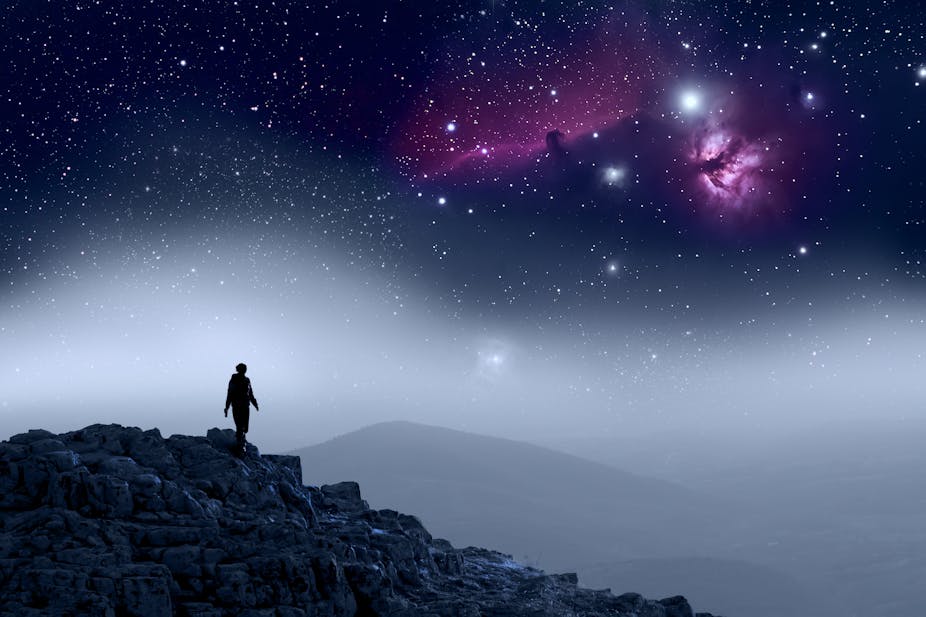
Square away your personal philosophy now; proof of life beyond earth is coming. Stargazing image via http://www.shutterstock.com

How will humankind react after astronomers hand over rock-solid scientific evidence for the existence of life beyond the Earth? No more speculating. No more wondering. The moment scientists announce this discovery, everything will change. Not least of all, our philosophies and religions will need to incorporate the new information.

Searching for signs of life

Astronomers have now identified thousands of planets in orbit around other stars. At the current rate of discovery, millions more will be found this century.

Having already found the physical planets, astronomers are now searching for our biological neighbors. Over the next fifty years, they will begin the tantalizing, detailed study of millions of planets, looking for evidence of the presence of life on or below the surfaces or in the atmospheres of those planets.

And it’s very likely that astronomers will find it. Despite the fact that more than one-third of Americans surveyed believe that aliens have already visited Earth, the first evidence of life beyond our planet probably won’t be radio signals, little green men or flying saucers. Instead, a 21st century Galileo, using an enormous, 50-meter-diameter telescope, will collect light from the atmospheres of distant planets, looking for the signatures of biologically significant molecules.

Astronomers filter that light from far away through spectrometers – high-tech prisms that tease the light apart into its many distinct wavelengths. They’re looking for the telltale fingerprints of molecules that would not exist in abundance in these atmospheres in the absence of living things. The spectroscopic data will tell whether a planet’s environment has been altered in ways that point to biological processes at work.

What is our place in the universe? Woman image via http://www.shutterstock.com

If we aren’t alone, who are we?

With the discovery in a distant planet’s light spectrum of a chemical that could only be produced by living creatures, humankind will have the opportunity to read a new page in the book of knowledge. We will no longer be speculating about whether other beings exist in the universe. We will know that we not alone.

An affirmative answer to the question “Does life exist anywhere else in the universe beyond Earth?” would raise immediate and profoundly important cosmotheological questions about our place in the universe. If extraterrestrial others exist, then my religion and my religious beliefs and practices might not be universal. If my religion is not universally applicable to all extraterrestrial others, perhaps my religion need not be offered to, let alone forced on, all terrestrial others. Ultimately, we might learn some important lessons applicable here at home just from considering the possibility of life beyond our planet.

In my book, I investigated the sacred writings of the world’s most widely practiced religions, asking what each religion has to say about the uniqueness or non-uniqueness of life on Earth, and how, or if, a particular religion would work on other planets in distant parts of the universe.

Extrasolar sinners?

Let’s examine a seemingly simple yet exceedingly complex theological question: could extraterrestrials be Christians? If Jesus died in order to redeem humanity from the state of sin into which humans are born, does the death and resurrection of Jesus, on Earth, also redeem other sentient beings from a similar state of sin? If so, why are the extraterrestrials sinful? Is sin built into the very fabric of the space and time of the universe? Or can life exist in parts of the universe without being in a state of sin and therefore without the need of redemption and thus without the need for Christianity? Many different solutions to these puzzles involving Christian theology have been put forward. None of them yet satisfy all Christians.

Mormon worlds

Mormon scripture clearly teaches that other inhabited worlds exist and that “the inhabitants thereof are begotten sons and daughters unto God” (Doctrines and Covenants 76:24). The Earth, however, is a favored world in Mormonism, because Jesus, as understood by Mormons, lived and was resurrected only on Earth. In addition, Mormon so-called intelligences can only achieve their own spiritual goals during their lives on Earth, not during lifetimes on other worlds. Thus, for Mormons, the Earth might not be the physical center of the universe but it is the most favored place in the universe. Such a view implies that all other worlds are, somehow, lesser worlds than Earth.

Bahá’í without bias

Members of the Bahá’í Faith have a view of the universe that has no bias for or against the Earth as a special place or for against humans as a special sentient species. The principles of the Bahá’í Faith – unifying society, abandoning prejudice, equalizing opportunities for all people, eliminating poverty – are about humans on Earth. The Bahá’í faithful would expect any creatures anywhere in the universe to worship the same God as do humans, but to do so according to their own, world-specific ways.

Light years from Mecca

The pillars of the faith for Muslims require the faithful to pray five times every day while facing Mecca. Because determining the direction of Mecca correctly could be extremely difficult on a quickly spinning planet millions of light years from Earth, practicing the same faith on another world might not make any sense. Yet the words of the Qu’ran tell us that “Whatever beings there are in the heavens and the earth do prostrate themselves to Allah” (13:15). Can terrestrial Muslims accept that the prophetically revealed religion of Muhammad is intended only for humans on earth and that other worlds would have their own prophets?

Astronomers as paradigm-shatterers

Philosophers and scientists have forced worldviews to adapt in the past.

At certain moments throughout history, astronomers’ discoveries have exerted an outsized influence on human culture. Ancient Greek astronomers unflattened the Earth – though many then chose to forget this knowledge. Renaissance scholars Copernicus and Galileo put the Earth in motion around the Sun and moved humans away from the center of the universe. In the 20th century, Edwin Hubble eliminated the very idea that the universe has any center at all. He demonstrated that what the universe has is a beginning in time and that, bizarrely, the universe, the very fabric of three-dimensional space, is expanding.

Clearly, when astronomers offer the world bold new ideas, they don’t mess around. Another such paradigm-shattering new idea may be in the light arriving at our telescopes now.

No matter which (a)theistic background informs your theology, you may have to wrestle with the data astronomers will be bringing to houses of worship in the very near future. You will need to ask: Is my God the God of the entire universe? Is my religion a terrestrial or a universal religion? As people work to reconcile the discovery of extrasolar life with their theological and philosophical worldviews, adapting to the news of life beyond Earth will be discomfiting and perhaps even disruptive.

ooOOoo

Now I don’t really want to open up the subject of religion but I will say that WikiPedia have a great entry about the subject. My own view is that a few hundred years ago, when life was a lot more mysterious and uncertain, believing in life after death made some sense.

But we know a lot better now despite death still being a certainty.

Brandy!

Dogs don’t need religion!

A sailing memory, part two.

Again, this is for Pendantry.

I left yesterday’s post with the statement: “However, getting to Gibraltar was not without its challenge for we suffered a knockdown and this scared us both to the core.

This is the account of that knockdown.

ooOOoo

The knockdown

So this was it, the end of life. This is what that end felt like. A lifetime of experiences reduced to this stilled moment; all my hopes, dreams, pleasures, memories, everything shrunk to this tiny moment of now.

I knew, in some trance-like way, that if just one of those foaming, giant waves swept across us, so utterly over-whelmed as we were on our side, it would flood the cabin, and down Dave and I and the yacht would go.

Other sensations came to me. Feelings of quiet, of calm, even of peace. My world now reduced to close, intimate dimensions. To the yacht’s wheel, to which I so grimly hung. To the front edge of the port cockpit seat, now underneath me, against which I braced my feet. To the starboard guardrail, bizarrely above my head, and to those raging seas so very close that seemed to beckon, ‘Give up, give up now and slip away.’

Me and Dave, alone in this Mediterranean storm 10 days West of Cyprus, are going to drown, founder without trace in these vast waves and probably end up not being missed for many days. Our dream of sailing across the Atlantic snuffed out as easily as Songbird of Kent would sink the 5,000 feet down to the seabed. The futility of it all.

It was a strange, detached perspective that hardly registered the gusts coming at us like great padded hammers. This unimaginable gale that had Songbird of Kent, my floating home for the last 5 years, totally pressed down on her port side, even though the yacht offered nothing more to the winds than her bare mast and rigging.

From within the cabin, Dave could do no more than simply watch. Hunkered down outside, I could do no more than simply hang-on. Both of us transfixed in this stillness of life’s imminent ending. Dave would later say no words would ever properly describe what his eyes had seen.

My past life, rather ominously, started running before me. How one year, in the early 1950s, when I was 7 or 8 years old, my parents had rented a holiday villa in the French Atlantic coastal town of Arcachon. What a glorious summer holiday that had been.

Arcachon’s beautifully sheltered bay had enabled me to learn to swim. The buoyant sea-water helping me increase the number of strokes each day, until one afternoon I had swum out to a yacht anchored well off the beach. As I hung on to the anchor chain, panting hard, the owner looked over the guardrail. Next, me being rowed back to the beach in a dinghy and then everyone getting to know Englishman John Calvert, a solo sailor living aboard his yacht, Garrawog.

Next year we had holidayed again in Arcachon and found Garrawog moored in the small yacht harbour. I recalled fond memories of sitting in the cabin with my father and John Calvert, drinking lemonade, eating cream crackers and loving the cosiness of it all.

Then the amazing coincidence when the following year we had holidayed at the French Mediterranean town of Menton and Garrawog had sailed into the harbour. That had led to John taking us sailing along the coast, memories so vivid, all these years later, of helping to haul sails, steer Garrawog, even remembering the gentle nudge of the yacht into the waves.

I was clear how those memories had fuelled my romantic obsession with sailing. How as a young teenager growing up in London I had joined the Welsh Harp sailing club, based at a large lake, well a reservoir, just three miles from home, and learnt to sail a dinghy. All fuelling this fascination with the sea. Yet that romantic obsession didn’t revolve around idyllic meanderings along the Mediterranean coastline. No, my dreams involved ocean sailing. Not even as part of a crew, but sailing, single-handed, across the oceans.

I had devoured every book written by those sailors who, totally alone, had journeyed the vast oceans in a small yacht. Joshua Slocum, who wrote of his solo trip around the world in his yacht, Spray, way back in 1895. Master English navigator, Francis Chichester, who conceived the idea of a single-handed yacht race across the Atlantic ocean, later completing a round-the-world solo circumnavigation in his yacht, Gipsy Moth IV. Eric Tabarly, Chay Blyth, Robin Knox-Johnston and many more.

I reflected how that dream had remained with me for years. All through nearly 20 years as a salesman and entrepreneur to the point when, quite suddenly, on a Monday in the Spring of 1986, uncharacteristically I had nothing in my diary for that day, or for many days ahead. I had just sold my thriving company in Colchester and there was no longer a job to go to!

Then not so long after I had taken a holiday in Larnaca and in wandering around the marina I had seen Songbird of Kent for sale, and had bought it! I had previously read about Tradewind yachts and knew how many had made world circumnavigations. Thus by the end of 1986, my new address had become: Yacht ‘Songbird of Kent’, Larnaca Marina, Cyprus.

A shout from Dave jerked me back to the real world.

Hey, is it my imagination or is that wind easing?

I lifted my head and turned my face into the weather coming full at us. The seas were just as terrible but, yes, something was different, some subtle lowering of the tone of the wind.

Dave, you’re right, it has eased back a bit. We’re not so pressed down, are we?

Don’t think so. What do you reckon?

Not sure what to do, frankly these conditions scare the shit out of me!

In the subtlest way imaginable, Songbird provided the answer. The yacht now showed some response to the waves rather than previously being so overwhelmed. A tiny thought entered my mind, something I hardly dared acknowledge: Songbird is not going to founder.

Those 3 tons of lead at the bottom of Songbird’s keel were, at last, overcoming the wind pressure on her topsides and with seawater cascading down from the mast and rigging, the yacht slowly righted and bestowed on me and Dave the continuation of our lives. A miracle of miracles!

I quickly helmed the bow round to point us downwind, putting the full force of the gale directly aft. Within moments, a wave slowly started to overtake us but I couldn’t do anything other than keep my eyes on the mast-head wind-vane that, against all odds, had stayed intact during the knock-down. Watching the arrow head that absolutely had to keep pointing directly into the wind. We may be upright but one slip of steering, one moment’s loss of concentration and I knew we would slew broadsides to the seas and go over again.

I couldn’t believe the size of this wave that lifted us up and up, as if we were in giant, invisible hands. Up to the foaming crest from which was revealed, all around us, wild, angry, jagged waves, huge crests covered in white foam, an Alpine-like scene of raging hell as far as the eye can see. A vista of utter desolation.

Then the foaming crest moved ahead of us and Songbird slid down that vast lee of the wave, down towards the trough that lay behind us. Our bowsprit pointed directly into the dark green water ahead, water streaked with spume, as down and down we went until the inevitable arrival of the next wave started us up to another foaming crest.

We had survived what we could never have imagined. Hardly believing it, we intuitively knew that surviving that first wave increased the odds of us surviving the next few. Then the next few, and the next few until, against all expectations, we knew we stood a chance of living through it all.

I spotted something in the water and shouted, “Dave, look, look there in the water, just to our left. That bit of sail, surely not from our mainsail?

As we ran before the weather, a scrap of white sail had surged past our side, a piece of sail bearing the number 33 and two palm trees, the symbol of a Tradewind 33 yacht.

Dave laughed, “I can’t believe that, Paul. It’s from the mainsail that blew out when the gale first struck. How amazing! It must be from us, can’t be too many other Tradewind 33s out here!“.

Imagine that, Dave, after all that we have been through these past few hours, we’ve just sailed by a bit of our mainsail, close enough to have grabbed it.

That triggered my mind as to when this terrible experience started. How long ago was that? I didn’t have a clue, though surely it couldn’t have been much more than an hour or so ago. Indeed, I struggled to think what day it was, then realised it was Thursday, October 8th, 1992. Just 24 hours since we had left the dirty, commercial port of Algiers for the last leg of our trip from Larnaca in Cyprus to Gibraltar.

Dave, hand me the log, it’s at the back of the chart table.

I read,

Thursday, 8th October, 1992.

08:20 Sea state terrible.

I recalled how the dawn had revealed banks of low angry clouds, skidding across the tops of a nasty swell, made even worse by a vicious cross-swell. The next entry after that read,

09:00 Sky extremely threatening. Wind NE F4. Just 16 miles east of Greenwich meridian.

Then we had approximately 3 hours of sailing to go before we crossed Greenwich. On to the last entry,

12:00 Sea extremely ugly, Wind NNE F5. Longitude 2 minutes East of Greenwich.

Just 15 minutes from crossing that historical navigational line. I recalled how we had chatted about sharing a glass of something to celebrate ‘crossing the line’! Then how my words had been torn away when, in a seeming instant of time, this huge squall had come out of the North, heralding this vast, cauldron of a storm. The mainsail, even tripled-reefed, was way too much sail. But it was far too dangerous to leave the cockpit to drop the sail, too much to do anything other than hang on.

The mainsail failed, ripped into shreds as it tore away from the mast-track and disappeared into the storm. The sounds of the event obliterated by the screaming noise of a wind that I had guessed was now more than 50 knots. The rain and spray had stung my face so hard that I needed to turn my head away just to breathe. Clearly something had to give; I expected the mast to fail.

But it didn’t! Instead, as the wind force grew and grew, it steadily pressed us further and further over until Songbird ended up fully horizontal to the sea. It seemed a lifetime ago.

I looked at my watch: 5.30pm. To hell and back in so few hours!

Dave, what’s our position?

Dave ducked out of sight to read the GPS, came back out with a slip of paper on which he had written our position: Eight minutes of longitude west of the Greenwich meridian. We were now in the Western hemisphere!

Come on, Dave, you take the wheel. I’m going to fetch a couple of beers.

I reckon a double celebration, Paul, crossing the Meridian and living to tell the tale!

We drank our beers, chit-chatted about nothing much, both aware that we had literally stared into the abyss of a dark watery grave, and sailed on.

Just before 13:00 on Saturday, October 10th, Songbird rounded Gibraltar’s breakwater, briefly rolled in the cross-swell, and slipped into the calm waters of the inner harbour.

Soon we were safe and secure in a marina berth, a few minutes walk from good food and friendly bars. Our experiences rapidly migrated into the private worlds of our minds, as if discussing it openly might replay it all with a different, more tragic, outcome.

I struggled through those first nights of sleep. Again and again I awoke, panic across my chest, clinging to the sides of my bunk, trying to lay all the nightmares to rest. Slowly, those October days resting up in Gibraltar shone a light on this sailing obsession. How, with the sudden death of my father in 1956, those memories of idyllic times in and around Garrawog had buried themselves deep into my hidden emotional world. How dreams of sailing had more to do with keeping the memory of my father alive than with anything else.

That gale expunged the obsession. I never sailed on Songbird again or, for that matter, on any other sailing vessel. Paid crew eventually returned Songbird to England, where she was subsequently sold.

I would never forget the stillness I had experienced in the midst of all that chaos, but one knock-down in a lifetime was more than enough.

ooOOoo

This is absolutely a true account of what happened. Yes, an intimate, personal account of what happened but accurate down to the last detail.

I am so pleased I kept a written account of the knockdown all those years ago for if I was to recall it today then much of the detail would have been lost. Maybe lost as a result of old age or lost as a consequence of not wanting it in one’s mind. Who knows.

Finally, there are no photographs because we just had more important things to look after – keeping ourselves alive!

Our modern connected world!

A delightful conversation with Amit Roy.

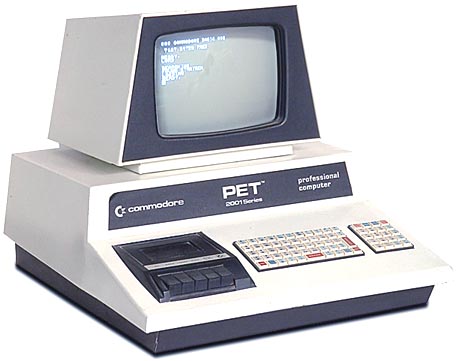
Way back in 1978 I started a company called Dataview. It was based in Colchester, Essex and I sold Commodore Computers; the ‘PET”, standing for Personal Electronic Transactor.

A photograph of a very early PET.

Now I was a word-processing salesman for IBM previously and didn’t know a thing about computers. I operated out of a small shop at first in Church Street and people came into the shop and played around with my demonstration models. Unbelievably I sold some!

Later I got involved with a software program known as Wordcraft. The first comprehensive word processing program for the PET. Indeed, I had the exclusive world distribution rights to Wordcraft. One thing lead to another and soon I was operating from much larger premises down at Portreeves House at East Bay, still in Colchester.

I appointed a Head of Marketing, Amit Roy, and the company grew and grew. I focused on appointing distributors across the world, and that included Dan Gomez in southern California, and he became a close friend being my best man when Jeannie and I were married in 2010.

Anyway, back to the story of Dataview. Eventually I sold out and escaped the country (and taxes) by moving to a yacht in the Greek side of Cyprus before April 15th. I went to Larnaca Marina. That was in 1986.

On Sunday, through a link from a mutual friend, I called Amit, the first time we had spoken since 1986. We had the most delightful of telephone conversations.

Amit was born in Burma, he is now 79, and lost his wife some 13 years ago. The counsellor who saw Amit after the death of his very dear wife said that he had to be strong and to take up something he could become passionate about. Amit joined the Colchester Photographic Society and took up studying again, in photography, and became a very good photographer.

With Amit’s permission I share some of his photographs with you.

The Red Arrows Flying After Dark

oooo

Firstsite At Dusk

oooo

Mischievous Boys of Bengal – India

oooo

Orchid Isabelia Pulchella

oooo

Felixstowe Docks at Dusk

oooo

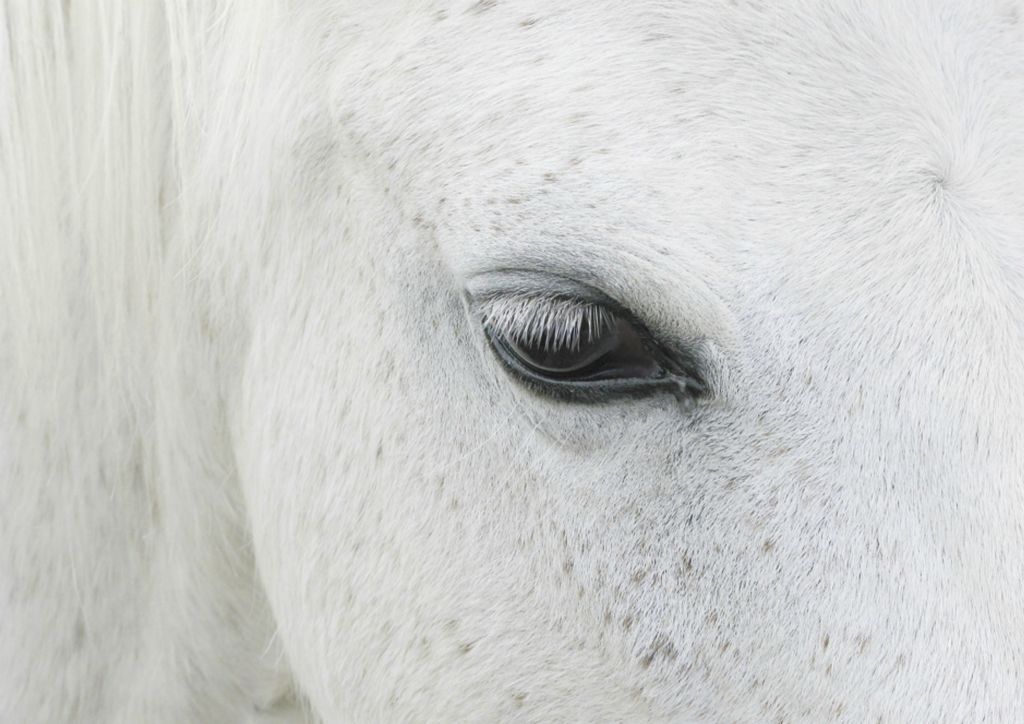
Horse Study

These are just a few but they are superb; absolutely marvellous.

That is the most welcome of connections – thanks to Roger Davis for suggesting it!

Memories of the past.

Angela Stockdale and Pharaoh came to mind!

In the last twenty-four hours I was in communication with a person in Essex, England about dog training (and hopefully there will be a guest post from him) and it caused me to think of Angela Stockdale.

I then did a search on my blog for posts where I had mentioned Angela and came across quite a few in the early days of blogging. Then I thought it would be nice to republish one of them; Four Years Old.

So here it is again.

ooOOoo

How time flies!

Four years ago this day, the first post was published on Learning from Dogs. Here it is again:

Parenting lessons from Dogs!

Much too late to make me realise the inadequacies of my own parenting skills, I learnt an important lesson when training my GSD (who is called Pharaoh, by the way). That is that putting more emphasis into praise and reward for getting it right ‘trains’ the dog much quicker than telling it off. The classic example is scolding a dog for running off when it should be lots of hugs and praise for returning home. The scolding simply teaches the dog that returning home isn’t pleasant whereas praise reinforces that home is the place to be. Like so many things in life, very obvious once understood!

Absolutely certain that it works with youngsters just the same way.

Despite being a very dominant dog, Pharaoh showed his teaching ability when working with other dogs. In the UK there is an amazing woman, Angela Stockdale, who has proved that dogs (and horses) learn most effectively when being taught by other dogs (and horses). Pharaoh was revealed to be a Beta Dog, (i.e. second in status below the Alpha Dog) and, therefore, was able to use his natural pack instinct to teach puppy dogs their social skills and to break up squabbles within a pack.

When you think about it, don’t kids learn much more (often to our chagrin!) from other kids than they do from their parents. Still focusing on giving more praise than punishment seems like a much more effective strategy.

As was read somewhere, Catch them in the act of doing Right!

By Paul Handover.

As it happens, it feels a little like ‘what goes around, comes around’. Why do I say that?

Because just last Saturday, I sent off a selection of pictures and videos to Angela Stockdale. Stay with me for a while as to the reason why.

Angela trades under the name of The Dog Partnership and, frankly, what she doesn’t know about the behaviour of dogs isn’t worth bothering about!

Just take a peek at the page on her website under the heading of Teaching Dogs. Here’s a little of what Angela writes:

I consider myself so lucky for dogs alone to have been my teachers. I learnt from watching how my own dogs responded to another dog’s body language and vice versa their language. Watching, learning and working with Teaching Dogs was the only way I knew.

I was and always will be in awe of a Teaching Dog’s dogs ability to consciously adapt their body language in accordance to how the other dog was feeling. The result being, they could relax nervous dogs but at the same time maintain control of a problem situation. Remember, dogs talk dog far better than we do.

It came as quite a shock to me when I learnt about other approaches. It seemed foreign for people to have so much input in resolving what were described as ‘ behavioural’ issues. For me, working with these dogs was far more than resolving a behavioural issue. It was about improving the quality of lives of dogs who were not coping with everyday life. If they found dogs or people worrying, sometimes this was shown in displays of aggression. It is important to understand, these dogs were not aggressive, they simply displayed aggressive behaviour.

Now, I would like to introduce you to the world of Teaching Dogs and how these special dogs change the lives of less fortunate dogs, who never had the opportunity to really understand how to communicate with their own species.

Do read the rest here.

Back to why those photographs and videos had been sent to Angela. A couple of weeks ago, we enjoyed an evening meal with friends of friends, so to speak. This other couple owned a beautiful-looking male German Shepherd dog: Duke. Duke was 4-years-old. Our hostess remarked that he was very boisterous and had nipped a couple of strangers who had called at the house. She added that he seemed difficult to control. Duke had been there for about a month and he was a rescue so they had little or no knowledge of past behaviour.

Well, I’m no expect with dogs, that’s Jean’s domain. But there was something about Duke that captivated me. Something in the way he looked at me, his eyes linking so directly with mine, allowing me to see a dog that offered an honest openness.

More or less on impulse I stood up, held my right arm up at 45 degrees, looked Duke in the face and said, “Duke! Sit!”

Duke held my gaze and sat back on his haunches.

I moved my arm in a complete circle, around to the right, and said, “Duke! Lie down!” Duke lay down.

H’mm, I thought. Fascinating. This dog has been professionally trained at some point in the past, using the same ‘command’ system of voice and arm signalling as I had learnt with Pharaoh way back in 2003/2004.

The food was now on the table. I grabbed a small piece of meat off my plate and returned to Duke who had, of course, resumed his pottering around the room. “Duke! Here boy!” Duke came over to me. “Duke! Lie down!” Duke did so. I placed the piece of meat on the wooden floor about three feet in front of him. Duke’s eyes were riveted on the meat. “Duke!” Duke’s eyes reluctantly engaged with mine. “Duke! Stay!” I repeated the Stay command a couple more times as I backed away about 6 or 8 feet.

“Go on, Boy. Take the meat!” Duke gleefully grabbed the piece of meat. Gracious, I thought, this dog is magnificent. I wonder ……..

I took another piece of meat, “Duke! Sit!” “Duke! Stay!” I then backed off that 8 feet again, got down on my knees and placed the piece of meat just between my lips. I knew this was potential madness with a dog I had only met some 30 minutes previously, but there wasn’t an ounce of doubt in my mind. I voiced in my throat for Duke to fetch the meat. Duke came straight over and confidently and carefully removed the meat from my lips.

What a truly fabulous dog! It was a wonderful evening and once home both Jean and I were eulogising about Duke.

Then two days later, our dinner hostess rang me. “You know, I have decided we can no longer keep Duke. He is too strong a dog, I can’t control him. Is there any chance of you finding a new home for Duke?”

Without question, Jean and I would have offered Duke a new home; in a heartbeat. The only thing stopping that was me wondering if this strong-willed, male German Shepherd might be a Beta dog, as Pharaoh was. Or just might be too dominant a male dog to fit in comfortably with our dogs, especially Pharaoh who was at the stage of life where the last thing that should happen is for his happiness and contentment to be disturbed.

I hadn’t a clue as to how to answer that question. But I knew someone who would know: Angela Stockdale.

I rang her, caught up on old times and then explained the background to Duke’s situation. Angela said to repeat the exercise that I had witnessed when I took Pharaoh to her all those years ago, when I wondered if Pharaoh was an aggressive dog. My uncertainty with regard to Pharaoh followed a number of times when walking him in a public area with other dogs and he had been very threatening, both in voice and posture, towards some of those other dogs.

This is what Angela arranged. I took Pharaoh up to her place at Wheddon Cross, near Minehead in Somerset. When we arrived, Angela was standing just by a gate into a fenced paddock, maybe a half-acre in size. In the far corner were two dogs.

Angela asked me to bring Pharaoh to the gate and let him off the leash. It was clear that Pharaoh was going to be let into the paddock. I cautioned that Pharaoh could be quite a handful with other dogs and, perhaps, it would be better that I walked him into the area still on his lead. Angela said that wouldn’t be necessary. So as she held the gate open sufficient for Pharaoh to enter the paddock, I slipped the lead off him and backed away, as requested.

Pharaoh had hardly taken 2 or 3 paces when Angela called out, “Paul, there’s nothing wrong with him!”

I was astounded and stammered, “But, er, er, how can you tell so quickly?” “Because my two dogs haven’t taken any notice!”, came the reply.

Later Angela explained that in the paddock were her female Alpha dog and her male Beta dog. Ergo, the two top dogs in terms of status so far as dogs see other dogs.

In fact, Pharaoh was utterly subservient to these dogs, in a way that I had never witnessed before. Later on, as Pharaoh relaxed and started playing, Angela said that she thought that Pharaoh was a Beta dog. Mixing some of her other dogs into the group was later able to confirm that.

So back now to present times and Duke.

Thus last Saturday, as Angela recommended, we selected two of our dogs, Cleo our female German Shepherd and the most socialable of dogs, and Casey, a strong but not aggressive male (he had some PitBull in him).

Duke arrived and was allowed freely to nose around the large grassed area some way from the fenced-off horse paddock that we were using for the ‘introduction’.

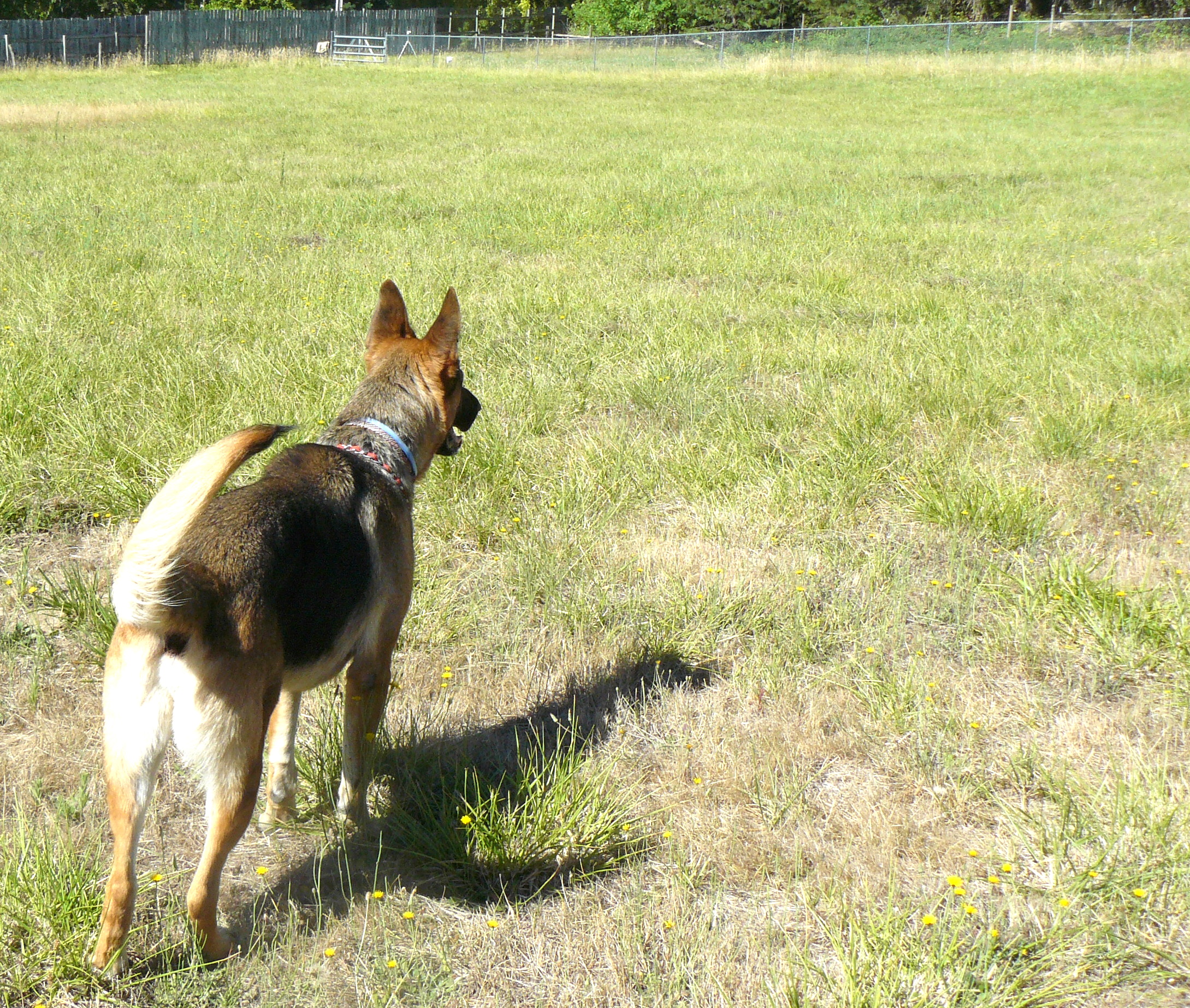
Duke pottered around and then caught sight of Cleo and Casey in the paddock.

First sighting of Cleo and Casey.

Then the meetings began!

Hello! My name is Duke. Do I smell OK? Mr. Casey?

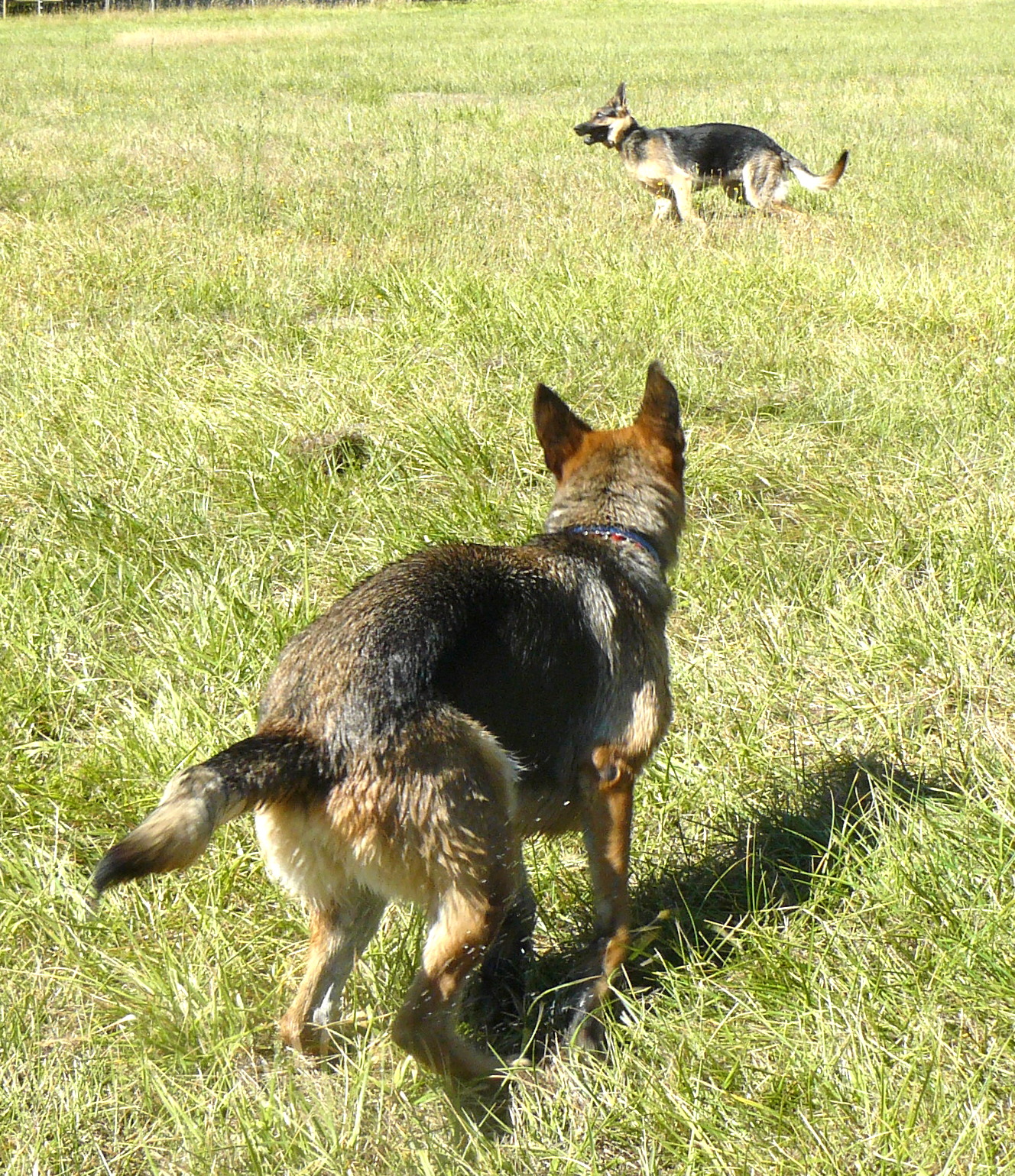
And play didn’t seem to be too far off the agenda!

You lead, Cleo, I'll chase!
You lead, Cleo, I’ll chase!

So all the photographs and videos have been sent to Angela, and we will see what the conclusion is!

As Angela put it, “Remember, dogs talk dog far better than we do.”

ooOOoo

Yes there’s no question that dogs talk dog far better than we do!

Change, for the better!

Animals, especially dogs, can have a profoundly positive effect on us humans.

We had to go to the local tip yesterday morning and there were a couple of other cars in the ‘recycling’ area that had dogs. Both the drivers of those other cars were allowing their dogs to look out through an open window and, in the course of dumping our stuff in the various piles, I approached the dogs and allowed them to sniff my outstretched arm. What struck me later was how natural that was, with the drivers being so friendly towards their dogs and me, let’s face it, practically a stranger. They were only brief exchanges but they were happy exchanges and that’s the point!

Emma is not really a private guest writer; putting all her material on her website Pawstruck.com.

But the value in what she writes totally justifies in my mind what is being said.

What do you think?

ooOOoo

The Many Ways Owning a Dog Can Change Your Life

True-blue dog owners can attest to the fact that life is never the same without their pet pooch. There’s something innately contagious about a dog’s spirit that nurses and nurtures the human soul.

It’s science!

According to a Finnish study, merely looking at your dog releases a flood of oxytocin in your brain. Also called the love hormone, these neurotransmitters lessen anxiety and promote well-being.

For most dog parents, simply receiving their dog’s unconditional love is enough of a reason to keep pumping love, effort, and money into caring for their pet. Still, there are so many more arguments for why having a dog is an experience everyone should try once in their lives.

Dogs Are Mood Boosters

The jolly temperament, silly mannerisms, and unsinkable enthusiasm of a dog at whatever time of day make them the funniest companions. Simply petting your dog or spending a few minutes of fetch each day releases serotonin and dopamine in the human brain. These neurotransmitters are responsible for keeping you in a good mood.

Constant interaction with your pet is also found to manage the symptoms of depression, according to a 2018 study. In many instances, dogs can provide the kind of genuinely reliable relationship that can rarely be found between humans. This feeling of dependability, it turns out, is vital for humans’ mental wellness.

Dogs Keep You Fit

Being a dog parent is a full-time job. That means ensuring they eat well and exercise right. Even if you own a “lazy” breed, all dogs still need to be exercised at least 30 minutes every day to keep fit.

As a responsible owner, you are obliged to attend to these needs and, in the process, also benefit from the task. A lot of people, despite the clear benefits of exercise, refuse to move for lack of motivation. Dog parents don’t get to choose, and sometimes, that’s a good thing.

Make a routine out of your dog’s walking schedule. This way, your body can get used to the new pace and help turn the practice into a habit.

Dogs Keep Your Heart Healthy

Another research in 2018 concluded that dog ownership is highly associated with a healthy heart. The simple act of caressing your dog or engaging in lovable cuddles results in lowered blood-pressure levels.

This, coupled with the mood-boosting benefits of a dog’s presence all contribute to a reduced risk of developing heart problems, which are the leading cause of death among older adults in the US.

Dogs Help You Socialize

One of the biggest contributors and symptoms of depression is social isolation. Living alone can exacerbate the situation and cause you to distance yourself even more from family members and your tightest circle of friends.

Whereas if you have a dog, the responsibility of going out for dog supplies, routine vet visits, and daily walks obliges you to interact with people. For natural introverts, the forced socialization may be hard at first. But it will also help you hone your social skills and find new friends aside from keeping the blues at bay.

Dogs Help You Be Kinder to Yourself and to Those Around You

When someone else’s life depends on you, you learn to be more conscious of your decisions. You encourage yourself to take care of your health because no one else will tend to their needs. You learn to be decisive with your choices, from selecting the perfect dog treats to opting for brands with cruelty-free practices.

You cannot pour from an empty cup, as they say, and once you experience your pup’s absolute love, you will realize that the only way to give love back is to love yourself first.

ooOOoo

I asked Emma, as I do with all my guest bloggers at first, to send me a short bio.

This is what she wrote:

Emma Nolan is a blogger, writer, and dog parent to a dachshund and three adorable black Labradoodles. She likes strolling outdoors with her lovable fur babies when not writing about them. She writes about everything pooch at Pawstruck.

I think that was a good article!

Golden Brown

A musical classic!

We were listening to the radio early on Tuesday morning and the BBC News played a tribute to the recent death of Dave Greenfield. Here’s a little bit of that BBC News piece:

The Stranglers keyboard player Dave Greenfield has died at the age of 71 after testing positive for Covid-19.

Greenfield died on Sunday having contracted the virus after a prolonged stay in hospital for heart problems.

He penned the band’s biggest hit, Golden Brown, a song about heroin, which went to number two on the UK singles chart in 1982.

The Stranglers bass player Jean-Jacques “JJ” Burnel paid tribute to Greenfield as a “musical genius”.

He said: “On the evening of Sunday May 3rd, my great friend and longstanding colleague of 45 years, the musical genius that was Dave Greenfield, passed away as one of the victims of the Great Pandemic of 2020.

“All of us in the worldwide Stranglers’ family grieve and send our sincerest condolences to [Greenfield’s wife] Pam.”

Drummer Jet Black added: “We have just lost a dear friend and music genius, and so has the whole world.

“Dave was a complete natural in music. Together, we toured the globe endlessly and it was clear he was adored by millions. A huge talent, a great loss, he is dearly missed.”

There’s more to read but I wanted to republish one of the photographs taken:

(Left to right) Dave Greenfield, Jean-Jacques Burnel, Jet Black and Hugh Cornwell of The Stranglers in 1980

Then to close my tribute to Dave here’s a beautiful rendition of that most famous song – Golden Brown.

A classic, a real classic.

The loss of Dave Greenfield. A loss to us all!

Returning to a theme – May!

The years click by!

We are coming up to the month of May!

Then in a very short time it will be May 8th. Not only my half-birthday but considerably of more note the anniversary of the end of World War II.

I am certain that I am the only one who puts meaning into these dates. I can do no better than to re-post something that I published on May 1st, 2017.

ooOOoo

For all my life this has felt like a very special month.

And, dear friends, at the risk of repeating myself to many of you, this is why the month of May is special for me.

Simply that I was born in London during the closing months of the Second World War. Inevitably, I was unaware of the number of German bombs that were falling on London during those last few months. But there were thousands.

On May 8th. 1945, the day that WWII ended and six months to the day from when I was born, my mother looked down at me and said aloud to me: “You are going to live”. Despite the fact that I don’t recall my mother saying that, it was verified many times later when I was growing up.

Now here we are approaching May 8th. 2017 (now May, 2020) and in a very real sense it seems that we are in another war.

A war of consequence.

A war that we have been engaged in for many, many years.

A war where we are inadvertently fighting on a global battlefield.

A war where 99.99% of us don’t consciously identify the weapons we are using. Weapons that are incredibly effective. So much so that we are in sight of winning the last battle; winning the war.

Yet a war where winning is no win at all. Indeed, where winning this war, this global war, spells the end. The end of life for 99.99% of us humans (and much else besides).

Now what on earth has got me so fired up?

Two things have:

The first is that I am living in my 73rd year of life. (Now 75th.) I have no idea of when my life comes to an end. But that death is a guarantee. Indeed, if one takes note of the average life expectancy of a male today in the USA (75.6 years) , it may not be that far away.

The second thing is that before my death I truly want to know that humankind has laid down its weapons of war against our planet and that there really is an unstoppable mission, a united wave of passion, to live in peace on this planet. Perhaps better put to live in peace with this planet.

Or in the words of an organization that I now want to introduce:

A mission which will require the hard work and dedication of each and every one of us as we do everything in our power as individuals, but also as we galvanize businesses, entrepreneurs, innovators, city planners, communities, people and politicians—all those who share our purpose.

OK! Thank you if you are still reading this! (Someone give Fred in that soft arm-chair over there a nudge; I can hear his snores from here!)

In the last Smithsonian electronic newsletter that I was reading yesterday morning there was a reference to an organization that I hadn’t previously come across. Here is the link to that item on The Smithsonian website. I am republishing it in full in this place. As you read it you will understand why I am republishing it.

ooOOoo

Using a New Roadmap to Democratize Climate Change

A new tool aims to bypass governments and put the power of climate action in the people’s hands

By Anne Glusker Smithsonian.com April 28, 2017

Olafur Grimsson, who was president of Iceland from 1996 to 2016 and saw his country through the worst economic crisis in its history, making headlines all over the world as banks collapsed and the country fell into a depression, is the very picture of an urbane statesman. Collected and poised, with a striking full head of white hair, as comfortable in English as in his native Icelandic, he seems an unlikely revolutionary, not the sort of person you’d look at and immediately find yourself thinking: “Power to the People.”

But Grimsson is one of the primary architects of a quietly radical new idea whose aim is to facilitate action on climate change without any of the usual suspects—governments, countries, international bodies, negotiating parties.

He and several other veterans of the historic 2015 Paris Agreement on climate change were in Washington, D.C., last year, just before COP22, the climate meeting held in Marrakesh in 2016. They were pondering next steps when the conversation took a new and interesting turn, Grimsson says, addressing the question: “Was it possible to have the success of Paris without governments necessarily being in the leading role?”

The group included movers and shakers such as Peter Seligmann, the chairman of Conservation International; Laurene Powell Jobs, president of the philanthropic organization the Emerson Collective; and Andy Karsner, an assistant energy secretary during the administration of George W. Bush. Galvanized by their own query, they decided to try to answer it—to set about creating a new tool to aid in achieving the goals of the Paris accord.

At the Smithsonian’s Earth Optimism Summit, a gathering this past weekend of conservation-minded citizens, scientists and activists, Grimsson explained: “You get governments that are opposed or even hostile to climate action. We decided to bring together in Marrakesh a gathering of thinkers and scientists and innovators and policymakers from different countries in order to discuss a new model of securing the success of the future of the climate movement.”

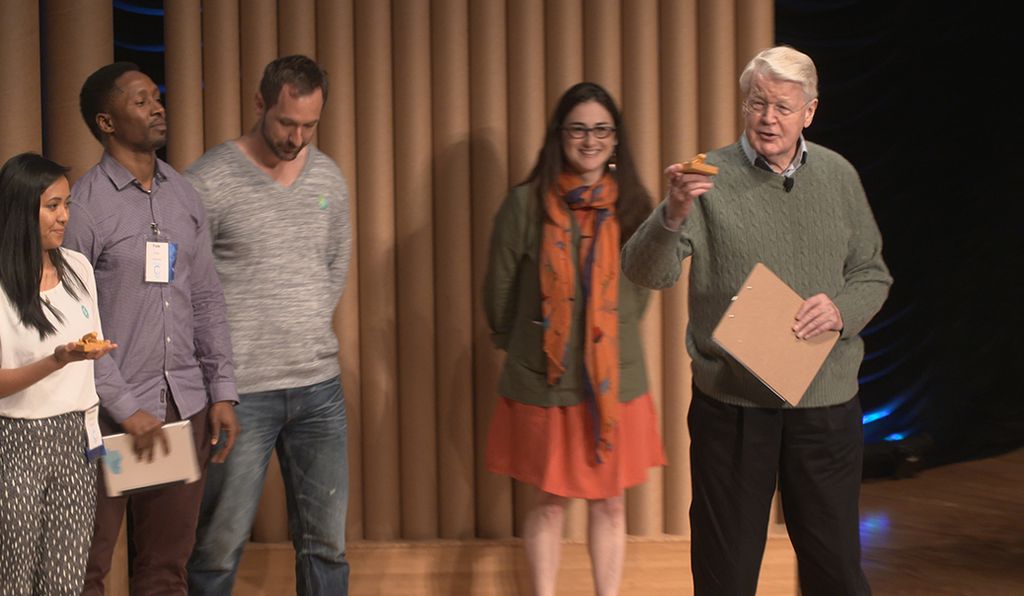
At the Smithsonian’s Earth Optimism Summit, the former president of Iceland Olafur Grimsson encouraged new solutions to climate change, awarding cash prizes to the winners of the “Make for the Planet” challenge. (The Roadmap)

Grimsson’s group felt that due to changes in information technology and social transformations, the large organizations and structures that used to be necessary to effect change were now not needed. And thus was born Roadmap, a new crowdsourcing tool for anyone and everyone interested in climate action. Still in its very early stages, Roadmap’s founders envision it as a platform for those working on climate issues—from scientist and policymaker to farmer and fisherman—to facilitate the sharing of knowledge and ideas, methods and techniques.

“A new political model is possible—where everyone can be a doer, where you no longer need big government or big enterprises to bring about success,” Grimsson says.

This new model for social change that skips the usual cumbersome channels and processes has been seen everywhere from public health, where the Bill & Melinda Gates Foundation has redefined the sector, to the hospitality industry, which is working to combat the human trafficking that plagues its businesses, to perhaps most famously the Arab Spring, where the role of social media in bringing about political change is still being debated today.

And this new model is complemented by technological changes. “The innovation in energy technology is such that we no longer have to wait for the big energy breakthrough,” Grimsson says. “We already have the available technologies. Every individual, home, village, community, town and region can execute change. The good news from the climate point of view is that, in addition to the information technology revolution, there has now also taken place an energy revolution. A house can be a power station: If the people who live in that house have extra energy, they can sell their energy through the smart grid. The notion that every house can be a power station is as revolutionary as saying that every mobile phone can be a media company.”

Grimsson admits that it may seem odd for someone in his position to be advocating that ordinary citizens take action apart from the conventional corridors of governmental power.

“For me to say that these traditional political organizations and positions are somewhat outdated is perhaps a strange statement: I was a professor of political science, I’ve been a member of parliament, I’ve been a minister of finance, I was president for 20 years,” he says.

It was during Iceland’s financial meltdown that he first experienced this new kind of social change: “I saw this very strongly through the financial crisis in my own country, which led to a big social economic uprising. All those activities were engineered by unknown people, people who were not part of a big organization, who used Facebook and the information media to bring thousands of people together in one day.”

Right now, Roadmap consists of a website and a lofty manifesto that speaks of raising the value of “moral currency” and creating a “best practices warehouse.” Visitors to the site can fill out a form if they want to become part of its community of “doers.” The practical part of the manifesto speaks of identifying the best methodologies and models; implementing a “real-time system of measurement” and a way to “gauge and understand what is working, what is not, and exactly what is being achieved.” As the platform develops, it will be interesting to see exactly what form these gauges, measurement systems, and warehouses take.

After the Paris Agreement, Grimsson says of himself and his Roadmap co-founders, “We were all optimistic, but we are all also realists.” It is his belief that if you “give people the tools, they can execute the transformation and the change—without governmental leadership.” Perhaps Roadmap will be one of those tools.

ooOOoo

Here’s a video that spells it out in ways that I find impossible to ignore.

Because in hundreds of years time I want others to look at the following picture of Troutbeck Valley in England and know how precious is this one and only planet we live on.

Or in the words of Sue Dreamwalker that I read yesterday evening:

We are witnessing more storms, more unseasonal weather patterns, and I just hope that we wake up soon to the damage we are doing to our beloved Mother that has held us in her eternal arms for so long..

Photo credit: Getty Images

Enjoy the month of May wherever you are in the world!

Closing by repeating a key pronouncement in that RoadMap video above:

Why We?

Who Else!

Thirty Years of the Hubble Space Telescope

My how the years go by!
Back in 2010 I wrote about the Hubble, wishing it Happy Birthday!

Now here we are in 2020 and, again, I want to feature this most amazing space telescope ever.

The thirtieth anniversary of the launch of the Hubble Space Telescope was on the 24th April, 2020, just three days ago.

The challenge is that the photographs that go with the article are not permitted to be shared with you. So I have grabbed some others that, apparently, are alright.

ooOOoo

How the Hubble Space Telescope opened our eyes to the first galaxies of the universe

April 24, 2020
By Professor Rodger Thompson, Professor of Astronomy, University of Arizona

The Hubble Space Telescope launched on the 24th of April, 30 years ago. It’s an impressive milestone especially as its expected lifespan was just 10 years.

One of the primary reasons for the Hubble telescope’s longevity is that it can be serviced and improved with new observational instruments through Space Shuttle visits.

When Hubble, or HST, first launched, its instruments could observe ultraviolet light with wavelengths shorter than the eye can see, as well as optical light with wavelengths visible to humans. A maintenance mission in 1997 added an instrument to observe near infrared light, which are longer wavelengths than people can see. Hubble’s new infrared eyes provided two new major capabilities: the ability to see farther into space than before and see deeper into the dusty regions of star formation.

I am an astrophysicist at the University of Arizona who has used near infrared observations to better understand how the universe works, from star formation to cosmology. Some 35 years ago, I was given the chance to build a near infrared camera and spectrometer for Hubble. It was the chance of a lifetime. The camera my team designed and developed has changed the way humans see and understand the universe. The instrument was built at Ball Aerospace in Boulder, Colorado, under our direction.

Seeing further and earlier

Edwin Hubble, HST’s namesake, discovered in the early 1900s that the universe is expanding and that the light from distant galaxies was shifted to longer, redder wavelengths, a phenomenon called the redshift. The greater the distance, the larger the shift. This is because the further away an object is, the longer it takes for the light to reach us here on Earth and the more the universe has expanded in that time.

The Hubble ultraviolet and optical instruments had taken images of the most distant galaxies ever seen, known as the Northern Hubble Deep Field, or NHDF, which were released in 1996. These images, however, had reached their distance limit due to the redshift, which had shifted all of the light of the most distant galaxies out of the visible and into the infrared.

One of the new instruments added to Hubble in the second maintenance mission has the awkward name, the Near Infrared Camera and Multi-Object Spectrometer, NICMOS, pronounced “Nick Moss.” The near infrared cameras on NICMOS observed regions of the NHDF and discovered even more distant galaxies with all of their light in the near infrared.

Astronomers have the privilege of watching things happen in the past which they call the “lookback time.” Our best measurement of the age of the universe is 13.7 billion years. The distance that light travels in one year is called a light year. The most distant galaxies observed by NICMOS were at a distance of almost 13 billion light years. This meant that the light that NICMOS detected had been traveling for 13 billion years and showed what the galaxies looked like 13 billion years ago, a time when the universe was only about 5% of its current age. These were some of the first galaxies ever created and were forming new stars at rates that were more than a thousand times the rate at which most galaxies form stars in the current universe.

Hidden by dust

Although astronomers have studied star formation for decades, many questions remain. Part of the problem is that most stars are formed in clouds of molecules and dust. The dust absorbs the ultraviolet and most of the optical light emitted by forming stars, making it difficult for Hubble’s ultraviolet and optical instruments to study the process.

The longer, or redder, the wavelength of the light, the less is absorbed. That is why sunsets, where the light must pass through long lengths of dusty air, appear red.

The near infrared, however, has an even easier time passing through dust than the red optical light. NICMOS can look into star formation regions with the superior image quality of Hubble to determine the details of where the star formation occurs. A good example is the iconic Hubble image of the Eagle Nebula, also known as the pillars of creation.

The optical image shows majestic pillars which appear to show star formation over a large volume of space. The NICMOS image, however, shows a different picture. In the NICMOS image, most of the pillars are transparent with no star formation. Stars are only being formed at the tip of the pillars. The optical pillars are just empty dust reflecting the light of a group of nearby stars.

The dawning of the age of infrared

When NICMOS was added into the HST in 1997 NASA had no plans for a future infrared space mission. That rapidly changed as the results from NICMOS became apparent. Based on the data from NICMOS, scientists learned that fully formed galaxies existed in the universe much earlier than expected. The NICMOS images also confirmed that the expansion of the universe is accelerating rather than slowing down as previously thought. The NHDF infrared images were followed by the Hubble Ultra Deep Field images in 2005, which further showed the power of near infrared imaging of distant young galaxies. So NASA decided to invest in the James Webb Space Telescope, or JWST, a telescope much larger than HST and completely dedicated to infrared observations.

On Hubble, a near infrared imager was added to the third version of the Wide Field camera which was installed in May of 2009. This camera used an improved version of the NICMOS detector arrays that had more sensitivity and a wider field of view. The James Webb Space Telescope has much larger versions of the NICMOS detector arrays that have more wavelength coverage than the previous versions.

The James Webb Space Telescope, scheduled to be launched in March 2021, followed by the Wide Field Infrared Survey Telescope, form the bulk of future space missions for NASA. These programs were all spawned by the near infrared observations by HST. They were enabled by the original investment for a near infrared camera and spectrometer to give Hubble its infrared eyes. With the James Webb Space Telescope, astronomers expect to see the very first galaxies that formed in the universe.

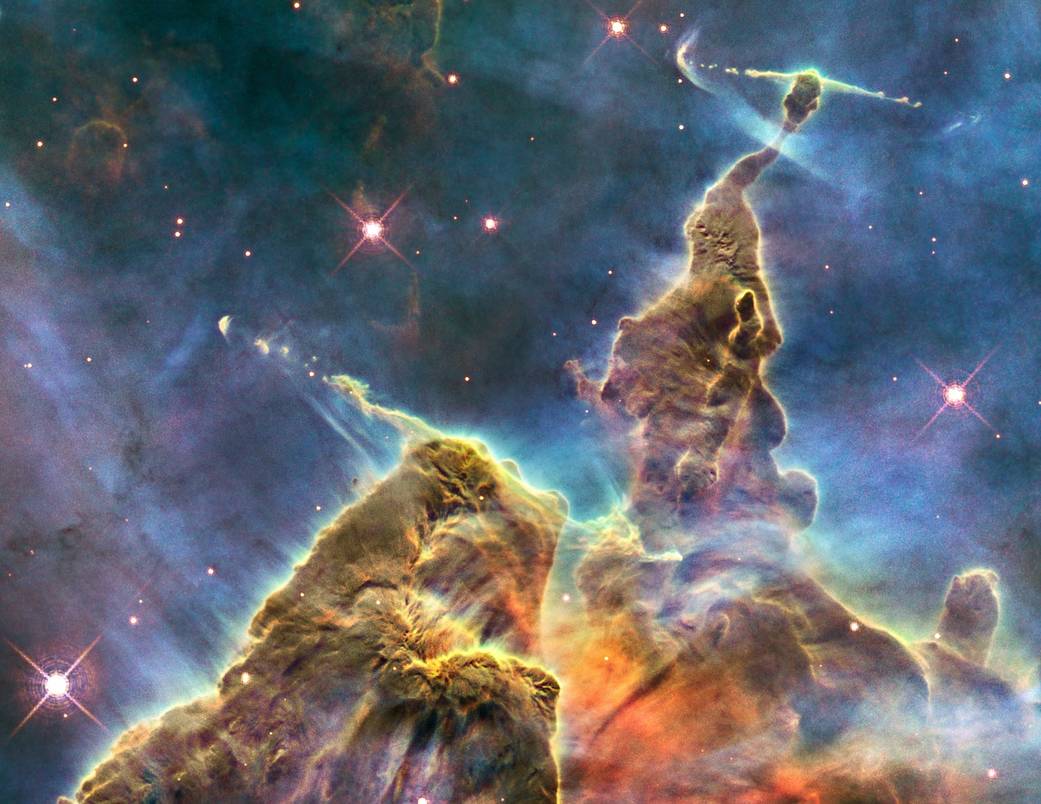
The Eagle Nebula in visible light. NASA, ESA and the Hubble Heritage Team (STScI/AURA)

oooo

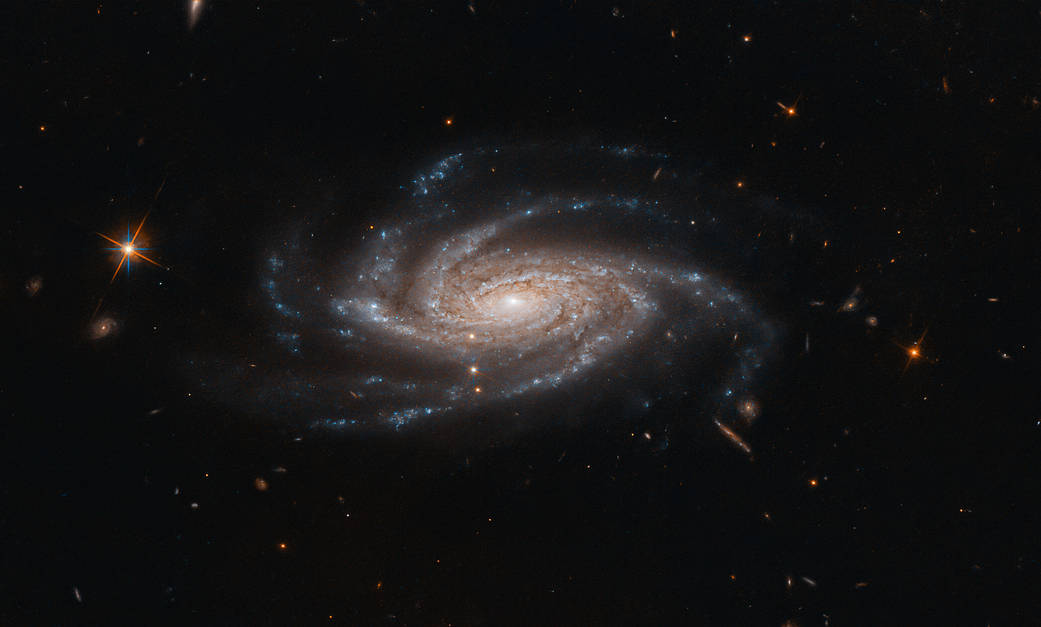
The spiral galaxy NGC 2008 sits centre stage, its ghostly spiral arms spreading out towards us, in this image captured by the NASA/ESA Hubble Space Telescope.  This galaxy is located about 425 million light-years from Earth in the constellation of Pictor (The Painter’s Easel). Discovered in 1834 by astronomer John Herschel, NGC 2008 is categorised as a type Sc galaxy in the Hubble sequence, a system used to describe and classify the various morphologies of galaxies. The “S” indicates that NGC 2008 is a spiral, while the “c” means it has a relatively small central bulge and more open spiral arms. Spiral galaxies with larger central bulges tend to have more tightly wrapped arms, and are classified as Sa galaxies, while those in between are classified as type Sb. Spiral galaxies are ubiquitous across the cosmos, comprising over 70% of all observed galaxies — including our own, the Milky Way. However, their ubiquity does not detract from their beauty. These grand, spiralling collections of billions of stars are among the most wondrous sights that have been captured by telescopes such as Hubble, and are firmly embedded in astronomical iconography.

oooo

The NASA/ESA Hubble Space Telescope has revisited one of its most iconic and popular images: the Eagle Nebula’s Pillars of Creation. This image shows the pillars as seen in infrared light, allowing it to pierce through obscuring dust and gas and unveil a more unfamiliar — but just as amazing — view of the pillars. In this ethereal view the entire frame is peppered with bright stars and baby stars are revealed being formed within the pillars themselves. The ghostly outlines of the pillars seem much more delicate, and are silhouetted against an eerie blue haze. Hubble also captured the pillars in visible light.

Rodger I. Thompson was the Principal Investigator for the Near Infrared Camera and Multi-Object Spectrometer, NICMOS. He was responsible for the execution of a contract to Arizona Board of Regents from NASA to deliver NICMOS as a Hubble Space Telescope Instrument and carry out a scientific investigation with it. Prof. Thompson received summer salary from this contract at his University pay rate during the execution of the contract which ended in 2004. Prof. Thompson is not currently receiving any external funding.

ooOOoo

Now for two YouTube videos.

The first is a celebration of the 30th anniversary.

And the second is slightly longer but conveys images taken from the telescope. I have no doubt that you will love them as we did!

Both these videos are beyond words! That we are alive today and can share these videos on this blog is stupendous!

See you tomorrow!