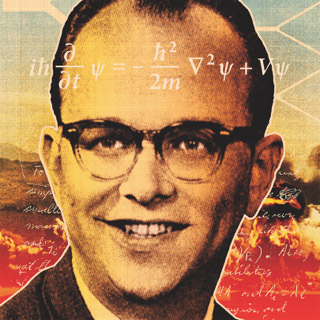
Regular readers of this Blog will recall that on the 19th April I wrote about Hugh Everett and on the 21st April Stephen Hawking. A consequence of those articles was some vigorous debate from a loyal follower of Learning from Dogs, Patrice Ayme. But before publishing, in full, a post from Patrice’s Blog, and then later in the week a guest article from John Hulburt, I wanted to explain the ‘unintended consequence’.
But of course as you, dear reader, will instantly acknowledge, these are just THE times when independent thinking is so, so important. Thus I want to acknowledge two completely different and totally disconnected people who set such wonderful examples of the power of a beautiful mind.
The first is Patrice Ayme. That’s not his real name and, so what! He could be called Alice in Wonderland so far as I care. Whoever he is he thinks and writes beautifully. The following is an example and is published with the written permission of the author.
AUTHORITY FALLACY: From Physics & History.
By Patrice Ayme
FANTASY & CREDULITY HELP AUTHORITY ESTABLISH FASCISM. Examples From Religion & POPULAR PHYSICS:
***
Main ideas: Oligarchies control the vast multitudes they subjugate by disintegrating their minds. They use the principle of authority to do so.
The Principle Of Authority Says That The Powers That Be Determine The Truth. There Is No Truth But Authority, And Authority Is Its Prophet.
Make the wrong drawing, say the wrong word, you die. (Riddle of the day: do you know a great superstition still that way nowadays?)
Minds fragmented by non sense, conditioned by the authority of appearances, and power, lack ability for the sharp logic, keen observation and self confidence necessary for subversion and revolution.
To extinguish all and any revolt, oligarchies train the public to accept authority, even when it makes no sense, especially if it makes no sense. The love and expectation of authority is perfectly honed by training to obey it, at its most absurd, just for the heck of it. The best dictatorships rule by aura. Get on your knees five times a day for starters, and dig your forehead in the dirt. That serves your masters well.
When absurdities are presented as facts by some of the best physicists, absurdity is taught, and that comforts authority, and thus the oligarchy. And it is taugght from up high, so it is extolled as The Way.
The same critique can be made against the philosophy of the absurd: it was comforting for the oligarchies to see a philosopher such as Sartre defending the notion that life made no sense, and ultimately, embracing the absurdity of Maoism. An absurd would-be revolution does not worry authority. Authority rules with change you can believe. So it makes the rest unbelievable.
Christ’s ardent viciousness is also exhibited. But so great was the control by politico-religious authority, that Christ was made the definition of love, while the Bible provided with the roaring fires of hell below, for those harboring some doubts. I put that sort of lack of integrity in the context of control by oligarchies.
Fascism without intellectual fascism would ruin the plutocracy, authority is its savior.
Alpha baboons lead the troop, because they acquired Authority. Authority makes the minds of the many into the one, the mind of the Authority. This is best for the military operations baboons conduct at least twice a day. When they have to drink. However the instinctual awe for, and love of, Authority (“intellectual fascism“) occults the creativity of intelligence.
Military operations ought to be abated nowadays, while the dictators (“commanders in chief”) which go with them, ought to be phased out. Miraculously, the rise of the Internet arrives just in time to eschew Authority, and, maybe, to bring up enough intelligence for primates to survive the increasing power of Means of Mass Destruction. (CO2 poisoning being the number one MMD exhibit, followed by the WMD such as nuclear weapons…)
Authority owns not just the physical property of the world, but its intellectual property, which it has instrumentalized as the ultimate weapon. Authority owns the minds. The most infamous example is how plutocracy made the world pay for plutocracy in the recent 2008 plutocratic crisis. Twice. even George Orwell did not think of that one, because it was too absurd. Unsurprisingly plutocracy has made it into a world religion that the cult of Authority pervades the planet.
Science ought to demonstrate, not just what is, but how intelligence got to know what it knows (that’s the difference between physics and engineering). There is a meta-message attached to the reality science depicts. The same is true for philosophy.
Authority loves to practice hiding absurdities in plain view, and making the children chase hose eggs. Nothing like doing it in physics. If you can do it in physics, you can do it anywhere. You can do it in finance.
Naivety can be taught, as any other mood, or method. So it is no accident that some widely advertized pieces of today’s physics are made of clay. Most of the justification they have is Authority. Therein their meta-message and importance. Truly what they teach is Authority: love it, and understand. Don’t love it, and be condemned as ignorant. I will try to demonstrate all that below.
***
Abstract: The dictators had it easy in the past. By controlling a few individuals, heading a few organizations, they controlled the Main Stream Media (MSM).
For decades, the Assad dictatorship in Syria easily controlled all radio, TV, and newspapers. But now the Internet is becoming the MSM, and the smallest phone shoots video, allowing us to see fascism live, and in full.
This system extended in a worldwide plutocracy, where all was entangled, from universities to energy, health, military and finance companies. Bush destroyed Hussein, because he knew too much, and was not a player. Gaddafi re-affirmed his plutocratic credential as a player in the worldwide system, and was re-instated by the same Bush. (Bush, by the way, was not just a servant of plutocracy, such as Clinton, or Reagan, but is a full member of it, as was his father, and the one before that, a manager of the industrial system that Auschwitz served.)
Smart phones would have stopped Auschwitz in its tracks, as even common Germans would have had to face their personal responsibility. They would have been unable to keep on hiding behind their deliberate, intricately constructed, ignorance buttressed by mental rigidity.
Thus, the Chinese dictatorship makes herculean efforts to control the Internet, employing at least 35,000 to do that. Type “Sarkozy” there, and you find nothing: Sarkozy, viewed from China, is a dangerous revolutionary.
The Chinese dictatorship can’t hide its hiding. In the USA control is achieved by direct plutocratic ownership of mass media, would-be dissidents get bought of, or ignored, or put in the world’s most extensive prison system (fundamentally, that’s not very different with the Chinese system, that’s why they are friends). The nature of information provided to the masses, and the mood with which it is served, is a refined art. Often the mood imposed through the media is more important than the hard data.
However, the rise of the Internet is now allowing knowledge to circulate directly without Authority’s authorization.
The Authority Principle says that authority knows best. There is no Authority but Authority, and Authority is its prophet.
Authority is its own main message. In authoritative societies, the Authority Principle reigns supreme, and is best embodied by the concept of “god”, a creature defined as the ultimate authority, and that everybody has to respect all day long, to stay in good standing… relative, to, well, the authorities. And don’t insult god: it’s a great religion. If you do insult that great religion, the authorities, or their faithful dogs, will have you burned, lapidated, torn to pieces…
“Authority” comes from the Latin “auctoritas”, from “auctor “master, leader, author. The author becomesthe master. If there is just one author, there is only one master. therein how intellectual fascism works.
Instead of letting the Authority stay the main message, the Internet makes the message itself the main interlocutor.
This is a fundamental change in the way in which to apprehend information. Instead of depending upon Big Brother for knowledge, and its moods, we are back to the precivilizational stage, when there was no Big Brother. In prehistory, individuals talked directly to individuals, and pointed at facts themselves.
Much of the advancement of civilization consist into succeeding to re-create many traits, and environmental circumstances, that millions of years of prehistory have bequeathed to us.
The Internet allows civilization to recoup in a good way, a precivilizational trait it had lost, when small human groups formed giant cities. That trait is mind to mind communications about things themselves, without going through the censorship and manipulation of Big Brother. Rousseau would have been proud.
Those chains Rousseau spoke of, were, indeed, first, mental. They exploited the fascist instinct, the abject thrill found in surrendering to a leader and joining the masses in frantic adulation, becoming one giant monster that nothing and nobody can resist. Power at last!
Fascism is known to the Germans as the Führerprinzip (venerated in Gaddafi, even in 2011!). Hitler, an avid reader of the occult, may have found it in the Qur’an, where it is explicitly stated in one efficient sentence, as Qur’an S 4, v59,
The madness in these religions (Nazism was a religion, with millions of martyrs!) originated with the hyper violent Jesus Christ, Jesus did not just invent anti-Judaism.
The mythical originator of Christianity. Christ is the one who started the fashion of burning those who believed differently: see for example the Bible, New Testament. John: 15:6: “If a man abide not in me, he is cast forth as a branch, and is withered; and men gather them, and cast them into the fire, and they are burned.”
Well, OK, not really. Christ had predecessors. The Celts burned non Celts with gusto, and it is said that do did the Carthaginian plutocracy with the eldest sons (in tough times). The Roman republic outlawed both religions. 310 years after the plutocratic theocracy of the Druids was finally snuffed out by the legions off the welsh coast, the dictators of Rome found Christ’s injunction to burn people most convenient, and it was applied to books first.
Burning miscreants was the ultimate moral authority of Christianity.
During the Crusades, the Franks, professional soldiers with a ragged sense of humor, interpreted that order of Christ as a call to the culinary arts, and, respectfully abiding by a literal reading of Christ to eat the flesh of man (or god, whatever), they roasted and ate the natives. For some reason, the Muslims, who view Christ as a prophet, came to resent that logical application of Christian authority. Maybe they should do like the Franks did, and make Christ and other prophets an object of derision.
The Carolingian Franks legislated mandatory secular education by the all and any religious establishments, to the great rage of the Church authorities back in Rome. The oversight of superstitious authority by secular authority was the huge difference between the Merovingian Franks and the late, degenerated Romans.
Five centuries after the imposition of mandatory secular schooling by the Church, the European university system grew out of the “Cathedral schools”. The states (including the Carolingian created Vatican) entangled themselves with the universities, as the Church disentangled itself.
Thereafter the professors were agents of innovation, occasionally, but, mostly, agents of the state, hiding below a veneer of independence.
This is why most of the innovative great thinkers, in the following centuries, were not university professors, but amateurs (from the word “amor”).
Thanks to the Internet, we are back in a situation where great thinking go directly from people to people, without being filtered profitably by the Authority of the state.
The servants of the state know many pernicious ways: after all, they got up high because they had smarts (hereditary smarts in the case of the children of Assad or the children of Qaddafi, or the late Hussein).
Respect for Authority is why, when they evoke the Mideast and North Africa, the American authorities, those servants of American plutocracy, never fail to sing the praises of Islam (and that means implicitly the praises of Salafism, as found in the friendly Saudi Arabian, or Yemeni governments). If it’s such a great religion, why don’t they have it at home, in the USA, too, ruling things? (As Hitler wished would have happened in Germany!)
Science ought to be the celebration of the ultimate triumphs of reason. As science crushes the ignorance of the past, it exemplifies the rule of stupidity, how unjustified it was, and how good it is to throw it down. Thus progress in science is the enemy of authority, and intellectual fascism.
Thus science in full, just as philosophy in full, or thinking in full, is the enemy of the established order, oligarchies, and plutocracy. Science, philosophy and thinking are the friends of revolution, and mental explosions.
To bring reason down to manageable size, Authority loves to confuse the public about what is science, and what is fantasy. If people conflate one with the other, they will not know how to reason correctly, and the authorities can coral their thoughts like sheep.
Here I focus on three examples given as hard core science, although they are nothing but.: “The First Three Minutes”, “Cosmic Inflation”, and the so called “Multiverse”, the latter previously known as the Many-Worlds Interpretation Of Quantum Mechanics are soft science fantasy.
When those pseudo scientific noises will be found to be false and naïve, the public will have less respect for science, than they otherwise would have. Authority and the attached plutocracy will love that.
A related tactic was followed to make the public believe that there was no problem with the rising levels of CO2 and CO2 equivalent gases. Agents of the fossil fuel industries made it so that scientist were believed to be manipulating liars.
In the case of “The First Three Minutes”, “Cosmic Inflation”, and the so called “Multiverse”, physicists do it to themselves. That, of course makes those big fables wildly popular with Authority.
Respect for authority is in total contrast with the irreverent attitude of Richard Feynman. Feynman found ideas (“sum over histories”, “Feynman diagrams“) which have proven very deep (don’t let the fact that Feynman had to share his Nobel prize fool you).
Feynman carried with him a total lack of respect for Authority (in private conversation, Feynman did not take ”The First Three Minutes”, “Cosmic Inflation”, and the “Multiverse” seriously; he is not the only one that way: so did Zumino, a founder of SUSY, who marveled at the naivety of Weinberg and other Nobel level physicist writing books of fables). Irreverence is precisely why Feynman was able to be so deep.
Those who are truly for the advancement of thinking will rejoice that the Internet now allows to short circuit, and hopefully fry, Authority itself. Irreverence is not a luxury anymore, and only irreverence will save us all.
***
***
THE AUTHORITY FALLACY, OR THE VALIDATION OF IDEAS BY POWER:
Some theories often brandished in the public eye as facts are truly deranged. And not just in finance and economics. At least. there, it is obvious that plutocracy has interest to make people believe in lies, so that they can be fleece. Careful propaganda has made all Europeans and Americans into sheep that way. They overlooked Iceland, though, and that may turn into their Achilles’ heel.
But why would plutocracy have interest to make propaganda for physics which is not truly physics? Because plutocracy is more subtle than those it rules. It knows quite well that it is easier to rule over the stupid, and hard to overrule the intelligent.
So it is important to teach naivety and credulity, and the way to do that is to teach absurdities, and make people learn to take them for the truth. Now, of course, one can do so by unreal “reality shows”. But that is for the rabble. The case of the upper middle class has still to be addressed. Fables passing as physics is best for those.
Some will object that here I lend more credence to the intelligence of plutocracy than it has. Well, yes and no. Any conscious plot is preceded by conspiracies inside the mind itself, where parts of the mind talk to others through feelings, and that happens with groups of minds too (Carl Jung studied this sort of things).
Hence the popularity of absurdities. They go from deep idiocy, such as with the “Multiverse Theory“, a contradictio in adjecto, to milder forms such as the “First Three Minutes“, or “Cosmic Inflation“. Those theories are worse than selling the proverbial snake oil. After all, snakes exist. Whereas the preceding three concepts, generally presented as established facts, are as far removed from facts as can be. The “Multiverse Theory“, the “First Three Minutes“, and “Cosmic Inflation“, are blatant fantasies about things which not only do not exist, but are of the self contradictory type, as I will show.
Science should be the high temple of reason, and conflating it with the great unwashed is pretty dirty.
The conflation of insanity and reality in physics is a particularly egregious abuse of the Authority Fallacy. The Authority Fallacy consists into accepting that the pedigree of those who present an idea, or the pedigree of an idea, is more important than the idea itself. (Pedigree comes from the French “pied de grue”, a long stem with a widespread branching at the foot.) For example, whatever Christ says, it’s got to be good and true. Because Christ said it, and Christ, by definition is the Authority in matters of good and true. Or whatever a Nobel prize says, it’s got to be true, because he got the Nobel. More subtly, this extends to behaviors, and ideas themselves. For example, because the wise is cool, an authoritative behavior, to be cool is wise. Thus the president of the USA stays cool while reactionary idiots walk all over him, and feels wisdom pervading.
The economic establishment has authority, except in Iceland, and thus Icelanders have seen that they should not pay for others. Whereas in cities where financiers show their expensive suits, the public has been so impressed by this exhibition of wealth, that they find normal to give money to the richest.
***
MULTIVERSE & INFLATION: SPONTANEOUS CREATION OF ALL, ALL THE TIME, EVERYWHERE:
The fundamental questions in physics are: what happened, what could happen? We have the same questions in many other fields of thought, such as history, economics, finance, politics, sociology, etc. Physics though concentrates on the most fundamental processes of nature, so it is foundations to the rest, in all sorts of ways. Get that one wrong, and one will tend to get the rest wrong. For example the multiverse theory says that, for any version of the universe, there is another one were the same is not the same. Accept this, and nothing is the matter.
The most fundamental theory of physics is Quantum Mechanics (QM). The foundations of QM have been a riddle ever since Max Planck got it started in 1900 CE. Planck was very cautious, Einstein, five years later, much bolder (see the note on Einstein and the Photon).
For a number of reasons, some of which are below, QM looked so much out of this world that desperate attempts have been made to make sense of it.
A proposed “solution” to the riddle of QM is the so calledmultiverse (aka multi-universe interpretation of QM). That was dreamed up by a student of Wheeler, Everett (Feynman was also a student of Wheeler).
The multiverse answer is that, whatever it is, it happened in one universe, and it did not happen, in another universe. Yes, that sounds crazy, and it is. You read that crazy sentence correctly: whatever it is, it is not too, somewhere else. Big advance. Sounds like American politics: nothing is real, anything goes.
And this non-existent existence is not always a matter of finitechoice. In a 2 slit experiment, the most perplexing experiment in physics, an infinity of universes will be created, according to the multiverse mania, each time a photon, or any particle, goes through. As particles interfere all the time, all over the place, universes are created all the time, all over..
In other words, if one wants a proof of the insanity of some of today’s physicists, the multiverse is all we need. According to this spasm of the mind, during every single, smallest amount of time imaginable, an uncountable infinity of universes appear. Creation of universes is all over, everywhere, all the time. Even at the height of the craziness of the craziest during the hallucinogenic 1960s, nobody lost it that bad, short of going to the slammer.
OK, the inflationary universe has the same problem, and thus is about as insane. The idea of inflation is an ad hoc field (thus force) to reconcile the intuition of the “Big Bang” with observed facts (without inflation, the observed universe is too big, and too smooth, to have expanded in 14 billion years). The drawback is that, just as with the multiverse hypothesis, the inflation hypothesis makes universes appear out of nowhere, any time, anyhow. Like the Chinese and American plutocracies, that’s why these theories love each other.
***
SILLINESS MASQUERADING AS SCIENCE
Science is inspirational, not just because it is knowledge, but because it also leads to new models of thought. That works best when it is real science (although science fiction, or history fiction can work a bit that way).
Conversely, the love of authority, naivety, credulity, and general lack of mental seriousness can be also be taught, by conditioning people to believe the unbelievable. It is no coincidence that a particular American sense of humor belittles reason, and the self as author (thus reinforcing Big Brother as author).
Some science fantasy masquerading as science emanates from some of the very best (Weinberg, Hawking, Guth, etc.) Worse: some “real” science rests on it!
That conflation of fantasy and reality was alien to the prolific writer Isaac Asimov, a university professor of chemist who was very careful to distinguish science from his (excellent) science-fiction.
Confusing fantasy and reality can only have a deleterious effect on the popular imagination, let alone common sense. The hysteria against nuclear energy while burning 450 million years of radioactive, heavy metal laced, atmosphere devouring coal is an effect of this inability to think in an organized manner (an hysteria that crafty nuclear and coal operators have abused).
***
IN THE BEGINNING, THERE COULD HAVE BEEN NO TIME:
A case in point is “The First Three Minutes”. Somehow, those “minutes” have become central to elementary particles physics, aka, Grand Unified Theory, aka Quantum Field Theory. The whole field will suffer a set-back in popular esteem when people realize that, after all, in the beginning, nobody could have been there to keep time. Indeed, how does one keep time, when there is no time keeper?
In the abstract, one keeps time with a light clock. This is the conceptual instant where space and time get mixed: one measures time by using light, and distance. Here is Special Relativity in its conceptual nutshell!
In a light clock, light bounces between two mirrors, and one counts the bounces. That time comes from light clocks is why time slows down in a high gravitational field: orient the clock so that light is parallel to the gravitational field: when light climbs up in the field, it will go ever more slowly as the gravitational field gets stronger (if the field is so strong that light cannot get up, you have got a black hole).
But of course to have a light clock, one needs mirrors, that is matter of some sort. But, early in the universe, that Big Bang theorists describe, there were no baryons, thus no walls. There were also no atoms and particles, so one cannot take refuge behind some spontaneous decay to measure time.
As there was no way to measure time, I say there was no time. Exit “The First Three Minutes”.
***
AUTHORITATIVE PHYSICISTS, GOD, & PARTICLE?
A number of physics Nobel Prize winners wrote about a “God Particle”. Maybe they take themselves for god. After all, that is what god is for (under Gaddafi, god reigns in Libya too).
There is only one problem: not only has nobody has seen god, but neither has anybody seen “his” particle. The gentlemen physicist were actually alluding to the so called “Higgs” particle, which is supposed to somehow confer mass to particles, sometimes after the Big Bang. OK, some Nobel guys were just trying to sell books.
In 2008, Professor Hawking suggested that it would be “more exciting” if the experiment at CERN did not find the “God particle”.
“That will show something is wrong, and we will need to think again.”
Professor Higgs, one of six who postulated the existence of the particle 47 years ago, reacted with irritation. (hey, there would his Nobel go!): “I have to confess I haven’t read the paper in which Stephen Hawking makes this claim. But I have read one he wrote, which I think is the basis for the kind of calculation he does. And frankly I don’t think the way he does it is good enough… he puts together theories in particle physics with gravity . . . in a way which no theoretical particle physicist would believe is the correct theory. From a particle physics, quantum theory point of view, you have to put a lot more than just gravity into the theory to have a consistent theory and I don’t think Stephen has done that. I am very doubtful about his calculations.”
The truth is that physicists are at sea. Nothing wrong with that, as long as they admit it. Many do. Feynman was good at admitting ignorance, especially if all shared it with him.
Those who don’t admit their ignorance, are only fooling the public (which finance them). They deliberately confuse fantasy, and, or, wild guesses with science, a serious ethical breach. In turn it implies a cognitive dissonance in the masses. If one has accepted that an infinity of universes is created in a split instant, then one is certainly ready to believe that the fractional private-public reserve system enriches the public.
Hawking’s fame is from one simple, strong idea nobody thought of before. That’s good, that’s the best (as the super mathematician David Hilbert pointed out in mathematics).
Here is Hawking’s main idea. Quantum Field Theory more or less knows experimentally to some extent, and then postulates generally, that the vacuum is teeming with particle-anti-particle pairs. Hawking observed that if one element of a pair fell into a Black Hole, the other would become a real particle and escape, and that would show up as radiation. So Black Holes would radiate (and small ones evaporate with a bang).
Simple ideas are strong. Over-complex ideas expose themselves to fallacy, because if one link in the logical chains they constitute fail, so do they.
Science is not just amazing, it is the essence of our society. Our society will grow, live, and die with our science. Science is harder to escape than a Black Hole. however, if we take good care of our science, it will go on forever, and so will intelligent life from Earth.
There is enough real science out there to not need to conflate it with fantasy. Abusing the public with non sense is no way to instill long term awe for reason.
***
ANY MULTIVERSE IS A UNIVERSE (oops):
The multiverse is particularly galling, as the ultimate outrage to the principle of not adding superfluous hypotheses (that principle is called “Occam’s Razor”, although Occam was far from the first to brandish it). Civilization class physicists such as Newton (“I don’t find hypotheses”) and Laplace (“I don’t need that hypothesis”… speaking of god), would have been baffled by the absurdity of the multiverse, and that proclaimed top thinkers worship it like others the Golden Calf.
The multiverse hypothesis adds universes, and even a continuum of superfluous universes, in each instance of the most fundamental process. Basically the multiverse says that anything goes, that one keeps one’s cake intact, as long as one eats it. Thinkers of the Middle Ages would have sneered. The medieval thinkers used to worry a lot about general questions, of the type god was supposed to worry about. They would have had the following objection:
A moment of philosophical reflection shows how self contradicting this multiverse is. Indeed, the union of all multiverses itself constitute a universe. What the naïve partisans of the multiverse are then saying is that all and any fundamental process has all potential consequences, for real.
***
HOW QUANTUM MECHANICS MADE SOME PHYSICISTS SCHIZOPHRENIC:
Schizophrenia means “splitting of the mind”. The multiverse theory splits not just minds, but universe, as needed, and that is for each and any fundamental process. The multiverse is the ultimate schizophrenia.
So, if it is sheer insanity of the ultimate type, why are there partisans of the multiverse? And why are they so desperate? Out of hubris. Denied. Extreme hubris. Extremely denied. On the face of it, it is clear that Quantum mechanics is incomplete, as I am going to show. Instead of admitting that, and moving on modestly, conventional theoretical physicists have maintained that Quantum Mechanics is the one and only best Mechanics possible. Why? Because they are all-knowing. even rigorous mathematicians got ruined by the same madness: Von Neumann produced a bogus proof that: “Only QM is QM, and QM is its prophet.” (Namely only QM could explain QM.) It should have been seen as obviously false, as de Broglie had a competitive theory, and as the EPR thought experiment showed that QM conflicted with locality. Instead it was seen as deep.
Why is Quantum mechanics incomplete?
1) Although Quantum Mechanics is the most precise theory, it seems observer dependent. This is embodied by the Schrodinger Cat thought experiment (truly an original idea of Einstein in correspondence with Schrodinger; a lot of De Broglie’s work was also attributed to Schrodinger).
From the point of view of an observer outside of the cat box, the Quantum mechanical description is a mixture of dead and live cat. Intuitively though, even an educated peasant from Middle Age Russia knows that cats are either dead or alive, and not a mix, so Quantum mechanics is incomplete. However, a moment’s reflection shows that, from outside the box, the cat is neither dead or alive. We just don’t know what it is. So the dependency of QM upon context is not that mysterious. That’s fine. But to claim that it is the best knowledge possible, as many QM specialists are wont to do, is absurd.
2) In truth, QM is geometrical-context dependent (the geometry being from functional analysis, not just the usual n-dimensional spaces the public is familiar with). Somehow, fundamental processes are able to apprehend the cosmic immensity at their disposal through space and time (that’s best depicted by Feynman’s “Sum Over Histories”).
How this happens is not under-stood. Not at all understood (although I have my own theory, glimpses of which are found in my various essays). Many physicists got ‘headaches’ from the situation (as a well known physicist told me once).
Quantum Computer engineers don’t have the luxury to indulge in headaches, and they are trying to master the subject. Standard physics was found way short of the needed precisions; suddenly the obscure, sometimes metaphysical debate on the nature of Quantum Mechanics held in 1920s and 1930s, have become very practical.
Quantum engineers had to re-label some of the classical terms: the “collapse of the wave packet” has became “decoherence”, for example. The notion of “Collapse” was all too attached to the foundational quarrels of the 1920s to 1950s, which ended with some name calling of Einstein and the like. Moreover, we “decoherence” is highly practical, and a more general notion than “collapse”. Stray photons have been found to be a major source of collapse. Penrose and (now) Hawking have advertized a theory of a trio of Italians, that gravitation causes collapse. [In my own theory collapse can be caused by all the preceding, obviously, but also by entanglement collapse, of course, and stray matter fields. Moreover, the collapse is not instantaneous, but proceeds at an extremely high speed (more than ten billion times c).]
3) How fundamental processes go from the “in flight” Quantum Mechanical description of entangled time evolving probability waves to the end result of the process, a definite state (mathematically a “eigenstate”), is not part of Quantum Mechanics. This “collapse of the wave packet” is part of nothing at all. So here we have a physical theory which goes from something all over the place, to something else completely different in one (often tiny) locale, refusing to imagine anything in between, while claiming to be the final say. It leaves one queasy, all the more since theories such as De Broglie (-Bohm) or mine are readily imaginable.
Now remember many physicists want to be all-knowing. Therein the power.
The multiverse approach “solves” one problem of QM by saying there is no collapse, because all possibilities (“eigenstates”) occur in universes, one universe for all and each eigenstate. It sweeps the collapse under a countable or uncountable infinity of universes.
the absurdity of it all is colossal. Suppose you drive through town at 200 km/h. I doubt that the judge will be impressed if a physicist grandly declares that she was in a parallel universe. On the other hand, I must admit, high finance is definitively in a parallel universe, and all too many people accept that.
***
THE CREDIBILITY OF CREDULITY WITH AUTHORITY:
Much is made by Authority, and various oligarchies, with the credibility of credentials. Since it is Authority which attributes credentials, it is tidy arrangement. For example the Federal Reserve bank is full of people with a high degree of credibility, and high credentials. That allows to give lend trillions to crooks, no questions asked. The survival of ATMs was at stake, they say, and people accepted that incredibly stupid statement, because big governments have big Authority.
In Iceland, the government is not big, and close to the 230,000 voters. So the (corrupt, as they all are) government was unable to hypnotize taxpayers into paying for plutocrats they have never met, never had any business with, and they owed absolutely nothing to. Remarkably this common sense has escaped most Europeans and Americans so far, and those serfs keep on serving plutocrats they have never met, never had any business with, and they owe absolutely nothing to, and are richer than ever. This apparently will go on, and people will work to make plutocrats ever more powerful. Until the plutocrats capture the last civil liberties.
Being sure that the universe was created out of nothing is an absurdity similar to being sure that the economy was created by plutocrats, and they have to be saved, and served, lest the economic universe collapses.
***
BIG BANG REASONING, PLAYING ALL TOO FAST WITH FACTS:
Here is an example of what I am talking about. I listened to theHawking’s presentation as found in “Learning From Dogs”. (Hawking is admirable, be it only in the tenacity with which his indomitable spirit fights his terrible disease, a form of ALS; I met him a few times, long ago, and I was already awed by his courage… He has the world’s survival record for ALS. maybe the spirit of curiosity sustains him, a good lesson for those who claim that curiosity has no survival value!)
I agree with Hawking’s observations about life, and civilization, in the last two parts of that speech. It’s clear life started very fast on Earth, as he says. (It’s all the more remarkable because the collision which created the Moon happened after 50 million years or so, and would have melted the Earth. Because of this and the cooling from the outside, it seems likely, at this point, that Earth’s life started on… Mars. Ejecta can reach Earth, staying mild enough inside for even (some) bacterial survival.)
The first part of Hawking talk about the evolution of the universe is well done, and much of what he says is known to be correct. However, hidden inside Hawking’s authoritative delivery, are invented assertions presented as facts. The fact that they are commonly made does not excuse them.
Hawking claims that we know the laws of evolution of the universe, and he evokes Maxwell (that is electromagnetic theory, known to be 100% correct under known conditions, which include QED), and Einstein’s Theory of Gravitation (ETG, aka GR). The latter works splendidly in Low Earth Orbit (GPS). But that proves nothing, because its success in LEO is attributable to bits and pieces of GR, not the whole thing. Those bits and pieces have more to do with energy conservation, and are pretty certain, and not implied by the controversial parts, which they therefore do not prove in any sense.
The evolution of the universe is supposedly guided by the Einstein equation, gravitationally speaking. That is partly derived from first principles, such as “Newton’s” gravitational law (in turn deduced first in an analogy with light, by a French priest… As Newton himself declared).
A serious problem is that the Einstein equation is determined only up to the so called “Cosmological Constant”, which cannot be guessed from first principles (the Cosmological Constant drove Einstein a bit nuts; first he used it to make a static universe; then, as the universe was revealed non static by Hubble and his colleagues, Einstein called the CC his “greatest blunder“… And had he lived until recently, he would no doubt have changed his mind again!)
What invalidates Hawking’s certainty about the evolution of the universe is that the CC is turning out to be non zero. If we don’t know the evolution equation, how can we know the evolution?This is an argument that anybody can understand, as long as they are not paid to not understand it.
The speed of expansion of the universe is apparently increasing. Nobody knows why. This casts a doubt even on the 15 billion years universe: if the universe can accelerate, why could not it brake? Just insinuating…
Another thing Hawking does not insist on is that it is QFT, Quantum Field Theory, or more exactly its specialization known as the “Standard Model“, which drives the theory of the early universe.
To say that it is only electromagnetism and gravitation which drive the universe is to hark back to the 1920s (by the 1930s, QED had appeared, and physicists decided Einstein was a pet dinosaur, as Einstein himself observed!) But the SM is clearly a work in progress, which may pretty well collapse soon if the LHC in Geneva does not find the so called “Higgs”, soon. Hawking knows well that there are huge problems with the SM (see above!) But “The Brief History of Time” depends upon ignoring these problems. Otherwise it would become the “Obscure History Of Time”, and it won’t sell as many books.
“Cosmic Inflation” rests on another imaginary particle, the“inflaton”. That imaginary thing is why Hawking claims to be surethat the universe is created out of nothing. Sure to have made it up, I agree. I guess that, if the “Higgs” is not found, even standard physicists are going to have doubts about many of their certainties, and their cosmic cognition will deflate. They will acquire a negative cosmological constant of known origin…
Another point: Hawking claims that time acts like space in extreme conditions. As far as I know, that’s another fast one. QFT physicists make computations that way, and the results fit observation, but that does not prove that this mathematical artifice (“imaginary time”) rests on anything real. It is philosophically unacceptable: it forcefully turns spacetime, a Finsler manifold, into a Riemannian manifold, just because the mathematics of the former are unmanageable (it reminds me of drunks searching for keys only where they can see).
Hawking conflate what is known for sure (say about life) and the great unknown (all that Big bang stuff).
We know that life started very fast on Earth, but we do not know what was going on 15 billion years ago, or what drove it. We don’t even know if Newton’s law of gravitation is correct, in first order, at a large scale, right now (apparently, it’s not, since the CC seems non zero!)
In truth we know all too little to speak authoritatively about the Big Bang. We don’t even know the dimensionality of the universe. (A problem string theory has advertized, but which is all over fundamental physics; for all we know, the universe could have dynamic, irrational dimensions)
We don’t even know the TOPOLOGY of the universe! All of conventional mathematics rest on what is known as Hausdorff spaces, spaces where points are separated. Our real number system is like that. However, so far, Quantum Mechanics describes a dynamic NON Hausdorff universe (that is a way to interpret the EPR experiment, non locality).
Thus, Hawking certainty about space is, to say the least, premature. And he is not the only one. Thousands of Big Bangists out there are even more sure.
***
ROTTED BY THE HEAD:
There is plenty of room for fantasy and wild guesses in physics. Imagination is necessary to progress. Simply, flights of fancy, and wishful thinking should be presented as such. One of the interests of studying science and broadcasting it, OUGHT TO BE teaching how to learn to discern the difference between fantasy and reality. This is a skill society needs to become much better at. it is the opposite of the authority principle.
How come those famous people can get away with presenting as facts somewhat insane ideas? We have a paradigm here: Some (previously) very respected physics Nobel prizes not only got their Nobel prizes well before Einstein, but they were member of the Nazi party before Hitler. Their top accreditations did not make their physics any less insane. (Lenard denounced “Jewish physics”.)
Egomania is not reserved to Donald Trump. Nor is it only profitable to him.
Ever since civilization exist, a priestly class has always tended to rule, in collaboration with the military and the wealthy. (This observation was made earlier by Nietzsche, the French Revolution of 1789, Henry VIII, and the Franks themselves; the practice of state religion was enforced by Theodosius, and earlier, Constantine, following earlier, and just as fierce practices by the Roman republic, and Athens; Socrates was initially prosecuted on the charge of calumny against (the) god(s).)
In India, the Brahmin class ruled for 35 centuries, knew how valuable the class system was, and imparted that notion on the rabble. (The much revered Gandhi himself embraced it, although he did not agree about the Untouchables.)
Who are the priests? Those who know. As knowledge has grown, the scientists themselves were drafted by the established order into the priesthood, as long as they thought correctly. By denaturing the harshness of the scientific inquiry, scientists, like the priests, teach submission. Let me give a few examples.
***
HELIOCENTRISM WAS OBVIOUS, THUS SUBVERSIVE:
Aristarchus of Samos suggested, around 300 BCE, that the sun turned around the earth. That’s what Archimedes said. Some objections were raised, but they would have been easy to overrule. The reasoning of Aristarchus was not preserved (why would the fascists preserve revolutionary thoughts?)
However, it’s easy to guess what Aristarchus thought. The Greeks had computed the size of the Earth (very precisely). By the angles the sun made at noon in different places in Egypt and Greece. From this, observing the shadow of the earth on the moon, they computed the distance of the moon. Then, observing the angle of the (terminus of the) sunlight on the moon, when the moon was at the same distance to the sun, as the earth, they got a lower bound of the distance of the sun. That angle is hard to observe, so they underestimated the distance of the sun. however, it was clear that the sun was enormous. one could then argue that it would make more sense that the Earth turned around itself at 1,000 miles an hour, than the sun around the Earth at 20 million miles an hour. (It’s known that rotation speeds were invoked.)
So how come the heliocentric theory was not developed? Well, around 320 BCE, freedom was collapsing: the Athenian plutocracy allied itself with the Macedonian dictatorship, while Rome took over Syracuse (killing Archimedes in passing).
After this, it was pretty much plutocracy uninterrupted until the USA became independent, and the Terror reigned over France. OK, there were times when the plutocracies got beaten back. And plutocracy was sometimes self consciously favorable to the advancement of knowledge (the Franks were this way, from the 6C onwards, through queen Bathilde, Charlemagne, king and emperor Charles The Bald.)
Researching, debating and establishing the heliocentric theory would have been too revolutionary for the political powers that be, in Macedonia, Rome, Ptolemaic Egypt, and, a fortiori fanatical Catholic Rome. Maybe some youth got the idea… But it was certainly not encouraged by their professors. In antiquity, professors were entangled with power. (That was even worse in China.)
By contrast, the empire of the Franks was deeply revolutionary. It imposed a lot of notions which became common place later: mandatory education, the secularly, state controlled Church, nationalization thereof, outlawing slavery. Moreover Roman notions such as universal citizenship, ethnic and religious tolerance were reinstated.
When the Church went for its second power grab, after the First Crusade, top intellectuals of the Franks’ works were outlawed (= “put at the index“)by the Vatican (=”Papal States”), and the dark conspiracy that extended it, the inquisition..
***
REVOLUTIONARIES DO NOT GET SUBSIDIZED OFTEN:
Under the Franks, top intellectuals were brought from all over Europe (including Britain: Alcuin!), and paid by the court, in a desperate effort to relaunch civilization. In a way, Rome had started this, and so it was in China. The difference was that the thinkers at the center of empire of the Franks were revolutionary, whereas in rome and China, they just reinforced the authority of the state, or, more exactly, of the plutocracy.
(Although the leaders of the Franks were very wealthy, with properties all around Europe, the equalitarian succession laws of the Franks insured that the wealth was spread around; this has been misunderstood by historian as a state of degeneracy, because no strong man owned the whole thing. Even Charlemagne lived very modestly for a Roman emperor of nearly all of Europe. No emperor, ever, in the history of humanity, spent as much time at the head of his army, on the battlefield. even more than Genghis Khan!)
Most top thinkers of the scientific revolution in the 17C were not respected tenured professors at the university (although Galileo and Newton were, not so for Kepler, Bruno, Descartes, Fermat, Pascal, Leibnitz…). The pattern was renewed in the 18 C, and 19C (although by then more were university professors, Nietzsche, judged too extreme, was asked to resigned).
Direct, or indirect patronage by enlightened plutocrats was often present. Thus Huyghens was financed by Louis XIV through the French Academy, Descartes by the Queen of Sweden, Voltaire by Frederik of Prussia (and Nietzsche by a wealthy widow).
We have no historical distanciation to judge what’s going on now, and find out if deep thought is thriving, or everybody is getting big banged, by superficial thinking where it matters most. Indeed, most of science, although progressing quickly, is on automatic, as the singularity approaches….
***
INTELLECTUAL AUTHORITY IN ROME:
Under the Antonine emperors, in the Second Century of the Roman Principate, which Gibbons saw, erroneously, as the summum of civilization, intellectuals of the right type stood on a pinnacle of money and power. The intellectual establishment, mostly Greek, had been captured by Greco-Roman plutocracy. Intellectuals could get immensely rich, and it would run in families. In exchange, when they gave their expensive talks, they exalted the strong medicine of Greco-Roman imperial plutocratic ideology. Their basic message was that Rome was the best of all possible worlds
Intellectuals then were the equivalent of Bill Clinton today: immensely respected, corrupt to the core. Some will say: not so, where is the emperor? But a refined knowledge of the Roman empire showed that it was truly a plutocracy. The richest would meet, the emperors among them, and, generally, the atmosphere was collegial at dinner: the plutocrats would speak about “us”. And one of these “us” was the emperor, the “Princeps”, the “First”, the plutocracy’s president, so to speak. Seeing Rome in this light, it sounds like a prototype of the system we have today, complete with the daughter of the future Chinese dictator president at Harvard, protected by the secret services.
Aelius Aristides’s begged to differ discreetly, in front of the whole imperial court. he observed something felt wrong, but he could not tell what. By then the plutocracy was so strong that even the emperor, M. Aurelius, could not find enough funds to fight a war on the Danube which was a matter of survival for Rome. The rich was refusing taxation. It was a rotten situation, but intellectuals, instead of observing, and denouncing, were careful not to say much, and they milked the system like hedge fund managers, making billions.
The oligarchies are now entangled in such a manner that only Icelanders have not been properly vetted. Elsewhere, it’s all about credentials.
***
CREDENTIALS AS COMMAND AND CONTROL:
As far as accreditation system is concerned, I will refer to the PhDs of Qaddafi’s eight children, and the numerous professors at Harvard on Qaddafi’s payroll. Does that mean that Harvard was accredited by Qaddafi? And the London School of economics too? Where does it stop?
Speaking of Harvard, what about Huntington’s “Clash of Civilizations”, of an incredibly low scholarly level? (In it, Huntington evokes the Sino-Muslim civilization, a grotesque concept for whom know either!)
The movie “Ghostwriter” sums it well. There Harvard is presented as churning well programmed heads of states. Surely a joke, isn’t?
I am quite familiar with academia, and I think too much credit is given, quite often.
QM, however impressive, is no deal. Authority does not like this about QM. The multiverse theory is a desperate attempt to make Quantum mechanics into an authoritative, complete discourse, like the Bible, or the Qur’an. It is a scheme to eschew the mystery of the non existence of a detailed mechanism of wave packet collapse. [Ironically I was once punished on a “philosophy” site for saying that QM was a live subject of research; I never went back to that site, which has academic pretentions: they told me that they checked with physics professors that QM was a done deal, and therefore I was ignorant…]
***
CONCLUSION: AUTHORITY COMMANDS, HOWEVER,COMMANDING IS NOT THINKING:
The Authority Fallacy is that thinking is validated by Authority. But Authority is no ersatz for the truth. In truth, thinking is only validated by the truth. The truth is what’s left, after the rest has been proven to be false.
The truth is only reached through debate. Truth is not god given, that is, authority given. Accepting authority as valid thinking is the essence of intellectual fascism; a few ideas lead, and all follows. No thought but repetition, and authority is its prophet. the analogy with some well known superstition is no coincidence.
Thinking creatively is fundamentally about disobedience, about breaking pre-existing order. Humans have to learn to expectthoughts to stand on their own, independently of Authority.Some rebels in Libya have hit on that idea:”Don’t try to define us, we do not know who we are!”
Science is knowledge, but science is also a set of methods to acquire knowledge, and that should include the admission of what we don’t know, also known as rational humility.
The history of science shows that the best minds come short, and we need more than them. We need the truth, and only the many, thinking deep, and vigorously, can bring that, thanks to withering critique.
Democracy is not just necessary to achieve fairness, but also to reach superior intelligence. And both will improve through the democratic debate (isegoria).
Indeed, full democracy is not just one man, one vote. Full democracy includes isegoria, the right to equal speech. for the first time since the Athenian national assembly, the Internet allows this, now for the billions out there.
For oligarchic, and technological reasons, civilization had lost isegoria in the last 24 centuries. But it can be regained now. thanks to the Internet.
Deep debates can now happen on a planetary basis, without the filtering of plutocratic authority. And not just in philosophy, politics, and economics, but also in engineering and, more generally, all over science.
A god example is the Fukushima nuclear disaster; a democratic debate could easily have avoided it. The natural question would have been: what would happen if a 42 meters tsunami hit it? Obvious answer: at the very least, evacuation of Tokyo. Forever. Fortunately the wave was only 15 meters at Fukushima, and 42 meters somewhere else. (Looking forward one can question what would happen if oil got in the cooling system of a nuclear plant; just like at Fukushima, easy counter-measures can be taken, but have they?)
More generally dangers from technological choices ought to be vigorously debated: many vulnerable regions are awfully ill prepared for quakes. Looming over it all, the unparallel catastrophe of CO2 planetary engineering, has been completely turned off by the plutocracy in the USA (huge money was spent in creating fake authorities which imposed the view that there was no CO2 problem, and most Americans, and even Europeans, came to believe that in the last two years!)
Not only, most scientists are directly financed by the public, but, whether we like it or not, or civilization is a giant science experiment. And the only sure thing is that if we let it run its course unsupervised, it will blow up…
The time has definitively come to leave the way of life, and thought, of the baboons, well behind.
It is not going to be easy: group thinking is a deep instinct. The authority principle and intellectual, or group fascism are just aspects of it. So is hostility to those who do not belong.
Careful recent studies on monkeys exhibit the instinct of forming a group, and hating the rest. Don’t hate monkeys, our ancestors; their was no other way they could have been, that’s the Dark Side of natural selection. This aggressive group instinct was necessary because monkeys are so good, and would have been otherwise defenseless.
That violent and nasty group instinct is both the cause (with the mathematics of capital), and the mechanism which leads to plutocracy, and often to racism and war, as it is best implemented with its specialization, the fascist instinct (the instinct to focus the mind of the many on combat as one).
We cannot just do like Chinese philosophers of old, and decree that man is good, or that man is bad, and that there is nothing to do, but obey Authority. Authority is not bright enough. And badness starts with thinking wrong.
In his latest book (2010), in a major change, Stephen Hawking recognizes tentatively that it does not make sense to speak of time in the early universe (so he diverged from his old, and still widely accepted official sing-song). He does not give detailed reasons as I do above, though.
Progress in intellectual honesty ought to be encouraged, so I congratulate him. Science has to show the way of basic integrity. Nothing else can do it as well, short of a parent’s love for a child
***
Patrice Ayme
***
Note on the photoelectric effect: Einstein, a non-authority before 1906, became a supreme authority after British scientists verified that the sun grazing light was deviated by twice what Newton’s theory predicted. Thus Einstein’s reasoning about the existence of the Photon is beyond any suspicion (all the more since Einstein got the Nobel Prize for the Photon in 1921).
Waxing lyrical on the photoelectric effect, Einstein had proclaimed “heuristically” the concept of “photon”, which became the paradigm of conceptual particle creation, thereafter. Einstein observed that it look as if electromagnetic energy was not just emitted in lumps, but also received in lumps, thus, travelled as a lump; beautiful logic, but Plank, who was Einstein’s door to fame, was unimpressed on that point. Einstein’s jumped to the implicit conclusion, that the photon is a lump. That authoritative opinion was repeated ever since, as there is no physics, but physics, and Einstein is its prophet. This is well in keeping with the opinion that physics is local, an opinion justified before QM, but false ever since. I am personally guessing that the Photon does not travel as a lump, but as what space is made of.
***
QM is the most precise theory we have, but it’s most certainly false or crazy as Newton basically said about his own theory of gravitation, and pretty much for the same reasons…
In any case QM got no traction with the Quantum computer, so far. To say the least, many questions have been found to not be answered…
Heuristically yours.