It was called “the most influential environmental photograph ever taken.” Rightly so!
Those words were spoken by the late Galen Rowell, the famous Californian wilderness photographer, commenting about the Earthrise photograph taken from Apollo 8 on December 24th, 1968 during the first manned mission to the Moon.
No one who saw that picture of the planet we all live on could fail to be moved. Indeed, none more so than onboard NASA astronaut Frank Borman who uttered the words as the Earth rose above the horizon of the moon, “Oh my God! Look at that picture over there! Here’s the Earth coming up. Wow, is that pretty.” It was fellow Apollo 8 crew-member, Bill Anders, who then took the ‘unscheduled’ photograph.
Who hasn’t gazed into a night sky and been lost in the beauty above our heads. Or felt the wind, flowing across our ancient lands, kiss our face. We stand so mite-like, so insignificant in all this immensity of creation. Our planet is ‘pretty’. Indeed, Planet Earth is good, beautiful, and so precious to life. Life that arose in just a fraction of time after our Solar System formed 3.7 billion years ago; the oldest traces of life have been found in fossils dating back 3.4 billion years. Our miracle of life.
But the one thing we cannot do is to take that miracle of life for granted. Here’s a perspective on that. Just a couple of months after that famous Earthrise photograph, in February 1969, America’s National Oceanic and Atmospheric Administration (NOAA) recorded the level of CO2 in the Earth’s atmosphere as 324.42 parts per million (PPM).
From 43 years ago we fast forward to February of 2012. NOAA now recorded that CO2 level as 393.65 PPM, some 21% higher than the 1969 level, but even more importantly over 12% higher than the figure of 350 PPM which is regarded by climate scientists as the maximum safe level for our Planet. And the trend upwards is steepening. Not just for CO2 but also for Methane and Nitrous Oxide which have the potential to be incredibly more damaging to our beautiful planet than CO2.
Across the face of the world people are waking up to the fact that something has to be done. While some Governments and many industries are providing great leadership, the complexities of these modern institutions means that progress is slow; far too slow. People are now taking action for themselves and for their communities.
The most notable group is the worldwide Transition Movement. It started in the UK in September 2006, indeed started in the town of Totnes, Devon, just three miles from where I used to live.
Less than 6 years later across the world there are 975 initiatives! Including nearly 500 Transition Communities in Europe and 392 in the UK.
In the USA, there are a staggering 285 initiatives with 26 in California and three here in Arizona: Tucson, Pima and and East Valley in Phoenix ‘mulling’ it over. The ideas behind the Transition concept are powerfully simple and can be easily summarised thus:
That it is inevitable that our lives will soon have to adapt to a dramatically lower energy consumption, especially carbon-based energy, and that it’s better to plan for it than to be taken by surprise.
That the over-whelming majority of communities, currently lacks resilience.
That we have to act now to rebuild our community resilience and prepare for life without fossil fuels.
That by tapping into the collective potential of the community, it is possible to develop new ways of living that are nourishing, fulfilling and ecologically sustainable.
Reduce our energy use, increase our resilience, switch away from carbon-based fuels and go back to the strength of communities. No mystery about what to do!
We do not have another 43 years. Indeed, some say we are very close to the tipping point of runaway climate consequences.
My message for this Earth Day and, indeed, for every day of the rest of our lives.
The first picture comes from Merci O. from here in Payson.
Lost for words!
The next two are from the camera of ‘yours truly’.
Tough work being a puppy!
Cleo has settled in so beautifully and we can’t believe that these two weeks have gone so quickly.
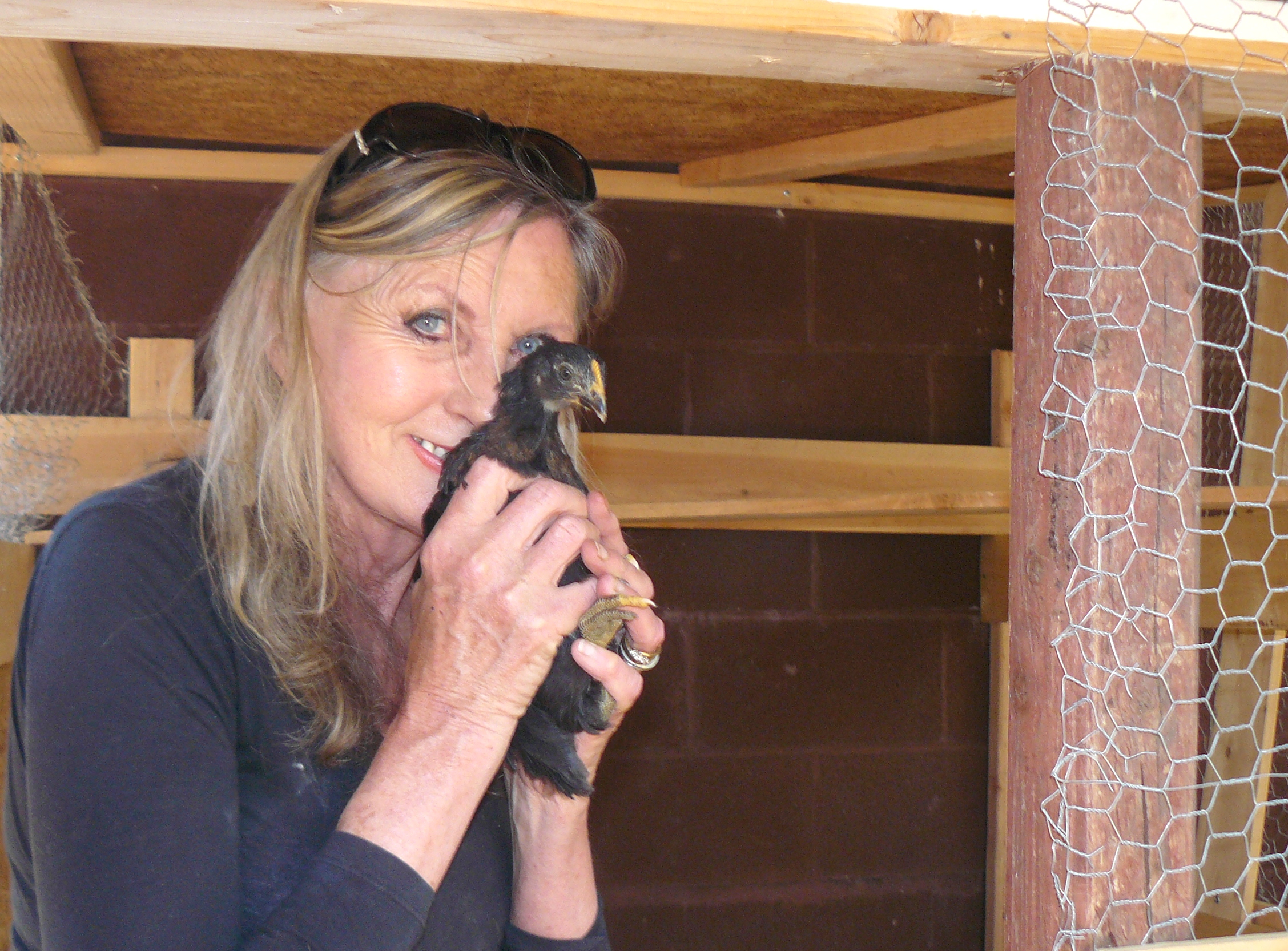
Finally, talking of settling in, our five young chicks have reached the stage where they could be housed outside in their new chicken house, the move taking place just five days ago.
Politics, oil and our natural world – tell me it’s all a bad dream!
Note
Yesterday, Thursday, I was really under the cosh in terms of finding time to write a careful and thoughtful Post for today, being involved in meetings both in the morning and afternoon, those meetings all about launching a transition town movement for Payson.
So my apologies for taking a short-cut and reproducing an item that was published on Common Dreams that, fortuitously, linked in with yesterday’s Post Moved to help?
Obama Echoes Bush, Sets Plan for Polar Bear Extinction
“President Obama’s proposal for these magnificent and imperiled animals is a gift to Big Oil”
– Common Dreams staff
The Obama Administration issued a proposed rule yesterday that disregards the effects of greenhouse gases on polar bear habitat leading one conservation group to say that the rule echoes former President George W. Bush’s plan, and that it will lead to the extinction of polar bears.
Kassie Siegel from the Center for Biological Diversity: “President Obama’s proposal for these magnificent and imperiled animals is a gift to Big Oil and an affirmation of the pro-industry policies of the Bush government. (photo: Subhankar Banerjee)
Kassie Siegel from the Center for Biological Diversity: “President Obama’s proposal for these magnificent and imperiled animals is a gift to Big Oil and an affirmation of the pro-industry policies of the Bush government. (photo: Subhankar Banerjee)Noting that polar bears are only on the endangered species list precisely because of loss of habitat caused by greenhouse gases generated from activities outside the Arctic, the proposed rule excluding activities outside the range of polar bears from regulations will lead to the bears’ demise.
Brendan Cummings of the Center for Biological Diversity called the rule “complete doublespeak,” the Associated Press reports. “It’s saying, ‘Here is a rule necessary for the conservation of the polar bear,’ yet the only thing it does is exempt from regulation the overwhelming threat to the species.”
“If polar bears are to survive we have to directly confront the greatest threat to them: our greenhouse gas emissions,” said Kassie Siegel, director of the Center for Biological Diversity’s Climate Law Institute.
“With their sea-ice habitat rapidly disappearing, polar bears need the full protection of the Endangered Species Act,” said Siegel. “President Obama’s proposal for these magnificent and imperiled animals is a gift to Big Oil and an affirmation of the pro-industry policies of the Bush government. When it comes to saving urgently endangered polar bears, the only ‘change’ Obama has delivered is more climate change.”
The rule, released by the U.S. Fish and Wildlife Service, has 60-day public comment period.
WASHINGTON – April 17 – The Obama administration announced today that it is reissuing a Bush-era regulation that sharply limits protections for polar bears under the Endangered Species Act. Both the current proposal and the previous Bush rule exclude activities occurring outside the range of polar bears — such as the greenhouse gas emissions of industrial polluters like coal plants — from regulations that could help stop the bear’s extinction. Today’s announcement comes as a result of a court order that struck down the Bush rule in October 2011.
Polar bears were the first species added to the endangered and threatened species list solely because of threats from global warming. Regulations issued under the Endangered Species Act must provide for the “conservation” of threatened species. Notably, the press release issued by the U.S. Fish and Wildlife Service announcing the new proposed rule today did not mention greenhouse gases or climate change at all, while the very purpose of the rule is to exempt greenhouse emissions from the reach of the Act.
“If polar bears are to survive we have to directly confront the greatest threat to them: our greenhouse gas emissions,” said Kassie Siegel, director of the Center for Biological Diversity’s Climate Law Institute. “But the Obama administration seems to be living in a fantasy world where the way to solve a difficult problem is to deny its existence.”
The proposed rule severely undermines protection for polar bears by exempting from portions of the Endangered Species Act all activities that occur outside of the bears’ range. But the species is endangered precisely because of activities occurring outside the Arctic — namely the emission of greenhouse gases and resulting warming that is leading to the rapid disappearance of summer sea ice.
“With their sea-ice habitat rapidly disappearing, polar bears need the full protection of the Endangered Species Act,” said Siegel. “President Obama’s proposal for these magnificent and imperiled animals is a gift to Big Oil and an affirmation of the pro-industry policies of the Bush government. When it comes to saving urgently endangered polar bears, the only ‘change’ Obama has delivered is more climate change.”
The special rule also reduces the protections the bear would otherwise receive in Alaska from oil-industry activities in its habitat.
When the polar bear was listed as a threatened species in May 2008 (following a petition by the Center), the Bush administration simultaneously issued a special rule under section 4(d) of the Endangered Species Act. A similar rule was finalized in December 2008 and defended by the Obama administration in court. On Oct. 17, 2011, a federal district court judge struck it down owing to the Fish and Wildlife Service’s failure to conduct an environmental review of the rule’s impacts.
The challenge was brought by the Center for Biological Diversity, Natural Resources Defense Council, Greenpeace and Defenders of Wildlife. Today’s proposal, in response to the 2011 court order, triggers a 60-day public comment period, with the rule scheduled for finalization by the end of 2012.
So I ponder on how to respond to the question from my grandson, currently one-year-old, when, in a few years time, the polar bears are no longer?
Yesterday, I posted an item built around a visit by Prof. Nicole Darnall, ASU, outlining the practical ways that a society can respond to the present challenges.
That post prompted a email to me from a Environmental Specialist who did not have the authority to speak publicly. Nonetheless, it seems perfectly valid to voice those views, as follows:
Dear Mr. Handover:
I found your posting via a Google alert I’ve set up. I like your idea of trying to pull the high-flying concept of saving the planet down to a local level by referencing analysis from a local expert.
But I wonder whether you chose the right expert; e.g., if Dr. Darnall’s forecast is correct, then her recommendation of Meatless Mondays won’t go far and fast enough. It can’t even be said to be a good start — as its very name locks people into thinking that just one meatless day suffices. In fact, no consumer product is ever marketed by asking consumers to use it just one day a week; e.g., very little Pepsi-Cola would be sold by prodding consumers to drink it one day a week, conceding that Coca-Cola remains the drink of choice the rest of the week. A City University of London prof might be making more sense when he recommends one meat day per week, see Eat meat on feast days only to fight obesity, says adviser.
Producing meat is harmful for the environment as growing animals requires energy and water, and cows produce the greenhouse gas methane Photo: Christopher Jones
Preceding Dr. Darnall’s recommendation is her assessment, which states that methane has 21 times the warming effect of carbon dioxide. But climate authorities now say methane has 25 times the effect of CO2 over a 100-year timeframe and 72 over a 20-year timeframe — which many use because methane’s half-life in the atmosphere is only about 10 years — while others use even higher figures; e.g., see Cornell Gas Study Stirs Heated Debate
A study examining the greenhouse impacts of methane leaks in the unconventional natural gas industry has proved highly controversial.
Below you can see I’ve addressed some even more basic points to Dr. Darnall directly; I haven’t yet had any reply.
The Environmental Specialist also included some important and pertinent points that had been sent to Dr. Darnall but I have decided to delay including that ‘letter’ for a short while in the hope that Dr. Darnall will reply. But read the items that are linked to above.
Professor Nicole Darnall, ASU, outlines what can be done.
At home, we subscribe to the Payson Roundup, our local newspaper, and in the April 10th edition there was a full back-page article written by Pete Ayleshire, Editor, about …. well let me quote from the on-line copy,
ASU professor Nicole Darnall taught a session on living a sustainable lifestyle at the Women’s Wellness Forum. Photo by Pete Aleshire.
Save money.
Get healthy.
Save the planet.
Why wait?
That’s the message Arizona State University professor Nicole Darnall delivered recently to a roomful of savvy planet
Prof. Nicole Darnall
huggers at the Women’s Wellness Forum. The daylong event drew about 240 women to listen to speakers on an array of topics.
Darnall offered a gripping presentation that started with global disaster, but ended with a reassuringly doable list of steps individuals can take to solve the seemingly overwhelming problems.
As I wrote at the end of last Friday’s article on Autism and bees, “I hope to publish a summary of a fascinating presentation given to a local women’s group here in Payson that shows the many obvious and easy steps we can all take to revert back to a resilient life on this planet.”
It’s so easy to be overwhelmed by the barrage of ‘doom and gloom’ stories that abound and, make no mistake, if each of us do nothing, the future does look ‘interesting’!
I don’t know about you but the degree of awareness of the changes we all need to make is huge and growing. So Prof. Darnall was right on the button when she spoke to that women’s forum. For instance,
“Livestock generates more greenhouse gases than all the planes, trains and automobiles on the planet,” said Darnall. In part, that’s because the methane from, well, the other end of cows, has 21 times the greenhouse gas warming effect as carbon dioxide.
Darnall’s solution? Meatless Mondays — to start curving that scary trend line.
A few paragraphs later,
The average person generates 4.5 pounds of trash daily. Of that, 75 percent can be recycled — but less than 30 percent actually ends up recycled.
Worse yet, we discard half of the food we produce, which works out to 474 pounds of wasted food per person.
Once again: The answer lies surprisingly close to home.
Start a composting bin: That would reduce discarded trash by about one-third — while increasing the health of your garden, not to mention averting the production of chemical fertilizers.
Then there’s this …..
Quit buying the plastic water bottles that add 25 million items to the waste stream every day. After all, tap water must meet higher health and purity standards than bottled water.
And not forgetting …..
Worried about all the bleach and other chemicals used in household cleaning products? No problem, said Darnall — before offering up a recipe for environmentally friendly scouring involving vinegar and baking soda. You can also ditch the ammonia in the window cleaner, with a mixture of corn starch — great for smudged mirrors and spots in the carpet.
Then this touched the spot for this part of Arizona with this year’s rainfall already far below the 30-year average.
Worried about the reckless use of fresh water, with predictions of longer deeper droughts well established?
Shorter showers can save 150 gallons each time — and a low-flow shower head can save 175 gallons a month. Get rid of the lawn, cut the water bill by 60 percent.
Rounding off by …..
But here’s the kicker, she said — you can save your wallet by saving the planet.
Make your cleaning products and you not only protect streams you also save money.
Change over to LED lights, you not only reduce greenhouse gas emissions — you save money.
Install solar tubes and you reduce greenhouse gases — and save money.
Eat less meat and reduce global warming — and also lose weight.
And heck: You might even make the cows happy.
Delightful close to the article that is Pete Ayleshire all over. (Pete teaches the creative writing class at the local extension college that Jean and I have been attending for two terms.)
It seems to me that one of the many lucky aspects of living in Payson is having the Arizona State University (ASU) School of Sustainability in the area and being able to draw on the expertise of people such as Prof. Darnall.
So look around and see what small steps you can take to make a difference, and start those small changes. As in the words of an old saying from my England days, ‘By the inch, it’s a cinch, by the yard it’s hard!‘
With grateful thanks to Alanna B. for sending me the details of this tragic case!
DOG FOR SALE:
New home needed for this wonderful animal.
A guy is driving around the back streets of Bristol, England.
He sees a sign in front of an unkempt terraced house: ‘Talking Dog For Sale‘, so he rings the bell and the owner appears and tells him the dog is in the garden.
The guy goes into the backyard and sees a nice looking Labrador retriever sitting there.
‘You talk?‘ he asks.
‘Yep,’ the Lab replies.
After the guy recovers from the shock of hearing a dog talk, he says ‘So, what’s your story?‘
The Lab looks up and says, ‘Well, I discovered that I could talk when I was pretty young.. I wanted to help the government, so I told the SAS. [Special Air Service or SAS is a corps of the British Army, Ed.]
In no time at all they had me jetting from country to country, sitting in rooms with spies and world leaders, because no one figured a dog would be eavesdropping.‘
‘I was one of their most valuable spies for eight years running…
But the jetting around really tired me out,and I knew I wasn’t getting any younger so I decided to settle down. I signed up for a job at the airport to do some undercover security, wandering near suspicious characters and listening in. I uncovered some incredible dealings and was awarded a batch of medals.’
‘Then I got married, had a load of puppies, and now I’m just retired.‘
The guy is amazed. He goes back in and asks the owner what he wants for the dog.
‘Ten quid,’ the guy says.
‘Ten quid? This dog is amazing! Why on earth are you selling him so cheap?‘
‘Because he’s a liar. He’s never been out of the garden all his life!’
If you eat food, and hope to do so in the future, read this!
I subscribe to Food Freedom News and often read their articles when they appear in my ‘in-box’. Especially so yesterday morning when the headline jumped off the ‘page’ at me: Autism and Disappearing Bees: A Common Denominator?
So, in a sense, hand-in-hand with the article in yesterday’s Learning from DogsFood, glorious food! Because if trying to feed 9 billion people living on a planet where ‘farmers holding seeds that won’t sprout‘ means the even greater use of chemicals then ….. then, I don’t know what!
The Food Freedom website showed that the article came from Brian Moench of the Common Dreams website. Not a website I had come across before but one that quickly impressed me!
A few days ago the Salt Lake Tribune’s front page headline declared, “Highest rate in the nation, 1 in 32 Utah boys has autism.” This is a national public health emergency, whose epicenter is Utah, Gov. Herbert. A more obscure story on the same day read: “New pesticides linked to bee population collapse.” If you eat food, and hope to do so in the future, this is another national emergency, Pres. Obama. A common denominator may underlie both headlines.
A honeybee pollinates a flower in a citrus grove just coming into blossom. (Photograph: David Silverman/Getty Images)
A Stanford University study with 192 pairs of twins, with one twin autistic and one not, found that genetics accounts for 38% of the risk of autism, and environmental factors account for 62%.
Supporting an environmental/genetic tag team are other studies showing autistic children and their mothers have a high rate of a genetic deficiency in the production of glutathione, an anti-oxidant and the body’s primary means of detoxifying heavy metals. High levels of toxic metals in children are strongly correlated with the severity of autism. Low levels of glutathione, coupled with high production of another chemical, homocysteine, increase the chance of a mother having an autistic child to one in three. That autism is four times more common among boys than girls is likely related to a defect in the single male X chromosome contributing to anti-oxidant deficiency. There is no such thing as a genetic disease epidemic because genes don’t change that quickly. So the alarming rise in autism must be the result of increased environmental exposures that exploit these genetic defects.
During the critical first three months of gestation a human embryo adds 250,000 brain cells per minute reaching 200 billion by the fifth month. There is no chemical elixir that improves this biologic miracle, but thousands of toxic substances can cross the placenta and impair that process, leaving brain cells stressed, inflamed, less well developed, fewer in number and with fewer connections with each other all of which diminish brain function. The opportunity to repair the resulting deficits later on is limited.
The list of autism’s environmental suspects is long and comes from many studies that show higher rates of autism with greater exposure to flame retardants, plasticizers like BPA, pesticides, endocrine disruptors in personal care products, heavy metals in air pollution, mercury, and pharmaceuticals like anti-depressants. [my emphasis] (Utah’s highest in the nation autism rates are matched by the highest rates of anti-depressant use and the highest mercury levels in the country in the Great Salt Lake).
Doctors have long advised women during pregnancy to avoid any unnecessary consumption of drugs or chemicals. But as participants in modern society we are all now exposed to over 83,000 chemicals from the food we eat, the water we drink, the air we breathe and the consumer products we use. Pregnant women and their children have 100 times more chemical exposures today than 50 years ago. The average newborn has over 200 different chemicals and heavy metals contaminating its blood when it takes its first breath. 158 of them are toxic to the brain. Little wonder that rates of autism, attention deficit and behavioral disorders are all on the rise.
How does this relate to vanishing bees and our food supply? Two new studies, published simultaneously in the journal Science, show that the rapid rise in use of insecticides is likely responsible for the mass disappearance of bee populations. The world’s food chain hangs in the balance because 90% of native plants require pollinators to survive.
The brain of insects is the intended target of these insecticides. They disrupt the bees homing behavior and their ability to return to the hive, kind of like “bee autism.” But insects are different than humans, right? Human and insect nerve cells share the same basic biologic infrastructure. Chemicals that interrupt electrical impulses in insect nerves will do the same to humans. But humans are much bigger than insects and the doses to humans are miniscule, right?
During critical first trimester development a human is no bigger than an insect so there is every reason to believe that pesticides could wreak havoc with the developing brain of a human embryo. But human embryos aren’t out in corn fields being sprayed with insecticides, are they? A recent study showed that every human tested had the world’s best selling pesticide, Roundup, detectable in their urine at concentrations between five and twenty times the level considered safe for drinking water.
The autism epidemic and disappearing bees are real public health emergencies created by allowing our world to be overwhelmed by environmental toxins. Environmental protection is human protection, especially for the smallest and most vulnerable among us.
Please bring this to the notice of any couples who you know are planning for a family!
If all this sort of information makes you want to curl up and kiss your backside goodnight, then hold on. Next week I hope to publish a summary of a fascinating presentation given to a local women’s group here in Payson that shows the many obvious and easy steps we can all take to revert back to a resilient life on this planet.
This Post includes the details of a live broadcast of an important event Feeding the World While the Earth Cooks from Washington D.C. If you would like to watch that broadcast then it starts at:
6am US Mountain Time Zone
9am US Eastern Daylight Time
13:00 Greenwich Mean Time (GMT/UTC)
2pm British Summer Time
Full details below.
H’mm, maybe the days of Oliver are well and truly numbered!
A quick ‘search’ found the lyrics of the famous song from the musical Oliver. Here’s a part of the chorus:
Food, glorious food!
Don’t care what it looks like —
Burned!
Underdone!
Crude!
Don’t care what the cook’s like.
Just thinking of growing fat —
Our senses go reeling
One moment of knowing that
Full-up feeling!
Not to be taken for granted.
However, a recent announcement from Arizona State University quite rightly points out the challenges that lay ahead in terms of feeding the world’s population. Here are the details of that ASU announcement.
The future of food: feeding the world while the Earth cooks
Editor’s Note: This event is presented by Future Tense, a partnership between Arizona State University, the New America Foundation and Slate, that examines emerging technologies, public policy and society.
The event considers the agricultural crisis that may ensue when today’s toddlers are parents themselves – a time when the world population will reach 9 billion. “A growing global middle class will demand more food. And climate change will leave farmers holding seeds that won’t sprout. By 2050, will our global appetite outgrow our agricultural capacity?”
Tune in to find out how everyone – growers, technologists, governments, business leaders, and carbon-conscious consumers – will be part of the solution.
Speakers include Nina Fedoroff, special advisor on science and technology to the Secretary of State; Fred Kirschenmann, Distinguished Fellow at the Leopold Center for Sustainable Agriculture and President of Stone Barnes Center; Debra Eschmeyer, founder and program director of FoodCorps; and Bill Hohenstein, director of the USDA Global Change Program Office.
Let me highlight that the event is being carried live and is available to view.
The link you need to that ASUtv programme is here. From where you will see that:
Arizona State University, the New America Foundation , and Slate present “Feeding the World While the Earth Cooks” live from Washington, D.C., this April 12 from 6:00 am to 12:15 pm. The program will air in it’s entirety onASUtv.
(From the New America Foundation): When today’s toddlers are parents themselves, they will face an agricultural crisis. The world population will reach 9 billion. A growing global middle class will demand more food. And climate change will leave farmers holding seeds that won’t sprout. By 2050, will our global appetite outgrow our agricultural capacity?
Join us to find out how everyone—growers, technologists, governments, business leaders, and carbon-conscious consumers—will be part of the solution.
The day’s speakers include Dr. Nina Fedoroff, Special Advisor on Science and Technology to the Secretary of State; Dr. Fred Kirschenmann, Distinguished Fellow at the Leopold Center for Sustainable Agriculture and President of Stone Barnes Center; Debra Eschmeyer, Founder and Program Director of FoodCorps; Bill Hohenstein, Director of the USDA Global Change Program Office; and many more.
So if you want to watch that event then here are the UTC times.
April 12 from 6:00 am to 12:15 pm US Mountain Time equates to 13:00 – 19:15 UTC (2 pm to 8:15 pm British Summer Time)
On April 10, 1912, the Titanic, largest ship afloat, left Southampton, England on her maiden voyage to New York City. The White Star Line had spared no expense in assuring her luxury. A legend even before she sailed, her passengers were a mixture of the world’s wealthiest basking in the elegance of first class accommodations and immigrants packed into steerage.
She was touted as the safest ship ever built, so safe that she carried only 20 lifeboats – enough to provide accommodation for only half her 2,200 passengers and crew. This discrepancy rested on the belief that since the ship’s construction made her “unsinkable,” her lifeboats were necessary only to rescue survivors of other sinking ships. Additionally, lifeboats took up valuable deck space.
Four days into her journey, at 11:40 P.M. on the night of April 14, she struck an iceberg. Her fireman compared the sound of the impact to “the tearing of calico, nothing more.” However, the collision was fatal and the icy water soon poured through the ship.
It became obvious that many would not find safety in a lifeboat. Each passenger was issued a life jacket but life expectancy would be short when exposed to water four degrees below freezing. As the forward portion of the ship sank deeper, passengers scrambled to the stern. John Thayer witnessed the sinking from a lifeboat. “We could see groups of the almost fifteen hundred people still aboard, clinging in clusters or bunches, like swarming bees; only to fall in masses, pairs or singly, as the great after part of the ship, two hundred and fifty feet of it, rose into the sky, till it reached a sixty-five or seventy degree angle.” The great ship slowly slid beneath the waters two hours and forty minutes after the collision
The next morning, the liner Carpathia rescued 705 survivors. One thousand five hundred twenty-two passengers and crew were lost. Subsequent inquiries attributed the high loss of life to an insufficient number of lifeboats and inadequate training in their use.
Read more of this fascinating account, especially the story of Elizabeth Shutes who, aged 40, was governess to nineteen-year-old Margaret Graham who was traveling with her parents. As Shutes and her charge sit in their First Class cabin they feel a shudder travel through the ship. At first comforted by her belief in the safety of the ship, Elizabeth’s composure is soon shattered by the realization of the imminent tragedy.
Also grateful to my cousin, Rose F., who sent me a link to a story in the British newspaper The Telegraph that came out in September, 2010. I don’t have permission to reproduce that story but hope that it being 18 months since it was published by the Telegraph makes my act forgiveable!
Titanic sunk by steering blunder, new book claims
It was always thought the Titanic sank because its crew were sailing too fast and failed to see the iceberg before it was too late.
But now it has been revealed they spotted it well in advance but still steamed straight into it because of a basic steering blunder.
According to a new book, the ship had plenty of time to miss the iceberg but the helmsman panicked and turned the wrong way.
By the time the catastrophic error was corrected it was too late and the side of the ship was fatally holed by the iceberg.
Even then the passengers and crew could have been saved if it had stayed put instead of steaming off again and causing water to pour into the broken hull.
The revelation, which comes out almost 100 years after the disaster, was kept secret until now by the family of the most senior officer to survive the disaster.
Second Officer Charles Lightoller covered up the error in two inquiries on both sides of the Atlantic because he was worried it would bankrupt the liner’s owners and put his colleagues out of job.
Since his death – by then a war hero from the Dunkirk evacuation – it has remained hidden for fear it would ruin his reputation.
But now his granddaughter the writer Lady (Louise) Patten has revealed it in her new novel. “It just makes it seem all the more tragic,” she said. “They could easily have avoided the iceberg if it wasn’t for the blunder.”
The error on the ship’s maiden voyage between Southampton and New York in 1912 happened because at the time seagoing was undergoing enormous upheaval because of the conversion from sail to steam ships.
The change meant there were two different steering systems and different commands attached to them.
Some of the crew on the Titanic were used to the archaic Tiller Orders associated with sailing ships and some to the more modern Rudder Orders.
Crucially, the two steering systems were the complete opposite of one another.
So a command to turn “hard a starboard” meant turn the wheel right under the Tiller system and left under the Rudder.
When First Officer William Murdoch spotted the iceberg two miles away, his “hard a-starboard” order was misinterpreted by the Quartermaster Robert Hitchins.
He turned the ship right instead of left and, even though he was almost immediately told to correct it, it was too late and the side of the starboard bow was ripped out by the iceberg.
“The steersman panicked and the real reason why Titanic hit the iceberg, which has never come to light before, is because he turned the wheel the wrong way,” said Lady Patten who is the wife of former Tory Education minister, Lord (John) Patten.
Whilst her grandfather Lightoller was not on watch at the time of the collision, her book Good as Gold reveals that a dramatic final meeting of the four senior officers took place in the First Officer’s cabin shortly before Titanic went down.
There, Lightoller heard not only about the fatal mistake, but also what happened next, up on the bridge.
While Hitchins had made a straightforward error, what followed was a deliberate decision.
Bruce Ismay, chairman of Titanic’s owner, the White Star Line, persuaded the Captain to continue sailing. For ten minutes, Titanic went “Slow Ahead” through the sea.
This added enormously to the pressure of water flooding through the damaged hull, forcing it up and over the watertight bulkheads, sinking Titanic many hours earlier than she otherwise would have done.
“Ismay insisted on keeping going, no doubt fearful of losing his investment and damaging his company’s reputation,” said Lady Patten. “The nearest ship was four hours away. Had she remained at ‘Stop’, it’s probable that Titanic would have floated until help arrived.”
The truth of what happened on that historic night was deliberately buried.
Lightoller, the only survivor who knew precisely what had happened, and who would later go on to be a twice-decorated war hero, decided to hide what he knew from the world, including two official inquiries into the sinking.
By his code of honour, he felt it was his duty to protect his employer – White Star Line – and its employees.
Lady Patten said: “The inquiry had to be a whitewash. The only person he told the full story to was his beloved wife Sylvia, my grandmother. As a teenager, I was enthralled by the Titanic. Granny revealed to me exactly what had happened on that night and we would discuss it endlessly.
She died when I was sixteen and, though she never told me to keep the knowledge to myself, I didn’t tell anyone. My mother insisted that everything remained strictly inside the family: a hero’s reputation was at stake.
Nearly forty years later, with Granny and my mother long dead, I was plotting my second novel and it struck me that I was the last person alive to know what really happened on the night Titanic sank.
My grandfather’s extraordinary experiences felt like perfect material for Good As Gold.
Yesterday, I had the pleasure of publishing a guest post from Patrice Ayme about the important subject of Energy Question For The USA
One of the comments on that Post was from Per Kurowski, a former Executive Director of the World Bank. He reported about a letter he wrote that was published in the Financial Times back in April, 2005. That letter set out the case for,
A sensible country would raise tax on petrol, so what is US waiting for?
Sir, it is hard to understand the United States of America! It has a huge fiscal deficit; it has a huge current-account deficit; it is by far the world’s biggest oil consumers both in absolute and in relative terms; now willing to explore for oil and gas in Alaska, it shows itself to be aware of the difficult energy outlook the world faces; it seems aware and resolute about the environmental problems (ignore the Alaska part) as it imposes other expensive environmental regulations, such as recycling—which, as no one likes to do it, requires the hiring of Salvadoreans; it speaks all over the place about having to reduce the vulnerabilities of its oil supplies.
As any other sensible country would, in similar circumstances, increase the taxes on petrol consumption and substantially help to solve all the above-mentioned problems; and as the US has always shown willingness to pull together as a nation, recently even to the extent of going to war on shaky grounds, the big question remains: why is it that the leaders of the US do not even want to talk about a substantial tax on petrol?
The letter struck me as eminently sensible. Then a while later Perfect Stranger emailed an equally valid alternative approach and that now follows as a guest post.
oooOOOooo
Many years ago while working for Lehman Bros I did a spreadsheet relating to oil profits based on government taxes, I can assure you that having the USA government (or any other government) raise taxes on oil will do the complete opposite to what everyone expects it will do.
Any taxes raised will only end up in the federal coffers, they will not harm the oil companies because they will simply marginally raise the price of fuel meaning they will still receive the same profits while the government gets even more. The consumers will hurt in the pocket and nothing else will happen.
If for some reason the government found a way to stop the oil companies from any marginal increases then the oil companies would simply raise their fuel transportation costs and lump the entire loss on the Petrol Station operators meaning the operators would lose out, the oil companies would still receive the same profit and the government would still end up with more money in their coffers.
But oil consumption would remain the same, in other words .. raising taxes (or lowering them ) will do no good whatsoever
So the answer to using less fossil fuels, as I keep on saying, is not up to any government nor is it up to the oil companies nor is it up to science, the blame lies entirely on the people who choose to drive to the shops to buy their bread and milk instead of walking whatever short distance that might require.
This is something I have found throughout the entire global warming movement, everybody tends to expect that it is up to governments and science to find solutions when in reality it is we who cause the problems and it is we who should be fixing them … THE GOVERNMENTS CANNOT HELP THOSE WHO WILL NOT HELP THEMSELVES, as long as we keep demanding the same lifestyle they have no choice but to provide us with it.
It is the same with coal, gas and oil in power plants, they only get burnt because we as consumers draw the power from the grid, in other words, we demand it, and if the companies don’t provide enough we get all sorts of blackouts,then we whinge, the companies get fined, directors get jailed for failing in their duty to the public and still .. more coal, gas and oil gets delivered to the power plants.
Spending less Energy and Wasting less Heat is actually the “only” solution that will work, anything else, any other form of debate or discussion on the issue is just another way of extending a debate that should have been over decades ago .. because that is the only possible solution, there really is no other solution, none whatsoever, there are no other answers.
The truth of the matter is that nobody wants to do anything about it except to continue the debate all the while expecting others to resolve the issue while they sit on their butts and talk about how things are going ever so slowly and that it must all be the fault of somebody else.
The oil companies cannot stop producing fuel nor should they be stopped as this would destroy our entire civilization, I am amazed at the ignorance in even discussing such an issue, it’s as if people imagine that by stopping oil and other fossil fuels over, say the next 10 years, that somehow some magical system would suddenly develop to replace them.
Do you realize that it took over a hundred years to build our existing fossil fuel based society and that currently only 3% of that has been replaced by alternative energy sources and that it has taken 3 decades for that to occur, all over the world?
There is no miracle technology that can be implemented fast enough to save us, there never has been, EVER, even nuclear power cannot be produced fast enough for our needs, we have to save ourselves.
So use some common sense and realize that the only possible solution to the global warming issue is for all of us to get into conserving energy and wasting less heat and above all … educating others into doing the same thing.
You leave it too long and we are all going to die ,,,,,, and it’s a guarantee we shall blame some else for it 😦
Footnote: This is a warning given to us by one of the greatest scientists who ever lived, comparable only to both Issac Newton and Albert Einstein.
Lord Kelvin
“Within a finite period of time past, the Earth must have been, and within a finite period of time to come the Earth must again be, unfit for the habitation of man as at present constituted, unless operations have been, or are to be performed, which are IMPOSSIBLE under the laws to which the known operations going on at present in the material world are subject.” – Lord William Kelvin.
As they say, the solutions to the problems of the future may always be found in the lessons of the past. As we can see by Lord Kelvin’s warning, this problem has never had a technical solution and we have little time to learn that one lesson.
oooOOOooo
As much as I respect Per’s opinion, indeed I wrote yesterday, “The points you make seem complete common sense.” the argument put forward by Perfect Stranger really does ‘join the dots’ for me and, I suspect, for many others. Indeed, as Wen Scott commented on last Tuesday’s Post,
For my own personal experience, my husband and I have concluded that the only way we can make a contribution is to make our own grass-roots changes. We are solar, heat with wood (carbon neutral), composting toilets and kitchen scraps, and lately are choosing as much local food, goods and services as possible. The Transitions movements are a great example and well worth emulating for all of us.
I think it’s pretty clear that waiting around for governments and big business to solve environmental problems is dangerous to our health and well-being — it’s important to hear voices directly from our scientists, but I think we are very foolish (insane) to refuse to take action now. What are people waiting for, and at this date, does it really make much difference who or what is causing such environmental and climate devastation?
What’s the saying…. walk softly and leave nothing behind but your footprints. Even that may be too little, too late, but let’s hope not.
And it is thanks to Wen’s blogsite that I was linked to the following video,
We are living in exceptional times. Scientists tell us that we have 10 years to change the way we live, avert the depletion of natural resources and the catastrophic evolution of the Earth’s climate.
The stakes are high for us and our children. Everyone should take part in the effort, and HOME has been conceived to take a message of mobilization out to every human being.
For this purpose, HOME needs to be free. A patron, the PPR Group, made this possible. EuropaCorp, the distributor, also pledged not to make any profit because Home is a non-profit film.
HOME has been made for you : share it! And act for the planet.







 Learning from Dogs