Category: Culture

More Bird and Fortune

The power of humour in reflecting life back at us!

It was such fun revisiting John Bird and John Fortune back in July, see That sub-prime crisis, that I found another one for your enjoyment.  On the proposal for the privatisation of British Air Traffic Control. Goes back to 1996, I think, but clearly from Rory Bremner: Who else!

.

The more it changes, the more it’s the same thing.

Tom Engelhardt’s essay on the recent US Presidential election.

Introduction

Regular readers will be aware that republishing essay’s from Tom Engelhardt’s superb blog site TomDispatch has been a regular event on Learning from Dogs.  Again, readers will surely be aware that shortly after this blog got under way and I requested permission to republish a TomDispatch essay, Tom not only promptly gave me permission but added that I was free to republish any others that caught my fancy.  That was very generous and, by way of example, here are links to the last three that have appeared here.  There was the essay on Ernest Callenbach in May, Magic and the Machine in June, and The West in flames at the end of July.

So on to this essay that was recently published by Tom and is called The Meaning of a Do-Nothing Election.  As someone who is not entitled to vote in American elections and is far from understanding local cultures let alone American politics, reading an essay like this is deeply educational and I trust is for you as well.  The full essay including the introduction now follows:

oooOOOooo

[Note for TomDispatch Readers: Recently, I went back to a piece I wrote just days after the 2008 election titled “Don’t Let Barack Obama Break Your Heart.”  It reminded me that sometimes a good deal about our American future can be mined from the post-election moment.  So today, I’ve tried my hand at it again.  I’ll have to check it out in November 2016.  In the meantime, if you want to read more of my writings about the years in between, pick up a copy of The United States of Fear — or for $75 that will help this website stay afloat, you can get a signed, personalized copy (with my appreciation) via our donation page. Tom]

The Mandate of Hell 
How Not to Change the World 
By Tom Engelhardt

In the fall of 1948, Harry Truman barnstormed the country by train, repeatedly bashing a “do-nothing Congress,” and so snatched victory from the jaws of defeat in that year’s presidential campaign.  This year, neither presidential candidate focused on blasting a do-nothing Congress or, in Obama’s case, “Republican obstructionism,” demanding that the voters give them a legislative body that would mean an actual mandate for change.

We now know the results of such a campaign and, after all the tumult and the nation’s first $6 billion election, they couldn’t be more familiar.  Only days later, you can watch a remarkably recognizable cast of characters from the reelected president and Speaker of the House John Boehner to the massed pundits of the mainstream media picking up the pages of a well-thumbed script.

Will it be bipartisanship or the fiscal cliff?  Are we going to raise new revenues via tax reform or raise tax rates for the wealthiest Americans?  Will the president make up with Israeli Prime Minister Benjamin Netanyahu or not?  Will it be war or something less with Iran?  And so on and so forth.  It’s the moment the phrase déjà vu all over again was made for.

A Hell of Our Own Making

When a new Chinese dynasty came to power, it was said that it had received “the mandate of heaven.”  We’ve just passed through an election campaign that, while the noisiest in memory, was enveloped in the deepest of silences on issues that truly matter for the American future.  Out of it, a “mandate” has indeed been bestowed not just on Barack Obama, but on Washington, where a Republican House of Representatives, far less triumphant but no less fully in the saddle than the president, faces media reports that its moment is past, that its members are part of “the biggest loser demographic of the election,” and that its party — lacking the support of young peoplesingle women, those with no religious affiliationHispanicsAfrican Americans, and Asian Americans — is heading for the trash barrel of history.

If true, that does sound like a mandate for something, sooner or later — assuming you happen to have years of demographic patience.  In the meantime, there will be a lot more talk about how the Republicans need to reorient their party and about a possible “civil war” over its future.  And while we’re at it, bet on one thing: we’re also going to hear a ton more talk about how much deeply unhappy Americans — the very ones who just reinstalled a government that’s a senatorial blinkaway from the previous version of the same — really, really want everyone to make nice and work together.

But isn’t it time to cut the b.s., turn off those talking heads, and ask ourselves: What does election 2012 really mean for us and for this country?

Let’s start with one basic reality: we’ve just experienced a do-nothing election that represents a mandate from a special American kind of hell. (Admittedly, Mitt Romney’s election, which would have put the House of Representatives and Big Energy in the Oval Office, undoubtedly represented a more venal circle of that fiery establishment.)

That, in turn, ensures two different but related outcomes, both little discussed during the campaign: continuing gridlock on almost any issue that truly matters at home and a continuing damn-the-Hellfire-missiles, full-speed-ahead permanent state of war abroad (along with yet more militarization of the “homeland”).  The only winners — and don’t believe the outcries you’re hearing about sequestration “doom” for the military — are likely to be the national security complex, the Pentagon, and in a country where income inequality has long been on the rise, the wealthy.  Yes, in the particular circle of hell to which we’re consigned, it’s likely to remain springtime for billionaires and giant weapons manufacturers from 2012 to 2016.

How do we know that gridlock and a permanent state of war are the only two paths open to the people’s representatives, that Washington is quite so constrained?  Because we’ve just voted in a near-rerun of the years 2009-2012, which means that the power to make domestic policy (except at the edges) will continue to slowly seep out of the White House, while the power of the president and the national security state to further abridge evaporating liberties at home and make war abroad will only be enhanced.  The result is likely to be stasis for the globe’s last superpower at a moment when much of the world — and the planet itself — is in the process of tumultuous transformation.

Here are things not to expect: a major move to rebuild the country’s tattered infrastructure; the genuine downsizing of the American global military mission; any significant attempt to come to grips with a changing planet and global warming; and the mobilization of a younger generation that, as Hurricane Sandy showed, is ready to give much and do much to help others in need, but in the next four years will never be called to the colors.

In other words, this country is stuck in a hell of its own making that passes for everyday life at a moment when the world, for better and/or worse, is coming unstuck in all sorts of ways.

Fiddling While the Planet Burns

The United States remains a big, powerful, wealthy country that is slowly hollowing out, breaking down.  Meanwhile, on planet Earth, the global economy is up for grabs.  Another meltdown is possible, as the European, Chinese, Japanese, and Indian economies all continue to take hits.  Power relations have been changing rapidly, from the rise of Brazil in what was once Washington’s “backyard” to the Chinese miracle (and the military muscle that goes with it).  A largely American system that long helped keep the Greater Middle East, the energy heartlands of the globe, under grim, autocratic control is unraveling with unknown consequences.  Above all, from increasingly iceless Arctic waters to ever more extreme weather, rising sea levels, and the acidification of the oceans, this planet is undergoing a remarkably rapid transformation based largely on the release into the atmosphere of carbon dioxide from the burning of fossil fuels.

Other than a few curious Republican comparisons of an American economy under the Democrats to “Greece,” a near obsessive focus on the death of Ambassador J. Christopher Stephens and three other Americans in Libya, and various denunciations of China as a currency manipulator, not a single one of these matters came up in any meaningful way in the election campaign.  In other words, election 2012 boiled down to little more than a massive case of Washington-style denial.  And don’t for a second think that that’s just an artifact of election year artifice.

Take climate change, which like the Arab Spring blasted its way into our unprepared midst in 2011-2012.  There was the wildfire season of all seasons in a parching Southwest and West, a devastating drought that still hasn’t fully lifted in the Midwestern breadbasket (or corncob) of the country, and a seemingly endless summer that may make this the hottest year on record for the continental United States.  It was staggering and, if opinion polls are to be believed, noted by increasing numbers of concerned Americans who could literally feel the world changing around them.

And yet none of this made global warming an election issue.  Month after month, it was The Great Unmentionable.  The silence of emboldened Republicans plugging their drill-baby-drill and lay-those-pipelines policies and of cowed Democrats who convinced themselves that the issue was a no-win zone for the president proved deafening — until the campaign’s last days.  It was then, of course, that Hurricane Sandy, the “Frankenstorm,” swept through my town and devastated New Jersey.  It provided the extreme weather coup de grâce of 2012.  (And yes, there’s little doubt that climate-change-induced rising sea levels contributed to its fury.)  Superstorm Sandy also revealed just how unprepared the U.S. infrastructure is for predicted climate-change events.

The extremity of Sandy and its 14-foot storm surge was stunning enough that global warming was suddenly forced out of the closet.  It made magazine covers and gubernatorial press conferences.  There was even a last-minute Romney vs. Sandy web ad (“Tell Mitt Romney: Climate Change Isn’t a Joke”), and in his victory statement on election night, President Obama did manage to briefly acknowledge the changed post-Sandy moment, saying, “We want our children to live in an America that isn’t… threatened by the destructive power of a warming planet.”

Still, in just about every sense that matters in Washington, real planning for climate change is likely to remain off that table on which all “options” always sit.  Expect the president to offer Shell further support for drilling in Arctic waters, expect a new push for the Keystone XL pipeline which will transport some of the “dirtiest” energy from Canada to the Gulf of Mexico, and so on.

Don’t count on anyone doing the obvious: launching the sort of Apollo-style R&D program that once got us to the moon and might speed the U.S. and the planet toward an alternative energy economy, or investing real money in the sort of mitigation projects for the new weather paradigm that might prevent a coastal city like New York — or even Washington — from turning into an uninhabitable disaster zone in some not so distant future.

Climate science is certainly complex and filled with unknowns.  As it happens, many of those unknowns increasingly seem focused on two questions: How extreme and how quickly?  It’s suggested that sea levels are already rising faster than predicted and some recent scientific studies indicate that, by century’s end, the planet’s average temperature could rise by up to eight degrees Fahrenheit, an almost unimaginable disaster for humanity.

Whatever the unknowns, certain things are obvious enough.  Here, for instance, is a simple reality: any set of attempts, already ongoing, to make North America the “Saudi Arabia” of the twenty-first century in energy production are guaranteed to be a climate-change disaster.  Unfortunately, this election ensures once again that, no matter what the planetary realities or the actual needs of this country, no significant money will flow into alteration or mitigation projects.

Among the truly bizarre aspects of this situation, one stands out: thanks in part to a long-term climate-change-denial campaignwell-funded by the giant energy companies, the subject has become “political.”  The idea that it is a liberal or left-wing “issue,” rather than a global reality that must be dealt with, is now deeply embedded.  And yet there may never have been a more basic conservative issue (at least in the older sense of the term): the preserving, above all else, of what is already most valuable in our lives.  And what qualifies more for that than the health of the planet on which humanity “grew up”?

The phrase “fiddling while Rome burns” seems to catch something of the essence of this post-election moment — and it has special meaning when the fiddlers turn out to be slipping matches to the arsonists.

Mobilize Yourself

Just a week after the election, the Republican Party is already gearing up to produce a new, better-looking, more “diverse,” better-marketed version of itself for the 2014 and 2016 Hispanic and Asian American “markets.”  The Democratic Party is no doubt following suit.  In American politics these days, presidential elections last at least four years.  The first poll for Iowa 2016 is already out.  (Hillary’s way ahead).  Elections are the big business, sometimes just about the only significant political business Washington focuses on with any success, aided and abetted by the media.  So look forward to the $7 billion or $8 billion or $9 billion elections to come and the ever-greater hoopla surrounding them.

But stop waiting for change, “big” or otherwise, to come from Washington.  It won’t.  Don’t misunderstand me: as the residents of the Midwestern drought zone and the Jersey shore now know all too well, change is coming, like it or not.  If, however, you want this country to be something other than its instigator and its victim, if you want the U.S. to engage a world of danger (and also of opportunity), you’d better call yourself and your friends and neighbors to the colors.  Don’t wait for a Washington focused on its own well-being in 2014 or 2016.  Mobilize yourself.  It’s time to occupy this country before it’s blown away in a storm.

Tom Engelhardt, co-founder of the American Empire Project and author of The United States of Fear as well as The End of Victory Culture, his history of the Cold War, runs the Nation Institute’s TomDispatch.com. His latest book, co-authored with Nick Turse, is Terminator Planet: The First History of Drone Warfare, 2001-2050.  You can see his recent interview with Bill Moyers on supersized politics and election 2012 by clicking here.

Follow TomDispatch on Twitter @TomDispatch and join us on Facebook.  Check out the newest Dispatch book, Nick Turse’s The Changing Face of Empire: Special Ops, Drones, Proxy Fighters, Secret Bases, and Cyberwarfare.

Copyright 2012 Tom Engelhardt

oooOOOooo

So what made me select the heading?  Well, it’s the English translation of the well-known French saying, “plus ça change, plus c’est la même chose” that translates to “The more things change, the more they stay the same.”  As Wikipedia tells us, “An epigram by Jean-Baptiste Alphonse Karr in the January 1849 issue of his journal Les Guêpes (“The Wasps”). Literally “The more it changes, the more it’s the same thing.”  Seems to pick up Tom’s theme very nicely.
Animals in love

The beautiful hidden depths of the consciousness of animals

Back in the Summer of 2011, I published a couple of posts on the subject of consciousness.  The first one was called Consciousness, science or God? and the second one about a month later continued the theme under the heading of And more on consciousness.

In that second article, I concluded with these words:

Finally, do you have a dog at home?  If you do, ponder on how their conscious world engages them.  If science can’t explain human consciousness then all we have is our own intuition with regard to animals.  Not sure about you but when one is feeling a little low and a dog comes up and lays a head across you I feel a very strong conscious connection.

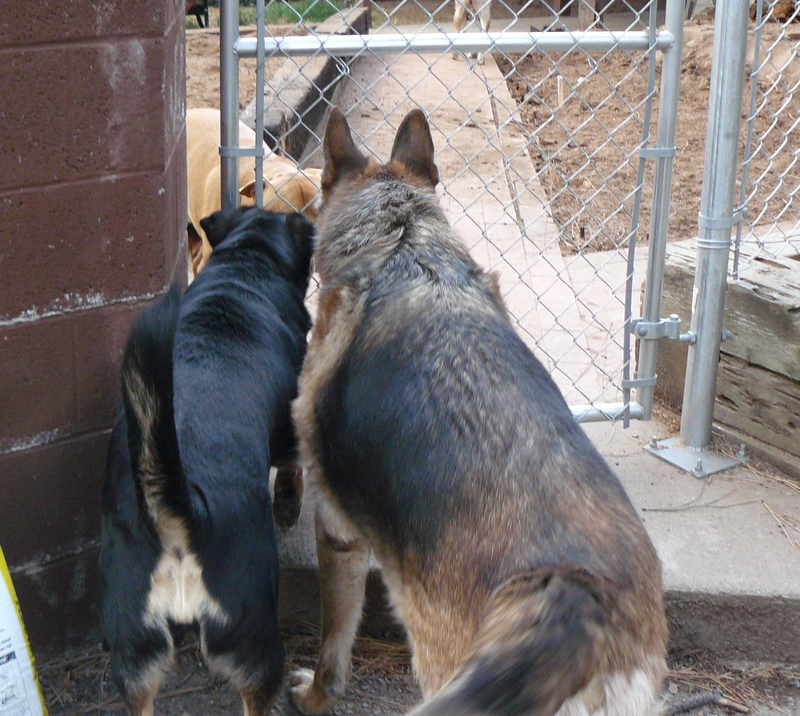
Hazel and Pharaoh

The dog to the left of Pharaoh in the above picture is Hazel.  Shortly before we left San Carlos, Mexico to move up to Arizona in February, 2010, this dog was dumped outside Jean’s house.  She was still in milk and Jean explained that it was common practice for female dogs to be cast out shortly after they had had pups.  The pups would have been sold for a few pesos and the mother dog was no longer of any use or value and was ‘disposed’.

We took her in, of course, and she joined the other dozen dogs on our journey to our new Arizonan home.  Hazel has the sweetest of dispositions and frequently sleeps snuggled up against me at night.  As I write these words, Hazel is sleeping just to the left of my feet.  There are times when Hazel looks into my eyes with what I can’t lable as anything other than the look of a dog in love.

So with that in mind, let me introduce you to Kate and Pippin.  As their website proposes  Kate & Pippin is “An unlikely love story“.

THE STORY

Pippin, a helpless baby fawn was abandoned by her mother on the property of Isobel Springett. Isobel’s Great Dane, Kate, adopted Pippin immediately and they have been best friends ever since.

The story of Kate’s and Pippin’s loving relationship is charmingly chronicled in a handsome book featuring the beautiful photography of Isobel Springett.

Here’s Martin Springett, author of the book.

While there’s a small degree of overlap with the first video, you’ll still love to watch this.

A collection of photos from pips’s early days. She was just a few days old when she found us. Music is by my brother Martin Springett.

To close, here’s Pip at about two and a half months old. She’s just lost her spots and is looking like a teenager, all legs! She loves grapes and bananas after her bottle. (And the music is fabulous – Artist: Jelengue “Amar Mi Verdad”)

Reminds me of that great book from Jeffrey Masson, Dogs never lie about love!

Deeper insights into who we are.

Two fascinating perspectives.

1. A conversation with Charles Taylor – THE 2008 KYOTO PRIZE

Video Messages from Dr. Charles MargraveTaylor, the Laureate of 2008 KYOTO PRIZE, Arts and Philosophy. “Feelings on receiving the Kyoto Prize” “What philosophers can do for society” “Future interest and theme”(2008/11/11)

Wikipedia describes Charles Taylor thus,

Charles Margrave Taylor, CC GOQ FRSC (born November 5, 1931) is a Canadian philosopher from Montreal, Quebec best known for his contributions to political philosophy, the philosophy of social science, and intellectual history. This work has earned him the prestigious Kyoto Prize and the Templeton Prize, in addition to widespread esteem among philosophers. In 2007, Taylor served with Gérard Bouchard on the Bouchard-Taylor Commission on Reasonable Accommodation with regard to cultural differences in the province of Quebec. Taylor currently teaches at McGill University in the Department of Religious Studies. He is a practicing Roman Catholic.

There is also a fuller biography presented here.

2. How we see circumstances is so much more important – Rory Sutherland on Perspectives.

The circumstances of our lives may matter less than how we see them, says Rory Sutherland. At TEDxAthens, he makes a compelling case for how reframing is the key to happiness.

The TED profile of Rory Sutherland explains that:

From unlikely beginnings as a classics teacher to his current job as Vice Chairman of Ogilvy Group, Rory Sutherland has created his own brand of the Cinderella story. He joined Ogilvy & Mather’s planning department in 1988, and became a junior copywriter, working on Microsoft’s account in its pre-Windows days. An early fan of the Internet, he was among the first in the traditional ad world to see the potential in these relatively unknown technologies.

A damming indictment!

Life’s strange quirks.

I’m very grateful to John H., a dear friend back in Payson, for forwarding this to me.  Enjoy!

oooOOOooo

This is an actual letter sent to a man named Ryan DeVries regarding a pond on his property. It was sent by the Pennsylvania Department of Environmental Quality, State of Pennsylvania . This guy’s response is hilarious, but read the State’s letter before you get to the response letter, you won’t stop once you start. WOW Love this man.

——————-

This is an actual letter: State of Pennsylvania’s letter to Mr. DeVries: 

SUBJECT: DEQ …. File No.97-59-0023; T11N; R10W, Sec 20; Lycoming County

Dear Mr. DeVries:

It has come to the attention of the Department of Environmental Quality that there has been recent unauthorized activity on the above referenced parcel of property. You have been certified as the legal landowner and/or contractor who did the following unauthorized activity:

Construction and maintenance of two wood debris dams across the outlet stream of Spring Pond.

A permit must be issued prior to the start of this type of activity. A review of the Department’s files shows that no permits have been issued Therefore, the Department has determined that this activity is in violation of Part 301, Inland Lakes and Streams, of the Natural Resource and Environmental Protection Act, Act 451 of the Public Acts of 1994, being sections 324.30101 to 324.30113 of the Pennsylvania Compiled Laws, annotated.

The Department has been informed that one or both of the dams partially failed during a recent rain event, causing debris and flooding at downstream locations.. We find that dams of this nature are inherently hazardous and cannot be permitted. The Department therefore orders you to cease and desist all activities at this location, and to restore the stream to a free-flow condition by removing all wood and brush forming the dams from the stream channel. All restoration work shall be completed no later than January 31, 2010.

Please notify this office when the restoration has been completed so that a follow-up site inspection may be scheduled by our staff. Failure to comply with this request or any further unauthorized activity on the site may result in this case being referred for elevated enforcement action..

We anticipate and would appreciate your full cooperation in this matter. Please feel free to contact me at this office if you have any questions.

Sincerely,

David L. Price
District Representative and Water Management Division.

—————–

Here is the actual response sent back by Mr. DeVries: 

Re: DEQ File
No.. 97-59-0023; T11N; R10W, Sec. 20; Lycoming County

Dear Mr. Price,

Your certified letter dated 11/17/09 has been handed to me. I am the legal landowner but not the Contractor at 2088 Dagget Lane , Trout Run, Pennsylvania .

A couple of beavers are in the process of constructing and maintaining two wood ‘debris’ dams across the outlet stream of my Spring Pond. While I did not pay for, authorize, nor supervise their dam project, I think they would be highly offended that you call their skillful use of natures building materials ‘debris.’

I would like to challenge your department to attempt to emulate their dam project any time and/or any place you choose. I believe I can safely state there is no way you could ever match their dam skills, their dam resourcefulness, their dam ingenuity, their dam persistence, their dam determination and/or their dam work ethic.

These are the beavers/contractors you are seeking. As to your request, I do not think the beavers are aware that they must first fill out a dam permit prior to the start of this type of dam activity.

My first dam question to you is:
(1) Are you trying to discriminate against my Spring Pond Beavers, or
(2) Do you require all beavers throughout this State to conform to said dam request?

If you are not discriminating against these particular beavers, through the Freedom of Information Act, I request completed copies of all those other applicable beaver dam permits that have been issued. (Perhaps we will see if there really is a dam violation of Part 301, Inland Lakes and Streams, of the Natural Resource and Environmental Protection Act, Act 451 of the Public Acts of 1994, being sections 324.30101 to 324.30113 of the Pennsylvania Compiled Laws, annotated.)

I have several dam concerns. My first dam concern is, aren’t the beavers entitled to legal representation? The Spring Pond Beavers are financially destitute and are unable to pay for said representation — so the State will have to provide them with a dam lawyer.

The Department’s dam concern that either one or both of the dams failed during a recent rain event, causing flooding, is proof that this is a natural occurrence, which the Department is required to protect. In other words, we should leave the Spring Pond Beavers alone rather than harassing them and calling them dam names.

If you want the dammed stream ‘restored’ to a dam free-flow condition please contact the beavers — but if you are going to arrest them, they obviously did not pay any attention to your dam letter, they being unable to read English.

In my humble opinion, the Spring Pond Beavers have a right to build their unauthorized dams as long as the sky is blue, the grass is green and water flows downstream. They have more dam rights than I do to live and enjoy Spring Pond. If the Department of Natural Resources and Environmental Protection lives up to its name, it should protect the natural resources (Beavers) and the environment (Beavers’ Dams).

So, as far as the beavers and I are concerned, this dam case can be referred for more elevated enforcement action right now. Why wait until 1/31/2010? The Spring Pond Beavers may be under the dam ice by then and there will be no way for you or your dam staff to contact/harass them.

In conclusion, I would like to bring to your attention to a real environmental quality, health, problem in the area It is the bears! Bears are actually defecating in our woods. I definitely believe you should be persecuting the defecating bears and leave the beavers alone. If you are going to investigate the beaver dam, watch your dam step! The bears are not careful where they dump!

Being unable to comply with your dam request, and being unable to contact you on your dam answering machine, I am sending this response to your dam office.

THANK YOU,

RYAN DEVRIES & THE DAM BEAVERS

oooOOOooo

Those dam beavers!

Regrowth

Yet another example of how positive change is so powerful.

I first saw this mentioned in a recent update from The Permaculture Research Institute of Australia.  It concerns the wonderful work being done by the town of Todmorden in the UK.  Here’s a recent piece on Daily Mail Online,

Carrots in the car park. Radishes on the roundabout. The deliciously eccentric story of the town growing ALL its own veg

Admittedly, it sounds like the most foolhardy of criminal capers, and one of the cheekiest, too.

Outside the police station in the small Victorian mill town of Todmorden, West Yorkshire, there are three large raised flower beds.

If you’d visited a few months ago, you’d have found them overflowing with curly kale, carrot plants, lettuces, spring onions — all manner of vegetables and salad leaves.

Today the beds are bare. Why? Because people have been wandering up to the police station forecourt in broad daylight and digging up the vegetables. And what are the cops doing about this brazen theft from right under their noses? Nothing.

Now watch this:

Todmorden have a website where all is explained, not unnaturally (sorry) called Incredible Edible Todmorden Unlimited! From there one learns that what they do is as follows:

What we do

We grow and campaign for local food.

Follow the links on the left to see in detail what we’re up to. Or you can get involved yourself. Our growing around town is organised by our community growers’ group: find out about that here.

From our beginnings with herb gardens, we’ve taken to planting and growing veggies and trees round town we’ve planted several orchards and there are more to come, and we’re working with public bodies round town to use their land – like the fire station and the railway station – or to work with them on their own Incredible ideas – like social landlord Pennine Housing.

Every school in the town is now involved in growing with us and we promotefood-based learning for the community as a whole.

We’re reaching back into local memories and knowledge with our History project.

Our campaigns aim to make different futures happen, through local campaigns like Every Egg Matters, and by spreading the word locally, regionally and nationally.

We hope to make a difference with major projects. We now have Lottery funding for our food hub at Tod High School and are just waiting for the final planning permission. That bid included the work of a food-inspirer a position now held by Sally.

We have also branched out to greenfield sites, working on donated land in Walsden to create a major resource for growing and learning, and on donated land in Gorpley to develop ideas about hill-top farming. More about them here

Growing herbs at the Station – of course!

What an absolutely fabulous example to the rest of the world!

Lets try not to get stuck in a rut…

A fascinating look back at making tracks!

This came in from Suzann, Su to her friends, a few days ago.  Suzann is Dan Gomez’s sister and if Dan’s name is familiar it’s because he, too, sends in items for Learning from Dogs, the recent Tad too much cabin pressure being an example.  It was Su that invited me out to San Carlos, Mexico for Christmas 2007 which resulted in me meeting Jean, a long-time friend of Su, and, as they say, the rest is history!  OK, to the article from Su.

oooOOOooo

Here’s a question?

Think about railroad (railways in ‘English’!) tracks.  The US standard railroad gauge (distance between the rails) is 4 feet, 8.5 inches.  That’s an exceedingly odd number.

Why was that gauge used? Because that’s the way they built them in Scotland, and Scots expatriates designed the US railroads.

Why did the Scots build them like that? Because the first rail lines were built by the same people who built the pre-railroad tramways, and that’s the gauge they used.

Why that gauge then?  Because the people who built the tramways used the same jigs and tools that they had used for building wagons, which used that wheel spacing.

Why did the wagons have that particular odd wheel spacing?  Well, if they tried to use any other spacing, the wagon wheels would break on some of the old, long-distance roads in Scotland, because that’s the spacing of the wheel ruts.

So who built those old rutted roads?  Imperial Rome built the first long distance roads in Europe (including Scotland) for their legions.  Those roads have been used ever since. [And rarely repaired! 😉 Ed. ]

And the ruts in the roads? Roman war chariots formed the initial ruts.  Which forever more everyone else had to match for fear of destroying their wagon wheels.

Since the chariots were made for Imperial Rome, they were all alike in the matter of wheel spacing.  Therefore the United States standard railroad gauge of 4 feet, 8.5 inches is derived from the original specifications for an Imperial Roman war chariot.

Bureaucracies live forever….

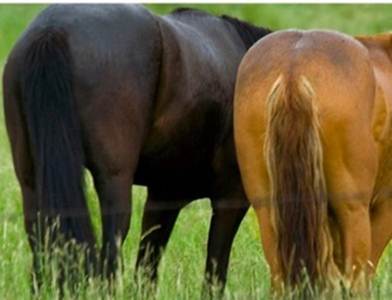
So the next time you are handed a specification or a procedure or process and wonder ‘What horse’s ass came up with this?‘, you may be exactly right.  Imperial Roman army chariots were made just wide enough to accommodate the rear ends of two war horses.

Now, the twist to the story. When you see a Space Shuttle sitting on its launch pad, there are two big booster rockets attached to the sides of the main fuel tank. These are solid rocket boosters, or SRBs.  The SRBs are made by Thiokol at their factory in Utah.

The engineers who designed the SRBs would have preferred to make them a bit fatter, but the SRBs had to be shipped by train from the factory to the launch site. The railroad line from the factory happens to run through a tunnel in the mountains, and the SRBs had to fit through that tunnel.

The tunnel is slightly wider than the railroad track, and the railroad track, as you now know, is about as wide as two horses’ behinds.

oooOOOooo

Just a fabulously interesting account of something we all take for granted, or had done until now! Thank you so much, Su, for sharing that with everyone.

The death of the USA?

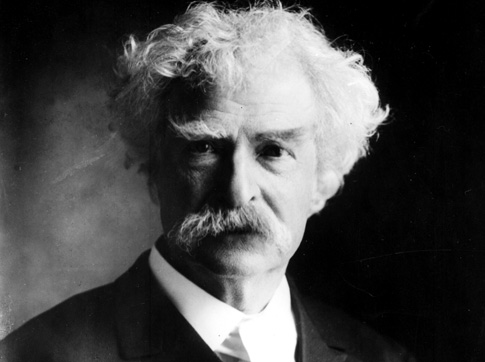
The reports of my death are greatly exaggerated! Mark Twain.

Mark Twain

Origin

Mark Twain quotation after hearing that his obituary had been published in the New York Journal.

Mistaken publications of obituaries aren’t as rare as you might expect. A recent example is of Dave Swarbrick, the British folk/rock violinist, who was killed off mistakenly by the Daily Telegraph in April 1999 when they reported that his visit to hospital in Coventry had resulted in his death. He did at least get the opportunity to read a rather favourable account of his life, not something we all get to do, and to deliver the gag “It’s not the first time I have died in Coventry”.

So why have I opened with this quote from Mark Twain?  Read on and I hope all will be clear.

Integrity is always about getting to the truth!

A little under a week ago I published a couple of posts that proposed that the United States of America is an empire in decline.  The first was What goes up? and the second Might just come down! As a Brit I well know that aspect of British history!

However a recent conversation with a friend of many years back in England, who has also been a shrewd and wise entrepreneur for longer than I care to remember, argued that the evidence for the ‘end of the USA’ could be challenged.

He cited five reasons why he thought the USA would remain, more or less, in its dominant position.  They were:

  1. Spirit of innovation
  2. Relaxed labour laws
  3. The importance of Mexico
  4. The uncertainty of China in terms of the next ’empire’
  5. The likely energy self-sufficiency for the USA in the near-term.

So let me expand on each of those points.

Spirit of innovation

Let me quote from an article in TIME Magazine of the 5th June, 2011,

Innovation is as American as apple pie. It seems to accord with so many elements of our national character — ingenuity, freedom, flexibility, the willingness to question conventional wisdom and defy authority. But politicians are pinning their hopes on innovation for more urgent reasons. America’s future growth will have to come from new industries that create new products and processes. Older industries are under tremendous pressure. Technological change is making factories and offices far more efficient. The rise of low-wage manufacturing in China and low-wage services in India is moving jobs overseas. The only durable strength we have — the only one that can withstand these gale winds — is innovation.

Now there are plenty to argue both ways in terms of the future innovation potential for the USA, as a recent article in The Atlantic does, see American Innovation: It’s the Best of Times and the Worst of Times.  But the spirit of innovation will be a powerful economic potential for the USA for many years to come.

Relaxed labour laws.

Definitely an area that I have little knowledge of except for the subjective notion that compared to many other nations, the laws in the USA are much less of a restraint on economic productivity than elsewhere.

The importance of Mexico.

Importance in the context of providing the USA with a source of cheaper manufacturing facilities.  My English friend thought that this was a significant competitive advantage for the USA.  Now, as it happens, we had a couple staying with us over the week-end of the 6th/7th October.  The husband is a senior manager of Horst Engineering, an American firm based in Guaymas, Sonora County, Mexico.  Here’s a picture from their website,

We are a contract manufacturer of precision machined components and assemblies for aerospace, medical, and other high technology industries. Our core processes include Swiss screw machining, turning, milling, thread rolling, centerless grinding, and assembly. Our extensive supply chain offers our customers a full service logistics solution for managing their precision product requirements. We are ISO9001:2008 and AS9100 registered and proud of our 66 year, three-generation legacy of quality and performance.

I was told that many American and British firms were using Mexico rather than China for a number of reasons.  Not least because Chinese suppliers require full payment before shipment.  Plus that taking into account that financial aspect together with shipping costs and other logistical issues, China wasn’t as ‘cheap’ over all.  Here’s a recent announcement from Rolls Royce,

Rolls-Royce plans new Sonora hub

The burgeoning aerospace industry in Guaymas had its efforts validated recently when the venerable Rolls-Royce chose it as the site for its newest global purchasing office.

Surrounded by several of its aerospace manufacturing suppliers, London-based Rolls-Royce will move into a Guaymas industrial park owned by Tucson-based The Offshore Group to develop a supply hub for commercial jets and military aircraft around the globe.

“Rolls-Royce has very robust booking orders for the next 10 years,” said Joel Reuter, director of communications for Rolls-Royce in North America. “We need to double our production.”

Because a number of Rolls-Royce suppliers already operate in Guaymas, the city was a logical choice, Reuter said.

The uncertainty of China in terms of the next ’empire’

The point made in terms of China taking over ’empire’ status from the USA, as Simon Johnson argues over at Baseline Scenario, is countered by the fact that politically China is an unknown quantity.  Until China endorses some form of democratic process, that unknowingness is not going to disappear.

The likely energy self-sufficiency for the USA in the near-term.

I can’t do better than to ask you to watch this video!  Just 27-minutes long, it is a very interesting review of the energy future of the USA.

As the TED website suggests in terms of why you should listen to Amory Lovins,

Amory Lovins was worried (and writing) about energy long before global warming was making the front — or even back — page of newspapers. Since studying at Harvard and Oxford in the 1960s, he’s written dozens of books, and initiated ambitious projects — cofounding the influential, environment-focused Rocky Mountain Institute; prototyping the ultra-efficient Hypercar — to focus the world’s attention on alternative approaches to energy and transportation.

His critical thinking has driven people around the globe — from world leaders to the average Joe — to think differently about energy and its role in some of our biggest problems: climate change, oil dependency, national security, economic health, and depletion of natural resources.

More on Reinventing Fire may be found here.

So, don’t know about you, but I found those five points deeply convincing.  How about you?  Are the reports of the death of the USA  greatly exaggerated? Do leave a comment.

New life for the ducks!

For every case of cruelty towards animals there is an example of boundless love.

I first saw this story on the popular Grist website, from which I quote,

Watch rescued ducks discover the water for the first time in this heartwarming video

These ducks were rescued from a hoarder, who was keeping over 160 fowl in filthy, overcrowded conditions. The neglected birds had never even seen a pond. But the Woodstock Farm Animal Sanctuary has nursed them back to health, repairing infections, injured feet, and nutritional deficiencies — and now you can watch these newly rehabilitated duckies learn to swim. They’re a bit confused about it at first, but eventually, they take to it like a … well, you know.

Just be warned that the embedded link to that story about the hoarder is a tough read.  Although it does have a happy ending, a very happy ending.

Rescue: Over 130 Neglected Birds from Hoarding Case

Almost a year after our initial efforts to rescue over 160 ducks, geese, turkeys and chickens that were living with a hoarder in appalling conditions, we were finally able to bring them to safety. They are now enjoying sunshine on their feathers, water to swim in, clean bedding, warmth, grass under their feet and room to roam for the very first time.  Initially, we tried working with their owner towards an amicable surrender, pleading with her to consider the quality of life for the birds and used many of our own resources to help provide a cleaner environment for them.  The hoarder’s initial intentions were good and her love for the animals apparent, but she neglected to see how their overcrowding, over-breeding, lack of shelter and space and filthy conditions were hurting them. She also continued to buy chicks and ducklings online and mail ordered to her.

Story continues here and concludes, thus,

We are treating all of their health issues by providing veterinary care, nutritional supplements, quality food and vitamins daily in their water. They are beginning to thrive with their new freedom.  It’s a joy for us to see and we’re so happy to be able to give these animals the lives they deserve. YOUR SUPPORT helps in many cases like this and give them life-long shelter and the care and love they need and so deserve.

Much gratitude to the ASPCA for a grant to help to care for all of these very-deserving animals.

Many of these birds are up for adoption, please contact us if interested.

So back to the ducks!

Probably my favorite part is when the ducks keep running away from the water in what, as one Woodstock worker points out, looks just like a Benny Hill routine. Or maybe it’s the part where the sanctuary workers go for the “tough love uncle” approach to swimming lessons, and just chuck the birds in the pond. Or maybe it’s watching that first duck figure out that the water is amazing. Or maybe it’s watching ALL of them figure out that the water is amazing! What I’m saying is that I could, and will, watch this video all day.