Like thousands of others I have been supporting the efforts to ensure that the US Government did not proceed with the proposal to remove wolves from endangered species protection.
Wolves are the animals that enabled early man to ‘progress’ from hunter-gatherer to the life of farming, and thence to our modern world. As I write elsewhere on Learning from Dogs,
There is no hard evidence about when dogs and man came together but dogs were certainly around when man developed speech and set out from Africa, about 50,000 years ago.
So it utterly breaks my heart to republish a recent post on The Sand County, Jeremy Nathan Marks wonderful and evocative blog. Here it is, republished with Jeremy’s kind permission.
oooOOOooo
I used to believe
As some of you may have heard, late last week the Obama Administration officially delisted gray wolves from endangered species protection. This means that 40 years of wolf recovery efforts have come to an end. Wolves only occupy a tiny fraction of their former habitat and with anti-wolf governments occupying the state houses in the few places that still have wolf populations, states like Montana, Wyoming, Idaho and Wisconsin, it is hard to imagine that wolves have a bright future in the lower 48 states.
I am deeply, profoundly saddened by this decision. I have learned over time how wolves -like so many other species- just don’t register on the list of national concerns and priorities. A great many people oppose the delisting, in fact one gets the impression that the effort to remove these protections has consistently been guided by political pressures and a political agenda and not by a true commitment to a sustainable and enduring wolf recovery. I know that I am hardly alone in registering my disappointment and voice of protest.
I cannot let this sad milestone pass without acknowledging it here on this blog. If you do not like wolves -if you feel hatred or resentment towards them or are pleased at what has recently transpired, I respectfully request that you refrain from sharing your feelings here. I seldom offer any “directives” like this, but if you are a reader of this blog then you know how strongly I feel about this issue. I am sharing these thoughts because I want to not only draw attention to what has happened, but also because I feel the need to mourn it. I tremble at the thought of a United States -or a North America- without wolves. Defenders of the administration and the Department of Interior’s position will say that the United States Government is committed to protecting wolves and ensuring their future but I am afraid I see things quite differently. This is not a partisan political issue: Democratic and Republican administrations alike are behind this stance towards wolves.
I would like to share a poem which I feel is very incomplete and does not begin to adequately draw upon the well of feelings, concerns and thoughts I have on this subject. But I would be remiss I think if I did not mark what has just happened.
I used to believe
I used to believe that one day
I might live carefully, cooperatively
beside the wolves
I would go to them but respect their
space; wait for their return and tend
my garden with local mind, open my windows
When they moved off I would wait
and make a space; I would lock my guns
in bolted cabinets to honor and not to intrude
I used to believe that there was a chance
of this because there were others who saw
in wolves the same uncertainties and histories
And we, a new community, would redraw
the map, eradicate “the frontier” and perhaps
expunge that word altogether from our plans
It is ironic really how a word, a concept,
one invisible line can have more tendrils
and seeds than a weed, more pups than a pack.
–Jeremy Nathan Marks
oooOOOooo
The Center for Biological Diversity has been incredibly active in fighting for the continued protection of the wolf. The Press Release about the loss of protection is here. Do read it and do everything you can to help. PLEASE!
Let me share some of my special feelings about wolves.
Luna, the wild wolf, with Tim and Tim’s dog; taken in 2006.
Then in February this year, I wrote about Oregon and the wolf. The following picture was in that Post.
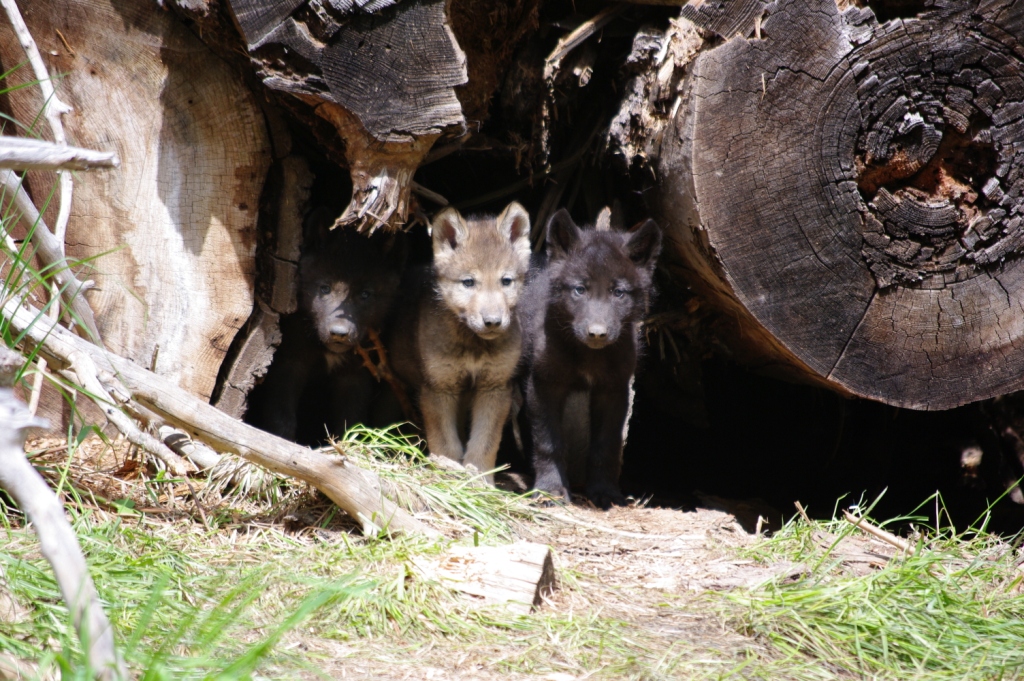
These wolf pups born to the Wenaha Pack in 2012 helped get recovery back on track. But their future remains tenuous (photo courtesy ODFW)
Please now listen to this:
So you can see that I have written frequently about wolves; indeed just a few days ago did so and included this photograph.
Wolf greets man.
Now just look at those eyes of the Grey Wolf above and compare them to the eyes of the German Shepherd dog below and tell me that wolves aren’t as close to man as dogs.
Finally, feel free to share this post as far and wide as you can. Learning from Dogs is published under a Creative Commons License. This link covers how to share my material.
Please do something to help these ancient animals who, more than any other creature, helped put mankind ‘on the map’.
Reflections on the launch of George Monbiot’s new book Feral.
In my recent post, Dealing with Madness, where I referred to the launch of this new book there were comments from Jules that included him saying:
George is appearing at the Hay Festival to sell his book and do a talk this Saturday and it is only a few miles away so may be I will pop in and buy the book.
all the best
Jules
Jules, who has his own blog Bollocks2012, did go across to the Hay Festival and most generously agreed to write up his visit as a guest post.
So I am delighted to offer you Jules’ report today.
oooOOOooo
George at Hay
by Jules Bywater-Lees, 1st June, 2013
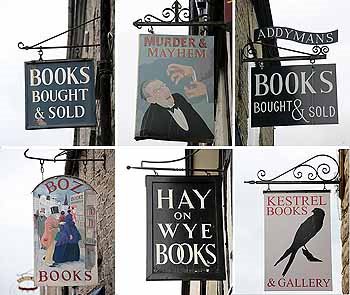
The small Welsh border town of Hay-on-Wye in Powys is just a few miles from where I live. It went from a little backwater with a failing rural economy to become, in the words of Bill Clinton, ‘the Woodstock of the mind’. All through the vision of eccentrics!
Hay-on-Wye
The town of Hay-on-Wye is pretty. It is set in the most beautiful Welsh countryside and even has its own tumble-down castle. However, back in the 70’s, like so many other small market centres, the town was in decline. That was until an eccentric bibliophile moved into the castle. The name of that eccentric was Richard Booth.
Richard Booth established a second-hand bookshop in town and, as a publicity stunt, on 1st April 1977 proclaimed himself King of Hay and Head of this new Independent Kingdom! Hay-on-Wye subsequently became a magnet for the second-hand book lover and trader, and now every other shop is a bookshop giving the town a healthy economy serving the many visitors.
Books, books and more books!
The Hay Literary Festival was devised by Norman and Peter Florence in 1988 and had become sufficiently established internationally for the highlight of Bill Clinton being a speaking guest in 2001. It is rather a corporate festival now attracting big names but the town has developed fringe events, that are both cheaper and more fun.
The reason this back story is relevant is that Hay-on-Wye has always been a gateway town between the urban English and rural Welsh. It is only a few hours drive from London and the nearest ‘wilderness’ for day trippers and holiday makers. A few miles further west and the uplands, or mountains as we call them (few are higher than 1000 feet), are considered by most people to be wild.
George Monbiot lives another 60 miles away to the West on the coast in what is considered deepest Wales where the hills have a barren beauty and the locals speak Britain’s ancient first language. But it is not all that it seems; the moors and hilltops are not natural they are a product of over-grazing. They are the degraded shells of a natural ecosystem. A shadowland; a ghostly memory of a former landscape.
View from Hay Bluff, just a few miles from Hay-on-Wye, and a powerful example of a bald hill.
Back to this year’s Festival. I coughed up the £8 ticket price and went with friends to have a day of culture. Those friends who came to hear George Monbiot speak were sceptical; for them the hills are beautiful and it is the denuded ‘wildness’ and prancing Spring lambs that gives the landscape so much value.
George makes frequent appearances on television and is very much a leading commentator on the environment and climate change, and his Guardian articles, see postscript, cover his views well so I wasn’t expecting any surprises. If anything I felt sceptical! You see while in principle I agreed with Monbiot’s message of rewilding and supportive of his views on the wide range of subjects he covers, the concept of rewilding appeared to be woolly and vague and lacking the practicalities of how this vision would be achieved. I even prepared a question for the session after his presentation.
Britain is a little country and our national parks are not the same as those elsewhere in the world, a better description would be regulated areas of private ownership. There are a few parks in Wales notable Snowdonia, which amounts to 2,200 square Kilometres (850 square miles), Brecon Beacons, 1,300 Km2 (502 SqM) and larger ones in Scotland such as the Cairngorms of 4,500 Km2 (1,737 SqM). But all of these are tiny compared to Yellowstone National Park with its 9,000 km2 (3,475 SqM and about 100 wolves!). Is it possible to have viable populations of wild animals in such a small area?
My concern is that Britain actually does have a wild landscape of both international importance and scale, with mega fauna, diversity and rare ecosystems that put it on par with the rainforest. It is truly huge with a conservative estimate of 50 to 100 thousand Km2 in area (19,305 to 38,610 square miles) but it is hidden: It is the 31,000 Km (19,260 miles) of coastline and the waters that extend from it. Surely we should be concentrating on its protection rather than allowing the hill tops to grow pretty common native woodland that could support a few hundred wolves, Lynx and beavers at best?
George live, as it were, was a lot more engaging than his appearance on telly and his spoken words a lot more passionate than his written words. I was surprised, and interested. Like all good story tellers he started off with a mystery. Why do British native trees appear to thrive when they are hacked about into hedges, why do blackthorn trees have thorns so tough and sharp they spike industrial leather gloves and why does the yew and holly have roots so extensive they could hold up a tree twice as big? The answer: Elephants!
Much of what he spoke about is found in his last three Guardian articles so I will spare you the detail but what struck me was his passion. Initially the cynic within wondered if George was just another celebrity seeking a cause. But such thoughts were dispelled as soon as George started to speak. What was communicated resonated strongly with this idealistic former self who was sufficiently passionate about nature enough to have studied zoology and yearned a human desire for wilderness and, indeed, danger but whose life has otherwise been engaged in more civilised necessities.
Such was the passion expressed by Mr. Monbiot that even I could overlook the practicalities and details; they can be sorted out when they need to be. My friends were impressed and even they were able to see that letting the hills go wild or a least a few of them would enhance their appreciation of our countryside.
But I didn’t buy a signed copy of the book! At £20 for the hardback version I thought it best to order one from my local library or at least wait for the paperback edition on Amazon.
Until modern humans arrived, every continent except Antarctica possessed a megafauna. In the Americas, alongside mastodons, mammoths, four-tusked and spiral-tusked elephants, there was a beaver the size of a black bear: eight feet from nose to tail. There were giant bison weighing two tonnes, which carried horns seven feet across.
Even before you start reading the devastating State of Nature report, published today, you get an inkling of where the problem lies. It’s illustrated in the opening pages with two dramatic photographs of upland Britain (p6). They are supposed to represent the natural glories we’re losing. In neither of them (with the exception of some distant specks of scrub and leylandii in the second) is there a tree to be seen. The many square miles they cover contain nothing but grass and dead bracken. They could scarcely provide a better illustration of our uncanny ability to miss the big picture.
The dam is beginning to crack, faster than I would have believed possible. Britain, one of the world’s most zoophobic nations, is at last considering the return of some of its extinct and charismatic mammal species.
While wolves, lynx, bears, bison, moose, boar and beavers have been spreading across the continent for decades, into countries as developed and populous as ours, and while they have been widely welcomed in those places, here we have responded to this prospect with unjustified horror.
As Edinburgh Zoo’s panda freakshow continues to captivate the witless and the infantile, a real Scottish animal has been allowed to die. Under the noses of Scottish Natural Heritage, which likes to be known as the nation’s leading conservation body, the Scottish wildcat has all but been extinguished from the Highlands. The importance of this news may be deemed worthy of a mere footnote on the schedule of important issues with which Scotland is grappling but it ought to rank much higher. For the wildcat’s demise seems to be part of the neutering and emasculating of our wildest places. That which was previously held to be a quintessential part of what Scotland was originally meant to look like and smell like and sound like is now, it seems, unimportant.
I never imagined being 52. As I grew up catching lizards and newts, rummaging through hedges to find birds’ nests, or prodding flattened hedgehogs with my scuffed Clarks lace-ups, the world was ripe with natural riches. Every scrap of wasteland revealed yet more gems: tadpoles, fox cubs and a confetti of butterflies. And when at the weekends the family Ford Anglia trundled off to the countryside, I strode in shorts into a wildlife nirvana, a utopia, and I explored what I imagined would be a never-ending world of beautiful and exotic creatures.
oooOOOooo
Finally, back to me and all I want to add is that the blogsite for more information on the book Feralis here.
So how to close? Well having given this post the title of a well-known saying, let me close with one perhaps less familiar but, boy oh boy, so relevant.
“When the oak is felled the whole forest echoes with it fall, but a hundred acorns
What an expanse of learning is out there in this modern interconnected world!
I try to limit my following to those organisations and writers who offer me the opportunity of learning. Whether something I was previously unaware of or a sight of the world from an unfamiliar perspective, it’s a rare day when something doesn’t ‘pass my screen’ that offers an ‘Ah, ha’ moment.
Such as the following essay by Dave Nussbaum that recently appeared on the Big Think website. Cheekily, I asked permission to republish and promptly and generously both Dave and Daniel Honan, managing editor of Big Think, said yes. Thank you, gentlemen.
A quick web search finds that Dave Nussbaum is Adjunct Assistant Professor of Behavioral Science, University of Chicago Booth School of Business. (I couldn’t avoid wondering if the learned Professor requires extra-large business cards! Sorry for that!) To fill in a little more about the Professor, one can easily read that:
I am currently an Adjunct Assistant Professor of Behavioral Science at the University of Chicago Booth School of Business. I received my PhD in Social Psychology from Stanford in 2008, working primarily with Claude Steele and Carol Dweck. I recently completed a SSHRC Post-Doctoral Fellowship at the University of Waterloo with Steve Spencer. My research is primarily focused on how people manage and defend their self-image in the face of threats, and how this affects their beliefs and behavior. I also explore how social contexts and psychological processes can either exacerbate threats to self-image or attenuate them. I have found that defensively managing self-image threats can often lead to negative consequences, including academic disidentification, missed learning opportunities, the avoidance of important medical tests, and persistence in failing investments. I believe that by identifying contexts and processes that attenuate threat, individuals and organizations can employ strategies to prevent these maladaptive outcomes.
So moving on past my quip about the length of Professor Nussbaum’s title, the summary above shows that this is one smart cookie! Just go back and reread “My research is primarily focused on how people manage and defend their self-image in the face of threats, and how this affects their beliefs and behavior.” Then reflect on the range and scale of ‘threats’ facing millions of us across the world. So research into “how social contexts and psychological processes can either exacerbate threats to self-image or attenuate them“, seems particularly appropriate for these times.
OK, without further ramblings from yours truly, here is that essay.
oooOOOooo
Odysseus Nudged: How Limiting Our Choices Can Give Us More Freedom
According to legend, the Sirens were beautiful women whose voices were so alluring that when sailors heard their song they could not resist approaching and were drowned on the rocky shores of the island where the Sirens sang. No sailor had heard their song and lived until Odysseus, who, on the counsel of the goddess Circe, had his crew tie him to the mast of his ship. When he heard the Sirens’ song he begged to be released, but his crew, their ears plugged with beeswax, would not unbind him and saved him from his own desires. Odysseus was lucky – he knew that he would be unable to resist the Sirens and had himself bound – but people often have difficulty foreseeing their weakness from a distance. Sometimes they need help.
I love watching my not-quite-two-year-old son learn about the world from his mistakes. I look on with sympathy at his falls and bumps and spills and I try to restrain myself from interceding. But when he’s about to tumble down a flight of stairs I step in. It is difficult to balance preserving his freedom to explore and make his own mistakes with the desire to keep him safe. There’s a lot to be said for giving kids autonomy and letting them learn from experience, but sometimes you have to behave paternalistically and tie them to the mast (or at least install safety gates).
When you start treating grown men and women like you’re their father, though, the charge of paternalism becomes a more serious one. There may be cases in which a heavy-handed approach is necessary (particularly when people’s actions harm others), but we should be careful about using it. A more circumspect approach is libertarian paternalism, described by Richard Thaler and Cass Sunstein in Nudge (and re-articulated more recently by Sunstein in his Simpler) as a way of influencing people to make decisions that they themselves would consider beneficial, without restricting their freedom.
Here, we are not tying Odysseus to the mast – the more appropriate analogy would be to the beeswax that Odysseus had his sailors put in their ears. The wax prevented the sailors from hearing the Sirens’ song and saved them from being lured to their deaths, but it also left them free to remove the wax if that is what they wanted to do. This sort of intervention is an acknowledgment that the sailors’ freedom is important, but also that people are not always perfectly rational. As Carnegie Mellon economist (and psychologist) George Loewenstein recently explained to me, “When people have problems exercising self-control, restricting their choices can, in some cases, leave them more freedom to choose.”
On its face, Loewenstein’s claim may seem paradoxical – isn’t a person most free when presented with all her options and allowed to choose among them? But as the mythical Sirens make clear, there are some options that we are not truly free to resist. Without beeswax in their ears Odysseus’ crew would have been doomed; the wax gave them the freedom to choose.
Take the recent attempt by New York City Mayor, Michael Bloomberg, to forbid stores from displaying cigarettes to their customers. Just like the beeswax did not prevent the sailors’ from choosing to hear the Sirens’ song, hiding cigarettes from view doesn’t prevent people from buying them. But, as Loewenstein explains, it makes it easier for those who may be trying to quit to avoid being lured back in.
When we pass laws that forbid the sale of cigarettes to minors we are being paternalistic. We are tying Odysseus to the mast, whether he likes it or not. But when we ban cigarette advertising that targets children – as the FTC did when it banned Joe Camel ads – we’re not tying anyone down. We are merely acknowledging that children are vulnerable to influences that may lead them to act contrary to their own interests and that they may not be in a position to resist these influences. Banning the display of cigarettes in stores is merely acknowledging that children aren’t the only ones who are vulnerable. The cigarettes, like the sirens, draw us in against our will. Putting them out of sight is like putting wax in our ears – we can easily still give in to temptation if we choose to, but we’re less at its mercy.
‘Twas brillig, and the slithy toves
Did gyre and gimble in the wabe;
All mimsy were the borogoves,
And the mome raths outgrabe. — Lewis Carroll, Jabberwocky.
To begin to understand nonsense it may help first if one has a good grasp of sense, for comparison between the two.
General education is obviously useful in this regard; after which perhaps the most important trait is critical thinking. One suggestion for a book that gives a good grounding in critical thinking is ‘What’s the Worst That Could Happen’, by Greg Craven.
Craving Understanding
Nonsense can be interpreted as communication that lacks any coherent meaning; it can be considered synonymous with absurdity and the ridiculous. Artists in many realms have long employed nonsense (though ironically, tragically, many suffer unemployment while doing so). Poets, novelists, lyricists and copywriters often seek refuge in it; and there are entire works that depend upon it as a foundation.
Swans Reflecting Elephants — Salvador Dali
When contemplating the antithesis of sense, one promising candidate for non-sense can be found lurking within surrealism.
And then there’s ‘common sense’, which is a thing to which people often appeal, and yet its use all too often can turn out to be oxymoronic. One example of ‘common sense’ that results in reality inversion is the persistent case of King Cnut.
In the philosophies of language and science, nonsense is distinguished from sense or meaningfulness. An understanding of nonsense is a necessary field of study in cryptography, as it is essential in separating a signal from noise. But attempts to come up with a coherent and consistent method of distinguishing sense from nonsense are troublesome at best; such may be a slippery chimaera, one that can even perhaps be spied on occasion chewing upon its own tail.
When all else is said and done, phlyarology can be a subject of crucial importance — especially when it comes to considering peak everything (to name but a few paltry aspects that, it would seem, appear to be irrelevant to ‘normal’ life).
Which is, of course, why we’re all here. Assuming, of course, that we are…
“Death is not an event in life: we do not live to experience death. If we take eternity to mean not infinite temporal duration but timelessness, then eternal life belongs to those who live in the present. Our life has no end in the way in which our visual field has no limits.” — Ludwig Wittgenstein, Tractatus, 6.431
I do not believe it is possible to ever fully grok nonsense; and so phlyarology is a never-ending pursuit. But I do believe that this doom can be a thoroughly rewarding and worthwhile one.
Or, to put it another way, stupid nonsense is a serious matter!
Any questions to be directed to Pendantry!
oooOOOooo
So how to close off a post about nonsense?
Well being a Brit sufficiently old to remember The Two Ronnies, a YouTube find that so perfectly shows the skill and professionalism of Ronnie Barker now follows.
Starting with Monday’s video of Carl Sagan reminding us all that Planet Earth is just a grain of sand in the vast cosmos right through to yesterday’s Dealing with madness post, much of the week has been reminding us all of one very fundamental truth. No better expressed than in a comment from Patrice Ayme [my emphasis]:
… there is no healthy man without a healthy world.
Regulars will have noted the high levels of debate this week. Thank you all for those comments.
I have also received a couple of emails with feedback and comments, sent to me on a personal basis. One of those emails had such a powerful message that I begged for permission to publish it on Learning from Dogs. I was asked to keep the author’s identity private but, trust me, it is from someone I know well who subscribes to ideas of integrity and honesty in spades.
The author also strongly recommended publishing in association with his personal essay an extract from Chris Hedges’ book “Death of the Liberal Class”. That extract follows straight on from the essay.
oooOOOooo
Reflections from a Vietnam Combat Veteran
War is an unnatural dichotomy. Both sides are morally and materially diminished. A future World War would most probably finish us as the self-appointed predominant intelligent species on planet earth. It seems worth noting that German industrialists coordinated fundamentalist propaganda to foster the bigotry, hatred and fear which fueled their profitable war engines prior to World War II.
United States commercial media today reflects a financially dominated military-industrial culture with liberty and justice for sale. The results are divisive and lead to both a declared international war against nebulous assailants we have been taught to dislike and an internal political war that has polarized our once fair nation.
We’ve stopped investing in the future in response to radicals who want to destroy government, human rights and what remains of the earth’s surface resources. There is an emerging police state mentality on display with a variety of candidates for local dictator.
It’s well past time for moderate republicans to ignore their uber-conservative brethren. It’s well past time for moderate democrats to renounce their corporate ties. This will only happen when our financial and political leaders awaken to the reality of what is in the best long-term interests for all life on this planet rather than our present unsustainable global economy.
To complicate the problem, our planet is under attack by a swarm of vociferous human locusts seeking profit without regard to the consequences. Meanwhile, despite human denial, the universe continues to emerge. Species which do not adapt to change do not survive.
It’s important to remember that we’re in the midst of a battle that’s as old as the conscious awareness of the human species. We generally have very little idea of the inclusive nature of our being; let alone the nature of our collective being as a species. We have as yet to learn how to surrender to reality. The battle is with our own species.
Committing collective suicide for quarterly profit is not a sane way of life. What we’ve created is a neo-feudal global economy without any foundation that feeds on an empire of consumption. When we combine a neo-feudal economy with neo-fascist politics we arrive at a moral and biological dead end.
The coup d’état of the current Corporate State is the Citizen’s United ruling that makes money a form of free speech. Money has no DNA. In case anyone missed how the “occupy” movement was crushed, there’s no question that we’re rapidly criminalizing all forms of dissent. These actions are being taking under the 1917 Espionage Act and related state secrets acts. No discernment of moral value is considered and no public hearings are conducted. People who speak up are locked up. We’ve become a fearful and secretive population.
Our self-appointed elite power structure is completely irrational in its belief that human reason is our ultimate power and money is its servant. We are made of the stuff of the stars. At best, we’re in our adolescence as a species. We think we know the answers rather than admitting our ignorance. What little we know is vastly less than what we have as yet to learn. We are often unaware of being unaware.
The lives we presently lead can not be sustained in ways that we have become accustomed to; ways we take for granted. What’s going to need to change? The simple answer is everything. Our species has systemically corrupted the small part of the cosmos which sustains our being. Nature has no sense of humor, no patience for human squabbles and no financial interest.
Fortunately, we already know what we need to do to adapt. We know how nature works through the wisdom of our earth sciences. The answer is simple. Love the earth. Love life. Share compassion. Educate, naturally energize, and transform. The resulting process of change will help re-establish a realistic world economic foundation.
The following selection is taken from the first chapter of the book, published in October 201 by Nation Books.
In a traditional democracy, the liberal class functions as a safety valve. It makes piecemeal and incremental reform possible. It offers hope for change and proposes gradual steps toward greater equality. It endows the state and the mechanisms of power with virtue. It also serves as an attack dog that discredits radical social movements, making the liberal class a useful component within the power elite.
But the assault by the corporate state on the democratic state has claimed the liberal class as one of its victims. Corporate power forgot that the liberal class, when it functions, gives legitimacy to the power elite. And reducing the liberal class to courtiers or mandarins, who have nothing to offer but empty rhetoric, shuts off this safety valve and forces discontent to find other outlets that often end in violence. The inability of the liberal class to acknowledge that corporations have wrested power from the hands of citizens, that the Constitution and its guarantees of personal liberty have become irrelevant, and that the phrase consent of the governed is meaningless, has left it speaking and acting in ways that no longer correspond to reality. It has lent its voice to hollow acts of political theater, and the pretense that democratic debate and choice continue to exist.
The liberal class refuses to recognize the obvious because it does not want to lose its comfortable and often well-paid perch. Churches and universities—in elite schools such as Princeton, professors can earn $180,000 a year—enjoy tax-exempt status as long as they refrain from overt political critiques. Labor leaders make lavish salaries and are considered junior partners within corporate capitalism as long as they do not speak in the language of class struggle. Politicians, like generals, are loyal to the demands of the corporate state in power and retire to become millionaires as lobbyists or corporate managers. Artists who use their talents to foster the myths and illusions that bombard our society live comfortably in the Hollywood Hills.
The media, the church, the university, the Democratic Party, the arts, and labor unions—the pillars of the liberal class—have been bought off with corporate money and promises of scraps tossed to them by the narrow circles of power. Journalists, who prize access to the powerful more than they prize truth, report lies and propaganda to propel us into a war in Iraq. Many of these same journalists assured us it was prudent to entrust our life savings to a financial system run by speculators and thieves. Those life savings were gutted. The media, catering to corporate advertisers and sponsors, at the same time renders invisible whole sections of the population whose misery, poverty, and grievances should be the principal focus of journalism.
In the name of tolerance—a word the Rev. Dr. Martin Luther King Jr., never used—the liberal church and the synagogue refuse to denounce Christian heretics who acculturate the Christian religion with the worst aspects of consumerism, nationalism, greed, imperial hubris, violence, and bigotry. These institutions accept globalization and unfettered capitalism as natural law. Liberal religious institutions, which should concern themselves with justice, embrace a cloying personal piety expressed in a how-is-it-with-me kind of spirituality and small, self-righteous acts of publicly conspicuous charity. Years spent in seminary or rabbinical schools, years devoted to the study of ethics, justice, and morality, prove useless when it comes time to stand up to corporate forces that usurp religious and moral language for financial and political gain.
Universities no longer train students to think critically, to examine and critique systems of power and cultural and political assumptions, to ask the broad questions of meaning and morality once sustained by the humanities. These institutions have transformed themselves into vocational schools. They have become breeding grounds for systems managers trained to serve the corporate state. In a Faustian bargain with corporate power, many of these universities have swelled their endowments and the budgets of many of their departments with billions in corporate and government dollars. College presidents, paid enormous salaries as if they were the heads of corporations, are judged almost solely on their ability to raise money. In return, these universities, like the media and religious institutions, not only remain silent about corporate power but also condemn as “political” all within their walls who question corporate malfeasance and the excesses of unfettered capitalism.
Unions, organizations formerly steeped in the doctrine of class struggle and filled with members who sought broad social and political rights for the working class, have been transformed into domesticated negotiators with the capitalist class. Cars rolling off the Ford plants in Michigan were said to be made by UAW Ford. But where unions still exist, they have been reduced to simple bartering tools, if that. The social demands of unions in the early twentieth century that gave the working class weekends off, the right to strike, the eight-hour workday, and Social Security, have been abandoned. Universities, especially in political science and economics departments, parrot the discredited ideology of unregulated capitalism and have no new ideas. The arts, just as hungry as the media or the academy for corporate money and sponsorship, refuse to address the social and economic disparities that create suffering for tens of millions of citizens. Commercial artists peddle the mythical narrative, one propagated by corporations, self-help gurus, Oprah and the Christian Right, that if we dig deep enough within ourselves, focus on happiness, find our inner strength, or believe in miracles, we can have everything we desire.
Such magical thinking, a staple of the entertainment industry, blinds citizens to corporate structures that have made it impossible for families to lift themselves out of poverty or live with dignity. But perhaps the worst offender within the liberal class is the Democratic Party.
The party consciously sold out the working class for corporate money. Bill Clinton, who argued that labor had nowhere else to go, in 1994 passed the North American Free Trade Agreement (NAFTA), which betrayed the working class. He went on to destroy welfare and in 1999 ripped down the firewalls between commercial and investment banks to turn the banking system over to speculators. Barack Obama, who raised more than $600 million to run for president, most of it from corporations, has served corporate interests as assiduously as his party. He has continued the looting of the U.S. Treasury by corporations, refused to help the millions of Americans who have lost their homes because of bank repossessions or foreclosures, and has failed to address the misery of our permanent class of unemployed.
Populations will endure the repression of tyrants, as long as these rulers continue to manage and wield power effectively. But human history has demonstrated that once those in positions of power become redundant and impotent, yet insist on retaining the trappings and privileges of power, their subject populations will brutally discard them. Such a fate awaits the liberal class, which insists on clinging to its positions of privilege while at the same time refusing to play its traditional role within the democratic state. The liberal class has become a useless and despised appendage of corporate power. And as corporate power pollutes and poisons the ecosystem and propels us into a world where there will be only masters and serfs, the liberal class, which serves no purpose in the new configuration, is being abandoned and discarded. The death of the liberal class means there is no check to a corporate apparatus designed to enrich a tiny elite and plunder the nation. An ineffectual liberal class means there is no hope, however remote, of a correction or a reversal. It ensures that the frustration and anger among the working and middle classes will find expression outside the confines of democratic institutions and the civilities of a liberal democracy.
The second of two essays reflecting the ‘New World Order’.
Yesterday, I introduced the first essay from Patrice Ayme. Today, the second essay is a complete ‘copy and paste‘ as it appeared on TomDispatch. The importance of such writers as Patrice Ayme, the authors that are published on TomDispatch, and many more besides, is beyond measure. As the old saying goes, “The only thing required for evil to triumph is for good men to do nothing“.
So without further ado, here is that TomDispatch essay.
oooOOOooo
Tomgram: Mattea Kramer and Jo Comerford, Congress Tweeted While America Burned
[Note for TomDispatch Readers:Those of you who were struck by the recent TD piece “You Are a Guinea Pig: How Americans Became Exposed to Biohazards in the Greatest Uncontrolled Experiment Ever Launched” shouldn’t miss last Sunday’s fascinating Bill Moyers interview with its authors, David Rosner and Gerald Markowitz, who have written the new book Lead Wars: The Politics of Science and the Fate of America’s Children. Tom]
Three days after the terrorist attacks of September 11, 2001, Congress passed a joint resolution called an Authorization for Use of Military Force (AUMF). You might remember it. In layman’s terms, it was a carte blanche for the Bush administration to go to war wherever it wanted, whenever it wanted, however it wanted, under the guise of fighting anyone who “planned, authorized, committed, or aided” the September 11th attackers, or “harbored” any terrorists or terror organizations connected to the attacks. That document, more than any other, launched the Global War on Terror or GWOT. President Obama long ago ditched the name and acronym, but he kept the global war.
And don’t expect that to change. On Thursday, Assistant Secretary of Defense Michael Sheehan went before Congress and insisted that the Defense Department couldn’t be more “comfortable” with AUMF, as it was written, and that not a word should be altered or amended for changed circumstances. The Pentagon was so comfortable, in fact, that its officials foresee using that resolution to continue its drone-powered “dirty wars” in the Greater Middle East and Africa for years to come. “In my judgment,” Sheehan said, “this is going to go on for quite a while, yes, beyond the second term of the president… I think it’s at least 10 to 20 years.”
So there you have it. The military got its blank check for overseas wars, for sending out the drones and the special operations forces, and has no plans to change that before 2023, if not 2033. In other words, for at least the next decade, the GWOT, whatever label it’s given, will continue to be the central fixture of American foreign policy. It’s not going anywhere. Today, TomDispatch regulars Mattea Kramer and Jo Comerford of the invaluable National Priorities Project look at the “homeland” a decade into the future, as the effects of Congress’s austerity policies sink in. Put the two together and what a grim scene you have: a country investing in war in distant lands as it crumbles here at home. Andy Kroll
The streets are so much darker now, since money for streetlights is rarely available to municipal governments. The national parks began closing down years ago. Some are already being subdivided and sold to the highest bidder. Reports on bridges crumbling or even collapsing are commonplace. The air in city after city hangs brown and heavy (and rates of childhood asthma and other lung diseases have shot up), because funding that would allow the enforcement of clean air standards by the Environmental Protection Agency is a distant memory. Public education has been cut to the bone, making good schools a luxury and, according to the Department of Education, two of every five students won’t graduate from high school.
It’s 2023 — and this is America 10 years after the first across-the-board federal budget cuts known as sequestration went into effect. They went on for a decade, making no exception for effective programs vital to America’s economic health that were already underfunded, like job training and infrastructure repairs. It wasn’t supposed to be this way.
Traveling back in time to 2013 — at the moment the sequester cuts began — no one knew what their impact would be, although nearly everyone across the political spectrum agreed that it would be bad. As it happened, the first signs of the unraveling which would, a decade later, leave the United States a third-world country, could be detected surprisingly quickly, only three months after the cuts began. In that brief time, a few government agencies, like the Federal Aviation Administration (FAA), after an uproar over flight delays, requested — and won — special relief. Naturally, the Department of Defense, with a mere $568 billion to burn in its 2013 budget, also joined this elite list. On the other hand, critical spending for education, environmental protection, and scientific research was not spared, and in many communities the effect was felt remarkably soon.
Robust public investment had been a key to U.S. prosperity in the previous century. It was then considered a basic part of the social contract as well as of Economics 101. As just about everyone knew in those days, citizens paid taxes to fund worthy initiatives that the private sector wouldn’t adequately or efficiently supply. Roadways and scientific research were examples. In the post-World War II years, the country invested great sums of money in its interstate highways and what were widely considered the best education systems in the world, while research in well-funded government labs led to inventions like the Internet. The resulting world-class infrastructure, educated workforce, and technological revolution fed a robust private sector.
Austerity Fever
In the early years of the twenty-first century, however, a set of manufactured arguments for “austerity,” which had been gaining traction for decades, captured the national imagination. In 2011-2012, a Congress that seemed capable of doing little else passed trillions of dollars of what was then called “deficit reduction.” Sequestration was a strange and special case of this particular disease. These across-the-board cuts, instituted in August 2011 and set to kick in on January 2, 2013, were meant to be a storm cloud hanging over Congress. Sequestration was never intended to take effect, but only to force lawmakers to listen to reason — to craft a less terrible plan to reduce deficits by a wholly arbitrary $1.2 trillion over 10 years. As is now common knowledge, they didn’t come to their senses and sequestration did go into effect. Then, although Congress could have cancelled the cuts at any moment, the country never turned back.
It wasn’t that cutting federal spending at those levels would necessarily have been devastating in 2013, though in an already weakened economy any cutbacks would have hurt. Rather, sequestration proved particularly corrosive from the start because all types of public spending — from grants for renewable energy research and disadvantaged public schools to HIV testing — were to be gutted equally, as if all of it were just fat to be trimmed. Even monitoring systems for possible natural disasters like river flooding or an imminent volcanic eruption began to be shut down. Over time the cuts would be vast: $85 billion in the first year and $110 billion in each year after that, for more than $1 trillion in cuts over a decade on top of other reductions already in place.
Once lawmakers wrote sequestration into law they had more than a year to wise up. Yet they did nothing to draft an alternate plan and didn’t even start pointing out the havoc-to-come until just weeks before the deadline. Then they gave themselves a couple more months — until March 1, 2013 — to work out a deal, which they didn’t. All this is, of course, ancient history, but even a decade later, the record of folly is worth reviewing.
If you remember, they tweeted while Rome burned. Speaker of the House John Boehner, for instance, sent out dozens of tweets to say Democrats were responsible: “The president proposed sequester, had 18 mo. to prioritize cuts, and did nothing,” he typically wrote, while he no less typically did nothing. For his part, Senate Majority Leader Harry Reid tweeted back: “It’s not too late to avert the damaging #sequester cuts, for which an overwhelming majority of Republicans voted.” And that became the pattern for a decade of American political gridlock, still not broken today.
Destruction Begins
March 1st came and went, so the budgetary axe began to fall.
At first, it didn’t seem so bad. Yes, the cuts weren’t quite as across the board as expected. The meat industry, for example, protested because health inspector furloughs would slow its production lines, so Congress patched the problem and spared those inspectors. But meat production aside, there was a sense that the cuts might not be so bad after all.
They were to be doled out based on a formula for meeting the arbitrary target of $85 billion in reductions in 2013, and no one knew precisely what would happen to any given program. In April, more than a month after the cuts had begun, the White House issued the president’s budget proposal for the following year, an annual milestone that typically included detailed information about federal spending in the current year. But across thousands of pages of documents and tables, the new budget ignored sequestration, and so reported meaningless 2013 numbers, because even the White House couldn’t say exactly what impact these cuts would have on programs and public investment across the country.
As it happened, they didn’t have to wait long to find out. The first ripples of impact began to spread quickly indeed. Losing some government funding, cancer clinics in New Mexico and Connecticut turned away patients. In Kentucky, Oregon, and Montana, shelters for victims of domestic violence cut services. In New York, Maryland, and Alabama, public defenders were furloughed, limiting access to justice for low-income people. In Illinois and Minnesota, public school teachers were laid off. In Florida, Michigan, and Mississippi, Head Start shortened the school year, while in Kansas and Indiana, some low-income children simply lost access to the program entirely. In Alaska, a substance abuse clinic shut down. Across the country, Meals on Wheels cut four million meals for seniors in need.
Only when the FAA imposed furloughs on its air traffic controllers did public irritation threaten to boil over. Long lines and airport delays ensued, and people were angry. And not just any people — people who had access to members of Congress. In a Washington that has gridlocked the most routine business, lawmakers moved at a breakneck pace, taking just five days to pass special legislation to solve the problem. To avoid furloughs and shorten waits for airline passengers, they allowed the FAA to spend funds that had been intended for long-term airport repairs and improvements.
Flights would leave on time — at least until runways cracked and crumbled. (You undoubtedly remember the scandal of 2019 at Cincinnati International Airport, when a bright young candidate for Senate met her demise in a tragic landing mishap.)
And then, of course, the Pentagon asked for an exemption, too. We’re talking about the military behemoth of planet Earth, which in 2013 accounted for 40% of military spending globally, its outlays exceeding the next 10 largest militaries combined. It, too wanted a special exemption for some of its share of the cutbacks.
Meat inspectors, the FAA, and the Department of Defense enjoyed special treatment, but the rest of the nation was, as the history books recount, not so lucky. Children from middle-class and low-income families saw ever fewer resources at school, closing doors of opportunity. The young, old, and infirm found themselves with dwindling access to basic resources such as health care or even a hot dinner. Federal grants to the states dried up, and there was less money in state budgets for local priorities, from police officers to lowly streetlights.
And remember that, just as the sequestration cuts began, carbon concentration in the atmosphere breached 400 parts per million. (Climate scientists had long been warning that the level should be kept below 350 for human security.) Unfortunately, as with the groundbreaking research that led to the Internet, it takes money to do big things, and the long-term effects of cutting environmental protection, general research, and basic infrastructure meant that the U.S. government would do little to stem the extreme weather that has, in 2023, become such a part of our world and our lives.
Looking back from a country now eternally in crisis, it’s clear that a Rubicon was crossed back in 2013. There was then still a chance to reject across-the-board budget cuts that would undermine a nation built on sound public investment and shared prosperity. At that crossroads, some fought against austerity. Losing that battle, others argued for a smarter approach: close tax loopholes to raise new revenue, or reduce waste in health care, or place a tax on carbon, or cut excessive spending at the Pentagon. But too few Americans — with too little influence — spoke up, and Washington didn’t listen. The rest of the story, as you well know, is history.
Mattea Kramer is Research Director at National Priorities Project, where Jo Comerford is Executive Director. Both are TomDispatch regulars. They wrote A People’s Guide to the Federal Budget.
Two very different essays that, nonetheless, do sing to a common tune.
I sit here with a heavy heart. Why, you may ask?
Because I really wish I wasn’t setting the scene to a couple of disturbing essays. The first from Patrice Ayme. His essay is called Plutocracy: New World Order with the subtitle of The New World Thinking. The New World Emoting. The second essay is from Mattea Kramer and Jo Comerford under the TomDispatch umbrella. Their title is How America Became a Third World Country.
That heaviness comes from an emotional conflict. The conflict between never having been more contented in our beautiful Oregonian home and the tiny voice in my head that says that I shouldn’t throwing darts at the country that has been generous in welcoming me as a resident.
But I justify publishing these two essays in this manner. Just as Pharaoh leads the barking whenever the dogs sense something threatening their ‘territory’, then too should citizens (I use the term in the broadest sense) start barking when they sense something threatening the integrity of their country.
So today the Patrice Ayme essay and tomorrow the TomDispatch essay. I’m very grateful to both Patrice and Tom for their permission to republish their essays.
oooOOOooo
PLUTOCRACY: NEW WORLD ORDER
Obama just nominated Commerce Secretary the billionaire heiress who discovered him, and introduced him to the Rubin-Summers-Goldman-Sachs-Citigroup conspiracy. Penny Priztker was condemned to pay a 460 million dollar fine by the Federal government in 2001, for financial malfeasance. 460 million, that’s more than Mitt Romney’s fortune, that made small rank and file democrats huff and puff, in indignation, a few months ago, just like their mighty masters told them to do.
Now, if the 460 million dollars fine felon becomes chief, that’s fine, as long as the masters of the people don’t ask the People to huff and puff about the fine. The finer the fine, the finer the master, say the little People, and they bleat, satisfied. As Obama put it:”Priztker is one of the most eminent personalities of our country“. When Pluto reigns, down is up.
When Common Decency Is A Hindrance
Plutocracy is the New World Order. The New World Thinking. The New World Emoting.
To get some perspective on this, it’s good to have a retrospective look at the greatest plutocratic realms of the past, and ponder why extremely wealthy fascism rose, increasingly, in the Orient, while clever democracy rose, occasionally, in the West. And sometimes fell, disastrously, for reasons related.
It turns out that, when Rome became fascist and plutocratic, it turned to Oriental despotism, and criminals, indeed, came to command and control.
***
PERSIA REIGNED WITH ALL CRAFTS; YET NOT SMART ENOUGH:
Establishing giant, metastatic empires in the Orient is nothing new: the Hittites tried it, they proceeded to invade Lebanon and the rich valleys behind, Egyptian territory. However young Pharaoh Ramses II, defeated them at Qadesh, next to present day Damascus. Through courageous combat in that battle which defined his long rule, Ramses rescued victory from the jaws of defeat, somewhat miraculously.
Ramses lost ground, though, and later made a loving peace with his enemies. Then, the Hittites having been destroyed by the mysterious coalition of the Peoples of the Sea, the Assyrians tried to impose their own giant metastatic empire, using the harshest methods. That brought them so many enemies that they got invaded from all quarters, annihilated as a nation first, and an army, later.
Then the union of Medes and Persians, thanks to three remarkable leaders, established a giant fascist empire, from Ethiopia to Central Asia, Libya to India. The third emperor, Darius, besides being excellent at sword-play in the dark, and a great general, proved capable of using a free market economy, switching to so called Keynesianism, and then a command and control economy, as needed. Darius established a giant “Royal” road network (ancestral to the one the Romans would build, four centuries later).
A Persian Pony Express, with posts every five miles, would bring news from distant corners of the empire in a week. Darius went on to invade the Scythians, land of the Amazons, present day Ukraine.
Darius’ Persia was the greatest empire, so far, larger than the present day continental USA. It became so, thanks to a great variety of methods of socio-economic governance. Some of these methods would later be used by the West, massively. Not just the communication network, the free market, the command and control, but also a crafty diplomacy of seduction, cooptation and local autonomy (that’s how the Ionian Greeks and Phoenicians became collaborators of Persia; whereas Alexander would annihilate Tyr).
However, unbelievably, tiny Athens broke the Persian empire, inaugurating the next great event, still on-going, the rise of the West. Again and again, minuscule Greek armies routed the juggernauts of professional giant armies. Again and again, small democracies proved superior to large fascist foes. I claimed that mental superiority entailed military superiority.
***
FREE IN THE WEST, SLAVES IN THE EAST
Herodotus explained the Greeks’ military superiority: free men are more motivated in battle, as they fight for themselves, he said. But it’s not clear that elite Persian soldiers did not feel free.
So I hold something slightly different: free men are, living in an “open society” are not just more motivated, but, simply, more intelligent. Yes, intelligent.
Yet how come that the free men tended to be in the West, and the subjugated ones, in the East? And this for 4,000 years, defining the “West” as anything west of Mount Lebanon. Why did so much of the Mediterranean turn out propitious to freedom and individual initiative? What of the enormous Celto-German forests, from Spain to the Baltics?
Two factors played a role:
1) Trade, with the big man, the leader being the ship owner-captain (Tyr, Phoenicia, Crete, Athens, Carthage, etc.). This required to excel at technology and adaptative intelligence, confronting nature.
2) Small owner-peasants. The West’s agricultural system did better thanks to small, free owner-peasants. The owner peasant was captain of his own plot of land, and found himself in a situation roughly similar to the ship captain. Such people worked hard, and thought hard about outwitting nature. All of Germany was this way, until the military encroachment of Rome in the beginning of its plutocratic phase, brought, by reaction, a militarization of German society (this is what archeology shows).
A demographic core of owner-peasants was the core of the success of the Roman republic, and its successors, the Imperium Francorum, and France, or anything working along French lines (most of Europe). When enjoying this basic culture, of free, independent peasants, the West did very well. Why so? Because thinking by oneself, for oneself, makes one more intelligent.
***
WHY THE ORIENT IS DUMBER:
The Orient did better when the peasants could cultivate. That meant, when they had water. That was not obvious in the increasingly parched lands, from the Maghreb to India. First, there, one needed to bring water to agricultural lands. Whereas in the West, both water and arable land were in the same place, not so in the East. In the East water was on rocky mountains, arable lands in parts of plains at the bottom of said mountains. To bring the former to the latter, one needed great hydraulic works. Underground canalizations, sometimes fifty feet deep, could extend dozens of miles.
Such extensive works meant armies of workers and maintenance people. And also standing armies to establish and protect the necessary order. Plus a field army to roam around the empire, and keep the static defenses obedient.
In other words, food on the carpet in the parched, basin and range Orient meant a large fascist system to make it possible, and everybody enslaved to it, in a military organization (Christianity and Islam, both oriental religions, kept much of this essential psychological character: fascist god on top, giving absolute, even capricious orders to its slaves below).
***
ALL TOGETHER NOW, DOWN THE ROMAN ROAD TO HELL?
What consequences today? Western countries do not depend upon small owner-peasants anymore, but upon giant farms, or agribusinesses, for food procurement. Even trade has become unbalanced: production on one end of the Earth, increasing unemployment, at the other end.
Giant agribusinesses, and unbalanced trade became facts of empire in Rome, and lasted centuries. It was a deliberate plot of Roman plutocracy. At some point, six senatorial families owned most of North Africa. Seneca, Nero’s tutor, the plutocratic philosopher of note, used to boast that he had no idea how many giant properties he owned on the various continents.
That delocalization and globalization made Rome, and Italy into an empty shell of its former self. As those who had the power, the senatorial families, wished. What they feared first, was a proud, potent, empowered People.
(Part of) Italy would resurrect as independent republics, more than a millennium later.
What’s the morality of the story? Men have a strong instinct for doing things right. In a plutocratic system, though, men who do things wrong get rewarded, and this goes on, until the situation exponentiates and breaks down. Thus plutocratic systems are intrinsically pathological: they reward criminals. Not just criminal according to the laws of men, but criminals according to the laws of nature.
In the Orient, life is harder, less natural, militarization exploits part of the Dark Side, because human beings, by living there, live in a less optimal situation. In the West, the rise of plutocracy did not have these excuses.
The Romans knew this well. The Roman republic was the product of a revolution against Tarquinus Superbus, the king of Rome, of Etruscan origin. So the founding act of five centuries of Roman republic was an anti-plutocratic revolt. Same for Athens (several times, during the same centuries).
The Romans passed a strong anti-plutocratic law. That law limited, by force the size of a family’s fortune; it fixed an upper bound on how much one could own. The Second Punic war saw the death, on the battlefield, of too many of the best leading Romans. Meanwhile the conspirators of wealth, back behind the walls of the fortified cities, as Hannibal was roaming the countryside, established a New World order of rents.
When Carthage got defeated, those men of greed kept on pushing, and tried to grab control of the state. After several wars of distraction against Macedonia, Carthage, Numantia, Corinth, etc. it became clear that was what was going on to thousands of the best Romans, led by top nobles (in mind and ancestry), the Gracchi.
The Gracchis mostly tried to impose the wealth limitation law. They also succeeded to impose a land redistribution (an unthinkable socialist measure in the post Thatcher-Reagan world!). Yet, the Gracchi and their supporters lost a civil war. All got killed, by the private armies of the plutocrats. By 100 BCE, when Caesar was born, the dice had long been thrown. Only extreme measures could address the situation (extreme measures that Caesar and Cicero, on the good side, would try).
Now what? Losing democracy, means, ultimately, that we will lose not just freedom, but intelligence itself. It is difficult to imagine how the Americans will pull out of their present death spiral into furthering the wealth of the .1%. When bandits are called “philanthropists”, all values have been inverted in a country: gangsters are in control, the mafia has got metastatic. It will go on, all inverted, until it explodes, or get trampled over. The commerce chief will be a certified felon.
The situation in Europe is not as desperate: conditions for a revolt exist. Although Goldman Sachs has its servants in place all over, the Italians threw out one of them, a Goldman Sachs partner, Mario Monti, at the first chance they got.
Some may sneer, as they notice that, once again I used “Orient” and “Occident” according to old Greco-Roman semantics. What of the true Orient, the far-out East, China and company? Well, I will hide behind my usual observation: it’s Western culture that conquered the world. Present day China’s ideology has very little that is specifically Chinese, besides what the West and China had in common, such as the more or less free market. The idea of “People” (Populus) and “Republic” (Respublica) are Roman. So the very title of China, the “People Republic of China” is, well, (Greco-)Roman.
The dangers threatening China, accordingly, like those threatening us, are those that devastated the Roman republic. For the reasons exposed above, the development in the West, of a more advanced civilization was first, thus why everybody adopted it later. Rome was first to rise as high as it did. But, the greater the rise, the greater the fall. By 700 CE, the fall of Rome had been so great, that China had risen higher, on many indicators. The West, invaded by hordes of savages for more than six hundred years (beyond even 400 CE to 1000 CE) was fighting for survival.
Plutocracy as a New World Order is not just the end of many things. In the fullness of time, plutocracy is the end of everything.
Even the Will to Power. Slave masters are not so masterful. After all, they are enslaved to their slaves.
When Rome went down, Roman plutocrats whined that the “world was getting old“. By this they meant that resources were being exhausted, and that, in its stupidity plutocratic civilization could not find a technology out.
Right now, the world is not getting old, it’s getting killed. And that’s worst.
In my last essay on love that was published on Friday, I quoted Carl Sagan, “For small creatures such as we the vastness is bearable only through love.Carl Sagan” My conclusion about love was:
… that if we don’t love our planet with all the ardour and passion of a teenager’s first romance, all those other loves in our lives will ultimately become irrelevant.
In researching for that essay, I visited Carl Sagan’s website, a rich source of information and materials for anyone interested in the far Cosmos right down to our future on this planet.
Just a little over three months ago, I wrote a post with the title of Carl Sagan with the objective of promoting his beautiful and awe-inspiring film called Pale Blue Dot.
Back to the present. On YouTube I came across this short video that seems so relevant to our need to love the only planet we have.
Carl Sagan explains the immensity of space and time in this clip is from Carl Sagan’s Cosmos episode 8, “Journeys in Space and Time.
“Those worlds in space are as countless as all the grains of sand on all the beaches of the Earth. Each of those worlds is as real as ours. In every one of them, there’s a succession of incidence, events, occurrences which influence its future. Countless worlds, numberless moments, an immensity of space and time.
And our small planet, at this moment, here we face a critical branch-point in the history. What we do with our world, right now, will propagate down through the centuries and powerfully affect the destiny of our descendants. It is well within our power to destroy our civilization, and perhaps our species as well. If we capitulate to superstition, or greed, or stupidity we can plunge our world into a darkness deeper than time between the collapse of classical civilization and the Italian Renaissance.
But we are also capable of using our compassion and our intelligence, our technology and our wealth, to make an abundant and meaningful life for every inhabitant of this planet. To enhance enormously our understanding of the Universe, and to carry us to the stars.”
Today, in the USA it is Memorial Day. The day of remembering the men and women who died while serving in the United States Armed Forces. It doesn’t seem out of order to reflect that all those courageous men and women died with a belief in the future. That belief in the future surely must embrace “… using our compassion and our intelligence, our technology and our wealth, to make an abundant and meaningful life for every inhabitant of this planet.“
Five days of writing about love and none the clearer!
So here I am penning Friday’s post about love. You will recall that on Monday I wrote:
In last week’s telephone conversation MaryAnne spoke so easily about love that I promised her that I would dedicate a post on Learning from Dogs to her.
In fact, rather than one post, I’m setting myself the challenge of writing about love for the entire week, i.e. Monday to Friday. I will readily admit that over and beyond today’s post, I don’t have more than the vaguest inkling of how the week will pan out. You have been warned!
Ironically, up until yesterday things fell into place pretty easily. But I must confess that today’s post has been a struggle. I read the love quotes over on the Brainy Quote website to find some inspiration. None found. Not that there weren’t many, many beautiful sayings but the incredible spread of quotations just magnified the difficulty of pinning down something to write about.
Then I did a web search for ‘love stories’. Came across the story of The Lost Wallet. It was moving but seemed too perfect a love story – try it yourself if you want.
Then back to the Brainy Quote website and once more meandered through the love quotes. Saw this one.
For small creatures such as we the vastness is bearable only through love.Carl Sagan
That struck a chord. A few hours earlier I had been sorting out my photographs and came across this one.
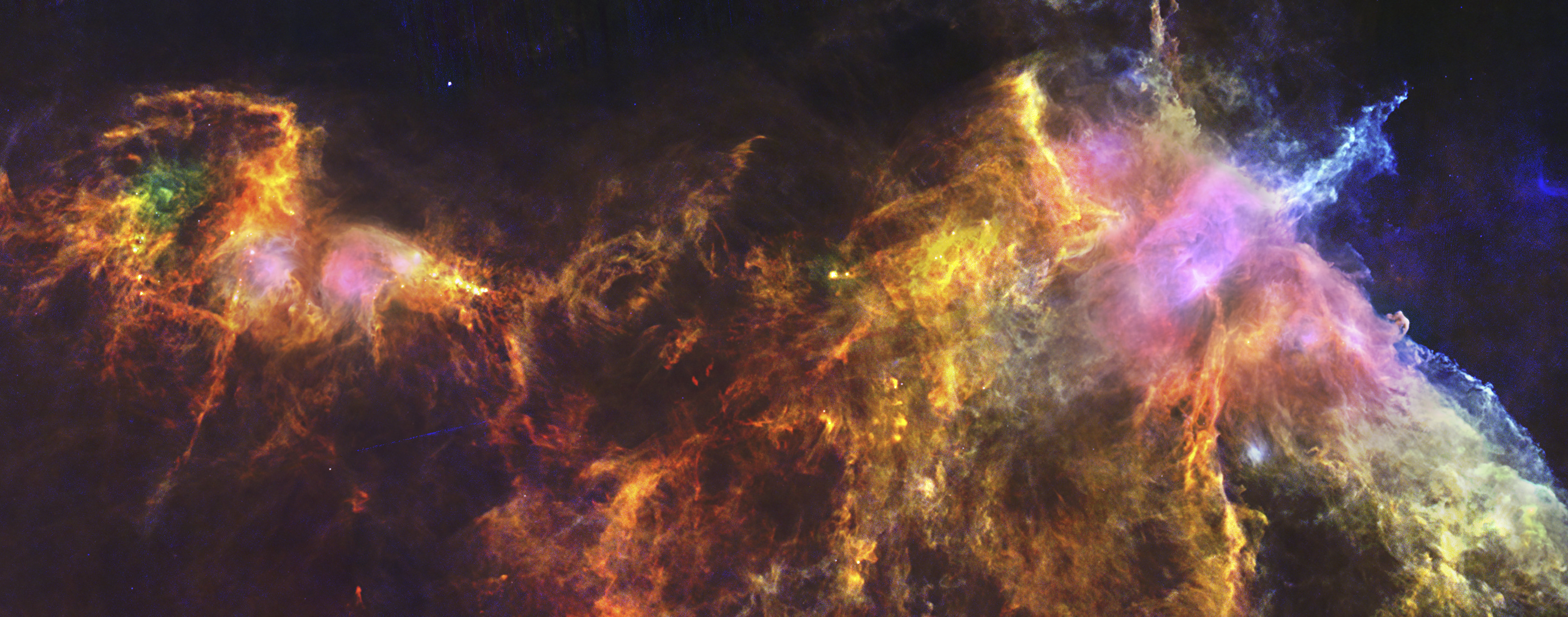
The Herschel Horsehead Nebula.
I had grabbed this image a month ago from the announcement on ESA’s website:
19 April 2013 New views of the Horsehead Nebula and its turbulent environment have been unveiled by ESA’s Herschel space observatory and the NASA/ESA Hubble space telescope.
The Horsehead Nebula lies in the constellation Orion, about 1300 light-years away, and is a popular target for amateur and professional astronomers alike. It sits just to the south of star Alnitak, the easternmost of Orion’s famous three-star belt, and is part of the vast Orion Molecular Cloud complex.
The new far-infrared Herschel view shows in spectacular detail the scene playing out around the Horsehead Nebula at the right-hand side of the image, where it seems to surf like a ‘white horse’ in the waves of turbulent star-forming clouds.
It appears to be riding towards another favourite stopping point for astrophotographers: NGC 2024, also known as the Flame Nebula. This star-forming region appears obscured by dark dust lanes in visible light images, but blazes in full glory in the far-infrared Herschel view.
The image is staggeringly beautiful yet a potent reminder that man, even the totality of our planet, is such an irrelevance in the scheme of things. We are surrounded by beauty both within and without, yet the fragility of our existance is a ‘vastness’, both literally and psychologically.
Guess what! Writing that last sentence brought to mind a photograph that I took Wednesday afternoon. As part of the Land Stewardship course Jean and I are taking, the class had gone to the Limpy Creek Botanical area in the Rogue River-Siskiyou National Forest not far from Grants Pass, Oregon. Here’s that photograph.
Reflect on the delicate beauty and vulnerability of that small wild flower. A perfect metaphor for the entire natural world.
So I am going to close this week’s perambulation through love with the thought that if we don’t love our planet with all the ardour and passion of a teenager’s first romance, all those other loves in our lives will ultimately become irrelevant.