I live in Brooklyn with my wife, daughter, and too many cats.
So to the essay.
oooOOOooo
Socialism: Converting Hysterical Misery into Ordinary Unhappiness for a Hundred Years
In yesterday’s New York Times, Robert Pear reports on a little known fact about Obamacare: the insurance packages available on the federal exchange have very high deductibles. Enticed by the low premiums, people find out that they’re screwed on the deductibles, and the co-pays, the out-of-network charges, and all the different words and ways the insurance companies have come up with to hide the fact that you’re paying through the nose.
For policies offered in the federal exchange, as in many states, the annual deductible often tops $5,000 for an individual and $10,000 for a couple.
Insurers devised the new policies on the assumption that consumers would pick a plan based mainly on price, as reflected in the premium. But insurance plans with lower premiums generally have higher deductibles.
In El Paso, Tex., for example, for a husband and wife both age 35, one of the cheapest plans on the federal exchange, offered by Blue Cross and Blue Shield, has a premium less than $300 a month, but the annual deductible is more than $12,000. For a 45-year-old couple seeking insurance on the federal exchange in Saginaw, Mich., a policy with a premium of $515 a month has a deductible of $10,000.
In Santa Cruz, Calif., where the exchange is run by the state, Robert Aaron, a self-employed 56-year-old engineer, said he was looking for a low-cost plan. The best one he could find had a premium of $488 a month. But the annual deductible was $5,000, and that, he said, “sounds really high.”
By contrast, according to the Kaiser Family Foundation, the average deductible in employer-sponsored health plans is $1,135.
It’s true that if you’re a family of three, making up to $48,825 (or, if you’re an individual, making up to $28,725), you’ll be eligible for the subsidies. Those can be quite substantive at the lower ends of the income ladder. But as you start nearing those upper limits (which really aren’t that high; below the median family income, in fact), the subsidies start dwindling. Leaving individuals and families with quite a bill, as even this post, which is generally bullish on Obamacare, acknowledges.
Aside from the numbers, what I’m always struck by in these discussions is just how complicated Obamacare is. Even if we accept all the premises of its defenders, the number of steps, details, caveats, and qualifications that are required to defend it, is in itself a massive political problem. As we’re now seeing.
More important than the politics, that byzantine complexity is a symptom of what the ordinary citizen has to confront when she tries to get health insurance for herself or her family. As anyone who has even good insurance knows, navigating that world of numbers and forms and phone calls can be a daunting proposition. It requires inordinate time, doggedness, savvy, intelligence, and manipulative charm (lest you find yourself on the wrong end of a disgruntled telephone operator). Obamacare fits right in with that world and multiplies it.
I’m not interested in arguing here over what was possible with health care reform and what wasn’t; we’ve had that debate a thousand times. But I thought it might be useful to re-up part of this post I did, when I first started blogging, on how much time and energy our capitalist world requires us to waste, and what a left approach to the economy might have to say about all that. It is this world of everyday experience—what it’s like to try and get basic goods for yourself and/or your family—that I wish the left (both liberals and leftists) was more in touch with.
The post is in keeping with an idea I’ve had about socialism and the welfare state for several years now. Cribbing from Freud, and drawing from my own anti-utopian utopianism, I think the point of socialism is to convert hysterical misery into ordinary unhappiness. God, that would be so great.
• • • • • •
There is a deeper, more substantive, case to be made for a left approach to the economy. In the neoliberal utopia, all of us are forced to spend an inordinate amount of time keeping track of each and every facet of our economic lives. That, in fact, is the openly declared goal: once we are made more cognizant of our money, where it comes from and where it goes, neoliberals believe we’ll be more responsible in spending and investing it. Of course, rich people have accountants, lawyers, personal assistants, and others to do this for them, so the argument doesn’t apply to them, but that’s another story for another day.
The dream is that we’d all have our gazillion individual accounts—one for retirement, one for sickness, one for unemployment, one for the kids, and so on, each connected to our employment, so that we understand that everything good in life depends upon our boss (and not the government)—and every day we’d check in to see how they’re doing, what needs attending to, what can be better invested elsewhere. It’s as if, in the neoliberal dream, we’re all retirees in Boca, with nothing better to do than to check in with our broker, except of course that we’re not. Indeed, if Republicans (and some Democrats) had their way, we’d never retire at all.
In real (or at least our preferred) life, we do have other, better things to do. We have books to read, children to raise, friends to meet, loved ones to care for, amusements to enjoy, drinks to drink, walks to take, webs to surf, couches to lie on, games to play, movies to see, protests to make, movements to build, marches to march, and more. Most days, we don’t have time to do any of that. We’re working way too many hours for too little pay, and in the remaining few hours (minutes) we have, after the kids are asleep, the dishes are washed, and the laundry is done, we have to haggle with insurance companies about doctor’s bills, deal with school officials needing forms signed, and more.
What’s so astounding about Romney’s proposal—and the neoliberal worldview more generally—is that it would just add to this immense, and incredibly shitty, hassle of everyday life. One more account to keep track of, one more bell to answer. Why would anyone want to live like that? I sure as hell don’t know, but I think that’s the goal of the neoliberals: not just so that we’re more responsible with our money, but also so that we’re more consumed by it: so that we don’t have time for anything else. Especially anything, like politics, that would upset the social order as it is.
…We saw a version of it during the debate on Obama’s healthcare plan. I distinctly remember, though now I can’t find it, one of those healthcare whiz kids—maybe it was Ezra Klein—tittering on about the nifty economics and cool visuals of Obama’s plan: how you could go to the web, check out the exchange, compare this little interstice of one plan with that little interstice of another, and how great it all was because it was just so fucking complicated.
I thought to myself: you’re either very young or an academic. And since I’m an academic, and could only experience vertigo upon looking at all those blasted graphs and charts, I decided whoever it was, was very young. Only someone in their 20s—whipsmart enough to master an inordinately complicated law without having to make real use of it—could look up at that Everest of words and numbers and say: Yes! There’s freedom!
That’s what the neoliberal view reduces us to: men and women so confronted by the hassle of everyday life that we’re either forced to master it, like the wunderkinder of the blogosphere, or become its slaves. We’re either athletes of the market or the support staff who tend to the race.
That’s not what the left wants. We want to give people the chance to do something else with their lives, something besides merely tending to it, without having to take a 30-year detour on Wall Street to get there. The way to do that is not to immerse people even more in the ways and means of the market, but to give them time and space to get out of it. That’s what a good welfare state, real social democracy, does: rather than being consumed by life, it allows you to make your life. Freely. One less bell to answer, not one more.
I came at today’s post from a number of directions.
A few days ago I was catching up with a good friend back in the UK, Peter M. We hadn’t spoken in a couple of months. One of the items from my end was mentioning that I had converted to a vegetarian diet, verging on trying to be a vegan. Jeannie has been a vegetarian for almost her entire life. Having made the change to a vegetarian diet, to my surprise I had gained 12 lbs (5.4 kgs) in the last month. Peter then mentioned that he, too, had put on 8 kgs before deciding to try and cut back. Peter and I are of the same age and motivated to stay as fit and healthy as we can. Anyway, Peter’s route for losing some weight was to commit to the fasting arrangement promoted and recommended by Dr. Michael Mosley – more of this later.
The conversation also reminded me of an essay by George Monbiot back at the end of November: Wrong About Being Wrong. Mr. Monbiot wrote of his mind changes about being vegetarian. With his permission, here is that essay.
oooOOOooo
Wrong About Being Wrong
November 27, 2013
The argument seems, once more, decisively to favour veganism.
By George Monbiot, published on the Guardian’s website 27th November 2013
He did it quietly, and the decision is the better for that: Al Gore, according to reports in the US press, has gone vegan.
Certain things could be said about other aspects of his lifestyle: his enormous houses and occasional use of private jets, for example. While we can’t demand that everyone who espouses green causes should live like a Jain monk, I think we can ask that they don’t live like Al Gore. He’s a brilliant campaigner, but I find the disjunction between the restraint he advocates and the size of his ecological footprint disorienting.
So saying, if he is managing to sustain his vegan diet, in this respect he puts most of us to shame. I tried it for 18 months and almost faded away. I lost two stone, went as white as a washbasin and could scarcely concentrate. I think I managed the diet badly; some people appear to thrive on it. Once, after I had been unnecessarily rude about vegans and their state of health (prompted no doubt by my own failure), I was invited to test my views in an unconventional debate with a vegan cage fighter. It was a kind invitation, but unfortunately I had a subsequent engagement.
In 2010, after reading a fascinating book by Simon Fairlie, a fair part of which was devoted to attacking my views, I wrote a column in which I maintained that I’d been wrong to claim that veganism is the only ethical response to what is arguably the world’s most urgent social justice issue. Diverting grain that could have fed human beings to livestock, I’d argued, is grotesque when 800 million go hungry.
Fairlie does not dispute this, and provides many examples of the madness of the current livestock production system. But he points out that plenty of meat can be produced from feed which humans cannot eat, by sustaining pigs on waste and grazing cattle and sheep where crops can’t grow. I was swayed by his argument. But now I find myself becoming unswayed. In the spirit of unceasing self-flagellation I think I might have been wrong about being wrong.
Part of the problem is that while livestock could be fed on waste and rangelands, ever less of the meat we eat in the rich nations is produced this way. Over the past week, a row has erupted between chefs and pig farmers over the issue of swill. The chefs point out – as Simon Fairlie does – that it is ridiculous to feed pigs on soya grown at vast environmental cost in the Amazon instead of allowing them to dispose of our mountain of waste food. Feeding pigs on swill has been forbidden since the foot and mouth outbreak of 2001.
The farmers respond that the risks of spreading disease are too great and that pigs fed on waste grow more slowly than pigs fed on soya. I side with the chefs: I believe that a society capable of identifying the Higgs boson should be able to sterilise waste food. But I suspect that they’re not going to win: the industry and its regulators are firmly against them.
I should have seen it coming, but I watched in horror as the meat industry used my article to justify the consumption of all meat, however it was produced, rather than just the meat raised on food that humans can’t eat. A potential for good is used to justify harm.
While researching my book Feral, I also came to see extensive livestock rearing as a lot less benign than I – or Simon Fairlie – had assumed. The damage done to biodiversity, to water catchments and carbon stores by sheep and cattle grazing in places unsuitable for arable farming (which means, by and large, the hills) is out of all proportion to the amount of meat produced. Wasteful and destructive as feeding grain to livestock is, ranching appears to be even worse.
The belief that there is no conflict between this farming and arable production also seems to be unfounded: by preventing the growth of trees and other deep vegetation in the hills and by compacting the soil, grazing animals cause a cycle of flash floods and drought, sporadically drowning good land downstream and reducing the supply of irrigation water.
So can I follow Al Gore, and do it better than I did before? Well I intend at least to keep cutting my consumption of animal products, and to see how far I can go. It’s not easy, especially for a person as greedy and impetuous as I am, but there has to be a way.
Back to the conversation with Peter M. about fasting. He spoke enthusiastically about Dr. Mosley who one quickly discovers,
Dr. Michael Mosley.
Michael J. Mosley (born 22 March 1957) is a British journalist, medical doctor, producer and TV presenter. He is probably best known as a television presenter of programmes on biology and medicine, particularly his series on the workings of the human body, Inside the Human Body and his regular appearances as the friendly medic on The One Show.
He was interviewed by Steve Wright of BBC Radio 2 back in January, 2012 and that interview is on YouTube:
That BBC Horizon programme is no longer available to watch but a 4-minute extract may be seen here:
Inevitably, Dr. Mosley has a website Fast Diet that is packed full of valuable information.
So just as soon as we have the water back to the house and I can have a long, hot shower I intend to adopt the 5:2 diet.
Confidence in what you and I can achieve is our salvation.
Yesterday, I wrote about just a few of the things going on in our world that have the power to destroy us. Destroy us in the sense of making us feel powerless, irrelevant and insignificant. Trust me, there were plenty more examples that I could have mentioned.
But so what!
The vast majority of the humans on this planet have control over what they think. Untold numbers of those self-same people have control over what they do with their lives.
Take Dr Peter Pratje. I suspect that you, as with me, hadn’t heard of Dr Pratje before. But he is a Project leader with the Frankfurt Zoological Society and he holds an MSc in Biology and a PhD in Conservation biology. This may be learned not from the website of that Frankfurt Society but from the website of the Orangutan project. Bet you hadn’t heard of that project either. The Orangutan Project (TOP) is described:
The Orangutan Project (TOP) is the world’s foremost not-for-profit organisation, supporting orangutan conservation, rainforest protection, local community partnerships and the rehabilitation and reintroduction of displaced orangutans back to the wild, in order to save the two orangutan species from extinction.
Back to the good Doctor. This is what he says, “What we do for orangutans, we do for ourselves.”
Now settle down for a tad less than twelve minutes and see the power of self, see what we can do for ourselves.
Published on Dec 4, 2013
Peter Pratje, of the Frankfurt Zoological Society, introduces us to our orangutan family and reveals how we, as individuals, can help prevent their imminent extinction.
The eleven minutes long video accompanies Peter Pratje and his team working with young orangutans at the jungle school. The apes have been confiscated after illegally being held as pets. In daily training sessions they now learn the survival skills they need for a life of freedom – how to climb trees, build nests, find food and generally behave like wild orangutans. The project aim is to re-introduce the great apes into the Bukit Tigapuluh national park in central Sumatra.
Taking matters into their own hands, the young orangutans were most supportive – snatching the small and robust cameras and filming themselves climbing up and down trees.
I wrote down the title of today’s post a few days back. Jean and I had just watched the BBC Panorama Special regarding Amazon UK. It had been screened on the 25th November and was described:
It’s the online retailer that has transformed the way we shop, but how does Amazon treat the workers who retrieve our orders? Working conditions in the company’s giant warehouses have been condemned by unions as among the worst in Britain. Panorama goes undercover to find out what happens after we fill our online shopping basket.
Or more fully reported in a BBC News item, as this extract reveals:
A BBC investigation into a UK-based Amazon warehouse has found conditions that a stress expert said could cause “mental and physical illness”.
Prof Michael Marmot was shown secret filming of night shifts involving up to 11 miles of walking – where an undercover worker was expected to collect orders every 33 seconds.
It comes as the company employs 15,000 extra staff to cater for Christmas.
Amazon said in a statement worker safety was its “number one priority”.
Undercover reporter Adam Littler, 23, got an agency job at Amazon’s Swansea warehouse. He took a hidden camera inside for BBC Panorama to record what happened on his shifts.
He was employed as a “picker”, collecting orders from 800,000 sq ft of storage.
A handset told him what to collect and put on his trolley. It allotted him a set number of seconds to find each product and counted down. If he made a mistake the scanner beeped.
Adam Littler went undercover as a “picker” at Amazon’s Swansea warehouse
“We are machines, we are robots, we plug our scanner in, we’re holding it, but we might as well be plugging it into ourselves”, he said.
The 30-minute Panorama programme is on YouTube and is included in this post just below.
As I started to explain, the reaction to watching the Panorama programme was to feel sickened by the way these workers were being treated.
Not helped when yesterday, the UK Daily Mail newspaper added their own story of another undercover reporting operation at Amazon. Here’s an extract from the last third of the piece, reported by Carole Cadwalladr:
It is taxes, of course, that pay for the roads on which Amazon’s delivery trucks drive, and the schools in which its employees are educated.
Taxes that all its workers pay, and that, it emerged in 2012, Amazon tends not to pay.
On UK sales of £4.2 billion in 2012, it paid £3.2 million in corporation tax. In 2006, it transferred its UK business to Luxembourg and reclassified its UK operation as simply an ‘order fulfilment’ business.
The Luxembourg office employs 380 people. The UK operation employs 21,000. You do the sums.
Brad Stone tells me that tax avoidance is built into the company’s DNA. From the very beginning it has been ‘constitutionally oriented to securing every possible advantage for its customers, setting the lowest possible prices, taking advantage of every known tax loophole or creating new ones’.
In Swansea I chat to someone called Martin for a while. It’s Saturday, the sun is shining and the warehouse has gone quiet. The orders have been turned off like a tap.
‘It’s the weather,’ he says. ‘When it rains, it can suddenly go mental.’ We clear away boxes and the tax issue comes up.
‘There was a lot of anger here,’ he says. ‘People were very bitter about it. But I’d always say to them: “If someone told you that you could pay less tax, do you honestly think you would volunteer to pay more?”’
He’s right. And the people who were angry were also right. It’s an unignorable fact of modern life that, as Stuart Roper of Manchester Business School tells me, ‘some of these big brands are more powerful than governments. They’re wealthier. If they were countries, they would be pretty large economies.
‘They’re multinational and the global financial situation allows them to ship money all over the world. And the Government is so desperate for jobs that it has given away large elements of control.’
MPs like to attack Amazon and Starbucks and Google for not paying their taxes, but they’ve yet to actually create legislation compelling them to do so.
Then if that wasn’t sufficient to make me want to live on a desert island, along comes George Monbiot pointing out that even the BBC, to me the most respected and trusted news organisation on the planet, has been economical with the truth.
The BBC’s disgraceful failure to reveal who its contributors are speaking for.
By George Monbiot, published on the Guardian’s website 29th November 2013
Do the BBC’s editorial guidelines count for anything? I ask because it disregards them every day, by failing to reveal the commercial interests of its contributors.
Let me give you an example. Yesterday the Today programme covered the plain packaging of cigarettes. It interviewed Mark Littlewood, director-general of the Institute of Economic Affairs, an organisation which calls itself a thinktank.
Mishal Husain introduced Mark Littlewood as “the director of the Institute of Economic Affairs, and a smoker himself”.
It’s bad enough when the BBC interviews people about issues of great importance to corporations when it has no idea whether or not they are funded by those companies, and makes no effort to find out.
It’s even worse when those interests have already been exposed, yet the BBC still fails to mention them.
Then along came three items that pulled my back from the brink of despair and disgust.
The first came from the blog of the UK’s Transition Network, Transition Times. Rob Hopkins wrote an article on December 5th called The day I closed my Amazon account. Please read it if you feel unsettled by the Amazon situation. The last two paragraphs are:
Me, I resolve to buy less, but better. Less, but longer-lasting. Less, but local. The thought of where we will end up in 5 years time, 10 years time, 20 years time, if companies like Amazon continue as they are, really frightens me. It’s not good, it’s not right. It’s not about our needs, it’s about the needs of huge investors. I want a different world for my boys.
I can’t, on my own, do that much about it. I can’t insist that the UK government legislate so that, as in Holland, the Recommended Retail Price (RRP) is the legal minimum at which any book can be sold, although I think that is grounds for a really timely campaign. Because of that, Amazon don’t really operate in Holland. Bring back the RRP for books here, and let’s have a level playing field. As I say, I can’t do much, but I can withdraw my support. I just have withdrawn my support. It feels surprisingly unsettling, as one does after ending a relationship, but it was the right thing to do. It may be a drop in the ocean, but if enough people do it….
The second was coming across something called The Restart Project in London. I had never heard of them before. But it gets better because these London folk are part of a global movement. Which in the words of The Restart Project can be explained thus:
A spontaneous, global, grassroots repair movement
Sitting in London, we at The Restart Project have been inspired by Holland, the US, Australia, and now we realize that there are many more community repair and fixit groups than we ever knew of before… Milan, Barcelona, Finland, the list just grows.
Some groups have regular events in their own spaces and some are pop-up groups.
The most remarkable thing is that we are not just all doing similar things, we are doing them in the same way and with similar motivations
1) learning, skillsharing and community are a premium. No judgment. Openness and inclusivity, all are made to feel welcome.
2) the idea is NOT a freebie fix. The idea is that people get involved in the repair, taking responsibility for their stuff and taking back control. It’s about behaviour change, not just about waste prevention
and
3) importantly – fun!
Please help us map repair groups, to connect people to their local repair gurus and fixit friends – and who knows, inspire the creation of more.
“Just repair, don’t despair!”
Just repair, don’t despair! That shouted out at me. The more that the world we live in is consumed by the power-brokers and greed-mongers. The more that our traditional view of politics is seen to be out-dated and incorrect, then the more we have do within our own lives, within our own communities and with our friends, loved ones and families to show we can repair our world a darn site quicker than the ‘dark forces’ can break it.
My third example of hope is tomorrow in a post called The power of self.
Now don’t knock it for because the Irish don’t take their medical terminology too seriously, they have the lowest stress rate!
Artery – The study of paintings
Bacteria – Back door to cafeteria
Barium – What doctors do when patients die
Benign – What you be, after you be eight
Caesarean Section – A neighbourhood in Rome
Cat scan – Searching for Kitty
Cauterize – Made eye contact with her
Colic – A sheep dog
Coma – A punctuation mark
Dilate – To live long
Enema – Not a friend
Fester – Quicker than someone else
Fibula – A small lie
Impotent – Distinguished, well known
Labour Pain – Getting hurt at work
Medical Staff – A Doctor’s cane
Morbid – A higher offer
Nitrates – Rates of Pay for Working at Night,
Normally more money than Days
Node – I knew it
Outpatient – A person who has fainted
Pelvis – Second cousin to Elvis
Post Operative – A letter carrier
Recovery Room – Place to do upholstery
Rectum – Nearly killed him
Secretion – Hiding something
Seizure – Roman Emperor
Tablet – A small table
Terminal Illness – Getting sick at the airport
Tumour – One plus one more
Urine – Opposite of you’re out
A heart-rending, true story of a puppy. (Has a very happy ending!)
Those of you who have read today’s Chapter Eighteen of ‘the book’ will not have escaped the central role played by Philip’s German Shepherd: Pharaoh.
Well a few days ago the following video was sent to me by a good friend, Ginger, from our Payson days. Won’t say anymore until you have watched it.
Tried hard to find the Facebook page but failed. However, I did find this article on the Psychology Today website that not only refers to Daisy but offers more on the subject of animal emotions.
Animal Emotions
Do animals think and feel?
by Marc Bekoff – Professor Emeritus of Ecology and Evolutionary Biology at the University of Colorado, Boulder.
Daisy: The Injured Dog Who Believed She’d Walk Again and Did
Often, a simple video captures the essence of the deep nature of the incredibly close and enduring bonds we form with other animals and they with us. As a case in point, my recent essay called “A Dog and His Man” showed a dog exuberantly expressing his deep feelings for a human companion he hadn’t seen for six months. Another essay titled “My Dog Always Eats First: Homeless People and Their Animals” dealt with the relationship between homeless people and the animals with whom they share their lives.
Daisy: An unforgettable and inspirational symbol of dedication and hope
I just saw another video called “Daisy – the Little Pup Who Believed” that is well-worth sharing widely with others of all ages. There is no way I can summarize the depth of five-month old Daisy’s resolve to walk again after she was injured or of the devotion of the woman, Jolene, who found her on the side of a road – scared, malnourished, unable to walk or wag her tail, the people who contributed money to help her along, or the wonderful veterinarians and staff at Barrie Veterinary Hospital in Ontario, Canada, who took care of her. You can also read about Daisy’s remarkable and inspirational journey here.
Please take five minutes out of your day to watch this video, read the text, listen to the song that accompanies it, and share it widely. I am sure you will get teary as you watch Daisy go from an injured little ball of fur living in a ditch on the side of a road with a broken spine to learning to walk in water to romping around wildly as if life had been that proverbial pail of cherries from the start.
I’ve watched Daisy’s journey many times and every single time my eyes get watery. Among the many lessons in this wonderful video is “stay strong and never give up”. Clearly dogs and many other animals can truly teach us about traits such as trust, friendship, forgiveness, love, and hope.
OOOO
Daisy – a lesson for all!
Two closing thoughts.
When you next want a dog please, please think of those dogs who are in shelters. They must be our first priority.
If there is ever a time when we humans need to learn from dogs the qualities of trust, friendship, forgiveness, love and hope, it is now!
Like thousands of others, Jean and I are regular viewers of the TED Talks.
So first the old. Here’s a reminder of the inspiring nature of mathematics; in this case Fibonacci numbers.
Published on Nov 8, 2013
Math is logical, functional and just … awesome. Mathemagician Arthur Benjamin explores hidden properties of that weird and wonderful set of numbers, the Fibonacci series. (And reminds you that mathematics can be inspiring, too!)
Now to the new. Innovation at its very best.
Published on Jul 11, 2013
The development of new medicine is problematic because laboratories cannot replicate the human body’s environment, making it difficult to determine how patients will respond to treatment. At TEDxBoston, Geraldine Hamilton demonstrates how scientists can implant living human cells into microchips that mimic the body’s conditions. These “organs-on-a-chip” can be used to study drug toxicity, identify potential new therapies, and could lead to safer clinical trials.
Just fancied a change from two days of Democratic Deficit. So today’s post is a brief overview of the US State that Jean and I live in, together with our animals, the State of Oregon.
Now it’s easy to look up a Wikipedia reference to Oregon but what really caught my eye was as a result of a recent visit to the local Grants Pass office of the Bureau of Land Management. We had gone there to purchase a $5 permit that allows us to go on to BLM land and harvest our own Christmas Tree!
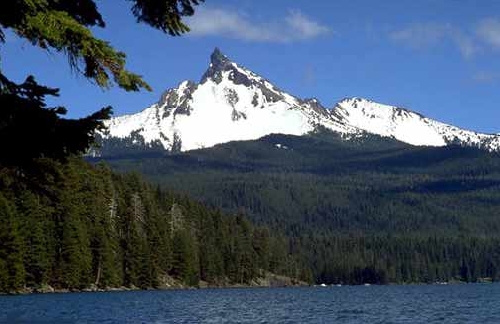
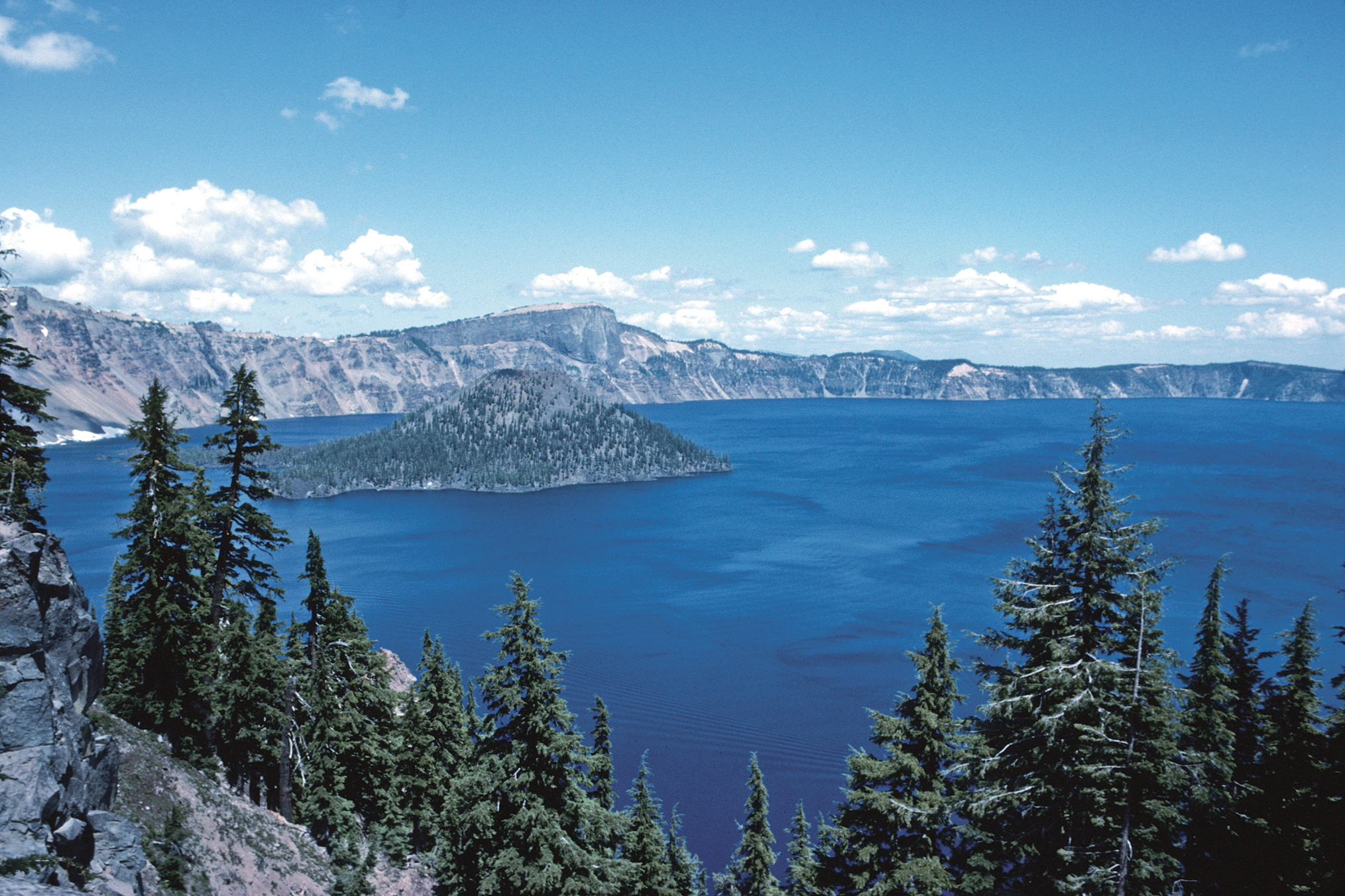
In the Grants Pass office were a number of brochures of scenic attractions in Oregon and we picked up one describing the Rogue-Umpqua National Scenic Byway. Just a quick browse reminded us of Oregon’s stunning and dramatic scenery. Just wanted to share some images.
At a depth of 1,932 feet Crater Lake is the deepest lake in the United States. It was formed more than 7,500 years ago when the Mount Mazama volcano erupted and then collapsed back in on itself.
The lake partly fills a nearly 2,148-foot (655 m)-deep caldera[1] that was formed around 7,700 (± 150) years ago[2] by the collapse of the volcano Mount Mazama. Human interaction is traceable back to the indigenousNative Americans witnessing the eruption of Mount Mazama. There are no rivers flowing into or out of the lake; the evaporation is compensated for by rain and snowfall at a rate such that the total amount of water is replaced every 250 years. At 1,943 feet (592 m), the lake is the deepest in the United States, and the seventh[3] or ninth deepest in the world, depending on whether average or maximum depth is measured.[4]
Watson Falls is the third highest waterfall in Oregon at 272 feet. It is the most beautiful waterfall along the North Umpqua River Valley. You will cross a wooden bridge below the falls that will put you right into the lower rapids with an amazing view of the falls as they roar over the basalt lava cliffs ahead.
Someone who goes under the handle of HikingTheWest posted this video on YouTube about 6 weeks ago.
Oregon Caves
These caves are an Oregon National Monument with full details on the US National Park Service’s website. That website explains:
Nestled deep inside the Siskiyou Mountains, the caves formed as rainwater from the ancient forest above dissolved the surrounding marble and created one of the world’s few marble caves. The highly complex geology found on the Monument contributes to the unusual and rare plants and animals found nowhere else but here.
A view of the inside of the caves.
There are many good videos of the Oregon Caves on YouTube so do have a browse if you want to. This one caught my eye, especially as it was filmed in January, 2013..
Rogue River
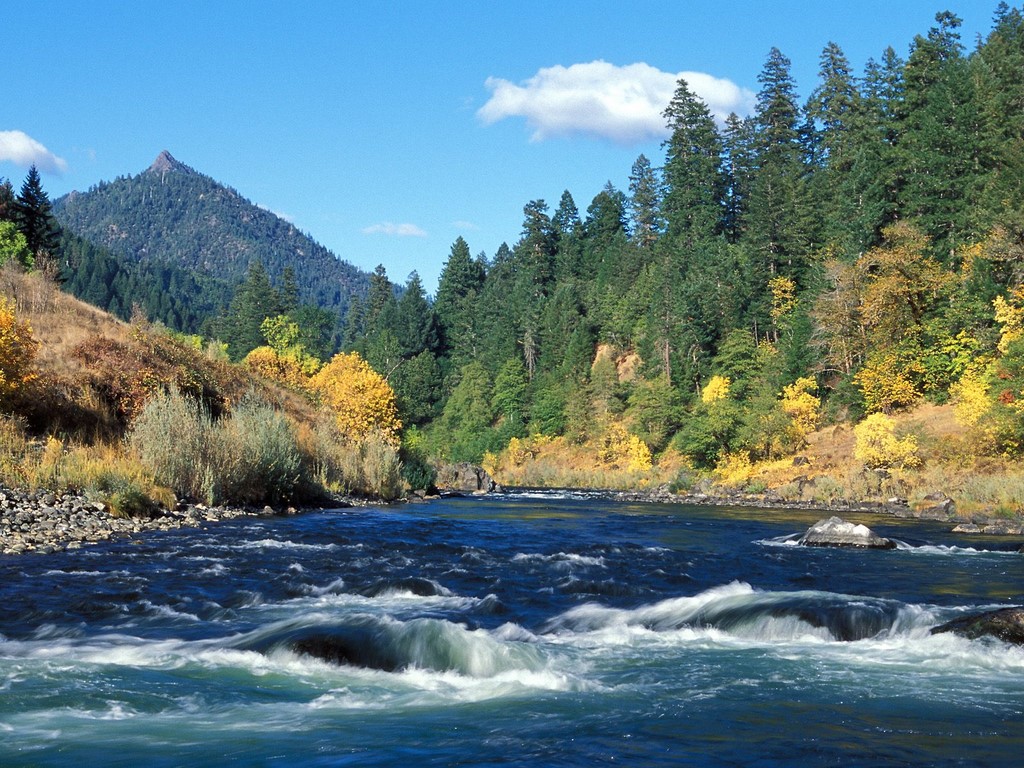
The Rogue River
Final sight for today, the Rogue River runs close by Grants Pass, our nearest town to where we live. Again there is a Wikipedia entry from which one learns that, “Although the Rogue Valley near Medford is partly urban, the average population density of the Rogue watershed is only about five people per square mile (12 per km2).”
Just reflecting on that last paragraph, a simple calculation reveals that the State of Oregon has a population of around 3.9 million people with an land area of 98,300 square miles. Thus the population density of Oregon is 39.6 persons per square mile. To put that into perspective, our neighbouring Californians to the South enjoy a population density of 238 persons per square mile!
Jean and I are very lucky to be living in such a beautiful part of Southern Oregon.
Yesterday, I introduced the essay by George Monbiot, Why Politics Fails. He opened his essay with the sub-heading: Nothing will change until we confront the real sources of power.
His last paragraph read:
So I don’t blame people for giving up on politics. I haven’t given up yet, but I find it ever harder to explain why. When a state-corporate nexus of power has bypassed democracy and made a mockery of the voting process, when an unreformed political funding system ensures that parties can be bought and sold, when politicians of the three main parties stand and watch as public services are divvied up by a grubby cabal of privateers, what is left of this system that inspires us to participate?
And who would disagree with those closing sentiments!
Then just four days ago there was an item on Permaculture News that continued where Mr. Monbiot left off. It was an interview by Marcia Gerwin of Professor Lyn Carson that sets out a positive approach to correcting the widely-acknowledged issue so well articulated by George Monbiot.
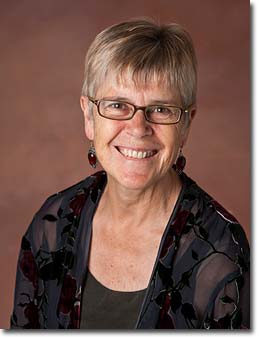
Professor Lyn Carson, is a Professor at the University of Sydney. As Professor Carson’s website Active Democracy explains:
Hi, I’m Lyn Carson, welcome to my website. I hope to provide easy access to information which individuals, groups or organisations can use to enhance citizens’ involvement in the activities of local, state or federal government.
I’m currently a professor with the Business Programs Unit at the University of Sydney, Australia. I’m researching in the fascinating area of community engagement and deliberative democracy. I’m teaching ‘critical thinking’ which will have resonance for those familiar with public deliberation.
Democracy, for me, is active, interactive, deliberative and genuinely representative of the wider population. It’s as valid to speak of a democratic personality (Gould, 1988) as it is to speak of a democratic workplace or a democratic society. We can enact in microcosm what we imagine for the level of nation state. We need not restrict our thinking to systems of government—we can do democracy at any time, any place.
Like C. Douglas Lummis, I see democracy as the antithesis of centralised power:
…democracy is one of those beautiful, absolute clear principles… that poses a maddening, tantalizing puzzle to humankind and launches us on the historic project of seeking to realize it in our collective life (Lummis, 1982).
I note the words of Frances Moore Lappé (2006): “To save the democracy we thought we had, we must take it to where it’s never been.” One way of saving democracy—or causing a democratic breakout (Blaug, 1999)—is to involve citizens in political decision making.
I’ve written numerous articles on public participation in decision making—from setting up citizens’ juries to improving community consultation in your local council. Go to Publications if you’d like to download some of my written works. Your feedback is warmly encouraged after you have roamed around this site.
Marcin Gerwin: There are many people who are disappointed in the way the democratic system works. They see politicians arguing and making decision in the interest of their political parties rather than the common good. What is wrong with modern democracy?
Lyn Carson: The difficulties that relate to modern democracy probably start with the use of that term. We have begun to believe that the system of
Professor Lyn Carson
representative government that is pervasive in both the West and increasingly in other locations is actually a democracy. I think we do well to reflect on the origins of democracy, and how democracy was first conceived. We know it was a very different system. We also know that representative government was designed during periods of the French, the American and the English revolutions to perpetuate elites. It was certainly designed to ensure that those who had money, who had property — usually men in the early days — would have their power maintained. I think what we have are the remnants of that.
Democracy is a beautiful ideal in its true sense of people power or the ability for people to make decisions about their own destinies, about things that affect them. In locations where we’ve been able to replicate at least of some of the qualities of ancient Athens, which was the cradle of democracy, then I think we can say that democracy can take root and can actually deliver its promise. It may serve us better not to use the word, I would suggest, to describe what it is that we have, which is far from the notion of genuine democracy. If we call it representative government or even an oligarchy we might start to realise what it is that we have.
MG: I think politicians will not be happy to hear that. They like to present themselves as democrats and some of them don’t acknowledge that there is a problem with a political system.
LC: Scholars are increasingly using the term “democratic deficit” to describe what is happening in the world. There is a widening gap between the governed and those who are doing the governing. There is a crisis of trust, and a growing mistrust because of what is called short-termism — political parties, because of the system, have an eye on the next election and not on the long-term needs of either humans or the even bigger picture, the environment and planetary survival. What we try to create in deliberative democracy are circumstances where all of the voices are in the room, where we can create what we call a “miniature population” or “mini-public” that resembles the entire population so it can achieve what we call a descriptive representation.
At the moment we have representation in parliaments, but it’s not descriptive of the wider population. In Australian parliament there is an inordinate number of lawyers, policy advisers, unionists — usually male — and they don’t resemble the entire population. As deliberative democrats what we are trying to do is to tune into the wider population. We can’t ask the entire population constantly. We can certainly ask what their opinions are but we actually want their judgment, which can only be arrived through a process of very deep deliberation, through a lot of education, through a lot of sharing of information, experience and stories. We want to achieve a very different democratic space than anything that we see in parliaments.
MG: Do you think that mini-publics could be used for actual decision-making instead of public consultations only?
LC: In deliberative democracy we talk about three ideals. That’s the notion of inclusion, or representativeness — that’s the principle of the miniature population. The second ideal is deliberation — you need people to be able to really wrestle with the complexity of an issue, to be fully informed, to argue it out, to use reason, to use storytelling, including emotion. The third ideal is the notion of influence. It is incredibly important that it is attached to decision-making. The NewDemocracy Foundation, that I’m a director of, deals only with projects that have influence. We have continually proved that we can achieve representativeness and deliberation, but the most difficult to achieve is influence. And that’s because elected representatives don’t want to give up power. They believe that they have a mandate to govern and they are disinclined to do so.
But there have been some fantastic examples where elected representatives have done just that. We’ve had a premier of a state in Western Australia who promised to act on the decisions of mini-publics. As Minister for Planning and Infrastructure she stood by citizens’ recommendations. We’ve had a participatory budget in New South Wales with Canada Bay Council. The local government agreed to abide by its decisions. It was the only reason we agreed to be involved. So it is happening. It’s not happening enough, but it’s certainly possible. I would suggest that none of us should proceed with mini-publics anymore unless it has the imprimatur of the decision-maker. It’s a little wearisome to keep proving that we can do these robust processes and then have the decision-makers ignoring the recommendations.
MG: What does the participatory budgeting work like in Australia?
LC: In the case of Canada Bay people were randomly selected, we had a group of 40 who came together face to face over five weekends. They deliberated on the entire budget of the council, they listened to expert speakers, they spent many hours having discussions. They split into small working parties to consider different aspects of the budget and they worked hard to deliver their recommendations to council and it was considered in a council meeting.
MG: Five weekends is a lot of time. Did the citizens receive a compensation for being involved in participatory budgeting?
LC: They received compensation, but it was a very small amount, something like 50 dollars a day or a weekend. It’s not huge and people don’t actually need a lot of money. They don’t want the equivalent of their salary. It’s an honorarium, a way to say “we value your participation”.
MG: If it was possible to change the law, would you like to have the decisions made by mini-public binding just like those made in referendums?
LC: That’s certainly my dream and there’s no reason why it can’t be so. A couple of examples exist. In Denmark there was a Danish Board of Technology which routinely convened mini-publics and fed those recommendations into the parliament. The parliament had to say why it wasn’t going to abide by those recommendations. That’s in a way the closest we’ve come to it. There’s a law in Tuscany in Italy, it’s called the Tuscan Law 69 which had a trigger mechanism which said that if there was a controversial issue it had to go to a deliberative process and again the regional government had to say why it would not act on those recommendations.
If I had a dream it would be to say that we would routinely convene policy juries to consider issues like education, health, transport and so on. You wouldn’t want to do it for everything. The whole point is to use these processes when and where appropriate, otherwise you would be bogging down the decision-making process which is often working quite well just through the current mechanisms that we have. It’s only when controversy emerges or long-term decisions have to be made, or when politicians are reluctant to act.
MG: What about the referenda? Are they a good way of making decisions?
LC: I’m not a fan of referenda. The reason is that they lack the deliberative element. We’ve had many referenda in Australia. I think we’ve had 44 and 36 of them was unsuccessful. That’s because the issue tends to become very polarized unless it has bi-partisan support, from the two major parties. They are inevitably rejected by the population because it’s so easy to run a negative campaign. Australian governments provide a lot of information when there is a referendum. But this can be quite confusing and citizens need an opportunity to deliberate on them, as they do in Oregon with the Citizens Initiative Review, or to have serious discussions with other people. A referendum for me without that deliberative component is nothing more than an opinion poll. It’s absolutely destined to failure unless you have all the major parties supporting it.
The citizen-initiated referendum sounds good on the surface because there is a groundswell of support, but what I would like to see is the groundswell of support demanding a deliberative process and then letting that deliberative process make a decision instead of putting it to a referendum.
MG: For some people it may be hard to accept that only those who are chosen by lot are going to make a decision instead of everybody as in referenda.
LC: That’s going to vary from country to country. In Australia we have a great deal of faith in random selection because it’s fair. Everyone has an equal opportunity to be selected. We also have an independent Australian Electoral Commission that has earned public confidence and it could have oversight of such lotteries. As long as you have faith in the process there shouldn’t be a problem. The difficulty is that it is not a routine to do that, although in Australia it is quite a routine to do that through criminal juries — people are randomly selected to sit on those juries. So actually we understand that process and we have faith in it to make very binding decisions about whether or not someone is guilty or not guilty, whether they should go to jail for life. We actually give that power to citizens at the moment. If that process doesn’t exist in a country, then yes, it needs to become a routine in order for trust to develop.
OOOO
Wouldn’t be at all surprised to find that many, if not all, that read that interview had heads nodding in agreement.
Back on Lyn Carson’s website you can find an interesting selection of her publications. I, for one, will be browsing through them.






 Learning from Dogs